
Someone suggested that I write a little bit about my background in Robotics and the fact that I did a PhD in Robotics (Department of Electrical Engineering and Applied Physics). My thesis involved the emulation of basic animal behavior such as reflexes and fixed action patterns, as well as tree-search based artificial intelligence. I used neural networks in other contexts, but not for my PhD research. It also involved quite a bit of non-linear robot system control and the study of chaotic systems. I implemented my research on many kinds of robots but the robot I used the most was the 7-degrees of freedom Robotics Research Corporation Robot pictured below.
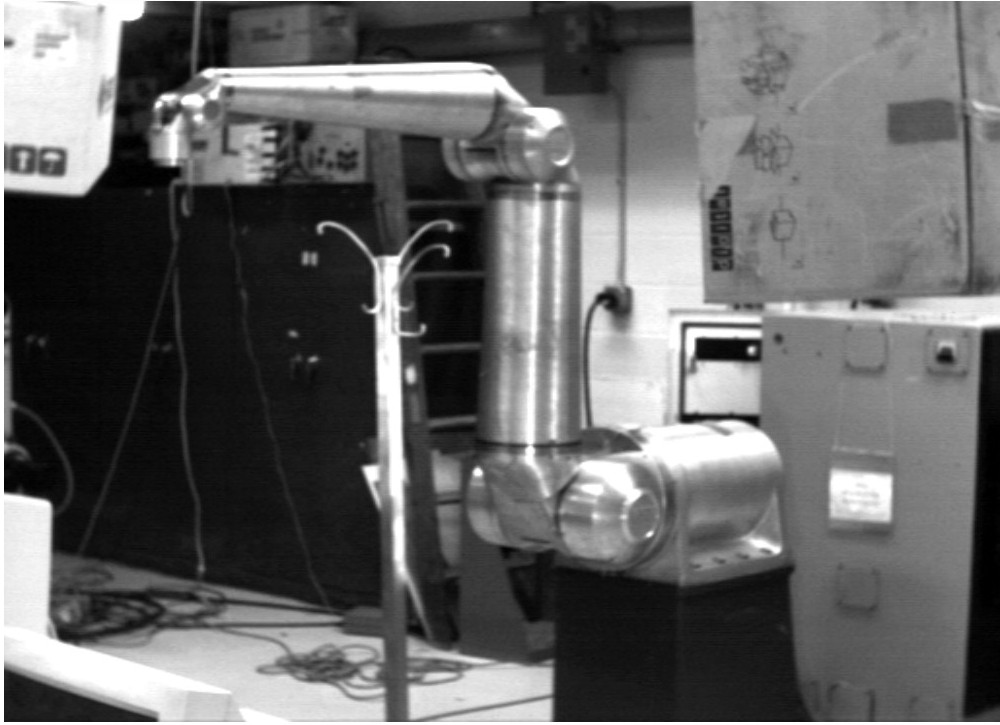
It looks messy in the picture, and I should probably explain. I had hung a few boxes from the ceiling and placed a coatrack in front of the robot. There is also another robot just outside the picture to the left. I placed a sonar sensor, or perhaps more correctly eco-location equipment on the tip of the robot. I used the sonar/eco-location to create a 3D map of the robot’s surroundings. Since the sonar-sensor could not see everything at once I used the arm of the robot to search and investigate the surroundings, including discovering that the boxes were open on one side. The motion of the robot was guided by the sonar and was not directly programmed by me. The robot was able to avoid colliding with the objects, including the other robot as it was moving. I moved objects around and added clothes and hats to the coatrack to make it harder. It looked like an animal figuring out what was around it. This was in 1993.
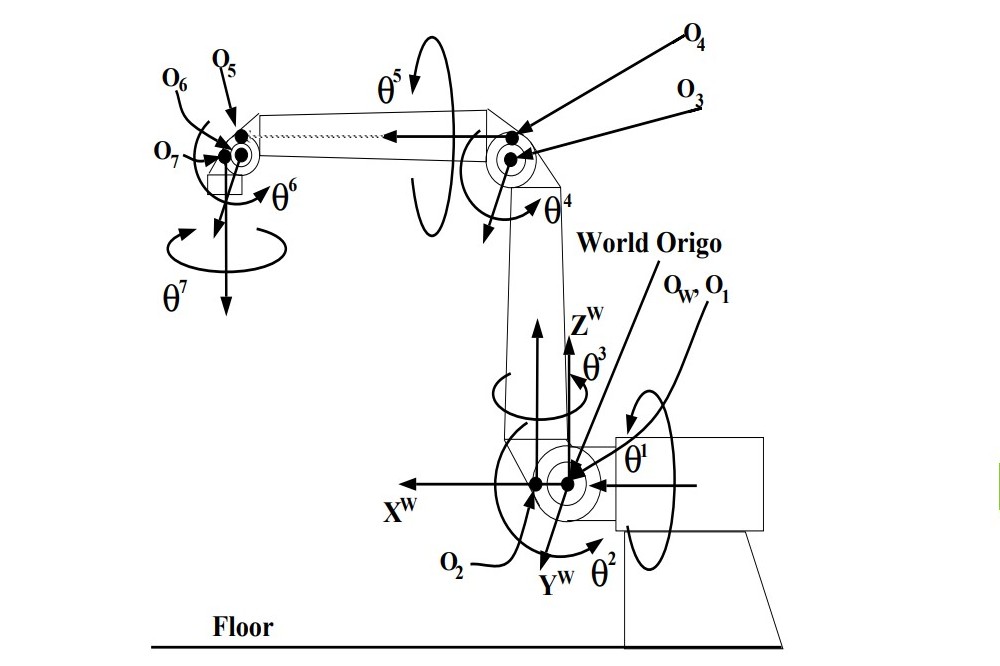
Maybe I should explain what 7-degrees of freedom mean. One degree of freedom could be a rotation (around a joint) or a translation. To arbitrarily position an object in space you need at least three degrees of freedom. To arbitrarily orient an object in space you need an additional three degrees of freedom. So, to arbitrarily position and orient a tool in space you need at least six degrees of freedom. Industrial robots frequently have six degrees of freedom. However, if you also want the robot arm to avoid collisions with objects in its space you need an additional degree of freedom. That’s why I needed a 7-degrees of freedom robot.
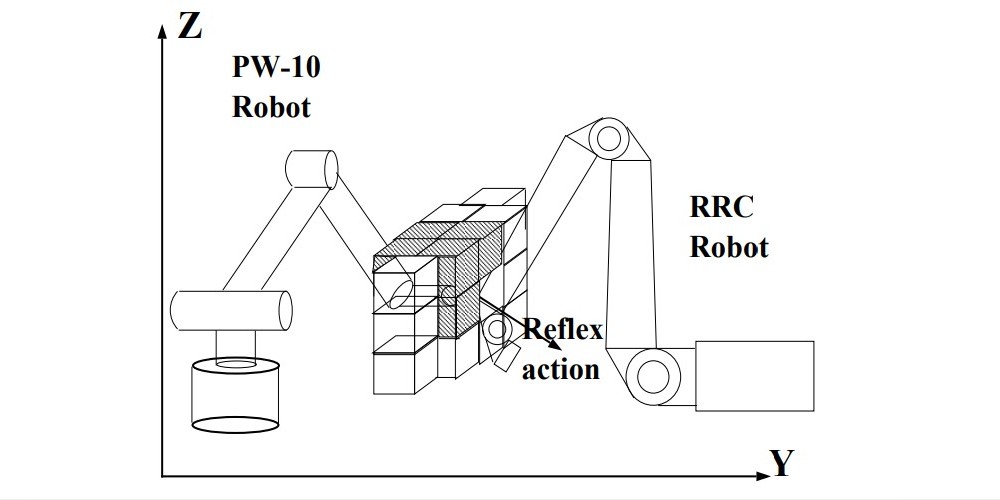
In the picture below an arc welding robot PW-10 is moving around unaware of its surroundings. The RRC robot detects that the PW-10 is in its space and perhaps approaching and quickly gets out of the way. Reflex control in action.
Robotics can be Math heavy (Algebra, Trigonometry, Calculus)
Part of the job of creating the control system is to create the kinematics, dynamics, and perhaps inverse kinematics, for the robot, and this is math heavy. Lots of algebra, calculus and trigonometry. I have included the Jacobian matrixes for the first four degrees of freedom for the RRC robot below. Just to illustrate how math heavy it is, and this is just four degrees of freedom. Note, doing this was not part of my research. It was just a basic mandatory task to get the robot to move predictably before you even get started.
I should say that as soon as I finished my PhD, I was offered a job at JPL in Los Angeles to work on an 11-degree of freedom robot that was supposed to be on the International Space Station. However, the government cut the funding for the project, so I never got to do it. Instead, I took a job with ABB Robotics. I did not get to do the math for the 11-degree robot but one of my first tasks at ABB Robotics in Wisconsin was to create the kinematic matrixes for more than 20 ABB robots.
Algebra is indeed a good skill in many professions. A lot of engineers, scientists, mathematicians, IT professionals use algebra in their work, and algebra teaches you how to think logically and methodically. Therefore, schools should teach it. Which is why I don’t find this common joke funny “Another Day Has Passed And I Didn’t Use Algebra Once”. I don’t find “Another Day Has Passed And I Didn’t Play An Musical Instrument Once” funny either but somehow I think the problem with the joke is more obvious to some people in the latter case.
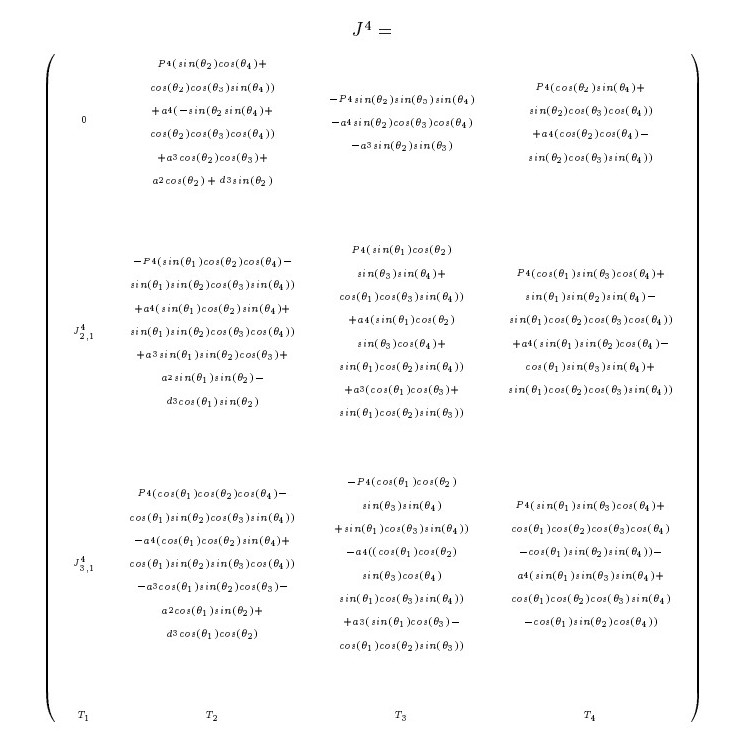
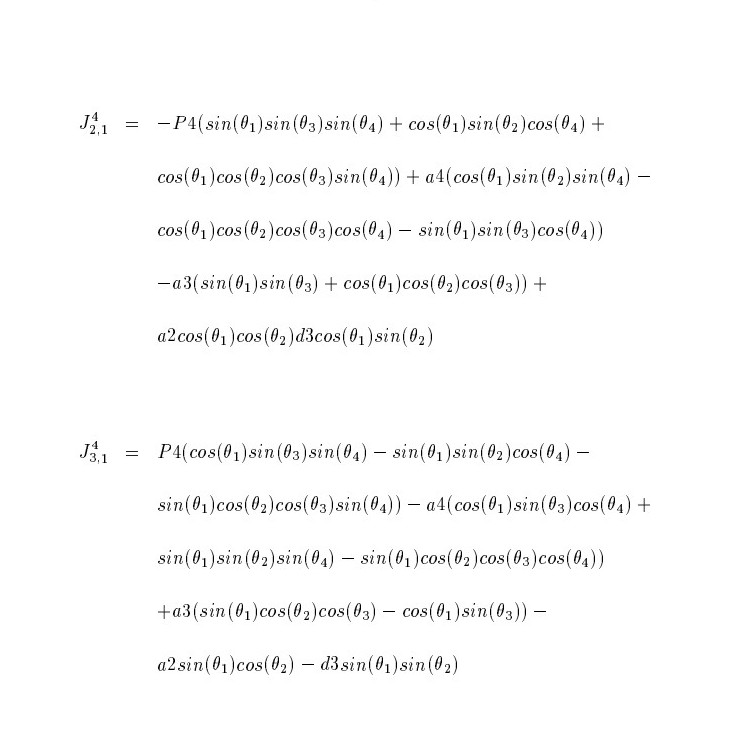
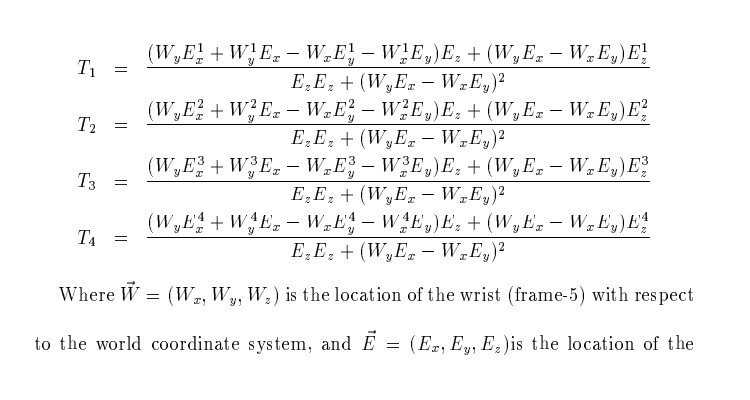
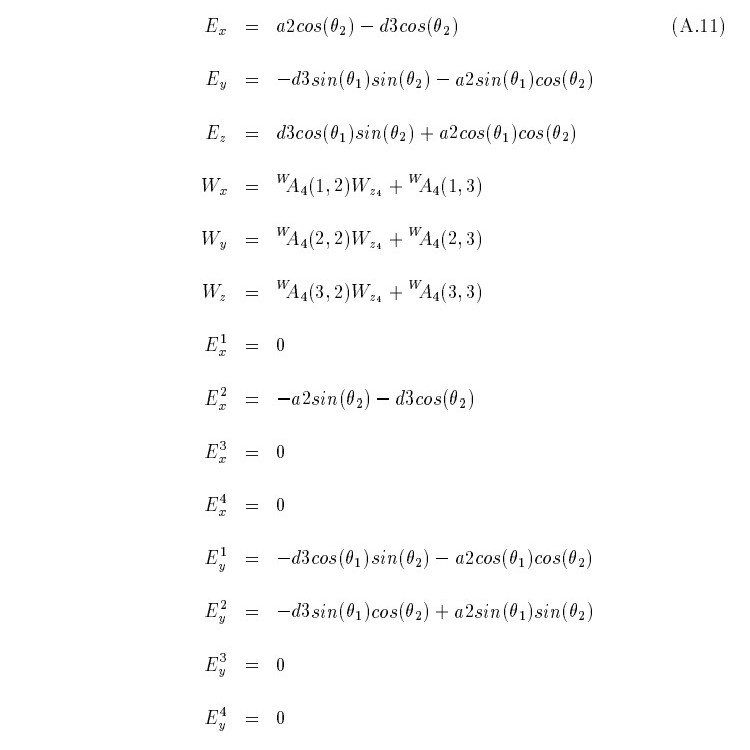
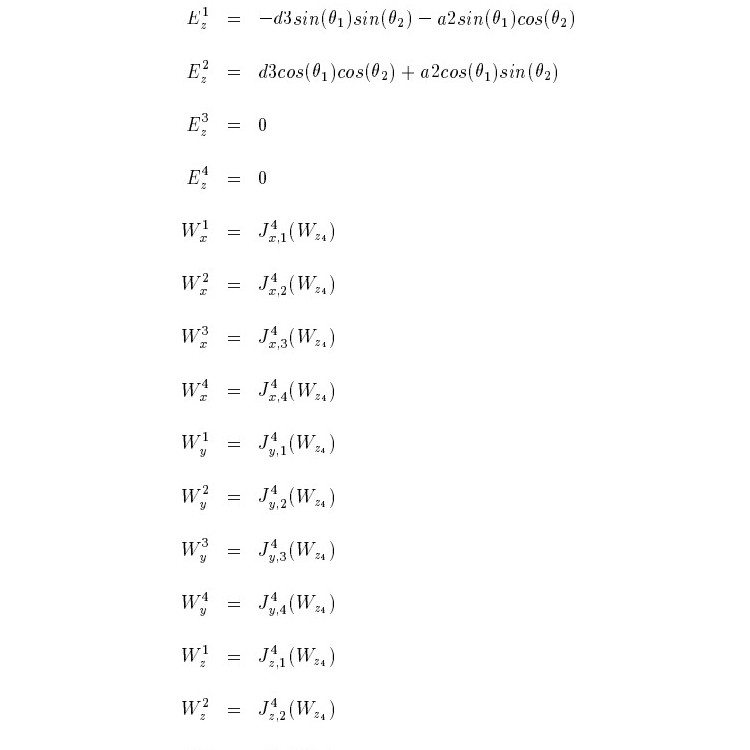
Note, not all factors are explained or shown so to see the complete equation you have to open the link in the first paragraph.

 Leonberger Life
A bit complicated, but really interesting!
LikeLiked by 1 person
Thank you so much Luisa. All those equations were just to show that Robotics can be math heavy, a lot of engineering can be math heavy, and I did not intend anyone to read that seriously.
LikeLiked by 1 person
Thanks a lot for your kind reply 😉
LikeLiked by 1 person
This is so interesting! And way above my head. LOL 😀 Hope you’re having a terrific day!
LikeLiked by 1 person
Thank you so much Kymber. I should say I included those equations just to show how much math you may need to do in robotics (and many other engineering fields). I did not expect anyone to actually read it.
LikeLiked by 1 person
My dad was a high school math teacher turned electrical engineer. My sisters and I used to groan whenever guests asked him what his line of work was. hahaha 😀
I remember hearing so many of my classmates over the years complaining about math and saying they would never use it in real life. First thing I learned while pursuing my nursing degree was how much math there is to know in that, too. But it couldn’t stop me because I was the weirdo who loved chemistry with all its formulas. haha
LikeLiked by 1 person
Groan, ha ha, we are nerds, I guess. Yes, I think many underestimates how much math is used professionally. I’ve had small businessmen, lawyers, accountants, and financial advisors, tell me they use algebra in their line of work. And yes chemistry is full of formulas.
LikeLiked by 1 person
Hello. My name is Kymber and I am a nerd. LOL 🤣😂
LikeLiked by 1 person
LOL
LikeLiked by 1 person
Math and robotics are cool! Thanks for sharing, Thomas!
LikeLiked by 1 person
Thank you Priscilla. Yes I agree with you. In robotics so many fields come together, electronics, mechanics (mechatronics), software, and math, often lots of math.
LikeLiked by 1 person
Thanks for sharing, Thomas! This is great!
LikeLiked by 1 person
Thank you so much Gina / pixel penny. I hope you are doing great.
LikeLike
You had me going until T4. Glad I switched to Russian in college!
LikeLiked by 1 person
Well, I am impressed you could follow any of that. I also skipped parts right after the T4. I included those equations just to show how much math you may need to do in robotics (and many other engineering fields). I did not expect anyone to actually read it. Russian that is an interesting choice. I went to Russia/Soviet in 1980. I was a teenager at the time. We tried to smuggle some stuff (unwanted literature, printing press equipment for the underground) but we were caught and interrogated at gun point. That part wasn’t fun, but we were Swedish tourists so never in any real danger.
LikeLiked by 1 person
I was 20 when I went to what was USSR–in 1973. Didn’t try to smuggle anything, but had a lot of Western world stuff stolen from my hotel. Like jeans! Oh well.
LikeLiked by 1 person
I can imagine. In 1980 jeans were still very sought after in the Soviet Union, so where plastic bags and pens. We brought some gifts.
LikeLiked by 1 person
Wow, Thomas! This is fascinating, and beautiful. I already had enormous respect for the field of robotics after spending a brief stint as coach for my daughter’s 4th grade robotics team a few years ago (my favorite response to any question was generally, “Well, what do YOU think you should do?”). What a mind stretch that was. So great to glimpse this other side. Thank you for sharing this. Huge smile.
LikeLiked by 1 person
Thank you so much Stacey for your kind words. That is very interesting; 4th grade robotics. That is amazing. In the 1990’s this was an adult only field.
LikeLiked by 1 person
They had fun. The idea was to build a little car out of lego parts, put a motor in it, and program the car to go through an obstacle course. For candy prizes, of course : )
LikeLiked by 1 person
That sounds like a fun project. You’ve got to start them early.
LikeLiked by 1 person
I admit, most of that went zinging by over my head, but interesting! Thanks.
LikeLiked by 1 person
Thank you so much Denise. I should say I included those equations just to show how much math you may need to do in robotics (and many other engineering fields). I did not expect anyone to read it. Many people dreaded this kind of math but it had to be done if you wanted your robot control system to be fast and precise.
LikeLiked by 1 person
I showed your post to my dearly beloved who’s been doing a lot of 3-D printing over the past several years. He found it interesting. He said 3-printing involves four points of freedom.
LikeLiked by 1 person
I don’t know much about 3D printing but four degrees of freedom that makes sense.
LikeLiked by 1 person
Hi Thomas, this is Lisa, the fellow author you’ve met at the Watauga Public Library Indie Author Day events. I am working with a business owner in Southlake to host an independent author event at their location. If you are interested in participating, please e-mail me at poetlisamartinezhtx@gmail.com. Would love to have you there.
LikeLiked by 1 person
Yes sure. Very good to hear from you. I’ll send you an email.
LikeLike
Mery Christmas to all ard Blessed New Year!
LikeLiked by 1 person
Thank you so much Patricia. I am almost done reading your book and I loved it. It is so interesting and fun to read, so beautifully made, and it brought back so many memories. Have a Merry Christmas and a Blessed New Year you too!
LikeLike
Hi Thomas, some people just aren’t good at maths, while others excel at it. My son, Greg, is very good at maths. He is doing a Bachelor of Science IT and achieved 12 distinctions and one B this year. He got 98% for the year for linear algebra. You must have an interesting job and career.
LikeLiked by 1 person
98% on linear algebra. That is so impressive. I was good at Linear Algrebra too and this, the coordinate transforms, the matrixes, that’s Linear Algebra.
LikeLiked by 1 person
Gregory loves maths and he is very good at it.
LikeLiked by 2 people
It sounds like Greg has a great future.
LikeLike
Fascinating but, as an “artsy fartsy” type (who barely survived grade 11 math), this is way over my head. Nonetheless, robotics are the wave of the future and I’m in awe of your expertise!
LikeLiked by 1 person
I know it is not for everyone. It was just a demonstration of what robotics engineers and many other engineers have to do. Math is indeed very useful in many professions. It is going to be interesting to see what happens with robotics.
LikeLiked by 1 person
Wow, I had no idea that’s what you have your PhD in. Math is definitely not a subject I’m strong in, thus why I got my degrees in literature😄 Thanks for sharing this.
LikeLiked by 1 person
Thank you Jennifer. We all have different interests. I am taking French classes with a professor in English literature and she is indeed very smart and interesting.
LikeLiked by 1 person
wowsers. trig-tastic.
💫🌿✨🦎☀️💖☮️⚛️♾️🦀🐉🙏🏻😌🙋♂️
LikeLiked by 1 person
Thank you Graham. Happy holidays
LikeLiked by 1 person
Happy Holidays!
💫✨🌟🎄🌟🪩🌟🎄✨💫
LikeLiked by 1 person
hello, thanks for sharing. a bit complicated to me. have a nice day and happy holidays!
LikeLiked by 1 person
Thank you so much Carfax and Happy Holidays to you
LikeLiked by 1 person
Quote interesting and informative piece, Thomas! Though I couldn’t understand the equations etc in finer print, I liked the idea and process. Thanks a lot for sharing it.
LikeLiked by 1 person
Thank you so much for your kind words Kaushal. Yes the equations I put there just to show what you had to do so that people know that the math in robotics can get complicated.
LikeLiked by 1 person
Sometimes on “Battlebots” they explain how some unusual robot works, like this one that has some sort of flywheel that gets engaged with a drum that causes some kind of nylon cord to twist that causes a flipper to fire. Apparently there’s tons of math involved in figuring all that out, but they gloss over that and go right to the part where it throws another robot into the ceiling. Real world application! 😁
LikeLiked by 1 person
I have not been following battlebots but that sounds quite interesting. Thank you for the info James.
LikeLike
Wow… I am seriously impressed Thomas, and I was hopeless at Maths at school, and could never fathom Algebra out… or see the reasoning behind XYZ.. Now I know lol… 🙂 This is way, WAY over my head, but what a gift…
See, you said you were no good at art… Well, I am certainly No good at understanding any of this, except to know its outstandingly good.. 🙂
Wishing you a very Happy New Year Thomas… 😀
LikeLiked by 1 person
Thank you Sue. I guess we all have our different skills and interests. I just wanted to show that math is used extensively in certain professions. I wish you and your family a very Happy New Year as well.
LikeLiked by 1 person
Oh yes, Maths is essential, and I’m pleased to say my granddaughter just turned 13, has excelled so much in maths that’s she’s been pushed into a top higher age group.
She’s interes in science, so she will need Maths.
She didn’t like maths in her junior school. I asked her what had changed so much.. She said it was her teacher, she said her teacher presented it in a fashion she understood it better and it all clicked.
And that also has a lot to do with it, too.
Your presentation, if I had a better grasp of maths, I would understand.
This goes to all things we are taught. If we are not aware of certain facts, we can not get the bigger picture.
So I thank you Thomas, for I know how long it takes to put such posts together. ✨️
LikeLiked by 1 person
That is great. Math and computer science are fields that need more women, and the teachers matter a lot. I’ve helped teach my daughter and some of her friends programming languages and math, which makes me wonder how I would be as a teacher. I should say this post was not meant to be understood, so don’t judge by that. I should say my daughter started out in computer engineering but switched to environmental science. You have to follow your passion. Anyway, I wish your granddaughter the best of success.
LikeLiked by 1 person
Thank you, Thomas. I agree that teaching makes a huge difference. And I feel we all are guided to be where we are meant to be.
At 13, my granddaughter has lots of choices at her disposal as to which route she wants her career to travel in .
Have a wonderful New Year ✨️ 😊
LikeLiked by 1 person
Sue I wish you a great week and a wonderful New Year
LikeLike