
As I mentioned in a previous blog post I’ve been thinking about launching a second blog. The topic would be facts, or insights that are widely disputed or misunderstood amongst the public, yet important and known to be true. However, I am also thinking about adding another aspect to the blog and that is facts, or insights that are highly surprising to people, yet important and known to be true. Curious or strange facts if you will. Not strange trivia but important stuff. People wouldn’t necessarily dispute these facts, well they might, but they may appear unintuitive to a lot of people. So, the true facts that people are disputing would be “cluster-A” and the facts that just would seem strange, ponderous, or counter intuitive would be “cluster-B”. I will post about both.
This particular blog post gives an example of a cluster B fact. To express myself a little bit simplistic, science does not know everything (otherwise it would stop), but it knows a lot. By studying the light from a distant star, we can determine what elements it is composed of. The star may be composed of 71% hydrogen, 27% helium, 1% Lithium, and 1% other elements, and we can know that just from its light. We can determine the distance to the star, how it is moving compared to us, its temperature, roughly its age and longevity, and more. 150 years ago, we could not have dreamed of this capability.
Yet we know that there are things we can never know, no matter how advanced science becomes. Infinite experimentation, super intelligence, a quintillion super genius, infinite time, cannot breach some knowledge. The universe itself forbids some knowledge. It also means that the statement “nothing is impossible” is false. My natural reaction to such a claim is, “come on you can’t say that with certainty”, and I expect many others will feel the same. However, the reason some knowledge will never be attainable is that physical laws as well as mathematics and logic forbid some knowledge. Some things are not meant to be known. I will explain in the four sections below: the event horizon, the Heisenberg uncertainty principle, beyond the observable Universe, and Gödels incompleteness theorem.
I should say in my future blog I will explore each of the four examples below more in depth, and put them in their own blog posts, and I might add or remove examples as I learn more.
The Event Horizon of a Black Hole
A black hole is a region of spacetime where gravity is so strong that nothing, including light, can escape it. The boundary of no escape is called the event horizon. If you pass the event horizon you cannot come back out no matter how much energy, you expand. Nothing can escape, no matter, no radiation, not light or other electromagnetic radiation, and no information. Nothing at all can escape. The curvature of time and space itself forbids it. I should add that right at the event horizon, there is so called Hawking radiation, but without complicating things it is not the same thing as escaping a black hole.
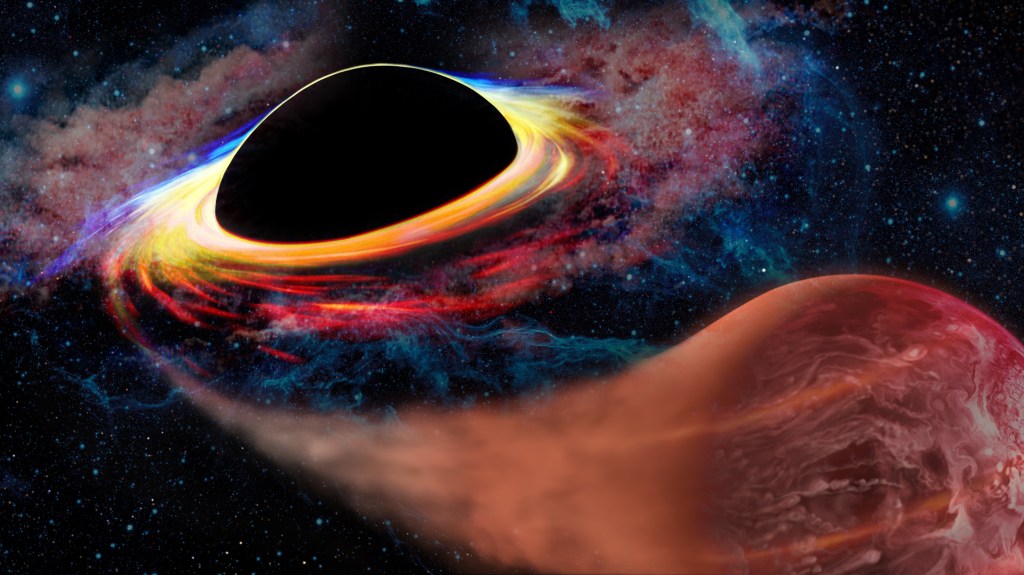
Some black holes are formed when large stars die and collapse. These black holes are estimated to have a mass of five to several tens of solar masses. However, there are also super massive black holes that reside in the center of galaxies. The super massive black hole at the center of our galaxy, the Milky Way, is called Sagittarius A* and is estimated to have a mass of four million times the mass of our sun. The largest known supermassive black hole TON 618 is 66 billion times more massive than our sun. There are an estimated 100 million black holes in our own galaxy, the Milky Way. One interesting fact is that celestial objects can orbit a black hole, just like planets orbit the sun, but as you get too close you will rush, at the speed of light, into the depths of the black hole You are “poff and gone”.
The fact that nothing, including information, can escape a black hole means that we can never observe what is on the inside. You can venture inside and be lost. You can extrapolate from physical laws what might be inside, but you can never observe and report what is inside to planet Earth.
The Heisenberg uncertainty principle
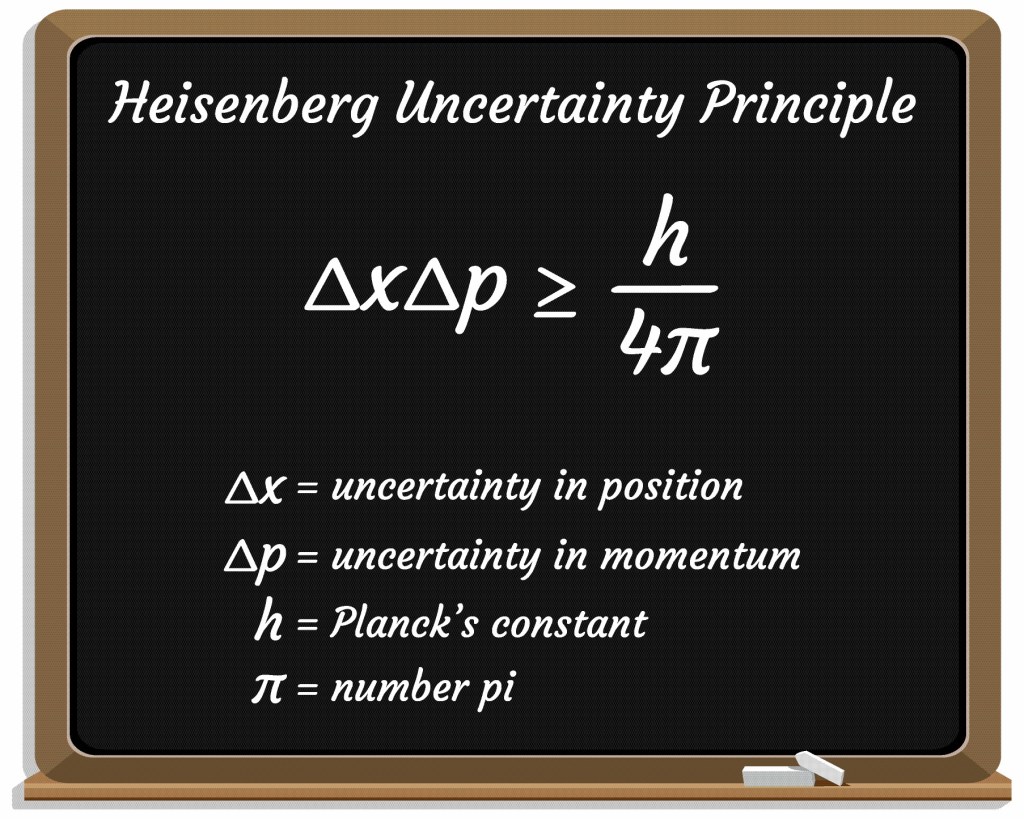
The Heisenberg uncertainty principle states that it’s not possible to know the position and momentum of an object with perfect accuracy at the same time. Another way of saying that is that we cannot know both the position and speed of a particle, such as a photon or electron, with perfect accuracy. The formula is: dX * dP >= h/4pi , uncertainty in position (dX) times uncertainty in momentum (dP) is larger than half of Planck’s constant, which is very small. There is also an energy and time precision : dT * dE >= h/4pi. It basically means that there are no perfectly exact measurements or knowledge. Everything is a bit fuzzy. Planck’s constant is very small, so Heisenberg uncertainty principle does not matter for everyday objects, but it matters when sizes are very small (positions, energies, etc.) Note, Heisenberg uncertainty principle is not regarding a limitation of our equipment, but a limit set by a law of physics. It is a limitation set by the Universe.
Beyond the observable Universe
The observable universe is a ball-shaped region of the universe consisting of all matter that currently can be observed from Earth or its space-based telescopes. The radius of the observable universe is 46.6 billion light-years. The size of the observable universe is growing. Unfortunately, at those distances, space itself is stretching/expanding faster than the speed of light. Since no signal or information can travel faster than the speed of light we are losing, not gaining, celestial objects from the observable universe. Further, in the past we’ve lost many galaxies this way. I can add that the universe may be infinite. Since the expansion is accelerating, we will keep losing more galaxies beyond the boundary of the universe and some galaxies were always lost (with respect to observation).
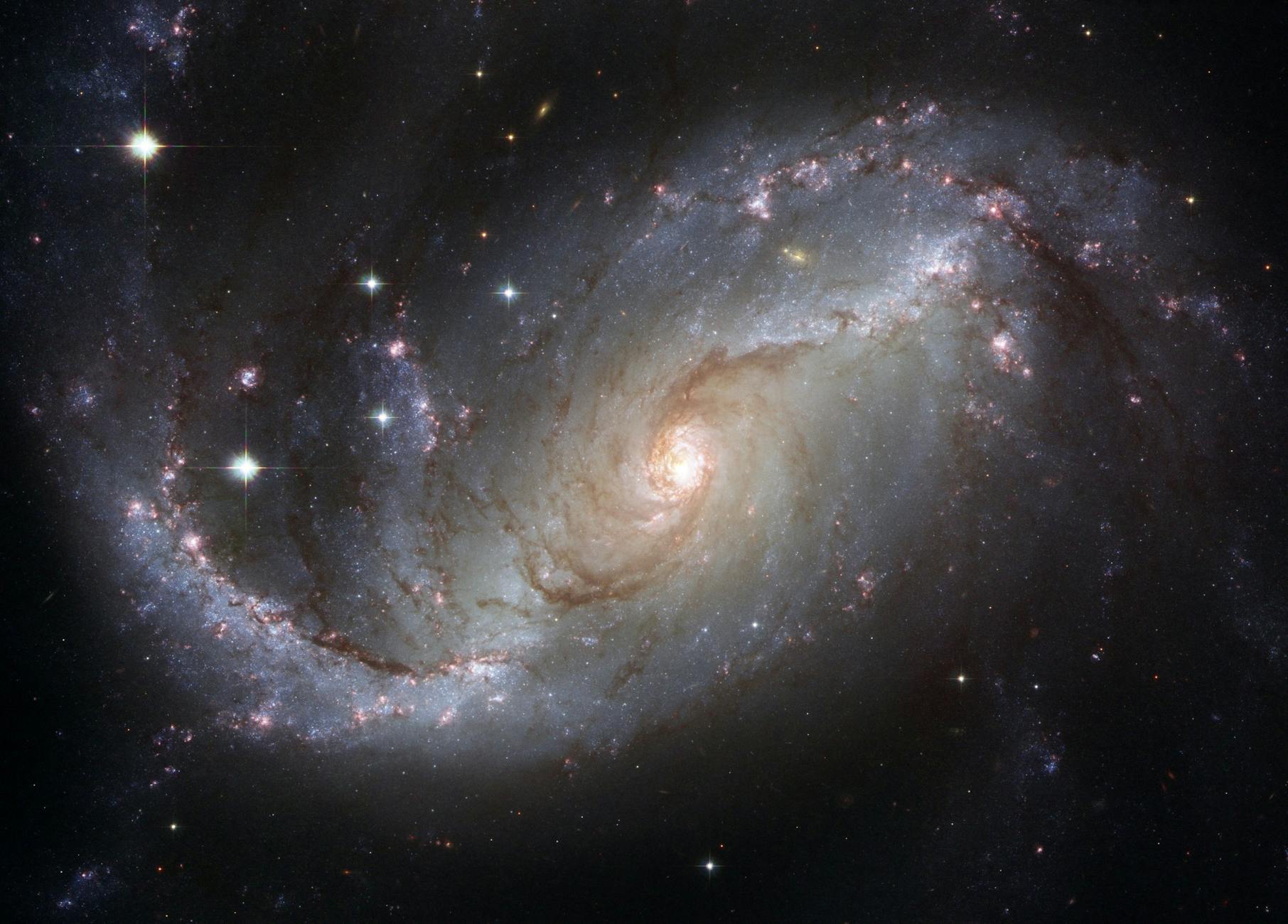
If we are wrong about the fact that the expansion of the universe is accelerating, then perhaps we can observe more galaxies in the future. But if not, then there are galaxies that we have never observed, galaxies that we can never observe, and there are galaxies that will become unobservable in the future. Depending on the size of the universe we may never be able to observe more than an infinitesimally small portion of the universe. Again, the universe is stopping us from knowing something.
Gödels incompleteness theorem(s)
The theorem states that in any reasonable mathematical system there will always be true statements that cannot be proved. In other words, to find a complete and consistent set of axioms for all mathematics is impossible. There are forever hidden truths in mathematics. For the case of natural numbers this means that there will always be statements about natural numbers that are true, but that are unprovable. I can add that there is also a second incompleteness theorem that states that a formal system cannot prove that the system itself is consistent. Basically, there are limits to mathematics set by logic.

I have a book on Gödels incompleteness theorem, which I have not read, but I will read it before I make a post about it.
Some other topics for strange yet important facts
- Light speed in vacuum is a Universal Constant.
- Time is relative (deeper explanation).
- Non-simultaneity and simultaneity are relative.
- The strange double slit experiment.
- Quantum Tunneling.
- Quantum entanglement.
- The Monty-game-door trick, 3-doors.
- The butterfly effect.
- Mandela effect.
What do you think about mixing in some very strange but important facts in my future blog about facts people dispute even though they are known to be true?

 Leonberger Life
These are weighty subjects, Thomas. I’m sure you’ll eventually get to the conundrum of Schoedinger’s Cat. I played with the myriad of unsolved hypotheses (like Riemann Hypothesis) as a way to differentiate an AI from a human in one of my early books. It was fun but almost over my cerebral head!
LikeLiked by 6 people
It is a good suggestion. Perhaps I could include the Schrödinger’s cat conundrum. It has generated a lot of arguments and different opinions through the years. The position I took during my first class in Quantum Mechanics was that the cat knows whether he is dead or not. Basically, I thought that the wave is not a physical thing but a mathematical representation of one’s knowledge, and therefore different observers have different waves. I supported that with a strange feature of the wave mechanics for a free electron that I noticed. It strongly suggested that the wave for that electron was different for people depending on how they moved. My professor actually agreed with me. That’s called the information theoretic interpretation. Now a day it seems like the new way of looking at decoherence could have solved the mystery, and some people are saying that there is no collapse of the wave at all. But I have to read up on this. Regarding the Riemann hypothesis. There are a number of unsolved mathematical problems. Could they be examples of Gödel’s truths that can never be proven? I will look into it in the future and see what the experts say.
LikeLiked by 1 person
Looking forward to your new blog . These sound like some very interesting topics.
LikeLiked by 3 people
Thank you so much Deanne.
LikeLiked by 2 people
You’re welcome Thomas.
LikeLiked by 1 person
Interestingly, the Heisenberg uncertainty principle is the main reason why Star Trek transporters will never leave the realm of science fiction. The franchise even acknowledges this by mentioning that transporters are able to break matter down into energy and back to its original form via a component called the “Heisenberg Compensator.”
LikeLiked by 3 people
Thank you Alex. I did not know that. “Heisenberg compensator”. I have to admit I find that amusing. I think a lot Star Trek will remain in the realm of science fiction. The universal speed limit, the speed of light in vacuum, being the biggest issue.
LikeLiked by 1 person
On the other hand, Star Trek did inspire cell phones, hospital beds with built in monitors……
But yeah….transporter tech is one of those Trek things that won’t happen. There’s not enough computing power to track down all the molecules of a human being beaming up….or down.
LikeLiked by 1 person
Yes you are right. I like Star Trek and I think it has been a great inspiration for inventions and exploration. But there are some unrealistic things in Star Trek. I read a book by Michio Kaku, the physics of the impossible that delved into what is and is not possible in Star Trek, considering the known laws of physics.
LikeLike
Well, there is a reason why the Star Trek franchise is called science fiction.
From a writing point of view, Star Trek isn’t even really science fiction. It doesn’t try to predict what will really happen between now and the 23rd Century and beyond. It’s really a way for storytellers to explore human issues and ideas, including racial and gender equality, war and peace, our relationship with technology, and interpersonal relationships.
And…who knows, though. Right now, we must accept that there won’t be anything like warp drive based on what we know or understand about physics, energy sources, and whatnot. But…who knows what future scientists may discover?
LikeLiked by 1 person
That is interesting. It is a great way to to explore human issues and ideas. We certainly don’t know what future scientists may discover, but there are pesky physical laws that you can’t realistically get around. Just like future scientists can’t make 1 + 1 = 3, they are unlikely to get around the speed of light in vacuum.
LikeLike
A very interesting post. I’m not great at science but this wasn’t too hard to follow. Would love to read more facts posts in the future.
LikeLiked by 2 people
Thank you so much Pooja. I really appreciate it.
LikeLiked by 1 person
My pleasure.
LikeLiked by 1 person
Brilliant, Thomas! Last year, I was at a planetarium and listened to a scientist explain that space is expanding faster now than ever before. Your post brought me back to last summer – and my astonishment. I look forward to your posts. Excellent!
LikeLiked by 2 people
That is great. I have not been to a planetarium for a while. It is time for me to visit one. Thank you so much Gwen.
LikeLiked by 2 people
Hi Thomas, my son, Gregory, loves to tell me about the Heisenberg uncertainty principle. He will talk to me about it at great length. I didn’t know about it prior to his specialising in mathematics at university. I wonder though, if these truths in maths that can never be proved are really unprovable or whether it is more that our approach to maths is not yet sophisticated enough to solve certain mysteries. After all, some ‘truths’ in science and maths have been expanded on or even disproved over time.
LikeLiked by 1 person
Thank you Robbie. Gregory sounds like someone who loves advanced physics and math. I remember you writing about him before. The Heisenberg uncertainty principle makes it impossible to know perfectly exact the position and momentum/speed at the same time. The second part of your comment I assume refers to Gödels theorem. It is not “that our approach to maths is not yet sophisticated enough to solve certain mysteries”. I know, that is what I thought when I first heard about it too. However, Gödel proved logically / mathematically that there are truths in mathematics that we can never prove. There is no way around it. I suggest you ask Gregory about Gödel’s incompleteness theorem. He can probably explain it much better.
LikeLiked by 1 person
Hi Thomas, you are probably right. When I have four or five hours to spare, I’ll ask Gregory – wink! It does all interest me very much. I look forward to learning a lot from this series.
LikeLiked by 1 person
LOL well when I have four or five hours to spare I will read the book I have on Gödels incompleteness theorem and after you talked to Gregory you can also fill me in and then I am ready to make a post.
LikeLike
An ambitious post. Smile!
LikeLiked by 1 person
hello, how are you? very interresting… ans complicated! have a nice day!
LikeLiked by 2 people
Thank you so much Carfax. Have a nice day you too.
LikeLike
I’m ready to dig in, Thomas, and to learn new things! 🙂
LikeLiked by 1 person
That is very cool Kymber. Thank you for your support.
LikeLiked by 1 person
Whatever you post will be interesting!
LikeLiked by 1 person
That is very nice of you to say Dawn. Thank you for your support.
LikeLike
Absolutely fascinating, Thomas. I think your new blog is going to make all of your followers a lot smarter. Thanks for all the research and for explaining it all in a way I could understand. 🙂
LikeLike
Thank you so much for your support Diane. I am hoping to launch it in a few weeks.
LikeLiked by 1 person
Looking forward to it!
LikeLiked by 1 person
Fascinating topics, Thomas! I’m sure, you will address the issues in a very interesting way. We don’t know what future will unfold, but for the present, we can certainly discuss what is what. Looking forward to your future posts! All the best!
LikeLiked by 1 person
Well, hopefully I will get this blog started sometime in June. Thank you so much Kaushal.
LikeLike
Good one Thomas..👍👍
LikeLiked by 1 person
Thank you so much gabanmeow
LikeLiked by 1 person
You’re welcome Thomas.
LikeLiked by 1 person
And the truth about Dracula!
LikeLiked by 2 people
Yes you are right
LikeLike