
This is a Leonberger blog, but sometimes I also post reviews for books that are not about Leonbergers and when I do it is books that I love and that I want others to read. Today I am posting a review for a book that I loved, “A Brief History of Time: And Other Essays” Hardcover – September 1, 1998, updated in 2017. It was written by Stephen Hawking. A long time ago I read the original “A Brief History of Time” but now I read this updated version. It is still the original but the adjustments/corrections for more recent discoveries are described in the appendix. Contrary to what Amazon claims I don’t think this is a book “Told in language we all can understand”. In my opinion you need a little bit of a physics background or at least a serious interest in the subject. Otherwise, it will be too much abstract information at once. I should add that I bought the Hardcover.
- Hardcover – Publisher : Bantam; Anniversary edition (September 1, 1998), updated 2017, ISBN-10 : 0553109537, ISBN-13 : 978-0553109535, 240 pages, Item Weight : 2.31 pounds, dimensions : 6.18 x 0.83 x 9.29 inches, it cost $16.14 on US Amazon. Click here to order it from Amazon.com.
- Paperback – Publisher : RANDOM HOUSE UK; First Edition (January 1, 1990), ISBN-10 : 0553176986, ISBN-13 : 978-0553176988, 211 pages, Item Weight : 2.31 pounds, dimensions : 4.33 x 0.71 x 7.05 inches, it cost $20.85 on US Amazon. Click here to order it from Amazon.com.
- Kindle – Publisher : Bantam; 10th edition (May 4, 2011), ASIN : B004WY3D0O, 242 pages. It is currently $9.99 on Amazon.com. Click here to order it from Amazon.com.
- Audiobook – Publisher : Phoenix Books, Inc., Release date : January 06, 2022, ASIN : B09NLFY54Z, Listening length 5hrs 49 minutes. Click here to order it from Amazon.com.
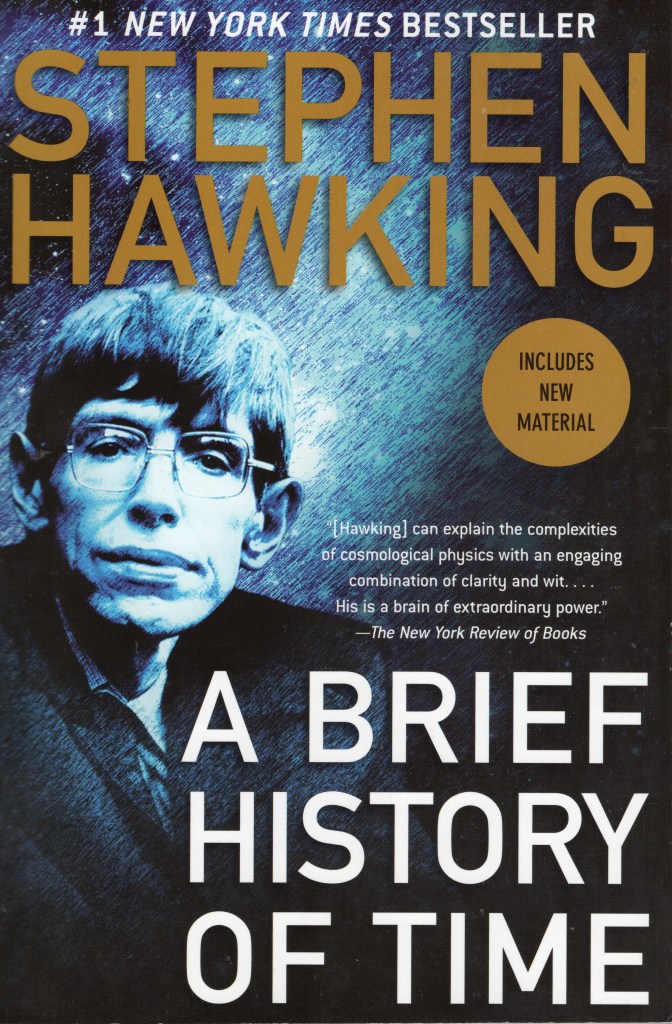
Amazon’s description of the book
Published more than two decades ago to great critical acclaim and commercial success, A Brief History of Time has become a landmark volume in science writing. Stephen Hawking, one of the great minds of our time, explores such profound questions as: How did the universe begin—and what made its start possible? Does time always flow forward? Is the universe unending—or are there boundaries? Are there other dimensions in space? What will happen when it all ends?
Told in language we all can understand, A Brief History of Time plunges into the exotic realms of black holes and quarks, of antimatter and “arrows of time,” of the big bang and a bigger God—where the possibilities are wondrous and unexpected. With exciting images and profound imagination, Stephen Hawking brings us closer to the ultimate secrets at the very heart of creation.
This is my five-star Amazon review for A Brief History of Time: And Other Essays by Stephen Hawking
Relativity, Quantum Mechanics, Black Holes, and Cosmology in just 200 Pages.
First, I should mention that even though I bought the hardcopy version of the book released in 1998, I received the updated version released in 2017. The same will probably happen to you if you buy it. I certainly did not mind. The 2017 version is identical to the 1998 version, but it contains additional material including corrections that are featured in an appendix at the end of the book. For example, in 1998 it was discovered that the expansion of the universe is accelerating, making the Friedmann models he discussed in chapter 3 almost obsolete. In addition, since 1998 Hawking’s no-boundary condition has become more certain, as well as the existence of multiverses. Therefore, it is important not to skip the appendix, and perhaps it is best to read the appendix first, so you know what to ignore in the original text of “A Brief History of Time”. I should mention that I read the original book from 1990, a very long time ago.
The book covers a lot of material. He describe past models of the universe, space and time and special and general relativity, light cones, cosmology, the expanding universe, quantum physics, Heisenberg’s uncertainty principle, the two slit experiment, the wave particle duality, anti-particles, Feynman’s sum over histories, elementary particles, particle spin, fundamental forces, entropy, black holes, event horizons, space-time singularities, the cosmic censorship hypothesis, virtual particles, the big bang, the inflationary model and the new inflationary model, the anthropic principle, imaginary time, quantum gravitational effects, the no-boundary condition, three arrows of time, Gödels incompleteness theorem, Einstein-Rosen bridges, or so called wormholes, supergravity, string theory, the unification of physics, renormalization, eternal inflation and the multiverse, etc. In summary, he covers a lot in less than 200 pages.
I have a degree in physics (I became an engineer) and I have an interest in these kind of topics, and therefore I understood most of the content in this book, at least at some level. However, I can see how people without a background in physics would have a hard time with this book. Hawking is for the most part doing a great job explaining these topics, but many of the topics are very abstract and the book covers a lot of them. I think it might be too much for some people, but I don’t see that as necessarily a fault of the book. It is just an acknowledgement that this is not an easy subject. If you want to understand what we know about the universe you have a lot of work ahead of you, no matter how great your teachers or authors are.
One potentially controversial item is the implications of the no-boundary condition derived from the combination of general relativity and quantum mechanics (quantum gravity). It is natural to think that the universe has either existed for an infinite time or that it had a beginning. The no-boundary condition offers up a third option. Space-time is finite and yet there is no singularity. In addition, the universe is self-contained meaning it does not have a beginning or an end. Just like in a universe that has existed for an infinite time there is no moment of creation.
In chapter 10 he discusses wormholes and time travel. Kurt Gödel, the guy with the incompleteness theorem, showed that under certain circumstances General Relativity allowed for time travel. Also, when you travel faster than the speed of light you are traveling backwards in time, something most science fiction authors depicting spaceships traveling faster than the speed of light conveniently ignore. However, the conclusion of the discussion that followed was basically, in practice you can probably not time travel. Just imagine that you could travel back in time and kill your mother. That way you would never be born so now you could not travel back in time and kill your mother, and poff, now you exist again, but now you can travel back in time and kill your mother. Time travel comes with various logical problems. By the way where are all the time travelers from the future?
One thing I disagree with was that he on page 156 says that intelligent beings can only exist in the expanding phase of the universe. His explanation for this statement is not convincing and I don’t believe it. However, since we now know that the universe is likely to expand forever it is a moot point. He also keeps calling entropy “disorder”. This is very common, but “disorder” in common vernacular is a vague term that does not exactly correspond to the mathematical definition of entropy, and this should at least be pointed out. These are very minor and unimportant complaints, but I wanted to mention them. The Amazon description states: “Told in language we all can understand”, which as I mentioned is not really true. But that is the Amazon description of the book, not a problem with the book.
In summary, I think this is a very interesting and informative book and I think it is well written and well organized. The fact that it is difficult reading for many people is because of the subject matter and is not the fault of the author. I highly recommend the book to anyone with a background in physics and anyone else who is really interested in the subject and doesn’t mind looking up concepts a bit more in depth. I give it five stars.

About the Author

Stephen Hawking’s ability to make science understandable and compelling to a lay audience was established with the publication of his first book, A Brief History of Time, which has sold nearly 10 million copies in 40 languages.
Hawking has authored or participated in the creation of numerous other popular science books, including The Universe in a Nutshell, A Briefer History of Time, On the Shoulders of Giants, The Illustrated On the Shoulders of Giants, and George’s Secret Key to the Universe.
I can add that I also read The Grand Design by Stephen Hawking, which I also recommend but with the same caution as for this book. It’s a bit abstract.

 Leonberger Life
I have always been an admirer of Stephen Hawkin and although I reread every chapter more than twice… it took me months to complete the book but I was detemined to do so I have now passed it on to my grandaughter with a warning that it took me a while to complete the read…I felt it was worth it to perserve and read the book in its entirety what a man he was …he would definitely be a guest round my dinner table …
LikeLiked by 1 person
That is great Carol. That is determination and I am glad you passed on the book to your grandaughter. Stephen Hawking was indeed a very impressive physicist, a real genius. I can imagine him at your dinner table.
LikeLike
So can I Thomas he had a wicked zense of humour and zest for life…
LikeLiked by 1 person
Yes I remember some anecdotes. He did have great humor.
LikeLiked by 1 person
Thomas, this is an impressive review and glad you posted it. I know my son has a second hand edition of this book, his first love was Physics but decided to study Computer Engineering (they had only one semester of Physics in the 1st year).
The no-boundary condition is fascinating and excitingly mind-bending in a way, as it proposes a new way to think about the universe’s existence. Instead of believing the universe had a beginning like the Big Bang or it always existed, this idea suggests a third option. It proposes that the universe is like the surface of a sphere. So without edges, meaning it doesn’t have a clear starting or ending point. It makes sense that this will challenge our usual way of thinking about time and creation. Where time had a beginning and an end. And historical timelines I think have confused this image for us even more, as that BC to AD horizontal line is imprinted on our retina.
The no-boundary condition suggests that the universe is a closed loop without a clear origin. This idea should encourage us to rethink how we understand the universe and may become important as we learn more about how the universe works.
And how we can(not) time travel. But, shh, don’t tell that to a writer 😉
LikeLiked by 1 person
That is similar to my path. I started out with BS/MS in engineering physics and I continued with Electrical Engineering and Computer Software / Robotics. I entirely agree with you on the no-boundary condition. It is fascinating and mind-bending. Based on what you say I assume you must have read the book or perhaps another book on the subject.
LikeLiked by 1 person
I tried to read this but despite the blurb saying he made science readable for the layperson, it wasn’t for me! I needed more Margaret Meade
LikeLiked by 1 person
Yes I could imagine myself before studying physics and I concluded that I would not have understood this. Unless you have some solid pre-knowledge about the subject it is too dense. He could have written a book filled with detailed explanations, diagrams and illustrations, examples, and perhaps a few equations too, with examples of how to use them, and that would have been easier to follow. Unfortunately, that book would have been a 1,000 pages. There is no way around it. It is a dense subject that can’t be explained well to the layman in just 200 pages. He got a lot of one-star reviews for being incomprehensible but I don’t think that is fair. It is the subject, not the skill of the author.
LikeLiked by 1 person
I like how you made the distinction that the difficulty in reading is not the author’s fault, but the subject matter. Great review, Thomas!🌸
LikeLiked by 1 person
Thank you so much Kymber. Yes he got a lot of one-star reviews for being incomprehensible but I don’t think that is fair. Like you say, it is the subject, not the skill of the author. He could have written a book filled with detailed explanations, diagrams and illustrations, examples, and perhaps a few equations too, with examples of how to use them, and that would have been easier to follow. Unfortunately, that book would have been a 1,000 pages and no one would have bought it. If you haven’t studied physics you can still read it and get something from it, but you just have to ignore that some parts are going to appear strange and incomprehensible.
LikeLiked by 1 person
Thomas, this must be one of the most learned book reviews I’ve had the pleasure of coming across! Brilliantly written with great knowledge and I am pleased to realise that one truly needs a physics degree to understand the book! I know many who bought the book, started it but never finished it! Many thanks for sharing here and letting me try to grasp some of the content!
LikeLiked by 1 person
Thank you so much Annika for your kind words. Like you say, I think it is very common that people without physics education try to read it but it does not work out. It is a really tough subject unless you know something about it already.
LikeLiked by 1 person
I’ve heard others who have told me they started this book and were unable to finish it because it was too dense for them. I’m a reasonably intelligent person, but I’m not sure I’d want to work that hard to understand Hawking’s thoughts.
LikeLiked by 1 person
Yes I think the book require some physics knowledge, either from a college education or a significant interest in modern physics. Stephen Hawking did a great job but it is tough and big subject. The books by Neil De Grasse Tyson, Lewis Carroll Epstein, Michio Kaku, and also books by Steven Weinberg for laymen are easier to read but they tend to cover less abstract topics. (Steven Weinberg was the nobel prize winning physicist who unified the weak nuclear force with electromagnetics and predicted the existence of a bunch of elementary particles).
LikeLiked by 1 person
I read this book a few years ago when I first became interested in physics. Admittedly it was a bit difficult for me to understand and follow but as you mentioned it is not due to the author but because I don’t study physics and am not familiar with a lot of it. Still, I found it very interesting even if I did have to keep pausing and searching certain things he mentioned.
LikeLiked by 1 person
That is very interesting. It is great that you didn’t give up but looked up things as you went along. Like you say it requires some pre-existing knowledge of the related physics to be comprehensible. It is an interesting but tough topic.
LikeLiked by 1 person
I remember enjoying the book and I still have it, that’s interesting you studied Physics at a high level. Thanks for this post.
LikeLiked by 1 person
That is great. Thank you so much JR.
LikeLiked by 1 person
Thanks for sharing your thoughts on A Brief History of Time. Despite my degree in physics and work with cosmologists, I’ve never actually read the book. Now I want to make the time and do so.
LikeLiked by 1 person
That is interesting. I should say that as a student I started out with the intention of becoming a physicist. That’s why I have a physics degree. The degree I got was a masters in engineering physics, which included a Swedish BS in physics plus various engineering classes and an engineering masters dissertation. I did part of my studies at Case Western Reserve U. in Cleveland, Ohio. However, I realized that to make it in physics you have be very smart and dedicated, and that it might not be for me, so I decided to take the more practical path for me, which was electrical engineering, computer science with specialty robotics. Well I suspected that would be the case from the start, which is why I chose the Masters in Enginering Physics rather than a pure physics path. Anyway, what I wanted to say is that I kept my interest in physics, especially modern physics and astrophysics so that is why I keep reading these books. I think they are very interesting. Anyway, thank you for stopping by David.
LikeLiked by 1 person
It sounds like there are some similarities in our paths. My degree is astrophysics and I started working on my PhD. However, while working on my degree, I began to get heavily involved in telescope engineering and found I really preferred that and was ultimately hired out of my graduate program to support observations at Kitt Peak. The upshot is that I’ve worked with people like Saul Perlmutter, one of the discoverers of dark energy, and Vera Rubin, credited with discovering dark matter. I’ve also met numerous other Nobel laureates and other well-regarded astrophysicists over the years. If I had stayed for my PhD, I probably would have been a lecturer at a small college and probably wouldn’t have worked on as many important projects as I have. It’s funny how these things work out!
LikeLiked by 1 person
That is a pretty amazing story. Telescope engineering sounds like a really interesting as well as practical and useful career. I certainly know who Saul Perlmutter and Vera Rubin. Vera Rubin’s name comes up every now and then in the Astronomy magazine and the Scientific American magazine I read.
LikeLiked by 1 person
HI Thomas, my son, Gregory, has some of Stephen Hawking’s books, but I have never read one. This physics is a bit above my pay grade and I don’t have the interest. I do appreciate the genius that was Stephen Hawking though. I am more likely to know all the origination myths by various first peoples. I spent some time on the airplane home investigating Norwegian troll mythology and I’ve written a poem about it.
LikeLiked by 1 person
I could guess that Gregory have some of Stephen Hawking’s books. We all have our different interests. I think Norwegian troll mythology sounds very interesting.
LikeLike
Hi Thomas, my interests have changed over time. I used to be very interested in mergers and acquisitions and International Financial Reporting as well as economics. Over the years, I’ve become disillusioned in my work environment and my interest has waned significantly. I think I use about 10% of my brain power in my day job now – sigh! I have tried to do lots of new things but its all the same really. Anyhow, I found new interests with my writing, poetry and art so that is my new passion.
LikeLiked by 1 person
Yes you certainly have a passion for writing, powetry and art and nature. It is a great new passion for you.
LikeLike
Yes, it helps keep me happy and balanced.
LikeLiked by 1 person
An excellent review of an interesting and informative book! I liked your points of cautions and disagreements.
LikeLiked by 1 person
Thank you so much Kaushal
LikeLiked by 1 person