What Past Climate Says About Our Current Fragile Moment

This is a Leonberger blog, but sometimes I also post reviews for books that are not about Leonbergers and when I do it is for books that I love and that I want others to read. Today I am posting a review for  Our Fragile Moment: How Lessons from Earth’s Past Can Help Us Survive the Climate Crisis by Dr. Michael E. Mann. If you don’t know who Michael Mann is, he is the creator of the hockey-stick curve (in 1998), which is a curve that shows the variation of average global temperature throughout history. For recent times (last 150 years) he used measured temperatures and for temperatures further in the past he used so called proxy data to estimate global temperatures. As the name indicates the graph looked like a hockey stick laying down, which did not sit well with climate change deniers, and as a result he was viciously attacked, threatened, and defamed. He was a young post-doc student at the time. February 8, 2024, Dr. Michael Mann was awarded one million dollars in a defamation lawsuit against Fox talk show host Mark Steyn and another $1,000.00 from Rand Simberg.

The graph is going back 1,000 years. It features three graphs, a blue, a green, and a red.
Hockey stick curve for the last 1,000 years, blue-Michael Mann’s original curve (proxy measurements such as tree rings), green-dots 30-year average, red temperature measurements. From Wikipedia Commons.
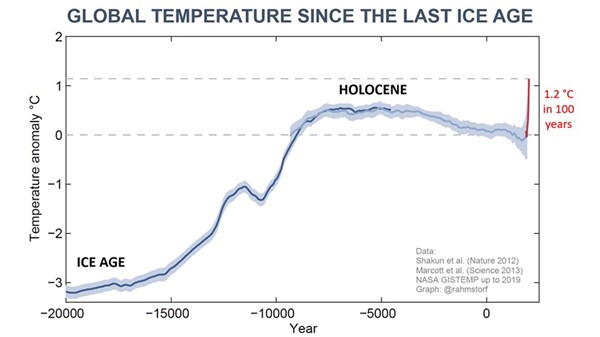
This graph goes back 20,000 years and starts at height of the last ice age and ends today.
Global temperature going back twenty thousand years, another hockey stick graph. Notice the stable temperature during the last 6-7,000 years, coinciding with the development of human civilization, and then a sudden sharp increase at the end.

I should say that at first, I believed myself that Dr. Mann was a fraud. As I took a deep dive into the topic and learned more about it, I came to realize I was wrong and that his critics were wrong, and that Michael Mann was right. Since his original hockey stick curve there have been several dozen hockey stick curves produced by other independent researchers, often going back further in time, and they all confirm his findings. Today the scientific community has entirely accepted the hockey stick as correct. Despite this fact Dr. Mann is still being attacked by various organizations and individuals. Typically graphs put people to sleep, but this one started a war that is still ongoing. Charles Darwin was also attacked for his scientific discoveries and now history is repeating itself.

Anyway, about this book. This book mentions the hockey stick curve, but it is not the focus of the book. This book goes back 4.5 billion years and explains what is known about past climate which is surprisingly much. Science does not know everything, otherwise it would stop, but it knows a lot. He discusses various past climate shocks, various climate cycles, extinction events, etc., and analyses what past climate means for us today. There is bad news and there is good news. The book is packed with information and data, but I loved it.

  • Hardcover –  Publisher : PublicAffairs (September 26, 2023), ISBN-10 : 1541702891, ISBN-13 : 978-1541702899, 320 pages, Item Weight ‏ : ‎ 1.15 pounds, dimensions ‏ : ‎ 6.4 x 1.06 x 9.55 inches, it cost $19.59 on US Amazon. Click here to order it from Amazon.com.
  • Paperback –  Publisher : PublicAffairs (October 15, 2024), ISBN-10 : 1541702905, ISBN-13 : 978-1541702905, 320 pages, Item Weight ‏ : ‎ 1.11 pounds, dimensions ‏ : ‎ 5.5 x 0.8 x 8.25 inches, it cost $19.99 on US Amazon. Click here to order it from Amazon.com.
  • Kindle – Publisher : PublicAffairs (September 26, 2023), ASIN : B0BRJ6SCFM, 392 pages. It is currently $18.99 on Amazon.com. Click here to order it from Amazon.com.
  • Audiobook – Publisher : PublicAffairs, Release date September 26, 2023, ASIN : B0BWKCPSDY, Listening length 9 hours and 38 minutes. Click here to order it from Amazon.com.
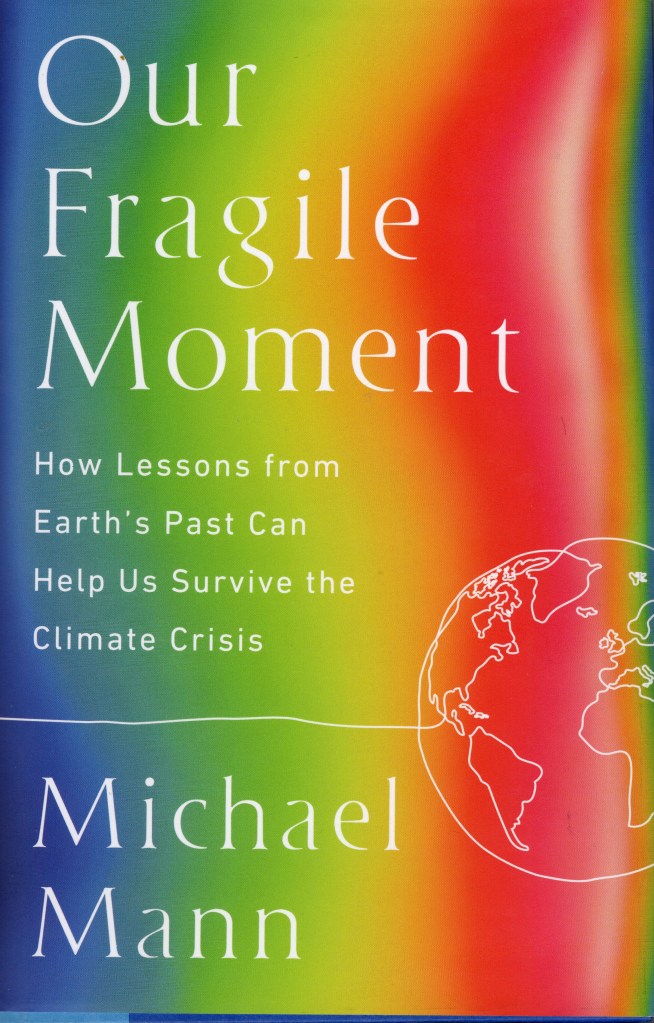
Rainbow background going from blue on the left to red on the right. This illustrates earth’s warming climate.
Front cover of Our Fragile Moment: How Lessons from Earth’s Past Can Help Us Survive the Climate Crisis by Michael E. Mann. Click here or the picture to visit the Amazon.com page for the Hardcover version of the book.

Amazon’s description of the book (from the Amazon page)

In this sweeping work of science and history, the renowned climate scientist and author of The New Climate War shows us the conditions on Earth that allowed humans not only to exist but thrive, and how they are imperiled if we veer off course.

For the vast majority of its 4.54 billion years, Earth has proven it can manage just fine without human beings. Then came the first proto-humans, who emerged just a little more than 2 million years ago—a fleeting moment in geological time. What is it that made this benevolent moment of ours possible? Ironically, it’s the very same thing that now threatens us—climate change.

The drying of the tropics during the Pleistocene period created a niche for early hominids, who could hunt prey as forests gave way to savannahs in the African tropics. The sudden cooling episode known as the “Younger Dryas” 13,000 years ago, which occurred just as Earth was thawing out of the last Ice Age, spurred the development of agriculture in the fertile crescent. The “Little Ice Age” cooling of the 16th-19th centuries led to famines and pestilence for much of Europe, yet it was a boon for the Dutch, who were able to take advantage of stronger winds to shorten their ocean voyages.

The conditions that allowed humans to live on this earth are fragile, incredibly so. Climate variability has at times created new niches that humans or their ancestors could potentially exploit, and challenges that at times have spurred innovation. But there’s a relatively narrow envelope of climate variability within which human civilization remains viable. And our survival depends on conditions remaining within that range.

In this book, renowned climate scientist Michael Mann will arm readers with the knowledge necessary to appreciate the gravity of the unfolding climate crisis, while emboldening them—and others–to act before it truly does become too late.

This is my five-star Amazon review for Our Fragile Moment by Dr. Michael Mann

A Palaeoclimatological Journey Accompanied by Intelligent Analysis And What It Means for Us

In this book the author takes us on a journey through earth’s climate history. He discusses the climate during the different eras and periods of earth’s history starting with the Hadean and Archean and ending with the Holocene. There have been extreme changes in the climate, caused by shocks to the system, followed by mass extinctions. The many devastating large swings in the climate often took hundreds of thousands of years or millions of years to run their course. Species disappeared while species better adapted to the new climate evolved. As he gets to modern times, the Holocene, he gives us more detail and analyzes the climate for much shorter intervals. It is clear from his discussion on more recent climate that climate has shaped us, and we have shaped climate.

He also discusses the various climate cycles that effected our climate in the past as well as currently, including the Milankovitch cycles, such as the eccentricity of Earth’s orbit, earth’s obliquity and precession. Other cycles he is discussing include the El Niño–Southern Oscillation, the north Atlantic Oscillation (NAO), and the Atlantic Multidecadal Oscillation (AMO), which as it turns out does not exist. The purpose of all this is to determine what this means for our civilization and the unnatural and extremely rapid warming that we are causing today primarily via our carbon emissions.

I found some of the climate shocks he discussed quite interesting. During the Paleoproterozoic era 2 billion years ago the biological innovation of oxygen-generating photosynthesis led to a rapid drawdown on atmospheric carbon dioxide and in addition the positive feedback from the increased albedo from the ice buildup turned the planet into a snowball. This was reversed as the ice prevented absorption of carbon dioxide. Eventually the carbon dioxide concentration in the atmosphere reached 200 times of what it is today, and the snowball rapidly melted, and the carbon dioxide concentration settled again. The greatest extinction event in geological history was the Permian-Triassic extinction event 250 million years ago when 90% of all species on Earth perished. It was primarily caused by a substantial release of carbon dioxide from Siberian Trap volcanic eruptions.

Another interesting climate shock was the dinosaur-killing K-Pg event 66 million years ago. An asteroid collision made Earth’s climate much colder, and all large species died out. It took four million years for flora and fauna to reestablish itself but with new species. The losers were the non-avian dinosaurs, and the winners were the mammals and the avian dinosaurs or birds. The PETM event 55 million years ago was triggered by carbon-enriched volcanic eruptions that led to a rapid increase in temperature of 7-11 Fahrenheit in just 10,000 years. This event is eerily similar to what we are experiencing now, except our warming is even faster. He also describes the cooling that happened 50 million years ago because of the forced uplift of the Himalayas due to the collision of India with Eurasia. For more recent times he is discussing the various glacial and interglacial periods (ice-ages), driven by Milankovitch cycles.

His chief goal with his paleoclimate discussion is to find out what the paleoclimate record implicates for us. For example, establishing what is the equilibrium climate sensitivity (ECS), which is the increase in Earth’s average surface temperature that occurs after the climate system fully adjusts to a sustained doubling of atmospheric carbon dioxide. Another is Earth System Sensitivity (ESS), which describes how much warming you ultimately get in response to a doubling of CO2, after all the slow-response feedback mechanisms fully unfold.

Yet another climate feature is the existence of hysteresis loops, in which the value of a physical property lags behind changes in the effect causing it. For example, setting back CO2 to what it was before an event may not bring temperatures and climate back to what it was for 100,000 years. He is also analyzing the risk for ocean conveyor disruption and the risk for future methane bombs. The latter, which turns out to be low risk. Another piece of good news is that we are not at risk of a run-away greenhouse effect like the one Venus underwent two billion years ago. His conclusions are a mixed bag of good news and bad news. I can add that naturally he is also discussing the hockey-stick curve. He was the inventor of it.

The book contains a lot of information, and it sometimes features complex discussions, but if you read the book carefully it makes perfect sense. It is logical, intelligently written, and avoids hyperbole and exaggerations. However, if you are not very familiar with science and have a hard time with complexity it may not be the book for you. He stresses that the greatest threat to meaningful climate action is no longer denial, but despair and doomism, premised on the flawed notion that it is too late to do anything. We will not all perish from climate change, but neither is it a good thing. The facts justify immediate and dramatic action, but we are not going to fall off a cliff. Climate change is a crisis, but a solvable crisis. The question is how much damage we will do to future generations.

I highly recommend this brilliant, and fact filled deep dive into paleoclimate and what it means for humanity today, to anyone willing and able to tackle some complexity.
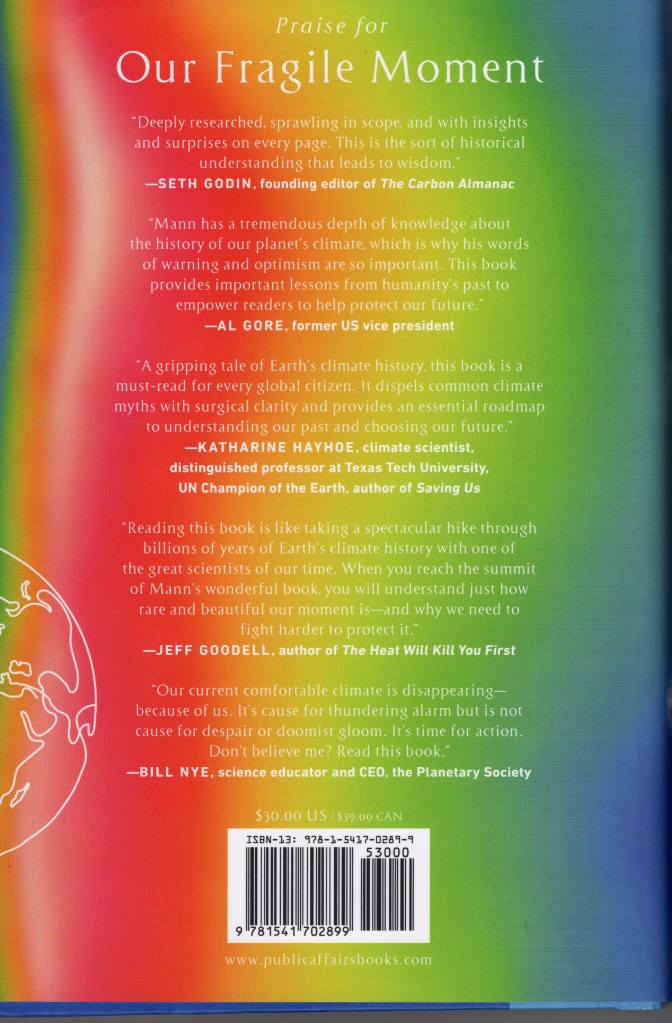
Rainbow background going from blue on the right to red on the left. This illustrates earth’s warming climate. The back is also filled with endorsements.
Back cover of Our Fragile Moment: How Lessons from Earth’s Past Can Help Us Survive the Climate Crisis by Michael E. Mann. Click here or the picture to visit the Amazon.com page for the Paperback version of the book.

About the Author

Dr. Michael E. Mann, famous for the hockey stick curve, is Presidential Distinguished Professor in the Department of Earth and Environmental Science at the University of Pennsylvania, with a secondary appointment in the Annenberg School for Communication. He is director of the Penn Center for Science, Sustainability, and the Media (PCSSM).

Dr. Mann has received a number of honors and awards including NOAA’s outstanding publication award in 2002 and selection by Scientific American as one of the fifty leading visionaries in science and technology in 2002. He contributed, with other IPCC authors, to the award of the 2007 Nobel Peace Prize. He was awarded the Hans Oeschger Medal of the European Geosciences Union in 2012. In 2020 he was elected to the US National Academy of Sciences. He is the author of more than 200 peer-reviewed and edited publications and five books. His research involves the use of theoretical models and observational data to better understand Earth’s climate system.

The Silurian Hypothesis

For all science fiction fans, the book also featured an idea that would make a good science fiction story.  55 million years ago there was an exceptionally fast warming of 9 degrees Fahrenheit (5 degrees Celsius) that was in many regards similar to what is happening now. It was not quite an extinction event, that requires more than 75% of all species to be gone in less than 2 million years, but it was catastrophic. This event is referred to as the PETM event. I can add that we are warming the earth at a rate 10 times faster today.

If we were to destroy ourselves what would a future species know about us 55 million years from now? Well, all traces of our civilization would be gone and finding fossils of us would be very likely despite our large population, because fossilization events are extremely rare. What would be left of us are the traces of the global warming we caused and long-lived chemicals such as nitrates from our fertilizers. That’s exactly what the PETM event has left behind, signs of a sharp increase in CO2, global warming and a sudden spike in nitrates that remain unexplained. Could it be that we are not the first intelligent species on earth and that our predecessors caused global warming as well? Well, this was just entertaining speculation, not science, but could there be something to it?

What do you think of the Silurian Hypothesis?
Two Conservative Leaning Climate Advocates and one Independent

Responding once more to CCL’s (Citizen Climate Lobby) request to start conservations about climate change I am posting about three Conservative/Republican friends who are engaged in climate change solutions. Well, Bob Ingliss, the former Republican Congressman from South Carolina is not a personal friend, but I’ve met him, seen him speak several times, and I am a member of his organization. The other two, Larry Howe and Jack Zimanck are personal friends, and they have blogs (but not on word-press). I am posting this with their permission. If you don’t mind perhaps, you could check out their blogs a little bit (links below).

I should mention that Citizen Climate Lobby is a non-partisan / bipartisan volunteer organization promoting climate solutions. CCL does a lot of things but one of our main focuses is to speak to politicians, which is where “Lobby” comes from. However, we are just regular citizens / constituents. We don’t have money, unlike other lobbyists, not even donuts, but we vote, and we are many (200,000+). RepublicEN is an organization for Republican Environmentalists, and they are also promoting climate solutions.

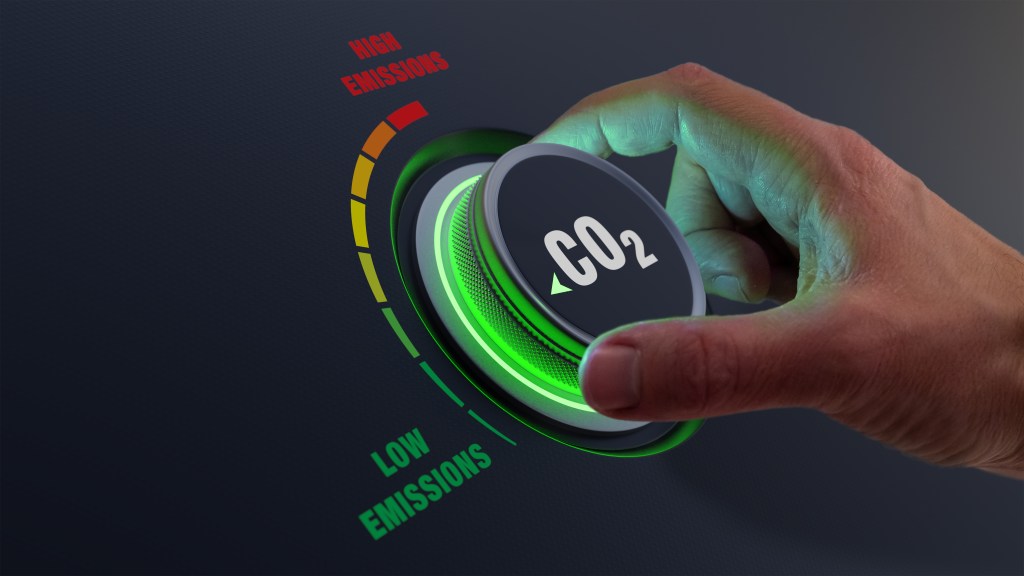
The photo is of a dial which can be used to decrease or increase CO2 emissions.
CO2 emissions dial. Shutter stock Photo ID: 1928699927 by NicoElNino

Larry Howe

Larry Howe is a retired electrical engineer and engineering manager and a lifelong conservative. He embraces free market climate solutions, and he volunteers for republicEn.org and Citizens Climate Lobby Conservative Caucus. After initially being skeptical about climate change, he took a deep dive into the topic/science. He came to realize that he needed to accept the science, and the fact that global warming is happening and that the cause is us. You can read about his climate journey here. This is the link to his home page .

Extract from Larry Howe’s Post My bottom line on Climate Policy

Life before harnessing energy from the combustion of fossil fuels was cold, dark, and short. We owe many of the benefits of our wonderful modern way of life to harnessing energy from burning fossil fuels. However, we now know that the accumulated CO2 from the burning of fossil fuels poses a grave threat to our well-being.

Human society has dumped trillions of tons of excess heat-trapping CO2 in the atmosphere over the last 100+ years by combusting hydrocarbons for energy. That excess CO2 doesn’t just go away. Each year about half of what is emitted adds to the atmospheric concentration which then persists for hundreds to thousands of years. The rest is redistributed from the atmosphere to the land and ocean which are reaching limits of what they can further sequester. CO2 concentrations in the atmosphere have increased 50% in the last 100+ years trapping more and more heat. We shouldn’t continue doing it…….

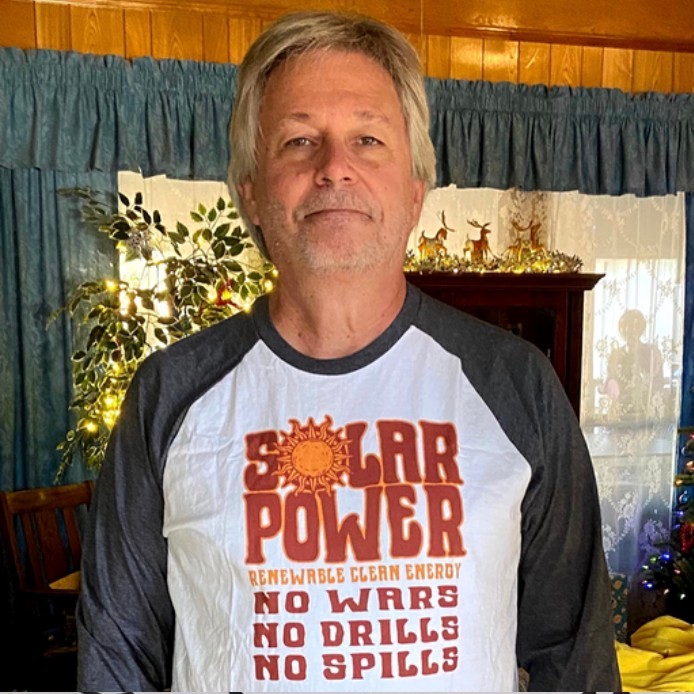
Larry how in his solar energy shirt. It says “Solar Power. Renewable Clean Energy. No Wars. No Drills. No Spills."
This is Larry Howe, a retired electrical engineer and manager. He is a lifelong conservative/republican who promotes climate solutions.

Jack Zimanck

Jack Zimanck is a retired business leader and consultant who is exploring how businesses can be part of the solution to climate change and environmental problems. He is not associated with any particular political ideology. This is what he says in his latest blog post Sustainable Growth | Challenges and Opportunities. The institution of business may be our most powerful force for positive change

Businesses of various types provide the food, shelter, water, energy, and sanitation that allows more people to live safe, comfortable lives than ever before. Business provides the entertainment, transportation, and technology we enjoy each day. In reality, business is the economic framework that enables life in the 21st century.

Yet, it is important to understand that this constant stream of goods, service, and benefits has also brought unintended consequences and challenges to our ability to sustain this remarkable bounty for current and future generations…..to read more click on the link above. This is the link to his blogs main page.

This is a photo of Jack Zimanck.in front of his bookshelf.
Jack Zimanck, retired business leader and business consultant focusing on how businesses can help solve the climate crises and other environmental problems.

Bob Ingliss

Bob Ingliss, a former Republican Congressman from South Carolina won his district in 1994 and 1996 by 70%. His interest in climate change began after he asked his 11-year-old son if he would vote for him, and he said no because his stance on climate change was bad. So, Bob Ingliss studied the subject, and he came to change his mind. He realized it was a real problem that we humans had caused, and he announced his new stance on the topic publicly. His son was happy. However, despite a 93.5% lifetime rating from the American Conservative Union and his endorsements from the NRA Political Victory Fund and National Right to Life Committee he lost his primary election in 2010. Republican primary voters felt that he had moderated his views. Bob Ingliss went onto found RepblicEN and the ECORight. You can read more about him here.

Bob Ingliss congressional portrait. He is shown in a black suit and a golden tie.
Former Congressman Bob Ingliss. From Wikipedia public domain.

Related Posts By Me

The Climate Journeys of Thomas and Larry

Banned on Amazon the Book Review That Recounted One Inconvenient Truth Too Many

Reviewing The Climate Casino by William D. Nordhaus

Citizen Climate Lobby is Calling to Action

Speaking to Politicians About Climate Change or Any Other Issue

Please go ahead and click on and read a little bit of Larry’s and Jack’s blogs.

Citizen Climate Lobby is Calling to Action

I am a volunteer for an organization called Citizen Climate Lobby, CCL for short. CCL is a grassroots bipartisan organization consisting of 200,000 volunteers from the entire political spectrum, from conservative, libertarian, independent, and liberal / left. Considering that we are volunteers and just regular people the part of our name that says “Lobby” may seem out of place. However, it refers to the fact we visit congressional offices and talk to politicians. We don’t bring any gifts, like real lobbyists, not millions of dollars, not even donuts. What we bring is useful information, our voices, community leaders, our votes, and gratitude and respect for our representatives, whether we agree with them or not.

A man wearing signs saying volunteer
Citizens Climate Lobby, or CCL, is volunteer organization seeking to create political will for climate solutions. Photo by Mikhail Nilov on Pexels.com

I am the liaison for Senator Ted Cruz office. Despite him not being a “climate champion” he  voted Yes on one of the resolutions we supported, the Growing Climate Solutions Act (Senate bill S.1251, house bill HR.2820). They typically meet with us 3 or 4 times a year and they have never turned down a meeting request. We have a good relationship with the vast majority of congressional offices despite the partisanship that’s ripping congress apart. I remember having a really good meeting in one office then having another great meeting with a congress woman who told us about how evil the guy we had just met was. It felt funny getting along well with two people who seemed to hate each other (or maybe that’s just how they talk). So, in addition to the climate question, I think we are helping to heal some of the divisions in congress as well.

A note about the bill numbers. Any law/resolution must pass both houses and they have different numbers in each house even though they are essentially identical. For the senate it is S.####, and for the house HR.####. Even though a bill passes both houses there are things like the filibuster in the senate and Presidential vetoes, so passing a bill is not easy.

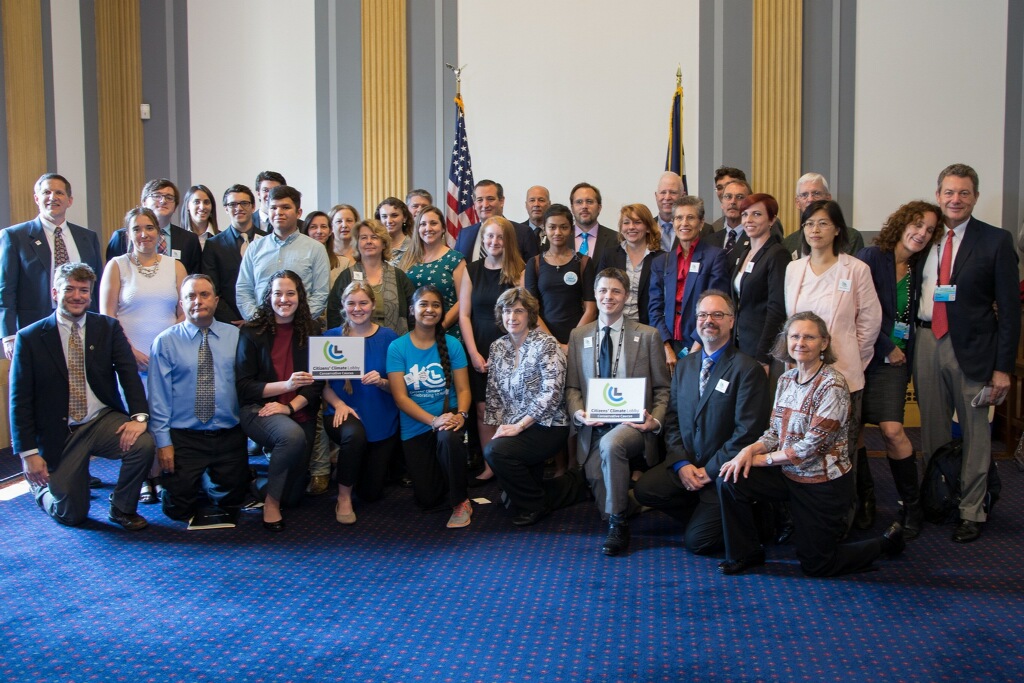
40 people with Senator Ted Cruz
Senator Ted Cruz TXJR with Citizens Climate Lobby in 2017. The senator is standing immediately to the right of the American flag, and I am standing immediately to the left of the American flag. My wife and daughter are also there.

I should say that I used to be quite “skeptical” of “global warming”. I knew, of course, that greenhouse gases cause a warming effect (like a blanket), that’s just hundreds of years old basic science, like we breathe oxygen or that the pressure in an enclosed gas container will increase when heated. However, I thought that the issue was politicized, and that there were natural explanations for the warming such as the sun, orbital cycles, cosmic radiation, volcanoes, etc. I was misinformed because at the time I almost exclusively read rightwing media and literature.

The sharp uptick at the end is not natural, for example, because the distribution of the warming vertically, geographically and temporally (the fingerprint) matches exactly the greenhouse gases we’ve released and contradicts natural causes.

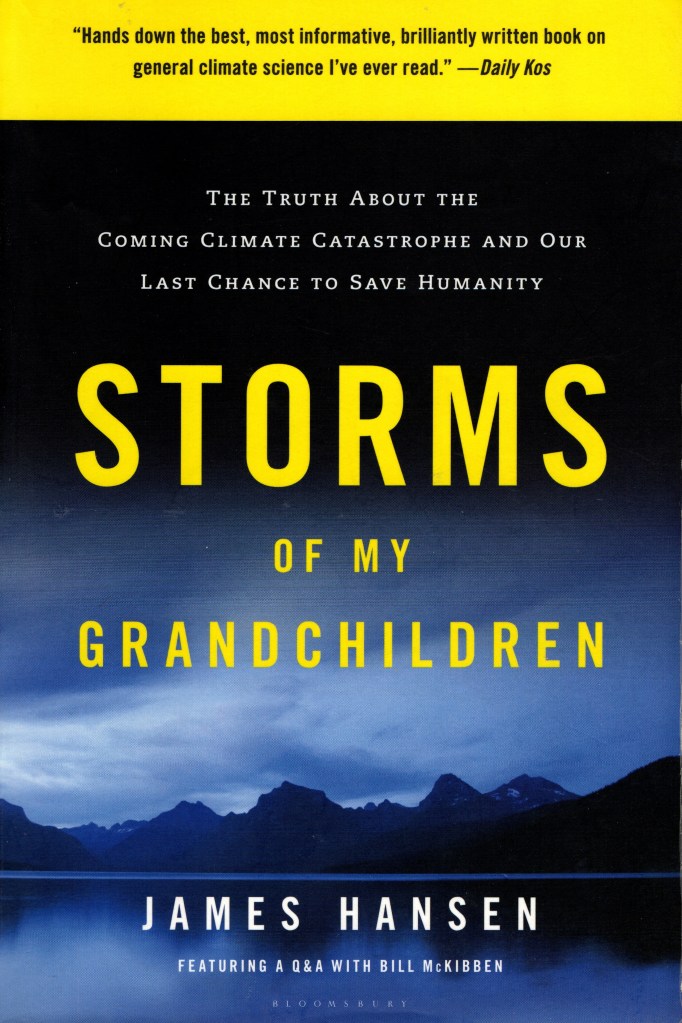
After studying scientific literature and keeping an open mind I came to realize that I was wrong. It had been known for decades that Global Warming, or Climate Change, as it would be called later on, was mostly caused by carbon emissions from fossil fuels, and scientists knew that it was a serious problem. Not necessarily a “we are all going to die” issue, but a serious problem that we should not hand over to our children and grandchildren without trying to mitigate. After reading the book “The Storms of my Grand Children” by the physicist Dr. James Hansen I decided to volunteer. I wanted a non-political organization, if possible, so I chose the Citizens Climate Lobby. You can read more about my Climate Journey here.

The front cover features the title on the background of a mountainous landscape.
Front cover of the Storms Of My Grandchildren by Dr. James Hansen.

CCL is focused on four areas.

Carbon Pricing

CCL’s favorite carbon price policy is what is called a carbon fee and dividend. There is currently a resolution in the house, the Energy Innovation Act, HR.5744 which implements this policy. A senate version S.#### has not yet been introduced.

  • Carbon Fee: This policy puts a fee on fuels like coal, oil and gas. It starts low and grows over time.
  • Carbon Dividend: The money collected from the carbon fee is allocated in equal shares every month to the American people to spend as they see fit. The carbon fee would raise the prices on carbon intensive products but since the money is returned to households the dividend would more than make up for the shortfall. This would financially benefit low-income families, specifically the lower 2/3 of income.
  • Border Carbon Adjustment: To protect U.S. manufacturers and jobs, imported good will pay a border carbon adjustment, and goods exported from the United States will receive a refund under this policy. This also allows American businesses to reap the rewards of their carbon advantage over other countries.
Photo by Pixabay on Pexels.com

Healthy Forests

America’s natural resources — forests, grasslands, wetlands and oceans — act as natural climate solutions by pulling carbon out of the air. We can manage these natural resources to maximize their climate change-fighting impacts. CCL has supported a number of forest or agriculture related bills in congress.

Photo by Rudolf Jakkel on Pexels.com

Building Electrification and Efficiency

By upgrading our homes and buildings to be electric and making them more energy efficient, we can save money and eliminate a major source of carbon pollution.

Photo by Kindel Media on Pexels.com

Permitting Reform

Building electrical powerlines is very complicated in the United States. Building a wind power station takes months, getting approval for a powerline can take decades. The bureaucracy is daunting. This is a big problem as we try to expand the use of renewables, but it is also a threat to our energy supply regardless of energy source. America’s transmission shortfall is contributing to grid outages across the country and inflating energy prices for American families and businesses.

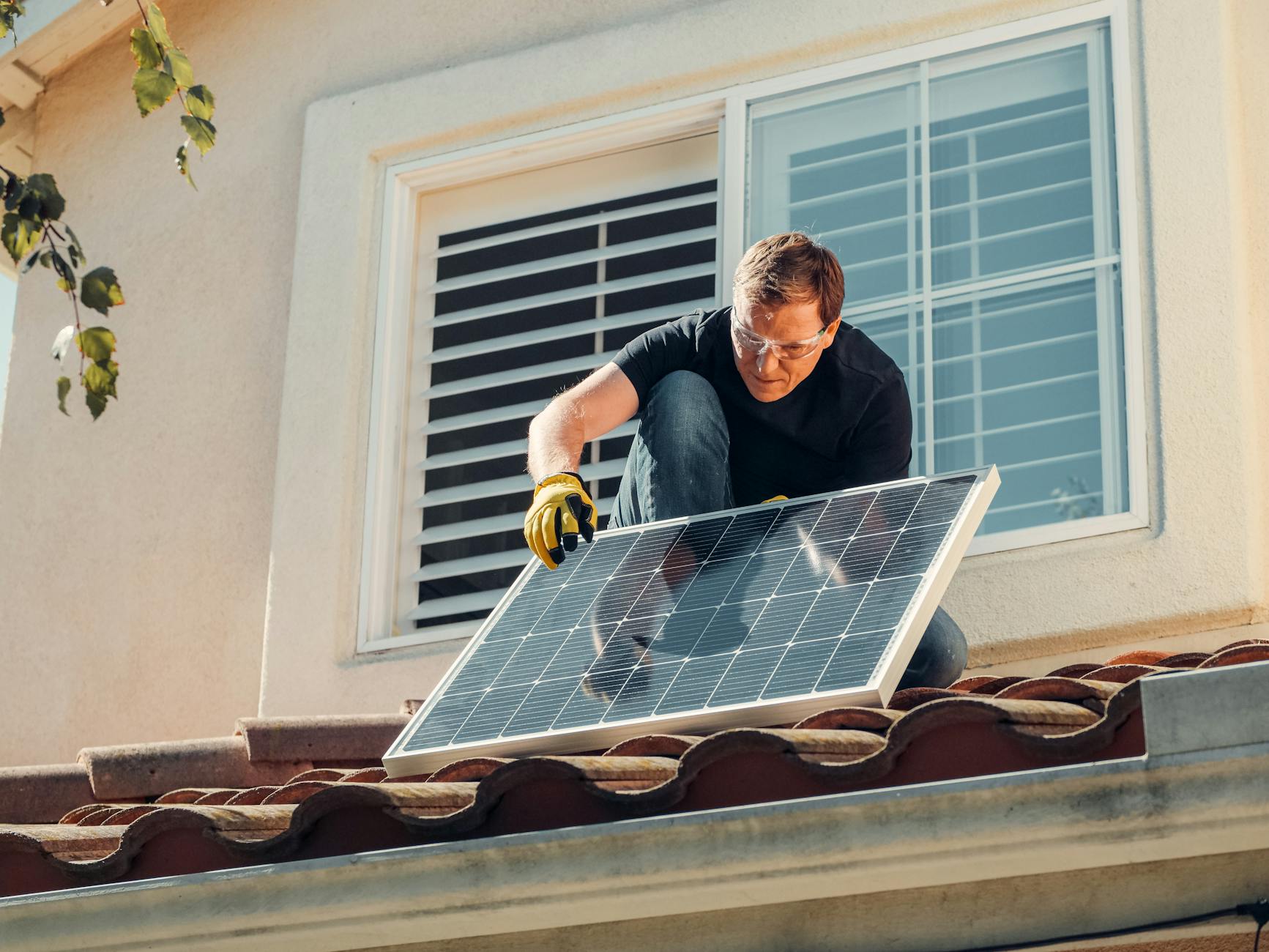
Photo by Ana-Maria Antonenco on Pexels.com

Permitting reform will make it possible to unlock the clean energy infrastructure that’s waiting to be built, and by getting that clean energy to American households and businesses. About half of the potential emissions reductions delivered by Inflation Reduction Act (IRA) in 2030 are lost if transmission expansion is constrained to 1% per year, and roughly one quarter are lost if growth is limited to 1.5% per year. There are bills in congress which address this, such as the the BIG WIRES Act (Senate version of the bill is S.2827, and house version is HR.5551). Note, CCL did not come out in support of IRA because it was a partisan bill, but many of us liked it.

The Conversation

More than 70% of Americans are worried about climate change. But most of us still avoid discussing it because we feel like it’s too political, too doom and gloom, or too overwhelming. But we can’t solve a problem if we don’t talk about it. Therefore, for the month of April CCL have requested that we volunteers initiate 25,000 climate conversations. So that is what I am doing here. Preaching is not conversation and therefore I invite you all to agree or disagree with me, and to consider the following questions.

Are you worried about climate change ?

Would you consider joining a climate organization ?

What’s your impression of CCL ?

What do you think about the four policy areas ? Would you like to add some ? Remove a policy area ?

Also ask me any questions