Solar Sail Spacecraft to Saturn

This is a Leonberger blog, but I also post about other topics including book reviews of books that I love and want to promote. With this post I would like to promote an exciting and imaginative science fiction book called The Solar Sea by David Lee Summers.

Strange new particles are detected that seem to be coming from Titan the largest moon of the planet Saturn. Whales change their songs in curious ways. As a result, a major space expedition to Saturn is launched. At the center of this book is a spaceship called Aristarchus named after an ancient Greek astronomer named Aristarchus who presented the first known model that placed the Sun at the center of the known universe with the Earth revolving around it.

I can add that the fact that Earth orbited the sun did not become common knowledge until much later because of Copernicus and Galileo Galilei. However, they were not the first to suggest it. On the other hand, the fact that earth was roundish or near spherical has been common knowledge for thousands of years, at least among educated people. About 2,300 years ago, Eratosthenes a Greek philosopher calculated the circumference of Earth and got very close. This history is explored in this blog post.

Below is an overview of the two formats of The Solar Sea

I should mention that even though this book (second edition) was released on Amazon in 2018 the story was completed by the author in 2004.

  • Paperback –  Hadrosaur Press (March 16, 2018), ISBN-10 : 1885093845, ISBN-13 : 978-1885093844, 206 pages, Item Weight : 9.6 ounces, dimensions ‏ : ‎ 5.5 x 0.52 x 8.5 inches, it cost $12.95 on US Amazon. Click here to order it from Amazon.com.

  • Kindle – Publisher : Hadrosaur Production (March 21, 2018), ASIN : B07BHFS2WV, 208 pages. It is currently $3.99 on Amazon.com. Click here to order it from Amazon.com.
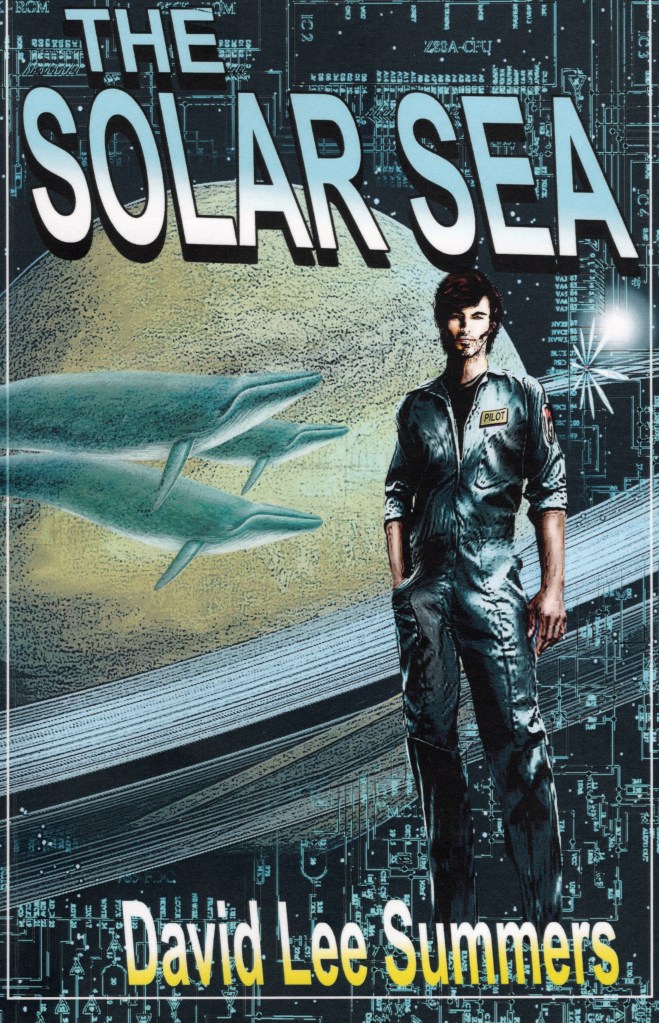
The front cover features Saturn with its rings, a man in a space suit and humpback whales.
Front cover of The Solar Sea by David Lee Summers. Click on the image to go to the Amazon page for the paperback version of the book.

Amazon’s Description of The Solar Sea

Whales around the world changed their songs the day scientists announced the discovery of powerful new particles around Saturn’s largest moon which could solve Earth’s energy needs. The Quinn Corporation rushes to build a solar sail space craft to unlock the secrets of these strange new particles. They gather the best and brightest to pilot the ship: Jonathan Jefferson, an aging astronaut known as the last man on Mars; Natalie Freeman, a distinguished Navy captain; Myra Lee, a biologist who believes the whales are communicating with Saturn; and John O’Connell, the technician who first discovered the particles. Charting the course is the mysterious Pilot who seems determined to keep secrets from the rest of the crew. Together they make a grand tour of the solar system and discover not only wonders but dangers beyond their imagination.

This is my Amazon review of The Solar Sea

Fun and Easy Hard Science Fiction

Solar Sea is a fast paced and imaginative hard science fiction story. Strange things are happening. Whale songs are changing into what seems to be binary code. Something strange is going on nearby Saturn’s moon Titan, and weird particles are discovered. Earth is facing an energy crisis that might be solved by the discovery of the new particles. A manned flight using a solar wind powered spaceship called Aristarchus is launched toward Saturn. The spaceship was named after Aristarchus an ancient Greek astronomer who presented the first known model that placed the Sun at the center of the known universe with the Earth revolving around it.

The author, an astronomer, clearly liked to keep the story both imaginative and scientifically plausible. He included drawings of the spaceship and explained how it worked. Despite being hard science fiction, the book is easy and lighthearted reading. Above all it is filled with adventure, mystery, and it is fast paced and captivating. Several plot elements and perhaps plot twists reminded me of my favorite film Interstellar, but this book was written in 2004 a decade before Interstellar. However, the story itself is quite different from Interstellar, and it features some quite surprising but fun plot twists.

The character development is well done but not overdone, and the sometimes-tense interactions between the characters are realistic and interesting. Some of the characters have some big secrets that they are hiding and seeing how this develops adds to the mysteries. I also loved the good feeling of the ending. This is a fun, creative and unique science fiction story that I highly recommend.

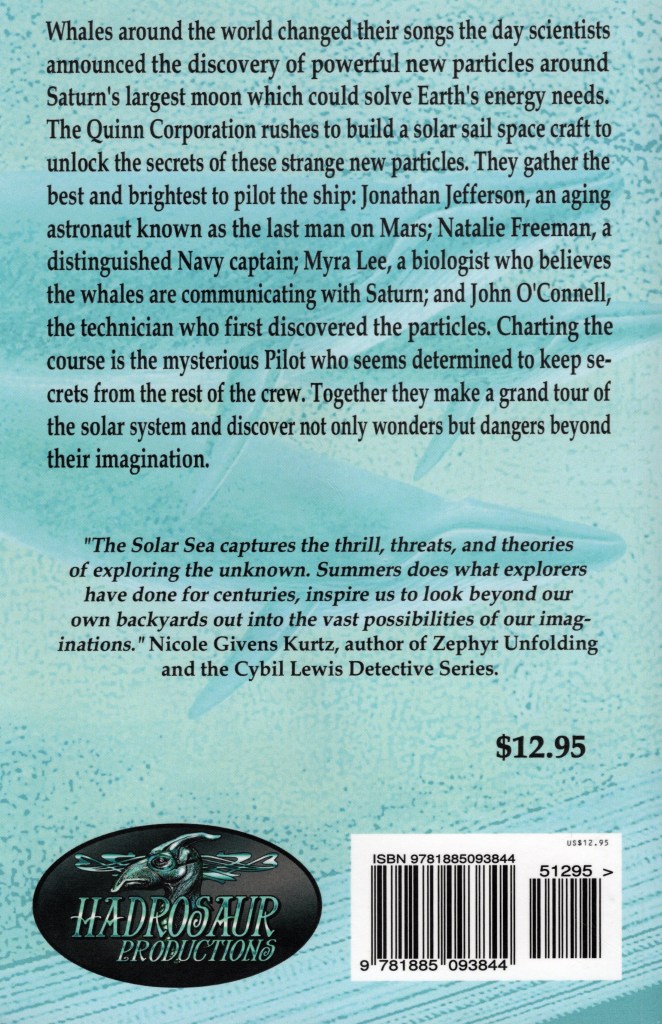
An overview of the book as well as a recommendation for the book, both written on a blue background.
Back cover of The Solar Sea by David Lee Summers. Click on the image to go to the Amazon page for the Kindle version of the book.

About the Author of The Solar Sea

David Lee Summers is an author, editor and astronomer living somewhere between the western and final frontiers in Southern New Mexico. He is the author of twelve novels. His short stories and poems have appeared in numerous magazines including Cemetery Dance, Realms of Fantasy, Star*Line, and The Santa Clara Review.

David also edited Tales of the Talisman Magazine for ten years. When he’s not writing, he operates telescopes at Kitt Peak National Observatory.

Click here to visit the author’s website

Click here to visit his blog

Click here to visit my blog post review for another book by David Lee Summers

Horror at the Observatory

The focus of this blog is Leonbergers but sometimes I post about books that are not about Leonbergers but that I want to promote. Halloween is over but I would like to promote a great thriller or horror story taking place at an astronomical observatory in New Mexico, The Astronomer’s Crypt by David Lee Summers. It is an action packed and fun story that is not as heavy as the previous book I reviewed (Mr. B. Gone).

  • Paperback –  Publisher : Hadrosaur Press (June 2, 2020), ISBN-10 : 1885093918, ISBN-13 : 978-1885093912, 256 pages, Item Weight : 11.7 ounces, Dimensions : 5.5 x 0.64 x 8.5 inches, it cost  $12.95 on US Amazon. Click here to order it from Amazon.com.
  • Kindle –  Publisher : Hadrosaur Press; 2nd edition (June 2, 2020), ASIN : B089LRV6BC, 258 pages, it costs $3.99 on US Amazon. Click here to order it from Amazon.com.
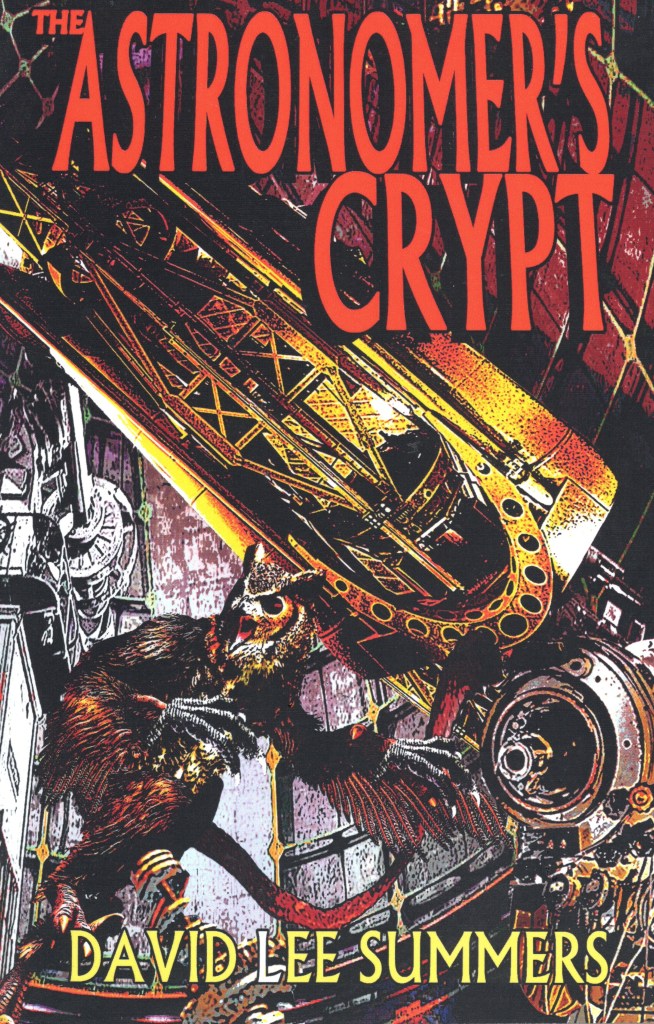
Complex machinery, a telescope, and a creature looking like a cross between an owl and a velociraptor.
Front cover of The Astronomer’s Crypt. Click on the image to go to the Amazon page for the paperback version of the book.

Amazon’s description of the book

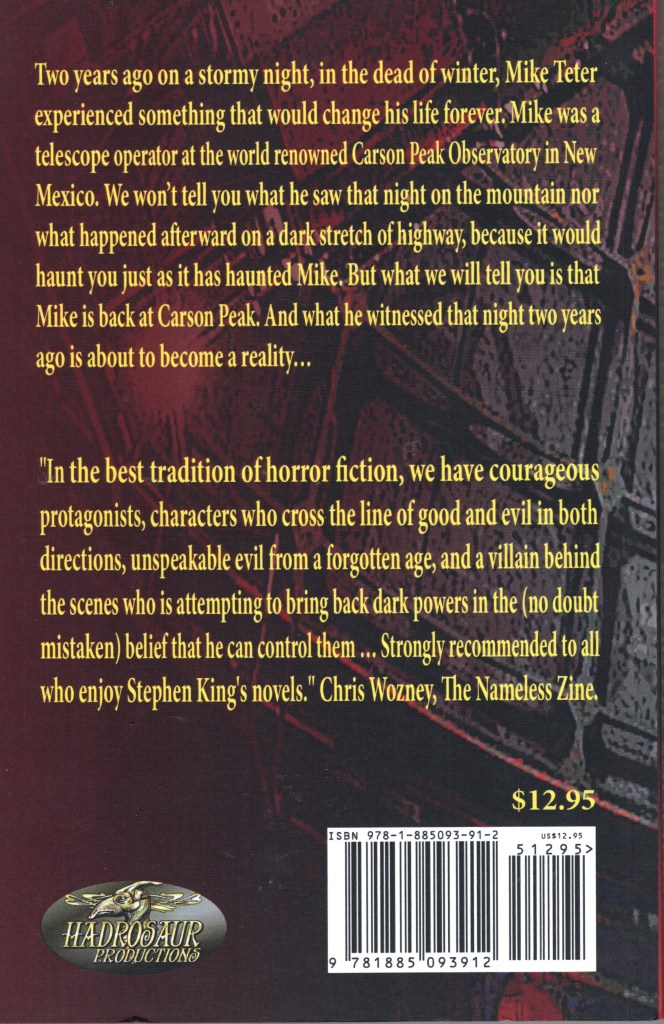
Two years ago on a stormy night, in the dead of winter, Mike Teter experienced something that would change his life forever. Mike was a telescope operator at the world renowned Carson Peak Observatory in New Mexico. We won’t tell you what he saw that night on the mountain nor what happened afterward on a dark stretch of highway, because it would haunt you just as it has haunted Mike. But what we will tell you is that Mike is back at Carson Peak. And what he witnessed that night two years ago is about to become a reality…

This is my Amazon five-star review for The Astronomer’s Crypt by David Lee Summers

An Intense and Fun Horror Thriller Taking Place in an Astronomical Observatory

The protagonist Mike Teter is a telescope operator at a fictitious observatory in New Mexico, the Carson Peak observatory. The Carson Peak observatory features two large buildings hosting a 5-meter and a 2.5-meter telescope. It is located on sacred land adjacent to an Apache reservation. There are caves nearby that host ancient sacred artifacts that should not be removed from the caves. The observatory is a labyrinthine and dangerous place that appears to be haunted. There are long corridors and hidden rooms. The observatory has a history of deadly accidents. For example, a Dr. Burroughs and a graduate student had been killed there.

One day Mike has what seems to be hallucinations. A large ancient evil creature looking like a mix of a dinosaur and a bird appears before him, and he encounters a talking coyote that gives him a warning about the sacred portals, he sees the ghost of Dr. Burroughs, and he witnesses the gruesome death of his friend the Astronomer Dr. Wallerstein. He’s had enough and he quit his job only to return to it at a later time. He thought that the things he saw were just nerves. However, this time things really go amiss. A creepy but wealthy lawyer by name of Mr. Vassago is trying to acquire sacred artifacts. There are drug cartel thugs, greedy adventurers, freak accidents, severe storms, hostage situations, ghosts, and ancient evil monsters. Mike Teter is faced with a very complicated and nightmarish situation.

The story is action packed, suspenseful and features a lot of plot twists. The characters are well-developed, relatable and multi-layered. The observatory is realistically described, and it is obvious that the author is very familiar with astronomical observatories. As you read this book you will learn something about observatories as well as the job of telescope operators. The author skillfully creates a chilling scenery of a dark haunted observatory, which brought my imagination to the spaceship in the movie Alien. It is obvious that the author is highly intelligent. A lot of things happened in just a few pages, and it was difficult to put the book down. It is one of the most intense and fun horror thrillers I’ve ever read, and I highly recommend it.

The back cover is black and red and has a description of the book.
Back cover of The Astronomer’s Crypt. Click on the image to go to the Amazon page for the kindle version of the book.

About the Author

David Lee Summers is an author, editor and astronomer living somewhere between the western and final frontiers in Southern New Mexico. He is the author of twelve novels. His short stories and poems have appeared in numerous magazines including Cemetery Dance, Realms of Fantasy, Star*Line, and The Santa Clara Review.

David also edited Tales of the Talisman Magazine for ten years. When he’s not writing, he operates telescopes at Kitt Peak National Observatory.

Click here to visit his website

Click here to visit his blog