A Teachers Memoir Featuring Great Stories and Information

This is a Leonberger blog, and every now and then I post reviews for Leonberger books. Some Leonberger books I love and some I don’t think are as good. Sometimes I also post reviews for other kinds of books but when I do it is books that I love and that I want others to read. Today I am posting a review for a book that I loved and that I think you should read, “They Call Me Mom: Making a Difference as an Elementary School Teacher” – by Pete Springer. This is a teacher’s memoir featuring a lot of great stories but also important insights and information valuable to both teachers as well as parents.

  • Paperback –  Publisher : Outskirts Press (July 16, 2018), ISBN-10 : 1977200052, ISBN-13 : 978-1977200051, 178 pages, Item Weight ‏ : ‎ 8.6 ounces, dimensions ‏ : ‎ 6 x 0.38 x 9 inches, it cost $12.42 on US Amazon. Click here to order it from Amazon.com.
  • Kindle – Publisher : Outskirts Press, Inc. (September 23, 2019), ASIN : B07YBL8DPY, 169 pages. It is currently $2.99 on Amazon.com. Click here to order it from Amazon.com.
Picture of happy children sitting at their desks and raising their hands.
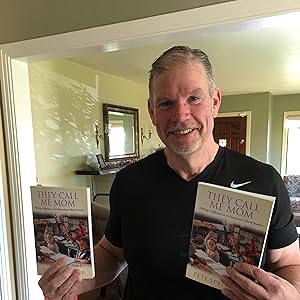
Front cover of They Call Me Mom. Click here or the picture to visit the Amazon.com page for the paperback version of the book.

Amazon’s description of the book

Who Will You Inspire Today? Teachers face this challenge and responsibility each day, but in the process, the author discovers that his students can also have a profound influence on him. Pete Springer takes you on his memorable thirty-one-year journey in education as an elementary school teacher and offers the many valuable life and teaching lessons he learned along the way. Get ready to laugh out loud at some of the humorous and memorable experiences that all teachers face, feel inspired by the inherent goodness of children, and appreciate the importance of developing a sense of teamwork among the staff. Learn valuable tips for working with children, parents, fellow staff members, and administrators.

This book is ideal for young teachers, but also a reminder to all educators of the importance and responsibility of being a role model. This book is a must-read for all new teachers and those teachers that need a reminder they are human! Mr. Springer educates others in his easy-to-read, story-like, first-hand manuscript. You will laugh, cry, and get motivated to be the best educator you can. After reading this, I have a better outlook on relationships with my colleagues and am reminded to savor every moment. -Tami Beall (Principal, Pine Hill School).

This is my Amazon review of They Call Me Mom by Pete Springer

The Beauty and Challenges of an Underappreciated Profession

There is a joke. There are three reasons to become a teacher, June, July, and August. I used to think that was funny until my wife became a teacher. She was a teacher for about 5-6 years. During this time I learned that teachers don’t have the entire summer off, that they work long hours, often 60hrs a week, and that they have to handle a lot of very difficult situations and circumstances, all while getting a salary that is significantly less than other professionals with a similar level of education. I also learned from her experiences as a teacher as well as a parent of three children that teachers are invaluable and very appreciated by the children as well as by many parents but unfortunately underappreciated by some people and perhaps by society.

In this book the author describes his journey to become a teacher and his journey as a teacher. He recounts issues with setting up the classroom, working with students, some coming from very difficult home environments, helpful and unhelpful parents, colleagues and administrators, and handling discipline. Therefore, I believe this book is invaluable to new teachers as a practical problem-solving guide. However, I believe the book is also very valuable to parents. A lot of parents don’t understand that they need to be involved in their children’s education as helpful partners to the school and as positive role models. This book offers insights into why and how.

Teachers sometimes encounter some quite tricky situations. For example, two boys get into an altercation because one boy tells the second boy that he is going to hell because his family is not going to church. My instinct would be to tell the first boy that is an absurd belief and a terrible thing to say. However, that would be contradicting the belief system of the parents of that boy. So, you have to deal with it differently. An enraged parent makes a scene at the school because her kid told her that you said something at school that she disagrees with, but you never said this. How do you handle it? What about a father handing over divorce papers to his wife during a parent-teacher conference? What about parents getting arrested by the police in front of their kid? The author handles these tricky situations brilliantly and professionally. He dealt with challenges and provocations with wisdom and restraint. I don’t think I would have been able to handle these situations as well. I believe the solutions he had for the various examples he gives might be very helpful to other teachers.

Pete Springer was clearly a very competent and thoughtful teacher who loved his job despite all the difficulties, and I think we can all learn from what he has written in this book. He recounts a lot of anecdotes, which he narrates with humor and intelligence. The book is interesting and very well written. It is a real page turner. It also has an important message for all of us. The education of our children is essential for the future of our nation. Unfortunately, it is often held hostage by political fads and bureaucrats with little understanding of the realities facing the educators. Teachers typically stay 7 years in their profession and fewer young people are becoming teachers because they see that the teaching profession is underappreciated and underpaid. We need to listen to the teachers more. In summary, this is a delightful, interesting as well as important read that I highly recommend to both new teachers and parents of school children.
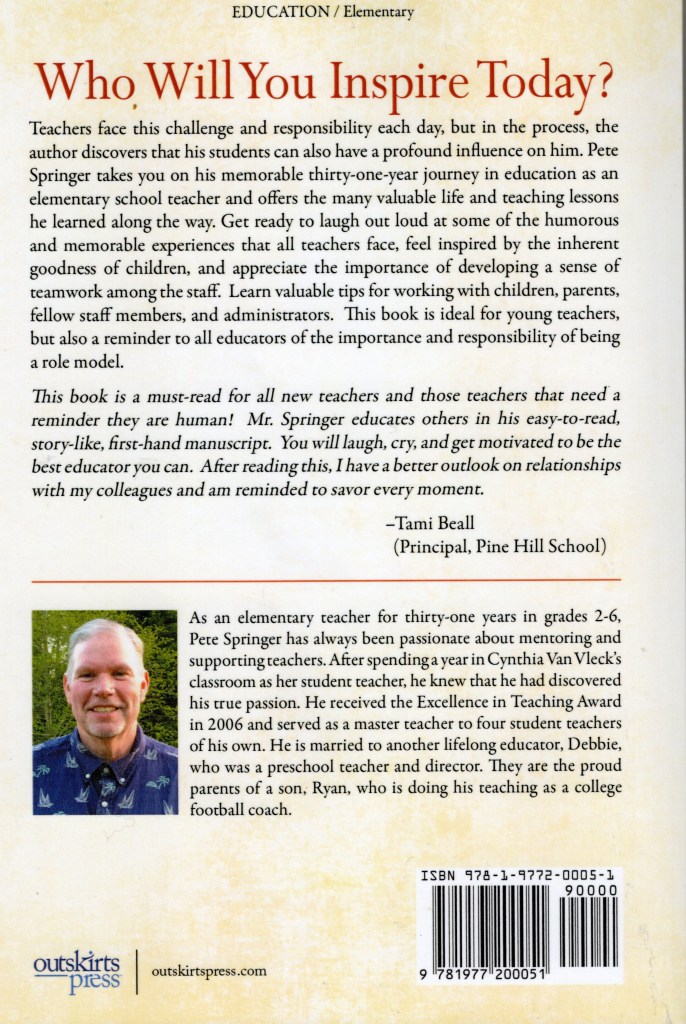
Back cover of They Call Me Mom. Click here or the picture to visit the Amazon.com page for the kindle version of the book.

About the Author

I’m a retired elementary teacher (31 years) who will always be a strong advocate for children, education, and teachers. My favorite thing to do as a teacher was to read to my students, and now I’m following my heart and writing children’s books for middle grades.

Amnesia in Garmisch-Partenkirchen and Statistical Mechanics

I read today that Elon Musk said that “memory loss is a thing of the past”. It was an advert for a drug. True or not, in the past I’ve had severe memory loss. At the age of 22 I had Amnesia as a result of a ski accident in Garmisch-Partenkirchen in Bavaria in Germany. But I remember it as if it was yesterday. So, in my case you can say that “memory loss is a thing of the past”.

Image showing a disintegrating brain
I had what is called post traumatic amnesia, which fortunately is temporary. Shutterstock ID: 1685660680 by MattL_Images

Garmisch-Partenkirchen is a beautiful Bavarian town, and it is one of the most famous German ski resorts. Zugspitze Germany’s highest mountain is nearby Garmisch-Partenkirchen providing for an impressive scenery. I was there with a large group of Swedish friends, and we stayed at a youth hostel. As is typical for a youth hostel men and women were separated. What was a bit unusual were all the loudspeakers.

Photo of Zugspitze
Zugspitze Germany’s highest mountain. Photo by op23 on Pexels.com

Achtung! Achtung. Sei jetzt ruhig.

At 10:00PM on our first evening at the youth hostel the loudspeakers came on and someone started shouting “Achtung! Achtung. Sei jetzt ruhig. Alle Gäste müssen gehen und sich die Zähne putzen. Musik ist verboten. Die Lichter beginnen zu dimmen.” We had to be quiet and go brush our teeth. The lights started dimming and women and men had to go to their quarters. The loudspeaker came on every now and then barking orders at us in German and all windows and doors were locked electronically. Being from Sweden we followed orders, but we were laughing about it. Suddenly new voices started shouting in the loudspeaker. It was younger sounding voices. It was still in German but this time we were told to rebel against the hotel management, we were told to refuse to go to bed, and they started singing fighting songs in German. Then, suddenly the loudspeakers went quiet. The hotel management was back. We all had to go to bed. Well, it was budget lodging after all.

The town of Garmisch-Partenkirchen. Photo by op23 on Pexels.com

The Ski Accident

What happened the next day I do not remember myself, but this is what I have been told. I decided to go down an icy double black diamond slope despite the sign saying that the conditions were dangerous. I fell badly, hit my head (I had no helmet), and I got a severe shoulder displacement. My arm was hanging on my back. I went looking for my skis and tried to put them back on, but some Germans came down to stop me. They were screaming at me and calling me crazy. An ambulance was called, and they sent snowmobiles to pick me up. However, the snowmobiles were unable to get there so they got a pist-machine to get me instead. I had no pain, but I was confused, and I discovered my severe shoulder displacement about 10 times before I got to the hospital. I was equally shocked every time I noticed the condition of my arm. I had no short-term memory, and I had forgotten my friends and most other things.

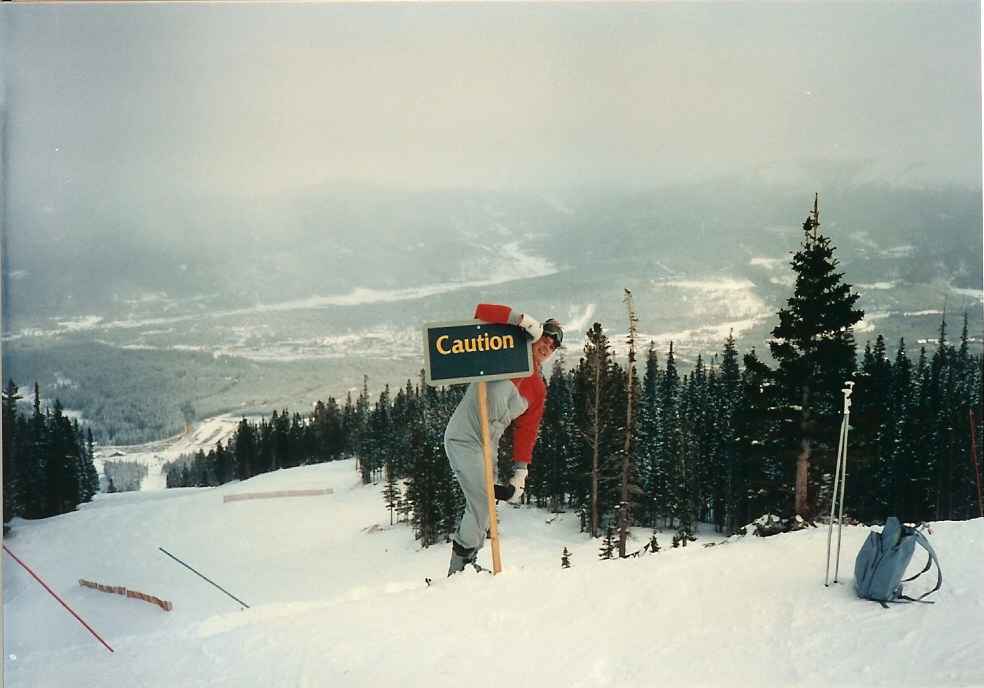
Me standing in the ski slope in Breckenridge leaning on a sign that says “Caution”
This is me in the ski slope when I was young. This is not Garmisch-Partenkirchen, it is Breckenridge, Colorado, but I don’t have any photos of Garmisch-Partenkirchen.

My memories come back

The next 2-3 days after the accident are essentially gone. However, I remember my friends coming into my room asking me questions such as “what’s my name?”, “do you remember where we are?”. I kind of liked all the attention I got but I understood that something was not right. No one knew whether I would ever get my memory back and going though immigration and customs might be an issue when you are, well out of it. The leader and organizer of the trip was very upset. However, my memories came back very quickly within just a few hours on the second or third day of amnesia. I have to admit I was happier when I couldn’t remember anything. I can add that my left arm was in a cast.

Photo of a brain, a lightbulb, on purple background
My memories and my brain came back to normal. Photo by KATRIN BOLOVTSOVA on Pexels.com

A shocking discovery of what’s under my bed

Under my bed I found a thick book on Statistical Mechanics. At first, I did not know what it was, but then I unfortunately remembered. I had a final exam in Statistical Mechanics after our vacation. Statistical mechanics is a mathematical framework that applies statistical methods and probability theory to large assemblies of microscopic entities. More specifically, you do statistical calculations over large sets of atoms and molecules to figure out the macro condition of the corresponding gas or material. For example, temperature corresponds to the average kinetic energy of atoms, entropy is the natural logarithm of the number of real microstates corresponding to the gas’s macrostate, often loosely referred to as the disorder of the system.

Picture showing molecules of various sizes moving fast
In 1905 Albert Einstein proved the existence of molecules and atoms using statistics and an observed phenomenon called Brownian motion. Shutterstock ID: 2334052703

Statistical Mechanics includes classical Statistical Mechanics as well as its Quantum Mechanical counterpart, which is a lot more abstract and complicated. The class I was taking covered both. Some important scientists in the field are James Clerk Maxwell, Ludwig Boltzmann, Paul Ehrenfest, Albert Einstein, and Satyendra Nath Bose. If you love statistics and complicated mathematics, then Statistical Mechanics might be for you but more likely it will just kill your enthusiasm.

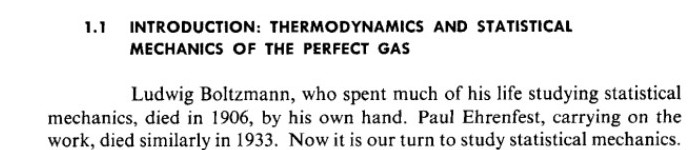
Ludwig Boltzmann, who spent much of his life studying statistical mechanics, died in 1906, by his own hand. Paul Ehrenfest, carrying on the work, died similarly in 1933. Now it is our turn to study statistical mechanics.
The epic opening of the first paragraph in David L. Goodstein’s States of Matter, a textbook on Statistical Mechanics.

My Exam

Once I was back in Sweden, I went to see my professor, and I explained the situation to him: “hello professor, I had a ski accident, hit my head, and I lost my memory. My amnesia made me forget statistical mechanics.”. He could also see that my left arm was in a cast. I said, “could I take the exam a little later?” He asked me “are you right-handed or left-handed?” I said, “I am right-handed”. The professor answered, “well then you take the exam on time like everybody else”. It wasn’t what I wanted to hear but I took it and I passed but not with flying colors.

Have you had Amnesia?

If you were a teacher, would you accept amnesia as an excuse for postponing an exam?

Speak 25 Languages in One Hour

I’ve got a number of hobbies, one of them being learning French. Back in December I took and passed the DELF / CEFR B1 level language test in French. The CEFR is a European standard for assessing an individual’s language proficiency that is being adopted around the world. It includes all European languages as well as other languages. The A1 & A2 tests are for beginners with A2 being more challenging. The B1 and B2 tests are for independent speakers, meaning you can get around without help, listening to the news, having conversations, etc. C1 & C2 are advanced levels, like native speakers and experts. If you immigrate to France, you need to pass the B1 test to become a citizen. Most countries do not have such a language requirement for citizenship. The A1, A2, B1, B2 tests (and maybe C1 & C2) consist of four parts but the different tests have different difficulty levels.

  • Oral comprehension: Listening to recordings like a conversation or a radio broadcast and answering questions about what was said. 
  • Reading comprehension: Reading articles and answering questions  
  • Writing: Such as writing an essay, and for A1 it is just filling out a form or writing a 40+ word post card  
  • Oral production: Participating in conversations and doing presentations on topics decided on at the exam. 
Picture of the Eifel tower in Paris, France
Photo by Silvia Trigo on Pexels.com

To pass the test you need 50 out of 100. As mentioned, the test is designed to assess your level. It is not like a test you take to get a grade at school. Therefore, if you do what is expected of you at the B1 level you may get 50-60 points and more if you can do more. If you get 80+ on the B1 test, then you probably should have taken the B2 test. There are no A, B, C, D or 1,2,3,4,5 grades.

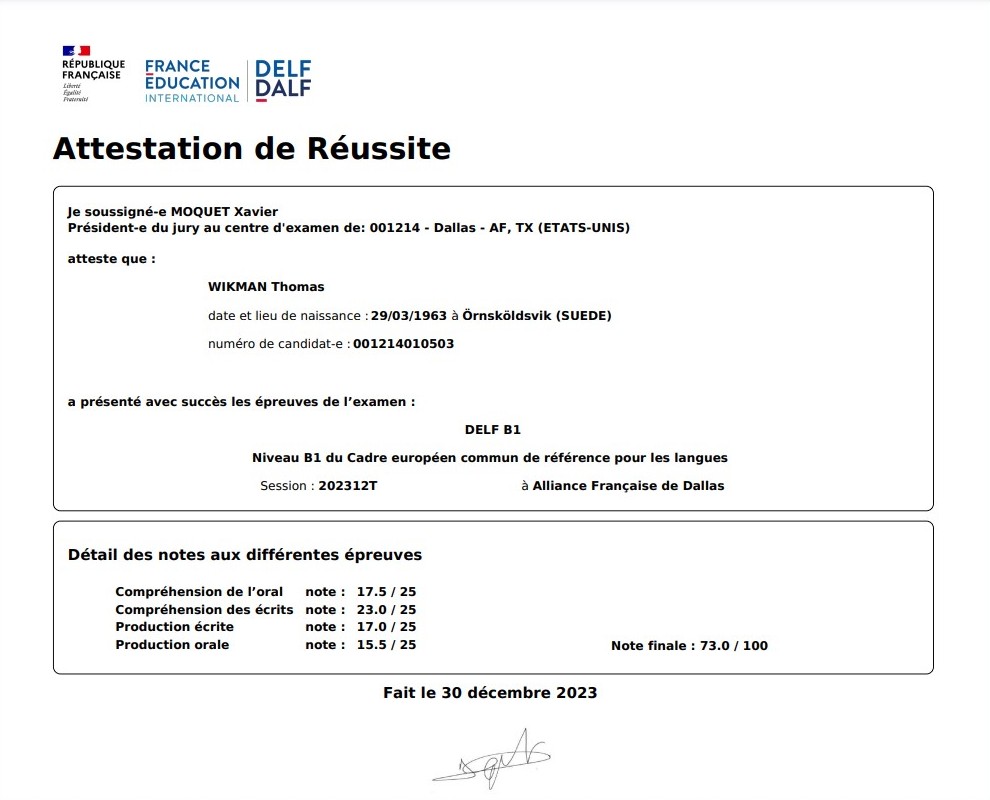
My DELF B1 test results
My B1 test results

There are a couple of things that come to mind regarding these tests.

Learn to Speak 25 languages in one hour!

Yesterday I saw an advertisement on Facebook for the Pimsleur approach that stated, “start speaking a new language after just one lesson”. Well, I used the Pimsleur approach for French for a short while and I remember the first half an hour lesson. You learned to repeat one short sentence. That’s not speaking a new language in my opinion. The advertisement sounded like there should be more to it. I should say I think the Pimsleur approach is a good approach. It is the ad I have a problem with. I’ve seen other language program commercials stating that you will become fluent in 24 hours, or become conversant right away, and many other ads that are just BS.

There are some language geniuses but most of us need a lot of practice to learn a second language regardless of method. There is no way around the fact that you need to know a few thousand words, internalize sentence structure and grammar, etc., before you can be fluent. I think one reason these language companies get away with unrealistic promises is that many people expect ads to be BS and another that many language learners greatly overestimate their proficiency. These universally accepted tests are great for assessing true proficiency.

Our son wearing a white Tae Kwon Do suit with a black belt. He is holding his diploma.
Our younger son with his black belt in Tae Kwon Do

When our younger son (pictured above) was 6-7 years old my wife used to play a song in the car that featured Hello and Goodbye in 25 languages, and he learned that song. One day I was having a conversation with a waiter at a restaurant who noticed that I had an accent. He was curious about my native language Swedish. That’s when my son told him “I speak 25 languages”. So, the waiter started asking him questions about how to say hello and goodbye in the various languages he claimed to speak, and he knew. So, the waiter asked me, “does he really speak 25 languages?”. I said, well that’s what he says. Perhaps, the language companies could put this song in the first lesson and then claim, not entirely incorrectly, that with their method you’ll speak 25 languages in one hour.

Proficiency assessment for other subjects

I sometimes wonder if rather than assigning grades to students it would be more practical to allow people to attain certain levels in one or more fields that they are interested in. Naturally, people could reach their levels any way they like, and not necessarily through the university system. Considering the many failures of modern universities, extremely high tuition, student loan issues, grade inflation, crazy partying and drugs, failures to protect girls from sexual assault, political indoctrination, antisemitism on campuses, fewer people going to college, parents losing faith in universities (including myself), and the list goes on, maybe it is time for something new. What should replace it I don’t know. Perhaps assessing proficiency levels instead of class grades could be part of it.