
The focus of this blog is Leonbergers but sometimes I post about books that are not about Leonbergers but that I want to promote. Today I am posting about Green Earth (Science in the Capital Trilogy) by Kim Stanley Robinson, a thick book. It is 1,088 pages to be exact. I gave it four stars, not five, so I am not entirely enthusiastic about it. It featured a few pages of anti-capitalist rhetoric (the author is very left-wing), which I found to be annoying and out of place, as well as some distracting dialogue and subplots that I thought the book could have done without. A book with more than 1,000 pages should be as lean and fast paced as possible.
I am still promoting it because I think Kim Stanley Robinson’s books in general are very good books and it is one of the more prominent books in a relatively new genre that is gaining significant traction, so called cli-fi, or climate science fiction. Cli-fi deals with the impacts of climate change and global warming and is one of the fastest-growing literary subgenres. Major publishers are releasing more titles in the genre and some cli-fi works are being adapted into films, TV series, and other media formats. Amazon typically lists these books as science fiction. It is a subgenre to keep an eye on.
- Paperback – Publisher : Del Rey; Abridged edition (November 3, 2015), ISBN-10 : 1101964839, ISBN-13 : 978-1101964835, 1088 pages, Item Weight : 2.22 pounds, Dimensions : 6.1 x 1.9 x 9.2 inches, it cost $ 19.39 on US Amazon. Click here to order it from Amazon.com.
- Kindle – Publisher : Del Rey (November 3, 2015), ASIN : B00TWERWLA, 1071 pages, it costs $10.99 on US Amazon. Click here to order it from Amazon.com.
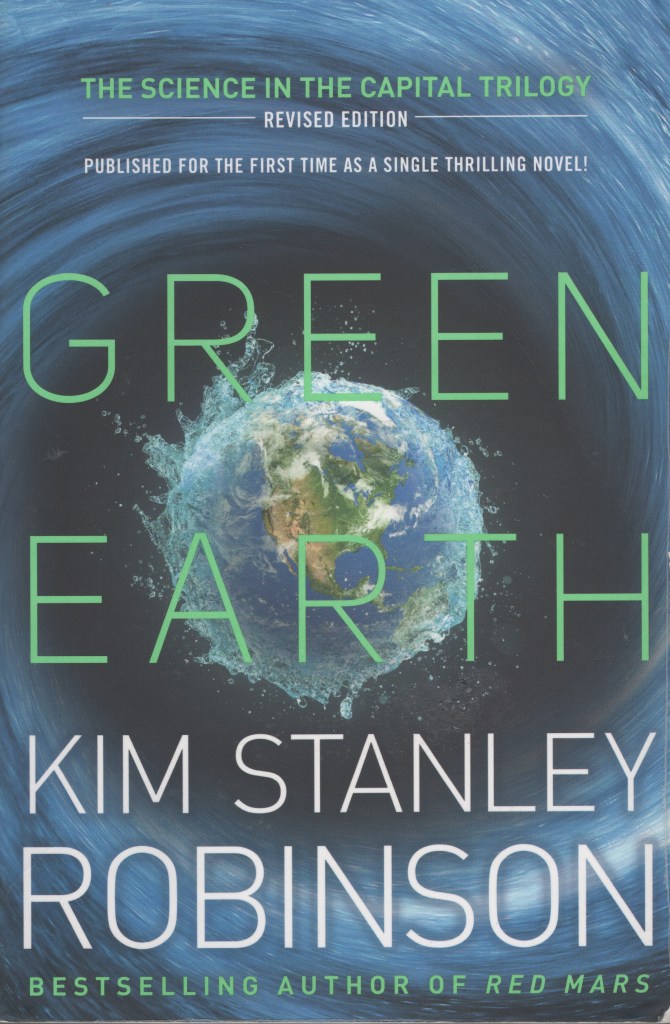
Amazon’s Description of Green Earth
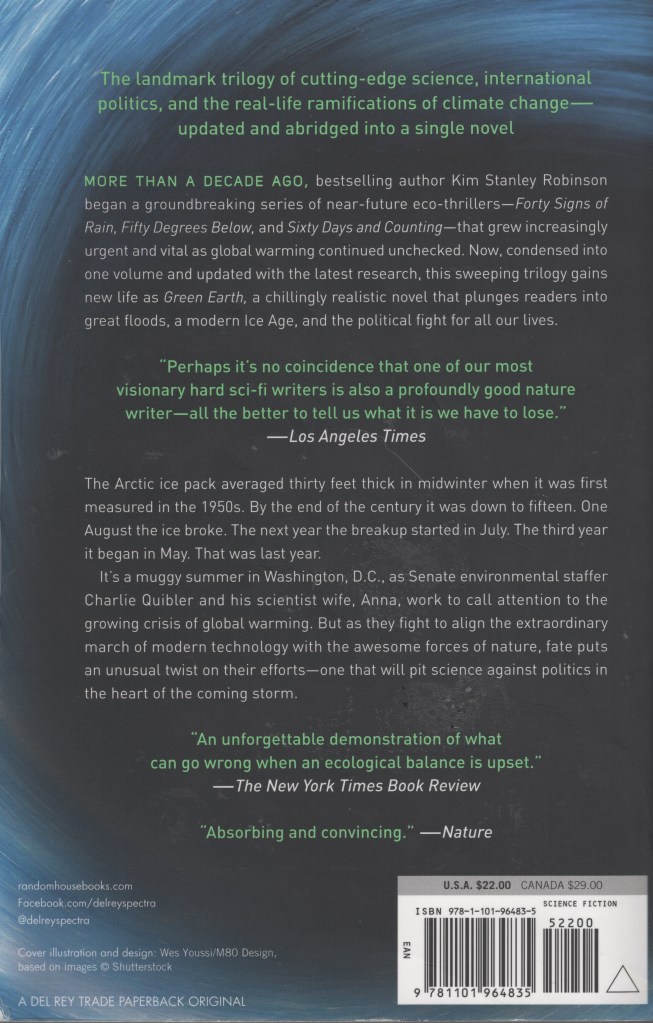
The landmark trilogy of cutting-edge science, international politics, and the real-life ramifications of climate change—updated and abridged into a single novel
More than a decade ago, bestselling author Kim Stanley Robinson began a groundbreaking series of near-future eco-thrillers—Forty Signs of Rain, Fifty Degrees Below, and Sixty Days and Counting—that grew increasingly urgent and vital as global warming continued unchecked. Now, condensed into one volume and updated with the latest research, this sweeping trilogy gains new life as Green Earth, a chillingly realistic novel that plunges readers into great floods, a modern Ice Age, and the political fight for all our lives.
The Arctic ice pack averaged thirty feet thick in midwinter when it was first measured in the 1950s. By the end of the century it was down to fifteen. One August the ice broke. The next year the breakup started in July. The third year it began in May. That was last year.
It’s a muggy summer in Washington, D.C., as Senate environmental staffer Charlie Quibler and his scientist wife, Anna, work to call attention to the growing crisis of global warming. But as they fight to align the extraordinary march of modern technology with the awesome forces of nature, fate puts an unusual twist on their efforts—one that will pit science against politics in the heart of the coming storm.
Praise for the Science in the Capital trilogy
“Perhaps it’s no coincidence that one of our most visionary hard sci-fi writers is also a profoundly good nature writer—all the better to tell us what it is we have to lose.”—Los Angeles Times
“An unforgettable demonstration of what can go wrong when an ecological balance is upset.”—The New York Times Book Review
“Absorbing and convincing.”—Nature
My Four-Star Review of Green Earth by Kim Stanley Robinson
An Interesting but Frightening Vision of the Future plus some Unnecessary Filler
In a future that is not too distant climate change / global warming is beginning to cause havoc. An island nation founded by Tibetan refugees is washed away due to sea level rise, the west Antarctic ice sheet is breaking up, the arctic ice disappears in the summer, the gulf stream is beginning to shut down, there’s severe storms, floods, extreme heat and drought, as well as extreme cold. Washington DC is ironically hard hit by natural disasters. The story is focused on Washington DC and to a lesser degree San Diego, California. There are scientists looking for solutions and politicians deflecting and other politicians who act on the problem.
One of the main characters is Frank Vanderwals, a respected scientist working for the National Science Foundation, falls in love with a woman, Caroline, who is involved in a very dangerous high level political intrigue and plots. He is homeless for a period of time during which Washington DC is hit by a record winter storm. Other characters in the book are Diane, who is the director of the National Science Foundation, Senator Phil Chase who is running for President, scientists Charlie and Anna Quibler and their children Nick and Joe. Charlie is an advisor to Phil Chase. Yann Pierzinski is a genius scientist who developed some algorithms that may be important for human genome editing and for solving climate change. I can add that the National Science Foundation is a real organization that I have a special connection with because they funded robotics research I did when I was young. I thought this was a fun aspect of the book. Other organizations mentioned were often made up.
This book has a lot to offer. There’s interesting science, climate change discussions, political intrigue, deadly games, thorough and well-done character development, and a lot of interesting subplots. The plot is rich and complicated but for the most part interesting. I enjoyed the discussions on gene editing, climate change, and the discussion on how to prevent the shut down of the Atlantic current. I enjoyed the discussions on Tibetan Buddhist philosophy, Yann Pierzinski’s algorithms, and Frank’s experiences as a homeless man. I slept in tents in the forest in northern Sweden when I did my Swedish army service and it was 40 below, so I very much identified with Frank during the winter storm in Washington DC. Some creepy but interesting features of the plot were the secret microchipping of people and the possibility of manipulating voting machines. I have a lot of good things to say about this book.
A few things I did not like about the book was that some of the dialogues and subplots seemed unnecessary and contained references to drugs or detailed romantic courtship that seemed out of place and added more pages than necessary to a book that is 1088 pages long. Sometimes the character development was too slow and featured unnecessary details. Frank was throwing frisbees with homeless people for a considerable amount of pages. Both Frank and Charlie seemed a bit incompetent despite their high-level positions. I also did not appreciate the leftwing / socialist propaganda around page 500. I realize that is how the author views the world, but it is not how I see things. The book seems to take place somewhere between 2030 and 2050 based on the futuristic technology and science described as well as the effects of climate change and yet there are payphones and Vietnam veterans. But maybe people will live longer, and payphones will make a comeback. Overall, I liked the book, and I recommend it, even though I think it would have been better, and 100 or 200 pages shorter, if the content I just complained about had been taken out.
 Leonberger Life