
This is a Leonberger blog, but sometimes I also post reviews for books that are not about Leonbergers and when I do it is for books that I love and that I want others to read. Today I am posting a review for Our Fragile Moment: How Lessons from Earth’s Past Can Help Us Survive the Climate Crisis by Dr. Michael E. Mann. If you don’t know who Michael Mann is, he is the creator of the hockey-stick curve (in 1998), which is a curve that shows the variation of average global temperature throughout history. For recent times (last 150 years) he used measured temperatures and for temperatures further in the past he used so called proxy data to estimate global temperatures. As the name indicates the graph looked like a hockey stick laying down, which did not sit well with climate change deniers, and as a result he was viciously attacked, threatened, and defamed. He was a young post-doc student at the time. February 8, 2024, Dr. Michael Mann was awarded one million dollars in a defamation lawsuit against Fox talk show host Mark Steyn and another $1,000.00 from Rand Simberg.

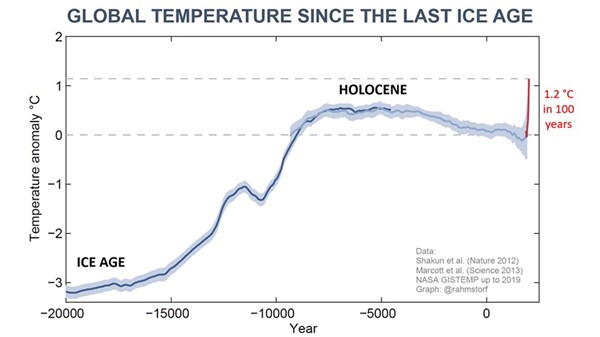
I should say that at first, I believed myself that Dr. Mann was a fraud. As I took a deep dive into the topic and learned more about it, I came to realize I was wrong and that his critics were wrong, and that Michael Mann was right. Since his original hockey stick curve there have been several dozen hockey stick curves produced by other independent researchers, often going back further in time, and they all confirm his findings. Today the scientific community has entirely accepted the hockey stick as correct. Despite this fact Dr. Mann is still being attacked by various organizations and individuals. Typically graphs put people to sleep, but this one started a war that is still ongoing. Charles Darwin was also attacked for his scientific discoveries and now history is repeating itself.
Anyway, about this book. This book mentions the hockey stick curve, but it is not the focus of the book. This book goes back 4.5 billion years and explains what is known about past climate which is surprisingly much. Science does not know everything, otherwise it would stop, but it knows a lot. He discusses various past climate shocks, various climate cycles, extinction events, etc., and analyses what past climate means for us today. There is bad news and there is good news. The book is packed with information and data, but I loved it.
- Hardcover – Publisher : PublicAffairs (September 26, 2023), ISBN-10 : 1541702891, ISBN-13 : 978-1541702899, 320 pages, Item Weight : 1.15 pounds, dimensions : 6.4 x 1.06 x 9.55 inches, it cost $19.59 on US Amazon. Click here to order it from Amazon.com.
- Paperback – Publisher : PublicAffairs (October 15, 2024), ISBN-10 : 1541702905, ISBN-13 : 978-1541702905, 320 pages, Item Weight : 1.11 pounds, dimensions : 5.5 x 0.8 x 8.25 inches, it cost $19.99 on US Amazon. Click here to order it from Amazon.com.
- Kindle – Publisher : PublicAffairs (September 26, 2023), ASIN : B0BRJ6SCFM, 392 pages. It is currently $18.99 on Amazon.com. Click here to order it from Amazon.com.
- Audiobook – Publisher : PublicAffairs, Release date September 26, 2023, ASIN : B0BWKCPSDY, Listening length 9 hours and 38 minutes. Click here to order it from Amazon.com.
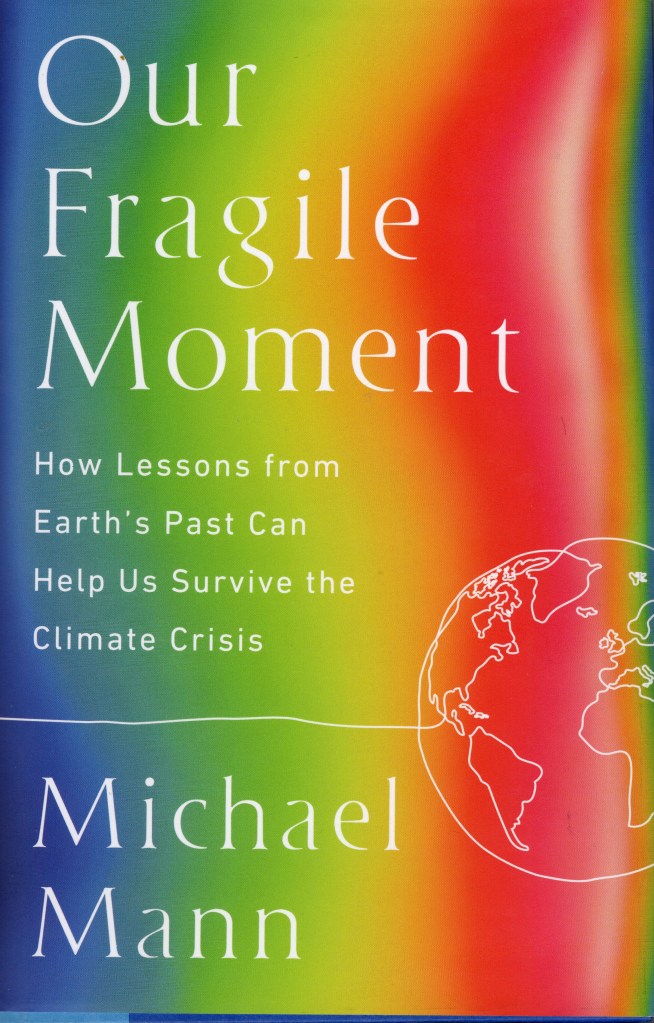
Amazon’s description of the book (from the Amazon page)
In this sweeping work of science and history, the renowned climate scientist and author of The New Climate War shows us the conditions on Earth that allowed humans not only to exist but thrive, and how they are imperiled if we veer off course.
For the vast majority of its 4.54 billion years, Earth has proven it can manage just fine without human beings. Then came the first proto-humans, who emerged just a little more than 2 million years ago—a fleeting moment in geological time. What is it that made this benevolent moment of ours possible? Ironically, it’s the very same thing that now threatens us—climate change.
The drying of the tropics during the Pleistocene period created a niche for early hominids, who could hunt prey as forests gave way to savannahs in the African tropics. The sudden cooling episode known as the “Younger Dryas” 13,000 years ago, which occurred just as Earth was thawing out of the last Ice Age, spurred the development of agriculture in the fertile crescent. The “Little Ice Age” cooling of the 16th-19th centuries led to famines and pestilence for much of Europe, yet it was a boon for the Dutch, who were able to take advantage of stronger winds to shorten their ocean voyages.
The conditions that allowed humans to live on this earth are fragile, incredibly so. Climate variability has at times created new niches that humans or their ancestors could potentially exploit, and challenges that at times have spurred innovation. But there’s a relatively narrow envelope of climate variability within which human civilization remains viable. And our survival depends on conditions remaining within that range.
In this book, renowned climate scientist Michael Mann will arm readers with the knowledge necessary to appreciate the gravity of the unfolding climate crisis, while emboldening them—and others–to act before it truly does become too late.
This is my five-star Amazon review for Our Fragile Moment by Dr. Michael Mann
A Palaeoclimatological Journey Accompanied by Intelligent Analysis And What It Means for Us
In this book the author takes us on a journey through earth’s climate history. He discusses the climate during the different eras and periods of earth’s history starting with the Hadean and Archean and ending with the Holocene. There have been extreme changes in the climate, caused by shocks to the system, followed by mass extinctions. The many devastating large swings in the climate often took hundreds of thousands of years or millions of years to run their course. Species disappeared while species better adapted to the new climate evolved. As he gets to modern times, the Holocene, he gives us more detail and analyzes the climate for much shorter intervals. It is clear from his discussion on more recent climate that climate has shaped us, and we have shaped climate.
He also discusses the various climate cycles that effected our climate in the past as well as currently, including the Milankovitch cycles, such as the eccentricity of Earth’s orbit, earth’s obliquity and precession. Other cycles he is discussing include the El Niño–Southern Oscillation, the north Atlantic Oscillation (NAO), and the Atlantic Multidecadal Oscillation (AMO), which as it turns out does not exist. The purpose of all this is to determine what this means for our civilization and the unnatural and extremely rapid warming that we are causing today primarily via our carbon emissions.
I found some of the climate shocks he discussed quite interesting. During the Paleoproterozoic era 2 billion years ago the biological innovation of oxygen-generating photosynthesis led to a rapid drawdown on atmospheric carbon dioxide and in addition the positive feedback from the increased albedo from the ice buildup turned the planet into a snowball. This was reversed as the ice prevented absorption of carbon dioxide. Eventually the carbon dioxide concentration in the atmosphere reached 200 times of what it is today, and the snowball rapidly melted, and the carbon dioxide concentration settled again. The greatest extinction event in geological history was the Permian-Triassic extinction event 250 million years ago when 90% of all species on Earth perished. It was primarily caused by a substantial release of carbon dioxide from Siberian Trap volcanic eruptions.
Another interesting climate shock was the dinosaur-killing K-Pg event 66 million years ago. An asteroid collision made Earth’s climate much colder, and all large species died out. It took four million years for flora and fauna to reestablish itself but with new species. The losers were the non-avian dinosaurs, and the winners were the mammals and the avian dinosaurs or birds. The PETM event 55 million years ago was triggered by carbon-enriched volcanic eruptions that led to a rapid increase in temperature of 7-11 Fahrenheit in just 10,000 years. This event is eerily similar to what we are experiencing now, except our warming is even faster. He also describes the cooling that happened 50 million years ago because of the forced uplift of the Himalayas due to the collision of India with Eurasia. For more recent times he is discussing the various glacial and interglacial periods (ice-ages), driven by Milankovitch cycles.
His chief goal with his paleoclimate discussion is to find out what the paleoclimate record implicates for us. For example, establishing what is the equilibrium climate sensitivity (ECS), which is the increase in Earth’s average surface temperature that occurs after the climate system fully adjusts to a sustained doubling of atmospheric carbon dioxide. Another is Earth System Sensitivity (ESS), which describes how much warming you ultimately get in response to a doubling of CO2, after all the slow-response feedback mechanisms fully unfold.
Yet another climate feature is the existence of hysteresis loops, in which the value of a physical property lags behind changes in the effect causing it. For example, setting back CO2 to what it was before an event may not bring temperatures and climate back to what it was for 100,000 years. He is also analyzing the risk for ocean conveyor disruption and the risk for future methane bombs. The latter, which turns out to be low risk. Another piece of good news is that we are not at risk of a run-away greenhouse effect like the one Venus underwent two billion years ago. His conclusions are a mixed bag of good news and bad news. I can add that naturally he is also discussing the hockey-stick curve. He was the inventor of it.
The book contains a lot of information, and it sometimes features complex discussions, but if you read the book carefully it makes perfect sense. It is logical, intelligently written, and avoids hyperbole and exaggerations. However, if you are not very familiar with science and have a hard time with complexity it may not be the book for you. He stresses that the greatest threat to meaningful climate action is no longer denial, but despair and doomism, premised on the flawed notion that it is too late to do anything. We will not all perish from climate change, but neither is it a good thing. The facts justify immediate and dramatic action, but we are not going to fall off a cliff. Climate change is a crisis, but a solvable crisis. The question is how much damage we will do to future generations.
I highly recommend this brilliant, and fact filled deep dive into paleoclimate and what it means for humanity today, to anyone willing and able to tackle some complexity.
About the Author

Dr. Michael E. Mann, famous for the hockey stick curve, is Presidential Distinguished Professor in the Department of Earth and Environmental Science at the University of Pennsylvania, with a secondary appointment in the Annenberg School for Communication. He is director of the Penn Center for Science, Sustainability, and the Media (PCSSM).
Dr. Mann has received a number of honors and awards including NOAA’s outstanding publication award in 2002 and selection by Scientific American as one of the fifty leading visionaries in science and technology in 2002. He contributed, with other IPCC authors, to the award of the 2007 Nobel Peace Prize. He was awarded the Hans Oeschger Medal of the European Geosciences Union in 2012. In 2020 he was elected to the US National Academy of Sciences. He is the author of more than 200 peer-reviewed and edited publications and five books. His research involves the use of theoretical models and observational data to better understand Earth’s climate system.
The Silurian Hypothesis
For all science fiction fans, the book also featured an idea that would make a good science fiction story. 55 million years ago there was an exceptionally fast warming of 9 degrees Fahrenheit (5 degrees Celsius) that was in many regards similar to what is happening now. It was not quite an extinction event, that requires more than 75% of all species to be gone in less than 2 million years, but it was catastrophic. This event is referred to as the PETM event. I can add that we are warming the earth at a rate 10 times faster today.
If we were to destroy ourselves what would a future species know about us 55 million years from now? Well, all traces of our civilization would be gone and finding fossils of us would be very likely despite our large population, because fossilization events are extremely rare. What would be left of us are the traces of the global warming we caused and long-lived chemicals such as nitrates from our fertilizers. That’s exactly what the PETM event has left behind, signs of a sharp increase in CO2, global warming and a sudden spike in nitrates that remain unexplained. Could it be that we are not the first intelligent species on earth and that our predecessors caused global warming as well? Well, this was just entertaining speculation, not science, but could there be something to it?
What do you think of the Silurian Hypothesis?
 Leonberger Life