The Speed of Light In Vacuum Is a Universal Constant

As I previously mentioned I would like to launch a second blog featuring small facts or insights that are widely disbelieved despite being known to be true by the experts in the relevant field or facts that are very surprising or misunderstood by a lot of people. These facts shouldn’t be trivia but important facts that are somewhat easy to understand despite their status as being unthinkable to many. They are not scientific theories or complex sets of facts or information, but facts that you can easily state. They may be part of a scientific theory, or a result of an established scientific theory but not an entire scientific theory. I’ve collected hundreds of these facts because to me they seem to be extraordinarily important. They are worldview altering facts, big shocking facts to some, facts that many people deny regardless of the evidence, super-facts if you will.

In a previous post I discussed that despite the fact that the scientific community states that Earth is 4.5 billion years old and that humans evolved over millions of years a 2019 Gallup poll, showed that 40% of US adults believe that God created humans in their current form within the last 10,000 years. The evidence proves that this 40% of the population is wrong. The scientists aren’t guessing. They make their claim that earth is 4.5 billion years old based on a lot of strong evidence. Evidence which is unknown to a lot of people. In this post I am discussing a fact that once was widely disputed but today is more just surprising or not understood by many and that is that the speed of light in vacuum is a universal constant.

No matter how fast you travel, what direction, or where you are you will measure the speed of light compared to yourself to be c = 299,792,458 meters per second or approximately 186,000 miles per second or 671 million miles per hour.
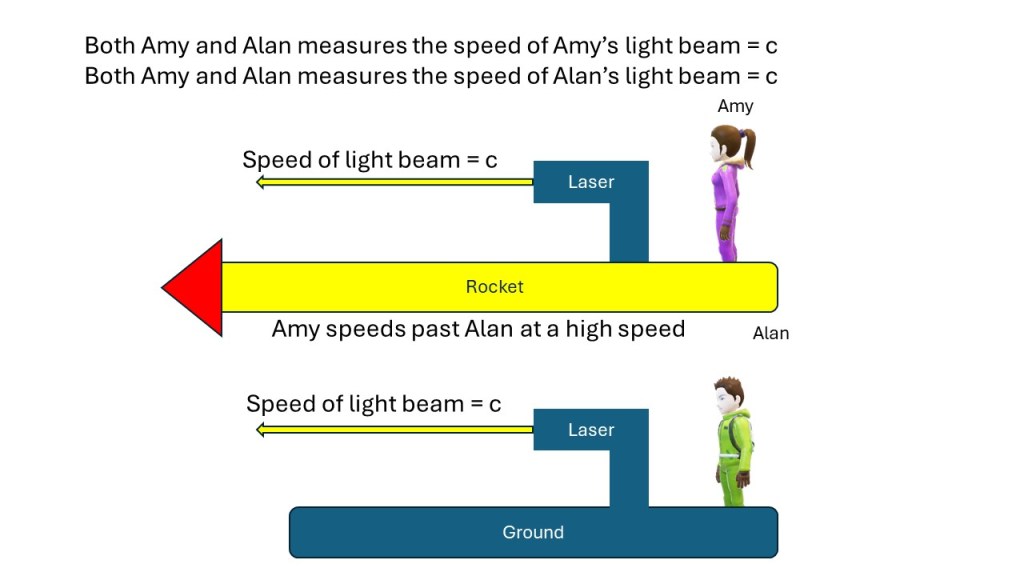
The picture shows two people Alan and Amy. Alan is on the ground. Amy is flying by Alan in a rocket speeding left. Both Alan and Amy are pointing lasers to the left.
In this picture Amy is traveling past Alan in a rocket. Both have a laser. Both measure the speed of both laser beams to be c = 299,792,458 meters per second.

In the picture above let’s say Amy is flying past Alan at half the speed of light. If you believe Alan when he says that both laser beams are traveling at the speed of c = 186,000 miles per second, then you would expect Amy to measure her laser beam to travel at a speed that is half of that c/2 = 93,000 miles per hour, but she doesn’t. She measures her laser light beam to travel at the speed of c = 186,000 miles per second just like Alan. This seems contradictory. The solution that the special theory of relativity offers for this paradox is that time and space are relative and Amy and Alan measure time and space differently (more on that in another post).

Clocks being sucked into a hole or possibly sped up into space
Time is going to be different for me. From shutterstock Illustration ID: 1055076638 by andrey_l

I should add that the realization that the speed of light in vacuum is a constant regardless of the speed or direction of the observer or the light source was a result of many experiments, which began with the Michelson-Morley experiments at Case Western Reserve University, Cleveland, Ohio in the years 1881-1887. At first scientists thought that there was an ether that compressed the experimental equipment and distorted clocks so that it seemed like the light vacuum always came out the same. With the special theory of relativity in 1905 those speculations were laid to rest.
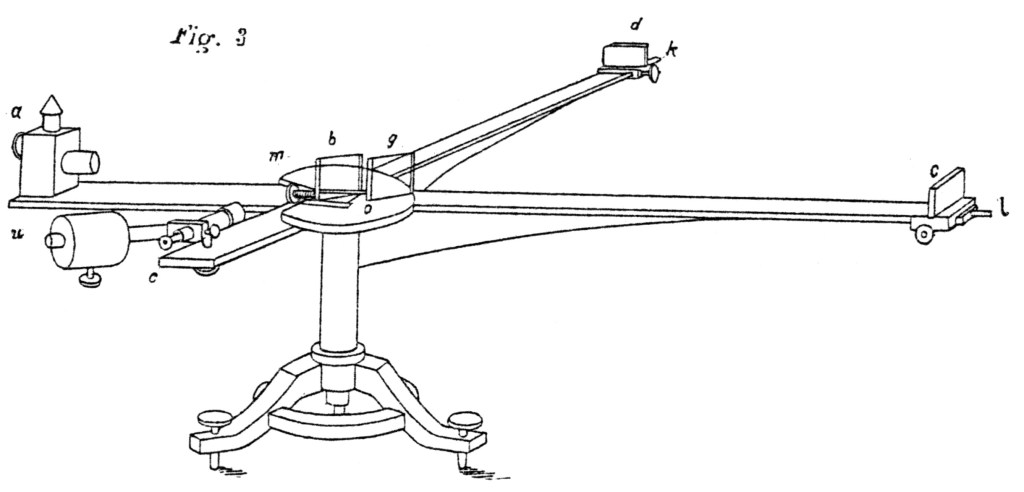
This is a drawing of the Michelson interferometer used at Case Western Reserve University
The first Michelson-Interferometer from 1881. It was used to measure the speed difference of two light beams (well a split light beam) with a very high accuracy (for the time). The light traveled with the same speed in all directions and no matter what earth’s position and speed was in its orbit around the sun. This picture is taken from Wikipedia and is in the public domain of the United States.

The speed c = 299,792,458 meters per second is a universal speed limit created by time and space

I should point out that there is nothing magical about the speed of light in a vacuum. Light traveling through matter, like glass or water, does not travel at this speed c, but slower. It also isn’t entirely correct to say that the speed of light in vacuum is a universal constant, because it isn’t about light per se. What is happening is that light traveling completely unimpeded through vacuum is prevented from traveling infinitely fast by the way time and space is set up. All massless particles / radiation, or anything that hypothetically could be traveling at an infinite speed is prevented from doing that because of the way time and space are related. Light in vacuum just happened to be what we first discovered to be restricted by this universal speed limit. Yes, time and space are annoying that way, putting a limit on the speed of light and on massless particles.

So how is time and space arranged to cause this universal speed limit? Well, that is an even more surprising blog post for another day (I will link to it once I have made the post). From this discovery about time and space came a lot of other interesting realizations but that is also for another post,  but let’s just give a brief summary:

  • Time for travelers moving fast compared to you is running slower.
  • Length intervals for travelers moving fast compared to you are contracted.
  • Simultaneous events may not be simultaneous for another observer.
  • The order of events may be reversed for different observers.
  • If you accelerate to a speed that is 99.999% of the speed of light you still haven’t gotten any closer to the speed of light from your perspective. Light in vacuum will still speed off from you at c = 186,000 miles per second.
  • Acceleration will get harder the closer you get to the speed of light in vacuum. The force required will reach infinity as you approach the speed of light in vacuum.
  • Forces, the mass of objects, momentum, energy and many other physical quantities will reach infinity as you approach the speed of light in vacuum assuming you are not a massless particle.
  • Mass is energy and vice versa E = mc2
  • Magnetic fields pop out as a relativistic side-effect of moving charges.

So, it seems like we cannot travel faster than the speed of light in vacuum. It seems like the universal speed limit is really a hard limit, unlike the speed limits on Texas highways. That is maybe true, at least locally where we are. However, you could get around it, sort of cheating, by stretching and bending space to the extreme by using, for example, enormous amounts of negative energy. That’s happening to our Universe over a scale of tens of billions of lightyears. A lightyear is the distance light in vacuum travel over a year. Stretching and bending space is not part of the special theory of relativity. That is Einstein’s General Theory of Relativity, which is a very complicated theory, so you may not see any posts on that.
Mass is energy and vice versa, a direct result of the way time and space are related. Stock Photo ID: 2163111377 by Aree_S

How do you feel about time and space creating this universal speed limit in which light in vacuum travel?


We Know That the Earth is Billions of Years Old

As I mentioned in a previous post I would like to launch a second a blog. The topic would be facts and insights that are either widely disputed or often misunderstood amongst the public, yet important and known to be true to the experts and scientists in the relevant field. I’ve identified hundreds of such cases.

In my previous post I discussed the fact that despite the fact that the scientific community states that Earth is 4.5 billion years old and that humans evolved over millions of years a 2019 Gallup poll, showed that 40% of US adults believe that God created humans in their current form within the last 10,000 years. As a teenager I believed that myself. That was before I knew much about science. I had read agenda driven books that left out, or wrongfully dismissed the evidence for an old earth while presenting faulty arguments for a young earth. Just learning about the relevant science was enough for me to realize that I had been bamboozled. At first, I dug my heels in, but I eventually realized that the belief that earth was 6,000 years old was not tenable and unsupportable by science.

A photo of planet earth. North America is facing the camera.
Is Earth 4.5 billion years old or 6,000 years old? Photo by Pixabay on Pexels.com

My goal for the blog is not to be an exhaustive source for these kinds of topics, or a deep dive into these topics, but just to collect a large set of these unnecessarily controversial topics and provide some insight into the surrounding misunderstandings. Not a complete insight into the topics, but some. Perhaps my blog will lead to some new insights for some, or intellectually honest reflection as well as interesting and friendly discussions.

A man sitting on a rock by the ocean look at the senset.
Perhaps some new insight. Perhaps some intellectually honest reflection. Photo by Keegan Houser on Pexels.com

The format I decided on is to present the evidence for the fact or insight in question as a headline in bold followed by a list of failed objections to that evidence. Then, if applicable, failed arguments for the opposing point in bold as well, followed by an explanation as to why the argument does not work. It may seem like this setup is biased. However, the point is that the fact or insight in question is not commonly contested among the experts for good reasons, and therefore this setup is natural. Naturally, I would be open to counter arguments. I could, of course, be wrong and then I have to remove the fact/insight from my list.

A woman is shouting into the man's face using a megaphone.
I will certainly be open to counter arguments but let’s keep it friendly. Photo by Mikhail Nilov on Pexels.com

Radiometric dating of meteorite material, terrestrial material and lunar samples demonstrate that earth is 4.5 billion years, or more precisely 4.54 billion years old.

  • Radioactive decay rates have changed: This objection does not work because rates of radiometric decay (the ones relevant to radiometric dating) are thought to be based on rather fundamental properties of matter, such as the probability per unit time that a certain particle can “tunnel” out of the nucleus of the atom. Analysis of spectra from quasars show that the fine structure constant has not changed over the last ten billion years. There are dozens of radiometric dating methods that are consistent with each other throughout time. Also, for a young earth you would need the decay rates to have been millions of times faster in the past, which would require changes in fundamental properties that would have plenty of noticeable effects on processes other than radioactive decay, not to mention the radiation being millions of times stronger than today. It would have fried everything.
  • Young earth creationists sometimes make the claim that the initial ratios between isotopes may have been different: That the initial ratios/condition were different in the past and therefore radiometric dating is unreliable. This is a better objection, but it also fails. In this case you must take it case by case for each radiometric dating method and situation. But in many cases the amount of the daughter isotope is known to have been zero, which makes it easy and reliable.
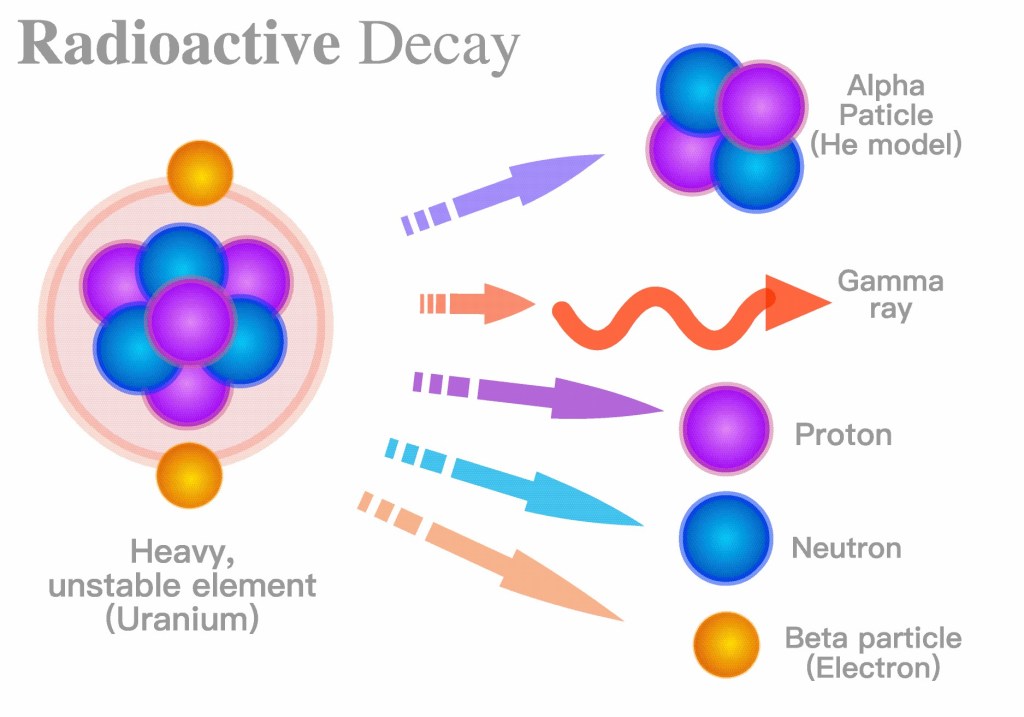
On the left a Uranium nucleus. On the right an alpha particle, gamma ray, proton, neutron, and a beta particle (electron), originating from the uranium nucleus.
Radioactive decay wasn’t a million times faster 6,000 years ago. Stock Vector ID: 2417370135 by grayjay

We can see galaxies that are billions of lightyears away. This does not establish the age of the earth, but it makes a young earth and a young universe implausible.

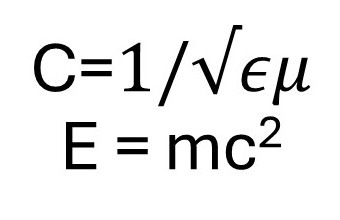
A common objection to this observation is that lightspeed in vacuum has changed: Similar to above this objection does not work because the light speed in vacuum is a fundamental constant that is not believed to change. It has been measured and no change has been seen. An example is the Einstein’s equivalence of energy and mass E = mc2. If the speed of light once was millions of times faster than now, the energy contained in a kilogram would be a trillion times larger than now. Where did all that energy go? The speed of light is determined by the inverse of the square root of the electric constant multiplied by the magnetic constant. You would have to drastically change the strength of the electric and magnetic fields (by the trillions) to get the speed of light to be millions of times faster. Wouldn’t that be noticeable? The light speed in vacuum shows up in many other physical relations as well. It is not a tenable objection.

Two equations, James Clerk Maxwell's equation for the speed of light and Albert Eintein's energy and mass equivalency E=mc2
A couple of equations in which the speed of light in vacuum is a fundamental constant.

We know stars are old because they develop according to certain physical processes that for some stars take billions of years. An example is our sun. It has fused (burned up) up five billion years’ worth of hydrogen.

The heavier elements in our solar system originate with older stars that burned out and exploded.

Electromagnetic radiation, including light, heat transfer if you will, travels from the inside of the sun to the surface and this takes 100,000 years. The photons are emitted and reabsorbed over and over, which is why the electromagnetic transfer is lower than in vacuum. If the sun is only 6,000 years old, how can we see it?

Finally, some objections to old earth by young earth creationists.

The earth’s magnetic field has been weakening during the last 130 years as if it was formed from currents resulting from earth being a discharging capacitor (claim by Thomas Barnes). This would make an impossibly strong magnetic field already 8,000 years ago. I remember this being the argument in a young earth creationist book I read as a teenager.

  • The first problem with this argument is that there is no good reason to believe that earth’s magnetic field acts this way.
  • We know that earth’s magnetic field has reversed itself several times thus disproving the discharging capacitor model.
  • Thomas Barnes’ extrapolation completely ignores the nondipole component of the field.
  • Conclusion, this objection is not reasonable.
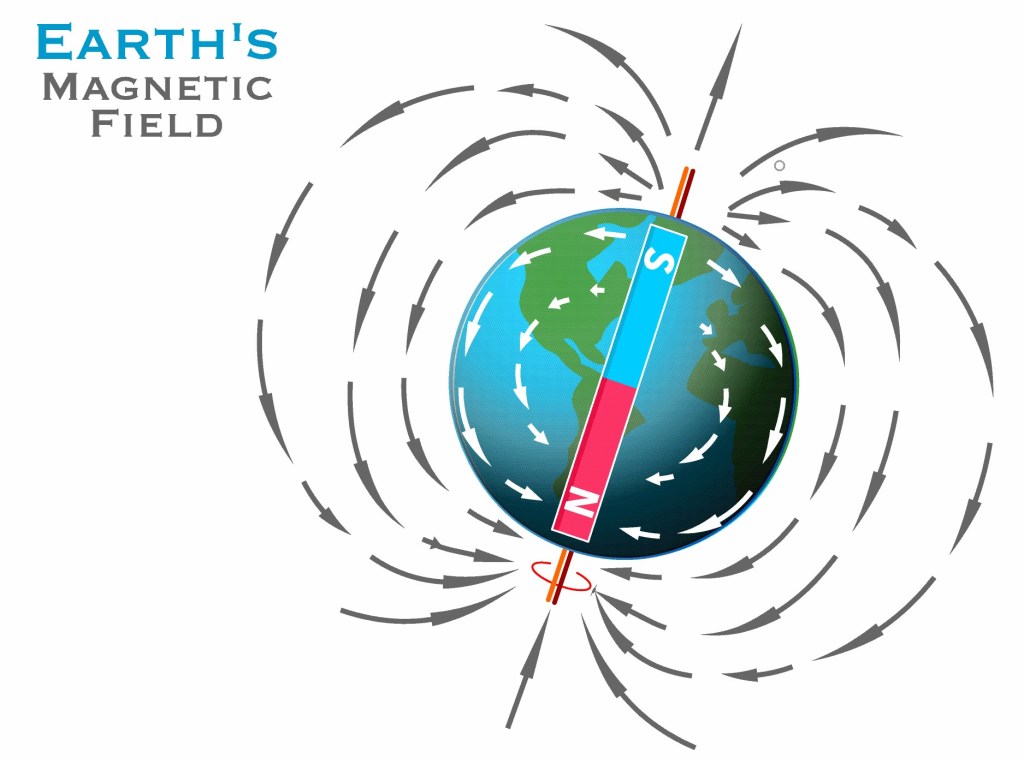
A picture showing earth's magnetic field around planet earth. The north pole end of the magnetic field being in the south and the south end in the north.
Earth’s magnetic field. Stock Vector ID: 1851166585 by grayjay.

If the earth and the moon were billions of years old there would be a hundred feet thick dust layer from meteorites  on the moon. The moon landing proved otherwise. This is another argument I remember reading in a young earth creationist book (Scientific Creationism by Henry Morris) as a teenager.

The problem with this argument, as I would later find out, is that Morris’ claims about a hundred feet thick dust layer was based on faulty and obsolete data. The expected depth of meteoritic dust on the Moon is less than one foot (after billions of years).

If I had known and understood any of this when I was 14 years old, I would not have been bamboozled by the young earth creationists, but it was not the only time I was bamboozled.

Anyway, this is how I envision one blog post in my upcoming blog post adventure. It is a brief overview of why experts/scientists can be trusted in regards the topic of the post. I have not yet decided on a name for my new blog.