
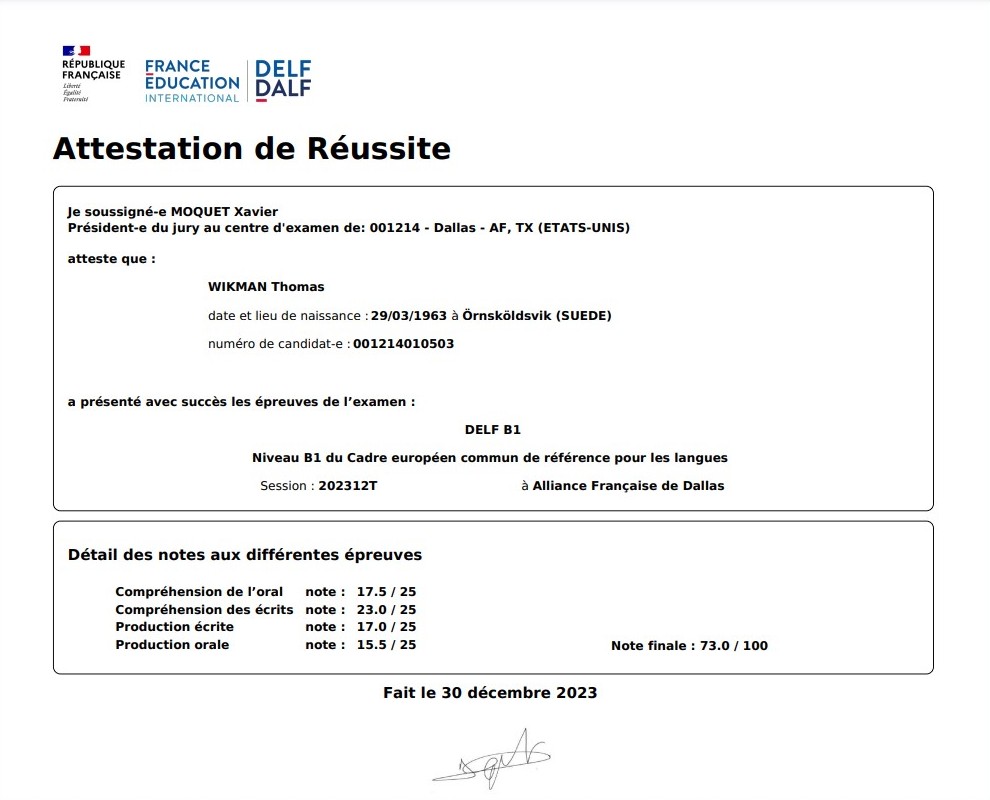
I’ve got a number of hobbies, one of them being learning French. Back in December I took and passed the DELF / CEFR B1 level language test in French. The CEFR is a European standard for assessing an individual’s language proficiency that is being adopted around the world. It includes all European languages as well as other languages. The A1 & A2 tests are for beginners with A2 being more challenging. The B1 and B2 tests are for independent speakers, meaning you can get around without help, listening to the news, having conversations, etc. C1 & C2 are advanced levels, like native speakers and experts. If you immigrate to France, you need to pass the B1 test to become a citizen. Most countries do not have such a language requirement for citizenship. The A1, A2, B1, B2 tests (and maybe C1 & C2) consist of four parts but the different tests have different difficulty levels.
- Oral comprehension: Listening to recordings like a conversation or a radio broadcast and answering questions about what was said.
- Reading comprehension: Reading articles and answering questions
- Writing: Such as writing an essay, and for A1 it is just filling out a form or writing a 40+ word post card
- Oral production: Participating in conversations and doing presentations on topics decided on at the exam.

To pass the test you need 50 out of 100. As mentioned, the test is designed to assess your level. It is not like a test you take to get a grade at school. Therefore, if you do what is expected of you at the B1 level you may get 50-60 points and more if you can do more. If you get 80+ on the B1 test, then you probably should have taken the B2 test. There are no A, B, C, D or 1,2,3,4,5 grades.
There are a couple of things that come to mind regarding these tests.
Learn to Speak 25 languages in one hour!
Yesterday I saw an advertisement on Facebook for the Pimsleur approach that stated, “start speaking a new language after just one lesson”. Well, I used the Pimsleur approach for French for a short while and I remember the first half an hour lesson. You learned to repeat one short sentence. That’s not speaking a new language in my opinion. The advertisement sounded like there should be more to it. I should say I think the Pimsleur approach is a good approach. It is the ad I have a problem with. I’ve seen other language program commercials stating that you will become fluent in 24 hours, or become conversant right away, and many other ads that are just BS.
There are some language geniuses but most of us need a lot of practice to learn a second language regardless of method. There is no way around the fact that you need to know a few thousand words, internalize sentence structure and grammar, etc., before you can be fluent. I think one reason these language companies get away with unrealistic promises is that many people expect ads to be BS and another that many language learners greatly overestimate their proficiency. These universally accepted tests are great for assessing true proficiency.

When our younger son (pictured above) was 6-7 years old my wife used to play a song in the car that featured Hello and Goodbye in 25 languages, and he learned that song. One day I was having a conversation with a waiter at a restaurant who noticed that I had an accent. He was curious about my native language Swedish. That’s when my son told him “I speak 25 languages”. So, the waiter started asking him questions about how to say hello and goodbye in the various languages he claimed to speak, and he knew. So, the waiter asked me, “does he really speak 25 languages?”. I said, well that’s what he says. Perhaps, the language companies could put this song in the first lesson and then claim, not entirely incorrectly, that with their method you’ll speak 25 languages in one hour.
Proficiency assessment for other subjects
I sometimes wonder if rather than assigning grades to students it would be more practical to allow people to attain certain levels in one or more fields that they are interested in. Naturally, people could reach their levels any way they like, and not necessarily through the university system. Considering the many failures of modern universities, extremely high tuition, student loan issues, grade inflation, crazy partying and drugs, failures to protect girls from sexual assault, political indoctrination, antisemitism on campuses, fewer people going to college, parents losing faith in universities (including myself), and the list goes on, maybe it is time for something new. What should replace it I don’t know. Perhaps assessing proficiency levels instead of class grades could be part of it.
 Leonberger Life