
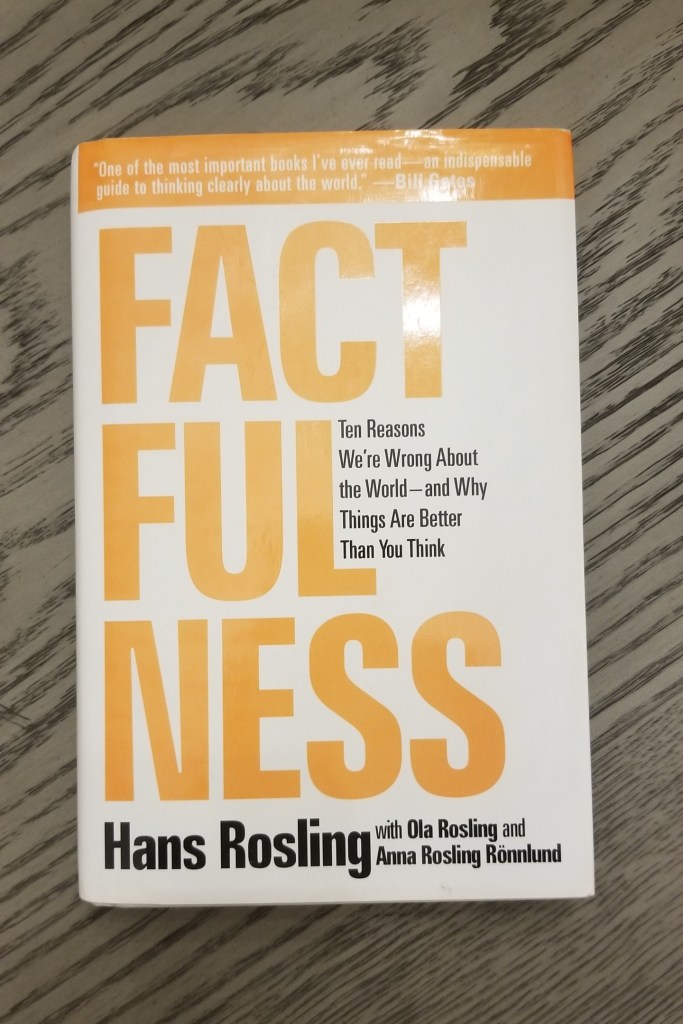
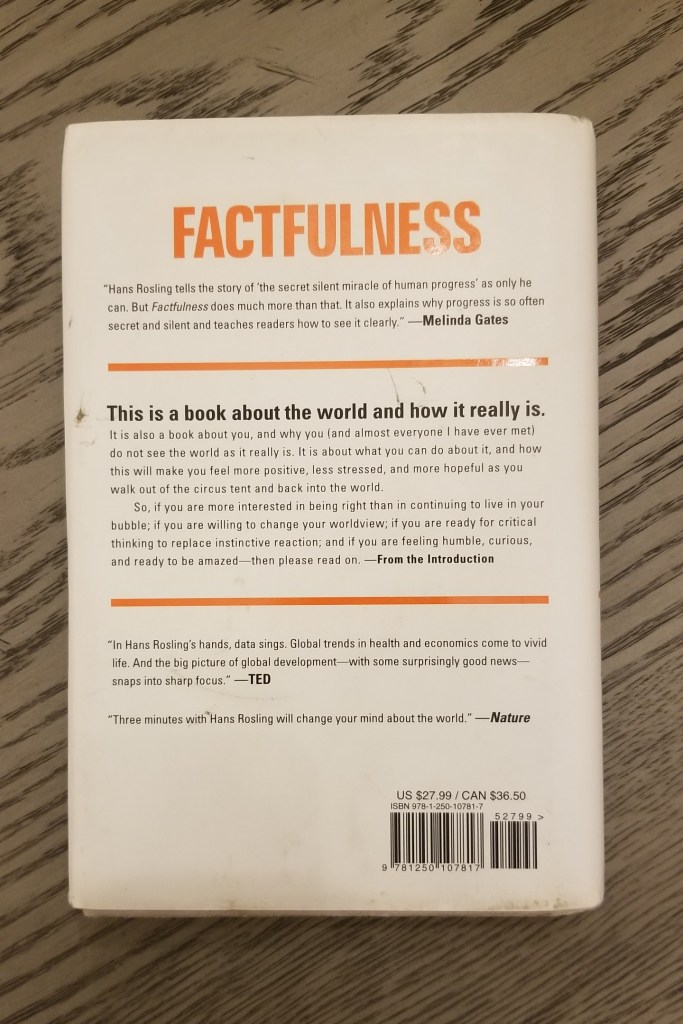
The focus of my blog is Leonbergers, especially our late Leonberger Bronco, but sometimes I present a good book which I want to promote. Today I would like to present and review Factfulness: Ten Reasons We’re Wrong About the World–and Why Things Are Better Than You Think Paperback – April 7, 2020 by Hans Rosling, Anna Rosling Rönnlund, and Ola Rosling, ISBN: 978-1250123824, 352 pages, item weight 14.4 ounces, dimensions 5.3 x 1 x 8.2 inches.

Misconceptions Are Everywhere
Yesterday as we were on our way back from our son’s wedding, I accidentally overheard a conversation among fellow Texans that went something like this “…the wind turbines effect how the wind blows and therefore they have a very bad effect on the environment”. I turned around to see if it was a shrunken head speaking, but the speaker looked like a normal human being. It was a man my age. His friend then stated, “also the wind turbines kill a lot of birds.” That’s also a misconception but perhaps not one as silly. Wind turbines do kill birds, and it is a real problem, but the birds killed by wind turbines correspond to a very tiny fraction compared to the number of birds killed by fossil fuels, cats and even windows. Then I remembered that I once harbored some pretty silly misconceptions myself, so maybe I shouldn’t be so judgmental. We all have misconceptions, but naturally we don’t know what they are. Misconceptions is what other people have.

The world is full of misconceptions and not just about wind turbines, but nuclear power, all energy sources, animals, dogs, leonbergers, history, science, cosmology, space, evolution, particle physics, trees, Sweden, and all other countries, the state of the world, how the economy works, governments, vaccines, microbes, time, space, mathematics, quantum physics, plastic pollution, climate change, chaos, crime, etc. I have a bit of an interest in the topic, and I’ve made a list of more than 100 very important basic facts that we know to be true with certainty, or with a very high degree of certainty, and yet a large segment of people who are not experts in the relevant fields denies those facts or grossly misunderstand them. Having a belief that is contrary to the relevant expertise and/or widely accepted data is a red flag, yet so common. In addition, biases, a weak understanding of science, arrogance, and strong religious and political beliefs make it difficult to correct misconceptions. We are drowning in misconceptions, they are everywhere.

Overview of Factfulness by Hans Rosling
Factfulness by Hans Rosling, focuses on misconceptions about global trends and the state of the world. It therefore has narrower scope than my general concern about misconceptions, but it adds a lot to my special hobby. It focuses on the good news, of which there is plenty. It is clear that things like our health, wealth, peace and human rights have made a lot of improvements over the last 100 years. But somehow our biases tend to make us think that things are getting worse.

- The world is getting wealthier and extreme poverty is vanishing. The poorest countries in the world today are better off than the richest countries in 1900.
- Children dying before the age of 5 has gone from 44% in 1800 to 4% in 2016.
- The pollution of ozone depleting substances has gone from 1,663 kiloton in 1970 to 22 kiloton in 2016 (thank you Montreal protocol).
- In the 20th century 300 million people died from smallpox. Today it is 0. (Thank you vaccines)

- The share of undernourished people went from 28% in 1970 to 11% in 2015.
- The average price of solar panels has gone from $66 in 1976 to $0.6 in 2016.
- War casualties have gone down significantly and so have violence in general.
- Deaths from natural disasters are down, not because there are fewer natural disasters, but because we are wealthier and better at preventing casualties.
- HIV infections, child labor, traffic deaths, violence, hunger, child labor, are all down.
- Cereal yield (thousands kg per hectare) went from 1.4 in 1961 to 4 in 2014.

- Child cancer survival went from 58% in 1975 to 80% in 2010.
- Immunization of one-year olds has increased from 22% in 1980 to 88% in 2016.
- Crime has gone down. In the US violent crime is much lower today than it was in the 1990’s.
- Literacy, the ability to read has gone from 10% in the 1800’s to almost 90% today.
- The number of scholarly articles published per year has increased exponentially.
- The share of land surface that is protected has vastly increased worldwide.
- The right of women to vote has gone from 0 to 193 countries.

Hans Rosling, the author, was a Swedish physician, academic and public speaker, professor of international health, and he was the co-founder and chairman of the Gapminder Foundation, which developed the Trendalyzer software system. He passed away in 2017. To visit Gapminder and explore world statistics and facts click here.
My Amazon Review
Understand the World Better
In the book’s introduction there’s a test you can take to see how well you understand the world. According to the author, most people do worse than monkeys randomly selecting answers. Even well-educated people do worse than monkeys. That’s because we have biases or instincts that distort our view of the world. I should say I did well on the test, not because I am a monkey, but because I had knowledge of most of the statistics in the book before I read it.
Rosling discusses ten instincts: the gap instinct, the negativity instinct, the straight-line instinct, the fear instinct, the size instinct, the generalization instinct, the destiny instinct, the single perspective instinct, the blame instinct, and the urgency instinct. Once we have been made aware of these instincts and how they mislead us we are much better equipped to understand the world. The gap instinct makes us divide the world into developed and developing countries whilst in reality nations are on a sliding scale from poor to rich and in general moving towards rich. Also differences within countries are typically more important. The negativity instinct, our tendency to notice the bad more than the good, causes us to ignore the silent miracle of human progress, etc.
Rosling said something that resonated with me “the world cannot be understood without numbers. And it cannot be understood with numbers alone”. The book contains a lot of interesting statistics that may seem counterintuitive to many people. Surveys show most people believe things have gotten worse for us humans. However, people are better off. In the chapter on the negativity instinct there are 36 graphs showing how things have gotten better (32 graphs on just four pages). Violence is decreasing, poverty is decreasing, infectious disease is decreasing, people are living longer. Here are a few things that a few of the graphs show:
* The average length of life in the world has gone from 31 years in 1800 to 72 years in 2017
* Children dying before their fifth birthday has gone from 44% in 1800 to 4% in 2016
* The rate of undernourished people in the world has gone from 28% in 1970 to 11% in 2015, despite the world population doubling
* Cereal yield per acre in the world has gone from 1.4 ton per acre in 1961 to 4 ton in 2014
* Literacy has gone from 10% in 1800 to 86% in 2016
Despite all the good news in this book he says we should still worry. The five things that concern the author the most are the risk of global pandemic, financial collapse, world war, climate change and extreme poverty. He dedicates the next five sections to discussing those five concerns. However, another issue that he does not discuss is that as the human condition has gotten better that of animals has largely gotten worse. Not only are there fewer wild animals and less habitat for wild animals but with factory farming and other modern practices the quality of life for domesticated animals has gotten much worse. I know that may be outside of the scope of this book, but it was something that occurred to me.
One statement in the book that may seem confusing but certainly is interesting is this: “There has been progress in human rights, animal protection, women’s education, climate awareness, catastrophe relief, and many other areas where activists raise awareness by saying that things are getting worse. That progress is often largely thanks to these activists. Maybe they could achieve more though, if they didn’t have such a singular perspective.”
Overall, I loved this book because it is filled with clever analysis and interesting statistics. It is a book that will help you understand the world better. Unless you already know the facts and statistics presented in this book, this book will revolutionize how you view the world. It is also well written and well organized. I highly recommend this book.
 Leonberger Life