The Speed of Light In Vacuum Is a Universal Constant

As I previously mentioned I would like to launch a second blog featuring small facts or insights that are widely disbelieved despite being known to be true by the experts in the relevant field or facts that are very surprising or misunderstood by a lot of people. These facts shouldn’t be trivia but important facts that are somewhat easy to understand despite their status as being unthinkable to many. They are not scientific theories or complex sets of facts or information, but facts that you can easily state. They may be part of a scientific theory, or a result of an established scientific theory but not an entire scientific theory. I’ve collected hundreds of these facts because to me they seem to be extraordinarily important. They are worldview altering facts, big shocking facts to some, facts that many people deny regardless of the evidence, super-facts if you will.

In a previous post I discussed that despite the fact that the scientific community states that Earth is 4.5 billion years old and that humans evolved over millions of years a 2019 Gallup poll, showed that 40% of US adults believe that God created humans in their current form within the last 10,000 years. The evidence proves that this 40% of the population is wrong. The scientists aren’t guessing. They make their claim that earth is 4.5 billion years old based on a lot of strong evidence. Evidence which is unknown to a lot of people. In this post I am discussing a fact that once was widely disputed but today is more just surprising or not understood by many and that is that the speed of light in vacuum is a universal constant.

No matter how fast you travel, what direction, or where you are you will measure the speed of light compared to yourself to be c = 299,792,458 meters per second or approximately 186,000 miles per second or 671 million miles per hour.
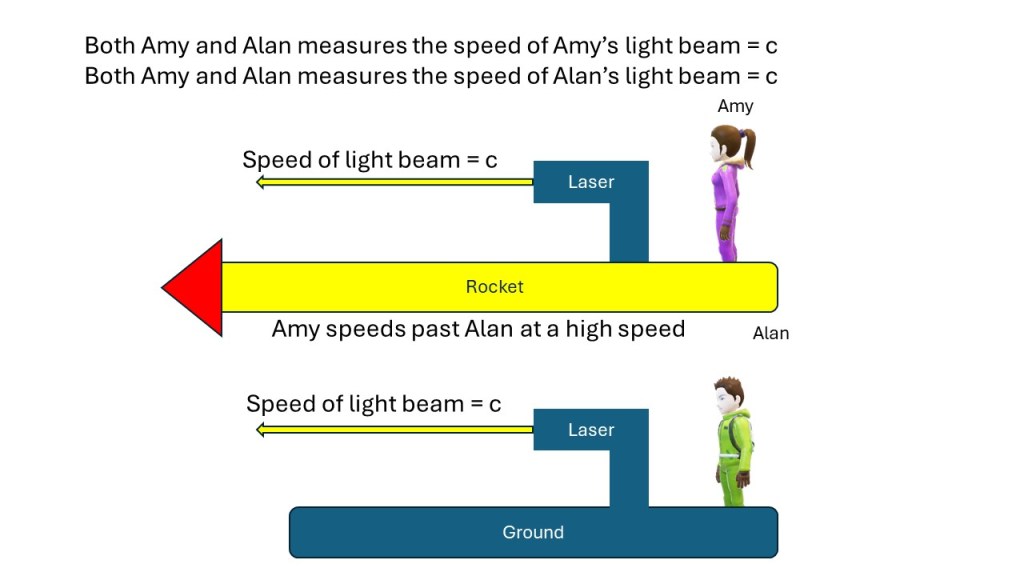
The picture shows two people Alan and Amy. Alan is on the ground. Amy is flying by Alan in a rocket speeding left. Both Alan and Amy are pointing lasers to the left.
In this picture Amy is traveling past Alan in a rocket. Both have a laser. Both measure the speed of both laser beams to be c = 299,792,458 meters per second.

In the picture above let’s say Amy is flying past Alan at half the speed of light. If you believe Alan when he says that both laser beams are traveling at the speed of c = 186,000 miles per second, then you would expect Amy to measure her laser beam to travel at a speed that is half of that c/2 = 93,000 miles per hour, but she doesn’t. She measures her laser light beam to travel at the speed of c = 186,000 miles per second just like Alan. This seems contradictory. The solution that the special theory of relativity offers for this paradox is that time and space are relative and Amy and Alan measure time and space differently (more on that in another post).
Clocks being sucked into a hole or possibly sped up into space
Time is going to be different for me. From shutterstock Illustration ID: 1055076638 by andrey_l

I should add that the realization that the speed of light in vacuum is a constant regardless of the speed or direction of the observer or the light source was a result of many experiments, which began with the Michelson-Morley experiments at Case Western Reserve University, Cleveland, Ohio in the years 1881-1887. At first scientists thought that there was an ether that compressed the experimental equipment and distorted clocks so that it seemed like the light vacuum always came out the same. With the special theory of relativity in 1905 those speculations were laid to rest.
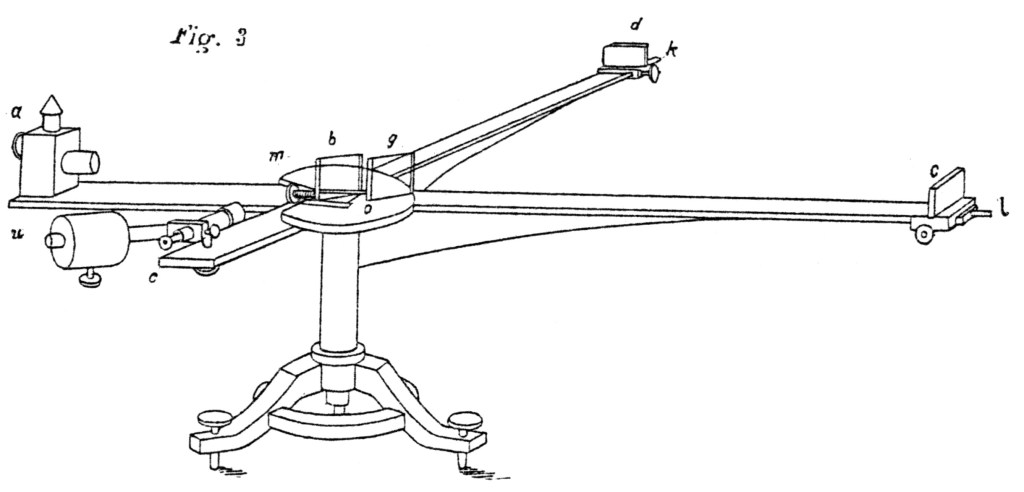
This is a drawing of the Michelson interferometer used at Case Western Reserve University
The first Michelson-Interferometer from 1881. It was used to measure the speed difference of two light beams (well a split light beam) with a very high accuracy (for the time). The light traveled with the same speed in all directions and no matter what earth’s position and speed was in its orbit around the sun. This picture is taken from Wikipedia and is in the public domain of the United States.

The speed c = 299,792,458 meters per second is a universal speed limit created by time and space

I should point out that there is nothing magical about the speed of light in a vacuum. Light traveling through matter, like glass or water, does not travel at this speed c, but slower. It also isn’t entirely correct to say that the speed of light in vacuum is a universal constant, because it isn’t about light per se. What is happening is that light traveling completely unimpeded through vacuum is prevented from traveling infinitely fast by the way time and space is set up. All massless particles / radiation, or anything that hypothetically could be traveling at an infinite speed is prevented from doing that because of the way time and space are related. Light in vacuum just happened to be what we first discovered to be restricted by this universal speed limit. Yes, time and space are annoying that way, putting a limit on the speed of light and on massless particles.

So how is time and space arranged to cause this universal speed limit? Well, that is an even more surprising blog post for another day (I will link to it once I have made the post). From this discovery about time and space came a lot of other interesting realizations but that is also for another post,  but let’s just give a brief summary:

  • Time for travelers moving fast compared to you is running slower.
  • Length intervals for travelers moving fast compared to you are contracted.
  • Simultaneous events may not be simultaneous for another observer.
  • The order of events may be reversed for different observers.
  • If you accelerate to a speed that is 99.999% of the speed of light you still haven’t gotten any closer to the speed of light from your perspective. Light in vacuum will still speed off from you at c = 186,000 miles per second.
  • Acceleration will get harder the closer you get to the speed of light in vacuum. The force required will reach infinity as you approach the speed of light in vacuum.
  • Forces, the mass of objects, momentum, energy and many other physical quantities will reach infinity as you approach the speed of light in vacuum assuming you are not a massless particle.
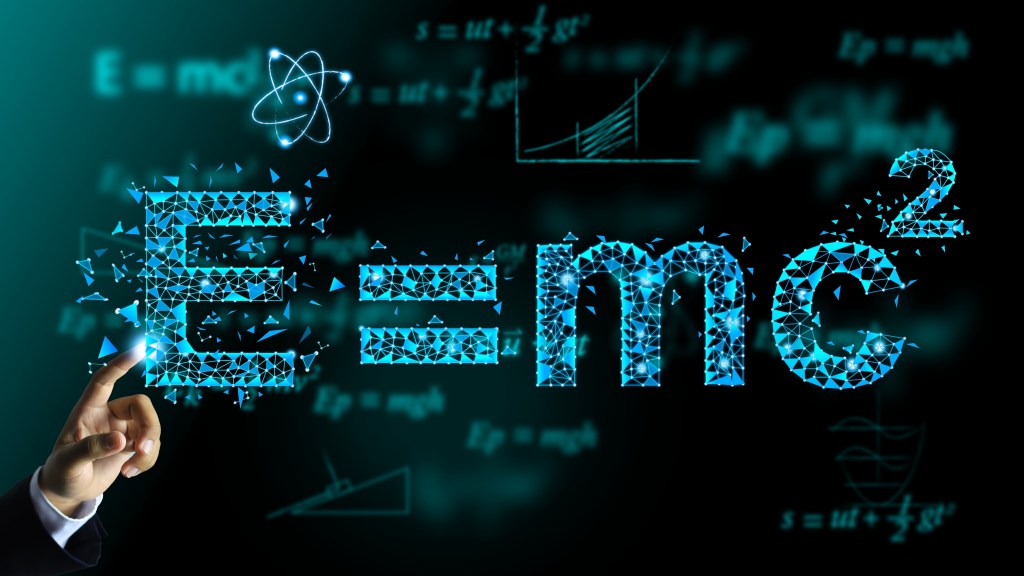
  • Mass is energy and vice versa E = mc2
  • Magnetic fields pop out as a relativistic side-effect of moving charges.
So, it seems like we cannot travel faster than the speed of light in vacuum. It seems like the universal speed limit is really a hard limit, unlike the speed limits on Texas highways. That is maybe true, at least locally where we are. However, you could get around it, sort of cheating, by stretching and bending space to the extreme by using, for example, enormous amounts of negative energy. That’s happening to our Universe over a scale of tens of billions of lightyears. A lightyear is the distance light in vacuum travel over a year. Stretching and bending space is not part of the special theory of relativity. That is Einstein’s General Theory of Relativity, which is a very complicated theory, so you may not see any posts on that.
Mass is energy and vice versa, a direct result of the way time and space are related. Stock Photo ID: 2163111377 by Aree_S

How do you feel about time and space creating this universal speed limit in which light in vacuum travel?
Some Things are not Meant to be Known

As I mentioned in a previous blog post I’ve been thinking about launching a second blog. The topic would be facts, or insights that are widely disputed or misunderstood amongst the public, yet important and known to be true. However, I am also thinking about adding another aspect to the blog and that is facts, or insights that are highly surprising to people, yet important and known to be true. Curious or strange facts if you will. Not strange trivia but important stuff. People wouldn’t necessarily dispute these facts, well they might, but they may appear unintuitive to a lot of people. So, the true facts that people are disputing would be “cluster-A” and the facts that just would seem strange, ponderous, or counter intuitive would be “cluster-B”. I will post about both.

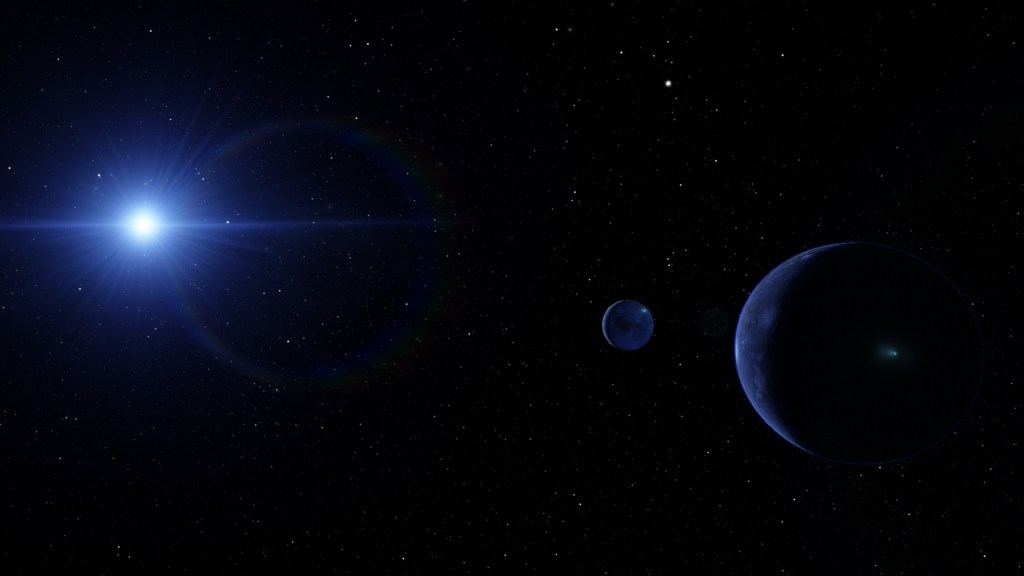
This particular blog post gives an example of a cluster B fact. To express myself a little bit simplistic, science does not know everything (otherwise it would stop), but it knows a lot. By studying the light from a distant star, we can determine what elements it is composed of. The star may be composed of 71% hydrogen, 27% helium, 1% Lithium, and 1% other elements, and we can know that just from its light. We can determine the distance to the star, how it is moving compared to us, its temperature, roughly its age and longevity, and more. 150 years ago, we could not have dreamed of this capability.

Bright white star with a planet and a moon.
We can know so much about a star from its light. Shutter Stock Illustration ID: 566774353 by Nostalgia for Infinity.

Yet we know that there are things we can never know, no matter how advanced science becomes. Infinite experimentation, super intelligence, a quintillion super genius, infinite time, cannot breach some knowledge. The universe itself forbids some knowledge. It also means that the statement “nothing is impossible” is false. My natural reaction to such a claim is, “come on you can’t say that with certainty”, and I expect many others will feel the same. However, the reason some knowledge will never be attainable is that physical laws as well as mathematics and logic forbid some knowledge. Some things are not meant to be known. I will explain in the four sections below: the event horizon, the Heisenberg uncertainty principle, beyond the observable Universe, and Gödels incompleteness theorem.

I should say in my future blog I will explore each of the four examples below more in depth, and put them in their own blog posts, and I might add or remove examples as I learn more.


The Event Horizon of a Black Hole

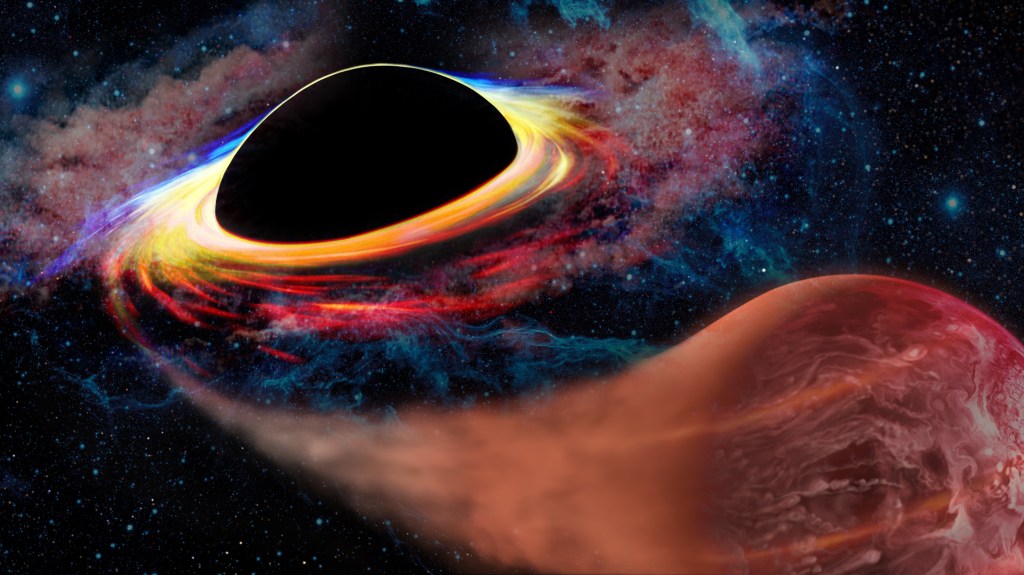
A black hole is a region of spacetime where gravity is so strong that nothing, including light, can escape it. The boundary of no escape is called the event horizon. If you pass the event horizon you cannot come back out no matter how much energy, you expand. Nothing can escape, no matter, no radiation, not light or other electromagnetic radiation, and no information. Nothing at all can escape. The curvature of time and space itself forbids it. I should add that right at the event horizon, there is so called Hawking radiation, but without complicating things it is not the same thing as escaping a black hole.

Black hole devouring a planet.
Black Hole Stock Photo ID: 2024419973 by Elena11

Some black holes are formed when large stars die and collapse. These black holes are estimated to have a mass of five to several tens of solar masses. However, there are also super massive black holes that reside in the center of galaxies. The super massive black hole at the center of our galaxy, the Milky Way, is called Sagittarius A* and is estimated to have a mass of four million times the mass of our sun. The largest known supermassive black hole TON 618 is 66 billion times more massive than our sun. There are an estimated 100 million black holes in our own galaxy, the Milky Way. One interesting fact is that celestial objects can orbit a black hole, just like planets orbit the sun, but as you get too close you will rush, at the speed of light, into the depths of the black hole You are “poff and gone”.

The fact that nothing, including information, can escape a black hole means that we can never observe what is on the inside. You can venture inside and be lost. You can extrapolate from physical laws what might be inside, but you can never observe and report what is inside to planet Earth.


The Heisenberg uncertainty principle

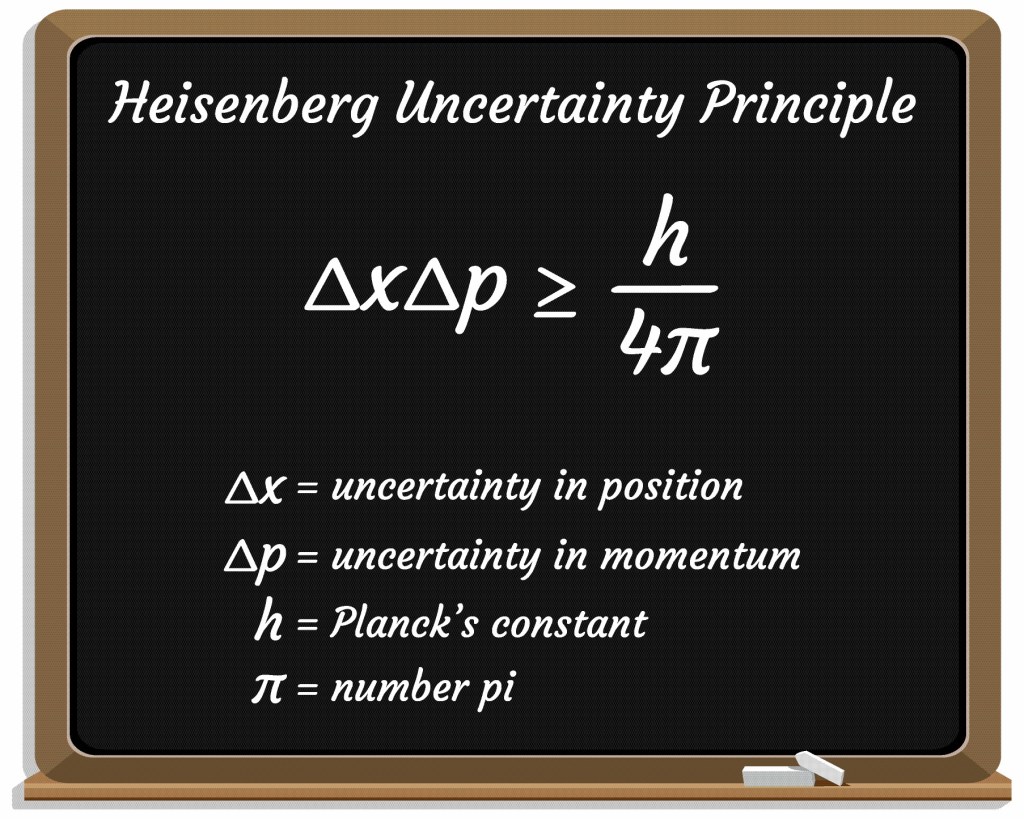
The Heisenberg uncertainty principle states that it’s not possible to know the position and momentum of an object with perfect accuracy at the same time. Another way of saying that is that we cannot know both the position and speed of a particle, such as a photon or electron, with perfect accuracy. The formula is: dX * dP >= h/4pi , uncertainty in position (dX) times uncertainty in momentum (dP) is larger than half of Planck’s constant, which is very small. There is also an energy and time precision : dT * dE >= h/4pi. It basically means that there are no perfectly exact measurements or knowledge. Everything is a bit fuzzy. Planck’s constant is very small, so Heisenberg uncertainty principle does not matter for everyday objects, but it matters when sizes are very small (positions, energies, etc.) Note, Heisenberg uncertainty principle is not regarding a limitation of our equipment, but a limit set by a law of physics. It is a limitation set by the Universe.

The picture shows the formula for the Heisenberg uncertainty principle
Heisenberg uncertainty principle Shutter Stock Vector ID: 2380436193 by Sasha701

Beyond the observable Universe

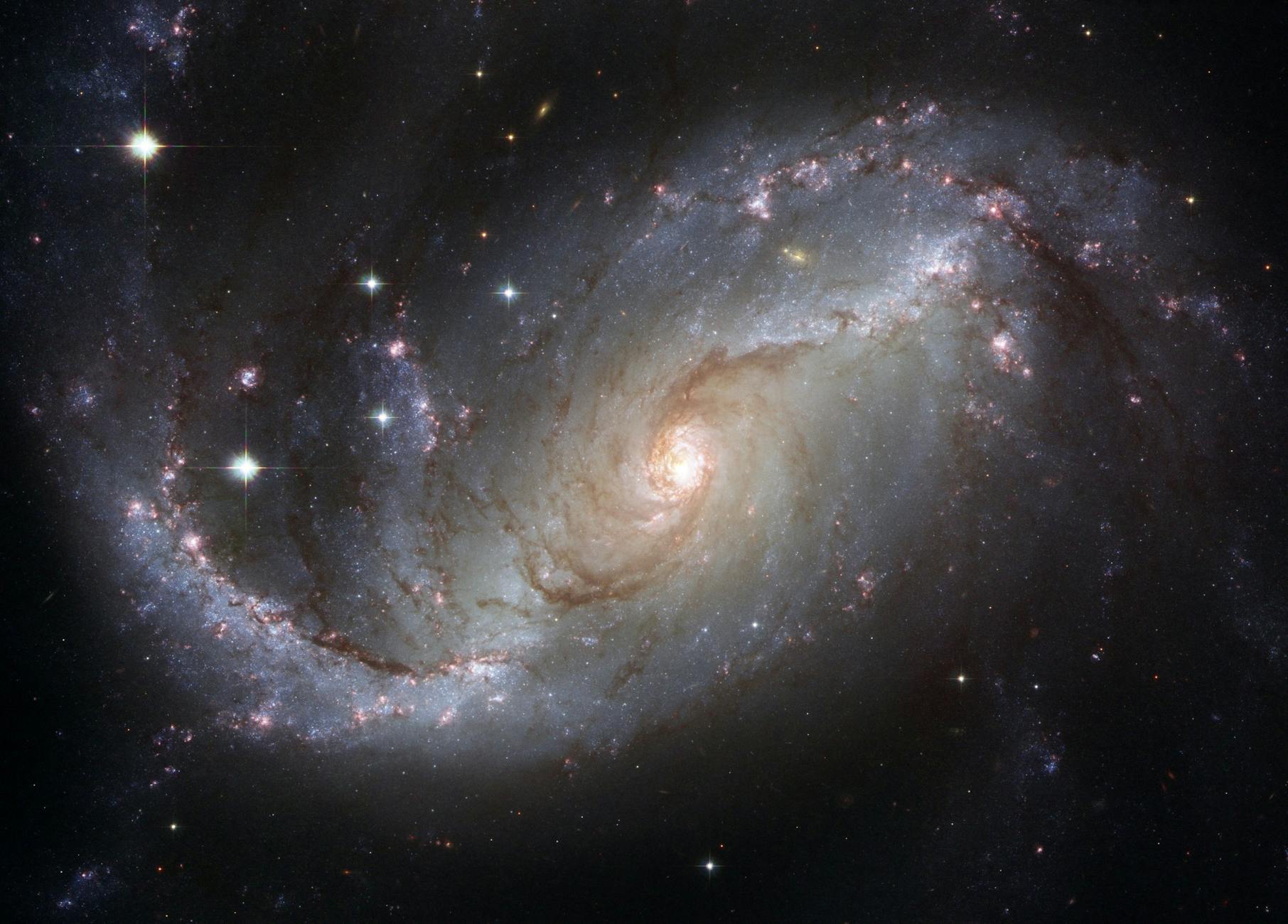
The observable universe is a ball-shaped region of the universe consisting of all matter that currently can be observed from Earth or its space-based telescopes. The radius of the observable universe is 46.6 billion light-years. The size of the observable universe is growing. Unfortunately, at those distances, space itself is stretching/expanding faster than the speed of light. Since no signal or information can travel faster than the speed of light we are losing, not gaining, celestial objects from the observable universe. Further, in the past we’ve lost many galaxies this way. I can add that the universe may be infinite. Since the expansion is accelerating, we will keep losing more galaxies beyond the boundary of the universe and some galaxies were always lost (with respect to observation).

A picture of a galaxy full of stars.
A view of a galaxy full of stars. Photo by Pixabay on Pexels.com

If we are wrong about the fact that the expansion of the universe is accelerating, then perhaps we can observe more galaxies in the future. But if not, then there are galaxies that we have never observed, galaxies that we can never observe, and there are galaxies that will become unobservable in the future. Depending on the size of the universe we may never be able to observe more than an infinitesimally small portion of the universe. Again, the universe is stopping us from knowing something.


Gödels incompleteness theorem(s)

The theorem states that in any reasonable mathematical system there will always be true statements that cannot be proved. In other words, to find a complete and consistent set of axioms for all mathematics is impossible. There are forever hidden truths in mathematics. For the case of natural numbers this means that there will always be statements about natural numbers that are true, but that are unprovable. I can add that there is also a second incompleteness theorem that states that a formal system cannot prove that the system itself is consistent. Basically, there are limits to mathematics set by logic.

There are forever hidden truths in mathematics in the form of unprovable truths. Photo by Andrea Piacquadio on Pexels.com

I have a book on Gödels incompleteness theorem, which I have not read, but I will read it before I make a post about it.


Some other topics for strange yet important facts

  • Light speed in vacuum is a Universal Constant.
  • Time is relative (deeper explanation).
  • Non-simultaneity and simultaneity are relative.
  • The strange double slit experiment.
  • Quantum Tunneling.
  • Quantum entanglement.
  • The Monty-game-door trick, 3-doors.
  • The butterfly effect.
  • Mandela effect.

What do you think about mixing in some very strange but important facts in my future blog about facts people dispute even though they are known to be true?