
I have not posted in a while, and I have not read blog posts either because I’ve been focused on the annual Citizens Climate Lobby (CCL) conference and lobby days in Washington DC. Part of this event was about 1,000 CCL volunteers having meetings with more than 400 congressmen and senators. I organized and participated in a meeting with senator Ted Cruz’ office (Texas) and I participated in a meeting with Senator Wicker’s office (Mississippi). I also had a small one-man (just me) meeting with the office of another Texas congressman and a delivery to my own congresswoman Beth Van Duyne (Texas district 24).

Some technical background. The United States congress consist of two houses, the house of representatives with 435 congressmen, and the Senate with 100 Senators, two from each state. Each proposed law or bill/act has a number in the house of representatives on the form H.R.xxxx and S.xxxx in the Senate. To become a law, a bill/act must be approved by the house of representatives with a vote of at least 50% as well as approved by the Senate with a vote of at least 60% (filibuster rule) or 50% if you can make it part of a budget bill (so called budget reconciliation). I can add that the president can also veto a bill that has passed both houses.

The majority of the house of representatives is Republican and the majority of the Senate is Democratic, but the split is very even. Unfortunately, the current congress is also very partisan, and pretty much war like, making passing any laws nearly impossible. Most bills are introduced to impress respective side’s partisan base and for grandstanding, not with the intention of it becoming law. I’ve read that the current congress is the most dysfunctional in United States history. Into this mess CCL is proposing or supporting climate related legislation that is bipartisan, or introduced jointly by Democratic and Republican congressmen, and therefore has a chance of passing. CCL is a bipartisan organization and has good relations with both Democrats and Republicans.
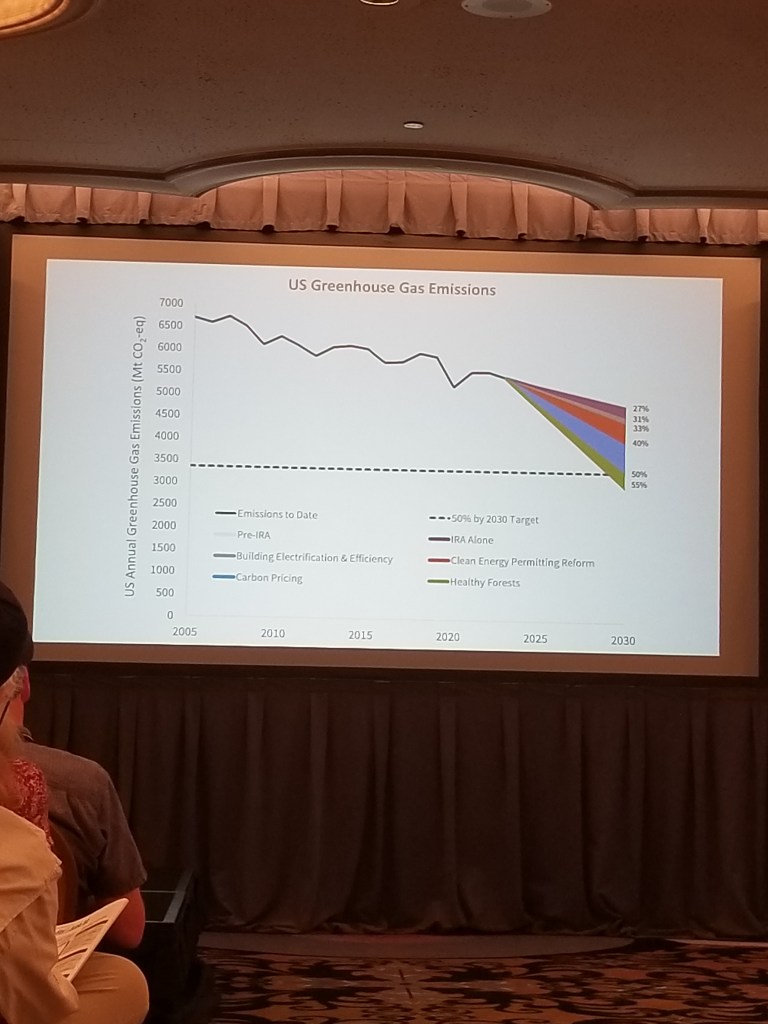
Our favorite piece of legislation is the carbon fee and dividend, but we did not discuss it for reasons I will soon explain. The carbon fee and dividend policy consist of three parts. First, a price/fee/tax is placed on carbon emissions. This makes sense because ruining the atmosphere for everyone on earth should not be free of charge. Second, the proceeds are returned to people/consumers on an equal basis, as a dividend, a check or a direct deposit. Most people will receive more money than they lose from paying higher prices, while the incentive to buy less carbon intensive products will remain. You are rewarded for polluting less than the average. Thirdly, a carbon border adjustment, or a fee at the border, will be enacted on imported carbon intensive products that are produced with higher carbon emissions than the average for the United States. A subsidy is applied to exported products created using less carbon emissions. According to economists, a carbon fee and dividend is a very effective policy in reducing emissions. In fact, an optimal way of reducing carbon emissions. At the same time, it does not harm the economy. This is why CCL loves it.
Unfortunately, it is currently not politically viable. In Canada something similar has been implemented and even though 80% of Canadians come out ahead financially from this policy, almost no one believes it because doing the accounting is not easy. It is also incorrectly blamed for inflation. Add the fact that the Republican party has turned against it, thus making it a partisan policy (no longer bipartisan). Therefore, we have to wait.
For this year we had four “Asks”. Four policy proposals or areas for which we are asking support from congress.
- Prove It Act S.1863
- Energy Permitting Reform
- Seedlings for Sustainable Habitat Restoration Act of 2023 S.1164 / H.R.5015
- Increased TSP Access Act of 2023 S.1400 / H.R.3036
Below are the summaries of our four asks. Below each short summary I have included the full text from our flyers. I don’t expect anyone to read the full text, but naturally you can if you are really interested.
Prove It Act S.1863
This bipartisan act introduced by Senators Chris Coons (D-DE) and Kevin Cramer (R-ND) would require the Department of Energy to study the emissions density of certain emissions intense products, cement, aluminum, steel, fossil fuels, etc., in the United States and in other countries. US products are much cleaner than the same products from many other countries such as China and India. Having the data will help us capitalize on this advantage, for example, in trade negotiations and attracting foreign buyers of these products. It is good business for the United States.
Full CCL text of Prove It Act S.1863
The bipartisan Providing Reliable, Objective, Verifiable, Emissions Intensity and Transparency Act of 2023 (S.1863), or PROVE IT Act, introduced by Sens. Chris Coons (D-DE) and Kevin Cramer (R-ND), would require the Department of Energy (DOE) to study the greenhouse gas emissions intensity of certain products — including aluminum, cement, crude oil, fertilizer, iron, steel, plastic, and others — that are produced in the United States and in certain covered countries. The PROVE IT Act is not a carbon tax or carbon border tariff.
The PROVE IT Act was approved by the Senate EPW Committee in a large bipartisan vote (14-5) in January and is expected to be introduced in the House by Reps. John Curtis (R-UT-03) and Scott Peters (D-CA-50) in the coming weeks.
Greenhouse gas emissions are a global issue, and trade and the power of the American market are some of the best tools we have to reduce global emissions. Since many U.S. industries are among the least carbon intensive in the world, producing products here is good for the U.S. economy and good for the climate. In addition, U.S. industries have had to unfairly compete with industries from higher-polluting foreign countries with lax labor and environmental standards. As Sens. Coons and Cramer have said, “The PROVE IT Act would put high-quality, verifiable data behind these practices and bolster transparency around global emissions intensity data to hold countries with dirtier production accountable.”
The PROVE IT Act is endorsed by the American Petroleum Institute, American Conservation Coalition Action, Bipartisan Policy Center Action, American Iron and Steel Institute, Center for Climate and Energy Solutions, Citizens’ Climate Lobby, Climate Leadership Council, Citizens for Responsible Energy Solutions, Environmental Defense Fund, Information Technology and Innovation Foundation, Third Way, Progressive Policy Institute, Independent Petroleum Association of America, Steel Manufacturers Association, and the United States Chamber of Commerce.
The PROVE IT Act is an important bipartisan step to protect American industry and drive down global carbon pollution. Citizens’ Climate Lobby urges all members of Congress to cosponsor the PROVE IT Act and take action to pass the bill this Congress.
Energy Permitting Reform
The biggest obstacle to expanding the utilization of clean energy isn’t building clean energy but building the power lines needed to bring the power from the clean energy sources to households. It takes 10-20 years to get a powerline approved while building a wind power facility takes months. There are also energy technology specific hurdles for building, for example, nuclear power stations and renewables including endless judicial reviews and several layers of bureaucratic approval processes. We can’t wait decades for yes or no. It is important to speed up the process for building America’s clean energy infra structure. Some has been done but more needs to be done. This is an area that will make a big difference that both Democrats and Republicans seem to agree on.
Full CCL text of Energy Permitting Reform
Citizens’ Climate Lobby believes it is critical to speed up the process for building America’s clean energy infrastructure. Changes to the current process for permitting energy projects must be made so America can lower greenhouse gas emissions and ensure American households have access to affordable clean energy. CCL appreciates that the Fiscal Responsibility Act of 2023 included some provisions that will help streamline clean energy permitting and several new agency and FERC rules intended to speed the energy permitting process have been finalized. However, more comprehensive permitting reform is still needed and should be done in a way that protects communities, preserves their ability to provide input, and maintains environmental standards. We also know that further changes to our permitting process will need to have bipartisan support.
In each of the past three years, at least 84% of the new energy capacity built in the United States was clean energy. More than 95% of new energy projects currently awaiting permits are solar, wind, and battery storage. Building a new electrical transmission line, on average, takes over a decade and solar, wind, and transmission projects are litigated at higher rates than other infrastructure projects. If construction of energy infrastructure continues at this pace, we will not be able to lower our emissions at the speed and scale necessary and ensure Americans have affordable and reliable energy in the 21st century.
We still need key reforms to our energy permitting process, such as but not limited to:
- Allow transmission lines to be permitted and built much faster: We must permit, site, and build interregional transmission and require that regions be able to transfer significant power between regions.
- Reasonable timelines for judicial review: There are new time limits for NEPA reviews, but litigation still has the potential to delay needed energy projects almost indefinitely. We need a reasonable statute of limitations that allows impacted communities to have a voice and stop bad projects but does not allow for infinite delays.
- Ensuring robust and early community engagement: Any permitting reform must still provide a thorough, accessible process for community engagement and input.
- Technology-specific permitting: There is also a critical need to modernize permitting for specific technologies like nuclear, hydropower, and geothermal power.
We urge Congress to work in a bipartisan manner to enact needed changes to our energy infrastructure permitting process. We believe both parties must come to an agreement on reforms that can pass both the House and Senate and be signed into law.
Seedlings for Sustainable Habitat Restoration Act of 2023 S.1164 / H.R.5015
The Seedlings for Sustainable Habitat Restoration Act was introduced by Texas Senator John Cornyn (R), and a couple of Democrats jumped on board as well. It will authorize the secretary of agriculture to carry out eco system restoration activities particularly the development of seedling nurseries, which will significantly aid forest recovery from wildfires. It is part of CCL’s Healthy Forest initiative.
Full CCL text of Seedlings for Sustainable Habitat Restoration Act of 2023 S.1164 / H.R.5015
The Seedlings for Sustainable Habitat Restoration Act was introduced in the Senate by Sen. Ben Ray Lujan (D-NM), Sen. John Cornyn (R-TX) and Sen. Martin Heinrich (D-NM) and in the House by Rep. Leger Fernandez (D-NM-03). The legislation ensures that funding from the Bipartisan Infrastructure Law of 2021 is available to support the development of seedling nurseries to improve and expand reforestation efforts.
Specifically, the bill would:
- Authorize the Secretary of Agriculture, acting through the Chief of the Forest Service, to enter into contracts, grants and agreements to carry out certain ecosystem restoration activities.
- Clarify that funding from the Bipartisan Infrastructure Law is available for the development of seedling nurseries at state forestry agencies, local or non-profit entities and institutions of higher education.
The Seedlings for Sustainable Habitat Restoration Act has the potential to significantly aid in forest recovery from wildfires. From 2001 to 2021, the nation lost 11.1 million hectares of tree cover from wildfires and 33.1 million hectares from all other loss. Although the Bipartisan Infrastructure Law provides funding for replanting programs, it does not address the need for expanded nurseries. The Seedlings for Sustainable Habitat Restoration Act rectifies this omission by providing funding for crucial seedling nurseries to further our nation’s progress toward resilient forestry. The bill complements another one of CCL’s secondary asks, the Save our Sequoias Act, through aiding its regeneration efforts.
On April 16, 2024, the House version of the Seedlings for Sustainable Habitat Restoration Act was voted out of the Committee on Natural Resources by unanimous consent. It now awaits action by the full House. The Senate companion was referred to the Committee on Agriculture, Nutrition, and Forestry on March 3, 2023, where it awaits review.
Increased TSP Access Act of 2023 S.1400 / H.R.3036
There is a current Technical Service Providers Shortage that needs to be addressed. Farmers and ranchers need help with resilient and climate smart practices, and this bill streamlines and improves the certification process. It was introduced by Senators Mike Braun (R-IN) and Michael Bennet (D-CO) in the Senate and Representatives James Baird (R-IN-04) and Abigail Spanberger (D-VA-07) in the House. It is a small step forward but easy and inexpensive to do.
Full CCL Text of Increased TSP Access Act of 2023 S.1400 / H.R.3036
The bipartisan Increased TSP Access Act of 2023 has been introduced by Sens. Mike Braun (R-IN) and Michael Bennet (D-CO) in the Senate and Reps. James Baird (R-IN-04) and Abigail Spanberger (D-VA-07) in the House. The bill would address the current Technical Service Providers (TSPs) shortage, which is impacting the ability of agricultural producers to fully utilize current conservation and climate programs.
As extreme weather events increase in frequency and strength, we are seeing increasingly devastating effects throughout our agricultural and food systems. Farmers, ranchers and forest-owners are on the front lines of climate change and can also mitigate its effects through resilient and climate-smart practices.
TSPs help producers to access USDA conservation programs through one-on-one assistance. For example, TSPs can help producers to develop grazing management plans, nutrient management plans and sustainable forestry plans. TSPs will be key to leveraging the recent $20 billion investment in agricultural conservation programs and conservation technical assistance.
USDA’s current TSP program has failed to adequately train and certify TSPs, even though the 2018 Farm Bill included language (Section 2502) that would allow USDA to approve non-Federal entities to certify TSPs. The Increased TSP Access Act would address the TSP shortage by expanding on the framework first envisioned in the 2018 Farm Bill.
- Non-Federal Certifying Entities: The bill directs USDA to establish a process to approve non-Federal certifying entities within 180 days of enactment. The bill ensures that USDA’s process will allow agricultural retailers, conservation organizations, cooperatives, professional societies and service providers to become certifying entities. It also puts clear deadlines on USDA to ensure that the agency is responsive in administering the program.
- Streamlined Certification: The bill directs USDA to establish a streamlined certification process for TSPs who hold appropriate specialty certifications (including certified crop advisors) within 180 days of enactment. This guarantees that applicants with other certifications aren’t burdened with duplicative training, but are still trained in the competencies needed to serve as a TSP.
- Parity in Compensation: The bill ensures that TSPs—who are often paid using conservation program dollars—are paid the fair market rate for their services.
The Increased TSP Access Act was referred to the House Agriculture Committee, Subcommittee on Conservation, Research and Biotechnology, and to the Senate Committee on Agriculture, Nutrition, and Forestry on May 2, 2023, where it awaits consideration.
But wait a minute! That’s not what the bill says.
I should mention that the full CCL texts of the aforementioned bills above are still summaries of the real bills that are even longer. This makes the Senators and the Representatives job difficult, which is why they have their staff read and summarize the bills for them. The staff is often young kids making this a little bit risky.
One of the Senators that we (including me) met with had voted no on one of the bills above in committee. The bill had still passed out of committee to be voted on in the Senate later, but we wanted to know why he voted no. The reason given made no sense. He had misunderstood the bill. This was a great opportunity for us to correct the misunderstanding. Hopefully, he will vote differently in the Senate.
Would you be willing to visit your representatives regarding matters you would like to address?
 Leonberger Life