
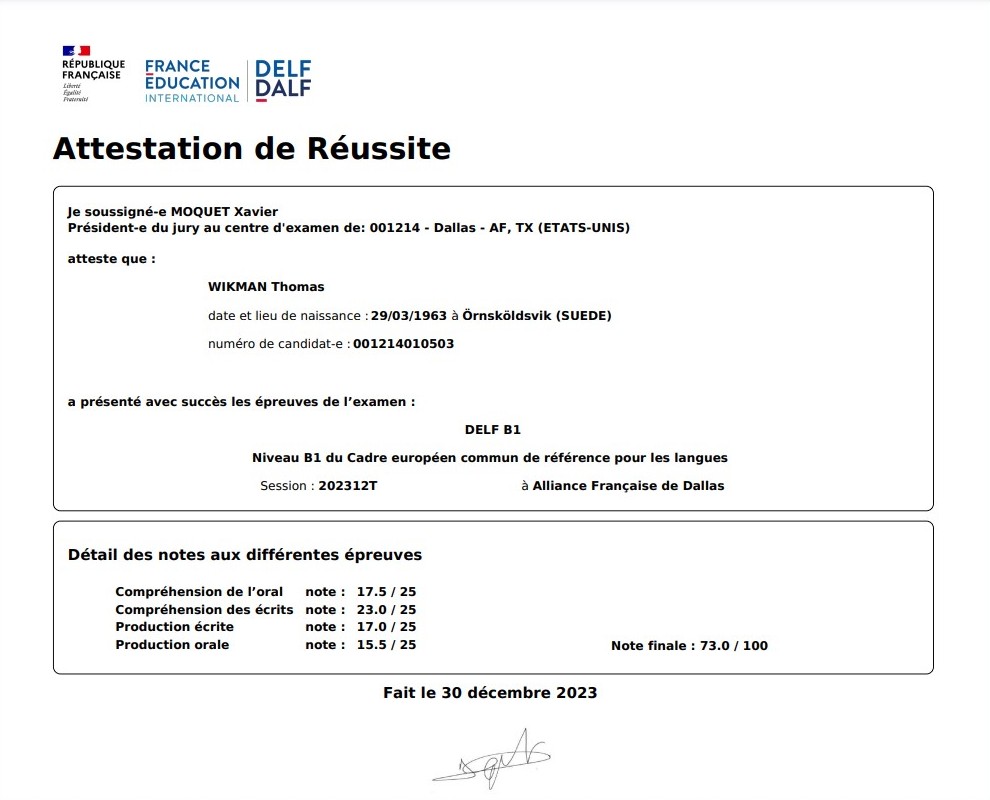
I’ve got a number of hobbies, one of them being learning French. Back in December I took and passed the DELF / CEFR B1 level language test in French. The CEFR is a European standard for assessing an individual’s language proficiency that is being adopted around the world. It includes all European languages as well as other languages. The A1 & A2 tests are for beginners with A2 being more challenging. The B1 and B2 tests are for independent speakers, meaning you can get around without help, listening to the news, having conversations, etc. C1 & C2 are advanced levels, like native speakers and experts. If you immigrate to France, you need to pass the B1 test to become a citizen. Most countries do not have such a language requirement for citizenship. The A1, A2, B1, B2 tests (and maybe C1 & C2) consist of four parts but the different tests have different difficulty levels.
- Oral comprehension: Listening to recordings like a conversation or a radio broadcast and answering questions about what was said.
- Reading comprehension: Reading articles and answering questions
- Writing: Such as writing an essay, and for A1 it is just filling out a form or writing a 40+ word post card
- Oral production: Participating in conversations and doing presentations on topics decided on at the exam.

To pass the test you need 50 out of 100. As mentioned, the test is designed to assess your level. It is not like a test you take to get a grade at school. Therefore, if you do what is expected of you at the B1 level you may get 50-60 points and more if you can do more. If you get 80+ on the B1 test, then you probably should have taken the B2 test. There are no A, B, C, D or 1,2,3,4,5 grades.
There are a couple of things that come to mind regarding these tests.
Learn to Speak 25 languages in one hour!
Yesterday I saw an advertisement on Facebook for the Pimsleur approach that stated, “start speaking a new language after just one lesson”. Well, I used the Pimsleur approach for French for a short while and I remember the first half an hour lesson. You learned to repeat one short sentence. That’s not speaking a new language in my opinion. The advertisement sounded like there should be more to it. I should say I think the Pimsleur approach is a good approach. It is the ad I have a problem with. I’ve seen other language program commercials stating that you will become fluent in 24 hours, or become conversant right away, and many other ads that are just BS.
There are some language geniuses but most of us need a lot of practice to learn a second language regardless of method. There is no way around the fact that you need to know a few thousand words, internalize sentence structure and grammar, etc., before you can be fluent. I think one reason these language companies get away with unrealistic promises is that many people expect ads to be BS and another that many language learners greatly overestimate their proficiency. These universally accepted tests are great for assessing true proficiency.

When our younger son (pictured above) was 6-7 years old my wife used to play a song in the car that featured Hello and Goodbye in 25 languages, and he learned that song. One day I was having a conversation with a waiter at a restaurant who noticed that I had an accent. He was curious about my native language Swedish. That’s when my son told him “I speak 25 languages”. So, the waiter started asking him questions about how to say hello and goodbye in the various languages he claimed to speak, and he knew. So, the waiter asked me, “does he really speak 25 languages?”. I said, well that’s what he says. Perhaps, the language companies could put this song in the first lesson and then claim, not entirely incorrectly, that with their method you’ll speak 25 languages in one hour.
Proficiency assessment for other subjects
I sometimes wonder if rather than assigning grades to students it would be more practical to allow people to attain certain levels in one or more fields that they are interested in. Naturally, people could reach their levels any way they like, and not necessarily through the university system. Considering the many failures of modern universities, extremely high tuition, student loan issues, grade inflation, crazy partying and drugs, failures to protect girls from sexual assault, political indoctrination, antisemitism on campuses, fewer people going to college, parents losing faith in universities (including myself), and the list goes on, maybe it is time for something new. What should replace it I don’t know. Perhaps assessing proficiency levels instead of class grades could be part of it.

 Leonberger Life
Congratulations on passing the B1 test on Franch, Thomas! Now you can become a citizen in France! My daughter took French in high school. My son-in-law speaks some Italian. Between the two languages, they got along well when they revealed in Europe. I would like to learn Italian because we may visit some cities in Italy. I speak a few words in Spanish and both languages are straight forward in their vowels.
LikeLiked by 1 person
Thank you so much Miriam. One speaks french and the other some italian, that’s certainly useful for traveling in southern Europe. Like you say I read that France and Italy have a B1 requirement for citizenship, and a few other countries have an A2 requirement, but most countries don’t have such a requirement. Sweden doesn’t but they provide unlimited free Swedish classes to get immigrants to learn Swedish. In the US there is no language requirement except for a very basic one that is much much easier than A1, and it is only some immigrants who have to take it (I didn’t). I will never move to France but my wife has a sister in France so we will probably visit. Like you say it is useful for travel.
LikeLike
Hej Thomas! Well done on on your French exam and it is great to read about your interest in languages and bless your son and his 25 languages! Even to just say hello and goodbye in a native language when travelling means a lot! I’ve been learning Portuguese for quite a while, both linguaphone and Duolingo and enjoying it lots – hope to travel to Portugal to use it soon! Happy Learning! 😀
LikeLiked by 1 person
Thank you so much Annika. It is great that you are learning Portugese. I hope you get to travel to Portugal. My wife spoke Portugese when she was a little kid (born in Brazil) but she forgot almost all of it. She speaks Spanish and French pretty well though and she would probably pass B1 and maybe B2 for both if she tried. That’s how I got started. She wanted to improve her French so I joined her to learn it. She patiently sat through A1 classes with me.
LikeLike
Your third language? Thomas, you are a genius! My dad started learning Chinese in his 40s. He was a B1 Chinese speaker by age 50. He had no formal music training, so the tones were very new and hard for him to master. The older I get, the more I realize how tenacious he was to keep at it.
LikeLiked by 1 person
Thank you Priscilla but I am not a language genius at all. I am among the slowest in class. I am not terrible, but not a fast language learner. I studied English in Swedish school for many years (8 or 9) and five years of German. When I arrived as an exchange student in the US I spoke English the worst among the six Swedes in the group. The University (Case Western Reserve U.) did not ask us to pass a language test because they assumed we Swedes all spoke English well. That was lucky because I would not have passed. In the beginning I had no clue what the teachers were saying but for technical subjects that matters less and I got by well. I could easily read books. It is the same with my French now (look at my 23/25 score). However, once you are embedded you learn much quicker and towards the end of the year I had no problem.
When you take classes once or twice a week it goes slow. Chinese is a difficult language (for westerners) and I am not surprised at all it took 10 years to pass B1. As you said he was very tenacious. That’s why I get annoyed when language learning companies make it sound like it is a piece of cake in their ads, because it is not. As I mentioned, if you are embedded it is much faster. Well you have to know some before you are embedded otherwise it’s very hard to get started.
LikeLiked by 1 person
We wouldn’t let me daughter date until she had her black belt (in Shaolin Kenpo). Didn’t work for her and probably wouldn’t work for your son, either!
LikeLiked by 1 person
It is a good idea. It is certainly a dangerous world out there for girls. My son got his black belt at a very early age at seven, but he quit, and now he has forgotten all of it. It is more of a sport anyway and not so great for self defense. In a real situation there’s no fair fighting but I learned that carrying some sand in your pocket to throw in an attackers eyes often work.
LikeLiked by 1 person
HI Thomas, congratulations on your accomplishment in French. Other than English, I can only speak Afrikaans fairly well. I can say a few words in Zulu and in French. It does take a lot of effort to learn a new language.
LikeLiked by 1 person
Thank you Roberta. There are a lot South Africans living here in Dallas so I’ve come across Afrikaans a number of times. Our favorite neighborhood restaurant is South African. You are right, learning a new language takes a lot of effort. To be fluent, the way I interpret “fluent”, you need to be at least B2 level maybe C1, and that requires knowing at least a few thousand words, maybe 10,000 words, several hundreds of new ways of interpreting words and constructing sentences, 10+ tenses, several hundred verb conjugations, and that an average person cannot do in 24 hours as some language companies claim in their ads.
LikeLike
Those ads are idiotic. It takes years to learn a language and even then, a native speaker can nearly always spot a person who has learned a language at school or outside the home. It has to do with the usage of the language. Learned language is always more formal and slightly less natural.
LikeLiked by 1 person
Well, one easy way to spot a non-native speaker is the accent. I have an accent when speaking English. Children learning a second language can get away with not having an accent if they learned the language well as children. They say the cut-off is around 17 years old. That has to do with the muscles in the face and the tongue and how they are more difficult to redevelop in adults. Most people think my accent is German or British but it is Swedish. When I speak French I also speak with a Swedish accent (according to my teacher) even though I am learning French using English as the starting point.
LikeLike
Yes, the accent is another way to identify non home language speakers. I can only identify a ‘foreign’ accent when I hear spoken English or Afrikaans, I would know with other languages. It is hard to learn another language so I am always impressed by how accomplished with English a lot of my work colleagues and friends are. I can’t speak their home languages.
LikeLiked by 1 person
I noticed that as you get better at a language you can more clearly hear the difference between accents in that language. A few weeks ago, my teacher played a video with people speaking Cajun French. I easily understood what they were saying but it sounded so funny that I was laughing. The difference was very obvious. When I was a very new beginner, I could not hear a difference (I wouldn’t understand much either). You say, “home language”. I must admit that is new to me. I am used to “native language” or “mother tongue”.
LikeLike
Hi Thomas, that is interesting. Home language is widely used here in South Africa. I can hear the difference between French from France and French from French speaking Africa.
LikeLiked by 1 person
Well regarding “home language” I learned something. I think I am going to start using that. We’ve listened to some French from Senegal and Madagaskar and it sounds different but it is not hard to understand or funny sounding. The Cajun French though, sounded funny.
LikeLike
I have never heard Cajun French outside of a The Green Mile by Stephen King. I listened to the audio book and one of the characters was Cajun French. Home language is easy to understand, isn’t it?
LikeLiked by 1 person
The Green Mile is a very famous book, but I didn’t read/listen to it or watch the movie. The Cajun French I heard was a video in which Cajun French speaking people were interviewed. It was not very fast so I understood what they said but it was pretty different.
LikeLike
Yes, the Cajun French sounds different to either French from France and West African French.
LikeLiked by 1 person
Congratulations to you, and your son too 🎉
LikeLiked by 1 person
Thank you so much Kaushal
LikeLiked by 1 person
Congratulations on your accomplishment!
LikeLiked by 1 person
Thank you so much Mary Ann
LikeLiked by 1 person
I should try to learn Spanish given that we live in Southern California now. I mean, I took three years of it in high school, but that was longer ago than I would like to think about and do I remember it now? Not really. Good points about being able to spot accents as you become more proficient. My wife and I have taken ballroom dance lessons for over 20 years now and always make a point of scrutinizing dancing scenes in movies or TV shows so that we can catch what they did wrong (and they almost always do something wrong). You can usually tell when the actors didn’t really learn anything because in that case they never show their whole body dancing at once, they show their upper bodies and then cut to their feet and then cut back again. (They never do this with Sam Rockwell or John Travolta or, for that matter, Christopher Walken.)
LikeLiked by 1 person
I took German in school for five years, also a long time ago. At the time I was probably level A2 but now I wouldn’t have a chance to pass German A1. You forget when you don’t use it. Ballroom lessons for 20 years, that sounds fun and a good hobby. That’s interesting about never showing their/actors whole body dancing at once.
LikeLike
I took French for years and was always better at reading it than speaking it. I am currently using Duolingo to brush up on basic French since I haven’t practiced it for years. I commend you for taking this test!
LikeLiked by 1 person
Thank you so much Dawn and I wish you good luck with Duolingo. I have not yet tried that app.
LikeLike
Monsieur Thomas, je vous felicite pour votre diplôme. C’est vraiment super! Vous etez un vrai poliglot.
J’ai bien aimé l’anectode de votre fils. Tres drôle et intelligente.
Moi, j’ai appris de la francaise dans l’école.
J’ai eu la chance d’avoir une merveilleuse professeure. Puis ma fille a étudié de la francaise aussi.
Alors, ça y est.
Je vous souhaite un bon fin de la semaine.
A bienrôt 🙂
LikeLiked by 1 person
Merci beaucoup Patricia. Je suis bien content de recevoir votre aimable commentaire. Oui, je pense aussi que l’anecdote de mon fils était drôle. C’est très bien que vous et votre fille ayez appris le français.
Je vous souhaite également un bon week-end
Bien cordialement, Thomas
LikeLiked by 1 person