
The focus of this blog is Leonbergers but sometimes I post about books that are not about Leonbergers but that I want to promote. Today I am posting about Green Earth (Science in the Capital Trilogy) by Kim Stanley Robinson, a thick book. It is 1,088 pages to be exact. I gave it four stars, not five, so I am not entirely enthusiastic about it. It featured a few pages of anti-capitalist rhetoric (the author is very left-wing), which I found to be annoying and out of place, as well as some distracting dialogue and subplots that I thought the book could have done without. A book with more than 1,000 pages should be as lean and fast paced as possible.
I am still promoting it because I think Kim Stanley Robinson’s books in general are very good books and it is one of the more prominent books in a relatively new genre that is gaining significant traction, so called cli-fi, or climate science fiction. Cli-fi deals with the impacts of climate change and global warming and is one of the fastest-growing literary subgenres. Major publishers are releasing more titles in the genre and some cli-fi works are being adapted into films, TV series, and other media formats. Amazon typically lists these books as science fiction. It is a subgenre to keep an eye on.
- Paperback – Publisher : Del Rey; Abridged edition (November 3, 2015), ISBN-10 : 1101964839, ISBN-13 : 978-1101964835, 1088 pages, Item Weight : 2.22 pounds, Dimensions : 6.1 x 1.9 x 9.2 inches, it cost $ 19.39 on US Amazon. Click here to order it from Amazon.com.
- Kindle – Publisher : Del Rey (November 3, 2015), ASIN : B00TWERWLA, 1071 pages, it costs $10.99 on US Amazon. Click here to order it from Amazon.com.
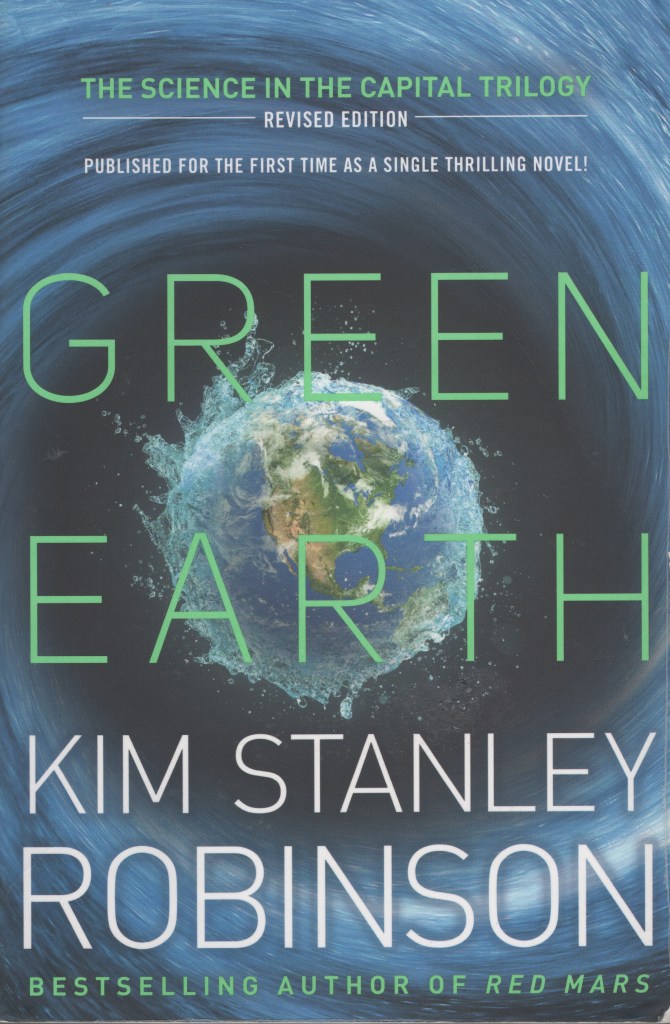
Amazon’s Description of Green Earth
The landmark trilogy of cutting-edge science, international politics, and the real-life ramifications of climate change—updated and abridged into a single novel
More than a decade ago, bestselling author Kim Stanley Robinson began a groundbreaking series of near-future eco-thrillers—Forty Signs of Rain, Fifty Degrees Below, and Sixty Days and Counting—that grew increasingly urgent and vital as global warming continued unchecked. Now, condensed into one volume and updated with the latest research, this sweeping trilogy gains new life as Green Earth, a chillingly realistic novel that plunges readers into great floods, a modern Ice Age, and the political fight for all our lives.
The Arctic ice pack averaged thirty feet thick in midwinter when it was first measured in the 1950s. By the end of the century it was down to fifteen. One August the ice broke. The next year the breakup started in July. The third year it began in May. That was last year.
It’s a muggy summer in Washington, D.C., as Senate environmental staffer Charlie Quibler and his scientist wife, Anna, work to call attention to the growing crisis of global warming. But as they fight to align the extraordinary march of modern technology with the awesome forces of nature, fate puts an unusual twist on their efforts—one that will pit science against politics in the heart of the coming storm.
Praise for the Science in the Capital trilogy
“Perhaps it’s no coincidence that one of our most visionary hard sci-fi writers is also a profoundly good nature writer—all the better to tell us what it is we have to lose.”—Los Angeles Times
“An unforgettable demonstration of what can go wrong when an ecological balance is upset.”—The New York Times Book Review
“Absorbing and convincing.”—Nature
My Four-Star Review of Green Earth by Kim Stanley Robinson
An Interesting but Frightening Vision of the Future plus some Unnecessary Filler
In a future that is not too distant climate change / global warming is beginning to cause havoc. An island nation founded by Tibetan refugees is washed away due to sea level rise, the west Antarctic ice sheet is breaking up, the arctic ice disappears in the summer, the gulf stream is beginning to shut down, there’s severe storms, floods, extreme heat and drought, as well as extreme cold. Washington DC is ironically hard hit by natural disasters. The story is focused on Washington DC and to a lesser degree San Diego, California. There are scientists looking for solutions and politicians deflecting and other politicians who act on the problem.
One of the main characters is Frank Vanderwals, a respected scientist working for the National Science Foundation, falls in love with a woman, Caroline, who is involved in a very dangerous high level political intrigue and plots. He is homeless for a period of time during which Washington DC is hit by a record winter storm. Other characters in the book are Diane, who is the director of the National Science Foundation, Senator Phil Chase who is running for President, scientists Charlie and Anna Quibler and their children Nick and Joe. Charlie is an advisor to Phil Chase. Yann Pierzinski is a genius scientist who developed some algorithms that may be important for human genome editing and for solving climate change. I can add that the National Science Foundation is a real organization that I have a special connection with because they funded robotics research I did when I was young. I thought this was a fun aspect of the book. Other organizations mentioned were often made up.
This book has a lot to offer. There’s interesting science, climate change discussions, political intrigue, deadly games, thorough and well-done character development, and a lot of interesting subplots. The plot is rich and complicated but for the most part interesting. I enjoyed the discussions on gene editing, climate change, and the discussion on how to prevent the shut down of the Atlantic current. I enjoyed the discussions on Tibetan Buddhist philosophy, Yann Pierzinski’s algorithms, and Frank’s experiences as a homeless man. I slept in tents in the forest in northern Sweden when I did my Swedish army service and it was 40 below, so I very much identified with Frank during the winter storm in Washington DC. Some creepy but interesting features of the plot were the secret microchipping of people and the possibility of manipulating voting machines. I have a lot of good things to say about this book.
A few things I did not like about the book was that some of the dialogues and subplots seemed unnecessary and contained references to drugs or detailed romantic courtship that seemed out of place and added more pages than necessary to a book that is 1088 pages long. Sometimes the character development was too slow and featured unnecessary details. Frank was throwing frisbees with homeless people for a considerable amount of pages. Both Frank and Charlie seemed a bit incompetent despite their high-level positions. I also did not appreciate the leftwing / socialist propaganda around page 500. I realize that is how the author views the world, but it is not how I see things. The book seems to take place somewhere between 2030 and 2050 based on the futuristic technology and science described as well as the effects of climate change and yet there are payphones and Vietnam veterans. But maybe people will live longer, and payphones will make a comeback. Overall, I liked the book, and I recommend it, even though I think it would have been better, and 100 or 200 pages shorter, if the content I just complained about had been taken out.

 Leonberger Life
Thanks, Thomas. It seems it has a lot of things to recommend it, and your comments give me a good idea about what I might or not like about it.
LikeLiked by 2 people
Thank you so much Olga for your kind words. It is a good book but with a few drawbacks.
LikeLike
Interesting book, Thomas! To keep an eye on. Thanks for sharing! Sending light your way*
LikeLiked by 1 person
Thank you so much for your kindness Susana. I am sending light to you too.
LikeLiked by 1 person
A great review! I’ve never heard of cli-fi before! Really interesting. At over 1,000 pages, it’s a long read, but sounds like there’s some intriguing issues in there to explore. Thanks for sharing! 😊🌸
LikeLiked by 1 person
Thank you so much Introverted Bookworm. Cli-fi is a new genre that has become important during the last 10-15 years. Amazon does not have a category for it so the books are just listed as science fiction.
LikeLiked by 1 person
This is an entirely new genre to me. Never let it be said there is nothing new under the sun. 🙂 Thanks for sharing your thoughts on this book, Thomas, and kudos to you for tackling a 1,000 page book!
LikeLiked by 1 person
Thank you so much Jan. Cli-fi has become prominent during the last 10-15 years and Amazon does not have a category for it yet, so the books are just listed as science fiction.
LikeLiked by 1 person
Cli-fi seems to be a new genre. I appreciate the chance to look into it.
LikeLiked by 1 person
Thank you Jacqui. You are right. Cli-fi has only become prominent during the last 10-15 years and Amazon does not have a category for it yet, so the books are just listed as science fiction.
LikeLiked by 1 person
Even Stephen King figured out that people nowadays are reluctant to read a 1,000 page book unless it’s fast-paced and thrilling! Thanks for sharing.
LikeLiked by 1 person
Yes I agree. His 500 page 2140 and ministry of the future were 600-700 pages but fast paced. With this one 1000+ pages there are passages (100-200 pages) that added nothing to the story. He should fix that next time but it was still a good book.
LikeLike
Great review on a long book, Thomas! I find it better to lay out the story and let the reader draw their own conclusions.
LikeLiked by 1 person
Yes you are right. Thank you so much Denise.
LikeLiked by 1 person
Really great review. Personally, I don’t know if I could read it due to the page count, that’s too many pages for me.
LikeLiked by 1 person
Thank you so much Pooja. Yes 1,000 plus pages is long and therefore it is important not to have unimportant passages. He drove me nuts with several pages of freesbee throwing. It could have been 800-900 pages.
LikeLiked by 1 person
I can imagine, I would get frustrated with that too.
LikeLiked by 1 person
It sounds interesting. I’ve never heard of cli-fi either.
LikeLiked by 1 person
Thank you Travel Spirit. Cli-fi has become prominent only during the last 10-15 years and Amazon does not have a category for it yet. The books are just listed as science fiction.
LikeLiked by 1 person
HI Thomas, a very interesting review. I was writing a book in this genre myself but I’ve put it on hold for now. The world is depressing enough without more dystopian books – grin. I wouldn’t like some of the rhetoric you mentioned so will skip this one.
LikeLiked by 1 person
I would love to read your book. I hope you continue. The thing is that even though there’s is a lot of dystopian aspects to cli-fi some books end on a positive note, for example, Kim Stanley Robinson’s “Ministry of the Future”, which started out dark with a horrific heat wave killing 20 million people in India, but ending with government cooperation around the world that led to emissions drawdawn eventually saving the planet. I liked that book better than this one.
LikeLike
Hi Thomas, that sounds like a good book. Maybe I’ll look for that one. As for The Creeping Change, I will go back to it. I have just had a bad run for the past two years with sick relatives that require a lot of care. It takes up a lot of my time.
LikeLiked by 1 person
I wish you all the best with the book. I hope you will be able to write it. I would love it.
LikeLike
Thank you, Thomas. I am working on another collection of short stories with a South African history focus. After that, I’ll probably go back to this book.
LikeLiked by 1 person
That sounds great
LikeLike
The question is : do compaigners of climate change want good things for the earth? Some people think they want to kill the industries of poor and developing countries.
LikeLiked by 2 people
This is just my opinion. In general, campaigners of climate change want good things for the earth and everybody, and many of them have good and helpful ideas. However, it all depends on what policies are enacted. The Nobel Prize winner in Economics William Nordhaus studied the economic aspects of climate change and he found that climate change will have devasting effects on the economy if it is not addressed but too aggressive of poorly chosen policies to combat it will also have bad effects on the economy. He offers some good advice (see my link below). As for developing countries, yes you have to be careful to protect their economies, which is why developed countries need to take the lead.
https://leonbergerlife.com/2023/08/06/reviewing-the-climate-casino-by-william-d-nordhaus/
LikeLike
Lulu: “Our Dada just finished Kim Stanley Robinson’s book Aurora and according to him it’s ‘the hardest hard SF I ever read’, so it must be like diamond strength SF or something …”
LikeLiked by 1 person
Any book that can devote entire chapters to things like “Where is the calcium in a closed system disappearing to?” and “How can we slow our ship down using orbital mechanics when we don’t have enough fuel to fire the braking rockets?” is pretty high up there on the list of hard science fiction works, I think …
LikeLiked by 1 person
Yes you are right James. I did not say much about that but one thing I like about Kim Stanley Robinson’s books is that he understands science well, and he spends time researching it. I am not sure I would like to read “Where is the calcium in a closed system disappearing to?” but he is the kind of author who could pull that off. His books are hard science fiction and cli-fi.
LikeLike
I have not read Aurora but I think Dada is right. Kim Stanley Robinson certainly understands science and how scientific organizations work. That’s a big plus.
LikeLike
It seems like this book has some unnecessary distractions taking up some pages in a long book, Thomas. I’m glad you pointed out some such as the romance. 2030-2050 is not too far away. Climate change is real and I hope more things are done to address the issue. Wow, what was it like to sleep below 40F?
LikeLiked by 1 person
Yes you are right. Kim Stanley Robinson is a great author and he understands the science and he can certainly describe the negative effects of climate change very well. I enjoy his writing very much. However, he may not have been that experienced when he wrote this book and lot of unneeded sub plots, endless frisbee throwing discussions and strange dialogues I could have been without got on my nerves, and the book is already 1,000+ pages. I also doubt we will have pay phones and vietnam veterans past 2030. The advanced chipping techniques I could believe though. I’ve already heard they are experimenting with it. Kim Stanley Robinson is all for addressing climate change and I like his thinking in that area.
LikeLiked by 1 person
I think many countries made pledge in the 2019 UN summit to change certain thing by 2030. Do you thin the US is on target?
LikeLiked by 1 person
Not a chance. Not now. However, Denmark, Norway, Sweden, Finland, the United Kingdom, France, and the European Union are likely to do it.
LikeLiked by 1 person
How sad! The US government doesn’t care. Most politicians only have self interest in mind. Look at our unside down weather in the last many years!!
LikeLiked by 1 person
After posting my comment I realized I should probably explain. We are going to withdraw from the Paris agreement and more importantly the IRA (Inflation Reduction Act) is/has already been overturned. I am quite certain the US meeting its climate goal is pretty much impossible at this point. However, Sweden, Norway, Denmark, Switzerland, Austria, Finland, the United Kingdom, and New Zealand are quite likely to meet their climate goals and perhaps also Australia, China, Indonesia, Japan, and Russia, but there are other countries that are not likely to do so, including us, but maybe we can make somewhat of an improvement. We’ll see what happens.
LikeLiked by 1 person
The US government has done some good things and succeded in reducing emissions by 20% compared to 2005. However, the next step forward has been cancelled.
LikeLiked by 1 person
I don’t think the new president believes in climate change.
LikeLiked by 1 person
Unfortunately, he has presented everyone who cares about that subject with a problem. It is a setback but he cannot stop progress.
LikeLiked by 1 person
He doesn’t believe in science. 😌
LikeLiked by 1 person
Yes it appears that he does not believe in science or he does not understand anything of it and only believes whatever is convenient for himself.
LikeLiked by 1 person
I haven’t watched the news since the election day. My husband said he claims only people born in this country are citizens. He’s causing many conflicts and chaos.
LikeLiked by 1 person
Well he wants to end the birthright citizenship. It was a huge slew of executive orders when he became President. More than 20 just on inauguration day, more than any President in history, and some of them were strange things that government has no business dictating. We’ll see what happens.
LikeLiked by 1 person
He wanted to be a dictator. Yes, we’ll see. 😀
LikeLiked by 1 person
I had the good fortune to sit next to Kim Stanley Robinson on a panel at WorldCon in San Antonio several years ago. He was a fascinating and smart fellow. Green Earth sounds like an interesting novel even if there are parts that meander unnecessarily.
LikeLiked by 1 person
Wow that is very cool. A very interesting experience. I should say that I think his writing improved with his later books, not that they were bad to start with, just a bit meandering into unnecessary topics. His Ministry of the Future was a five star book in my opinion and New York 2140 was very good as well.
LikeLiked by 1 person
It seems to help if China can meet their goals. When they held the 2008 Olympics, they regulated the cars and the factories for many months to “clear” the sky. I surely hope the US can do something.
LikeLiked by 1 person
Yes China has gotten better, a lot better within the last few years. We’ll see what happens.
LikeLiked by 1 person
Yes, we’ll see. They’re making trains go faster than airplanes.
LikeLiked by 1 person
That is very interesting. The first time I was on a speed train I did not even realize it. Then I looked out the window and saw how very fast we were going. A trip that took one hour on the highway took 20 minutes with the train.
LikeLiked by 1 person
Yes, that’s what we’ll do in Italy in June.😍
LikeLiked by 1 person
I wish you a great trip to Italy. I just realized I need to expand the layers of comments allowed. Sorry it gets a bit messed up.
LikeLiked by 1 person
I have to check mine also. 😊
LikeLiked by 3 people