This blog feature amusing and heartwarming stories about our late Leonberger dog Bronco, as well as other Leonbergers. It also has a lot of information about the Leonberger breed, the history, care, training, Leonberger organizations, etc. I also wrote a Leonberger book, which I am featuring in the sidebar.
This is a Leonberger blog, but I also post about other topics including book reviews for books that I love and want to promote. With this post I would like to promote Comings and Goings – The Art of Being Seen: A Jim Garraty Story (The Reunion Duology) by Alex Diaz-Granados.
Below is an overview of the two formats of Comings and Goings
Paperback – Independently published (July 1, 2025), ASIN : B0FFBJG5KQ, ISBN-13 : 979-8289407344, 51 pages, Item Weight : 4.6 ounces, dimensions : 6 x 0.13 x 9 inches, it cost $9.99 on US Amazon. Click here to order it from Amazon.com.
Kindle – Publisher : ADG Books via Kindle Direct Publishing (June 22, 2025), ASIN : B0FF5FLL87, 53 pages. It is currently $2.99 on Amazon.com but free with Kindle unlimited. Click here to order it from Amazon.com.
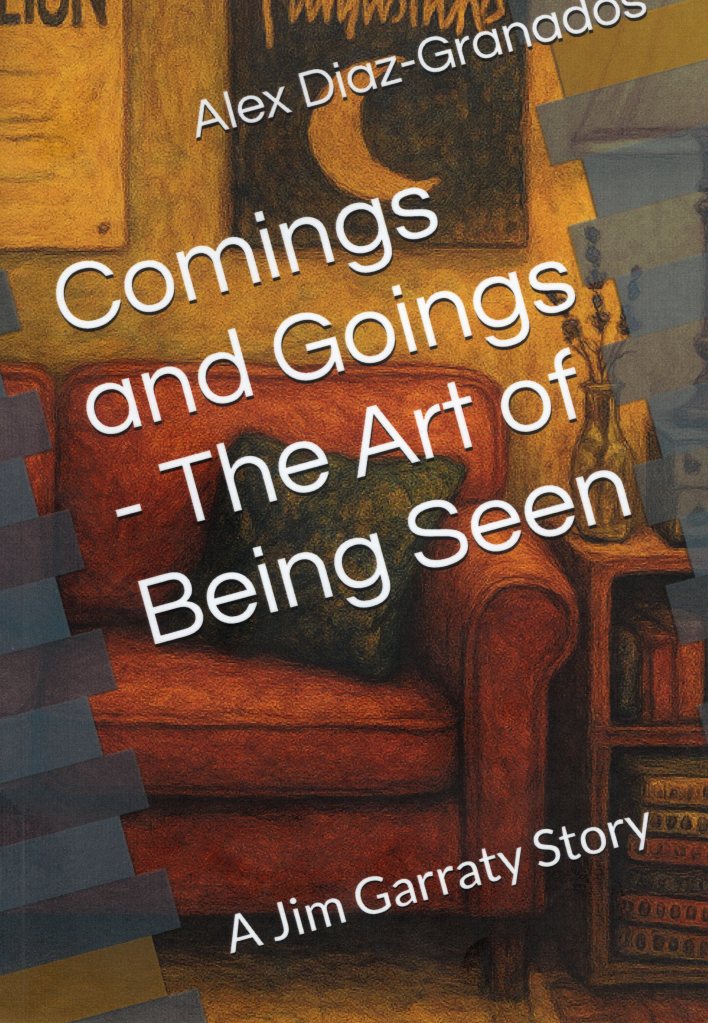
Front cover of Comings and Goings – The Art of Being Seen by Alex Diaz-Granados. Click on the image to go to the Amazon page for the paperback version of the book.
Amazon’s Description of Comings and Goings by Alex Diaz-Granados
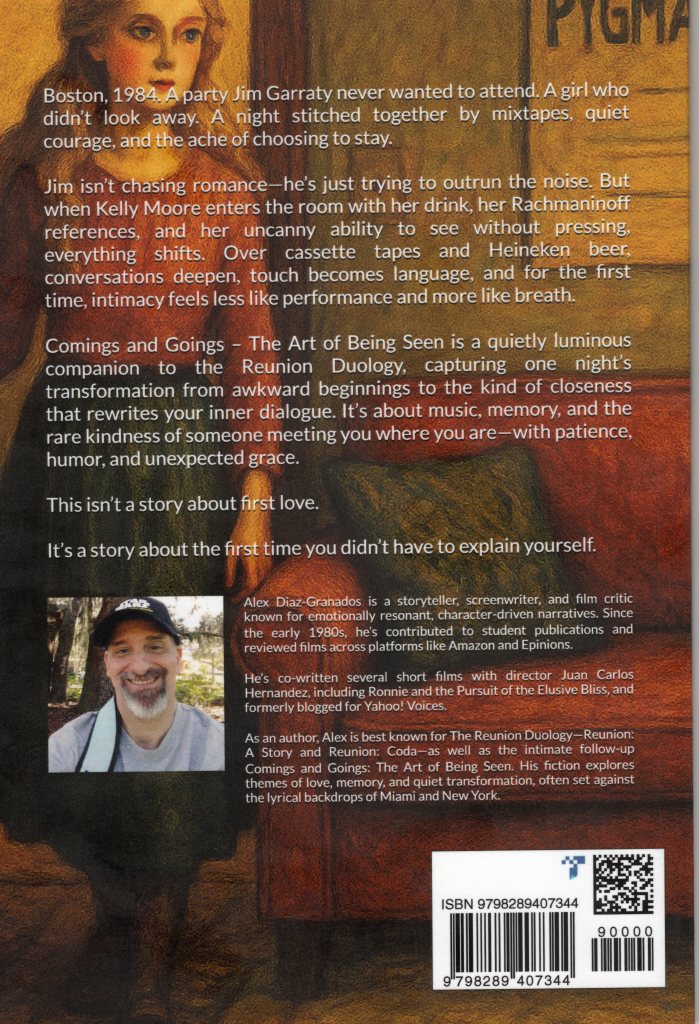
Boston, 1984. A party Jim Garraty never wanted to attend. A girl who didn’t look away. A night stitched together by mixtapes, quiet courage, and the ache of choosing to stay.
Jim isn’t chasing romance—he’s just trying to outrun the noise. But when Kelly Moore enters the room with her drink, her Rachmaninoff references, and her uncanny ability to see without pressing, everything shifts. Over cassette tapes and Heineken beer, conversations deepen, touch becomes language, and for the first time, intimacy feels less like performance and more like breath.
Comings and Goings – The Art of Being Seen is a quietly luminous companion to the Reunion Duology, capturing one night’s transformation from awkward beginnings to the kind of closeness that rewrites your inner dialogue. It’s about music, memory, and the rare kindness of someone meeting you where you are—with patience, humor, and unexpected grace.
This isn’t a story about first love.
It’s a story about the first time you didn’t have to explain yourself.
I think this novelette is best read as a companion to the author’s larger masterpiece Reunion: Coda. Alternatively, it serves as an introduction to the author’s writing style and storytelling prowess. The author has an exceptional skill in crafting and delivering compelling narratives that engage audiences, and this short novelette could be one of the many chapters in the life of the protagonist Jim Garraty, a man who will become a celebrated professor at Columbia University.
In this book Jim Garraty is a first year student at Harvard and he is attending a party where he does not know anyone except for a fellow student who is quite busy elsewhere and leaving him on his own. He feels lonely, awkward and out of place until a girl, Kelly Moore, takes interest in him and his miserable night turns into quite an adventure. What stands out about this book is the realistic description of emotions, inner thoughts, and the realistic dialogue. It serves as a prelude to what to expect from his other books. I highly recommend this short novelette.
Back cover of Comings and Goings – The Art of Being Seen by Alex Diaz-Granados. Click on the image to go to the Amazon page for the Kindle version of the book.
About the Author of Comings and Goings
Alex Diaz-Granados (born 1963) has spent decades weaving words into stories, critiques, and screenplays, always with an eye for nuance and emotional depth. His journey began in the early 1980s as a staff writer and Entertainment Editor for his high school newspaper, later serving as Diversions Editor for Miami-Dade Community College’s South Campus student publication.
Fueled by a passion for cinema, he has been sharing his thoughts on film—raving about masterpieces and ranting about misfires—since 2003, contributing reviews to platforms like Amazon, Ciao, and Epinions.
Beyond criticism, Alex has collaborated with actor-director Juan Carlos Hernandez on several screenplays, including A Simple Ad, Clown 345, Ronnie and the Pursuit of the Elusive Bliss, and Sunny in the Village of the Crickets, all of which can be seen on YouTube. His writing extends to blogging, with general-interest articles once featured on Yahoo! Voices (formerly Associated Content).
As an author, Alex is best known for the Reunion Duology—the novella Reunion: A Story and its sequel Reunion: Coda. These works explore themes of nostalgia, regret, and the enduring bonds of friendship, set against the atmospheric backdrop of Miami and New York City. With cinematic storytelling and emotionally authentic characters, his work resonates with readers seeking a blend of memory and new beginnings.
This is a Leonberger blog, but I also post about other topics including book reviews of books that I love and want to promote. With this post I would like to promote a delightful book called Reunion: Coda: Book 2 of the Reunion Duology by Alex Diaz-Granados.
Below is an overview of the three formats of Reunion: Coda
Hardcover – Publisher : Independently published (April 5, 2025), ASIN : B0F3VRRW3R, ISBN-13 : 979-8316859467, 471 pages, Item Weight : 2.85 pounds, dimensions : 8.25 x 1.25 x 11 inches, it cost $30.00 on US Amazon. Click here to order it from Amazon.com.
Paperback – Publisher : Independently published (April 5, 2025), ASIN : B0F3VWJGDD, ISBN-13 : 979-8316867066, 529 pages, Item Weight : 2.29 pounds, dimensions : 8 x 1.2 x 10 inches, it cost $ 26.00 on US Amazon. Click here to order it from Amazon.com.
Kindle – Publisher : ADG Books via Kindle Create (April 4, 2025), ASIN : B0F3V5HK2R, 473 pages. It is currently $5.99 on Amazon.com and free with Kindle unlimited. Click here to order it from Amazon.com.
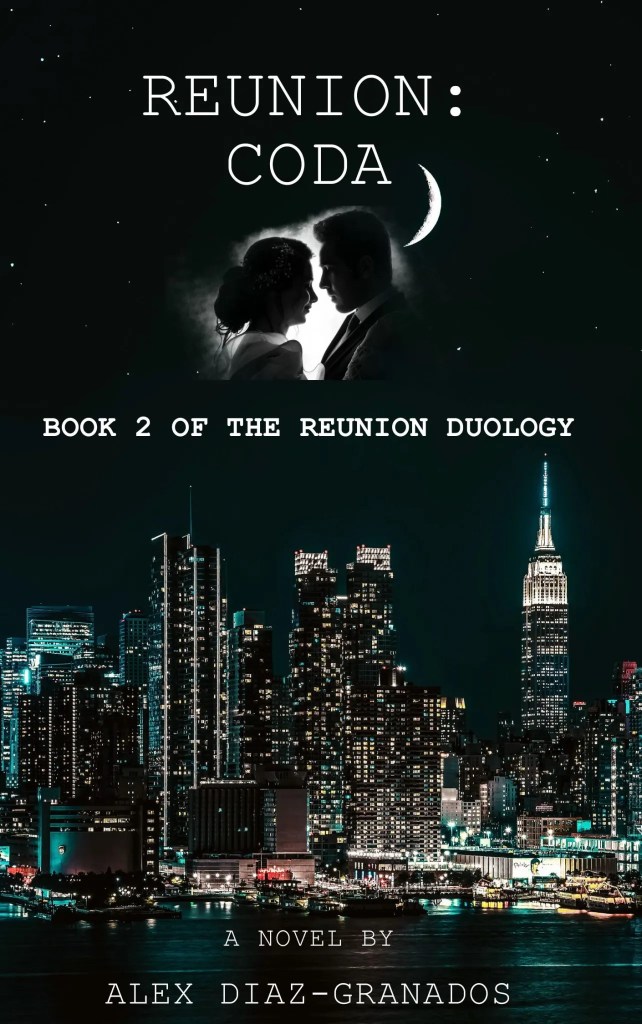
Front cover of Reunion: Coda: Book 2 of the Reunion Duology by Alex Diaz-Granados. Click on the image to go to the Amazon page for the hardcover version of the book.
Amazon’s Description of Reunion Coda
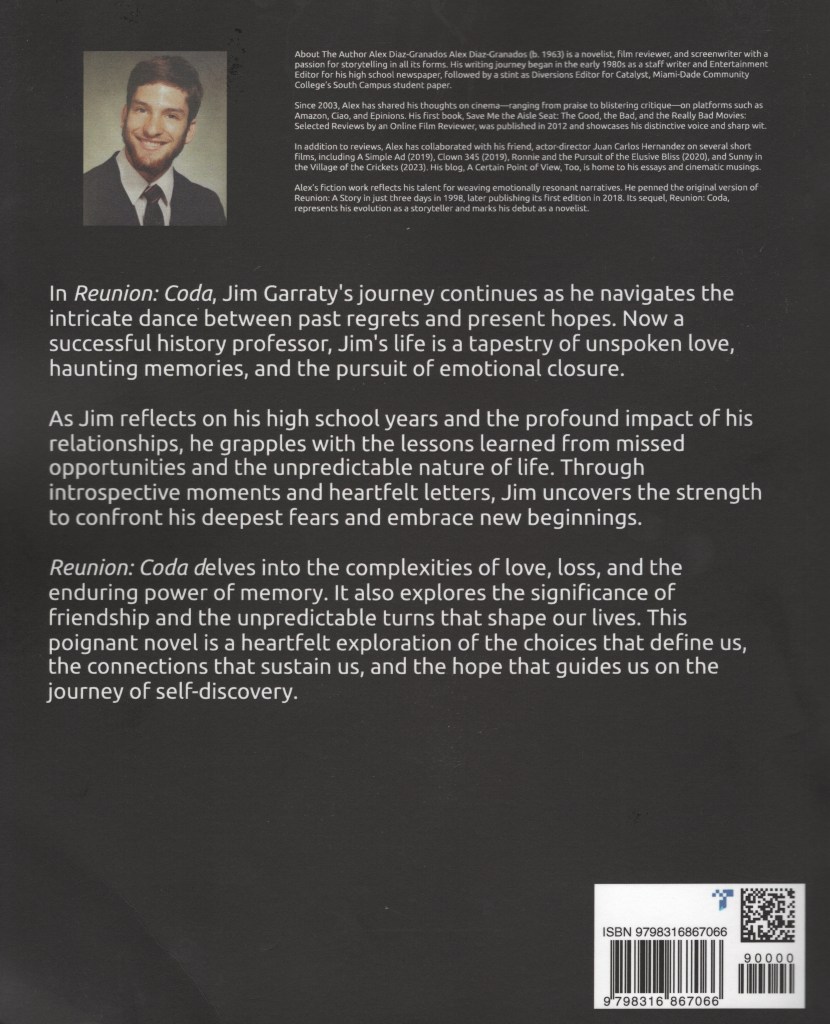
In Reunion: Coda, Jim Garraty’s journey continues as he navigates the intricate dance between past regrets and present hopes. Now a successful history professor, Jim’s life is a tapestry of unspoken love, haunting memories, and the pursuit of emotional closure.
As Jim reflects on his high school years and the profound impact of his relationships, he grapples with the lessons learned from missed opportunities and the unpredictable nature of life. Through introspective moments and heartfelt letters, Jim uncovers the strength to confront his deepest fears and embrace new beginnings.
Reunion: Coda delves into the complexities of love, loss, and the enduring power of memory. It also explores the significance of friendship and the unpredictable turns that shape our lives. This poignant novel is a heartfelt exploration of the choices that define us, the connections that sustain us, and the hope that guides us on the journey of self-discovery.
This is a love story complicated by life. Jim Garraty is a successful History Professor who has tragically lost love and found love again. The story follows two timelines. One is focused on Jim’s high school days and his secret love Martina Reynaud, as well as everything that goes on in high school. The second timeline is focused on Jim’s life as a professor at Columbia University, memories of love lost and a divorce, as well as a newfound love, Maddy. The switch between the two timelines is obvious and clearly stated and yet seamless. The two timelines are built upon each other in a way that creates a captivating story and the fascinating world of Jim Garraty and his lovers and friends. I should mention that there are surprising connections between the two timelines, serendipity if you will.
The story is touching and romantic but also real and thought-provoking. I found the many subplots fascinating and insightful. For example, the story about one of his students becoming ensnared and bamboozled by far-right propaganda and acting upon it. That story was a good story on its own, but it also added to the overall narrative. Life is complicated and difficult, people will disappoint you, and mishaps in your professional life as well as traffic effects your romantic life as well. There were many other sub plots. The book enlightens us on subjects like lost love, courage, disappointments, tragedy, integrity and forgiveness. Life can be good but never perfect. We recognize ourselves in the stories and it helps us feel and grow.
The character development is astounding, and the prose is beautiful and lyrical. The writing is of a very high quality and the story telling is epic. I read the hardcover version of this book, which featured a lot of black and white illustrations. It is far from a graphic novel, but I appreciated the appealing and interesting illustrations. I highly recommend this book.
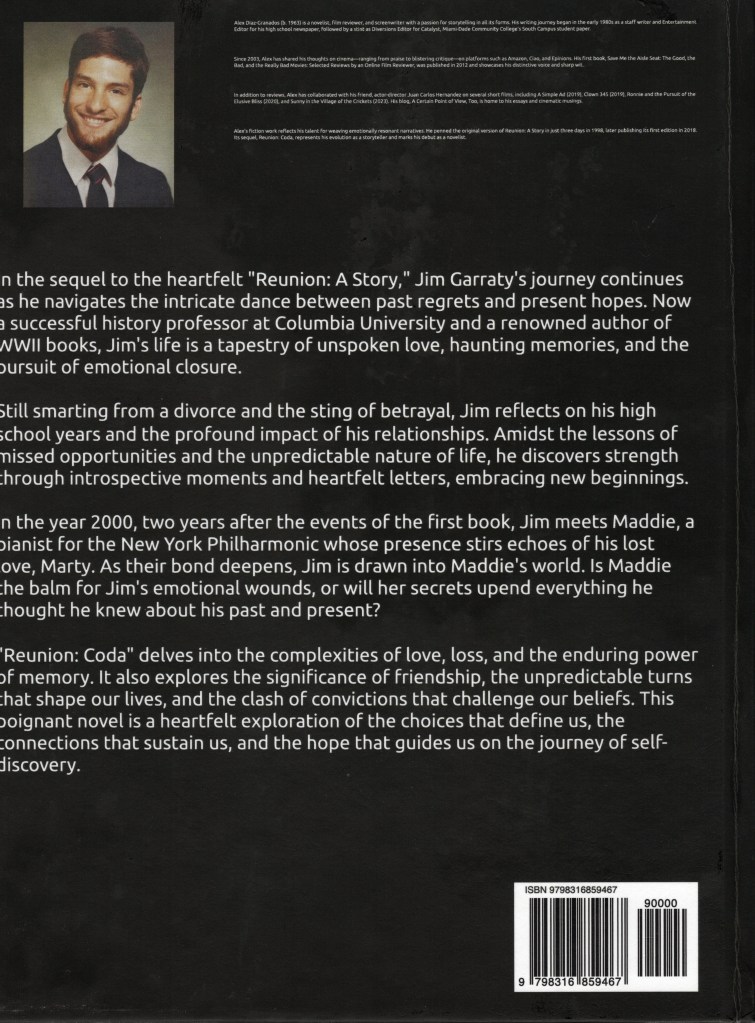
Back cover of Reunion: Coda: Book 2 of the Reunion Duology by Alex Diaz-Granados. Click on the image to go to the Amazon page for the paperback version of the book.
About the Author of Reunion Coda
Alex Diaz-Granados (born 1963) has spent decades weaving words into stories, critiques, and screenplays, always with an eye for nuance and emotional depth. His journey began in the early 1980s as a staff writer and Entertainment Editor for his high school newspaper, later serving as Diversions Editor for Miami-Dade Community College’s South Campus student publication.
Fueled by a passion for cinema, he has been sharing his thoughts on film—raving about masterpieces and ranting about misfires—since 2003, contributing reviews to platforms like Amazon, Ciao, and Epinions.
Beyond criticism, Alex has collaborated with actor-director Juan Carlos Hernandez on several screenplays, including A Simple Ad, Clown 345, Ronnie and the Pursuit of the Elusive Bliss, and Sunny in the Village of the Crickets, all of which can be seen on YouTube. His writing extends to blogging, with general-interest articles once featured on Yahoo! Voices (formerly Associated Content).
As an author, Alex is best known for the Reunion Duology—the novella Reunion: A Story and its sequel Reunion: Coda. These works explore themes of nostalgia, regret, and the enduring bonds of friendship, set against the atmospheric backdrop of Miami and New York City. With cinematic storytelling and emotionally authentic characters, his work resonates with readers seeking a blend of memory and new beginnings.
This is a Leonberger dog blog but I sometimes post about other topics and today’s topic is a book blast for a new book published by Alex Diaz-Granados. It is called Reunion: Coda: Book 2 of the Reunion Duology. It is a duology, but it can be read independently from the first book. The point of this post is to bring attention to the book. It is a poignant romantic tale delving into the complexities of love. I bought the Kindle version, the paperback version as well as the hardcopy version of the book. Below is an overview of the three versions.
Hardcover – Independently published (April 5, 2025), ASIN : B0F3VRRW3R, ISBN-13 : 979-8316859467, 471 pages, Item Weight : 2.85 pounds, Dimensions : 8.25 x 1.25 x 11 inches, it costs $30.00 on US Amazon. Click here to order it from Amazon.com.
Paperback – Independently published (April 5, 2025), ASIN : B0F3VWJGDD, ISBN-13 : 979-8316867066, 529 pages, Item Weight : 2.29 pounds, dimensions : 8 x 1.2 x 10 inches, it cost $26.00 on US Amazon. Click here to order it from Amazon.com.
Kindle – Publisher : ADG Books via Kindle Create; 1st edition (April 4, 2025), ASIN : B0F3V5HK2R, 473 pages. It is currently $5.99 on Amazon.com and free with Kindle unlimited. Click here to order it from Amazon.com.
Cover for the Kindle version of Reunion: Coda: Book 2 of the Reunion Duology by Alex Diaz-Granados. Click on the image to go to the Amazon page for the Kindle version of the book.Front cover of the paperback version for Reunion: Coda: Book 2 of the Reunion Duology by Alex Diaz-Granados. Click on the image to go to the Amazon page for the paperback version of the book.
Amazon’s description of Reunion: Coda
In Reunion: Coda, Jim Garraty’s journey continues as he navigates the intricate dance between past regrets and present hopes. Now a successful history professor, Jim’s life is a tapestry of unspoken love, haunting memories, and the pursuit of emotional closure.
As Jim reflects on his high school years and the profound impact of his relationships, he grapples with the lessons learned from missed opportunities and the unpredictable nature of life. Through introspective moments and heartfelt letters, Jim uncovers the strength to confront his deepest fears and embrace new beginnings.
Reunion: Coda delves into the complexities of love, loss, and the enduring power of memory. It also explores the significance of friendship and the unpredictable turns that shape our lives. This poignant novel is a heartfelt exploration of the choices that define us, the connections that sustain us, and the hope that guides us on the journey of self-discovery.
Back cover of the paperback version for Reunion: Coda: Book 2 of the Reunion Duology by Alex Diaz-Granados. Click on the image to go to the Amazon page for the hardcover version of the book.
Trailer for Reunion: Coda: Book 2 of the Reunion Duology by Alex Diaz-Granados.
About the Author of Reunion: Coda
Alex Diaz-Granados (1963- ) began writing movie reviews as a staff writer and Entertainment Editor for his high school newspaper in the early 1980s and was the Diversions editor for Catalyst, Miami-Dade Community College, South Campus’ student newspaper for one semester. Using his experiences in those publications, Alex has been raving and ranting about the movies online since 2003 at various web sites, including Amazon, Ciao and Epinions.
In addition to writing reviews, Alex has written or co-written three films (“A Simple Ad,” “Clown 345,” and “Ronnie and the Pursuit of the Elusive Bliss”) for actor-director Juan Carlos Hernandez. You can find his reviews and essays on his blog, A Certain Point of View.
Most of the posts I make on my Leonberger Life blog are related to Leonberger dogs, including our own departed Leonberger Bronco. However, I also post about non-Leonberger related topics such as book reviews and my personal interests. Today’s post is a very interesting interview with an author who is also an on-line friend of mine, Alex Diaz-Granados. I read one of his books, a novella with the title Reunion: A Story. I loved that book and you can read my review for it here and my cover reveal for it here and my post about the revised version here.
Front cover of Reunion: A Story. click here or on the picture to visit the Amazon page for Reunion: A Story.
The way we conducted the interview was that I asked Alex questions (by email) and he sent me back an email with the answers. Now let’s dive into the interview with Alex.
Thomas: Welcome to my Leonberger Life Blog, Alex. I enjoyed reading your novella, “Reunion: A Story”. It’s a captivating tale about a love that never materialized. Jim Garraty, a successful history professor, has to face the reality of losing Marty, his love interest, due to his insecurities and career ambitions. From what I gather, your next book also follows Jim Garraty and his romantic life. You call both works the “Reunion Duology.” Why is that?
Alex: Thanks for having me on your blog, Thomas! So, yeah, my novel is a follow-up to Reunion: A Story. In the Present Day parts of Reunion: Coda, Jim Garraty falls head over heels in love again. Plus, his third book, which delves into Operation Market-Garden of A Bridge Too Far fame, is out, and he’s still teaching history at Columbia University. Hopefully, it’ll show how much he’s grown and moved forward since we last caught up with him in 1998 in Miami.
I refer to Reunion: A Story and Reunion: Coda collectively as the Reunion Duology, similar to how Star Wars, The Empire Strikes Back, and Return of the Jedi were once known as the Star Wars Trilogy. These two works are intricately linked and together they narrate a single story. I don’t plan to expand this into a longer series, so for me, the novella and the novel constitute the Reunion Duology.
A possible cover design for Alex’ new book “Reunion: Coda” Image Credit: Juan Carlos Hernandez
Thomas: Could you share some details about your new book, without giving away any spoilers? How does this new book differ from your novella?
Alex: It’s definitely longer, that’s for sure. When you leave out the front and back sections of Reunion: A Story, it’s just 49 pages and can be read in one go. But the unfinished manuscript for Reunion: Coda is a whopping 463 pages, title page included. I haven’t even added the contents, dedication, foreword, author bio, or reviews yet, let alone finished the story. So, unless you’re an insanely fast reader who can breeze through a Stephen King novel in under a week, this one’s gonna take you much longer.
What’s different about the novel? Well, I got to make the story bigger and not just longer. If you take out the “frame story” from Reunion and only look at Jim and Marty’s main story, it all happens in a few hours on Jim Garraty’s last day of school. That’s actually how I first wrote it; the Present Day scenes were added at the very last minute when I did the novella’s draft 26 years ago.
The story now stretches across longer periods in both the high school and early 2000s chapters, and it’s set in South Florida, New York, and London. Besides bringing back Jim, Marty Reynaud, and Mark Prieto (the main three from Reunion), it also introduces Maddie, a gifted – though at first mysterious – concert pianist who Jim ends up falling for.
I hope readers notice that the novel feels lighter in tone for most of it, even though the scenes with Jim and Marty – especially those from their senior year in 1983 – are pretty touching. They have to be because as much as the novel lightens up Reunion’s more somber feel, it needs to stay true to what came before.
Thomas: Does your new book continue from Reunion: A Story? Can it be understood without reading your novella first?
Alex: You could jump straight into Reunion: Coda without touching the novella, but you’d lose a lot of the subtleties in Jim’s character development. His profound love for Marty and the weight of his last-minute confession are pivotal. There’s a crucial scene in the novella that ties the entire Duology together. Although I hint at it through Jim’s memories of their final day at school, I don’t retell it word-for-word. Whether you decide to get both books is entirely up to you. Still, bypassing the novella would mean missing out on essential layers of the story.
Thomas: From your blog, it looks like you’ve decided to call your new book “Reunion: Coda.” Is that right? If so, what led to this choice?
Alex: Unlike Reunion: A Story, which was previously called “Love Unspoken, Love Unbroken” after a song from Lehar’s operetta The Merry Widow, this novel has had its title set in stone since day one. So why did I go with Reunion: Coda?
In music, a coda (which means “tail” in Italian) is the bit that wraps up a larger piece. It can also be the closing or bonus part of a speech, social gathering, or even an article.
Honestly, I didn’t put much thought into naming it Reunion: Coda. The idea came from watching The Godfather Coda: The Death of Michael Corleone on Blu-ray around the time I started my novel in March 2023. It was meant to be just a temporary title until I thought of something better. But as the novel evolved, and I saw how music influenced many characters’ lives (like Jim and Marty meeting in Mrs. Quincy’s choral class, or Jim and Maddie meeting at a nightclub with a WWII/Big Band theme), I decided to stick with it. It fits the theme perfectly, and on top of that, it just sounds nice.
Thomas: Why did you choose your main character Jim Garraty to be a history professor?
Alex: Thomas, have you ever heard the saying, “Write what you know?” I mentioned before that I wrote the story of Jim, Mark, and Marty in the 1980s as part of my experiment with fiction writing in 1998. This was 11 years after I took a creative writing course at Miami-Dade Community College, but I didn’t pursue it further because I was afraid of failing and the whole process of getting published with a literary agent through big publishing houses intimidated me. Originally, it wasn’t even called Reunion: A Story; the dream sequence in “Journey’s End” started as a writing exercise for that CRW 2001 class back in 1987. The subject of the dream also changed from a steamy fantasy Jim has to something more romantic and meaningful, which led to creating a new character — that’s how Marty came into the picture.
Once I rewrote the dream sequence, I realized it could be developed into a longer piece, not quite a novel but either a short story or a novella. The tricky part was figuring out why this dream mattered so much to Jim on his last day of high school and why readers should care about the characters, especially Jim.
When I finished the core story on the second day of my fiction-writing experiment, I felt it was complete and almost put it away in an old folder with my CRW 2001 assignments. I had no plans to publish “Love Unspoken, Love Unbroken”; it was just a personal test to see if I could write fiction.
Then I listened to Billy Joel’s “Scenes from an Italian Restaurant” and felt like my “Ballad of Jim and Marty” was unfinished. Inspired by the song, I added an elegaic frame story set in the present day (1998) with scenes serving as an intro and outro.
Creating the grown-up version of Jim Garraty was challenging. While giving him many of my own teenage experiences and traits, I didn’t want him to be a direct representation of myself. Looking back 15 years after high school, the biggest accomplishments I had were making Dean’s List, earning an Honors scholarship, moving up from staff writer to managing editor of the campus newspaper, and then dropping out due to a learning disability.
When I gave Jim my passion for military history, especially World War II, I figured he could either become a career military officer or a history professor. I knew a few officers but couldn’t reach out to them for interviews and didn’t want to rely solely on books for his character. On the other hand, I spent a lot of time with my professors at Miami-Dade, more than the average student on South Campus. So, I followed the “Write What You Know” advice, and Jim Garraty became a history professor initially at a prestigious but unnamed university in New York City (Reunion: A Story), which is later revealed in the novel to be Columbia University.
Thomas: Given your passion for history, could you share how this interest has shaped the character development of Jim Garraty?
Alex: Crafting fictional characters can be quite a task, particularly for those new to the world of writing fiction. It’s common for novices, myself included, to envision themselves as their story’s main character. This tendency explains why many debut novels are written in the first person or revolve around a central figure, much like Tom Clancy’s Jack Ryan, Ian Fleming’s James Bond, or Scout Finch in Harper Lee’s classic To Kill a Mockingbird.
To give you a complete answer, Thomas, I should go back a bit. My fascination with history began at six years old in 1969. As family lore has it, I learned to read before turning two, while my father was still alive. Consequently, I devoured books beyond my age range and had the freedom to read nearly everything – except for stories with too much adult content. My early interest in war-themed shows on Colombian TV, such as Twelve O’Clock High and Combat dubbed in Spanish, naturally led me to read translated excerpts of Cornelius Ryan’s The Longest Day. I found these in an old issue of Reader’s Digest, Colombian edition, at my grandparents’ home in Bogota.
Since then, I’ve read tons of non-fiction books and watched loads of history documentaries. Most of them are about World War II, but I’ve broadened my scope to include wars from different periods, like the American and Spanish civil wars, World War I, Korea, Vietnam, the Falklands/Malvinas war of 1982 (which coincided with the end of my junior year in high school), as well as the conflicts in Iraq and Afghanistan.
I’ve also delved into other significant events, such as the Apollo moon landings, Kennedy’s assassination in November 1963, the Cold War, America’s Westward expansion, and the explorations by European “discoverers.” I took so many history courses at Miami-Dade that it felt like I nearly double majored in history along with journalism/mass communications.
To give Jim Garraty a realistic career that I could write about without stressing over accuracy, I made him a college professor. If I wanted to make him more like me, I would’ve written him as a newspaper reporter or editor since I have some experience there, at least at the high school and college level. But I purposely chose not to.
Thomas: How does the timeline in Reunion: Coda differ from that in Reunion: A Story?
Alex: Thematically, the timeline in both halves of the Reunion Duology is the same. I use the same style in Reunion: Coda that I established in Reunion: A Story – the Present Day events are told from Jim’s perspective, in the present tense, while events that take place between January of 1981 (the second semester of Jim, Mark, and Marty’s sophomore year) to Commencement Day 1983 are in the past tense. That didn’t change from book to book.
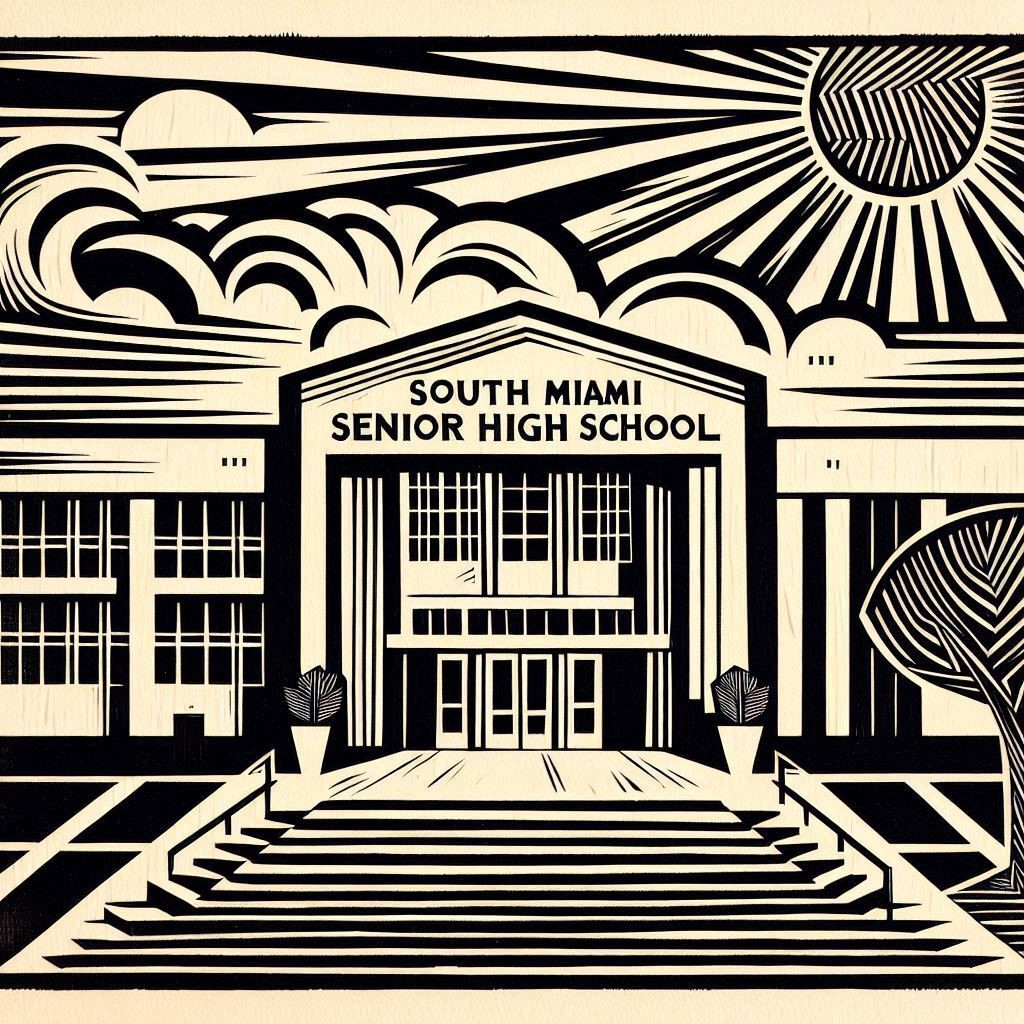
Structurally, there is a bit of divergence because I chose to not tell the story in strictly chronological order. Instead, the story alternates between Jim’s experiences in early 2000 (a time when Texas Governor George W. Bush was striving for his party’s nomination as its Presidential candidate) and most of his time at South Miami High School, with 10th grade in media res.
Of course, once Jim, Mark, and Marty graduate from high school, the remainder of Reunion: Coda focuses on Jim and Maddie’s budding relationship, with some of its ups and downs, including a career-related separation in early March of 2000.
Another aspect of the novel I want to highlight. I imagine the Duology as a literary triptych, with Reunion: A Story serving as the central panel and Reunion Coda framing it on either side. That’s why, Thomas, skipping the novella just because it lacks a Happily Ever After is not advisable. On its own, Reunion: A Story presents itself as a bittersweet tale that challenges romantic clichés. My intention was never to produce a run-of-the-mill romance, which is why I chose not to wrap it up with a HEA ending. My goal was to evoke a genuine emotional reaction to Jim’s decisions and their ramifications, rather than offering a sweet but disingenuous conclusion.
As I embarked on extending Jim Garraty’s tale in the novel, I resolved to offer my alter ego a renewed opportunity for love and, hopefully, a more gratifying narrative with fewer dramatic upheavals than the initial part of the Duology. During a period when my life had taken an unforeseen downturn, it seemed only fitting that Jim should receive the romantic reprieve that fate had withheld from me.
Thomas: What inspired you to write your new book?
On March 5, 2023, which was my 60th birthday, I got an email in my WordPress inbox from Peter Townsend, my old college journalism professor. He’s retired now but still keeps tabs on his students’ careers. I might be one of his less successful mentees, but thanks to my online presence, including my Amazon reviews and blogs, he found out I’ve self-published two books – a collection of selected movie reviews from Epinions and Reunion: A Story. Professor T, as we called him, bought the novella and liked it, even though it needed some tweaks. This is why I revised Reunion several times throughout 2023. Professor T was like a father figure to me during college, and that led to some of my best experiences, like journalism trips to New York, a study-abroad semester in Spain in 1988, and advancing from staff writer to managing editor of the campus newspaper.
In a follow-up email, T strongly urged me not to squander my talent and to keep pursuing fiction writing. I had been his student throughout most of my time at Miami-Dade, and even nearly 40 years after our initial encounter as professor and student, his opinion still holds much more significance to me than anyone else’s perspectives.
Alright, so you know why I was motivated to write a book, but that doesn’t explain why I chose to write this particular one. Like I said earlier, before 2023 I saw Reunion: A Story as a standalone tale, where one character’s destiny couldn’t change—unless I switched to horror or fantasy genres, which I didn’t want to do. So even though some fans asked for a sequel with Jim and Marty—one Amazon reviewer even suggested retelling Reunion from Marty’s viewpoint—I always replied, “Nope, can’t do that. Sorry.”
In the past, I’ve tried dabbling in other genres, like historical fiction set in different real or alternate periods. I once planned a tough and realistic story about a newbie GI right out of boot camp thrown into the battle of Normandy in 1944; I wrote three lousy chapters of The Tonic of their Victory before quitting. I also started looking into Operation Downfall, the planned invasion of Japan that got called off after Hiroshima, Nagasaki, and the Soviet Union joined the Pacific War in August 1945. I bought three solid books on that topic, but I realized I needed more novel-writing practice before stepping into what Harry Turtledove does so well.
Eventually, I concluded that if I wanted to write a novel that I would not abandon even before I wrote an opening line, I only had one option: to step back into the world of James Kevin Garraty and – without radically changing the established lore of Reunion: A Story – explore his life both before and after the events of the novella.
Thomas: You’ve mentioned in your blog that music is a huge deal in the Reunion Duology. Can you explain why that is?
Alex: Back in ninth grade, when we were diving into the world of novels in English 1 at Riviera Junior High School, Ms. Allen tasked us with crafting our own “novel” of at least 20 pages that adhered to the traditional storytelling arc, from “rising action” all the way to “denouement.” Being a die-hard Star Wars enthusiast both then and now, I couldn’t resist writing a classic “space war” tale. My story was set in a dystopian future, featuring a clash between exiled Americans—right out of a cheesy World War II meets Cold War flick—and faceless Soviet villains battling across the cosmos to free Earth from an oppressive Evil Empire.
I got the best grade in the class, even though my 61-year-old self doesn’t think my junior high work was anything Stephen King, Alan Dean Foster, or Tom Clancy would envy. But for a ninth-grader, Hypercraft One: The Sound of Armageddon wasn’t bad. I was lucky to have a neighbor with top-notch typing skills and a kind heart, so my “novel” ended up being neatly typed and – believe it or not – 40 pages long. Plus, it fit perfectly with the structure Ms. Allen wanted. So, I scored an A+ after getting top marks in spelling, grammar, punctuation, originality, and turning it in on time.
I bring up this seemingly random fact because when I was writing Hypercraft One, I got hooked on playing instrumental music. Back in 1980, it was vinyl LPs or eight-track tapes, but now it’s CDs or digital albums. I’d use it as background noise or a source of inspiration. While writing Hypercraft One, I’d listen to John Williams’ scores from Superman: The Movie and Star Wars to dive into the cheesy sci-fi universe my ninth-grade self was imagining.
It might seem off-track, but that’s why I think music plays a huge role in the Reunion Duology. It set the pattern for the way I approach not just the content I create but also how I write it.
Thomas, as you know from reading Reunion several times, Jim and Marty meet when they both join South Miami High’s choral department; Jim enrolls in the men’s chorus while Marty joins the women’s ensemble since they are new students. They do not end up in Mrs. Quincy’s Mixed Chorus, Regular until their junior year. Therefore, within the story, it is music that facilitates any significant interaction between Jim and Marty. This is evident in Reunion: A Story and even more so in Reunion: Coda.
In real-world terms, music not only inspired but also shaped the narrative. For instance, I chose the name of the Moonglow Club, a World War II/Big Band Era-themed nightclub in Williamsburg, Brooklyn, where Jim first meets Maddie, from a 1930s song popularized by Artie Shaw and Benny Goodman. The first dance between Jim and Maddie features Jerome Kern and Dorothy Fields’ “Smoke Gets in Your Eyes.” Additionally, Reunion: Coda’s high school flashbacks include songs performed by Jim, Marty, and other students in Mrs. Quincy’s concerts, though due to the high cost of obtaining permission to quote lyrics, I could only name the songs still under U.S. copyright. Any lyrics featured in the novel are either in the public domain or written by me (refer to my post about “Boy of Harvard” for more details).
Thomas: What has been the most rewarding feedback you’ve received from readers of your novella?
Alex: I’m really thankful for all the reviews Reunion: A Story has gotten over the six years since I first self-published my imperfect version with CreateSpace Independent Publishing. Even though some readers had a few critiques and rated the novella lower, all feedback has been positive. An average rating of 4.8 stars is pretty awesome for an indie author. Out of the 16 reviews on Amazon, of which I find the most gratifying (yours included, obviously), here are a few standouts:
Meg Learner (Amazon/United Kingdom):
A lovely lyrical book and excellently written. It makes use of flashbacks, yet these are expertly woven into the story so that you always know where you are and how they contribute to the tale. This is quite a short read (I downloaded it to my Kindle and read it on my train journey) but it certainly packs a lot into the story and the idea is fresh and novel. I have not read a story like this before. It’s not my normal type of reading material, as most of my reading these days is factual or business-related related but I really enjoyed it and was sorry when it was finished.
Pooja (P.J.) Gudka (Amazon/Canada):
The plot was what drew me to the story. I’m not usually drawn to romance novels or anything particular romantic. But the summary for this book really drew me in because it’s something most of us can relate to- lost love. We all have “the one that got away.” Well, most of us anyway. Also, as a historian myself I loved that Garraty’s character was a historian and was intrigued by that.
The author also explores multiple philosophical aspects of life such as true love, happiness, friendships, loss and regret. Things most adults are familiar with. We also learn the importance of confessing our feelings when we have the chance because life is so incredibly unpredictable.
The characters were relatable, emotion evoking, thoughtful and I loved that the characters grew and evolved. Overall, I very much enjoyed this book and would highly recommend it.
Denise Longrie (Amazon/United States):
Jim Garraty’s dream of becoming a history professor at a prestigious university has come true. He has some well-regarded publications under his belt and is working on the next one.
However, he’s still hurting from his recent divorce. And then comes the phone call from his old high school pal. Marty—the girl he loved back in the day—has died in a car crash. One of Jim’s greatest regrets is that he never told Marty he cared for her. Would romance have come of it? Or even friendship? It’s too late to know now.
Jim’s story is told in a series of flashbacks and returns to the present. The reader follows him through the last few days of high school when he had the chance to speak to Marty— but didn’t.
It’s a lyrical tale of regret for chances not taken, told in dreams and memories. It speaks to anyone who has been to high school and anyone who remembers the one who got away.
This pleasant, if bittersweet, novella is short enough to read in one sitting.
Thomas: Are there any particular writers who have influenced your work or whom you admire?
The writers I really admire (though they don’t influence my style) are historians like Cornelius Ryan, John Toland, Stephen Ambrose (who inspired Jim Garraty and gets compared to him a lot), Rick Atkinson, and Mark Bowden. If I decided to add excerpts from Jim’s writings on World War II or other 20th-century wars in my novel, his style would probably be influenced by Ambrose, Ryan, or Atkinson. I don’t plan to do that, but since the book isn’t finished yet, there’s a tiny chance I might if it fits the story.
When it comes to fiction, I have tons of favorite authors, but my top picks include Stephen King, Tom Clancy, Harper Lee, Carl Hiaasen, Dave Barry, Douglas Adams, James Luceno, Timothy Zahn, David Gerrold, and Harry Turtledove (we chat on Twitter a lot). And of course, Ernest Hemingway, who casts a long shadow over many American male fiction writers. Style-wise, my writing is kind of like Stephen King’s, but without all the horror and supernatural stuff.
Thomas: What message or experience do you want readers to take away from the Reunion Duology?
Unlike Ms. Allen and most English teachers who make students write essays on “What message is John Steinbeck trying to convey in The Grapes of Wrath (besides the fact that the Great Depression was terrible and it’s rough being poor in America)?” I don’t believe every novelist consciously aims to send a message for readers to ponder about themes or social issues. Sure, on some level, we authors create stories reflecting human needs and desires, exploring our religious, philosophical, and political beliefs, or looking at life stages from birth to death.
When I first drafted Reunion: A Story almost 26 years ago, I wasn’t pondering big themes like bright teenagers making bad choices—like not telling their crush how they feel and then regretting it. I was just, on the surface, seeing if I could use what I’d learned in my college Creative Writing 1 class to write a decent story. Deep down, though, I was grieving the loss of a classmate (she was around 32 or 33 in 1998) who had died in a car crash in North Carolina a few weeks before. That loss was heavy on my mind while writing Reunion, and you can see its impact on the story.
From the Reunion Duology, there are a few key lessons I hope readers take away. In Reunion: A Story, young Jim Garraty’s hidden affection for Marty illustrates the timeless truth that hesitation can lead to missed opportunities; as the saying goes, “he who hesitates is lost and faint heart never won fair maiden.” Across both stories, Jim’s deep connection with Mark highlights the importance of opening up to friends we trust completely and being unapologetically honest. Lastly, in Reunion: Coda, the core message is to embrace your mistakes, learn from them, and seize new chances at love with courage and determination.
Above all, I hope readers enjoy both books not as some lesson or philosophical statement, but as fun and engaging stories that make them eager for what comes next.
Thank you so much Alex for your very interesting and thorough answers. I learned a lot of things about you as well as about the creative writing process by reading your answers. I never realized that Marty’s car accident was taken straight out of your personal experiences. Whether you intended or not, I think you gave your readers a lot to think about.
About Alex
Alex Diaz-Granados (1963-) began writing movie reviews as a staff writer and Entertainment Editor for his high school newspaper in the early 1980s and was the Diversions editor for Catalyst, Miami-Dade Community College, South Campus’ student newspaper for one semester.
Using his experiences in those publications, Alex has been raving and ranting about the movies online since 2003 at various websites, including Amazon, ciao and Epinions. In 2012, Alex published his first book, Save Me the Aisle Seat: The Good, the Bad and the Really Bad Movies: Selected by an Online Film Reviewer through CreateSpace.
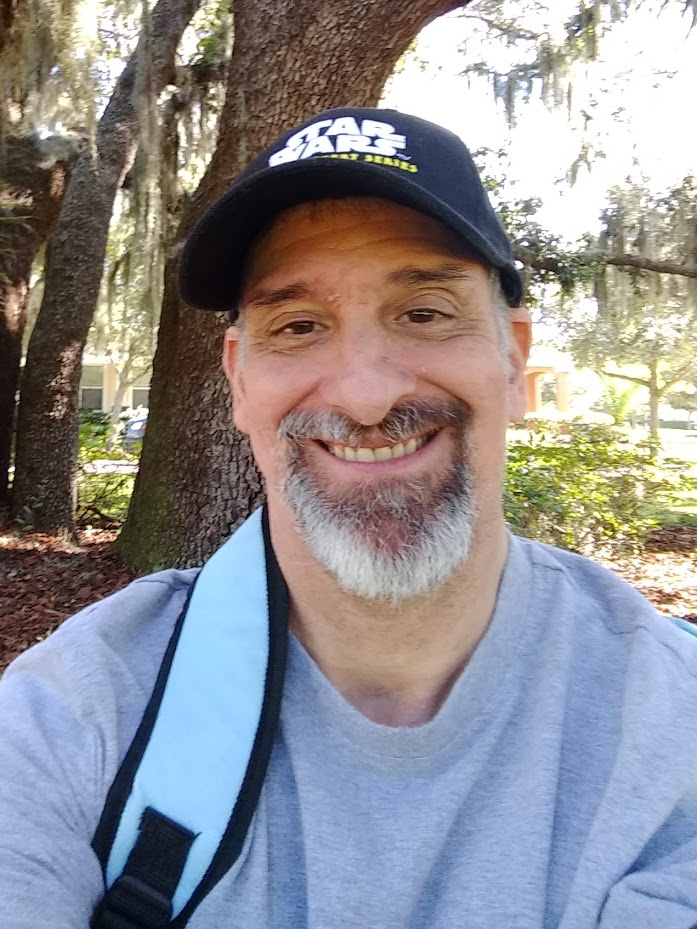
Reunion: A Story, is Alex’s first work of fiction. In addition to writing reviews, Alex has collaborated with actor-director Juan Carlos Hernandez on several short films, including A Simple Ad (2019), Clown 345 (2019), and Ronnie and the Pursuit of the Elusive Bliss. You can find his reviews and essays on his blog, A Certain Point of View, Too . Also see the related blog post.
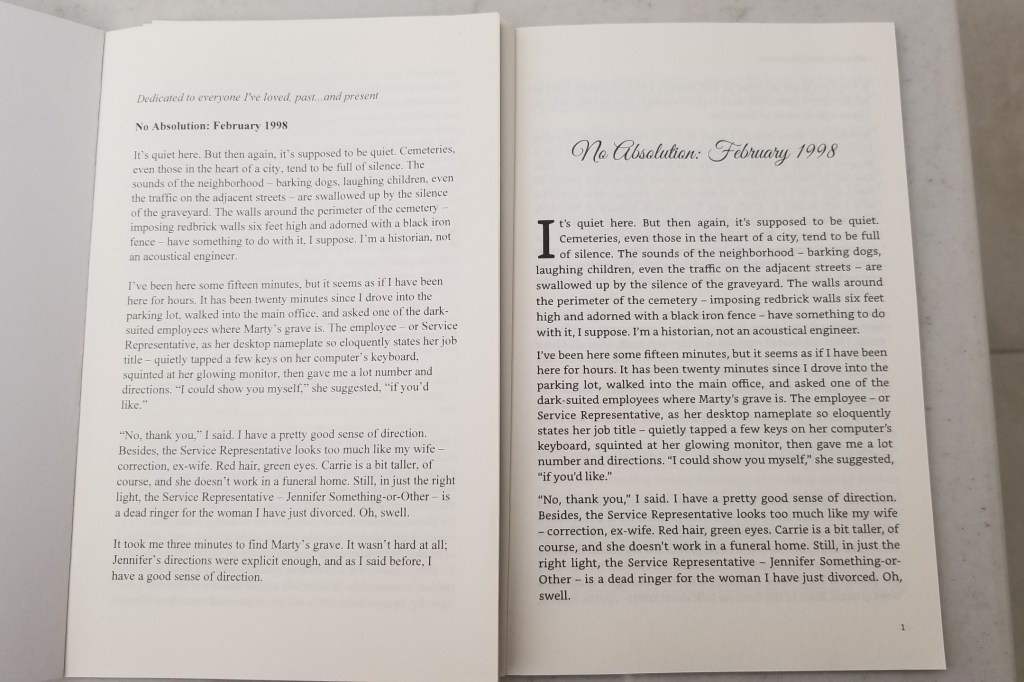
Sometimes I make posts not directly related to Leonberger dogs, especially if I want to promote a good book. Today I am announcing that a book written by my on-line friend Alex Diaz-Granados has been improved in various ways. The story is the same, but it has been edited a second time with input from Alex’ journalism professor. It has a new cover, there’s a title page, a copywrite page, a list of content, an improved page layout in the paperback version, and page numbering. If you have not bought the book before, now is the time to do so. I bought it a second time myself.
First some basic facts about the book. The title is Reunion: A Story Paperback – July 2, 2018 by Alex J Diaz-Granados (recently revised). The paperback version is 51 pages. The dimensions are 6 x 0.13 x 9 inches, and the weight is 3.21 ounces, ISBN: 978-1722120474, and it currently costs $7.99 on Amazon in the US, but it can be bought elsewhere, for example, Barnes & Noble (same price). The kindle version (ASIN: B07F4SL6NQ) is $3.99 or free if you have Kindle unlimited.
About the Author
Alex Diaz-Granados (1963-) began writing movie reviews as a staff writer and Entertainment Editor for his high school newspaper in the early 1980s and was the Diversions editor for Catalyst, Miami-Dade Community College, South Campus’ student newspaper for one semester.
Using his experiences in those publications, Alex has been raving and ranting about the movies online since 2003 at various websites, including Amazon, ciao and Epinions. In 2012, Alex published his first book, Save Me the Aisle Seat: The Good, the Bad and the Really Bad Movies: Selected by an Online Film Reviewer through CreateSpace.
Reunion: A Story, is Alex’s first work of fiction. In addition to writing reviews, Alex has collaborated with actor-director Juan Carlos Hernandez on several short films, including A Simple Ad (2019), Clown 345 (2019), and Ronnie and the Pursuit of the Elusive Bliss. You can find his reviews and essays on his blog, A Certain Point of View, Too.
About the Book
It is June 1983. Jim Garraty is a senior at South Miami Senior High. He’s a staff writer for the school paper, a college-bound scholar who plans to become a historian and author of books on military history. He’s well-liked by his peers and teachers, and his future looks bright. But as commencement draws near for the Class of 1983, Jim must deal with unfinished business. The girl he loves from afar is also graduating, and rumor has it that she is going away for the summer before starting college in the fall. Worse still, Marty doesn’t know how deeply Jim’s feelings for her are – unless he tells her. But when an opportunity arises on the last day of classes at South Miami High, Jim hesitates…and the window of opportunity closes. Now, 15 years later, James Garraty is an up-and-coming history professor whose literary career is on the rise. Respected by his fellow faculty professors and recipient of popular and critical acclaim, Jim seems to have it all. Except for one thing. True love.
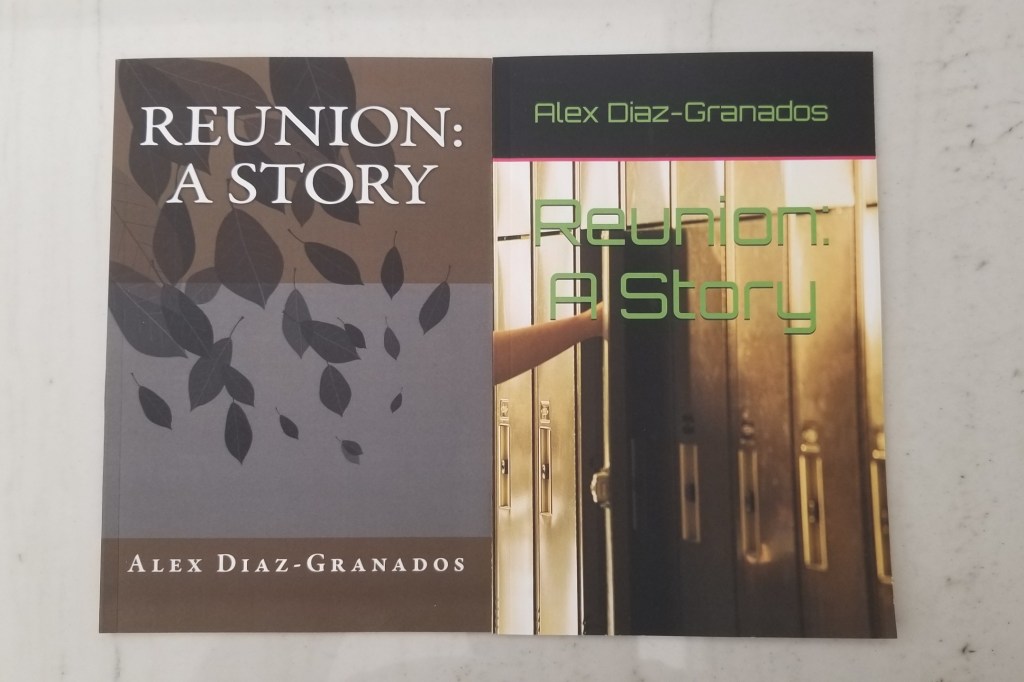
In the photo below I laid out the two books, old version and new version side by side, the front cover up. The old version is to the left and the new version to the right. The two books are laying on top of our kitchen counter.
Old front cover versus new front cover. Click on the image to go to the Amazon page for the paperback version.Old back cover (left) versus new back cover (right).This is the cover for the e-Book version of Reunion: A Story. Click on the image to go to the Amazon.com E-Book version of the book.
I also thought I include the first page of the old book (left) and the new book (right) to demonstrate the improved page layout / book design (see photo below).
Old page design to the left. New page design to the right.
Finally, a brief review
This book is about a “what if” scenario, about regret, and what could have been. Once you start reading the book you simply must find out what will happen, which is why I could not put it down and therefore I read it in one sitting. It is a sad but timeless love story that is very engaging. It is about life, friendship, and love. I think the story highlights how differently a teenager and an adult view life and what the consequences can be. The author describes the feelings and the thoughts of the characters in a manner that is realistic and easy to relate to. It was emotional but not too sentimental. The book has a message, especially for young people. The book is easy and quick to read, and it is one of the best short stories I’ve ever read. I highly recommend it.
Sometimes I make posts not directly related to Leonberger dogs, especially if I want to promote a good book. Today I am making a cover reveal post for one of the books written by a talented author and an on-line friend by the name Alex Diaz-Granados.
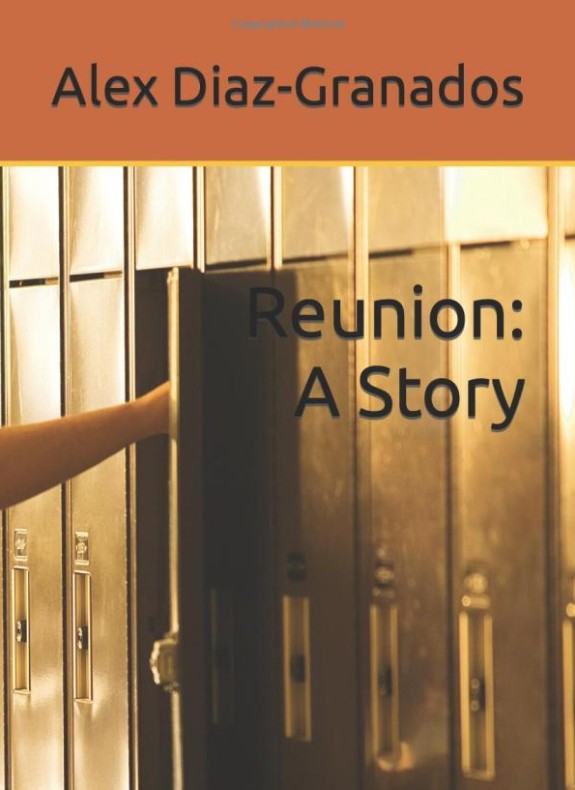
New front cover for Reunion: A Story. Click on the image to go to the Amazon.com page for the book.This is the cover for the e-Book version of Reunion: A Story. Click on the image to go to the Amazon.com E-Book version of the book.
About the Author
Alex Diaz-Granados (1963-) began writing movie reviews as a staff writer and Entertainment Editor for his high school newspaper in the early 1980s and was the Diversions editor for Catalyst, Miami-Dade Community College, South Campus’ student newspaper for one semester.
Using his experiences in those publications, Alex has been raving and ranting about the movies online since 2003 at various websites, including Amazon, ciao and Epinions. In 2012, Alex published his first book, Save Me the Aisle Seat: The Good, the Bad and the Really Bad Movies: Selected by an Online Film Reviewer through CreateSpace.
Reunion: A Story, is Alex’s first work of fiction. In addition to writing reviews, Alex has collaborated with actor-director Juan Carlos Hernandez on several short films, including A Simple Ad (2019), Clown 345 (2019), and Ronnie and the Pursuit of the Elusive Bliss. You can find his reviews and essays on his blog, A Certain Point of View, Too.
About the Book
It is June 1983. Jim Garraty is a senior at South Miami Senior High. He’s a staff writer for the school paper, a college-bound scholar who plans to become a historian and author of books on military history. He’s well-liked by his peers and teachers, and his future looks bright. But as commencement draws near for the Class of 1983, Jim must deal with unfinished business. The girl he loves from afar is also graduating, and rumor has it that she is going away for the summer before starting college in the fall. Worse still, Marty doesn’t know how deeply Jim’s feelings for her are – unless he tells her. But when an opportunity arises on the last day of classes at South Miami High, Jim hesitates…and the window of opportunity closes. Now, 15 years later, James Garraty is an up-and-coming history professor whose literary career is on the rise. Respected by his fellow faculty professors and recipient of popular and critical acclaim, Jim seems to have it all. Except for one thing. True love.
Reunion: A Story Paperback – July 2, 2018, by Alex Diaz-Granados can be purchased from Amazon or Barnes & Noble. The paperback version is currently $6.99 on both Amazon or Barnes & Noble. It is 51 pages, ISBN 978-1722120474, item weight 3.2 ounces, dimensions 6 x 0.13 x 9 inches. The e-Book version, ASIN B07F4SL6NQ, is $3.99 on Amazon, or free if you have Kindle unlimited.
A brief review
This book is about a “what if” scenario, about regret, and what could have been. Once you start reading the book you simply must find out what will happen, which is why I could not put it down and therefore I read it in one sitting. It is a sad but timeless love story that is very engaging. It is about life, friendship, and love. I think the story highlights how differently a teenager and an adult view life and what the consequences can be. The author describes the feelings and the thoughts of the characters in a manner that is realistic and easy to relate to. It was emotional but not too sentimental. The book has a message, especially for young people. It is an easy and quick reading, and it is one of the best short stories I’ve ever read. I highly recommend it.












 Leonberger Life