Horror at the Observatory

The focus of this blog is Leonbergers but sometimes I post about books that are not about Leonbergers but that I want to promote. Halloween is over but I would like to promote a great thriller or horror story taking place at an astronomical observatory in New Mexico, The Astronomer’s Crypt by David Lee Summers. It is an action packed and fun story that is not as heavy as the previous book I reviewed (Mr. B. Gone).

  • Paperback –  Publisher : Hadrosaur Press (June 2, 2020), ISBN-10 : 1885093918, ISBN-13 : 978-1885093912, 256 pages, Item Weight : 11.7 ounces, Dimensions : 5.5 x 0.64 x 8.5 inches, it cost  $12.95 on US Amazon. Click here to order it from Amazon.com.
  • Kindle –  Publisher : Hadrosaur Press; 2nd edition (June 2, 2020), ASIN : B089LRV6BC, 258 pages, it costs $3.99 on US Amazon. Click here to order it from Amazon.com.
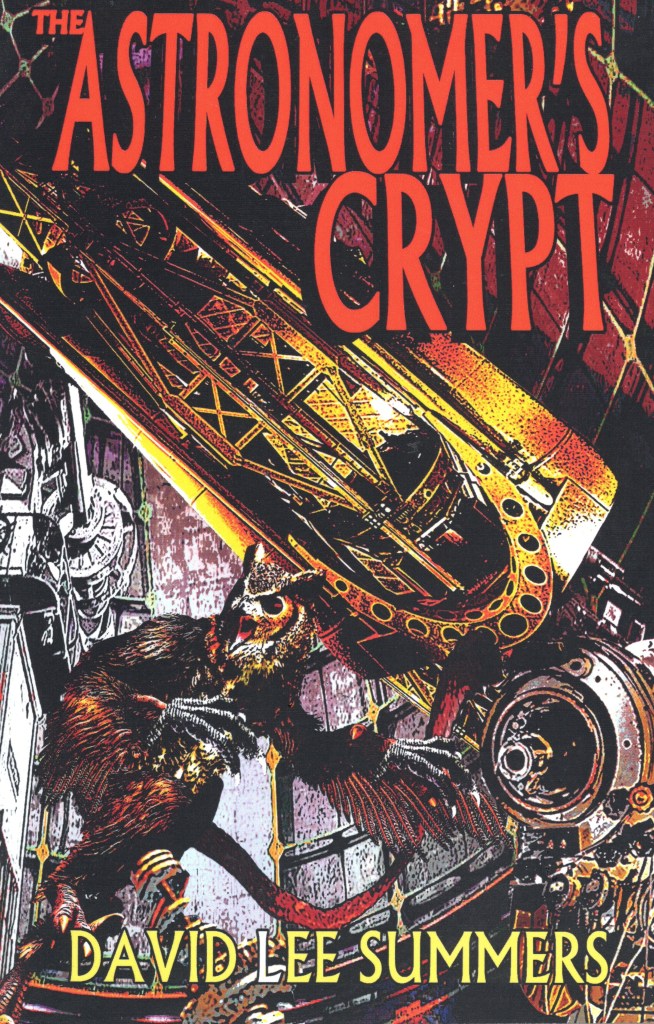
Complex machinery, a telescope, and a creature looking like a cross between an owl and a velociraptor.
Front cover of The Astronomer’s Crypt. Click on the image to go to the Amazon page for the paperback version of the book.

Amazon’s description of the book

Two years ago on a stormy night, in the dead of winter, Mike Teter experienced something that would change his life forever. Mike was a telescope operator at the world renowned Carson Peak Observatory in New Mexico. We won’t tell you what he saw that night on the mountain nor what happened afterward on a dark stretch of highway, because it would haunt you just as it has haunted Mike. But what we will tell you is that Mike is back at Carson Peak. And what he witnessed that night two years ago is about to become a reality…

This is my Amazon five-star review for The Astronomer’s Crypt by David Lee Summers

An Intense and Fun Horror Thriller Taking Place in an Astronomical Observatory

The protagonist Mike Teter is a telescope operator at a fictitious observatory in New Mexico, the Carson Peak observatory. The Carson Peak observatory features two large buildings hosting a 5-meter and a 2.5-meter telescope. It is located on sacred land adjacent to an Apache reservation. There are caves nearby that host ancient sacred artifacts that should not be removed from the caves. The observatory is a labyrinthine and dangerous place that appears to be haunted. There are long corridors and hidden rooms. The observatory has a history of deadly accidents. For example, a Dr. Burroughs and a graduate student had been killed there.

One day Mike has what seems to be hallucinations. A large ancient evil creature looking like a mix of a dinosaur and a bird appears before him, and he encounters a talking coyote that gives him a warning about the sacred portals, he sees the ghost of Dr. Burroughs, and he witnesses the gruesome death of his friend the Astronomer Dr. Wallerstein. He’s had enough and he quit his job only to return to it at a later time. He thought that the things he saw were just nerves. However, this time things really go amiss. A creepy but wealthy lawyer by name of Mr. Vassago is trying to acquire sacred artifacts. There are drug cartel thugs, greedy adventurers, freak accidents, severe storms, hostage situations, ghosts, and ancient evil monsters. Mike Teter is faced with a very complicated and nightmarish situation.

The story is action packed, suspenseful and features a lot of plot twists. The characters are well-developed, relatable and multi-layered. The observatory is realistically described, and it is obvious that the author is very familiar with astronomical observatories. As you read this book you will learn something about observatories as well as the job of telescope operators. The author skillfully creates a chilling scenery of a dark haunted observatory, which brought my imagination to the spaceship in the movie Alien. It is obvious that the author is highly intelligent. A lot of things happened in just a few pages, and it was difficult to put the book down. It is one of the most intense and fun horror thrillers I’ve ever read, and I highly recommend it.

The back cover is black and red and has a description of the book.
Back cover of The Astronomer’s Crypt. Click on the image to go to the Amazon page for the kindle version of the book.

About the Author

David Lee Summers is an author, editor and astronomer living somewhere between the western and final frontiers in Southern New Mexico. He is the author of twelve novels. His short stories and poems have appeared in numerous magazines including Cemetery Dance, Realms of Fantasy, Star*Line, and The Santa Clara Review.

David also edited Tales of the Talisman Magazine for ten years. When he’s not writing, he operates telescopes at Kitt Peak National Observatory.

Click here to visit his website

Click here to visit his blog
The Speed of Light In Vacuum Is a Universal Constant

As I previously mentioned I would like to launch a second blog featuring small facts or insights that are widely disbelieved despite being known to be true by the experts in the relevant field or facts that are very surprising or misunderstood by a lot of people. These facts shouldn’t be trivia but important facts that are somewhat easy to understand despite their status as being unthinkable to many. They are not scientific theories or complex sets of facts or information, but facts that you can easily state. They may be part of a scientific theory, or a result of an established scientific theory but not an entire scientific theory. I’ve collected hundreds of these facts because to me they seem to be extraordinarily important. They are worldview altering facts, big shocking facts to some, facts that many people deny regardless of the evidence, super-facts if you will.

In a previous post I discussed that despite the fact that the scientific community states that Earth is 4.5 billion years old and that humans evolved over millions of years a 2019 Gallup poll, showed that 40% of US adults believe that God created humans in their current form within the last 10,000 years. The evidence proves that this 40% of the population is wrong. The scientists aren’t guessing. They make their claim that earth is 4.5 billion years old based on a lot of strong evidence. Evidence which is unknown to a lot of people. In this post I am discussing a fact that once was widely disputed but today is more just surprising or not understood by many and that is that the speed of light in vacuum is a universal constant.

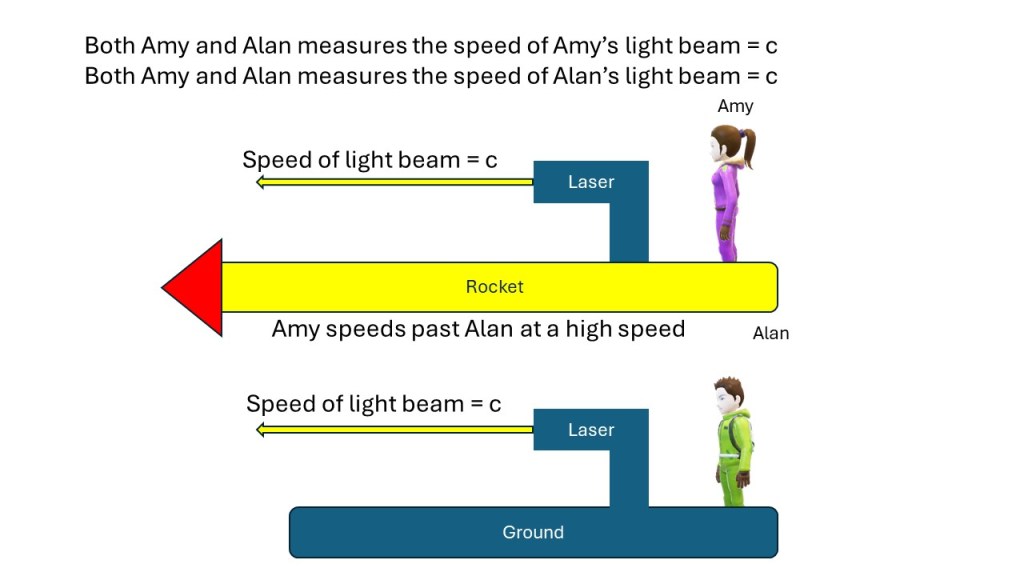
No matter how fast you travel, what direction, or where you are you will measure the speed of light compared to yourself to be c = 299,792,458 meters per second or approximately 186,000 miles per second or 671 million miles per hour.

The picture shows two people Alan and Amy. Alan is on the ground. Amy is flying by Alan in a rocket speeding left. Both Alan and Amy are pointing lasers to the left.
In this picture Amy is traveling past Alan in a rocket. Both have a laser. Both measure the speed of both laser beams to be c = 299,792,458 meters per second.

In the picture above let’s say Amy is flying past Alan at half the speed of light. If you believe Alan when he says that both laser beams are traveling at the speed of c = 186,000 miles per second, then you would expect Amy to measure her laser beam to travel at a speed that is half of that c/2 = 93,000 miles per hour, but she doesn’t. She measures her laser light beam to travel at the speed of c = 186,000 miles per second just like Alan. This seems contradictory. The solution that the special theory of relativity offers for this paradox is that time and space are relative and Amy and Alan measure time and space differently (more on that in another post).

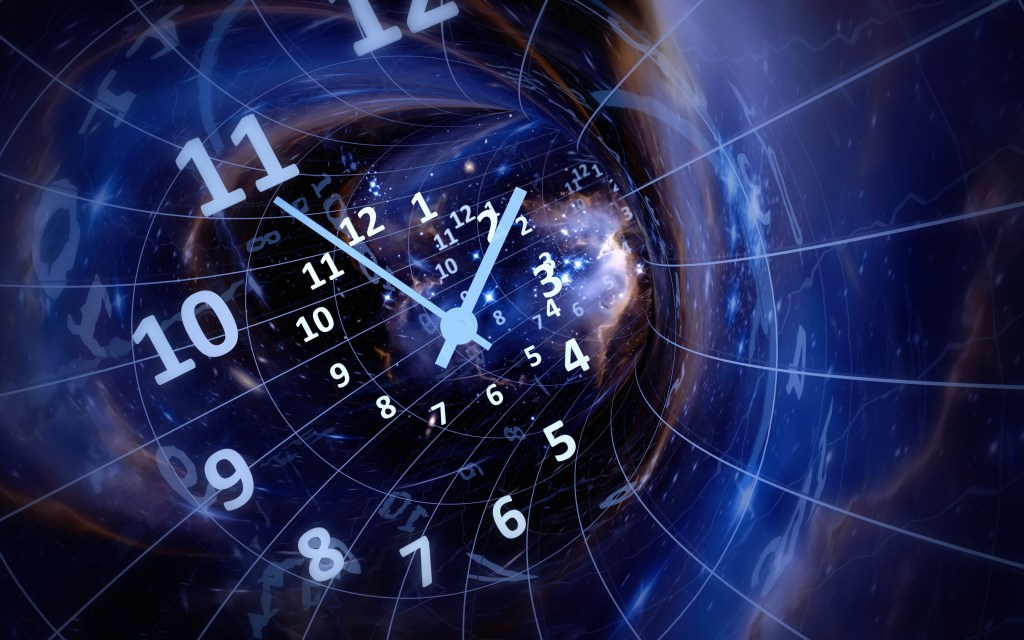
Clocks being sucked into a hole or possibly sped up into space
Time is going to be different for me. From shutterstock Illustration ID: 1055076638 by andrey_l

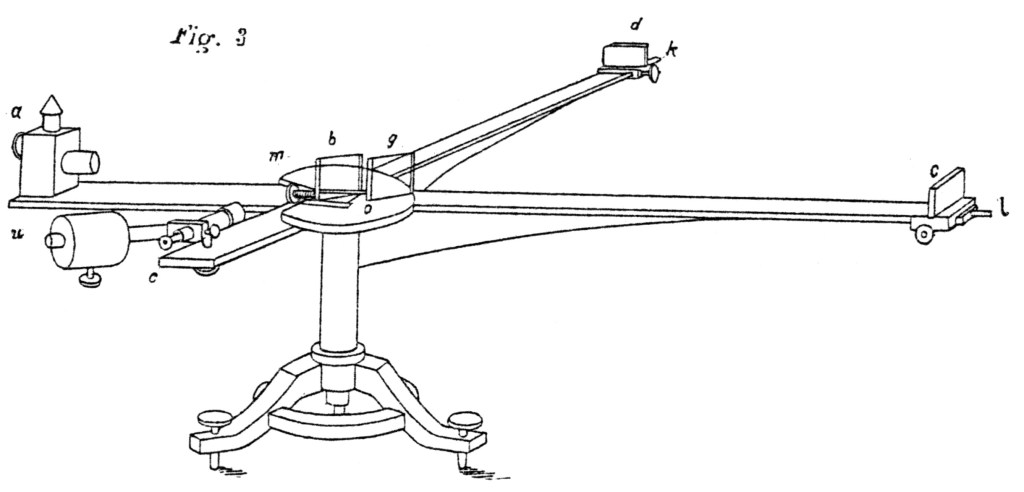
I should add that the realization that the speed of light in vacuum is a constant regardless of the speed or direction of the observer or the light source was a result of many experiments, which began with the Michelson-Morley experiments at Case Western Reserve University, Cleveland, Ohio in the years 1881-1887. At first scientists thought that there was an ether that compressed the experimental equipment and distorted clocks so that it seemed like the light vacuum always came out the same. With the special theory of relativity in 1905 those speculations were laid to rest.

This is a drawing of the Michelson interferometer used at Case Western Reserve University
The first Michelson-Interferometer from 1881. It was used to measure the speed difference of two light beams (well a split light beam) with a very high accuracy (for the time). The light traveled with the same speed in all directions and no matter what earth’s position and speed was in its orbit around the sun. This picture is taken from Wikipedia and is in the public domain of the United States.

The speed c = 299,792,458 meters per second is a universal speed limit created by time and space

I should point out that there is nothing magical about the speed of light in a vacuum. Light traveling through matter, like glass or water, does not travel at this speed c, but slower. It also isn’t entirely correct to say that the speed of light in vacuum is a universal constant, because it isn’t about light per se. What is happening is that light traveling completely unimpeded through vacuum is prevented from traveling infinitely fast by the way time and space is set up. All massless particles / radiation, or anything that hypothetically could be traveling at an infinite speed is prevented from doing that because of the way time and space are related. Light in vacuum just happened to be what we first discovered to be restricted by this universal speed limit. Yes, time and space are annoying that way, putting a limit on the speed of light and on massless particles.

So how is time and space arranged to cause this universal speed limit? Well, that is an even more surprising blog post for another day (I will link to it once I have made the post). From this discovery about time and space came a lot of other interesting realizations but that is also for another post,  but let’s just give a brief summary:

  • Time for travelers moving fast compared to you is running slower.
  • Length intervals for travelers moving fast compared to you are contracted.
  • Simultaneous events may not be simultaneous for another observer.
  • The order of events may be reversed for different observers.
  • If you accelerate to a speed that is 99.999% of the speed of light you still haven’t gotten any closer to the speed of light from your perspective. Light in vacuum will still speed off from you at c = 186,000 miles per second.
  • Acceleration will get harder the closer you get to the speed of light in vacuum. The force required will reach infinity as you approach the speed of light in vacuum.
  • Forces, the mass of objects, momentum, energy and many other physical quantities will reach infinity as you approach the speed of light in vacuum assuming you are not a massless particle.
  • Mass is energy and vice versa E = mc2
  • Magnetic fields pop out as a relativistic side-effect of moving charges.
So, it seems like we cannot travel faster than the speed of light in vacuum. It seems like the universal speed limit is really a hard limit, unlike the speed limits on Texas highways. That is maybe true, at least locally where we are. However, you could get around it, sort of cheating, by stretching and bending space to the extreme by using, for example, enormous amounts of negative energy. That’s happening to our Universe over a scale of tens of billions of lightyears. A lightyear is the distance light in vacuum travel over a year. Stretching and bending space is not part of the special theory of relativity. That is Einstein’s General Theory of Relativity, which is a very complicated theory, so you may not see any posts on that.
Mass is energy and vice versa, a direct result of the way time and space are related. Stock Photo ID: 2163111377 by Aree_S

How do you feel about time and space creating this universal speed limit in which light in vacuum travel?

We Know That the Earth is Billions of Years Old

As I mentioned in a previous post I would like to launch a second a blog. The topic would be facts and insights that are either widely disputed or often misunderstood amongst the public, yet important and known to be true to the experts and scientists in the relevant field. I’ve identified hundreds of such cases.

In my previous post I discussed the fact that despite the fact that the scientific community states that Earth is 4.5 billion years old and that humans evolved over millions of years a 2019 Gallup poll, showed that 40% of US adults believe that God created humans in their current form within the last 10,000 years. As a teenager I believed that myself. That was before I knew much about science. I had read agenda driven books that left out, or wrongfully dismissed the evidence for an old earth while presenting faulty arguments for a young earth. Just learning about the relevant science was enough for me to realize that I had been bamboozled. At first, I dug my heels in, but I eventually realized that the belief that earth was 6,000 years old was not tenable and unsupportable by science.

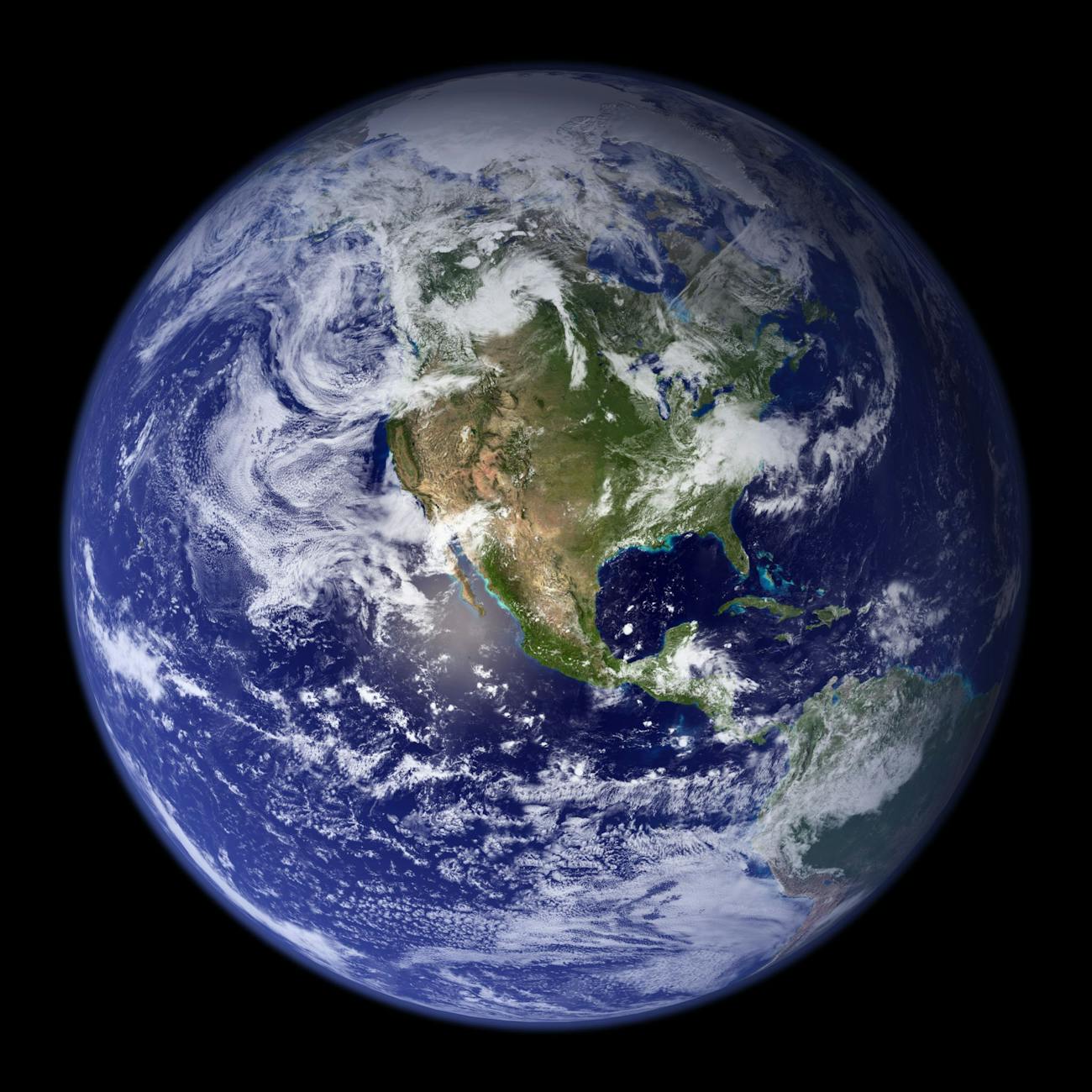
A photo of planet earth. North America is facing the camera.
Is Earth 4.5 billion years old or 6,000 years old? Photo by Pixabay on Pexels.com

My goal for the blog is not to be an exhaustive source for these kinds of topics, or a deep dive into these topics, but just to collect a large set of these unnecessarily controversial topics and provide some insight into the surrounding misunderstandings. Not a complete insight into the topics, but some. Perhaps my blog will lead to some new insights for some, or intellectually honest reflection as well as interesting and friendly discussions.

A man sitting on a rock by the ocean look at the senset.
Perhaps some new insight. Perhaps some intellectually honest reflection. Photo by Keegan Houser on Pexels.com

The format I decided on is to present the evidence for the fact or insight in question as a headline in bold followed by a list of failed objections to that evidence. Then, if applicable, failed arguments for the opposing point in bold as well, followed by an explanation as to why the argument does not work. It may seem like this setup is biased. However, the point is that the fact or insight in question is not commonly contested among the experts for good reasons, and therefore this setup is natural. Naturally, I would be open to counter arguments. I could, of course, be wrong and then I have to remove the fact/insight from my list.

A woman is shouting into the man's face using a megaphone.
I will certainly be open to counter arguments but let’s keep it friendly. Photo by Mikhail Nilov on Pexels.com

Radiometric dating of meteorite material, terrestrial material and lunar samples demonstrate that earth is 4.5 billion years, or more precisely 4.54 billion years old.

  • Radioactive decay rates have changed: This objection does not work because rates of radiometric decay (the ones relevant to radiometric dating) are thought to be based on rather fundamental properties of matter, such as the probability per unit time that a certain particle can “tunnel” out of the nucleus of the atom. Analysis of spectra from quasars show that the fine structure constant has not changed over the last ten billion years. There are dozens of radiometric dating methods that are consistent with each other throughout time. Also, for a young earth you would need the decay rates to have been millions of times faster in the past, which would require changes in fundamental properties that would have plenty of noticeable effects on processes other than radioactive decay, not to mention the radiation being millions of times stronger than today. It would have fried everything.
  • Young earth creationists sometimes make the claim that the initial ratios between isotopes may have been different: That the initial ratios/condition were different in the past and therefore radiometric dating is unreliable. This is a better objection, but it also fails. In this case you must take it case by case for each radiometric dating method and situation. But in many cases the amount of the daughter isotope is known to have been zero, which makes it easy and reliable.
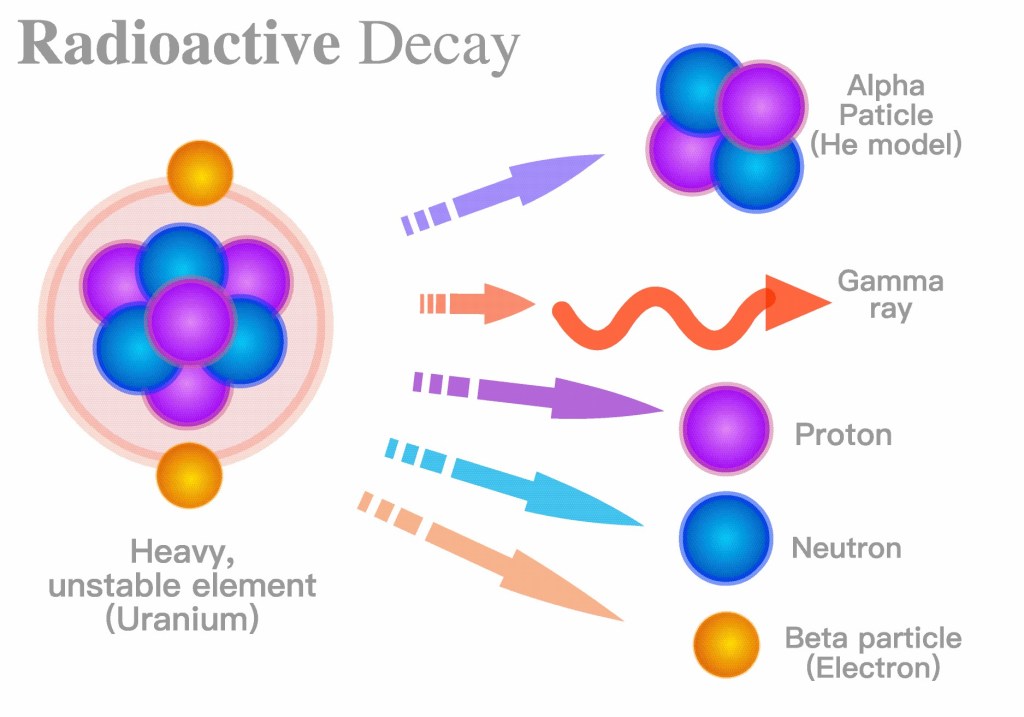
On the left a Uranium nucleus. On the right an alpha particle, gamma ray, proton, neutron, and a beta particle (electron), originating from the uranium nucleus.
Radioactive decay wasn’t a million times faster 6,000 years ago. Stock Vector ID: 2417370135 by grayjay

We can see galaxies that are billions of lightyears away. This does not establish the age of the earth, but it makes a young earth and a young universe implausible.

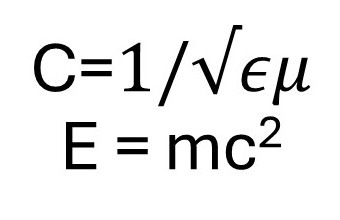
A common objection to this observation is that lightspeed in vacuum has changed: Similar to above this objection does not work because the light speed in vacuum is a fundamental constant that is not believed to change. It has been measured and no change has been seen. An example is the Einstein’s equivalence of energy and mass E = mc2. If the speed of light once was millions of times faster than now, the energy contained in a kilogram would be a trillion times larger than now. Where did all that energy go? The speed of light is determined by the inverse of the square root of the electric constant multiplied by the magnetic constant. You would have to drastically change the strength of the electric and magnetic fields (by the trillions) to get the speed of light to be millions of times faster. Wouldn’t that be noticeable? The light speed in vacuum shows up in many other physical relations as well. It is not a tenable objection.

Two equations, James Clerk Maxwell's equation for the speed of light and Albert Eintein's energy and mass equivalency E=mc2
A couple of equations in which the speed of light in vacuum is a fundamental constant.

We know stars are old because they develop according to certain physical processes that for some stars take billions of years. An example is our sun. It has fused (burned up) up five billion years’ worth of hydrogen.

The heavier elements in our solar system originate with older stars that burned out and exploded.

Electromagnetic radiation, including light, heat transfer if you will, travels from the inside of the sun to the surface and this takes 100,000 years. The photons are emitted and reabsorbed over and over, which is why the electromagnetic transfer is lower than in vacuum. If the sun is only 6,000 years old, how can we see it?

Finally, some objections to old earth by young earth creationists.

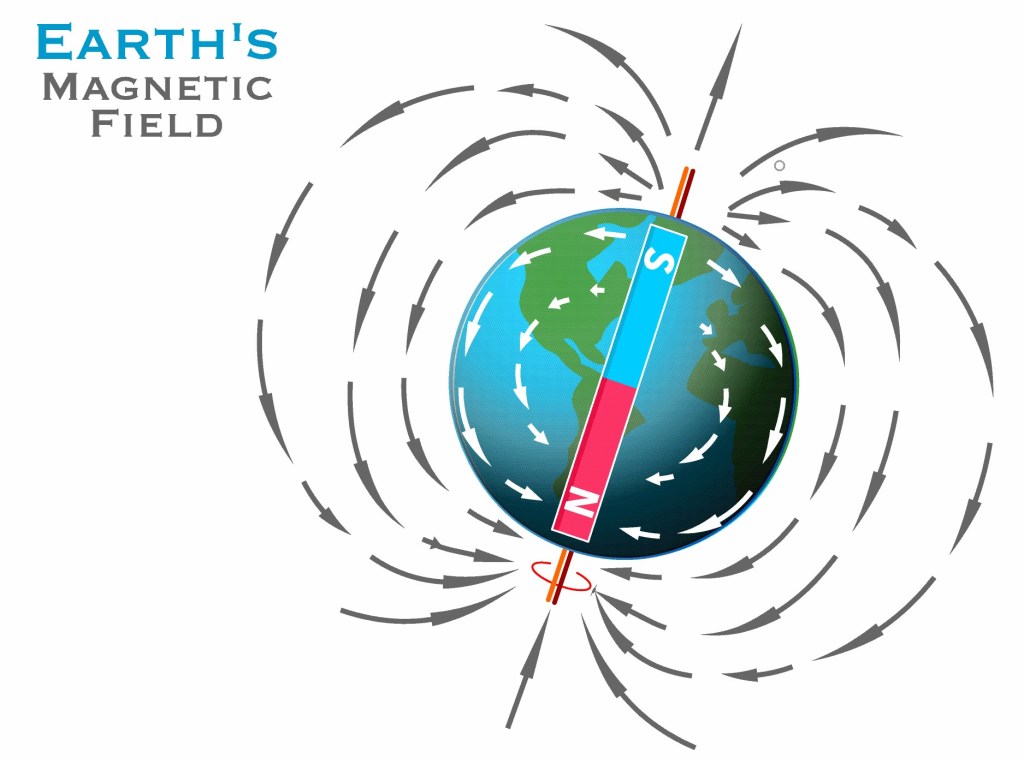
The earth’s magnetic field has been weakening during the last 130 years as if it was formed from currents resulting from earth being a discharging capacitor (claim by Thomas Barnes). This would make an impossibly strong magnetic field already 8,000 years ago. I remember this being the argument in a young earth creationist book I read as a teenager.

  • The first problem with this argument is that there is no good reason to believe that earth’s magnetic field acts this way.
  • We know that earth’s magnetic field has reversed itself several times thus disproving the discharging capacitor model.
  • Thomas Barnes’ extrapolation completely ignores the nondipole component of the field.
  • Conclusion, this objection is not reasonable.
A picture showing earth's magnetic field around planet earth. The north pole end of the magnetic field being in the south and the south end in the north.
Earth’s magnetic field. Stock Vector ID: 1851166585 by grayjay.

If the earth and the moon were billions of years old there would be a hundred feet thick dust layer from meteorites  on the moon. The moon landing proved otherwise. This is another argument I remember reading in a young earth creationist book (Scientific Creationism by Henry Morris) as a teenager.

The problem with this argument, as I would later find out, is that Morris’ claims about a hundred feet thick dust layer was based on faulty and obsolete data. The expected depth of meteoritic dust on the Moon is less than one foot (after billions of years).

If I had known and understood any of this when I was 14 years old, I would not have been bamboozled by the young earth creationists, but it was not the only time I was bamboozled.

Anyway, this is how I envision one blog post in my upcoming blog post adventure. It is a brief overview of why experts/scientists can be trusted in regards the topic of the post. I have not yet decided on a name for my new blog.

Total Eclipse Day in Dallas

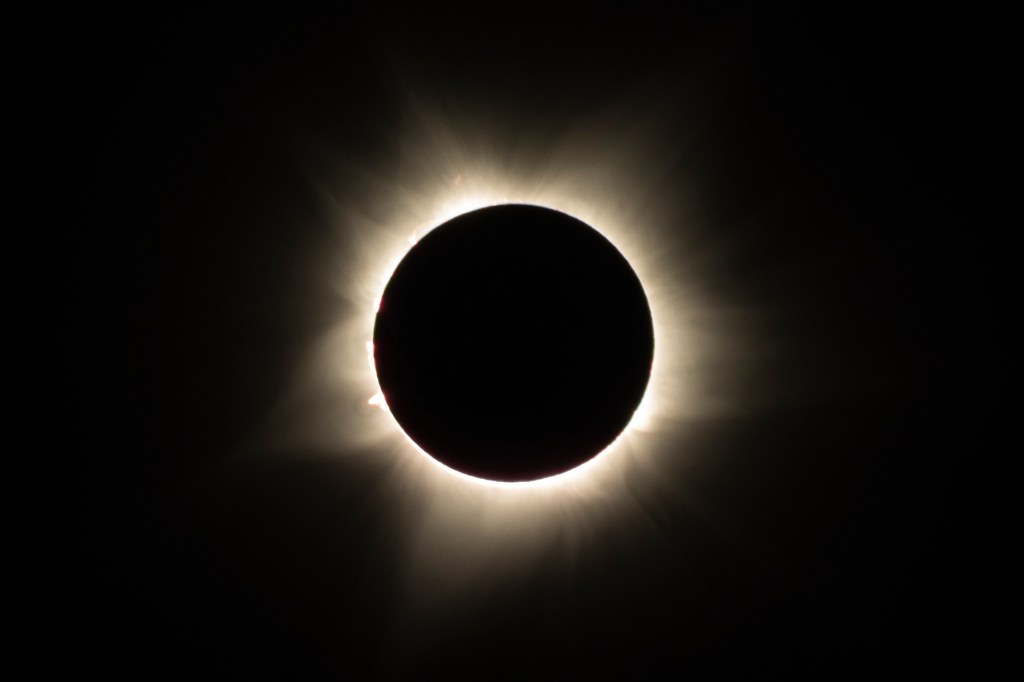
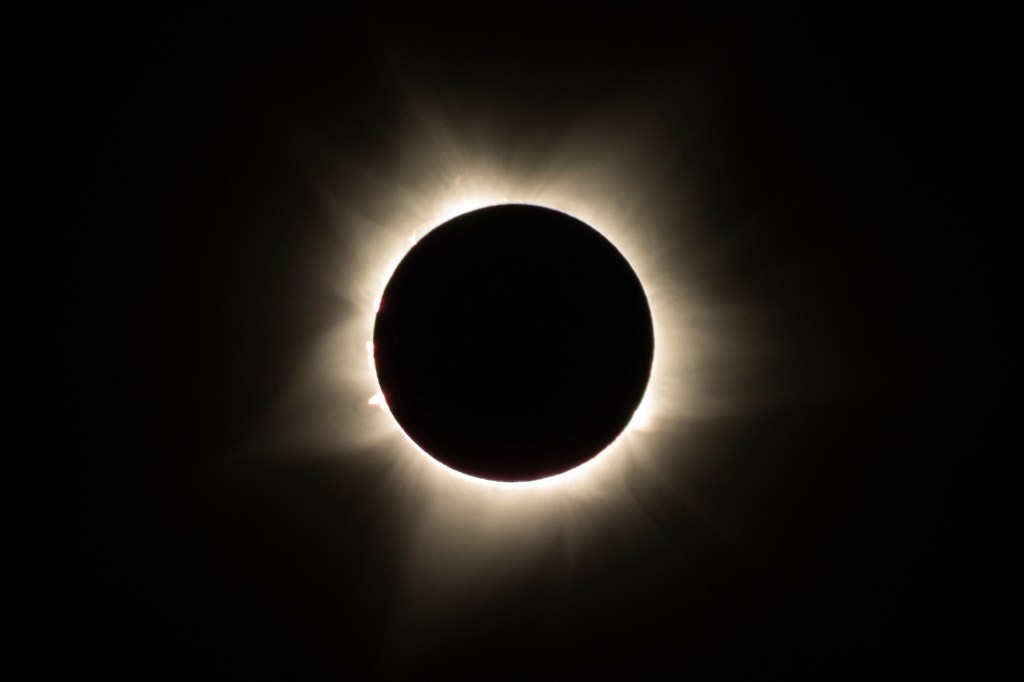
Black circle surrounded by a wispy white fog like light. That’s the sun’s corona.
What we saw today. Solar Eclipse Stock Photo ID: 2344355767 by aeonWAVE

When I made my blog post Dallas On April 8 2024 I promised to follow up with what happened. We had a small solar eclipse barbeque. It was just me and my wife, our daughter, grandpa and grandma and  our dog Rollo. Our daughter dressed up Rollo in a vampire dog cap and put bows on the beer glasses, my wife prepared the food, and I grilled chicken and hot dogs. Then we enjoyed the show. It was a great show, and we were lucky with the weather.

A Westvleteren 12 in front and my open grill in the background.
Grilling and drinking a Westvleteren 12 a Belgian Ale Quadrupel from Brouwerij de Sint-Sixtusabdij van Westvleteren in Belgium, ABV 10.2%.
A table set for five with a large parasol.
Our patio table. The little brown packages contain AAS / ISO certified solar eclipse glasses.
My daughter holding a Westvleteren 12 glass with a bow. Grandpa and grandma sitting on chairs in the background.
Our daughter holding a Westvleteren 12 glass with a bow. Grandpa and grandma in the background.
A mini-Australian Shepherd sitting on the patio floor.
Rollo our mini-Australian Shepherd on the patio.

The Partial Eclipse

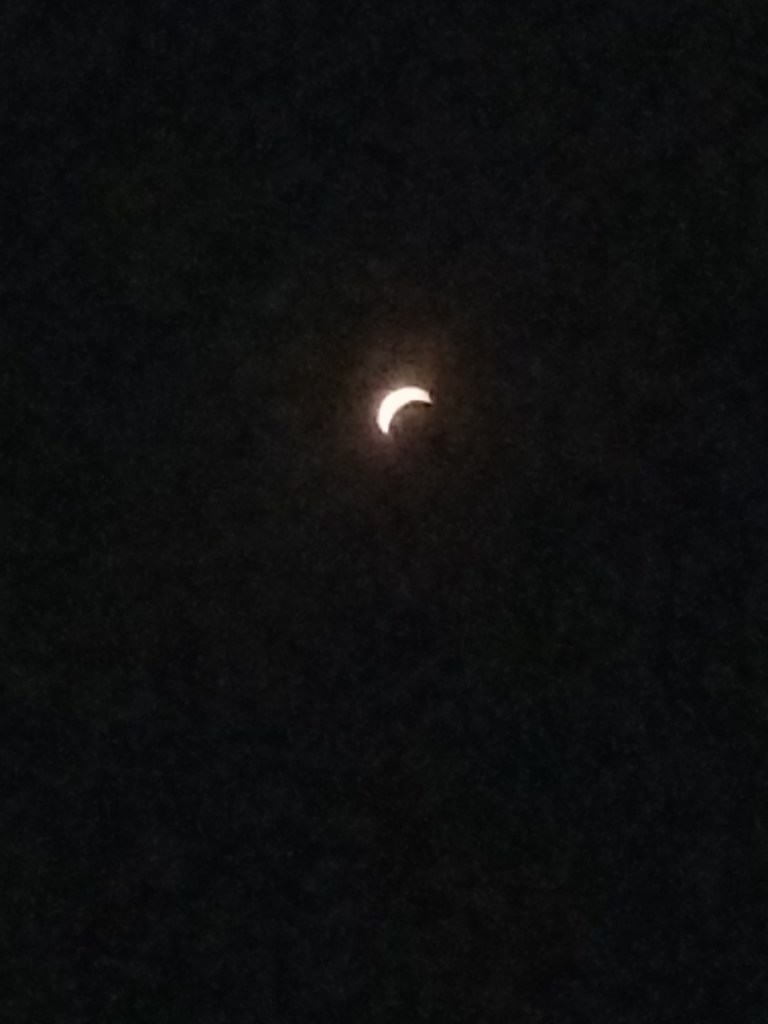
It was partially cloudy during the partial eclipse, but we were able to get a good look at the eclipse as it progressed. To see the partial eclipse, you have to use good solar eclipse glasses. It is primarily for safety reasons, but it is also pointless to look at the sun during a partial eclipse. You won’t see the eclipse because the powerful light from the sun overwhelms your view. I had a little filter that was placed in front of my phone camera as I took a few pictures. Admittedly they were pretty bad. I have an old Samsung Galaxy S8+ but even using newer phones it is difficult to get decent photos of something like this. This is why I need to invest in a real camera.

The photo shows a shiny crescent on black background.
Partial eclipse photo taken with my old Samsung Galaxy phone and a filter.

The Total Eclipse

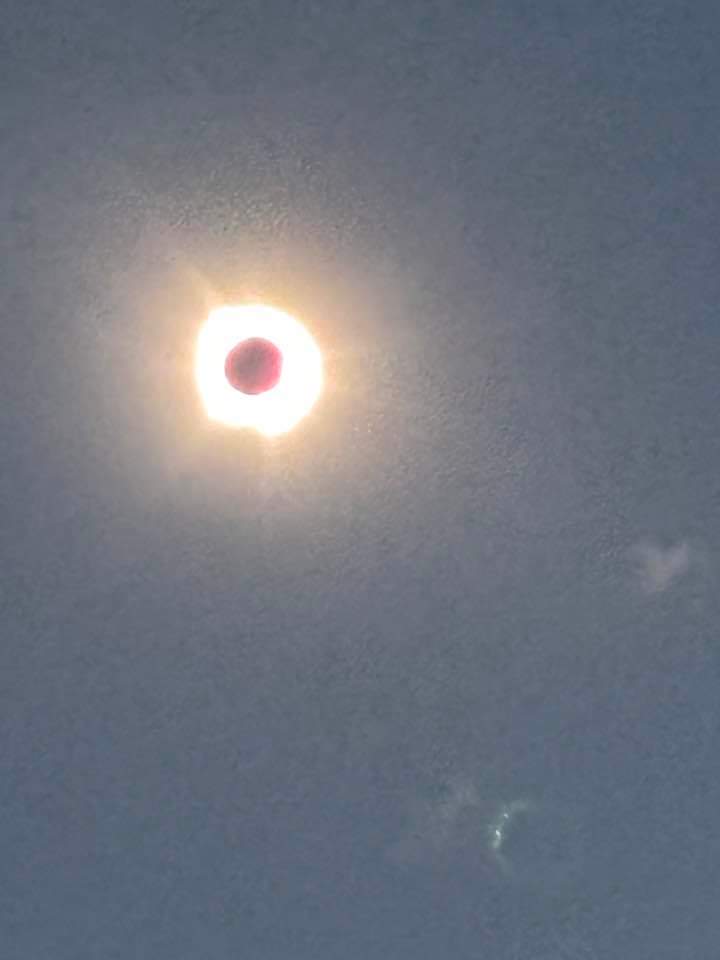
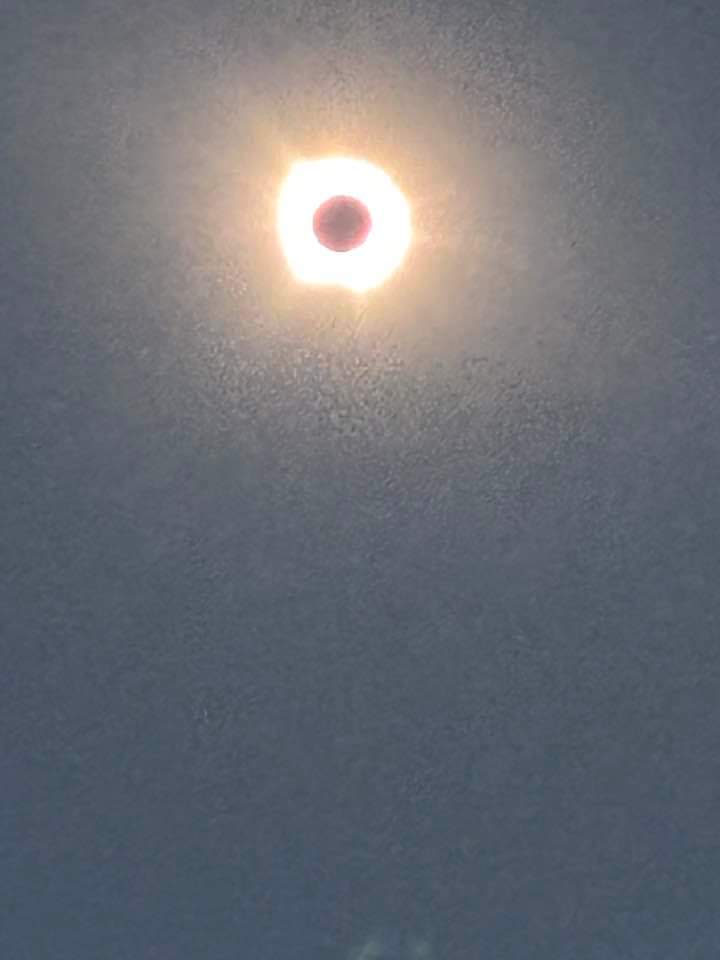
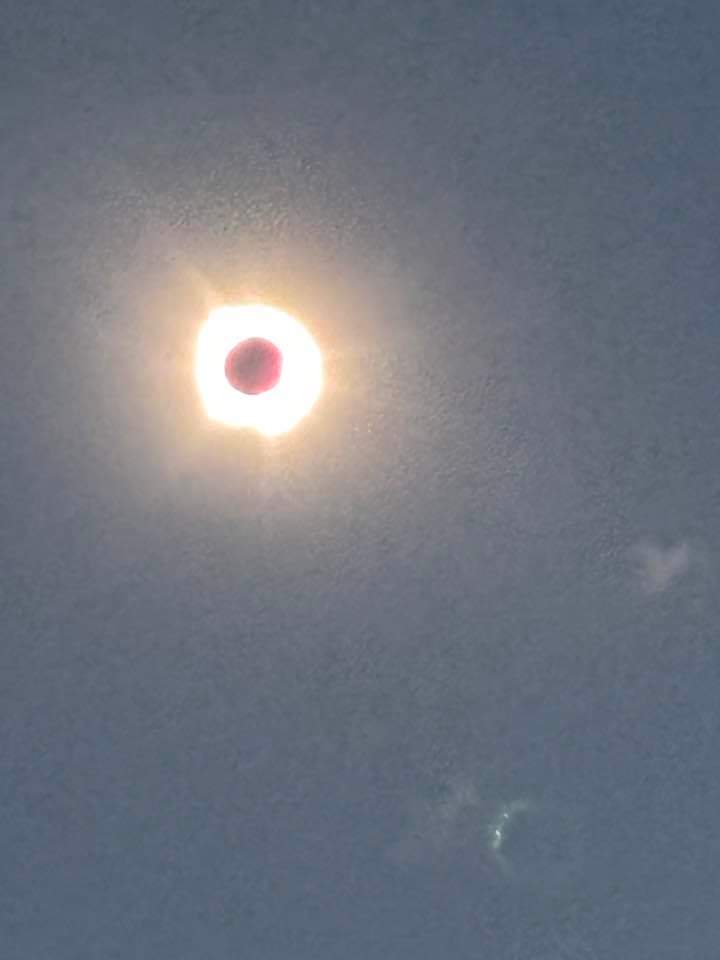
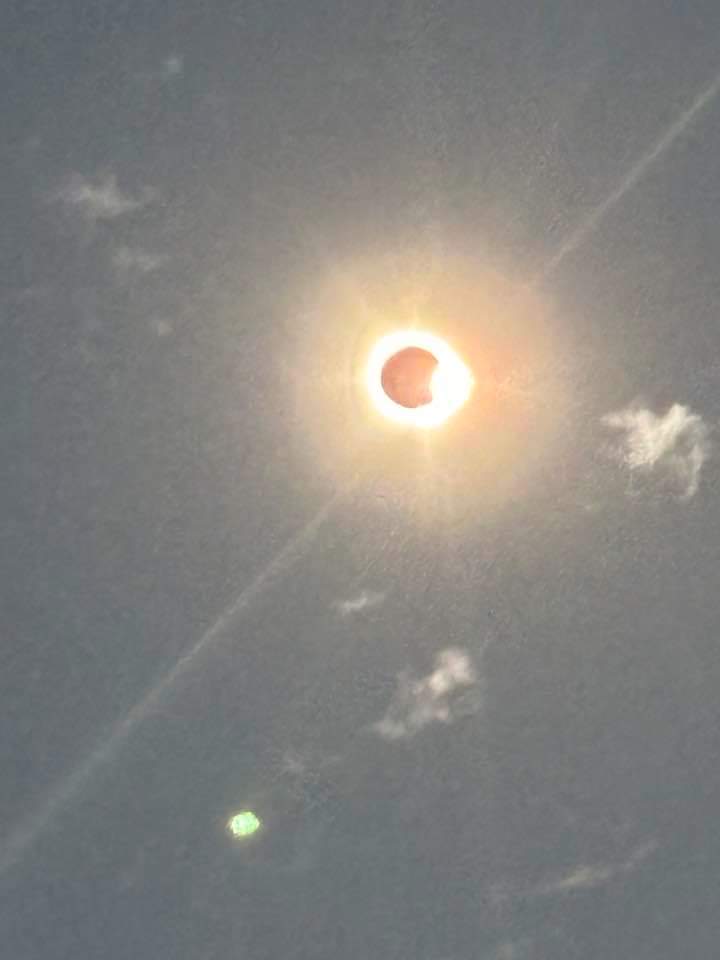
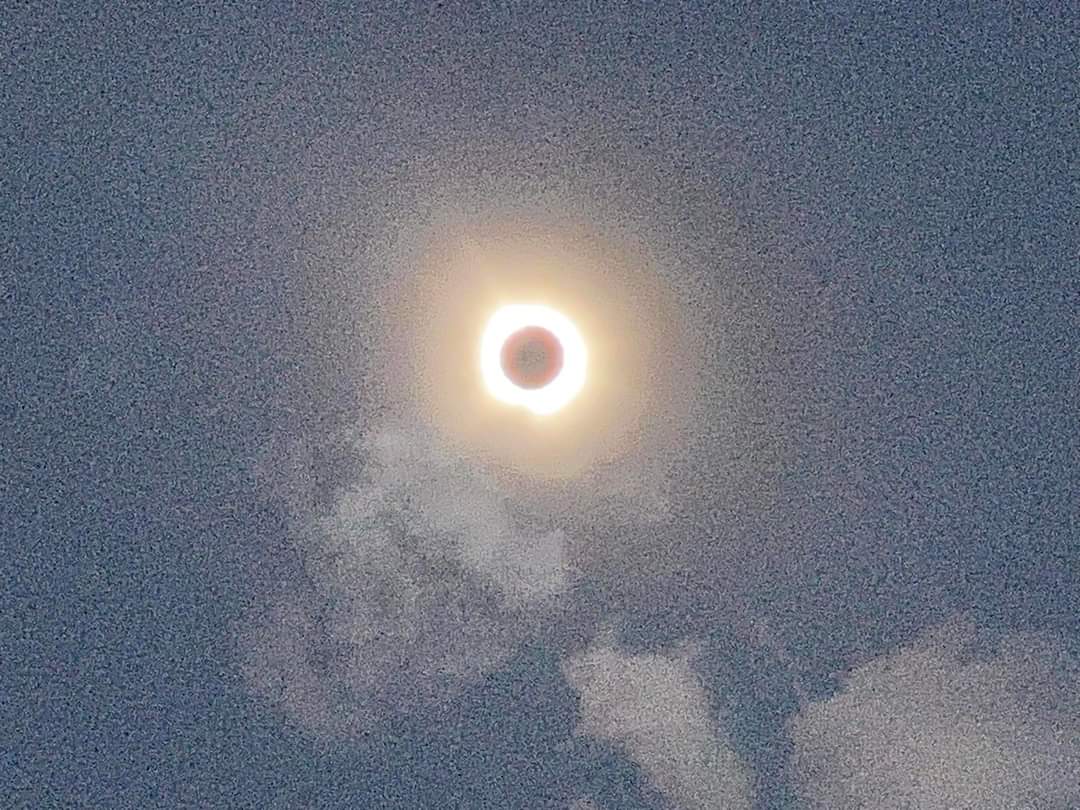
1:40PM Dallas time the total solar eclipse happened and luckily it was not covered by clouds. At this point it suddenly got dark and it was safe to look straight at the sun without using the eclipse glasses. The total eclipse lasted four minutes. I have included a shutter stock photo below which closely represents what we actually saw. We saw a black circle and around the black circle was a wispy white fog like light. This was the sun’s corona and it shone with about the same power as the full moon. It kind of looked like a black hole. Our phone cameras distorted what we saw quite a bit, especially mine. The corona was blown up to 3 times its actually size and it looked messy, perhaps because it got dark. One thing this photo does not show is that the stars came out, which provided us with a little surprise.

Black circle surrounded by a wispy white fog like light. That’s the sun’s corona.
What we saw today. Solar Eclipse Stock Photo ID: 2344355767 by aeonWAVE

The Venus Surprise

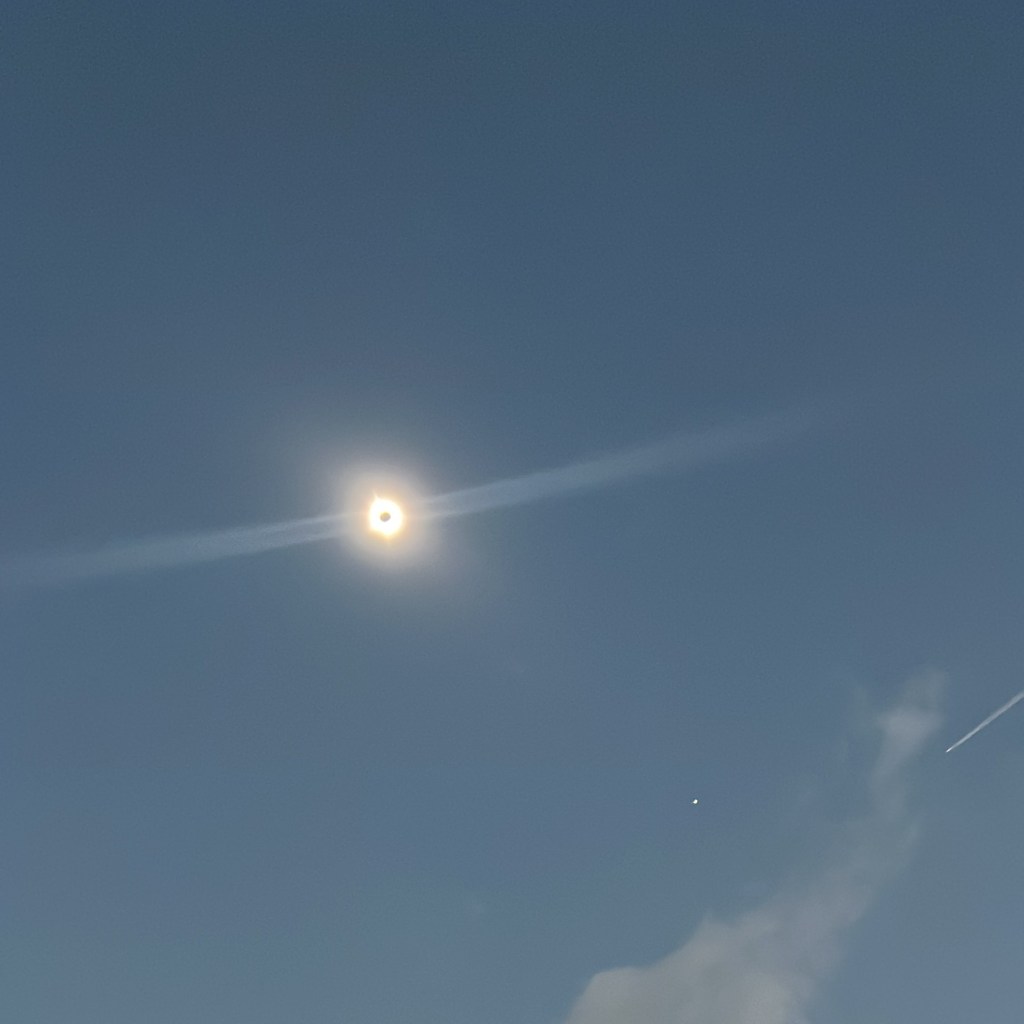
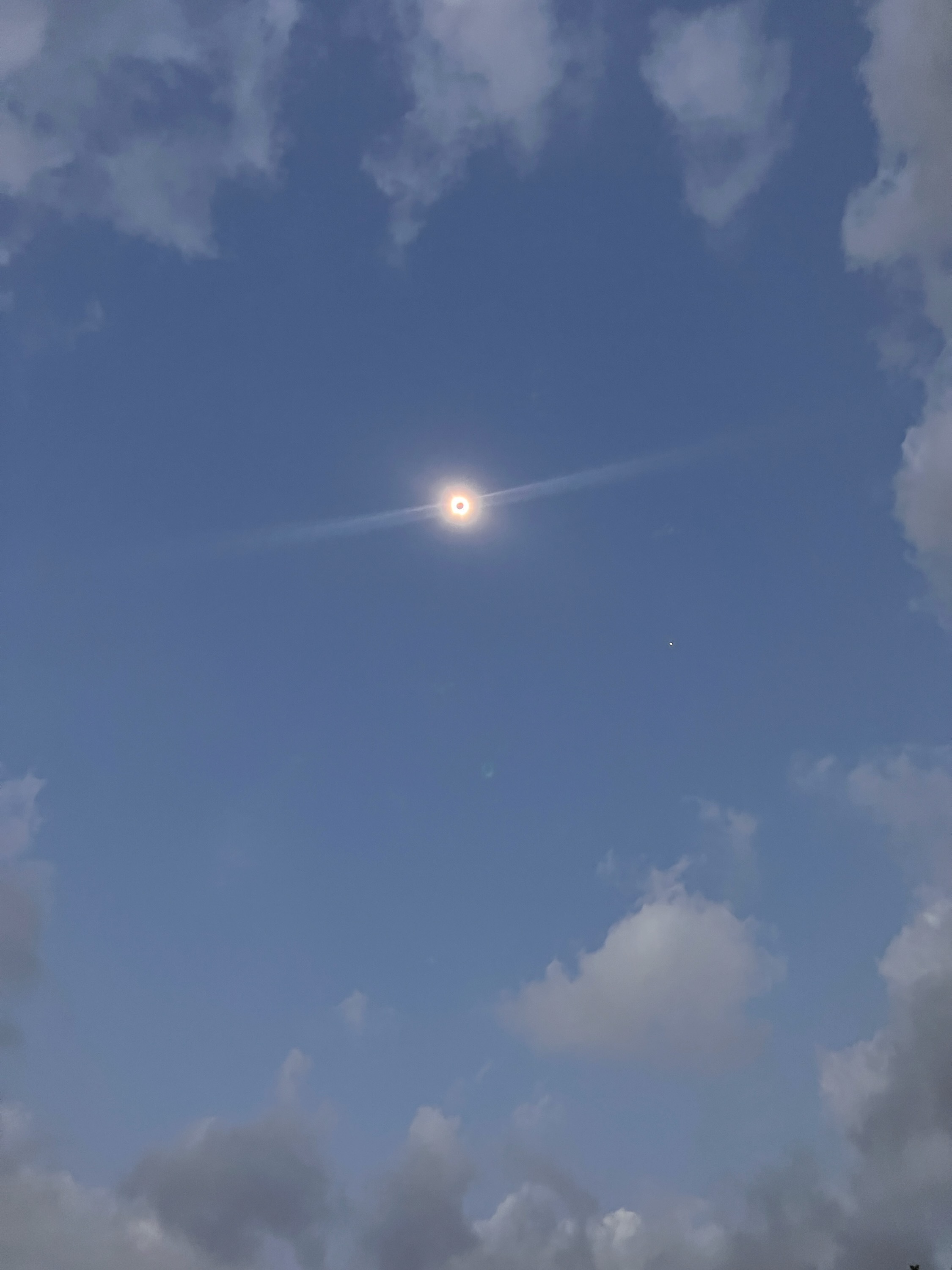
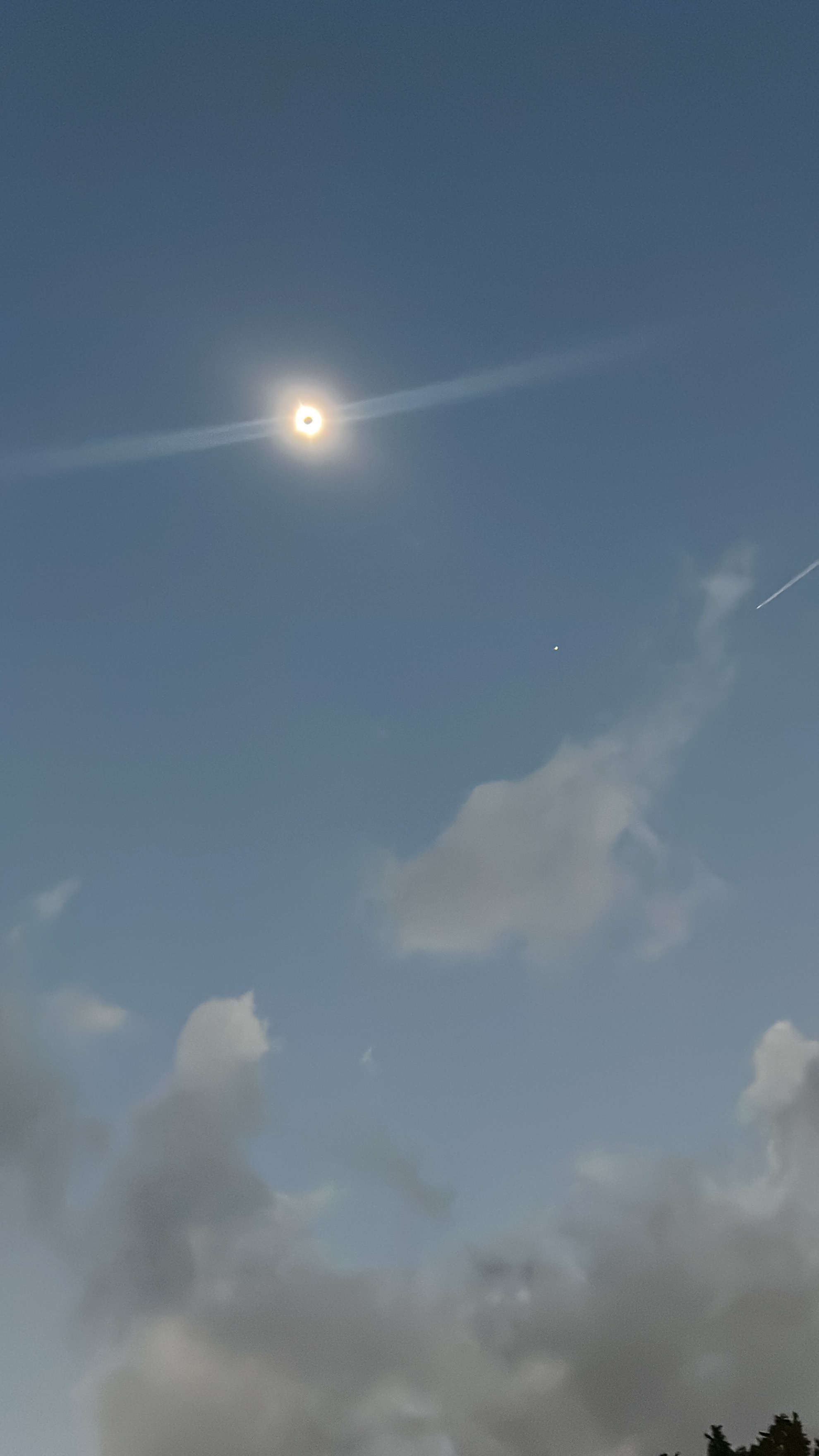
Below is a photo my daughter took with her phone. The sun looks tiny (it wasn’t) and the corona is overblown and does look like it actually did. However, you can see a star looking object down on the right above and on the left of the cloud and left of the airplane contrail. I used the Google Sky Map App to find out what star it was, but it wasn’t a star. It was the planet, Venus. It was located straight south high in the sky three quarters to zenith. I have certainly never seen Venus in that position in the sky before, and it was unusually luminous as well. I’ve seen Venus many times low in sky in the west soon after sundown (then called the evening star) and I’ve seen Venus many times low in sky in the east in the morning (then called the morning star), but never like this. The total solar eclipse provided an unexpected Venus show.

The photo shows the sun totally covered by the moon. It is very small in the photo. There is star like object, that’s Venus, a cloud and airplane contrail.
Total solar eclipse photo that my daughter took. Can you find Venus?

Total Eclipse Photos

These eight pictures above were taken with cell phones by my daughter Rachel, Denise Mosier-Wanken, and Margaret Weiss Bloebaum.

How was your Eclipse Day ?

Dallas On April 8 2024

This post is a brief reminder of the total solar eclipse happening April 8, 2024. Dallas, Texas, where I live, will experience totality, and the total time in totality in Dallas will be 3 minutes and 51 seconds (1:40:43 PM CDT to 1:44:34 PM CDT), one of the longest durations across the country. If you are content with just a partial eclipse you can see that from any of the 48 states, and it will last for hours. This event is less than two months away.

Map of north America showing the path of the total solar eclipse on April 8, 2024. Several cities in the path of totality are marked.
Path of totality (total solar eclipse). I am allowed to use this image as long as I link back to the National Eclipse. Click on the image to visit the National Eclipse.
Map of north America showing the path of the total solar eclipse on April 8, 2024. Several cities in the path of totality are marked.
Alternative map showing the path of totality from Travel + Leisure.

According to those who have experienced a total solar eclipse it is a lot more profound experience than a partial solar or an annular eclipse. A partial eclipse is definitely cool. You can see the crescent shadows of tree leaves and if you have the right glasses, you can see the sun partially covered by the moon. However, it won’t get dark. In a total solar eclipse, it will get dark, and many say that the birds will stop singing, it will become quiet. This is the last total solar eclipse in the United States until 2044. It will be my first total solar eclipse (I saw a partial in 2017). Hopefully the weather will cooperate.

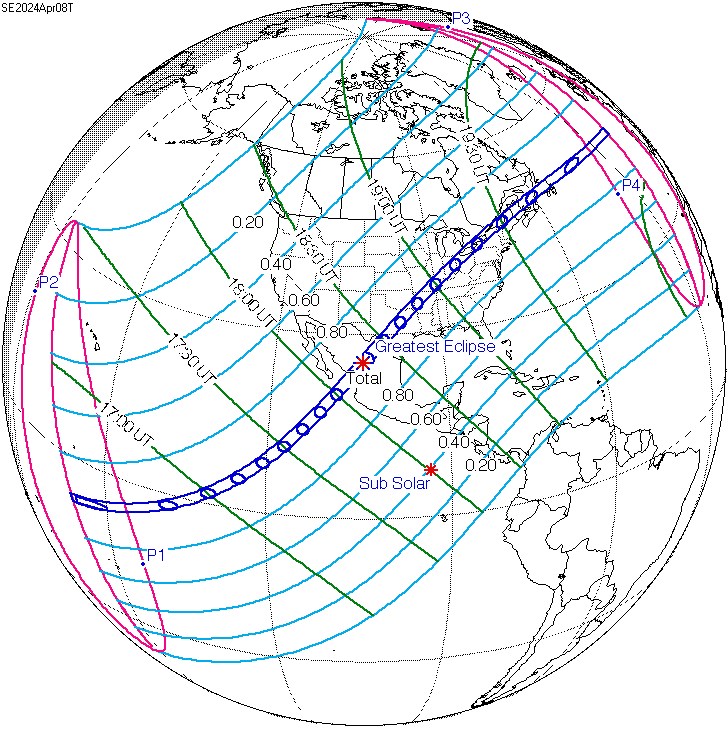
Illustration showing planet earth, the path of totality, partiality lines (in percentages), and times.
Overview of path of totality and partial solar eclipse worldwide. Public domain – NASA. Eclipse Predictions by Fred Espenak.
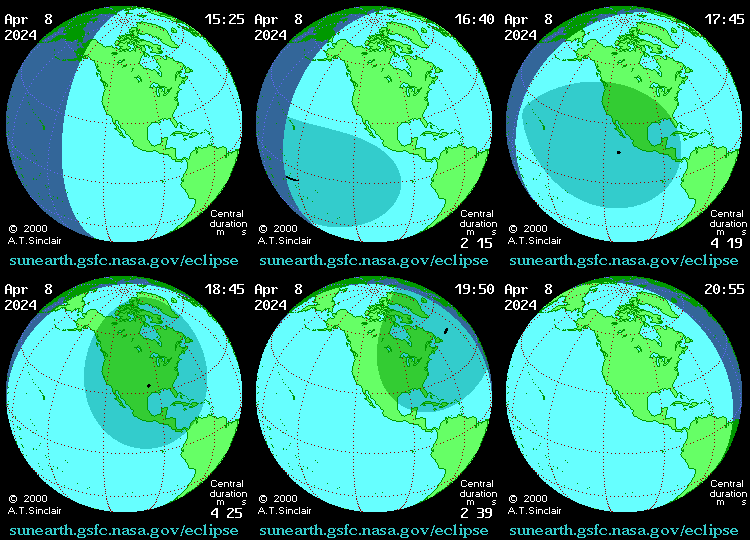
Blue planet earth with a small moving dot for totality and a big blue shadow showing the extent of partial solar eclipse.
Gif animation illustrating totality and extent of partial solar eclipse. Official work for NASA.
Photo of my 10 solar eclipse glasses.
My solar eclipse glasses that I bought on Amazon.

Click here or here to read more about the solar eclipse on April 8, 2024.