There are so many beer styles

Since it is St. Patrick’s Day today, I thought I’d make a post about beer.

Me Thomas wearing a green hat, a green shirt and drinking from a large cup of beer.
Me drinking Irish Goodbye an Irish Red Ale from Peticolas Brewery Dallas, Texas, ABV 6.5%. Photo taken today.

Bland pale mass produced lagers often made with low quality ingredients are very common now a day. Examples are Corona, Bud Light, Heineken, Miller Light, etc. However, there are many other beer styles. For example, there are:

Lagers:

  • Pale Lager that is not mass produced and not containing low quality ingredients
  • Dark Lager including Schwarzbier (essentially black)
  • Red/Amber Lager
  • Pilsner
  • Adjunct Lager
  • Rice Lager
  • Vienna Lager
  • India Pale Lager

Ales:

  • Stouts
  • Porter
  • Pale Ale
  • IPA / India Pale Ale (the second most popular beer style)
  • Hefeweizen
  • Kristallweizen
  • Witbier
  • Irish Red Ale (what I am drinking above)
  • Saison
  • Wild Ale
  • Lambic
  • Geueze
  • Gose
  • Smoked beer
  • Belgian Blonde Ale
  • Steam Beer
  • Kvass
  • Gruit
  • And much more

The beer advocate counts 120 beer styles of which I’ve had 107 so far. Beer advocate features around 250,000 different beers.

Bottle of BOMB!  Prairie Artisan Ales on left, glass with the beer and on the right my beer garden gnome.
The BOMB! From Prairie Artisan Ales, Tulsa, Oklahoma, ABV 13%. It is a so-called Imperial Stout, an extra strong stout and extra flavorful stout.

Generally speaking, beers are classified into two main types of beers, lagers and ales, or perhaps lagers and ales plus other beers. Steam beers are hard to classify and Lambics you don’t refer to as ales even though they technically are ales. Stouts, porters, hefeweizen, pale ales, IPAs, Wild Ales, Lambics are all ales. In the short list above, everything below Vienna Lager are ales.

Bottle of Atrial Rubicite on left, glass with the beer and on the right my beer garden gnome.
Atrial Rubicite is a world class Wild Ale from Jester King Brewery, Texas, my favorite Texas brewery. Wild Ales are fermented using wild yeast, which often gives them a fruity flavor. In this case they also added raspberries. It is considered the best raspberry Wild Ale in the world. I was once waiting for hours in a long line just to buy two bottles (the maximum allowed).

Lager beer is a relatively recent invention that originated in Bavaria. Lager beers use a special kind of yeast for the fermentation process, it is typically bottom fermented, and fermented and conditioned in cool temperatures, unlike other beer styles. Lager beers can be of many colors, pale, amber, dark, even black such as Schwarzbier. The Pale Lager originated in Pilsen in Bohemia (Western Czech Republic) in the mid-19th century. The pale lager has become the world’s most common beer style and bland tasting mass-produced pale lager beers dominate the market. In countries that are not traditional beer countries such as France, Italy, China, Japan and South America, the bland pale lager is very dominant. I’ve come across many people who think that the more tasteless the pale lager is, the better beer it is (people who love Corona).
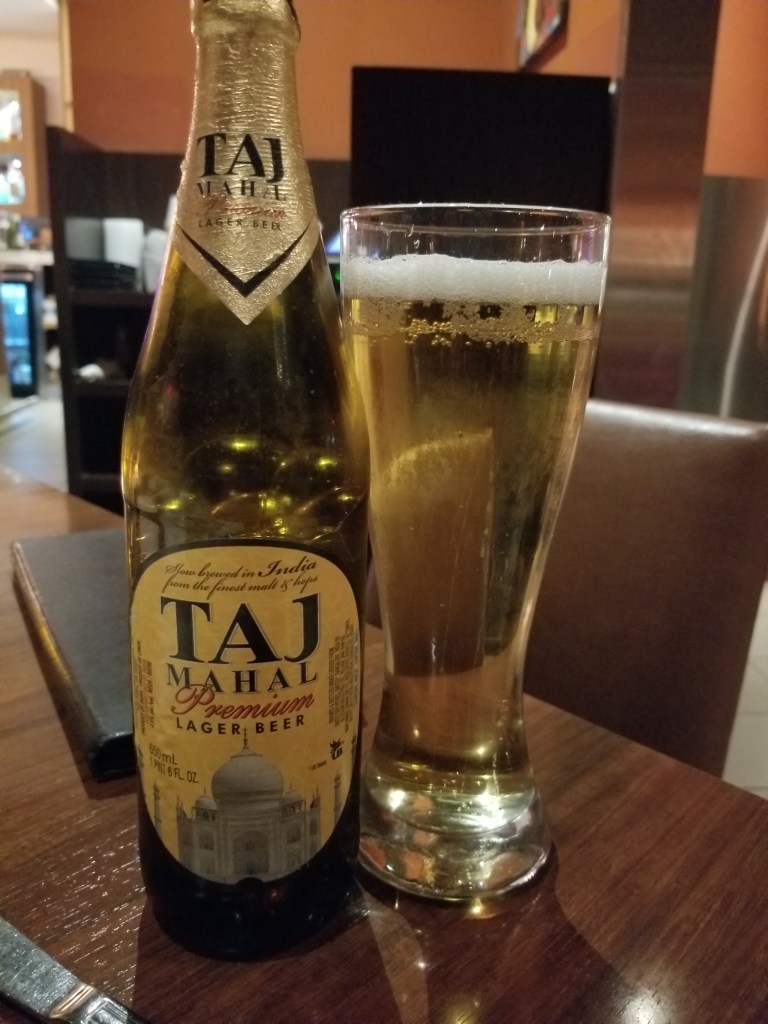
Bottle of Taja Mahal on left, glass with the beer on the right.
An American style mass produced Adjunct Lager from India. Adjunct lager means that they used ingredients such as corn and rice, which is not typical for higher quality lager beers. It wasn’t great, it was watery, but good with very spicy food. But then, water is probably best with very spicy food.

Stout is a dark, top-fermented beer / Ale style. Sub styles include dry stout, oatmeal stout, milk stout and imperial stout. It is derived from the Porter, which originated in London, England in the early 1720s. Stout is basically a stronger and more flavorful porter. However, there is no clear distinction between porter and stout. I am sure you have heard of Guinness Stout, a very Irish beer. Imperial stouts are extra strong, full bodied and flavorful stouts. Below is an imperial stout, which interestingly enough is not dark brown or black but golden/amber.

Glass with amber colored El Cuerro on left and can of El Cuerro on right.
El Cuerro is a so-called White Stout from Lone Pint Brewery, Texas, ABV 7.8%. The flavor is roasted malts, coffee and chocolate. I think it is pretty good.

IPAs, India Pale Ales is an extremely popular Ale that is typically flavorful and quite bitter. It is in a sense an anti-Lager. It is the beer style that I drink the most. The IPA is a type of Ale (fermented at warm temperatures, unlike, for example, lagers). It is typically a Pale Ale (exceptions are black IPAs). It was invented in England in the early 1800’s and became popular for exportation to India. It is characterized by its higher content of hops and the level of alcohol is often higher as well. More hops and more alcohol made it easier to preserve the beer for the trip to India.

A glass of my home brew on the left the bottle on the right
This is an India Pale Ale that I brewed at home. I call it “It’s Fine. I’m Fine. Everything is Fine.”  An artist friend of mine, Breanna, made the labels.

As I mentioned there are a lot of beer styles. One of the lesser-known ones is smoked beers. Smoked beer, or Rauchbier, is a type of beer with a distinctive smoke flavor imparted by using malted barley dried over an open flame. It goes great with barbecue. Below is an example of the style that I’ve had quite often.

Bottle of Aecht Schlenkerla on left, glass with the beer and then on the right my beer garden gnome.
Aecht Schlenkerla Rauchbier Märzen from Braurei Heller Bamberg, ABV 5.1%. It is a so called Rauchbier. The barley malts have been kilned over a fire of beech wood logs, giving it a smokey flavor. The flavor is smokey, very smokey malts or toasted bread, maybe smoked ham. I think it is delicious.

If you are paying attention to beer, you may have heard about “Trappist beers”. This is very special category that is not referring to a beer style, but by who makes it. Trappist beer is brewed by Trappist monks. There are tens of thousands of breweries in the world but there are only 13 Trappist breweries in the world. Trappist beers are considered to be very special. The most highly praised of the Trappist beers is Westvleteren 12 from Brouwerij Westvleteren founded in 1838 at the Trappist Abbey of Saint Sixtus in Vleteren, Belgium. Westvleteren 12 is a so called Quadrupel Belgian Ale. It is often said that Quadrupel means that it has been re-fermented four times, but it is often not true. However, quadruple means that it is a stronger, darker and more flavorful. Westvleteren 12 is extremely difficult to buy but I have been able to get my hands on several.

Big opener on the left, the glass with Westvleteren 12 in the middle and the Westvleteren 12 bottle on the right.
Westvleteten 12 is a Belgian Ale Quadrupel ABV 10.2% (Trappist). I think the taste is like raisin bread, dark fruits, plum, raisin, and some yeast and dark bread bitterness. There is a very small hint from the alcohol that adds nicely to the overall flavor. I love this beer.

I think my favorite type of lagers are Märzen and my favorite Ales are IPAs.

Do you have a favorite Lager? Do you have a favorite Ale?
Beer and Fruitiness

I wanted to write a post about craft beer, but I realized that putting everything I wanted to say about craft beer into one post would make it a very long post. I am starting with a post about fruity beers, craft beers or otherwise.

A woman drinking a beer
Photo by Engin Akyurt on Pexels.com

First a word about Lager beer. Lager beer is a relatively recent invention that originated in Bavaria. Lager beers use a special kind of yeast for the fermentation process, it is typically bottom fermented, and fermented and conditioned in cool temperatures, unlike other beer styles. Lager beers can be of many colors, pale, amber, dark, even black such as Schwarzbier. The Pale Lager originated in Pilsen in Bohemia (Western Czech Republic) in the mid-19th century. The pale lager has become the world’s most common beer style and bland tasting mass-produced pale lager beers dominate the market. In countries that are not traditional beer countries such as France, Italy, China, Japan and South America, the bland pale lager is very dominant. I’ve come across many people who think that the more tasteless the pale lager is, the better beer it is (Corona).

A photo of a bottle of corona with a lime
Photo by Arthur Swiffen on Pexels.com

Many people believe that beer is the same thing as pale lagers. However, the beer advocate counted 120 beer styles (so far). I can add that some mass-produced American pale lagers, such as Budweiser, contain adjuncts, such as rice and maize, which is prohibited by the German Reinheitsgebot tradition. The Reinheitsgebot tradition states that the only ingredients allowed in beer are water, malt, hops, and yeast and for bottom fermented beer (lager) the malt must be malted barley only. Therefore, what many people think of as beer, well, it’s complicated.

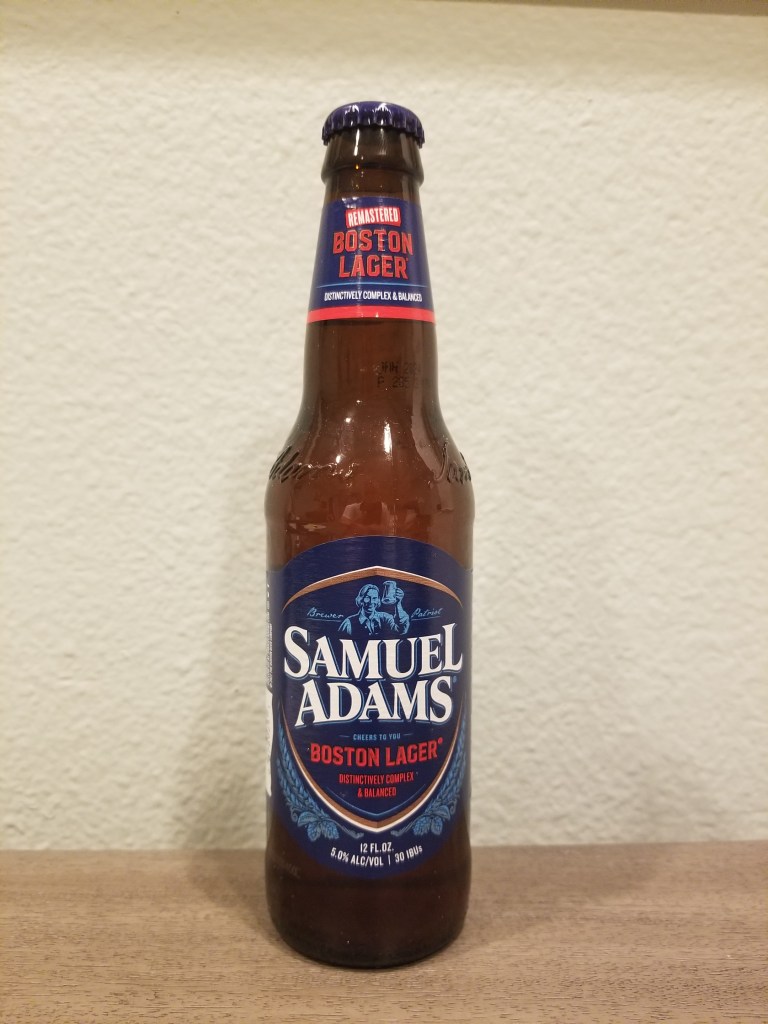
A photo of a bottle of Samuel Adams Remastered Lager.
Samuel Adams Remastered Lager is a pretty good lager beer.

Beers with fruity flavors

Pale lager beers aren’t associated with fruity flavors, which can lead to the incorrect impression that beer with fruity flavors isn’t real beer. However, beers with fruity flavors have a very long history, and many fruity beers, perhaps surprisingly to some, follow the German Reinheitsgebot tradition. In addition, many beers with fruity flavors are among the most celebrated beers in the world. There are many fruit Lambics (Belgium) that are sold for several hundred dollars per bottle. There are a number of ways to add fruit flavors to beer.

  • Hops is a flower that is used as a flavoring and stability agent in beer. It has been used since at least the 9th century and is allowed/part of the Reinheitsgebot tradition. There are at least 147 hop varieties in the world, many of them having fruity flavors. 
  • The fermentation process frequently generates esters (in addition to alcohol), a compound responsible for the fruity aromas and flavors in fruit. The amount of fruitiness that you get depends on the yeast and the grain used. For example, German and Belgian wheat beers often have more or less prominent notes of banana or pear due to an ester called Isoamyl acetate, also known as isopentyl acetate. Belgian lambics (not fruit lambics), gueuze, red flanders, and oud bruin beer styles has tart and very fruity flavors without any fruit or fruit juice being added. 
  • The German Berliner Weisse, a wheat beer, gets its fruity and tart flavor from a bacterium. Traditionally no fruit is added. However, now a day it is very common to add fruit or fruit syrup to enhance the fruit flavor. 
  • Sometimes fruity flavors can to some degree be added by aging the beer in, for example, wine barrels, adding notes of wine or grapes. 
  • Naturally you can also add fruit, or fruit juice, to the fermentation process. This is not in accordance with the German Reinheitsgebot tradition but perfectly acceptable among beer connoisseurs. Many of the highest rated beers in the world are so called fruit lambics that have added fruit. 
  • There are other ways to add fruit flavors in beer but above are four very common ones.

Below are some photos of beers with fruit flavors

Photo of a bottle of 3 Fonteinen Framboos standing on a table. There is a glass filled with Lambic.
The day I launched my book I drank 3 Fonteinen Framboos a so-called fruit Lambic. Raspberries were added to the fermentation process, so it does not follow the German Reinheitsgebot tradition. On the other hand, Reinheitsgebot has little meaning outside Germany and that includes Belgium. This beer is rated 100 out 100 on beer advocate and is listed as one of the best beers in the world.
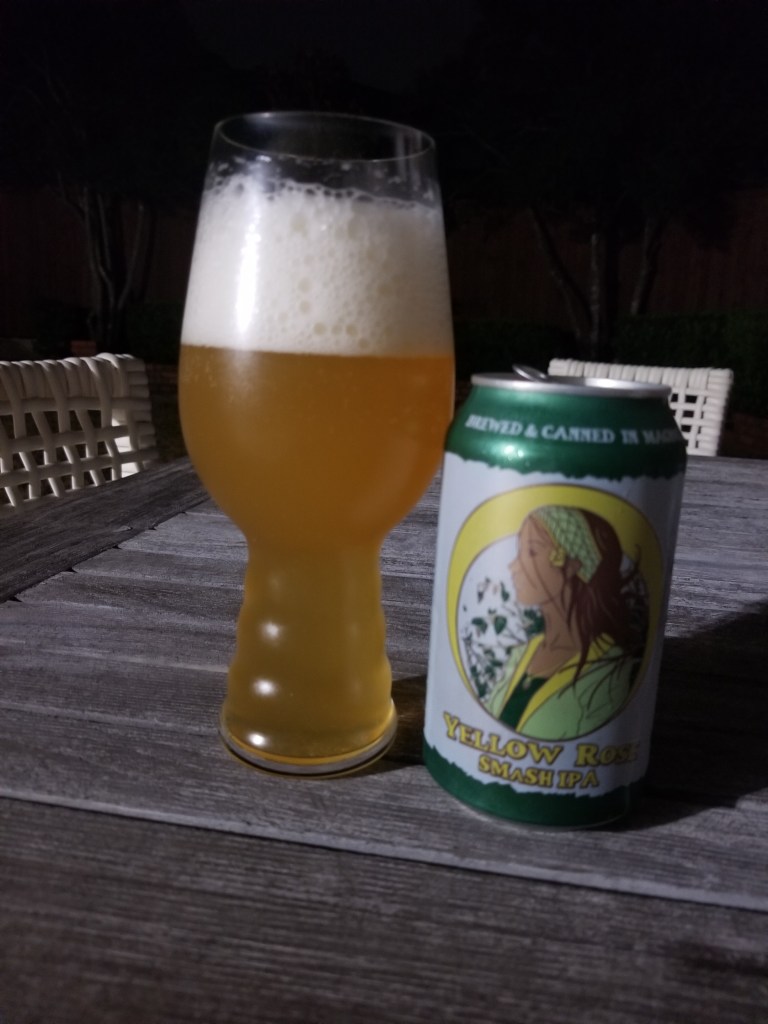
A can of Yellow Rose an IPA from Lone Pint Brewery, Texas. There is an IPA glass filled with Yellow Rose.
Yellow Rose, Lone Pint, Texas, is my favorite SMASH IPA. SMASH stands for Single Malt And Single Hop. IPA stands for India Pale Ale, and flavorful and bitter beer. The Hop in question is Mosaic Hops, which add notes of mango, other tropical fruits, blueberry, and grapefruit.
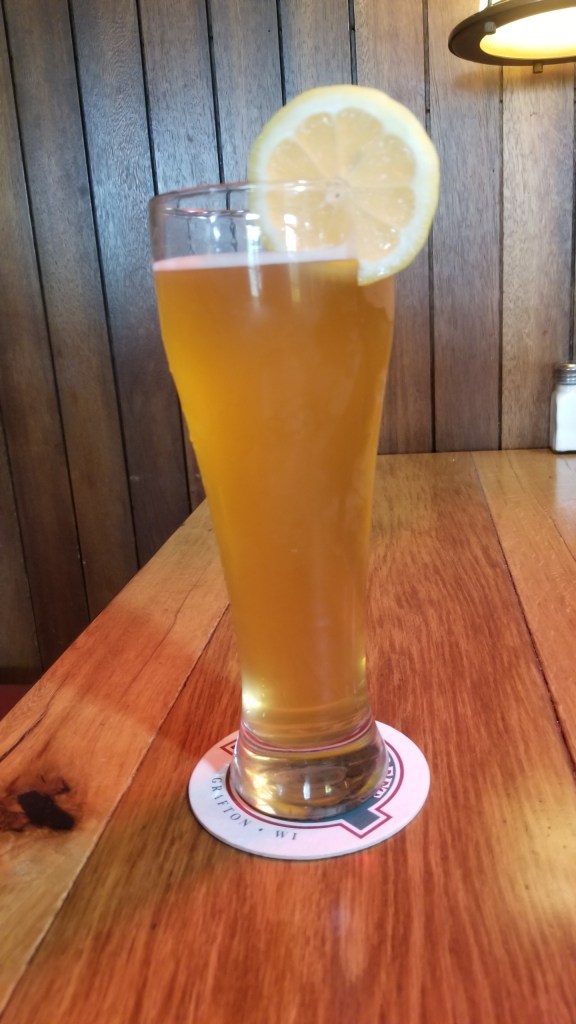
A tall glass filled with Hefeweizen beer. The glass has unfortunately a slice of lemon on top.
This is a Hefeweizen that I drank at a brewery in Wisconsin. It had strong notes of banana, in other words Isoamyl acetate, an ester generated during the fermentation process. The lemon slice is technically added fruit, but it happened after brewing and after pouring against my wishes.
A bottle of Oude Geuze from 3 Fonteinen is standing on table in my backyard. Our Pug Daisy is visible in the background.
Oude Geuze from 3 Fonteinen, Belgium, is blend of three Lambics. I think the flavor is tart green apple, lemon, grapefruit, white wine, some oak barrel woodiness. It is very fruity, but all the fruit flavor comes from esters generated during the fermentation process. There is no fruit added.
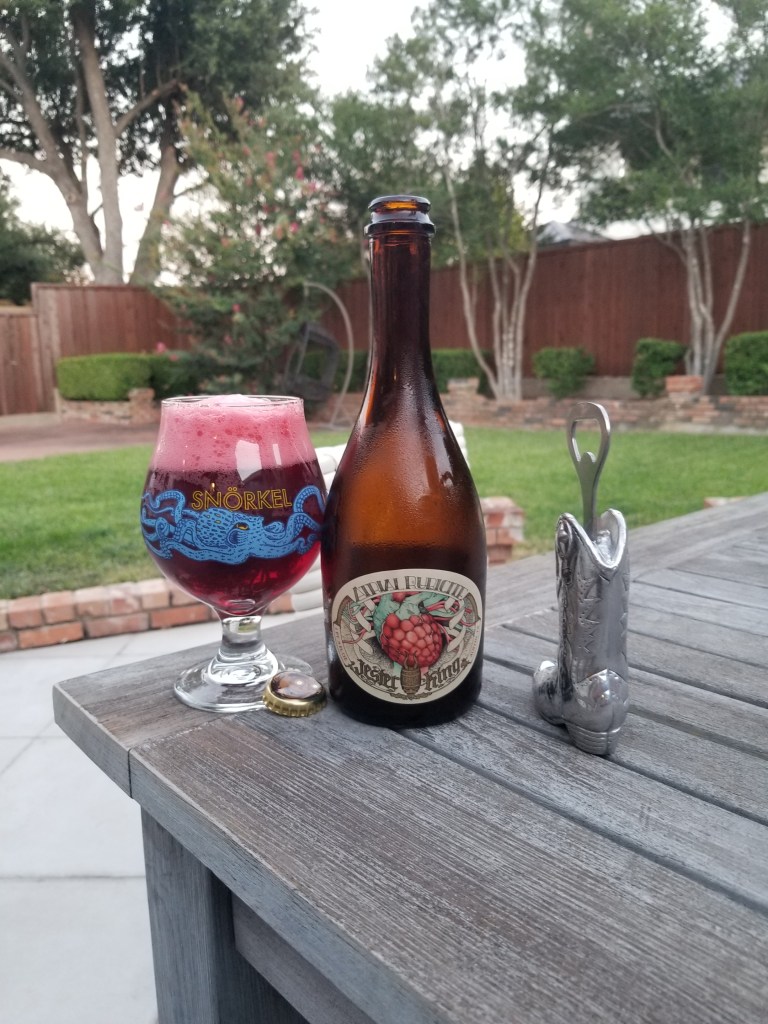
A bottle of Atrial Rubicite a so called Wild Ale from Jester King, Texas, is standing on a table in my backyard. There is a glass filled with Atrial Rubicite and boot shaped opener.
This is a so-called Wild Ale from Jester King, Texas. It is more specifically a raspberry Wild Ale. It is fermented using wild yeast (giving it a fruity and tart foundation), and raspberries have been added to the fermentation process. The result is a beer that taste like raspberry jam. It’s tart, sweet, thick body, lots of raspberry flavor. Most people that I’ve seen tasting it have a positive reaction to it. They think it is delicious even though it is not what they expect from a beer.
A can of Blue Dream, a Fruited Kettle Sour is standing on my brick wall. Next to it is my snörkel glass filled with Blue Dream.
Blue Dream is a so-called Fruited Kettle Sour from Martin Brewhouse, Fort Worth, Texas. Fruited Kettle Sours are a little different from the five examples I gave above. Bacteria is added to the wort to generate acid/tartness, then the bacteria are killed (boiling). Then it is fermented normally and the fruit, in this case blue raspberry, is added after primary fermentation. It was pretty sour, and it tasted like liquid jolly ranchers. The reactions to it were mixed. I liked it though. This type of beer is an American invention.
Standing on my table in my backyard, a box of Silent Blue (two cans) on the left, a glass of The Silent Blue (purple) in the middle and a can of The Silent Blue on the right.
The Silent Blue is another Fruited Kettle Sour from Martin Brewhouse, Fort Worth, Texas. The fruit/berry used in this case was blueberry, but it was also aged in whiskey barrels giving a whiskey aroma and flavor. So, it tasted like blueberry and whiskey, which I think turned out quite good.