This blog feature amusing and heartwarming stories about our late Leonberger dog Bronco, as well as other Leonbergers. It also has a lot of information about the Leonberger breed, the history, care, training, Leonberger organizations, etc. I also wrote a Leonberger book, which I am featuring in the sidebar.
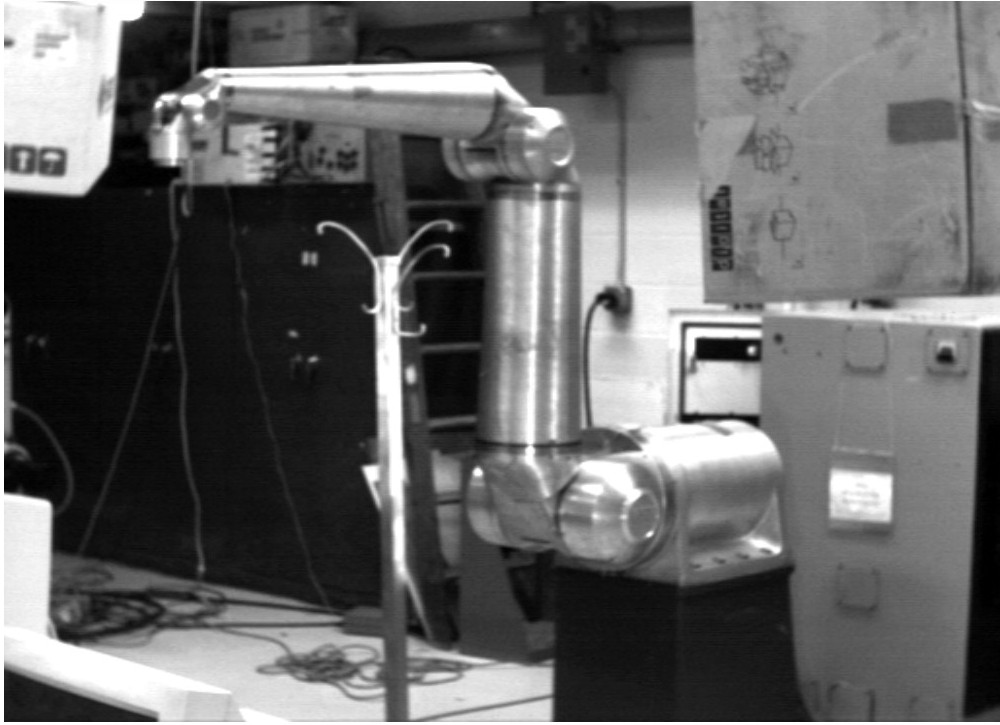
Someone suggested that I write a little bit about my background in Robotics and the fact that I did a PhD in Robotics (Department of Electrical Engineering and Applied Physics). My thesis involved the emulation of basic animal behavior such as reflexes and fixed action patterns, as well as tree-search based artificial intelligence. I used neural networks in other contexts, but not for my PhD research. It also involved quite a bit of non-linear robot system control and the study of chaotic systems. I implemented my research on many kinds of robots but the robot I used the most was the 7-degrees of freedom Robotics Research Corporation Robot pictured below.
Robotics Research Corporation Robot
It looks messy in the picture, and I should probably explain. I had hung a few boxes from the ceiling and placed a coatrack in front of the robot. There is also another robot just outside the picture to the left. I placed a sonar sensor, or perhaps more correctly eco-location equipment on the tip of the robot. I used the sonar/eco-location to create a 3D map of the robot’s surroundings. Since the sonar-sensor could not see everything at once I used the arm of the robot to search and investigate the surroundings, including discovering that the boxes were open on one side. The motion of the robot was guided by the sonar and was not directly programmed by me. The robot was able to avoid colliding with the objects, including the other robot as it was moving. I moved objects around and added clothes and hats to the coatrack to make it harder. It looked like an animal figuring out what was around it. This was in 1993.
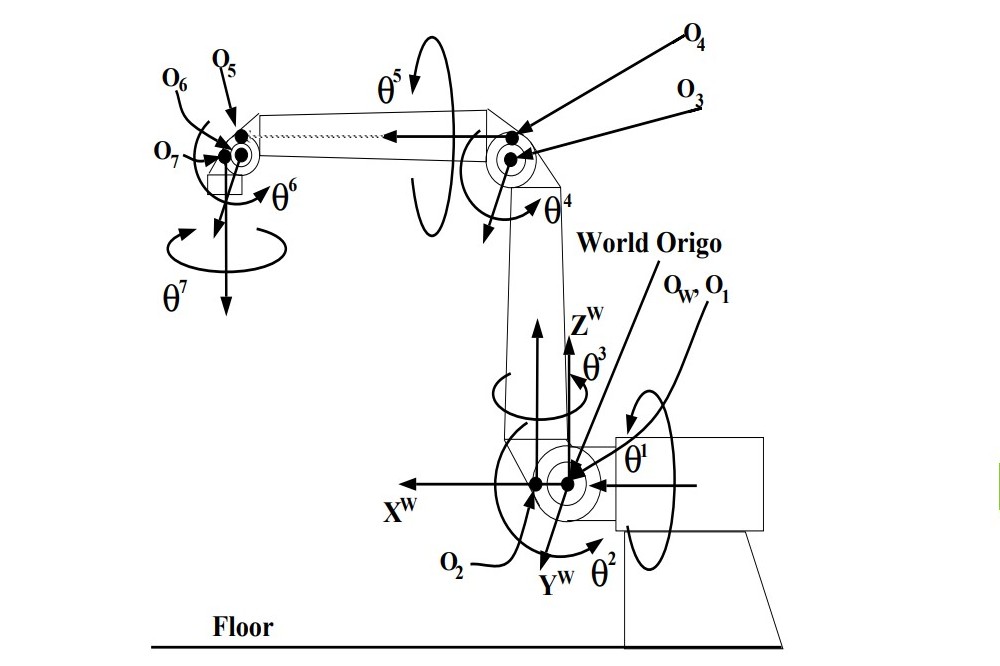
The 7 possible joint rotations (degrees of freedom) of the RRC robot.
Maybe I should explain what 7-degrees of freedom mean. One degree of freedom could be a rotation (around a joint) or a translation. To arbitrarily position an object in space you need at least three degrees of freedom. To arbitrarily orient an object in space you need an additional three degrees of freedom. So, to arbitrarily position and orient a tool in space you need at least six degrees of freedom. Industrial robots frequently have six degrees of freedom. However, if you also want the robot arm to avoid collisions with objects in its space you need an additional degree of freedom. That’s why I needed a 7-degrees of freedom robot.
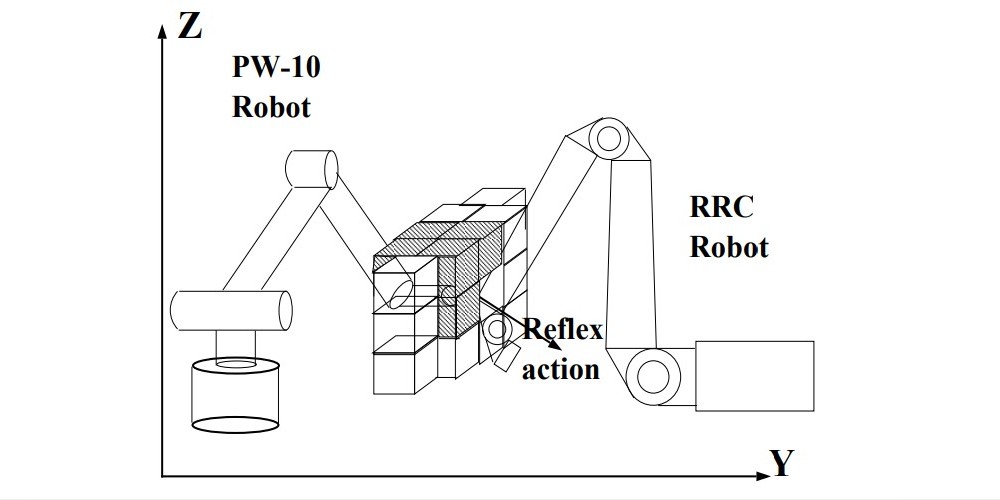
In the picture below an arc welding robot PW-10 is moving around unaware of its surroundings. The RRC robot detects that the PW-10 is in its space and perhaps approaching and quickly gets out of the way. Reflex control in action.
PW-10 Arc Welding Robot to the left. RRC robot on the right trying to avoid collision.
Robotics can be Math heavy (Algebra, Trigonometry, Calculus)
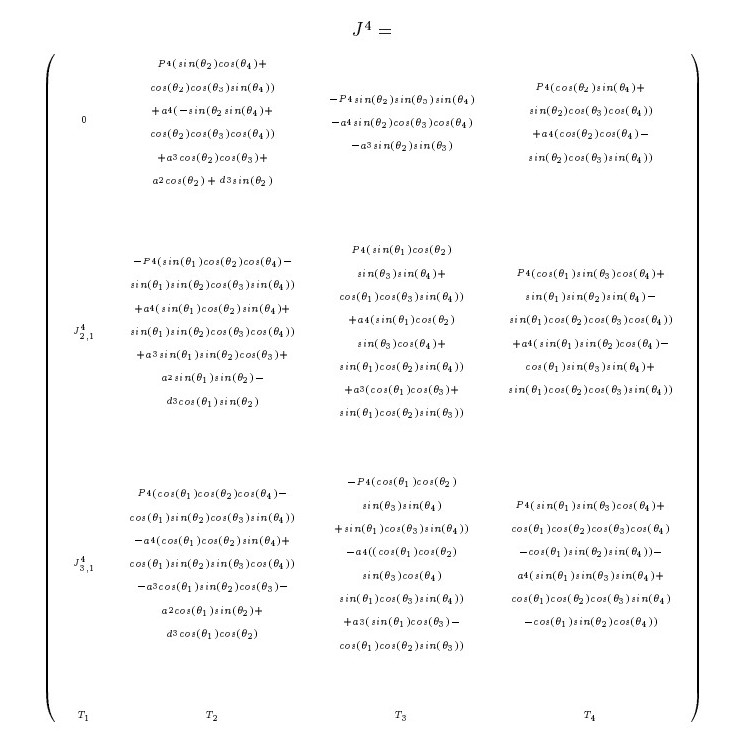
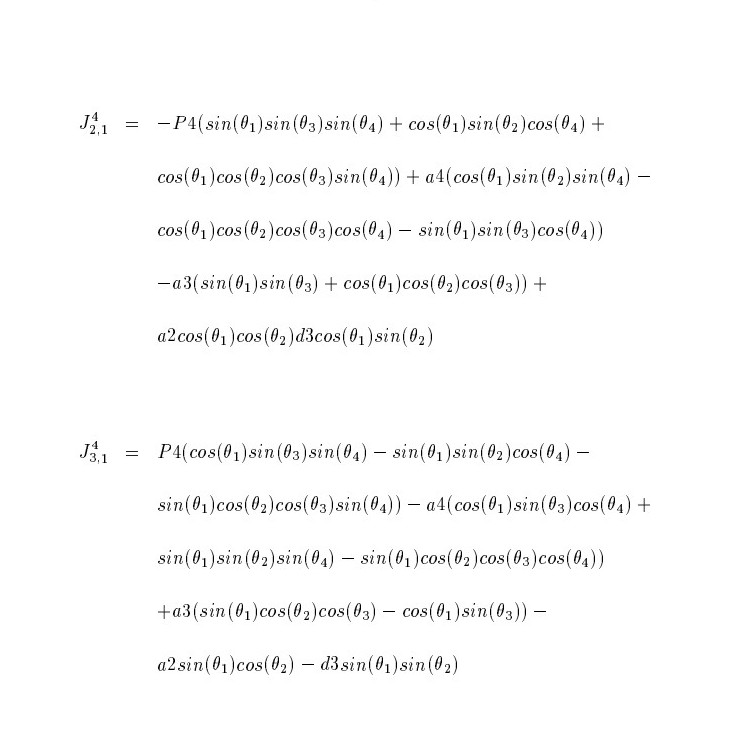
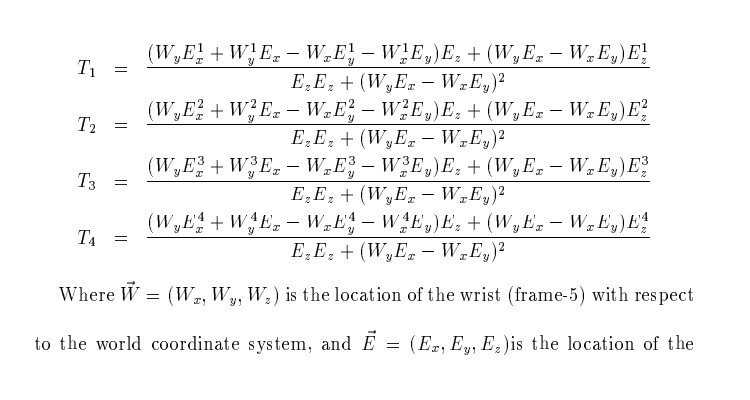
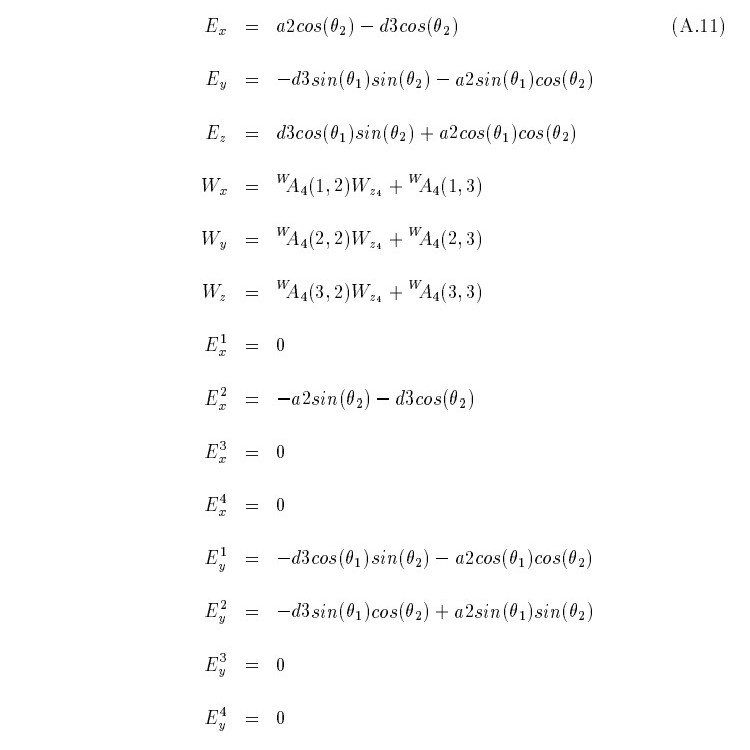
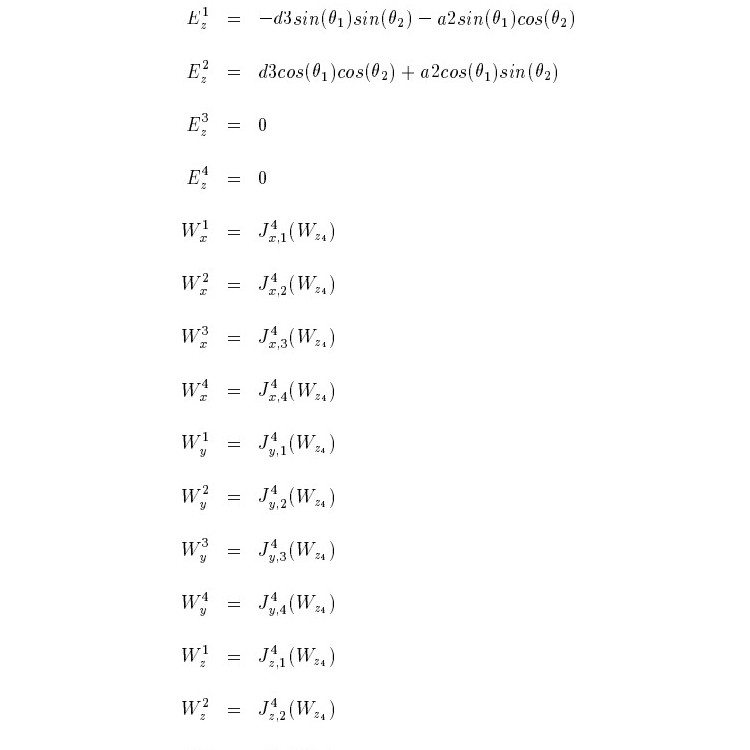
Part of the job of creating the control system is to create the kinematics, dynamics, and perhaps inverse kinematics, for the robot, and this is math heavy. Lots of algebra, calculus and trigonometry. I have included the Jacobian matrixes for the first four degrees of freedom for the RRC robot below. Just to illustrate how math heavy it is, and this is just four degrees of freedom. Note, doing this was not part of my research. It was just a basic mandatory task to get the robot to move predictably before you even get started.
I should say that as soon as I finished my PhD, I was offered a job at JPL in Los Angeles to work on an 11-degree of freedom robot that was supposed to be on the International Space Station. However, the government cut the funding for the project, so I never got to do it. Instead, I took a job with ABB Robotics. I did not get to do the math for the 11-degree robot but one of my first tasks at ABB Robotics in Wisconsin was to create the kinematic matrixes for more than 20 ABB robots.
Algebra is indeed a good skill in many professions. A lot of engineers, scientists, mathematicians, IT professionals use algebra in their work, and algebra teaches you how to think logically and methodically. Therefore, schools should teach it. Which is why I don’t find this common joke funny “Another Day Has Passed And I Didn’t Use Algebra Once”. I don’t find “Another Day Has Passed And I Didn’t Play An Musical Instrument Once” funny either but somehow I think the problem with the joke is more obvious to some people in the latter case.
Robotics can be math heavy (four dimensional Jacobian for RRC robot).Robotics can be math heavy (four dimensional Jacobian for RRC robot continued).Robotics can be math heavy (four dimensional Jacobian for RRC robot continued).Robotics can be math heavy (four dimensional Jacobian for RRC robot continued).Robotics can be math heavy (four dimensional Jacobian for RRC robot).
Note, not all factors are explained or shown so to see the complete equation you have to open the link in the first paragraph.
This post is not about Leonbergers but about something entirely different; culture shock, which I think is an interesting topic. The Merriam-Webster dictionary defines culture shock as : “a sense of confusion and uncertainty sometimes with feelings of anxiety that may affect people exposed to an alien culture or environment without adequate preparation”.
In 1987 I was selected to be part of a university level exchange student program. The exchange program was between Uppsala University in Sweden and Case Western Reserve University in Cleveland, Ohio. In total we were six Swedes (two from Uppsala). I was studying Engineering Physics in Sweden but in the US, I would continue studying Electrical Engineering because the Swedish Engineering Physics program was very similar to the Electrical Engineering program at CWRU.
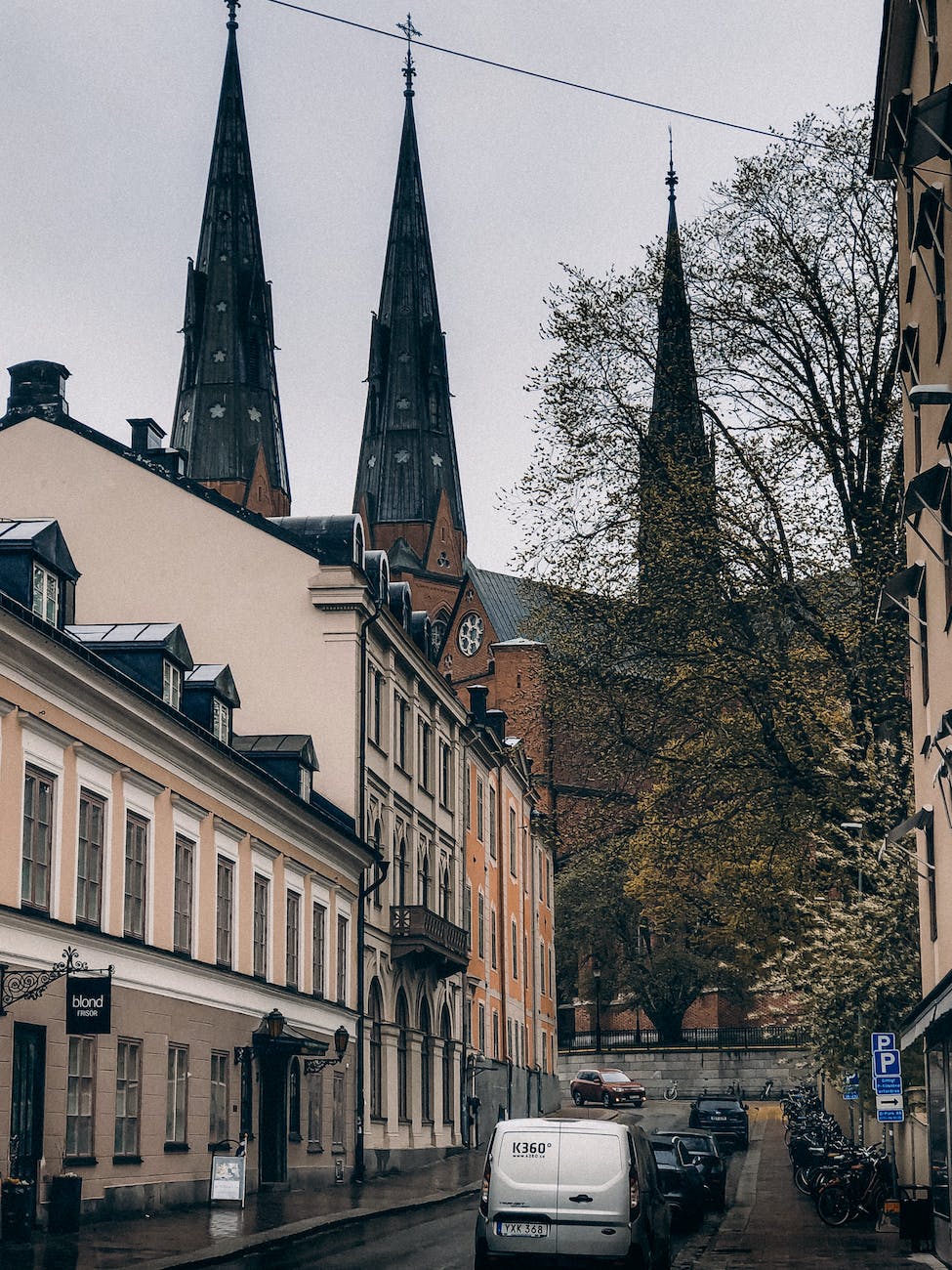
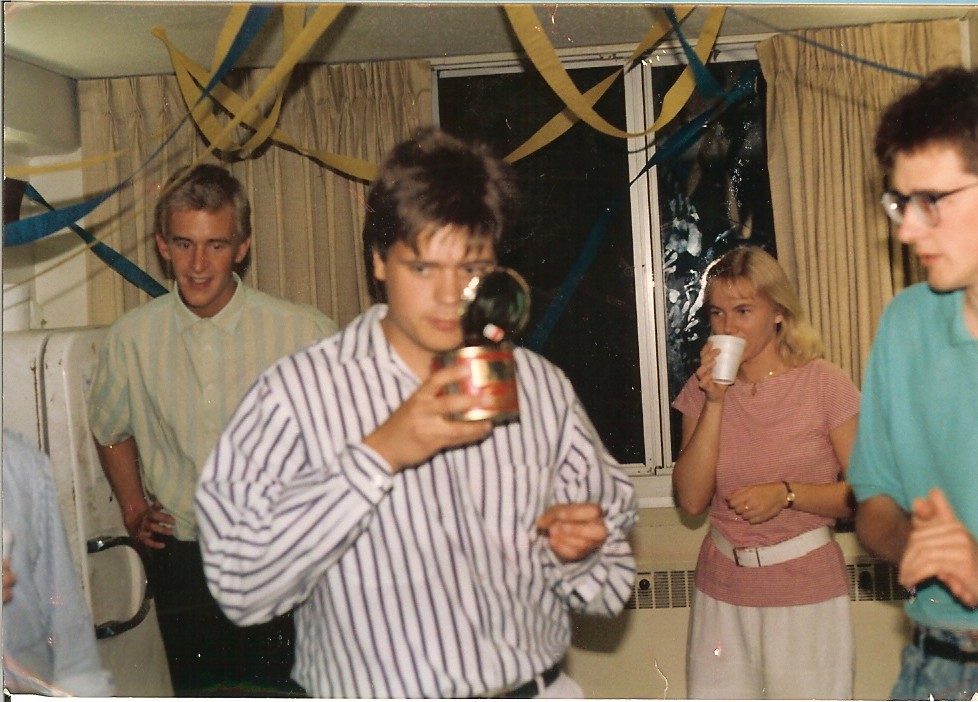
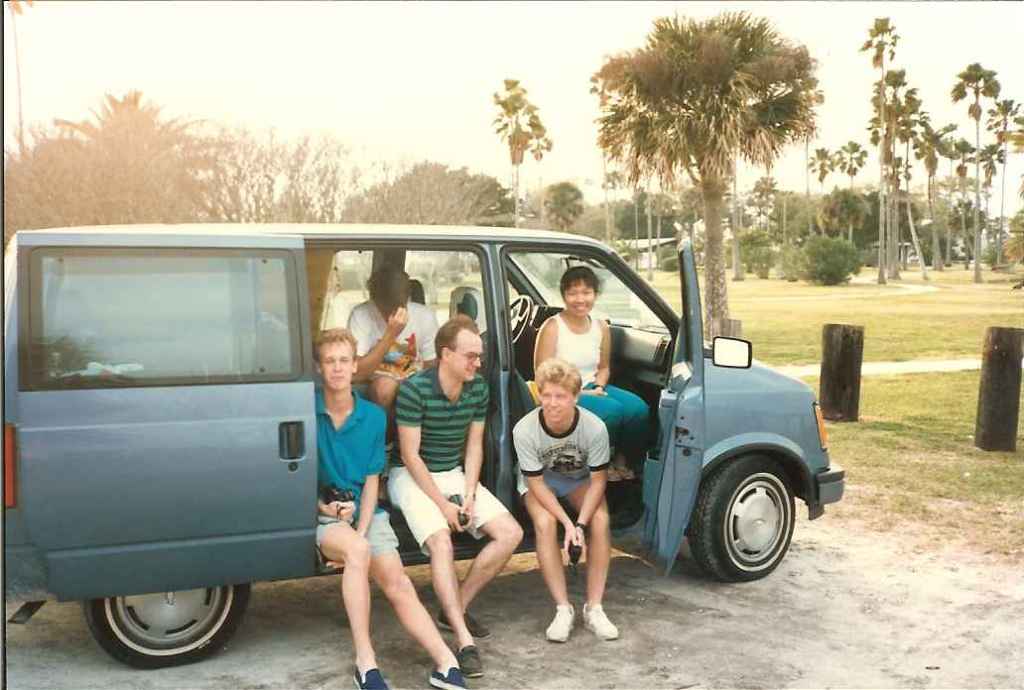
Street view of the old city of the Swedish city of Uppsala (1000+ years old). Photo by Aliia Troitskaya on Pexels.comFour Swedes inviting Americans to a fermented herring party. Fermented herring is a north Swedish specialty. Unfortunately, all the Americans experienced a culture shock from the fermented herring. I am the guy smelling the fermented herring can.Four Swedes and Jonas girlfriend from Indonesia. We were on a trip to Florida.Swedish exchange student Linda and her Indian friend Anuradha.
I arrived in the US in August 1987, and I was not well prepared for what I would experience. That doesn’t mean it wasn’t a great experience but there were challenges. Interestingly, I would later experience reverse culture shock. Reverse culture shock means that after adjusting to your new country you experience another shock when coming back to your old country.
Before heading out to Cleveland I visited Rakel, a Swedish friend who was living in California at the time. Here we are with our hosts Jay and Nancy Feinstein.
One of my first unpleasant discoveries was that the US uses imperial units instead of the metric system unlike most of the rest of the world. I quickly had to learn how to use inches, feet, miles, ounces, pounds, cups, gallons, etc. I knew about miles per hour versus kilometers per hour, but it had not dawned on me that it applied to everything. This is quite important in engineering.
The academic environment was also quite different. In the US there were fewer classes, but you were often required to participate and there were quizzes and homework in addition to the final exam, which was short and relatively rushed. In Sweden you showed what you had learned on one big final exam that lasted 6-8 hours. How you achieved success on that exam was up to you. Well certain lab work had some weight also.
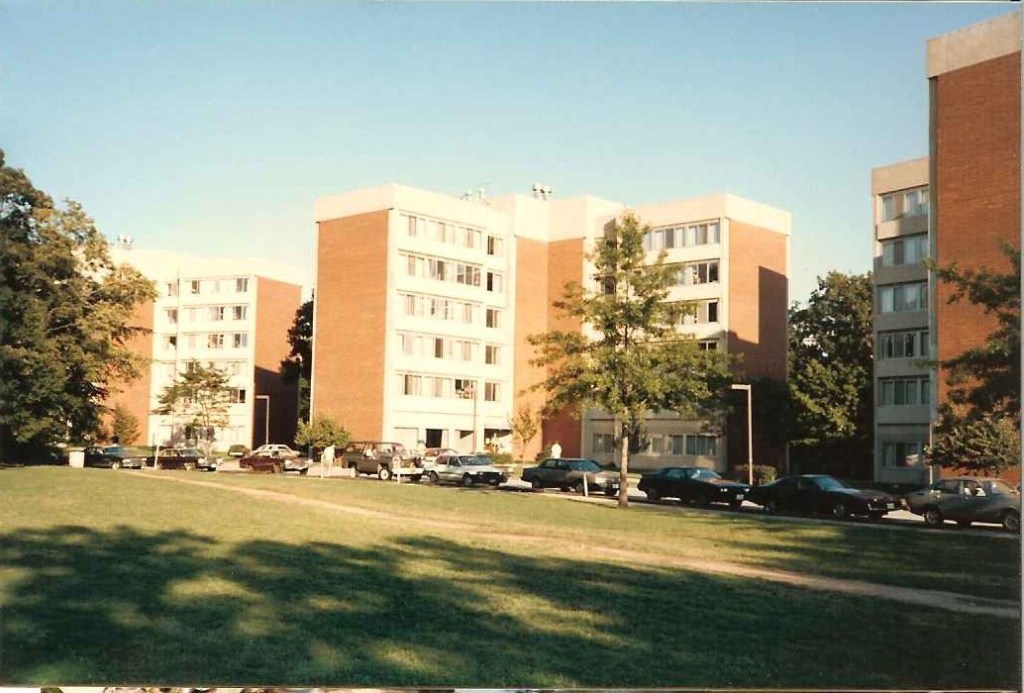
In addition, in Sweden there were no dorms, no fraternities, no Greek life, no meal plans, no college sports teams, no tuition, and no health insurance. Attending a university in Sweden is more like working for a company. You are more independent, and tuition is free, and Sweden has national healthcare. In Sweden there are clubs, organizations, and parties you can go to, but it is more adult and has no likeness to fraternities. I have no opinion on which system is better, but it was a challenge to suddenly adjust to a dorm, meal plans, a different kind of student life, tuition waivers (provided by Uppsala University), etc.
This is the Glaser dorm at Case Western Reserve University where I stayed.
Another difficulty was that I was not fluent in English at the time. I had a hard time with conversation as well as understanding portions of some lectures. People in English speaking countries often do not understand the amount of work that goes into learning how to speak a second language fluently because unlike most of the rest of the world they never had to do it. English being the premier second language comes with great benefits for native English speakers. Learning to speak a language fluently is one thing, learning to speak it without an accent if you primarily learned it as an adult is quite another. A question I’ve gotten many times is ”why do you still speak with an accent?”. Well, Arnold Schwarzenegger certainly knows the answer to that question.
Another thing people in English speaking countries sometimes miss is that people in the rest of the world are often not as familiar with the culture in English speaking countries as they might expect them to be. Well at least that was the case back then. In high school I studied Swedish and Scandinavian literature, and a little bit of German, French, Italian, and English/American literature, but I did not know much about Shakespear or famous American authors, and if you think about it, this is not strange. In addition, I did not know much about American movies or American music, but that was because I, unlike most Swedes, had not paid much attention to English speaking culture and music in general.
Add to that, the fact that Americans do not know much about cultural phenomenon in the world outside of the United States. For example, most Americans knew nothing about the world’s largest music competition, Eurovision. Eurovision is the largest song contest in the world. Countries compete against each other, and the final typically has as many viewers as the Superbowl, about 200 million. Americans also don’t know much about the second largest comic genre (largest at the time) in world, the French-Belgian Bandé-Dessiné (Astérix, Tintin, Spirou, etc.). So, we knew different things and were used to talking about different things, sometimes leading to awkward situations.
Scanned front cover of one of the Asterix comic books.
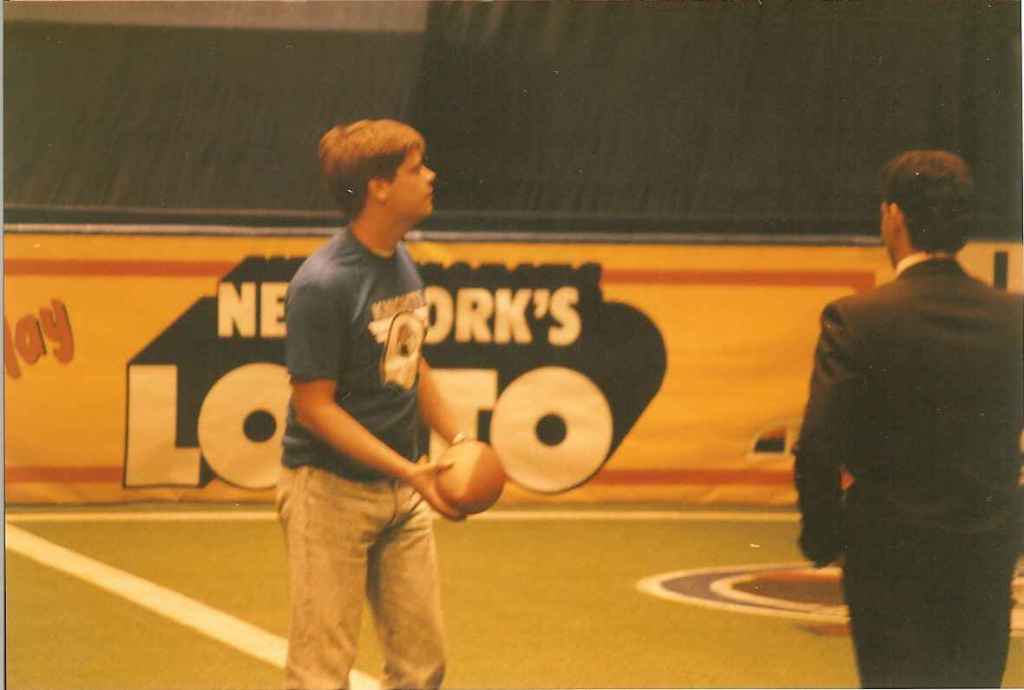
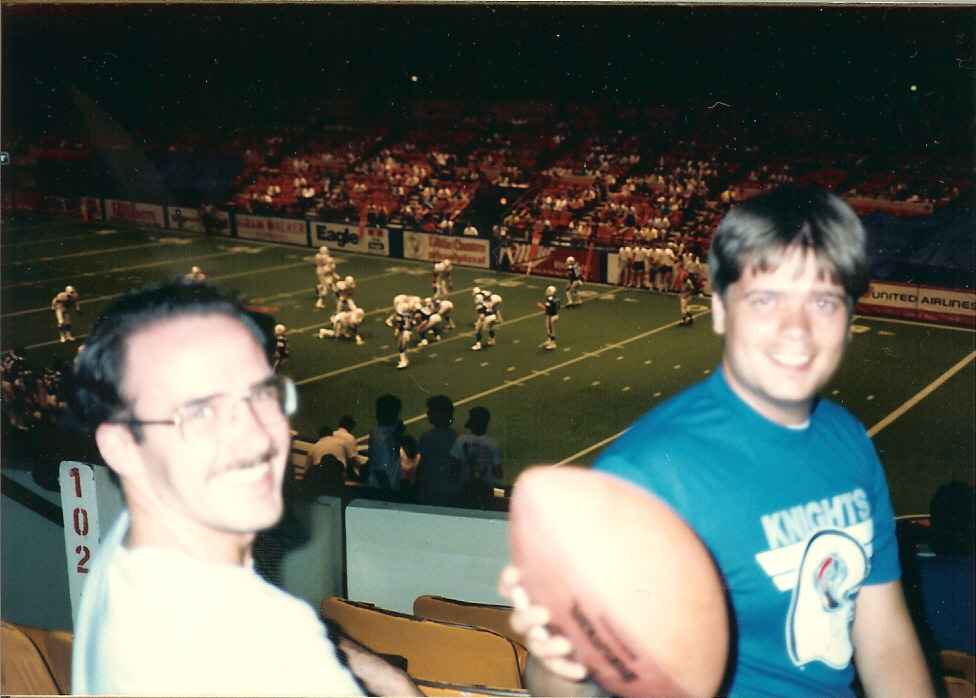
Which brings me to handegg. What most of the world call football is called soccer here, whilst a sport in which you handle an egg-shaped object mostly with your hands is called football, when it should be called “handegg”. When I arrived in the US, I had never heard of American football, but I quickly realized that I better know something about it. Later in the year I went to an indoor football game with a friend in Madison Square Garden in New York. Indoor football is a sport that has almost vanished, but it was still a thing back then. Can you guess who was called down to the field to play football at half time? I was. I told the host that I was from Sweden and that it was the first time I held a football. He showed me how to hold the ball and announced that I was from Sweden and had never held a football. The crowd was cheering for me, and luckily, I threw the ball into the goal two times out of three. Our team did not win but I did well.
I am getting ready to throw the ball.It went well, and I got to keep the ball (egg), my very first football.
Which brings me to the fact that Americans are typically polite, friendly and supportive of the underdog. They communicate well, they say excuse me when they bump into people, they smile a lot, and are often good conversationalists. Americans can be loud and not everyone is friendly but in general most Americans are friendly. I think this is a good thing that I am trying to emulate but it was yet another thing I needed to learn.
Some friendly Americans including my wife second from left. The others are (left to right) Jim Haggarty, something James Kirkpatrick and his wife.
One thing that might sound like critique is that Americans back then did not know world geography very well. Today’s youth seem to be a lot better educated in this regard. I should say that by the age of ten I knew every country in the world and their capitals, and I could say something about most of the larger countries. So, it was a little bit frustrating to me to speak to people who did not know where anything was. We met people who asked how long the drive from Sweden / or Europe was. A woman asked me where I was from and I said Sweden to which she replied, “is that where all the men wear skirts?”. I said, “no that is Scotland”. I believe that’s what she meant. Another woman asked me the same thing, and after hearing my answer, she said “Sweeting, that’s the name of your country? What a cute name for a country”. Or how about this conversation between the PhD advisor to a friend of mine and my friend’s boss:
Boss : My name is …, what is your name?
PhD advisor : My name is Bahram.
Boss : Baddam, that’s not an American name, is it?
PhD advisor : No, I am from Iran.
Boss : Iran I’ve never heard of that. Where is that?
I overcame my culture shock, and we all did well at CWRU. It was a good year. Later that year I met my wife Claudia and with her I would experience a reverse culture shock a few years later. I was working for a Swedish robotics company, and we moved to Sweden with our oldest son for one and a half year. Not only did my wife have a culture shock but I did too, coming back to Sweden. How did that happen? Well, one reason was that in the US I had gotten used to a mix of cultures and ethic groups and Sweden is a very homogenous country. This mattered because through my wife, who is not Swedish, I got to know immigrants to Sweden. It is difficult to fit in when you are different and therefore immigrants tend to hang around other immigrants, so I learned to see Swedish society through their eyes, and I saw what I had never seen before. It took some time to get used to.
My wife to be Claudia in 1988Photo by Pavel Danilyuk on Pexels.com
Have you experienced culture shock? How about a reverse culture shock?











 Leonberger Life