This blog feature amusing and heartwarming stories about our late Leonberger dog Bronco, as well as other Leonbergers. It also has a lot of information about the Leonberger breed, the history, care, training, Leonberger organizations, etc. I also wrote a Leonberger book, which I am featuring in the sidebar.
This is a Leonberger blog, but sometimes I also post reviews for books that are not about Leonbergers and when I do it is books that I love and that I want others to read. Today I am posting a review for a book that I loved, “A Brief History of Time: And Other Essays” Hardcover – September 1, 1998, updated in 2017. It was written by Stephen Hawking. A long time ago I read the original “A Brief History of Time” but now I read this updated version. It is still the original but the adjustments/corrections for more recent discoveries are described in the appendix. Contrary to what Amazon claims I don’t think this is a book “Told in language we all can understand”. In my opinion you need a little bit of a physics background or at least a serious interest in the subject. Otherwise, it will be too much abstract information at once. I should add that I bought the Hardcover.
Hardcover – Publisher : Bantam; Anniversary edition (September 1, 1998), updated 2017, ISBN-10 : 0553109537, ISBN-13 : 978-0553109535, 240 pages, Item Weight : 2.31 pounds, dimensions : 6.18 x 0.83 x 9.29 inches, it cost $16.14 on US Amazon. Click here to order it from Amazon.com.
Paperback – Publisher : RANDOM HOUSE UK; First Edition (January 1, 1990), ISBN-10 : 0553176986, ISBN-13 : 978-0553176988, 211 pages, Item Weight : 2.31 pounds, dimensions : 4.33 x 0.71 x 7.05 inches, it cost $20.85 on US Amazon. Click here to order it from Amazon.com.
Kindle – Publisher : Bantam; 10th edition (May 4, 2011), ASIN : B004WY3D0O, 242 pages. It is currently $9.99 on Amazon.com. Click here to order it from Amazon.com.
Audiobook – Publisher : Phoenix Books, Inc., Release date : January 06, 2022, ASIN : B09NLFY54Z, Listening length 5hrs 49 minutes. Click here to order it from Amazon.com.
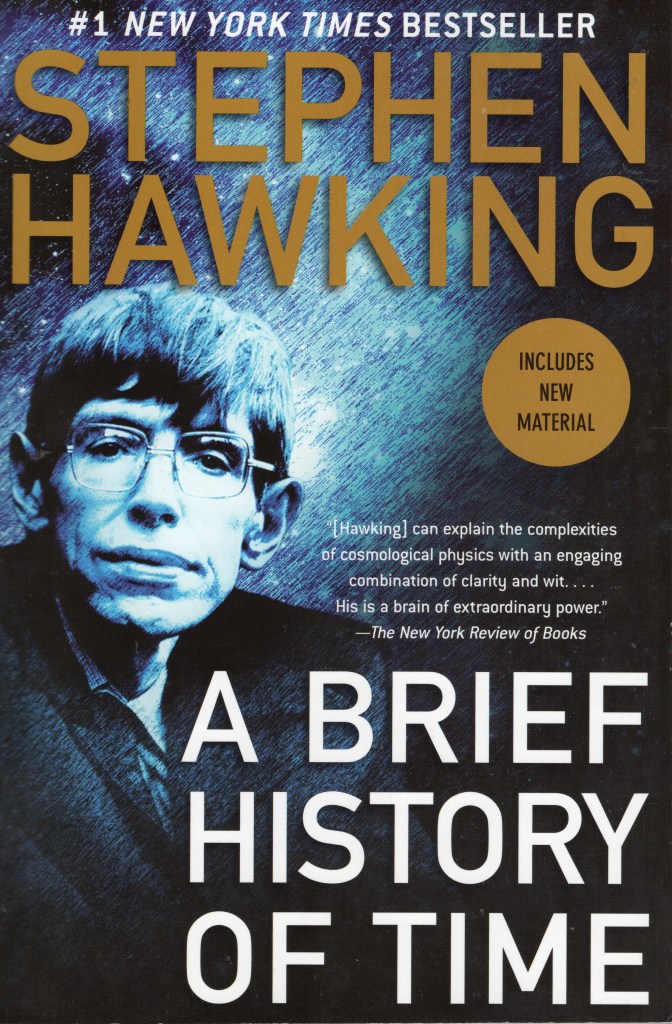
Front cover of A Brief History of Time: And Other Essays Hardcover by Stephen Hawking. Click here or the picture to visit the Amazon.com page for the Hardcover version of the book.
Amazon’s description of the book
Published more than two decades ago to great critical acclaim and commercial success, A Brief History of Time has become a landmark volume in science writing. Stephen Hawking, one of the great minds of our time, explores such profound questions as: How did the universe begin—and what made its start possible? Does time always flow forward? Is the universe unending—or are there boundaries? Are there other dimensions in space? What will happen when it all ends?
Told in language we all can understand, A Brief History of Time plunges into the exotic realms of black holes and quarks, of antimatter and “arrows of time,” of the big bang and a bigger God—where the possibilities are wondrous and unexpected. With exciting images and profound imagination, Stephen Hawking brings us closer to the ultimate secrets at the very heart of creation.
Relativity, Quantum Mechanics, Black Holes, and Cosmology in just 200 Pages.
First, I should mention that even though I bought the hardcopy version of the book released in 1998, I received the updated version released in 2017. The same will probably happen to you if you buy it. I certainly did not mind. The 2017 version is identical to the 1998 version, but it contains additional material including corrections that are featured in an appendix at the end of the book. For example, in 1998 it was discovered that the expansion of the universe is accelerating, making the Friedmann models he discussed in chapter 3 almost obsolete. In addition, since 1998 Hawking’s no-boundary condition has become more certain, as well as the existence of multiverses. Therefore, it is important not to skip the appendix, and perhaps it is best to read the appendix first, so you know what to ignore in the original text of “A Brief History of Time”. I should mention that I read the original book from 1990, a very long time ago.
The book covers a lot of material. He describe past models of the universe, space and time and special and general relativity, light cones, cosmology, the expanding universe, quantum physics, Heisenberg’s uncertainty principle, the two slit experiment, the wave particle duality, anti-particles, Feynman’s sum over histories, elementary particles, particle spin, fundamental forces, entropy, black holes, event horizons, space-time singularities, the cosmic censorship hypothesis, virtual particles, the big bang, the inflationary model and the new inflationary model, the anthropic principle, imaginary time, quantum gravitational effects, the no-boundary condition, three arrows of time, Gödels incompleteness theorem, Einstein-Rosen bridges, or so called wormholes, supergravity, string theory, the unification of physics, renormalization, eternal inflation and the multiverse, etc. In summary, he covers a lot in less than 200 pages.
I have a degree in physics (I became an engineer) and I have an interest in these kind of topics, and therefore I understood most of the content in this book, at least at some level. However, I can see how people without a background in physics would have a hard time with this book. Hawking is for the most part doing a great job explaining these topics, but many of the topics are very abstract and the book covers a lot of them. I think it might be too much for some people, but I don’t see that as necessarily a fault of the book. It is just an acknowledgement that this is not an easy subject. If you want to understand what we know about the universe you have a lot of work ahead of you, no matter how great your teachers or authors are.
One potentially controversial item is the implications of the no-boundary condition derived from the combination of general relativity and quantum mechanics (quantum gravity). It is natural to think that the universe has either existed for an infinite time or that it had a beginning. The no-boundary condition offers up a third option. Space-time is finite and yet there is no singularity. In addition, the universe is self-contained meaning it does not have a beginning or an end. Just like in a universe that has existed for an infinite time there is no moment of creation.
In chapter 10 he discusses wormholes and time travel. Kurt Gödel, the guy with the incompleteness theorem, showed that under certain circumstances General Relativity allowed for time travel. Also, when you travel faster than the speed of light you are traveling backwards in time, something most science fiction authors depicting spaceships traveling faster than the speed of light conveniently ignore. However, the conclusion of the discussion that followed was basically, in practice you can probably not time travel. Just imagine that you could travel back in time and kill your mother. That way you would never be born so now you could not travel back in time and kill your mother, and poff, now you exist again, but now you can travel back in time and kill your mother. Time travel comes with various logical problems. By the way where are all the time travelers from the future?
One thing I disagree with was that he on page 156 says that intelligent beings can only exist in the expanding phase of the universe. His explanation for this statement is not convincing and I don’t believe it. However, since we now know that the universe is likely to expand forever it is a moot point. He also keeps calling entropy “disorder”. This is very common, but “disorder” in common vernacular is a vague term that does not exactly correspond to the mathematical definition of entropy, and this should at least be pointed out. These are very minor and unimportant complaints, but I wanted to mention them. The Amazon description states: “Told in language we all can understand”, which as I mentioned is not really true. But that is the Amazon description of the book, not a problem with the book.
In summary, I think this is a very interesting and informative book and I think it is well written and well organized. The fact that it is difficult reading for many people is because of the subject matter and is not the fault of the author. I highly recommend the book to anyone with a background in physics and anyone else who is really interested in the subject and doesn’t mind looking up concepts a bit more in depth. I give it five stars.
Back cover of A Brief History of Time: And Other Essays Hardcover by Stephen Hawking. Click here or the picture to visit the Amazon.com page for the Hardcover version of the book.
About the Author
Stephen Hawking’s ability to make science understandable and compelling to a lay audience was established with the publication of his first book, A Brief History of Time, which has sold nearly 10 million copies in 40 languages.
Hawking has authored or participated in the creation of numerous other popular science books, including The Universe in a Nutshell, A Briefer History of Time, On the Shoulders of Giants, The Illustrated On the Shoulders of Giants, and George’s Secret Key to the Universe.
I can add that I also read The Grand Design by Stephen Hawking, which I also recommend but with the same caution as for this book. It’s a bit abstract.
I read today that Elon Musk said that “memory loss is a thing of the past”. It was an advert for a drug. True or not, in the past I’ve had severe memory loss. At the age of 22 I had Amnesia as a result of a ski accident in Garmisch-Partenkirchen in Bavaria in Germany. But I remember it as if it was yesterday. So, in my case you can say that “memory loss is a thing of the past”.
I had what is called post traumatic amnesia, which fortunately is temporary. Shutterstock ID: 1685660680 by MattL_Images
Garmisch-Partenkirchen is a beautiful Bavarian town, and it is one of the most famous German ski resorts. Zugspitze Germany’s highest mountain is nearby Garmisch-Partenkirchen providing for an impressive scenery. I was there with a large group of Swedish friends, and we stayed at a youth hostel. As is typical for a youth hostel men and women were separated. What was a bit unusual were all the loudspeakers.
Zugspitze Germany’s highest mountain. Photo by op23 on Pexels.com
Achtung! Achtung. Sei jetzt ruhig.
At 10:00PM on our first evening at the youth hostel the loudspeakers came on and someone started shouting “Achtung! Achtung. Sei jetzt ruhig. Alle Gäste müssen gehen und sich die Zähne putzen. Musik ist verboten. Die Lichter beginnen zu dimmen.” We had to be quiet and go brush our teeth. The lights started dimming and women and men had to go to their quarters. The loudspeaker came on every now and then barking orders at us in German and all windows and doors were locked electronically. Being from Sweden we followed orders, but we were laughing about it. Suddenly new voices started shouting in the loudspeaker. It was younger sounding voices. It was still in German but this time we were told to rebel against the hotel management, we were told to refuse to go to bed, and they started singing fighting songs in German. Then, suddenly the loudspeakers went quiet. The hotel management was back. We all had to go to bed. Well, it was budget lodging after all.
The town of Garmisch-Partenkirchen. Photo by op23 on Pexels.com
The Ski Accident
What happened the next day I do not remember myself, but this is what I have been told. I decided to go down an icy double black diamond slope despite the sign saying that the conditions were dangerous. I fell badly, hit my head (I had no helmet), and I got a severe shoulder displacement. My arm was hanging on my back. I went looking for my skis and tried to put them back on, but some Germans came down to stop me. They were screaming at me and calling me crazy. An ambulance was called, and they sent snowmobiles to pick me up. However, the snowmobiles were unable to get there so they got a pist-machine to get me instead. I had no pain, but I was confused, and I discovered my severe shoulder displacement about 10 times before I got to the hospital. I was equally shocked every time I noticed the condition of my arm. I had no short-term memory, and I had forgotten my friends and most other things.
This is me in the ski slope when I was young. This is not Garmisch-Partenkirchen, it is Breckenridge, Colorado, but I don’t have any photos of Garmisch-Partenkirchen.
My memories come back
The next 2-3 days after the accident are essentially gone. However, I remember my friends coming into my room asking me questions such as “what’s my name?”, “do you remember where we are?”. I kind of liked all the attention I got but I understood that something was not right. No one knew whether I would ever get my memory back and going though immigration and customs might be an issue when you are, well out of it. The leader and organizer of the trip was very upset. However, my memories came back very quickly within just a few hours on the second or third day of amnesia. I have to admit I was happier when I couldn’t remember anything. I can add that my left arm was in a cast.
My memories and my brain came back to normal. Photo by KATRIN BOLOVTSOVA on Pexels.com
A shocking discovery of what’s under my bed
Under my bed I found a thick book on Statistical Mechanics. At first, I did not know what it was, but then I unfortunately remembered. I had a final exam in Statistical Mechanics after our vacation. Statistical mechanics is a mathematical framework that applies statistical methods and probability theory to large assemblies of microscopic entities. More specifically, you do statistical calculations over large sets of atoms and molecules to figure out the macro condition of the corresponding gas or material. For example, temperature corresponds to the average kinetic energy of atoms, entropy is the natural logarithm of the number of real microstates corresponding to the gas’s macrostate, often loosely referred to as the disorder of the system.
In 1905 Albert Einstein proved the existence of molecules and atoms using statistics and an observed phenomenon called Brownian motion. Shutterstock ID: 2334052703
Statistical Mechanics includes classical Statistical Mechanics as well as its Quantum Mechanical counterpart, which is a lot more abstract and complicated. The class I was taking covered both. Some important scientists in the field are James Clerk Maxwell, Ludwig Boltzmann, Paul Ehrenfest, Albert Einstein, and Satyendra Nath Bose. If you love statistics and complicated mathematics, then Statistical Mechanics might be for you but more likely it will just kill your enthusiasm.
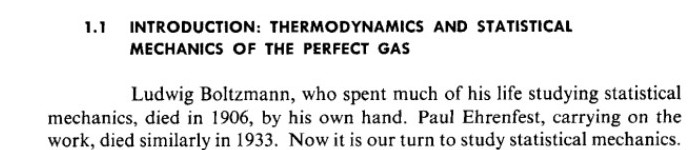
The epic opening of the first paragraph in David L. Goodstein’s States of Matter, a textbook on Statistical Mechanics.
My Exam
Once I was back in Sweden, I went to see my professor, and I explained the situation to him: “hello professor, I had a ski accident, hit my head, and I lost my memory. My amnesia made me forget statistical mechanics.”. He could also see that my left arm was in a cast. I said, “could I take the exam a little later?” He asked me “are you right-handed or left-handed?” I said, “I am right-handed”. The professor answered, “well then you take the exam on time like everybody else”. It wasn’t what I wanted to hear but I took it and I passed but not with flying colors.
Have you had Amnesia?
If you were a teacher, would you accept amnesia as an excuse for postponing an exam?
What is the greatest intellectual achievement of the human race? Is it Beethoven’s third symphony? The book War and Peace by Leo Tolstoy? General Relativity? Quantum Physics? multi layered neural networks? Or is it a theory of almost everything that comprises quantum physics, special relativity, Noether’s theorem and gauge theories, as its basic elements, and then Quantum Electrodynamics, Quantum Chromodynamics, and a framework for all elementary particles, and more. This is the so called “standard model of elementary particles”, or the “standard model” for short. It is a subjective question.
The standard model of elementary particles, the greatest intellectual achievement of humankind. Close up illustration of atomic particle for nuclear energy imagery. From iStock photos.
Some people like to say, “Science does not know everything”. They are right. If it did, it would stop. However, the people who like to say that typically grossly underestimate what science knows, and not by a little but by a lot, like a million times, or a trillion times. There are things science knows and there are things it doesn’t know, and the difference is often not obvious unless you have near expert knowledge. However, we have figured out a lot. The book I am describing below is a breathtaking reminder of how much we know. It is the book about the theory of almost everything after all.
Science does not know everything, but it knows a lot. The standard model of elementary particles is the theory of almost everything. Collision of Particles in the Abstract Collider. From iStock photos.
I read The Theory of Almost Everything: The Standard Model, the Unsung Triumph of Modern Physics Hardcover – July 22, 2005, by Robert Oerter, more than 15 years ago. I wrote a lengthy review, which is still the top review for this book. The hardback version is 336 pages. It currently costs $31.93. The dimensions of the hardback are 6.5 x 1.25 x 9.75 inches, and the weight is 1.2 pounds, ISBN 978-0132366786. The paperback version is 336 pages. It currently costs $17.00. The dimensions of the paperback are 5.5 x 0.8 x 8.4 inches, and the weight is 10.9 ounces, ISBN 978-0452287860. The kindle version costs $13.99 and is 348 pages ASIN : B002LLCHV6.
Front cover of “The Theory of Almost Everything” by Robert Oerter. Click on the image to go to the Amazon location for the book.
Someone reminded me that today, Wednesday August 9, is National Book Lovers Day. Even though I already published a post on a Leonberger book today I decided to post about one more book, one of the most mind-blowing books that I’ve ever read. I have a master’s in engineering physics from Uppsala University that was turned into a master’s in electrical engineering and applied physics by Case Western Reserve University in Ohio. That is why I am interested in this topic, which I understand is not everyone’s cup of tea, maybe no one’s. I took a few classes in Quantum Physics, Nuclear Physics, and Molecular Physics, and I had heard of the standard model, I just never realized what it was. Then I read this book many years later and as I said, I was blown away.
Quick note, if you have never heard of Noether’s theorem, don’t worry, almost no one has, yet it is an extremely important discovery in mathematics. Emily Noether discovered that associated with every symmetry was a conservation law and vice versa. It is one of the greatest discoveries of mankind, yet almost no one has heard of it. For example, if you assume (rather acknowledge) that the laws of physics don’t change over time, then energy is conserved. If you acknowledge that the laws of physics don’t change as you change position, then momentum is preserved. You use mathematics to derive one from the other. This is very useful because, if you find a symmetry you can find a conservation law. If you find a conservation law, you can find a symmetry. This has turbo charged modern physics.
The standard model does not get a lot of love. One reason is that unless you have a physics education it is difficult to grasp. It is also a gigantic theory. Well actually not really. You can summarize it in a few formulas that almost no one can understand, as the author of the book does. Another reason is that as soon as physicists were done with it, they were looking to replace it. That was because of the “Almost” in “the theory of almost everything”. There were a few things it could not explain, and it was not compatible with General Relativity even though it incorporated Special Relativity. Anyway, I cleaned up my review a bit and it is given below. If you want to see my original Amazon review, click here.
The Langrangian function that summarizes all of the propagators and interactions in the standard model.
Note; when I wrote the review below, we had not yet found the Higgs Boson. It was found at LHC in Switzerland in 2012.
An introduction to the greatest intellectual achievement of the human race
This review is a little bit long; however, it is more than an assessment of the book, it will also help you prepare for reading the book and explain confusing parts of the book.
Imagine if we had found a two-billion-year-old alien underground civilization under the desert in Arizona several years ago, and you still knew nothing about it, because journalists thought this information was pretty boring stuff and therefore didn’t bother telling anyone about it. Well, that is most likely not true, but what is true is that the general public has entirely missed the greatest scientific revolution in the history of the human race partially because mainstream media has largely ignored this information, even though the Nobel Prize committee has been raining Nobel Prizes over it.
In the 70’s a theory explained, at the deepest level, nearly all of the phenomena that rule our daily lives came into existence. The theory called “The Standard Model of Elementary Particles” is a set of “Relativistic Quantum Field Theories” that explains how elementary particles behave, which elementary particles there are, and why they have the properties they have, for example, isospin, spin, charge, color charge, flavor, even mass, or mass relations in many cases. The theory explains how all of the fundamental forces in nature work except gravity. The theory describes how the elementary particles interact; decay, how long they are expected to exist, and how they combine into other subatomic particles. The theory uses only 18 adjustable parameters to accomplish this.
In the extension the theory thus explains how nucleons and atoms are formed and what properties the atoms will have, and how molecules will form and what properties molecules will have, their chemical reactions, and what elasticity, electric conductivity, heat conductivity, color, hardness, texture, etc. any material will possess. In the extension it explains why mass and matter exist, how the sun and the stars work, and the theory is therefore the ultimate basis of all other science. It also provides a formula, or an equation of almost everything. Best of all it has been thoroughly verified experimentally, in fact the predictions the theory has made have been confirmed with such stunning accuracy and precision that it could be considered the most successful scientific theory ever. A theory that successfully unites all of physics and basically all of human knowledge of the Universe into one single theory has never before existed.
However, “The Standard Model” does not incorporate gravity and the general theory of relativity, and cannot explain dark energy, dark matter and why neutrinos have mass. Therefore as soon as the theory came into existence physicists started looking for the next theory that would finish what the “The Standard Model” did not finish. Example of such theories are GUT theories, SO(5), SO(10), string theories (abandoned), super string theories, and M-theories. Even though those new theories are extremely interesting they have not been verified or able to predict anything. In comparison with the “Standard Model”; superstring theories, grand unified theories, chaos theories, you name it, are essentially nothing, but are still better known.
This book explains to the layman what the “Standard Model” is and how it came into existence. The book is by no means a perfect book. I think there are several problems with the book. However, I decided not to take off any star because there are very few books written for science interested non-physicists that explain the “Standard Model of Elementary Particles”. Dr. Oerter deserves five stars just for his fairly decent attempt at doing so.
Even though the book is a Physics book, it is also a book on Philosophy. In fact Physics is often the best and the deepest Philosophy, the kind of Philosophy that can be falsified, verified and proven wrong or correct. To understand what I mean consider Noether’s theorem. Noether’s theorem states that whenever a theory is invariant under a continuous symmetry, there will be a conserved quantity. As an example of what a continuous symmetry is the following: any physical experiment that is performed at a certain time will have the same result if it is performed exactly the same way a certain time later. That seemingly self-evident observation means that Energy is conserved. Another example is, any physical experiment that is performed at a certain place will have the same result if it is performed exactly the same way somewhere else. That seemingly self-evident observation means that momentum is conserved.
Let me add that “exactly the same way” really means that! Gravity, other forces, differences in light, or anything else cannot be different in the second experiment. The only thing allowed to be different is the position “x” (if that is our symmetry variable). That is what continuous symmetry means, changing just one thing, and everything stays the same.
Noether’s theorem has been the guiding principle behind the standard model, and it is used to find conservation laws where symmetries are found, and it is used to find symmetries where conservation laws are found. It is a spontaneous symmetry brake that allows the Higgs Boson to give all other particles their mass (excepting mass less particles). This is why matter and everything in our Universe exist. The Higgs Boson is also called the God particle (guess why). So Noether’s theorem is both very useful in a practical sense and deeply philosophical at the same time.
The God particle has not yet been found, but scientists will be looking for it using the new Large Hadron Collider (LHC) that will come on line this fall (fall of 2008). LHC will start operating in August and the first collisions are planned for October. It is the largest machine ever built and it has a circumference of 17 miles. However, a lawsuit has been filed in an attempt to stop the LHC from operating. Some people believe that the LHC will create small black holes that could suck up all of the earth. In essence, they believe that our attempt to find the God particle will be the end of the world.
In addition to Noether’s theorem the standard model is built upon the special theory of relativity and a modern formulation of quantum mechanics (Quantum field theory), QED, QCD, as well as some discoveries regarding elementary particles. I can add that Noether’s theorem was formulated by a Jewish woman, Emmily Noether, who could not get a job in academia because she was a woman. This theorem is one of those very important but mostly unknown discoveries, like the invention of paper by the Chinese Tsai Lun.
Oerter does not attempt to explain the special theory of relativity; however, he tries to give the reader an idea of what it is. The problem with his approach is that he gives the reader just enough information to enable the observant reader to come up with the apparent paradoxes within the special theory of relativity, but not enough information to help the reader to easily resolve them.
He also confuses the reader by not distinguishing between rest mass and relativistic mass. The observant reader will think that he is contradicting himself. The term relativistic mass is the total mass and the total quantity of energy in a body. The rest mass is the mass of a body when it is not moving. The formula E = mc² is always true, when it refers to relativistic mass, which is why we talk about an energy/mass equivalence. The other more complex formula Oerter presents refers to rest mass. There is no such thing as an energy/rest mass equivalence (except at speed 0) but that is what the reader who is not already familiar with the subject will end up believing.
Another mistake Oerter makes is in regard to the fact that the speed of clocks will be measured differently in different reference frames. On page 35 last paragraph Oerter writes “Here, we have an apparent paradox: If each reference frame sees the other as slowed down, whose clock will be ahead when the passengers leave the train?” Then he implies that the paradox has to be solved by incorporating the General theory of relativity. Even though that may be how it was first solved, you can solve this form of the so called “Twin Paradox” and other similar paradoxes from within the framework of the special theory of relativity itself.
Oerter explains Quantum Physics in a very typical manner, but he mostly avoids making it look much weirder than it actually is which he should be commended for. However, there is one thing that all Physicists seem to do when they explain Quantum Physics to the layman which annoys me greatly. The matter waves (or quantum fields) in Quantum Physics are quite strange entities. The reason they are so strange is because they do not exist in a real sense, they are more correctly stated mathematical abstractions. Oerter states this clearly, which is good. However, he then goes on to mention De Witts’ idea about multiple Universes without acknowledging that these “bizarre solutions” to Quantum Wave conundrums are completely unnecessary and worthless. There is no more reason to believe in multiple Universes based on matter waves than there is to believe in multiple Universes because we all have different reference frames.
In fact when I took my first class in Quantum Physics (as an engineering physics student) I successfully proved, using a combination of the Schrödinger equation and plain Galileo transformations, that the matter waves are not only “not real” they don’t even represent information in an objective sense, in fact every reference frame had its own matter wave for the same particle. Our own single Universe is thus already all the Universes you need all at once. My associate professor was just scratching his head but the leading Swedish authority on Quantum Physics at the time, Staffan Yngwe, immediately agreed with me. So, in summary there is no need to make Quantum waves weirder than they are or draw unwarranted conclusions from apparent conundrums. Just take them for what they are; one possible mathematical model (among many) of a particle as seen from your frame of reference only.
After giving a background to the special theory of relativity and Quantum Physics Oerter continues explaining relativistic Quantum Physics including the fantastic prediction you get when you combine the special theory of relativity with Quantum Physics; that for every particle there is a twin particle with exactly the same mass, and spin, but opposite charge and isospin. These particles were called anti-particles and until they were actually found physicists tried to get rid of them from the theory. However, the combination of the special theory of relativity and Quantum Physics would lead not only to much better explanation for such things as the radiation and light spectrum and the properties of atoms, it would also lead to new discoveries.
Richard Feyman came up with a new representation of relativistic quantum physics for electrons that did not use waves called Quantum Electro Dynamics, and this was one of the first steps towards the standard model. Physicists started discovering a lot of unexpected particles which remained unexplained for decades (until the standard model came about), QCD was invented, the Higgs Boson (the God particle), symmetry breaks, etc. The story is simply breath taking and Oerter does a good job telling this story, except I think he should have used more and better pictures. However, as I said I cannot honestly take any stars off for these minor flaws. Finally Oerter discusses possible modifications to the standard model, GUT’s, string theory (abandoned), super string theories, and M-theories.
I also would like to add an interesting fact that I think everyone should be aware of. There are elementary particles with whole number spin and they are called Boson’s, and there are elementary particles with half number spin called Fermions. The Pauli Exclusion Principle (that no two particles can occupy the same state) applies to Fermions but not Bosons and therefore the two different types of particles behave very differently and follow different kinds of statistical rules (Bose-Einstein statistics versus Fermi-Dirac statistics). All force carriers are Boson’s while some Fermions are used to build “nomral matter”. Examples of Bosons are the photon, gluons, W and Z Boson, mesons, the Higgs Boson (the God particle). The Fermions come in three families each with four particles and their anti particle.
Electron / positron
Neutrino / anti-neutrino
Up quark / anti up quark
Down quark / anti down quark
muon / anti-muon
Mu Neutrino / anti-mu-neutrino
Charm quark / anti charm quark
Strange quark / anti strange quark
tau / anti-tau
Tau Neutrino / anti-tau-neutrino
Top quark / anti top quark
Bottom quark / anti bottom quark
The quarks can be used to build other particles. For example, a quark and anti-quark pair is called a meson (there are many kinds of mesons). A triplet of quarks is called a Baryon. An example of a baryon is the proton which consists of two up quarks and one down quark. Another example is the neutron which consists of one up quark and two down quarks.
I highly recommend this book for anyone who wants to understand something about our world and the Universe. However, don’t expect to understand everything, it is not written so that you can. I wish Physicists would become a little better at explaining these things to the layman using nice descriptive pictures and a little bit of math too (don’t assume math is always bad). I once read a 30 page long Swedish book on the special theory of relativity that successfully explained the kinematics, dynamics, and magnetism in relativity, to your average high school kid. The Lorenz transforms, formulas for acceleration, E = mc², and magnetism were derived using simple algebra and a tiny bit of calculus at one point. That is the way these kinds of books should be written, but I have seen this only once in my life. Excluding this single example (Swedish book), Oerter’s book is one of the best books on Physics for the layman that I have ever read.
Finally, I would like to ask a question for discussion. Will you and our planet survive this coming fall considering that the LHC is coming online?
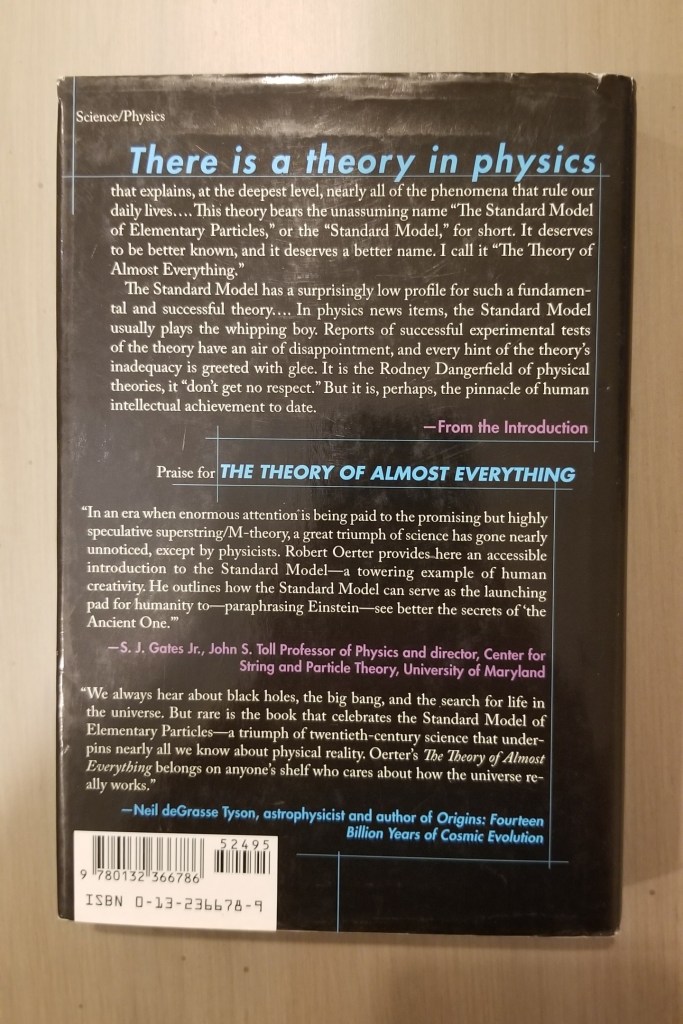
Back cover of “The Theory of Almost Everything” by Robert Oerter.













 Leonberger Life