
This is my third post in the “other hobbies” category. The other two are “The Climate Journeys of Thomas and Larry” and “Eurovision Victory for Sweden”. This category has nothing to do with Leonbergers and dogs, well almost nothing. I guess it is a get to know the blogger kind of category.
In this post I am explaining how you measure the alcohol level in a home beer brew. You can find this information online and in books, but I am explaining it very succinctly. It is quite simple, and you don’t need to read a ten-page explanation. A few photos with a brief explanation will do.
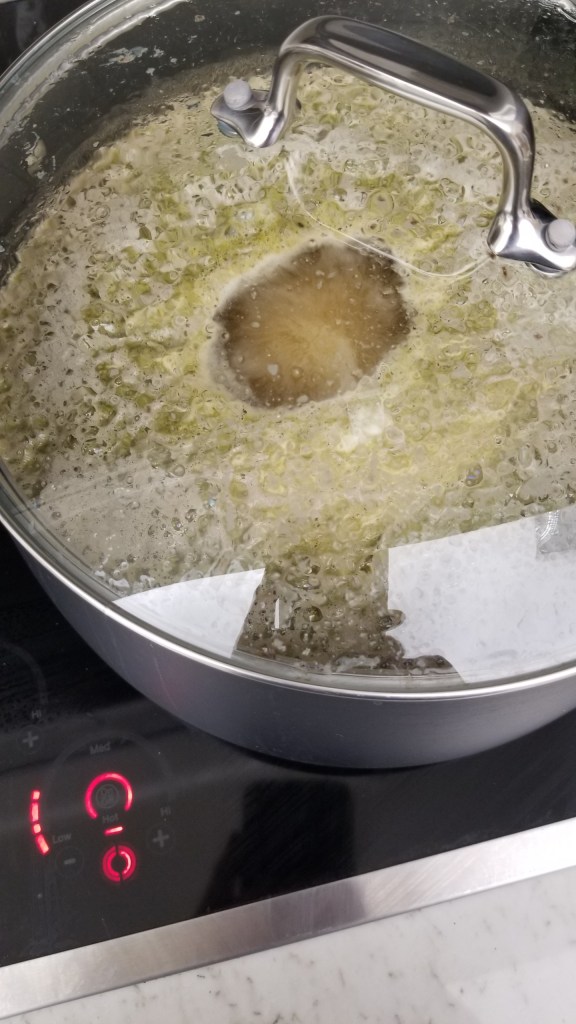
When you brew beer at home you start by boiling the wort. You boil water and you add the malts and the hops for the flavoring and the aroma at specific times. This all depends on the recipe you are following. The wort easily boils over, which upsets my wife, but luckily my dog Rollo loves to lick the wort off the kitchen floor. He’ll lay there and wait for me to screw up. Don’t worry, the wort contains no alcohol at this point, which makes this a good point to measure what is called gravity. I should mention that you need to let the wort cool off before doing your measurements and before adding the yeast (or you’ll kill it). I use an ice bath to do this.
It is difficult to measure the alcohol directly. You need to set up a chemistry lab in the kitchen, which would upset your wife. Therefore, you use an indirect method using a hydrometer. During the fermentation process, yeast converts sugars into alcohol (and carbon dioxide). As the sugar is used up, the wort slowly becomes less dense. By measuring the density before and after fermentation, you can calculate how much alcohol is in the finished beer. In the beer world this is called measuring the gravity. You can buy a hydrometer in a lot of places including Amazon.

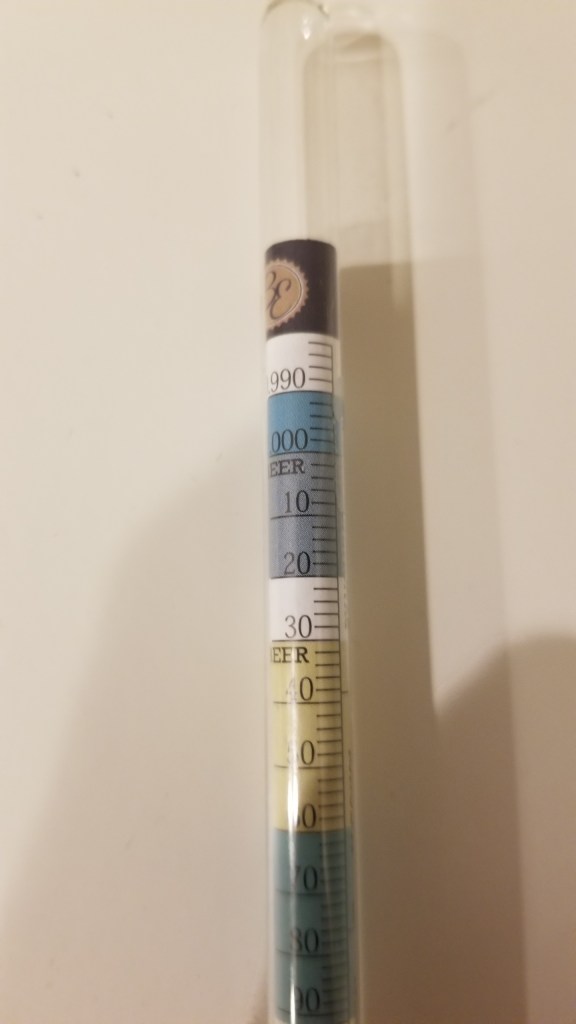

The density/gravity of water is used for reference as 1.000. To be exact, it also depends on the temperature, but for now we’ll ignore that. You measure the gravity before fermentation has started, just before you pitch (add) the yeast. The temperature at this point should be around room temperature, 72 degrees (60 to 75 degrees). This is called the original gravity (OG). Then after fermentation (in your container, carboy, whatever) you measure it again. This is called the final gravity (FG).
I should add that after the fermentation in your container/carboy is done you add a little bit more sugar (called priming sugar), you bottle the beer, and you let it ferment a little bit more, which will add a little bit more alcohol as well as carbon dioxide. You want some carbon dioxide in the beer but not too much. This extra amount of alcohol is not accounted for using the final gravity. However, it is typically around 0.2% and if you wish to include it, you can just add that number.
Using the original gravity (OG) and the final gravity (FG) you can now calculate the ABV, Alcohol By Volume, by using the formula below. For my latest brew, an IPA (India Pale Ale), which I bottled yesterday, I got OG = 1.072 and FG = 1.018. Ideally FG is around 1.010, but for whatever reason I did not get there.
ABV = (OG – FG) x 131.25 = 0.054 x 131.25 = 7.1%
So that would be 7.3% with the bottle fermentation.
There is a more exact formula:
ABV = (76.08 x (OG – FG) / (1.775 – OG)) * (FG/0.794) = which in my case yields ABV = 7.23% which would yield 7.43% with the bottling. I can add the recipe predicted ABV = 7.5%. There are also formulas that account for the temperature at the point of measurement of original gravity and the final gravity. But I think this is good enough.

 Leonberger Life
Interesting and geeky, Thomas.🙂
LikeLiked by 1 person
Thank you Priscilla. Yes geeky, but I am an engineering physicist after all, like you.
LikeLiked by 1 person
I LOVE home brews (and micro brews). I was a great beer drinker back in my 30s. I loved all the heartiness that came with the home brews.
LikeLiked by 1 person
Yes you are right, heartier and more flavorful compared to the pale bland mass produced lagers that became popular in the US. Traditional European beers, Belgian and German, (not Heineken), etc., always tended to be more flavorful though. Now with the craft beer movement the trend has reversed and the most flavorful and interesting beers are typically American. A few days ago I had a Wild Ale from Jester King, Texas that was refermented with grapes and it tasted almost exactly like red wine, but with a bready background. Also a few days ago I had a Belgian Ale Quadruple called Westvleteren 12 often considered the best beer in the world. I’ve had 106 of the 120 beer styles that beer advocate lists and I’ve brewed Lagers, Pale Ales, IPAs, Stouts, brown ales, bourbon barrel aged Russian Imperial Stouts, Hefeweizen, and maybe I forget something.
LikeLike
This would explain why I don’t brew my own beer. Another reason: I drink almost none!
LikeLiked by 1 person
It’s definitely easier to buy the beer at the store but you don’t have to measure the alcohol, at least not every time. It is something you do because you are curious. It’s just a hobby.
LikeLiked by 1 person
Wow, this is fascinating! Thank you, Thomas : )
LikeLiked by 1 person
Thank you Stacey. It is one of my fun hobbies.
LikeLiked by 1 person
Very nice you sharing beer gravity information.
LikeLiked by 1 person
Thank you so much Mumbai
LikeLike
You are most welcome!
LikeLiked by 1 person
This is very interesting and informative, Thomas. I have two friends who brew beer. They use a brewing system to do it. One person converted the garage to do it. He and his wife have beer parties for the neighbors. The other person also does it in the garage, but his garage is larger, so it doesn’t take up his entire garage. They like to entertain also.
I only taste, and don’t really drink. I’m allergic to alcohol.
LikeLiked by 1 person
Thank you so much Miriam. Your friends are more advanced than I am. I am just doing small batches in the kitchen. Being allergic to beer is not bad. It’s much better for your health not to drink beer at all, but if you like me like beer then you can drink in moderate amounts.
LikeLiked by 1 person
I like the beer with a bitter taste. I’m allergic to sleeping herbs that had valerian and hops. I stay away from most herbs.
LikeLike
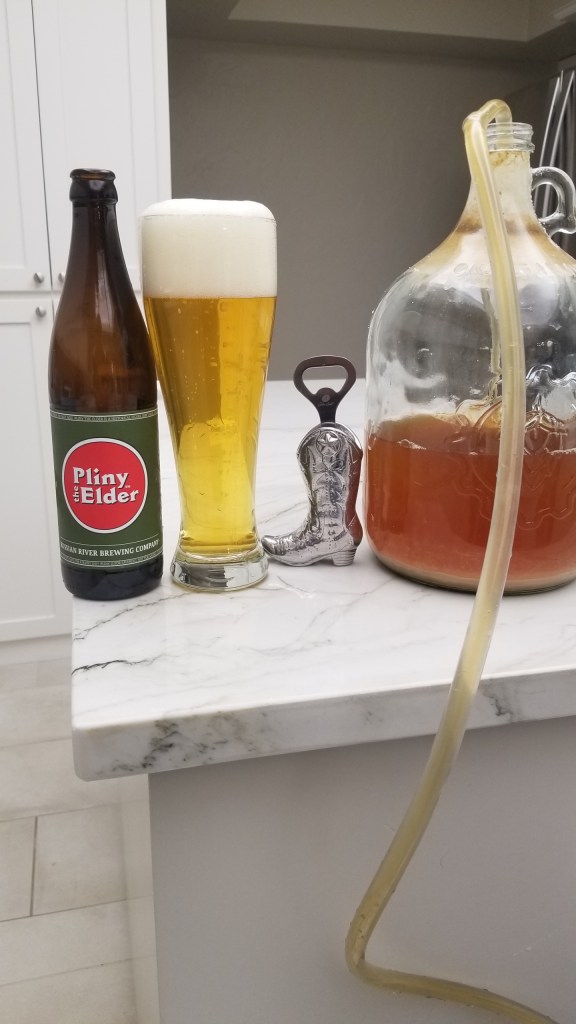
You like beer with bitter taste, that is probably IPAs then. They have a lot of hops. That’s what I am brewing and drinking in the picture. I don’t know if it is the valerian or the hops you are allergic to but that is a bit of a bummer.
LikeLiked by 1 person
Yes IPA. I’m allergic to valerian for sure. Hop, maybe or maybe not.
LikeLike
Hi, very very interesting, love bottle opener
LikeLiked by 1 person
Thank you chocolate baker. Some stouts taste like chocolate.
LikeLiked by 1 person
Thanks for sharing this fantastic hobbies. Anita
LikeLiked by 1 person
Thank you so much Anita
LikeLiked by 1 person
This brings back memories for me! I used to brew quite a bit, but let the hobby lapse during a period when work became busy. I should pull out the equipment and set up another batch. As it turns out, I actually won two silver medals for my beer at the New Mexico State Fair back in the day. Anyway, great description of how to use a hydrometer to determine the alcohol content of your beer.
LikeLiked by 1 person
Thank you David. It is very interesting that you used to brew and congratulations on your silver medals 🥈🥈. That is impressive. Yes why not another batch. Cheers 🥂🍻
LikeLiked by 1 person
Hi Thomas, this is an interesting post about making beer. I included some information about how the Zulu people of South Africa make beer in one of my stories, The Christmas Bird. It was interesting how some people reacted to that particular aspect.
LikeLiked by 1 person
That sounds interesting. I will get that kindle book.
LikeLiked by 1 person
It is a micro read, only just over 5000 words.
LikeLiked by 1 person
I read it. It is a really beautiful story, great for children and for adults too.
LikeLiked by 1 person
Thank you, Thomas. It is semi autobiographical and the people who have read it did enjoy it which is nice.
LikeLiked by 1 person
It very much sounded like a real experience, both raising the bird and the beer making. I like it when it is real.
LikeLike
Oh yes about the beer that was very interesting to read. I’ve used barley, wheat, oats, and I think corn/maize malts, but certainly not sorghum. It is a very unique and traditional way of making beer.
LikeLiked by 1 person
Hi Thomas, I remember watching the Zulu matriarch making that beer. It is a vivid memory for me, as is raising the baby hoopoe. I also raised a dove.
LikeLiked by 1 person
By the way I just published a review for the Christmas Bird story on Amazon and shared the review and your book on Facebook and Instagram. It is a fun and intriguing story that is beautifully told. Thank you Robbie for the reading pleasure.
LikeLike
Very interesting and informative article 👌👌👌
LikeLiked by 1 person
Thank you Kashual
LikeLiked by 1 person