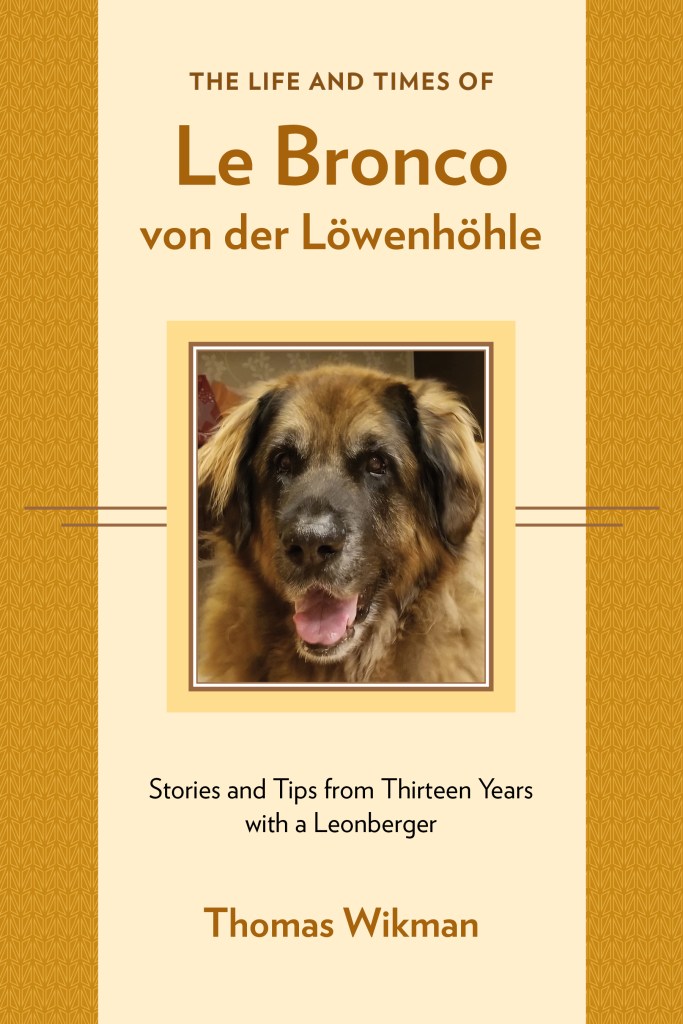
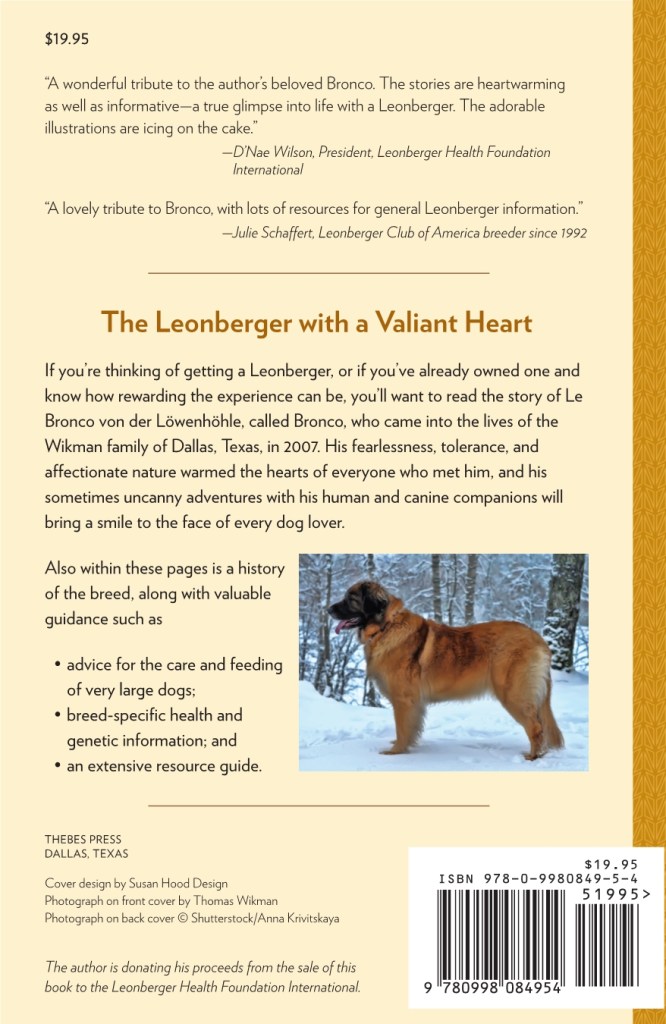
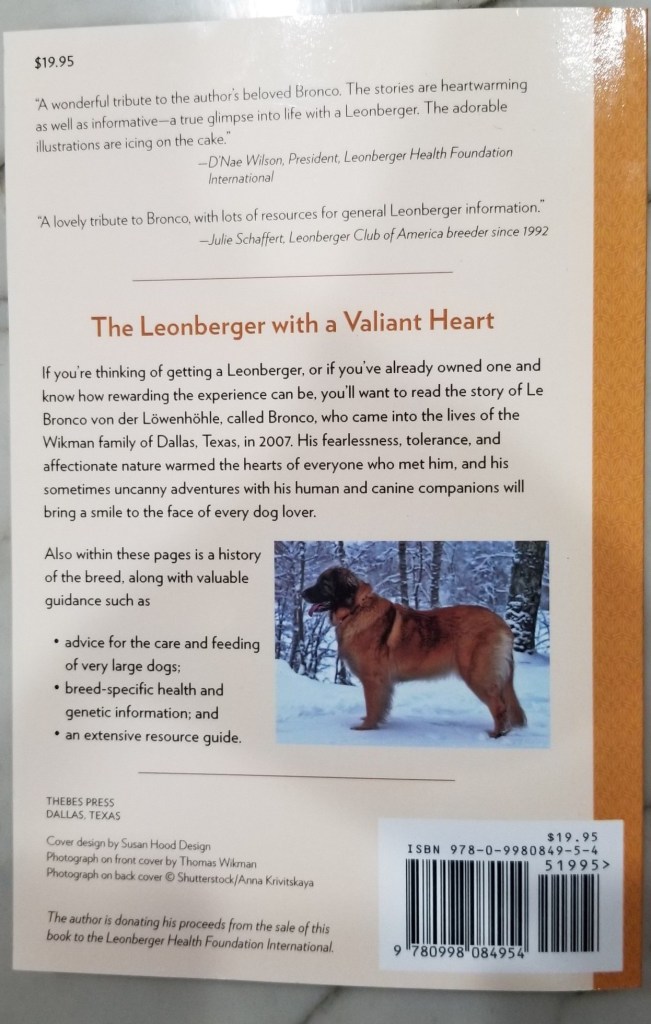
Bronco the Very Big Dog Bites My Behind

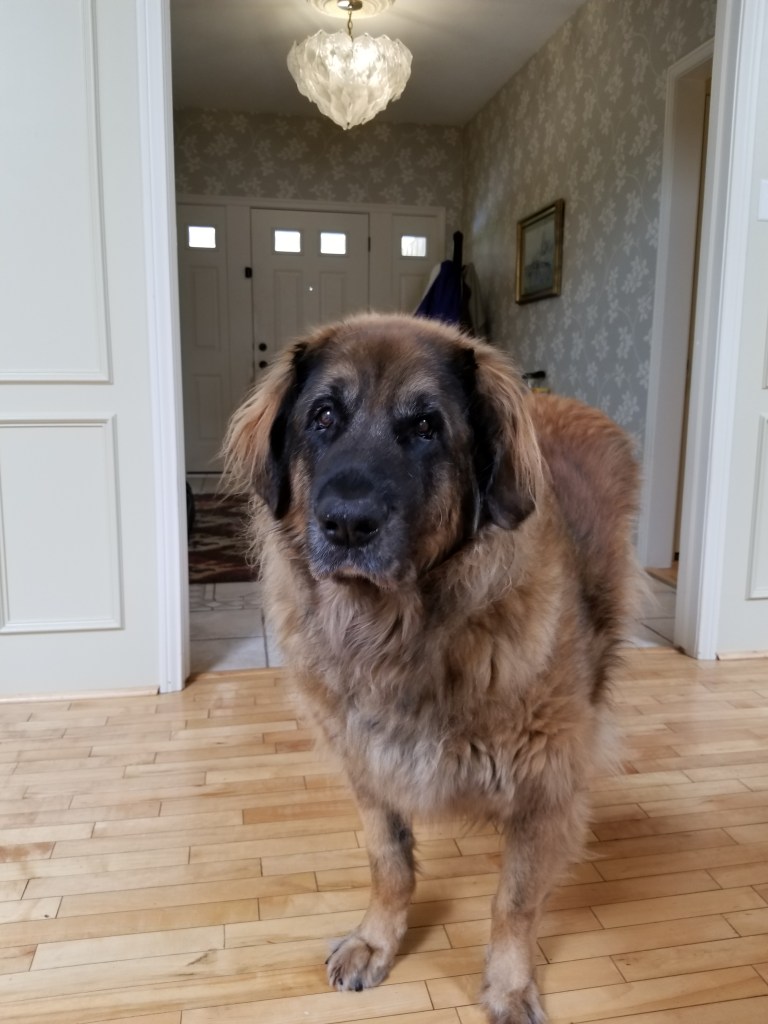
Bronco was a big dog. As an adult, when he was not overweight, he tipped the scales at 135 pounds. He was significantly bigger than a German shepherd, and when he stood on his hind legs, he could easily put his big paws on a person’s shoulders, even if that person was almost six feet tall. Naturally, his size, combined with his energetic nature, made him a perfect dance partner, and Bronco loved dancing. His size and energy also combined to produce a lot of good stories.
Me and my Leonberger Bronco. Leonbergers are very affectionate.
Bronco was a very affectionate dog and a good dancer
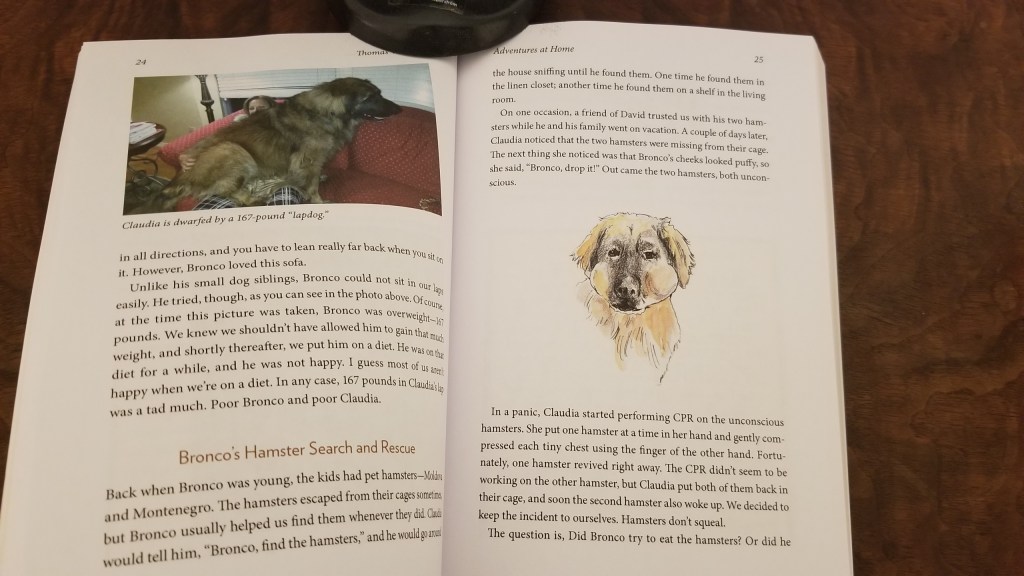
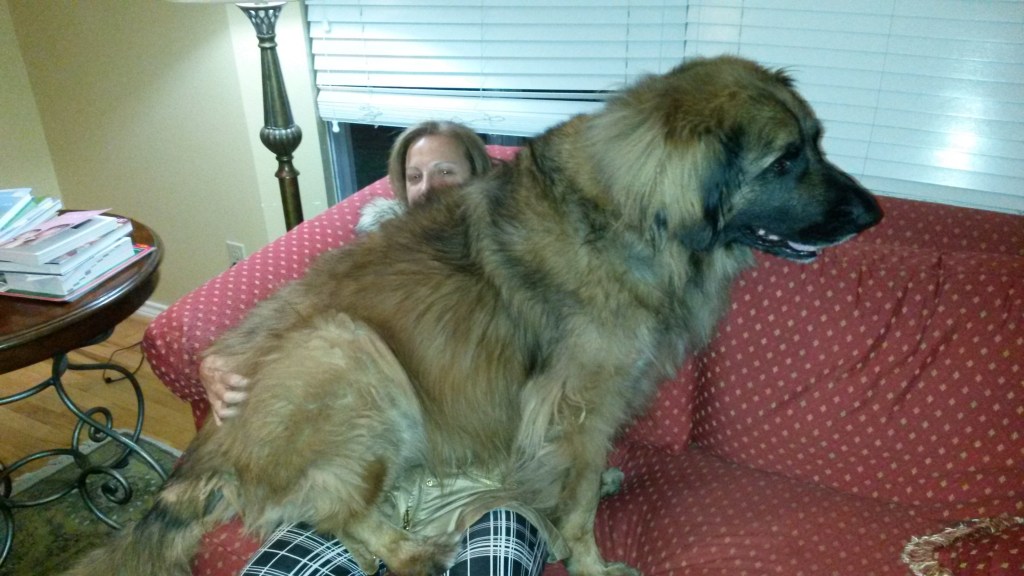
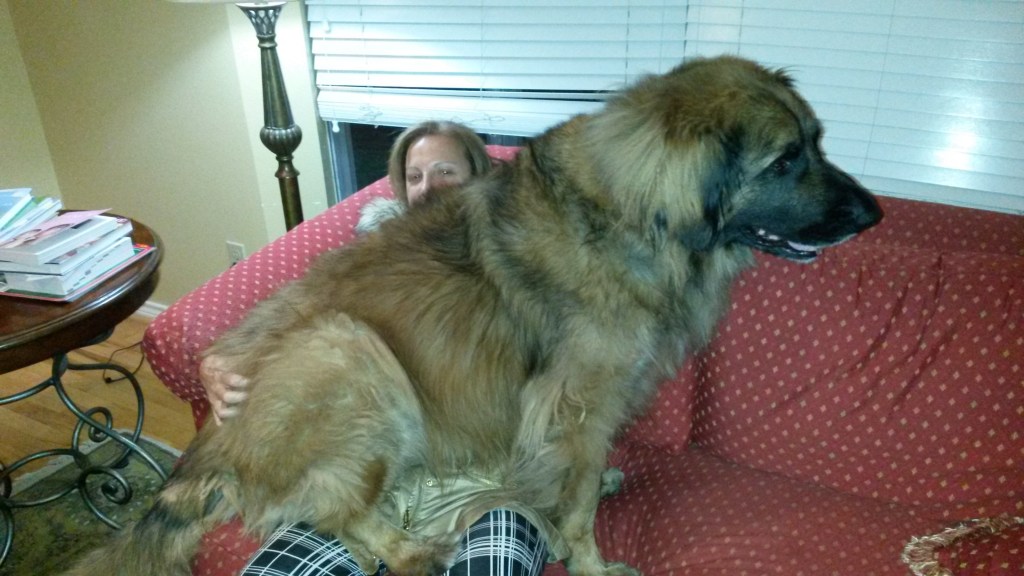
Bronco our Leonberger was a very big dog. Here he is sitting in Claudia’s lap. He was 167 pounds in the photo.
Bronco was a very big dog. Here he is sitting in Claudia’s lap

When Bronco arrived at our house from the airport, for example, we had prepared a very large crate for him to sleep in. Unfortunately, even though it was spacious, he didn’t like it very much. As time went on, he decided that he wanted to abandon the crate and sleep with us in our bed. It was difficult to say no and listen to him whine at night. So Claudia lay down on the floor next to him and put her hand into the crate and petted him and held his paw. He loved that and was able to fall asleep that way.

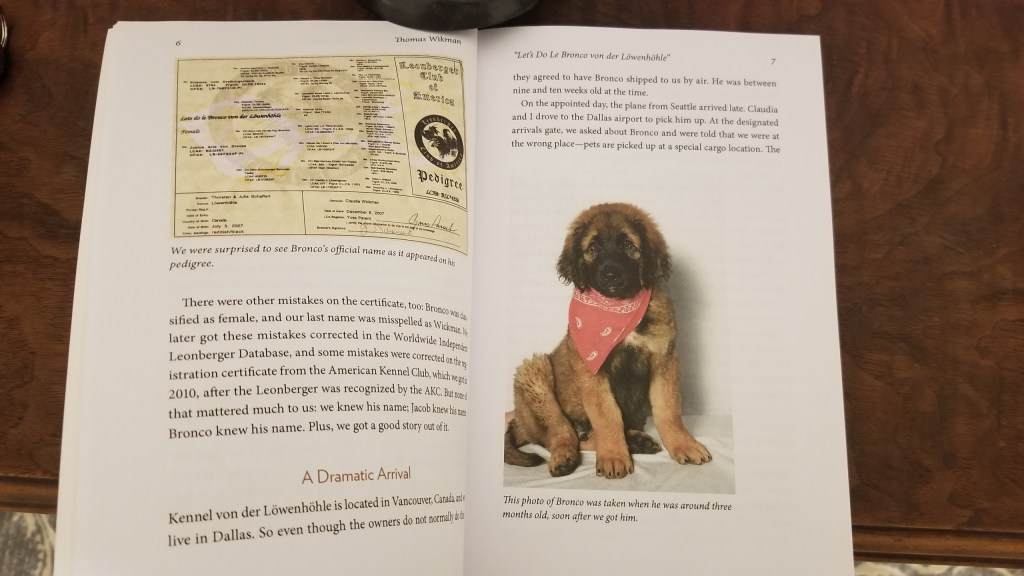
Our Leonberger Bronco at 3 months
Bronco our Leonberger 3 months
Bronco our Leonberger 3 months old in black and white

Eventually, though, we relented and let him sleep in our bed. As the saying goes, “First they take your heart, then your bed.” But as Bronco quickly grew to 120 pounds, and then to 130 pounds, that arrangement didn’t work very well. We were three in the bed, and Bronco would sleep between us, a situation that became a bit crowded. Sometimes Bronco would push me with his paws until I fell off the bed and onto the floor. To my great relief, as time passed, he started to prefer the dog mattresses that we bought for him. On the other hand, Bronco was relatively easy to potty train. He quickly learned to go number two outside, but the peeing outside took a little longer, so Claudia hired a trainer from our veterinarian’s office to help us out. As a result, Bronco was mostly potty trained by four months old.

Dogs in our bed, including a giant breed. First they take your heart, then your bed.
First they take your heart, then your bed
Our Leonberger on our sofa. Not much room left.
One of our sofas was too big too be comfortable for people. It was perfect for Leonbergers.
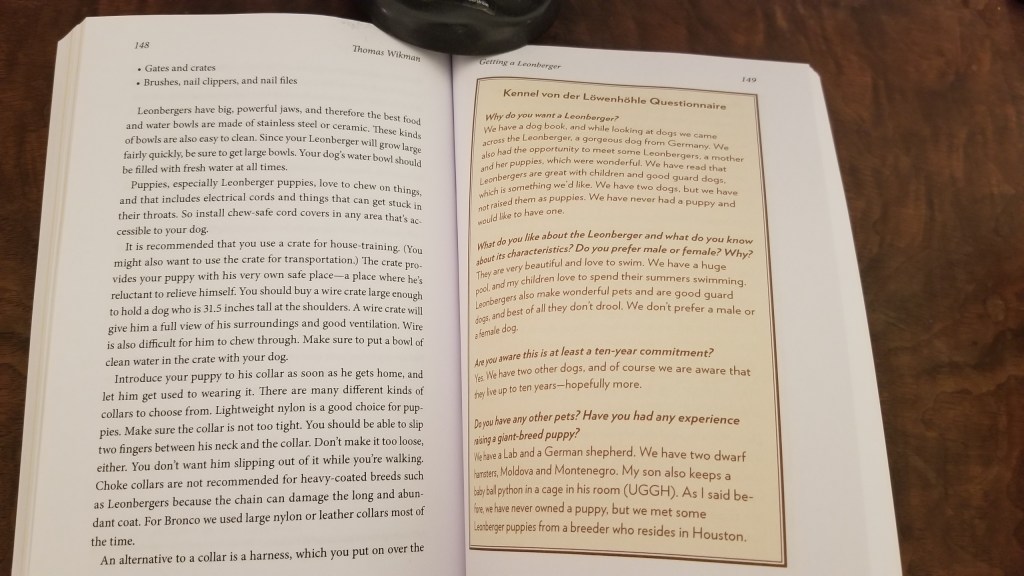
I was often working long hours, and Claudia was at home with our kids, so it was she who mostly took care of Bronco, especially in the early years. She took him for walks every morning; she took him to the dog park, to go shopping, to Starbucks, and other places. She socialized him well. She also brushed him a few times a week, kept him clean, gave him medication to prevent heartworm and repel fleas and ticks,* and took him to the veterinarian’s office and the groomer. All of us in the family helped with the training, but Claudia did most of it. She grew up with dogs, so she knew what she was doing, and she did a very good job.

This medication also protects against infestations of chewing lice: see “Dog Lice:

What They Are, How to Avoid Them,” American Kennel Club, June 24, 2020, at

Ticks, fleas aw well as lice

Bronco was eager to learn, and he liked to go for walks, but he didn’t always finish them. When he got tired, he lifted his front paws up and scratched our legs. Then we picked him up and carried him. He loved being carried around like a baby. We carried him when he was thirty pounds and when he was fifty pounds, but at one hundred pounds it was time to stop.

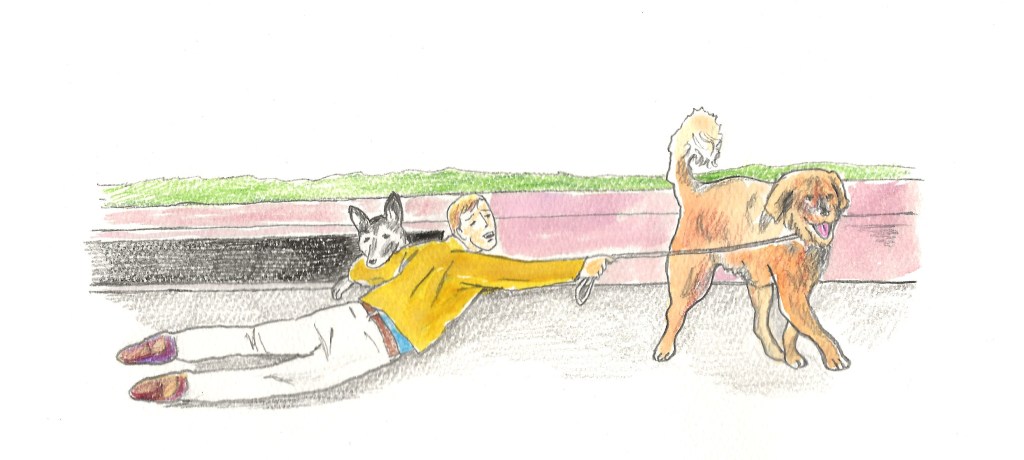
Walking a big strong dog like Bronco presents special challenges. You need to be physically fit in order to control a Leonberger who isn’t listening to you. On several occasions Bronco yanked the leash so hard when I walked him that I almost fell forward. Did I mention that it’s not a good idea to wear flip-flops while you’re walking a big strong dog? When our daughter, Rachel, did, she fell face-first after. Bronco got excited and took off in pursuit of something. She shouted at him to come back, and he did. I guess he felt bad for her and returned. That was his personality.

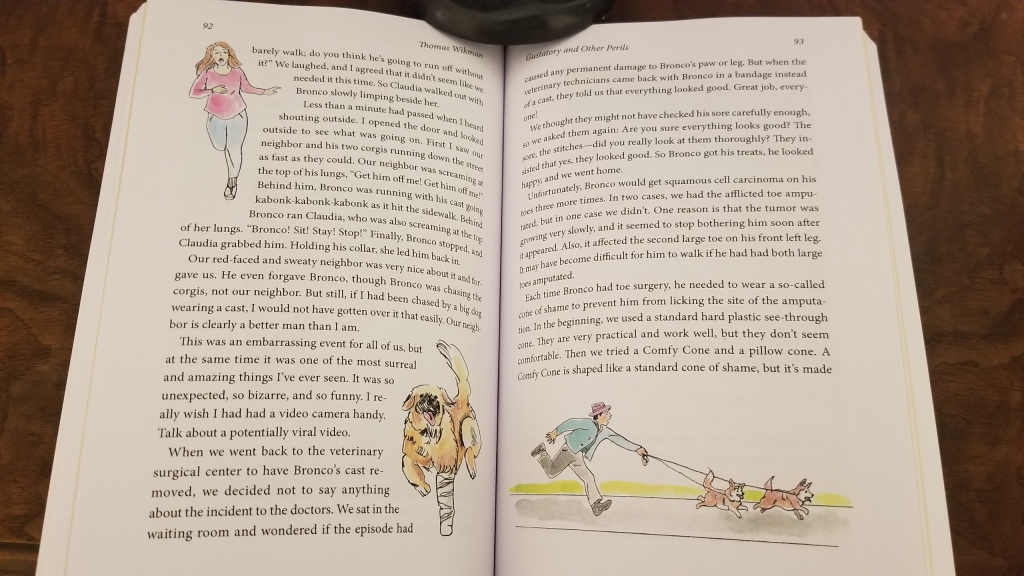
Bronco our Leonberger was strong enough to drag a less heavy person. Drawing by Naomi Rosenblatt.
Bronco was strong enough to drag a less heavy person. Drawing by Naomi Rosenblatt.

One time, when Claudia was walking Bronco at White Rock Lake Park, just outside Dallas, Bronco saw a dog whom, for whatever reason, he did not like. He started running toward the dog and its owner. Claudia, taken by surprise, had a hard time controlling the situation. Bronco pulled her along as she tried to keep her balance. The man with the other dog saw that a potential confrontation was developing, and he loudly screamed, “Noooooo,” at Bronco. Then Bronco just stopped. He understood, and it all ended well.

Adolescent Bronco, still a gangly not yet proportional Leonberger

It was incidents like these that prompted us to hire a professional dog trainer from Bark Busters and buy a Gentle Leader harness, which has a loop that fits around your dog’s nose. When your dog pulls forward, the motion gently moves his head to the side, redirecting his attention back to you. It may be a little bit uncomfortable for the dog, but it is certainly infinitely better than a shock collar, which is something you should never use.

One day I was standing in our living room, talking to the Bark Busters trainer. Bronco was standing behind me, and he kept poking my leg with his paw. I ignored him because I was in the middle of a conversation. Suddenly Bronco bit me on the rear end. It was not an aggressive bite, but it was a big one, and it hurt. He could easily have bitten me much harder, of course.

Our Leonberger Bronco and his confident look
Bronco’s confident look

I turned around, and there stood Bronco, looking at me with his happy eyes and wagging his tail as if he were completely innocent. I forgave him instantly.

I asked the trainer, “Why did he do that?” She said, “He was trying to get your attention, but you were ignoring him, so he bit you.” She continued, “He should know that he is not the one in charge, and he shouldn’t do that.” She knew what she was talking about. I should add that this was the only time Bronco bit anyone.

The Day an EF3 Tornado Ravaged Our Neighborhood. It was a tough day for us and Bronco

October of 2019 was a very difficult month for Bronco. He was getting old, and he had the first signs of geriatric-onset laryngeal paralysis polyneuropathy (or GOLPP), which made his breathing a bit labored and affected his gait. In addition, he had developed another case of squamous cell carcinoma, this time on his right rear paw, and that toe was amputated on October 3—the day he turned twelve years and three months old. The surgery went well, but after around ten days it was discovered that he had a large deep ulcerous sore on the same paw a few inches above the surgical scar. Fortunately, it was not cancerous, as we first thought, but we would have to treat this sore in addition to nursing him back from his amputation.

On October 20, I was sitting in our backyard. Claudia and the dogs were inside. I was finished walking the dogs, and the sun had just set. A severe thunderstorm was approaching, and there was a tornado watch in effect—but that’s not unusual for North Texas. I was sipping a delicious Texas beer, an IPA called Yellow Rose, when my cell phone started beeping. It was a tornado warning—upgraded from a tornado watch. I also heard tornado sirens, but they weren’t very loud, and as I found out later, some people didn’t hear them at all.

About the same time as I heard the sirens, I saw lightning in the distance and heard thunder. I decided to finish my beer and go inside to be safe. A few minutes after I walked in, it started raining heavily, and the wind became very rough. It sounded like golf-ball-size hail was hitting the roof. The house shook from the winds, then suddenly there was a loud boom.

Our neighbor's house was destroyed as can be seen in the photo.
The damage to my neighbor’s house after the Dallas tornado of October 2019 was devastating. Her roof lay across the street.

I thought lightning had struck the house. What I didn’t know was that a flying block of concrete had just smashed our chimney. Bronco was calm, and the little dogs seemed okay, too.

After the wind had died down a bit, I opened the door to the backyard, and what I saw shocked me. My gas grill had flown across the patio. There were bricks and pieces of concrete all over the patio and the lawn. There was a big sheet of metal lying on the patio. Big tree branches covered the lawn. There was debris everywhere. We had also lost power. I didn’t notice until the next morning that our chimney had been smashed and that the roof was covered in bricks and debris. It turns out that an EF3 tornado had gone through our neighborhood and passed within fifty to one hundred yards of our house.

Another neighbor's house that was destroyed in the Dallas Tornado of October 20 2019.
Dallas Tornado 2019. The damage to another of neighbor’s house was even worse.

Claudia called her parents, who live only a mile from us. They had been badly hit, but they seemed fine on the phone, and they didn’t complain. Still, she asked me to drive over and check on them. But as soon as I turned out of our driveway, I saw my neighbor’s roof lying on the street, rendering it impassable. I turned around and tried to go the other way, but that didn’t work, either. Across that end of the road lay a huge pile of trees.

So I parked the car in my driveway and started to walk toward their house. I was stopped by four firemen, who told me that it was not safe to walk around the neighborhood. They asked me to go back home.

This is the house of Dallas Stars Ice Hockey player Tyler Seguin. It is located in our neighborhood. It was destroyed by the tornado.
Another Tornado damaged house.

It was dark, but I could see some of the carnage. I realized that we had been lucky. Many of our neighbors had lost their entire homes. We ended up needing a new chimney, a new roof, a new fence, and a few other things, but we were fine.

Houses destroyed by the EF3 tornado that ravaged our neighborhood on October 20 2022.
Another Tornado damaged house

The damage to Claudia’s parents’ house was more severe, which we would discover the next day when we visited them. Their windows had been blown in, and Claudia’s dad had to hold on to a doorframe in order to keep himself from being carried away. A broken marble tabletop hit him in the back and gave him a foot-long bruise. He did not go to the hospital.

Claudia walking into her parents house. It was badly damaged by the tornado.
Claudia walking into her parents house.

The Preston Royal shopping center was also devastated by the tornado. That’s where our veterinarian’s office was located. Thank goodness they didn’t have any animals staying overnight that night, but the clinic was gone. So were many stores and restaurants. Our favorite supermarket was destroyed. The school our boys went to was severely damaged, and some buildings were later torn down. There was debris all over the neighborhood.

The Gap store at Preston/Royal was destroyed by the tornado.
The Gap Store at Preston Royal shopping center.

Claudia’s parents had to move out of their house while repairs were made, but although we were able to stay in our house, we didn’t have power for four days. There was no cell-phone signal in our neighborhood. The streets weren’t navigable, so I couldn’t go to work. It was also hot, so this was stressful for Bronco.

Bronco inspecting the damage of our fence that was made by the tornado.
Bronco, who was not at his best in this picture, rests next to our tornado damaged fence. We put a plastic bag around his bandage when he went outside.

The Eye Drop War

One day we noticed that Bronco’s eyes were red, so we took him to the veterinarian. He was around one year old at the time. The veterinarian told us that Bronco had conjunctivitis and that all we needed to do was give him eye drops. But giving a very big dog eye drops turned out to be a lot more challenging than we had anticipated. “Just give him three drops two times a day”—easy peasy, right? Well, the veterinarian might as well have told us to wrestle a bear on a tightrope while juggling.

Gates we had around the house to prevent Bronco from roaming where he shouldn’t

Whenever we approached Bronco with the eyedropper, he ran off. Almost nothing else scared him—thunder and lightning, explosions, large hail, other big dogs, noisy crowds—but he was terrified of eye drops. Once we would catch up with him, he would thwart any attempt on our part to put the drops in. He would jump up and down while violently shaking his head back and forth and closing his eyes. So Claudia and I and Jacob and David decided we needed to do it all together.

We made what we thought was a great plan: two people were going to hold Bronco down on the floor while keeping his head still. A third person would hold his eyelids open, and a fourth person would put in the eye drops, being careful not to touch his eyes in the process. Poor Bronco was certainly not going to like it, but what else could we do? He needed his medicine.

Bronco sleeping on the floor in the living room. No photo of the actual struggle.

We chased Bronco around the house and finally caught him in the living room. He struggled, but we were able to hold him down. However, before we could open his eyelids, he made a sudden and powerful move that got all five of us rolling like a giant snowball into the metal pet gate that stood between the family room and the living room. With a loud bang, we crashed into the gate. The screws that fastened it to the wall popped out and shot across the room. We had turned into a messy dog-and-people pile on the floor.

The family room

Bronco was the first one to get up. As he stood and surveyed the carnage, we acknowledged our defeat. Claudia put away the eye drops. I put the pet gate in the garage. No more eye drops; no more pet gate; no more forcing anything on Bronco. He had been victorious in the Eye Drop War, and he knew it.

As it happened, the conjunctivitis healed without the drops. We would later learn that it is possible to get eye drops into a Leonberger’s eyes without going to war.

———–

Pray that you don’t have to give your Leonberger eye drops, but if you do, first ask your veterinarian for instructions. If those don’t work, take a step-by-step approach: give the dog a treat for standing still, then a treat for letting you hold his head, then a treat for allowing the drops in his eyes. You can also warm the drops in your pocket so they don’t feel cold.

For other helpful tips, see Videojug, “How to Apply Dog Eye Drops,” at

uploaded April 12, 2011

Bronco the Great Swimmer

Leonbergers are double-coated, and they have webbed paws, so they’re natural swimmers. Bronco was no exception: he loved to swim and chase waterfowl at our go-to destination, White Rock Lake. If he saw ducks or egrets in the water, he would swim after them. They would fly off before he could get to them, though, so he never caught any. That was okay—he still had fun, and he had no egrets (pun intended).

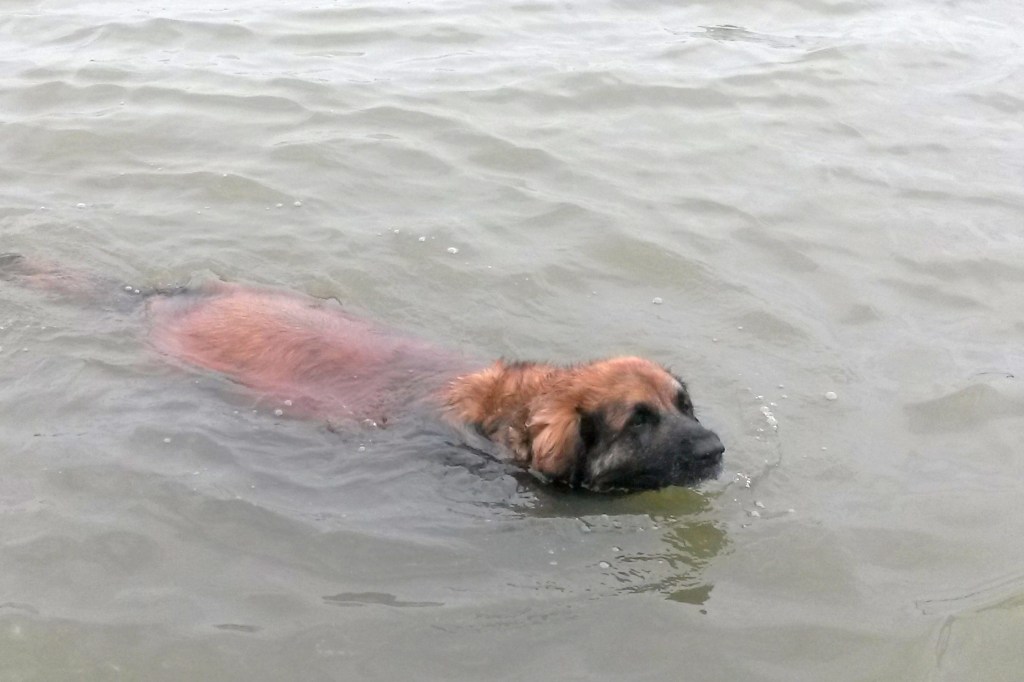
Leonbergers are excellent swimmers. Here is our Leonberger swimming in White Rock Lake.
Leonbergers are excellent swimmers and are sometimes used in water rescue.

Claudia started taking Bronco to White Rock with Baylor and Baby when he was an adolescent. At first, he was hesitant to get into the water. Then a nice man came along (we don’t know who he was) and threw a stick a little way out into the lake. He asked Bronco to get it, and he did. Then he threw the stick a little bit farther so that Bronco had to swim to get it. Little by little and step by step, the man encouraged Bronco to swim. And once he got started, there was no looking back. Swimming in the lake became one of his favorite pastimes.

Bronco loved swimmed in White Rock Lake outside Dallas
Bronco loved swimming in White Rock Lake.

After a while, getting Bronco into the water was easy. Unleash him, and he would walk right in. Getting Bronco out—that was another story.

Leonbergers are excellent swimmers. Here is our Leonberger Bronco swimming in White Rock Lake nearby Dallas.
Bronco in water

It wasn’t that he disobeyed. He came out of the water when we asked him to. The problem was what happened after he came out. He shook himself dry, like all wet dogs do, but a large dog with a coat like his has a lot of water to share. If you’ve ever been to a show at SeaWorld, you know that you get very wet if you sit in the first row. It was the same with Bronco: if you stood close enough to hold the leash, you were bound to get soaked when he shook himself. Our choices were to walk away, hide behind a tree, or take the involuntary bucket challenge. Towels certainly came in handy.

Leonbergers are excellent swimmers. Here is our Leonberger coming out of the water.
At White Rock Lake, Dallas

One morning, Claudia was taking Bronco for a walk around the lake with two of her sisters, Dora and Marianne. Suddenly Bronco jumped in the lake. But there were steep banks on either side of him, and he couldn’t get back out. So Claudia got in the water with him and pushed his butt while Dora and Marianne encouraged him to move toward a less steep part of the bank. They got him out, but this scary incident didn’t decrease Bronco’s love of swimming.

Leonbergers are excellent swimmers. Here is our Leonberger by the canoe dock.
Bronco at the canoe dock, White Rock Lake

A Shocking Walk

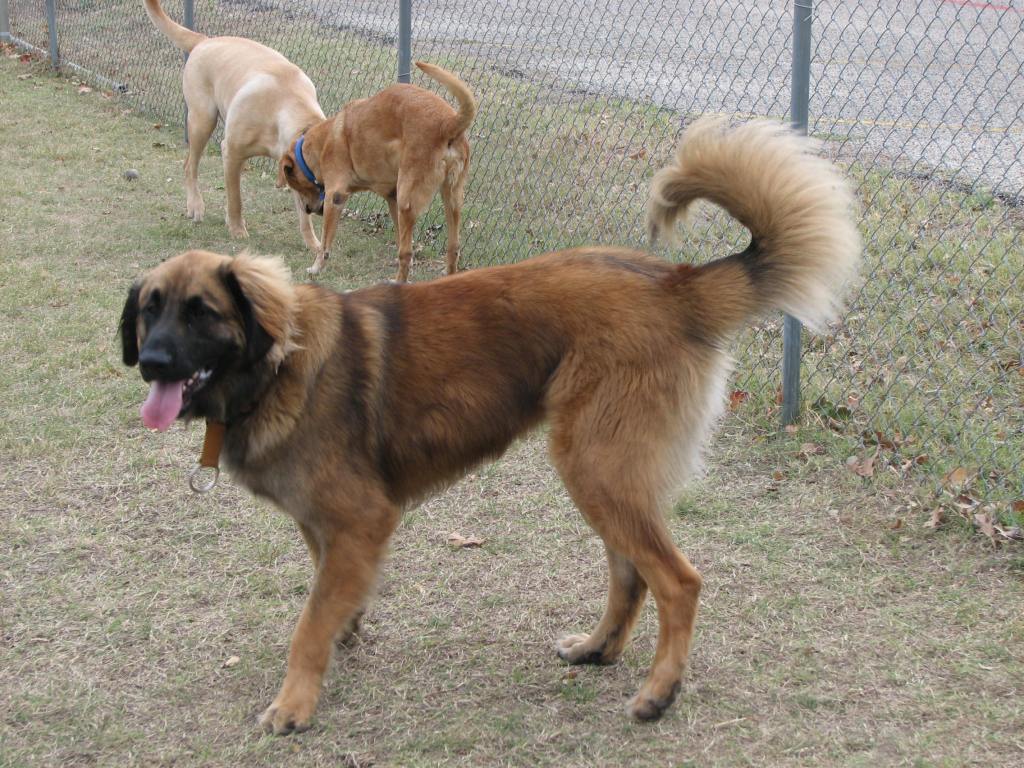
Young Bronco, less than one years old. He was gangly but already very big.
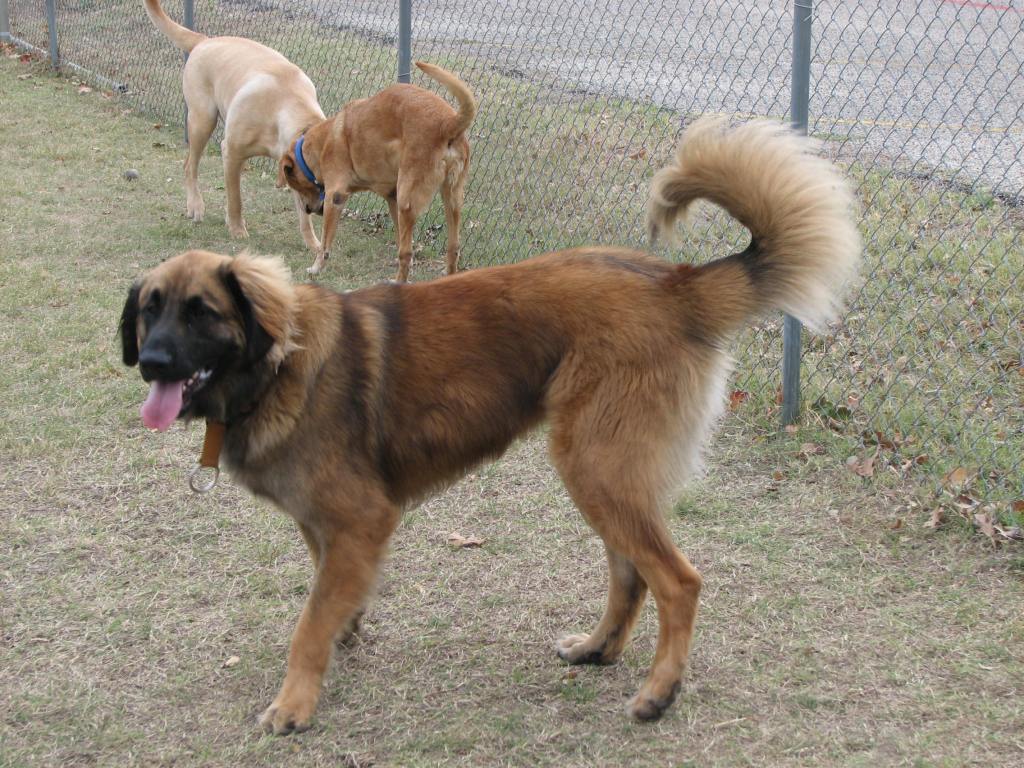
Bronco was slim and a bit gangly when he was young. He would fill out later. He was full of energy, confident and not afraid of anything.

Bronco was not only big, he was also confident and unafraid and insensitive to noise. Most dogs I’ve known have been afraid of lightning and thunder and loud explosions, but not Bronco. Here in Texas, thunderstorms can be very violent and dangerous. North Texas is located in Tornado Alley, and that’s where the world’s worst thunderstorms occur. We’ve had our share of lightning strikes, heavy rain, flooded streets, sixty-mile-an-hour winds, giant hail, and tornadoes. You don’t want to be outside when a severe thunderstorm is at hand.

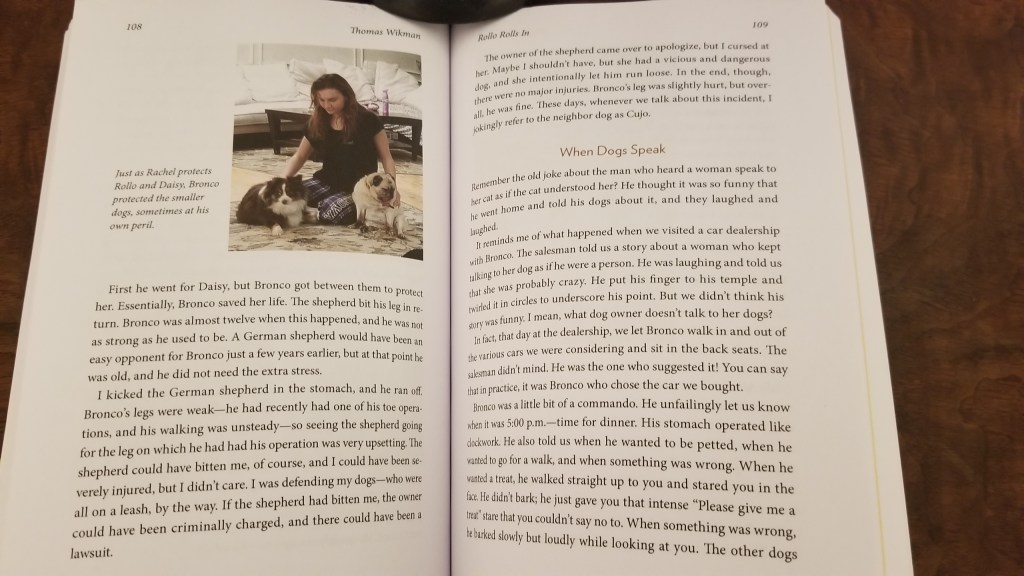
Once when I was out walking Bronco, we were surprised by one of those Tornado Alley–style supercell thunderstorms, and lightning struck the ground maybe one hundred yards away from us. It was bright, but above all the following thunderclap was very loud. It was an explosion more than anything else. I jumped where I stood, and my heart was pounding afterward. Bronco, on the other hand, was too busy sniffing something interesting to pay attention to the sound. After the lightning strike, he looked up as if to make sure everything was okay, then he continued with his important olfactory project. I can assure you that he was not deaf. My repeated failure to quietly open a cheese wrapper in the kitchen without his noticing is proof of that.

I should add that Leonbergers are known to be confident and unafraid. It is part of the breed standard and they are bred that way.

The Day Bronco Sniffed Out an Oncoming Insulin Shock

On the right our Labrador Baylor. On the left our Leonberger Bronco under a sun ray. Bronco may have saved Baylor when he sniffed our an oncoming insulin shock.
Bronco’s nose predicted an oncoming insulin shock

When Bronco was young we had a Labrador named Baylor. Baylor developed diabetes and I had to give him insulin shots before every meal. But he was very cooperative, and he never complained despite the pinch he must have felt every time.

One day we witnessed what seemed like a miracle. Bronco started barking while looking at Baylor, then he intently looked at us, then he turned his head toward Baylor and started barking again. He did this a few times—not aggressively, but to get our attention. It became clear that. Bronco wanted us to look at Baylor. I examined Baylor but saw nothing wrong at first. Then I looked again. This time I saw that his back legs were shaking slightly. It quickly got worse. His gait became wobbly, then within perhaps fifteen seconds he fainted. He had gone into insulin shock. We rushed him to the emergency clinic, where fortunately the doctors were able to revive him. I should mention; we didn’t know this at the time, but giving a dog sugar, or something sweet, can bring him out of insulin shock.

Bronco detected a problem with Baylor before we could see anything wrong. His warnings gave us that little bit of extra time we needed to save Baylor’s life. I still wonder what it was that Bronco noticed. Leonbergers have a very keen sense of smell, and people have told me that the dogs can smell when there’s something physically wrong with a person. We had never taught Bronco to detect insulin shock or any other condition. It was entirely his own instinct. This was one of the amazing superpowers Bronco had.

History of the Leonberger

Bronco at three months old. You can trace his ancestry back 120 years. A lot of interesting Leonberger history happened in that time.

This post is a sample from my new Leonberger History page. The Leonberger History page is somewhat long (almost 3,000 words), too long for a post, but it is interesting.  This post only covers up to the end of the 1800’s and I’ve also removed all the references. To see the full history click here:

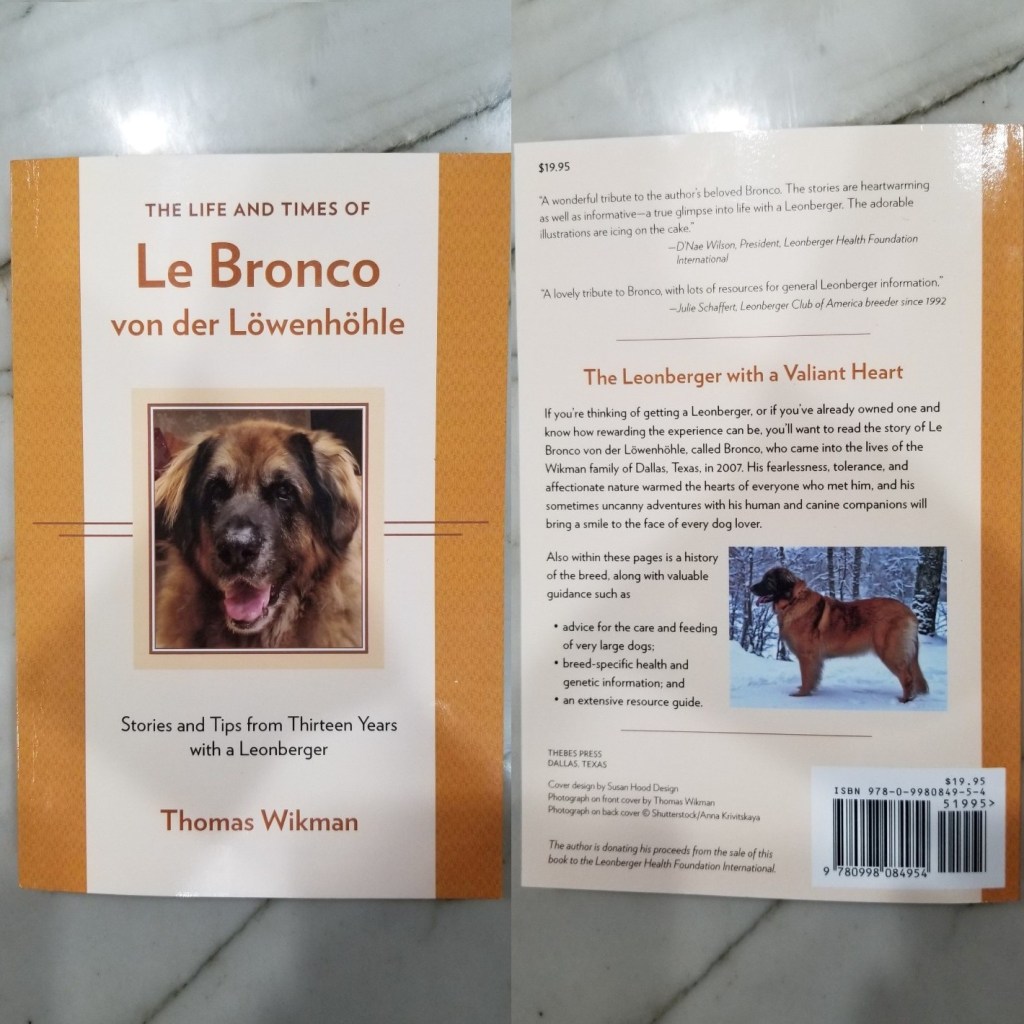
The Leonberger breed was originally created by Heinrich Essig (1808–87) in the German town of Leonberg, in what was then the kingdom of Württemberg. According to legend, Essig bred the dog to resemble the lion in the town’s coat of arms. Indeed, as you can see in the image on page 132, the lion in the coat of arms doesn’t look like a real lion, so you could say that the Leonberger looks the way it does because Germans were bad at drawing lions back then. All joking aside, though, Leonbergers do bear some resemblance to lions and maybe even bears. In any case, they are beautiful dogs.

When people would stop me and ask me questions about the kind of dog Bronco was, I would say he was a Leonberger—a cross between a Saint Bernard, a Newfoundland, and a Great Pyrenees—and that the breed was created by the mayor of the German town of Leonberg. But, as the economist Tyler Cowen said, “Be suspicious of simple stories.” As it turns out, the story I kept telling was a simplification and not entirely true. History is more complicated, and that’s another reason I’m writing this: I was unintentionally spreading misinformation about Leonbergers, and want to try to correct some of it.

Simple and interesting stories are easy to remember, easy to believe, and easy to propagate. But first, Heinrich Essig was never the mayor of Leonberg. He was a prominent citizen of the town, and he was a successful businessman, farmer, innkeeper, horse and dog trader, large-dog enthusiast, dog breeder, and town councilman, but he was never the mayor.

Essig claimed to have created the Leonberger in the 1830s by crossing a female Landseer Newfoundland with a male long-haired Saint Bernard from the Great Saint Bernard Hospice, a monastery in Switzerland. He continued crossing the Landseer Newfoundland and the Saint Bernard over four generations, then he crossed his Newfoundland–Saint Bernard mix with a Pyrenean wolfhound not, as is often asserted, with a Great Pyrenees (called a Pyrenean mountain dog in Europe). He then crossed that dog with the Saint Bernard again. In 1846, he was finally ready to announce and register his “lion of a dog.” A few years later, Leonbergers were officially introduced to the public at the Munich Oktoberfest.

However, the story is more complicated than that. There’s no specific breed named Pyrenean wolfhound today, so Essig could have used a Great Pyrenees or a Pyrenean mastiff . In addition, later in the nineteenth century, Leonbergers were used to breed the long-haired Saint Bernard dog, and this likely saved the Saint Bernard dog from extinction. At one point, too, Leonbergers were deliberately mixed with Newfoundland dogs to strengthen the Newfoundland breed. In other words, breeding happened in both directions, and the characteristics of the large breeds were in constant fl ux. Th e dogs—including Leonbergers and Saint Bernards—didn’t look like they do today, either. Essig’s Leonbergers were multicolored, mostly white, and lacked the black mask that is so important to the breed now. What has not changed is the essence of what Essig was aiming for: a large but moderately proportioned dog that is friendly and loving and a great companion.

Ultimately, the origins of the Leonberger, as well as the Saint Bernard and the other large breeds from this region, are complex and shrouded in mystery. In addition, some of Essig’s claims have been disputed. Breed standards wouldn’t be codified until the end of the nineteenth century. It should also be noted that it was Essig’s niece Marie who to a large extent bred and cared for the dogs.

Essig was selling his Leonberger dogs as luxury items to the wealthy. He was also a marketing genius and was able to get the attention of European nobility and royalty. The czar of Russia, Emperor Napoleon II, Otto von Bismarck, the king of Belgium, Empress Elisabeth of Austria, Emperor Maximilian I, the Prince of Wales, King Umberto of Italy, Giuseppe Garibaldi, and the mikado of Japan were among those who owned Leonbergers. Not everyone was happy about this. Some people viewed the Leonberger as a fashionable knockoff of the Saint Bernard that could hinder that breed’s development.

Toward the end of the nineteenth century, the discipline of cynology, or the scientific study of dogs, emerged. Cynologists pushed for breed classification and systematic breeding practices, and breed standards were created. But Essig and others viewed dog breeding as an art rather than a science, and this led to a conflict with the cynologists. Heinrich Schumacher, for example, was a breeder who strove to create a clearly identifiable Saint Bernard type. He was upheld by the cynologists as a paragon, in contrast to Heinrich Essig—to the detriment of the Leonberger.

After Essig’s death, in 1887, other people more willing to please the cynologists continued breeding Leonbergers. By that time, the dogs looked for the most part like Leonbergers do today. Then, in 1895, Albert Kull created the Leonberger’s first breed standard. It would go through several revisions in 1901, 1926, 1938, 1951, 1955, and 1972 until finally, in 1996, the FCI-approved version was established. The Fédération Cynologique Internationale, or FCI, serves as a kind of worldwide kennel club for all breeds. It was created on May 22, 1911, with the goal of promoting and protecting cynology and purebred dogs. The Kennel Club in the UK and the American Kennel Club also have their own breed standards. However, most of them are similar to Albert Kull’s 1895 version. The first Leonberger club was formed 1891 in Berlin: two more were created in 1895, then two more were formed in 1901. The most prominent was the Internationaler Klub für Leonberger Hunde, of which Albert Kull was the first president.

See the federation’s website at http://www.fci.be/en/

Some Fun Leonberger Facts

Coat of arms for the city of Leonberg, Germany
The coat of arms of the town of Leonberg, Germany, was allegedly the inspiration for the first breeder of the Leonberger, Heinrich Essig
  • The Leonberger takes it name after the town of Leonberg in Germany
  • The Leonberger breed was originally created by Heinrich Essig (1808–87) in the German town of Leonberg, in what was then the kingdom of Württemberg
  • The coat of arms of the town of Leonberg, Germany, was allegedly the inspiration for the first breeder of the Leonberger, Heinrich Essig (maybe you can say that the Leonberger looks the way it does because Germans were bad at drawing lions back then)
  • The breed was first registered in 1846
  • According to Essig, the Leonberger is a cross between a Saint Bernard, a Newfoundland, and what is thought to be Great Pyrenees or a Pyrenean Mastiff (not known which). In reality the mixing and matching went back and forth between these three breeds throughout history and it may be more complicated.
  • In the 1870s, Leonbergers were brought to Newfoundland to invigorate the stock of Newfoundland dogs
  • In 1879 President Ulysses S. Grant gave two Leonbergers gold medals
  • The first Leonberger breed standard was created in 1895
  • Leonbergers were used in the World War I to pull ammunition carts and cannons, which was one of the reasons the breed was decimated during World War I
  • Leonbergers have webbed paws
  • Leonbergers are double coated
  • Until 1985, there were only seventeen Leonbergers known to be living in the United States
  • The Leonberger Club of America was founded in 1985
  • The Leonberger was recognized by the American Kennel Club in 2010 as its 167th breed.*
  • The Leonberger is unique in the AKC for being the only dog in the Working Group originally bred to be a companion.†
  • According to an estimate prepared by BioMed Central, there were around 30,000 Leonbergers in the world in 2020 (registered only).‡
  • There are around 3,300 Leonbergers in North America—2,300 in the United States and 1,000 in Canada.§
  • The five countries with the most Leonbergers, in order, are France, with nearly 8,000; Germany, with more than 4,000; and Great Britain, the United States, and Sweden, with approximately 2,300 each.¶
  • The country with the highest number of Leonbergers per capita is Finland, with nearly 2,000 Leonbergers among a population of 5.5 million people.

AKC Communications, “AKC Welcomes the Cane Corso, Icelandic Sheepdog and Leonberger,” June 30, 2010, https://www.akc.org/press-releases/akc-welcomes-the-cane-corso-icelandic-sheepdog-and-leonberger/


†  AKC staff, “Meet 31 Purposely-Bred Dogs,” August 1, 2020,


‡  Anna Letko et al., “Genomic Diversity and Population Structure of the
Leonberger Dog Breed,” Genetics Selection Evolution 52, no. 61 (October
2020),

https://gsejournal.biomedcentral.com/articles/10.1186/s12711-020-00581-3


§  Sharon Springel, “Understanding Mean Kinship,” LeoLetter, October 2018,
60.
¶  “Springel, “Understanding Mean Kinship.”
**  “Springel, “Understanding Mean Kinship.”

Leonbergers on-screen


Did you know that three Leonberger dogs played the main character, Buck, in The Call of the Wild: Dog of the Yukon (1997)?


*   See Stuart Fitzgerald, “Leonberger,” DogZone.com, at

https://www.dogzone.com/breeds/leonberger/

And that a Leonberger named Hagrid appeared on Britain’s Got More Talent in 2017? Hagrid was attempting to set a new Guinness world record for catching the maximum number of sausages in his mouth in the shortest period of time.

You can watch Hagrid’s attempt below

The Leonberger Hagrid and his world record in sausage catching

The Day Bronco Stumped the Geek Squad

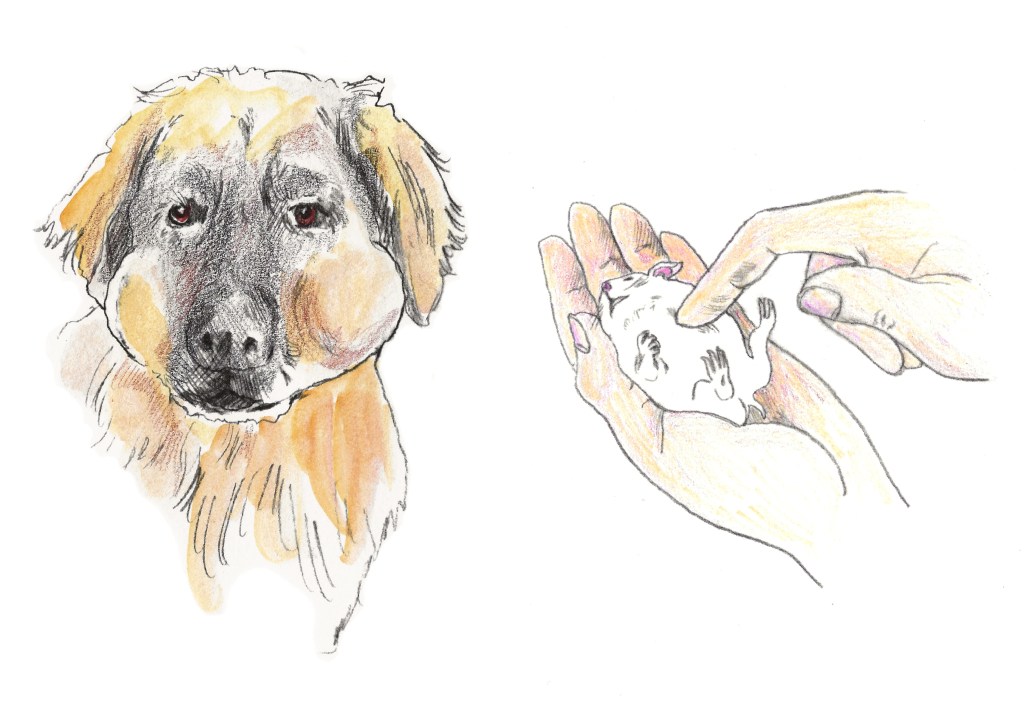
At around the time the hamsters died, the kids had a laptop that they used for playing games and—allegedly—doing homework. One evening, when the laptop was folded flat on a table, Bronco calmly walked over to it and bit it, as if he were taking a bite out of a sandwich. He bit it very hard—so hard that his teeth punctured the metal top and the edges curled up on each side. The force of his bite made a loud cracking sound.

The boys and I stared in amazement. The laptop looked like it had been hit with a toothed sledgehammer. It really demonstrated the immense power of Bronco’s jaws. The bite force of a Leonberger has been measured at 399 PSI (pounds per square inch), which is significantly more than those of an American pit bull terrier (235 PSI), a German shepherd (238 PSI), and a Rottweiler (328 PSI).  See the link below. We don’t know why Bronco bit the laptop. Maybe he didn’t like the computer because of all the attention it got. Thank goodness we had an extended warranty from Best Buy.

Our Leonberger Bronco bit the kids laptop with devastating but impressive results. The Geek Squad employee was astonished. Luckily the warranty covered both acts of God and acts of Dog (illustration Naomi Rosenblatt)
Luckily the warranty covered both acts of God and acts of Dog (illustration Naomi Rosenblatt)

We took the crushed laptop with the huge bite marks back to Best. Buy and asked the technician if our extended warranty covered the damage. The man looked at the laptop, puzzled. He said, “Wow—I’ve never seen anything like this before.” He told us that we were covered under the warranty but that he was dying to know what happened. I explained to him that our very big and very strong dog bit the laptop. He said, “That’s the best story I’ve ever heard.” I guess our extended warranty covered both acts of God and acts of Dog.

Check this link “Dogs Bite Force Comparison,” at

Dogs Bite Force Comparison

uploaded December 26, 2020

The Worldwide Independent Leonberger Database

One amazing aspect of owning a Leonberger is that there is database where you can lookup information on your Leonberger including his siblings (and where they are) and pedigree/ancestry.

The Worldwide Independent Leonberger Database is a very large and nearly complete database that contains information about more than 160,000 Leonbergers who lived as far back as the late nineteenth century. Considering that there are thirty thousand living Leonbergers in the world, that is quite impressive. The database is updated weekly and free to use. It serves mostly as a tool for breeders and researchers, but it is quite interesting for anyone to browse. It was established in 2005 as a nonprofit organization and is managed and owned by Wilma and Ben Kroon, breeders who live in the Netherlands.

The database, which is still growing, can be found at http://www.leonberger-database.com

An excerpt from the World Wide Independent Leonberger Database. It shows the entry for our Leonberger Bronco. It contains more than 160,000 Leonbergers.
This screen shot shows the information about Bronco that appears in the WILD database above his full pedigree.

For each Leonberger, the database contains the following information.

  • Full name
  • A photograph if available
  • Registration number
  • Tattoo and/or microchip number
  • DNA profile number
  • Date and place of birth
  • Kennel name
  • Website of breeder
  • Website of owner
  • Export registration number
  • Mean kinship (a measure of genetic diversity)
  • Indicators of hip dysplasia (abbreviated as HD) and elbow dysplasia (abbreviated as ED)
  • Eye test dates and results
  • Indicators of hypothyroidism
  • Results of DNA tests for the genes LPN1, LPN2, LPPN3, and LEMP
  • Number of offspring
  • Coefficient of inbreeding for ten generations and all generations

Like any database, it is fully searchable. Search criteria include the name (or portion of a name), registration number, date of birth, and chip number. You can search in English, German, and French. The website also features informative articles about the data that’s collected. Note that some of Bronco’s information is missing because he was not used for breeding.

With the help of the database, I was able to trace Bronco’s lineage all the way back to 1901, and I found photographs of and other information about several of his ancestors as far back as 1904.

I also found out that twenty-one Leonbergers were born on the same day as Bronco, five of them in Canada. Before I searched, I didn’t know the names of Bronco’s siblings, but now I do. And I found out that thirty-one Leonbergers out of the more than 160,000 in the database had or have the name Bronco. Three of them were born in North America.