This blog feature amusing and heartwarming stories about our late Leonberger dog Bronco, as well as other Leonbergers. It also has a lot of information about the Leonberger breed, the history, care, training, Leonberger organizations, etc. I also wrote a Leonberger book, which I am featuring in the sidebar.
One day we noticed that Bronco’s eyes were red, so we took him to the veterinarian. He was around one year old at the time. The veterinarian told us that Bronco had conjunctivitis and that all we needed to do was give him eye drops. But giving a very big dog eye drops turned out to be a lot more challenging than we had anticipated. “Just give him three drops two times a day”—easy peasy, right? Well, the veterinarian might as well have told us to wrestle a bear on a tightrope while juggling.
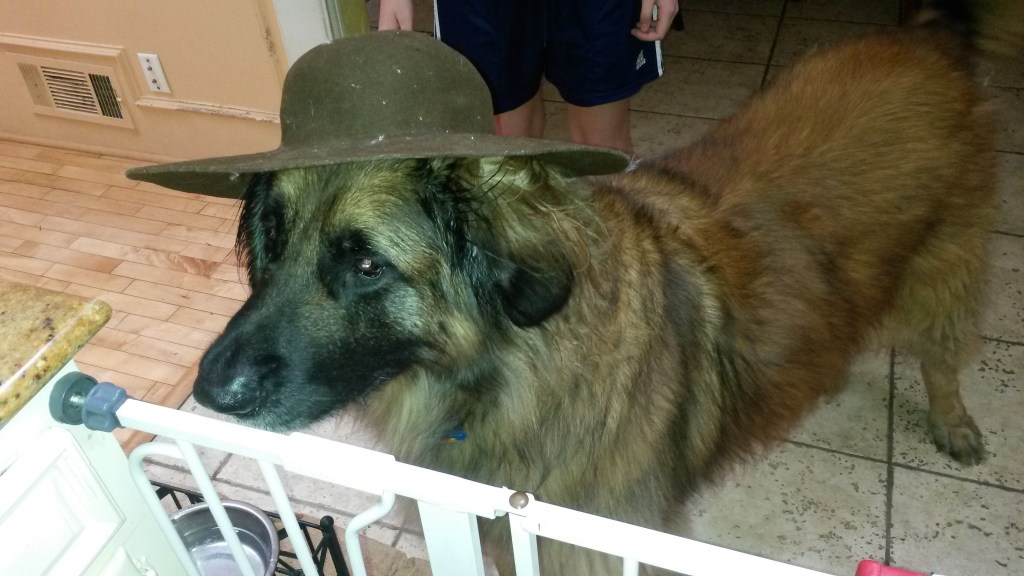
Gates we had around the house to prevent Bronco from roaming where he shouldn’t
Whenever we approached Bronco with the eyedropper, he ran off. Almost nothing else scared him—thunder and lightning, explosions, large hail, other big dogs, noisy crowds—but he was terrified of eye drops. Once we would catch up with him, he would thwart any attempt on our part to put the drops in. He would jump up and down while violently shaking his head back and forth and closing his eyes. So Claudia and I and Jacob and David decided we needed to do it all together.
We made what we thought was a great plan: two people were going to hold Bronco down on the floor while keeping his head still. A third person would hold his eyelids open, and a fourth person would put in the eye drops, being careful not to touch his eyes in the process. Poor Bronco was certainly not going to like it, but what else could we do? He needed his medicine.
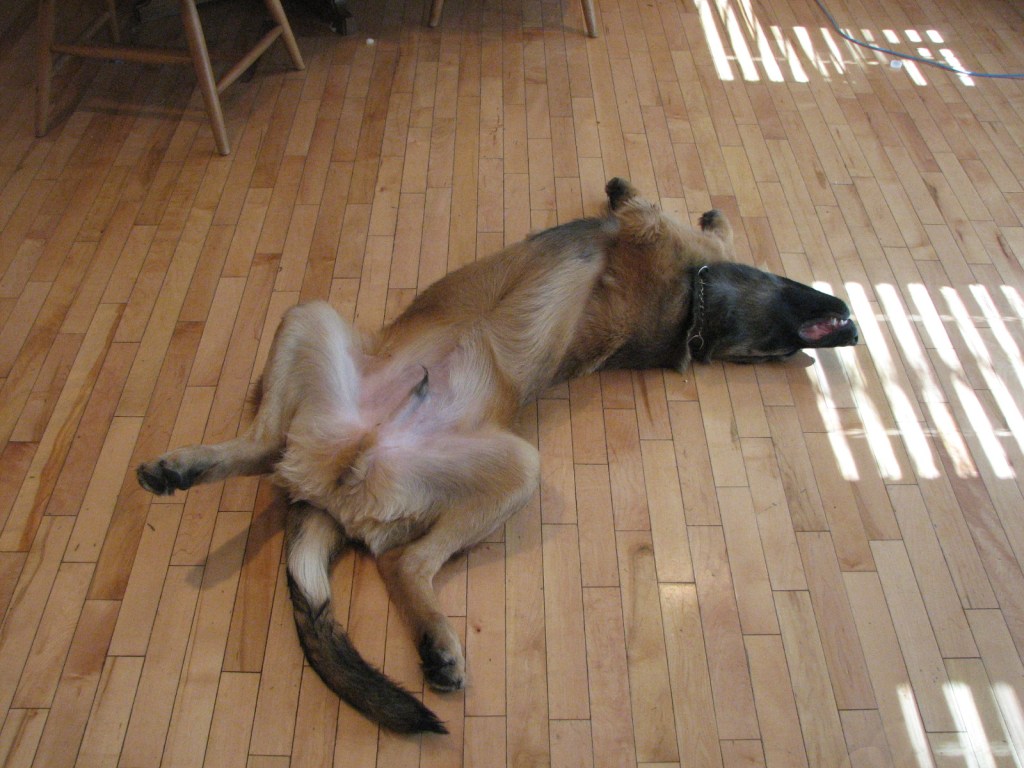
Bronco sleeping on the floor in the living room. No photo of the actual struggle.
We chased Bronco around the house and finally caught him in the living room. He struggled, but we were able to hold him down. However, before we could open his eyelids, he made a sudden and powerful move that got all five of us rolling like a giant snowball into the metal pet gate that stood between the family room and the living room. With a loud bang, we crashed into the gate. The screws that fastened it to the wall popped out and shot across the room. We had turned into a messy dog-and-people pile on the floor.
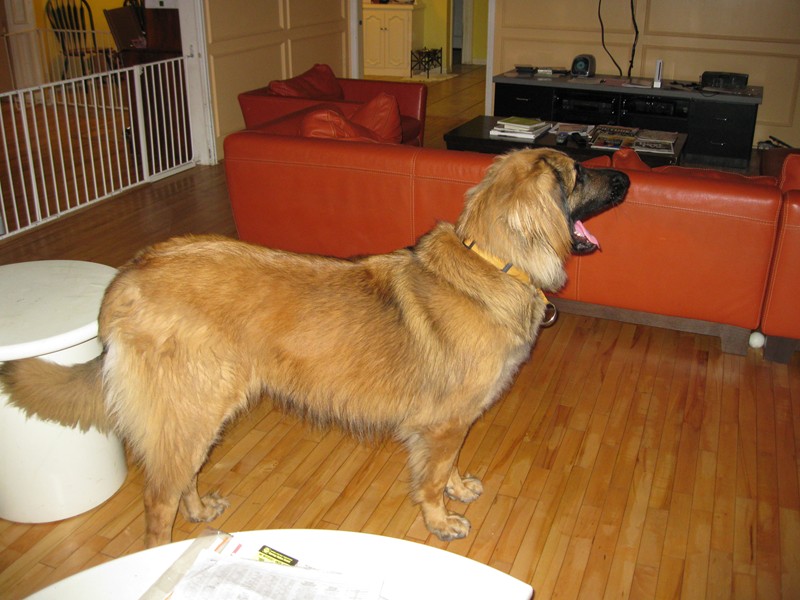
The family room
Bronco was the first one to get up. As he stood and surveyed the carnage, we acknowledged our defeat. Claudia put away the eye drops. I put the pet gate in the garage. No more eye drops; no more pet gate; no more forcing anything on Bronco. He had been victorious in the Eye Drop War, and he knew it.
As it happened, the conjunctivitis healed without the drops. We would later learn that it is possible to get eye drops into a Leonberger’s eyes without going to war.
———–
Pray that you don’t have to give your Leonberger eye drops, but if you do, first ask your veterinarian for instructions. If those don’t work, take a step-by-step approach: give the dog a treat for standing still, then a treat for letting you hold his head, then a treat for allowing the drops in his eyes. You can also warm the drops in your pocket so they don’t feel cold.
For other helpful tips, see Videojug, “How to Apply Dog Eye Drops,” at
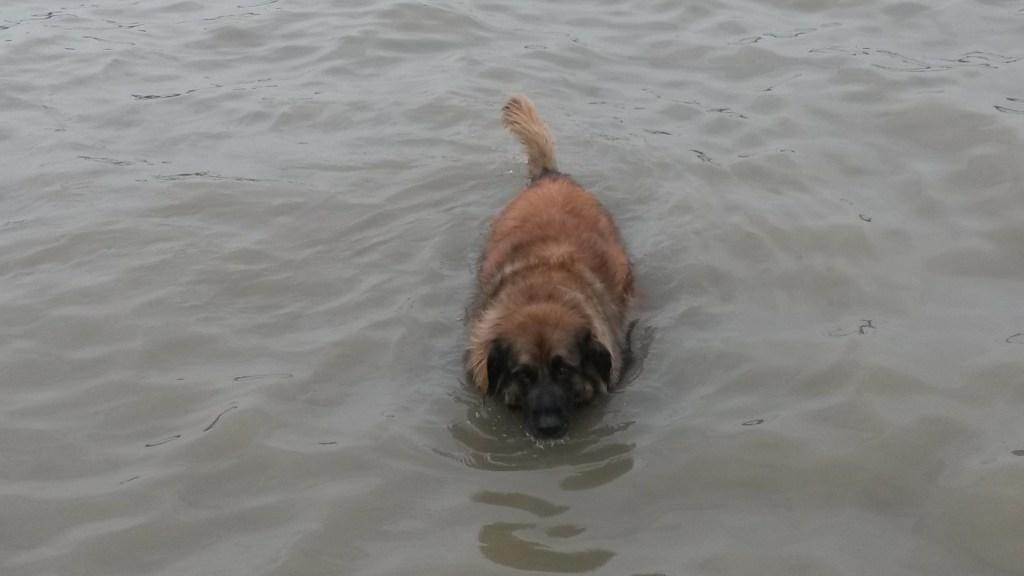
Leonbergers are double-coated, and they have webbed paws, so they’re natural swimmers. Bronco was no exception: he loved to swim and chase waterfowl at our go-to destination, White Rock Lake. If he saw ducks or egrets in the water, he would swim after them. They would fly off before he could get to them, though, so he never caught any. That was okay—he still had fun, and he had no egrets (pun intended).
Leonbergers are excellent swimmers and are sometimes used in water rescue.
Claudia started taking Bronco to White Rock with Baylor and Baby when he was an adolescent. At first, he was hesitant to get into the water. Then a nice man came along (we don’t know who he was) and threw a stick a little way out into the lake. He asked Bronco to get it, and he did. Then he threw the stick a little bit farther so that Bronco had to swim to get it. Little by little and step by step, the man encouraged Bronco to swim. And once he got started, there was no looking back. Swimming in the lake became one of his favorite pastimes.
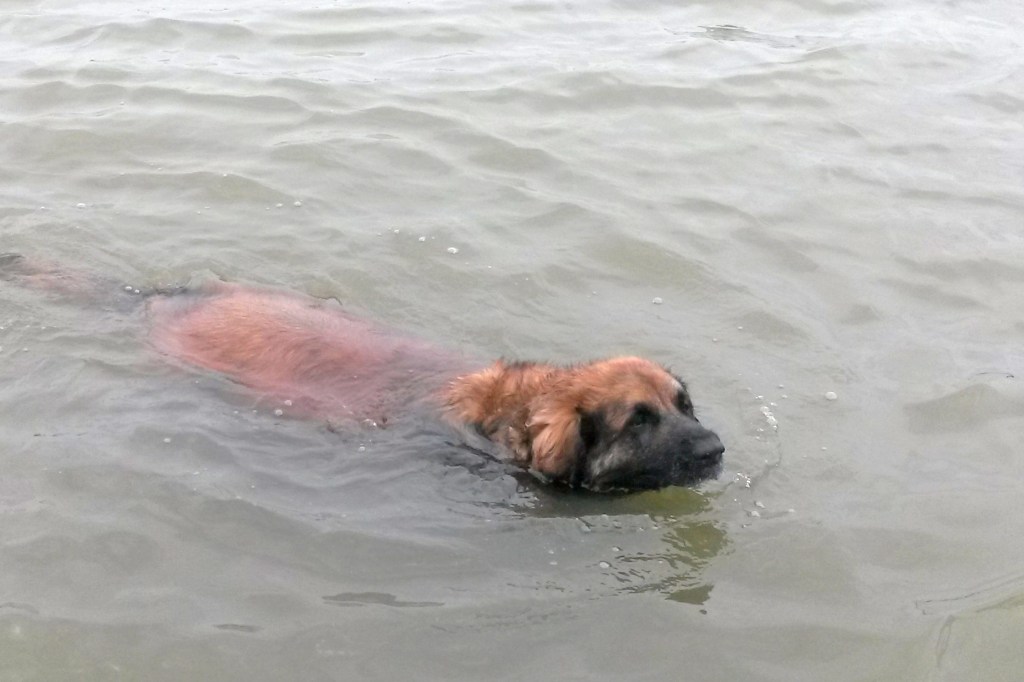
Bronco loved swimming in White Rock Lake.
After a while, getting Bronco into the water was easy. Unleash him, and he would walk right in. Getting Bronco out—that was another story.
Bronco in water
It wasn’t that he disobeyed. He came out of the water when we asked him to. The problem was what happened after he came out. He shook himself dry, like all wet dogs do, but a large dog with a coat like his has a lot of water to share. If you’ve ever been to a show at SeaWorld, you know that you get very wet if you sit in the first row. It was the same with Bronco: if you stood close enough to hold the leash, you were bound to get soaked when he shook himself. Our choices were to walk away, hide behind a tree, or take the involuntary bucket challenge. Towels certainly came in handy.
At White Rock Lake, Dallas
One morning, Claudia was taking Bronco for a walk around the lake with two of her sisters, Dora and Marianne. Suddenly Bronco jumped in the lake. But there were steep banks on either side of him, and he couldn’t get back out. So Claudia got in the water with him and pushed his butt while Dora and Marianne encouraged him to move toward a less steep part of the bank. They got him out, but this scary incident didn’t decrease Bronco’s love of swimming.
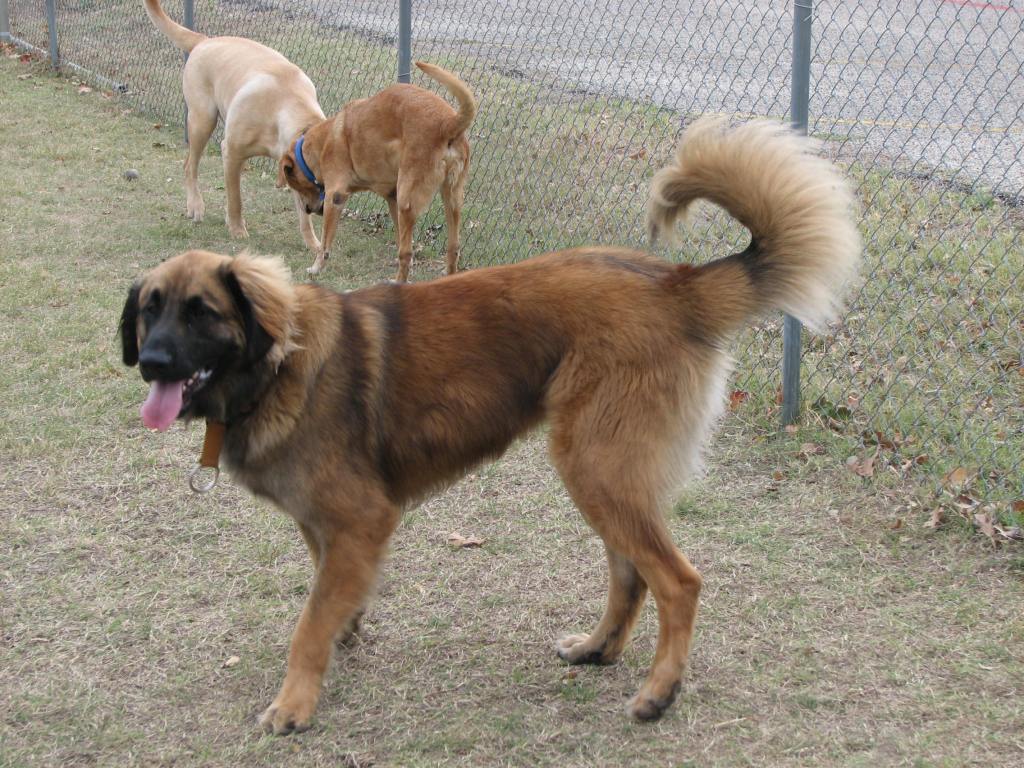
Bronco was slim and a bit gangly when he was young. He would fill out later. He was full of energy, confident and not afraid of anything.
Bronco was not only big, he was also confident and unafraid and insensitive to noise. Most dogs I’ve known have been afraid of lightning and thunder and loud explosions, but not Bronco. Here in Texas, thunderstorms can be very violent and dangerous. North Texas is located in Tornado Alley, and that’s where the world’s worst thunderstorms occur. We’ve had our share of lightning strikes, heavy rain, flooded streets, sixty-mile-an-hour winds, giant hail, and tornadoes. You don’t want to be outside when a severe thunderstorm is at hand.
Once when I was out walking Bronco, we were surprised by one of those Tornado Alley–style supercell thunderstorms, and lightning struck the ground maybe one hundred yards away from us. It was bright, but above all the following thunderclap was very loud. It was an explosion more than anything else. I jumped where I stood, and my heart was pounding afterward. Bronco, on the other hand, was too busy sniffing something interesting to pay attention to the sound. After the lightning strike, he looked up as if to make sure everything was okay, then he continued with his important olfactory project. I can assure you that he was not deaf. My repeated failure to quietly open a cheese wrapper in the kitchen without his noticing is proof of that.
I should add that Leonbergers are known to be confident and unafraid. It is part of the breed standard and they are bred that way.
When Bronco was young we had a Labrador named Baylor. Baylor developed diabetes and I had to give him insulin shots before every meal. But he was very cooperative, and he never complained despite the pinch he must have felt every time.
One day we witnessed what seemed like a miracle. Bronco started barking while looking at Baylor, then he intently looked at us, then he turned his head toward Baylor and started barking again. He did this a few times—not aggressively, but to get our attention. It became clear that. Bronco wanted us to look at Baylor. I examined Baylor but saw nothing wrong at first. Then I looked again. This time I saw that his back legs were shaking slightly. It quickly got worse. His gait became wobbly, then within perhaps fifteen seconds he fainted. He had gone into insulin shock. We rushed him to the emergency clinic, where fortunately the doctors were able to revive him. I should mention; we didn’t know this at the time, but giving a dog sugar, or something sweet, can bring him out of insulin shock.
Bronco detected a problem with Baylor before we could see anything wrong. His warnings gave us that little bit of extra time we needed to save Baylor’s life. I still wonder what it was that Bronco noticed. Leonbergers have a very keen sense of smell, and people have told me that the dogs can smell when there’s something physically wrong with a person. We had never taught Bronco to detect insulin shock or any other condition. It was entirely his own instinct. This was one of the amazing superpowers Bronco had.
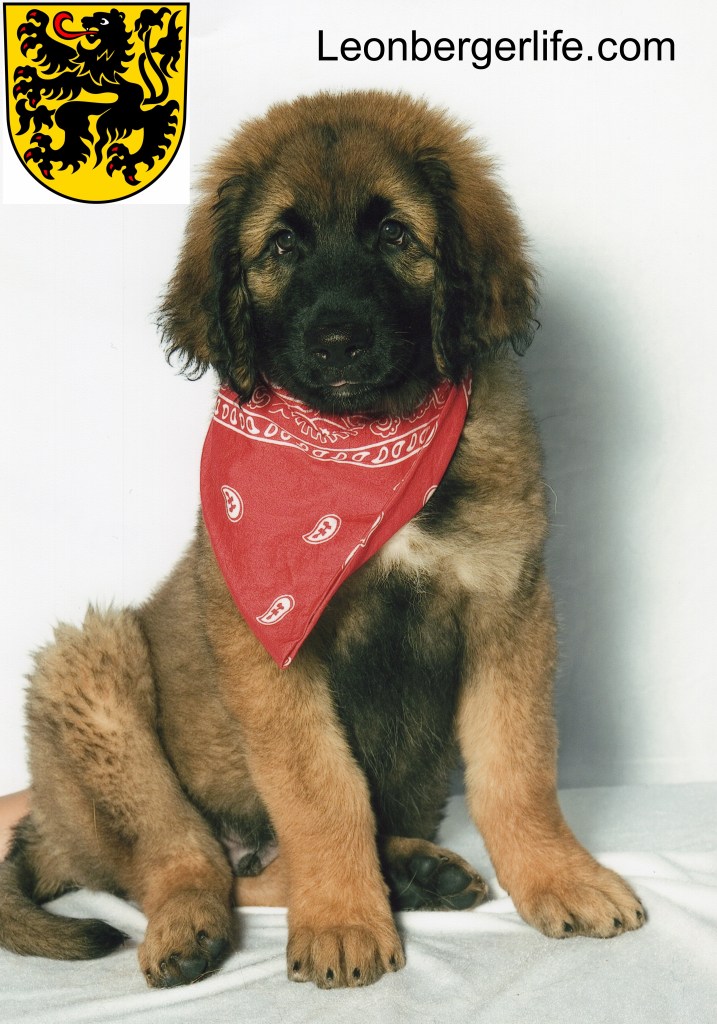
Bronco at three months old. You can trace his ancestry back 120 years. A lot of interesting Leonberger history happened in that time.
This post is a sample from my new Leonberger History page. The Leonberger History page is somewhat long (almost 3,000 words), too long for a post, but it is interesting. This post only covers up to the end of the 1800’s and I’ve also removed all the references. To see the full history click here:
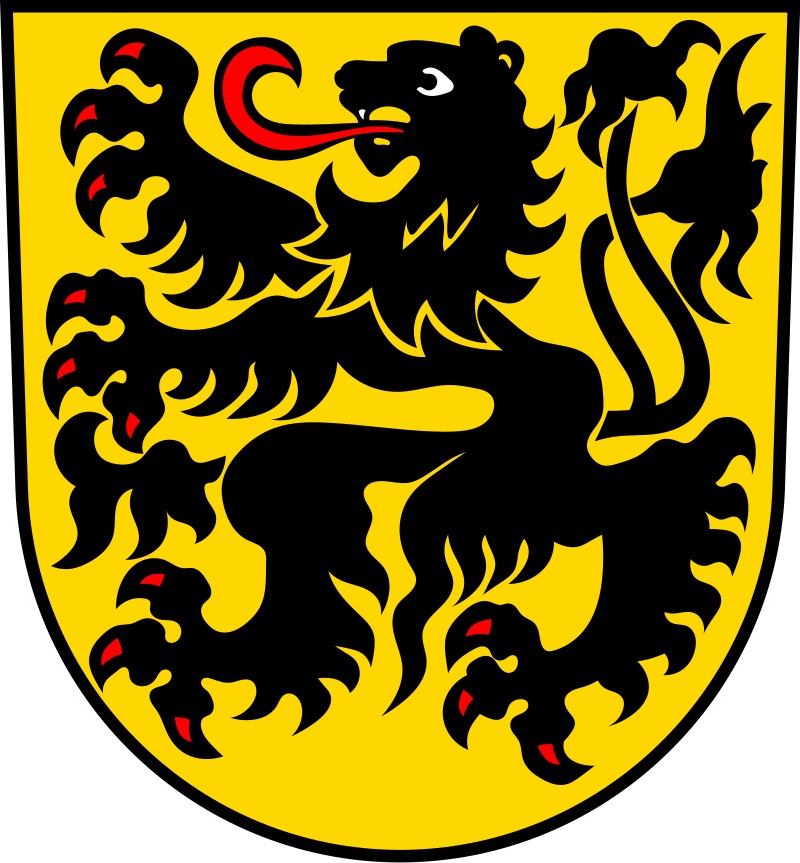
The Leonberger breed was originally created by Heinrich Essig (1808–87) in the German town of Leonberg, in what was then the kingdom of Württemberg. According to legend, Essig bred the dog to resemble the lion in the town’s coat of arms. Indeed, as you can see in the image on page 132, the lion in the coat of arms doesn’t look like a real lion, so you could say that the Leonberger looks the way it does because Germans were bad at drawing lions back then. All joking aside, though, Leonbergers do bear some resemblance to lions and maybe even bears. In any case, they are beautiful dogs.
When people would stop me and ask me questions about the kind of dog Bronco was, I would say he was a Leonberger—a cross between a Saint Bernard, a Newfoundland, and a Great Pyrenees—and that the breed was created by the mayor of the German town of Leonberg. But, as the economist Tyler Cowen said, “Be suspicious of simple stories.” As it turns out, the story I kept telling was a simplification and not entirely true. History is more complicated, and that’s another reason I’m writing this: I was unintentionally spreading misinformation about Leonbergers, and want to try to correct some of it.
Simple and interesting stories are easy to remember, easy to believe, and easy to propagate. But first, Heinrich Essig was never the mayor of Leonberg. He was a prominent citizen of the town, and he was a successful businessman, farmer, innkeeper, horse and dog trader, large-dog enthusiast, dog breeder, and town councilman, but he was never the mayor.
Essig claimed to have created the Leonberger in the 1830s by crossing a female Landseer Newfoundland with a male long-haired Saint Bernard from the Great Saint Bernard Hospice, a monastery in Switzerland. He continued crossing the Landseer Newfoundland and the Saint Bernard over four generations, then he crossed his Newfoundland–Saint Bernard mix with a Pyrenean wolfhound not, as is often asserted, with a Great Pyrenees (called a Pyrenean mountain dog in Europe). He then crossed that dog with the Saint Bernard again. In 1846, he was finally ready to announce and register his “lion of a dog.” A few years later, Leonbergers were officially introduced to the public at the Munich Oktoberfest.
However, the story is more complicated than that. There’s no specific breed named Pyrenean wolfhound today, so Essig could have used a Great Pyrenees or a Pyrenean mastiff . In addition, later in the nineteenth century, Leonbergers were used to breed the long-haired Saint Bernard dog, and this likely saved the Saint Bernard dog from extinction. At one point, too, Leonbergers were deliberately mixed with Newfoundland dogs to strengthen the Newfoundland breed. In other words, breeding happened in both directions, and the characteristics of the large breeds were in constant fl ux. Th e dogs—including Leonbergers and Saint Bernards—didn’t look like they do today, either. Essig’s Leonbergers were multicolored, mostly white, and lacked the black mask that is so important to the breed now. What has not changed is the essence of what Essig was aiming for: a large but moderately proportioned dog that is friendly and loving and a great companion.
Ultimately, the origins of the Leonberger, as well as the Saint Bernard and the other large breeds from this region, are complex and shrouded in mystery. In addition, some of Essig’s claims have been disputed. Breed standards wouldn’t be codified until the end of the nineteenth century. It should also be noted that it was Essig’s niece Marie who to a large extent bred and cared for the dogs.
Essig was selling his Leonberger dogs as luxury items to the wealthy. He was also a marketing genius and was able to get the attention of European nobility and royalty. The czar of Russia, Emperor Napoleon II, Otto von Bismarck, the king of Belgium, Empress Elisabeth of Austria, Emperor Maximilian I, the Prince of Wales, King Umberto of Italy, Giuseppe Garibaldi, and the mikado of Japan were among those who owned Leonbergers. Not everyone was happy about this. Some people viewed the Leonberger as a fashionable knockoff of the Saint Bernard that could hinder that breed’s development.
Toward the end of the nineteenth century, the discipline of cynology, or the scientific study of dogs, emerged. Cynologists pushed for breed classification and systematic breeding practices, and breed standards were created. But Essig and others viewed dog breeding as an art rather than a science, and this led to a conflict with the cynologists. Heinrich Schumacher, for example, was a breeder who strove to create a clearly identifiable Saint Bernard type. He was upheld by the cynologists as a paragon, in contrast to Heinrich Essig—to the detriment of the Leonberger.
After Essig’s death, in 1887, other people more willing to please the cynologists continued breeding Leonbergers. By that time, the dogs looked for the most part like Leonbergers do today. Then, in 1895, Albert Kull created the Leonberger’s first breed standard. It would go through several revisions in 1901, 1926, 1938, 1951, 1955, and 1972 until finally, in 1996, the FCI-approved version was established. The Fédération Cynologique Internationale, or FCI, serves as a kind of worldwide kennel club for all breeds. It was created on May 22, 1911, with the goal of promoting and protecting cynology and purebred dogs. The Kennel Club in the UK and the American Kennel Club also have their own breed standards. However, most of them are similar to Albert Kull’s 1895 version. The first Leonberger club was formed 1891 in Berlin: two more were created in 1895, then two more were formed in 1901. The most prominent was the Internationaler Klub für Leonberger Hunde, of which Albert Kull was the first president.
The coat of arms of the town of Leonberg, Germany, was allegedly the inspiration for the first breeder of the Leonberger, Heinrich Essig
The Leonberger takes it name after the town of Leonberg in Germany
The Leonberger breed was originally created by Heinrich Essig (1808–87) in the German town of Leonberg, in what was then the kingdom of Württemberg
The coat of arms of the town of Leonberg, Germany, was allegedly the inspiration for the first breeder of the Leonberger, Heinrich Essig (maybe you can say that the Leonberger looks the way it does because Germans were bad at drawing lions back then)
The breed was first registered in 1846
According to Essig, the Leonberger is a cross between a Saint Bernard, a Newfoundland, and what is thought to be Great Pyrenees or a Pyrenean Mastiff (not known which). In reality the mixing and matching went back and forth between these three breeds throughout history and it may be more complicated.
In the 1870s, Leonbergers were brought to Newfoundland to invigorate the stock of Newfoundland dogs
In 1879 President Ulysses S. Grant gave two Leonbergers gold medals
The first Leonberger breed standard was created in 1895
Leonbergers were used in the World War I to pull ammunition carts and cannons, which was one of the reasons the breed was decimated during World War I
Leonbergers have webbed paws
Leonbergers are double coated
Until 1985, there were only seventeen Leonbergers known to be living in the United States
The Leonberger Club of America was founded in 1985
The Leonberger was recognized by the American Kennel Club in 2010 as its 167th breed.*
The Leonberger is unique in the AKC for being the only dog in the Working Group originally bred to be a companion.†
According to an estimate prepared by BioMed Central, there were around 30,000 Leonbergers in the world in 2020 (registered only).‡
There are around 3,300 Leonbergers in North America—2,300 in the United States and 1,000 in Canada.§
The five countries with the most Leonbergers, in order, are France, with nearly 8,000; Germany, with more than 4,000; and Great Britain, the United States, and Sweden, with approximately 2,300 each.¶
The country with the highest number of Leonbergers per capita is Finland, with nearly 2,000 Leonbergers among a population of 5.5 million people.
§ Sharon Springel, “Understanding Mean Kinship,” LeoLetter, October 2018, 60. ¶ “Springel, “Understanding Mean Kinship.” ** “Springel, “Understanding Mean Kinship.”
Leonbergers on-screen
Did you know that three Leonberger dogs played the main character, Buck, in The Call of the Wild: Dog of the Yukon (1997)?
* See Stuart Fitzgerald, “Leonberger,” DogZone.com, at
And that a Leonberger named Hagrid appeared on Britain’s Got More Talent in 2017? Hagrid was attempting to set a new Guinness world record for catching the maximum number of sausages in his mouth in the shortest period of time.
You can watch Hagrid’s attempt below
The Leonberger Hagrid and his world record in sausage catching
At around the time the hamsters died, the kids had a laptop that they used for playing games and—allegedly—doing homework. One evening, when the laptop was folded flat on a table, Bronco calmly walked over to it and bit it, as if he were taking a bite out of a sandwich. He bit it very hard—so hard that his teeth punctured the metal top and the edges curled up on each side. The force of his bite made a loud cracking sound.
The boys and I stared in amazement. The laptop looked like it had been hit with a toothed sledgehammer. It really demonstrated the immense power of Bronco’s jaws. The bite force of a Leonberger has been measured at 399 PSI (pounds per square inch), which is significantly more than those of an American pit bull terrier (235 PSI), a German shepherd (238 PSI), and a Rottweiler (328 PSI). See the link below. We don’t know why Bronco bit the laptop. Maybe he didn’t like the computer because of all the attention it got. Thank goodness we had an extended warranty from Best Buy.
Luckily the warranty covered both acts of God and acts of Dog (illustration Naomi Rosenblatt)
We took the crushed laptop with the huge bite marks back to Best. Buy and asked the technician if our extended warranty covered the damage. The man looked at the laptop, puzzled. He said, “Wow—I’ve never seen anything like this before.” He told us that we were covered under the warranty but that he was dying to know what happened. I explained to him that our very big and very strong dog bit the laptop. He said, “That’s the best story I’ve ever heard.” I guess our extended warranty covered both acts of God and acts of Dog.
One amazing aspect of owning a Leonberger is that there is database where you can lookup information on your Leonberger including his siblings (and where they are) and pedigree/ancestry.
The Worldwide Independent Leonberger Database is a very large and nearly complete database that contains information about more than 160,000 Leonbergers who lived as far back as the late nineteenth century. Considering that there are thirty thousand living Leonbergers in the world, that is quite impressive. The database is updated weekly and free to use. It serves mostly as a tool for breeders and researchers, but it is quite interesting for anyone to browse. It was established in 2005 as a nonprofit organization and is managed and owned by Wilma and Ben Kroon, breeders who live in the Netherlands.
This screen shot shows the information about Bronco that appears in the WILD database above his full pedigree.
For each Leonberger, the database contains the following information.
Full name
A photograph if available
Registration number
Tattoo and/or microchip number
DNA profile number
Date and place of birth
Kennel name
Website of breeder
Website of owner
Export registration number
Mean kinship (a measure of genetic diversity)
Indicators of hip dysplasia (abbreviated as HD) and elbow dysplasia (abbreviated as ED)
Eye test dates and results
Indicators of hypothyroidism
Results of DNA tests for the genes LPN1, LPN2, LPPN3, and LEMP
Number of offspring
Coefficient of inbreeding for ten generations and all generations
Like any database, it is fully searchable. Search criteria include the name (or portion of a name), registration number, date of birth, and chip number. You can search in English, German, and French. The website also features informative articles about the data that’s collected. Note that some of Bronco’s information is missing because he was not used for breeding.
With the help of the database, I was able to trace Bronco’s lineage all the way back to 1901, and I found photographs of and other information about several of his ancestors as far back as 1904.
I also found out that twenty-one Leonbergers were born on the same day as Bronco, five of them in Canada. Before I searched, I didn’t know the names of Bronco’s siblings, but now I do. And I found out that thirty-one Leonbergers out of the more than 160,000 in the database had or have the name Bronco. Three of them were born in North America.
Me handling a difficult situation. Illustration by Naomi Rosenblatt.
Among the 100+ stories I have about Bronco, this is one of the shorter ones. However, it is an amusing one. At the time our Leonberger Bronco was still young and somewhat misbehaved. We also had a well-behaved older female German Shepherd, Baby, who loved Bronco very much.
On this occasion I was walking Bronco and Baby. We met a man and his dog walking on the other side of the street, heading toward us. Bronco started barking at the dog, and the other dog responded. Both dogs worked themselves up into a frenzy. Bronco began pulling on his leash and even jumping. Baby remained quiet. But with all his carrying on, Bronco accidentally bumped Baby into a storm drain, which we happened to be standing right in front of.
To save Baby, I lay on my stomach and grabbed her around her abdomen with one arm—all while holding Bronco’s leash with my other hand. He continued pulling, jumping, and barking as I gradually dragged Baby up out of the drain. The guy on the other side of the street looked at us with big eyes, as if he had seen an evil clown peering out from the storm drain. He lifted his dog up in his arms and ran as fast as he could in the opposite direction.
Meanwhile, Bronco had calmed down, and I was able to drag Baby back onto the street. She loved Bronco, but after this incident she showed us in her own way that she’d rather not take her walks with him. We respected her wishes, and I walked them separately from that point on.
Le Bronco von der Löwenhöhle a Leonberger. Leonbergers are loving big goofballs and great guard dogs. This blog is mainly about his one hundred crazy adventures as well as information on Leonbergers and how to care for them and train them. Most posts will be a funny or amazing story. Some posts will be tips, advice, breed information, history or health.
At the beginning of 2020 Bronco our old Leonberger received an award for longevity: the Grey Muzzle Award, given by the Leonberger Health Foundation International, which bestows the award on any Leonberger who has reached the age of twelve. The Grey Muzzle Award is also given to breeders, because they are partially responsible for the dogs’ longevity. This is a special award and it made us very happy that Bronco got it.
For those who do not know, giant breeds such as Leonbergers tend to live much shorter lives than small dogs. This may seem backwards to some, after all elephants live longer than mice, but it is a fact. Leonbergers live on average 8-9 years, Bernese dogs live on average 7 years, Great Danes live 8 years, while Pugs live 12-15 years, and Chihuahua’s can live up to 20 years.
The Leonbergers receiving the Grey Muzzle Award are the canine equivalents of centenarians—humans who are at least one hundred years old. You don’t have to have your Leonberger registered with the LCA or AKC to apply for the award—it’s open to all purebred Leonbergers around the world. You can also apply if your dog is deceased, as long as he lived past the age of twelve. Incidentally, the oldest Leonberger on record is Su-Riya (formally Genette of Mutsugoro), who lived in Japan and died in 2017 at the ripe old age of sixteen years and three months.
If you have a twelve-year-old Leonberger, simply fill out a form on the LHFI website or send an email to lhfgreymuzzle@gmail.com.
The foundation will ask for some information, including the registered name and call name of the dog; the breeder’s name, kennel name, address, and email; the dam’s registered name; the sire’s registered name; the owner’s name, address, and email; the birth date of the dog; and whether the dog is alive or dead. If the latter, they will want to know the cause of death. In addition, they would like you to write a one-paragraph tribute to the dog and send two (preferably high-resolution) photos—one head shot and one favorite photo.
I found out about the Grey Muzzle award via a Facebook group called the Leonberger Double Digit Club. We applied for the award a little bit late, but we received it in February of 2020, when Bronco was twelve years and seven months old. At the time, he had recovered from a heart failure the previous October and was doing pretty well. He was subsequently mentioned at the LCA’s awards banquet and featured in a video about long-lived Leonbergers produced by the LHFI.
I would encourage anyone who owns a Leonberger who is at least ten years old to join the Facebook Leonberger Double Digit Club. There you can gather a tremendous amount of information and helpful tips. Its members share photos and stories and advice for dealing with old-age problems, food issues, and more.
LHFI (the Leonberger Health Foundation International) is an organization that exist to improve the health of the Leonberger breed. They facilitate the solicitation and distribution of donations given to support health related breed-specific research.” The LHFI also administers a program that collects DNA samples from Leonbergers to share with universities and research institutions, in addition to administering the Grey Muzzle Award. I can add that when Bronco passed away, we submitted his DNA for research.
LHFI’s global biobank contains DNA samples from more than nine thousand Leonbergers. Among the organization’s notable achievements are the eradication of Addison’s disease among Leonbergers and the raising of nearly half a million dollars for research into conditions that affect canine health, including osteosarcoma, hemangiosarcoma, glaucoma, cardiac diseases, thyroid diseases, and neurological disorders. Its research also supports healthful longevity and aging as well as population diversity. Another success is the fact that since 2011, no Leonbergers with two copies of the LPN1 gene mutation (which causes Leonberger polyneuropathy) have been recorded in LHFI’s biobank. LHFI is one of my favorite charities






 Leonberger Life