Holiday Book Promotion and the Leonberger Health Foundation

The Price Has Been Reduced

Amazon lowered the price of the paperback version of my book “The Life and Times of Le Bronco von der Löwenhöhle” from $19.95 to $17.95 some time ago and I cannot set it back to $19.95. I am guessing that it is because of Amazon’s lowest price policy and that another bookstore somewhere is selling it for $17.95. So, I am thinking, why not roll with it and have a holiday promotion. I also just lowered the price of the Kindle version from $4.95 to $2.99. The prices in all other countries, Canada, the UK, Germany, France, the Netherlands, Italy, Spain, Australia, etc., are likewise lowered by the same amount.

I would like to add that the reason I tried to set the price back to $19.95 is not because I want more money. I am donating all royalties to the Leonberger Health Foundation International, which is a great organization that supports health related breed-specific research. However, the research frequently improves the health of other dog breeds as well. You can read more about the Leonberger Health Foundation International below.
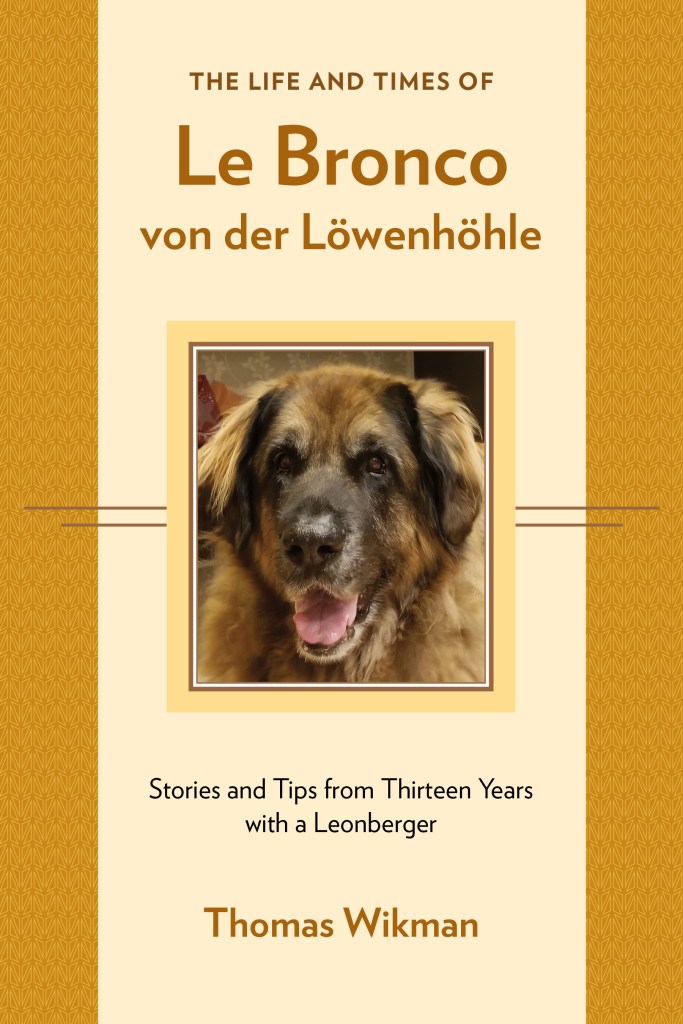

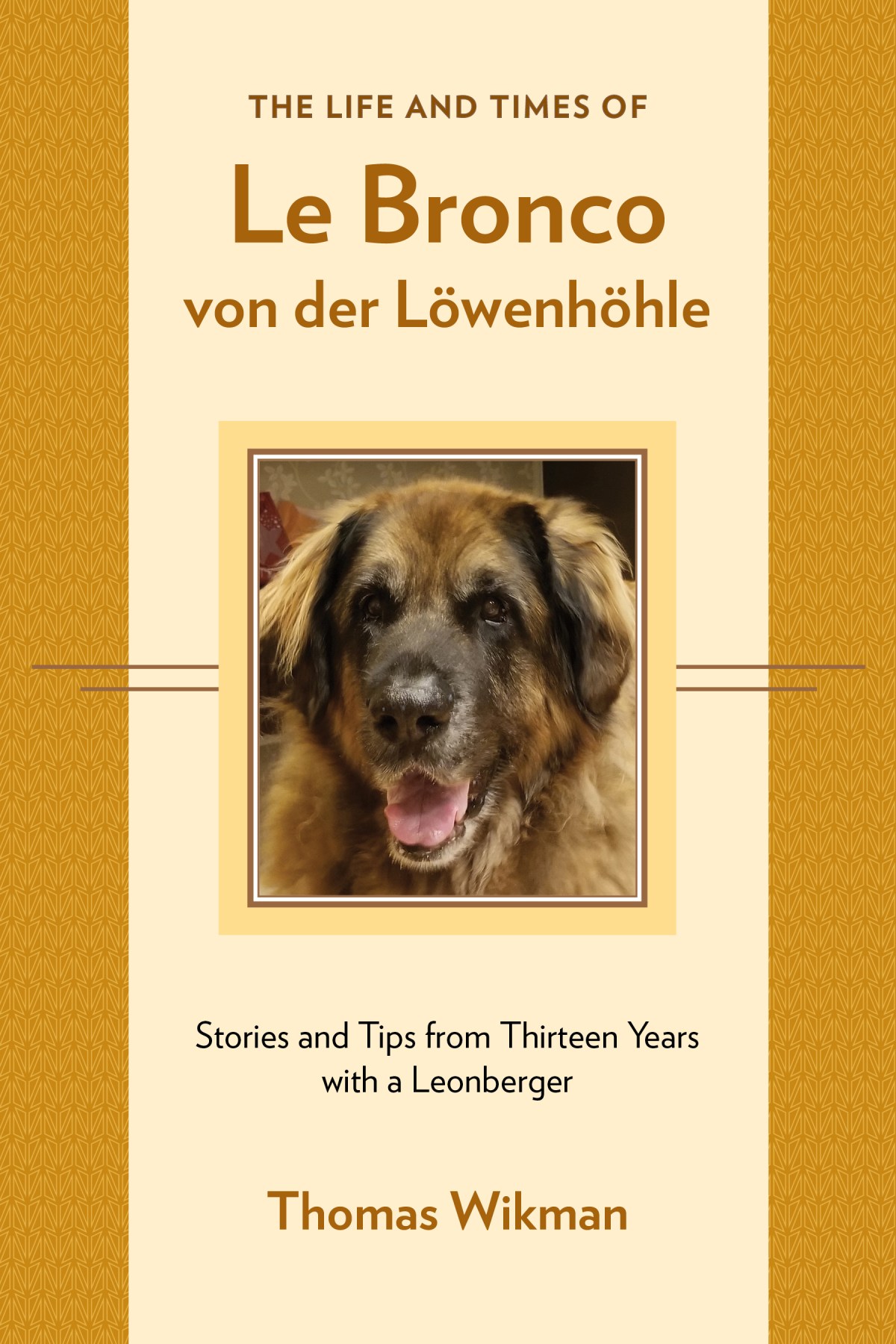
The gold and beige book cover features the face of our Leonberger Bronco and the text "The Life and Times of Le Bronco von der Löwenhöhle. Stories and Tips from Thirteen Years with a Leonberger."
This is the front cover of the book “The Life and Times of Le Bronco von der Löwenhöhle”. Click on the image to go to the Amazon.com location for the paperback version of the book.
The back cover in gold and beige features a photo of a Leonberger in a snowy forest and an introduction to the book.
This is the back cover of the book “The Life and Times of Le Bronco von der Löwenhöhle”. Click on the image to go to the Amazon.com location for the kindle version of the book.
The endorsements say “A wonderful tribute to the author's beloved Bronco. The stories are heartwarming as well as informative - a true glimpse into life with a Leonberger. D'Nae Wilson, President, Leonberger Health Foundation International.” and “A lovely tribute to Bronco, with lots of resources for general Leonberger information. Julie Schaffert, LCA breeder since 1992.”
These are the endorsements for the book. Click on the image to go to the Barnes and Noble location for the book.

In this book you’ll read about some of Bronco’s amazing feats: the night he scared away a prowler; the day he performed a hamster search and rescue; the time he stumped the Geek Squad; and the late night he snuck into the kitchen and ate a two-pound bag of dog treats, a box of pastries, a loaf of bread, a grilled chicken, and a Key lime pie, all in one sitting. You’ll also read about his unflappable calm during a north Texas tornado and his stoicism as he endured health challenges in his later years.

In addition to entertaining stories, these pages contain a wealth of practical guidance, including:

  • a history of the Leonberger breed;
  • advice for the care of very large dogs;
  • breed-specific health and genetic information;
  • training and feeding tips;
  • suggestions for finding a breeder;
  • the official breed standard; and
  • an extensive resource guide.

Below is a list of places where you can get my book.

The Leonberger Health Foundation International

The Leonberger Health Foundation International is an organization that supports science and research impacting Leonberger health, longevity and breed preservation. Examples of research they’ve supported include research on Addison’s Disease, Inherited Leonberger Polyneuropathy (LPN), LEMP research, the Rabies Challenge Fund, Osteosarcoma, Hemangiosarcoma, genetic causes of male (dog) infertility, Cryptorchidism, study of cruciate ligament repair, Glaucoma, cardiac diseases, thyroid disease, neurological disorders, longevity & aging, population diversity, juvenile renal dysplasia, anal furunculosis, the EGFR Immunotherapy Project, and Leonberger inherited Arrythmia. As mentioned above, a lot of the progress applies to other dog breeds as well.

LHFI’s global biobank contains DNA samples from more than nine thousand Leonbergers. Among the organization’s notable achievements are the eradication of Addison’s disease among Leonbergers and the raising of more than $650,000 for research into conditions that affect canine health. Another success is the fact that since 2011, no Leonbergers with two copies of the LPN1 gene mutation (which causes Leonberger polyneuropathy) have been recorded in LHFI’s biobank. LHFI does other things as well. LHFI grants an award called the Grey Muzzle Award to Leonbergers who reach the impressive age of 12 years. Leonbergers and other giant breeds tend to live short lives, something LHFI is trying to solve and they have made progress. One of the recipients of the Grey Muzzle Award was our Leonberger Bronco.
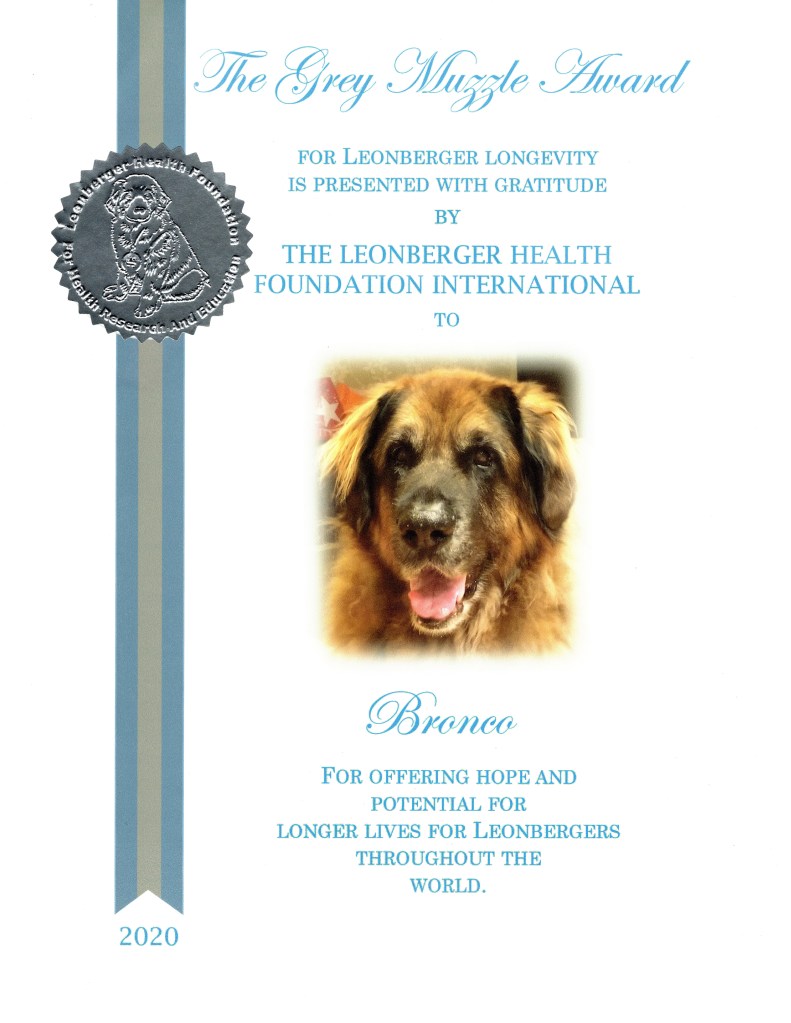
The picture shows our Leonberger Bronco’s Grey Muzzle Award. It says “The Grey Muzzle Award, for Leonberger longevity, is presented with gratitude by The Leonberger Health Foundation International To Bronco, For offering hope and potential for longer lives for Leonbergers throughout the world.”.
The Grey Muzzle Award from the Leonberger Health Foundation International.

Below is an 8-minute video explaining the ongoing research on sudden cardiac death in young Leonbergers.

IPA

The India Pale Ale, or IPA, is a very popular beer style, at least among beer connoisseurs. It is the beer style that I drink the most. The IPA is a type of Ale (fermented at warm temperatures, unlike, for example, lagers). It is typically a Pale Ale (exceptions are black IPAs). It was invented in England in the early 1800’s and became popular for exportation to India. It is characterized by its higher content of hops and the level of alcohol is often higher as well. More hops and more alcohol made it easier to preserve the beer for the trip to India.

A can of double Yellow Rose on the left. A can of Yellow Rose on the right. Both cans feature two ladies and a yellow theme. There are two IPA glasses in the middle containing each beer and two yellow lucia saffron buns.
Double Yellow Rose ABV 10.0%, IBU 90 (left) and Yellow Rose, ABV 6.8%, IBU 62 (right) both from Lone Pint, Magnolia, Texas. The flavor of both beers is mango, pineapple, orange, blueberry and then there is a grapefruit rind and pine resin like bitterness. The Double Yellow Rose has more pine resin like bitterness at the end. They are both delicious and so are the saffron/St.Lucia buns.

The aroma of the IPA is often floral, piney, and fruity, and it is less malty. If the flavor has fruity notes, it comes from the hops. The color can be light yellow, pale golden, reddish amber, brown or black. Just like lagers can be pale golden as well as black, so can IPAs, which combined with the fact that the beer advocate count 120 beer styles, is a good reminder that a broad classification of beers based on only color is not very helpful.

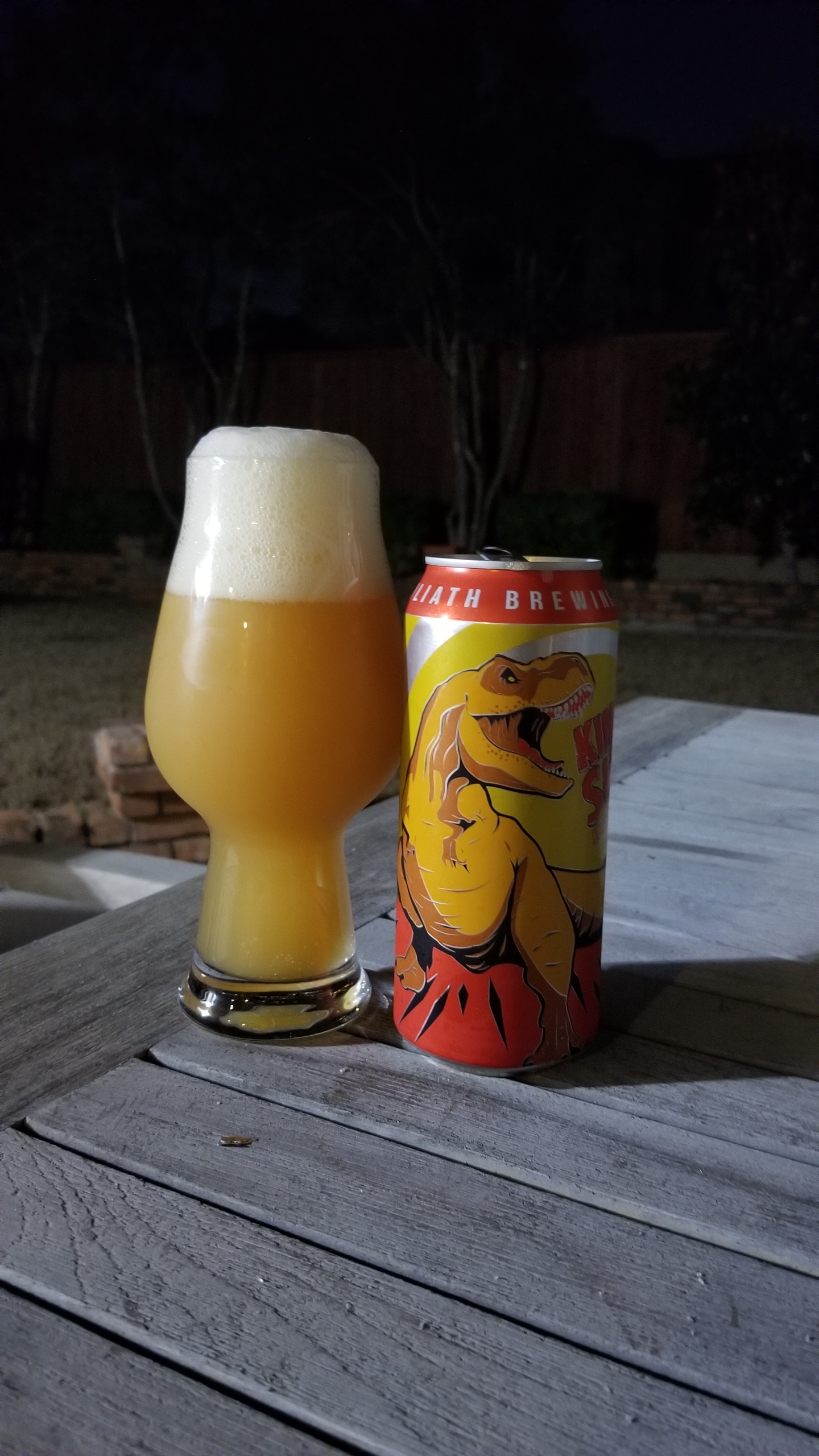
A glass filled with hazy pale golden beer  on the left with a can of King Sue on the right. There is a grill in the background.
King Sue is a New England style IPA from Toppling Goliath, ABV 7.80%. New England style means that is hazy and the flavor is fruitier with less bitterness than other IPAs (but certainly a lot more bitterness than lagers). The flavor is fruity plus some bitterness. I can taste mango, orange, pineapple, grapefruit and a grapefruit rind bitterness at the end. It is thirst quenching.

I tried to find out what share of the beer market IPAs have in the United States. I could not find that number, but I found out that in 2021 craft beer share of the American beer market was 26.8% and out of that IPAs share of the craft beer market was at least 40% (these two numbers according to statista), or 46% according to one source, which make the IPAs share of the American beer market at least 12.3%. It is probably closer to 20% since craft breweries aren’t the only ones brewing IPAs. I can add that craft beer is beer that is not mass produced, or not owned by large conglomerates. Examples are microbreweries and brewpubs.

A Scarborough Faire glass filled with Heady Topper IPA and the can to the right.
Heady Topper from the Alchemist, ABV 8.0%, IBU 100. It is the Imperial IPA that is ranked the highest in the world according to the beer advocate. If you like IPAs it is to die for. I can taste grapefruit and mango, citrus, and then a pine resin like hoppy bitterness. It is juicy, dank, bitter, in a good way, and thirst quenching.

Perhaps those among you who are Americans and were around in the 80’s remember the bitter beer face commercials. At that time beer was supposed to taste as little as possible. Bitter beer was to be avoided according to many. The IPAs have reversed that trend by making IPAs intentionally bitter, more bitter, and oh my golly super bitter having 100+ IBU. IBU stands for International Bitterness Units and brewers of IPAs often brag about the IBU, the more bitter the better. A public poll showed that more people prefer bitter beer over non-bitter beer.  Jabberwocky an IPA from Lone Pint below feature 117 IBU. Beyond 100-120 IBU the IBU scale begins to lose its meaning according to Wikipedia.

An IPA glass filled with Jabberwock IPA on the left and a Jabberwocky can on the right.
Jabberwocky from Lone Pint, Magnolia, Texas, ABV 8.5%, a very bitter beer that I love. The flavor is white bread, honey, it’s fruity with tart grapefruit, orange, and a dry tart bitterness like grapefruit rind and pine resin. Jabberwocky is quite bitter at the same time as it is fruity, juicy and dank. I think it is a delicious IPA.

The beer advocate divides the IPA style into American IPA (or Westcoast), Imperial IPA, New England IPA, Black IPA, Belgian IPA, English IPA, Brut IPA, and Milkshake IPA. The American IPA or Westcoast IPA is the most popular of the substyles and the most bitter. Imperial IPA is not really a substyle but just an indicator that it has more of everything including alcohol. The 120 minute IPA from Dogfish Head Brewery, is a very popular Imperial IPA with an ABV of 18%, IBU is 120. It is a bit sweet, very bitter in a good way, and this hides the alcohol, which is a bit dangerous.

A glass of 120 minutes IPA on the left and the bottle on the right. There is flip-flop shaped opener in the foreground.
It taste sweet, honey, dark fruits, plum maybe, grapefruit and then there’s a significant pine resin bitterness at the end. You can taste some booziness but not much for this ABV and it complements the overall flavor in a warming way.

Finally, miscellaneous IPA photos.