
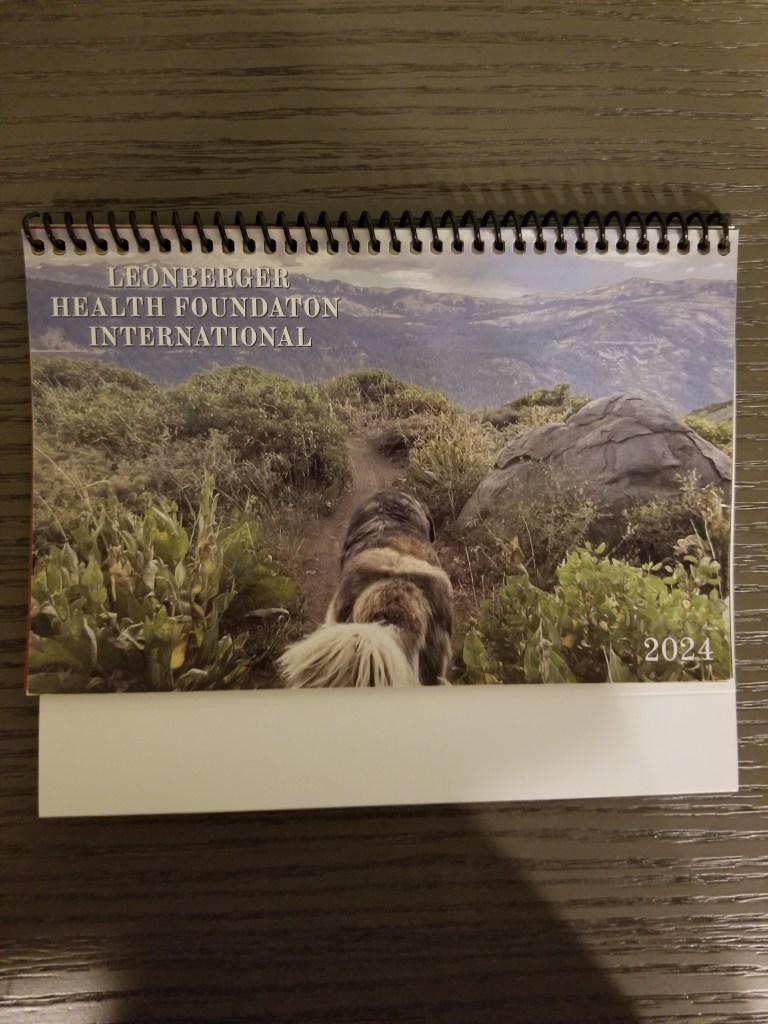
Today I received the Leonberger Health Foundation International (LHFI) Calendar for 2024 and I was reminded of this wonderful organization. LHFI supports medical research that improves the health and lives of Leonbergers as well as other large dog breeds, potentially even humans. They have raised nearly half a million dollars for research into conditions that affect canine health, including osteosarcoma, hemangiosarcoma, glaucoma, cardiac diseases, thyroid diseases, and neurological disorders. Its research also supports healthful longevity and aging as well as population diversity. They have had several successes, for example the eradication of Addision’s disease among Leonbergers.
The Leonberger Health Foundation International (LHFI) was founded in 2000 by Waltraut Zieher and other members of the LCA’s health, education, and research committee to “facilitate the solicitation and distribution of donations given to support health related breed-specific research.” The LHFI also administers a program that collects DNA samples from Leonbergers to share with universities and research institutions.

All purebred dogs are more or less inbred, which comes with inherent health risks. That is especially true for large breeds. However, Leonbergers, especially those bred in North America, are fortunate compared to other large breeds. The Leonberger breed standard does not call for traits that can be detrimental to health. The precise and restrictive breeding regulations of the Leonberger Club of America (LCA) and other Leonberger clubs, and the work of the Leonberger Health Foundation International or LHFI, have resulted in Leonbergers being relatively free of inherited illnesses compared to other large dog breeds in America. For more information see Humane Society Veterinary Medical Association, “Guide to Congenital and Heritable Disorders in Dogs,”

One happy event for our family was when Bronco received his Grey Muzzle Award, which is an award given for longevity by LHFI. LHFI bestows the award on any Leonberger who has reached the age of twelve. These Leonbergers are the canine equivalents of centenarians, humans who are at least one hundred years old. The Grey Muzzle Award is also given to breeders, because they are partially responsible for the dogs’ longevity. The Grey Muzzle Award was certainly a happy event in Wikman family. If you have a twelve-year-old Leonberger, simply fill out a form on the LHFI website or send an email to lhfgreymuzzle@gmail.com.

The foundation will ask for some information, including the registered name and call name of the dog; the breeder’s name, kennel name, address, and email; the dam’s registered name; the sire’s registered name; the owner’s name, address, and email; the birth date of the dog; and whether the dog is alive or dead. If the latter, they will want to know the cause of death. In addition, they would like you to write a one-paragraph tribute to the dog and send two (preferably high-resolution) photos—one head shot and one favorite photo. To find out more about the Grey Muzzle Award click here. To see the 2019–2020 awardees video featuring Bronco click here.

I can add that when Bronco passed away, we sent his DNA to the University of Minnesota to be used in research. This was facilitated by the LHFI.
Familiar faces. Time marches on.

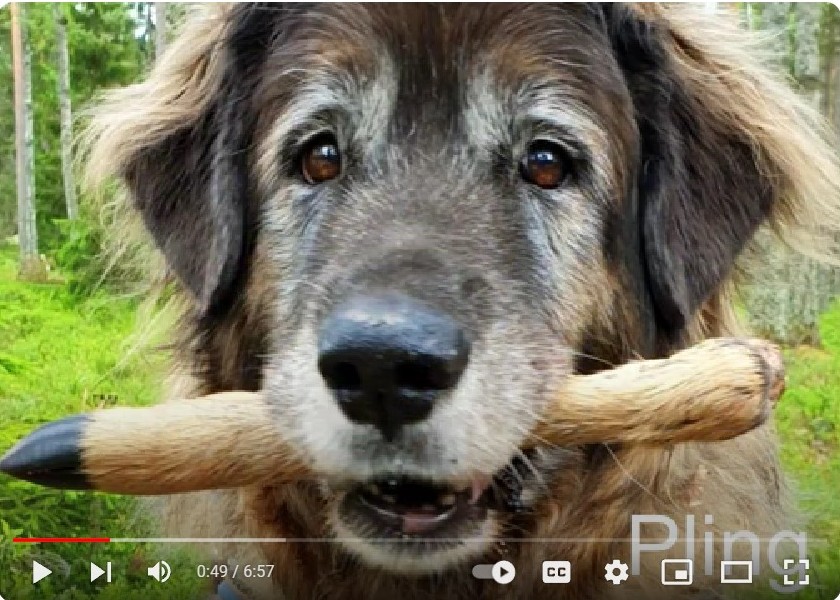
Many of the owners of very old Leonbergers joined the Double Digit Leonberger group on Facebook (Leonberger 10+ years old) and the owners of the extremely old Leonbergers (around 12 or older) started talking to each other a lot. It was a small group from around the world. This is why I said “Familiar faces” above. I knew many of them, including Pling, a Leonberger in Sweden. I and Pling’s owner talked a lot to each other in Swedish. Bronco and Pling reached about the same age and passed not too far from each other in time.


Note, all royalty earnings from my book (see right) go to the Leonberger Health Foundation International.
 Leonberger Life