The Leonberger Is a Rare Breed

The worldwide dog population is estimated to be 900 million, including 471 million dogs kept as pets, 200 million stray dogs. There are also village dogs, federal dogs and there are many millions of wild dogs such as wolves, coyotes, jackals, dholes, foxes (35 species). In the United States, 65.1 million households own at least one dog. There are at least 3 million Labradors around the world. The AKC currently recognizes 197 dog breeds. A close cousin of the Leonberger, the St. Bernard comes it as the 53rd most popular breed in the United States whilst the Leonberger comes in at place 102. This is a link featuring additional statistics.

Below is an excerpt from my book

According to an estimate prepared by BioMed Central, there were around 30,000 Leonbergers in the world in 2020. See Anna Letko et al., “Genomic Diversity and Population Structure of the Leonberger Dog Breed,” Genetics Selection Evolution 52, no. 61 (October 2020)

There are around 3,300 Leonbergers in North America, 2,300 in the United States and 1,000 in Canada. The five countries with the most Leonbergers, in order, are France, with nearly 8,000; Germany, with more than 4,000; and Great Britain, the United States, and Sweden, with approximately 2,300 each. The country with the highest number of Leonbergers per capita is Finland, with nearly 2,000 Leonbergers among a population of 5.5 million people. (Information from the October 2018 LeoLetter).

In summary, the Leonberger is a rare breed. However, a few times in history the Leonberger was not just a rare breed but close to extinction.
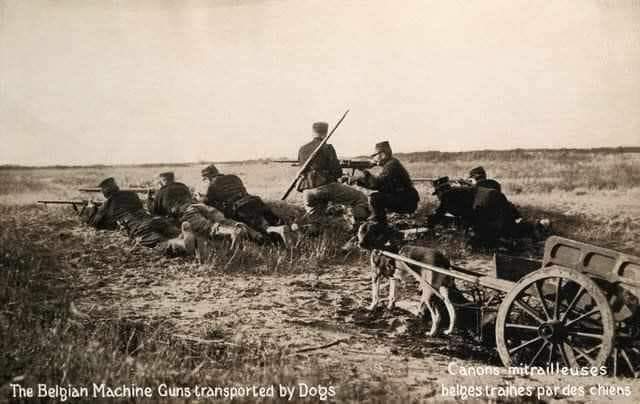
Photo of a Leonberger pulling a cart with guns and ammunition
Leonberger pulling a cart with guns and ammunition

World War I was tough on the breed. Some Leonbergers were used to pull ammunition carts and small cannons during the conflict, and others were left to wander unattended. Often, these dogs starved to death. But after the war, two Leonberg businessmen, Karl Stadelmann and Otto Josenhans, worked hard to save the breed. They scoured the countryside looking for Leonbergers who were still alive. They were able to find twenty-five of them whose owners were willing to cooperate in reestablishing the breed. Of these, only five were suitable for breeding. None of the Leonberger clubs had survived, so they founded a new one in 1922 called Deutsche Club für Leonberger Hunde (DCLH), and Stadelmann created an updated version of Albert Kull’s breed standard.

I’ve read that World War II was even more devastating to the breed. Supposedly there were only eight Leonbergers left in the world after the end of the war, and all Leonbergers today are descendants of those eight surviving Leonbergers. That’s once again a fascinating and simple story that’s easy to remember and spread, but the truth is rarely simple.

The Leonberger, like so many other dog breeds, was devastated by World War II—kennels were destroyed; dogs were left unattended or used for food—but Leonbergers weren’t used in the war effort itself, and there were more than eight left afterward. However, there was indeed a “genetic bottleneck” of Leonbergers in the 1940s, meaning that the population was greatly reduced in size, limiting the genetic diversity of the species. This was largely because people repeatedly bred the dogs they thought were the best specimens in a misguided attempt to improve the breed. Of course, for breed (and species) health, you need diversity. Scientific pedigree analyses demonstrate that the Leonberger has twenty-two founder animals, or animal ancestors unrelated to one another (ten males and twelve females).

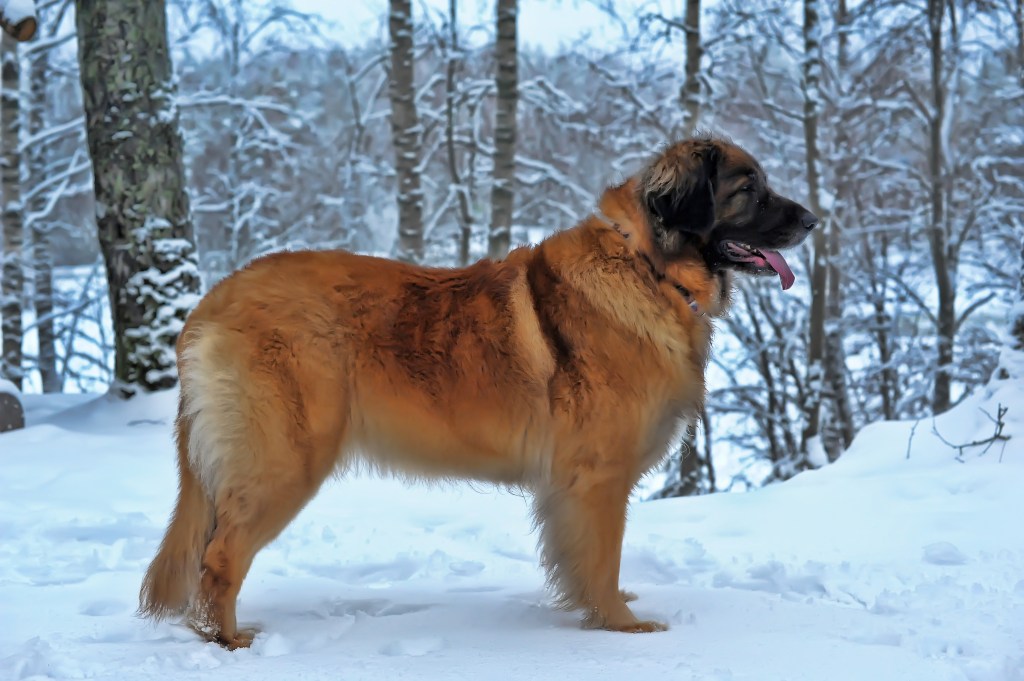
Photo of our Leonberger Bronco at 3 months old, in black and white
Our Bronco at 3 months old, in black and white
Photo of Leonberger in a snow covered forest
Leonberger in snow (purchased from shutterstock ID:705193912 by Anna Krivitskaya.)
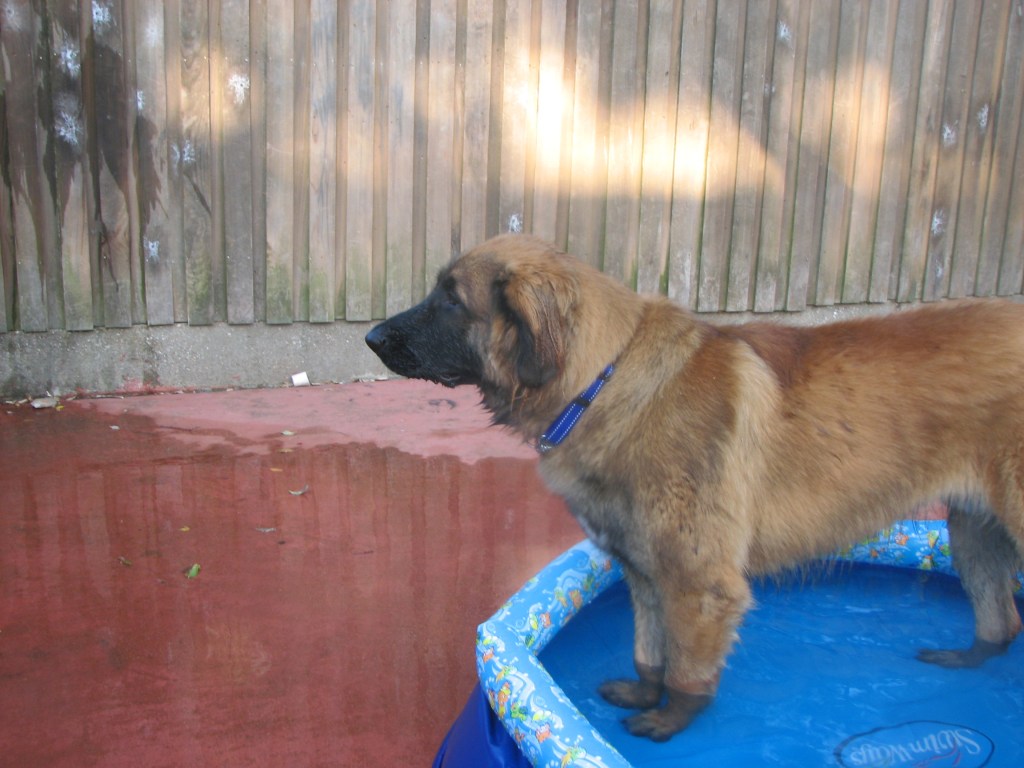
Our Bronco standing in a kiddie pool

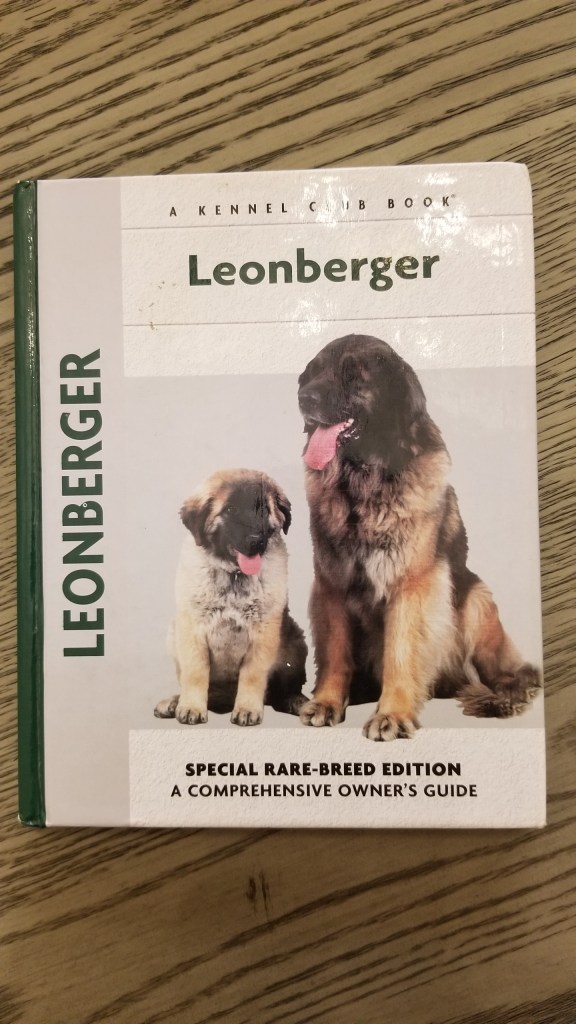
Leonberger Special Rare Breed Edition

This is the second Leonberger book review on my blog. This time I am reviewing Leonberger, Special Breed Edition, a comprehensive owner’s guide, by Madeline Lusby, ISBN 978-1593783143. This is a Kennel Club book and part of a large series of dog breed books (167 books). You can buy it from Amazon and Barnes & Noble and it exist in both printed version (hardcover) and e-Book (kindle/nook). It is not expensive $9.95 on Amazon for a used hardcover version and $24.99 for the kindle version (nook a little cheaper). It appears that you can no longer buy it new (as I did). I remember buying the book new for $24.95. It is 155 pages, in a medium sized format (6.75 x 0.75 x 8.25, 1.27 pounds) and it is in color.

Photo of the book Leonberger, Special rare breed edition, by Madeline Lusby.
Leonberger, Special rare breed edition, by Madeline Lusby. Click on the photo to go to the Amazon page for the book.

This book was published in 2005 before the Leonberger breed was recognized by the AKC and therefore there was no Leonberger AKC breed standard at the time. However, the FCI Leonberger breed standard certainly existed, and it is still the most prominent Leonberger breed standard. I was very impressed by the image summarizing the FCI Leonberger breed standard on the inside front cover (see below). I should mention that FCI (Féderation Cynologique Internationale) is the international organization that defines the dog breeds. However, some local organizations, such as the AKC (American Kennel Club) have their own breed standards that typically exactly match (but differ in language) or very closely match that of the FCI.

Photo of the inside cover of the book Leonberger, a Kennel Club book. It features the FCI (Féderation Cynologique Internationale) breed standard illustrated.
The FCI (Féderation Cynologique Internationale) breed standard illustrated

As the front cover states this is a pretty comprehensive book on Leonbergers. Due to the age of the book a few of the chapters may not be up to date, but overall, the book contains useful information for all Leonberger owners or potential owners. Leonberger history is interesting and fascinating, and this book contains some Leonberger history even though some of the claims should be taken with a grain of salt. For example, there is no proof that Leonbergers were used to pull ammunition carts during World War II as they were in World War I. There are chapters on the characteristics of the Leonberger, the breed standard, the Leonberger puppy, proper care, training, healthcare and the showing of your Leonberger. The chapter on healthcare is detailed and very well written and organized with nice sidebars, illustrations and photos. Unfortunately, this chapter is also a bit outdated. As the book points out, a Leonberger is not for everyone. Do you have the time and money to take care of it? Do you have the space? You can find out if a Leonberger is right for you by reading this book.

Overall, the book is well written, well organized and professionally made. There’s amusing anecdotes, and it is filled with interesting and beautiful photographs, tables, illustrations and colorful sidebars and notes. It was a pleasure reading it and despite its age and some inaccuracies I highly recommend this book. I gave it five stars.