


The focus of this blog is Leonberger dogs but sometimes I write about other things, for example, about myself. This time I am responding to the daily Writing prompt “Which languages do you speak and how did that impact your life?”.
Swedish or Norrlandish
My native language is Swedish because that is where I was born and grew up. Since I lived in northern Sweden, I speak Swedish in a dialect referred to as Norrlandish. I was told by a Dutch linguist that Norrlandish is different enough from main Swedish that Norrlandish could be considered its own language, especially in the region where I grew up where the Norrlandish dialects are especially distinct. He was very familiar with the local variants of my dialect, which I found to be amazing. I was also amazed by the fact that he spoke so many languages. If I don’t remember incorrectly this linguist claimed that he spoke 30 languages.
Anyway, languages evolve, including Swedish. Things like Television, local travel, etc., tend to dilute and evolve dialects. However, I’ve been in the US for a few decades, and I’ve lived in Texas for 25+ years, which means that the way I speak Norrlandish has not evolved much, which has led to some interesting situations.
For example, once when I was shopping at a local grocery store in northern Sweden the cashier told me, “It is so nice to hear someone who still speaks the old way”. She was curious about how I had managed to keep the old dialect, and she asked me where I was living. Maybe she expected me to live in a cabin deep in the forest without a TV or radio. It was obvious from her reaction that she did not expect “I live in Dallas, Texas”.
Now I speak American or as some call it English

One of the languages I studied back in school was English. The other was German. My parents did not speak any English, well, at first. However, my dad took English classes as an adult and was able to get by. My guess is that when I was done with school, I spoke English at the B1 level, possibly B2 level, according to the Common European Framework of Reference for Languages, which rates your language skills in any language from A1 to C2 (A1 is beginner, then comes, A2, B1, B2, C1, C2, C2 is like a native speaker).
B1 means that you can participate in a conversation with some difficulty, understand a newspaper article that does not have difficult language, write a short essay on any unexpected topic using multiple tenses, and understand a radio newscast that is not too fast.
In 1987 I was sent to Case Western Reserve University by my University, Uppsala University, Sweden, as a university level exchange student for one year. I was studying electrical engineering and physics. During that year I met my wife and after living in both the US and Sweden we ended up staying in the US. I had some difficulties with my English at first but with respect to learning a different language nothing beats being embedded in the language and I soon spoke and understood English I think pretty well. The type of English that we had studied in Swedish school was British English, but now the English that I absorbed was American English. Thereof the tongue in cheek of the title of this section.
I view being fluent in the main language of the country you live in to be of high importance. I have no problem understanding, speaking, reading or writing in English. However, it is very difficult to lose your accent when you have learned a new language as an adult. Just think of Arnold Schwarzenegger. Children can do it more easily. They say that the cut-off age is 12 years old. It is quite uncommon for people who are not fluent in at least two or more different languages to grasp this. On several occasions people have expressed their surprise over the fact that I still have an accent. Sorry the accent stays, and it is not my choice. You can read a related post “Accents are very difficult to lose” over at my second blog.
Another second language fact that you will find in that post is that Spanish has 74 million non-native speakers in the world, making it number eight with respect to the number of non-native speakers (second language). Oh, you thought it was the most popular second language in the world after English? Well, that is a common misconception here in the US due to the closeness to Latin America. I have often come across people who do not consider me bilingual just because I don’t speak Spanish. There are thousands, actually millions, of ways of being bilingual.
Now I am learning French

My wife has a sister in France and her parents speak French. When she decided to improve her French by taking French lessons for adults, I joined in with her. I don’t know if it is because of age, or because I am not putting in enough time into it, but it is going slow. However, I did pass the French B1 exam, which means I can participate in a conversation with some difficulty, understand a radio broadcast if they don’t speak fast, read a newspaper, and write short essays in French. However, I don’t think I can become fluent in French unless I somehow stay in France, or another French speaking country for some time.
So far, my experience in French has not been of very high importance to me. However, it is a hobby, it is something interesting that my wife and I can do together, and French speakers cannot speak behind my back without me knowing.
Speaking Dog




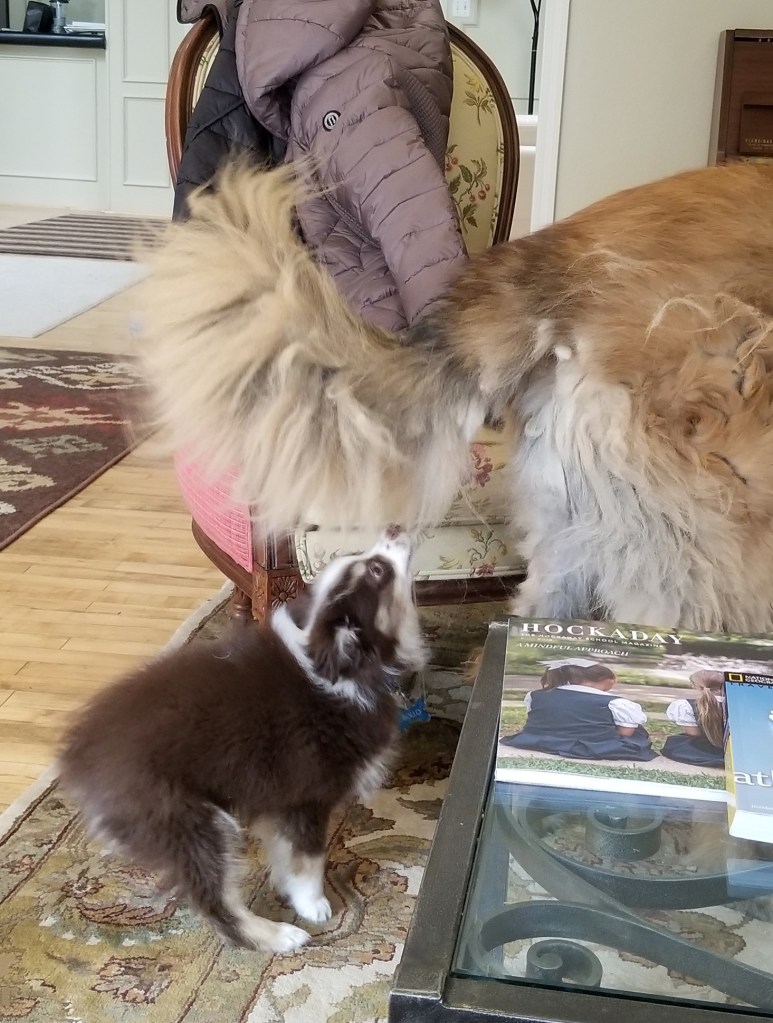
Dogs don’t speak human languages, but they can understand many words and react to them. Some dogs such as our mini-Australian Shepherd Rollo understand several hundreds of words. If you tell him, “Rollo go look out the window”, he goes and looks out the window. If you tell him, “We are going to Jack and Etty”, he starts screaming happily and running around in circles, because he knows he will get snacks there. If you say “bribe” he comes running expecting a handout, just like a politician. I could go on.
Dogs don’t speak with words, but they express themselves through body language and different kinds of barks, and if you pay attention, they can tell you a lot. For example, when Rollo lays down on his side and lets out one loud bark, he wants a belly rub. When it is 4PM and he starts staring at me, he wants dinner. When I am sitting in the sofa and he scratches my leg with his paw, it means, “move over so I can sit in the sofa”. So, you could say I also speak Dog. Sometimes people call me the dog whisperer, which I like to hear. Well, except for the sarcastic tone.


I know some french, some Spanish, and some irish, but I don’t speak Irish, my native language, fluently, i hated irish in school. X
LikeLiked by 1 person
Oh yes I know that Irish or Irish Gaelic as some call it, is very different from English. Learning a second language is huge project and if you don’t like it, it is a much harder.
LikeLike
It’s great to know more than one language. It’s also very useful to speak dog.
LikeLiked by 1 person
Thank you Darlene. You are so right on both points.
LikeLiked by 1 person
I loved languages at school and wished I’d kept up with them. I think it’s great to know more than one language – and dog is essential!
LikeLiked by 1 person
Thank you so much Esther. Knowing languages can be very useful and like you say speaking dog is essential. It is great that you loved languages in school. I did not. I detested learning English. I thought it was such a weird langiage. I think I was almost the worst in the class. Well, I think Gunnar was worse. I thought German was easier. But here I am having no problem with it. It requires a lot of work to learn a language though.
LikeLiked by 1 person
It really does. I learned French, German and Latin. English isn’t an easy language at all!
LikeLiked by 1 person
That is amazing, especially that you learned Latin. I guess I had a harder time with English compared to other students because I did not listen to popular music, which was often in English, and I did not see a lot of movies at the cinema. The movies at the cinema were often in English with subtitles. I pretty much stayed with Swedish only when I was young. But you are right, English is also not an easy language to learn.
LikeLiked by 1 person
I speak English and German, and can get by in French and Spanish. But best of all, I speak dog, cat, bird, squirrel, and raccoon. I do not speak snake or spider.
LikeLiked by 1 person
That is great Anneli. Dog, cat, bird, squirrel and racoon in addition to English and German and some French and Spanish. That is certainly a lot of languages. You could be a linguist.
LikeLiked by 1 person
Haha.
LikeLiked by 1 person
Good for you. I love languages. I think he more languages people can speak the better. But out of all the languages, I think speaking DOG is the best. 🙂
LikeLiked by 2 people
I think that’s pretty good too.
LikeLiked by 2 people
Yes I agree
LikeLike
🙂
LikeLiked by 2 people
Thank you Jeannie. You are right, speaking dog is the best, and learning to speak some languages is a great thing. It is wonderful that you love languages.
LikeLiked by 1 person
🙂 🙂 🙂
LikeLiked by 1 person
I love how Rollo communicates. Dogs are so smart. 🙂
LikeLiked by 1 person
Thank you so much Kymber. Yes I have to say that Rollo is probably the smartest dog we’ve ever had, as well as the most difficult dog we’ve ever had. We are his little flock of sheep.
LikeLiked by 1 person
it’s a great language for humans to learn
LikeLiked by 1 person
I agree, speaking dog is very important.
LikeLiked by 1 person
I am not a natural with languages, but I slogged my way through French and Russian. Dog was easy!
LikeLiked by 2 people
I am not a natural with languages either. I really had to struggle with English and now French. I had an easier time with German but since I did not keep up with it I forgot most of it. Russian seems like a difficult language, at least for a west-north European. Dog is the best language.
LikeLiked by 1 person
*Title:*
*Prayer For Good Health & A Sound Mind | Daily Christian Prayer Request*
Heavenly Father,
I come before You today asking for good health and a sound mind.
Touch my body, Lord. Heal every sickness, every pain, every weakness. Let Your life flow through my bones, my blood, my organs. Make me strong from my head to my feet.
Guard my mind, God. Take away fear, anxiety, and negative thoughts. Fill my mind with peace, joy, and clarity. Help me think right, speak right, and make wise choices.
Your Word says in *2 Timothy 1:7* – _“For God hath not given us the spirit of fear; but of power, and of love, and of a sound mind.”_
I receive that sound mind today. I receive that good health today. I will not be sick. I will not be confused. I am strong in You.
Thank You Father, because You have heard me. In Jesus’ name, Amen.
*Prayer Request*: If you need prayer for your health or mind today, comment “Amen” below. God sees you.
LikeLiked by 1 person
Did you read my post?
LikeLiked by 1 person
Yes dogs and other animals say a lot when we listen!
LikeLiked by 1 person
You are so right Sara. You have to pay attention.
LikeLiked by 1 person
Very much so!
LikeLiked by 1 person
A fun post, Thomas. I took six years of French in school and when I traveled to France most turned up their nose and said “Eh?” when I attempted to speak. I understand the French are insulted by the American accent so unlike outer countries they are not impressed if you try. Maybe your accent will be thought of more favorably.
LikeLiked by 2 people
I found much the same response, John. Snickering at my efforts to speak French instead of helping me and showing me the right way to say something.
LikeLiked by 2 people
I am sorry you had that experience Anneli. I wonder how long ago this was. I think it is much better now. When I visited France 40 years ago, when I was young, I could not speak any French and I was just observing others and I did not get a good impression. However, to me it seems much better now, but now I can speak some French, with a Swedish accent.
LikeLike
You’re right, Thomas. It was a very long time ago. I would hope that things have changed for the better now. Probably they have.
LikeLiked by 1 person
Yes, I think because the French have started to learn English in school, thus realizing that learning a foreign language is indeed a big deal that you should respect.
LikeLiked by 1 person
😊
LikeLiked by 1 person
Well, my French teacher thinks my accent is funny and she laughs sometimes. It is definitely different from and American or English accent. My wife lived in France as a kid, and even though she needs to improve her vocabulary and grammar, etc., her accent is perfectly French. It is that being a kid while learning a language magic. My guess is that it was a while ago since you were in France. Back then the French did not speak English and they did not look favorably on other languages. Now they’ve learned English in school and are much more open to other languages, including English. I think you might have a different experience now.
LikeLiked by 1 person
Yes it was back in the 90s
LikeLiked by 1 person
Yes that was before the French had started taking other languages like English seriously. The problem now though is that the French are so eager to practice English, or show that they know it, that they will switch to English when you speak French, so you just say, well I want to practice my French, S’il vous plaît, je veux pratiquer et améliorer mon français.. They can practice English when it is their turn.
LikeLiked by 1 person
I won’t likely get to France again, but if I do, I’ll give it a try. When I worked for Bayer, I took German lessons, but sadly, the language of commerce at Bayer is English, so like you say, I had to find folks who wanted to practice English in order for me to practice German. (sometimes beer was involved)
LikeLike
I took French in high school but remember very little of it. My husband grew up with his dad and grandma speaking Italian around him, but he didn’t remember enough for it to help when we visied in Italy. 🙂 I’m always impressed when people can retain several languages. It is definitely good to speak dog!
LikeLiked by 1 person
Yes if you don’t use it, you loose it. I took five years of German in high school and I could speak it with some difficulty. However, I’ve never used it and now I’ve forgotten how to speak it. I am not even A1 level. Learning a language and retaining it require a lot of work. I agree, it is definitely good to speak dog!
LikeLiked by 1 person
Your comment about Rollo being like a politician is very funny. It’s nice to speak a pure version of your own language as well as English and French. I picked up a lot of words in French while in France and Belgium. I can read Dutch and understand it if it’s spoken slowly.
LikeLiked by 2 people
Ha ha thank you Robbie. Yes bribing dogs with treats is typically a good way of getting them to behave the way you want. Dogs and politicians have a lot in common that way. 40 years ago, when I was young, I visited France but I picked up nothing. I have a hard time learning languages. It takes me a lot of work. My guess from what you are saying makes me think you have an easier time. I am impressed that that you can read Dutch and understand it if it’s spoken slowly. My guess is that it is because of Afrikaans?
LikeLike
Hi Thomas, yes, Afrikaans is quite similar to Dutch and Flemish and I can read and understand Afrikaans well 💓. I know some French and Zulu but I don’t consider myself to be good at learning languages. I wish I knew more but art and writing take all my spare time ✍️🧑🎨
LikeLiked by 1 person
Wow English, Afrikaans, Flemish, Dutch, French, Zulu, you are definitely good at learning languages.
LikeLike
Ah. Americanese. But which dialect? I speak with a Yankee twang, I’m told, but since I don’t listen to myself I have to take their word for it.
Interesting about Norrlandish. I listen to a band called Raubtier. Among their songs is one “från Norrlands til Helvete port” (I believe.) now I have some context, I think.
LikeLiked by 1 person
Yes I guess that is like in Boston. I wonder what the Dutch linguist I spoke to would say about the different dialects here in the US. I’ll bet that he might consider the Texan English that people speak out in the Texas country side to be a different language.
M R ducks: “‘Em are ducks.”
M R not: “‘Em are not.
“O S M R: “Oh, yes, ’em are.
“C M Wangs: “See ’em wings?”
L I B, M R ducks!: “Well, I’ll be, ’em are ducks!”
Anyway, I had nor heard about Raubtier before. I have not followed that kind of music very well but I saw they are from Haparanda, definitely Norrland.
LikeLiked by 1 person
Fair enough! I’m trying to get away from metal. Southern English definitely feels like another language.
LikeLiked by 1 person
Yes maybe it is. I should say that the English / American spoken here in Dallas where I live is not very “southern”. It is pretty mainstream. Think about how Owen and Luke Wilson speak. They grew up around where we live and my kids went to the same school as they did (well Owen was kicked out in high school). However, out in the country side (I used to take the kids hunting), the southern accent is strong.
LikeLiked by 1 person
Interesting. Not how I would have imagined it! But. Most of my experience with Southerners comes from Virginian immigrants to Maine. Good people – different but good.
LikeLiked by 1 person
I should say the south is big and Virginians don’t speak like country side Texans, East Texans (towards Louisiana) don’t speak like Texans farther west.
LikeLiked by 1 person
I know (kind of). I shouldn’t even compare. I’m told Virginia is the North of the South. But, to me they seem ελλ, southern.
LikeLiked by 1 person
Yes I guess you live in New England
LikeLike
Indeed, I do.
LikeLiked by 1 person
Nice place. I’ve been to New York, Boston, Connecticut, Maine several times, as well as New Hampshire and Vermont. I was in Massachusstts during hurricane Sandy.
LikeLiked by 1 person
Yes. I’m partial to us. Maine, Southern Maine, is my digs. I’ve been to each of the others but Rhode Island. It’s easy to miss.
LikeLiked by 1 person
I think I’ve been to all the New England states including Rhode Island, but only as a visitor. I’ve never lived there. I forgot to mention Rhode Island but my wife and I spent a few days of vacation in Connecticut and Rhode Island.
LikeLiked by 1 person
I’ve seen the not so hot parts of CT en route to NY. I hear good things about RI, though.
LikeLiked by 1 person
Java Bean: “Ayyy, our Dada took three years of Spanish, but can he speak a word? ¡No, no puede!”
LikeLiked by 2 people
Ha ha Java Bean. Three years of Spanish, in school, is not going to make a big difference, especially if you don’t continue using it. Just ask me about my five years of German in school. Ein, zwei, drei….I don’t remember much else.
LikeLike