This blog feature amusing and heartwarming stories about our late Leonberger dog Bronco, as well as other Leonbergers. It also has a lot of information about the Leonberger breed, the history, care, training, Leonberger organizations, etc. I also wrote a Leonberger book, which I am featuring in the sidebar.
In this post I am posting three videos that I like, first, an interesting informational video about Leonberger dogs Second a song video featuring a Swedish lullaby about a wolf. Wolves are after all close relatives of dogs and our Leonberger Bronco was accused of being a wolf. The third video from the Britain got talent show, feature a Leonberger, Hagrid making a world record in sausage eating.
First video: It is an AKC informational overview of Leos featuring Leonberger breeder Alida Greendyk, von Alpanese Leonbergers. The video is 4 minutes 25 seconds.
AKC video with Alida Greendyk, von Alpanese Leonbergers
Second video: This music video, feature Vargsången or the wolf song, a Swedish or Nordic Lullaby. Dogs, Canis Lupus Familiaris, are descended from wolves Canis Lupus, and they have a lot in common. Our Leonberger Bronco was accused of being a wolf by an alarmed boy at PetSmart. We handled it well, so don’t worry. Bronco has been accused of being both a wolf and a bear, but as far as I can remember not a lion, despite the fact that Leonbergers were bred to resemble the Lion on the coat of arms of the town of Leonberg. I guess Germans are bad at drawing lions.
The song is about a woman protecting her child from being eaten by a wolf, but notice that despite that, there is empathy expressed in the song for the hungry wolf and his aching stomach. The existence of the stomach creates conflict between creatures in our world, and it’s been that way billions of years before humans entered the picture. The landscape is from northern Sweden where I am from. The singer is Jonna Jinton. The video is 4 minutes and 20 seconds….notice to get English subtitles you may have to change your YouTube settings.
Varsången with Jonna Jinton
Third video: is about a Leonberger named Hagrid who appeared on Britain’s Got More Talent in 2017, and other places. Hagrid was attempting to set a new Guinness world record for catching the maximum number of sausages in his mouth in the shortest period of time. You can watch Hagrid’s attempt below. The video is 4 minutes and 46 seconds.
The worldwide dog population is estimated to be 900 million, including 471 million dogs kept as pets, 200 million stray dogs. There are also village dogs, federal dogs and there are many millions of wild dogs such as wolves, coyotes, jackals, dholes, foxes (35 species). In the United States, 65.1 million households own at least one dog. There are at least 3 million Labradors around the world. The AKC currently recognizes 197 dog breeds. A close cousin of the Leonberger, the St. Bernard comes it as the 53rd most popular breed in the United States whilst the Leonberger comes in at place 102. This is a link featuring additional statistics.
Below is an excerpt from my book
According to an estimate prepared by BioMed Central, there were around 30,000 Leonbergers in the world in 2020. See Anna Letko et al., “Genomic Diversity and Population Structure of the Leonberger Dog Breed,” Genetics Selection Evolution 52, no. 61 (October 2020)
There are around 3,300 Leonbergers in North America, 2,300 in the United States and 1,000 in Canada. The five countries with the most Leonbergers, in order, are France, with nearly 8,000; Germany, with more than 4,000; and Great Britain, the United States, and Sweden, with approximately 2,300 each. The country with the highest number of Leonbergers per capita is Finland, with nearly 2,000 Leonbergers among a population of 5.5 million people. (Information from the October 2018 LeoLetter).
In summary, the Leonberger is a rare breed. However, a few times in history the Leonberger was not just a rare breed but close to extinction.
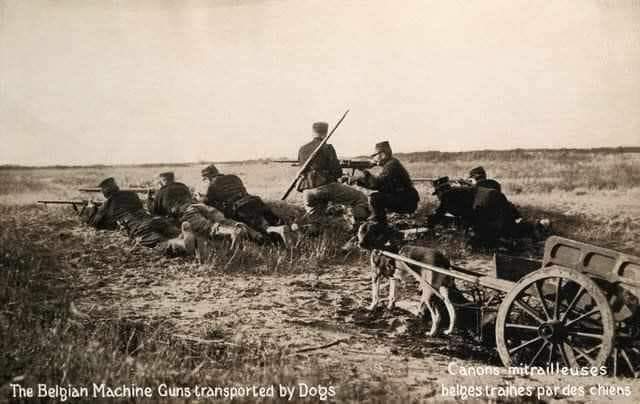
Leonberger pulling a cart with guns and ammunition
World War I was tough on the breed. Some Leonbergers were used to pull ammunition carts and small cannons during the conflict, and others were left to wander unattended. Often, these dogs starved to death. But after the war, two Leonberg businessmen, Karl Stadelmann and Otto Josenhans, worked hard to save the breed. They scoured the countryside looking for Leonbergers who were still alive. They were able to find twenty-five of them whose owners were willing to cooperate in reestablishing the breed. Of these, only five were suitable for breeding. None of the Leonberger clubs had survived, so they founded a new one in 1922 called Deutsche Club für Leonberger Hunde (DCLH), and Stadelmann created an updated version of Albert Kull’s breed standard.
I’ve read that World War II was even more devastating to the breed. Supposedly there were only eight Leonbergers left in the world after the end of the war, and all Leonbergers today are descendants of those eight surviving Leonbergers. That’s once again a fascinating and simple story that’s easy to remember and spread, but the truth is rarely simple.
The Leonberger, like so many other dog breeds, was devastated by World War II—kennels were destroyed; dogs were left unattended or used for food—but Leonbergers weren’t used in the war effort itself, and there were more than eight left afterward. However, there was indeed a “genetic bottleneck” of Leonbergers in the 1940s, meaning that the population was greatly reduced in size, limiting the genetic diversity of the species. This was largely because people repeatedly bred the dogs they thought were the best specimens in a misguided attempt to improve the breed. Of course, for breed (and species) health, you need diversity. Scientific pedigree analyses demonstrate that the Leonberger has twenty-two founder animals, or animal ancestors unrelated to one another (ten males and twelve females).
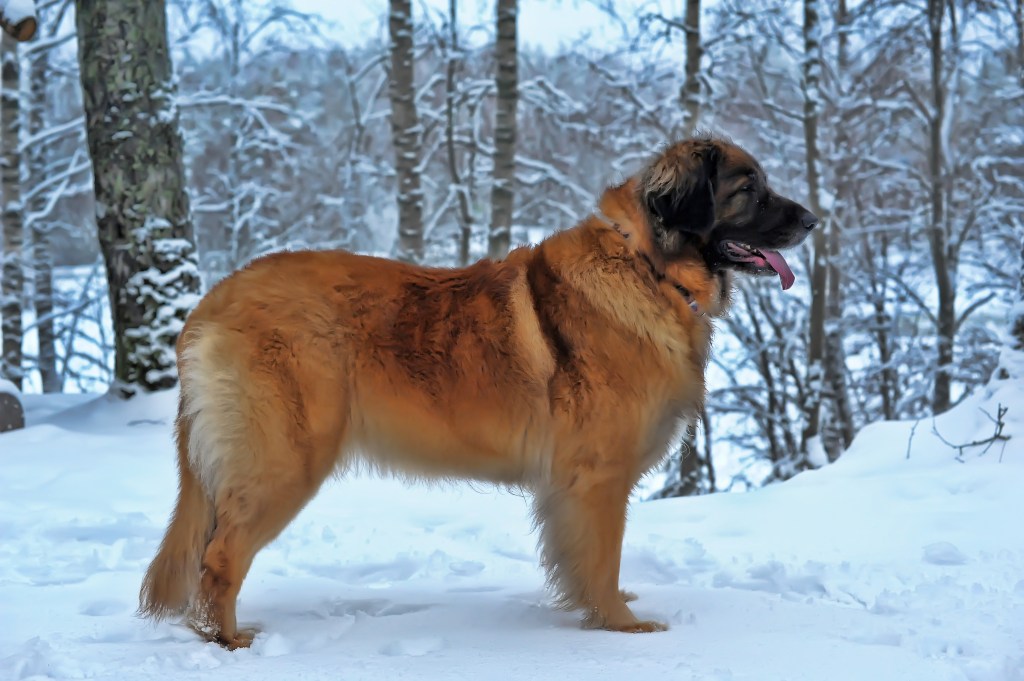
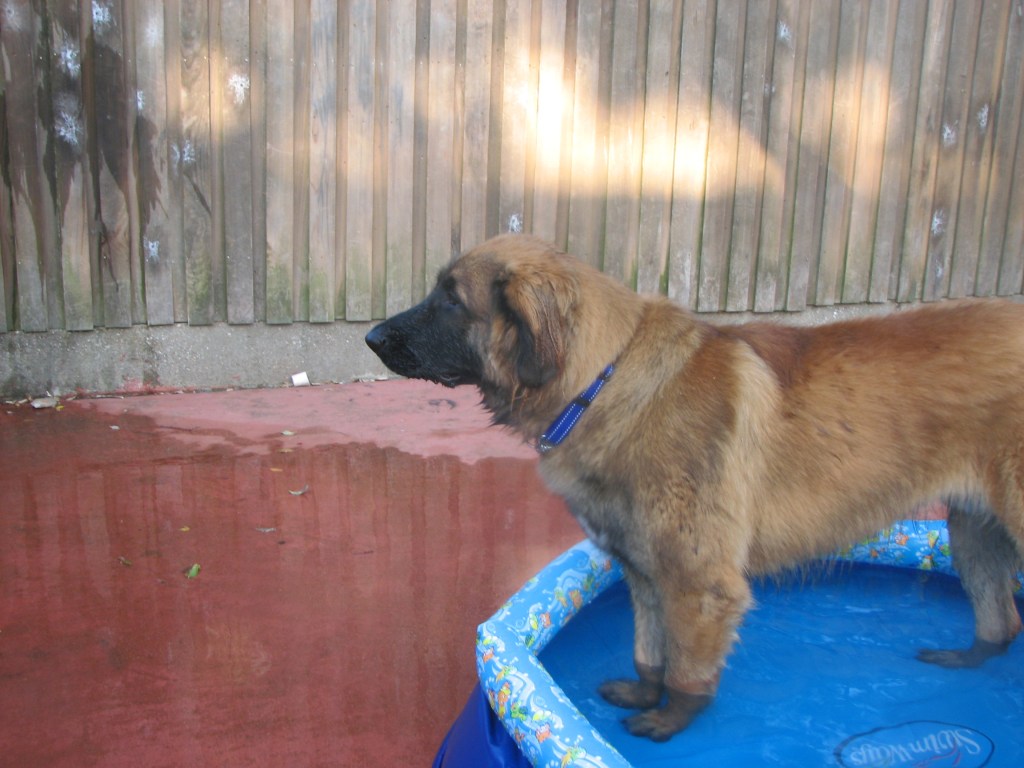
Our Bronco at 3 months old, in black and whiteLeonberger in snow (purchased from shutterstock ID:705193912 by Anna Krivitskaya.)Our Bronco standing in a kiddie pool
Today is Veterans Day, a day with roots in Armistice Day from World War I. Did you know that the Leonberger dog almost went extinct during World War I? Below is a short excerpt from my book.
World War I was tough on the breed. Some Leonbergers were used to pull ammunition carts and small cannons during the conflict, and others were left to wander unattended. Often, these dogs starved to death. But after the war, two Leonberg businessmen, Karl Stadelmann and Otto Josenhans, worked hard to save the breed. They scoured the countryside looking for Leonbergers who were still alive. They were able to find twenty-five of them whose owners were willing to cooperate in reestablishing the breed. Of these, only five were suitable for breeding. None of the Leonberger clubs had survived, so they founded a new one in 1922 called Deutsche Club für Leonberger Hunde (DCLH), and Stadelmann created an updated version of Albert Kull’s Leonberger breed standard from 1895. To find out what a breed standard is click here.
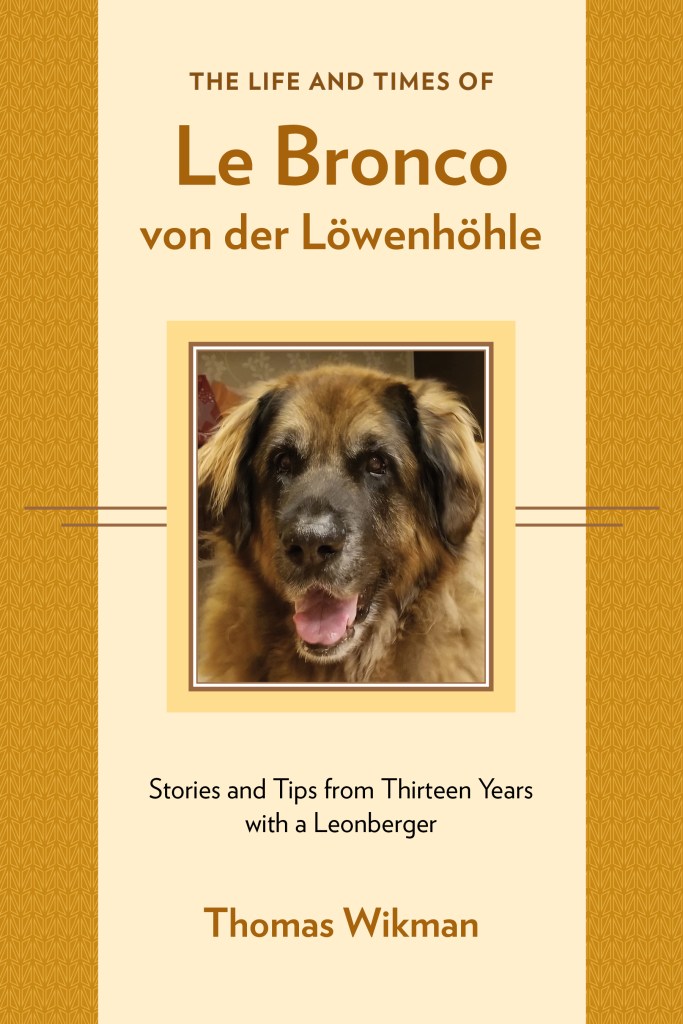
Note: I temporarily lowered the price of the Kindle version of my book to $4.99.
For your information the ASIN number for the e-book edition: B0B5NN32SR and the ISBN number for printed edition: 978-0998084954
Below are some Leonberger photos from World War I that I came across. Notice; Leonbergers looked a little bit different back then.
Purebred large dog breeds tend to have shorter life spans compared to most other dogs and they have more health issues. However, Leonbergers are fortunate compared to other large breeds, especially those bred in North America, primarily for three reasons:
The Leonberger breed standard does not call for traits that can be detrimental to health.
The precise and restrictive breeding regulations of the Leonberger Club of America (LCA) and other Leonberger clubs.
The work of the Leonberger Health Foundation International or LHFI, have resulted in Leonbergers being relatively free of inherited illnesses compared to other large dog breeds in America.
Today I received my first payment for the sale of my book from Amazon (for the month of July) and I donated all proceeds to the Leonberger Health Foundation International like I said I would. Regardless of whether you get my book or not you can donate to LHFI. It is one of my favorite charities. LHFI “facilitate the solicitation and distribution of donations given to support health related breed-specific research.” The LHFI also administers a program that collects DNA samples from Leonbergers to share with universities and research institutions.
Among the organization’s achievements are the eradication of Addison’s disease among Leonbergers, the raising of nearly half a million dollars for research into conditions that affect canine health, including osteosarcoma, hemangiosarcoma, glaucoma, cardiac diseases, thyroid diseases, and neurological disorders. Another notable achievement is the fact that since 2011, no Leonbergers with two copies of the LPN1 gene mutation, which causes Leonberger polyneuropathy, have been recorded in LHFI’s biobank (featuring 9,000 Leonbergers). Its research also supports healthful longevity and aging as well as population diversity.
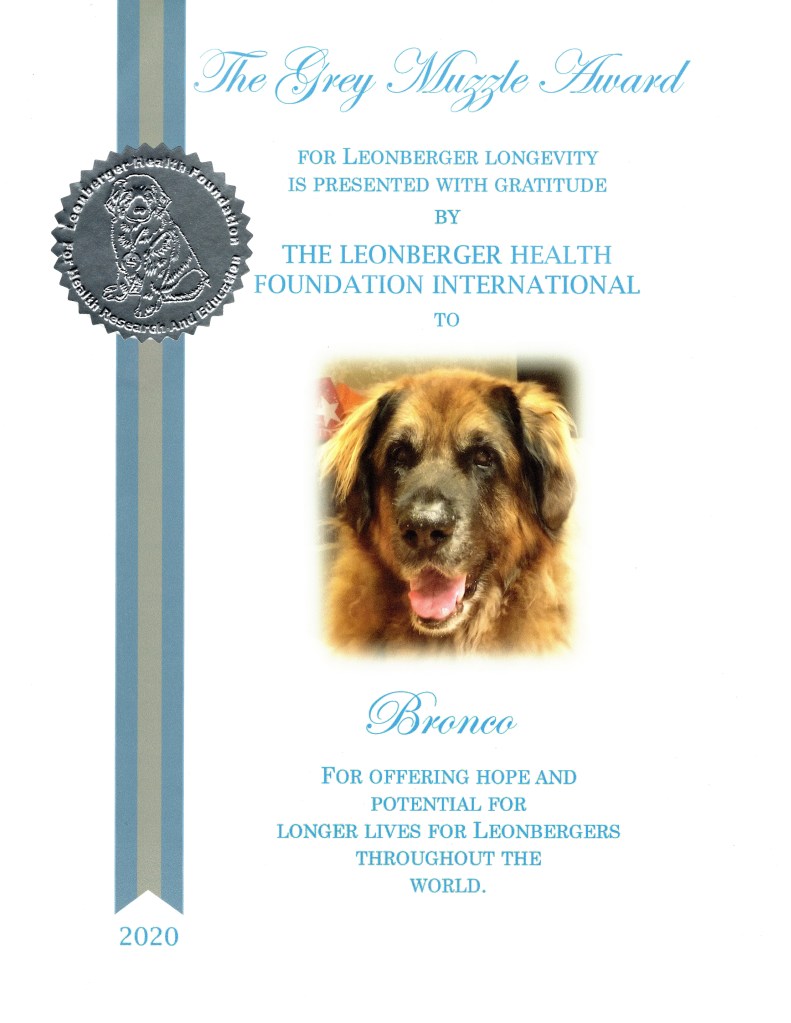
One happy event for our family was when Bronco received his Grey Muzzle Award, which is an award given for longevity by LHFI. LHFI bestows the award on any Leonberger who has reached the age of twelve. To find out more about the Grey Muzzle Award click here. To see the 2019–2020 awardees video featuring Bronco click here.
Bronco receiving his grey muzzle award.Grey Muzzle Award certificate from the Leonberger Health Foundation International.The Grey Muzzle Award from the Leonberger Health Foundation International.
I can add that when Bronco passed away, we sent his DNA to the University of Minnesota to be used in research. This was facilitated by the LHFI.
A dog breed standard is a description of the characteristics of an ideal example of a dog breed. The description may include physical characteristics, genetic criteria, behavioral characteristics, or criteria of athletic or productive performance. Breed standards are devised by breed associations, and are written to reflect the use or purpose of the dog breed. The Federation Cynologique Internationale regulates breed standards for dogs internationally. However, the American Kennel Club, does not belong to the international body and uses its own breed standard format. In practice the breed standards are very similar.
For the AKC, the breed standard, and any revision thereof, originates with an AKC parent club. For Leonbergers the parent club is the Leonberger Club of America. It was very lucky that it became that way. To read about the history of the history of the Leonberger breed standard, Leonberger Club of America and the great dog wars, click here.
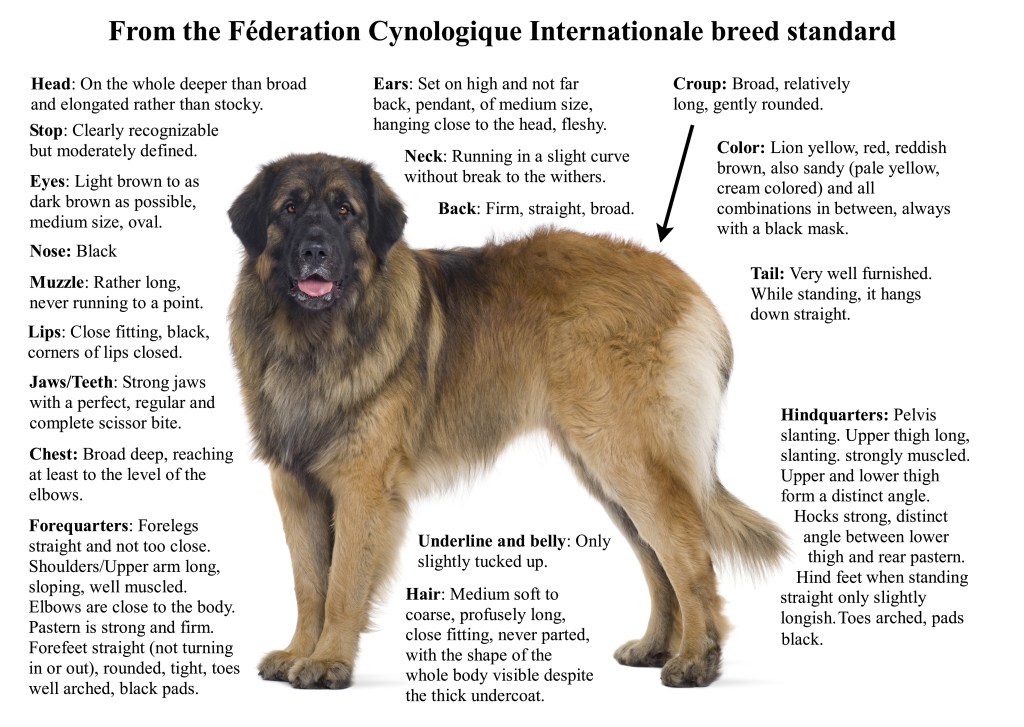
Below is a visual depiction of the physical aspects of the Leonberger breed standard. To find out more click on the image.
Physical physical criteria of the Leonberger breed standard. Click on the photo to read more about the Leonberger breed standard.
As I mentioned before, our Leonberger Le Bronco von der Löwenhöhle, or as we called him, Bronco, was an unusually long lived Leonberger. Leonbergers live on average 8-9 years, but our Bronco almost made it 13 (by two weeks).
Our Old Leonberger Bronco going on 13. He loved walking into his old age but needed breaks.You can look up the average life span of hundreds of dog breeds by clicking on the image. As you see, smaller dogs live longer, the giant breeds have the shortest life spans.
Scientific veterinary research has shown that large dogs have a much shorter life span than small dogs. This is not controversial, yet so many people are surprised by it. For example, one day after Bronco had just visited the veterinarian and I was walking him around the shopping center, a woman came up to me and asked about him. I told her he was twelve—old for a Leonberger. She said, “Twelve isn’t very old; my Chihuahua lived to be sixteen.” I explained to her that big dogs, especially really big dogs such as Leonbergers and Saint Bernards, don’t live as long as small dogs do, so for a Leonberger, Bronco was indeed really old. The look on her face told me she didn’t believe me; excuses, excuses, excuses. So this fact is far from intuitive to people, especially considering that big animals tend to live longer than small animals in the wild.
The cliché that one human year corresponds to seven dog years is a myth. For example, the average life span of a Great Dane is eight to ten years. For a Chihuahua, it is twelve to twenty years. Dachshunds and Pomeranians live between twelve and sixteen years, and pugs live between twelve and fifteen years. The average life span of a Leonberger, by contrast, is eight to nine years (some sources say seven years*). You can look up your dog’s particulars online: the product-review website Goody Pet features a life-expectancy calculator for hundreds of dog breeds.
Knowing the expected life span of your dog has value. When a dog reaches three-quarters of it, for example, he is considered a senior and needs to be treated differently.‡ You should get dog food that’s especially made for senior dogs and visit the veterinarian more often—ideally, twice a year.
To take Bronco’s temperature, we used a thermometer that we could insert into his ear canal. However, you can also do it the old-fashioned way: coat a thermometer with petroleum jelly or baby oil and gently insert it about one inch into your dog’s anus. Wait sixty seconds, then remove the thermometer. It should be noted, however, that the old-fashioned approach may lead to protests.
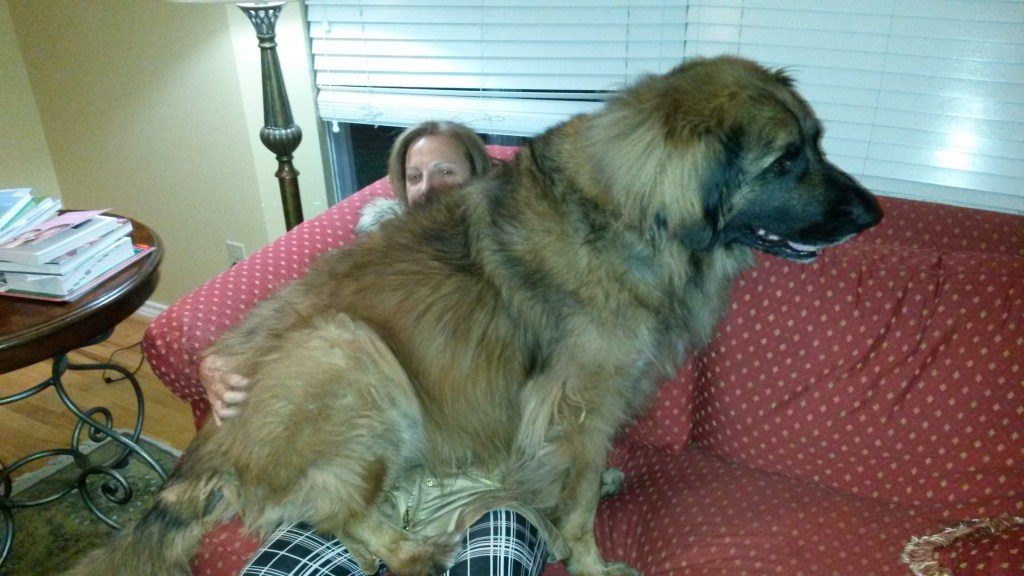
It’s also important to keep careful track of your Leonberger’s weight. Obesity in dogs is a growing problem: according to the Association for Pet Obesity Prevention, in 2018, 56 percent of American dogs were obese. Obesity, by definition, is a condition in which a person—or an animal—weighs at least 30 percent more than his ideal weight. In the photo below, in which Bronco is sitting on Claudia’s lap, he weighed 167 pounds—thirty-two pounds above his ideal weight of 135 pounds. Soon after that photograph was taken, we put him on a diet. Obesity can cause a lot of health problems, including diabetes, heart disease, early-onset arthritis, and joint pain. It can also put a strain on the body’s vital organs.
Bronco was a loving dog but 167 pounds in your lap might be a tad much.
I think it is awful when people return dogs. Barring some very special circumstances, such as severe illness or death, this is not something that should happen. If it does happen a reputable breeder will take the dog back. A Leonberger, well any dog, should never be turned into a shelter. The Leonberger Club of America and the Leonberger community in general are very concerned about the wellbeing of all Leonbergers. Therefore, you often have to go through an interview before you can purchase or adopt a Leonberger. Are you fit to be a Leonberger owner? Would you pass the interview? Below is the interview we went through including our answers.
Kennel von der Löwenhöhle Questionnaire and our Answers
Why do you want a Leonberger?
We have a dog book, and while looking at dogs we came across the Leonberger, a gorgeous dog from Germany. We also had the opportunity to meet some Leonbergers, a mother and her puppies, which were wonderful. We have read that Leonbergers are great with children and good guard dogs, which is something we’d like. We have two dogs, but we have not raised them as puppies. We have never had a puppy and would like to have one.
What do you like about the Leonberger and what do you know about its characteristics? Do you prefer male or female? Why?
They are very beautiful and love to swim. We have a huge pool, and my children love to spend their summers swimming. Leonbergers also make wonderful pets and are good guard dogs, and best of all they don’t drool. We don’t prefer a male or a female dog.
Are you aware this is at least a ten-year commitment?
Yes. We have two other dogs, and of course we are aware that they live up to ten years—hopefully more.
Do you have any other pets? Have you had any experience raising a giant-breed puppy?
We have a Lab and a German shepherd. We have two dwarf hamsters, Moldova and Montenegro. My son also keeps a baby ball python in a cage in his room (UGGH). As I said before, we have never owned a puppy, but we met some Leonberger puppies from a breeder who resides in Houston.
Where will your dog be kept—indoors or outdoors? Backyard or kennel?
Our dog would be kept mostly indoors. (We live in Texas, and it would get too hot outside.) At night we take all our dogs for walks and for occasional swims during the year. When the dog is still a puppy, we would keep it in a puppy playpen and take it out every half hour to go to the bathroom (until obedience training). We do have a fenced backyard the puppy can play in, and we have a dog run with a dog door so the dogs can come and go as they please.
Is your yard fenced?
Yes. Our yard has a seven-foot-high solid wood fence all the way around
How many hours will you be out of the house? Where will your Leonberger be while you are gone?
I am a stay-at-home mom, and we would almost always have someone in the house, such as our housekeeper, children, and family. If we are gone for a long periods of time, we have a dog sitter who comes to our house to take care of our dogs.
Do you have children? If so, what are their ages?
We have three kids, ages thirteen, ten, and eight. Two boys and one girl (in that order).
Describe a typical day at your house now. How do you think it will change once the puppy arrives?
On a typical day, the kids go to school, and I like to take a long walk. I go through some paperwork, I prepare dinner, then everyone comes home. On weekends, my younger kids have sports, but my oldest kid stays home (he plays during the week).
I would be with the dog most of the day and would do my shopping while the housekeeper is there. I do not plan on leaving the puppy for any long period of time. I’m sure that having the puppy will be like having another child. We have been told that the puppy will be quite rambunctious for the first three years of its life.
Have you observed any obedience classes in your area? It is very important that Leonberger puppies start obedience classes by sixteen weeks of age. Would you attend such classes?
We have not observed any obedience classes yet. However, we are interested in the International K9 training facility in Dallas and would absolutely attend these classes.
Von der Löwenhöhle puppies start their crate training at our kennel. Will you continue this training? If not, why not?
Yes, we would continue crate training at our home. We will follow your advice and that of our veterinarians in regard to further training.
What plans do you have for your Leonberger—e.g., showing, breeding, obedience, family companion, therapy? If you plan to show or breed, what experience, if any, have you had?
Our major purpose for wanting a Leonberger is to have a family companion.
Please add any other information you feel will help us pick out a puppy for you.
We would like a dog that will fit in well with our family.
All purebred dogs are more or less inbred, which comes with inherent health risks. That is especially true for large breeds. However, Leonbergers, especially those bred in North America, are fortunate compared to other large breeds. The Leonberger breed standard does not call for traits that can be detrimental to health. The precise and restrictive breeding regulations of the Leonberger Club of America (LCA) and other Leonberger clubs, and the work of the Leonberger Health Foundation International or LHFI, have resulted in Leonbergers being relatively free of inherited illnesses compared to other large dog breeds in America. For more information see Humane Society Veterinary Medical Association, “Guide to Congenital and Heritable Disorders in Dogs,” rev. 2011
The Leonberger Health Foundation International (LHFI) was founded in 2000 by Waltraut Zieher and other members of the LCA’s health, education, and research committee to “facilitate the solicitation and distribution of donations given to support health related breed-specific research.” The LHFI also administers a program that collects DNA samples from Leonbergers to share with universities and research institutions.
LHFI’s global biobank contains DNA samples from more than nine thousand Leonbergers. Among the organization’s notable achievements are the eradication of Addison’s disease among Leonbergers and the raising of nearly half a million dollars for research into conditions that affect canine health, including osteosarcoma, hemangiosarcoma, glaucoma, cardiac diseases, thyroid diseases, and neurological disorders. Its research also supports healthful longevity and aging as well as population diversity. Another success is the fact that since 2011, no Leonbergers with two copies of the LPN1 gene mutation (which causes Leonberger polyneuropathy) have been recorded in LHFI’s biobank.
One happy event for our family was when Bronco received his Grey Muzzle Award, which is an award given for longevity by LHFI. LHFI bestows the award on any Leonberger who has reached the age of twelve. These Leonbergers are the canine equivalents of centenarians, humans who are at least one hundred years old. The Grey Muzzle Award is also given to breeders, because they are partially responsible for the dogs’ longevity. The Grey Muzzle Award was certainly a happy event in Wikman family. If you have a twelve-year-old Leonberger, simply fill out a form on the LHFI website or send an email to lhfgreymuzzle@gmail.com.
The foundation will ask for some information, including the registered name and call name of the dog; the breeder’s name, kennel name, address, and email; the dam’s registered name; the sire’s registered name; the owner’s name, address, and email; the birth date of the dog; and whether the dog is alive or dead. If the latter, they will want to know the cause of death. In addition, they would like you to write a one-paragraph tribute to the dog and send two (preferably high-resolution) photos—one head shot and one favorite photo. To find out more about the Grey Muzzle Award click here. To see the 2019–2020 awardees video featuring Bronco click here.
Grey Muzzle Award certificate from the Leonberger Health Foundation InternationalThe Grey Muzzle Award from the Leonberger Health Foundation International
I can add that when Bronco passed away, we sent his DNA to the University of Minnesota to be used in research. This was facilitated by the LHFI.
LHFI is one of my favorite charities and all proceeds from this book will be donated to the Leonberger Health Foundation International.
Leonbergers have a long history in North America and the United States—despite the fact that until 1985, there were only seventeen Leonbergers known to be living in the United States.
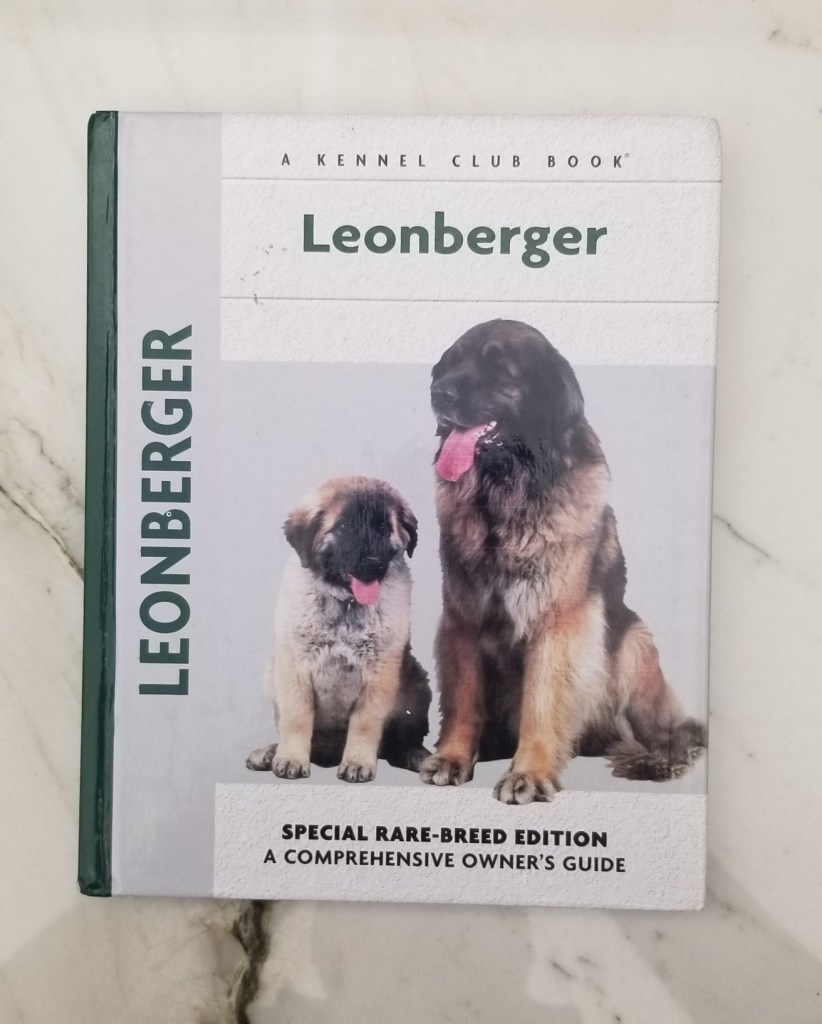
See: Lusby, Leonberger, page 15.
Leonberger, Special Rare-Breed Edition, A Comprehensive Owners Guide, Madeline Lusby
In the 1870s, Leonbergers were brought to Newfoundland to invigorate the stock of Newfoundland dogs. Around the same time, two Leonbergers named Caesar and Sultan were purchased from Essig’s kennel and transported across the ocean to join the Wellesley-Sterling theater company in the United States as the stars of their productions. Then in 1879, Caesar and Sultan visited President Ulysses S. Grant, who called them the largest and most magnificent dogs he had ever seen and presented them with gold medals. During the years between World War I and World War II, a New Jersey family, the Wolfs, opened their home as a temporary refuge for Jews fleeing Germany: they also imported Leonbergers. Unfortunately, this introduction of the breed into the United States did not last, and it would be another fifty years before the Leonberger appeared in America again.
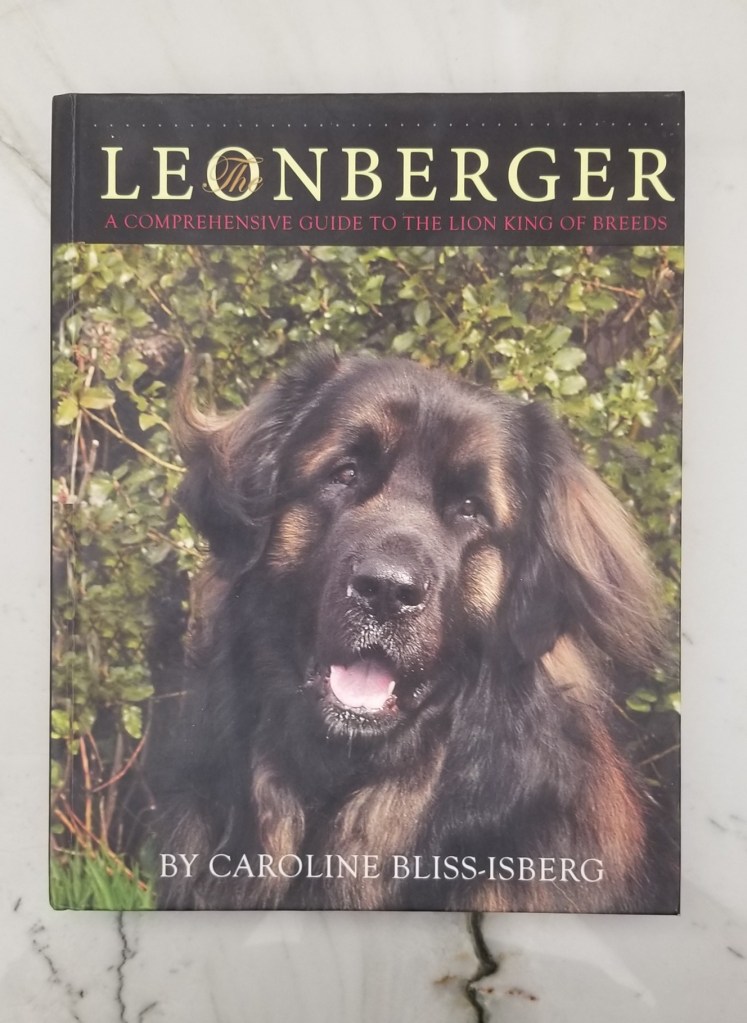
See: Bliss-Isberg, Leonberger, page 60.
See: Bliss-Isberg, Leonberger, page 64
See: Bliss-Isberg, Leonberger, page 101.
Leonberger, A comprehensive guide to the lion king of breeds, Caroline Bliss-Isberg
During the late 1970s and the 1980s, a few families—Waltraut and Klaus Zieher, Brian Peters, Manfred and Sylvia Kaufmann, Keri Campbell and Melanie Brown, and Mary and Reiner Decher brought Leonbergers to the United States. The Dechers had started a breeding program and were looking for a mate for their first dam, Viona. By chance their neighbor discovered through a newsletter that there was another Leonberger in the United States, and that led to the families’ finding and connecting with one another. I should add that the Dechers were careful to conform to the German breeding regulations and performed hip X-rays that they then submitted to the Orthopedic Foundation for Animals (OFA). Viona became the first OFA-certified Leonberger in America.
See: Bliss-Isberg, Leonberger, page 152.
On Saturday, November 2, 1985, eight of these Leonberger enthusiasts met at a hotel in Denver, Colorado, to found the Leonberger Club of America (LCA). This group of founders, which has since been dubbed the Denver Eight, appointed a registrar, formulated a breeding acceptability checklist, and instituted various policies, including the requirement that OFA certification is mandatory for breeding. LCA membership grew: it held social gatherings, began publishing LeoLetter, and imported an increasing number of dogs. Now the LCA has thousands of members across the country, and Leonbergers receive high ratings on health tests relative to other large breeds. For example, in 2000, the OFA reported that only 14.6 percent of Leonbergers tested positive for hip dysplasia, compared to 47 percent of Saint Bernards.
See: Bliss-Isberg, Leonberger, page 154.
See: Bliss-Isberg, Leonberger, page 176.
Another important historical event was the founding of the Leonberger Health Foundation International (LHFI), in 2000 (it was just called the Leonberger Health Foundation back then). According to its website, the organization was founded by Waltraut Zieher and other memers of the LCA’s health, education, and research committee to “facilitate the solicitation and distribution of donations given to support health related breed-specific research.” The LHFI also administers a program that collects DNA samples from Leonbergers to share with universities and research institutions, and of course it administers the Grey Muzzle Award.
LHFI’s global biobank contains DNA samples from more than nine thousand Leonbergers. Among the organization’s notable achievements are the eradication of Addison’s disease among Leonbergers and the raising of nearly half a million dollars for research into conditions that affect canine health, including osteosarcoma, hemangiosarcoma, glaucoma, cardiac diseases, thyroid diseases, and neurological disorders. Its research also supports healthful longevity and aging as well as population diversity. Another success is the fact that since 2011, no Leonbergers with two copies of the LPN1 gene mutation (which causes Leonberger polyneuropathy) have been recorded in LHFI’s biobank. LHFI is one of my favorite charities.
The end of the twentieth century marked not only the end of the Cold War but also the beginning of what I call the Dog Wars of America. In 1985, the American Kennel Club (AKC) registry comprised one-third of the world’s known dog breeds. But the AKC had recognized only a few new breeds since 1887—a period of ninety-eight years. So the organization decided to change that policy, but this did not always go smoothly. The members of rare-breed clubs often did not want to be part of the AKC. For example, the Australian Shepherd Club of America (ASCA) was very reluctant to join, so a relatively small splinter group, the United States Australian Shepherd Association, was formed and designated the official member club of the AKC, which was not welcome news to the ASCA. The border collie is another example. Charles Krauthammer, the late political columnist, called the AKC the politburo of American dog breeding.
See: Bliss-Isberg, Leonberger, page 159.
Similarly, in 2003, a new Leonberger club was formed—the Leonberger Club of the United States—with the goal of becoming the Leonberger member club of the AKC. This essentially forced the LCA’s hand, so they applied for membership in the AKC, a process that took years to complete. But ultimately the AKC approved the LCA as members in 2010: Leonbergers would officially become part of the Working Group. Fortunately, 90 percent of LCA breeders agreed to continue following LCA regulations regardless of whether the club would remain independent or become part of the AKC. Also fortunately, AKC membership afforded more opportunities for Leonbergers to participate in dog shows, which is important to many owners.
See: Bliss-Isberg, Leonberger, page 187
For information on the history of the Leonberger starting in 1830’s see this link




















 Leonberger Life