The Leonberger Is a Rare Breed

The worldwide dog population is estimated to be 900 million, including 471 million dogs kept as pets, 200 million stray dogs. There are also village dogs, federal dogs and there are many millions of wild dogs such as wolves, coyotes, jackals, dholes, foxes (35 species). In the United States, 65.1 million households own at least one dog. There are at least 3 million Labradors around the world. The AKC currently recognizes 197 dog breeds. A close cousin of the Leonberger, the St. Bernard comes it as the 53rd most popular breed in the United States whilst the Leonberger comes in at place 102. This is a link featuring additional statistics.

Below is an excerpt from my book

According to an estimate prepared by BioMed Central, there were around 30,000 Leonbergers in the world in 2020. See Anna Letko et al., “Genomic Diversity and Population Structure of the Leonberger Dog Breed,” Genetics Selection Evolution 52, no. 61 (October 2020)

There are around 3,300 Leonbergers in North America, 2,300 in the United States and 1,000 in Canada. The five countries with the most Leonbergers, in order, are France, with nearly 8,000; Germany, with more than 4,000; and Great Britain, the United States, and Sweden, with approximately 2,300 each. The country with the highest number of Leonbergers per capita is Finland, with nearly 2,000 Leonbergers among a population of 5.5 million people. (Information from the October 2018 LeoLetter).

In summary, the Leonberger is a rare breed. However, a few times in history the Leonberger was not just a rare breed but close to extinction.

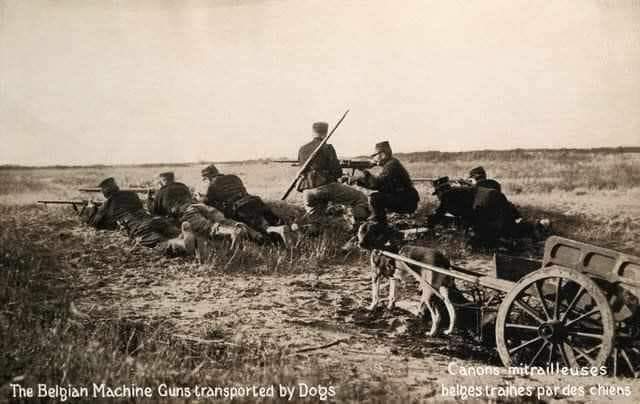
Photo of a Leonberger pulling a cart with guns and ammunition
Leonberger pulling a cart with guns and ammunition

World War I was tough on the breed. Some Leonbergers were used to pull ammunition carts and small cannons during the conflict, and others were left to wander unattended. Often, these dogs starved to death. But after the war, two Leonberg businessmen, Karl Stadelmann and Otto Josenhans, worked hard to save the breed. They scoured the countryside looking for Leonbergers who were still alive. They were able to find twenty-five of them whose owners were willing to cooperate in reestablishing the breed. Of these, only five were suitable for breeding. None of the Leonberger clubs had survived, so they founded a new one in 1922 called Deutsche Club für Leonberger Hunde (DCLH), and Stadelmann created an updated version of Albert Kull’s breed standard.

I’ve read that World War II was even more devastating to the breed. Supposedly there were only eight Leonbergers left in the world after the end of the war, and all Leonbergers today are descendants of those eight surviving Leonbergers. That’s once again a fascinating and simple story that’s easy to remember and spread, but the truth is rarely simple.

The Leonberger, like so many other dog breeds, was devastated by World War II—kennels were destroyed; dogs were left unattended or used for food—but Leonbergers weren’t used in the war effort itself, and there were more than eight left afterward. However, there was indeed a “genetic bottleneck” of Leonbergers in the 1940s, meaning that the population was greatly reduced in size, limiting the genetic diversity of the species. This was largely because people repeatedly bred the dogs they thought were the best specimens in a misguided attempt to improve the breed. Of course, for breed (and species) health, you need diversity. Scientific pedigree analyses demonstrate that the Leonberger has twenty-two founder animals, or animal ancestors unrelated to one another (ten males and twelve females).

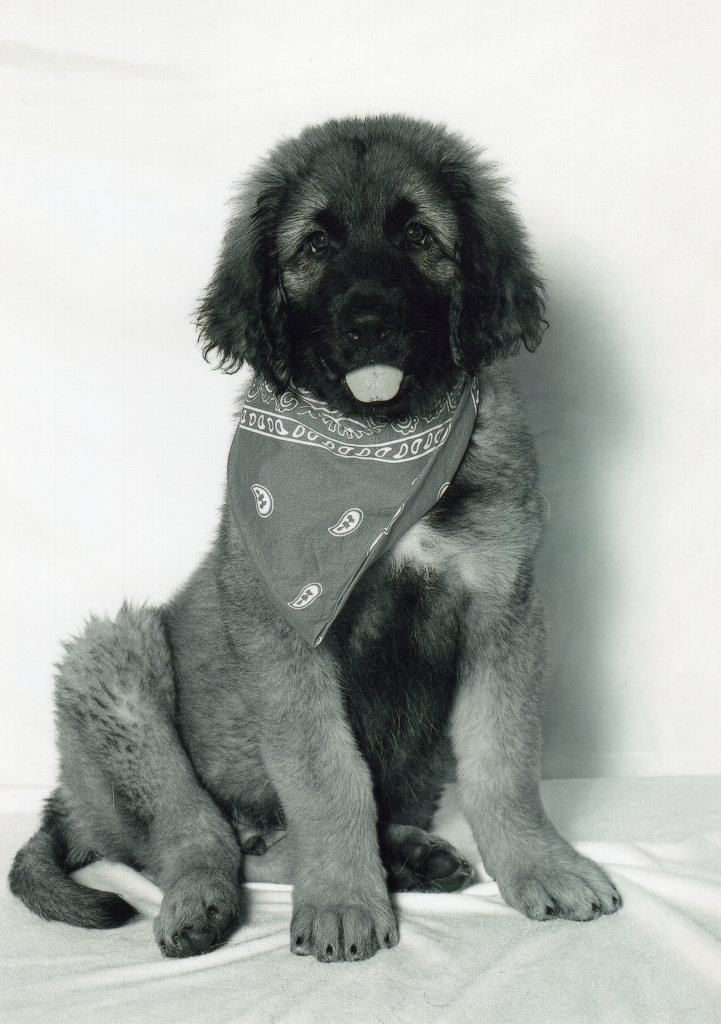
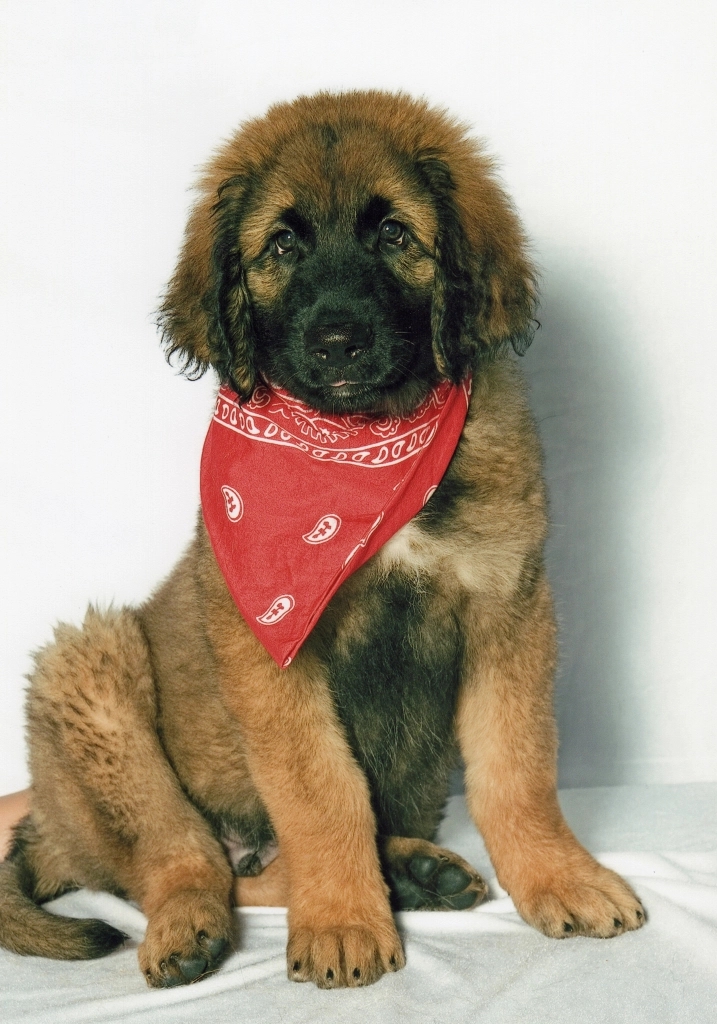
Photo of our Leonberger Bronco at 3 months old, in black and white
Our Bronco at 3 months old, in black and white
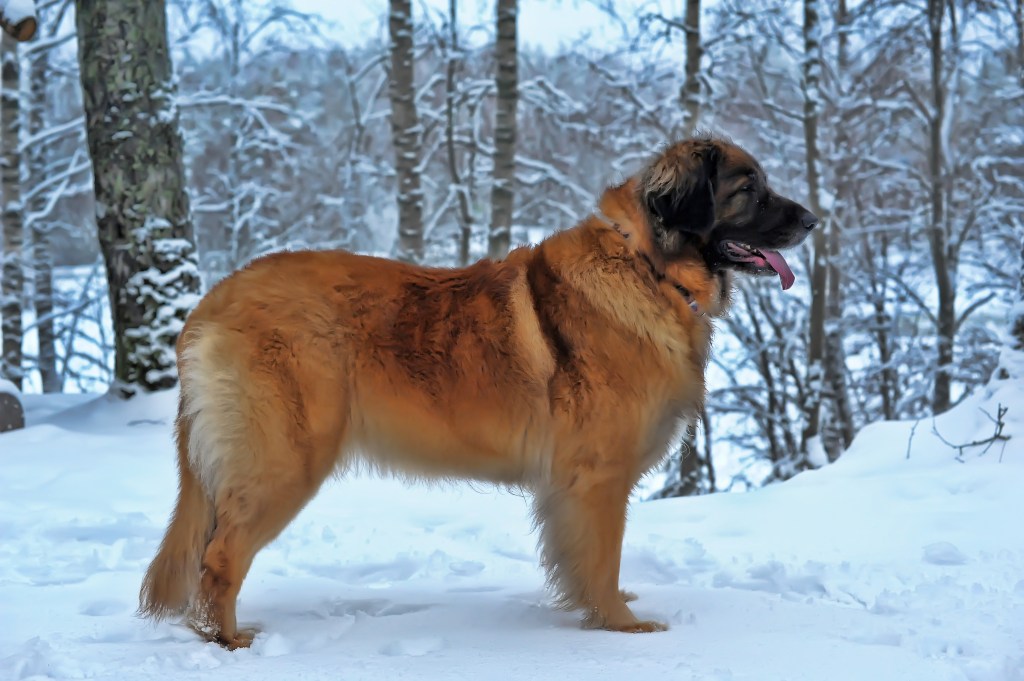
Photo of Leonberger in a snow covered forest
Leonberger in snow (purchased from shutterstock ID:705193912 by Anna Krivitskaya.)
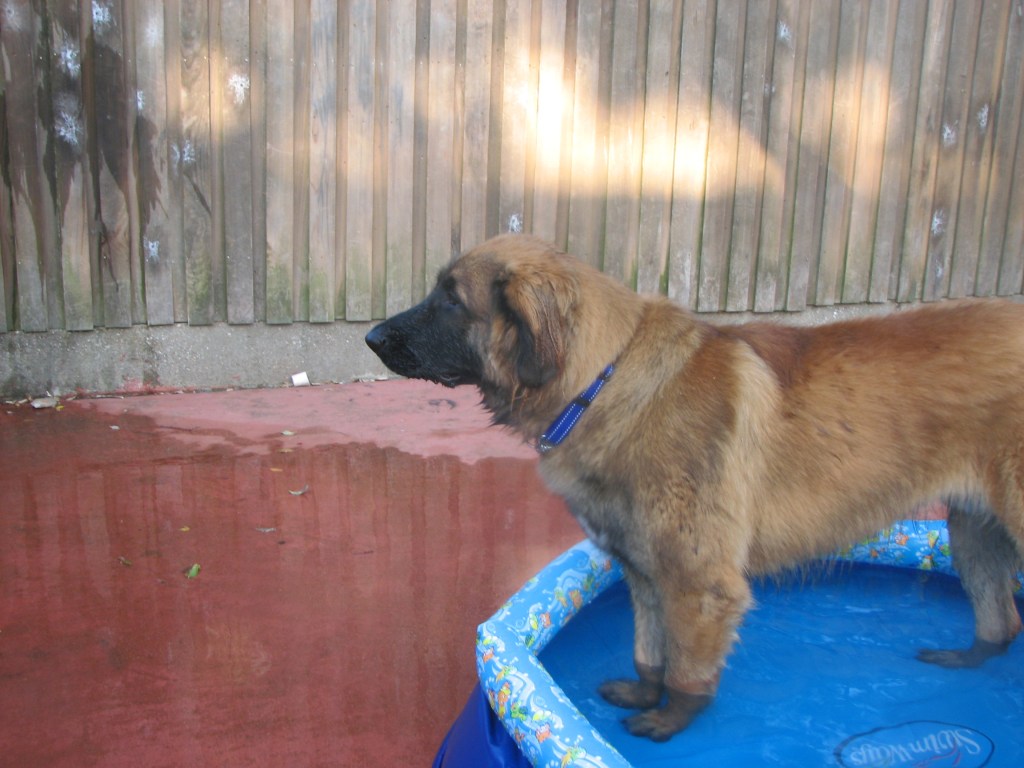
Our Bronco standing in a kiddie pool

Good News Regarding Cancer for Leonbergers and Other Dogs

Cancer is the most common killer of purebred dogs: in fact, nearly half of them die from some form of cancer. Overall, the most common form is skin cancer. In Leonbergers, bone cancer and hemangiosarcoma are the most common forms. As in humans, early detection can save or extend the life of your dog. Warning signs of cancer include:

  • weight loss,
  • bleeding or discharge from a body cavity,
  • bumps or lumps that keep growing,
  • persistent stiffness or lameness,
  • breathing difficulties,
  • bad breath or bodily odors,
  • difficulty with defecation or urination,
  • difficulty with eating or swallowing,
  • lesions that won’t heal,
  • sores that recur or won’t heal, and
  • loss of appetite

Naturally, not every one of these signs and symptoms is applicable to all types of cancer. The only sign of Bronco’s squamous cell carcinoma was a lesion that wouldn’t heal.

Hemangiosarcoma (HSA) is an aggressive cancer of the blood vessels. It often appears as a mass in the spleen, liver, or heart but can also be found elsewhere. It is challenging to diagnose and equally difficult to treat. It is most common in golden retrievers, German shepherds, and Labrador retrievers but can occur in Leonbergers as well. In addition to genetic factors, certain toxins are associated with this cancer. Fortunately, there is a promising blood test (called the Shine On Study, or SOS) that identifies features of rare cells linked to this cancer and a novel drug therapy called eBAT (EGF bispecific ligand targeted angiotoxin). Both SOS and eBAT are still in the clinical-study phase at the time of this writing, but they offer hope for early detection and treatment.

Illustration showing Bronco our Leonberger running with a full leg cast. He just had a toe amputation.
Bronco’s cancer problem was Squamous cell carcinoma which luckily is not an aggressive cancer, but he needed toe amputations. He got this cancer once a year starting at the age of eight.
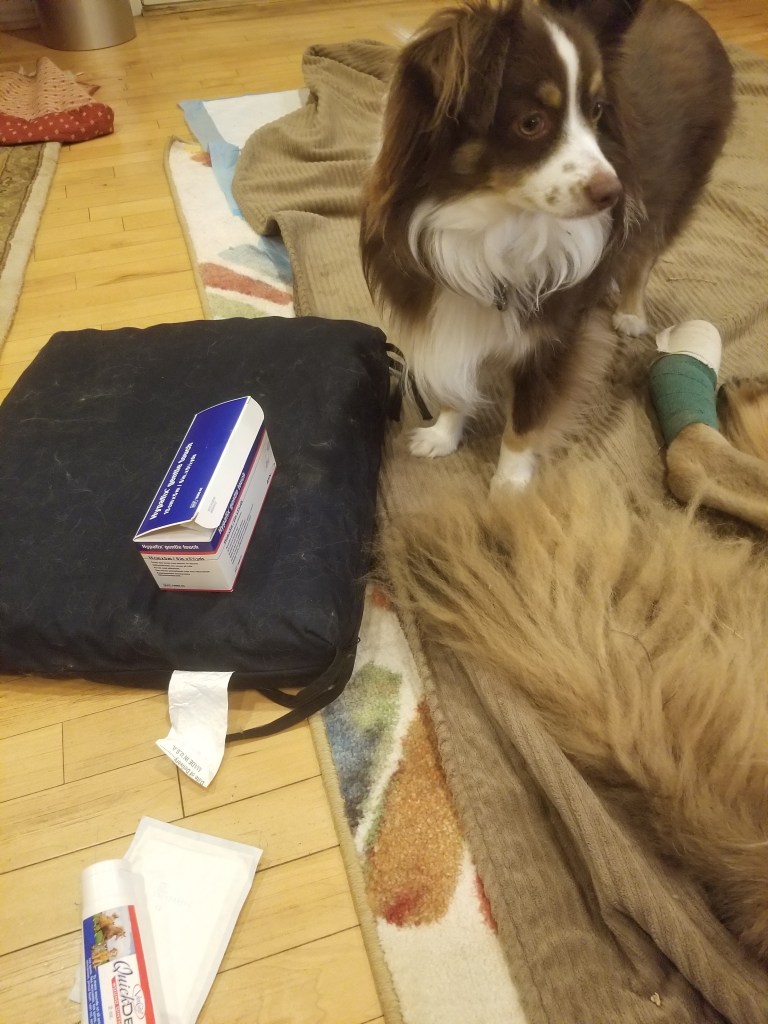
Photo of Rollo our mini-Australian Shepherd helping us change our Leonberger Bronco’s bandage after he had a toe amputation.
Rollo our mini-Australian Shepherd is helping us change Bronco’s bandage after he had a toe amputation.

Below is another piece of good news regarding cancer in dogs that a friend of ours alerted us to. I don’t know if it is related to the SOS study mentioned above. You can watch the video by clicking here.

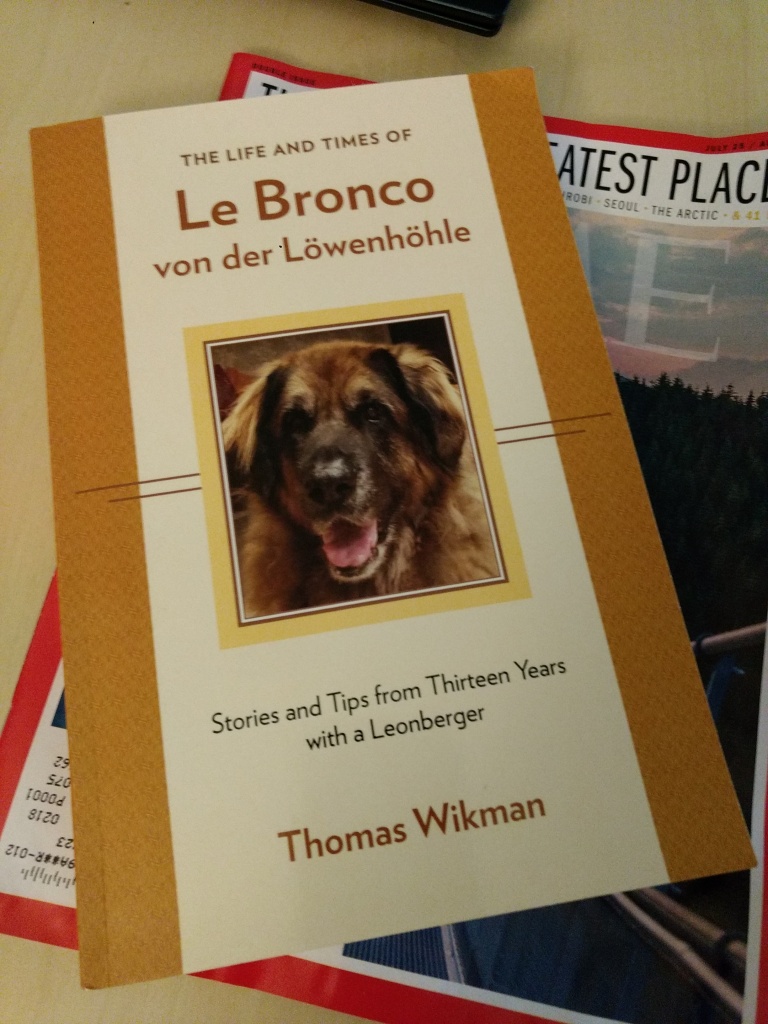
Book Review: ‘The Life and Times of Le Bronco von der Löwenhöhle: Stories and Tips from Thirteen Years with a Leonberger’

Below is very well written and supportive review of my book by my old online friend Alex from epinions.com

Alex Diaz-Granados's avatarA Certain Point of View, Too

My friend Thomas Wikman wrote a loving tribute to his Leonberger, Bronco.

(Photo by the author)

Reviewer’s Note: Thomas Wikman is one of my long-time online friends from Epinions, a now-defunct review site where we both wrote product reviews. Additionally, I adapted this review from an original version that I wrote on the book’s Amazon product page.

Isn’t he cute? Bronco, aged three months. Image Credit: Leonberger Life/Thomas Wikman

“Dogs are our link to paradise. They don’t know evil or jealousy or discontent. To sit with a dog on a hillside on a glorious afternoon is to be back in Eden, where doing nothing was not boring–it was peace.” Milan Kundera

In 2007, Thomas Wikman, an automation, robotics, and software engineer and resident of Dallas, TX, bought a Leonberger puppy for his son’s upcoming 14th birthday.

Wikman and his family, which also included his…

View original post 982 more words

Coyotes Dogs and Leonbergers

The coyote (Canis latrans) is a close relative of the wolf (Canis lupus) and the dog (Canis lupus familiaris). Coyotes live in every US state except Hawaii. It is estimated that there are between one million and ten million coyotes. Coyotes kill a lot of cats and dogs as well as livestock including 135,000 sheep per year (see this link). A lot of coyotes roam the neighborhoods in Dallas. I see them all the time and I’ve had close encounters with them while walking the dogs. Recently a two-year-old in Dallas was injured by a coyote attack (see the video below).

This means that dog owners need to pay attention to the coyotes. Don’t leave small dogs and cats outside if you don’t have a fence that coyotes cannot get through. When walking small dogs, you may want to bring maze or bear spray with you. I admit, I don’t, but it is an option worth thinking about.

Photo of a coyote taken on our younger son’s class trip to Yellowstone. Very green grass with a coyote in the middle.
Photo of a coyote taken on our younger son’s class trip to Yellowstone
This is a photo showing the math teacher Frank Jordan in Yellowstone and Grand Teton in 2007. Grand Teton the background. If you want to see wildlife photos from the Yellowstone/Grand Teton class trip click on the image. I was there too. It is a website that I created a long time ago. The trip was led by the math teacher (Frank Jordan).
If you want to see wildlife photos from the Yellowstone/Grand Teton class trip click on the image. I was there too. It is a website that I created a long time ago. The trip was led by the math teacher (Frank Jordan).
This informational video was created by a local news organization after the coyote attack on the two-year-old boy. DFW stands for Dallas Forth Worth.

Below I am including an excerpt from my book about a close coyote encounter while walking the dogs.

Our neighborhood is generously populated with coyotes as well as rabbits. Bronco (our Leonberger) used to bark at them, so they never got close to us. I assume they were afraid of him, but they certainly weren’t afraid of Daisy (Pug) or Ryu (Japanese Chin).

One day I saw a coyote coming around the corner at the end of our street as I was walking Daisy and Ryu. He saw us and proceeded straight toward us without hesitation and with no sign of fear. He wasn’t running, but coyotes have long legs, and he was sort of trotting along and moving pretty fast. I wasn’t worried for myself—an adult human can easily handle a lone coyote. I was worried for Daisy and Ryu. I didn’t want them to be the coyote’s dinner.

As the coyote came closer, I stopped and stared at him. When he was around fifteen feet away, he stopped and stared back at me. Ryu and Daisy were staring at the coyote, too. I could see that they were frightened, but they didn’t bark.

Meanwhile, I was calculating how best I could fight the animal. It wasn’t practical to lift both dogs in my arms and try to fight at the same time. So I had to let the dogs stay on the ground.

Before I could strategize further, though, the coyote continued on his way and disappeared behind some houses farther down the road.

Coyotes are pretty common almost everywhere in the United States, so if you need another reason to avoid letting your cats and small dogs run loose, remind yourself of this story.

The Day Leonberger Squamous Cell Carcinoma caused Hullabaloo in the Neighborhood

Squamous Cell Carcinoma (SCC) is a tumor of skin cells that usually appear as a single, solitary lesion in one location. It is common in large dark coated dogs and typically appear in the nailbed, but it can appear in other places. Our Leonberger Bronco was plagued by Squamous Cell Carcinoma in the toe nailbeds. In fact, he got it five times starting when he was eight years old and after that it occurred about once a year. It did not spread, and his second and third tumor, etc., were not metastatic growths. He got this type of cancer five times, each time independent of the other times.

Our veterinarian was at loss as to why he got it so many times. Remember, there was no spread of the cancer. SCC is caused by exposure to ultraviolet rays/sunlight and the exposure to papilloma-like viruses, but as with many cancers the cause is a bit of a mystery. Our veterinarian suggested it could be genetic, but recently we discovered that our pest control guy was using roundup for our lawn where Bronco walked and ran a lot, and he had been doing that for decades. We asked him to stop but we have no idea whether it had anything to do with Bronco’s SCC.

Luckily handling a case of Squamous Cell Carcinoma in the toe is quite straightforward. This type of cancer is not aggressive, even though it can spread (and is therefore called cancer), so if you don’t take too long to amputate the toe you should be fine. In fact, Bronco seemed to enjoy the annual toe amputation. He got to go to the Dallas Veterinary Surgical Center, he was pampered, everyone felt sorry for him, he got treats, he had a bandage for a few weeks and then the pain in his toe was gone. He was always very cooperative. Perhaps he understood that we were helping him.

Photo of an agitated Bronco standing guard at the back door. Note the missing toe on his left (your right) front paw. It is enclosed by a red circle.
An agitated Bronco stands guard at the back door. Note the missing toe on his left (your right) front paw. It is enclosed by a red circle.

Below is an excerpt from the book regarding Bronco’s Squamous Cell Carcinoma. One day his toe amputation led to hullabaloo in the neighborhood, and we ended up having to apologize to some neighbors.

When Bronco was almost eight years old, we discovered a case of squamous cell carcinoma in one of his toes—or, rather, in one of his toenails. It was on his right rear paw.

Squamous cell carcinoma is a type of skin cancer that certain large-breed dogs, including Leonbergers, are susceptible to. It often grows out from the skin around the nail and can affect the bone and tissue around it. It is typically not very aggressive, but it can spread, and it is painful. It manifests itself as a swollen toe, or you may be able to see a large red papule that looks like a pimple. Sometimes the toenail falls off. The dog is likely to limp and lick the toe and may become reluctant to go for walks, although that was never the case with Bronco.

Primarily because of the pain, but also because of the small risk of metastasis, it is usually recommended that the affected toe be amputated. So we went through with the procedure.

When we picked Bronco up the day after the surgery, his paw was in a bandage. But he got some treats, and he was in a good mood. We went back to the veterinary surgical center for a bandage change a few times, and then he was done.

Unfortunately, though, we discovered another lesion a year later. This time it was on a large toe on his left front leg. We asked the doctors if the cancer had spread to this toe. We were told no—Bronco was just prone to getting this type of cancer. But the cause could also have been something in the environment. In Texas, the ultraviolet radiation from the sun is significant. We really don’t know why this happened to him, but we were assured that it was not because the cancer had spread.

This time around, Bronco’s entire leg was put in a cast, to be replaced by a bandage after ten days. We were instructed to keep him inside during those ten days and keep him as still as possible. We were to make sure he wouldn’t bump the cast. This was, of course, almost impossible to do, but we were going to try.

However, Bronco really wanted to go out, which he showed us in various ways, such as scratching at the front door. After a week or so, Claudia suggested that we take him outside a little bit, just in our driveway. I agreed. When I handed her the leash, she said, “He can barely walk; do you think he’s going to run off without it?” We laughed, and I agreed that it didn’t seem like we needed it this time. So Claudia walked out with Bronco slowly limping beside her.

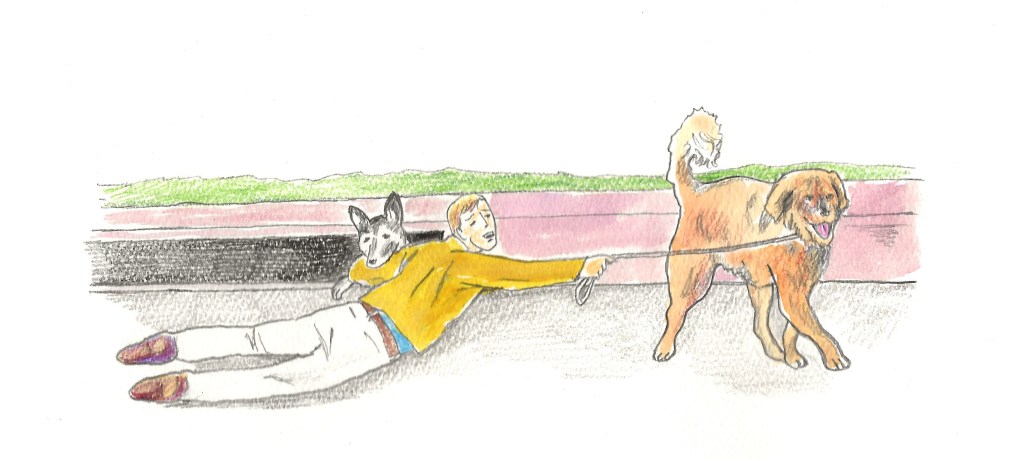
Less than a minute had passed when I heard shouting outside. I opened the door and looked outside to see what was going on……….let’s just say that what I saw was a sight for sore eyes. If I had thought of videotaping it, it would have become a viral video. The crazy thing that happened was also an embarrassment to us and we had to apologize to neighbors. That’s all I am saying. The story is too good to reveal in this post. The rest of the story you have to read in my book. I give you a hint with the illustration below.

Illustration by Naomi Rosenblatt showing a Leonberger running wearing full leg cast.
OMG what is happening? Illustration by Naomi Rosenblatt.

The Littlest Leonberger Book

On this blog I’ve reviewed several good Leonberger books including:

Note the books above are Leonberger books that I do recommend. Here is a set of three more reviews for Leonberger books that I don’t recommend.

To this list I am adding another Leonberger book that could have been better; Leonberger: The Comprehensive Owners Guide For Costs, Feeding, Care, Grooming, Health, Nutrition, Breeding And Training Paperback – August 23, 2022 by by Ben Bradley. The book is 24 pages, kindle version 10 pages, and the current price on Amazon for the paperback is $7.66 and the Kindle is $3.00. ISBN-13 ‏ : ‎ 979-8847969666, weight ‏ : ‎ 2.72 ounces and the dimensions ‎ 5 x 0.06 x 8 inches.

Photo of the book Leonberger by Ben Bradley.
The book Leonberger by Ben Bradley.

This is my review for the book

The World’s Littlest Leonberger Book

This is a very short book that takes 5-10 minutes to read. As a brief introduction to the Leonberger it is fairly good. It does not contain any obvious errors, which is unlike some other Leonberger books I’ve read, and the font is large, which is helpful to those with bad eyesight. So, to some I believe this book could be useful.

However, the title is misleading. This book is anything, but a “Comprehensive Owners Guide” and the book says nothing about costs, nutrition and breeding. It is not even a brief owner’s guide. The Product details states that it is 24 pages (Kindle version 10 pages), which is probably true if you include the blank pages. Considering the large print, and that the number of pages with text is 21, my guess is that the content of the book corresponds to maybe 6-7 pages of a book with normal sized font. The book contains no photos, no pictures, no illustrations and no details. The product details state that the categories are Veterinary Parasitology, Food Animals in Veterinary Medicine, Fish & Aquarium Care. The book never touches on any of those subjects, so the categories are wrong.

Todays Dog Stroller Mishap

I don’t think there are any pet strollers that could accommodate a grown Leonberger, but there are certainly pet strollers that accommodate pugs and mini-Australian shepherds. We bought a stroller, for our old pug Daisy. She’s got arthritis and in addition she easily get tired. Our mini-Australian shepherd Rollo frequently wants to sit in the stroller too but not because he is tired, its because he heard a strange sound and feels safer in the stroller.

Left: Wolf who is not sitting in a stroller. Right: Rollo sitting in Daisy’s stroller. The photo contains text.

Text on the left: Canis Lupus, the grey wolf is a fearsome and courageous hunter in nature.

Text on the right: Canis Lupus familiaris, the dog, a close relative to the grey wolf, is sometimes less brave. This specimen prefers to sit in a stroller when he hears strange sounds.
Left: Wolf who is not sitting in a stroller. Right: Rollo sitting in Daisy’s stroller.

This morning our stroller broke. The front wheel suddenly caved, and the stroller took a nosedive with Daisy in it. Daisy slid from the back of the stroller to the front but luckily, she did not fall out. She was fine. Rollo, who was watching the misadventure, was not fine. Seeing the stroller capsizing with Daisy in it really scared him and he let out a scream, eeeeek!

Photo of a pug (Daisy) in a pet stroller
Daisy in her stroller at a time when the stroller was in better shape

I left the broken stroller on the sidewalk and walked home with the dogs, carrying Daisy part of the way. After I dropped off the dogs, I took my car and returned to where I left the stroller to pick it up. However, it was gone. Who would steal a broken stroller? I had been gone for maybe 15 minutes. I had also left a bag of dog feces in the stroller basket. I always pick up after my dogs. So, I don’t think the stroller thief got a good deal.

Daisy and Rollo both like to sit in the stroller, but the stroller is really for Daisy.

Announcement Leonberger Book Deal on Black Friday

This post is just an announcement.  For Black Friday throughout the weekend and Cyber Monday the Kindle version of my book, “The Life and Times of Le Bronco von der Löwenhöhle”, stories and tips from 13 years with a Leonberger, will sell for only $2.99.

If you would like to learn about more about my book and find out where to buy it, click here or here.

If click you on any of the images below you will be taken to the Kindle version of my book.

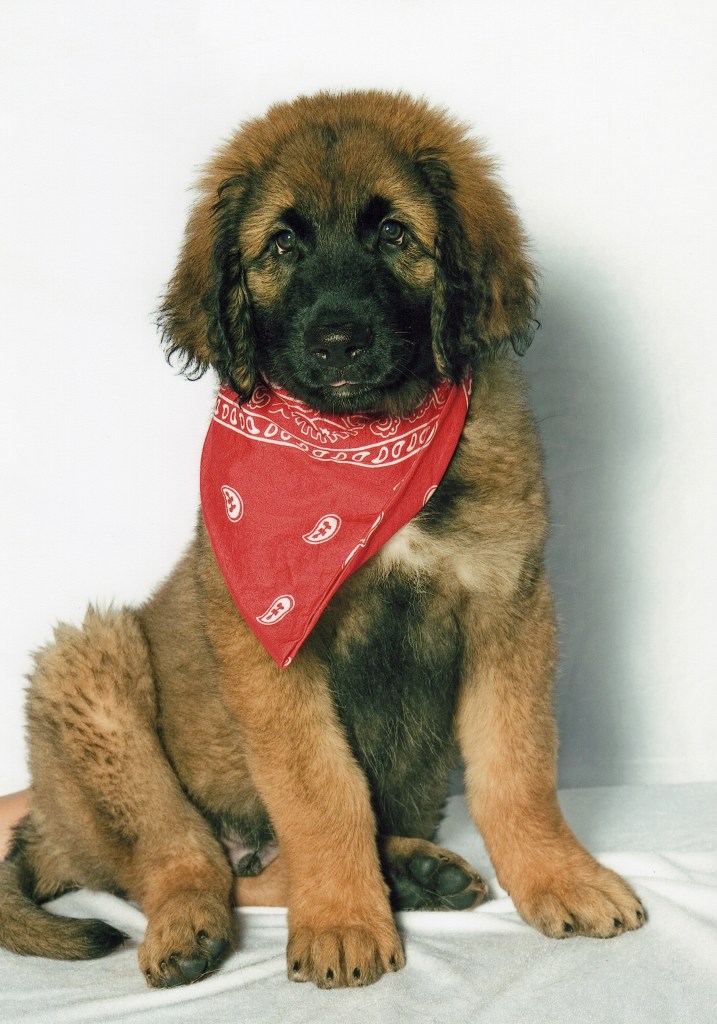
Photo of Bronco three months old. Click on the image to go to the Amazon.com Kindle location for the book.
Bronco three months old. Click on the image to go to the Amazon.com Kindle location for the book.
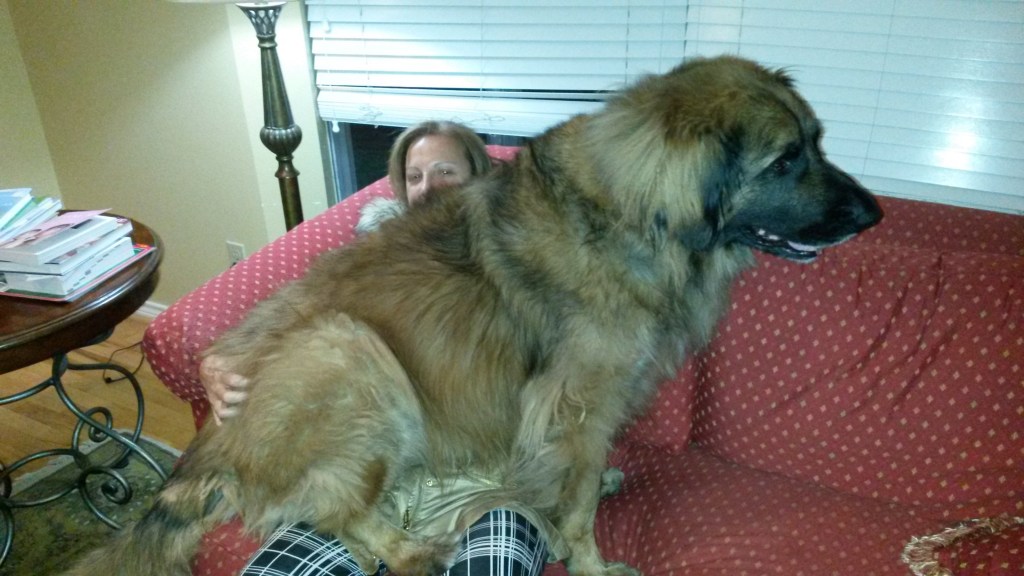
Photo of Bronco the lapdog. He is sitting in my wife's lap all 167 pounds of him. Click on the image to go to the Amazon.com Kindle location for the book.
Bronco the lapdog. He is sitting in my wife’s lap all 167 pounds of him. Click on the image to go to the Amazon.com Kindle location for the book.
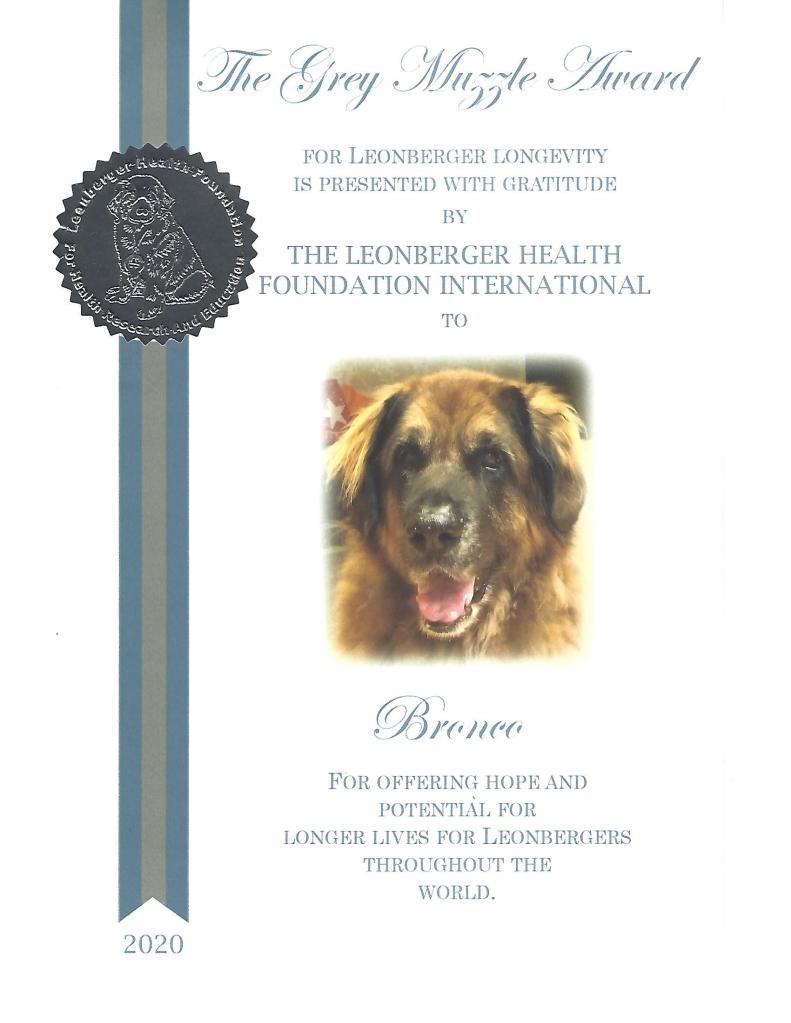
Image of the Grey Muzzle Award given by the Leonberger Health Foundation International. Click on the image to go to the Amazon.com Kindle location for the book.
Bronco lived unusually long for a Leonberger or for any giant breed. Bronco’s was awarded the Grey Muzzle Award given by the Leonberger Health Foundation International. Click on the image to go to the Amazon.com Kindle location for the book.
Photo of Bronco 12 years old going on 13. He is out for a walk and laying in the grass. Click on the image to go to the Amazon.com Kindle location for the book.
Bronco 12 years old going on 13. Click on the image to go to the Amazon.com Kindle location for the book.

Turkey Stealing Labradors and Leonbergers Who Share Their Loot

Our Labrador Baylor was a stealthy, opportunist and quick food thief. Food tended to disappear around him as if it never was there. Our German Shepherd on the other hand never stole food and took it upon herself to guard the entrance to the kitchen to the chagrin of Baylor. If she could have spoken, she would have said “you shall not pass”. 

Photo of Baylor and Baby
Baylor and Baby

Our Leonberger Bronco was our biggest dog, and he could eat a lot. Once we had prepared a big plate with five pounds of roast beef for a dinner party. Bronco finished those five pounds of roast beef with astonishing speed. I saw him do it, but I was not quick enough to stop him. Luckily, he thoughtfully left us the carrots, the broccoli and the dip, so the guests had something to eat. All our dogs were, and are, great dogs, but many dogs have this vice, food theft. I should say that Bronco often willingly shared his loot with other dogs. He was not selfish. Below I am including a few excerpts from my book concerning food theft.

Labrador food theft stories

Photo of our Labrador Baylor

In addition to his hatred for mailmen, Baylor had one more vice, and that was stealing food. He was always hungry, and he was pretty good at culinary theft. On one occasion, I was standing in the kitchen holding a sandwich in my hand. Suddenly the sandwich disappeared from my fingers as if it had been teleported. I didn’t feel a thing—no pull, no touch, no wet nose. It just vanished. I turned around, and behind me stood Baylor, swallowing something. He looked at me, wagging his tail. Was he innocent? Did Captain Kirk beam my sandwich to another dimension? How could I be mad at him when I didn’t have proof?

On another occasion, Baylor jumped up on top of the kitchen table using a chair as a step stool and cleared it of the desserts that Claudia’s grandmother had brought for the kids and the family. That’s how I learned that she had a swear-word vocabulary—and that it was substantial. Fortunately, the kids weren’t nearby. On yet another occasion, Baylor emptied a tray of baklava that had been sitting on the kitchen counter.

His most notable food raid was probably when he stole the Thanksgiving turkey and ran off with it. We salvaged most of it, but knowing that Baylor had been all over it, we decided not to eat what he left us. It wasn’t very appetizing.

Leonberger food theft stories

Photo of our Leonberger Bronco. He is ready for dinner.
Our Leonberger Bronco is ready for dinner

I believe dogs have empathy, and sometimes they want to share, at least Bronco did. There was a time when we were in our home eating take-out food and Bronco stole one of our dinners, including meat, vegetables, and a baked potato. He started eating the meat, then he glanced at Daisy, who was sitting in the middle of the floor looking sad. Immediately he took the baked potato in his mouth and carried it over to her and dropped it right at her feet. I was going to get mad at him for stealing, but when I saw his kindhearted and unselfish act, I let it be.

On another occasion, Rachel made a gingerbread house and left it on the kitchen counter. I had forgotten to lock the kitchen gate, and the photograph above shows what greeted me when I got home. Guess who ate half the gingerbread house. I should say that Bronco shared some with Daisy. He was always very generous.

Photo of our Leonberger Bronco and our Pug Daisy sharing a gingerbread house in the kitchen.
Bronco and our Pug Daisy sharing a gingerbread house

On yet another occasion, Bronco got hold of a box of chocolates in the shape of small gnomes. Each gnome was filled with liquor—some with gin, some with vodka, some with whiskey, and some with rum. It was a gift from Rachel, who had just come back from a visit to China. She had bought the present for us at the airport in Hong Kong. But Bronco ate the entire thing—tinfoil wrappers, chocolate, liquor, and all. We were afraid he might get very sick, and we carefully monitored him, ready to rush him to the emergency clinic if necessary. Fortunately, nothing happened, except he threw up a little bit of tinfoil. I guess he had a stomach of steel.

So, for this Thanksgiving watch your dogs so they don’t run off with your Turkey

Happy Thanksgiving to all who celebrate

Review of The Pup and The Pianist

As you know this blog is primarily about Leonbergers and Leonberger books but sometimes I write a review for a book or story that I find to be exceptional and therefore want to promote. Today, well it is after midnight so yesterday, I read a really fun and intriguing adventure novella by Sara Kjeldsen called “The Pup and The Pianist”. I wrote an Amazon review for it, and it showed up pretty quickly. It was a real page turner and therefore I would like to promote it. I bought the paperback version since I prefer that over Kindle. The Pup and The Pianist paperback version currently cost $12.99 on Amazon.com and is 86 pages. The kindle version cost $4.99 and is 70 pages. It was released January 5, 2018. The paper version is 6 x 0.22 x 9 inches, it weighs 5 ounces, and the ISBN number is 978-1976819599.  The ASIN number for the Kindle Edition is B078TMT9KX.

Photo of the front cover of The Pup and The Pianist by Sara Kjeldsen. Click on the image to go to the Amazon.com page for the paperback version.
The front cover of The Pup and The Pianist by Sara Kjeldsen. Click on the image to go to the Amazon.com page for the paperback version.

Below is my review of The Pup and The Pianist by Sara Kjeldsen. I also shared on my social media. Click here to go to my review.

War, Loss, Friendship and Captivating Adventure

This is a beautifully written and fast paced novella. Right from the start you are thrown into the Napoleonic wars as seen through the eyes of a young “powder monkey” on a British warship. A lot happens after that.

As I read it, I was reminded of when I read Treasure Island as a kid. That was a long time ago back in my native country of Sweden. I had the same feelings of anticipation and adventure all while the descriptions stimulated my imagination. However, the author of this book added another dimension represented by the emotions and thoughts that comes with a complicated and unlikely friendship, a friendship that developed despite initial extreme hostility, and compelled by the human instincts for companionship and survival. At the same time this novella is also a statement on the senselessness and cruelty of war. A side note: at least six million people died in the six Napoleonic wars.

The scenic descriptions were vivid and beautiful, the character development was excellent, the dialog was well crafted and realistic, and the story was truly captivating and unique. It was a true page turner, which is one reason I read this novella in one sitting this afternoon. Sara Kjeldsen is a truly gifted author and I highly recommend this novella.

Photo of the back cover of The Pup and The Pianist by Sara Kjeldsen. Click on the image to go to the Amazon.com page for the Kindle version.
The back cover of The Pup and The Pianist by Sara Kjeldsen. Click on the image to go to the Amazon.com page for the Kindle version.

Sara Kjeldsen is from Canada so her main market is likely Canada. Click here to go to the paper version on Canadian Amazon and click here to go to the Kindle version on Canadian Amazon.