
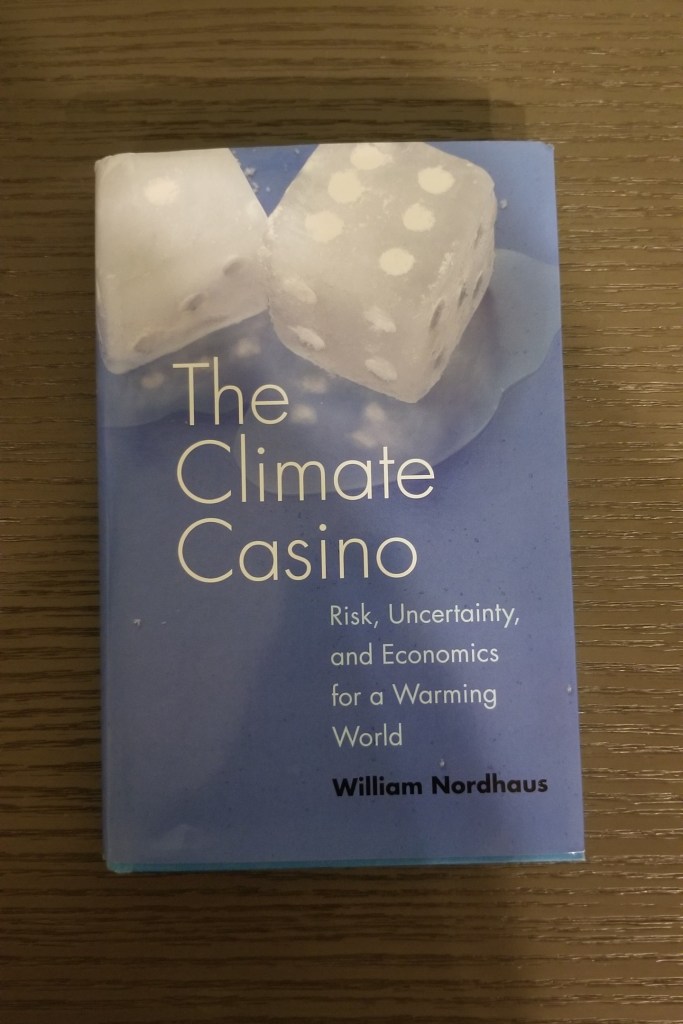
Normally the focus of my blog is on Leonbergers, especially our late Leonberger Bronco, but sometimes I present a good book which I want to promote. Today I would like to present and review The Climate Casino: Risk, Uncertainty, and Economics for a Warming World, Hardcover – October 22, 2013 and paperback– February 24, 2015 by William D. Nordhaus. The hardcover version has the dimensions 6.13 x 1.06 x 9.25 inches and the weight 1.54 pounds and currently cost $13.41 on Amazon.
Nordhaus received the Nobel prize in economics 2018 “for integrating climate change into long-run macroeconomic analysis” (Nobel Memorial Prize in Economic Sciences). Nordhaus is one of the most prominent economists in the world and without doubt a genius. He is worth listening to.
Before I present my Amazon review, I would like to point out that this book is very important for a few reasons.
- Nordhaus has been referenced, for example, in articles in the Wall Street Journal as someone who claims that climate change / global warming is costlier to mitigate than to allow to happen and that it might even be beneficial. He vehemently denies that he ever said something along these lines, and it is important to understand how this misunderstanding came to be.
- Nordhaus believes that climate change / global warming is happening, that it is dangerous, costly and that we humans are the cause of it.
- When calculating the potential cost of climate change Nordhaus does not take into account things like the extinction of species, not because it doesn’t matter, but because it is so difficult to put an economic value on it. Therefore, his calculations should be viewed as a baseline, a minimum to consider. If death is free of charge, it is not included, which he makes clear.
- Nordhaus takes into account the fact that technological progress and economic progress is making us more resilient. For example, despite the fact that natural disasters are getting worse, much fewer people are dying from them because we have become much better at preventing casualties. For example, WHO calculated that if global warming continues unabated 80 million additional people will die from malaria by 2050 due to the extended geographical spread of mosquitoes carrying malaria. Nordhaus takes into account the fact that future medical technology will be much better so that this may not be a big problem.
- Nordhaus also takes into account discounting. The fact that money is more valuable today than it is tomorrow. Twenty thousand dollars may be worth one hundred thousand dollars fifty years from now if you let it earn interest. Therefore, we should not spend too much money today to fix future problems (despite that fact we should still spend money today). The annual discount rate he is using is 4%. Some say that is too high.
- All that is mentioned above causes many environmentalists to jump to the conclusion that he is downplaying the cost of climate change / global warming. It also makes fossil fuel industry apologists falsely conclude that he is on their side. Thereof the confusion in Wall Street Journal articles.
- What he is doing is making his economic arguments for action today unassailable. No matter how you downplay the risks they should be addressed today based on purely economic rationale.
- He stresses the concept of economic externalities, something a lot of people don’t understand, especially people who learned economics from talk show hosts and politicians instead of taking classes in economics. An externality is an indirect cost or benefit to an uninvolved third party that arises as an effect of another party’s activity. It makes the free market fail and allows regulation to improve economic efficiency. It’s a big deal.
It should be noted that he is the world’s topmost expert on the economics of climate change / global warming. To see my original review, click here.
My Amazon Review
About The Thorniest of Externalities
In this book Nobel Prize Laurate in Economics (2018) William Nordhaus analyses the economic consequences of global warming. Nordhaus takes seriously the potentially catastrophic impacts of climate change, but he avoids all exaggeration and tries to be as realistic and conservative in his estimates as possible. He stresses that global warming is a major threat to humans and the natural world. That past climates were driven by natural sources, but that current climate change is increasingly caused by human activities. He gives us a brief introduction to climate science and the conclusions presented by the IPCC. He states that potential damage will be concentrated to low-income and tropical regions and explains that there are dangerous tipping points.
He explains that his economic analysis leaves out some potentially important consequences of climate change because they are difficult to quantity or because economic concerns are not the primary concern in those cases. He states that the most damaging impacts of climate change – in unmanaged and unmanageable human and natural systems – lie well outside the conventional marketplace. An example is species extinctions. There is no price tag on the value of a species. He explains that there have been five mass extinctions over the last 500 million years and now a sixth one is developing. That is a serious scenario he could not include in his economic analysis.
In his economic analysis he takes into account that many northern developed nations will be economically advantaged by global warming, as long as the temperatures do not rise too much. He takes into account that future generations will be wealthier, have better medicine, and will possess technologies that will help them adapt better to climate change. For example, the area in which malaria is endemic is likely to grow because of global warming thus potentially killing tens or hundreds of millions of people assuming today’s medical technology, but in the future medical technology will be better so that is not likely to happen. In fact, many of the health impacts of climate change are likely to be manageable in a future wealthier world. This is one reason why trying to slow economic growth to stop global warming is a bad idea that is counterproductive. There are much better ways.
Another important feature of his analysis is discounting. Money is more valuable today than tomorrow. Twenty thousand dollars may be worth one hundred thousand dollars fifty years from now if you let it earn interest. Therefore, it may not be worth paying a thousand dollars today to save future generations five thousand dollars. He uses a significant discount rate that has been criticized, but the important thing to remember is that this way he is not exaggerating. As it turns out, climate change is still expensive to future generations depending on how far we allow it to go. It is definitely worth investing today in slowing climate change. His graphs demonstrate that economic losses quickly become gigantic if you go too far beyond the temperature optimum (which depends on the assumptions behind the graph). One graph was 2 ¼ Celsius, another 3 ½ Celsius. Note, that is without considering unquantifiable consequences.
All his talk about discounting, certain economically positive consequences of climate change, that we will get better at adapting, etc., has led to misunderstandings by those with imperfect reading comprehension. Some environmentalists have concluded that he is underestimating climate change, and some climate skeptics have incorrectly concluded he is on their side. An article in the Wall Street Journal incorrectly claimed that William Nordhaus predicted that climate change would be economically beneficial.
Perhaps the most central concept in his analysis of how to approach the problem is externalities. An externality is an indirect cost or benefit to an uninvolved third party that arises as an effect of another party’s activity. For example, those who produce emissions/pollution do not pay for that privilege, and those who are harmed are not compensated. Global warming is a particularly thorny externality because it is global. Inventions correspond to positive externalities. Innovators are frequently paid only a small fraction of the benefits their innovations bring, while benefiting all of society. This is why subsidizing technology and innovation can be beneficial to the economy.
He states that economics teaches us that unregulated markets will not put the correct price on externalities like CO2. To make the market more fair, efficient, and grow the economy faster you try to correct for the externality and the best way to do that is a Pigouvian tax. Market fundamentalists who’ve learned economics from talk show hosts but never taken an economics class may balk at this, but it is a basic concept in economics, like supply and demand. Towards the end he strongly argues for some sort of a carbon price, which I saw as the conclusion of the book. I thought his book was very informative, excellent analysis, and very well written.

 Leonberger Life