
The Origins of the Leonberger Dog

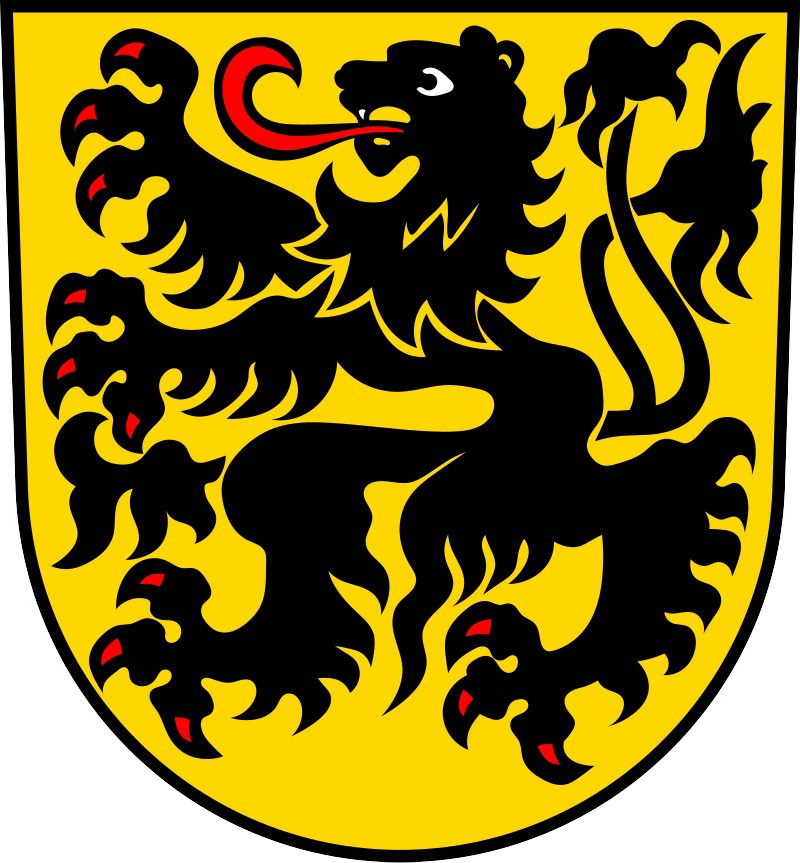
coat of arms of the town of Leonberg. A black lion like figure on a yellow background
The coat of arms of the town of Leonberg, Germany, was allegedly the inspiration for the first breeder of the Leonberger, Heinrich Essig.

The Leonberger breed was originally created by Heinrich Essig (1808–87) in the German town of Leonberg, in what was then the kingdom of Württemberg. According to legend, Essig bred the dog to resemble the lion in the town’s coat of arms. Indeed, as you can see in the image above, the lion in the coat of arms doesn’t look like a real lion, so you could say that the Leonberger looks the way it does because Germans were bad at drawing lions back then. All joking aside, though, Leonbergers do bear some resemblance to lions and maybe even bears. In any case, they are beautiful dogs.
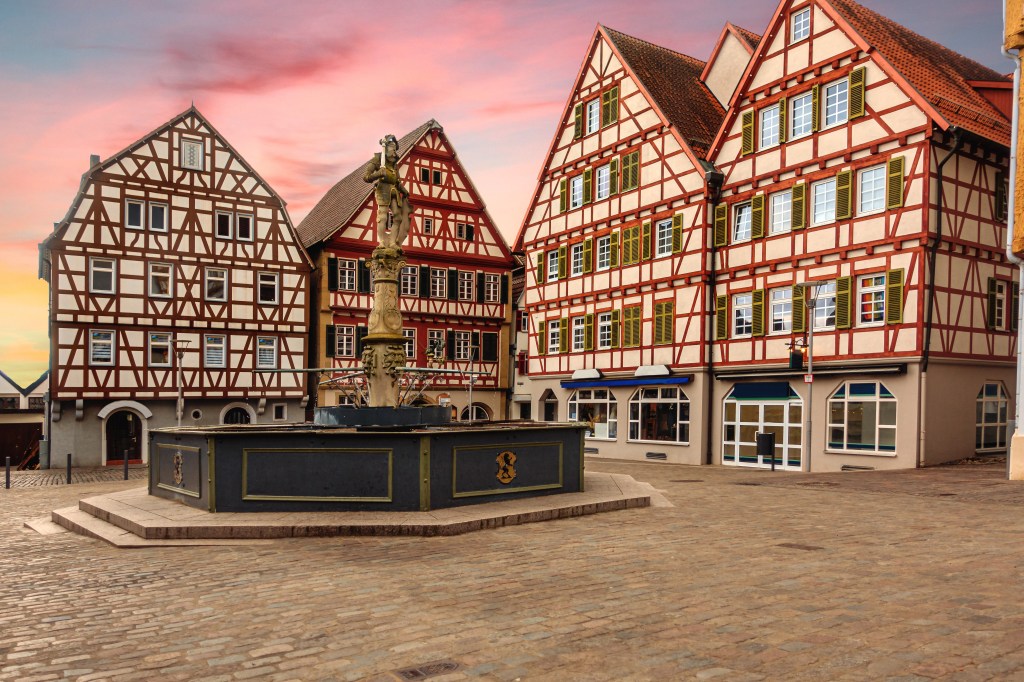
A town square surrounded by buildings. There is a statue in the middle.
The town square in the city of Leonberg. Shutter Stock Photo ID: 1689829297 by Martin Dutkiewicz.

When people would stop me and ask me questions about the kind of dog Bronco was, I would say he was a Leonberger, a cross between a Saint Bernard, a Newfoundland, and a Great Pyrenees and that the breed was created by the mayor of the German town of Leonberg. But, as the economist Tyler Cowen said, “Be suspicious of simple stories.” As it turns out, the story I kept telling was a simplification and not entirely true. History is more complicated. I was unintentionally spreading misinformation about Leonbergers.
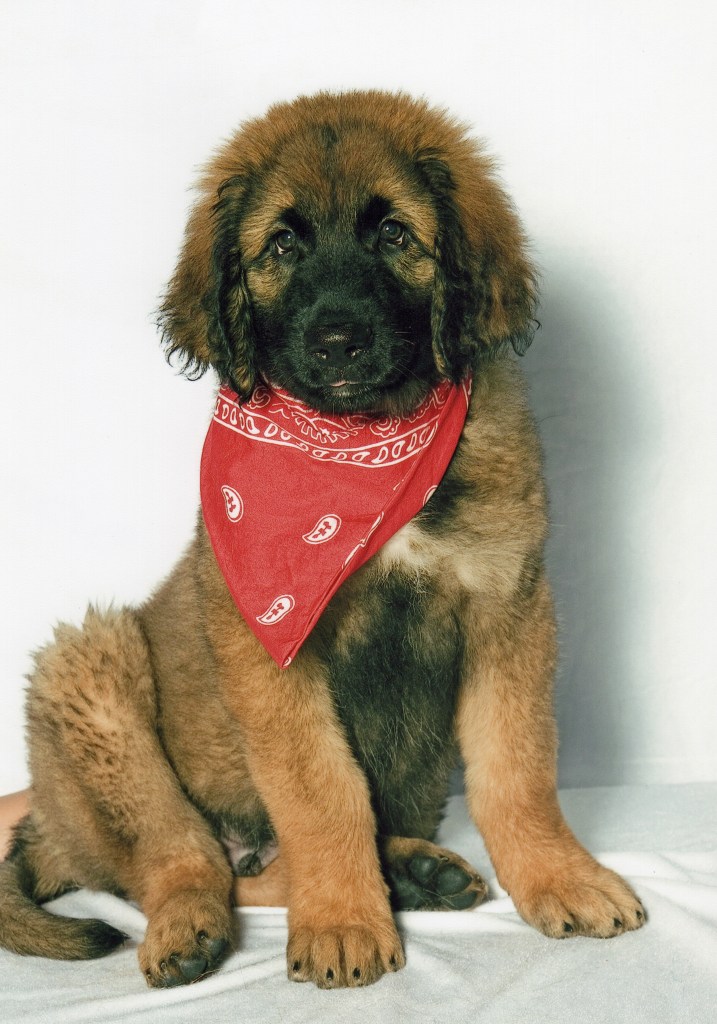
A Leonberger puppy wearing a red silk scarf.
Our Leonberger Le Bronco von der Löwenhöhle at 3 months old.

Simple and interesting stories are easy to remember, easy to believe, and easy to propagate. But first, Heinrich Essig was never the mayor of Leonberg. He was a prominent citizen of the town, and he was a successful businessman, farmer, innkeeper, horse and dog trader, large dog enthusiast, dog breeder, and town councilman, but he was never the mayor.
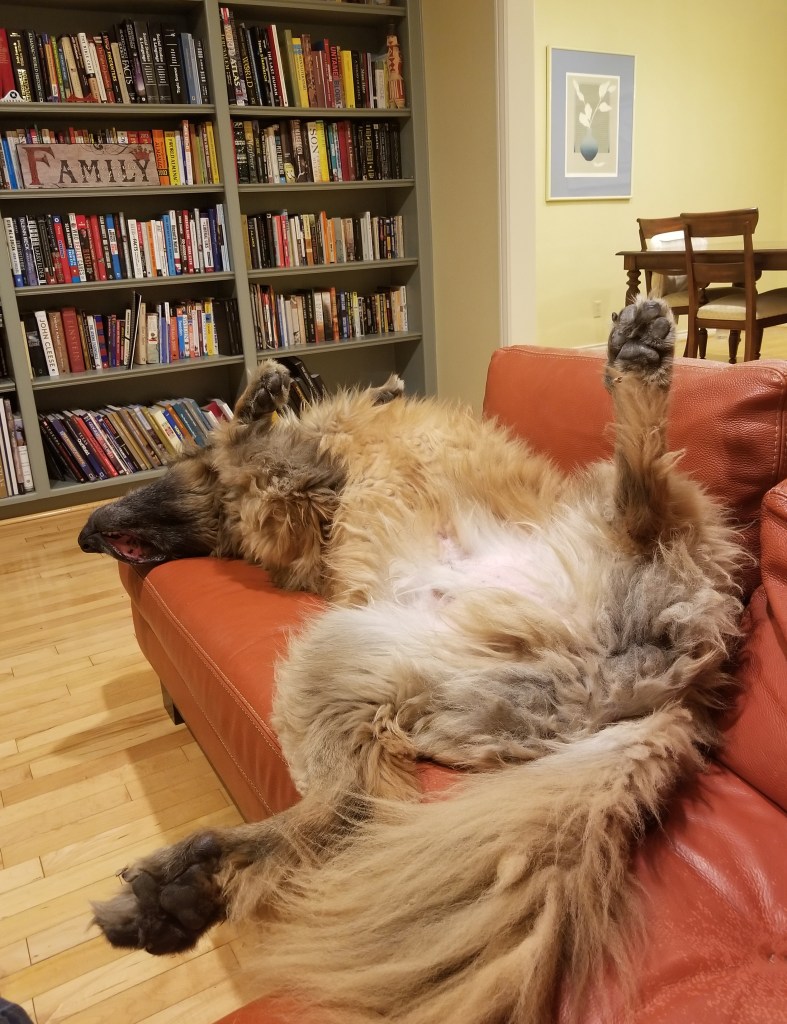
A big Leonberger splayed across a big wide red leather sofa.
Our Leonberger Bronco sleeping on our big red leather sofa.

Essig claimed to have created the Leonberger in the 1830s by crossing a female Landseer Newfoundland with a male long-haired Saint Bernard from the Great Saint Bernard Hospice, a monastery in Switzerland. He continued crossing the Landseer Newfoundland and the Saint Bernard over four generations, then he crossed his Newfoundland Saint Bernard mix with a Pyrenean wolfhound not, as is often asserted, with a Great Pyrenees (called a Pyrenean Mountain dog in Europe). He then crossed that dog with the Saint Bernard again. In 1846, he was finally ready to announce and register his “lion of a dog.” A few years later, Leonbergers were officially introduced to the public at the Munich Oktoberfest.

Our Leonberger is standing on the large red leather sofa giving me a kiss.
Me and our Leonberger Bronco when he was young.

However, the story is more complicated than that. There’s no specific breed named Pyrenean wolfhound today, so Essig could have used a Great Pyrenees or a Pyrenean mastiff . In addition, later in the nineteenth century, Leonbergers were used to breed the long-haired Saint Bernard dog, and this likely saved the Saint Bernard dog from extinction. At one point, too, Leonbergers were deliberately mixed with Newfoundland dogs to strengthen the Newfoundland breed. In other words, breeding happened in both directions, and the characteristics of the large breeds were in constant flux. The dogs, including Leonbergers and Saint Bernards didn’t look like they do today, either. Essig’s Leonbergers were multicolored, mostly white, and lacked the black mask that is so important to the breed now. What has not changed is the essence of what Essig was aiming for: a large but moderately proportioned dog that is friendly and loving and a great companion.

Saint Bernard Dog wearing a cognac barrel. The Alps in the background.
A modern Saint Bernard Dog. Shutter Stock Photo ID: 1713912484 by fred12.

Ultimately, the origins of the Leonberger, as well as the Saint Bernard and the other large breeds from this region, are complex and shrouded in mystery. In addition, some of Essig’s claims have been disputed. Breed standards wouldn’t be codified until the end of the nineteenth century. It should also be noted that it was Essig’s niece Marie who to a large extent bred and cared for the dogs.
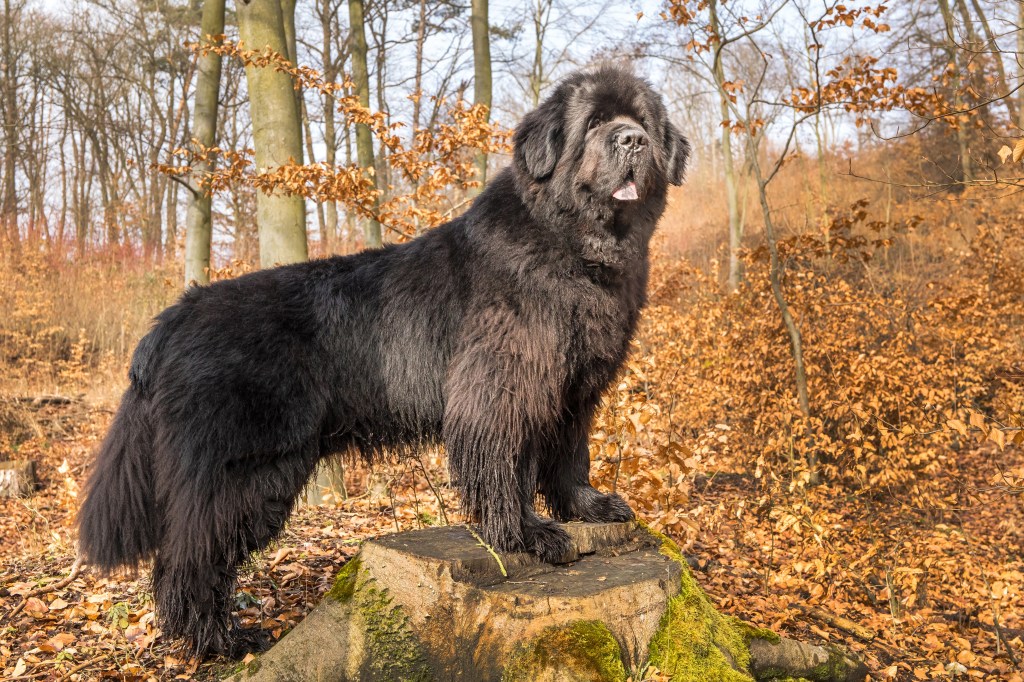
Black or dark brown New Foundland Dog with a colorful autumn forest in the background.
Modern New Foundland Dog. Shutter Stock Photo ID: 1925281937 by Marsan.

Essig was selling his Leonberger dogs as luxury items to the wealthy. He was also a marketing genius and was able to get the attention of European nobility and royalty. The czar of Russia, Emperor Napoleon II, Otto von Bismarck, the king of Belgium, Empress Elisabeth of Austria, Emperor Maximilian I, the Prince of Wales, King Umberto of Italy, Giuseppe Garibaldi, and the mikado of Japan were among those who owned Leonbergers. Not everyone was happy about this. Some people viewed the Leonberger as a fashionable knockoff of the Saint Bernard that could hinder that breed’s development.
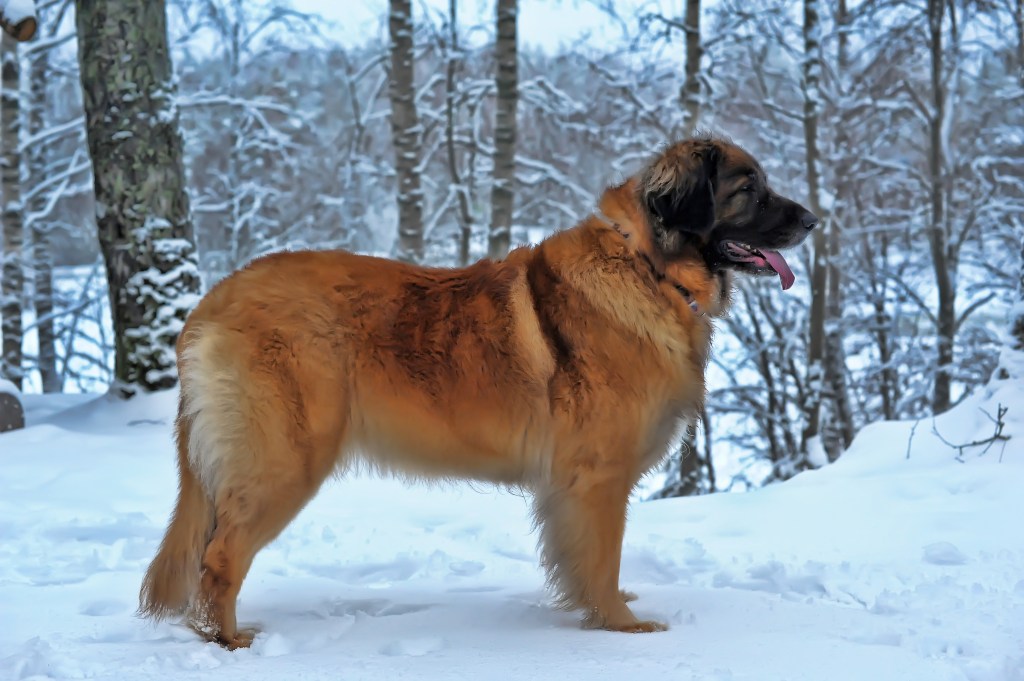
Photo of a Leonberger standing in the snow. There is a wintry forest in the background.
Modern Leonberger. Shutter Stock Photo ID:705193912 by Anna Krivitskaya.

Toward the end of the nineteenth century, the discipline of cynology, or the scientific study of dogs, emerged. Cynologists pushed for breed classification and systematic breeding practices, and breed standards were created. But Essig and others viewed dog breeding as an art rather than a science, and this led to a conflict with the cynologists. Heinrich Schumacher, for example, was a breeder who strove to create a clearly identifiable Saint Bernard type. He was upheld by the cynologists as a paragon, in contrast to Heinrich Essig to the detriment of the Leonberger.
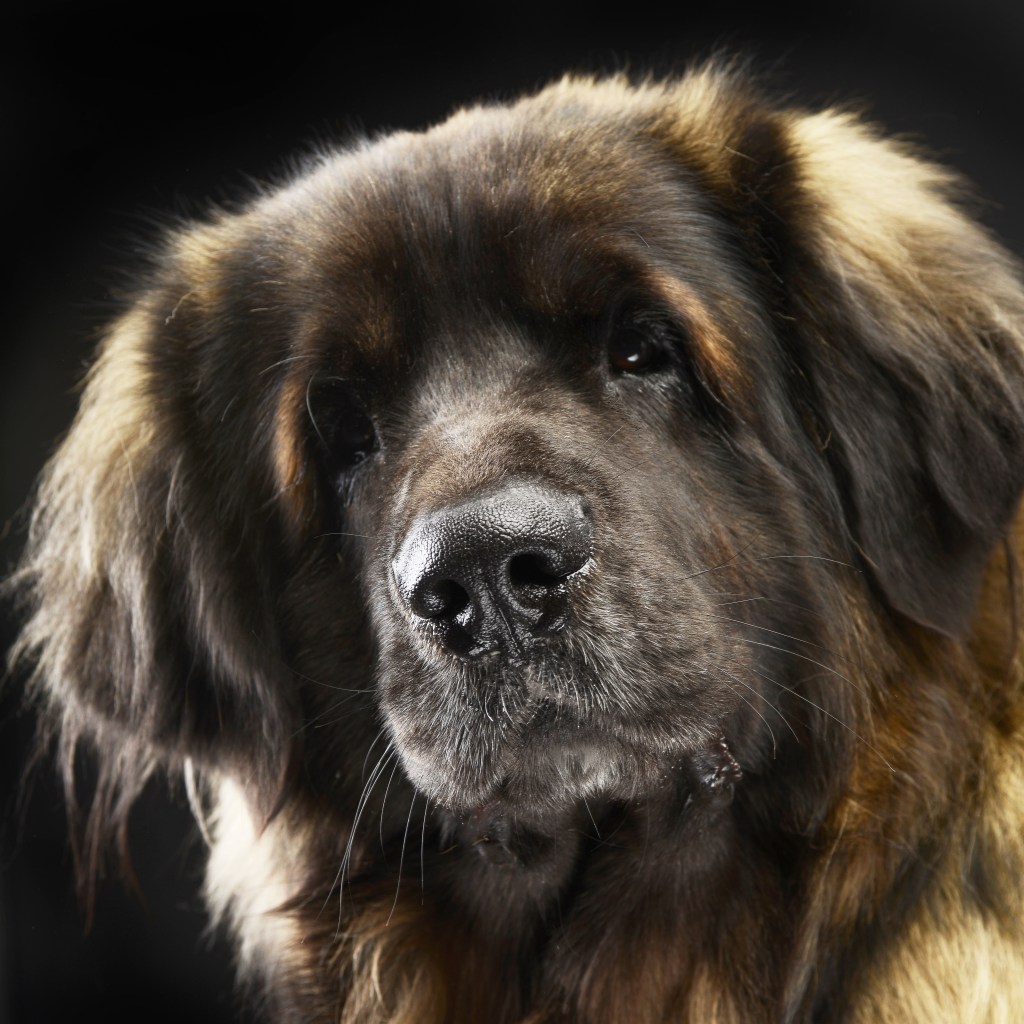
Face of a Leonberger looking into the camera.
Face of modern Leonberger. Shutter Stock Photo ID: 193024763 by Csanad Kiss.

After Essig’s death, in 1887, other people more willing to please the cynologists continued breeding Leonbergers. By that time, the dogs looked for the most part like Leonbergers do today. Then, in 1895, Albert Kull created the Leonberger’s first breed standard. It would go through several revisions in 1901, 1926, 1938, 1951, 1955, and 1972—until finally, in 1996, the FCI approved version was established. The Kennel Club in the UK and the American Kennel Club also have their own breed standards. However, most of them are similar to Albert Kull’s 1895 version. The first Leonberger club was formed 1891 in Berlin: two more were created in 1895, then two more were formed in 1901. The most prominent was the Internationaler Klub für Leonberger Hunde, of which Albert Kull was the first president.

For additional information see :

The Life and Times of Le Bronco von der Löwenhöhle: Stories and Tips from Thirteen Years with a Leonberger by Thomas Wikman.

Madeline Lusby, Leonberger: A Comprehensive Owner’s Guide (Allenhurst, NJ: Kennel Club Books, 2005).

Caroline Bliss-Isberg, Leonberger: A Comprehensive Guide to the Lion King of Breeds (Sea Cliff , NY: Revodana Publishing, 2017), 23, 41, 45, 48–49.
Ten Leonberger Myths and the Truth

In this post I am stating and correcting ten Leonberger myths that I’ve seen on various websites and in various Leonberger books. Websites featuring incorrect information include Wikipedia. It is always good to remember that googling is not research and that a lot of information on the internet is wrong. In the list below I avoid stating the myth and then correcting it. Instead, I am trying to implicate the myth as a myth from the start or begin the sentence with the truth. The reason for doing this is psychological. Research has shown that if you state something false and then correct it, people tend to remember the first thing they saw, which was the myth, instead of the truth.

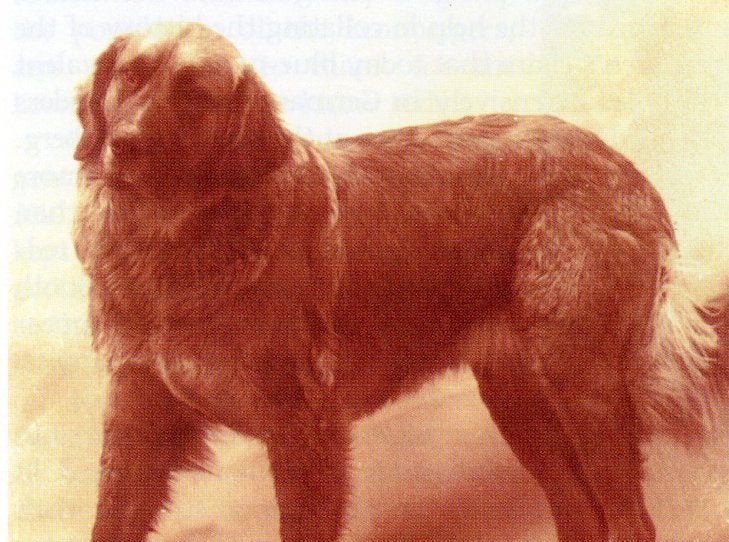
This embedded old historic photo of a Leonberger is from the AKC website.

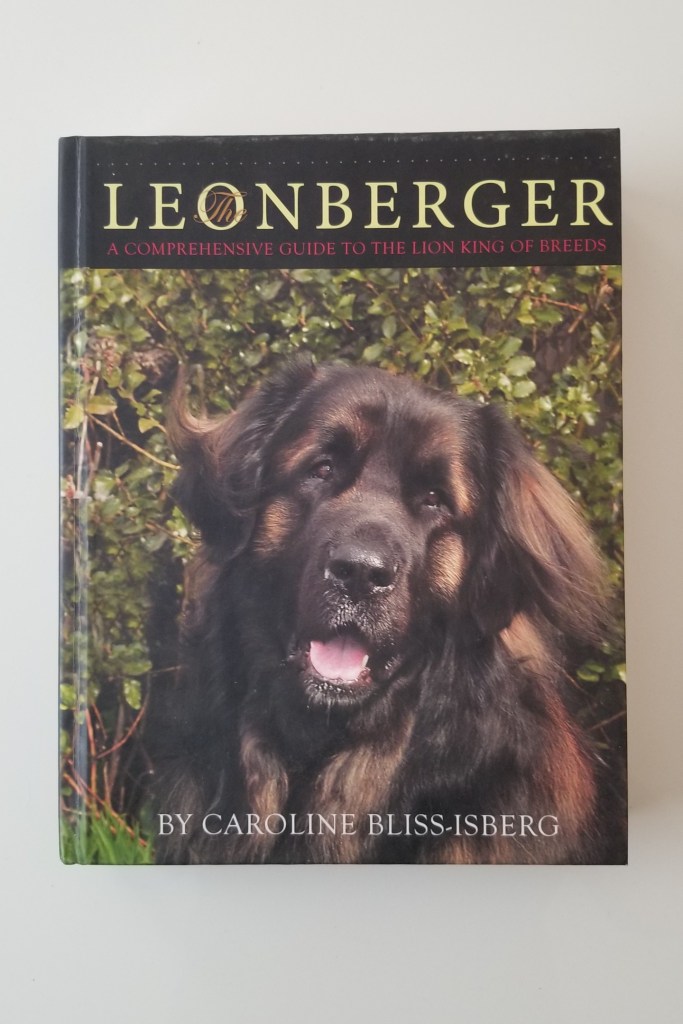
To correct many of the myths regarding Leonberger history I am referring to the book Leonberger by Caroline Bliss-Isberg. If I am not specifically stating the source in a listed item it is from her book. Caroline Bliss-Isberg is a recipient of the Heinrich Essig Award and the Leo Heart Award and a very prominent leader in the Leonberger community. With the help of other prominent leaders of the Leonberger community as well as expert researchers she attained documents, illustrations and photos never before published and from it she created the most extensive (several hundred pages) and accurate account of Leonberger history.

Photo of the book Leonberger, by Caroline Bliss-Isberg. Click on the image to go to my review of Leonberger.
Leonberger, by Caroline Bliss-Isberg. Click on the image to go to my review of Leonberger.
  • If you want to spay or neuter your Leonberger it is best to wait two years, so do NOT spay or neuter a Leonberger at six months as some erroneously state. The neuter at six months claim is not very common, so it is perhaps not a real myth in that sense. However, I’ve seen it in some books and there are some organizations that insist on spaying./neutering even giant breeds. To learn about the reasons and the research behind the two years wait for Leonbergers click here.
  • Heinrich Essig was NOT the mayor of the city of Leonberg. Heinrich Essig was a prominent citizen of the town, and he was a successful businessman, farmer, innkeeper, horse and dog trader, large-dog enthusiast, dog breeder, and town councilman, but he was never the mayor of Leonberg. About half the Leonberger websites and books that I’ve come across get this wrong and the other ones get it right. However, it is the research by Caroline Bliss-Isberg that sets this straight as can be seen on page 20 of her book.
  • More than two dogs were used for creating the Leonberger. It was not just a St. Bernard and a Newfoundland dog as a few Leonberger books I’ve come across erroneously claim. See next list item for more information.
  • It is not entirely true that the following three dogs were used to create the Leonberger; the St. Bernard, the Newfoundland dog and the Great Pyrenée dog. This is a common claim based on the Essig’s claim that he bred the Leonberger from long haired St. Bernards, the Newfoundland dog and the grey-yellow wolfhound from the Spanish Pyrenees. However, the Pyrenean wolfhound is not likely to be what we call a Great Pyrenée dog. Moreover, these dogs did not look like they do today and there was a lot of breeding back and forth going on and Essig did not keep records. Therefore, the story is likely to be a lot more complicated. The bigger story is explained on the pages 23, 41, 45, 48-49 Caroline Bliss-Isberg’s book but it is also more briefly explained in my Leonberger History page on this website.
  • There were definitely more than five Leonbergers alive after World War One despite several Leonberger books and websites erroneously claiming only five survived. I should say that many of the more reliable websites get this right. It is true that World War I was tough on the breed. It didn’t help that Leonbergers were used to pull ammunition carts and cannons. However, more than five Leonbergers survived the war. After the war, Karl Stadelmann and Otto Josenhans, worked hard to save the breed, and they were able to find twenty-five Leonbergers whose owners were willing to cooperate in reestablishing the breed. Of these, only five were suitable for breeding. That is still a pretty significant genetic bottleneck.
  • There is a common erroneous claim associated with World War II as well, stating that only eight Leonbergers survived World War II. There was indeed a “genetic bottleneck” of Leonbergers in the 1940s. This was largely because people repeatedly bred the dogs they thought were the best specimens in a misguided attempt to improve the breed. Scientific pedigree analyses demonstrate that the Leonberger has twenty-two founder animals, or animal ancestors unrelated to one another (ten males and twelve females). Again, that is a little bit different from “only 8 survived”.
  • Another World War II myth is that Leonbergers were used for pulling ammunition carts in World War II just as in World War I but there is no proof of that.
  • Another incorrect claim that I’ve seen on websites and some books is that the Leonberger dog first appeared in North America in the 1970’s. As Caroline Bliss-Isberg describes in her book in several places, Leonbergers were introduced in the United States and Canada on several occasions during the 19th century and at the beginning of the the 20th century. However, it was typically just a few Leonbergers and the population was not maintained. It was not until the 1970’s that Leonbergers a permanent population was established in North America.
  • The lifespan of a Leonberger is on average 8-10 years not 6-8 years or 7 years, which is old data still reported by some websites. The Leonberg Health Foundation International have been successful in eradication several detrimental genes in the Leonberger breed. I should say the reliable websites typically have this information correct.
  • I’ve come across a few Leonberger books which grossly understate the size and weight of Leonbergers, for example, claiming that a male Leonberger weigh between 45 and 60 pounds. The weight of a male Leonberger is 120 to 170 pounds. Luckily the vast majority of books and websites get this information correct.