This blog feature amusing and heartwarming stories about our late Leonberger dog Bronco, as well as other Leonbergers. It also has a lot of information about the Leonberger breed, the history, care, training, Leonberger organizations, etc. I also wrote a Leonberger book, which I am featuring in the sidebar.
I just returned from a trip to Scandinavia with my son and his wife. Since it is World Tourism Day today (September 27th) I thought I’d make a post related to our trip. I already made five posts about our trip on my new blog Super-Factful so what I am going to do is just link to those five posts. See below.
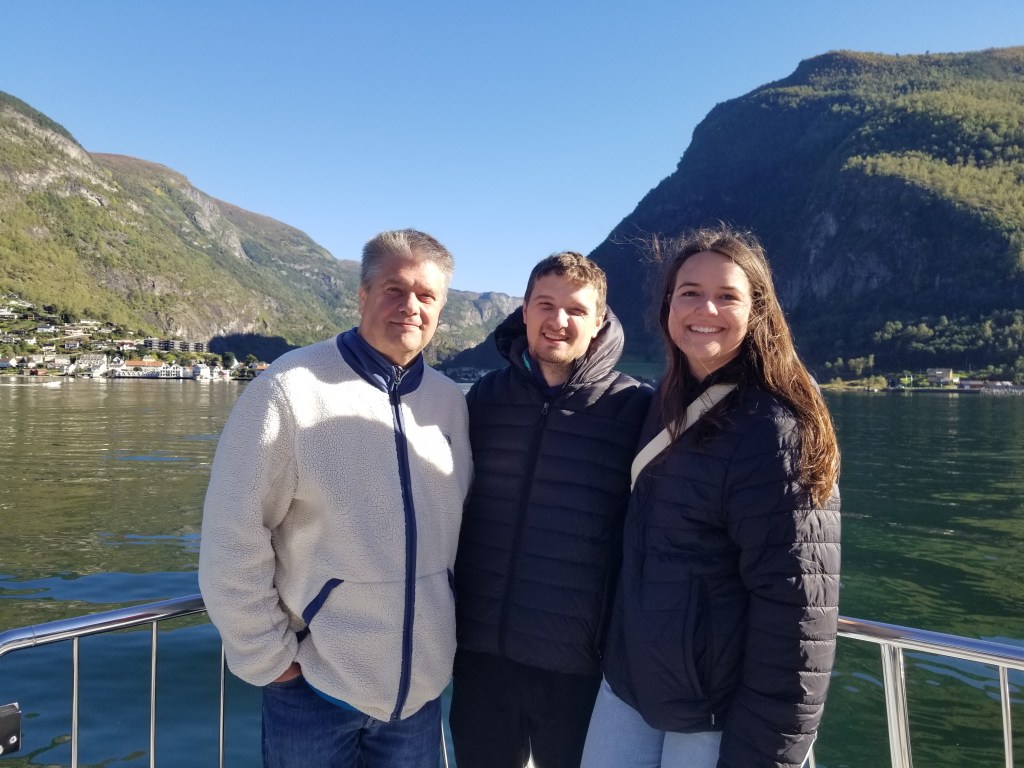
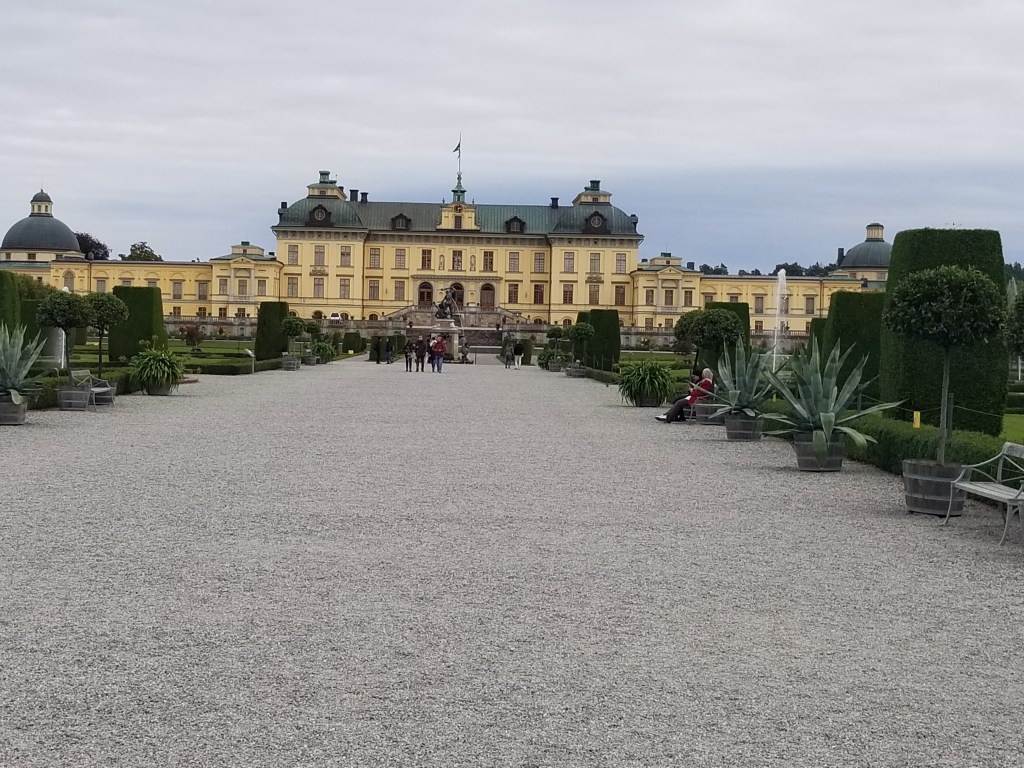
From a cruise in Sognefjord, Norway. Left to right, me, my oldest son and his wife. Click on the image to visit my post titled : “Tourism in Scandinavia on World Tourism Day”Drottningholm, one of the Royal Palaces in Sweden. It was built in the 1660’s and was inspired by Versailles. Click on the image to visit my post titled : “Sweden and Norway and Carl XIV Bernadotte”Painting of Gustav I Vasa the father of Sweden. Fashion was somewhat different back in the day. Click on the image to visit my post titled : “Sweden and Denmark and Gustav I Vasa”Imagining how a Huldra (female magical creature) would look like. Stock AI-generated image ID: 2400845203 by Shutterstock AI Generator. Click on the image to visit my post titled : “Scandinavian Folklore”.A photo of the Vasa ship from the bottom floor. My son is standing on the right in a green and black shirt. Click on the image to visit my post titled : “Vasa Museum Stockholm”.
Today, December 13, is Saint Lucy’s Day (Santa Lucia in Swedish) in Sweden. On this day girls or young women dress up in white robes and the chosen St. Lucy places a crown of candles or lights in her hair, The other girls/women are referred to as “Tärnor”. Boys dress up in white robes and wear white cones on their heads. Some of the boys dress up as gnomes. Then they march through the streets or inside buildings. They sing songs and hand out Lucia buns, gingerbread cookies and other goodies. They typically do this early in the morning while it is still dark. If the Lucia group is inside, you typically turn off the lights to create the right ambiance.
This evening my daughter surprised me by baking the traditional saffron buns, so called Lusse Bullar or Lucia Buns in English. She prepared a Swedish meatball dinner and dressed up as St. Lucia. I had completely forgotten about St. Lucy, so it was a surprise. She did not want her picture online, so I am including online photos of St. Lucia.
A Lucia procession. Fredrik Magnusson, CC BY 2.0 , via Wikimedia CommonsLucia procession at award ceremony. Holger Motzkau 2010, Wikipedia/Wikimedia Commons (cc-by-sa-3.0), CC BY-SA 3.0 , via Wikimedia CommonsThe Lucia buns my daughter baked. (My photo of course)One of the Lucia Buns my daughter baked.Meatball dinner that my daughter prepared.
St. Lucy takes place during the Nobel Week. The Nobel award ceremony happen on December 10. It should be noted that we often speak of the Nobel Prize, but there are six Nobel Prizes. The prizes for Physics, Chemistry, Physiology or Medicine, Literature, and Economics, are awarded in Stockholm, Sweden. The Nobel Peace prize is awarded in Oslo, Norway.
Anyway, On December 13 a St. Lucy parade visit and sometimes surprise the Nobel Prize winners in Stockholm who are staying for a few days (they stay at the Grand Hotel). In the past, these surprises did not always work out well, as the St. Lucy group of white dressed women sometimes frightened laurates from East Asia. In East Asia white dressed women are often thought of as ghosts (yūrei and onryō). Think of Samara Morgan in the Ring movies. Therefore, they modified how the Lucia train (as it is called) marches through the hotel. For example, they no longer show up in people’s rooms unannounced.
As a little piece of interesting information this is a list of this year’s Nobel Prize winners.
Physics: Pierre Agostini; Ferenc Krausz; Anne L’Huillier – “for experimental methods that generate attosecond pulses of light for the study of electron dynamics in matter.”
Chemistry: Moungi Bawendi; Louis E. Brus; Alexey Ekimov – “for the discovery and synthesis of quantum dots.”
Physiology or Medicine: Katalin Karikó; Drew Weissman – “for their discoveries concerning nucleoside base modifications that enabled the development of effective mRNA vaccines against COVID-19”
Literature: Jon Fosse – for “his innovative plays and prose which give voice to the unsayable”.
Economics: Claudia Goldin – “for having advanced our understanding of women’s labour market outcomes”.
Peace Prize: Narges Mohammadi – “for her fight against the oppression of women in Iran and her fight to promote human rights and freedom for all.
Someone reminded me that today is the day of writing, so I decided to make a blog post even though I made one yesterday. This post is not about Leonbergers or dogs but about our visit to the ice hotel in Jukkasjärvi in northern Sweden. It was 2005 and the kids were still small. It was the first ice hotel in the world and is the biggest one.
I should say that Jukkasjärvi is located north of the arctic circle and is typically very cold in winter. The ice hotel itself does not have any bathroom, but they have an adjacent wood building with bathrooms, showers, and rooms for anyone who can’t stand the cold for too long. If you are OK with being a bit cold, you sleep in sleeping bags on top of blocks covered by reindeer hides. Below are some selected photos that I took.
This is the ice theater. It was located next to the ice hotel (not in the picture).
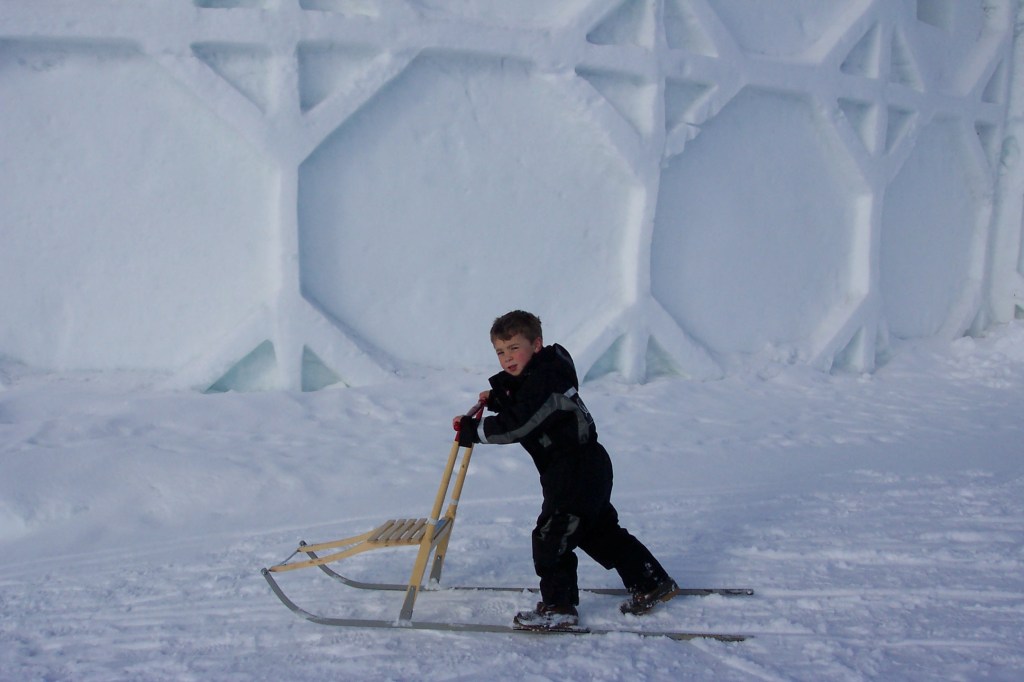
The ice hotel had put out lots of kick sleds, referred to as “spark” for people to use as a mode of transportation on the snow and ice, or just to sit on. As my dad, Stig, was sitting on one of them, our son came up to him and told him “Stig the hotel put out these sleds for children to play with. It is not for adults to sit on.” My dad was so surprised that he just handed him the sled.
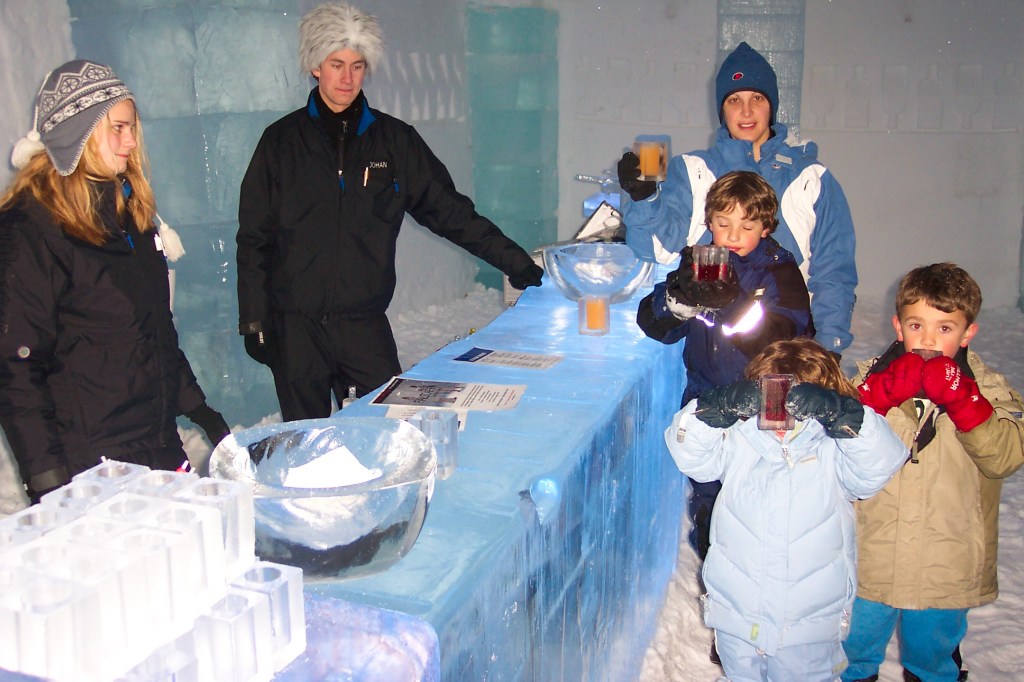
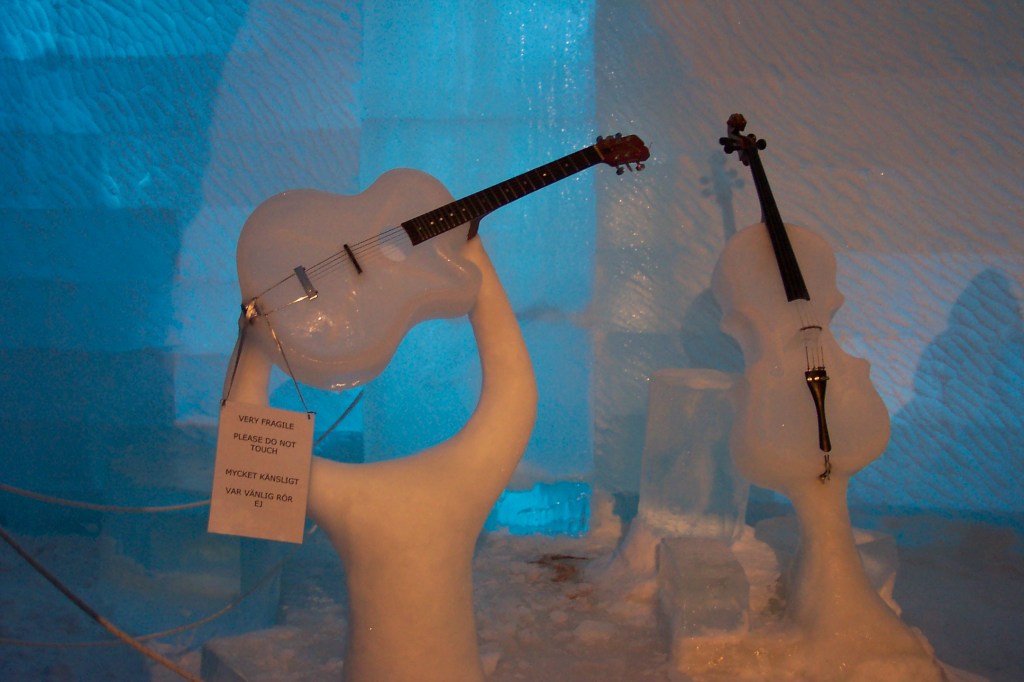
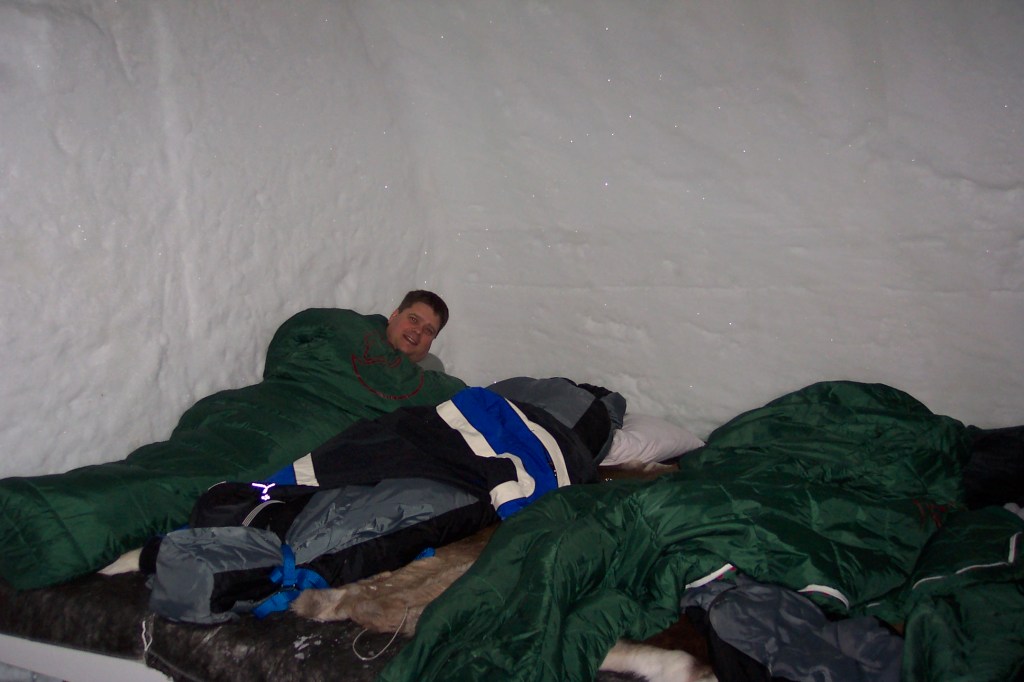
Our son David with one of the kick sleds called “spark”.The lobby of the ice hotel. Our kids are sitting around a table of ice. A chandelier of ice is hanging above the table. The light is from fiber optics, so the ice won’t melt.Another photo of the lobby at the ice hotel. My son David is barely visible behind one of the ice pillars.My oldest son sitting at an ice table in the lobby.They got the ice blocks for the structure and for the art from nearby Torneå river.We started the evening with a visit to the ice restaurant and bar. Everything in the ice restaurant was made of ice, the tables, the chairs, the counter, the glasses, the plates, and the art.This is a photo of the ice instruments standing on the ice stage.A close up of an ice cello and an ice guitar.My dad Stig and his girlfriend Ulla came with us on the trip.We are going to bed in our room. I think it was my wife Claudia who took the photo.
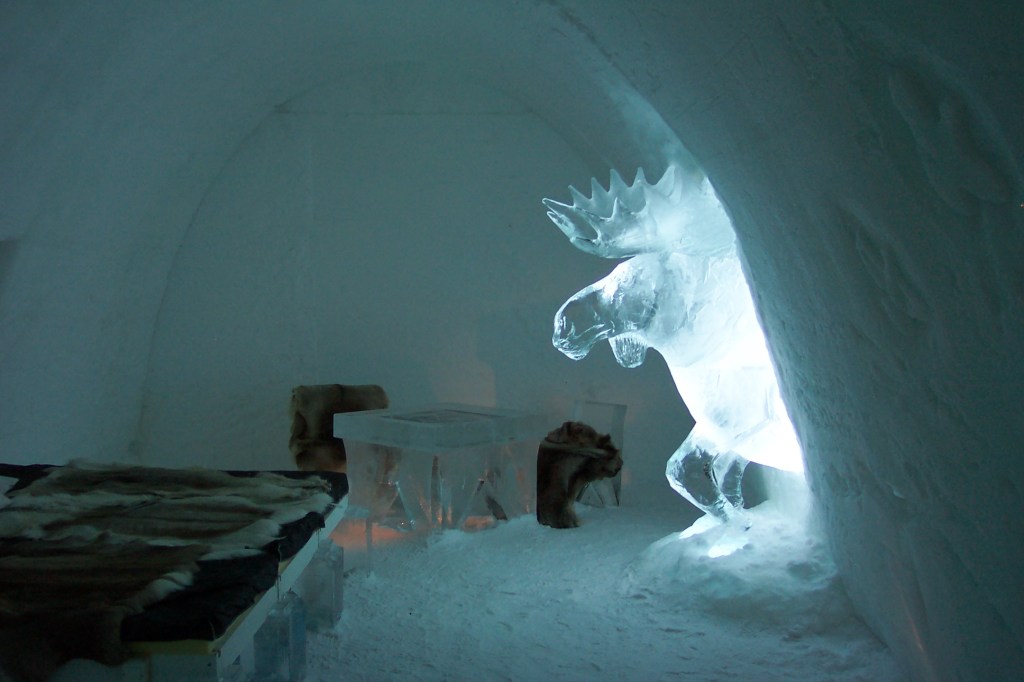
The day after I took some photos of the other rooms.
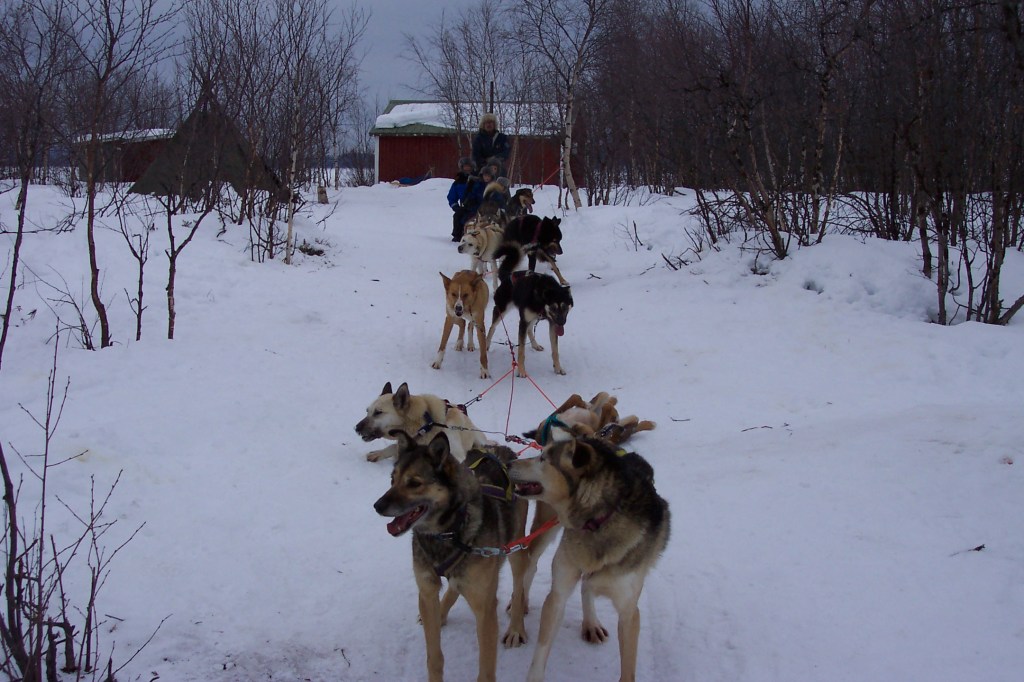
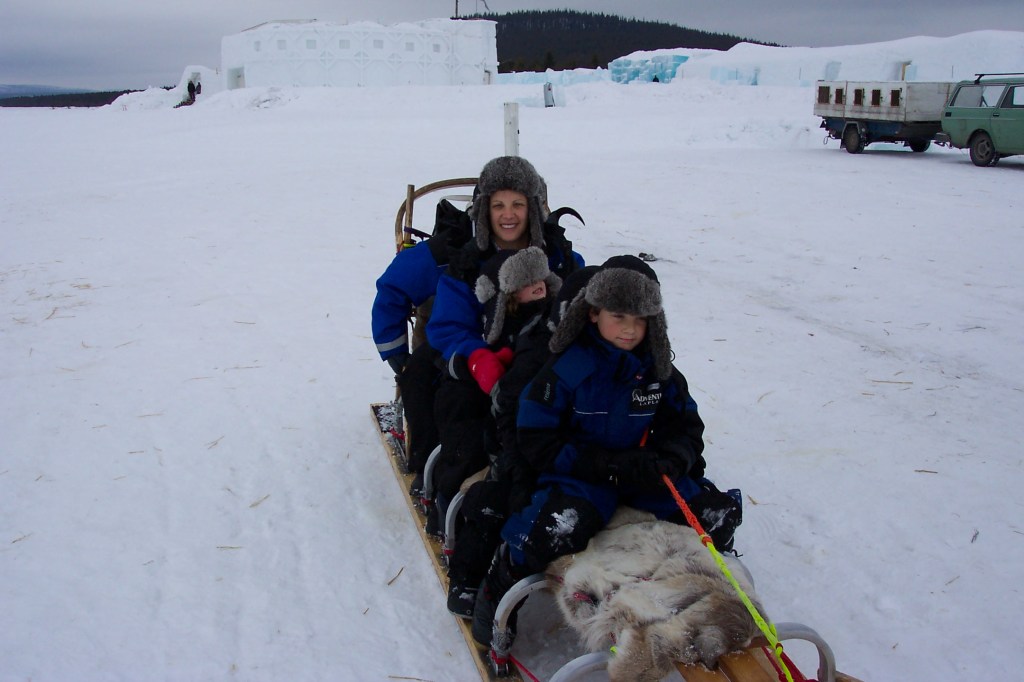
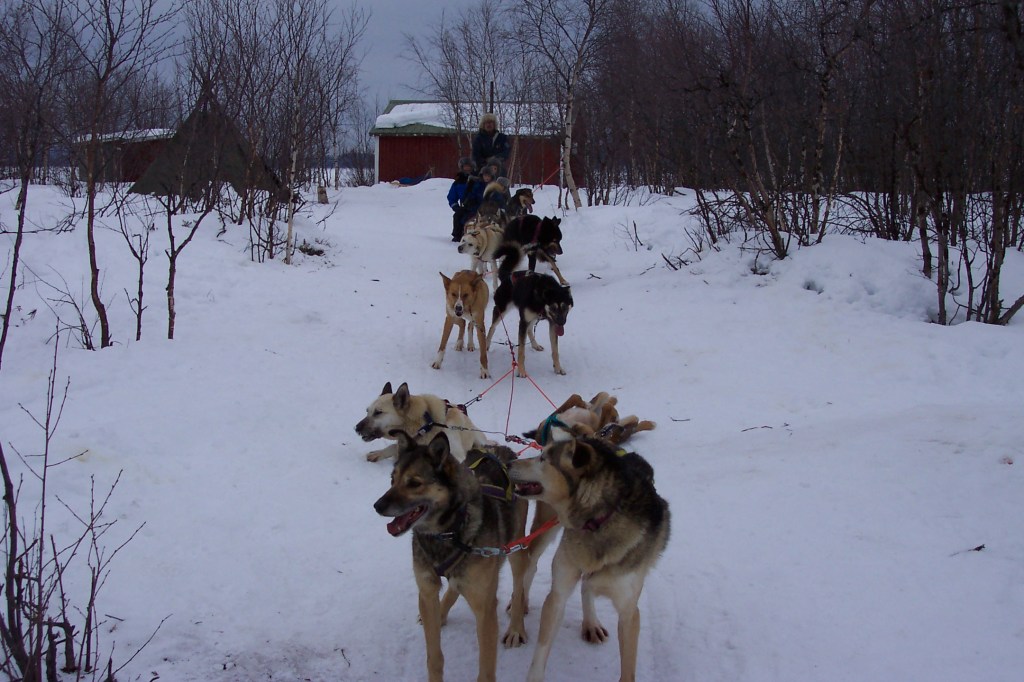
This was the hallway where our room was located.We are going on a dogsled tour. The ice theater is in the background, and you can see part of the ice hotel on the right.The kids had a lot of fun during the dogsled tour.
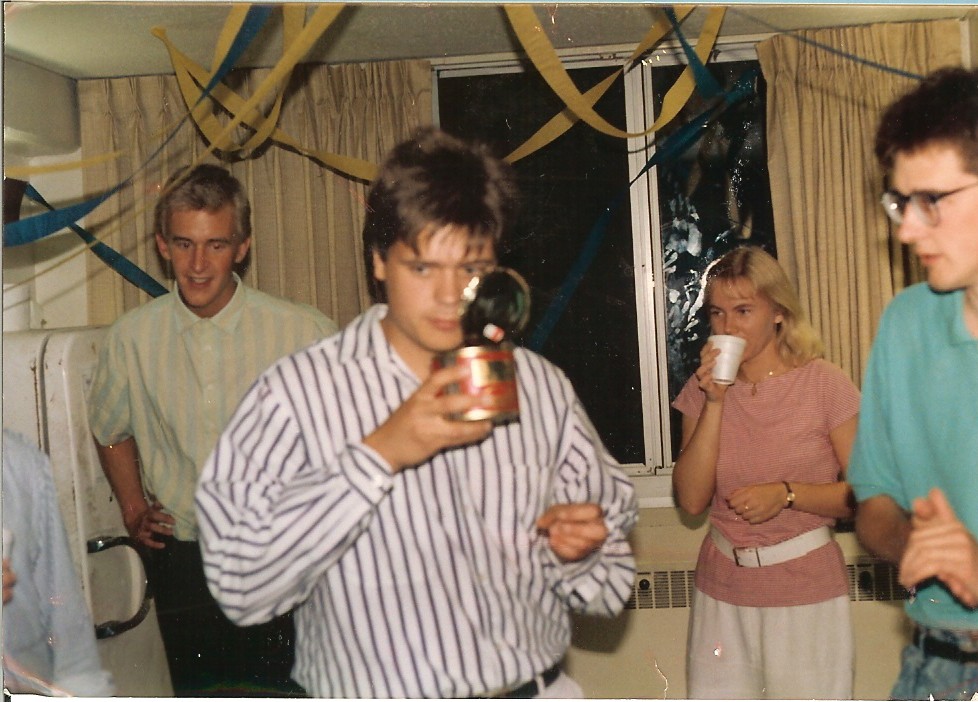
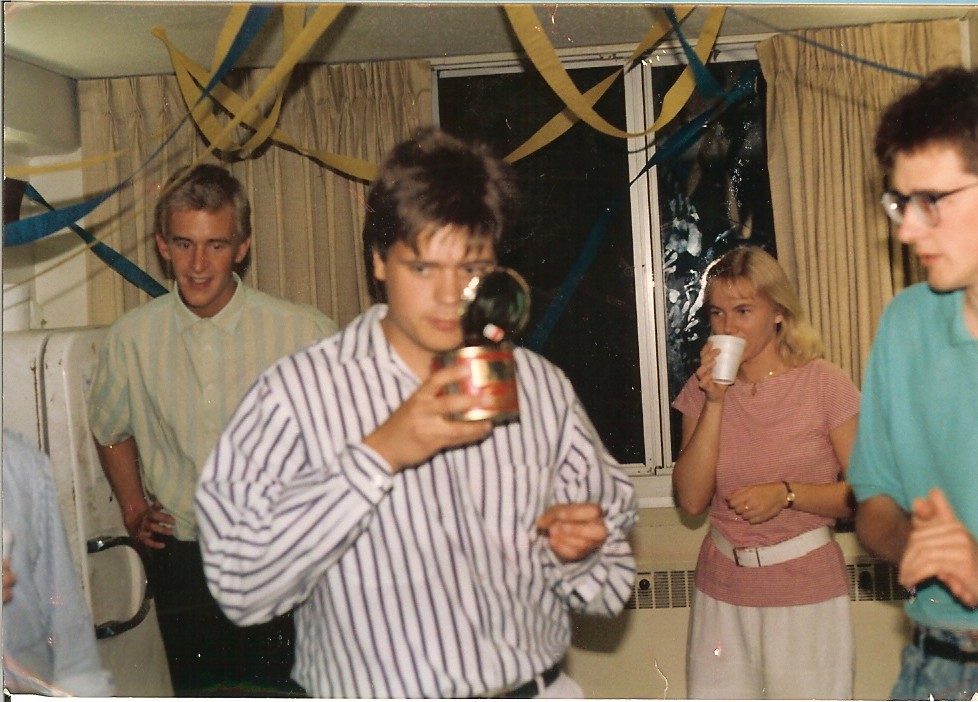
In my recent post called “Culture Shock Sweden USA” I included a photo of myself opening and smelling a can of north Swedish fermented herring, or as it is properly called “surströmming”. It is a specialty from the north Swedish Highcoast where I grew up. Underneath the photo I wrote “Unfortunately, all the Americans experienced a culture shock from the fermented herring.” See the excerpt below. What I should maybe have mentioned in my post is that even though it was a joke, it was still true. People were not ready for what was coming.
Four Swedes inviting Americans to a fermented herring party. Fermented herring is a north Swedish specialty. Unfortunately, all the Americans experienced a culture shock from the fermented herring. I am the guy smelling the fermented herring can.
After I had posted “Culture Shock Sweden USA”, I posted a link to my blog on my Facebook and I received a few comments including comments from two people who actually were there at the fermented herring party in 1987. I’ve included the comments below.
Surströmming first-timer videos are getting pretty common these days, but I still always end up laughing until I can barely breathe when they start the uncontrollable retching! Always reminds of the Surströmming party and that nasty prank we pulled on the residents of Glaser House! 🤣 — Lee
Delicious memories….NOT!!! 🤢🤮 — Alyce
What happened was that as soon as I opened the can, all Americans dashed for the windows or doors trying to escape the smell. In the party invitation we had left out one or two details, like that surströmming is often said to be the worst smelling food in the world. The “nasty prank” Lee was referring to was me and him going around the dorm and placing left over surströmming in the ventilation drums of the dorm. I admit that was immature. Luckily, it did not work as well as we had hoped, or we probably would have both been expelled.
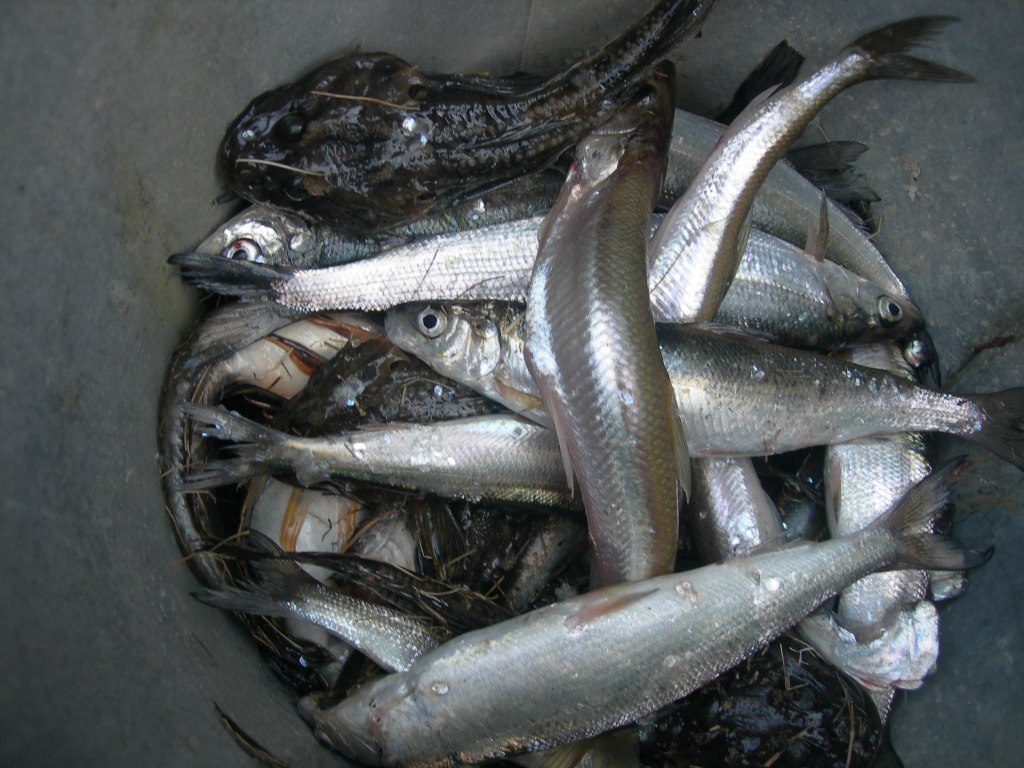
Herrings that we caught in northern Sweden. Plus, a fish called Simpa.
Since gaining notoriety as one of the world’s smelliest foods, surströmming has become the focus of a number of “challenge” videos on YouTube and other platforms where people uninitiated to the food show themselves opening a can for the first time, usually to visceral reaction, and then try to eat the fish without additional preparation. Often the videos show the participants gagging, swearing, holding their nose, or vomiting.
To read more about surströmming on the disgusting food museum’s webpage click here.
In the end we had a good time. The smell dissipated and people ate and drank other things we offered. We swedes ate the surströmming but a few others tasted a little bit as well. We knew what the reaction would be, and we did not offer the fermented herring in the hopes that people would love it. It became a good source of conversation and jokes, and that’s what we hoped for. I should say that you normally open the cans outside and let the smell dissipate before you eat them. The surströmming taste mostly like pickled herring with lemon and lots of salt and you typically eat with onion and potato or rolled in soft and thin bread (tunnbröd).
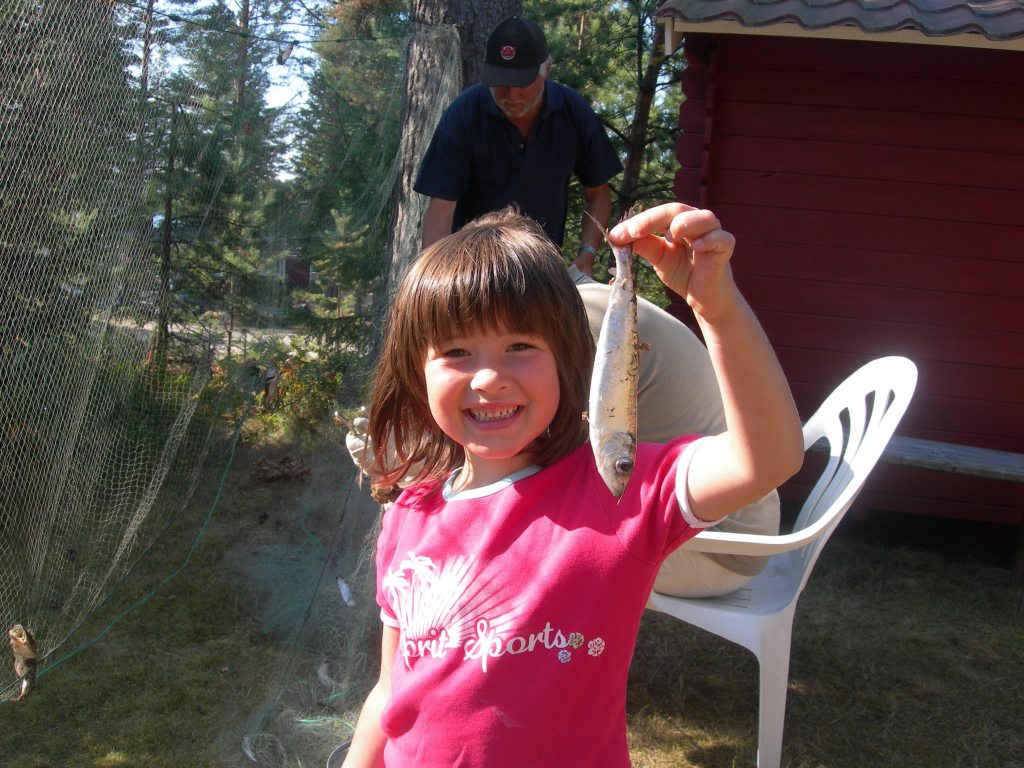
My niece Alma holding a herring. My dad in the background.
This post is not about Leonbergers but about something entirely different; culture shock, which I think is an interesting topic. The Merriam-Webster dictionary defines culture shock as : “a sense of confusion and uncertainty sometimes with feelings of anxiety that may affect people exposed to an alien culture or environment without adequate preparation”.
In 1987 I was selected to be part of a university level exchange student program. The exchange program was between Uppsala University in Sweden and Case Western Reserve University in Cleveland, Ohio. In total we were six Swedes (two from Uppsala). I was studying Engineering Physics in Sweden but in the US, I would continue studying Electrical Engineering because the Swedish Engineering Physics program was very similar to the Electrical Engineering program at CWRU.
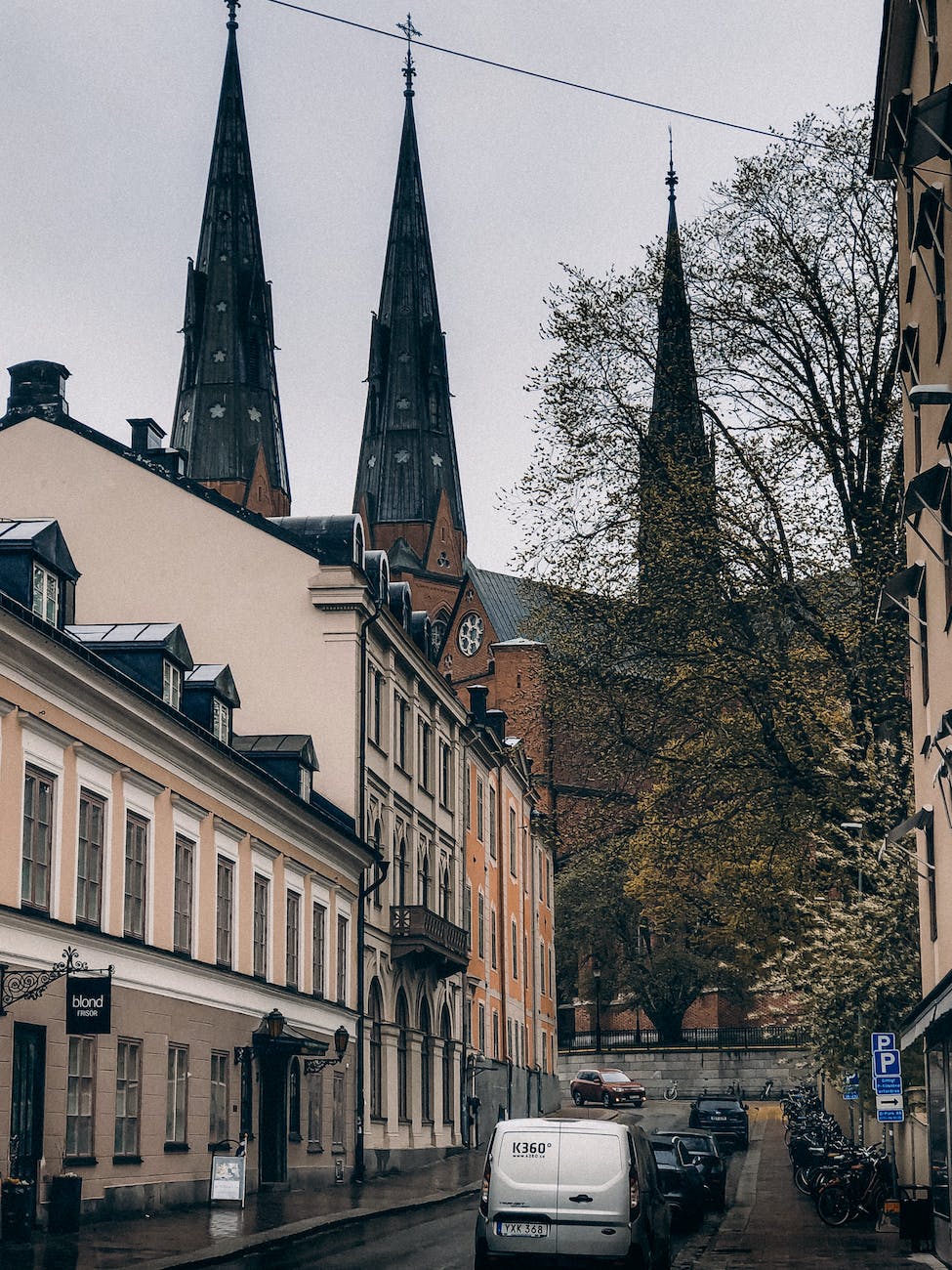
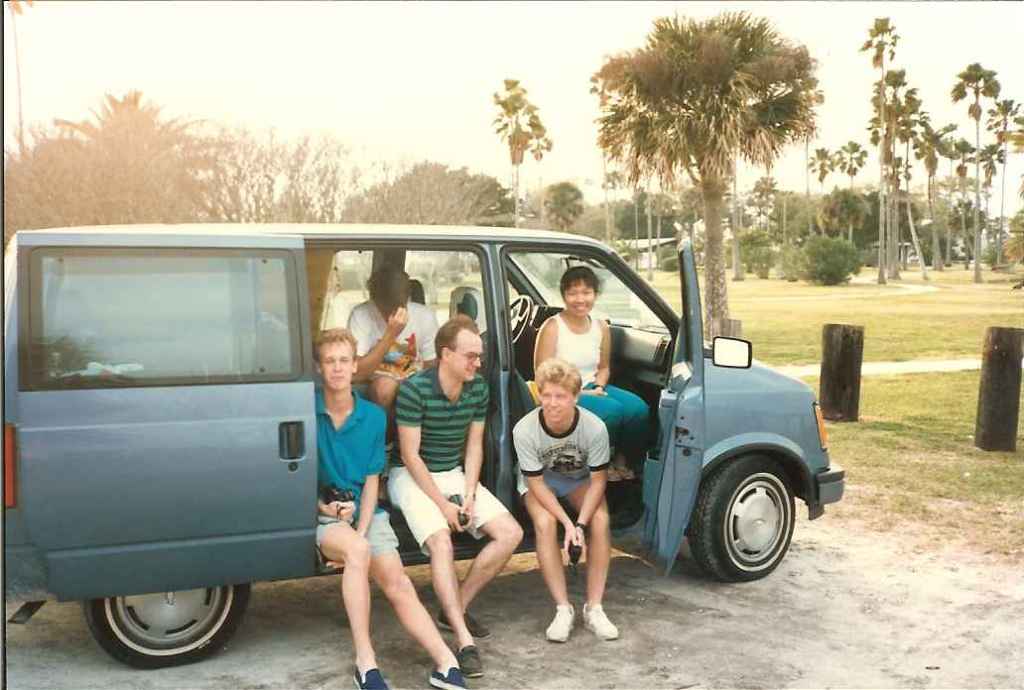
Street view of the old city of the Swedish city of Uppsala (1000+ years old). Photo by Aliia Troitskaya on Pexels.comFour Swedes inviting Americans to a fermented herring party. Fermented herring is a north Swedish specialty. Unfortunately, all the Americans experienced a culture shock from the fermented herring. I am the guy smelling the fermented herring can.Four Swedes and Jonas girlfriend from Indonesia. We were on a trip to Florida.Swedish exchange student Linda and her Indian friend Anuradha.
I arrived in the US in August 1987, and I was not well prepared for what I would experience. That doesn’t mean it wasn’t a great experience but there were challenges. Interestingly, I would later experience reverse culture shock. Reverse culture shock means that after adjusting to your new country you experience another shock when coming back to your old country.
Before heading out to Cleveland I visited Rakel, a Swedish friend who was living in California at the time. Here we are with our hosts Jay and Nancy Feinstein.
One of my first unpleasant discoveries was that the US uses imperial units instead of the metric system unlike most of the rest of the world. I quickly had to learn how to use inches, feet, miles, ounces, pounds, cups, gallons, etc. I knew about miles per hour versus kilometers per hour, but it had not dawned on me that it applied to everything. This is quite important in engineering.
The academic environment was also quite different. In the US there were fewer classes, but you were often required to participate and there were quizzes and homework in addition to the final exam, which was short and relatively rushed. In Sweden you showed what you had learned on one big final exam that lasted 6-8 hours. How you achieved success on that exam was up to you. Well certain lab work had some weight also.
In addition, in Sweden there were no dorms, no fraternities, no Greek life, no meal plans, no college sports teams, no tuition, and no health insurance. Attending a university in Sweden is more like working for a company. You are more independent, and tuition is free, and Sweden has national healthcare. In Sweden there are clubs, organizations, and parties you can go to, but it is more adult and has no likeness to fraternities. I have no opinion on which system is better, but it was a challenge to suddenly adjust to a dorm, meal plans, a different kind of student life, tuition waivers (provided by Uppsala University), etc.
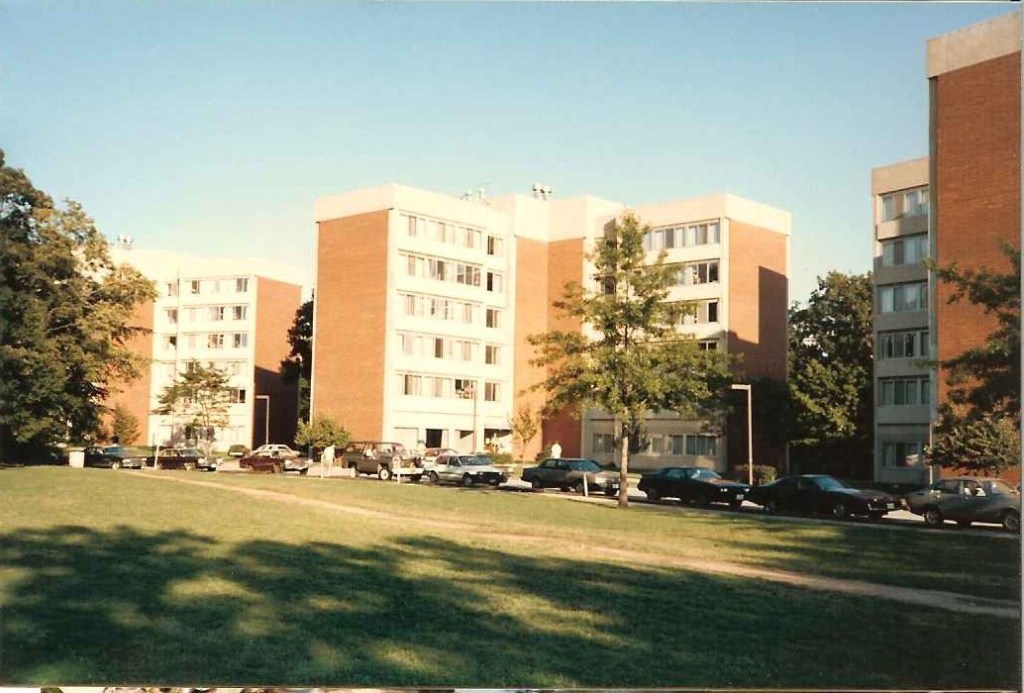
This is the Glaser dorm at Case Western Reserve University where I stayed.
Another difficulty was that I was not fluent in English at the time. I had a hard time with conversation as well as understanding portions of some lectures. People in English speaking countries often do not understand the amount of work that goes into learning how to speak a second language fluently because unlike most of the rest of the world they never had to do it. English being the premier second language comes with great benefits for native English speakers. Learning to speak a language fluently is one thing, learning to speak it without an accent if you primarily learned it as an adult is quite another. A question I’ve gotten many times is ”why do you still speak with an accent?”. Well, Arnold Schwarzenegger certainly knows the answer to that question.
Another thing people in English speaking countries sometimes miss is that people in the rest of the world are often not as familiar with the culture in English speaking countries as they might expect them to be. Well at least that was the case back then. In high school I studied Swedish and Scandinavian literature, and a little bit of German, French, Italian, and English/American literature, but I did not know much about Shakespear or famous American authors, and if you think about it, this is not strange. In addition, I did not know much about American movies or American music, but that was because I, unlike most Swedes, had not paid much attention to English speaking culture and music in general.
Add to that, the fact that Americans do not know much about cultural phenomenon in the world outside of the United States. For example, most Americans knew nothing about the world’s largest music competition, Eurovision. Eurovision is the largest song contest in the world. Countries compete against each other, and the final typically has as many viewers as the Superbowl, about 200 million. Americans also don’t know much about the second largest comic genre (largest at the time) in world, the French-Belgian Bandé-Dessiné (Astérix, Tintin, Spirou, etc.). So, we knew different things and were used to talking about different things, sometimes leading to awkward situations.
Scanned front cover of one of the Asterix comic books.
Which brings me to handegg. What most of the world call football is called soccer here, whilst a sport in which you handle an egg-shaped object mostly with your hands is called football, when it should be called “handegg”. When I arrived in the US, I had never heard of American football, but I quickly realized that I better know something about it. Later in the year I went to an indoor football game with a friend in Madison Square Garden in New York. Indoor football is a sport that has almost vanished, but it was still a thing back then. Can you guess who was called down to the field to play football at half time? I was. I told the host that I was from Sweden and that it was the first time I held a football. He showed me how to hold the ball and announced that I was from Sweden and had never held a football. The crowd was cheering for me, and luckily, I threw the ball into the goal two times out of three. Our team did not win but I did well.
I am getting ready to throw the ball.It went well, and I got to keep the ball (egg), my very first football.
Which brings me to the fact that Americans are typically polite, friendly and supportive of the underdog. They communicate well, they say excuse me when they bump into people, they smile a lot, and are often good conversationalists. Americans can be loud and not everyone is friendly but in general most Americans are friendly. I think this is a good thing that I am trying to emulate but it was yet another thing I needed to learn.
Some friendly Americans including my wife second from left. The others are (left to right) Jim Haggarty, something James Kirkpatrick and his wife.
One thing that might sound like critique is that Americans back then did not know world geography very well. Today’s youth seem to be a lot better educated in this regard. I should say that by the age of ten I knew every country in the world and their capitals, and I could say something about most of the larger countries. So, it was a little bit frustrating to me to speak to people who did not know where anything was. We met people who asked how long the drive from Sweden / or Europe was. A woman asked me where I was from and I said Sweden to which she replied, “is that where all the men wear skirts?”. I said, “no that is Scotland”. I believe that’s what she meant. Another woman asked me the same thing, and after hearing my answer, she said “Sweeting, that’s the name of your country? What a cute name for a country”. Or how about this conversation between the PhD advisor to a friend of mine and my friend’s boss:
Boss : My name is …, what is your name?
PhD advisor : My name is Bahram.
Boss : Baddam, that’s not an American name, is it?
PhD advisor : No, I am from Iran.
Boss : Iran I’ve never heard of that. Where is that?
I overcame my culture shock, and we all did well at CWRU. It was a good year. Later that year I met my wife Claudia and with her I would experience a reverse culture shock a few years later. I was working for a Swedish robotics company, and we moved to Sweden with our oldest son for one and a half year. Not only did my wife have a culture shock but I did too, coming back to Sweden. How did that happen? Well, one reason was that in the US I had gotten used to a mix of cultures and ethic groups and Sweden is a very homogenous country. This mattered because through my wife, who is not Swedish, I got to know immigrants to Sweden. It is difficult to fit in when you are different and therefore immigrants tend to hang around other immigrants, so I learned to see Swedish society through their eyes, and I saw what I had never seen before. It took some time to get used to.
My wife to be Claudia in 1988Photo by Pavel Danilyuk on Pexels.com
Have you experienced culture shock? How about a reverse culture shock?
I am originally from Sweden, but I’ve lived in Texas for more than 20 years and in the US for 30 years. Therefore, I forgot June 6, which is the Swedish National Day. It is still June 6 in California and Hawaii but not in Texas and certainly not in Sweden, so I am a day late. I forgot. A blogger who isn’t even Swedish incidentally reminded me. It is also a special National Day because it is the 500-year anniversary of Sweden’s independence from Denmark.
Swedish Flag
Christian the Tyrant, or as the Danes call him Christian the Good, was a very bad man who chopped people’s heads off. The Danish version of history is that Christian the Good was a very good man who tried to save the Union. He still chopped off heads though. Luckily, we had this guy Gustav Vasa (or Gustav Wasa) who resisted, and he became king of Sweden on June 6, 1523, which is 500 years ago. He was also really good at skiing.
Portrait of Gustav Vasa (from Wikipedia Commons).
Therefore, I have decided to post a couple of photos of the only Swedish Leonberger I’ve ever met personally, I haven’t been back to Sweden a lot. Her name is Amie, and she is from my neck of the woods, the high coast in northern Sweden. We met her at the top of a mountain, called the Skule mountain. Therefore, she is also the only Leonberger mountaineer I’ve ever met. To check out my original Amie post click here.
Amie at the top of the Skule Mountain.Amie was playful but very well behaved.
Amie was very happy and playful despite having climbed a mountain. Below is what Amie and we saw from the mountaintop.
View from the Skule Mountain top (skull mountain).
I am also posting a few more photos from Sweden.
My kids at the ice hotel in northern Sweden (Jukkasjärvi).My wife and kids getting ready for a dogsled tour in northern SwedenThe dog sled. My wife and kids in the back.
One thing that is pretty unique about Sweden is the different concept of private property. You can own the fruits of property, a farmer’s field, a mine, but the land belongs to everyone regardless of who owns it. Well almost everywhere, there are a few exceptions such as military reservations and you have stay at least 200 meters away from dwellings. It’s called “Allemansrätten”, or all-peoples-right translated roughly. This means that you can walk, hike, camp, pick berries and mushrooms, etc., anywhere without having to worry about trespassing. You just can’t walk off with the gold from a goldmine or a farmer’s crop. This is very different from how it works in Texas. However, everyone in Sweden love it and we certainly take advantage of it when we visit. In the picture below we were hiking, and we stopped at this small forest lake and someone had hung a tire from a branch.
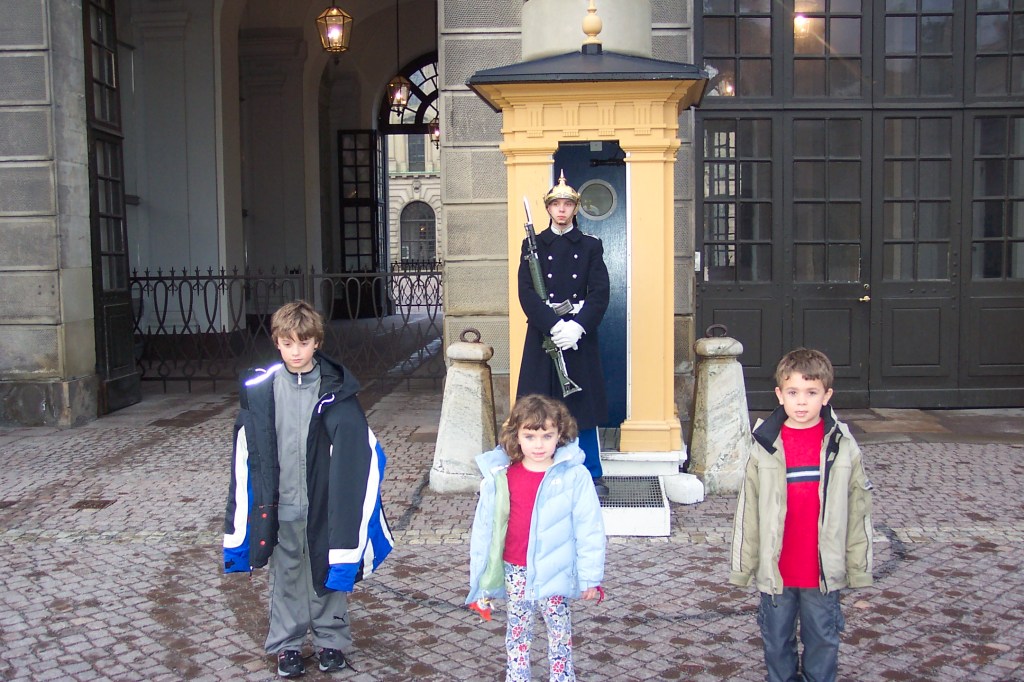
My son is jumping off a tire into a forest lake.The guard by Stockholm Castle and my kids
Today (well actually yesterday by now) was the Eurovision final (from the UK) and Sweden won. For those who don’t know, Eurovision is the largest song contest in the world. Countries compete against each other, and the final typically has as many viewers as the Superbowl, about 200 million. You are allowed to sing in your native language or in English. Not all participating countries are European, for example, Turkey, Israel, Armenia, Azerbaijan, and Cyprus are frequent participants, but they are not European countries, and this year Australia participated, The Eurovision is a huge cultural phenomenon that is not well known in the United States. I’ve noticed that the natively English-speaking countries often miss out on big worldwide cultural phenomena that are not entirely based on English. Typically, famous music groups do not participate, but many famous music groups got started or were propelled by the Eurovision, for example, ABBA (waterloo 1974) and Celine Dion (1988).
Anyway, this is a Leonberger blog but sometimes I post about other things and my home country Sweden winning the Eurovision is a big deal for me, so I made a post about it. I am also posting number two (Finland) and number three (Israel). Which one do you think is best? I won’t be offended if it is not Sweden.
Sweden in the Eurovision
Sweden, Eurovision 2023
Finland, Eurovision 2023
Israel, Eurovision 2023
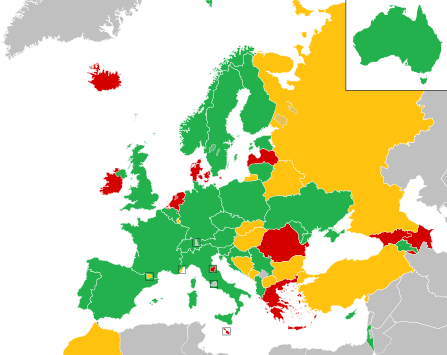
Russia was banned from participating this year, and some other countries that usually do like Turkey, Bulgaria, and Hungary did not participate. These were the top seven.
Sweden
Finland
Israel
Italy
Norway
Ukraine
Belgium
Finalists in green, participants not making it to the final in red, in yellow countries that typically participate but didn’t.































 Leonberger Life