This blog feature amusing and heartwarming stories about our late Leonberger dog Bronco, as well as other Leonbergers. It also has a lot of information about the Leonberger breed, the history, care, training, Leonberger organizations, etc. I also wrote a Leonberger book, which I am featuring in the sidebar.
Tomorrow I will do book signing at Wautega Public Library here in Texas. I will read a short story from my book and present myself. I will also mention that all royalties from book sales go to the Leonberger Health Foundation International, or LHFI, a charitable organization working towards healthier Leonbergers and healthier dogs in general. Below is my is my 20 seconds video pitch.
Hi, I’m Thomas Wikman, author of the Life and Times of Le Bronco von der Löwenhöhle, a book featuring funny and informative stories about our Leonberger. It is a great book for all dog lovers. All royalties from book sales are donated to the Leonberger Health Foundation International. Their work gives us healthier dogs.
My 20 second video pitch.That’s me a few days ago.The Leonberger Health Foundation International. Click on the image to visit the LHFI’s website.
The Leonberger is an unusual and fascinating dog breed that is known for its size, affectionate nature, and intelligence. I know a lot about Leonbergers because my family was lucky enough to live with one for thirteen years. His name was Le Bronco von der Löwenhöhle—but we called him “Bronco” for short.
Bronco wasn’t our only dog, but our world wouldn’t have been the same without him. For instance, he once saved the life of our pug by fending off an attack from another dog. He probably saved our Labrador’s life, too, by sniffing out an impending insulin shock before it happened. Then there was the time he scared off a trespasser who’d been terrorizing my wife and other women in the neighborhood.
This is me with our late Leonberger Bronco when he was still young, not even one years old.
Bronco is no longer with us, but even in his passing he was distinctive. Leonbergers tend to live less than nine years—but Bronco came very close to reaching his thirteenth birthday. In fact, he received an award for longevity called the “Grey Muzzle Award.” We already knew he was a special dog, but we sent his DNA to two labs for research anyway.
The Grey Muzzle Award is given to Leonbergers who reach the age of 12 years or older.
YouTube video featuring Grey Muzzle Awardees including Bronco, entry nr 10 out of 34 at 2 minutes. This is an emotional video for me, not only because of Bronco, but I was very familiar with many of the other dogs. Time marches on.Bronco’s Grey Muzzle Award
If you own a Leonberger, or are interested in Leonbergers, and you live in North America you likely know about the Leonberger Club of America, or the LCA for short. You are about as likely to find a Leonberger at Petland/Puppy-Mill as you are finding an Elephant for sale there. LCA is very protective of the Leonberger breed and of Leonbergers in general. You typically buy/get a Leonberger dog from an LCA certified Leonberger breeder or from the Leonberger Rescue Pals, and if you don’t that might be a problem.
We bought our Leonberger Bronco (Le Bronco von der Löwenhöhle) in 2007 from Julie Schaffert, a certified LCA breeder since 1992.
There are only about 3,000 Leonbergers in North America and about 2,000 Leonbergers in the United States but the Leonberger Club of America has more than 1,000 members. They publish the Leo-Letter, a quarterly Leonberger magazine. So, the Leonberger Club of America has a very prominent place among Leonberger owners. Click here to see a summary of the Leonberger Breed Standard.
Leonbergers have a long history in North America and the United States—despite the fact that until 1985, there were only seventeen Leonbergers known to be living in the United States.
See: Lusby, Leonberger, page 15.
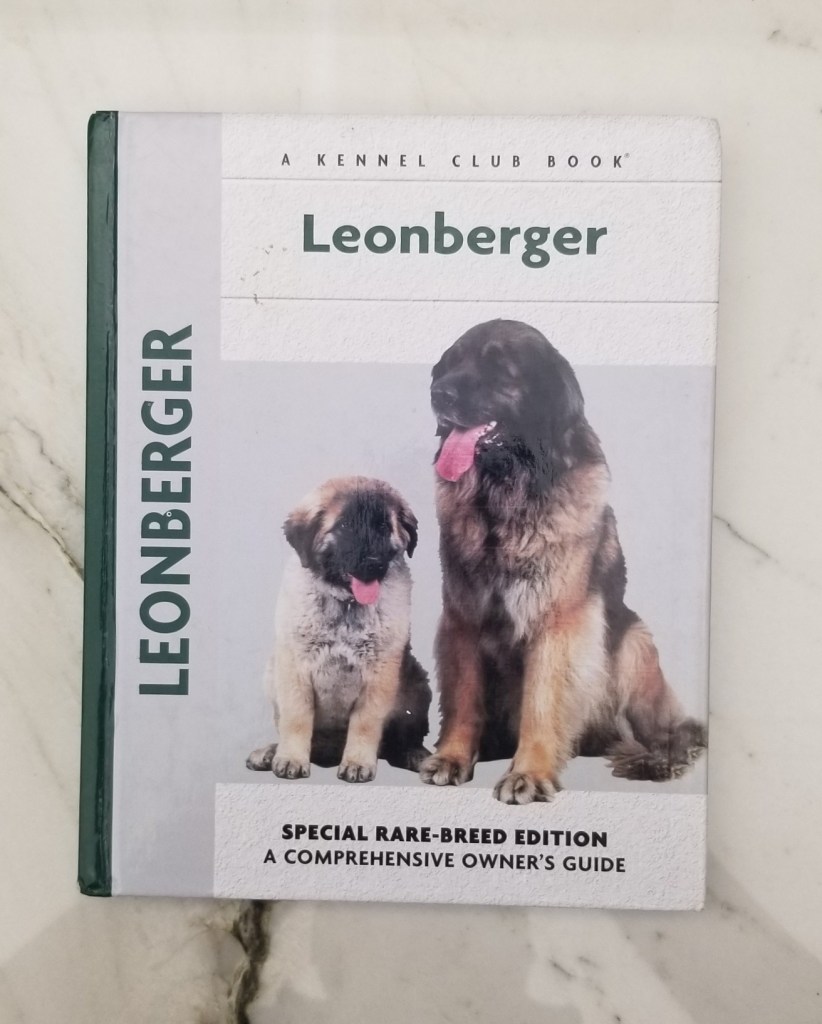
Leonberger, Special Rare-Breed Edition, A Comprehensive Owners Guide, Madeline Lusby. Click on the image to see my five star review for this book.
In the 1870s, Leonbergers were brought to Newfoundland to invigorate the stock of Newfoundland dogs. Around the same time, two Leonbergers named Caesar and Sultan were purchased from Heinrich Essig’s kennel (founder of the Leonberger breed) and transported across the ocean to join the Wellesley-Sterling theater company in the United States as the stars of their productions. Then in 1879, Caesar and Sultan visited President Ulysses S. Grant, who called them the largest and most magnificent dogs he had ever seen and presented them with gold medals. During the years between World War I and World War II, a New Jersey family, the Wolfs, opened their home as a temporary refuge for Jews fleeing Germany: they also imported Leonbergers. Unfortunately, this introduction of the breed into the United States did not last, and it would be another fifty years before the Leonberger appeared in America again.
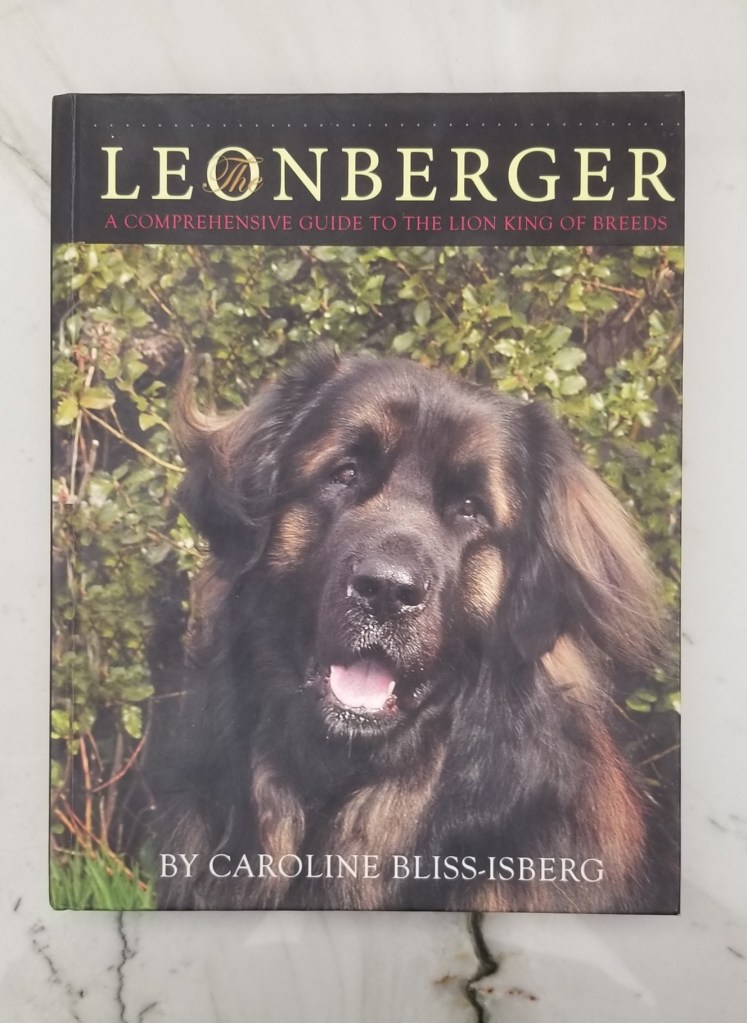
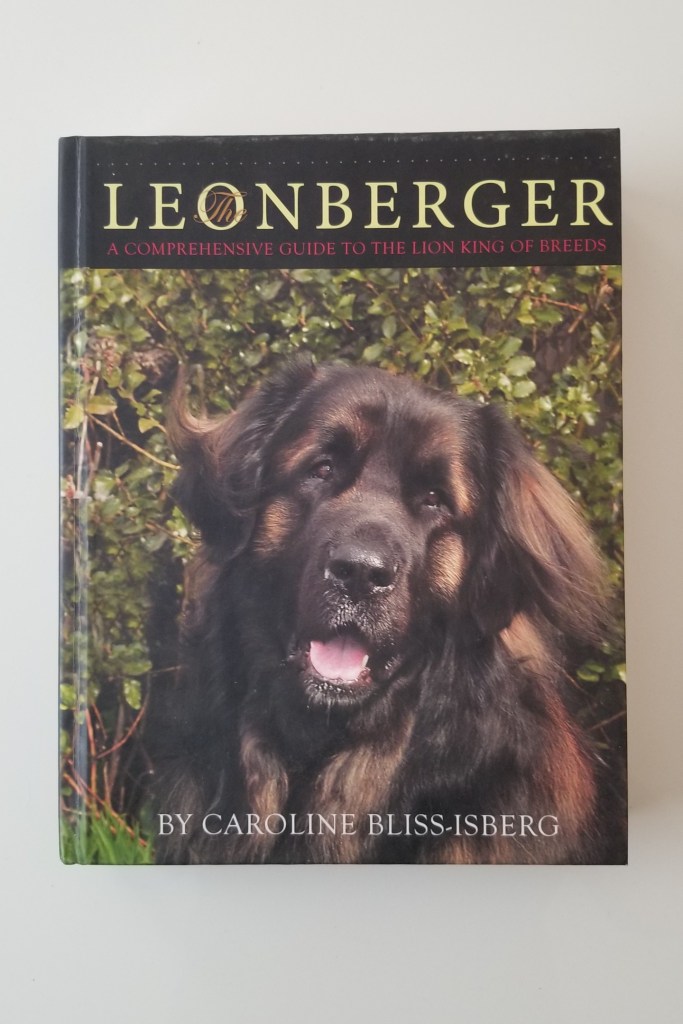
Leonberger, A comprehensive guide to the lion king of breeds, Caroline Bliss-Isberg. Click on the image to see my five start review for this book.
During the late 1970s and the 1980s, a few families—Waltraut and Klaus Zieher, Brian Peters, Manfred and Sylvia Kaufmann, Keri Campbell and Melanie Brown, and Mary and Reiner Decher brought Leonbergers to the United States. The Dechers had started a breeding program and were looking for a mate for their first dam, Viona. By chance their neighbor discovered through a newsletter that there was another Leonberger in the United States, and that led to the families’ finding and connecting with one another. I should add that the Dechers were careful to conform to the German breeding regulations and performed hip X-rays that they then submitted to the Orthopedic Foundation for Animals (OFA). Viona became the first OFA-certified Leonberger in America.
See: Bliss-Isberg, Leonberger, page 152.
On Saturday, November 2, 1985, eight of these Leonberger enthusiasts met at a hotel in Denver, Colorado, to found the Leonberger Club of America (LCA). This group of founders, which has since been dubbed the Denver Eight, appointed a registrar, formulated a breeding acceptability checklist, and instituted various policies, including the requirement that OFA certification is mandatory for breeding. LCA membership grew: it held social gatherings, began publishing LeoLetter, and imported an increasing number of dogs. Now the LCA has thousands of members across the country, and Leonbergers receive high ratings on health tests relative to other large breeds. For example, in 2000, the OFA reported that only 14.6 percent of Leonbergers tested positive for hip dysplasia, compared to 47 percent of Saint Bernards.
Another important historical event was the founding of the Leonberger Health Foundation International (LHFI), in 2000 (it was just called the Leonberger Health Foundation back then). According to its website, the organization was founded by Waltraut Zieher and other memers of the LCA’s health, education, and research committee to “facilitate the solicitation and distribution of donations given to support health related breed-specific research.” The LHFI also administers a program that collects DNA samples from Leonbergers to share with universities and research institutions, and of course it administers the Grey Muzzle Award (long living Leonbergers). Our Leonberger Bronco was a recipient of the Grey Muzzle Award, and we provided them with his DNA.
Bronco’s Grey Muzzle Award, which he received for being an unusually long lived Leonberger.
LHFI’s global biobank contains DNA samples from more than nine thousand Leonbergers. Among the organization’s notable achievements are the eradication of Addison’s disease among Leonbergers and the raising of nearly half a million dollars for research into conditions that affect canine health, including osteosarcoma, hemangiosarcoma, glaucoma, cardiac diseases, thyroid diseases, and neurological disorders. Its research also supports healthful longevity and aging as well as population diversity. Another success is the fact that since 2011, no Leonbergers with two copies of the LPN1 gene mutation (which causes Leonberger polyneuropathy) have been recorded in LHFI’s biobank. LHFI is one of my favorite charities.
The end of the twentieth century marked not only the end of the Cold War but also the beginning of what I call the Dog Wars of America. In 1985, the American Kennel Club (AKC) registry comprised one-third of the world’s known dog breeds. But the AKC had recognized only a few new breeds since 1887—a period of ninety-eight years. So, the organization decided to change that policy, but this did not always go smoothly. The members of rare-breed clubs often did not want to be part of the AKC. For example, the Australian Shepherd Club of America (ASCA) was very reluctant to join, so a relatively small splinter group, the United States Australian Shepherd Association, was formed and designated the official member club of the AKC, which was not welcome news to the ASCA. The border collie is another example. Charles Krauthammer, the late political columnist, called the AKC the politburo of American dog breeding.
See: Bliss-Isberg, Leonberger, page 159.
Similarly, in 2003, a new Leonberger club was formed—the Leonberger Club of the United States—with the goal of becoming the Leonberger member club of the AKC. This essentially forced the LCA’s hand, so they applied for membership in the AKC, a process that took years to complete. But ultimately the AKC approved the LCA as members in 2010: Leonbergers would officially become part of the Working Group. Fortunately, 90 percent of LCA breeders agreed to continue following LCA regulations regardless of whether the club would remain independent or become part of the AKC. Also fortunately, AKC membership afforded more opportunities for Leonbergers to participate in dog shows, which is important to many owners.
See: Bliss-Isberg, Leonberger, page 187
For information on the history of the Leonberger starting in 1830’s see this link
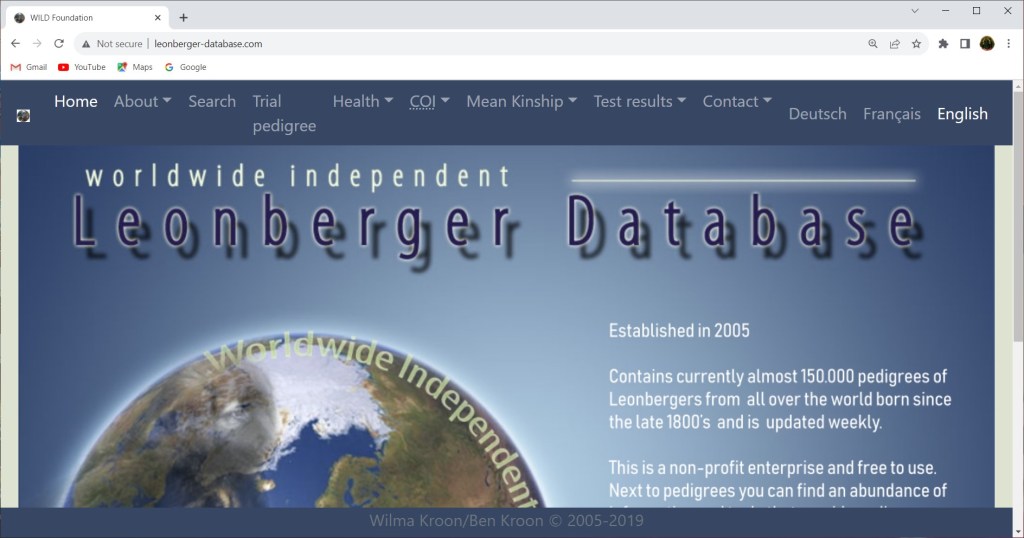
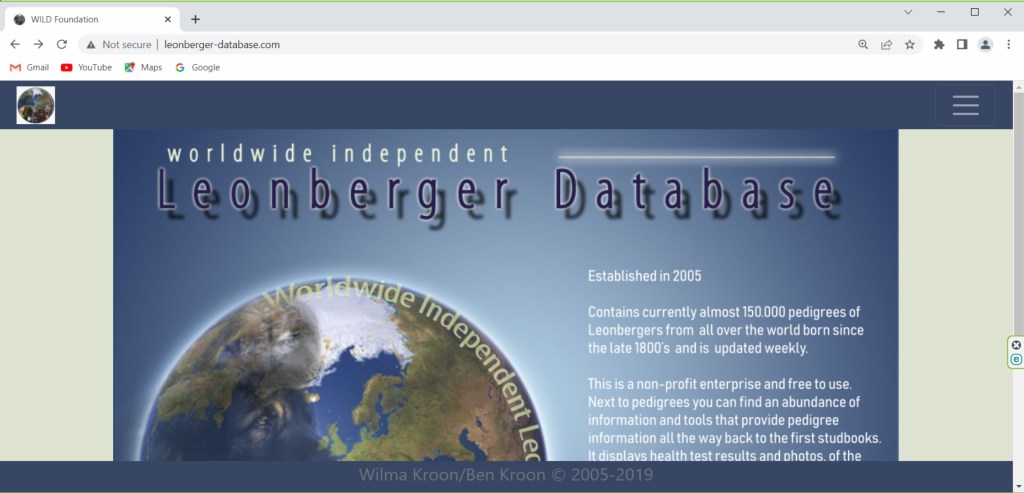
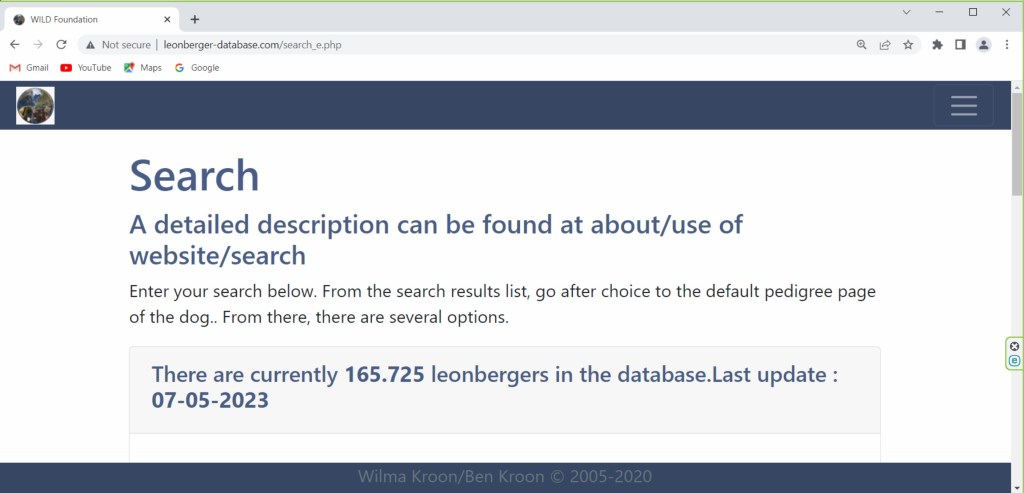
There is a World Wide Independent Leonberger Database (WILD) which features more than 166,000 Leonbergers. That is a lot considering that there are 30,000 Leonbergers in the world and if you go back in time there were many fewer. In fact, genetic research has shown that there are only 22 founder animals (the ancestors of all living Leonbergers) who lived soon after the Second World War. By selecting the search item from the menu and then typing in the name of your Leonberger you can most likely find your dog in the database. If your Leonberger’s entry does not have a photo you can email them a photo, which I did.
Click on the image to visit the World Wide Independent Leonberger Database (WILD).
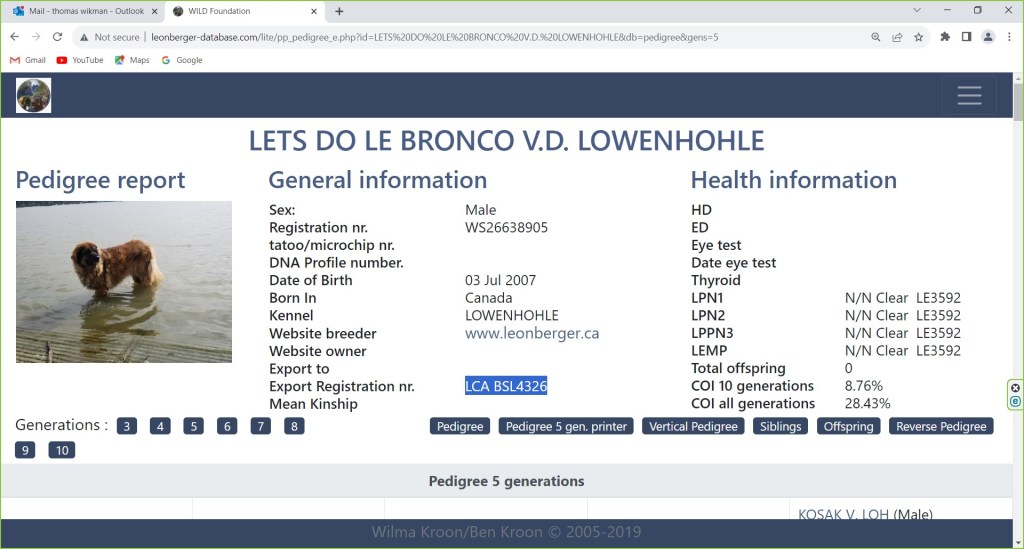
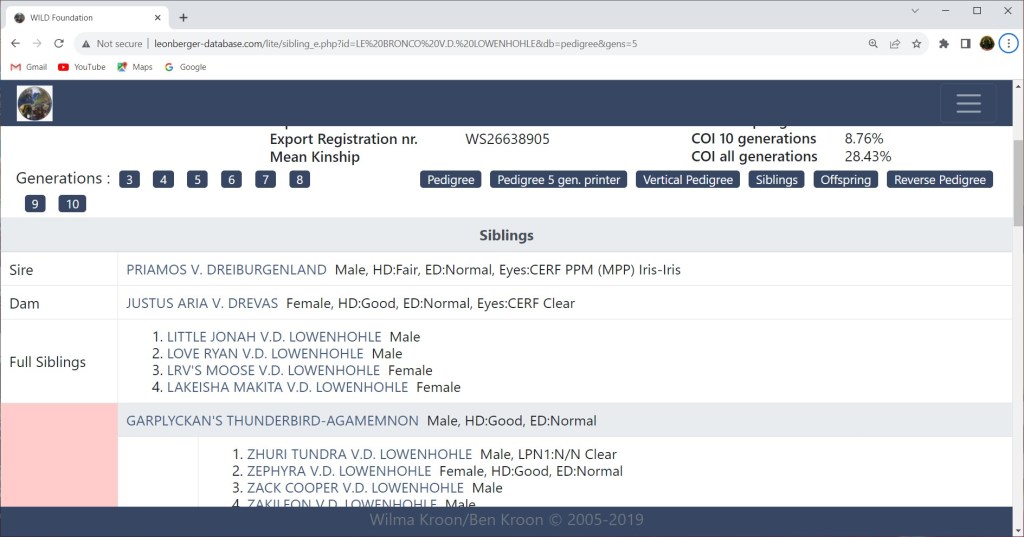
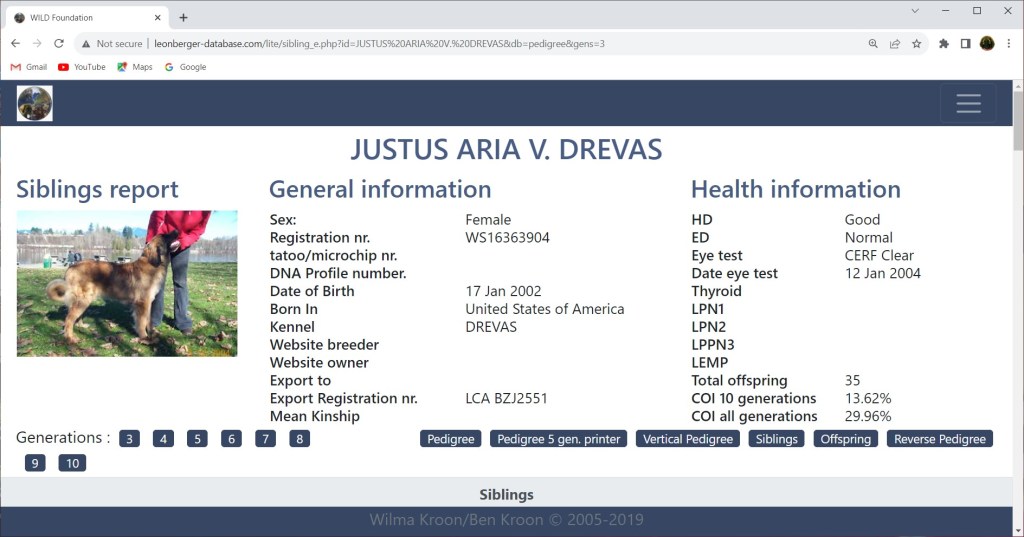
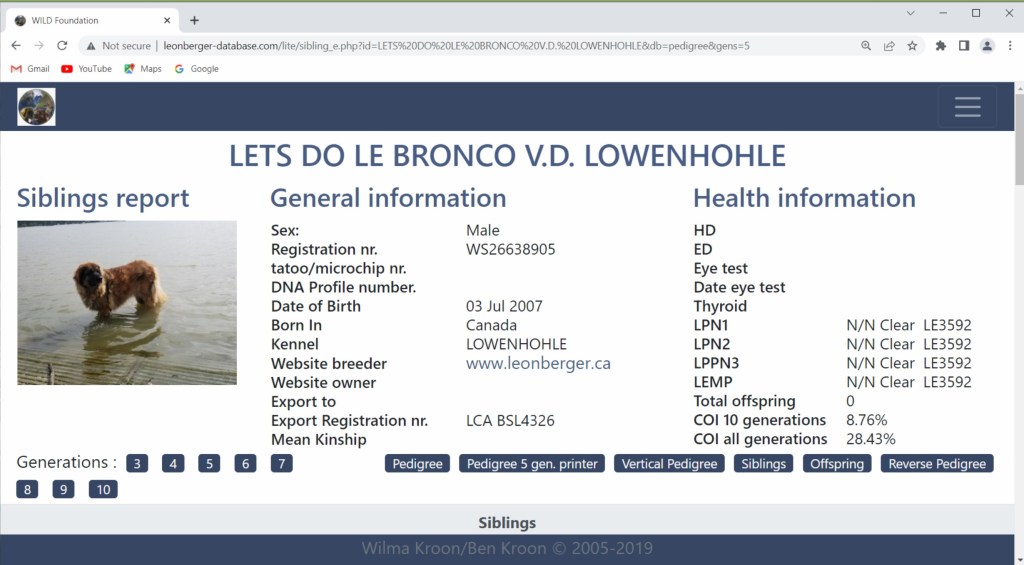
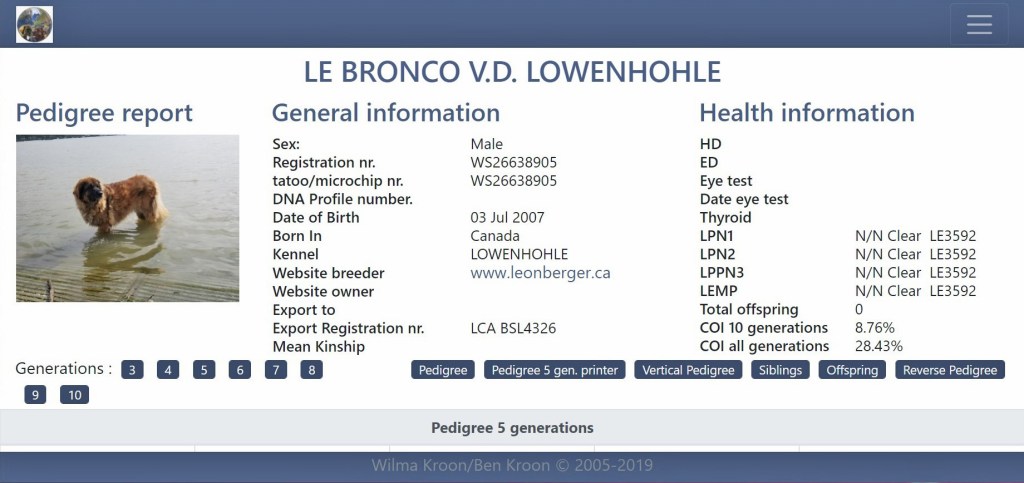
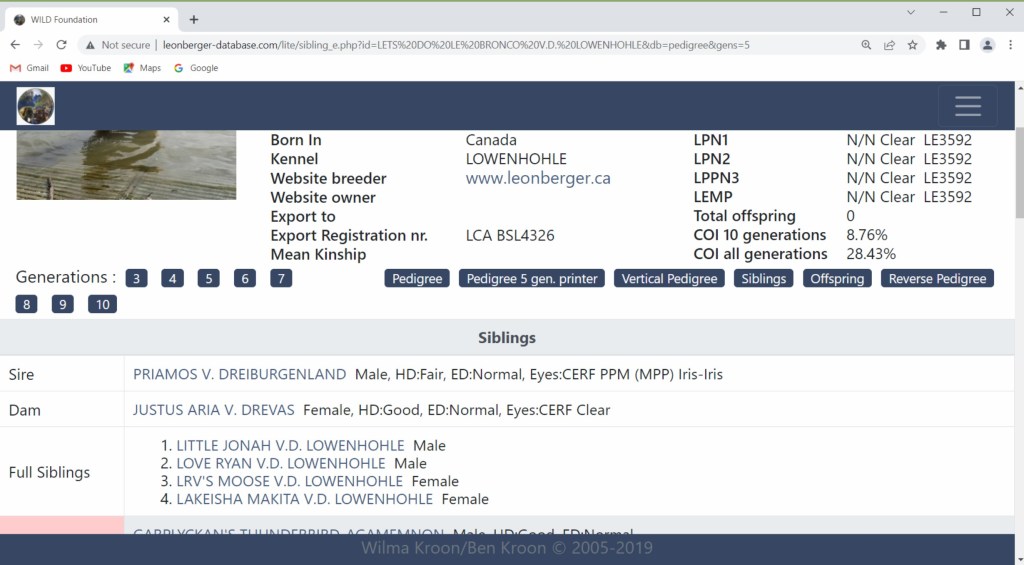
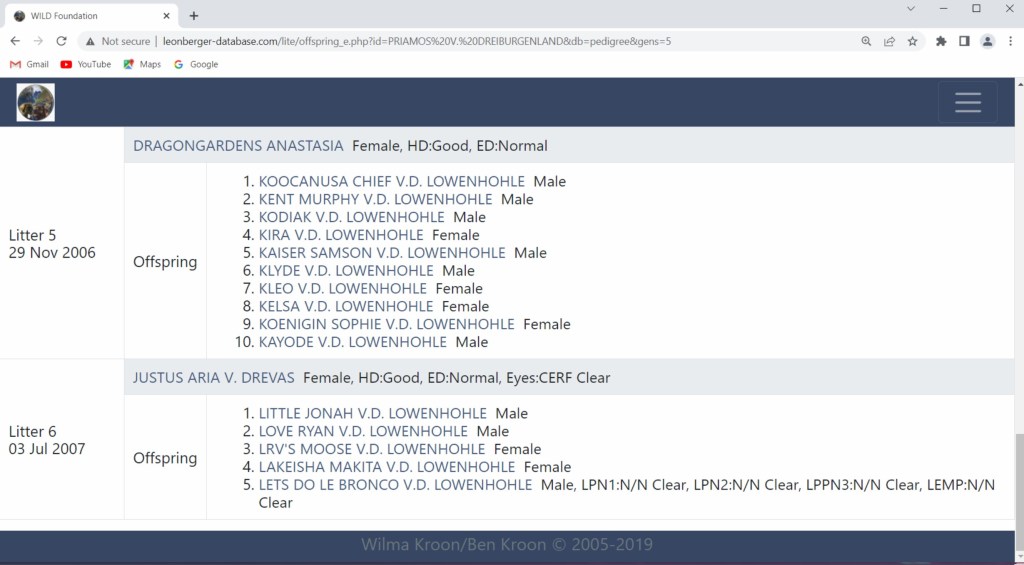
Another update I requested and had approved was an update to Bronco’s name. We wanted to name our Leonberger Bronco. It was our son’s choice. However, the Leonberger community and breeders have rules about how to name your dog. My wife Claudia was told that Bronco would not work because the litter Bronco was part of needed to have names beginning with an ‘L’. You can see the full sibling screenshot below. So, Claudia said “Let’s do Le Bronco”. Imagine our surprise when his birth certificate stated that his name was “Lets Do Le Bronco von der Löwenhöhle”. Well, “Lets Do Le Bronco von der Löwenhöhle” begins with an ‘L’. His birth certificate name including the unexpected preamble “Lets Do” made its way into the database. Fortunately, the World Wide Independent Leonberger Database recently updated his full name to “Le Bronco von der Löwenhöhle” upon my request.
This is the old data base entry for Bronco. Lets Do Le Bronco von der Löwenhöhle.This is the corrected data base entry for Bronco. Le Bronco von der Löwenhöhle. Click on the picture to visit Bronco’s database entry.
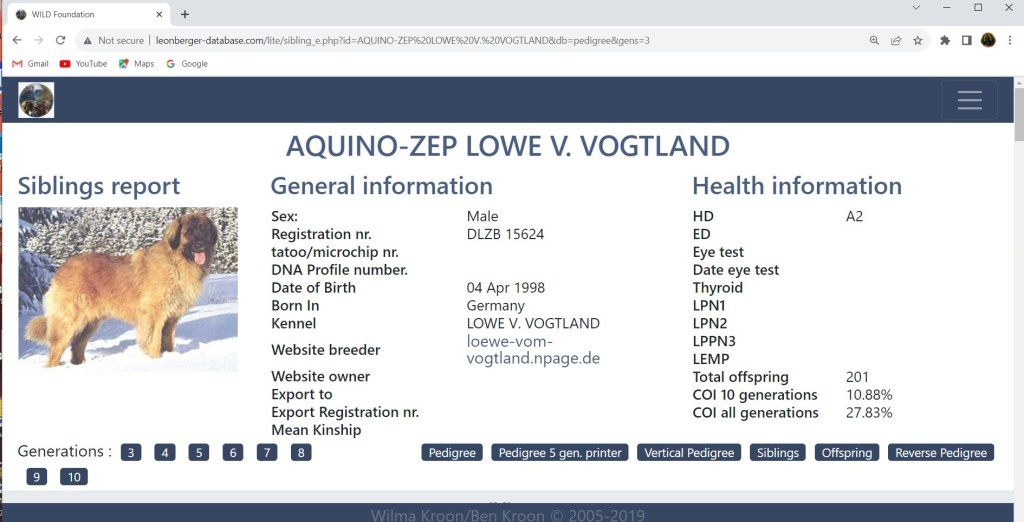
I should explain that the database entries feature not only name, birthdate and birthplace, kennel, etc. It also contains health related information including important tests, genetic defects and inbreeding coefficients (COI). Note that Bronco lived in Dallas, Texas, but he was born at Kennel Löwenhöhle outside Vancouver, Canada.
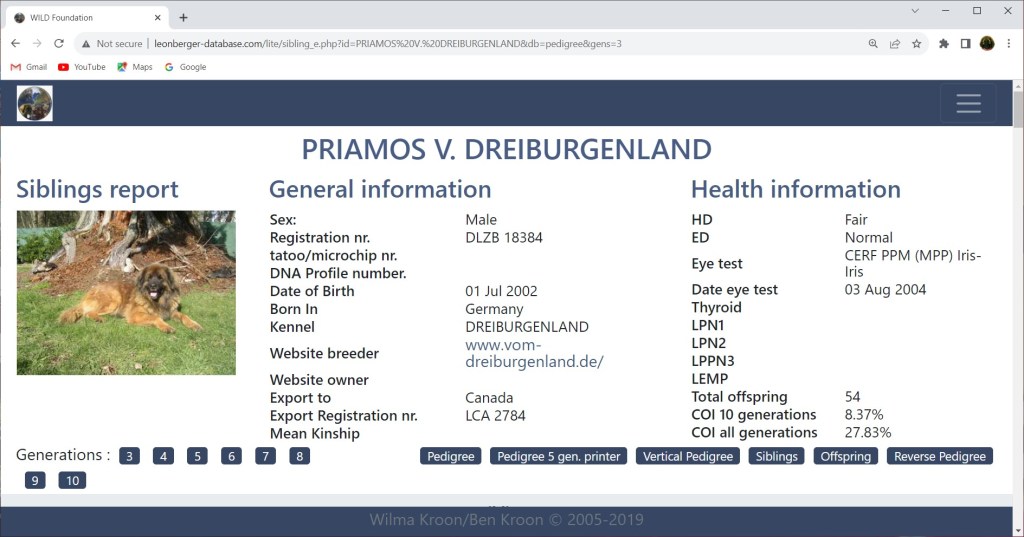
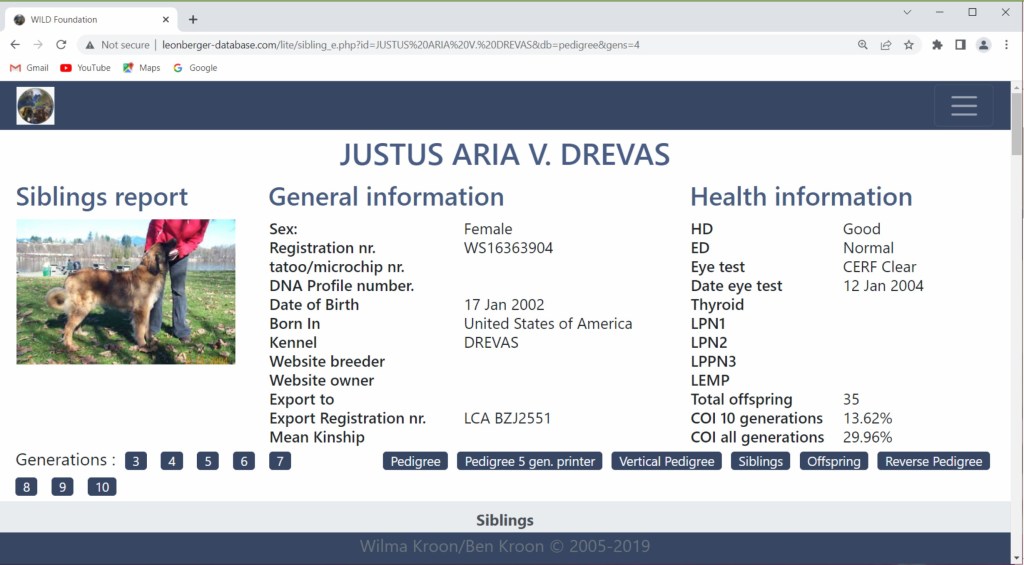
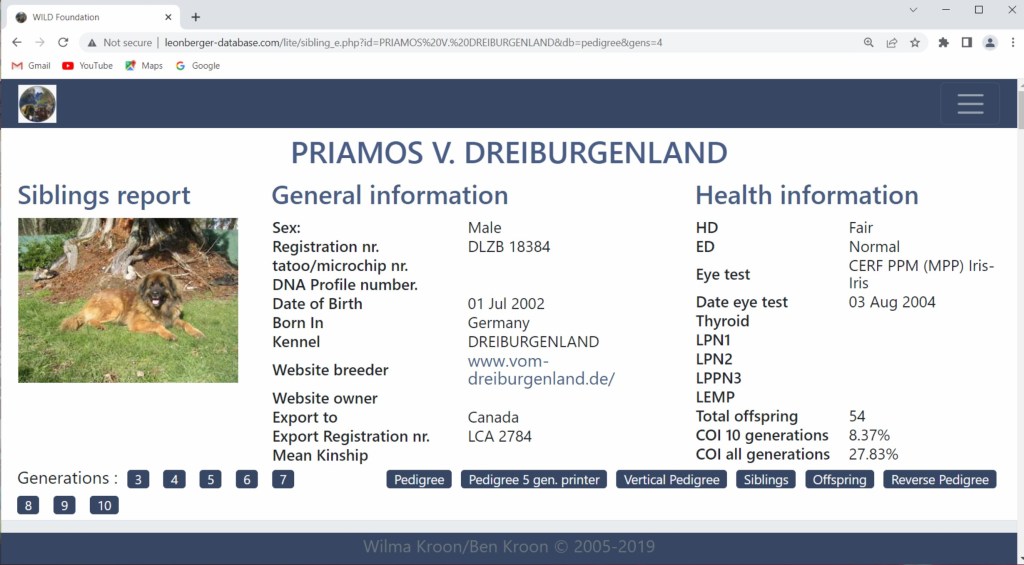
Bronco’s four full siblings (same litter). You don’t call it twins for dogs but that’s what they were. Notice that all their names start with an ‘L’.The database entry for Bronco’s father.The database entry for Bronco’s mother.The database entry for Bronco’s grandfather. Notice that he had 201 offspring. This was a kennel in Germany.
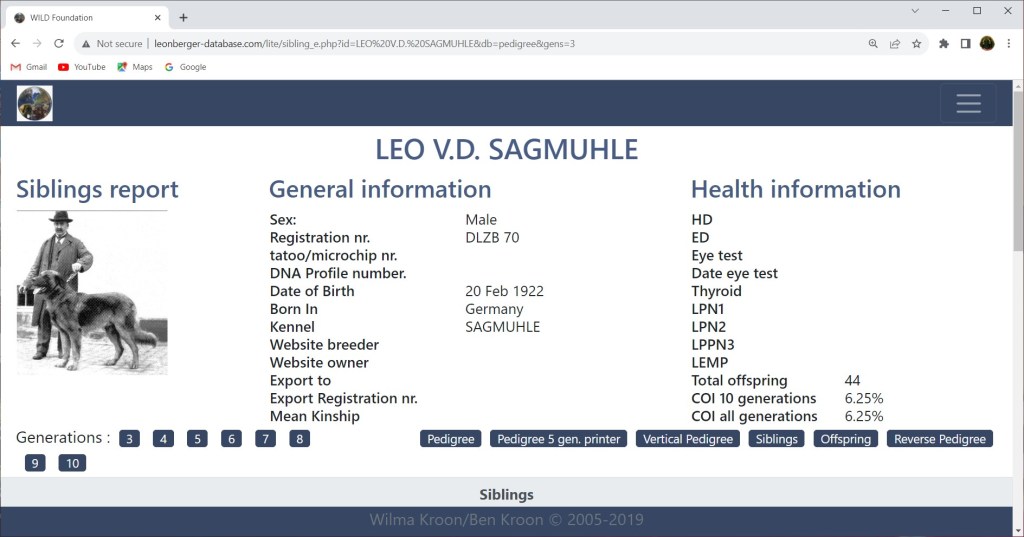
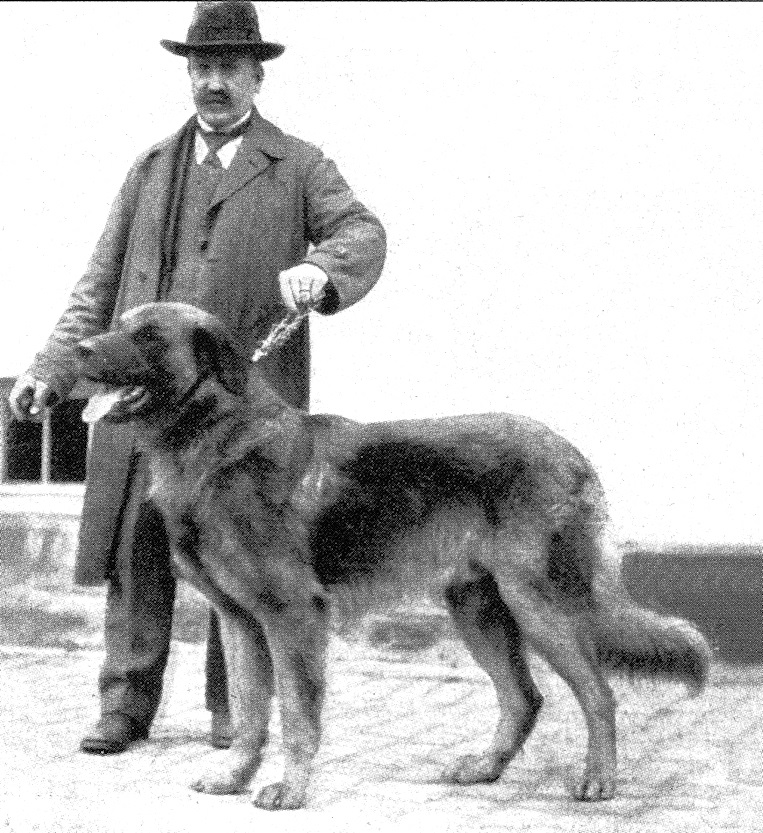
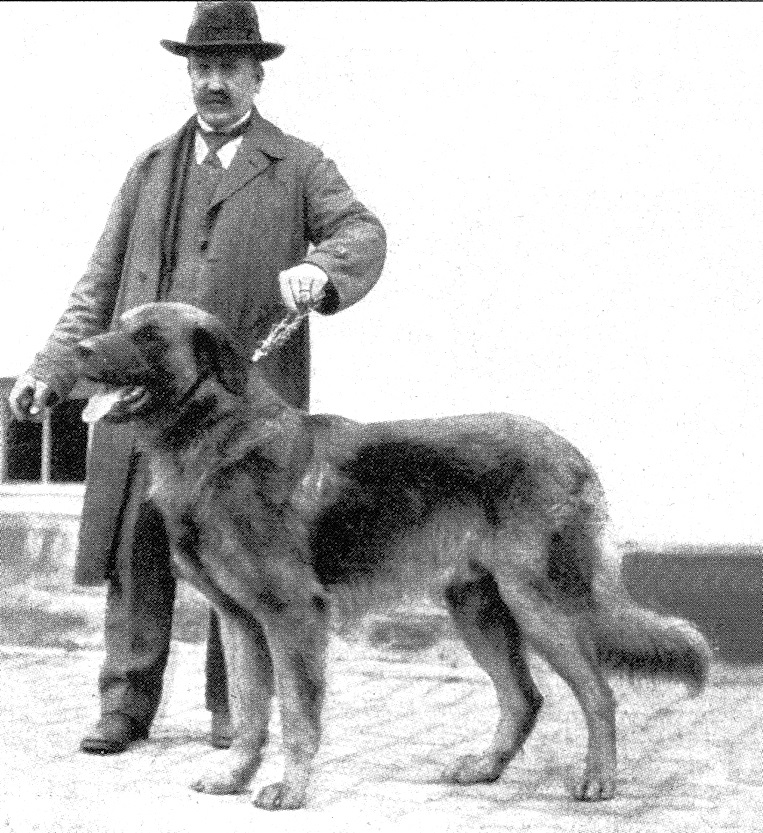
I followed Bronco’s ancestors back on his father’s side 22 generations. The last one with a photo was 17 generations back, born in 1922. However, ancestry is not a straight line along the father’s and the grandfather’s line. It is an ever-growing ancestry tree involving 2, then 4, 8, 16, 32, 64, 128, 256, etc., ancestors, so Bronco has many ancestors with photos.
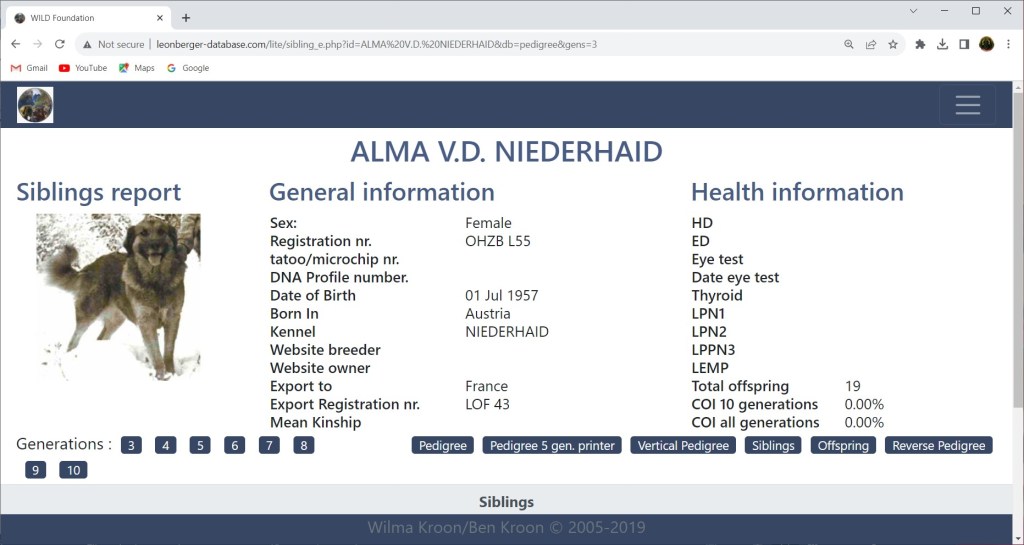
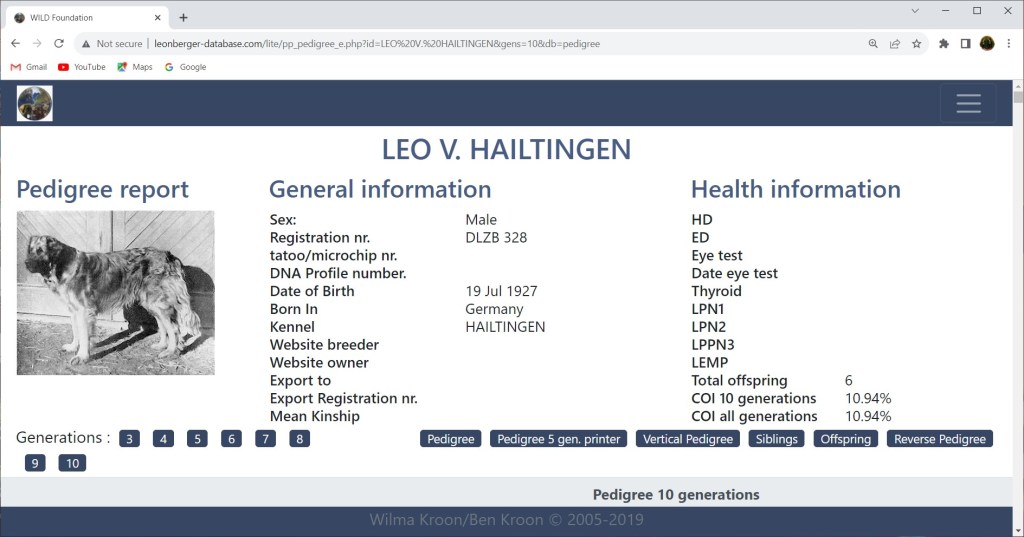
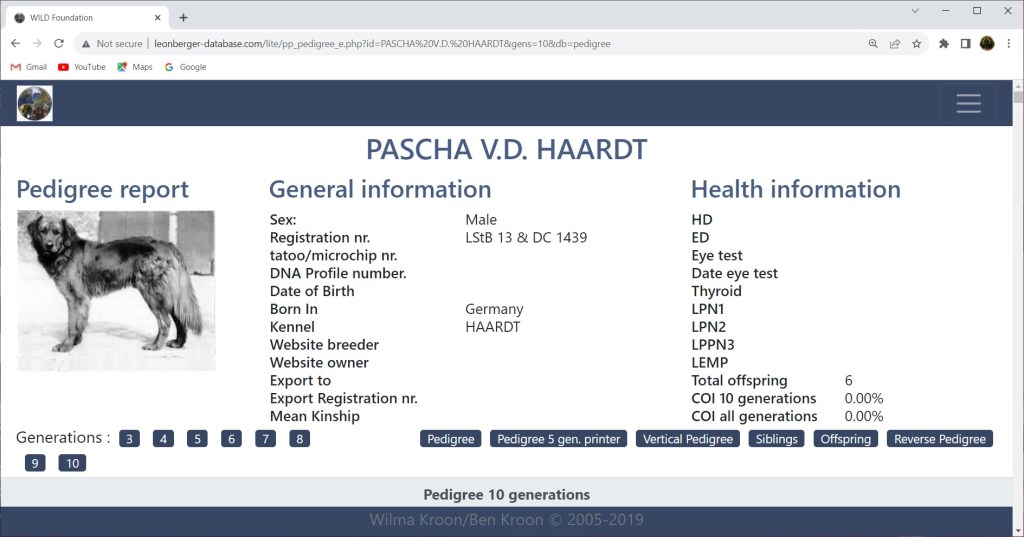
This is Bronco’s great great great father etc., 17 generations back. Leo von der Sagamuhle. He was born February 20th 1922.Close up of Leo von der Sagamuhle, Bronco’s straight back ancestor on his father’s side, 17 generations (great great …. grandfather).Alma von der Niederhaid, a female ancestor on Bronco’s mother’s side from 1957.Leo von Hailtingen born in 1927, another of Bronco’s ancestors.Pasha von der Haardt born 1904, the farthest back Bronco ancestor I found that had a photo.
What about you? Do you know your dog’s or cat’s ancestry tree? How about photos, illnesses, and inbreeding coefficients? How about your own lineage?
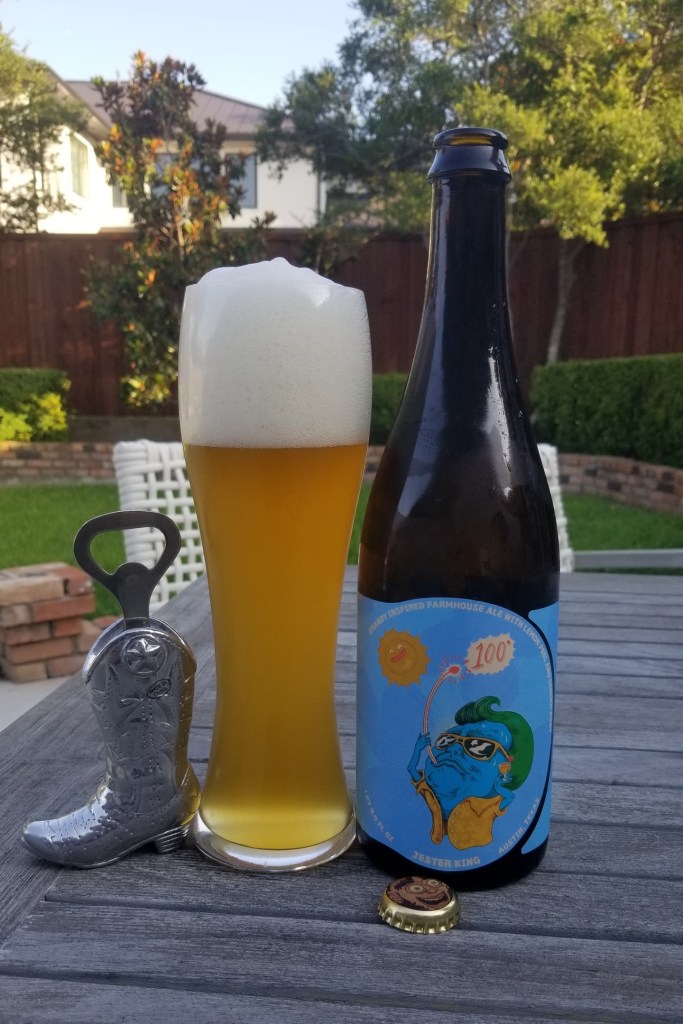
Today it was 104 degrees here in Dallas, Texas, which is 40 Celsius and tomorrow it will be hotter still according to Accuweather. While sitting in my backyard I drank 100 degrees to cool me off. In addition to being less than 104 degrees, 100 degrees is a Farmhouse Ale / Saison from Jester King, Texas, ABV 4.7%. It has the flavor of wheat crackers, lemon, lemon peel and ginger and it is very thirst quenching.
100 degrees is a Saison (type of beer) from Texas. It is good for hot weather.
What about Leonbergers and the hot Texas summer? Unfortunately, the Texas summer is not ideal for large fluffy dogs like Leonbergers, and yet people have them and breed them here in Texas. There is even a Leonberger club for the southwest (Texas, New Mexico, Oklahoma, Arkansas, Louisiana, Colorado), called Frontier Leonberger Club of the Southwest.
Embedded photo from – Frontier Leonberger Club of the Southwest
Hot Advice
In the hot summer, it is important to keep your Leonberger cool and at the same time keep up with the exercise. You can take your walks early in the morning or late at night if it has cooled down enough. You should bring a backpack with cold water and a water bowl, and perhaps ice cubes and ice packs. Unless you are almost back home don’t pour water on his fur to cool him off. This can be counterproductive since wet thick fur will clump and form a layer that will keep the much-needed airflow in. You can put water on his paws, face and belly where the fur is thin and make sure he drinks.
Our Leonberger Bronco resting while out walking.
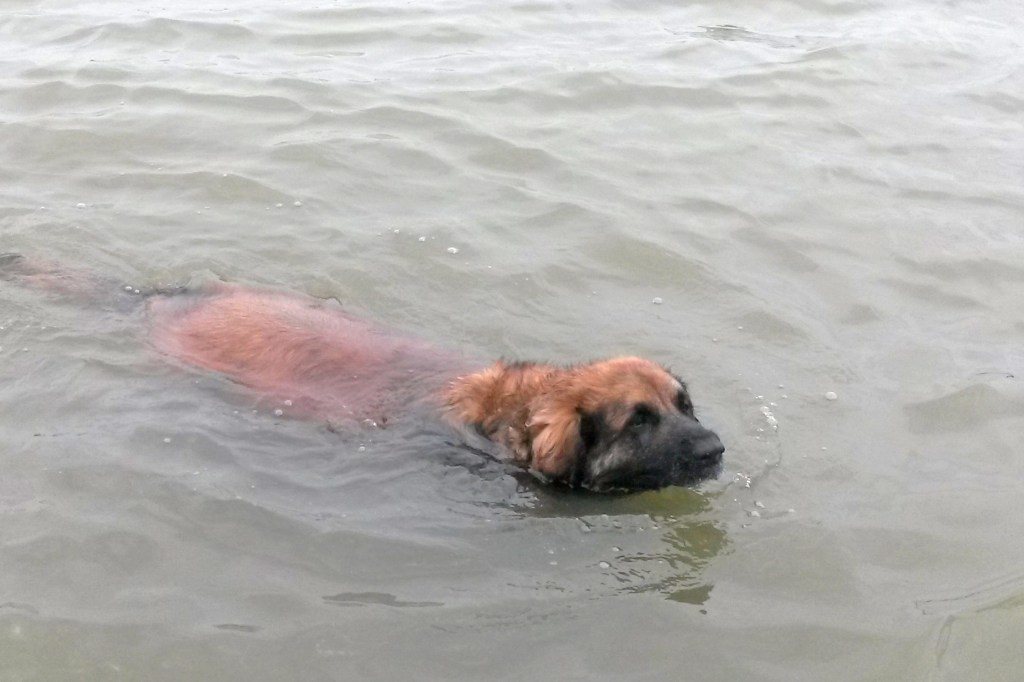
An alternative to walking is to go for a swim. Leonbergers love swimming and they are good at it. We frequently took our Leonberger Bronco to White Rock Lake outside Dallas where he chased ducks and egrets. He never caught any. Well, what can I say, he had no egrets. Just remember to bring a towel and to stand at a distance when he shakes himself dry.
Bronco swimming in White Rock Lake
While walking your Leonberger, or any dog, feel the surface temperature with the back of your hand. Asphalt, wood, sidewalks, beaches, and other surfaces can get very hot in the sun and burn the paws of dogs. Remember you have shoes on. Could you walk barefoot on the surface?
A heat stroke can happen very quickly. Dogs are much more susceptible to heatstroke than humans, and Leonbergers are more susceptible to heatstroke than most dogs because of their stocky bodies and thick coats.
Heatstroke can happen in as little as fifteen minutes. Don’t leave your Leonberger in a car. Avoid strenuous activity on hot days and exercise your Leonberger early in the morning or late in the evening. Keep your Leonberger in an air-conditioned dwelling as much as possible and provide plenty of water, shade, and maybe a kiddie pool when he’s outside.
Young Bronco in a Kiddie Pool
If there are signs that your Leonberger is getting overheated, you need to cool him off as soon as possible. Ideally, immerse him in cool water and hold his head above the surface to prevent drowning. Alternatively, move him into an air-conditioned building and put cool wet towels or ice packs on his stomach, neck, inner legs, and armpits.
Have seen or heard some people say, “If you want to be green turn off your air-conditioning”. DON’T. This will harm your dogs and is not the way you should reduce greenhouse gases. This type of advice often comes in the form of an admonition, and it does not come from climate scientists or even climate activists but from people with no interest in reducing greenhouse gas emissions. They want to make it seem more difficult than it is to reduce emissions and even shame you or harm you for caring. The responsibility to reduce greenhouse gas emissions lies primarily with industry, government, and those in charge of modernizing our power grid and transportation system. We consumers can certainly help, but the way to do it should be tailored to our circumstances and extreme action is often counterproductive.
One amazing aspect of owning a Leonberger is that there is a database where you can lookup information on your Leonberger including his siblings and ancestry. It is called the Worldwide Independent Leonberger Database. It currently contains 166,000 entries that lived as far back as the 19th century. Considering there are around 30,000 Leonbergers in the world, that’s impressive.
Click on the image to go to the Worldwide Independent Leonberger Database.
The database is updated weekly and free to use. It serves mostly as a tool for breeders and researchers, but it is quite interesting for anyone to browse. It was established in 2005 as a nonprofit organization and is managed and owned by Wilma and Ben Kroon, breeders who live in the Netherlands. Like any database, it is fully searchable. Search criteria include the name (or portion of a name), registration number, date of birth, and chip number. You can search in English, German, and French. The website also features informative articles about the data that’s collected. Note that some of Bronco’s information is missing because he was not used for breeding.
Click on the image to go to the Worldwide Independent Leonberger Database.
For each Leonberger, the database contains the following information.
Full name
A photograph if available
Registration number
Tattoo and/or microchip number
DNA profile number
Date and place of birth
Kennel name
Website of breeder
Website of owner
Export registration number
Mean kinship (a measure of genetic diversity)
Indicators of hip dysplasia (abbreviated as HD) and elbow dysplasia (abbreviated as ED)
Eye test dates and results
Indicators of hypothyroidism
Results of DNA tests for the genes LPN1, LPN2, LPPN3, and LEMP
Number of offspring
Coefficient of inbreeding for ten generations and all generations
Database entry for “Lets do Le Bronco von der Löwenhöhle”. The “Lets Do” part was because someone interpreted my wife too literally. She meant it to be “Le Bronco” not “Lets Do Le Bronco”. Click on the image to go to Bronco’s entry.
About “Lets do Le Bronco von der Löwenhöhle” that’s not his real name. His real name is “Le Bronco von der Löwenhöhle”. What happened was that we named him “Bronco” and we were told that his name had to start with an ‘L’. So, my wife Claudia said, “Let’s do Le Bronco” intending his name to be “Le Bronco”. When we received his certificate, it said “Lets do Le Bronco von der Löwenhöhle”, which also starts with an ‘L’ but not what we intended. I got this fixed in the database as you can see below. However, for whatever reason the “Lets Do” crept back in again.
Database entry after I got it corrected. Now the “Lets Do” is back again.
I am going to contact the database administrators to take the “Lets Do” back out. Do you think I will be able to succeed?
With the help of the database, I was able to trace Bronco’s lineage all the way back to 1901, and I found photographs of and other information about several of his ancestors as far back as 1904. However, below I am including screenshots showing the names of his immediate siblings (twins), his mother and father and a direct ancestor (grand-pa’s grand-pa etc.) 15 generations back.
Bronco’s four twin-siblings, the name of his mother and father.Information on Bronco’s motherInformation on Bronco’s fatherI guess Bronco was the runt of his litterGoing back 15 generations. Bronco’s grandpa’s grandpa’s grandpa’s grandpa’s grandpa’s grandpa’s grandpa’s grandpa’s grandpa’s grandpa’s grandpa’s grandpa’s grandpa’s grandpa’s father.Close up of Bronco’s ancestor 15 generations back.
The beautiful writing below I received from Brenda Saito a fellow Leonberger enthusiast and Leonberger owner. The author is unknown. Thank you so much Brenda.
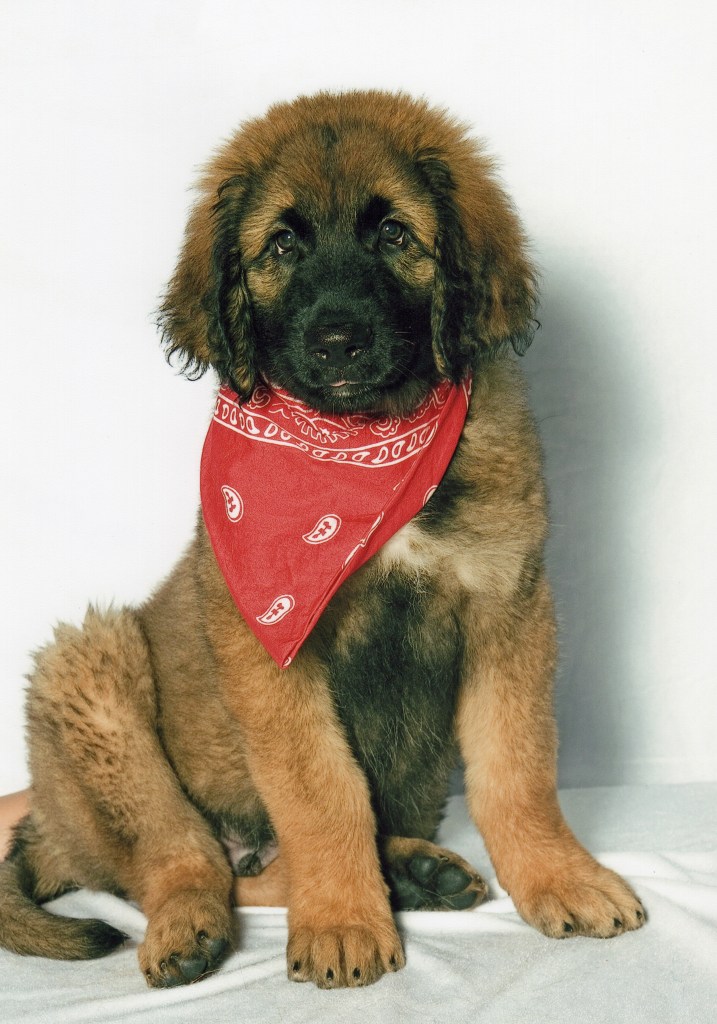
Our Leonberger at three months old
Hello there. I am so glad you are here to talk to me. I don’t always do the best job of communicating my emotions to you, yet there is so much I want you to know. I will start off by saying I am so so sorry I stepped on your foot this morning. I do it all the time and don’t mean to, its just that my feet are so big and it’s easy for me to lose track of where they are in space. Speaking of space, I love to be in yours. I am really sorry I was in your space last night and my tail knocked over your beverage on the coffee table. Also, I am sorry I stepped on your foot again while you were cleaning it up. And this is probably a good time to apologize for all of the times you have had to change your pants before work because I slobbered on them. I know that I am extra in every sense of the word simply because of my size. At times you seem annoyed at my attempts to become your literal shadow. What you don’t know is how much my proximity to you matters to me. I can not express to you the joy you bring to me just by being present. I love your scent and the way your fingers feel behind my ears when you scratch them. I live for the moments when you lay on the floor with me and rub my belly, or when you slip me a piece of ice when you are getting a drink for your self. It is true that I watch your every move. I know the sound of your footsteps from anyone else’s in the house and the sound of your car from anyone else’s in the neighborhood. I notice the difference in your cadence when you are down or tired. At times your anxiety radiates through the room. It is intense and permeates your energy like a poison. I am not sure why this is, but somehow my sitting beside you helps the anxious cloud to dissipate. I promise to always sit there for you, as long as it takes, until your energy changes and you are ready to move. My time with you in this life will be short. My lifespan is not as long as other, smaller breeds. I promise to make up for this by filling everyday with extra love and lots of laughter. The connection between you and I will never be broken. You are my person. I am your dog. Love always,
Bronco’s asking face. You could usually figure out what he wanted.Bronco in his old age. He is 12 1/2 going on 13, much older than most Leonbergers live.
Jackson Galaxy the world’s foremost Cat Behavior Consultant
I am sure you cat lovers know about the world’s foremost Cat Behavior Consultant Jackson Galaxy. He has written a lot of very successful books on cat behavior including the best seller “Catification”, Designing a Happy and Stylish Home for Your Cat (and You). It is rumored that Jackson Galaxy is from outer space and that he got stranded on Earth without his photon blaster and therefore had to come up with a job to survive. Whatever the case is he is a beloved icon in the cat community.
Being an energetic and family-oriented giant breed, the right type of home may be an even more important feature for Leonbergers. Below I am listing ten important points to consider when preparing your home for a Leonberger.
First of all, a small apartment is not a suitable home for a Leonberger. They need room and they need a backyard or similar for running and moving around.
Leonbergers are family dogs, and they like to be with people so they should not be left outside for too long, and therefore your house needs to be able to accommodate a very large and hairy dog that sheds a lot.
In addition to shedding a lot, Leonbergers love to dig and to be messy and muddy. Allowing a little bit of a mess will make your Leonberger a happy dog.
You need a fence, preferably at least six or seven feet tall. The ground below the fence cannot be too soft since Leonbergers are expert diggers. A runaway Leonberger may be a happy Leonberger for a short time but bad things can happen to runaway Leonbergers. Check whether wild animals such as bobcats and coyotes can get in through your fence.
Check your backyard and locate and get rid of sharp or dangerous objects such as metal rods sticking up from the grass.
If you have a swimming pool, make sure the dog can easily get in and out of the pool on his own.
While the Leonberger is still a puppy you need to enclose electrical cords with cord protectors for pets with strong jaws.
Secure glass tables and vases that can easily tip and fall, the fireplace. Secure toilet-bowl additives, drain cleaners, bar soap, tampons, paint, antifreeze, pesticides, oil and gasoline, rat poison, carpet cleaner, fertilizer, bleach, detergent, hot iron, sharp objects, and glass jars.
Leonbergers can reach all counters. They love to stand on their back legs, like bears, and they are intelligent enough to open easy access pantries, so it is important to secure food items dangerous to dogs such as; coffee beans, chocolate, onions, garlic, yeast, avocados, raisins, macadamia nuts, fruits pits and seeds, raw salmon and trout, raw eggs, mushrooms, tomatoes, persimmons, rhubarb leaves, medicine, Tylenol, any food containing xylitol (sugar substitute), food left out, garbage. Click here for more information.
And Happy Belated St. Patricks’ Day from me, Thomas, the Leonberger Behavior Consultant.
The video below from animal watch feature 15 fierce and dangerous dogs including Dogo Argentino, Rottweiler, the pit bull and others. But which dog is the most fierce and dangerous dog? There is a dog that is more fierce and powerful than any lion; the most dangerous dog in the world, the #1 on the list, the lion dog, it is the Leonberger. Yes, if you read some of the posts on this blog you will laugh. The most dangerous dog in the world is the goofy, friendly and happy Leonberger, the big teddy bear that every child loves to hug. There is some truth to it though, Leonbergers are very strong and powerful and will protect you and your home fiercely. Our Leonberger Bronco saved the neighborhood from a peeping Tom terrorizing the neighborhood. This is a long video but to see the segment on Leonbergers fast-forward to 19:38. That’s just one and a half minute.
The fiercest and most powerful dogs in the world. Which one is #1?
Like the video says, if bored they tend to chew on things and they have very powerful jaws among the most powerful jaws in the dog world. We lost our wedding album. My wife was so mad that our Leonberger chose to destroy the wedding album instead of let’s say encyclopedia Britannica.
To be honest though, I think that the most dangerous dog in the world is our mini-Australian Shepherd Rollo (see below). Don’t mind the stroller, that’s just to avoid scary snakes and frogs. Wouldn’t you want to avoid scary snakes and frogs? Quacking ducks scare him, but not much else. OK maybe everything else scares him too, but he is still the fiercest dog according to some opinions.
In this post I am just posting one video “THE GIANT LEONBERGER – DANGEROUS LION DOG?” from Animal Watch. I think it is a great video. It is 15 minutes long, which is I admit a bit long. However, all you need to do is watch one minute of it, at a random place to get an idea of how Leonbergers look like and how they interact. I did not take any videos of our Leonberger Bronco (that will change with the next Leonberger we get) so for videos I have to rely on the work of others, and I think this video is great (I’ve got plenty of photos though).
I think this video is bypassing the usual myths about Leonbergers and it is being more honest about the history of Leonbergers than most books and websites I’ve come across, so I like it. Yes, even Wikipedia is getting Leonberger history wrong. First, the creator of the Leonbergers breed, Heinrich Essig, was a politician, a councilman of the town of Leonberg, but never the mayor, as claimed by the majority of Leonberger books and Leonberger websites. This is confirmed by this video. The legend says that Heinrich Essig created the Leonberger to resemble to lion in the town of Leonberg’s coat of arms, which essentially means that Germans were pretty bad at drawing lions back then. Maybe Germans know how to draw lions now a day.
A lot of books state that the average lifespan of Leonbergers is 6-8 years, I stated 8-10 years in my book because their health had improved due to research by the (Leonberger Health Foundation International). A few other books also state 8-10 years, like mine. This video stated 10-12 years. It is the first time I hear that number, but it is believable because LHFI is doing their job. I should say that all royalties from my book goes to the Leonberger Health Foundation International. I can also add that work of the Leonberger Health Foundation International benefit not only Leonbergers but also other giant breeds as well as humans who are at risk for cancers that are very rare in humans but common in giant breed dogs such as, Hemangiosarcoma. However, it makes me wonder what will happen to the Grey Muzzle Award in the future. So if you buy my book you help Leonbergers, giant dog breeds, and people unlucky enough to get certain rare cancers common in some dogs.
The video stated that 22 breeding Leonbergers survived World War II and with respect to World War II I said that “that the Leonberger has twenty-two founder animals, or animal ancestors unrelated to one another (ten males and twelve females).” Both this video and my book thus disputed the very common claim that only 8 Leonbergers survived World War II (~80-90% of the books). So the agreement between the video and my book was very high despite the larger lifespan claim in this video.
Another item is that Heinrich Essig claimed to have used St. Bernards, Newfoundland dogs and Pyrenees dogs to create the breed. This is typically translated into, Heinrich Essig used St. Bernards and Newfoundland dogs to create the breed, or Heinrich Essig used St. Bernards, Newfoundland dogs and Great Pyrenees dogs to create the breed. I pointed out that Pyrenees dogs were probably not Great Pyrenees dogs but another breed called Pyrenee Mastiffs, that no longer exists. I also pointed out that Heinrich Essig did not keep a record and therefore we don’t know if what he said was even true. This video brings to out attention that Essig (without stating so) might have used the local farm dogs in his breeding, dogs which would have been the ancestors of the German Shepherd. That later part was news to me, and something that was never suggested in any of the 20+ Leonberger books that I’ve read. However, it makes sense. Leonbergers have some German Shepherd traits and our German Shepherd, we called her Baby, thought our Leonberger Bronco was her puppy, and raised him, and protected him with her life.
In this post I am stating and correcting ten Leonberger myths that I’ve seen on various websites and in various Leonberger books. Websites featuring incorrect information include Wikipedia. It is always good to remember that googling is not research and that a lot of information on the internet is wrong. In the list below I avoid stating the myth and then correcting it. Instead, I am trying to implicate the myth as a myth from the start or begin the sentence with the truth. The reason for doing this is psychological. Research has shown that if you state something false and then correct it, people tend to remember the first thing they saw, which was the myth, instead of the truth.
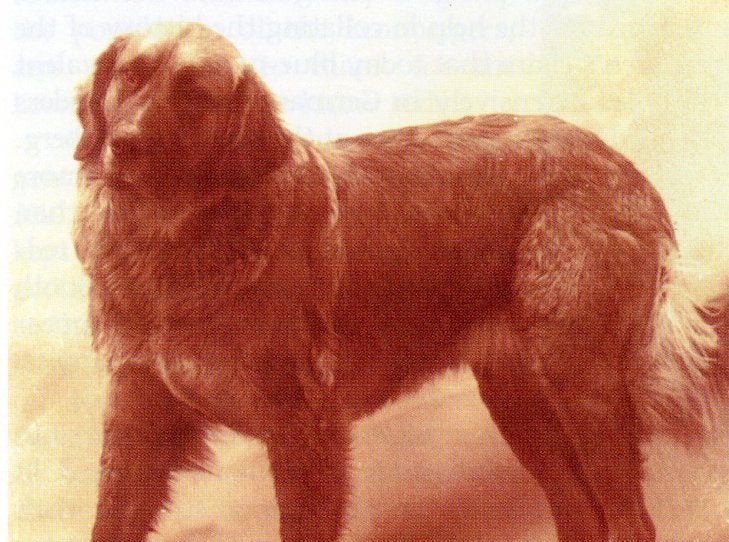
This embedded old historic photo of a Leonberger is from the AKC website.
To correct many of the myths regarding Leonberger history I am referring to the book Leonberger by Caroline Bliss-Isberg. If I am not specifically stating the source in a listed item it is from her book. Caroline Bliss-Isberg is a recipient of the Heinrich Essig Award and the Leo Heart Award and a very prominent leader in the Leonberger community. With the help of other prominent leaders of the Leonberger community as well as expert researchers she attained documents, illustrations and photos never before published and from it she created the most extensive (several hundred pages) and accurate account of Leonberger history.
Leonberger, by Caroline Bliss-Isberg. Click on the image to go to my review of Leonberger.
If you want to spay or neuter your Leonberger it is best to wait two years, so do NOT spay or neuter a Leonberger at six months as some erroneously state. The neuter at six months claim is not very common, so it is perhaps not a real myth in that sense. However, I’ve seen it in some books and there are some organizations that insist on spaying./neutering even giant breeds. To learn about the reasons and the research behind the two years wait for Leonbergers click here.
Heinrich Essig was NOT the mayor of the city of Leonberg. Heinrich Essig was a prominent citizen of the town, and he was a successful businessman, farmer, innkeeper, horse and dog trader, large-dog enthusiast, dog breeder, and town councilman, but he was never the mayor of Leonberg. About half the Leonberger websites and books that I’ve come across get this wrong and the other ones get it right. However, it is the research by Caroline Bliss-Isberg that sets this straight as can be seen on page 20 of her book.
More than two dogs were used for creating the Leonberger. It was not just a St. Bernard and a Newfoundland dog as a few Leonberger books I’ve come across erroneously claim. See next list item for more information.
It is not entirely true that the following three dogs were used to create the Leonberger; the St. Bernard, the Newfoundland dog and the Great Pyrenée dog. This is a common claim based on the Essig’s claim that he bred the Leonberger from long haired St. Bernards, the Newfoundland dog and the grey-yellow wolfhound from the Spanish Pyrenees. However, the Pyrenean wolfhound is not likely to be what we call a Great Pyrenée dog. Moreover, these dogs did not look like they do today and there was a lot of breeding back and forth going on and Essig did not keep records. Therefore, the story is likely to be a lot more complicated. The bigger story is explained on the pages 23, 41, 45, 48-49 Caroline Bliss-Isberg’s book but it is also more briefly explained in my Leonberger History page on this website.
There were definitely more than five Leonbergers alive after World War One despite several Leonberger books and websites erroneously claiming only five survived. I should say that many of the more reliable websites get this right. It is true that World War I was tough on the breed. It didn’t help that Leonbergers were used to pull ammunition carts and cannons. However, more than five Leonbergers survived the war. After the war, Karl Stadelmann and Otto Josenhans, worked hard to save the breed, and they were able to find twenty-five Leonbergers whose owners were willing to cooperate in reestablishing the breed. Of these, only five were suitable for breeding. That is still a pretty significant genetic bottleneck.
There is a common erroneous claim associated with World War II as well, stating that only eight Leonbergers survived World War II. There was indeed a “genetic bottleneck” of Leonbergers in the 1940s. This was largely because people repeatedly bred the dogs they thought were the best specimens in a misguided attempt to improve the breed. Scientific pedigree analyses demonstrate that the Leonberger has twenty-two founder animals, or animal ancestors unrelated to one another (ten males and twelve females). Again, that is a little bit different from “only 8 survived”.
Another World War II myth is that Leonbergers were used for pulling ammunition carts in World War II just as in World War I but there is no proof of that.
Another incorrect claim that I’ve seen on websites and some books is that the Leonberger dog first appeared in North America in the 1970’s. As Caroline Bliss-Isberg describes in her book in several places, Leonbergers were introduced in the United States and Canada on several occasions during the 19th century and at the beginning of the the 20th century. However, it was typically just a few Leonbergers and the population was not maintained. It was not until the 1970’s that Leonbergers a permanent population was established in North America.
The lifespan of a Leonberger is on average 8-10 years not 6-8 years or 7 years, which is old data still reported by some websites. The Leonberg Health Foundation International have been successful in eradication several detrimental genes in the Leonberger breed. I should say the reliable websites typically have this information correct.
I’ve come across a few Leonberger books which grossly understate the size and weight of Leonbergers, for example, claiming that a male Leonberger weigh between 45 and 60 pounds. The weight of a male Leonberger is 120 to 170 pounds. Luckily the vast majority of books and websites get this information correct.
















 Leonberger Life