This blog feature amusing and heartwarming stories about our late Leonberger dog Bronco, as well as other Leonbergers. It also has a lot of information about the Leonberger breed, the history, care, training, Leonberger organizations, etc. I also wrote a Leonberger book, which I am featuring in the sidebar.
Bronco gave us many funny stories and great memories. The book I wrote “The Life and Times of Le Bronco von der Löwenhöhle” feature several dozen stories. I’ve told a few of the stories here in my blog, but my recent visitors have not seen the early ones. Instead of telling too many stories from the book I’ve decided to rerun of the earlier stories including this one. It also an improvement because I am including images that were used in the book. In the first telling of this story back in March, I used an unfinished image. Anyway, this story is about our Leonberger Bronco finding run-away hamsters.
Bronco’s friendly face
Back when Bronco was young, the kids had pet hamsters—Moldova and Montenegro. The hamsters escaped from their cages sometimes, but Bronco usually helped us find them whenever they did. Claudia would tell him, “Bronco, find the hamsters,” and he would go around the house sniffing until he found them. One time he found them in the linen closet; another time he found them on a shelf in the living room.
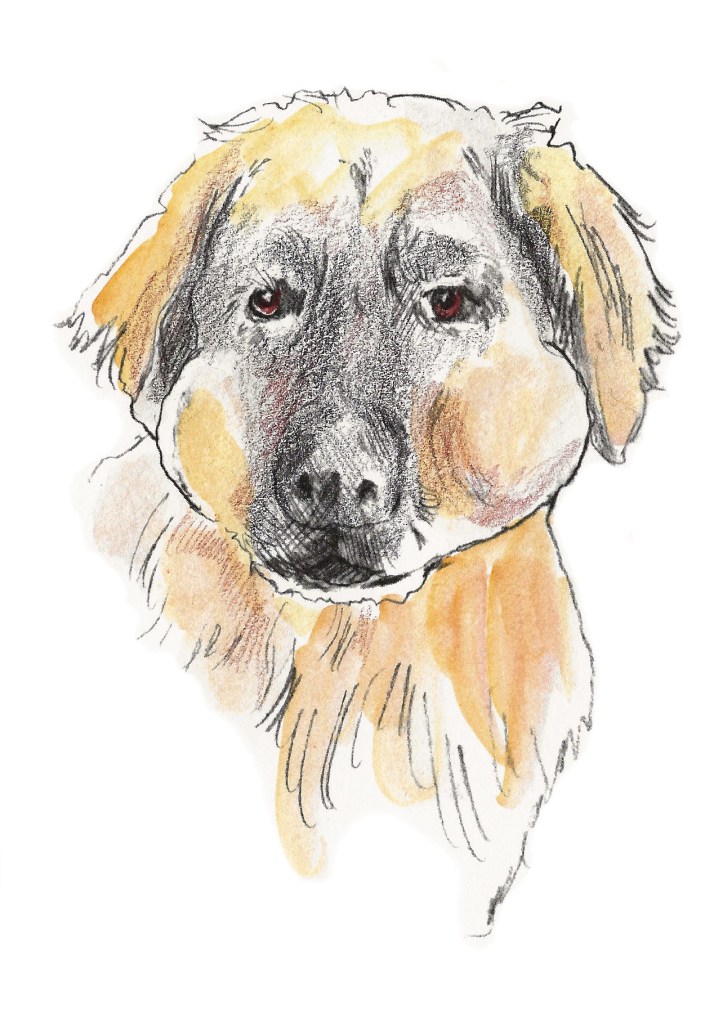
On one occasion, a friend of David trusted us with his two hamsters while he and his family went on vacation. A couple of days later, Claudia noticed that the two hamsters were missing from their cage. The next thing she noticed was that Bronco’s cheeks looked puffy, so she said, “Bronco, drop it!” Out came the two hamsters, both unconscious.
Bronco’s puffy cheeks. Are there hamsters in there? Illustration by Naomi Rosenblatt.
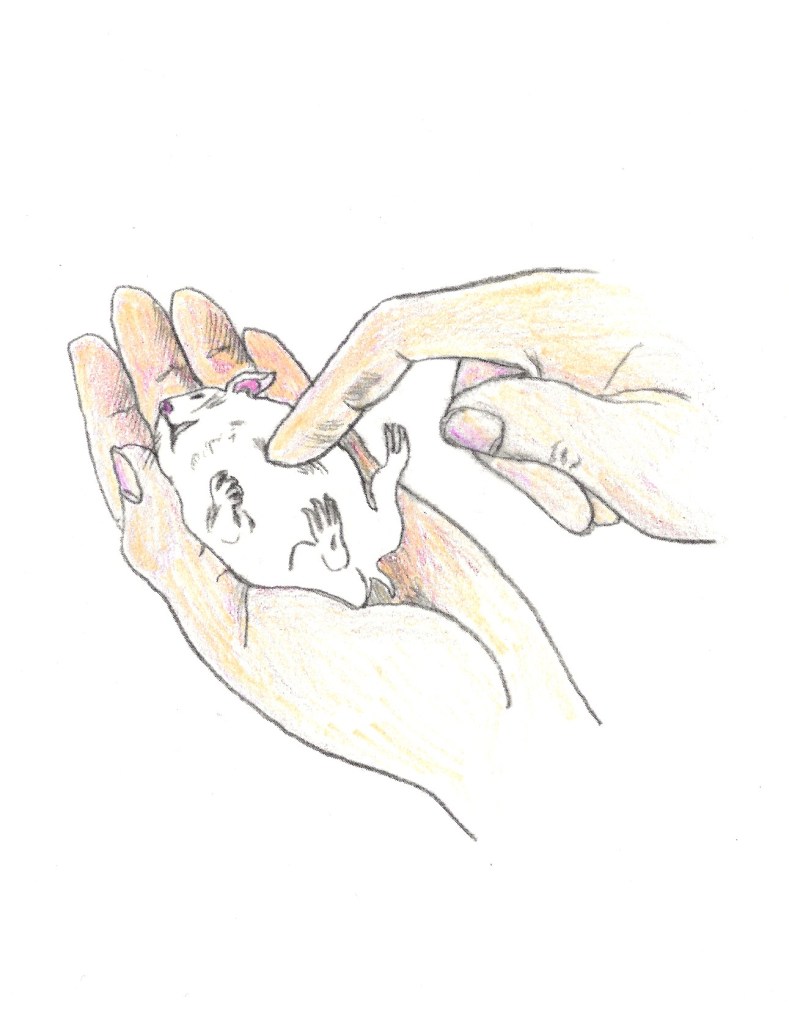
In a panic, Claudia started performing CPR on the unconscious hamsters. She put one hamster at a time in her hand and gently compressed each tiny chest using the finger of the other hand. Fortunately, one hamster revived right away. The CPR didn’t seem to be working on the other hamster, but Claudia put both of them back in their cage, and soon the second hamster also woke up. We decided to keep the incident to ourselves. Hamsters don’t squeal.
Claudia performing CPR on Hamster. They came back alive. Illustration by Naomi Rosenblatt.
The question is, Did Bronco try to eat the hamsters? Or did he simply find them and pick them up, intending to alert us to their presence? I’ve asked several people this question, including some who know Leonbergers well. The answer they give is that he tried to save them from whatever danger he thought they might have been in. If he wanted to eat them, they say, he would have tried chewing them. But clearly, he didn’t.
The hamsters may have felt differently about the situation and may have fainted from the shock. Who knows? Bronco was a hero on many occasions, but this time, perhaps, he was a hamster superhero.
Eventually our own hamsters died, but that didn’t end Bronco’s interest in them. When the first hamster died, we held a funeral. We put the hamster in a shoe box, said goodbye, put some flowers in the box, and buried it in the backyard underneath some bushes. But when we turned our backs, Bronco was there, digging under the bushes. Perhaps he thought he could save the hamster. So, we called Bronco off and tried again: this time I dug a deeper hole and put a wide rock over the shoe box before covering it. Now Bronco couldn’t dig up the hamster. When the second hamster died, I had learned my lesson and did the same thing.
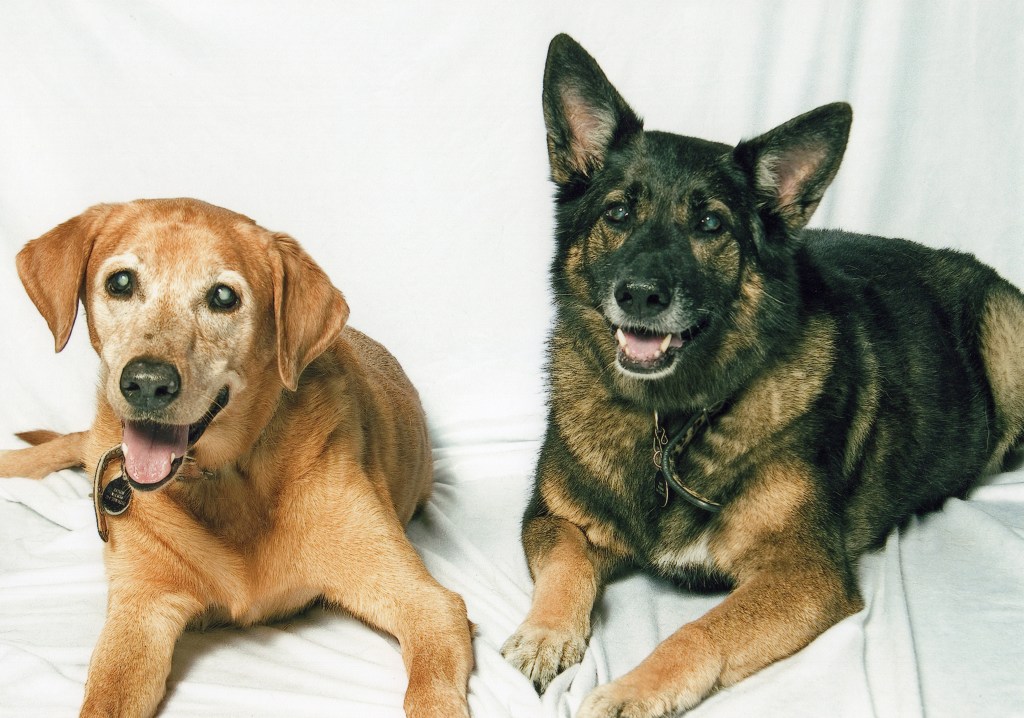
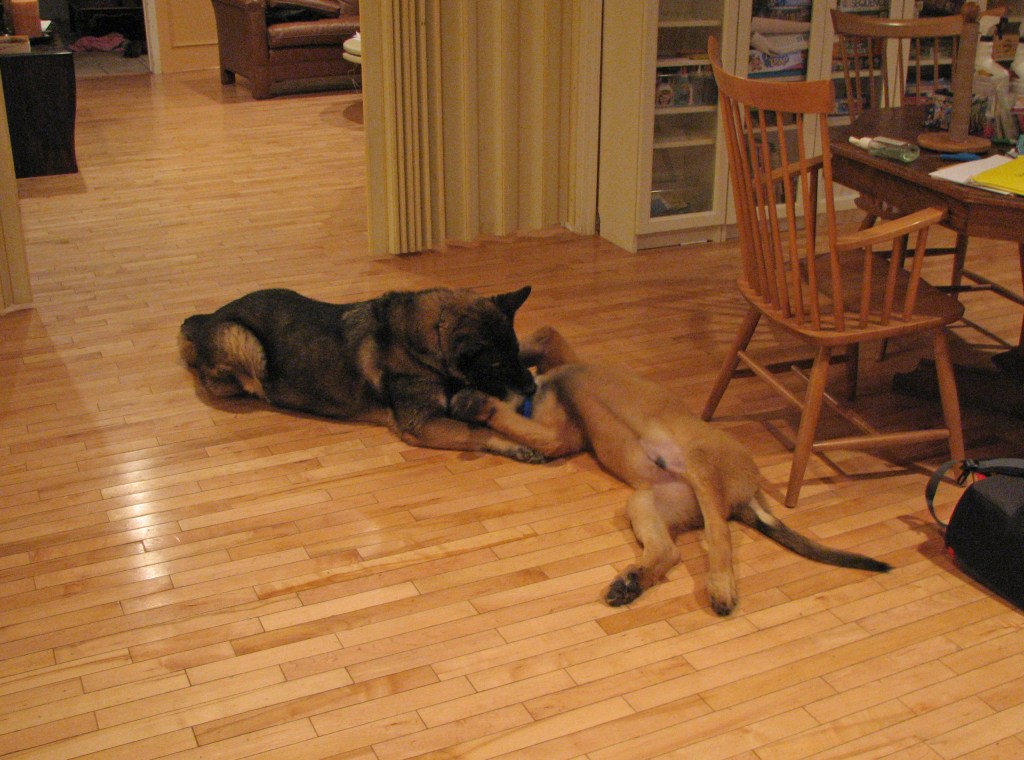
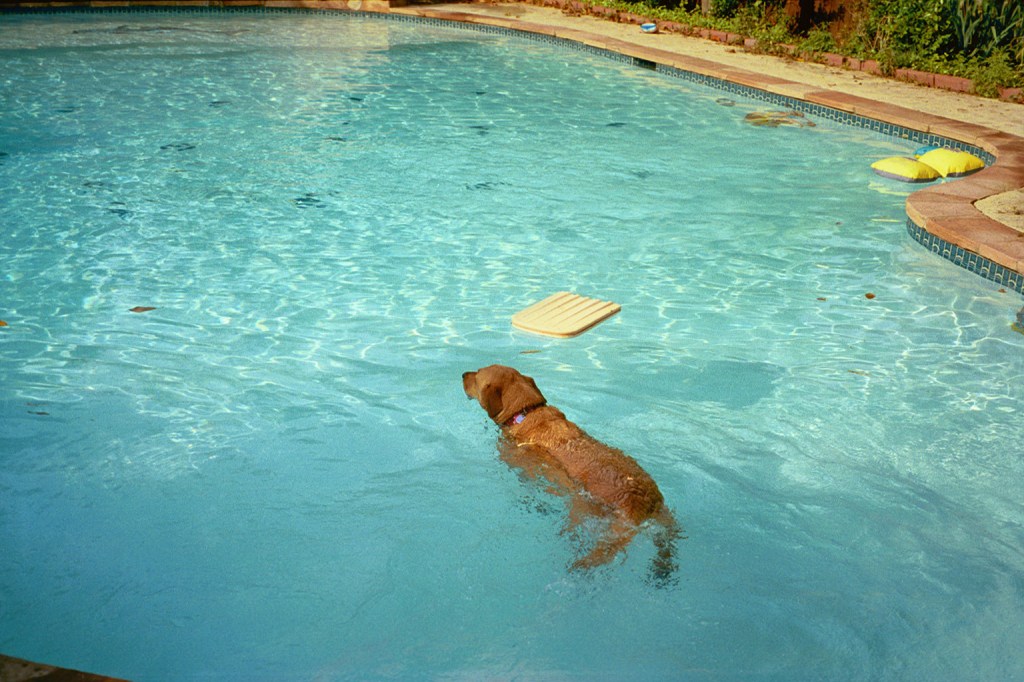
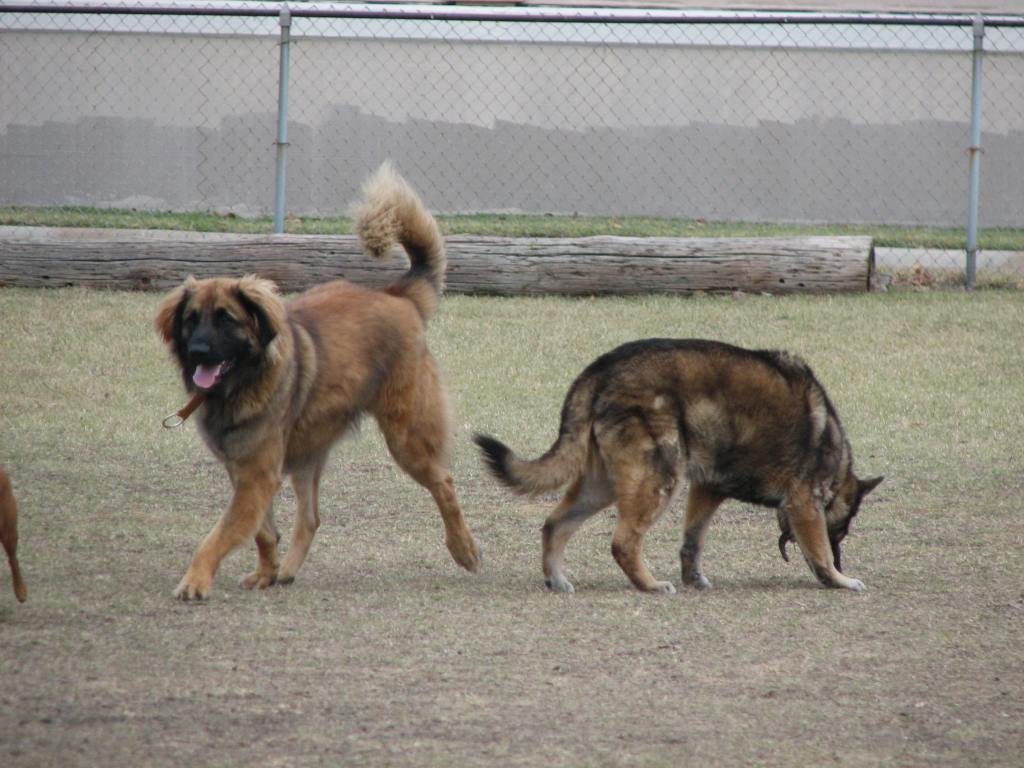
Our Leonberger Bronco grew up with several other dogs. Bronco loved them all and protected them with his life. He saved our pug’s life and got bit in the process. He sniffed out an oncoming insulin shock in our Labrador and the early detection may have saved his life. When Bronco was a puppy, he was fiercely protected by his stand-in mama our German Shepherd Baby. The other dogs sometimes followed Bronco around doing mischief. You can read about their crazy adventures in my book (see below). This post features various photos of Bronco and his siblings.
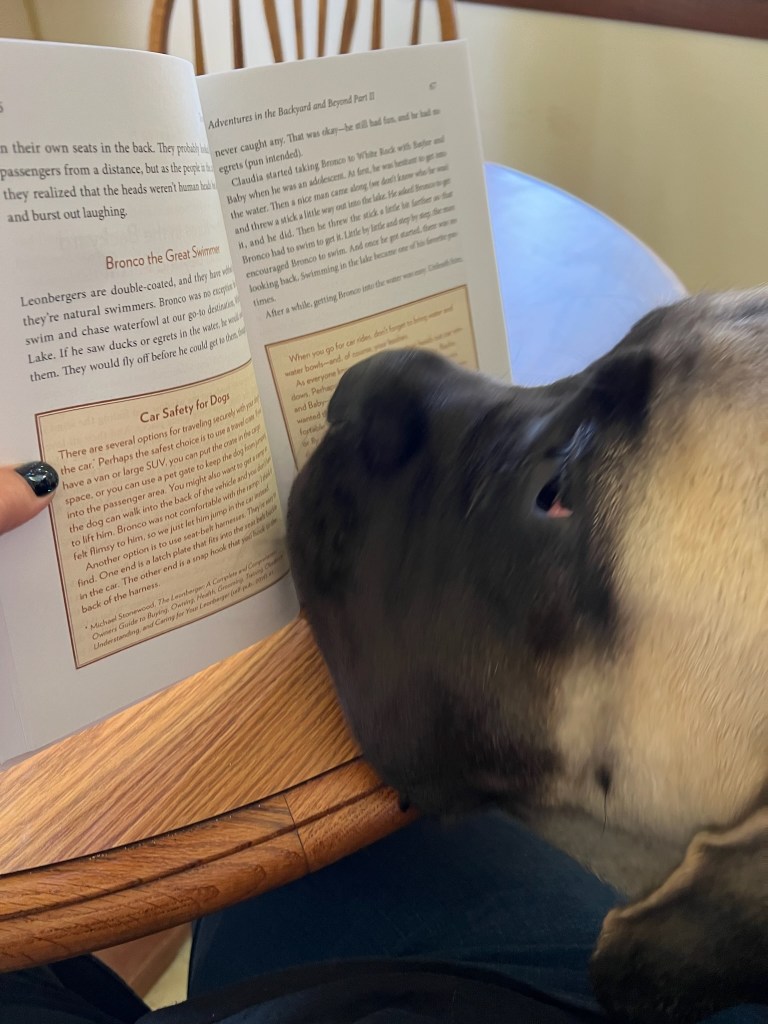
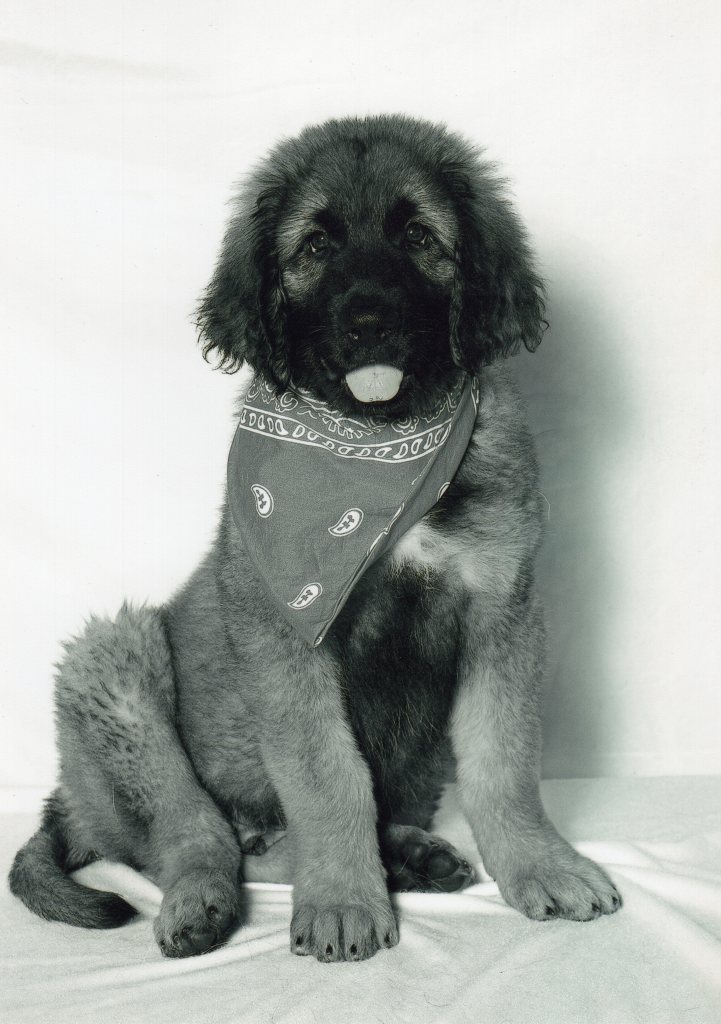
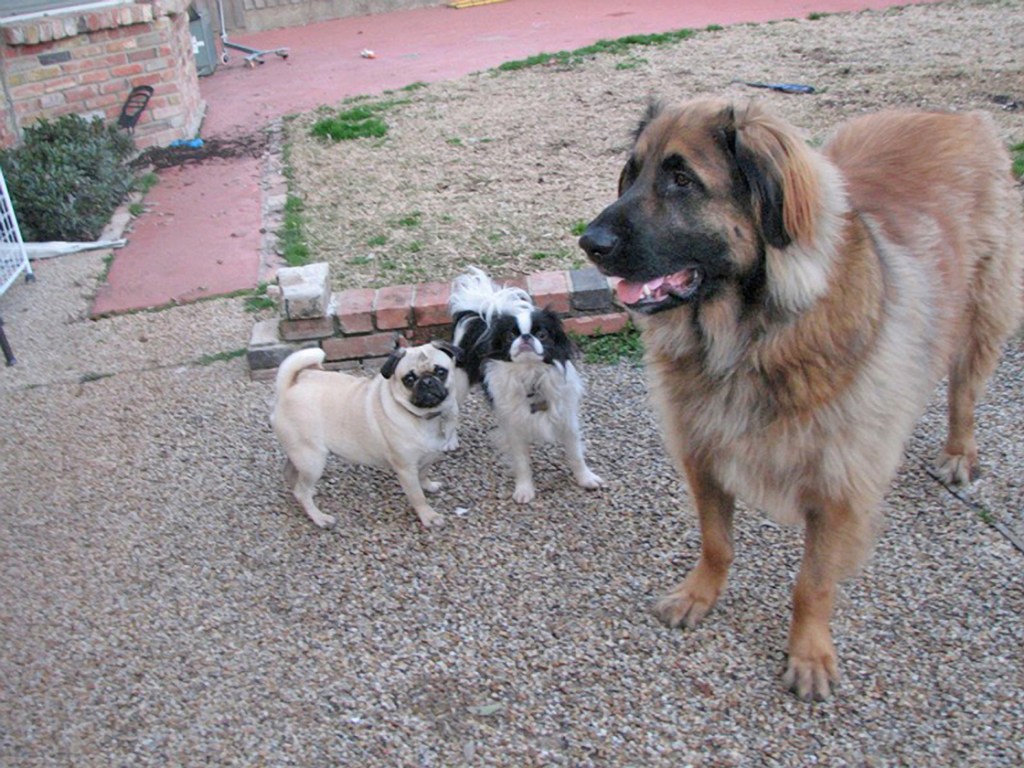
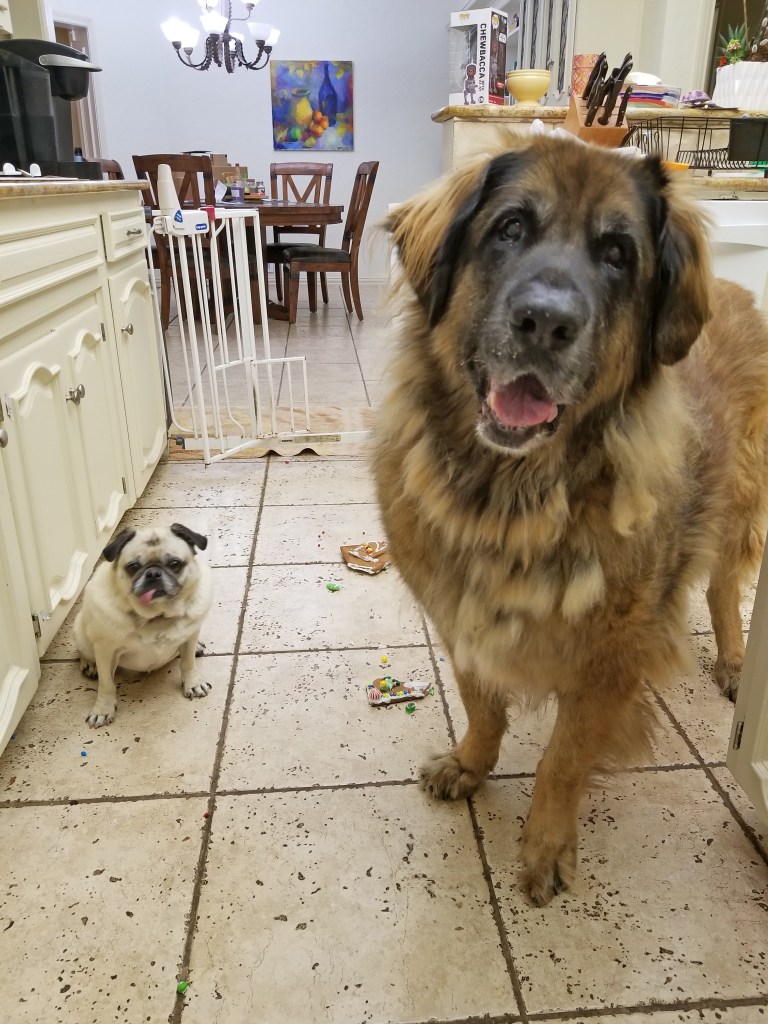
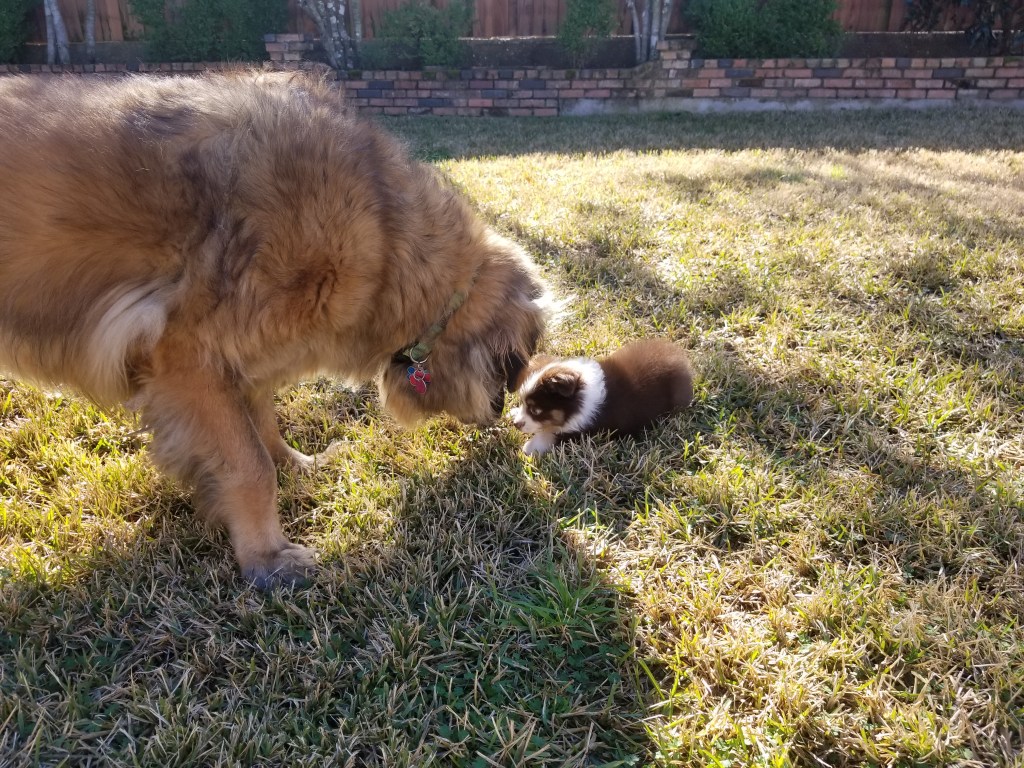
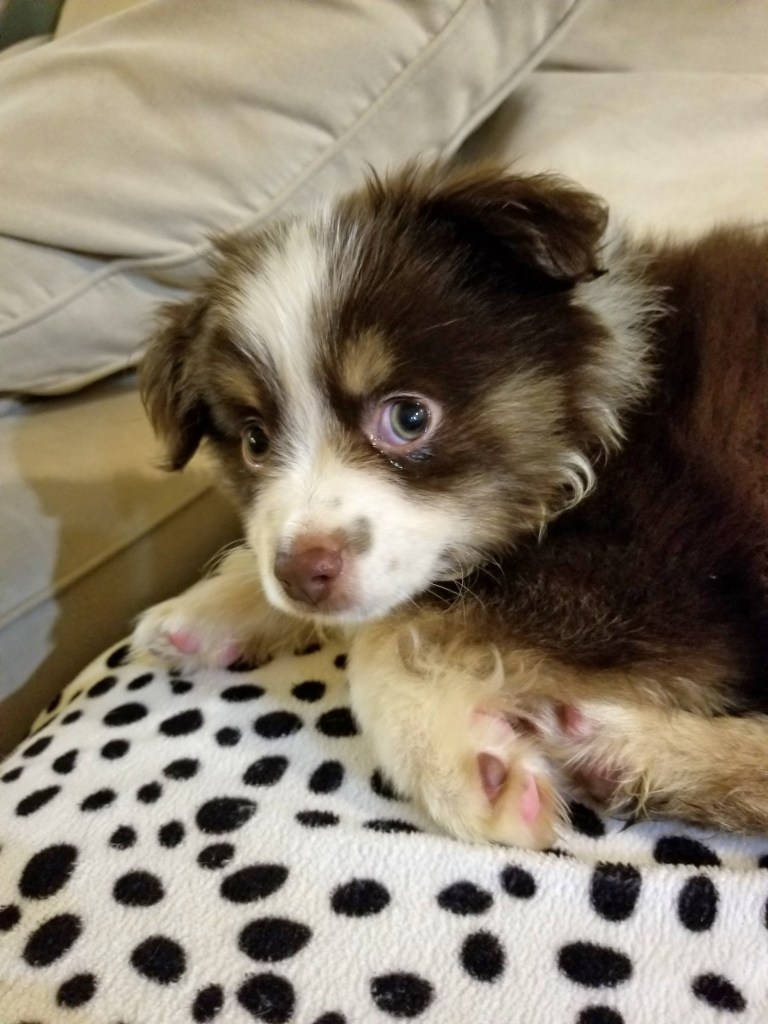
Sulley a young English Mastiff is reading my book. Sulley never knew Bronco but they would have loved each other.Bronco our Leonberger at three months oldBronco at three months old in black and whiteOur Labrador Baylor and our German Shepherd Baby. Photo taken at the same time as the two photos above. However, we couldn’t get Bronco sit still between Baylor and Baby.Our German Shepherd Baby is playing with Bronco. He is about five months old in the photo. Baby seemed to think that Bronco was her puppy. She protected him and stayed by his side at all time.Baylor our Labrador loved swimming, just like our Leonberger Bronco did.Bronco and Baby at the dog park. In the photo Bronco was almost one years old but did not quite look like a Leonberger yet. He needed a little bit more time to fill out.Bronco with his two little siblings, the pug Daisy and the Japanese Chin named Ryu (ninja warrior).Ryu and Daisy protesting that we are leaving for a trip. We had someone watching them, but they still hated when we left.It Daisy’s birthday (the pug) and Bronco helps celebrating. Bronco loved Daisy and saved her life from an attacking wild German Shepherd.Bronco raided our gingerbread house and shared some with Daisy.Daisy and Bronco. Two old friends in the backyard.A new puppy arrives, Rollo, a mini-Australian Shepherd. Hello Rollo!The new puppyRollo liked to pull and even swing in Bronco’s tail. He also walked over him and sat on him. Bronco was very patient.Bronco rub my belly!The artist and his art. Rollo loved chewing shoes. He has gotten over that now.Rollo (mini-Australian Shepherd) and Bronco (Leonberger) two buddies.Bronco was not afraid of anything. Rollo was afraid of everything.Bronco getting old, almost 13 and recovering from a heart failure.
A dog breed standard is a description of the characteristics of an ideal example of a dog breed. The description may include physical characteristics, genetic criteria, behavioral characteristics, or criteria of athletic or productive performance. Breed standards are devised by breed associations, and are written to reflect the use or purpose of the dog breed. The Federation Cynologique Internationale regulates breed standards for dogs internationally. However, the American Kennel Club, does not belong to the international body and uses its own breed standard format. In practice the breed standards are very similar.
For the AKC, the breed standard, and any revision thereof, originates with an AKC parent club. For Leonbergers the parent club is the Leonberger Club of America. It was very lucky that it became that way. To read about the history of the history of the Leonberger breed standard, Leonberger Club of America and the great dog wars, click here.
Below is a visual depiction of the physical aspects of the Leonberger breed standard. To find out more click on the image.
Physical physical criteria of the Leonberger breed standard. Click on the photo to read more about the Leonberger breed standard.
Our late Leonberger Bronco and his sister, the pug Daisy.
Bronco gave us many funny and exciting stories to tell. The book I wrote “The Life and Times of Le Bronco von der Löwenhöhle” feature several dozen stories. I’ve told a few of them here in my blog, but it was early on before I had many followers and I think most of you have not seen them. Instead of telling too many of the stories in the book I’ve decided to rerun some of the stories I’ve already told here in my blog, with some improvements, such as better images. Images that were used in the book (the images previously used in my blog were low-resolution early versions). This story is about the time when our Leonberger Bronco saved us as well as the neighborhood from a peeping tom who haunted and taunted us at night. Here we go!
Le Bronco von der Löwenhöhle or Bronco as we called him.
It was a quiet evening, and I was home alone. My wife, Claudia, was visiting her parents a few blocks away with Rachel, our daughter. Our son Jacob was meeting with his debate team; our other son, David, was visiting a friend.
I was making myself a ham sandwich in the kitchen when I suddenly felt a hand on my right shoulder. I startled and turned my head to face what I feared was an intruder, and there he stood on his hind legs—our Leonberger, Bronco. His big paw on my shoulder felt for a moment exactly like a human hand.
Bronco looked at me with his kind, wise eyes, then he looked at the sandwich. Then he turned his head toward me again and held my gaze. At that moment I understood what he wanted. I cut the sandwich in two and gave him his half.
I should explain that we had a problem with a trespasser at that time, which was the reason I was startled. This trespasser would sit outside our bedroom window at night and make threats and shout obscene comments at Claudia when I was not present. At first, though, we didn’t know where the threats and comments were coming from. I doubted Claudia’s accounts of these incidents, especially because she thought the voice might be coming from within our bedroom, perhaps via an electronic speaker. I thought she was just having nightmares.
Then one night I heard it myself—a voice screaming, “I am going to burn your house down!” Just as Claudia had said, it sounded like it came from within our bedroom, almost as if it were right next to me.
After Claudia and I went through our “Oh, so now you believe me” routine, I started looking under our bed and inside the heating and air-conditioning vents for hidden speakers and/or microphones. It was hard to believe that someone had planted these things in our bedroom, but that seemed to be the case.
Then it finally dawned on me. Next to the headboard of our bed, on Claudia’s side, just inches from her pillow, is a window. At night, when the blinds are lowered and the slats are partially open, you can see in, even if we have just a few lights on in the house. But, of course, under these conditions, you can’t see anything that might be outside.
I ran out the front door and around the back of the house, and there, right in front of our bedroom window, was one of our lawn chairs. The trespasser had climbed our fence, taken the chair, sat down in front of the window, and spied on us. Whenever I left the room, he would shout obscenities and threats at Claudia. When his face was planted in front of our window, he was just two or three feet away. This was why the voice felt so close. This had been going on for two weeks. We were happy to have finally figured it out, but we realized we had a problem.
Peeping Tom outside our bedroom window at night, illustration Naomi Rosenblatt
We talked to our neighbors about the situation, and they told us that the trespasser had terrorized them as well. He had been quite busy looking through bedroom windows at night. People in the neighborhood were scared. I called the police, who told us they could do nothing unless the man was caught in the act or he committed a crime other than trespassing.
Therefore, I decided to hire private investigators. I found them in the phone book. Phone books still existed back then.
The investigators told me that they typically spy on people suspected of cheating on their spouses, so this would be a more interesting job for them. The plan was for them to hide behind the bushes in our backyard and in a dark car parked on our street. When the man appeared, they would record him on video. They had a lot of fancy equipment and instruments, including big microphones, cameras, and metal detectors. They reminded us of Ghostbusters with all their technology and enthusiasm. They clearly loved their job. Unfortunately, though, the trespasser didn’t show up, so after a couple of days I decided to let the investigators go.
However, I soon figured out who the trespasser was. I started paying attention to what was going on in the neighborhood, and one evening, I noticed a strange looking but relatively young man, apparently homeless, who seemed to be stealthily roaming our neighborhood. I did not confront him, because I had no proof.
But a few days later, I heard shuffling noises outside our bedroom window. The trespasser was finally back. This time I sent Bronco out to chase him, and he did. Like the detectives, Bronco was enthusiastic but didn’t catch him. Still, he chased the man off. Having a big bearlike dog rushing toward you at night is probably a bit unnerving, even if the dog just wants to lick you. We never experienced or heard about the problem after this event, so Bronco may have helped the entire neighborhood.
Bronco chasing off intruder at night, illustration Naomi Rosenblatt.
A couple of weeks later, while walking Bronco on a neighboring block, I saw the homeless man across the street, at a bit of a distance. He stared at us in fright. Bronco just calmly looked at him without barking. The man was clearly terrified of Bronco, and he ran away.
But despite the nightmare the homeless man had inflicted on us, I felt sorry for him. My guess is that he was suffering from mental illness and that he had had a very tough and lonely life.
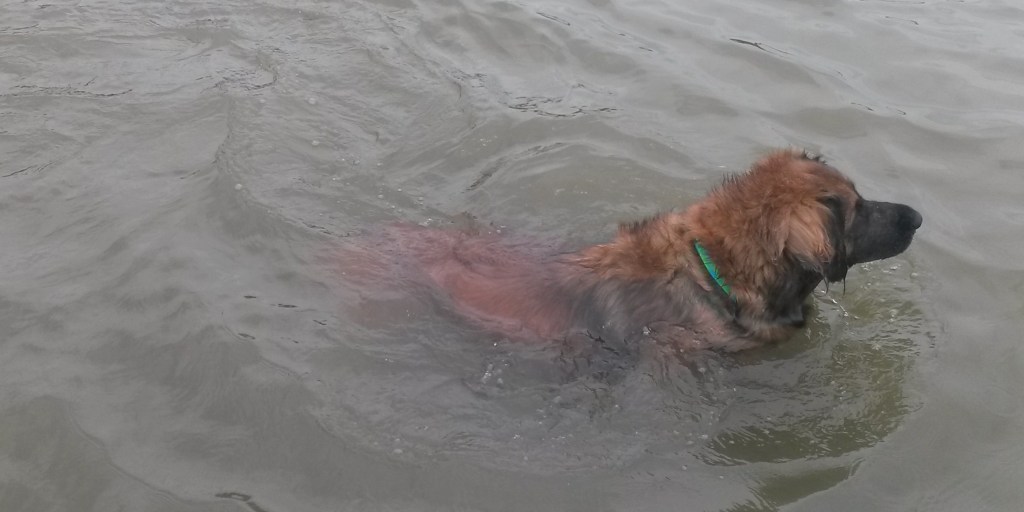
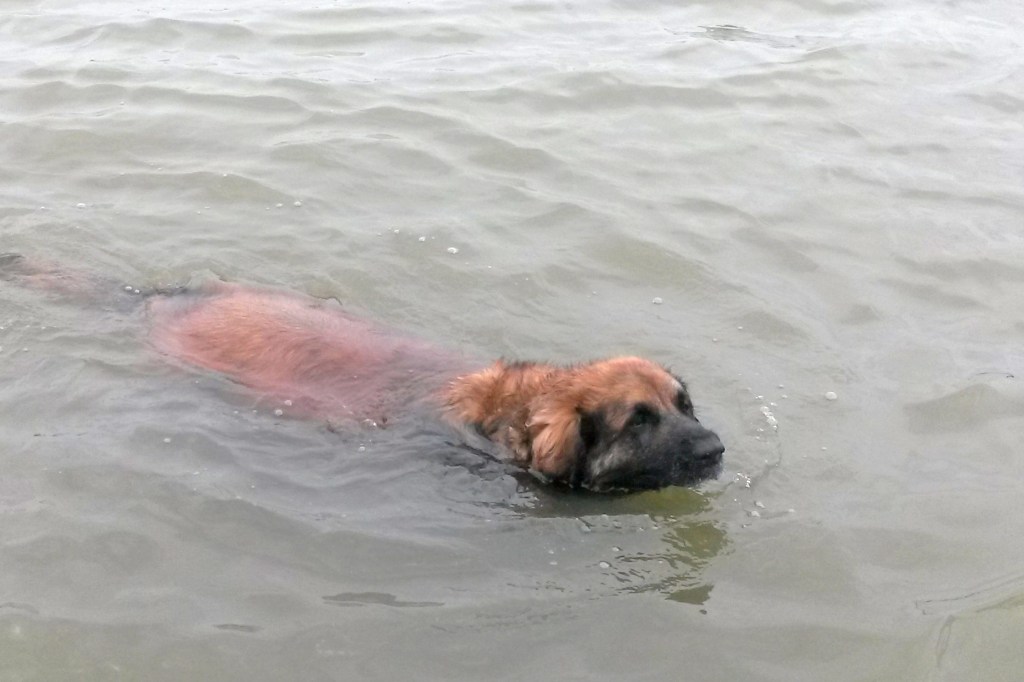
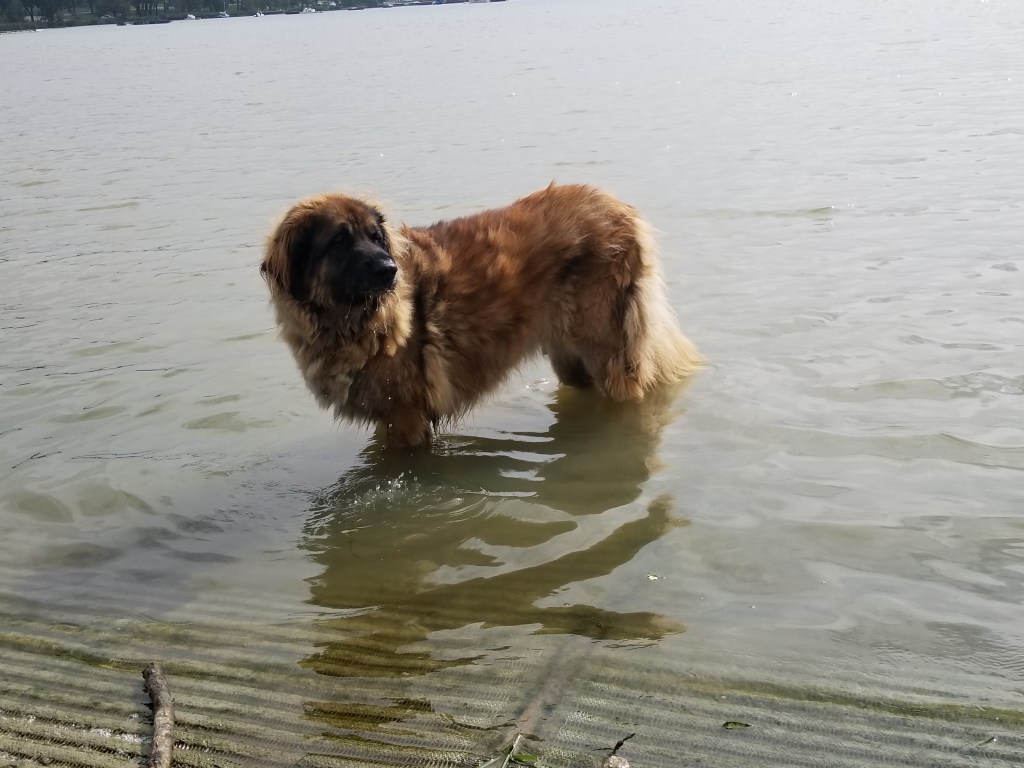
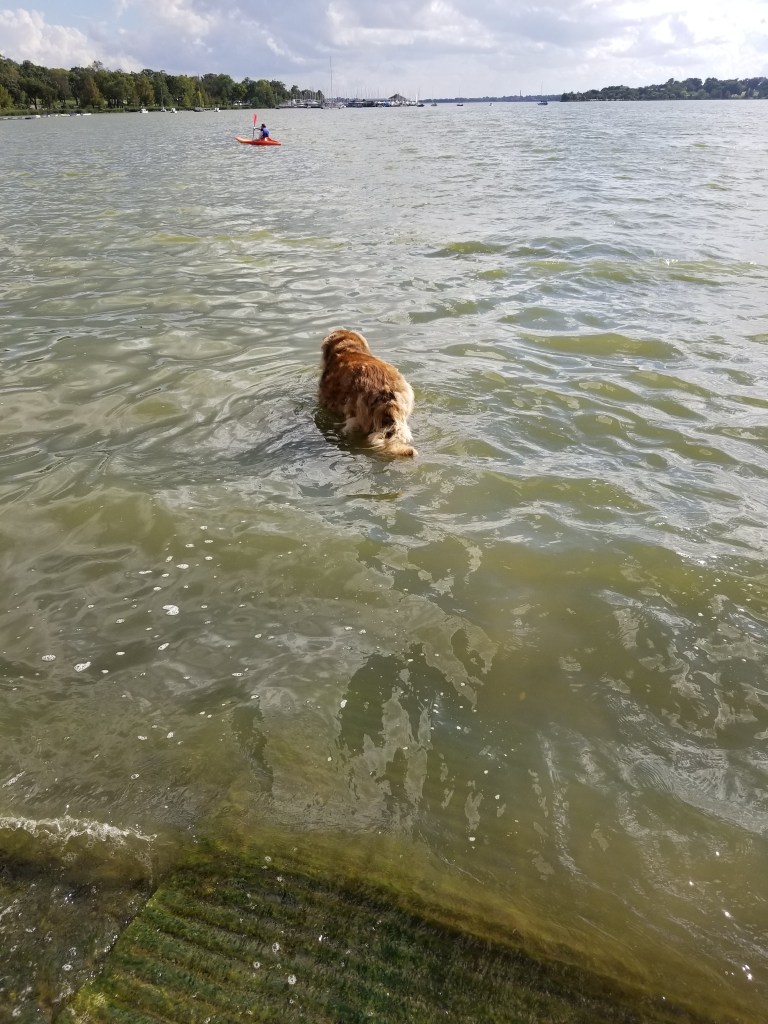
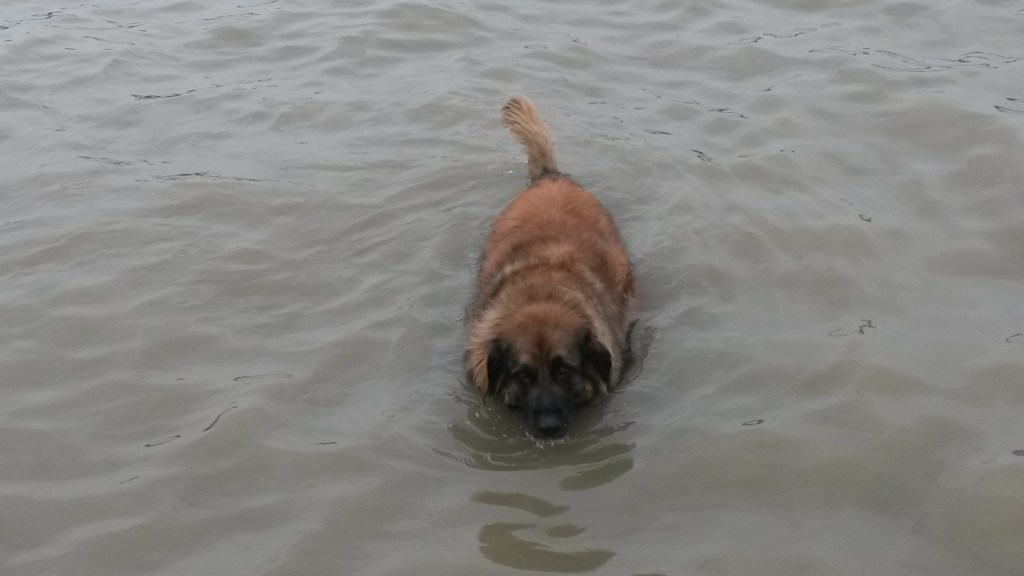
This post presents various photos of our late Leonberger Bronco swimming. Leonbergers have webbed paws and they are excellent swimmers. They are therefore used in water rescue. Some Leonbergers are trained to jump out of helicopters and into to the ocean. Bronco did not jump out of any helicopters, but he jumped into White Rock Lake in Dallas almost every weekend. Bronco loved swimming and he loved chasing ducks and egrets in the water, as well as fetching sticks in the water. Click on any of the photos below to read about Bronco’s water adventures.
Click on the photo to read about Bronco’s swim adventures.Click on the photo to read about Bronco’s swim adventures.Click on the photo to read about Bronco’s swim adventures.Click on the photo to read about Bronco’s swim adventures.Click on the photo to read about Bronco’s swim adventures.Click on the photo to read about Bronco’s swim adventures.
As I mentioned before, our Leonberger Le Bronco von der Löwenhöhle, or as we called him, Bronco, was an unusually long lived Leonberger. Leonbergers live on average 8-9 years, but our Bronco almost made it 13 (by two weeks).
Our Old Leonberger Bronco going on 13. He loved walking into his old age but needed breaks.You can look up the average life span of hundreds of dog breeds by clicking on the image. As you see, smaller dogs live longer, the giant breeds have the shortest life spans.
Scientific veterinary research has shown that large dogs have a much shorter life span than small dogs. This is not controversial, yet so many people are surprised by it. For example, one day after Bronco had just visited the veterinarian and I was walking him around the shopping center, a woman came up to me and asked about him. I told her he was twelve—old for a Leonberger. She said, “Twelve isn’t very old; my Chihuahua lived to be sixteen.” I explained to her that big dogs, especially really big dogs such as Leonbergers and Saint Bernards, don’t live as long as small dogs do, so for a Leonberger, Bronco was indeed really old. The look on her face told me she didn’t believe me; excuses, excuses, excuses. So this fact is far from intuitive to people, especially considering that big animals tend to live longer than small animals in the wild.
The cliché that one human year corresponds to seven dog years is a myth. For example, the average life span of a Great Dane is eight to ten years. For a Chihuahua, it is twelve to twenty years. Dachshunds and Pomeranians live between twelve and sixteen years, and pugs live between twelve and fifteen years. The average life span of a Leonberger, by contrast, is eight to nine years (some sources say seven years*). You can look up your dog’s particulars online: the product-review website Goody Pet features a life-expectancy calculator for hundreds of dog breeds.
Knowing the expected life span of your dog has value. When a dog reaches three-quarters of it, for example, he is considered a senior and needs to be treated differently.‡ You should get dog food that’s especially made for senior dogs and visit the veterinarian more often—ideally, twice a year.
To take Bronco’s temperature, we used a thermometer that we could insert into his ear canal. However, you can also do it the old-fashioned way: coat a thermometer with petroleum jelly or baby oil and gently insert it about one inch into your dog’s anus. Wait sixty seconds, then remove the thermometer. It should be noted, however, that the old-fashioned approach may lead to protests.
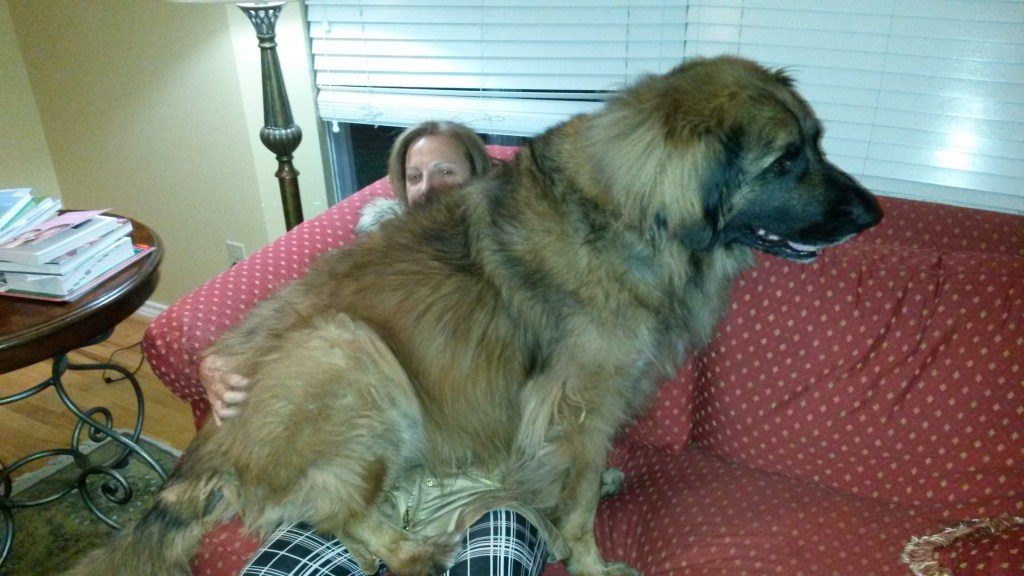
It’s also important to keep careful track of your Leonberger’s weight. Obesity in dogs is a growing problem: according to the Association for Pet Obesity Prevention, in 2018, 56 percent of American dogs were obese. Obesity, by definition, is a condition in which a person—or an animal—weighs at least 30 percent more than his ideal weight. In the photo below, in which Bronco is sitting on Claudia’s lap, he weighed 167 pounds—thirty-two pounds above his ideal weight of 135 pounds. Soon after that photograph was taken, we put him on a diet. Obesity can cause a lot of health problems, including diabetes, heart disease, early-onset arthritis, and joint pain. It can also put a strain on the body’s vital organs.
Bronco was a loving dog but 167 pounds in your lap might be a tad much.
This is my fourth book review on my Leonberger blog. However, this time I am reviewing a novella written by an epinions friend of mine, just because I want to spread the word about his great book. It is not a Leonberger book. Epinions was an on-line review site that paid reviewers. It covered all kinds of products, books, films, software, electronics, travel, you name it. Contrary to what one might think, paying reviewers led to more honest and fair reviews because the reviewers wrote reviews without strong feelings, either way, or to promote something. Anyway, writers started talking to each other and got to know each other on-line, even though they may never have met. That’s the case with Alex Diaz-Granados and me. Unfortunately, epinions shut down.
The name of Alex’ book is Reunion: A Story. It is 40 pages, 2.56 ounces, 5.98 x 0.1 x 9.02 inches, ISBN 978-1662913679. It is currently $6.99 on Amazon, it’s $2.99 on Kindle, and it is free for subscribers of Kindle Unlimited. It is $6.99 on Barnes and Noble.
Front cover of Reunion: A Story, by Alex Diaz-Granados. Click on the photo to go to the Amazon page for the book.
First a very brief synopsis for the novella. 33-year-old Jim Garraty is a respected history professor and bestselling author who lives in New York City. But when he gets a cryptic email from his best friend from high school, Jim is forced to relive his past – and a trip to his hometown of Miami reopens old wounds he thought had healed long ago. Based on what I know about Alex, there seems to be a lot of similarities between Alex and Jim Garraty.
Typically, I like to read a little bit a few times a day. I hardly ever read a book in one sitting. I am not that way. This book was an exception. Once I started reading it, I had to finish it. It was simply so well written and gripping that I could not put it down. The story is fresh, novel and engaging. I think the story underscore how differently a teenager and an adult views life and themselves, leading to the many “what if” scenarios in life. It is a sad love story about regret and loss as well as friendship. It is a unique story yet timeless. The author describes the feelings and the thoughts of the characters in a manner that is realistic and easy to relate to. It was emotional but not too sentimental. The story has something to tell us, especially young people. It is an easy and quick reading, and it is one of the best short stories I’ve ever read. I highly recommend it.
Back cover of Reunion: A Story, by Alex Diaz-Granados. Click on the photo to go to the Barnes & Noble page for the book.
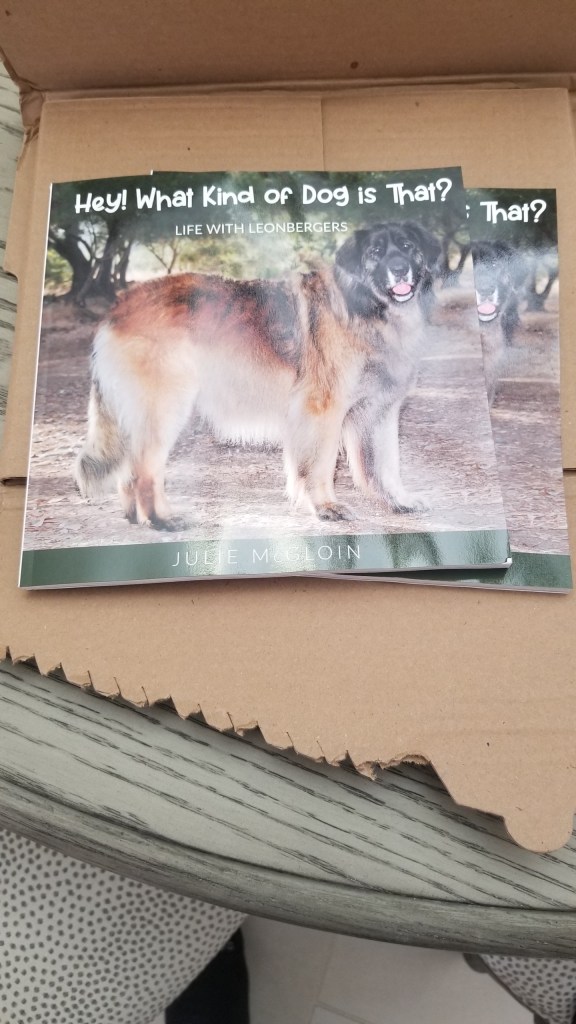
This is the third Leonberger book review on my blog. I am reviewing and recommending Leonberger books that I loved. This time I am reviewing Hey! What Kind of Dog is That?: Life With Leonbergers, by Julie McGloin, ISBN 978-1662913679. You can buy it from Amazon and Barnes & Noble. It is currently $13.88 on Amazon and $30.00 on Barnes and Noble. It is 104 pages, in a medium sized format (8.5 x 0.28 x 8.5 inches, 9.3 ounces) and it is in color.
Hey! What Kind of Dog is That?: Life With Leonbergers, by Julie McGloin. Click on the photo to go to the Amazon page for the book.
This book is a photographic tribute to a remarkable dog breed, the Leonberger. It is a fairly new book. It was launched early March 2022 and uploaded to Amazon at the end of February 2022. The author did not only include photos of her own Leonbergers but included photos from many other Leonberger owners as well. The book feature 100’s of beautiful color photos from around the world as well as interesting and useful information about Leonbergers. Our Leonberger Bronco is featured on page 6-7, which is something we are grateful for.
Page 6 & 7 spread in Hey! What Kind of Dog is That?: Life With Leonbergers, featuring our late Leonberger Bronco. Click on the photo to go to the Barnes and Noble page for the book.
I loved reading about all the other Leonbergers and learning a little bit more about the Leonberger breed. The information and the photos are presented in a charming and fun way, and it is easy reading. Leonbergers are beautiful and majestic, they love swimming, they love winter and snow, they love to eat, they are friendly and intelligent, and they are way too cute as puppies. All of this is reflected in the gorgeous photographs throughout the book. The book is for all ages and a great tabletop book. Below is the spread for page 64 & 65.
Page 64 & 65 spread in Hey! What Kind of Dog is That?: Life With Leonbergers, featuring Leonbergers in water.
Another important thing to mention is that a portion of the sale proceeds from this book is donated to the Leonberger Health Foundation International. I guess this book started a trend. Hopefully all Leonberger book authors will donate to the Leonberger Health Foundation International from now on. I highly recommend this book to all dog lovers and anyone thinking about getting a Leonberger.
Two copies of “Hey! What Kind of Dog is That?: Life With Leonbergers” arriving at my house.
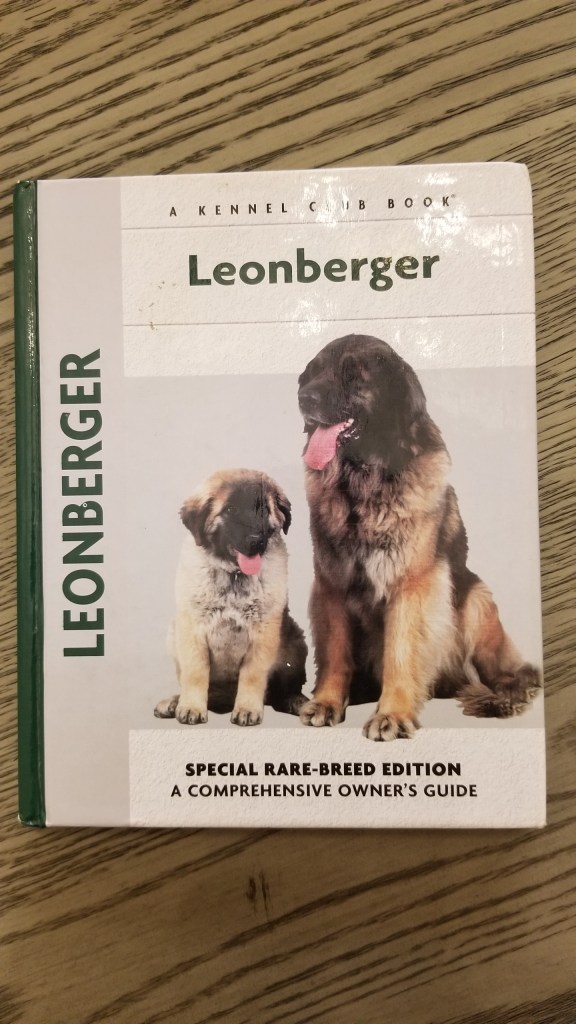
This is the second Leonberger book review on my blog. This time I am reviewing Leonberger, Special Breed Edition, a comprehensive owner’s guide, by Madeline Lusby, ISBN 978-1593783143. This is a Kennel Club book and part of a large series of dog breed books (167 books). You can buy it from Amazon and Barnes & Noble and it exist in both printed version (hardcover) and e-Book (kindle/nook). It is not expensive $9.95 on Amazon for a used hardcover version and $24.99 for the kindle version (nook a little cheaper). It appears that you can no longer buy it new (as I did). I remember buying the book new for $24.95. It is 155 pages, in a medium sized format (6.75 x 0.75 x 8.25, 1.27 pounds) and it is in color.
Leonberger, Special rare breed edition, by Madeline Lusby. Click on the photo to go to the Amazon page for the book.
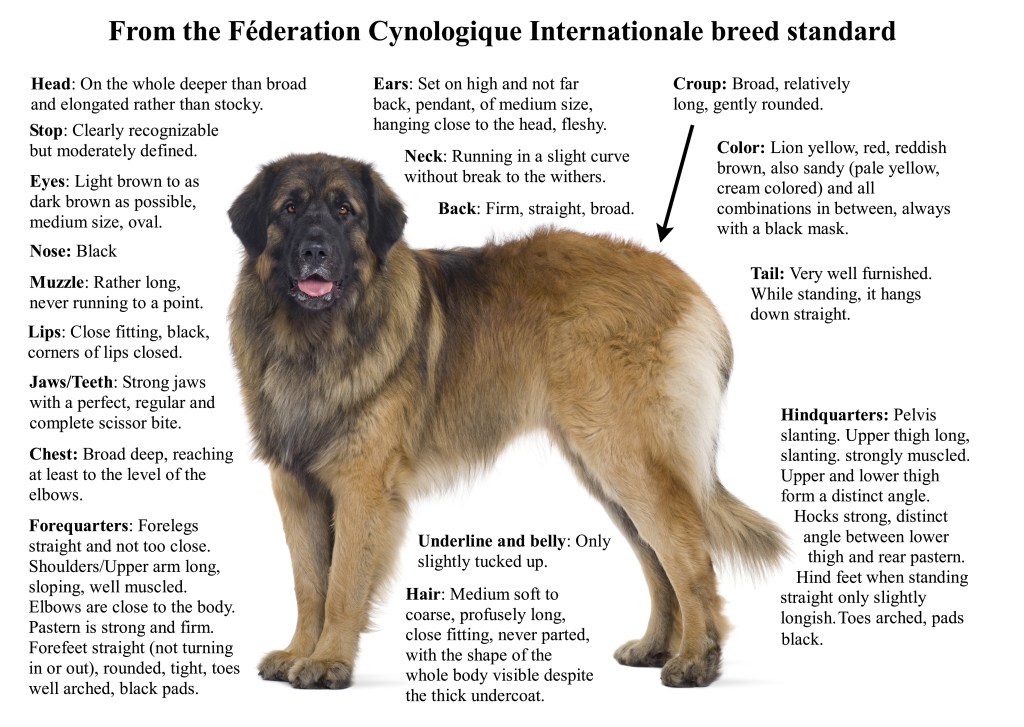
This book was published in 2005 before the Leonberger breed was recognized by the AKC and therefore there was no Leonberger AKC breed standard at the time. However, the FCI Leonberger breed standard certainly existed, and it is still the most prominent Leonberger breed standard. I was very impressed by the image summarizing the FCI Leonberger breed standard on the inside front cover (see below). I should mention that FCI (Féderation Cynologique Internationale) is the international organization that defines the dog breeds. However, some local organizations, such as the AKC (American Kennel Club) have their own breed standards that typically exactly match (but differ in language) or very closely match that of the FCI.
The FCI (Féderation Cynologique Internationale) breed standard illustrated
As the front cover states this is a pretty comprehensive book on Leonbergers. Due to the age of the book a few of the chapters may not be up to date, but overall, the book contains useful information for all Leonberger owners or potential owners. Leonberger history is interesting and fascinating, and this book contains some Leonberger history even though some of the claims should be taken with a grain of salt. For example, there is no proof that Leonbergers were used to pull ammunition carts during World War II as they were in World War I. There are chapters on the characteristics of the Leonberger, the breed standard, the Leonberger puppy, proper care, training, healthcare and the showing of your Leonberger. The chapter on healthcare is detailed and very well written and organized with nice sidebars, illustrations and photos. Unfortunately, this chapter is also a bit outdated. As the book points out, a Leonberger is not for everyone. Do you have the time and money to take care of it? Do you have the space? You can find out if a Leonberger is right for you by reading this book.
Overall, the book is well written, well organized and professionally made. There’s amusing anecdotes, and it is filled with interesting and beautiful photographs, tables, illustrations and colorful sidebars and notes. It was a pleasure reading it and despite its age and some inaccuracies I highly recommend this book. I gave it five stars.
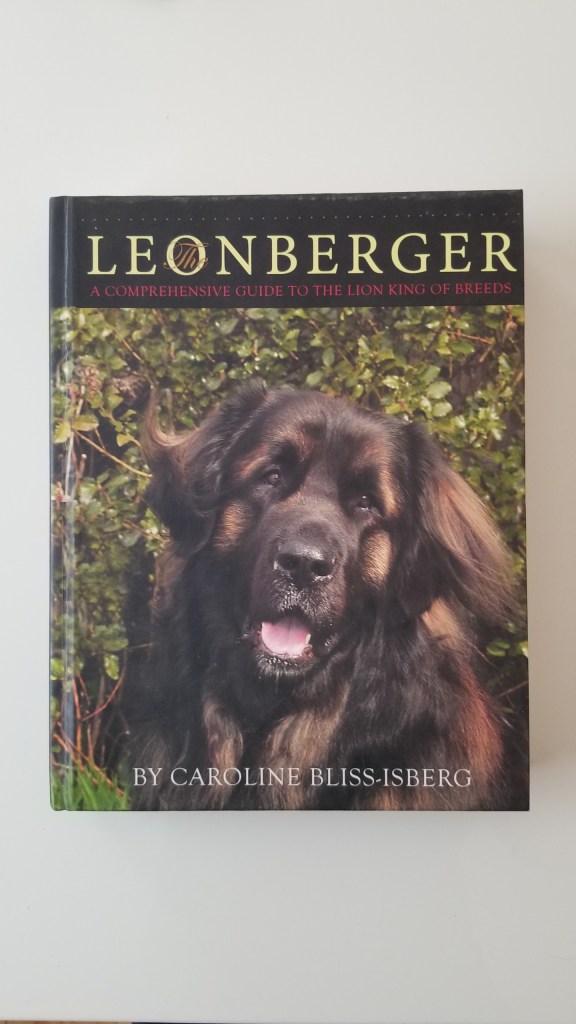
Previously I have not posted any book reviews on this blog. However, there are a lot of great Leonberger books out there, not just mine. I am starting with Leonberger, a comprehensive guide to the Lion King of breeds, by Caroline Bliss-Isberg, ISBN 978-1943824243. You can buy it from Amazon and Barnes & Noble and it exist in both printed version (hardcover) and e-Book (kindle/nook). It is expensive $109.95 for the hardcover version and $34.99 for the kindle version (nook a little cheaper). However, it is a masterpiece. It is 422 pages, in large format (8.5 x 1.25 x 11 inches, 3.62 pounds) and it contains hundreds of high-quality color photographs.
Leonberger, by Caroline Bliss-Isberg
The Leonberger is arguably the most interesting dog breed in the World. As you know we owned a Leonberger, Bronco, who passed away a couple of years ago at the age almost 13. That’s a long life for a Leonberger. Those 13 years were the best years of my life. Bronco was my best friend, so kind, so strong, so brave, so loving towards children and towards smaller dogs. He saved our Pug Daisy’s life from an attacking unleashed German Shepherd, and that’s just one of the amazing things he did. Leonbergers are truly amazing dogs and we are considering getting another one. Unfortunately, they don’t live that long, 8 years on average. Due to his age our Bronco got a longevity award called the Grey Muzzle Award.
What I didn’t know before reading this book was how incredibly interesting their history is. The research that’s been done on the breed, its origins, health, etc., is also fascinating. All of this is described in great detail in Isberg’s book. It was Isberg’s book that made me realize that the Leonberger is arguably the most interesting dog breed in the World. Isberg’s book also dispelled some of the Leonberger myths that I believed. Searching the internet and taking for granted what people tell you will often lead to misunderstandings and erroneous beliefs. For the case of the Leonberger breed this book will help you rectify that. In addition, Isberg’s book also inspired me to write something about Leonbergers myself. My shorter book is more focused on our Leonberger stories, but it also contains interesting Leonberger information.
In addition to history, this book presents the breed standard, how the breed standards have changed several times throughout history, and it feature a critique of how we breed purebred dogs. The how and why is very much part of human culture and history. The book discusses the Leonberger dog in detail, it feature Leonberger dog sports, dog show information, information on breeding, Leonberger organizations and their history, health, and genetics. The research effort that must have gone into this book is astounding. The book features hundreds of color photos, many of them incredibly beautiful. There are drawings in the book that are hundreds of years old, old newspaper clips, research paper excerpts, and full-page color photos of Leonbergers in action. It is an expensive book, but if you are up to paying the price, it is a great investment for any Leonberger enthusiast.





















 Leonberger Life