This blog feature amusing and heartwarming stories about our late Leonberger dog Bronco, as well as other Leonbergers. It also has a lot of information about the Leonberger breed, the history, care, training, Leonberger organizations, etc. I also wrote a Leonberger book, which I am featuring in the sidebar.
Today is Veterans Day, a day with roots in Armistice Day from World War I. Did you know that the Leonberger dog almost went extinct during World War I? Below is a short excerpt from my book.
World War I was tough on the breed. Some Leonbergers were used to pull ammunition carts and small cannons during the conflict, and others were left to wander unattended. Often, these dogs starved to death. But after the war, two Leonberg businessmen, Karl Stadelmann and Otto Josenhans, worked hard to save the breed. They scoured the countryside looking for Leonbergers who were still alive. They were able to find twenty-five of them whose owners were willing to cooperate in reestablishing the breed. Of these, only five were suitable for breeding. None of the Leonberger clubs had survived, so they founded a new one in 1922 called Deutsche Club für Leonberger Hunde (DCLH), and Stadelmann created an updated version of Albert Kull’s Leonberger breed standard from 1895. To find out what a breed standard is click here.
Note: I temporarily lowered the price of the Kindle version of my book to $4.99.
For your information the ASIN number for the e-book edition: B0B5NN32SR and the ISBN number for printed edition: 978-0998084954
Below are some Leonberger photos from World War I that I came across. Notice; Leonbergers looked a little bit different back then.
Last Saturday (11/5-2022) I participated in Indy Author Day at Watauga Public Library north of Fort Worth, Texas. Each of us had a booth where we sold and signed our books. We talked to each other and shared experienced. Some of us did presentations. didn’t sell a whole lot of books, six to visitors, and the library had already three before the event, but that was not the main point. It was a fun experience that was entirely new to me. Because of this event and other events coming up I have temporarily lowered the price of the Kindle version of my book to $4.99.
I can add that if your kindle device (or other eBook reader) is capable of displaying colors you will be able to to see all the color photos and colorful illustrations.
For your information the ASIN number for the e-book edition: B0B5NN32SR and the ISBN number for printed edition: 978-0998084954
I am not lowering the price of the paperback version because it is printed in color and the printing cost make that difficult. All Royalties are donated to the Leonberger Health Foundation International (LHFI). So, for the Kindle edition, 30% of the $4.99 is Amazon’s cut and 70% is royalty ($3.49). That Royalty is donated to the Leonberger Health Foundation International. $3.49 is less than the $6.29, which was the royalty when the price was $8.99. However, if you wish to donate more to LHFI you are welcome to.
I made a poster for my booth at Watauga Public Library. Click on the image to go to the Amazon.com Kindle location for the book. $4.99 for a limited time.This is a group photo of the attending authors. I am on the far right. Click on the image to go to the Amazon.com Kindle location for the book.
Finally, below is my typical blog post promotion of the paperback version of my book that I end almost every blog post with.
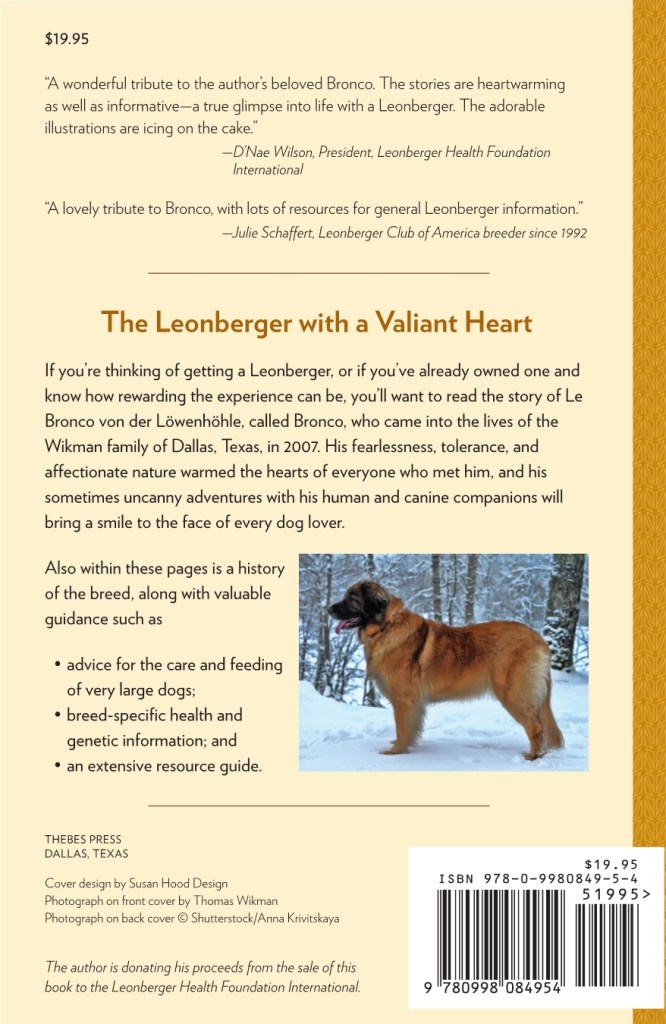
The front cover of my book “The Life and Times of Le Bronco von der Löwenhöhle”. Click on the image to go to the Amazon.com location for the book.This is the back cover of the book “The Life and Times of Le Bronco von der Löwenhöhle”. Click on the image to go to the Amazon.se location for the book.These are the endorsements for the book. Click on the image to got to the Barnes and Noble location for the book.
Below is a list of where you can find the book. Click on the links to go to the respective store. However, if your favorite bookstore is not listed below you can search for it using the ISBN or ASIN numbers.
The next few days are going to be interesting. I am participating in an Indy-Author Day tomorrow at a local library, I might be interviewed by a local magazine, and there might be other events coming up related to my book. Because the next few days or weeks are going to be special, I am temporarily lowering the price of the Kindle version of my book to $4.99.
For your information the ASIN number for the e-book edition: B0B5NN32SR and the ISBN number for printed edition: 978-0998084954
I am not lowering the price of the paperback version because it is printed in color and the printing cost make that difficult. All Royalties are donated to the Leonberger Health Foundation International (LHFI). 30% of the $4.99 is Amazon’s cut and 70% is royalty ($3.49). That Royalty is donated to the Leonberger Health Foundation International. $3.49 is less than the $6.29, which was the royalty when the price was $8.99. However, if you wish to donate more to LHFI you are welcome to. Below I am showing an Ad for the Leonberger magazine, the front and back cover of the book, and a few selected pages as they would look like on a kindle with color or as the pdf version of the book. Note: the book snapshots below may be too small to read, but if you can read them, I don’t mind.
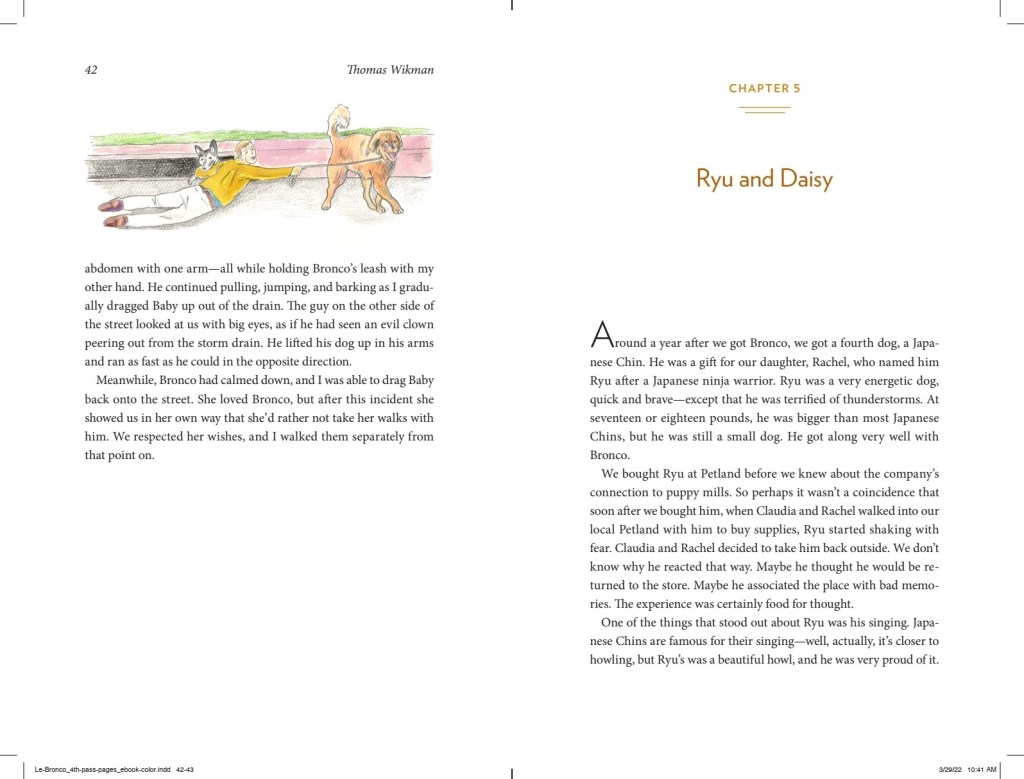
Ad for the Leonberger magazine. Click on the image to go to the Amazon.com Kindle location for the book. $4.99 for a limited time.This is the front cover of the book “The Life and Times of Le Bronco von der Löwenhöhle: Stories and Tips from Thirteen Years with a Leonberger”. Click on the image to go to the Amazon.com Kindle location for the book.This is the back cover of the book “The Life and Times of Le Bronco von der Löwenhöhle”. Click on the image to go to the Amazon.com paperback location for the book.Page 2-3 in the bookPage 24-25 in the bookPage 42-43 in the bookPage 92-93 in the bookPage 122-123 in the bookPage 132-133 in the bookPage 194-195 in the book
This blog is primarily about Leonbergers and our late Leonberger Bronco as well as the book I wrote about him and his dog friends. However, sometimes I review other Leonberger books and other great books. This time I am reviewing Laws of Nature, the second book in the Dawn of Humanity series – July 3rd, 2021, by Jacqui Murray. This paperback is 307 pages, 978-1942101604, item weight 14.6 ounces pounds, dimensions 6 x 0.7 x 9 inches. You can buy it from, for example, Amazon or Barnes and Noble, as a paperback or e-Book. The paperback version is currently $15.99 on Amazon.
Not only is this book great Historical Fiction but it was released July 3rd on my best friend’s birthday. I am talking about Bronco, or Le Bronco von der Löwenhöhle, our late Leonberger. The pre-historic canine in this book, Ump reminds me of Bronco. I feel there is a special connection. Reading this book was a great joy. I wrote a review on Amazon, which can be found here (Lucy, Ump and their motley crew survive in brutal pre-historic times), as well as on my social media. Here I am presenting a reworked version of the same review. From now on I will be focusing on her next book “Natural Selection” in her Dawn of Humanity series. I recommend that you read all three books. Who knows what will come next?
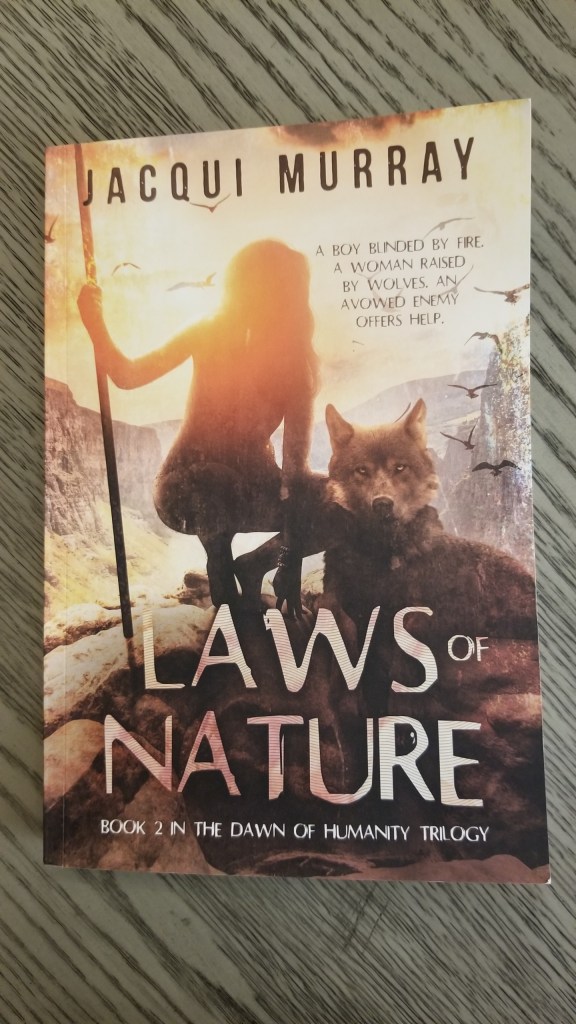
Front cover of the book Laws of Nature by Jacqui Murray. Click on the image to go to the Amazon page for the book.
Lucy, Ump and their motley crew survive in brutal pre-historic times
The story follows Lucy, a Homo Habilis woman who lived 1.8 million years ago, her tribe, and her canine companion Ump. Lucy’s tribe is attacked by a tribe of Homo Erectus, and we follow them as they migrate across Africa. They have to fight for their survival in various ways, finding food, finding shelter, fighting off saber tooth tigers, other dangerous animals as well as hostile tribes. Fortunately, Lucy is a special kind of pre-historic woman, a healer, a hunter, clever and wise.
I know a little bit about human pre-history, but I am not an expert. However, I find the author’s depictions of life in the early Quaternary quite believable and fascinating. Like Jean M Auel before her, Jaqui Murray has done her research. At the beginning of the book, she is explaining the background, the groups, what the various animals are, etc. This helps readers understand what is going on. It is especially helpful to readers who did not read the first book, Born in a Treacherous Time. I also highly recommend this book.
I was especially intrigued by Ump. Ump is a large pre-historic canine who became one of Lucy’s companions. Ump is friendly, he is brave, and he is very loving and protective of Lucy and her group. Ump is able to communicate with the hominids using body language in a manner that reminds me of how dogs do that today. It is amazing how much you can say using body language and how this translates across species boundaries. I see this with my dogs today. If you pay attention there’s so much a dog can tell you.
Ump reminded me of our late Leonberger Bronco. Like Ump Bronco was friendly, brave, protective and he loved his family. Like Ump he saved the lives of fellow family members a few times, and he chased off threating people. Like Ump he was a good communicator using body language, growls, grunts and barks, and like Ump he was in tune with the feelings of his family. Reading about Ump and other canines in this book was a joy.
Another thing I think the book makes clear is that even though diversity makes communication more challenging it makes for a stronger group. A group that is homogenous might be great for defense temporarily, but to venture out, to seek new pastures, to survive the unfamiliar you need diversity; and thus, we have Lucy’s and Ump’s diverse group. Ump’s canine skills, Boah’s special skills with traveling through the canopy, and the skills of the different hominid races and their experiences, all within Lucy’s small group allow them to survive challenges beyond what you can expect to be bearable.
This book is full of action-packed adventure. The stories are not only thrilling but imaginative, captivating, and full of surprises. This book feature some quite unexpected and surprising but credible plot twists towards the end. I love it when story lines are coming together in surprising but logical ways that you do not expect. The book also introduces some new characters, one of them “Wild”, which was, well quite wild to say the least. I highly recommend this book, but now I will focus on her next book “Natural Selection”.
Our Leonberger Bronco (Le Bronco von der Löwenhöhle) barked at mailmen but he did not hate them. He got along well with them when he met them. His sibling Baylor the Labrador was a different story. Even though Baylor was a friendly and sweet dog he was not friendly towards mailmen. Baylor stood in the window, he saw the mailman come, mess with our mailbox, and as Baylor barked frenetically, the mailman fled in his white squarish looking get a way car with blue letters. It happened every day! Baylor might have thought that he saved our lives every day.
Close up photo of Baylor our Labrador
I have an interesting fun fact about one of the prominent characters in the Leonberger community, Robert Beutelspacher. He was the Zuchtbuchführer (breed registrar) and later President of the DCLH (Deutsche Club für Leonberger Hunde), and was the one got the meticulous recording of Leonbergers started. Robert Beutelspacher was also a mailman and he had to deal with attacking dogs in his line of work. Hopefully no Leonbergers. He helped advertise a spray that harmlessly deterred attacking dogs, a pioneering product.
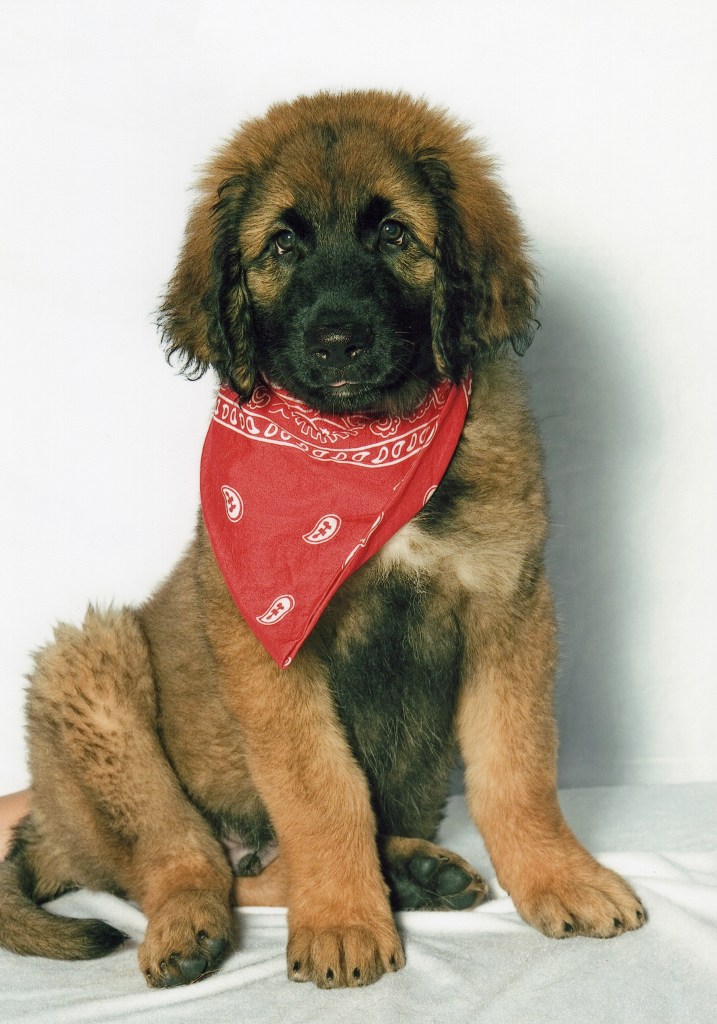
Baylor (Labrador, or Labrador mix) and Baby (German Shepherd).Bronco, three months old at the time the photo above was taken. He wouldn’t sit still with Baylor and Baby, so he got his own photo.
Below is a snippet from my book. Baylor went after a mailman, and it could have ended in disaster.
Well . . . Baylor wasn’t always friendly. There was one exception to his affability: the mailman, his only enemy. Baylor must have considered the daily act of putting mail in our mailbox a sign of aggression. Every time the mailman came, Baylor barked loudly and threateningly. Perhaps he thought he was saving us from grave potential danger.
One day while the mailman’s truck was stopped in front of our mailbox, I opened the front door—I don’t remember why. Like a bolt out of the blue, Baylor ran through the opening and charged the truck. I did not expect this to happen at all. The window of the truck was open, and, to my astonishment, Baylor jumped inside. I expected certain disaster to unfold before my eyes—injuries, expensive lawsuits, prison: maybe we would be banned from receiving mail ever again. This time it wasn’t the pit-bull-owning woman who was ashamed: it was I. (note: this is referring to another unrelated incident when we were attacked by an unleashed dog).
In a panic, I dashed toward the truck. But just as fast as he had jumped into it, Baylor jumped back out. He looked confused. He slowly walked back toward me, completely calm, and I realized that there was no one in the truck. Then I saw the mailman standing at my next-door neighbor’s house ringing the doorbell. Baylor hadn’t noticed him, and he hadn’t noticed Baylor. I quickly and carefully approached Baylor, grabbed his collar, and took him inside. No one but I had seen what had happened. No one but I knew how close we were to disaster.
I learned a lesson that day that I will never forget. I also developed an immense respect for letter carriers and the sacrifice they make every day to bring us mail.
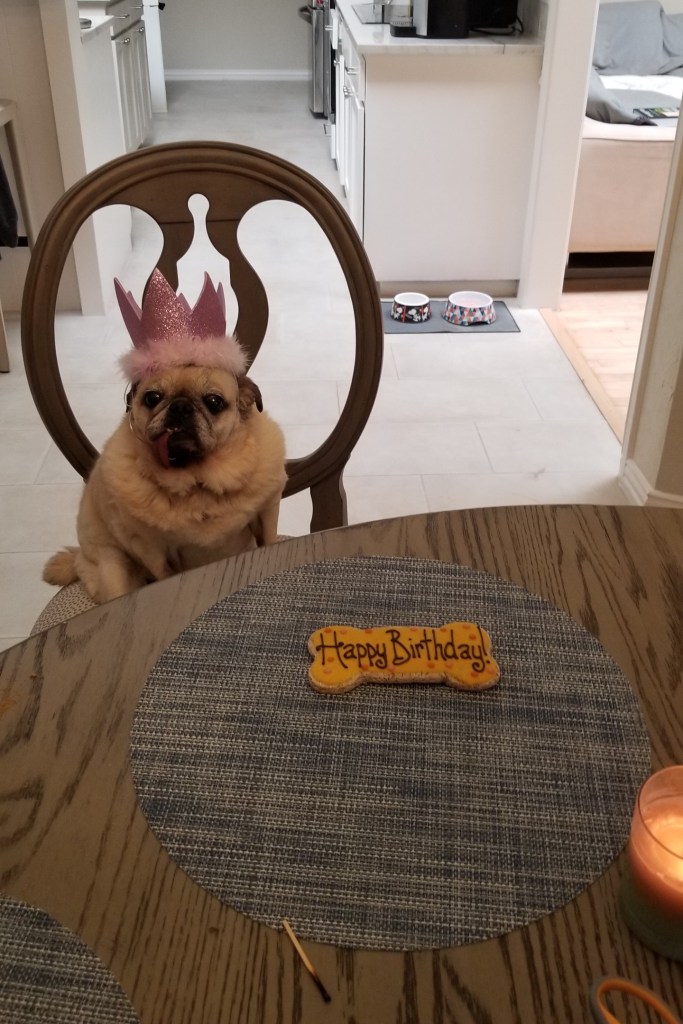
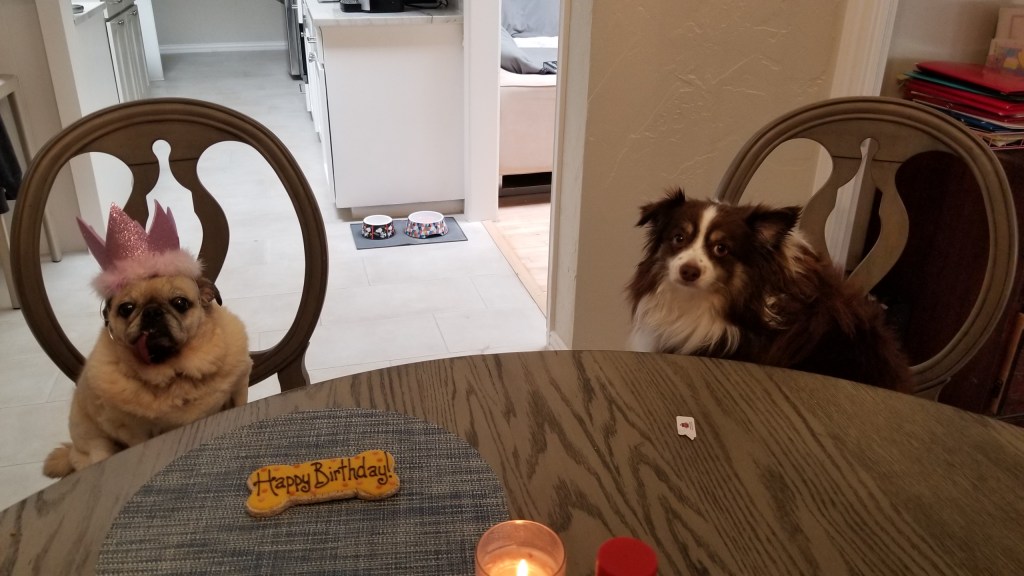
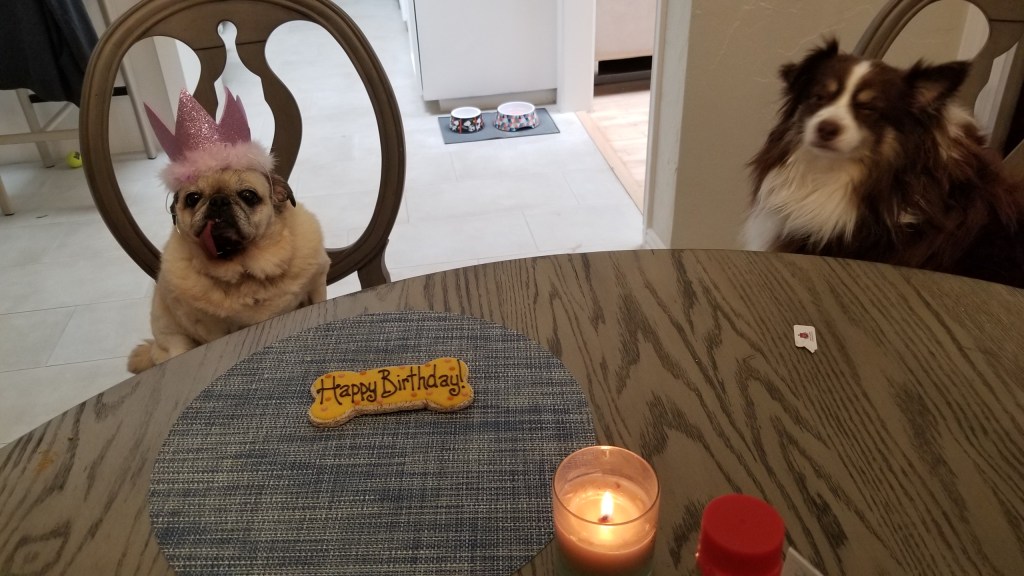
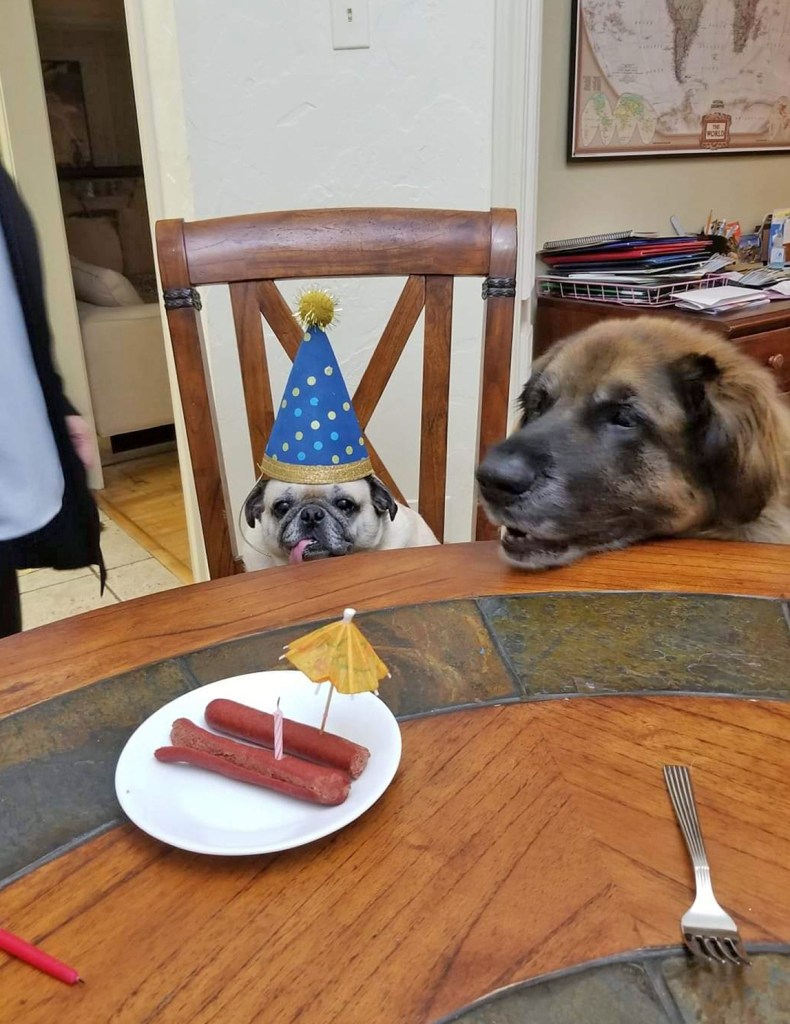
Yesterday was Daisy’s 14th birthday. We did not get around to celebrating it until today. Without our Leonberger Bronco it might never have come to pass. That’s because he saved her life from an attacking unleashed German Shepherd a few years ago. Bronco got in between him and his little sister Daisy. In the process he got bit in the leg where he had just had surgery, but he saved her life, and here we are.
It is Daisy’s 14th birthday. Look at her princess crown.Daisy and Rollo (mini-Australian Shepherd). It is Daisy’s 14th birthday.Daisy and Rollo. It is Daisy’s 14th birthday.Daisy’s 10th birthday, four years ago. Bronco our Leonberger is celebrating with her. This was before we had Rollo.
Below is a snippet from the book that is about Daisy. I should add that at the time we did not have Rollo, but we had another small dog, Ryu, a Japanese Chin who loved both Bronco and Daisy.
All our children were allowed to choose a dog when they were growing up—but only when they were old enough to understand that it’s a big responsibility. Jacob picked Bronco, Rachel picked Ryu, and David, our middle child, picked Daisy, a pug. However, our dogs were never just birthday presents. We made sure everyone understood that getting a dog is a years-long commitment that cannot be reversed. We needed to make sure we could give each dog a good life before we would consider making this commitment.
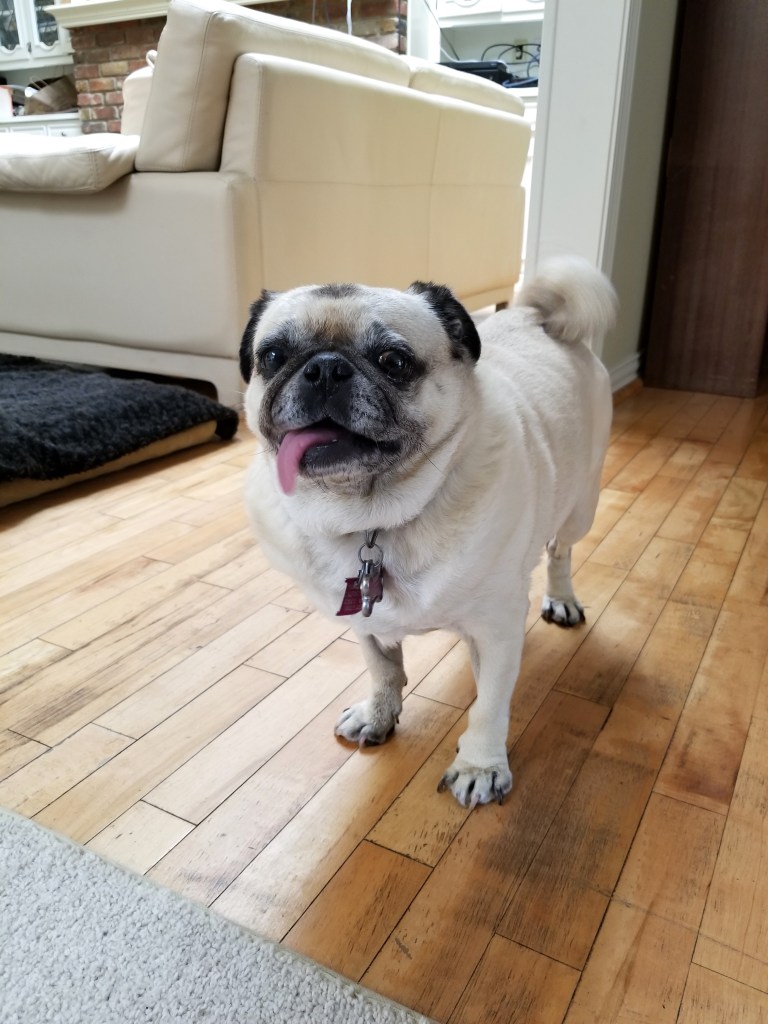
For Daisy, it’s tongue-out Tuesday every day.
Daisy arrived the year after we got Ryu. Like Ryu, she was purchased at Petland (not good, see book). Daisy is now thirteen years old and in good health at the time of this writing. She’s an easygoing, funny dog with an unusually long tongue, and everyone loves her, dogs as well as people. When it comes to being liked, she doesn’t have to try—she’s a natural. Ryu and Daisy would become best friends, but they also got along well with our other dogs. Daisy loved to follow Ryu around, and together they often trailed Bronco wherever he went. Pugs are not very energetic or fast, but they have easygoing and cheerful personalities. When the other dogs were being annoying, she liked to hide under chairs and tables to avoid getting involved.
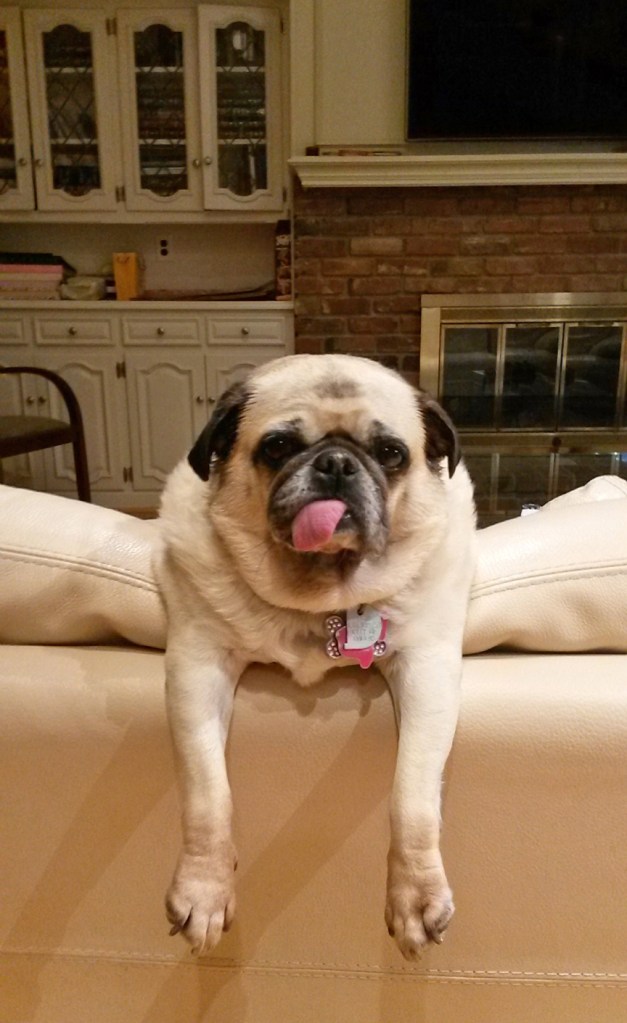
Daisy is a bit of couch potato—a very sweet couch potato. She sits on the sofa most of the day, watching TV or looking out the window. She barks at dogs on TV or passersby outside, but other than that she doesn’t move much. She likes to snuggle, sit in your lap, and sleep with her head resting on your leg or arm. What with our beds, the dog beds, the sofas, and our backyard, she sure has a lot of places to relax. The only thing missing is her glass of wine.
Daisy rests after an exhausting day on the bed and sofa, not quite finished doing nothing.
Ryu used to get jealous when other dogs gave Daisy attention, or so it seemed. For example, he would become hostile to any dog in the dog park who began playing with Daisy. What can I say? She’s Miss Congeniality.
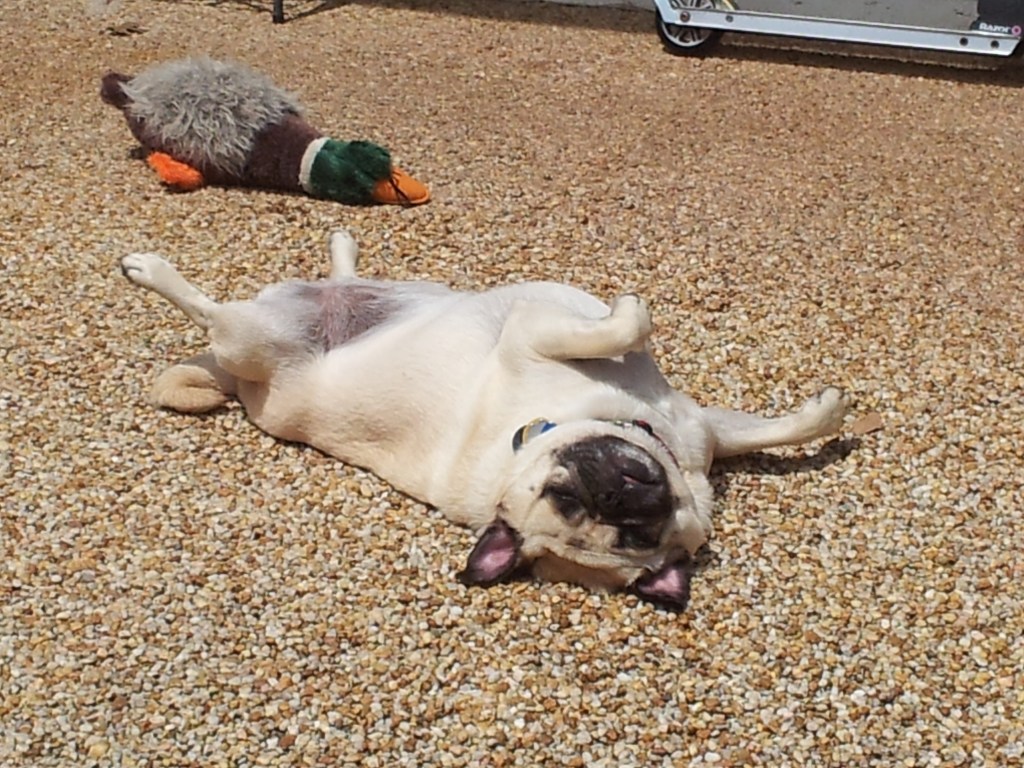
Daisy is the only dog I’ve met who really enjoys sunbathing. Our backyard isn’t exactly Playa Grande, but she frequently goes outside and lies down on her back. While our other dogs easily get too hot outside, she just soaks up the sun.
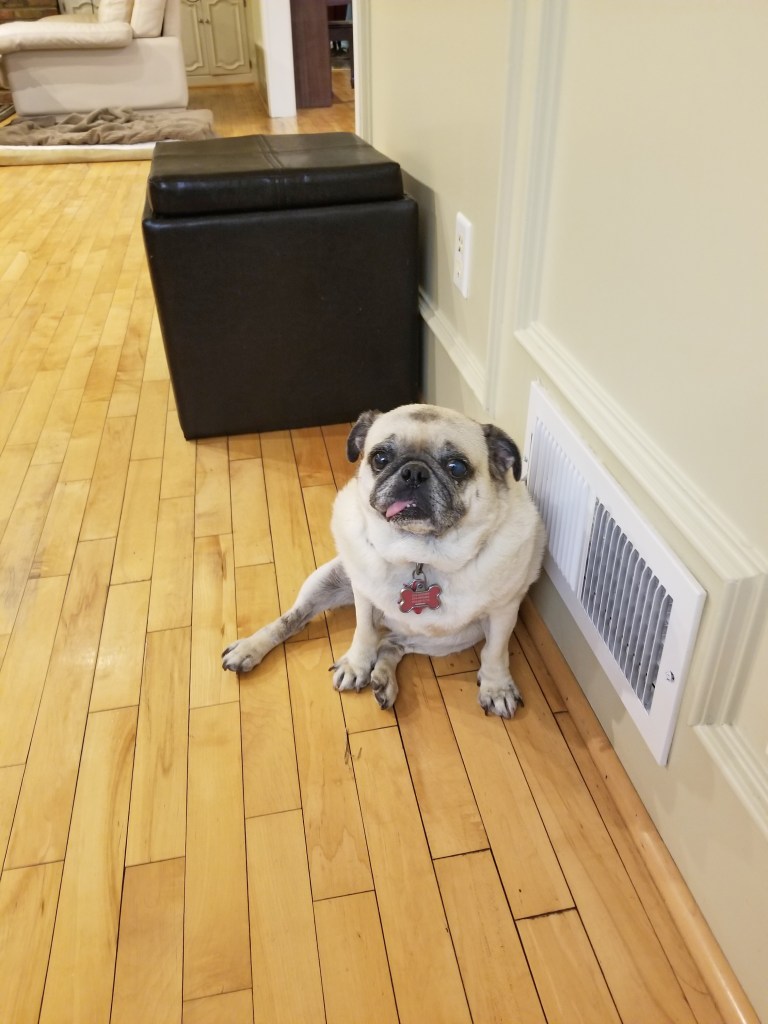
When it’s hot outside, Daisy loves to sunbathe.When it’s cold, she sits in front of the heating vents.
Other than following Ryu out on an adventure a couple of times and running out to say hello to Lily, a pug mix who used to live across the street, Daisy will not wander off. On the few occasions she did, we just called her back. She likes being home; she likes the couch and the safety of our house. And while our other dogs sometimes ignored our commands, Daisy never does. Another thing that’s different about her is that she doesn’t like cheese.
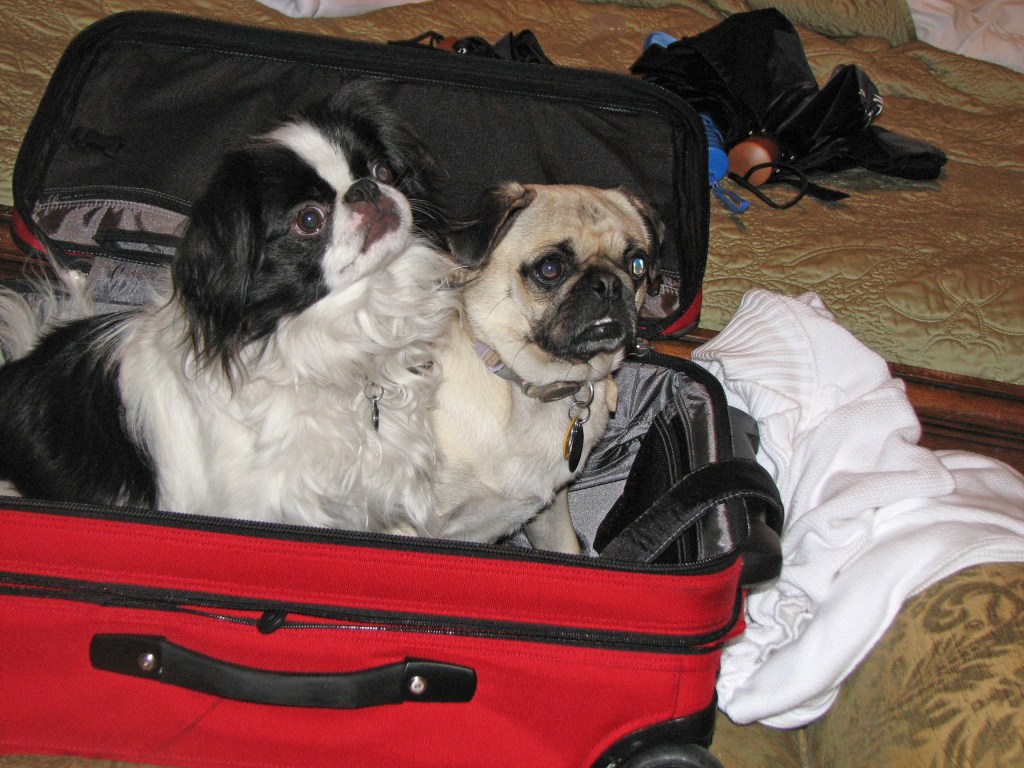
Ryu, too, loved the security of the house. In fact every time we made preparations to travel, he and Daisy seemed to sense it. As soon as we so much as took out our suitcases, they knew what was going on. You could see it in their faces and in the way they behaved. They were a bit sad.
One time, as we were packing our bags, we turned around and saw the scene I captured in the photo on below. How would you interpret this? Was it a protest? Did they want to come with us? Maybe both.
Ryu and Daisy didn’t want us to leave for our trip.
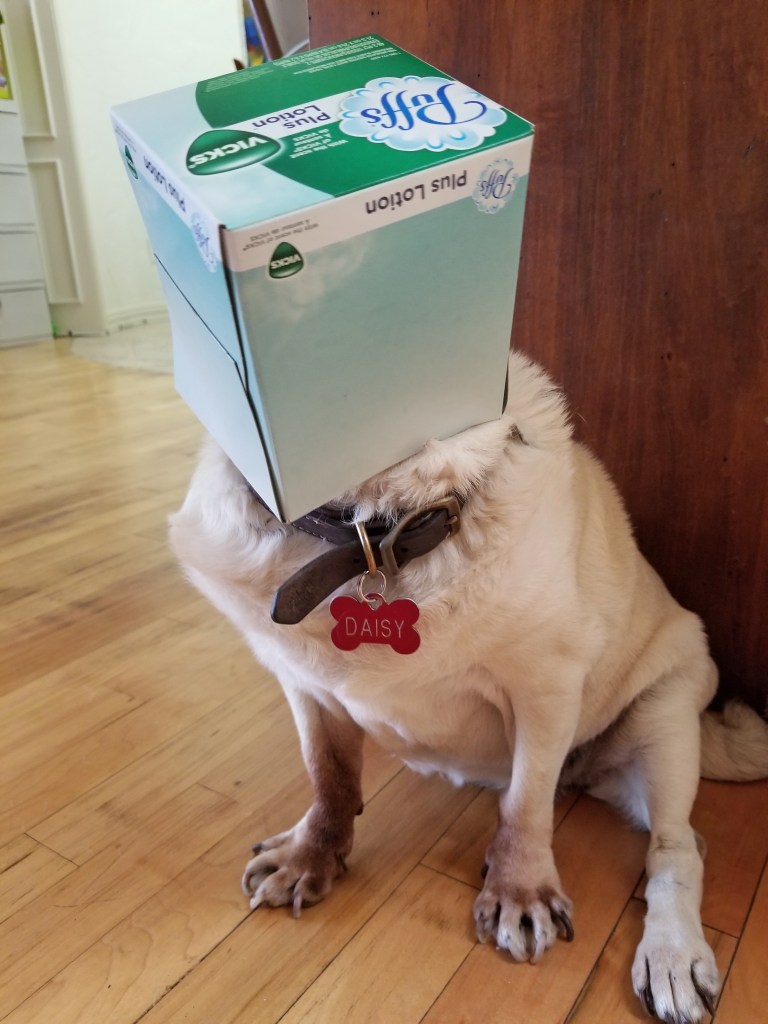
In what may have been a sign of anxiety during our absence, we once came home from a brief family outing and Daisy greeted us at the front door with a tissue box over her head. While we had been gone, she had somehow gotten her head stuck in it and couldn’t get it off. She was still running around barking. We laughed because it was such a funny sight, but she probably didn’t enjoy the experience. We removed it quickly.
Does dog humor exist? Well, this article featuring Leonbergers claim that it likely does. Dogs think it is funny to be a bit mischievous and they special sounds while doing it. You can call it dog laughter. Well, if that is the case, then our Leonberger Bronco laughed on several occasions, for example the time he escaped the leash and had me chasing him around the neighborhood (see story below).
Regarding dog laughter, I am also wondering about Rollo, our mini-Australian Shepherd. He loves lying on his back and getting a belly rub. While you are doing it, he is kicking all four of his legs while turning his head back and forth with his mouth open. It looks like he is laughing, like a giggling baby getting tickled.
A couple of times, Bronco took advantage of the fact that the snap hook on his leash would come loose and detach from his collar. One day this became a big problem. Bronco ran off, and I chased him—across the street, across people’s lawns, across the street again, and back over neighboring lawns. When he ran in circles, I ran in circles right behind him, yelling at him. He would stop and wait for me, and then as soon as I got close, he would start running again. I even jumped to catch him a few times. But he dashed off both times, and I just landed flat on my belly.
Bronco had a lot of fun doing this. I imagined him laughing at me, and I got angry. Dogs can’t laugh, of course, but his tail was wagging in excitement, and it was obviously a game to him—a dangerous game.
Bronco as a teenager young and gangly.
So, I asked him, “Do you want to be lost? Bad things happen to dogs who get lost.” I don’t know how much of that he understood, but I had to tell him the truth. Then I turned around and started walking home. I figured I’d never catch him, so it was better for me to go back and get help. (It was 2008, and I didn’t have a cell phone.) Naturally, I worried that Bronco would get hit by a car. I was also worried about the damage an energetic 130-pound adolescent dog could do to the neighborhood.
As I stomped off, I turned around to look at Bronco. He stood still, around a hundred yards away, staring back at me. He seemed confused. I continued walking. After a while, I heard the soft slapping of big paws on the road behind me, accompanied by some distinctly noisy breathing. Then I saw Bronco walking next to me, so I carefully snapped the leash back onto his collar. He let me do it without protest. He was finished playing games. We walked home calmly, and the next day I bought a new and better leash.
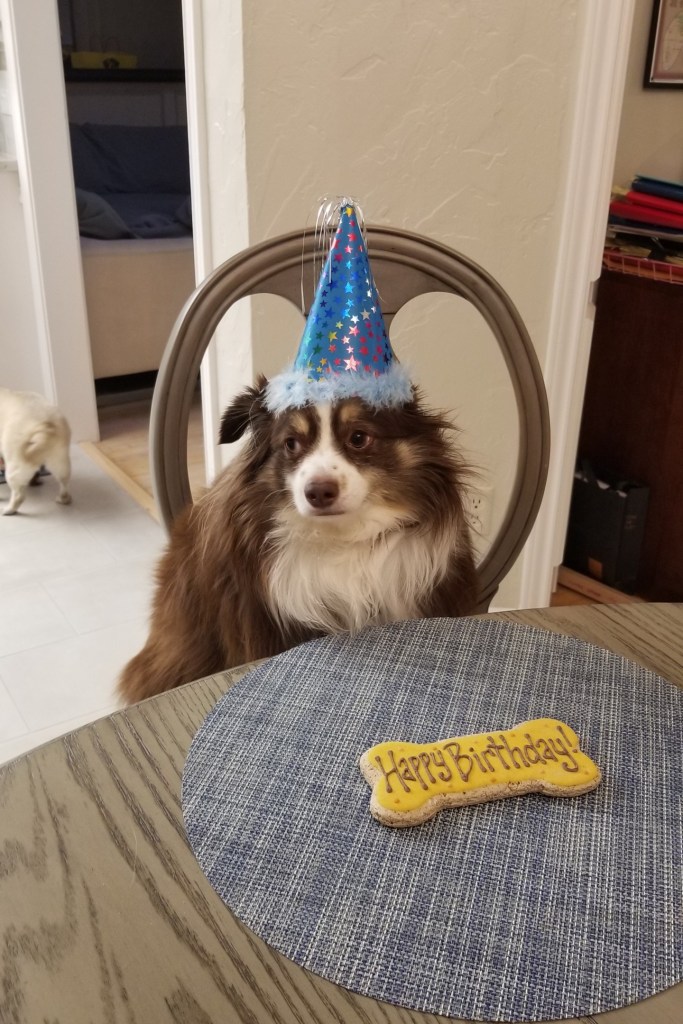
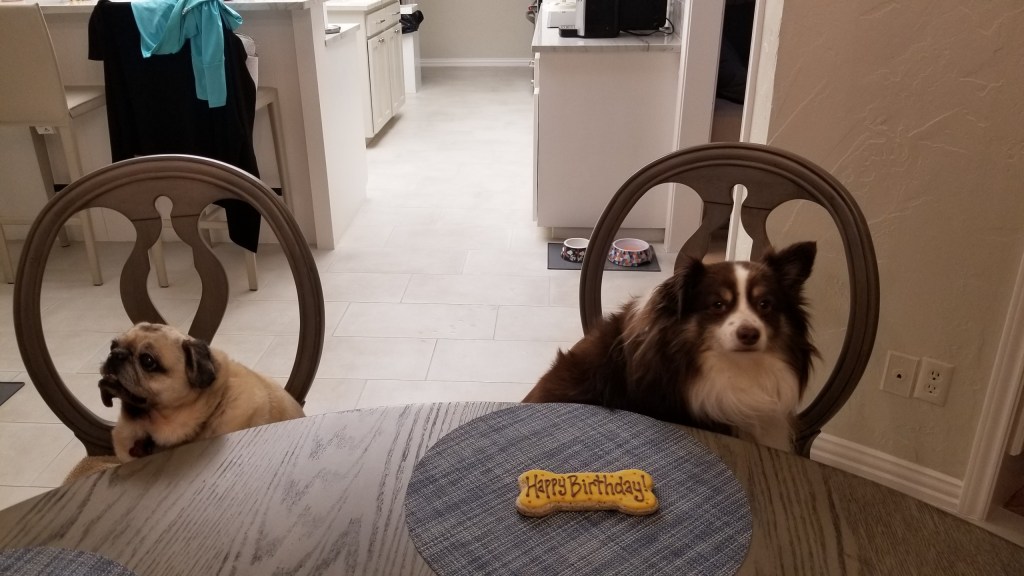
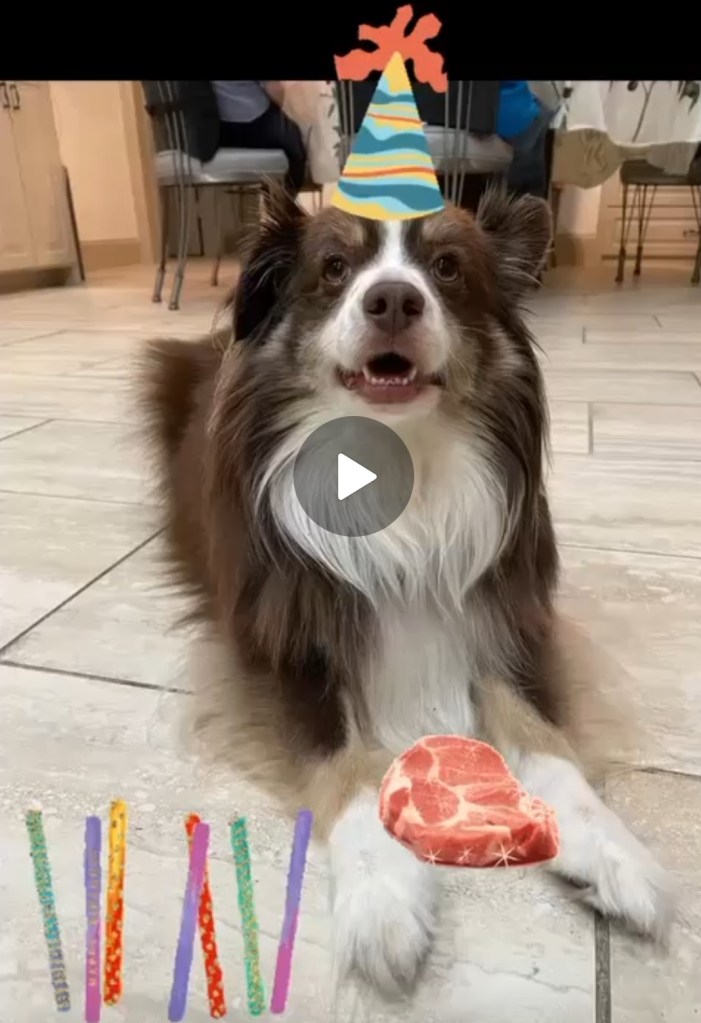
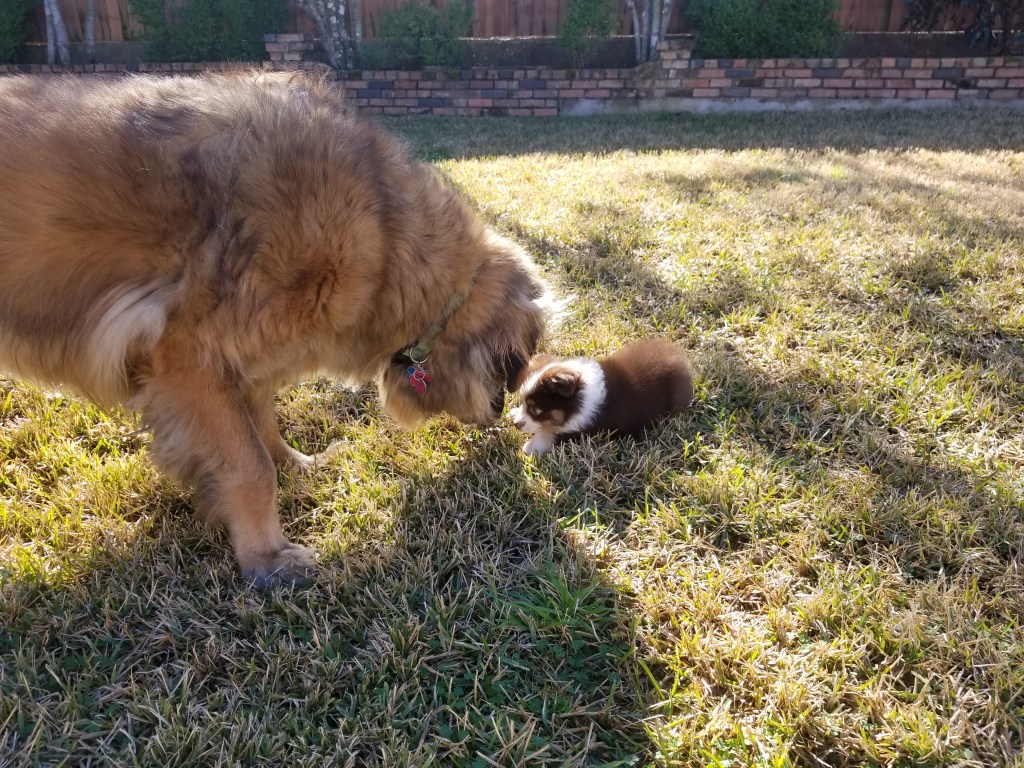
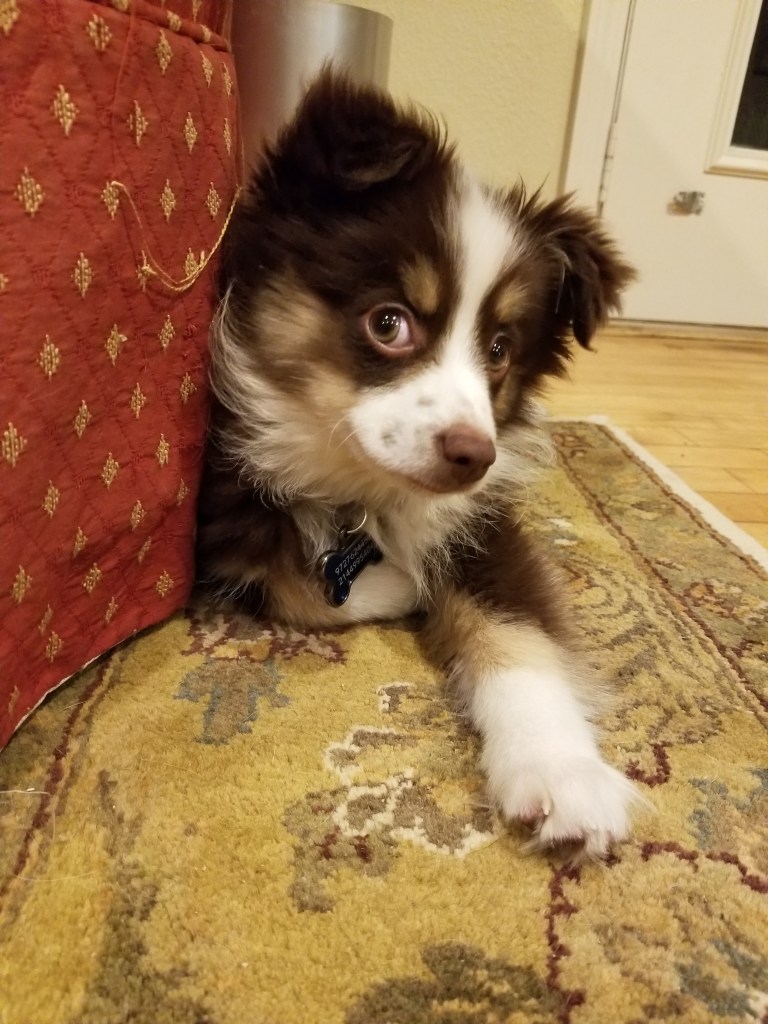
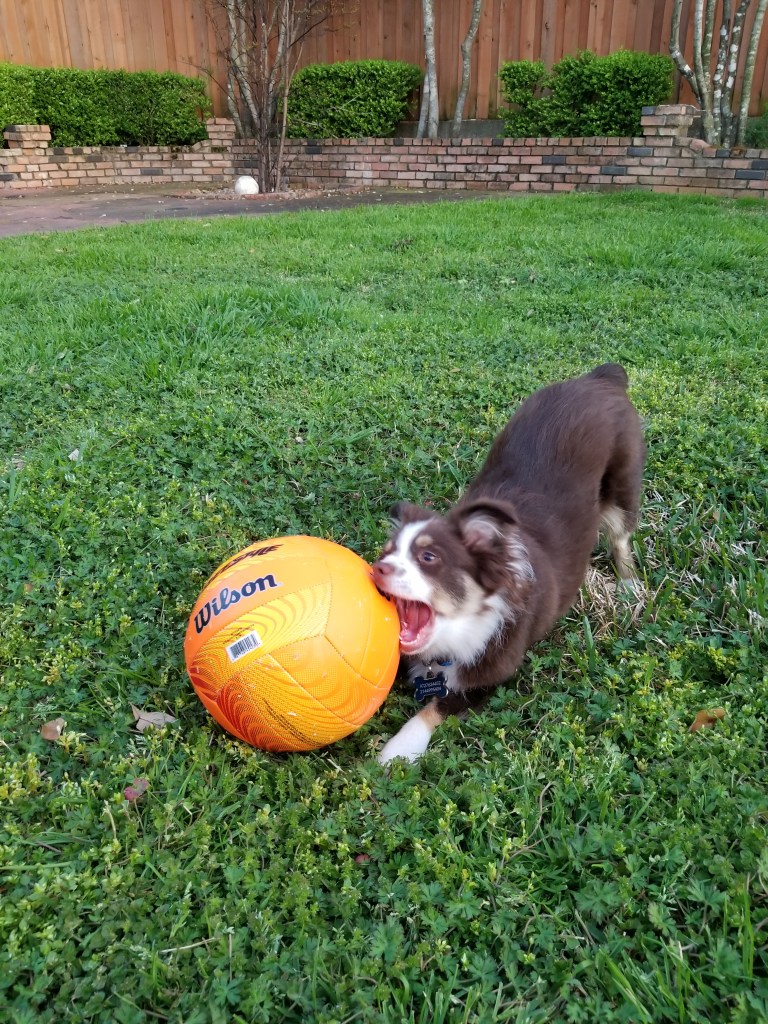
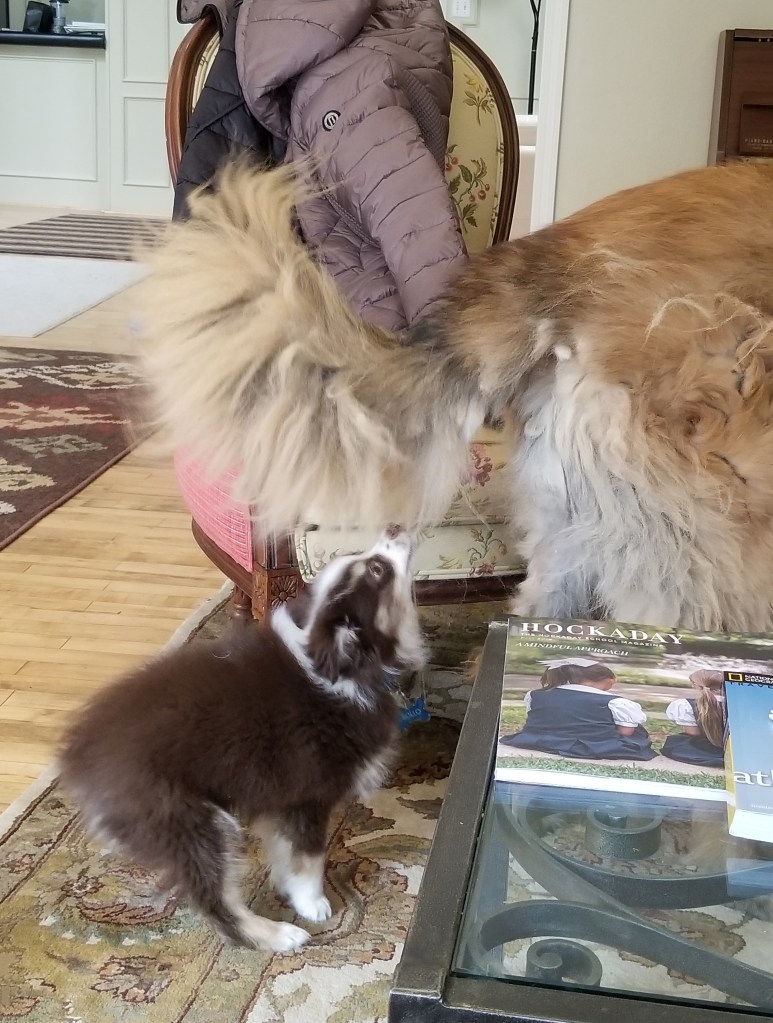
Today it is Rollo’s 4th birthday. Our late Leonberger Bronco welcomed him into our family when Rollo was just a 9-week-old puppy. Rollo is a mini-Australian Shepherd. They became very good friends and Bronco was very patient with the rambunctious puppy who climbed all over him and played with his tail, even hung in it. Well, we no longer have Bronco, but we have Rollo and his 14-year-old pug sister.
Rollo did not like the hat, so he took it off right away.Rollo and Daisy. It is Rollo’s 4th birthday.Rollo’s 4th birthday.Bronco our Leonberger welcoming Rollo to our house.When Rollo was just a puppy.Another photo from when Rollo was just a puppy.Rollo playing with a ball.
Next, I am including a little snippet from the book. This snippet is about Rollo.
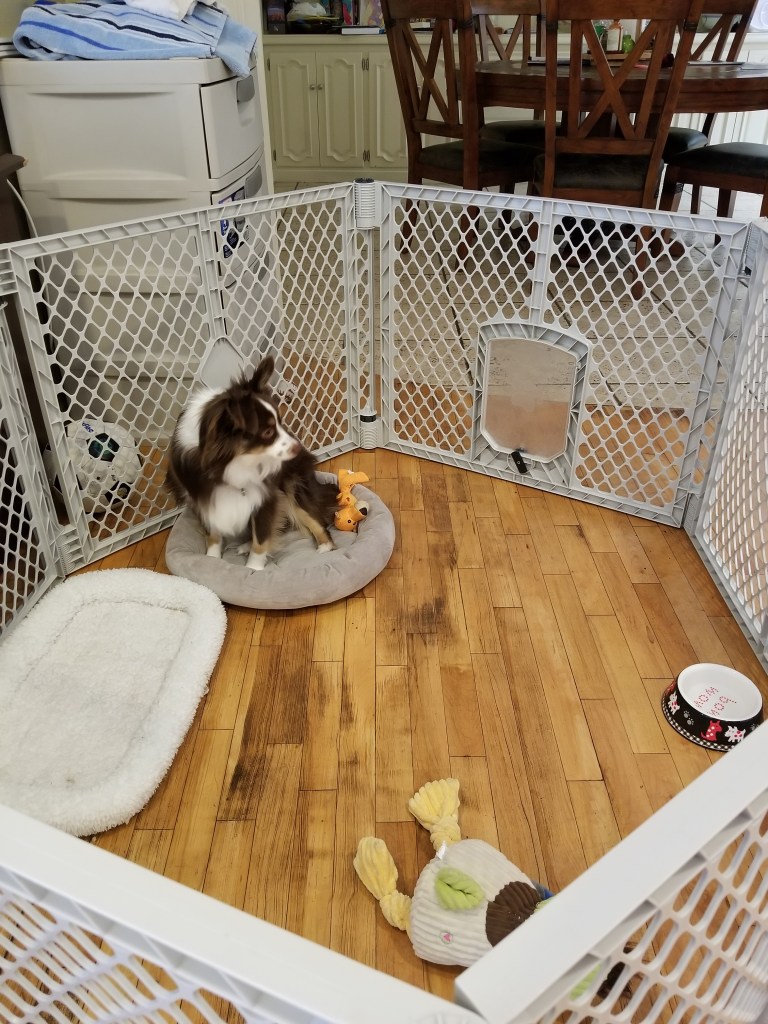
Rollo often pushed his luck with Bronco—climbing all over him, sitting on him, and stealing his possessions. Bronco was very patient and protective of little Rollo, but we were afraid he would lose patience with him one day when we were not present. Therefore, we put Rollo in a playpen whenever we left the house.
Rollo often played with our Leonberger Bronco’s tail. When he was a puppy he even hung and swung in it. Naturally, we stopped it as soon as we saw it.
The playpen had a door that swung open and could be locked. Soon he learned to go through the door on his own when we asked him to. We would say, “Rollo, playpen,” and he would march right in. We made sure that the playpen contained water and toys and that the door was locked behind him. Of course, we didn’t leave him there too long. Experts recommend a maximum of two hours when the puppy is two months old and a maximum of three hours when the puppy is three months old. Even when Rollo was older than that, we never left him in the playpen longer than four hours.
Rollo’s relationship with his playpen was interesting. When Daisy tried to walk in, Rollo would get angry. The playpen was Rollo’s, and no one else could enter. It was his little house within a house. Sometimes he would walk in even if we didn’t ask him to, and he would just sit there for a while, as if he needed some alone time.
This is the baby jail. When Rollo was in his playpen, we were sure he would be safe in case Bronco decided he had had enough of his younger sibling’s antics. To read more about Rollo click on the photo.
Our son David’s girlfriend, Meranda, came up with a great name for Rollo’s playpen: baby jail. So that’s what we called it, and Rollo seemed to like it. When we told Rollo, “Rollo, baby jail,” he would march right in, just as he did when we called it a playpen. Even though he didn’t seem to mind it, he was always eager to come back out when we got home. He would stand on his hind legs, jump up and down, and bark. Then we would rush to greet him and lift him out of his baby jail.
This blog is primarily about Leonbergers and Leonberger books but sometimes I review other items. In this post I will review a short film that brings attention to the fight against cancer. The name of the movie is “A Simple Ad”. The screen writing was done by an on-line friend of mine Alex Diaz-Granados.
My mother passed away from cancer at the age of 56. This was devastating. She left us too early. However, every parent’s worst nightmare is losing a child. I believe that losing a child to cancer is a loss too enormous to imagine. This short film brings attention to the pain and the enormity of this loss, and it brings attention to the need to fight cancer.
I can add that fighting cancer the easy way, via the kind of donations that we all can make, or by bringing attention to it, is not futile. In the end this supports cancer research and treatment, and it has been successful. For example, today, it is very unlikely that I would die from the cancer that killed my mother.
At the beginning of the movie, we see a bookcase with family pictures including a baby, a little boy, a wedding, among others. Next, we see a couple working in the same room. The man is working on a skateboard and the woman on an ad. From their discussion the tragedy becomes apparent. The couple love each other, they carry on, but it is clear that an immense sense of loss resides in their lives.
This short film features beautiful music, a children’s choir. It is poignant and has a sad atmosphere, but it is not overly dark. To me it felt like a call to action. You can watch the movie here.












 Leonberger Life