This blog feature amusing and heartwarming stories about our late Leonberger dog Bronco, as well as other Leonbergers. It also has a lot of information about the Leonberger breed, the history, care, training, Leonberger organizations, etc. I also wrote a Leonberger book, which I am featuring in the sidebar.
Tag: The Life and Times of Le Bronco von der Löwenhöhle
This photo was provided by Jen O’Keefe, Urgent Animal Care of Arlington. From left to right; Obi, Delfi, Aslan, Gryphon, Digory.
Happy Independence Day
.
.
.
.
As a reminder the price of my book “The Life and Times of Le Bronco von der Löwenhöhle” has been temporarily lowered to $2.99. Click here to visit the Kindle version of my book on Amazon.
On July 3rd 2007 our Leonberger Bronco was born. That was 16 years ago today. He died three years ago. On July 3rd 2022, soon one year ago, I launched my book The Life and Times of Le Bronco von der Löwenhöhle; Stories and Tips from Thirteen Years with a Leonberger.
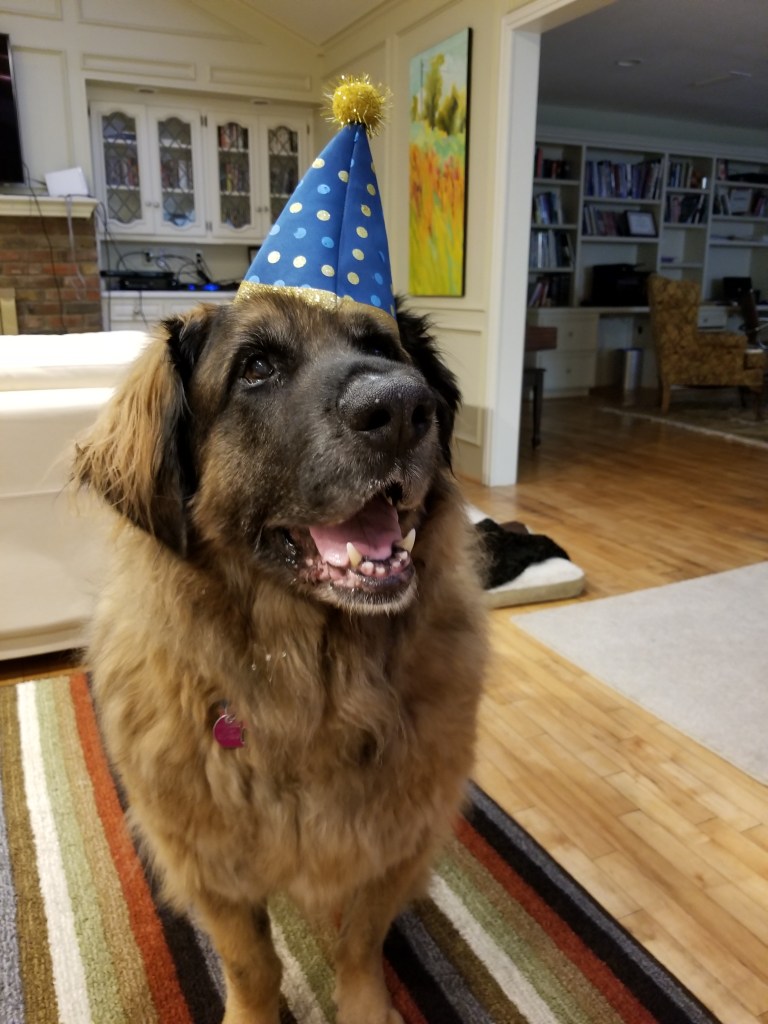
This photo was taken on Bronco’s 12th birthday on July 3rd 2019.
To celebrate Bronco’s birthday as well as the one-year anniversary of the publication of my book I am lowering the price of the Kindle version from $4.99 to $2.99.
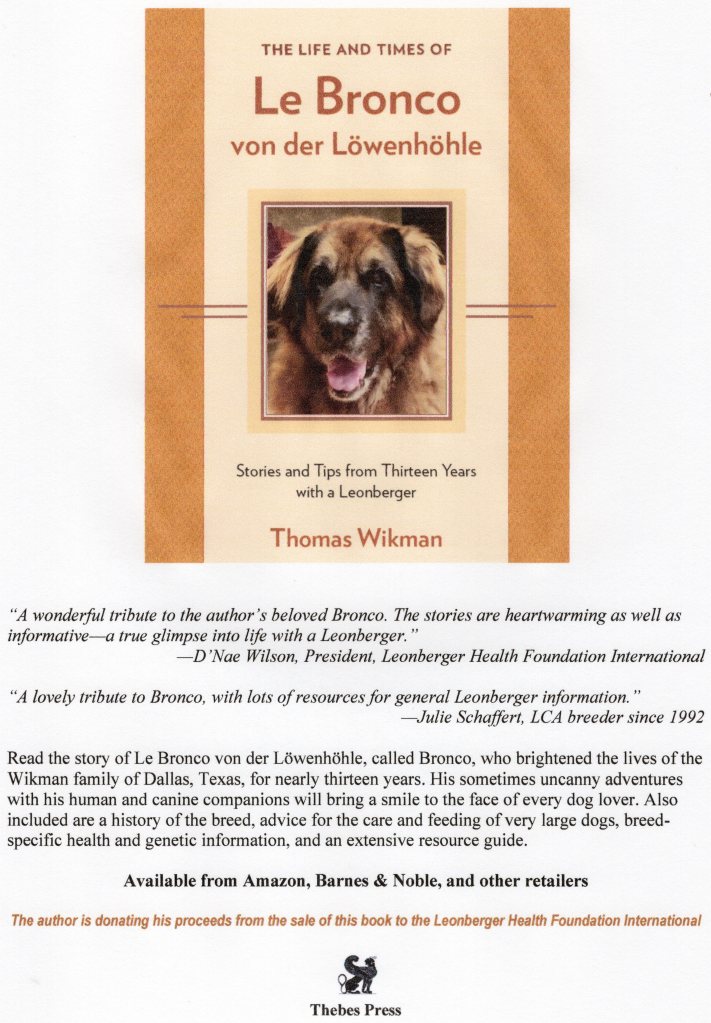
This is a special Ad for The Life and Times of Le Bronco von der Löwenhöhle (from the LeoLetter, the official publication of the Leonberger Club of America). Click on the image to go to the Kindle version on Amazon.com.
On July 3rd 2007 our Leonberger Bronco was born. On July 3rd 2022, soon one year ago, I launched my book The Life and Times of Le Bronco von der Löwenhöhle; Stories and Tips from Thirteen Years with a Leonberger. I can’t believe it’s been a year already.
To celebrate the one-year anniversary of the publication of my book I am lowering the price of the Kindle version from $4.99 to $2.99.
The Amazon page says the publish date is July 2nd for the paperback version and July 1st for the Kindle. What happened was that they told me it would take 2-3 days for it to show up after I pressed the yellow publish button. The evening of July 1st 2022 I pressed the yellow publish button on Amazon and it happened quicker than I expected. But the actual launch, i.e., telling friends, the Leonberger groups I was part of, and announcing the book on social media and on this blog that was July 3rd.
I also published the book with Ingramspark, which distribute to Barnes and Nobles, Canadian stores, and in many other places. Due to technical problems, I am having a hard time changing the price on Ingramspark. I will make another announcement about Ingramspark once I solved the technical problems.
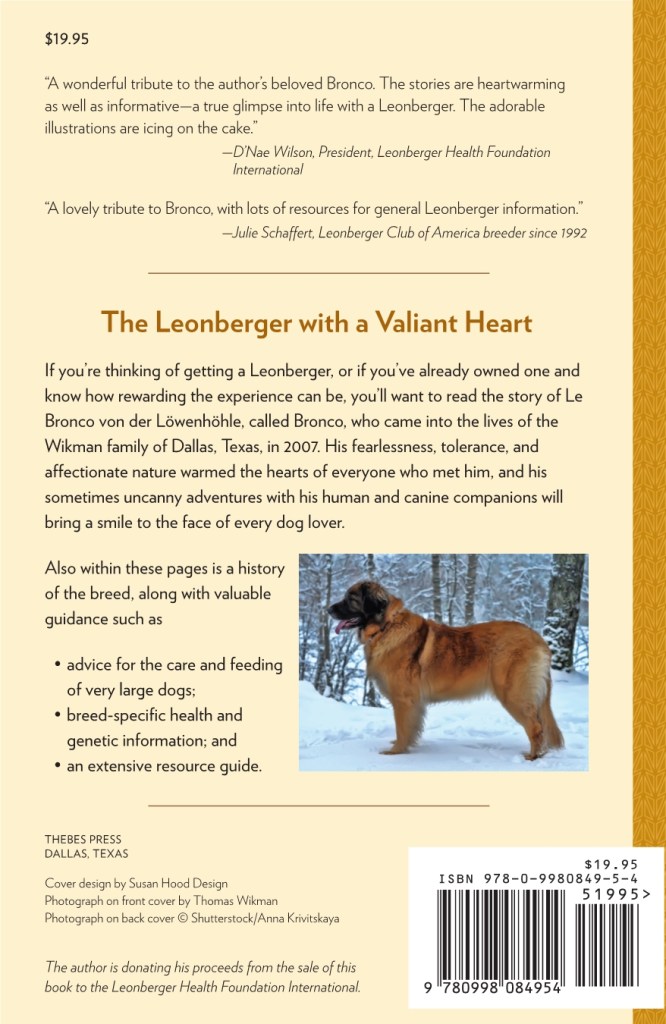
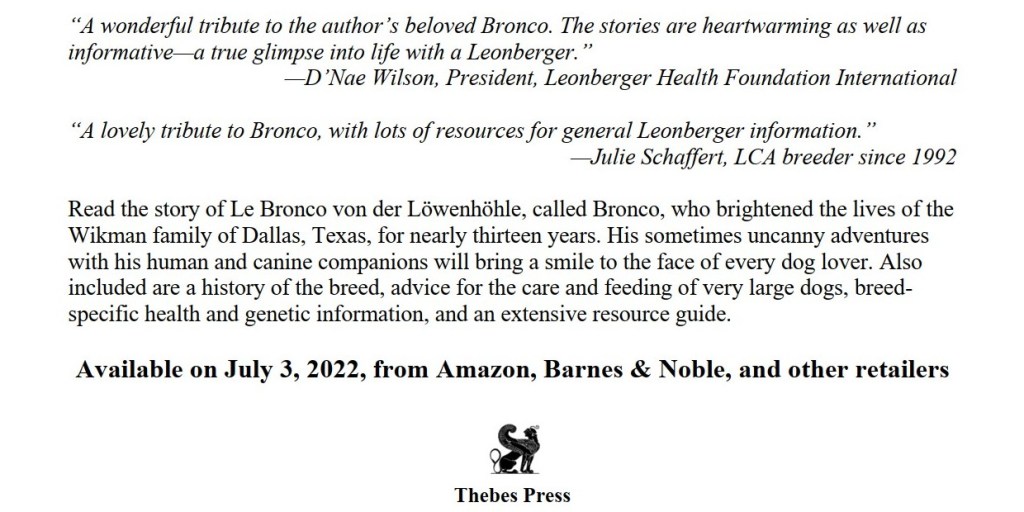
The front cover of my book “The Life and Times of Le Bronco von der Löwenhöhle”. Click on the image to go to the Kindle version on Amazon.com.The back cover of my book “The Life and Times of Le Bronco von der Löwenhöhle”. Click on the image to go to the paperback version on Amazon.com.These are the endorsements for the book. Click on the image to go to the Barnes and Noble location for the book.
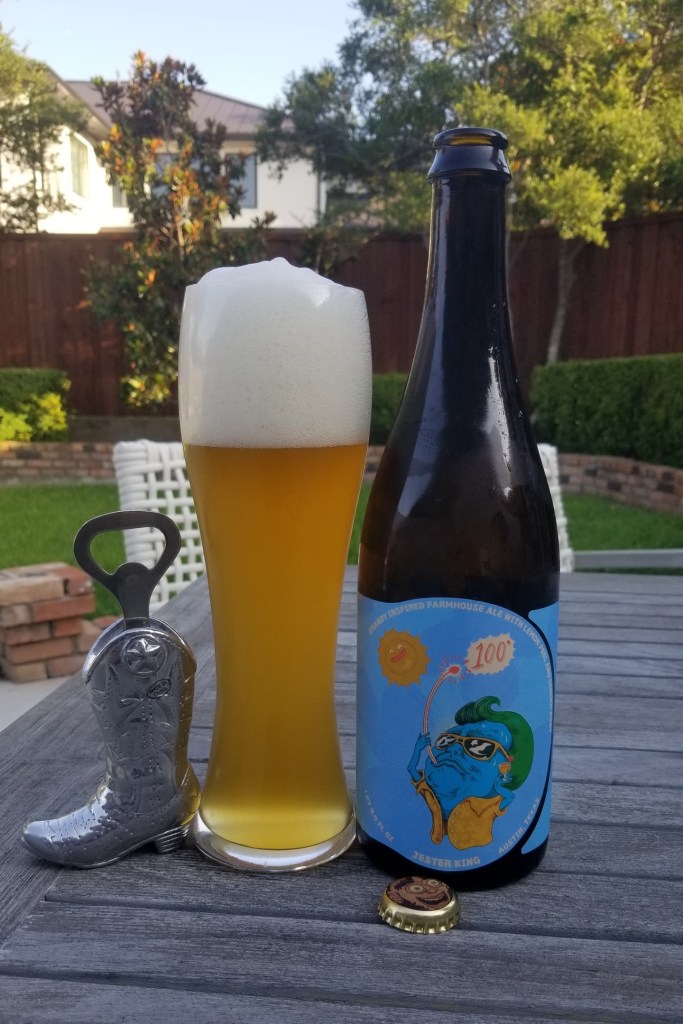
Today it was 104 degrees here in Dallas, Texas, which is 40 Celsius and tomorrow it will be hotter still according to Accuweather. While sitting in my backyard I drank 100 degrees to cool me off. In addition to being less than 104 degrees, 100 degrees is a Farmhouse Ale / Saison from Jester King, Texas, ABV 4.7%. It has the flavor of wheat crackers, lemon, lemon peel and ginger and it is very thirst quenching.
100 degrees is a Saison (type of beer) from Texas. It is good for hot weather.
What about Leonbergers and the hot Texas summer? Unfortunately, the Texas summer is not ideal for large fluffy dogs like Leonbergers, and yet people have them and breed them here in Texas. There is even a Leonberger club for the southwest (Texas, New Mexico, Oklahoma, Arkansas, Louisiana, Colorado), called Frontier Leonberger Club of the Southwest.
Embedded photo from – Frontier Leonberger Club of the Southwest
Hot Advice
In the hot summer, it is important to keep your Leonberger cool and at the same time keep up with the exercise. You can take your walks early in the morning or late at night if it has cooled down enough. You should bring a backpack with cold water and a water bowl, and perhaps ice cubes and ice packs. Unless you are almost back home don’t pour water on his fur to cool him off. This can be counterproductive since wet thick fur will clump and form a layer that will keep the much-needed airflow in. You can put water on his paws, face and belly where the fur is thin and make sure he drinks.
Our Leonberger Bronco resting while out walking.
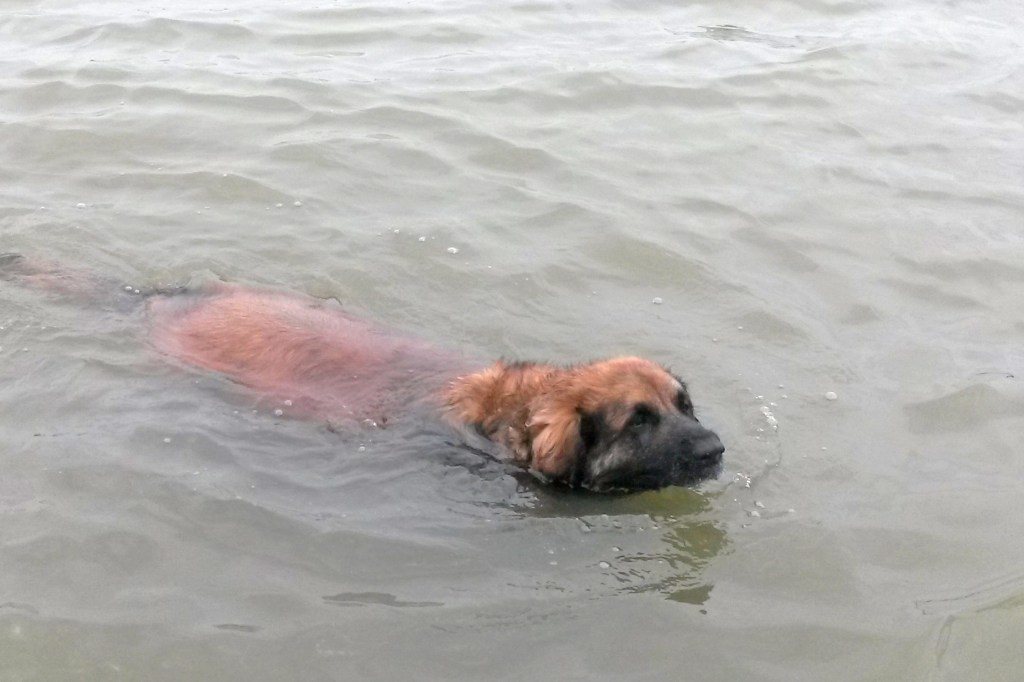
An alternative to walking is to go for a swim. Leonbergers love swimming and they are good at it. We frequently took our Leonberger Bronco to White Rock Lake outside Dallas where he chased ducks and egrets. He never caught any. Well, what can I say, he had no egrets. Just remember to bring a towel and to stand at a distance when he shakes himself dry.
Bronco swimming in White Rock Lake
While walking your Leonberger, or any dog, feel the surface temperature with the back of your hand. Asphalt, wood, sidewalks, beaches, and other surfaces can get very hot in the sun and burn the paws of dogs. Remember you have shoes on. Could you walk barefoot on the surface?
A heat stroke can happen very quickly. Dogs are much more susceptible to heatstroke than humans, and Leonbergers are more susceptible to heatstroke than most dogs because of their stocky bodies and thick coats.
Heatstroke can happen in as little as fifteen minutes. Don’t leave your Leonberger in a car. Avoid strenuous activity on hot days and exercise your Leonberger early in the morning or late in the evening. Keep your Leonberger in an air-conditioned dwelling as much as possible and provide plenty of water, shade, and maybe a kiddie pool when he’s outside.
Young Bronco in a Kiddie Pool
If there are signs that your Leonberger is getting overheated, you need to cool him off as soon as possible. Ideally, immerse him in cool water and hold his head above the surface to prevent drowning. Alternatively, move him into an air-conditioned building and put cool wet towels or ice packs on his stomach, neck, inner legs, and armpits.
Have seen or heard some people say, “If you want to be green turn off your air-conditioning”. DON’T. This will harm your dogs and is not the way you should reduce greenhouse gases. This type of advice often comes in the form of an admonition, and it does not come from climate scientists or even climate activists but from people with no interest in reducing greenhouse gas emissions. They want to make it seem more difficult than it is to reduce emissions and even shame you or harm you for caring. The responsibility to reduce greenhouse gas emissions lies primarily with industry, government, and those in charge of modernizing our power grid and transportation system. We consumers can certainly help, but the way to do it should be tailored to our circumstances and extreme action is often counterproductive.
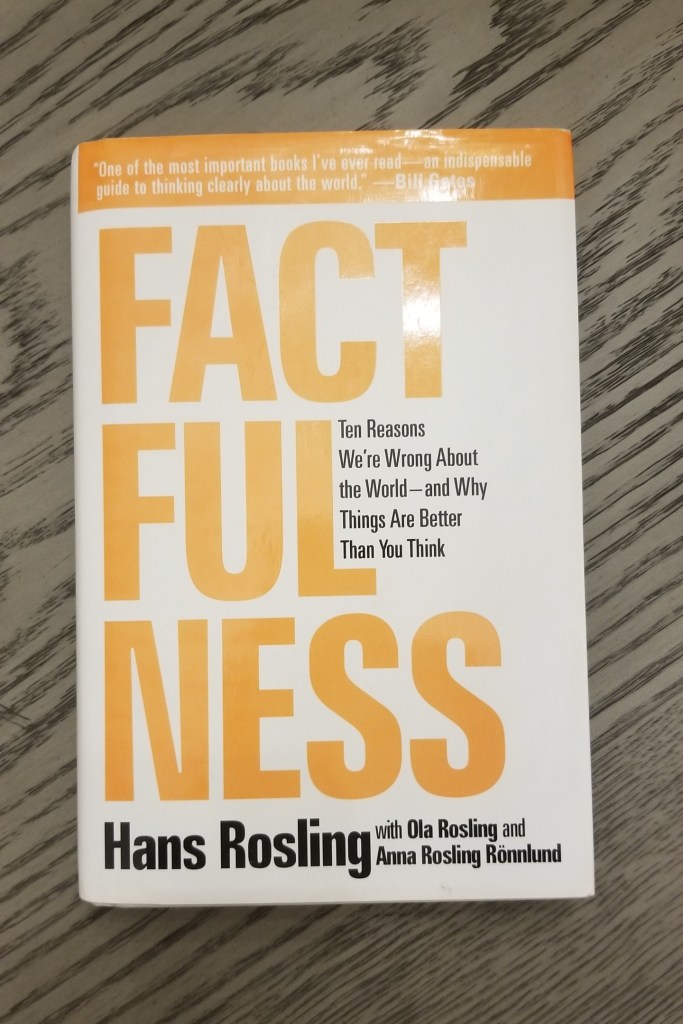
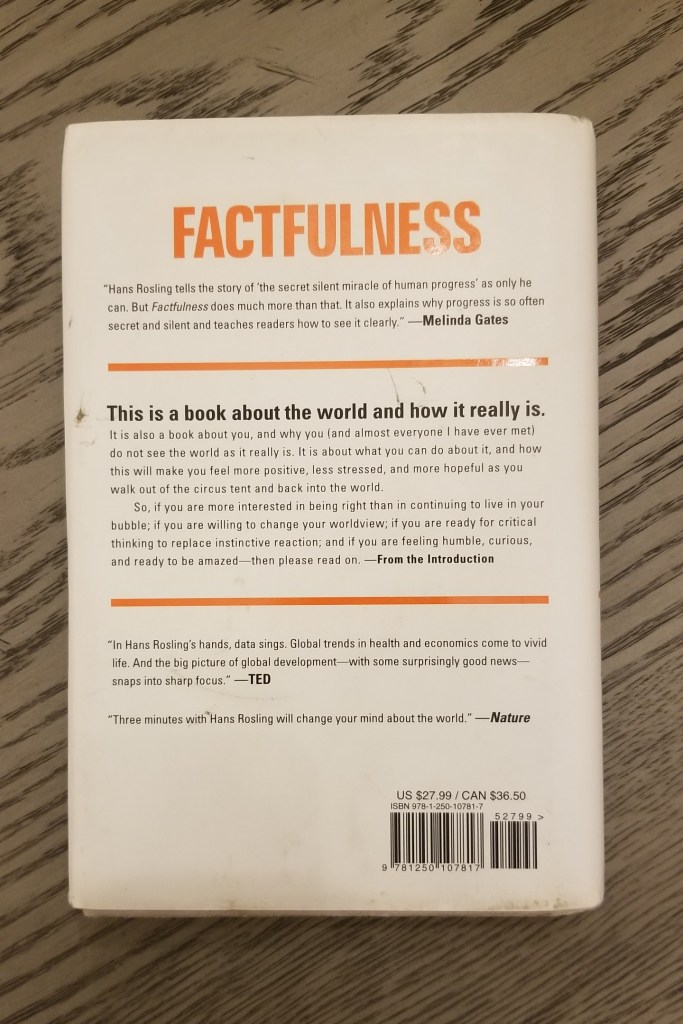
The focus of my blog is Leonbergers, especially our late Leonberger Bronco, but sometimes I present a good book which I want to promote. Today I would like to present and review Factfulness: Ten Reasons We’re Wrong About the World–and Why Things Are Better Than You Think Paperback – April 7, 2020 by Hans Rosling, Anna Rosling Rönnlund, and Ola Rosling, ISBN: 978-1250123824, 352 pages, item weight 14.4 ounces, dimensions 5.3 x 1 x 8.2 inches.
Are you wrong about your world? Photo by Pixabay on Pexels.com
Misconceptions Are Everywhere
Yesterday as we were on our way back from our son’s wedding, I accidentally overheard a conversation among fellow Texans that went something like this “…the wind turbines effect how the wind blows and therefore they have a very bad effect on the environment”. I turned around to see if it was a shrunken head speaking, but the speaker looked like a normal human being. It was a man my age. His friend then stated, “also the wind turbines kill a lot of birds.” That’s also a misconception but perhaps not one as silly. Wind turbines do kill birds, and it is a real problem, but the birds killed by wind turbines correspond to a very tiny fraction compared to the number of birds killed by fossil fuels, cats and even windows. Then I remembered that I once harbored some pretty silly misconceptions myself, so maybe I shouldn’t be so judgmental. We all have misconceptions, but naturally we don’t know what they are. Misconceptions is what other people have.
It won’t give you cancer or cause extreme wind patterns. Photo by Pixabay on Pexels.com
The world is full of misconceptions and not just about wind turbines, but nuclear power, all energy sources, animals, dogs, leonbergers, history, science, cosmology, space, evolution, particle physics, trees, Sweden, and all other countries, the state of the world, how the economy works, governments, vaccines, microbes, time, space, mathematics, quantum physics, plastic pollution, climate change, chaos, crime, etc. I have a bit of an interest in the topic, and I’ve made a list of more than 100 very important basic facts that we know to be true with certainty, or with a very high degree of certainty, and yet a large segment of people who are not experts in the relevant fields denies those facts or grossly misunderstand them. Having a belief that is contrary to the relevant expertise and/or widely accepted data is a red flag, yet so common. In addition, biases, a weak understanding of science, arrogance, and strong religious and political beliefs make it difficult to correct misconceptions. We are drowning in misconceptions, they are everywhere.
Misconceptions are everywhere. Photo by Andrea Piacquadio on Pexels.com
Overview of Factfulness by Hans Rosling
Factfulness by Hans Rosling, focuses on misconceptions about global trends and the state of the world. It therefore has narrower scope than my general concern about misconceptions, but it adds a lot to my special hobby. It focuses on the good news, of which there is plenty. It is clear that things like our health, wealth, peace and human rights have made a lot of improvements over the last 100 years. But somehow our biases tend to make us think that things are getting worse.
The world is getting wealthier and extreme poverty is vanishing. Photo by Karolina Grabowska on Pexels.com
The world is getting wealthier and extreme poverty is vanishing. The poorest countries in the world today are better off than the richest countries in 1900.
Children dying before the age of 5 has gone from 44% in 1800 to 4% in 2016.
The pollution of ozone depleting substances has gone from 1,663 kiloton in 1970 to 22 kiloton in 2016 (thank you Montreal protocol).
In the 20th century 300 million people died from smallpox. Today it is 0. (Thank you vaccines)
In the 20th century 300 million people died from smallpox. Today it is 0. (Thank you vaccines). Photo by Renato Danyi on Pexels.com
The share of undernourished people went from 28% in 1970 to 11% in 2015.
The average price of solar panels has gone from $66 in 1976 to $0.6 in 2016.
War casualties have gone down significantly and so have violence in general.
Deaths from natural disasters are down, not because there are fewer natural disasters, but because we are wealthier and better at preventing casualties.
HIV infections, child labor, traffic deaths, violence, hunger, child labor, are all down.
Cereal yield (thousands kg per hectare) went from 1.4 in 1961 to 4 in 2014.
Cereal yield (thousands kg per hectare) went from 1.4 in 1961 to 4 in 2014. Photo by Pixabay on Pexels.com
Child cancer survival went from 58% in 1975 to 80% in 2010.
Immunization of one-year olds has increased from 22% in 1980 to 88% in 2016.
Crime has gone down. In the US violent crime is much lower today than it was in the 1990’s.
Literacy, the ability to read has gone from 10% in the 1800’s to almost 90% today.
The number of scholarly articles published per year has increased exponentially.
The share of land surface that is protected has vastly increased worldwide.
The right of women to vote has gone from 0 to 193 countries.
The share of land surface that is protected has vastly increased worldwide. Photo by u00dcnsal Demirbau015f on Pexels.com
Hans Rosling, the author, was a Swedish physician, academic and public speaker, professor of international health, and he was the co-founder and chairman of the Gapminder Foundation, which developed the Trendalyzer software system. He passed away in 2017. To visit Gapminder and explore world statistics and facts click here.
Front cover of the book Factfulness by Hans Rosling
My Amazon Review
Understand the World Better
In the book’s introduction there’s a test you can take to see how well you understand the world. According to the author, most people do worse than monkeys randomly selecting answers. Even well-educated people do worse than monkeys. That’s because we have biases or instincts that distort our view of the world. I should say I did well on the test, not because I am a monkey, but because I had knowledge of most of the statistics in the book before I read it.
Rosling discusses ten instincts: the gap instinct, the negativity instinct, the straight-line instinct, the fear instinct, the size instinct, the generalization instinct, the destiny instinct, the single perspective instinct, the blame instinct, and the urgency instinct. Once we have been made aware of these instincts and how they mislead us we are much better equipped to understand the world. The gap instinct makes us divide the world into developed and developing countries whilst in reality nations are on a sliding scale from poor to rich and in general moving towards rich. Also differences within countries are typically more important. The negativity instinct, our tendency to notice the bad more than the good, causes us to ignore the silent miracle of human progress, etc.
Rosling said something that resonated with me “the world cannot be understood without numbers. And it cannot be understood with numbers alone”. The book contains a lot of interesting statistics that may seem counterintuitive to many people. Surveys show most people believe things have gotten worse for us humans. However, people are better off. In the chapter on the negativity instinct there are 36 graphs showing how things have gotten better (32 graphs on just four pages). Violence is decreasing, poverty is decreasing, infectious disease is decreasing, people are living longer. Here are a few things that a few of the graphs show:
* The average length of life in the world has gone from 31 years in 1800 to 72 years in 2017 * Children dying before their fifth birthday has gone from 44% in 1800 to 4% in 2016 * The rate of undernourished people in the world has gone from 28% in 1970 to 11% in 2015, despite the world population doubling * Cereal yield per acre in the world has gone from 1.4 ton per acre in 1961 to 4 ton in 2014 * Literacy has gone from 10% in 1800 to 86% in 2016
Despite all the good news in this book he says we should still worry. The five things that concern the author the most are the risk of global pandemic, financial collapse, world war, climate change and extreme poverty. He dedicates the next five sections to discussing those five concerns. However, another issue that he does not discuss is that as the human condition has gotten better that of animals has largely gotten worse. Not only are there fewer wild animals and less habitat for wild animals but with factory farming and other modern practices the quality of life for domesticated animals has gotten much worse. I know that may be outside of the scope of this book, but it was something that occurred to me.
One statement in the book that may seem confusing but certainly is interesting is this: “There has been progress in human rights, animal protection, women’s education, climate awareness, catastrophe relief, and many other areas where activists raise awareness by saying that things are getting worse. That progress is often largely thanks to these activists. Maybe they could achieve more though, if they didn’t have such a singular perspective.”
Overall, I loved this book because it is filled with clever analysis and interesting statistics. It is a book that will help you understand the world better. Unless you already know the facts and statistics presented in this book, this book will revolutionize how you view the world. It is also well written and well organized. I highly recommend this book.
Back cover of the book Factfulness by Hans Rosling
Three years ago today, our beloved Bronco passed away. We miss him very much. Below is a snippet from my book about his passing. Warning, it might be sad reading.
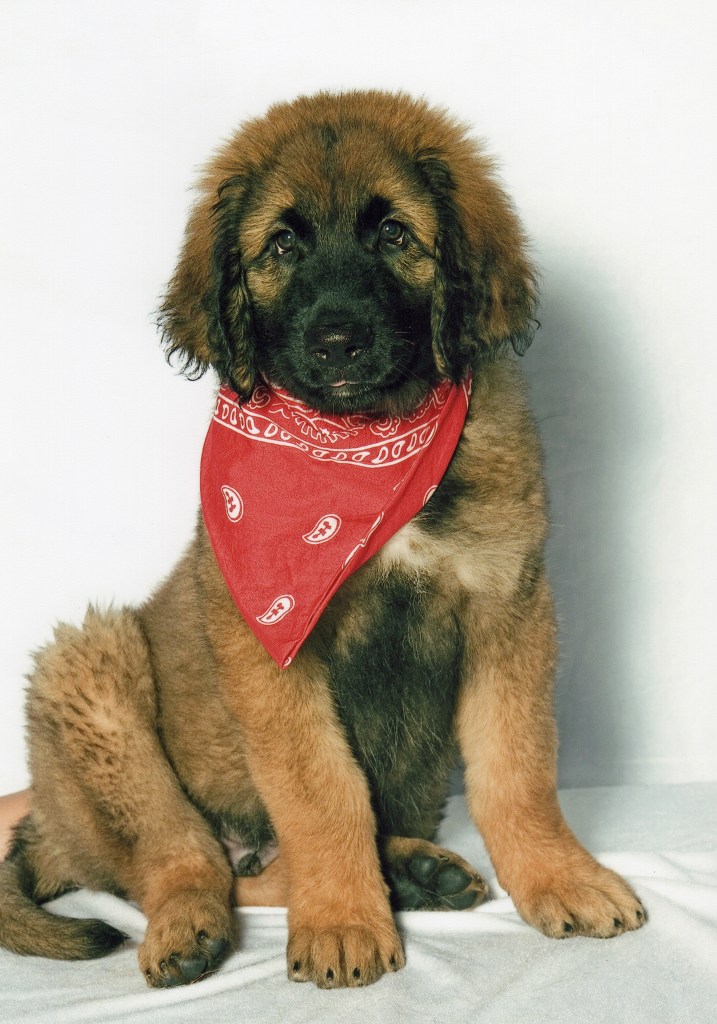
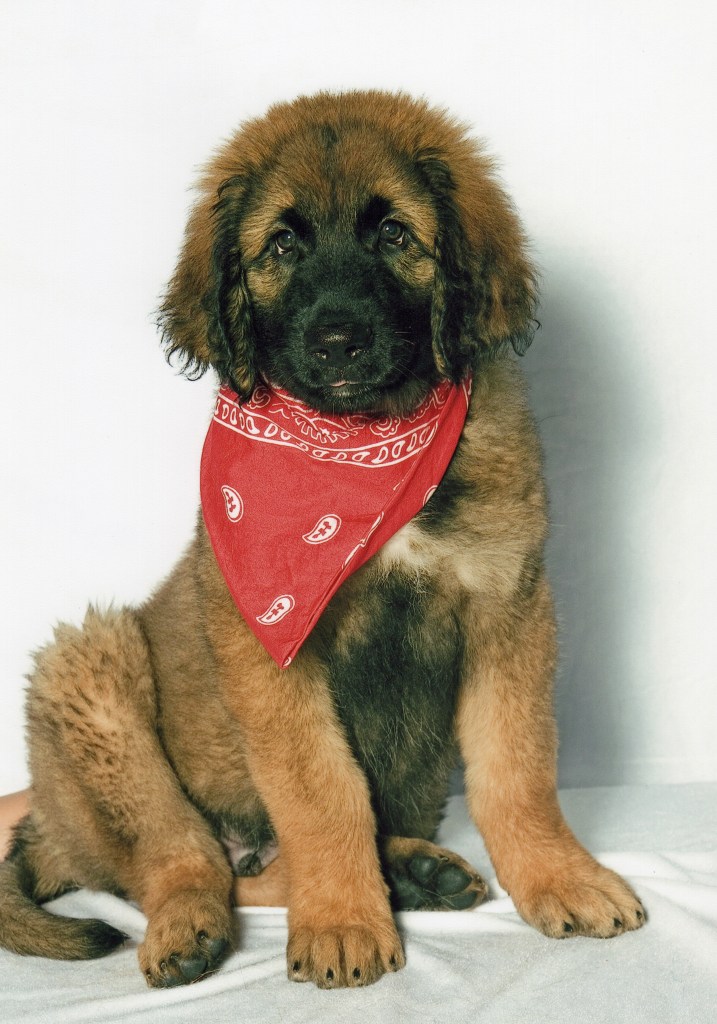
Our Leonberger Bronco three months old
Bronco (our Leonberger) was very old for a Leonberger, and his health had been badly failing him for months, including his first heart failure, as well as other issues. It seemed like the time had come for him to be put to sleep. This is an extremely difficult decision for any dog owner.
Our Leonberger Bronco 12 ½ years old
In the wee hours of the morning on June 16, 2020, Bronco collapsed. He was no longer able to get up or hold himself up even if we lifted him. His legs were like spaghetti, and his breathing was heavy. We called our veterinarian as soon as the clinic opened. She spent quite a bit of time with us over the phone trying to figure out what was going on. The preliminary conclusion was that he most likely was experiencing another episode of heart failure.
We decided, all of us, together with our veterinarian that it was time. Our veterinarian knew Bronco extremely well: she really cared for him, and she was not afraid to tell us how she felt.
Rachel and I would take Bronco to the clinic, where he would be put to sleep. Claudia would stay at home with the other dogs.
Rachel, Claudia, and I lifted him into the car—all 142 pounds of him. It was the first time he could do nothing to help. But once he was inside the car, he was able to rest his head on the center console, between the armrests of the front seats, and sometimes he lifted his head so that he could see out.
He was exhausted but very curious about what he could see out the windows. We had some extra time before our appointment, so we took him for a car ride instead of driving straight to the clinic. He seemed to enjoy it: he was looking at things that seemed to interest him, but he did not make a sound, and he didn’t move much. After a while we turned around and started heading toward the clinic. We dreaded what was coming, but it was time.
Our veterinarian was waiting for us. The staff put Bronco on a stretcher and rolled him inside. Seeing my best friend lying on a stretcher being rolled into a clinic and knowing these were his last moments on earth was surreal. Our veterinarian checked him to verify what was going on. His blood pressure was extremely low, and his heart was not pumping normally. It was indeed heart failure. Rachel was FaceTiming Claudia so she could talk to Bronco. We did everything we could to comfort him.
Our veterinarian and her assistant had taken care of Bronco for around ten years, and we had visited them quite often toward the end of his life. They both knew him really well, and they truly cared for him. The veterinarian had told us that Bronco was the oldest big dog she’d ever treated, and they both said that he had become like family to them; he wasn’t just another patient. The situation was upsetting for them, too. Putting him to sleep was not an easy thing for any of us, but it was the right thing to do.
We all petted him, and Rachel and Claudia spoke to him to comfort him. I was not able to say much—it was just too difficult—but I made sure Bronco heard my voice a few times and that he could see me. The room was somber but peaceful and filled with love. First he got a shot that put him to sleep, and then after he was completely asleep, the veterinarian gave him a drug that stopped his heart. It stopped beating less than fifteen seconds after the injection. Bronco had passed across the Rainbow Bridge. The room was quiet, but human hearts were not.
Bronco was cremated, and we picked up the box containing his remains and his paw print the next day. The veterinarian and her assistant also wrote us a beautiful card that will forever stay with us.
Bronco had a long life and a big heart. He was loving, caring, protective, and brave. So it’s almost fitting that heart disease ultimately caused his death. This calls to mind the legend of Sven Dufva, the fictional Finnish hero who was shot in the heart in the Finnish War of 1808–1809. In the epic poem The Tales of Ensign Stål, Dufva’s commanding general stands over his body and proclaims:
That bullet knew what course to take, it must acknowledged be. . . .
It knew far more than we.
It let his brow be spared in peace, the weaker, poorer part,
And chose the portion that was best—his noble, valiant heart.
The rainbow bridge
According to an article in the Washington Post,* the Rainbow Bridge is “a mythical overpass said to connect heaven and earth—and, more to the point, a spot where grieving pet owners reunite for good with their departed furry friends.” It’s also a poem of unknown origin that spawned a pet-bereavement movement and even a worldwide Pet Remembrance Day, August 28. The poem in its entirety follows.
Just this side of heaven is a place called Rainbow Bridge. When an animal dies that has been especially close to someone here, that pet goes to Rainbow Bridge. There are meadows and hills for all of our special friends so they can run and play together. There is plenty of food, water, and sunshine, and our friends are warm and comfortable.
All the animals who had been ill and old are restored to health and vigor. Those who were hurt or maimed are made whole and strong again, just as we remember them in our dreams of days and times gone by. The animals are happy and content, except for one small thing: they each miss someone very special to them who had to be left behind.
They all run and play together, but the day comes when one suddenly stops and looks into the distance. His bright eyes are intent. His eager body quivers. Suddenly he begins to run from the group, flying over the green grass, his legs carrying him faster and faster.
You have been spotted, and when you and your special friend finally meet, you cling together in joyous reunion, never to be parted again. The happy kisses rain upon your face; your hands again caress the beloved head, and you look once more into the trusting eyes of your pet, so long gone from your life but never absent from your heart.
Then you cross Rainbow Bridge together.
Bronco’s obituary appeared in the September 2021 issue of the LeoLetter, the official publication of the Leonberger Club of America.
I am originally from Sweden, but I’ve lived in Texas for more than 20 years and in the US for 30 years. Therefore, I forgot June 6, which is the Swedish National Day. It is still June 6 in California and Hawaii but not in Texas and certainly not in Sweden, so I am a day late. I forgot. A blogger who isn’t even Swedish incidentally reminded me. It is also a special National Day because it is the 500-year anniversary of Sweden’s independence from Denmark.
Swedish Flag
Christian the Tyrant, or as the Danes call him Christian the Good, was a very bad man who chopped people’s heads off. The Danish version of history is that Christian the Good was a very good man who tried to save the Union. He still chopped off heads though. Luckily, we had this guy Gustav Vasa (or Gustav Wasa) who resisted, and he became king of Sweden on June 6, 1523, which is 500 years ago. He was also really good at skiing.
Portrait of Gustav Vasa (from Wikipedia Commons).
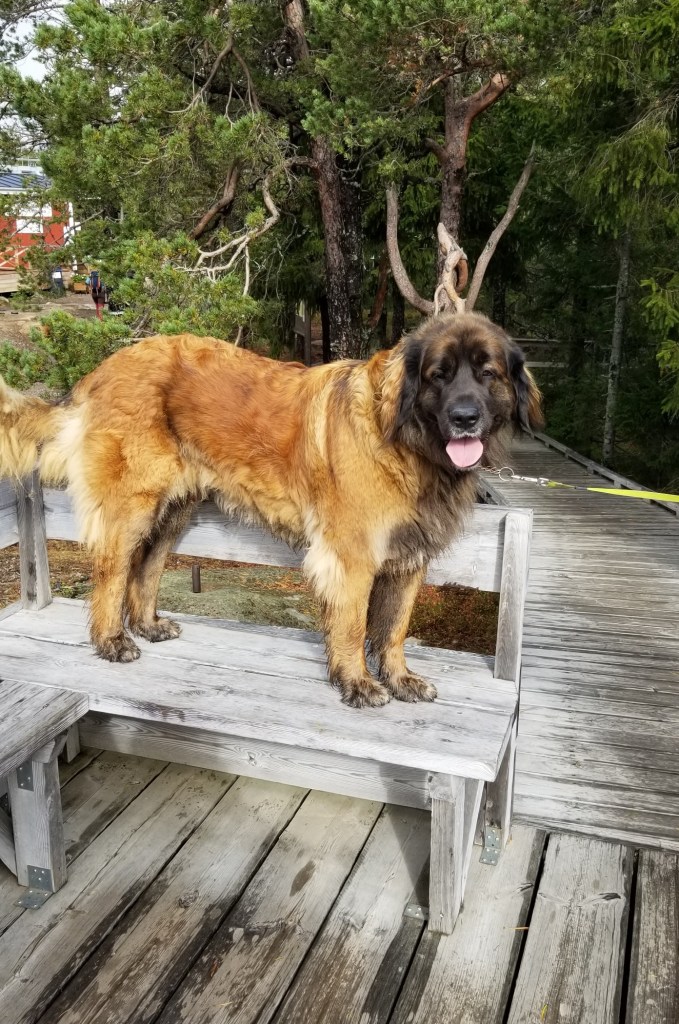
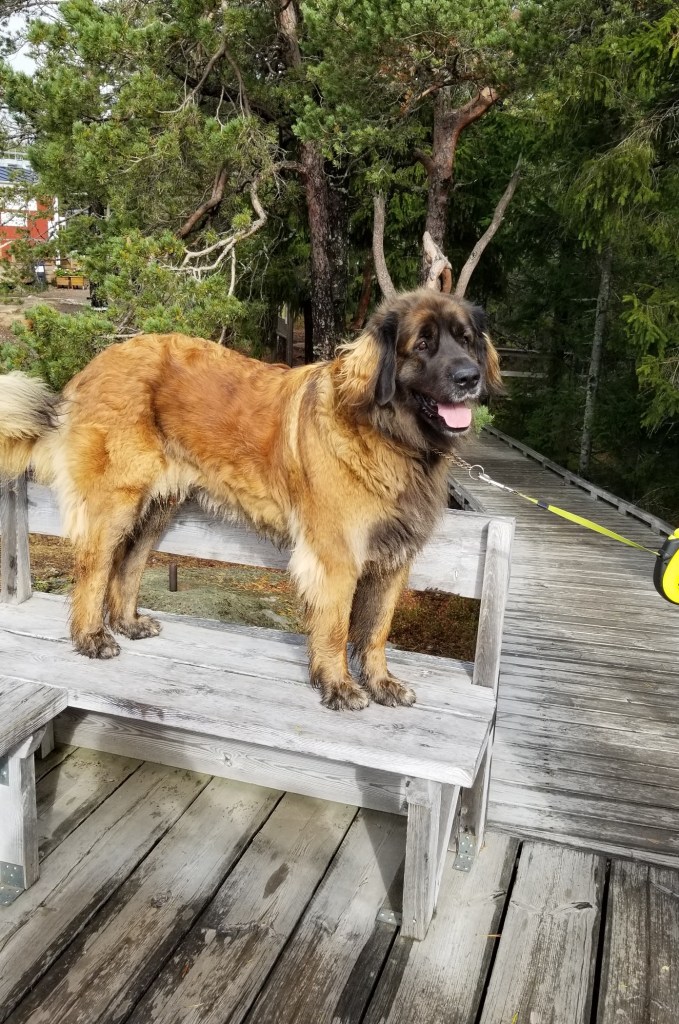
Therefore, I have decided to post a couple of photos of the only Swedish Leonberger I’ve ever met personally, I haven’t been back to Sweden a lot. Her name is Amie, and she is from my neck of the woods, the high coast in northern Sweden. We met her at the top of a mountain, called the Skule mountain. Therefore, she is also the only Leonberger mountaineer I’ve ever met. To check out my original Amie post click here.
Amie at the top of the Skule Mountain.Amie was playful but very well behaved.
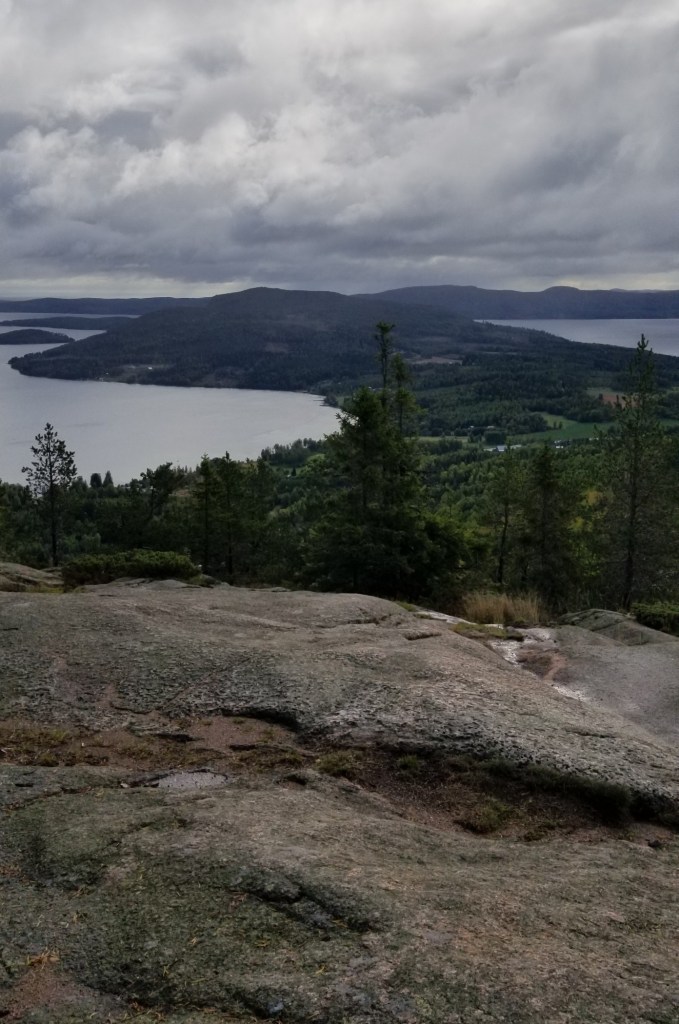
Amie was very happy and playful despite having climbed a mountain. Below is what Amie and we saw from the mountaintop.
View from the Skule Mountain top (skull mountain).
I am also posting a few more photos from Sweden.
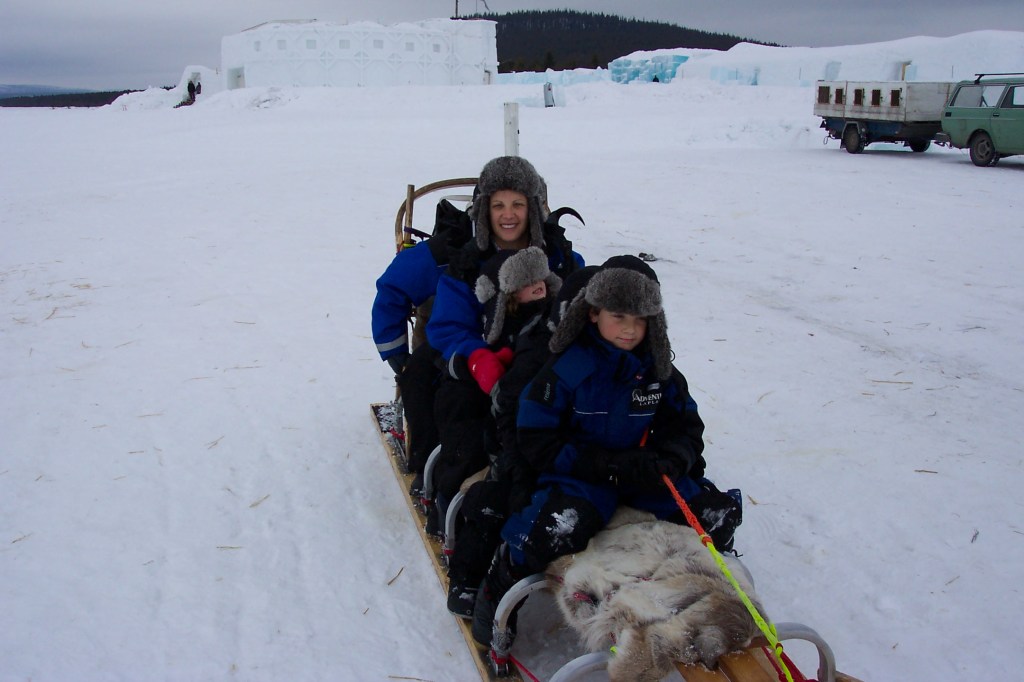
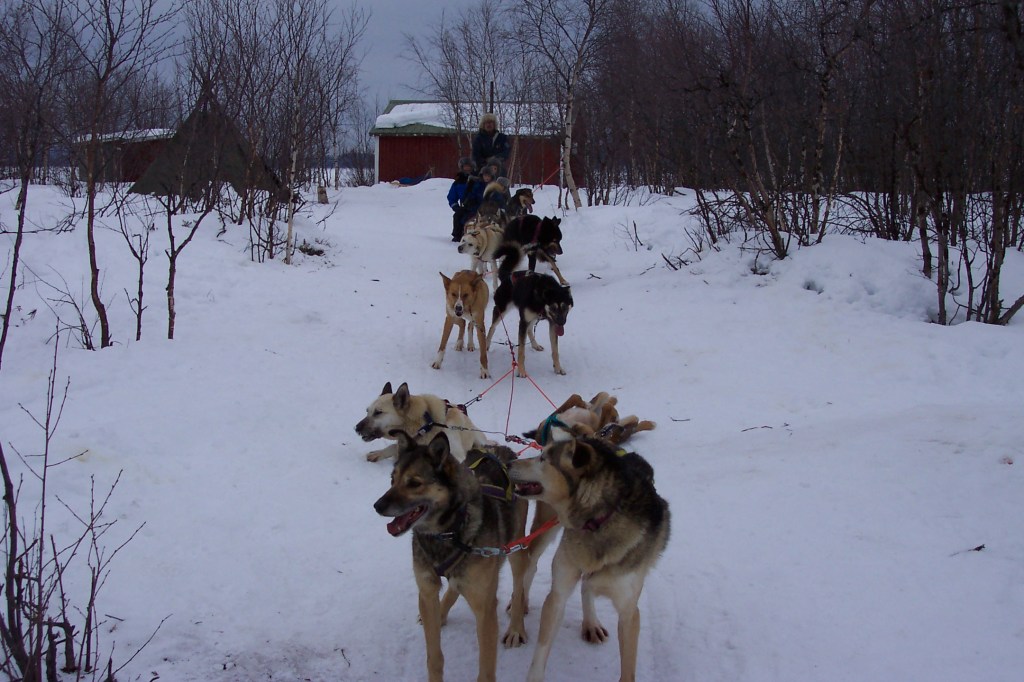
My kids at the ice hotel in northern Sweden (Jukkasjärvi).My wife and kids getting ready for a dogsled tour in northern SwedenThe dog sled. My wife and kids in the back.
One thing that is pretty unique about Sweden is the different concept of private property. You can own the fruits of property, a farmer’s field, a mine, but the land belongs to everyone regardless of who owns it. Well almost everywhere, there are a few exceptions such as military reservations and you have stay at least 200 meters away from dwellings. It’s called “Allemansrätten”, or all-peoples-right translated roughly. This means that you can walk, hike, camp, pick berries and mushrooms, etc., anywhere without having to worry about trespassing. You just can’t walk off with the gold from a goldmine or a farmer’s crop. This is very different from how it works in Texas. However, everyone in Sweden love it and we certainly take advantage of it when we visit. In the picture below we were hiking, and we stopped at this small forest lake and someone had hung a tire from a branch.
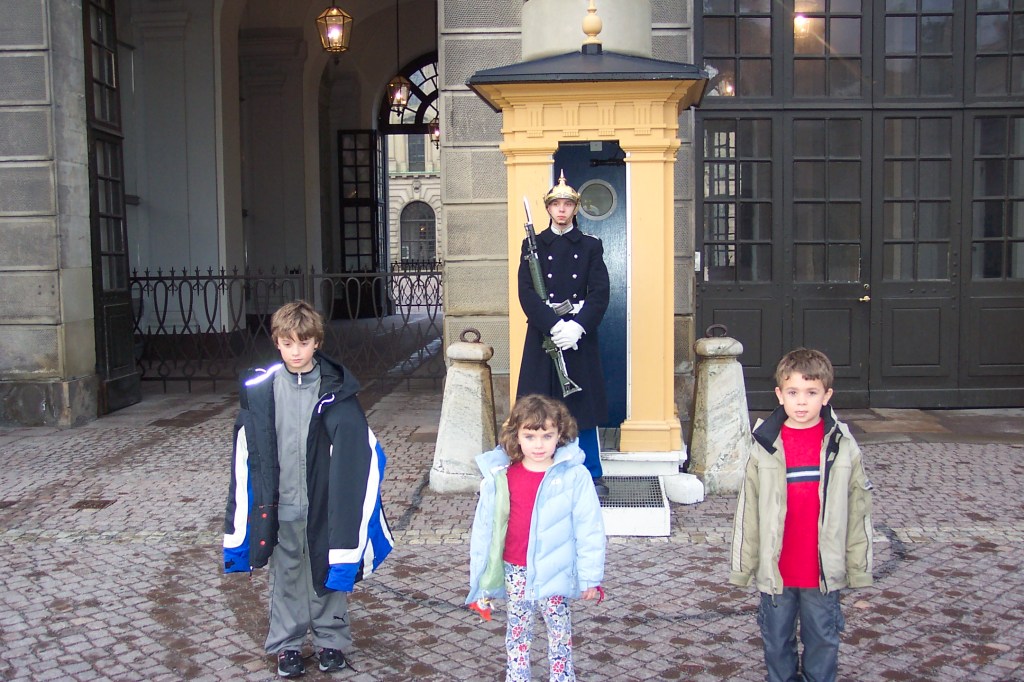
My son is jumping off a tire into a forest lake.The guard by Stockholm Castle and my kids
Today our Dog Rollo, a mini-Australian Shepherd who also was a good friend of our late Leonberger Bronco, walked out into the backyard and then he came back a few minutes later. He looked at me a bit funny. He was watching me closer than he usually does, and he lowered his head as he passed me by, and he was tiptoeing quietly. I did not think about it too much. I mean what could be wrong? However, my daughter told me, “That looked very suspicious”. She thought Rollo might be trying to hide something. Therefore, we followed him, and we realized that he had something in his mouth. We told him to drop but he wouldn’t obey us. He was defiant. That’s when my daughter got a glimpse of what was in his mouth. It was a piece of poop.
Look at those innocent trusting and loving eyes
He is not supposed to eat poop. He is not allowed to. We are very strict about this. We never had to tell any of our other dogs not to eat poop, they just never did, except Rollo. You give him cooked ground bison, ham, and liver treats, specially prepared treats, things he loves, but then he has poop for dessert. Anyway, I got some toilet paper for him to spit in. We told him to drop. He looked at the toilet paper, and he looked at me with his big eyes. It was clearly a very difficult decision for him, and after sitting there thinking hard for a minute, he quickly swallowed the poop. What would you have done? Anyway, remember how he fooled me at first.
The artist poses with one of his creations.
Rollo also loved chewing on shoes when he was younger. Fortunately, he’s gotten over that behavior, but in the process we’ve lost a lot of shoes. One time I forgot that I had left my shoes under a table in our TV room. I was walking around the house when I met Rollo in a hallway holding one of my shoes in his mouth. He gave me a deer-in-the-headlights look, then he slowly turned around and tiptoed back into the TV room. He placed my shoe back under the table, right next to its mate, positioning it correctly so it was just the way I had left it. Then he tiptoed away as if pretending that nothing had happened.
Three of our escape artists stand ready for their next adventure.
Our Leonberger Bronco, our pug and Japanese Chin also played us a few times, extorting treats from us by tricking us and they also tricked us when escaping the backyard in ways that we couldn’t figure out. Well actually, we figured out how Daisy and Ryu escaped, and we repaired the hole in the fence behind the tree that we found.
Daisy and Bronco opening the gate to the kitchen and eating the gingerbread house.
So how do you deal with this? My advice is to be smarter than I am, well at least, try to be smarter than your dog. Being smarter than your dog is very helpful. Watch them, observe them in the backyard. A Leonberger digging frenetically by the fence is soon going to be out roaming the neighborhood. A Leonberger shaking an unlocked gate using his paw, or trying to lift the lever with his nose, is soon going to be out roaming the neighborhood and eating Hors d’oeuvres at a neighbor’s cocktail party.
Bronco our Leonberger at three months oldBronco and me. Bronco about one years old.Bronco in Claudia’s lap, a little bigger, and chubbier (but he lost weight)Bronco about nine years old. He had just had a toe amputation.Bronco closing in on 13 years old at the end of his life
With permission from Brend Saito (see comment), in this post I am sharing something she shared on Facebook in memory of her golden retriever, Odie, who passed away in May 2021 at the age of 12. The author is unknown.
“A dog asked :
“Tell me, human, why’d you record me? ”
The human replied, “You were so little and cute then and I couldn’t resist”
“But I ate your flowers, peed on your carpet and broke the expensive vase and all your clothes are full of hair from me… never thought about giving me away? ”
Again the man replied:
“I was also upset at first and had more work to do, but then when you sat down on my lap as usual, everything was fine… you don’t give your children to the orphanage because they once are mischievous. ”
The dog looked attentively at his owner and asked:
“But look, now I’m very old and I have my problems too… I cost a lot of money because you go to the vet with me more often and I need special food… I’m not as agile as I was 10 years ago… and i don’t smell like a baby anymore”
The mistress swallowed briefly and struggled with tears for a moment when she then answered:
“My love, you will ALWAYS be my baby, you have enriched my life and given me countless beautiful moments, now you are old and not quite healthy but that doesn’t change how much I love you.
You have always been there for me, comforted me when I was sad and made me laugh, you are my most precious treasure. And I wish we can spend more time together.
I will continue to do my best to make your life beautiful.
I will do everything for you my little darling.. ”
The dog gently placed its paws on his wife’s cheek and licked.
The sun shone in his eyes that shone like opals.
Satisfaction.
H a p p y.
L O V E
Perfection.
Harmony.
Anyone who has and loves dogs understands without words….
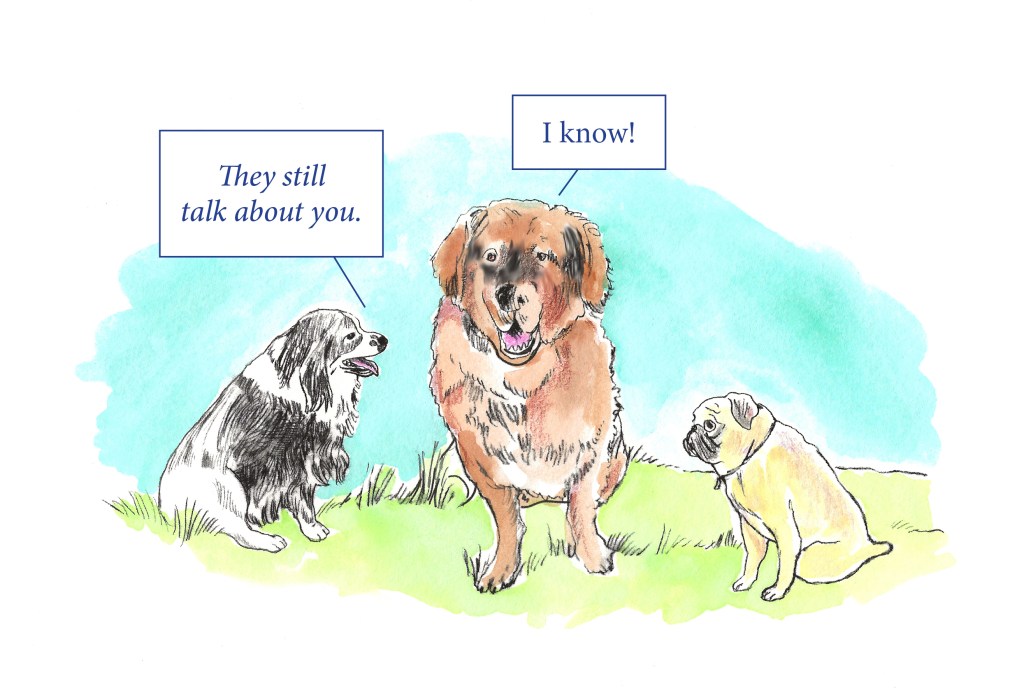
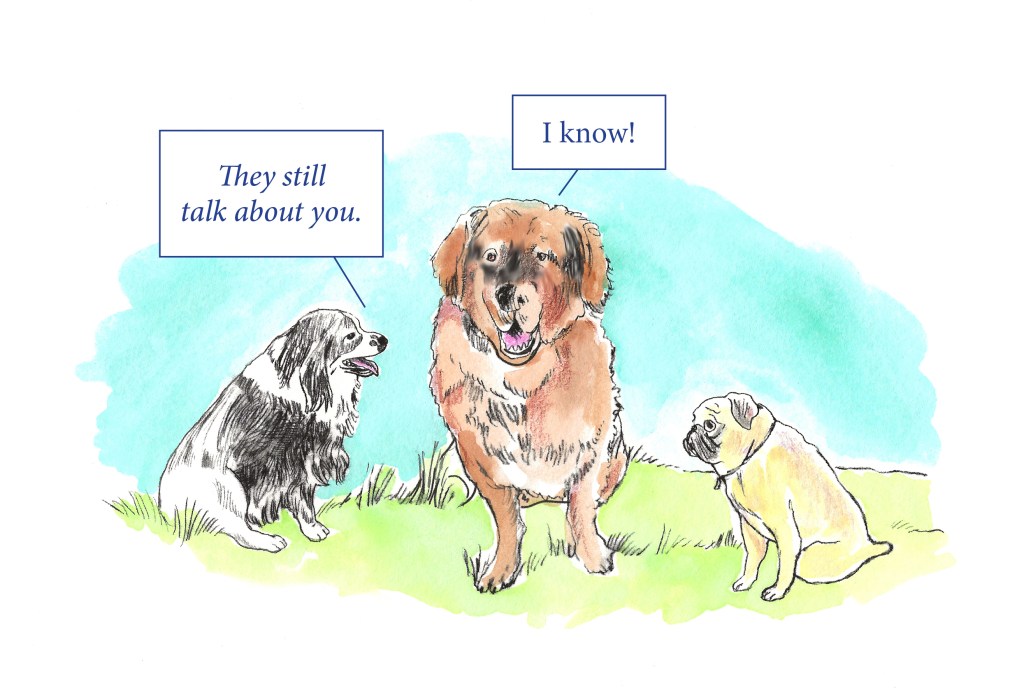
Bronco is in the middle, Rollo left, Daisy right. We still have Rollo and Daisy. We will never stop talking about Bronco. Illustration Naomi Rosenblatt.
I found out that today, or rather yesterday, that May 26 is World Dracula Day. It is celebrated to remember the day that the famous novel Dracula by Bram Stoker was published (1897). For most of you I am posting this one a day late. However, I found out about it a bit late. Check out VAMP JENN’S CORNER.
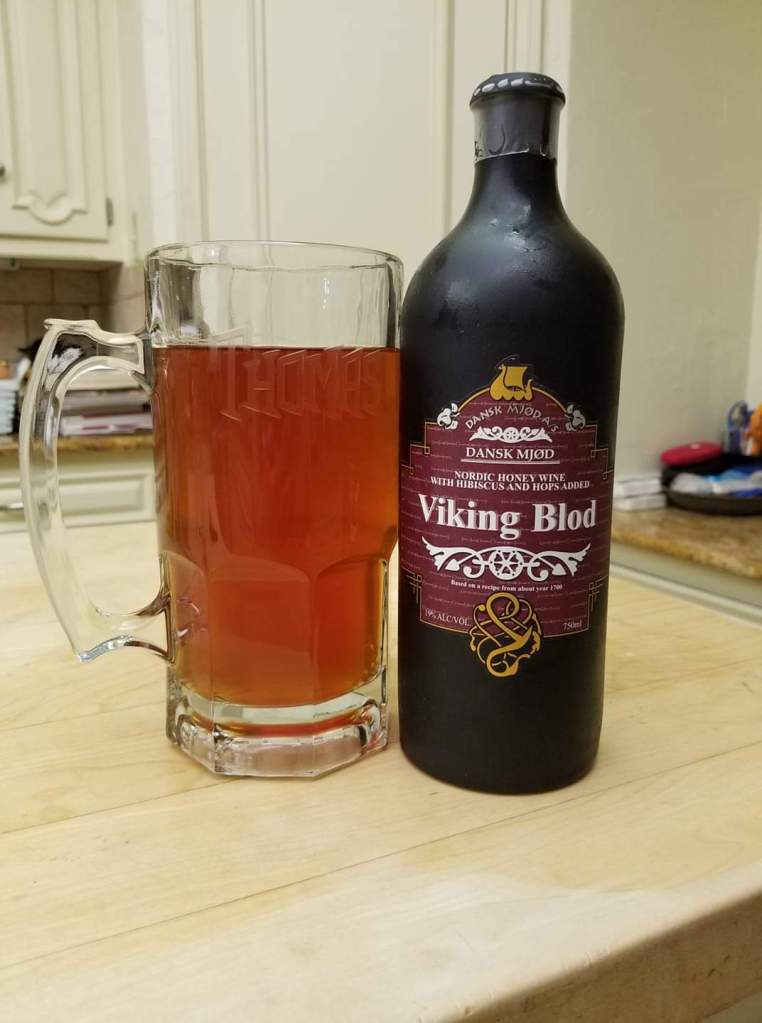
It reminded me of our trip to Romania and Transylvania in 2008. During that trip my son and I were inducted into the covenant of Dracula as special protectors of Dracula. Perhaps you could join as well? Viking Blood tastes pretty good and you can buy it at Specs. More on that later. (Photos by me).
Dressed up dude scaring tourists at the Bran Castle.
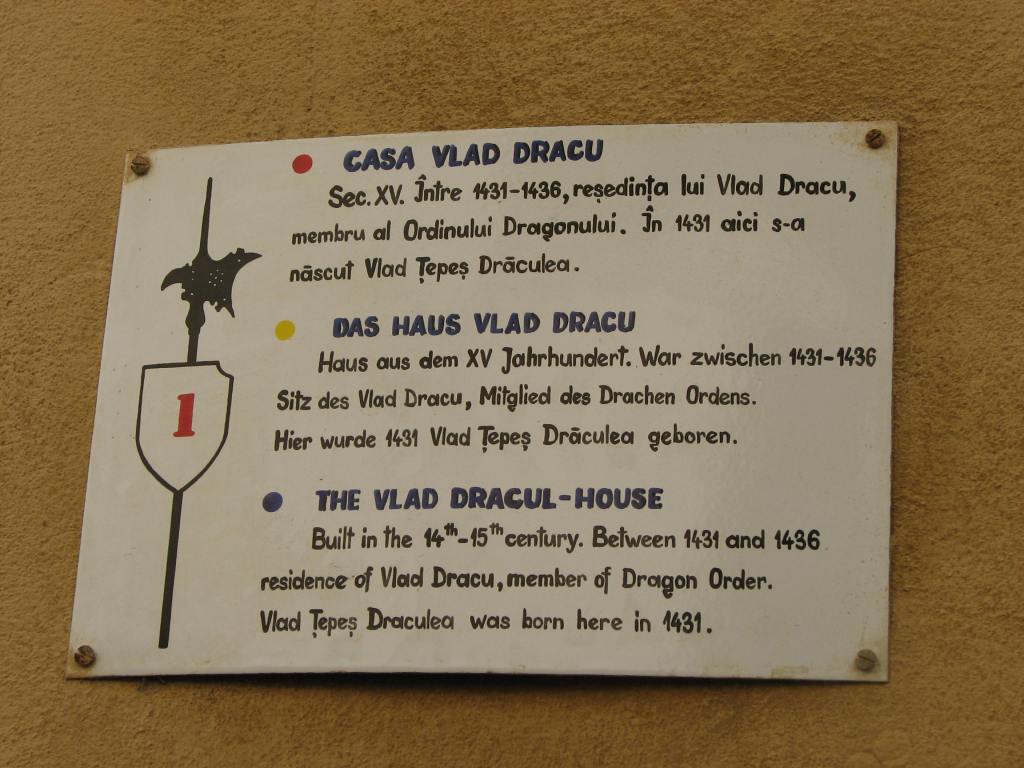
First a little bit about Dracula. Prince Vlad “Tepes” Draculea (Vlad the Impaler) known as Dracula was born in Sighisoara, Transylvania, Romania, in 1431. He was the second son of Vlad Dracul (Vlad the Dragon), who became the ruler of Wallachia in 1436. Wallachia is the province to the south of Transylvania. He got the nickname Vlad the Impaler because his favorite method of execution was to impale people, and he is rumored to have impaled tens of thousands. In 1442 the Ottoman Empire tried to invade Transylvania and Vlad Dracul and Vlad Tepes Draculea were imprisoned by the Ottomans. They were able to flee, and Vlad Tepes became the Voivod (ruler) of Wallachia, defender of Transylvania and ultimately the defender of all of Europe. For this reason, Vlad Tepes alias Dracula is a local hero, despite his impalement activities and being rumored to be a vampire.
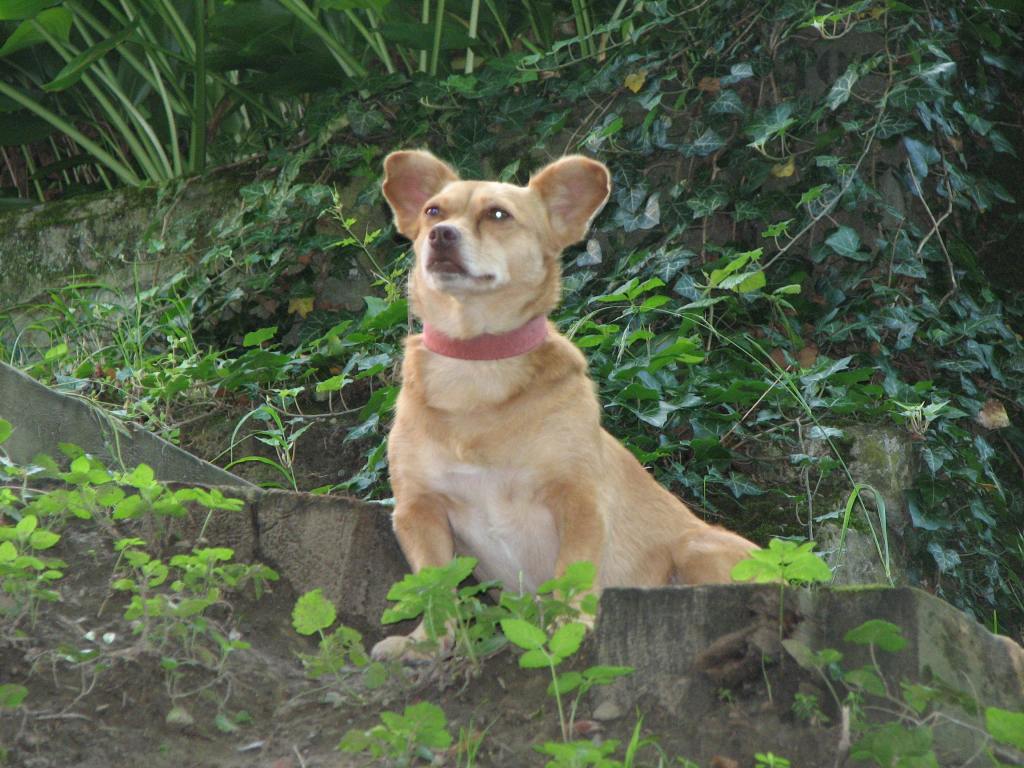
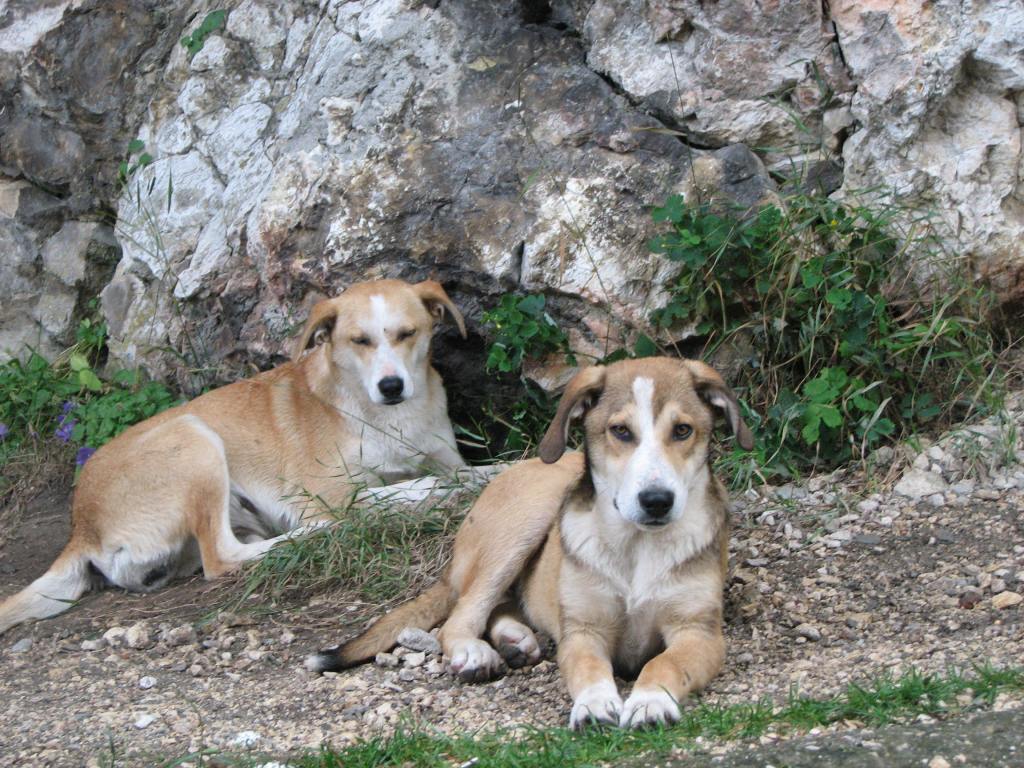
Stray dog that we came across in Sighisoara. Do you think he was a vampire dog?
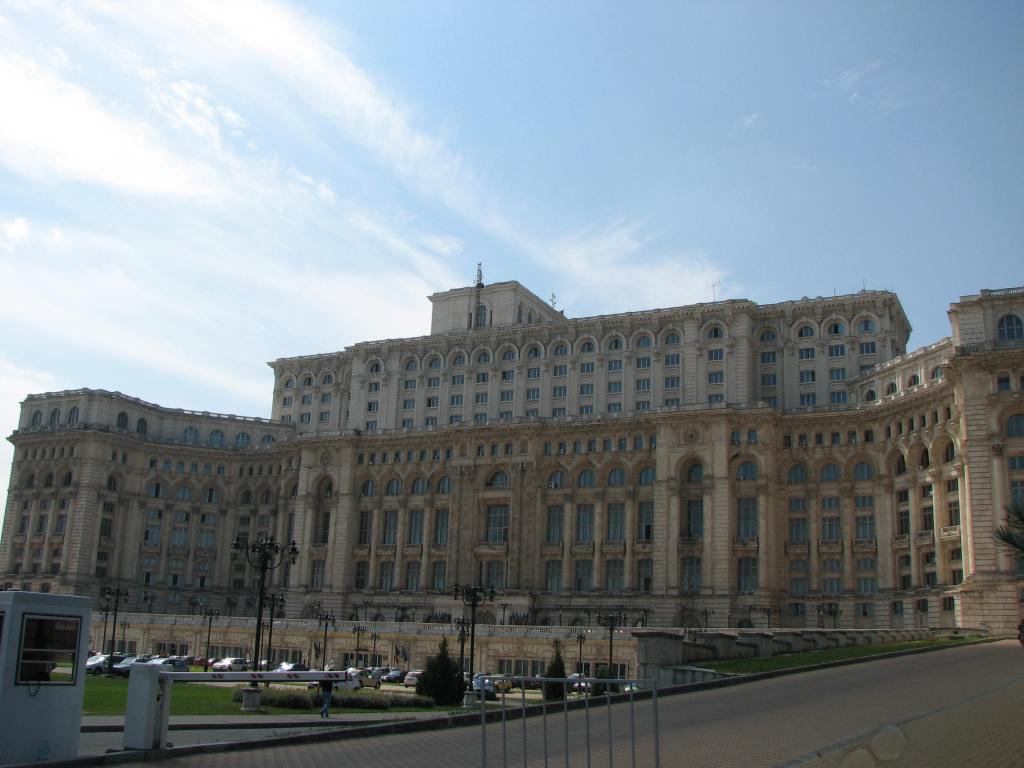
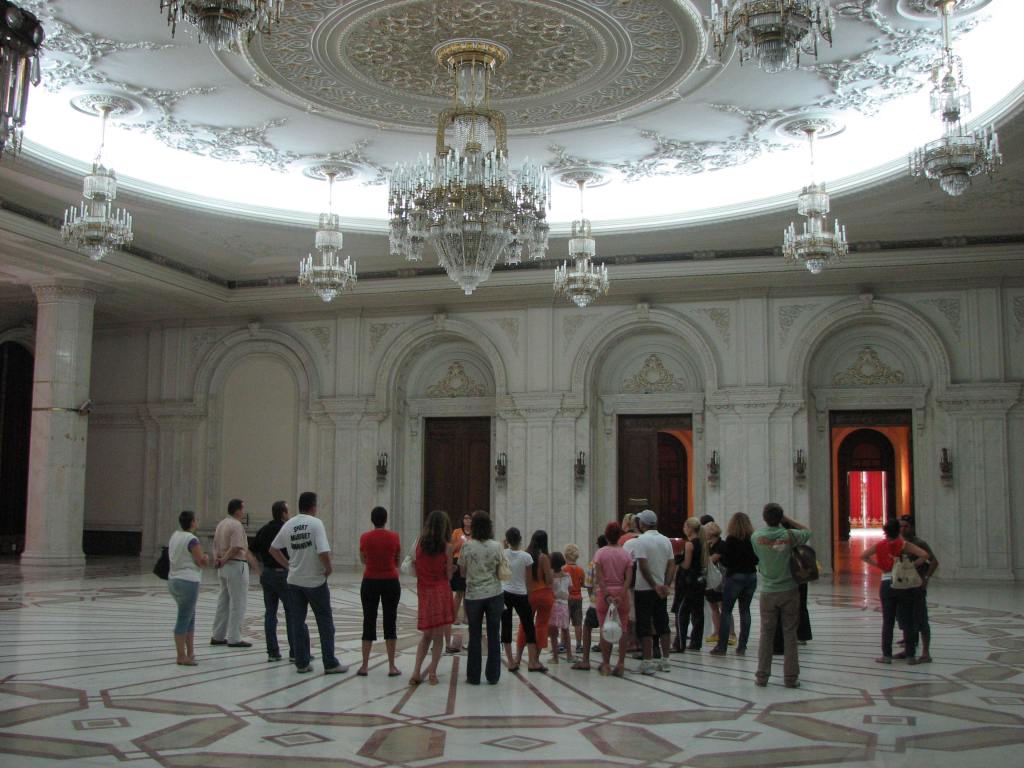
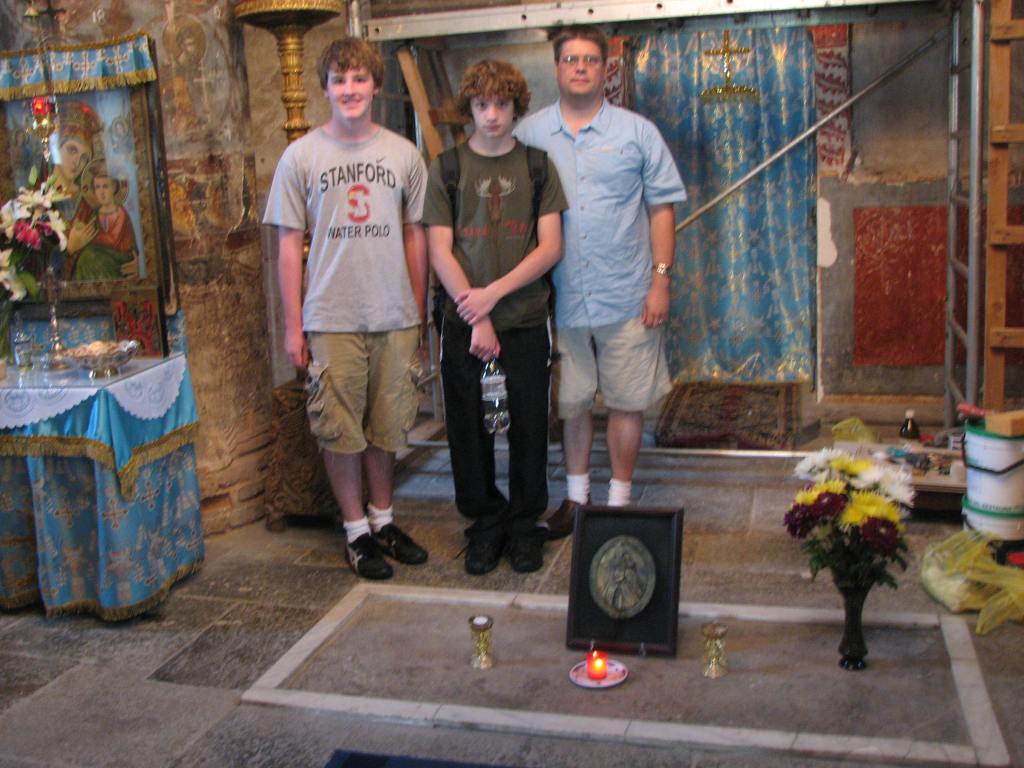
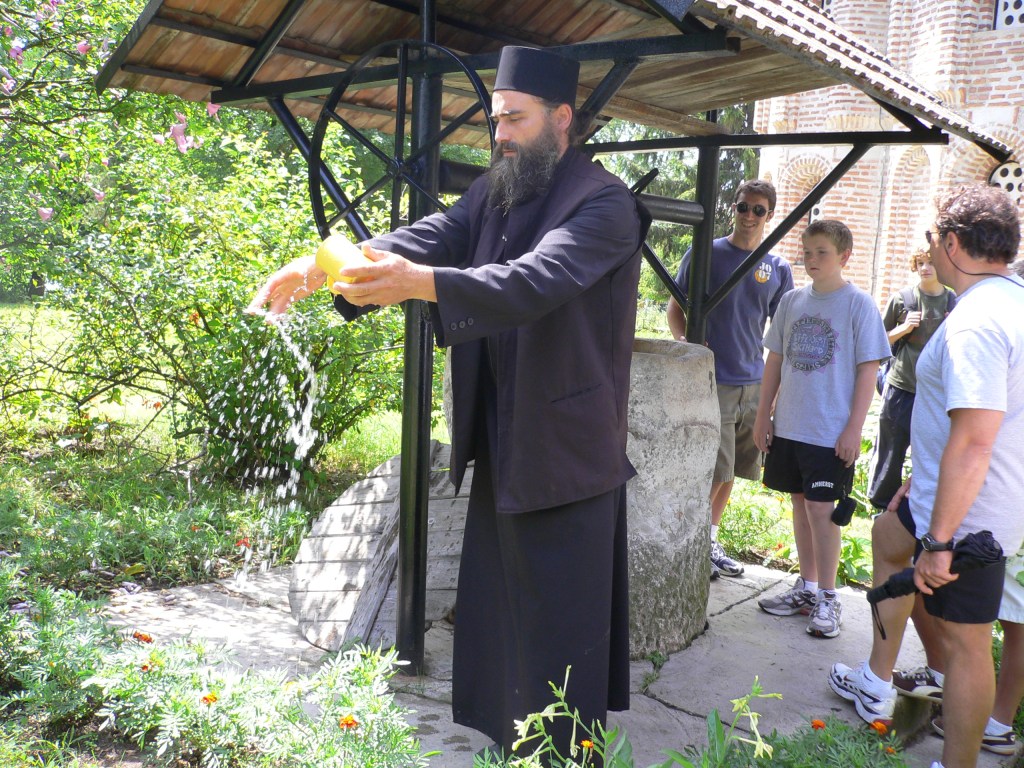
It was a Water polo team trip. In addition to the kids on the team, including my son Jacob, there was the coach Mihai, and two chaperones, me, and Jim Smith. We arrived in Bucharest (Wallachia) where the boys played water polo against other teams, and we also visited various tourist attractions such as the enormous Palace of the Parliament erected by Communist Dictator Nicolae Ceausescu. We also visited the Snagov island and the Snagov monastery located not far from Bucharest. The Snagov monastery is where Dracula’s grave is located and it is tended to by a monk, Dracula’s monk, and he was extremely happy to welcome us. He had been waiting for us.
This enormous Palace was erected by Nicolay Ceausescu. It is the largest administrative building in the World.One of hundreds of public rooms in Ceausescu’s palace.Dracula’s monk, Mihai and the kids. My son Jacob is second from right in the dark green shirt. Notice the little dogs. Dracula had nice little dogs.We are standing right behind Dracula’s grave. I am to the right in blue, my son in the middle and I forgot his friend’s name. Dracula’s monk took the photo using my camera. Focus could have been better.
Next the monk took us to Dracula’s well and he asked us if we were willing to join the covenant of Dracula as protectors of Dracula. I am not sure if that is the same as the order of the Dragon, the order that Dracula was part of. The monk said that my son was very special. He was the incarnation of the arch angel Gabriel and a special protector of Dracula. I am not sure if that had anything to do with me giving him a good tip earlier. I asked whom I was an incarnation of. The monk answered, no one special, you are just Pedro. I don’t know who Pedro is. Anyway, we drank from Dracula’s well and got inducted into the Dracula’s covenant.
Drinking from Dracula’s well.
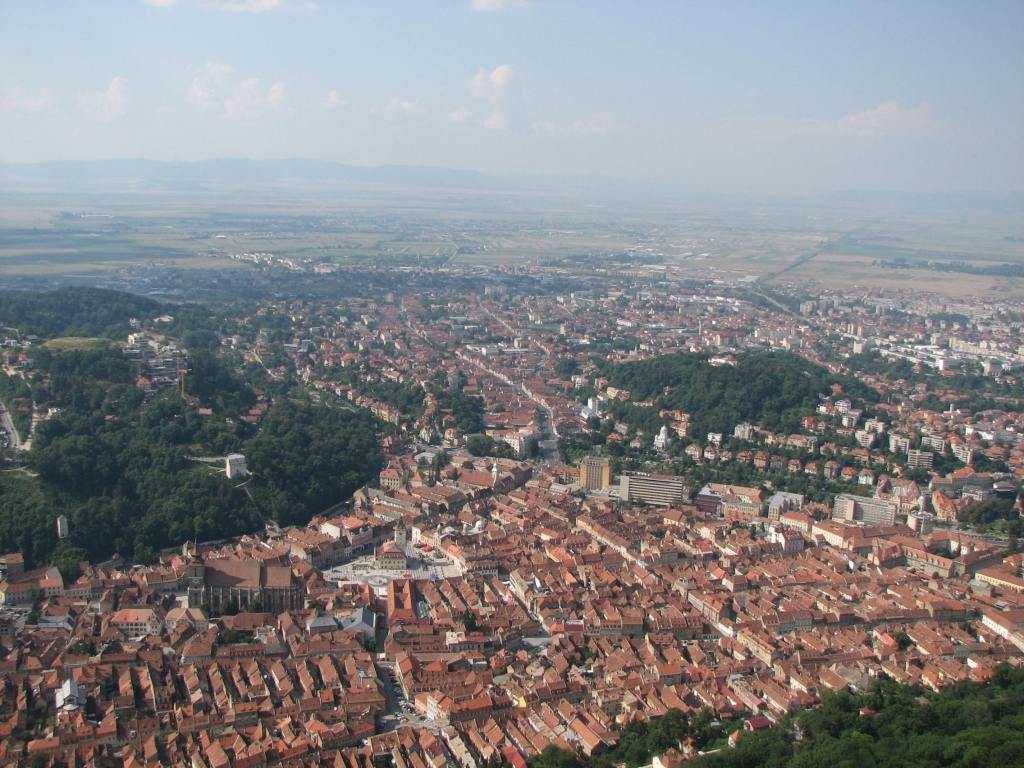
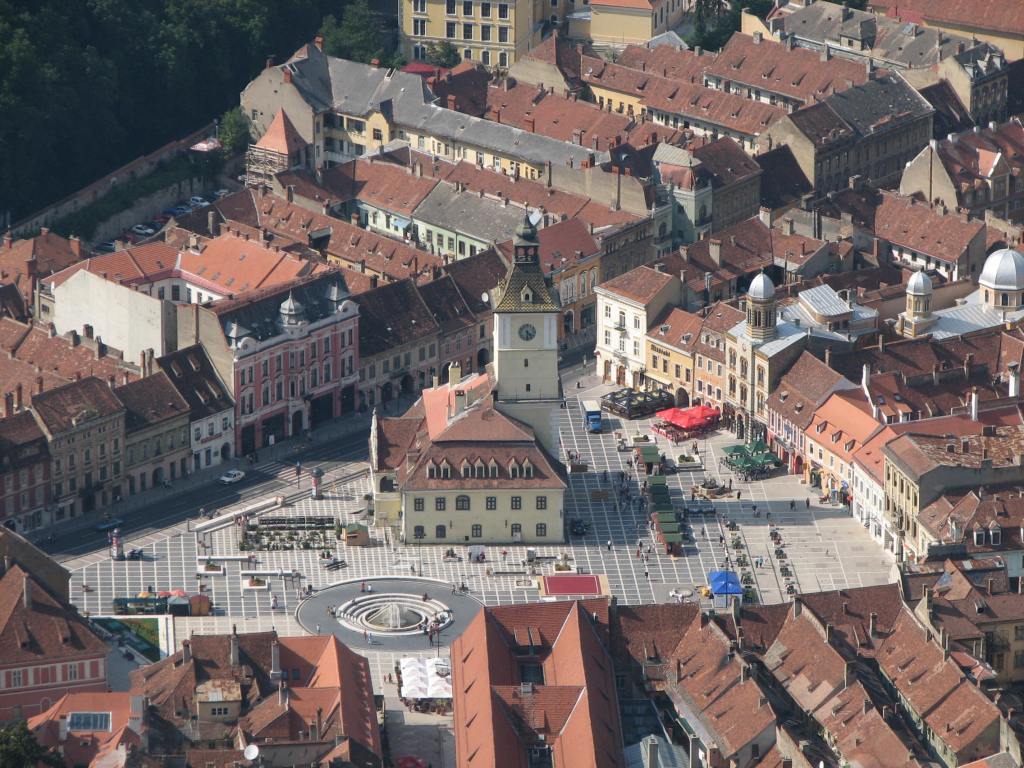
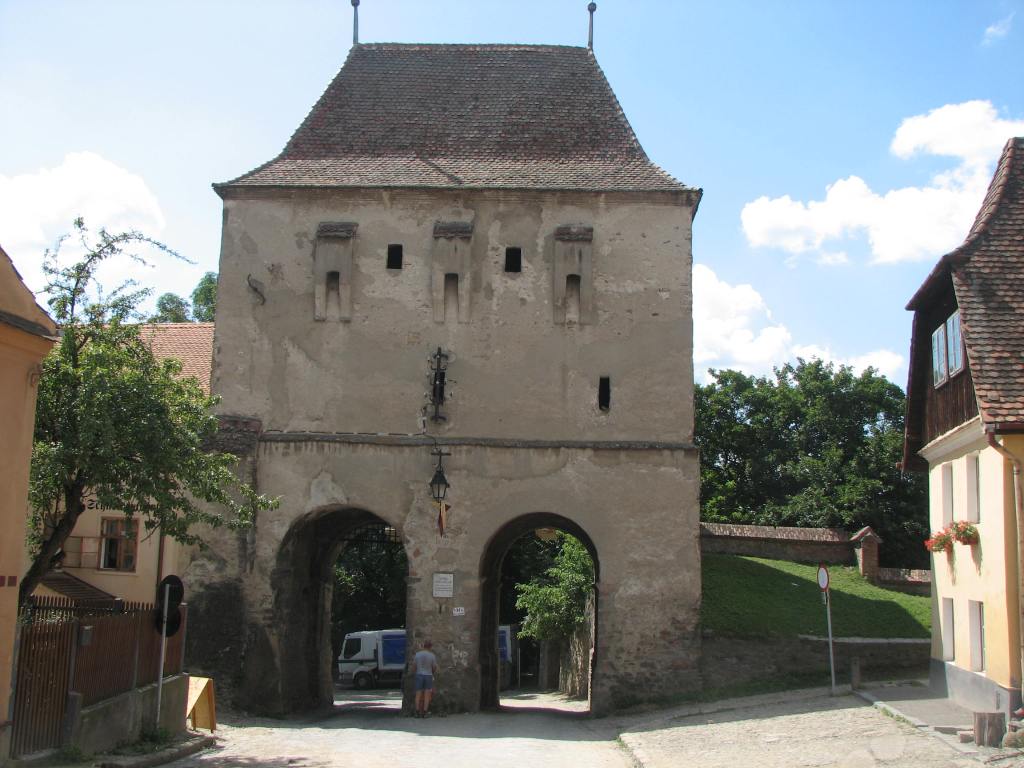
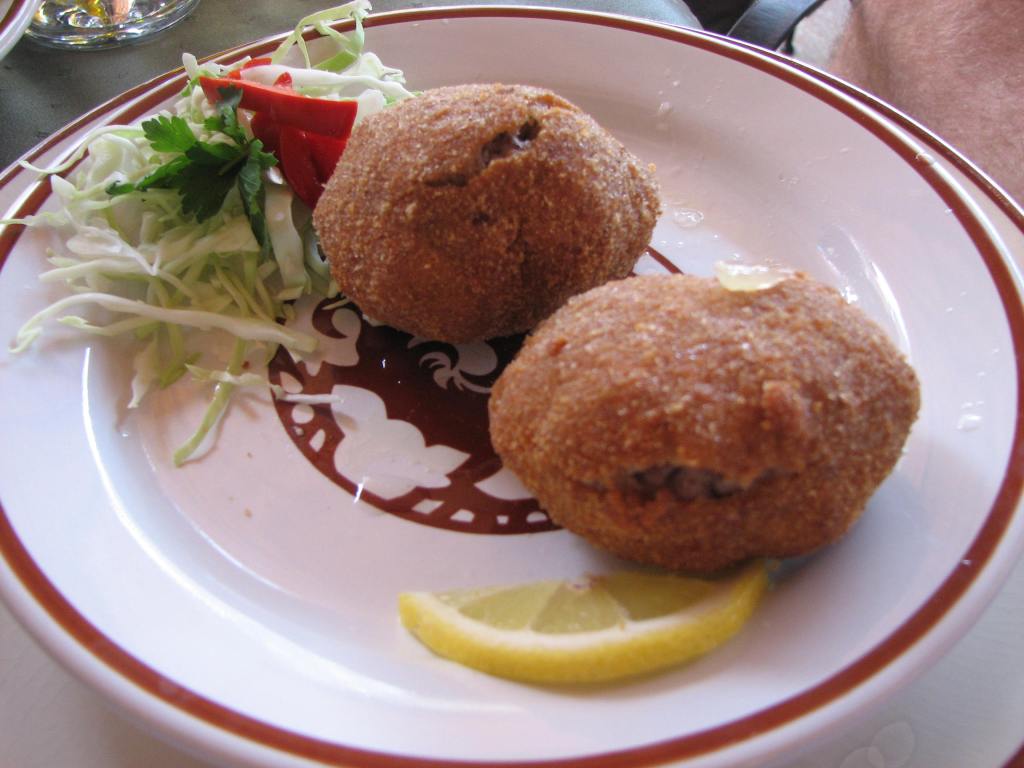
Next, we headed off to Transylvania where we visited the cities of Brasov and Sibiu and the town of Sighisoara. We stayed at a hotel “Casa cu Cerb” built inside the three-story house, at “Piata Muzeului” number 6, where Dracula was born. It was an interesting experience and we got to know the owner well. It is a famous small hotel with only ten guestrooms. We also ate at Dracula’s restaurant next-door. We had brain, not human brains, but cow brains, we aren’t zombies.
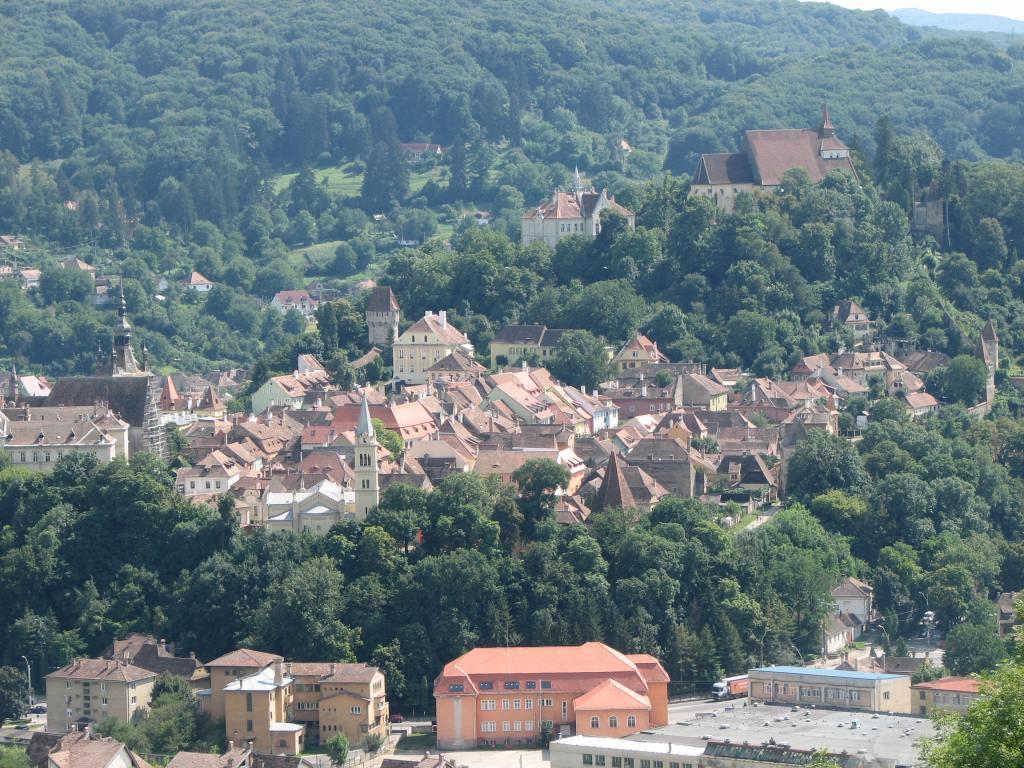
BrasovBrasov TownsquareSchneiderturm SighisoaraView of SighisoaraDracula ’s restaurantBrain food at Dracula’s restaurant
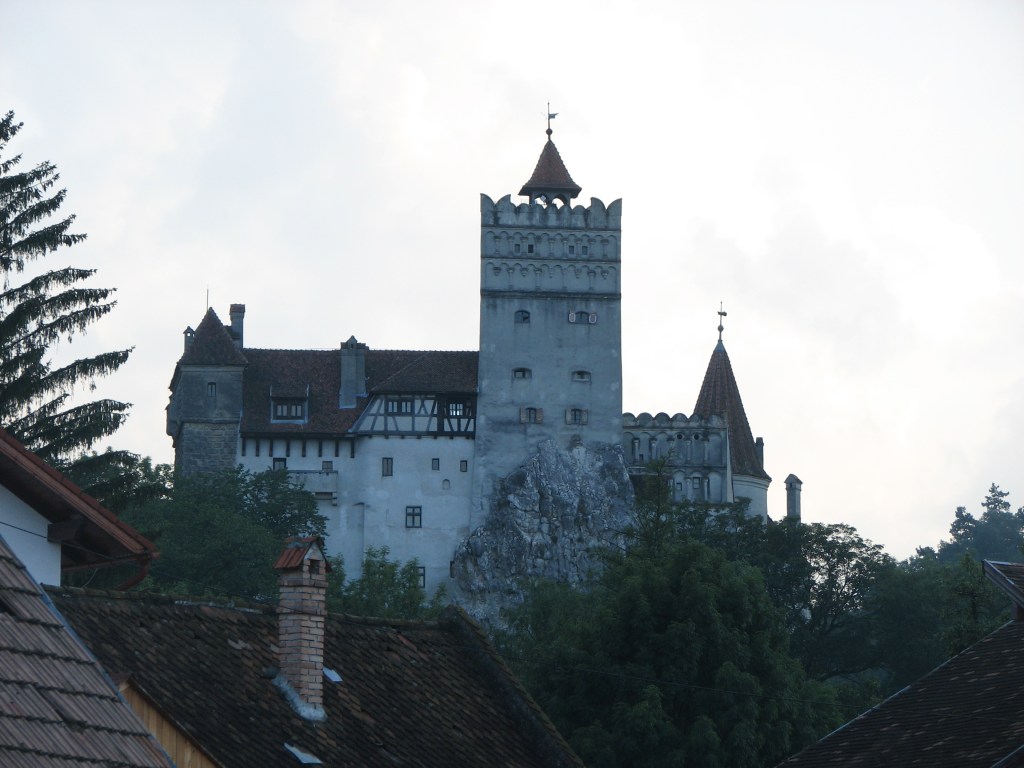
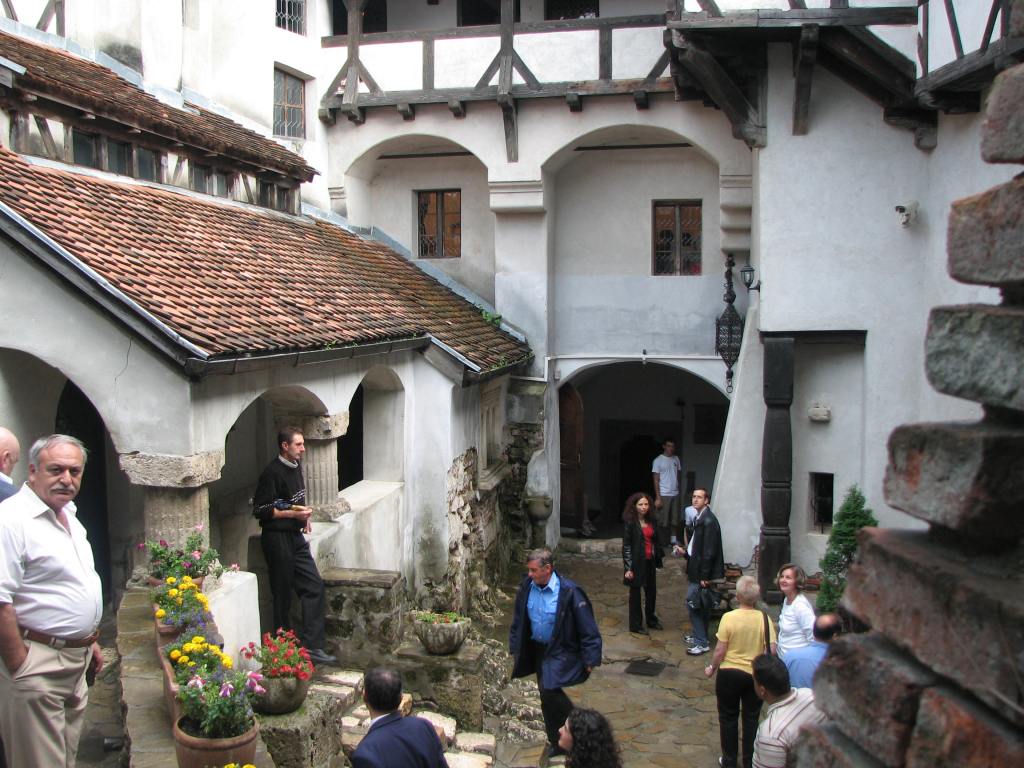
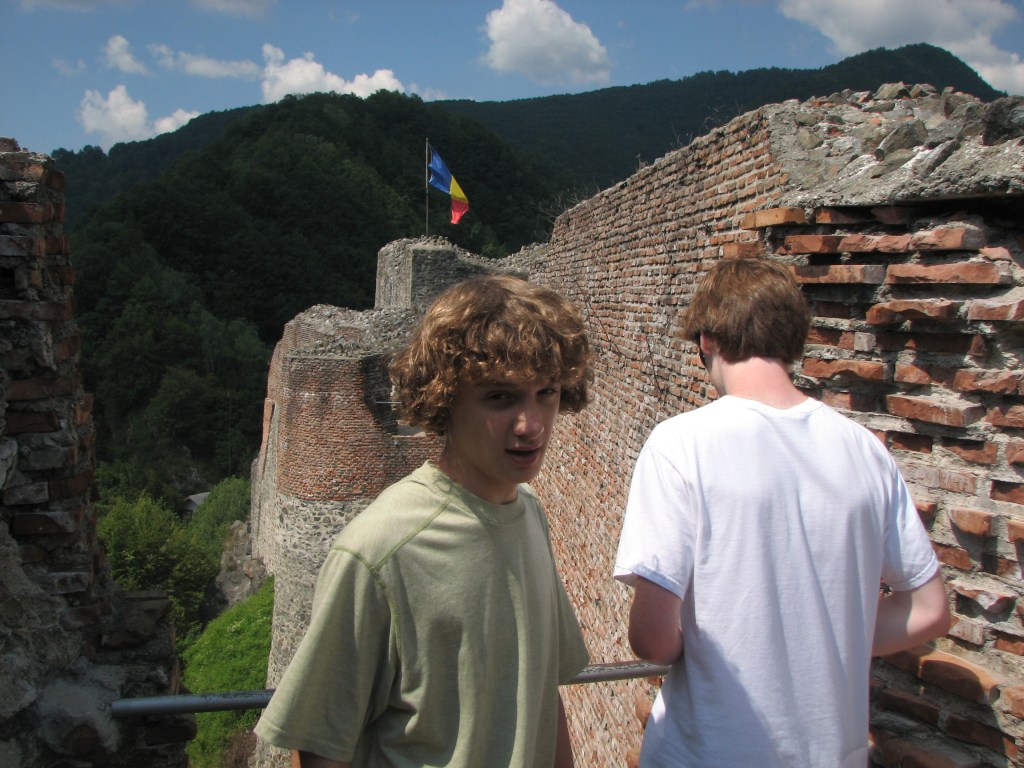
We also climbed the Transylvanian mountains and visited the Bran castle. The Bran castle is allegedly Dracula’s castle, but it is not really true. It is more of a tourist trap. The Poienari Castle, which we also visited, was on the other hand built or rather renovated by Dracula.
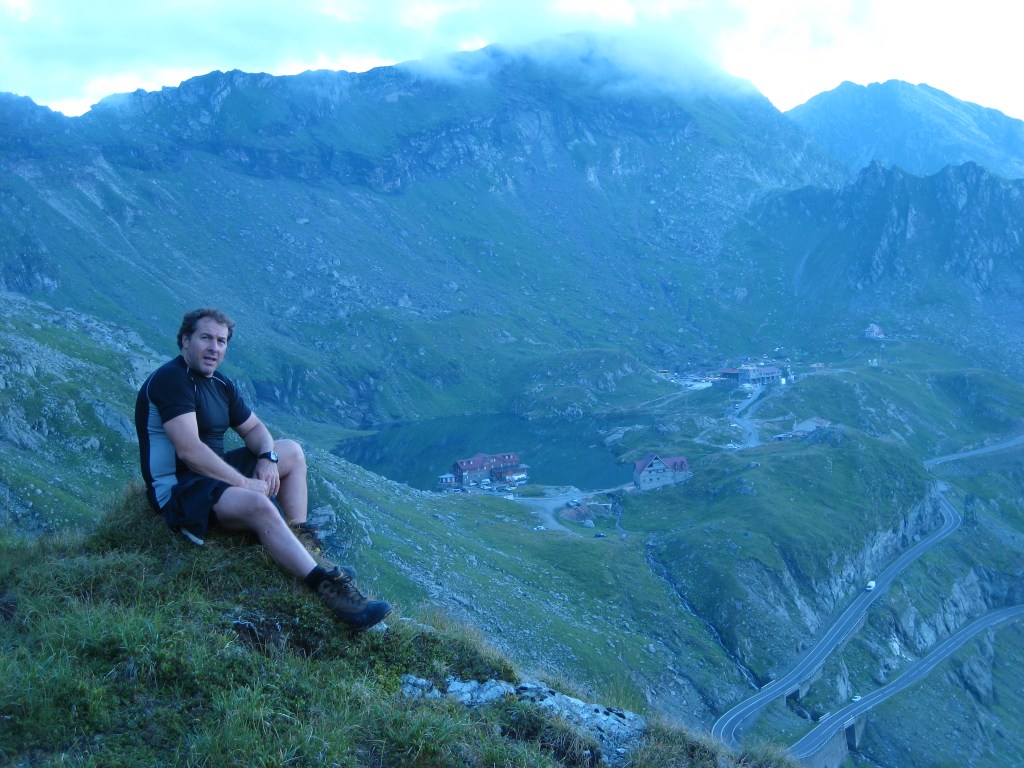
View of the Bran CastleCourtyard inside Bran Castle.Stray dogs by the Bran Castle.My son at the Poienari CastleMihai in the Transylvanian MountainsDarkness Falls, a run barrel aged coconut milk stout from Fort Worth, Texas, ABV 9.8%, that I drank today. Perfect for Dracula Day.Viking Blood a Danish mead, ABV 19.0%, that I drank some time ago. Perfect for Dracula Day.






















 Leonberger Life