This blog feature amusing and heartwarming stories about our late Leonberger dog Bronco, as well as other Leonbergers. It also has a lot of information about the Leonberger breed, the history, care, training, Leonberger organizations, etc. I also wrote a Leonberger book, which I am featuring in the sidebar.
I am one of those lucky ones that avoided Covid-19 (technical name coronavirus SARS-CoV-2) for years. Now I have it for the first time. Five days ago, my wife got Covid-19, and my daughter had strep. Well, the virus is still with us, and it is evolving so maybe we should stop calling it Covid-19 and just call it Covid vintage 2023, Covid vintage 2024, etc. Yesterday (Monday), well now it is after midnight so technically the day before yesterday, I got what seemed to be a cold. I had a sore throat. Then during the night (last night) I started feeling weak and tired, I had some muscle pains and I got very strong fever chills. I did not measure my temperature but based on the strong fever chills I think it must have been at least 100 degrees.
Luckily for me, the Covid vintage 2024 is milder than the original. Right now, I have a fever and fever chills, but not as strong as last night. I went to our doctor’s office here in Dallas today to get professionally tested for covid and strep. I did not have strep, but I had covid. Naturally my wife and I need to isolate and maybe our daughter too. We suggested she takes into a hotel, so she does not get covid, but she does not want to. I may not be as active blogging for a few days but here are some covid related jokes.
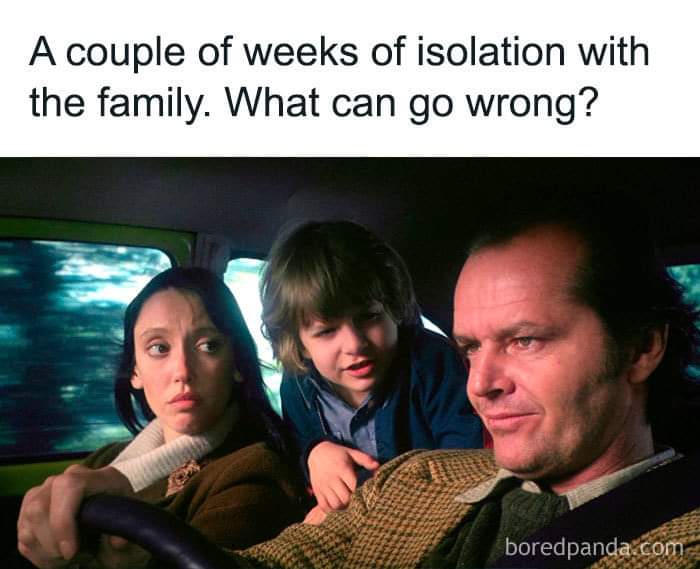
Look at Jack’s smug face. This scene is funny. The photo is from BoredPanda.Remember the toilet paper shortage?Poor Corona Beer. The photo is from BoredPanda.
This is a Leonberger blog, but sometimes I also post reviews for books that are not about Leonbergers and when I do it is for books that I love and that I want others to read. Today I am posting a review for Our Fragile Moment: How Lessons from Earth’s Past Can Help Us Survive the Climate Crisis by Dr. Michael E. Mann. If you don’t know who Michael Mann is, he is the creator of the hockey-stick curve (in 1998), which is a curve that shows the variation of average global temperature throughout history. For recent times (last 150 years) he used measured temperatures and for temperatures further in the past he used so called proxy data to estimate global temperatures. As the name indicates the graph looked like a hockey stick laying down, which did not sit well with climate change deniers, and as a result he was viciously attacked, threatened, and defamed. He was a young post-doc student at the time. February 8, 2024, Dr. Michael Mann was awarded one million dollars in a defamation lawsuit against Fox talk show host Mark Steyn and another $1,000.00 from Rand Simberg.
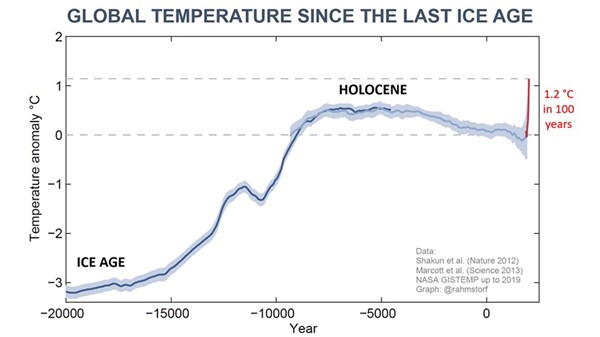
Hockey stick curve for the last 1,000 years, blue-Michael Mann’s original curve (proxy measurements such as tree rings), green-dots 30-year average, red temperature measurements. From Wikipedia Commons.Global temperature going back twenty thousand years, another hockey stick graph. Notice the stable temperature during the last 6-7,000 years, coinciding with the development of human civilization, and then a sudden sharp increase at the end.
I should say that at first, I believed myself that Dr. Mann was a fraud. As I took a deep dive into the topic and learned more about it, I came to realize I was wrong and that his critics were wrong, and that Michael Mann was right. Since his original hockey stick curve there have been several dozen hockey stick curves produced by other independent researchers, often going back further in time, and they all confirm his findings. Today the scientific community has entirely accepted the hockey stick as correct. Despite this fact Dr. Mann is still being attacked by various organizations and individuals. Typically graphs put people to sleep, but this one started a war that is still ongoing. Charles Darwin was also attacked for his scientific discoveries and now history is repeating itself.
Anyway, about this book. This book mentions the hockey stick curve, but it is not the focus of the book. This book goes back 4.5 billion years and explains what is known about past climate which is surprisingly much. Science does not know everything, otherwise it would stop, but it knows a lot. He discusses various past climate shocks, various climate cycles, extinction events, etc., and analyses what past climate means for us today. There is bad news and there is good news. The book is packed with information and data, but I loved it.
Hardcover – Publisher : PublicAffairs (September 26, 2023), ISBN-10 : 1541702891, ISBN-13 : 978-1541702899, 320 pages, Item Weight : 1.15 pounds, dimensions : 6.4 x 1.06 x 9.55 inches, it cost $19.59 on US Amazon. Click here to order it from Amazon.com.
Paperback – Publisher : PublicAffairs (October 15, 2024), ISBN-10 : 1541702905, ISBN-13 : 978-1541702905, 320 pages, Item Weight : 1.11 pounds, dimensions : 5.5 x 0.8 x 8.25 inches, it cost $19.99 on US Amazon. Click here to order it from Amazon.com.
Kindle – Publisher : PublicAffairs (September 26, 2023), ASIN : B0BRJ6SCFM, 392 pages. It is currently $18.99 on Amazon.com. Click here to order it from Amazon.com.
Audiobook – Publisher : PublicAffairs, Release date September 26, 2023, ASIN : B0BWKCPSDY, Listening length 9 hours and 38 minutes. Click here to order it from Amazon.com.
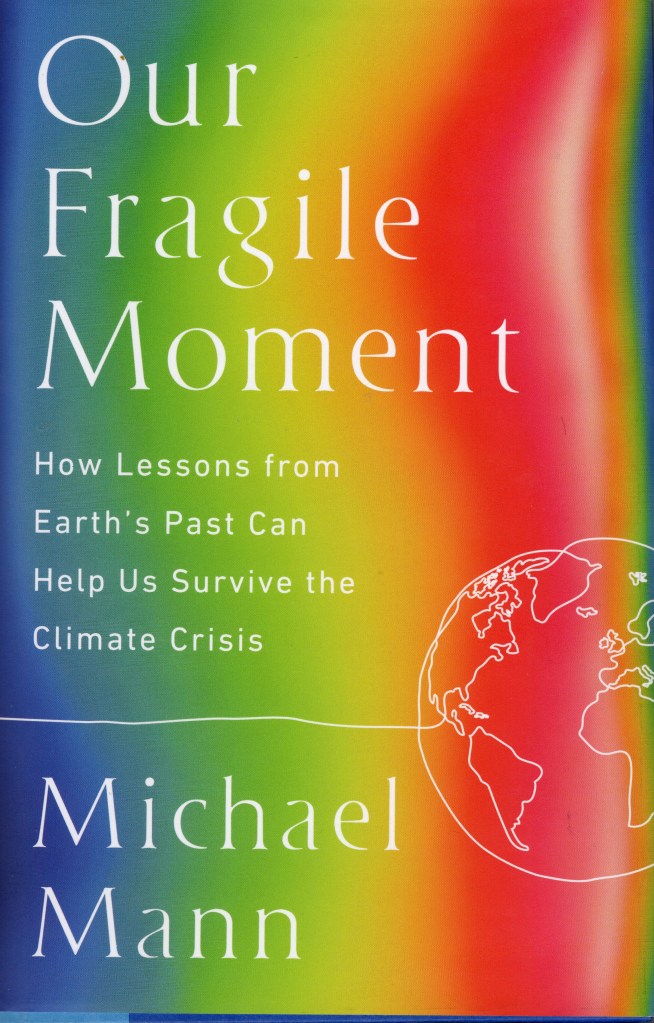
Front cover of Our Fragile Moment: How Lessons from Earth’s Past Can Help Us Survive the Climate Crisis by Michael E. Mann. Click here or the picture to visit the Amazon.com page for the Hardcover version of the book.
Amazon’s description of the book (from the Amazon page)
In this sweeping work of science and history, the renowned climate scientist and author of The New Climate War shows us the conditions on Earth that allowed humans not only to exist but thrive, and how they are imperiled if we veer off course.
For the vast majority of its 4.54 billion years, Earth has proven it can manage just fine without human beings. Then came the first proto-humans, who emerged just a little more than 2 million years ago—a fleeting moment in geological time. What is it that made this benevolent moment of ours possible? Ironically, it’s the very same thing that now threatens us—climate change.
The drying of the tropics during the Pleistocene period created a niche for early hominids, who could hunt prey as forests gave way to savannahs in the African tropics. The sudden cooling episode known as the “Younger Dryas” 13,000 years ago, which occurred just as Earth was thawing out of the last Ice Age, spurred the development of agriculture in the fertile crescent. The “Little Ice Age” cooling of the 16th-19th centuries led to famines and pestilence for much of Europe, yet it was a boon for the Dutch, who were able to take advantage of stronger winds to shorten their ocean voyages.
The conditions that allowed humans to live on this earth are fragile, incredibly so. Climate variability has at times created new niches that humans or their ancestors could potentially exploit, and challenges that at times have spurred innovation. But there’s a relatively narrow envelope of climate variability within which human civilization remains viable. And our survival depends on conditions remaining within that range.
In this book, renowned climate scientist Michael Mann will arm readers with the knowledge necessary to appreciate the gravity of the unfolding climate crisis, while emboldening them—and others–to act before it truly does become too late.
A Palaeoclimatological Journey Accompanied by Intelligent Analysis And What It Means for Us
In this book the author takes us on a journey through earth’s climate history. He discusses the climate during the different eras and periods of earth’s history starting with the Hadean and Archean and ending with the Holocene. There have been extreme changes in the climate, caused by shocks to the system, followed by mass extinctions. The many devastating large swings in the climate often took hundreds of thousands of years or millions of years to run their course. Species disappeared while species better adapted to the new climate evolved. As he gets to modern times, the Holocene, he gives us more detail and analyzes the climate for much shorter intervals. It is clear from his discussion on more recent climate that climate has shaped us, and we have shaped climate.
He also discusses the various climate cycles that effected our climate in the past as well as currently, including the Milankovitch cycles, such as the eccentricity of Earth’s orbit, earth’s obliquity and precession. Other cycles he is discussing include the El Niño–Southern Oscillation, the north Atlantic Oscillation (NAO), and the Atlantic Multidecadal Oscillation (AMO), which as it turns out does not exist. The purpose of all this is to determine what this means for our civilization and the unnatural and extremely rapid warming that we are causing today primarily via our carbon emissions.
I found some of the climate shocks he discussed quite interesting. During the Paleoproterozoic era 2 billion years ago the biological innovation of oxygen-generating photosynthesis led to a rapid drawdown on atmospheric carbon dioxide and in addition the positive feedback from the increased albedo from the ice buildup turned the planet into a snowball. This was reversed as the ice prevented absorption of carbon dioxide. Eventually the carbon dioxide concentration in the atmosphere reached 200 times of what it is today, and the snowball rapidly melted, and the carbon dioxide concentration settled again. The greatest extinction event in geological history was the Permian-Triassic extinction event 250 million years ago when 90% of all species on Earth perished. It was primarily caused by a substantial release of carbon dioxide from Siberian Trap volcanic eruptions.
Another interesting climate shock was the dinosaur-killing K-Pg event 66 million years ago. An asteroid collision made Earth’s climate much colder, and all large species died out. It took four million years for flora and fauna to reestablish itself but with new species. The losers were the non-avian dinosaurs, and the winners were the mammals and the avian dinosaurs or birds. The PETM event 55 million years ago was triggered by carbon-enriched volcanic eruptions that led to a rapid increase in temperature of 7-11 Fahrenheit in just 10,000 years. This event is eerily similar to what we are experiencing now, except our warming is even faster. He also describes the cooling that happened 50 million years ago because of the forced uplift of the Himalayas due to the collision of India with Eurasia. For more recent times he is discussing the various glacial and interglacial periods (ice-ages), driven by Milankovitch cycles.
His chief goal with his paleoclimate discussion is to find out what the paleoclimate record implicates for us. For example, establishing what is the equilibrium climate sensitivity (ECS), which is the increase in Earth’s average surface temperature that occurs after the climate system fully adjusts to a sustained doubling of atmospheric carbon dioxide. Another is Earth System Sensitivity (ESS), which describes how much warming you ultimately get in response to a doubling of CO2, after all the slow-response feedback mechanisms fully unfold.
Yet another climate feature is the existence of hysteresis loops, in which the value of a physical property lags behind changes in the effect causing it. For example, setting back CO2 to what it was before an event may not bring temperatures and climate back to what it was for 100,000 years. He is also analyzing the risk for ocean conveyor disruption and the risk for future methane bombs. The latter, which turns out to be low risk. Another piece of good news is that we are not at risk of a run-away greenhouse effect like the one Venus underwent two billion years ago. His conclusions are a mixed bag of good news and bad news. I can add that naturally he is also discussing the hockey-stick curve. He was the inventor of it.
The book contains a lot of information, and it sometimes features complex discussions, but if you read the book carefully it makes perfect sense. It is logical, intelligently written, and avoids hyperbole and exaggerations. However, if you are not very familiar with science and have a hard time with complexity it may not be the book for you. He stresses that the greatest threat to meaningful climate action is no longer denial, but despair and doomism, premised on the flawed notion that it is too late to do anything. We will not all perish from climate change, but neither is it a good thing. The facts justify immediate and dramatic action, but we are not going to fall off a cliff. Climate change is a crisis, but a solvable crisis. The question is how much damage we will do to future generations.
I highly recommend this brilliant, and fact filled deep dive into paleoclimate and what it means for humanity today, to anyone willing and able to tackle some complexity.
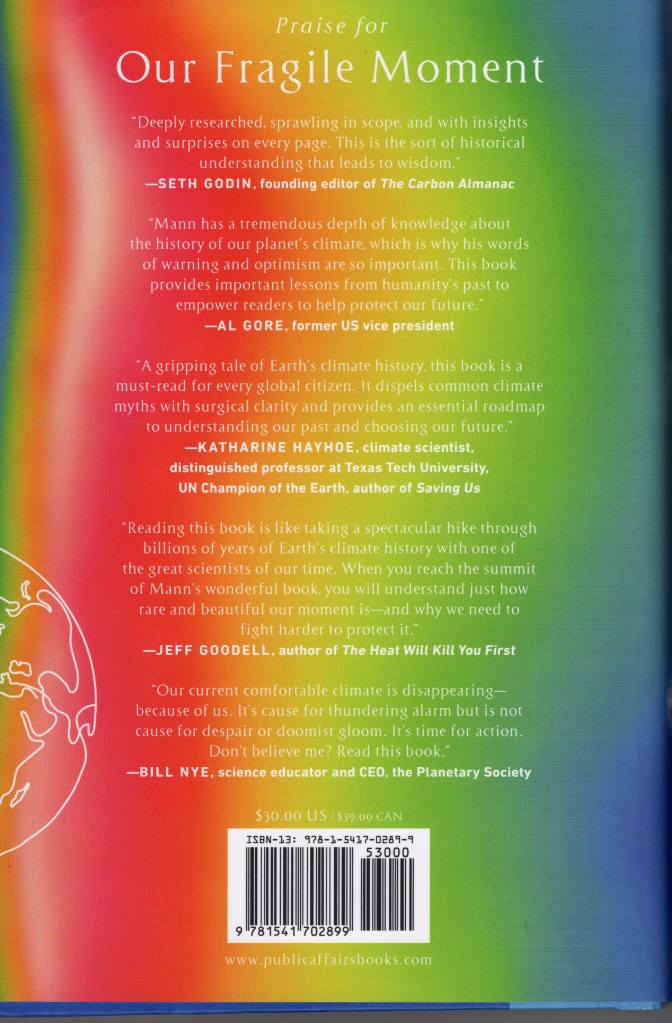
Back cover of Our Fragile Moment: How Lessons from Earth’s Past Can Help Us Survive the Climate Crisis by Michael E. Mann. Click here or the picture to visit the Amazon.com page for the Paperback version of the book.
About the Author
Dr. Michael E. Mann, famous for the hockey stick curve, is Presidential Distinguished Professor in the Department of Earth and Environmental Science at the University of Pennsylvania, with a secondary appointment in the Annenberg School for Communication. He is director of the Penn Center for Science, Sustainability, and the Media (PCSSM).
Dr. Mann has received a number of honors and awards including NOAA’s outstanding publication award in 2002 and selection by Scientific American as one of the fifty leading visionaries in science and technology in 2002. He contributed, with other IPCC authors, to the award of the 2007 Nobel Peace Prize. He was awarded the Hans Oeschger Medal of the European Geosciences Union in 2012. In 2020 he was elected to the US National Academy of Sciences. He is the author of more than 200 peer-reviewed and edited publications and five books. His research involves the use of theoretical models and observational data to better understand Earth’s climate system.
The Silurian Hypothesis
For all science fiction fans, the book also featured an idea that would make a good science fiction story. 55 million years ago there was an exceptionally fast warming of 9 degrees Fahrenheit (5 degrees Celsius) that was in many regards similar to what is happening now. It was not quite an extinction event, that requires more than 75% of all species to be gone in less than 2 million years, but it was catastrophic. This event is referred to as the PETM event. I can add that we are warming the earth at a rate 10 times faster today.
If we were to destroy ourselves what would a future species know about us 55 million years from now? Well, all traces of our civilization would be gone and finding fossils of us would be very likely despite our large population, because fossilization events are extremely rare. What would be left of us are the traces of the global warming we caused and long-lived chemicals such as nitrates from our fertilizers. That’s exactly what the PETM event has left behind, signs of a sharp increase in CO2, global warming and a sudden spike in nitrates that remain unexplained. Could it be that we are not the first intelligent species on earth and that our predecessors caused global warming as well? Well, this was just entertaining speculation, not science, but could there be something to it?
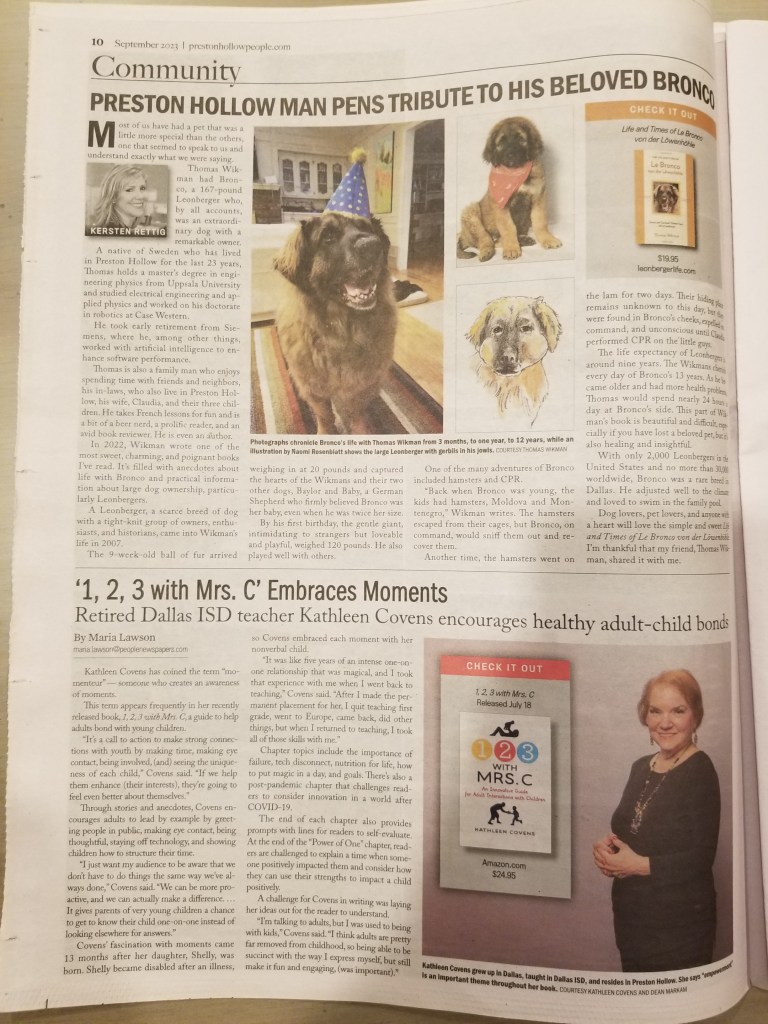
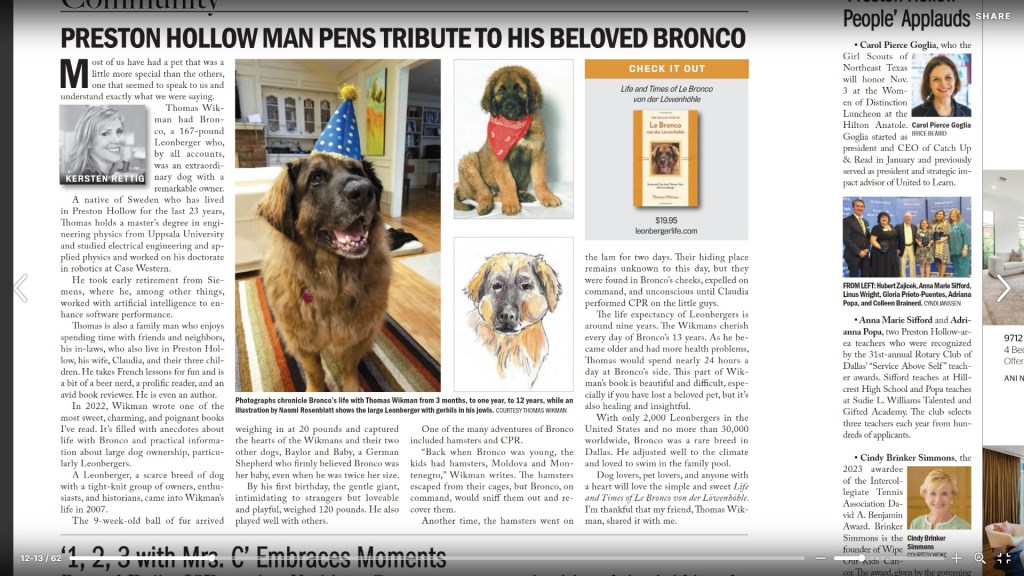
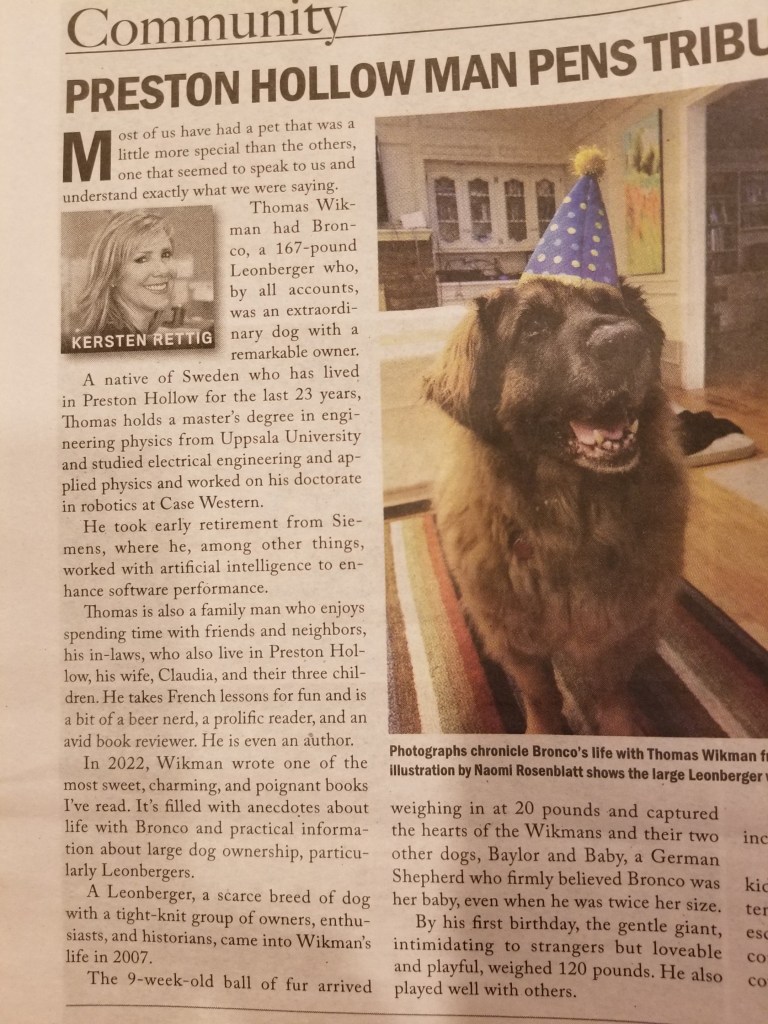
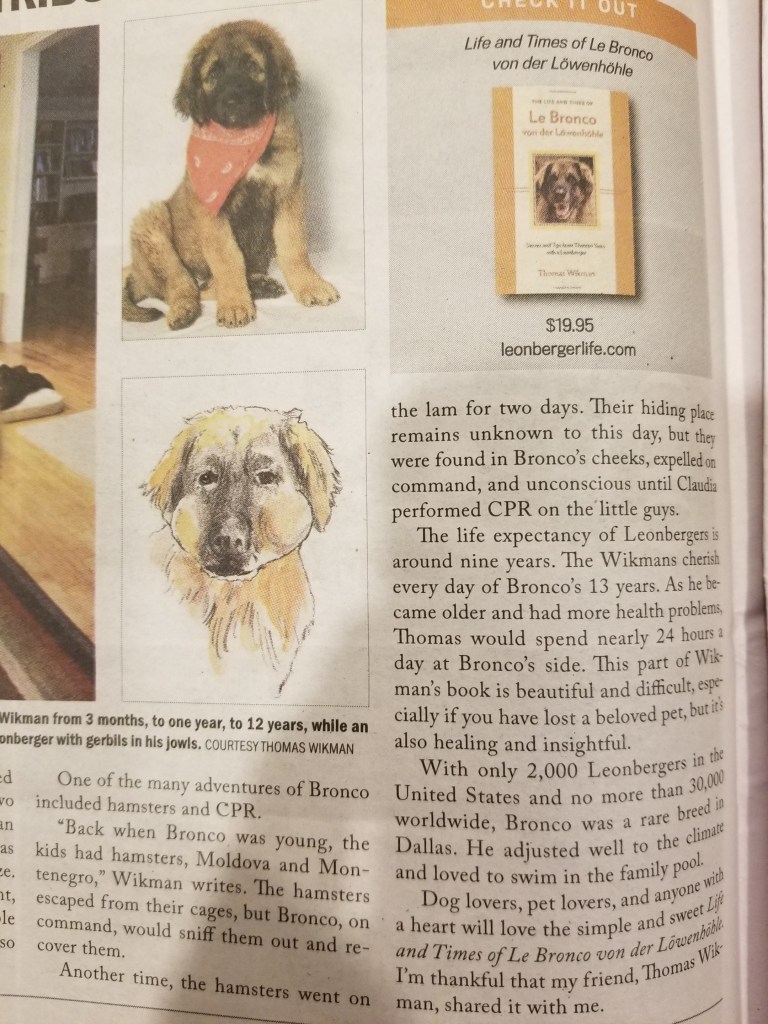
Park Cities People and Preston Hollow People Magazine here in Dallas (Preston Hollow) received 15 awards in this year’s National Newspaper Association Better Newspaper Contest. The National Newspaper Association (NNA), founded in 1885, has over 2,300 members, making it the largest newspaper trade association in the United States. There are slightly more than 100 categories and there is a first price, second price, third price, and an honorable mention, so a bit more than 400 opportunities for an award. Considering that there are 2,300 newspapers I think winning 15 is quite impressive. It is certainly a high-quality magazine. They earned three first-place awards, two second places, five third places, and five honorable mentions. One of the honorable mentions was for Best Book Review. That book review was written by Journalist Kersten Rettig and the book in question was “The Life and Times of Le Bronco von der Löwenhöhle”.
This is a photo of the page of Preston Hollow People Magazine where the review appeared. If you click on the picture (or click here) you can see the online version of the book review in Preston Hollow People Magazine.
A screenshot of another online version of Preston Hollow People Magazine where the review appeared. If you click on the picture (or click here) you can see it online.
It is certainly not my accomplishment. It is the newspaper’s award and Kersten Rettig’s accomplishment, but I am very happy about this for myself as well, since I wrote the book, and that is kind of exciting.
Close up of the review in Preston Hollow People Magazine.Close up of the review in Preston Hollow People Magazine.
I’ve written about this book review before back when it was published in September/October last year (2023). You can click here or here to see those blog posts. Finally, a reminder. To celebrate Bronco’s birthday (July 3rd), for the month of July I am lowering the price of the paperback on Amazon from $19.95 to $17.95 and I am lowering the price of the kindle from $4.95 to $2.95. That applies to all countries. By clicking on the pictures below you can visit the Amazon locations for the book.
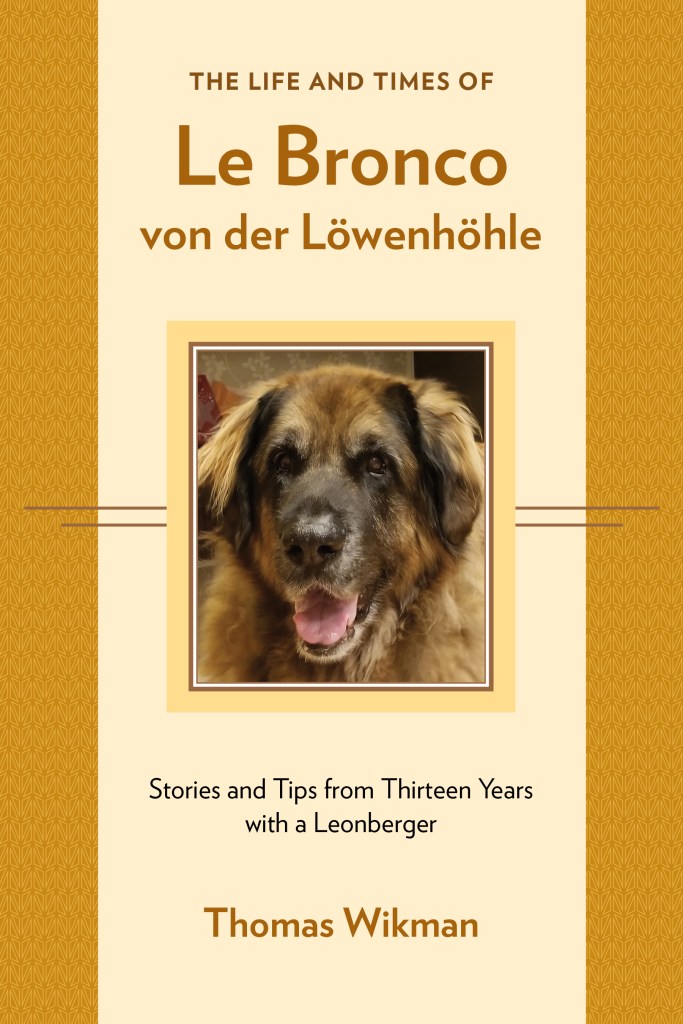
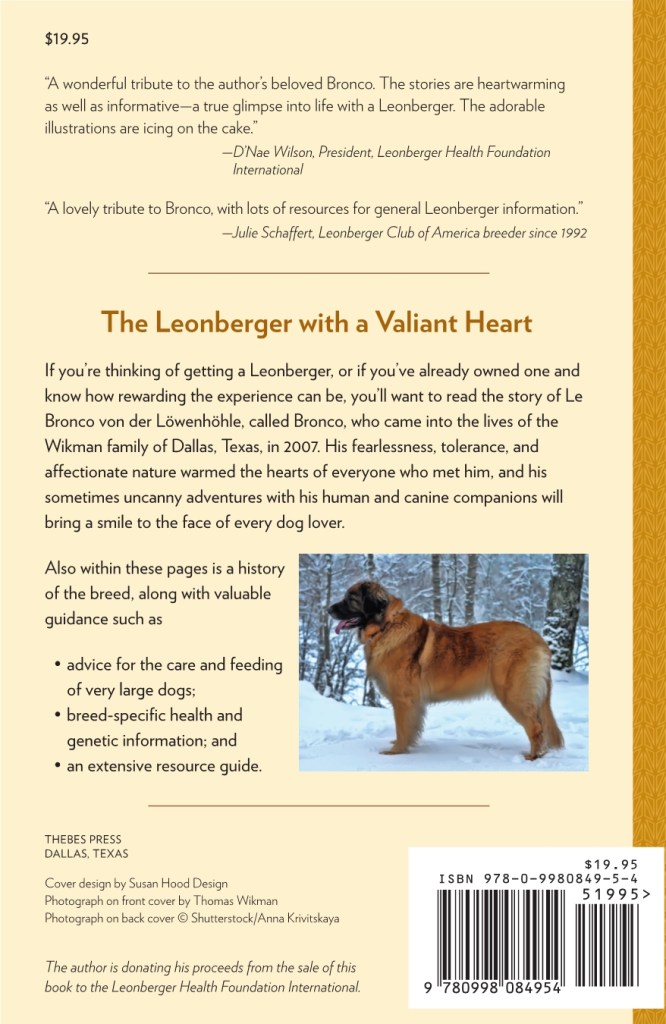
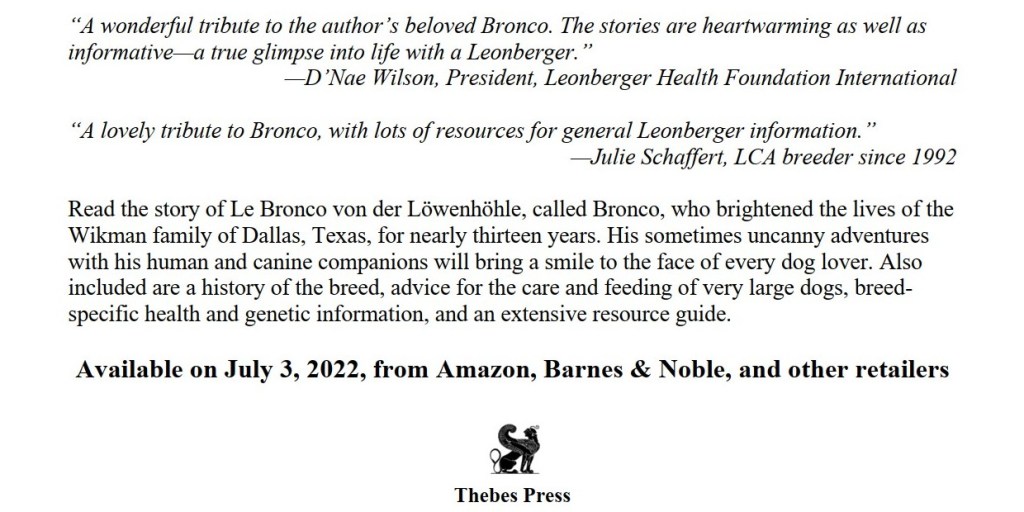
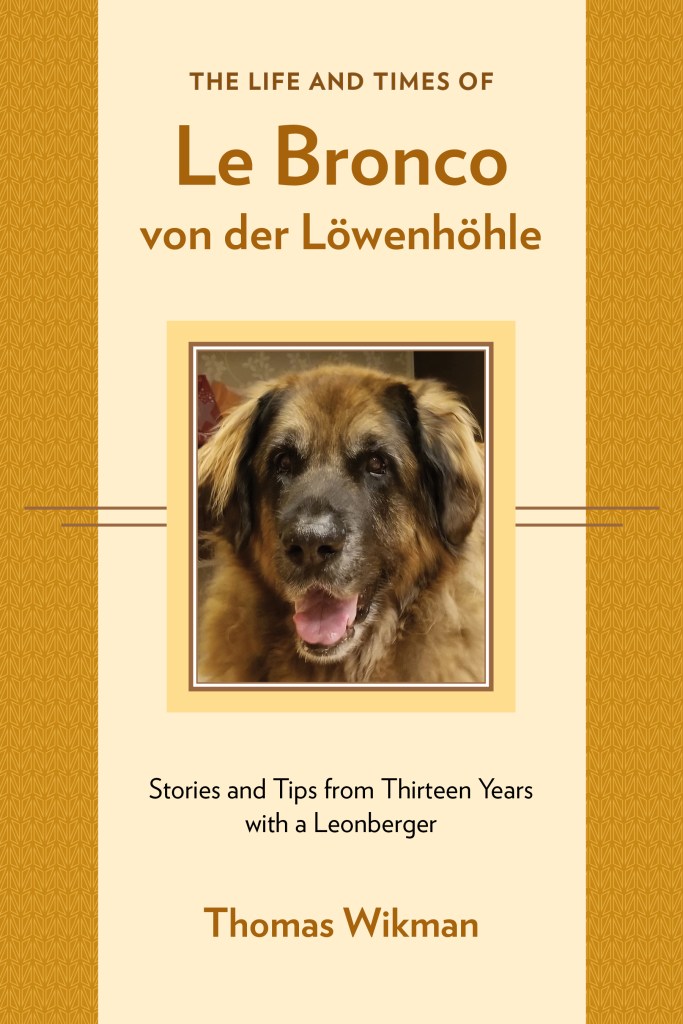
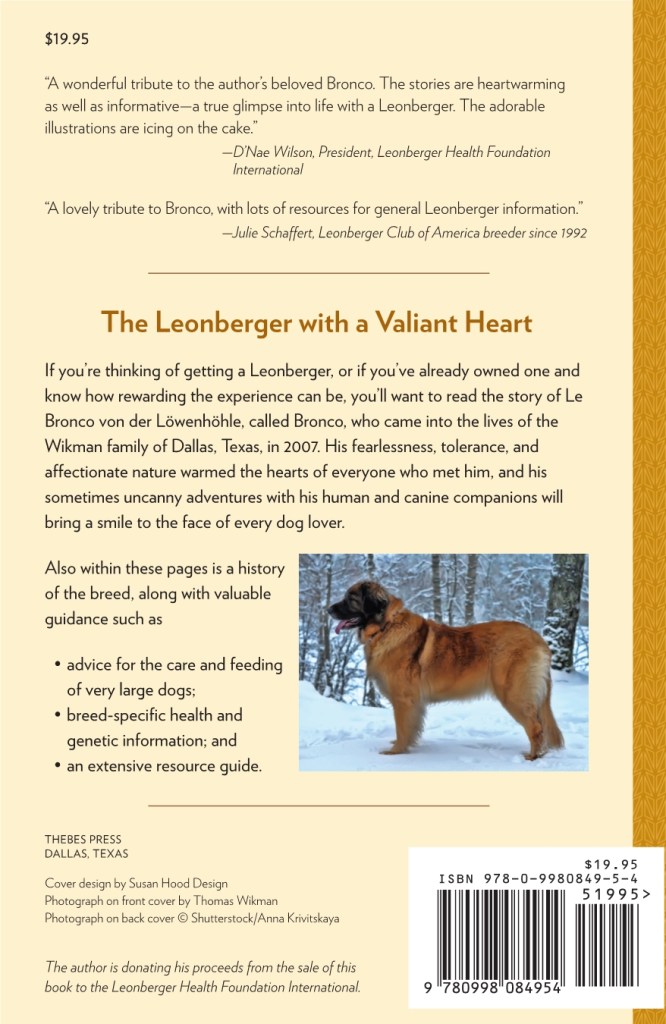
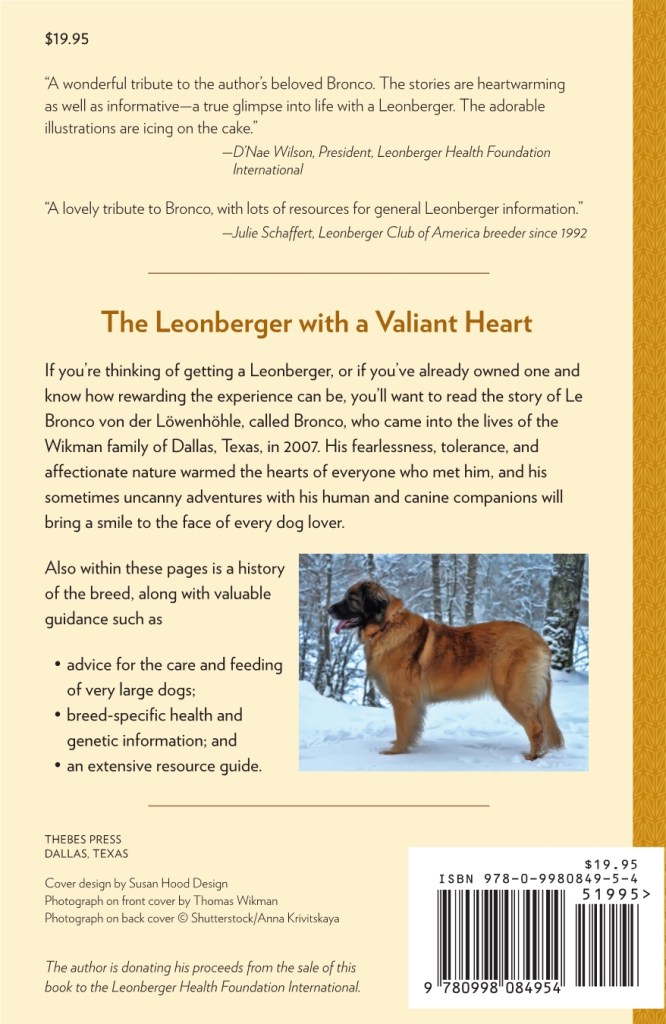
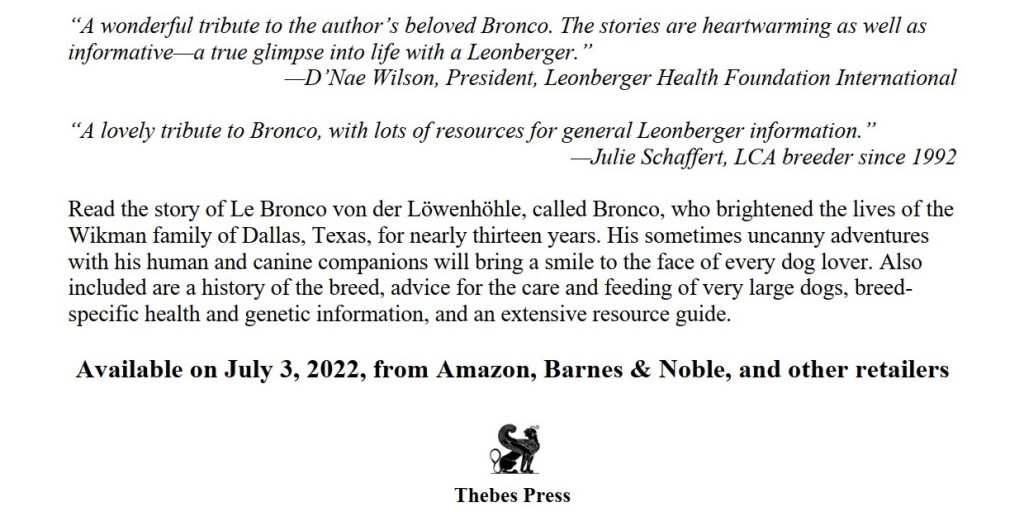
This is the front cover of the book “The Life and Times of Le Bronco von der Löwenhöhle”. Click on the image to go to the Amazon.com location for the paperback version of the book.This is the back cover of the book “The Life and Times of Le Bronco von der Löwenhöhle”. Click on the image to go to the Amazon.com location for the kindle version of the book.These are the endorsements for the book. Click on the image to go to the Barnes and Noble location for the book.
Below is a list of places where you can get my book.
I was overjoyed to see this very supportive and beautifully written review of my book “The Life and Times of Le Bronco von der Löwenhöhle.” It is detailed and filled with helpful information. Please take a look at this blog post.
The focus of this blog is Leonbergers but sometimes I post about books that are not about Leonbergers but are books that I love, and I therefore want to promote. This time I would like to promote All the Words I Kept Inside by P.J. Gudka – July 9, 2024. In this book P.J. Gudka, or Pooja, lets out her innermost feelings utilizing enchanting and beautiful poetry and it ends up being quite powerful. I bought the Kindle edition.
Paperback – Publisher : Wild Ink Publishing (June 29, 2024), ISBN-10 : 1958531650, ISBN-13 : 978-1958531655, 112 pages, Item Weight : 4.7 ounces, dimensions : 5 x 0.26 x 8 inches, it currently cost $ $19.99 on US Amazon. Click here to order it from Amazon.com.
Kindle – Publisher : Wild Ink Publishing (July 9, 2024), ASIN : B0D42BHQQ8, 113 pages. It is currently $6.99 on Amazon.com. Click here to order it from Amazon.com.
Front cover of All the Words I Kept Inside Kindle Edition by P.J. Gudka. Click on the image to go to the Amazon page for the book.
Amazon’s description of the book
What is your truth? What is your secret? What secrets are you keeping from the world that you hope one day you will be brave enough to tell? When will you tell your heart? All The Words I Kept Inside allows you this moment.
This collection of poetry urges you to look deeply inside and confront your darkest thoughts. It takes that inner dread, disappointment, and heartache to reveal the words of the heart. This book will show you that you are not alone. That you are understood. That you don’t have to go through these dark moments on your own because so many of us experience them too. The words found inside will reach out a hand and guide you.
This is your moment.
This is your truth that you’ve never told anyone.
The words see you.
From the very earliest moments, the words know…
“All the words I kept inside. In you, I now confide…”
The Girl Who Fell in Love with the Monster Under Her Bed
It’s OK to mourn the person you were. Even if you love the person you are now. That was one of the phrases in this book. This book features beautiful and deeply moving poems. They are often dark and sad, and while reading it I couldn’t help but recalling the phrase from the song “the sound of silence”, “Hello darkness my old friend I’ve come to talk with you again”. The author put her innermost feelings and angst into poems using enchanting word formations and rhymes. The poems were dark but also full of wisdom, truth and beauty. As soon as my kindle book was made available to me, I started reading it and I could not stop. The poems were so intriguing and powerful. Reading this book was a very special experience. I highly recommend this beautiful book of poetry.
About the Author
P. J. Gudka is a writer, blogger and freelancer currently working from Kenya. Her journey as a blogger began when she created her multi-niche blog, Lifesfinewhine, as a teenager, to share her experiences with life, mental health, travel and more. Since then, her blog has captured the interest of thousands of people around the world and is now her full-time passion.
Her writing has been published in books like Hidden In Childhood: A Poetry Anthology and Glow: Self-Care Poetry For The Soul as well as multiple magazines.
Our late Leonberger Bronco’s birthday was a few days ago, and so was the two years anniversary of the release of my book about him. It is a special occasion and therefore I’ve decided to have a promotion for the month of July. I lowered the price of both the paperback and the kindle version on Amazon by two dollars in all countries (or close to two dollars). For the United States I lowered the price of the Kindle version from $4.99 to $2.99 and for the paperback from $19.95 to $17.95. In Sweden I lowered the price from 180 Swedish Crowns to 150 Crowns or 159 Crowns with VAT.
This is the front cover of the book “The Life and Times of Le Bronco von der Löwenhöhle”. Click on the image to go to the Amazon.com location for the paperback version of the book.
This is the back cover of the book “The Life and Times of Le Bronco von der Löwenhöhle”. Click on the image to go to the Amazon.com location for the kindle version of the book.
If you’re thinking of getting a Leonberger, or if you’ve already owned one and know how rewarding the experience can be, or if you are just a dog lover, then you’ll want to read the story of Le Bronco von der Löwenhöhle, called Bronco, who came to live with us in Dallas, Texas, in 2007. Bronco, a recipient of the Leonberger Health Foundation International’s Grey Muzzle Award, lived an unusually long life for a Leonberger—almost thirteen years. We believe that what helped him exceed his breed’s normal life expectancy was his brave and loving heart.
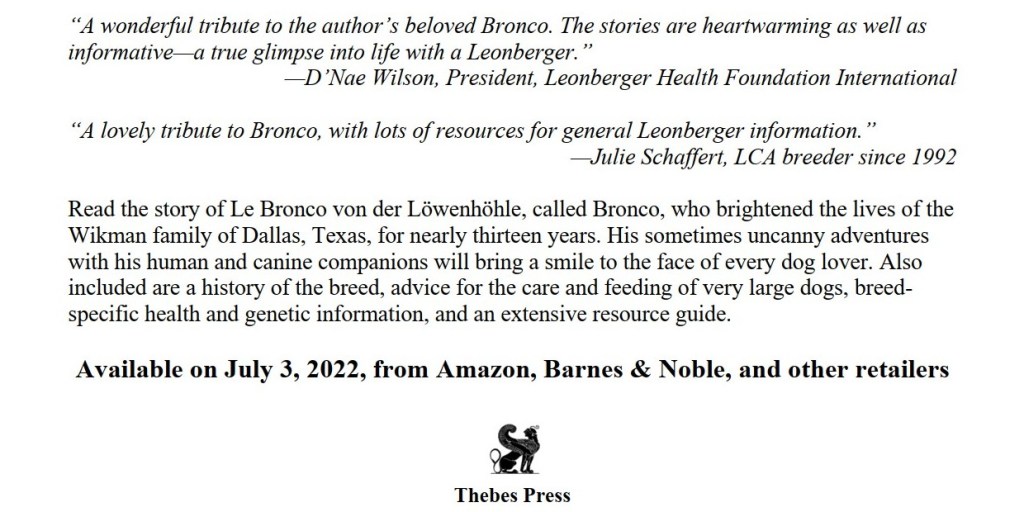
These are the endorsements for the book. Click on the image to got to the Barnes and Noble location for the book.
In this book you’ll read about some of Bronco’s amazing feats: the night he scared away a prowler; the day he performed a hamster search and rescue; the time he stumped the Geek Squad; and the late night he snuck into the kitchen and ate a two-pound bag of dog treats, a box of pastries, a loaf of bread, a grilled chicken, and a Key lime pie, all in one sitting. You’ll also read about his unflappable calm during a north Texas tornado and his stoicism as he endured health challenges in his later years.
In addition to entertaining stories, these pages contain a wealth of practical guidance, including:
a history of the Leonberger breed;
advice for the care of very large dogs;
breed-specific health and genetic information;
training and feeding tips;
suggestions for finding a breeder;
the official breed standard; and
an extensive resource guide.
Bronco’s fearlessness, tolerance, and affectionate nature warmed the hearts of everyone who met him, and his sometimes uncanny adventures with his human and canine companions will bring a smile to the face of every dog lover.
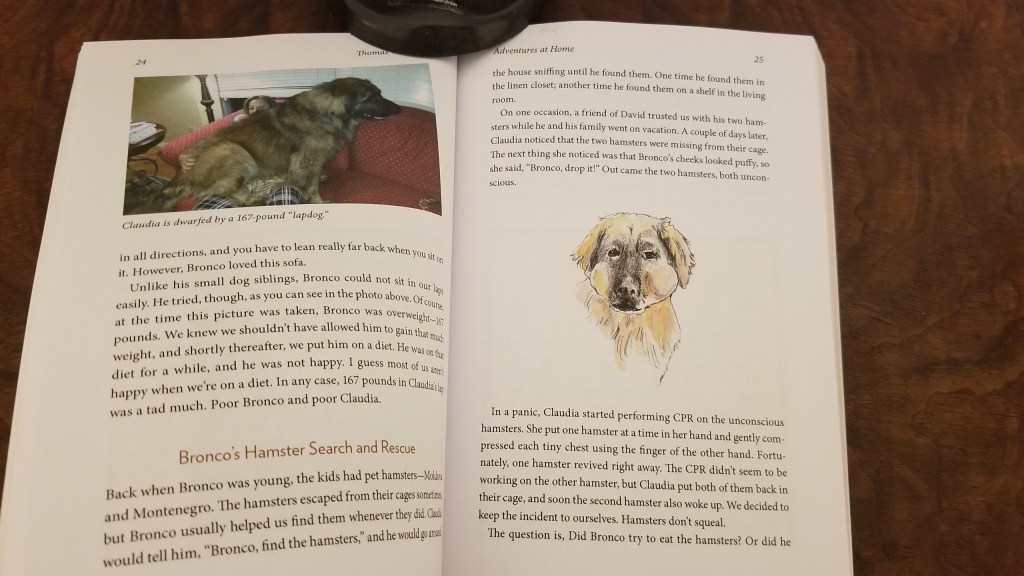
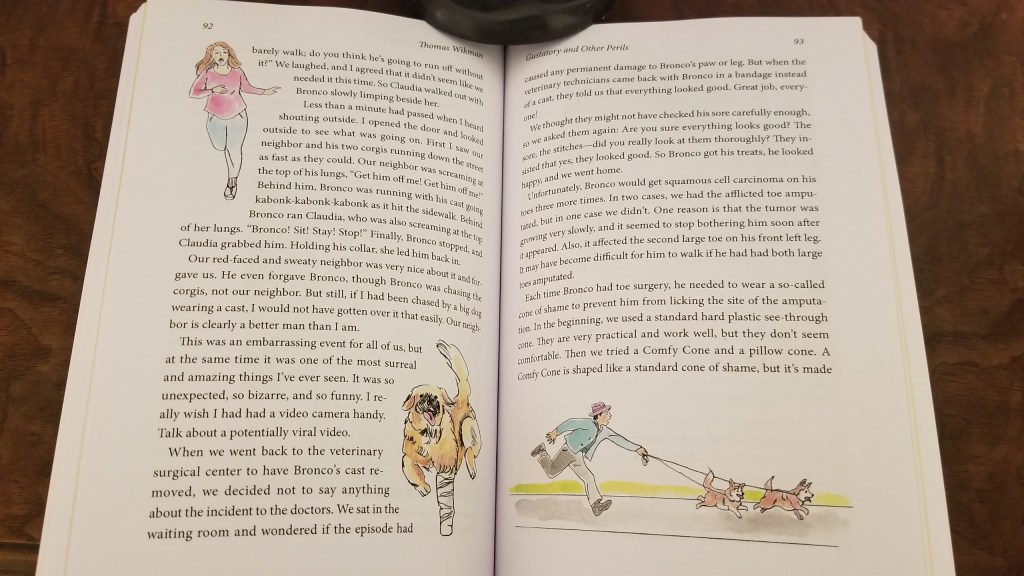
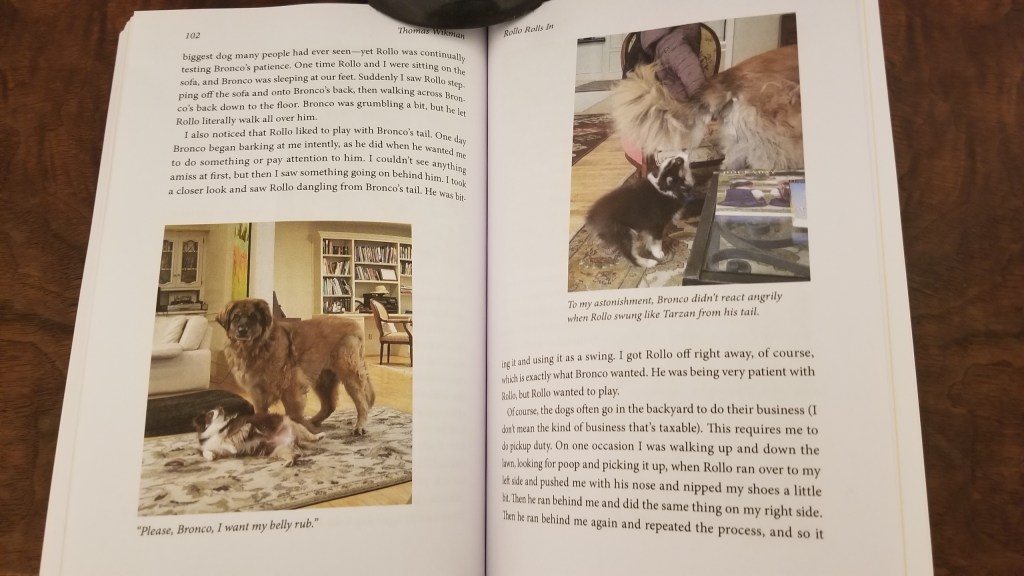
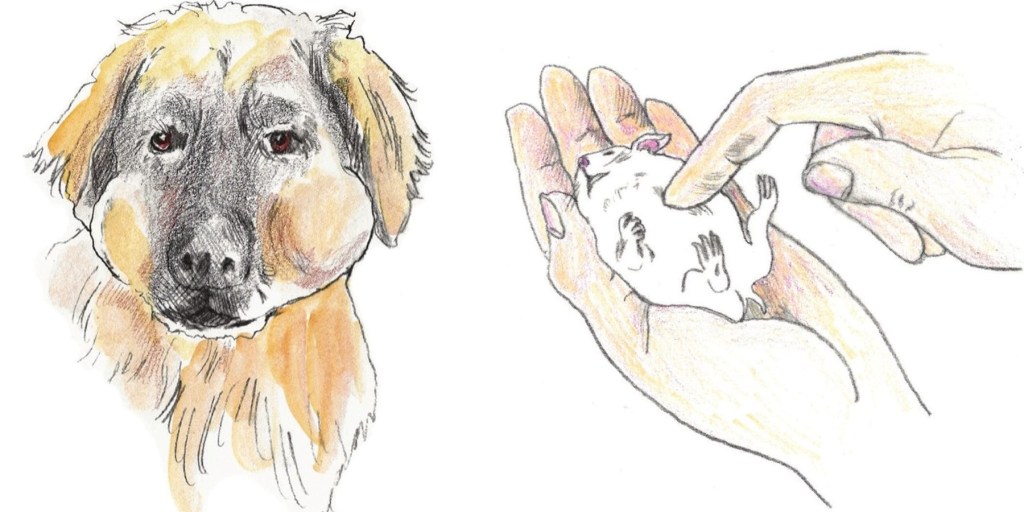
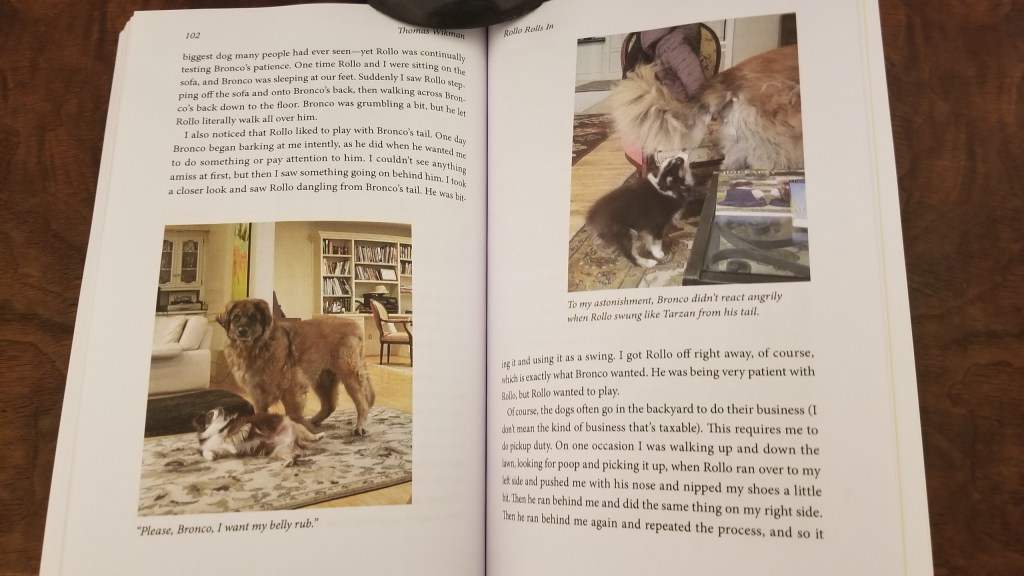
This is a sample spread from my book (The Life and Times of Le Bronco von der Löwenhöhle). It is page 24 and 25. The illustration (by Naomi Rosenblatt) showing Bronco with puffy cheaks depicts him holding two rescued hamsters in his mouth.This is another sample spread from my book. It is page 92 and 93. The spread contains the story about when Bronco was chasing our nice neighbor while wearing full leg cast, despite the fact he was not supposed to bump it. The illustrations were made by Naomi Rosenblatt.This is another sample spread from my book. It is page 102 and 103. The other dog is our mini-Australian Shepherd Rollo.
Below is a list of places where you can get my book.
An economic externality or external cost is an indirect cost or benefit to an uninvolved third party that arises as an effect of economic activities. They are unpriced components of market transactions. An example is the gasoline you buy. Burning the gasoline causes pollution that harms other people including those who do not own cars, future generations, and it harms the environment including animals. Society incurs a cost from that pollution that you don’t pay for at the pump. The gasoline producers and vendors do not pay for it either. Unless you add a tax or make other adjustments the act of polluting is free of charge, even though there is a real cost associated with it. It is a cost that is invisible to unfettered “free markets”. It is a market failure. Note I am putting “free markets” in quotes because the free market does not exist all by itself. It exists within a framework of societal norms, culture, laws, a banking system, and entities such as limited liability corporations, etc.
Pollution is an example of a negative externality. Photo by Chris LeBoutillier on Pexels.com
The existence of economic externalities is entirely uncontroversial among economists, including laissez-faire (libertarian) economists such as Milton Friedman, Friedrich Hayek, and Ludwig von Mises, even though Ludwig von Mises said that they arise from lack of “clear personal property definition.” In fact, Milton Friedman, Nobel prize winner in economics, and leading anti-tax champion, stated that pollution met the test for when government should act, but that when it did so, it should use market principles to the greatest extent possible — as with a pollution tax. However, in my experience the existence of economic externalities is unwelcome news to market fundamentalists who lack education in economic science, including many libertarian leaning politicians. If you bring up the subject you might be dismissed, scoffed at, or labeled as a leftist. I don’t have a Gallup poll to back this up, but I believe it is correct to say that economic externalities are controversial among significant portions of the public despite being a universally accepted and fundamental concept of economic science.
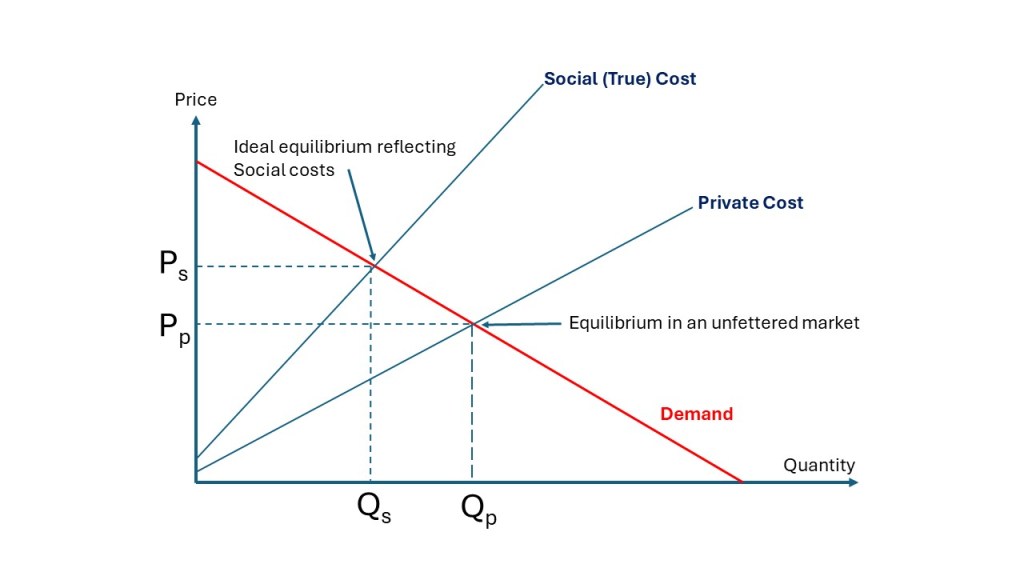
This simplified supply and demand graph shows two different graphs in blue. One for the private/production cost per unit of a goods and a second that also includes the cost of the externality.
In the simple supply-demand graph above we see how the price of a product per unit (private cost / or production cost) increases with the increased quantities produced. The increase in price could be because resources become increasingly scarce as more must be produced. The curves are typically not simple straight lines like this. It is just an illustration. As the price goes up demand goes down (the red demand curve/line) because fewer people want to buy the product or can afford the product. An equilibrium is reached where the curves meet. According to classical economics (micro-economics classes, or macro-economics classes) this equilibrium represents the optimum benefit for society assuming consumers and producers are perfectly rational (with respect to their self-interest) and there are no externalities.
Unfortunately, in this example, there is an externality and as we know the unfettered free market does not account for it. Let’s say that we know the cost of the externality and we find a way of adding that cost to the price, perhaps via a tax. The price is higher and fewer units will be sold and we have a new equilibrium. Now the economically optimal point is the ideal equilibrium that reflects social cost. In the 1920’s an economist Arthur Pigou argued that a tax, equal to the marginal damage or marginal external cost on negative externalities could be used to reduce their incidence to an efficient level. Notice this tax is not for redistributing wealth or bringing revenue for the government but to reduce economic harm to society. There are other ways to address the problem, but this type of tax is called a Pigouvian tax.
How a Pigouvian tax can reduce economic harm to society. Photo by Pixabay on Pexels.com
Finally, I would like to give a few examples of negative and positive externalities. Negative externalities could be :
Pollution
Climate Change
Depletion of fish due to overfishing
Depletion of other resources
Overuse of antibiotics
Spam email
Some positive externalities are :
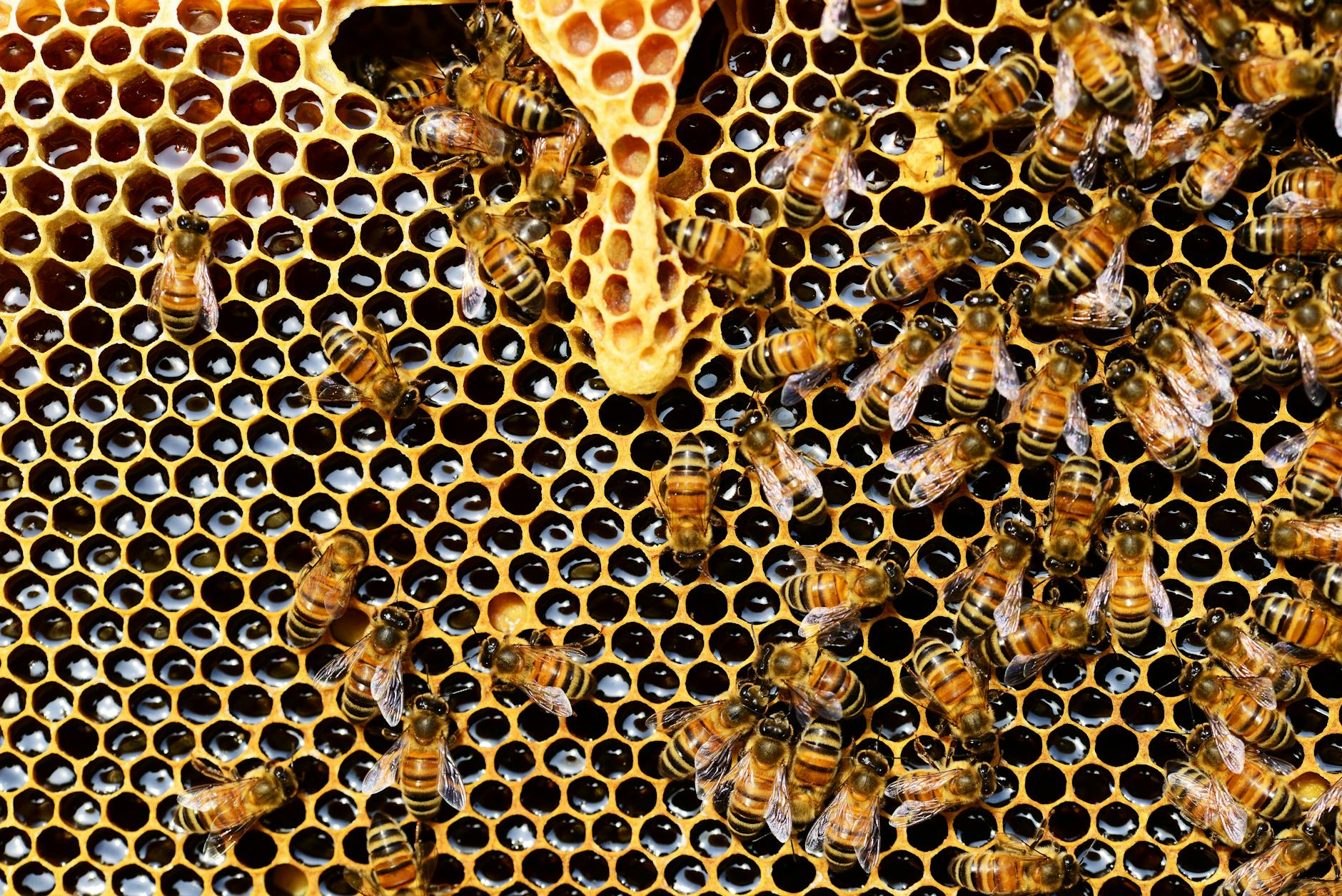
A beekeeper keeps the bees for their honey, but a side effect or externality is the pollination of surrounding crops by the bees.
Education (societal benefits beyond the individual).
Research and development
Innovations
Scientific discoveries
Vaccination
When a beekeeper keeps bees for their honey, a side effect is the pollination of surrounding crops by the bees. This is an example of a positive externality.. Photo by Pixabay on Pexels.com
As I previously mentioned I would like to launch a second blog featuring small facts or insights that are widely disbelieved despite being known to be true by the experts in the relevant field or facts that are very surprising or misunderstood by a lot of people. These facts shouldn’t be trivia but important facts that are somewhat easy to understand despite their status as being unthinkable to many. They are not scientific theories or complex sets of facts or information, but facts that you can easily state. I’ve decided to call these facts super facts (is that a stupid name?). This is the last super fact I am posting on my Leonberger blog. I will create a list of hundreds of super facts but that is for my upcoming blog. To see the other four super fact posts so far check the list below:
As I previously mentioned I would like to launch a second blog featuring small facts or insights that are widely disbelieved despite being known to be true by the experts in the relevant field or facts that are very surprising or misunderstood by a lot of people. These facts shouldn’t be trivia but important facts that are somewhat easy to understand despite their status as being unthinkable to many. They are not scientific theories or complex sets of facts or information, but facts that you can easily state. They may be part of a scientific theory, or a result of an established scientific theory but not an entire scientific theory. I’ve collected hundreds of these facts because to me they seem to be extraordinarily important. They are worldview altering facts, big shocking facts to some, facts that many people deny regardless of the evidence, super-facts if you will.
In a previous post I discussed that despite the fact that the scientific community states that Earth is 4.5 billion years old and that humans evolved over millions of years a 2019 Gallup poll, showed that 40% of US adults believe that God created humans in their current form within the last 10,000 years. The evidence proves that this 40% of the population is wrong. The scientists aren’t guessing. They make their claim that earth is 4.5 billion years old based on a lot of strong evidence. Evidence which is unknown to a lot of people. In this post I am discussing a fact that once was widely disputed but today is more just surprising or not understood by many and that is that the speed of light in vacuum is a universal constant.
No matter how fast you travel, what direction, or where you are you will measure the speed of light compared to yourself to be c = 299,792,458 meters per second or approximately 186,000 miles per second or 671 million miles per hour.
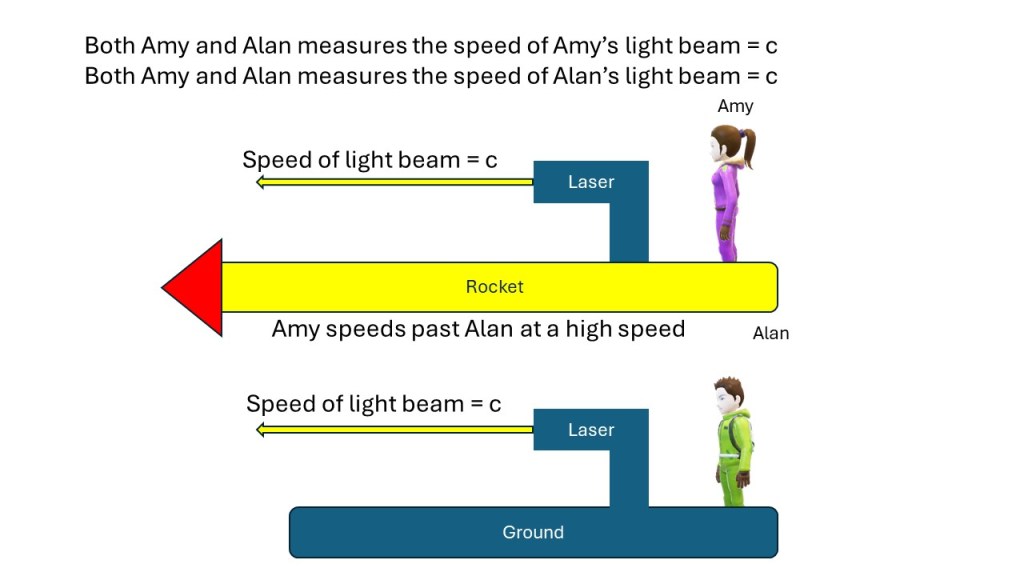
In this picture Amy is traveling past Alan in a rocket. Both have a laser. Both measure the speed of both laser beams to be c = 299,792,458 meters per second.
In the picture above let’s say Amy is flying past Alan at half the speed of light. If you believe Alan when he says that both laser beams are traveling at the speed of c = 186,000 miles per second, then you would expect Amy to measure her laser beam to travel at a speed that is half of that c/2 = 93,000 miles per hour, but she doesn’t. She measures her laser light beam to travel at the speed of c = 186,000 miles per second just like Alan. This seems contradictory. The solution that the special theory of relativity offers for this paradox is that time and space are relative and Amy and Alan measure time and space differently (more on that in another post).
Time is going to be different for me. From shutterstock Illustration ID: 1055076638 by andrey_l
I should add that the realization that the speed of light in vacuum is a constant regardless of the speed or direction of the observer or the light source was a result of many experiments, which began with the Michelson-Morley experiments at Case Western Reserve University, Cleveland, Ohio in the years 1881-1887. At first scientists thought that there was an ether that compressed the experimental equipment and distorted clocks so that it seemed like the light vacuum always came out the same. With the special theory of relativity in 1905 those speculations were laid to rest.
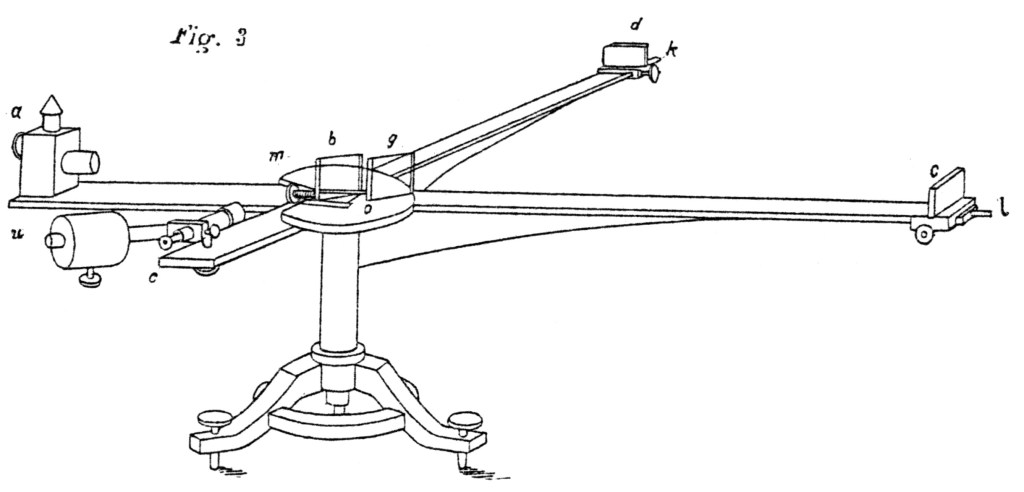
The first Michelson-Interferometer from 1881. It was used to measure the speed difference of two light beams (well a split light beam) with a very high accuracy (for the time). The light traveled with the same speed in all directions and no matter what earth’s position and speed was in its orbit around the sun. This picture is taken from Wikipedia and is in the public domain of the United States.
The speed c = 299,792,458 meters per second is a universal speed limit created by time and space
I should point out that there is nothing magical about the speed of light in a vacuum. Light traveling through matter, like glass or water, does not travel at this speed c, but slower. It also isn’t entirely correct to say that the speed of light in vacuum is a universal constant, because it isn’t about light per se. What is happening is that light traveling completely unimpeded through vacuum is prevented from traveling infinitely fast by the way time and space is set up. All massless particles / radiation, or anything that hypothetically could be traveling at an infinite speed is prevented from doing that because of the way time and space are related. Light in vacuum just happened to be what we first discovered to be restricted by this universal speed limit. Yes, time and space are annoying that way, putting a limit on the speed of light and on massless particles.
So how is time and space arranged to cause this universal speed limit? Well, that is an even more surprising blog post for another day (I will link to it once I have made the post). From this discovery about time and space came a lot of other interesting realizations but that is also for another post, but let’s just give a brief summary:
Time for travelers moving fast compared to you is running slower.
Length intervals for travelers moving fast compared to you are contracted.
Simultaneous events may not be simultaneous for another observer.
The order of events may be reversed for different observers.
If you accelerate to a speed that is 99.999% of the speed of light you still haven’t gotten any closer to the speed of light from your perspective. Light in vacuum will still speed off from you at c = 186,000 miles per second.
Acceleration will get harder the closer you get to the speed of light in vacuum. The force required will reach infinity as you approach the speed of light in vacuum.
Forces, the mass of objects, momentum, energy and many other physical quantities will reach infinity as you approach the speed of light in vacuum assuming you are not a massless particle.
Mass is energy and vice versa E = mc2
Magnetic fields pop out as a relativistic side-effect of moving charges.
Mass is energy and vice versa, a direct result of the way time and space are related. Stock Photo ID: 2163111377 by Aree_S
How do you feel about time and space creating this universal speed limit in which light in vacuum travel?
Our Leonberger Bronco was born in British Columbia, Canada (nearby Vancouver), on July 3rd, 2007. That was 17 years ago today. His full name was Le Bronco von der Löwenhöhle. His father’s name was Priamos Vom Dreiburgenland and his mother’s name was Justus Aria Von Drevas. He had four full siblings, or twins, Little Jonah, Love Ryan, LRV’s Moose, and Lakeisha Makita. That was his litter. Notice that all names begin with an ‘L’. He had 83 siblings in total. The breeder’s name was Julie Schaffert, who is a Leonberger Club of America certified breeder (since 1992), and arguably North America’s most prominent breeder.
Bronco’s entry in the Leonberger Data Base. Click on the picture to visit the Leonberger Data Base.
About 8-9 weeks later he came to Dallas, Texas to be with his new family. That was us. 13 years later he passed away. The name we picked for him was Bronco. However, we were told that his name needed to begin with an ‘L’, so my wife said, “Let’s do Le Bronco”, intending it to be “Le Bronco”. It took us several years to change his name from “Lets Do Le Bronco”, which also begins with an ‘L’, to “Le Bronco”.
Bronco’s original birth certificate from LCA (Leonberger Club of America). His name at this time was “Lets Do Le Bronco von der Löwenhöhle”.Close up of his name, which incorrectly was “Lets Do Le Bronco von der Löwenhöhle”.Bronco at the age of three months and at the age of almost 13.
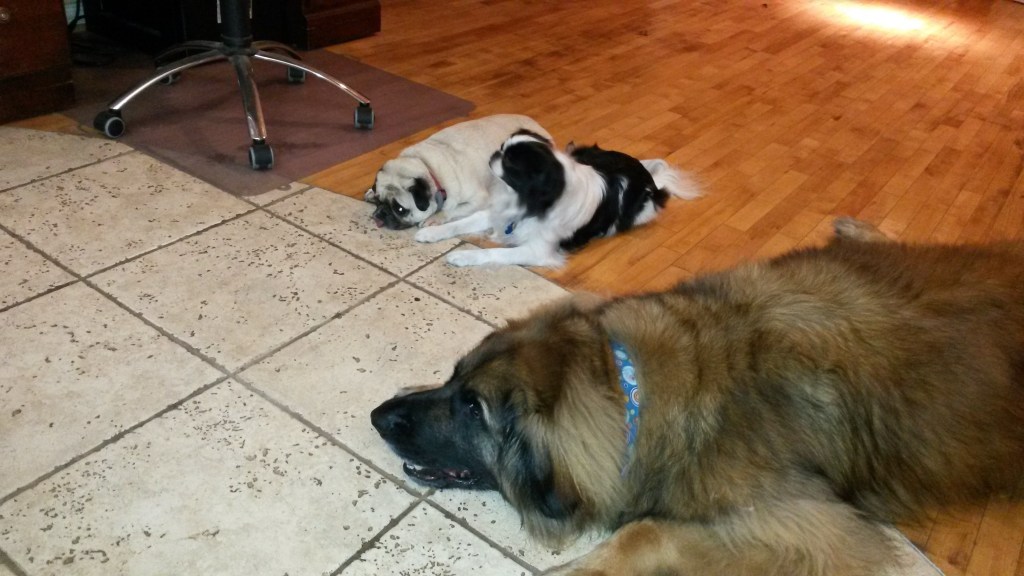
Bronco quickly grew to become a big dog. At one point he was 167lbs but his ideal weight was 135lbs. When he joined our family, we had two other dogs, a Labrador (or Labrador mix) called Baylor and a female German Shepherd called Baby. Baby was like a mother to Bronco, and she was fiercely protective of him. We would soon get two more dogs, a Japanese Chin called Ryu and a pug called Daisy. Once Bronco was older, we would get one more dog, a mini-Australian Shepherd called Rollo. Bronco loved all the other dogs, and he was very protective of them. He saved the life of our Labrador by sniffing out an oncoming insulin shock and he saved our pug Daisy from an attacking German Shepherd.
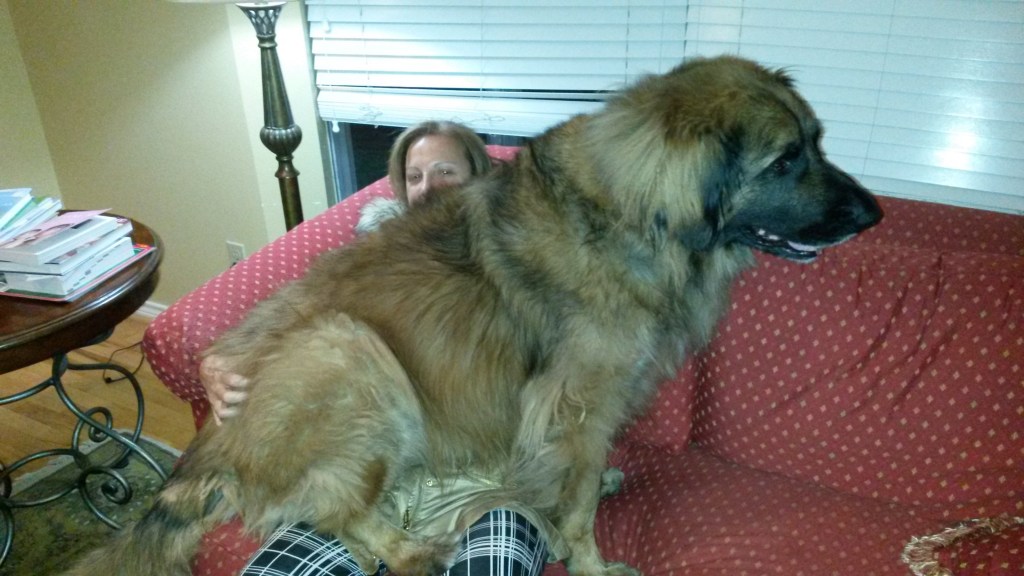
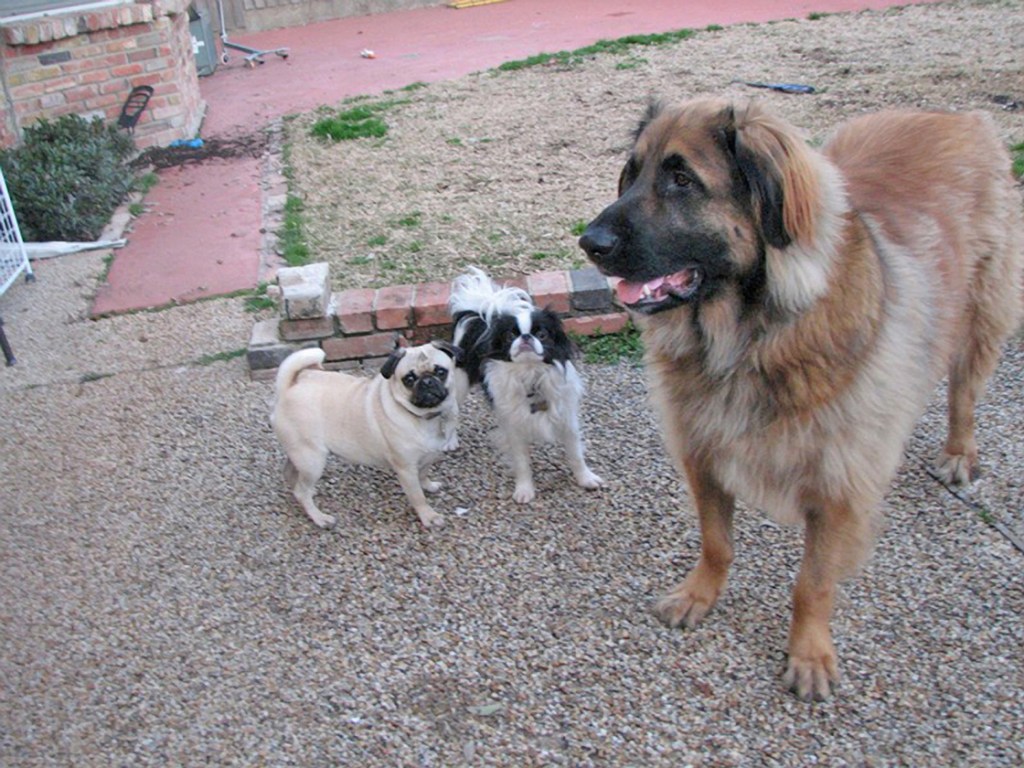
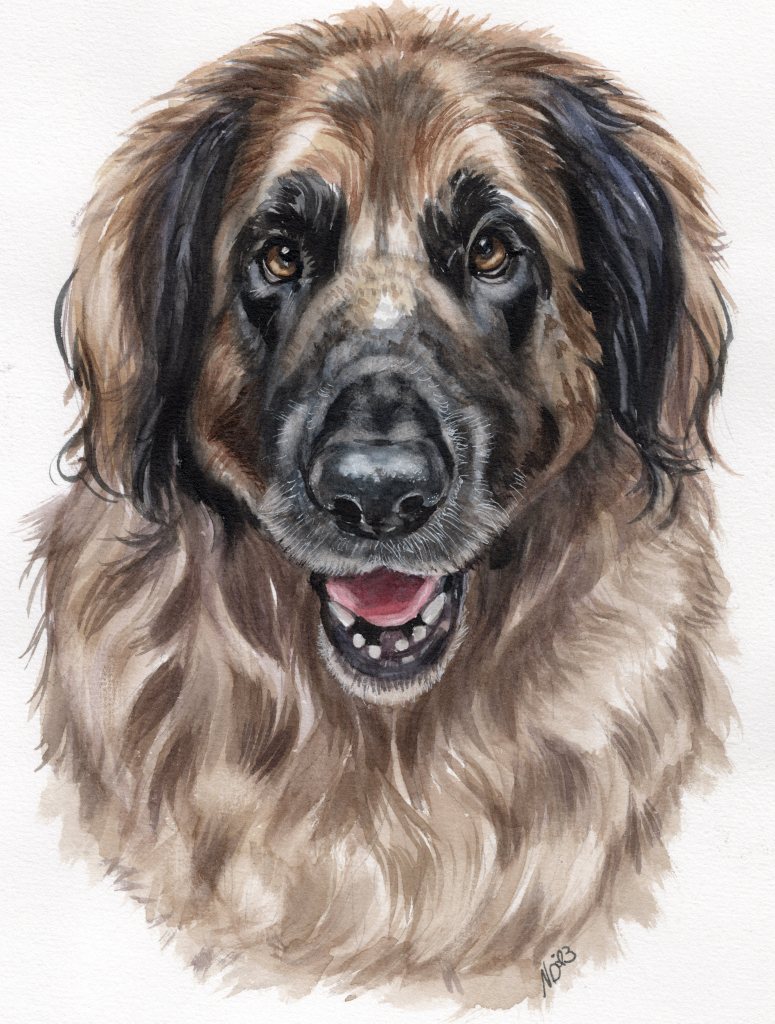
This is Bronco and me. He is about one year old. Not yet fully grown but still big.Bronco when he was 167lbs sitting in my wife’s lap. He went on a diet after this photo.Bronco with our pug Daisy and Japanese Chin Ryu.Bronco with our pug Daisy and Japanese Chin Ryu again.The portrait was drawn by Veniceme at Etsy (Natasha Dall’Ara) and it is based on one of our photos.
One thing that we are proud of is that Bronco lived very long for a Leonberger. The typical lifespan for a Leonberger is 8-10 years. Giant breeds tend to have a short lifespan. The Leonbergers who live at least 12 years are awarded the so-called Grey-Muzzle Award by the Leonberger Health Foundation International, and Bronco was a recipient. The Leonberger Health Foundation International (LHFI) is supporting research that aims to solve health issues in Leonbergers and other giant breeds. All proceeds from the sale of my book are donated to the Leonberger Health Foundation International. I can add that when Bronco passed away, we sent his DNA to the University of Minnesota to be used in research. This was facilitated by the LHFI.
Bronco was a very special dog, and he also gave us many amusing stories. Some of the stories were great, like when he chased off a trespasser / peeping Tom who had been terrorizing my wife and the other women in the neighborhood, but that the police and the private detectives I hired could not catch. Or when he saved runaway hamsters or saved the lives of other dogs. He also gave us some embarrassing stories, such as when he put our neighbor’s head in his mouth, like the circus lion trick, or pushed our German Shepherd into a storm drain. After Bronco passed, I decided that the world needed to know about Bronco, so I wrote a book about him. It is a tribute to him as well as a collection of funny stories. I also added information about Leonbergers in the book, their origins, care, training, health, etc.
Bronco is chasing off a trespassing peeping Tom who had been terrorizing the women in the neighborhood at night. Illustration by Naomi Rosenblatt.Bronco with hamsters in his mouth. When he dropped them, they were unconscious, so my wife gave the hamsters CPR. They were fine. Illustration by Naomi Rosenblatt.Bronco acting wild pushing our German Shepherd into a storm drain. I am trying to get her up. Illustration by Naomi Rosenblatt.
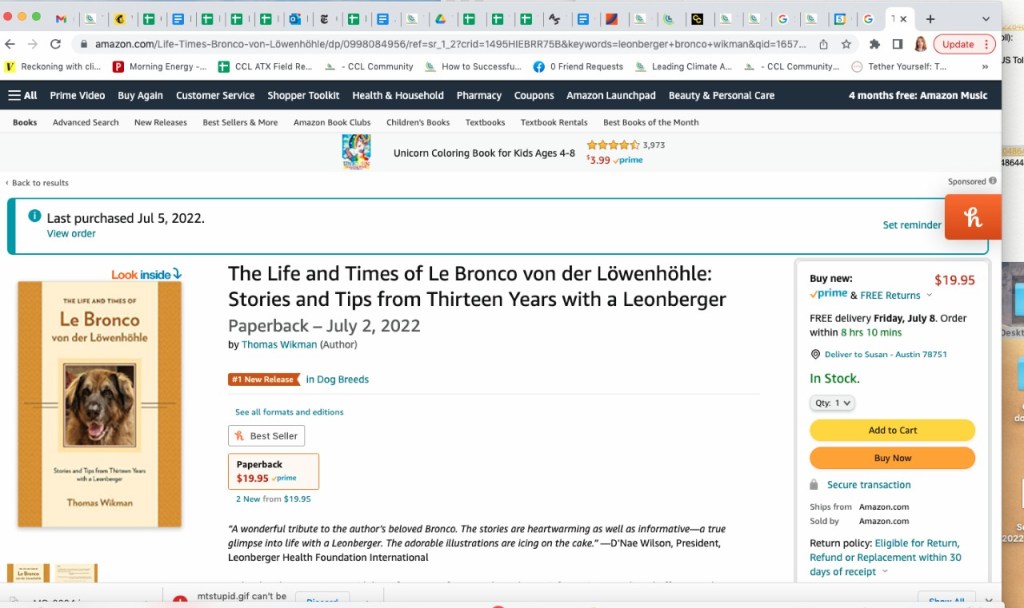
Finally, I would like to give an overview of my book about Bronco and Leonbergers. I intended to release the Book on July 3rd, 2022, on what would have been Bronco’s 15th birthday. However, Amazon was quicker than I expected. The Kindle version became available on the day I uploaded it July 1st, 2022, and the paperback version July 2nd, 2022, but I did not tell people about it until July 3rd. Well today it is July 3rd again. To read more about my book click here.
In July of 2022 my book was the number one new release on American Amazon in the category “dog breeds”This is a sample spread from my book (The Life and Times of Le Bronco von der Löwenhöhle). It is page 102 and 103. The other dog is our mini-Australian Shepherd Rollo.This is the front cover of the book “The Life and Times of Le Bronco von der Löwenhöhle”. Click on the image to go to the Amazon.com location for the paperback version of the book.This is the back cover of the book “The Life and Times of Le Bronco von der Löwenhöhle”. Click on the image to go to the Amazon.com location for the kindle version of the book.These are the endorsements for the book. Click on the image to got to the Barnes and Noble location for the book.
If you haven’t already, please take a look at my book
The focus of this blog is Leonbergers but sometimes I post about books that are not about Leonbergers but that I loved, and I want to promote. This time I would like to promote Sarah (Women in the West Adventure Series) by Kaye Lynne Booth – May 7, 2024. This is a captivating wild west book with a female main character. I did not buy the book. I won the book in a book raffle organized by the author. I was lucky. It is a great book.
Paperback – Publisher : Wordcrafter Press (May 7, 2024), ASIN : B0D32GQD8M, ISBN-13 : 979-8223446460, 314 pages, Item Weight : 14.1 ounces, dimensions : 5.5 x 0.7 x 8.5 inches, it currently cost $20.99 on US Amazon. Click here to order it from Amazon.com.
Kindle – Publisher : Wordcrafter Press (May 7, 2024), ASIN : B0CWZHG1W8, 318 pages. It is currently $6.99 on Amazon.com. Click here to order it from Amazon.com.
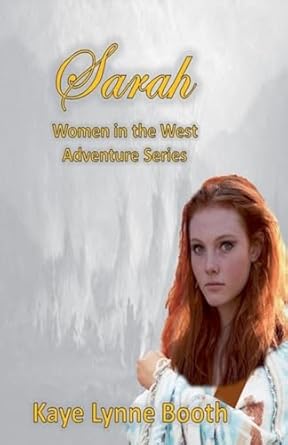
Front cover of Sarah by Kaye Lynne Booth. Click on the image to go to the Amazon page for the book.
Amazon’s description of the book
Sarah survived being abducted at fourteen and sold to the Utes.
She works hard to learn and be accepted as the squaw of the chief’s brother, Three Hawks, and she now looks forward to raising a family among the Ute tribe. But when a mysterious stranger, a lone Sioux warrior, she is thrown into a game of survival in the mountains of Colorado.
Hope and a streak of stubbornness take this optimistic heroine up against the adversities of the western frontier as she blossoms into a young woman and tries to make a place for herself in the world.
If you like strong female protagonists, you’ll love Sarah.
This is my five-star review of the book Sarah. Click here to see my review on Amazon.
A Young Woman’s Dangerous Adventures in the Wild West
I won this book in a raffle, so I did not buy the book from Amazon. Recently I’ve been reading a few Westerns featuring female main characters that was written by female authors. I’ve been awestruck by their intensity and compelling story telling, including this one. I think this might be a genre with a lot of hidden gems. Both women and men can certainly enjoy the captivating and fast-paced story about Sarah, or Hair-of-Fire, which was her Shoshone name.
Sarah was kidnapped by two men and sold to the Shoshone / Ute tribe. She became part of the Ute tribe and integrated into the Shoshone culture. She learned to speak Shoshone, but she retained her ability to speak English. Then one day she was abducted by a Sioux warrior that had been exiled from his tribe, and so began her complicated and tumultuous journey back to “white civilization”. She encountered a lot of life-threatening situations, dangerous animals, evil men, accidents and treacherous acquaintances as well as kindhearted men and women. Sarah is brave, cunning, and strong. She is a survivor with a good heart. That this book is fast-paced and intense is an understatement.
I also really enjoyed the depiction of animals in the book, including her loyal and brave dog Blue and her smart and strong horse Natsam-mayaapeh Beepi or “Beepi” for short. Blue really stole my heart. It seemed to me that the author had done her research well. It appeared that she was well informed about the frontier societies in the old West, she understood native American cultures, is familiar with the landscape in the area and she is a dog lover and horse lover. I highly recommend this book.
About the Author
For Kaye Lynne Booth, writing is her passion. It is a very strange time indeed when Kaye Lynne does not have at least three WIPs, in addition to her other writings, teaching and other life activities. Kaye Lynne lives, works and plays in the beautiful mountains of Colorado.




















 Leonberger Life