This blog feature amusing and heartwarming stories about our late Leonberger dog Bronco, as well as other Leonbergers. It also has a lot of information about the Leonberger breed, the history, care, training, Leonberger organizations, etc. I also wrote a Leonberger book, which I am featuring in the sidebar.
Tomorrow I will do book signing at Wautega Public Library here in Texas. I will read a short story from my book and present myself. I will also mention that all royalties from book sales go to the Leonberger Health Foundation International, or LHFI, a charitable organization working towards healthier Leonbergers and healthier dogs in general. Below is my is my 20 seconds video pitch.
Hi, I’m Thomas Wikman, author of the Life and Times of Le Bronco von der Löwenhöhle, a book featuring funny and informative stories about our Leonberger. It is a great book for all dog lovers. All royalties from book sales are donated to the Leonberger Health Foundation International. Their work gives us healthier dogs.
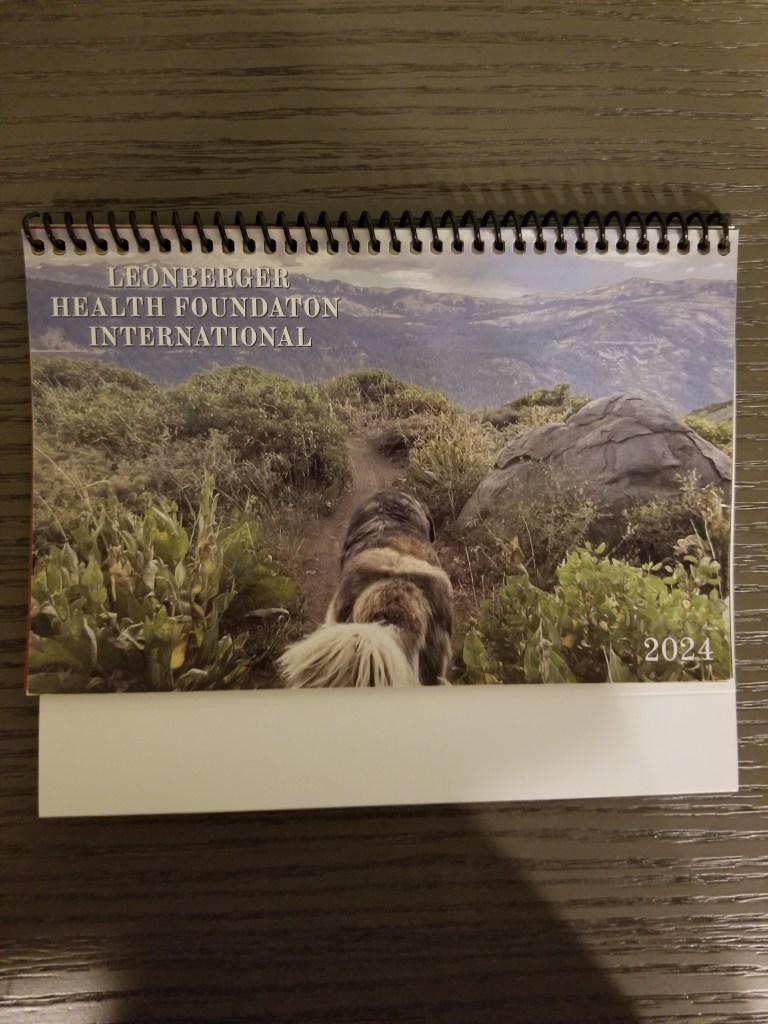
My 20 second video pitch.That’s me a few days ago.The Leonberger Health Foundation International. Click on the image to visit the LHFI’s website.
The Leonberger is an unusual and fascinating dog breed that is known for its size, affectionate nature, and intelligence. I know a lot about Leonbergers because my family was lucky enough to live with one for thirteen years. His name was Le Bronco von der Löwenhöhle—but we called him “Bronco” for short.
Bronco wasn’t our only dog, but our world wouldn’t have been the same without him. For instance, he once saved the life of our pug by fending off an attack from another dog. He probably saved our Labrador’s life, too, by sniffing out an impending insulin shock before it happened. Then there was the time he scared off a trespasser who’d been terrorizing my wife and other women in the neighborhood.
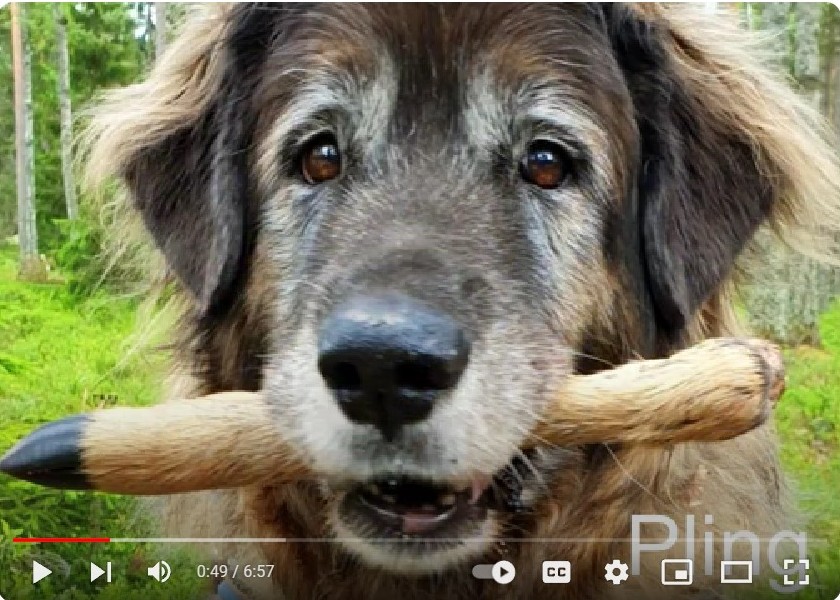
This is me with our late Leonberger Bronco when he was still young, not even one years old.
Bronco is no longer with us, but even in his passing he was distinctive. Leonbergers tend to live less than nine years—but Bronco came very close to reaching his thirteenth birthday. In fact, he received an award for longevity called the “Grey Muzzle Award.” We already knew he was a special dog, but we sent his DNA to two labs for research anyway.
The Grey Muzzle Award is given to Leonbergers who reach the age of 12 years or older.
YouTube video featuring Grey Muzzle Awardees including Bronco, entry nr 10 out of 34 at 2 minutes. This is an emotional video for me, not only because of Bronco, but I was very familiar with many of the other dogs. Time marches on.Bronco’s Grey Muzzle Award
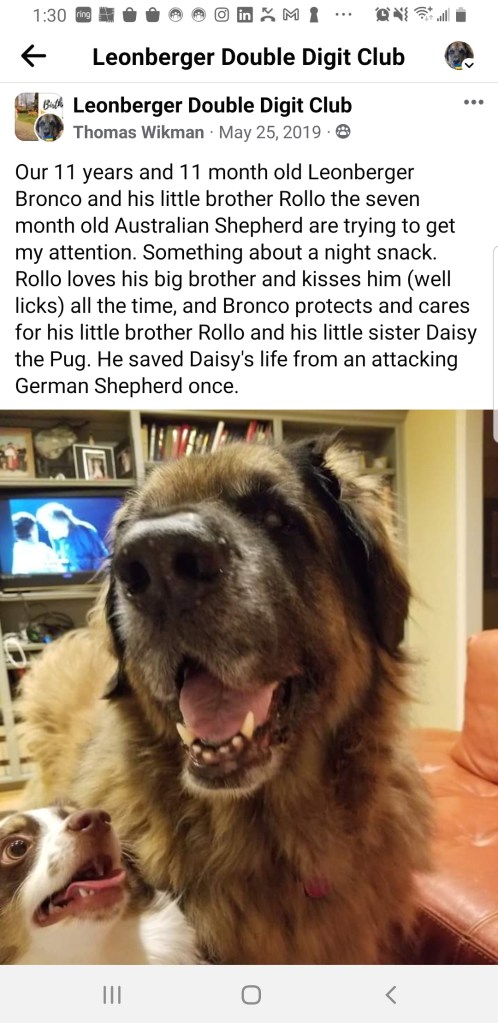
Today is Daisy’s fifteenth birthday. She is indeed a little old lady. She spent her first 12 years with her big brother, our Leonberger Bronco. Bronco saved her life one time, when a very aggressive lose German Shepherd attacked us and went after Daisy. Bronco stepped in between and saved her life. She also grew up with a Labrador, Baylor, a German Shepherd, Baby, a Japanese Chin, Ryu, and now Rollo our mini-Australian Shepherd. Everyone loved her and wanted to protect her. We no longer have Bronco, but we still have Daisy and Rollo.
Bronco and Daisy in our leather sofa. Daisy decided that Bronco was taking up too much room and moved.
Today we visited my wife Claudia’s parents where we celebrated Daisy’s birthday. We sang Happy Birthday to Daisy. Daisy and Rollo ate pupcakes and hot dogs.Today we visited my wife Claudia’s parents where we celebrated Daisy’s birthday. We sang Happy Birthday to Daisy. Daisy and Rollo ate pupcakes and hot dogs.
Below are some photos from today’s celebrations.
Daisy sitting in Claudia’s lap eating some pupcake.Daisy sitting in Claudia’s lap.Daisy in Claudia’s lap.We are singing Happy Birthday to Daisy. Claudia’s parents are sitting. Claudia is standing up.
Below are some photos from previous birthdays
The picture below has a story to it. We were celebrating Daisy’s 13th birthday and we had visitors from Los Angeles who came with their dog Oslo. Unfortunately, Rollo had not been socialized well when he was little (our fault) so he does not like dogs he does not know. Oslo came over to me and I made the mistake of petting him, which prompted Rollo to attack Oslo. We handled the situation, but it was an unpleasant surprise. I guess in his mind, I committed petimony. “You shall not pet any other dogs but me, well Daisy is OK”. We tried telling Rollo to behave but Oslo was obviously afraid of Rollo. Later, when the dogs were sitting around the table eating their pupcakes, Rollo was growling at Oslo who just looked away.
Daisy is telling Rollo to behave.This photo is from Daisy’s 11th birthday. Bronco was celebrating with Daisy. We did not yet have Rollo.
Below are some other photos featuring Daisy
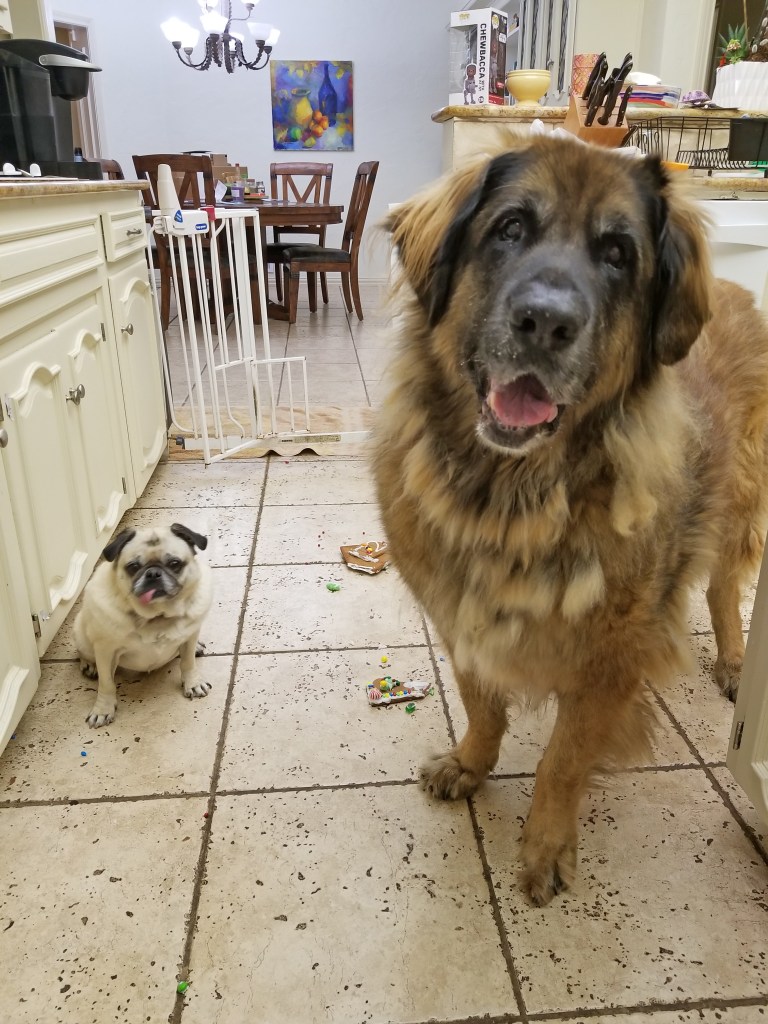
Daisy after an exhausting day of doing nothing.Daisy loves sunbathing. She lays out in the hot sun and soaks in the sun rays.Daisy is old and has arthritis so when we walk the dogs, we let her sit in a stroller. We lift her out so she can sniff.Daisy as a nurse, helping to nurse Bronco back after a toe amputation.Daisy and Bronco sharing a gingerbread house that Bronco grabbed.We are going on a vacation, but Ryu and Daisy didn’t like that. This is their protest.Daisy’s and Rollo’s knock knock joke
Today, October 20, 2023, is the 4-year anniversary of the EF3 Tornado that ravaged our neighborhood. Our house was damaged. Our chimney was smashed by a piece of concrete flying off a neighbor’s house, and our roof was damaged and needed to be replaced. In addition, our garage door was destroyed, and the wiring and pipes in the attic were destroyed, our fence was damaged, and my grill flew across the yard. The cost of the repairs was $50,000.00.
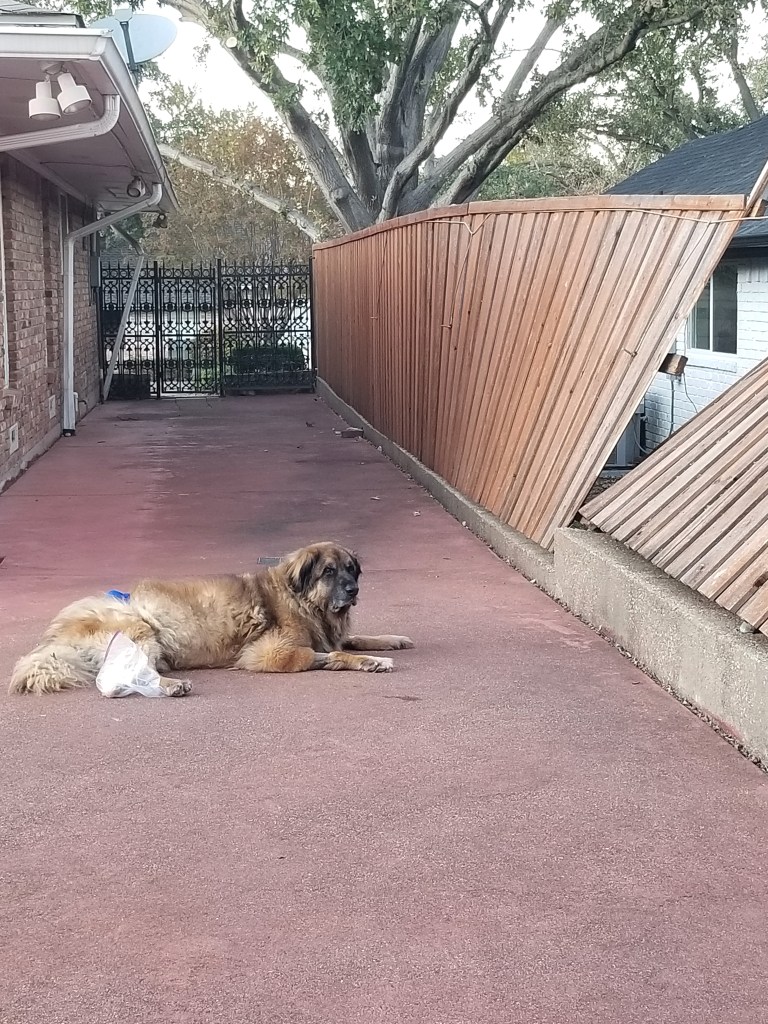
Bronco had just had a toe amputation. He did not blow down our fence.
However, we were lucky. Several of our neighbors’ houses were demolished and my wife’s parents house was a lot more damaged than our house was. The wind from the Tornado lifted my 89-year-old father-in-law up in the air and he was hit by a broken marble table that injured his back. The school where our boys used to go, St. Marks School of Texas, was badly damaged and the walls of the gymnasium blew away.
A neighbor’s house the morning of October 21st, 2019.
I remember this fateful day as if it was yesterday. I was sitting outside in my backyard drinking my favorite SMASH IPA, Yellow Rose, from Lone Pint, Texas, ABV 6.8%. IPA stands for India Pale Ale, a type of beer that contains a lot of hops. SMASH IPA is an IPA brewed with one type of Malts and one type of Hops (Single Malt, Single Hop). The single hop in this case is Mosaic.
On October 20 2019, four years ago today, I was sitting in my backyard drinking my favorite SMASH IPA, Yellow Rose from Lone Pint Brewery, Texas, ABV 6.8%, IBU 62, as an EF3 Tornado was ravaging our neighborhood. I walked in right before it got crazy. The flavor is mango, pineapple, orange, blueberry and then there is a grapefruit rind and a pine resin like bitterness at the end. It is my favorite bad weather beer.
Anyway, my phone started making a loud sound. It was an alarm announcing a tornado warning and, in the distance, I could hear a faint tornado siren. At first, I thought it was nothing but when I saw the lightning approaching, I decided to go inside. Two minutes later a hailstorm made things very loud, the wind was strong, and the house shook, and then we heard a loud explosion. That was our chimney being smashed.
Another neighbor’s house. This house was about 100 yards from our house. It took a direct hit from the tornado.
After the wind had died down a bit, I opened the door to the backyard, and what I saw shocked me. My gas grill had flown across the patio. There were bricks and pieces of concrete all over the patio and the lawn. There was a big sheet of metal lying on the patio. Big tree branches covered the lawn. There was debris everywhere. We had also lost power. It turns out that the EF3 tornado had gone through our neighborhood and passed within fifty to one hundred yards of our house.
Another neighbor’s house.
My wife Claudia asked me to go check on her parents. I drove about 50-100 yards when a neighbor’s roof lying across the road stopped me. I turned around but this time I was stopped by a large pile of trees lying across the street. So, I started walking, but this time I was stopped by a group of firemen telling me that it was too dangerous to be outside. They told me to go back home, and I did.
Inside Claudia’s parents’ house. This was the morning after. We are walking into their house to check on them (that’s my wife).
October of 2019 was a very difficult month for our Leonberger Bronco. He was getting old. He was twelve years old, and he had the first signs of geriatric-onset laryngeal paralysis polyneuropathy (or GOLPP), which made his breathing a bit labored and affected his gait. In addition, he had developed another case of squamous cell carcinoma, a toe-nail cancer, and this time on his right rear paw. We amputated his toe on October 3—the day he turned twelve years and three months old.
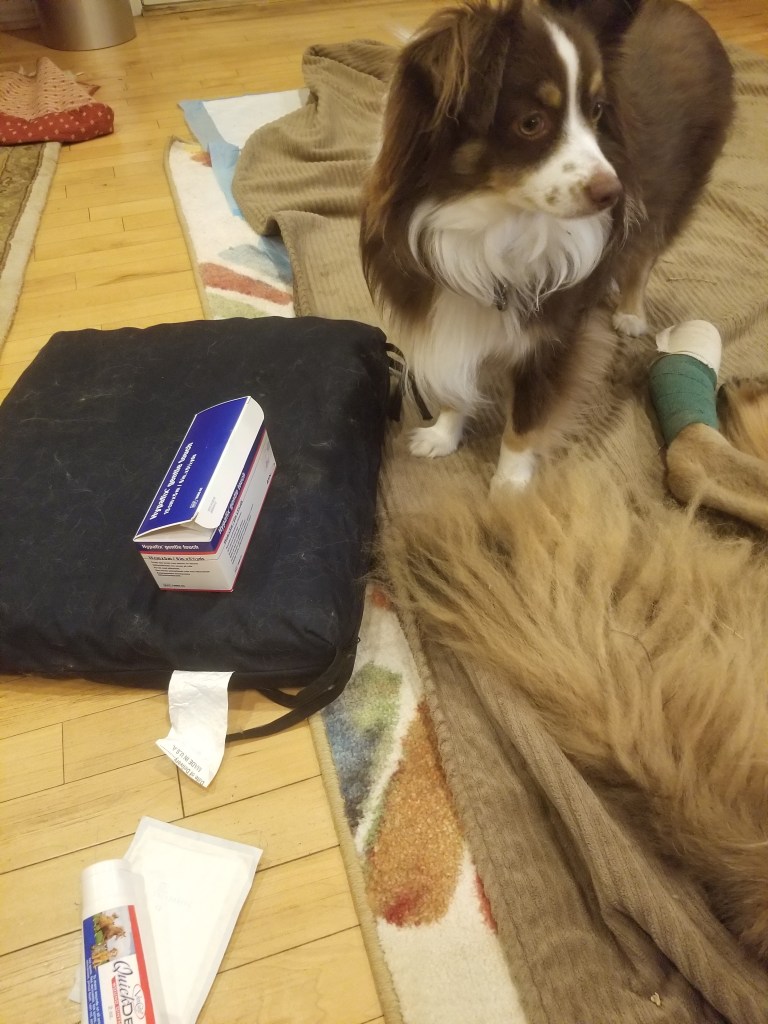
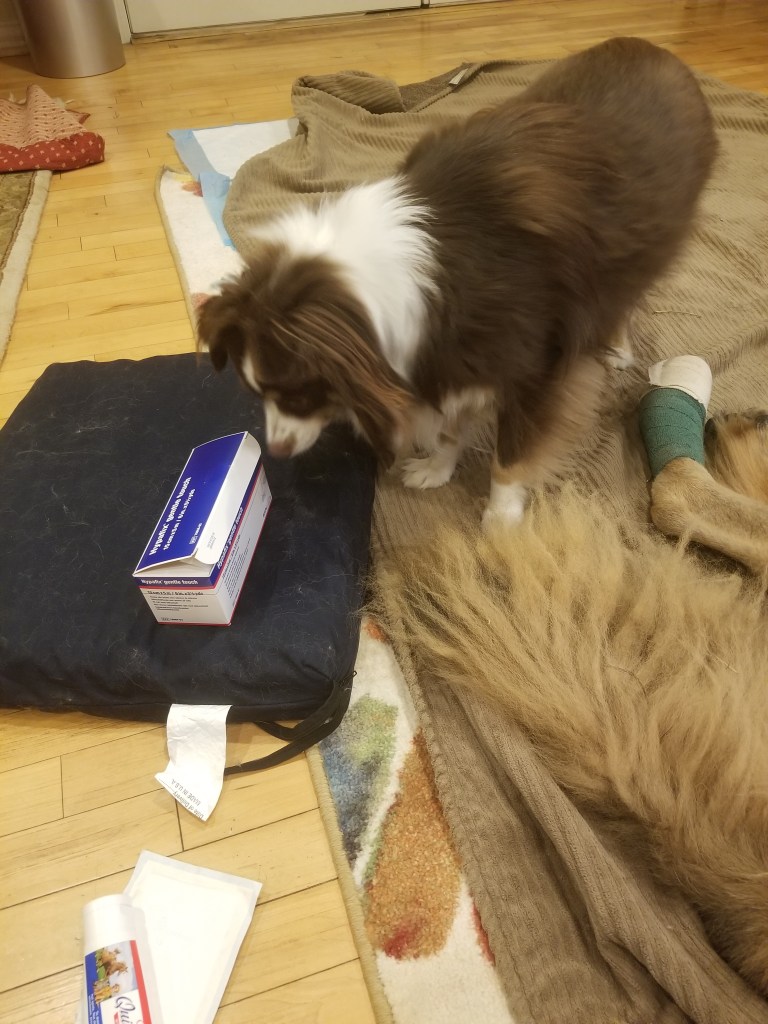
We had to change Bronco’s bandages every now and then but Rollo, our mini–Australian Shepherd made sure we did it right.A store at a nearby shopping center (it’s the GAP).
Sweet dreams, or maybe not. Photo by Mo Eid on Pexels.com
I opened my eyes and stared at the ceiling. As I tried to get out of bed, I realized I couldn’t move. No matter how hard I tried I couldn’t move a finger. I heard my parents talking downstairs so to get their attention I tried to scream but I couldn’t. I was completely paralyzed, and I did not understand how it had happened.
Man Suffering From Sleep Paralysis At Home. Purchased from iStock photos (order number 2093689644).
Then I saw three beings coming out of the walls, like the Cenobites in Clive Barkers Hellbound Heart. I should say I had not read the Hellbound Heart book or seen the movie at the time. It was just how it looked like. As they came closer, they looked down at me, and I realized that they were the Beagle Boys from Duck Tales. They promptly started to torture me by sticking long needles into my back, and it really hurt. I knew it was some sort of hallucination, but I didn’t know how to stop it.
When you dream you don’t know that you are dreaming, and logic and common sense does not work. This was different. I was fully aware, and I understood that what I felt and what I saw couldn’t be real. I guessed that I had some sort of condition causing a hallucination. I would later find out that it was sleep paralysis, a sort of mixed state between being awake and asleep. It happened to me several times during my teenage years and later on it happened to me once as an adult.
A little over a month ago I found out that an article about me, our late Leonberger Bronco and my book about him had been published in the September issue of the Preston Hollow People’s Magazine. It was a very nice surprise. Preston Hollow Peoples Magazine, which calls itself the best community magazine in Texas (I totally agree), is a monthly magazine with 47,000 online or print version subscribers. I can add that Preston Hollow is a large historic neighborhood in the northern part of Dallas with many famous residents including former President George W. Bush, Dallas Mavericks owner Mark Cuban, previous Dallas Stars owner Tom Hicks, the late Presidential candidate Ross Perot and many others.
What I am posting about today is that I finally acquired a couple of print versions of the September issue of the Preston Hollow Peoples Magazine, so I am posting a few here. I am also including a link to the online article because it might be easier to read.
Front page of the September issue of Preston Hollow Peoples Magazine. Click on the image to view the online version of the article.Page 10 of the September issue of Preston Hollow Peoples Magazine. Click on the image to view the online version of the article.Close up of the article about Bronco in the Preston Hollow Peoples Magazine. Click on the image to view the online version of the article.Close up of the article about Bronco in the Preston Hollow Peoples Magazine. Click on the image to view the online version of the article.
Today is Rollo’s fifth birthday. Rollo grew up with his big brother the Leonberger Bronco, but we lost him three years ago and now it is just Rollo and his sister Daisy the Pug. Today they both had a so called pupcake, a cupcake especially made for dogs. Unlike some other pupcakes, it was soft, like a human cupcake and the dogs liked that, especially Daisy who is 15 years old and missing half her teeth.
Rollo with his pupcake. We are singing happy birthday to him, and our daughter is holding him. Daisy participated but is not in the picture.Rollo’s birthday last year (4th birthday, coincidentally also on October 12).Another photo from Rollo’s birthday last year, with Daisy.Rollo almost five years ago, at his new home.Rollo almost five years ago, at his new home.Rollo almost five years ago, meeting his big brother Bronco.Rollo around four years ago, terrorizing his big brother Bronco.
In this Leonberger blog I sometimes post about books that are not about Leonbergers but that I want to promote, and this is a book that I would like to promote. I recently read In the Tree’s Shadow: A collection of stories that exist in your dreams… and nightmares the paperback version, by D. L. Finn. I found this book to be very imaginative, fun and great reading for Halloween, and therefore I would like to promote it. It comes in a paperback edition and a Kindle edition.
Paperback – April 14, 2023, ASIN : B0C1J5GSFZ, ISBN-13 : 979-8986158723, 214 pages, item weight : 10.2 ounces, dimensions : 6 x 0.49 x 9 inches, it is currently $ 11.24 on Amazon. Click here to order it from Amazon.com.
Kindle – April 17, 2023, ASIN B0BWL7LX9K, 225 pages. It is currently $2.99 on Amazon.com. Click here to order it from Amazon.com.
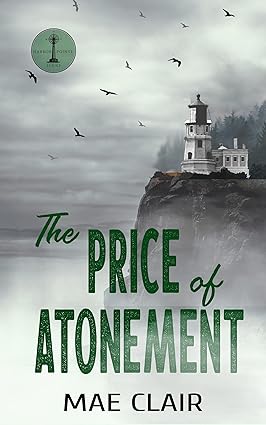
This is a photo of the front cover of the book In the Tree’s Shadow. Click on the photo to go to the Amazon location for the paperback version of the book.
This book is a delightful collection of entertaining and suspenseful horror, paranormal, sci-fi, and fantasy stories. There are a few dark ones, but the stories are mostly imaginative, fun and captivating. Perfect for Halloween for those of you who want something a bit less disturbing than Hellbound Heart. At the end of the book there is also a 23-page teaser for another of her books “This Second Chance”.
This is Amazon’s description of the book.
Nestled inside these pages, you’ll meet a couple in their golden years who take a trip with an unexpected detour, a boy desperate to give his brother the Christmas gift he asked for, a girl with a small glass dragon who is at the mercy of her cruel uncles, and a young mother who has a recurring dream about murder. You’ll be introduced to worlds where people get second chances and monsters might be allowed their desires, while angels and dragons try to help. Happy endings occur, but perspective can blur the line between good and evil in these twenty-seven tales. Since the stories vary between 99 and 12,000 words, whether you have only five minutes or an entire evening to settle into reading, there is something that will suit your time and taste.
My Amazon Five Star Review of In the Tree’s Shadow
Nightmares and Beautiful Dreams
In the tree’s shadow is a collection of 27 captivating and unique short stories ranging from half a page to almost 30 pages. Some of the stories are paranormal horror stories, other stories are delightful fantasy and science fiction stories and yet other stories are personal journeys about finding your self-worth and inner strength to live the life you want. The stories feature nightmares, beautiful dreams, fantasy creatures, ghosts, space aliens, demon-like entities, castaways, karma, and civil war. You just don’t know what you are going to read next as you finish one story.
The book engages your imagination a lot, which I enjoy. It is also well written and easy to read. Some of the stories are dark and scary, like “A man on the pier”, but most of these stories are entertaining and intriguing, and even heartwarming. It is a perfect book for Halloween if you want to keep it a little bit on the lighter and happier side. For me the book was a page turner and I highly recommend it.
This is a photo of the back cover of the book In the Tree’s Shadow. Click on the photo to go to the Amazon location for the kindle version of the book.
About the Author
D.L. Finn is an independent California local who encourages everyone to embrace their inner child. She was born and raised in the foggy Bay Area, but in 1990 relocated with her husband, kids, dogs, and cats to the Sierra foothills in Nevada City, CA. She immersed herself in reading all types of books, but especially loved romance, horror, and fantasy. She always treasured creating her own reality on paper. Finally, being surrounded by towering pines, oaks, and cedars, her creativity was nurtured until it bloomed.
Her creations vary from children’s books, young adult fantasy, and adult paranormal romance to an autobiography with poetry. She continues on her adventures with an open invitation for her readers to join her.
If you own a Leonberger, or are interested in Leonbergers, and you live in North America you likely know about the Leonberger Club of America, or the LCA for short. You are about as likely to find a Leonberger at Petland/Puppy-Mill as you are finding an Elephant for sale there. LCA is very protective of the Leonberger breed and of Leonbergers in general. You typically buy/get a Leonberger dog from an LCA certified Leonberger breeder or from the Leonberger Rescue Pals, and if you don’t that might be a problem.
We bought our Leonberger Bronco (Le Bronco von der Löwenhöhle) in 2007 from Julie Schaffert, a certified LCA breeder since 1992.
There are only about 3,000 Leonbergers in North America and about 2,000 Leonbergers in the United States but the Leonberger Club of America has more than 1,000 members. They publish the Leo-Letter, a quarterly Leonberger magazine. So, the Leonberger Club of America has a very prominent place among Leonberger owners. Click here to see a summary of the Leonberger Breed Standard.
Leonbergers have a long history in North America and the United States—despite the fact that until 1985, there were only seventeen Leonbergers known to be living in the United States.
See: Lusby, Leonberger, page 15.
Leonberger, Special Rare-Breed Edition, A Comprehensive Owners Guide, Madeline Lusby. Click on the image to see my five star review for this book.
In the 1870s, Leonbergers were brought to Newfoundland to invigorate the stock of Newfoundland dogs. Around the same time, two Leonbergers named Caesar and Sultan were purchased from Heinrich Essig’s kennel (founder of the Leonberger breed) and transported across the ocean to join the Wellesley-Sterling theater company in the United States as the stars of their productions. Then in 1879, Caesar and Sultan visited President Ulysses S. Grant, who called them the largest and most magnificent dogs he had ever seen and presented them with gold medals. During the years between World War I and World War II, a New Jersey family, the Wolfs, opened their home as a temporary refuge for Jews fleeing Germany: they also imported Leonbergers. Unfortunately, this introduction of the breed into the United States did not last, and it would be another fifty years before the Leonberger appeared in America again.
Leonberger, A comprehensive guide to the lion king of breeds, Caroline Bliss-Isberg. Click on the image to see my five start review for this book.
During the late 1970s and the 1980s, a few families—Waltraut and Klaus Zieher, Brian Peters, Manfred and Sylvia Kaufmann, Keri Campbell and Melanie Brown, and Mary and Reiner Decher brought Leonbergers to the United States. The Dechers had started a breeding program and were looking for a mate for their first dam, Viona. By chance their neighbor discovered through a newsletter that there was another Leonberger in the United States, and that led to the families’ finding and connecting with one another. I should add that the Dechers were careful to conform to the German breeding regulations and performed hip X-rays that they then submitted to the Orthopedic Foundation for Animals (OFA). Viona became the first OFA-certified Leonberger in America.
See: Bliss-Isberg, Leonberger, page 152.
On Saturday, November 2, 1985, eight of these Leonberger enthusiasts met at a hotel in Denver, Colorado, to found the Leonberger Club of America (LCA). This group of founders, which has since been dubbed the Denver Eight, appointed a registrar, formulated a breeding acceptability checklist, and instituted various policies, including the requirement that OFA certification is mandatory for breeding. LCA membership grew: it held social gatherings, began publishing LeoLetter, and imported an increasing number of dogs. Now the LCA has thousands of members across the country, and Leonbergers receive high ratings on health tests relative to other large breeds. For example, in 2000, the OFA reported that only 14.6 percent of Leonbergers tested positive for hip dysplasia, compared to 47 percent of Saint Bernards.
Another important historical event was the founding of the Leonberger Health Foundation International (LHFI), in 2000 (it was just called the Leonberger Health Foundation back then). According to its website, the organization was founded by Waltraut Zieher and other memers of the LCA’s health, education, and research committee to “facilitate the solicitation and distribution of donations given to support health related breed-specific research.” The LHFI also administers a program that collects DNA samples from Leonbergers to share with universities and research institutions, and of course it administers the Grey Muzzle Award (long living Leonbergers). Our Leonberger Bronco was a recipient of the Grey Muzzle Award, and we provided them with his DNA.
Bronco’s Grey Muzzle Award, which he received for being an unusually long lived Leonberger.
LHFI’s global biobank contains DNA samples from more than nine thousand Leonbergers. Among the organization’s notable achievements are the eradication of Addison’s disease among Leonbergers and the raising of nearly half a million dollars for research into conditions that affect canine health, including osteosarcoma, hemangiosarcoma, glaucoma, cardiac diseases, thyroid diseases, and neurological disorders. Its research also supports healthful longevity and aging as well as population diversity. Another success is the fact that since 2011, no Leonbergers with two copies of the LPN1 gene mutation (which causes Leonberger polyneuropathy) have been recorded in LHFI’s biobank. LHFI is one of my favorite charities.
The end of the twentieth century marked not only the end of the Cold War but also the beginning of what I call the Dog Wars of America. In 1985, the American Kennel Club (AKC) registry comprised one-third of the world’s known dog breeds. But the AKC had recognized only a few new breeds since 1887—a period of ninety-eight years. So, the organization decided to change that policy, but this did not always go smoothly. The members of rare-breed clubs often did not want to be part of the AKC. For example, the Australian Shepherd Club of America (ASCA) was very reluctant to join, so a relatively small splinter group, the United States Australian Shepherd Association, was formed and designated the official member club of the AKC, which was not welcome news to the ASCA. The border collie is another example. Charles Krauthammer, the late political columnist, called the AKC the politburo of American dog breeding.
See: Bliss-Isberg, Leonberger, page 159.
Similarly, in 2003, a new Leonberger club was formed—the Leonberger Club of the United States—with the goal of becoming the Leonberger member club of the AKC. This essentially forced the LCA’s hand, so they applied for membership in the AKC, a process that took years to complete. But ultimately the AKC approved the LCA as members in 2010: Leonbergers would officially become part of the Working Group. Fortunately, 90 percent of LCA breeders agreed to continue following LCA regulations regardless of whether the club would remain independent or become part of the AKC. Also fortunately, AKC membership afforded more opportunities for Leonbergers to participate in dog shows, which is important to many owners.
See: Bliss-Isberg, Leonberger, page 187
For information on the history of the Leonberger starting in 1830’s see this link