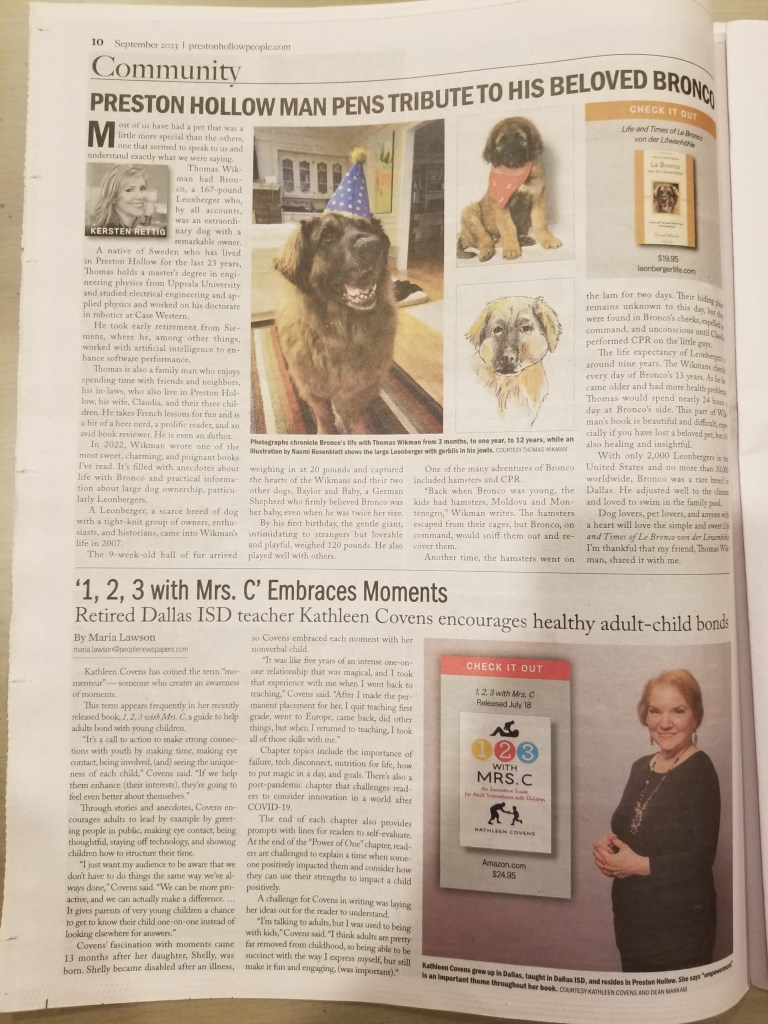
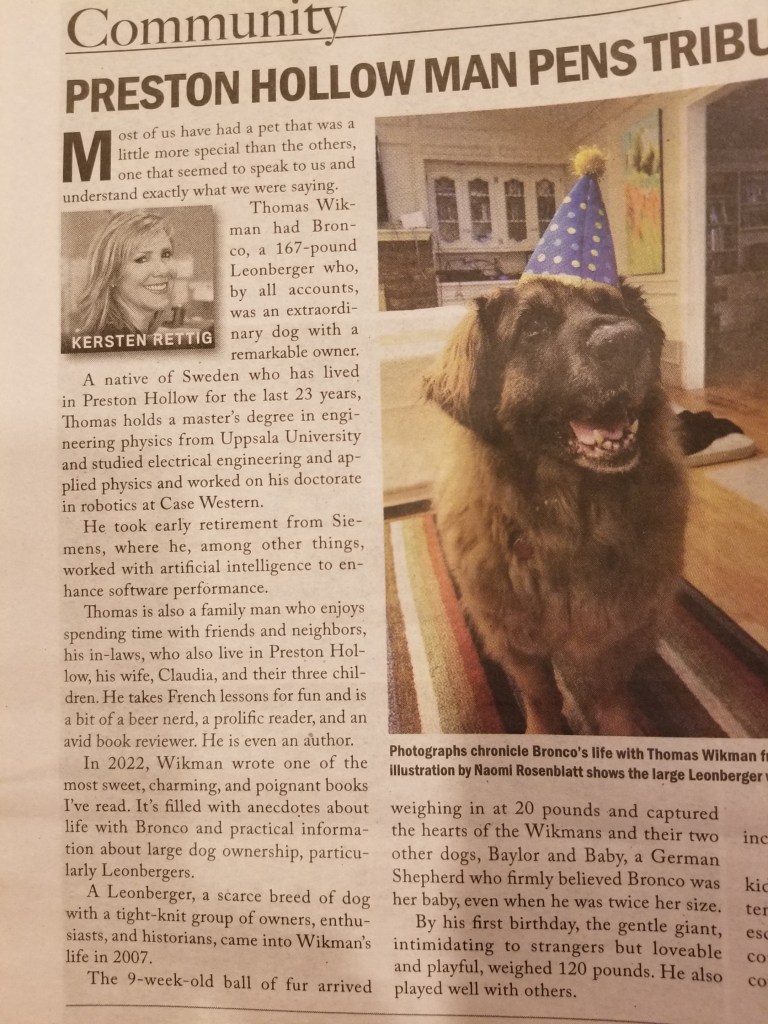
This blog feature amusing and heartwarming stories about our late Leonberger dog Bronco, as well as other Leonbergers. It also has a lot of information about the Leonberger breed, the history, care, training, Leonberger organizations, etc. I also wrote a Leonberger book, which I am featuring in the sidebar.
Recent dialogues at the Wikman residence concerning our mini-Australian Shepherd Rollo.
Rollo loves belly rubs.
Rollo: laying down on his side, opening his legs a bit and barking once. That’s how he asks for a belly rub.
Thomas: Honey, can you give Rollo a belly rub? I’ve done it several times today.
Claudia: No, I am cooking. You do it.
Thomas: I walk over to Rollo to give him a belly rub. He loves it, turns over and kicks his legs, and he looks like he is laughing like a child being tickled. Then I stopped.
Rollo: One loud bark. That means he wants more.
Thomas: continues giving a belly rub.
Rollo is asking our Leonberger Bronco for a belly rub. Unfortunately, it is not easy for one dog to give another dog a belly rub.
Rollo wants to sit where you are sitting.
Rollo: I am sitting on the sofa and Rollo comes over and taps me twice on my knee. That’s the command Rollo gives when he wants to sit where you are sitting.
Thomas: I move over.
Rollo: jumps up and sits where I sat.
Claudia: Thomas do you remember the trainer who said that Rollo thinks he is in charge and that we need to fix that?
Thomas: Yes, but he is so cute.
Rollo and Daisy in sofa chair.
Rollo wants to sleep on the bed but not alone.
Rollo: I am sitting on the sofa and Rollo comes over and scratches me on my knee while leaning backwards as if he wants to leave. That’s the command Rollo gives when he wants to go to bed but he does not want to go alone.
Thomas: Honey can you go lay down in the bed with Rollo. I am busy reading.
Claudia: No, I am not doing that anymore.
Thomas: stands up and follows Rollo into the bedroom and lays down on the bed as Rollo jumps up on the bed.
Claudia: Thomas you should not be doing that either. Remember, it is not good that Rollo thinks he is in charge.
Rollo: falls asleep while Thomas reads a book on the bed.
Rollo tucked in under the covers on our bed.
Rollo and Bronco
Rollo and Bronco (our Leonberger) were best buddies. We no longer have Bronco, but we have Rollo who is the worst behaved dog we’ve ever had. It already started while we were still having Bronco. Rollo walked all over Bronco, like he did with people. If a few people were sitting on the sofa, Rollo would just walk from one end of the sofa to the other, stepping on everyone’s legs or bellies in the process. He still does that. He frequently bit Bronco’s tail and even swung in it as if it was a swing. Bronco was extremely patient and did not get angry, except one time when Rollo stole his toy. Bronco’s loud booming bark scared Rollo and he let go of the toy. However, to be on the safe side we put Rollo in a playpen, or baby jail, as we called it. Rollo came to love his baby jail.
Bronco and Rollo, best buddies. Bronco is quite old and Rollo is quite young.Rollo is pulling Bronco’s tail.This was Rollo’s Baby Jail
Rollo’s other commands and peculiarities.
Rollo scratches doors he thinks should be open, which is basically every door, and if no one comes to open the door, then he barks. When he wants to play with a toy, he barks at the toy box with one loud bark until I give him the toy he wants. He barks at balls that roll in under sofas and beds and expects someone to get them for him. Rollo loves balls. I should say, naturally, we have commands for him as well, such as sit, stay, come, and shake, and he obeys them most of the time. But he has commands for us too. He sleeps in our bed, typically in the middle, surrounded by his subjects, me, Claudia and Daisy.
Rollo loves balls. He loves to chase balls, chew balls and roll balls.Rollo is ball crazy.
The greatest quality that someone could have.
What is the greatest quality someone could have? Is it intelligence? Is it knowledge? Is it wisdom? Is it charm? Is it beauty? Is it courage? Is it strength of character? Is it work ethics? Is it honesty? Is it integrity? No, it is none of that. The most important thing in the world is that you are cute. That is why Rollo is the King of the House, in fact the King of Texas. But seriously, Rollo is spoiled, he sleeps in our bed, he does not like other dogs (except Daisy), and this is our fault. Before we can get another Leonberger we must work on certain bad habits. However, his cuteness and his innocence make this harder.
Rollo as a puppy. Being cute is all that matters.Our daughter with Rollo and Daisy.
What is the greatest intellectual achievement of the human race? Is it Beethoven’s third symphony? The book War and Peace by Leo Tolstoy? General Relativity? Quantum Physics? multi layered neural networks? Or is it a theory of almost everything that comprises quantum physics, special relativity, Noether’s theorem and gauge theories, as its basic elements, and then Quantum Electrodynamics, Quantum Chromodynamics, and a framework for all elementary particles, and more. This is the so called “standard model of elementary particles”, or the “standard model” for short. It is a subjective question.
The standard model of elementary particles, the greatest intellectual achievement of humankind. Close up illustration of atomic particle for nuclear energy imagery. From iStock photos.
Some people like to say, “Science does not know everything”. They are right. If it did, it would stop. However, the people who like to say that typically grossly underestimate what science knows, and not by a little but by a lot, like a million times, or a trillion times. There are things science knows and there are things it doesn’t know, and the difference is often not obvious unless you have near expert knowledge. However, we have figured out a lot. The book I am describing below is a breathtaking reminder of how much we know. It is the book about the theory of almost everything after all.
Science does not know everything, but it knows a lot. The standard model of elementary particles is the theory of almost everything. Collision of Particles in the Abstract Collider. From iStock photos.
I read The Theory of Almost Everything: The Standard Model, the Unsung Triumph of Modern Physics Hardcover – July 22, 2005, by Robert Oerter, more than 15 years ago. I wrote a lengthy review, which is still the top review for this book. The hardback version is 336 pages. It currently costs $31.93. The dimensions of the hardback are 6.5 x 1.25 x 9.75 inches, and the weight is 1.2 pounds, ISBN 978-0132366786. The paperback version is 336 pages. It currently costs $17.00. The dimensions of the paperback are 5.5 x 0.8 x 8.4 inches, and the weight is 10.9 ounces, ISBN 978-0452287860. The kindle version costs $13.99 and is 348 pages ASIN : B002LLCHV6.
Front cover of “The Theory of Almost Everything” by Robert Oerter. Click on the image to go to the Amazon location for the book.
Someone reminded me that today, Wednesday August 9, is National Book Lovers Day. Even though I already published a post on a Leonberger book today I decided to post about one more book, one of the most mind-blowing books that I’ve ever read. I have a master’s in engineering physics from Uppsala University that was turned into a master’s in electrical engineering and applied physics by Case Western Reserve University in Ohio. That is why I am interested in this topic, which I understand is not everyone’s cup of tea, maybe no one’s. I took a few classes in Quantum Physics, Nuclear Physics, and Molecular Physics, and I had heard of the standard model, I just never realized what it was. Then I read this book many years later and as I said, I was blown away.
Quick note, if you have never heard of Noether’s theorem, don’t worry, almost no one has, yet it is an extremely important discovery in mathematics. Emily Noether discovered that associated with every symmetry was a conservation law and vice versa. It is one of the greatest discoveries of mankind, yet almost no one has heard of it. For example, if you assume (rather acknowledge) that the laws of physics don’t change over time, then energy is conserved. If you acknowledge that the laws of physics don’t change as you change position, then momentum is preserved. You use mathematics to derive one from the other. This is very useful because, if you find a symmetry you can find a conservation law. If you find a conservation law, you can find a symmetry. This has turbo charged modern physics.
The standard model does not get a lot of love. One reason is that unless you have a physics education it is difficult to grasp. It is also a gigantic theory. Well actually not really. You can summarize it in a few formulas that almost no one can understand, as the author of the book does. Another reason is that as soon as physicists were done with it, they were looking to replace it. That was because of the “Almost” in “the theory of almost everything”. There were a few things it could not explain, and it was not compatible with General Relativity even though it incorporated Special Relativity. Anyway, I cleaned up my review a bit and it is given below. If you want to see my original Amazon review, click here.
The Langrangian function that summarizes all of the propagators and interactions in the standard model.
Note; when I wrote the review below, we had not yet found the Higgs Boson. It was found at LHC in Switzerland in 2012.
An introduction to the greatest intellectual achievement of the human race
This review is a little bit long; however, it is more than an assessment of the book, it will also help you prepare for reading the book and explain confusing parts of the book.
Imagine if we had found a two-billion-year-old alien underground civilization under the desert in Arizona several years ago, and you still knew nothing about it, because journalists thought this information was pretty boring stuff and therefore didn’t bother telling anyone about it. Well, that is most likely not true, but what is true is that the general public has entirely missed the greatest scientific revolution in the history of the human race partially because mainstream media has largely ignored this information, even though the Nobel Prize committee has been raining Nobel Prizes over it.
In the 70’s a theory explained, at the deepest level, nearly all of the phenomena that rule our daily lives came into existence. The theory called “The Standard Model of Elementary Particles” is a set of “Relativistic Quantum Field Theories” that explains how elementary particles behave, which elementary particles there are, and why they have the properties they have, for example, isospin, spin, charge, color charge, flavor, even mass, or mass relations in many cases. The theory explains how all of the fundamental forces in nature work except gravity. The theory describes how the elementary particles interact; decay, how long they are expected to exist, and how they combine into other subatomic particles. The theory uses only 18 adjustable parameters to accomplish this.
In the extension the theory thus explains how nucleons and atoms are formed and what properties the atoms will have, and how molecules will form and what properties molecules will have, their chemical reactions, and what elasticity, electric conductivity, heat conductivity, color, hardness, texture, etc. any material will possess. In the extension it explains why mass and matter exist, how the sun and the stars work, and the theory is therefore the ultimate basis of all other science. It also provides a formula, or an equation of almost everything. Best of all it has been thoroughly verified experimentally, in fact the predictions the theory has made have been confirmed with such stunning accuracy and precision that it could be considered the most successful scientific theory ever. A theory that successfully unites all of physics and basically all of human knowledge of the Universe into one single theory has never before existed.
However, “The Standard Model” does not incorporate gravity and the general theory of relativity, and cannot explain dark energy, dark matter and why neutrinos have mass. Therefore as soon as the theory came into existence physicists started looking for the next theory that would finish what the “The Standard Model” did not finish. Example of such theories are GUT theories, SO(5), SO(10), string theories (abandoned), super string theories, and M-theories. Even though those new theories are extremely interesting they have not been verified or able to predict anything. In comparison with the “Standard Model”; superstring theories, grand unified theories, chaos theories, you name it, are essentially nothing, but are still better known.
This book explains to the layman what the “Standard Model” is and how it came into existence. The book is by no means a perfect book. I think there are several problems with the book. However, I decided not to take off any star because there are very few books written for science interested non-physicists that explain the “Standard Model of Elementary Particles”. Dr. Oerter deserves five stars just for his fairly decent attempt at doing so.
Even though the book is a Physics book, it is also a book on Philosophy. In fact Physics is often the best and the deepest Philosophy, the kind of Philosophy that can be falsified, verified and proven wrong or correct. To understand what I mean consider Noether’s theorem. Noether’s theorem states that whenever a theory is invariant under a continuous symmetry, there will be a conserved quantity. As an example of what a continuous symmetry is the following: any physical experiment that is performed at a certain time will have the same result if it is performed exactly the same way a certain time later. That seemingly self-evident observation means that Energy is conserved. Another example is, any physical experiment that is performed at a certain place will have the same result if it is performed exactly the same way somewhere else. That seemingly self-evident observation means that momentum is conserved.
Let me add that “exactly the same way” really means that! Gravity, other forces, differences in light, or anything else cannot be different in the second experiment. The only thing allowed to be different is the position “x” (if that is our symmetry variable). That is what continuous symmetry means, changing just one thing, and everything stays the same.



Noether’s theorem has been the guiding principle behind the standard model, and it is used to find conservation laws where symmetries are found, and it is used to find symmetries where conservation laws are found. It is a spontaneous symmetry brake that allows the Higgs Boson to give all other particles their mass (excepting mass less particles). This is why matter and everything in our Universe exist. The Higgs Boson is also called the God particle (guess why). So Noether’s theorem is both very useful in a practical sense and deeply philosophical at the same time.
The God particle has not yet been found, but scientists will be looking for it using the new Large Hadron Collider (LHC) that will come on line this fall (fall of 2008). LHC will start operating in August and the first collisions are planned for October. It is the largest machine ever built and it has a circumference of 17 miles. However, a lawsuit has been filed in an attempt to stop the LHC from operating. Some people believe that the LHC will create small black holes that could suck up all of the earth. In essence, they believe that our attempt to find the God particle will be the end of the world.
In addition to Noether’s theorem the standard model is built upon the special theory of relativity and a modern formulation of quantum mechanics (Quantum field theory), QED, QCD, as well as some discoveries regarding elementary particles. I can add that Noether’s theorem was formulated by a Jewish woman, Emmily Noether, who could not get a job in academia because she was a woman. This theorem is one of those very important but mostly unknown discoveries, like the invention of paper by the Chinese Tsai Lun.
Oerter does not attempt to explain the special theory of relativity; however, he tries to give the reader an idea of what it is. The problem with his approach is that he gives the reader just enough information to enable the observant reader to come up with the apparent paradoxes within the special theory of relativity, but not enough information to help the reader to easily resolve them.
He also confuses the reader by not distinguishing between rest mass and relativistic mass. The observant reader will think that he is contradicting himself. The term relativistic mass is the total mass and the total quantity of energy in a body. The rest mass is the mass of a body when it is not moving. The formula E = mc² is always true, when it refers to relativistic mass, which is why we talk about an energy/mass equivalence. The other more complex formula Oerter presents refers to rest mass. There is no such thing as an energy/rest mass equivalence (except at speed 0) but that is what the reader who is not already familiar with the subject will end up believing.
Another mistake Oerter makes is in regard to the fact that the speed of clocks will be measured differently in different reference frames. On page 35 last paragraph Oerter writes “Here, we have an apparent paradox: If each reference frame sees the other as slowed down, whose clock will be ahead when the passengers leave the train?” Then he implies that the paradox has to be solved by incorporating the General theory of relativity. Even though that may be how it was first solved, you can solve this form of the so called “Twin Paradox” and other similar paradoxes from within the framework of the special theory of relativity itself.
Oerter explains Quantum Physics in a very typical manner, but he mostly avoids making it look much weirder than it actually is which he should be commended for. However, there is one thing that all Physicists seem to do when they explain Quantum Physics to the layman which annoys me greatly. The matter waves (or quantum fields) in Quantum Physics are quite strange entities. The reason they are so strange is because they do not exist in a real sense, they are more correctly stated mathematical abstractions. Oerter states this clearly, which is good. However, he then goes on to mention De Witts’ idea about multiple Universes without acknowledging that these “bizarre solutions” to Quantum Wave conundrums are completely unnecessary and worthless. There is no more reason to believe in multiple Universes based on matter waves than there is to believe in multiple Universes because we all have different reference frames.
In fact when I took my first class in Quantum Physics (as an engineering physics student) I successfully proved, using a combination of the Schrödinger equation and plain Galileo transformations, that the matter waves are not only “not real” they don’t even represent information in an objective sense, in fact every reference frame had its own matter wave for the same particle. Our own single Universe is thus already all the Universes you need all at once. My associate professor was just scratching his head but the leading Swedish authority on Quantum Physics at the time, Staffan Yngwe, immediately agreed with me. So, in summary there is no need to make Quantum waves weirder than they are or draw unwarranted conclusions from apparent conundrums. Just take them for what they are; one possible mathematical model (among many) of a particle as seen from your frame of reference only.
After giving a background to the special theory of relativity and Quantum Physics Oerter continues explaining relativistic Quantum Physics including the fantastic prediction you get when you combine the special theory of relativity with Quantum Physics; that for every particle there is a twin particle with exactly the same mass, and spin, but opposite charge and isospin. These particles were called anti-particles and until they were actually found physicists tried to get rid of them from the theory. However, the combination of the special theory of relativity and Quantum Physics would lead not only to much better explanation for such things as the radiation and light spectrum and the properties of atoms, it would also lead to new discoveries.
Richard Feyman came up with a new representation of relativistic quantum physics for electrons that did not use waves called Quantum Electro Dynamics, and this was one of the first steps towards the standard model. Physicists started discovering a lot of unexpected particles which remained unexplained for decades (until the standard model came about), QCD was invented, the Higgs Boson (the God particle), symmetry breaks, etc. The story is simply breath taking and Oerter does a good job telling this story, except I think he should have used more and better pictures. However, as I said I cannot honestly take any stars off for these minor flaws. Finally Oerter discusses possible modifications to the standard model, GUT’s, string theory (abandoned), super string theories, and M-theories.
I also would like to add an interesting fact that I think everyone should be aware of. There are elementary particles with whole number spin and they are called Boson’s, and there are elementary particles with half number spin called Fermions. The Pauli Exclusion Principle (that no two particles can occupy the same state) applies to Fermions but not Bosons and therefore the two different types of particles behave very differently and follow different kinds of statistical rules (Bose-Einstein statistics versus Fermi-Dirac statistics). All force carriers are Boson’s while some Fermions are used to build “nomral matter”. Examples of Bosons are the photon, gluons, W and Z Boson, mesons, the Higgs Boson (the God particle). The Fermions come in three families each with four particles and their anti particle.
Electron / positron
Neutrino / anti-neutrino
Up quark / anti up quark
Down quark / anti down quark
muon / anti-muon
Mu Neutrino / anti-mu-neutrino
Charm quark / anti charm quark
Strange quark / anti strange quark
tau / anti-tau
Tau Neutrino / anti-tau-neutrino
Top quark / anti top quark
Bottom quark / anti bottom quark
The quarks can be used to build other particles. For example, a quark and anti-quark pair is called a meson (there are many kinds of mesons). A triplet of quarks is called a Baryon. An example of a baryon is the proton which consists of two up quarks and one down quark. Another example is the neutron which consists of one up quark and two down quarks.
I highly recommend this book for anyone who wants to understand something about our world and the Universe. However, don’t expect to understand everything, it is not written so that you can. I wish Physicists would become a little better at explaining these things to the layman using nice descriptive pictures and a little bit of math too (don’t assume math is always bad). I once read a 30 page long Swedish book on the special theory of relativity that successfully explained the kinematics, dynamics, and magnetism in relativity, to your average high school kid. The Lorenz transforms, formulas for acceleration, E = mc², and magnetism were derived using simple algebra and a tiny bit of calculus at one point. That is the way these kinds of books should be written, but I have seen this only once in my life. Excluding this single example (Swedish book), Oerter’s book is one of the best books on Physics for the layman that I have ever read.
Finally, I would like to ask a question for discussion. Will you and our planet survive this coming fall considering that the LHC is coming online?
Back cover of “The Theory of Almost Everything” by Robert Oerter.
I recently finished reading “Leonberger: Dog breed overview and guide Paperback – July 8, 2023”, by Nina Pultova. I bought the paperback version from Amazon, and it is 94 pages. It currently costs $9.99. There is also a kindle version, 74 pages, that costs $2.99 but if you have Kindle Unlimited it is free. The dimensions of the paperback are 6 x 0.22 x 9 inches, and the weight is 5 ounces, ISBN 979-8851501135.
Front cover of “Leonberger” by Nina Pultova. Click on the image to go to the Amazon location for the book.
Briefly, the book had some strongpoints but also some significant weaknesses. The author has written 192 dog breed books in a fairly short time. Impressive but that might explain why it was felt so generic. It was obvious that she did not have much experience with Leonbergers. I gave the book three stars. Below is my review of Leonberger by Nina Pultova. Click here to see the original review on Amazon.
The Well-Being and Happiness of Your Leonberger
The author, Nina Pustova, is a Ukrainian veterinarian who without question has a lot of knowledge of dogs. She is undoubtedly doing wonderful work for dogs in Ukraine under some very difficult circumstances. In this book she gives great advice on caring for and training dogs and the book has a positive and warm feel. It is well edited with respect to the English. I did not see any typos. The book is in black and white and contains no photos except for the beautiful Leonberger photo on the front cover. Nina Pustova has written 192 books on different dog breeds, which is quite an accomplishment.
Unfortunately, the information she presents in the book is pretty generic. Any book on a specific dog breed is bound to contain a fair amount of information that applies to dogs in general. However, if you are looking for in-depth Leonberger specific information this book does not provide much of that kind of information, even though there is some. It seems to me that the author does not have a lot of personal experience with Leonbergers. The book did not contain a lot of incorrect information, but I noticed a couple of noticeable errors. The author claims that a distinctive feature of Leonbergers is their double dewclaws on the hind legs. I think she is referring to Great Pyrenees here, not Leonbergers. She also states that they may have a black mask on their face. Well, that is a breed standard requirement, not just a “may”. They all have black masks.
I also found the “Myths and Misconceptions Debunked” chapter at the end of the book a bit peculiar. As an example, the first myth she is debunking is “Leonbergers are aggressive and dangerous”. Leonbergers are in general certainly not aggressive and dangerous, but no one thinks so either. It’s like debunking the myth that “Chihuahuas are large dogs” or “Canadians are impolite”. People don’t think so in the first place. The same applies to all her alleged myths. There are, however, real Leonberger myths. For example, one myth is that Heinrich Essig, the founder of the Leonberger was the mayor of the town of Leonberg. This is stated in a lot of Leonberger books and websites including Wikipedia, even though it is false information.
The biggest issue for me was the layout of the book. First there was a lot of repetition of information as well as overuse of certain words and phrases such as “…well-being and happiness of your Leonberger”. Secondly, the layout / book design made the book feel like a long list. Each page had a few subtitles on gray background followed by one paragraph written as a command or a fact, and this pattern was repeated throughout the book. Every now and then the subtitle would be at the bottom of a page and the associated paragraph at the top of the next page, which doesn’t look nice. I think this list pattern would work in a blog post but not in a book.
So, this book has some great strengths but also many weaknesses and therefore I am rating it three stars.
Normally the focus of my blog is on Leonbergers, especially our late Leonberger Bronco, but sometimes I present a good book which I want to promote. Today I would like to present and review The Climate Casino: Risk, Uncertainty, and Economics for a Warming World, Hardcover – October 22, 2013 and paperback– February 24, 2015 by William D. Nordhaus. The hardcover version has the dimensions 6.13 x 1.06 x 9.25 inches and the weight 1.54 pounds and currently cost $13.41 on Amazon.
Nordhaus received the Nobel prize in economics 2018 “for integrating climate change into long-run macroeconomic analysis” (Nobel Memorial Prize in Economic Sciences). Nordhaus is one of the most prominent economists in the world and without doubt a genius. He is worth listening to.
Before I present my Amazon review, I would like to point out that this book is very important for a few reasons.
Nordhaus has been referenced, for example, in articles in the Wall Street Journal as someone who claims that climate change / global warming is costlier to mitigate than to allow to happen and that it might even be beneficial. He vehemently denies that he ever said something along these lines, and it is important to understand how this misunderstanding came to be.
Nordhaus believes that climate change / global warming is happening, that it is dangerous, costly and that we humans are the cause of it.
When calculating the potential cost of climate change Nordhaus does not take into account things like the extinction of species, not because it doesn’t matter, but because it is so difficult to put an economic value on it. Therefore, his calculations should be viewed as a baseline, a minimum to consider. If death is free of charge, it is not included, which he makes clear.
Nordhaus takes into account the fact that technological progress and economic progress is making us more resilient. For example, despite the fact that natural disasters are getting worse, much fewer people are dying from them because we have become much better at preventing casualties. For example, WHO calculated that if global warming continues unabated 80 million additional people will die from malaria by 2050 due to the extended geographical spread of mosquitoes carrying malaria. Nordhaus takes into account the fact that future medical technology will be much better so that this may not be a big problem.
Nordhaus also takes into account discounting. The fact that money is more valuable today than it is tomorrow. Twenty thousand dollars may be worth one hundred thousand dollars fifty years from now if you let it earn interest. Therefore, we should not spend too much money today to fix future problems (despite that fact we should still spend money today). The annual discount rate he is using is 4%. Some say that is too high.
All that is mentioned above causes many environmentalists to jump to the conclusion that he is downplaying the cost of climate change / global warming. It also makes fossil fuel industry apologists falsely conclude that he is on their side. Thereof the confusion in Wall Street Journal articles.
What he is doing is making his economic arguments for action today unassailable. No matter how you downplay the risks they should be addressed today based on purely economic rationale.
He stresses the concept of economic externalities, something a lot of people don’t understand, especially people who learned economics from talk show hosts and politicians instead of taking classes in economics. An externality is an indirect cost or benefit to an uninvolved third party that arises as an effect of another party’s activity. It makes the free market fail and allows regulation to improve economic efficiency. It’s a big deal.
It should be noted that he is the world’s topmost expert on the economics of climate change / global warming. To see my original review, click here.
Front cover of the book The Climate Casino: Risk, Uncertainty, and Economics for a Warming World by Nobel Prize Winner in economics William Nordhaus. Click on the picture to go to the Amazon location for the hardcover of the book.
My Amazon Review
About The Thorniest of Externalities
In this book Nobel Prize Laurate in Economics (2018) William Nordhaus analyses the economic consequences of global warming. Nordhaus takes seriously the potentially catastrophic impacts of climate change, but he avoids all exaggeration and tries to be as realistic and conservative in his estimates as possible. He stresses that global warming is a major threat to humans and the natural world. That past climates were driven by natural sources, but that current climate change is increasingly caused by human activities. He gives us a brief introduction to climate science and the conclusions presented by the IPCC. He states that potential damage will be concentrated to low-income and tropical regions and explains that there are dangerous tipping points.
He explains that his economic analysis leaves out some potentially important consequences of climate change because they are difficult to quantity or because economic concerns are not the primary concern in those cases. He states that the most damaging impacts of climate change – in unmanaged and unmanageable human and natural systems – lie well outside the conventional marketplace. An example is species extinctions. There is no price tag on the value of a species. He explains that there have been five mass extinctions over the last 500 million years and now a sixth one is developing. That is a serious scenario he could not include in his economic analysis.
In his economic analysis he takes into account that many northern developed nations will be economically advantaged by global warming, as long as the temperatures do not rise too much. He takes into account that future generations will be wealthier, have better medicine, and will possess technologies that will help them adapt better to climate change. For example, the area in which malaria is endemic is likely to grow because of global warming thus potentially killing tens or hundreds of millions of people assuming today’s medical technology, but in the future medical technology will be better so that is not likely to happen. In fact, many of the health impacts of climate change are likely to be manageable in a future wealthier world. This is one reason why trying to slow economic growth to stop global warming is a bad idea that is counterproductive. There are much better ways.
Another important feature of his analysis is discounting. Money is more valuable today than tomorrow. Twenty thousand dollars may be worth one hundred thousand dollars fifty years from now if you let it earn interest. Therefore, it may not be worth paying a thousand dollars today to save future generations five thousand dollars. He uses a significant discount rate that has been criticized, but the important thing to remember is that this way he is not exaggerating. As it turns out, climate change is still expensive to future generations depending on how far we allow it to go. It is definitely worth investing today in slowing climate change. His graphs demonstrate that economic losses quickly become gigantic if you go too far beyond the temperature optimum (which depends on the assumptions behind the graph). One graph was 2 ¼ Celsius, another 3 ½ Celsius. Note, that is without considering unquantifiable consequences.
All his talk about discounting, certain economically positive consequences of climate change, that we will get better at adapting, etc., has led to misunderstandings by those with imperfect reading comprehension. Some environmentalists have concluded that he is underestimating climate change, and some climate skeptics have incorrectly concluded he is on their side. An article in the Wall Street Journal incorrectly claimed that William Nordhaus predicted that climate change would be economically beneficial.
Perhaps the most central concept in his analysis of how to approach the problem is externalities. An externality is an indirect cost or benefit to an uninvolved third party that arises as an effect of another party’s activity. For example, those who produce emissions/pollution do not pay for that privilege, and those who are harmed are not compensated. Global warming is a particularly thorny externality because it is global. Inventions correspond to positive externalities. Innovators are frequently paid only a small fraction of the benefits their innovations bring, while benefiting all of society. This is why subsidizing technology and innovation can be beneficial to the economy.
He states that economics teaches us that unregulated markets will not put the correct price on externalities like CO2. To make the market more fair, efficient, and grow the economy faster you try to correct for the externality and the best way to do that is a Pigouvian tax. Market fundamentalists who’ve learned economics from talk show hosts but never taken an economics class may balk at this, but it is a basic concept in economics, like supply and demand. Towards the end he strongly argues for some sort of a carbon price, which I saw as the conclusion of the book. I thought his book was very informative, excellent analysis, and very well written.
Back cover of the book The Climate Casino: Risk, Uncertainty, and Economics for a Warming World.
In my recent post called “Culture Shock Sweden USA” I included a photo of myself opening and smelling a can of north Swedish fermented herring, or as it is properly called “surströmming”. It is a specialty from the north Swedish Highcoast where I grew up. Underneath the photo I wrote “Unfortunately, all the Americans experienced a culture shock from the fermented herring.” See the excerpt below. What I should maybe have mentioned in my post is that even though it was a joke, it was still true. People were not ready for what was coming.
Four Swedes inviting Americans to a fermented herring party. Fermented herring is a north Swedish specialty. Unfortunately, all the Americans experienced a culture shock from the fermented herring. I am the guy smelling the fermented herring can.
After I had posted “Culture Shock Sweden USA”, I posted a link to my blog on my Facebook and I received a few comments including comments from two people who actually were there at the fermented herring party in 1987. I’ve included the comments below.
Surströmming first-timer videos are getting pretty common these days, but I still always end up laughing until I can barely breathe when they start the uncontrollable retching! Always reminds of the Surströmming party and that nasty prank we pulled on the residents of Glaser House! 🤣 — Lee
Delicious memories….NOT!!! 🤢🤮 — Alyce
What happened was that as soon as I opened the can, all Americans dashed for the windows or doors trying to escape the smell. In the party invitation we had left out one or two details, like that surströmming is often said to be the worst smelling food in the world. The “nasty prank” Lee was referring to was me and him going around the dorm and placing left over surströmming in the ventilation drums of the dorm. I admit that was immature. Luckily, it did not work as well as we had hoped, or we probably would have both been expelled.
Herrings that we caught in northern Sweden. Plus, a fish called Simpa.
Since gaining notoriety as one of the world’s smelliest foods, surströmming has become the focus of a number of “challenge” videos on YouTube and other platforms where people uninitiated to the food show themselves opening a can for the first time, usually to visceral reaction, and then try to eat the fish without additional preparation. Often the videos show the participants gagging, swearing, holding their nose, or vomiting.
To read more about surströmming on the disgusting food museum’s webpage click here.
In the end we had a good time. The smell dissipated and people ate and drank other things we offered. We swedes ate the surströmming but a few others tasted a little bit as well. We knew what the reaction would be, and we did not offer the fermented herring in the hopes that people would love it. It became a good source of conversation and jokes, and that’s what we hoped for. I should say that you normally open the cans outside and let the smell dissipate before you eat them. The surströmming taste mostly like pickled herring with lemon and lots of salt and you typically eat with onion and potato or rolled in soft and thin bread (tunnbröd).
My niece Alma holding a herring. My dad in the background.
The most gripping and well written survival story I have ever read, The Winding Road by Miriam Hurdle is free on Amazon today. That is to commemorate the release of the book and the day she discovered she had a very dangerous form of cancer. This is your opportunity to get the Kindle version for free. Click here for the free book on Amazon. Check her post in the reblog below for additonal places.
I recently finished reading “The Leonberger Hardcover version – April 1, 2000”, by Angela White. Currently it is only the hardback version that is available on Amazon, and it is 208 pages. I could not find it on Barnes and Noble or Chapters Indigo. The dimensions of this hardback are 7.25 x 0.75 x 10.5 inches, and the weight is 1.63 pounds, ISBN 978-1852790646, and on Amazon it currently costs between $4.95 and $91.85 depending on the quality of the book. It is currently out of print, so you have to buy a used copy. I bought mine for around $20.00 and except for a few scribbles on the inside cover it was in good condition.
Front cover of “The Leonberger” by Angela White (scanned). Click on the image to go to the Amazon location for the book.
In summary: Angela White is an experienced British author, an expert dog trainer and a Leonberger owner, well she was at the time. This book was great, much better than I expected. However, it is somewhat outdated and as I mentioned it is out of print. It does not have a great overall rating, but it seems like everyone who downrated it did so because it was out of print. I don’t downrate a book because it is out of print because that is a problem unrelated to the content of the book. Therefore, I gave it five stars.
Below is my review of The Leonberger by Angela White.
It’s Old but It Is the Most Professional Leonberger Book I’ve Come Across
I bought a used copy of the Leonberger by Angela White. Unfortunately, it is no longer in print. The author is a dog trainer and a Leonberger owner. As far as I can tell she is an expert dog trainer. In 208 pages the book covers, in detail, the origins and the history of the Leonberger breed, owning a Leonberger and the care of a Leonberger, showing your Leonberger, nutrition and health, breeding Leonbergers, and training Leonbergers. The author is British, so naturally the book is written from a British perspective. For example, she talks extensively about the (British) Kennel Club, but she does not mention the Leonberger Club of America.
The author is extremely knowledgeable, science oriented, and she knows and understands dogs, especially Leonbergers, exceptionally well. She is also a very good author and I think this book is very well written. It is jam packed with useful information, much of it I did not know. Therefore, I learned a lot from this book. It is well organized and there’s no repetition. I counted more than 180 colorful Leonberger photos that were all helpful and informative in their respective context, from whelping to old age.
I’ve read more than 30 Leonberger books, as well as other dog training books, and this book is hands down the best book on training a Leonberger that I’ve come across. The 80 pages on training Leonbergers is fabulously written with lots of helpful information. I think I can say with confidence that there is no better Leonberger book out there with respect to training. I was also impressed by the chapter on breeding Leonbergers. I am not very interested in this topic, but I’ve noticed that most Leonberger books that claim to cover breeding do not say much useful on the topic, if anything at all. This book gives a 32-page overview of the important aspects of breeding, how to do it, paperwork, etc., while referring to more in-depth sources for details.
The book was written a long time ago in 1998 (hardcover released 2000). Therefore, portions of it are outdated. This shows when the author writes about certain illnesses in Leonbergers. For example, Addison’s disease is no longer a considerable concern and some problems with Leonbergers are not mentioned. Perhaps most notable, the book states that Leonbergers should be neutered / spayed as soon as possible at the beginning of puberty. Since this book was written it has become clear that this will physically harm the dog and I see this as the major drawback of the book. Now a day it is recommended that you wait two years before neutering a Leonberger.
I am rating this book five stars despite it being outdated and despite the unfortunate advice on neutering / spaying, because the book shines in so many other aspects. I am not reducing my rating because the book is out of print since that is a problem unrelated to the content of the book.
Back cover of “The Leonberger” by Angela White (scanned).
This post is not about Leonbergers but about something entirely different; culture shock, which I think is an interesting topic. The Merriam-Webster dictionary defines culture shock as : “a sense of confusion and uncertainty sometimes with feelings of anxiety that may affect people exposed to an alien culture or environment without adequate preparation”.
In 1987 I was selected to be part of a university level exchange student program. The exchange program was between Uppsala University in Sweden and Case Western Reserve University in Cleveland, Ohio. In total we were six Swedes (two from Uppsala). I was studying Engineering Physics in Sweden but in the US, I would continue studying Electrical Engineering because the Swedish Engineering Physics program was very similar to the Electrical Engineering program at CWRU.
Street view of the old city of the Swedish city of Uppsala (1000+ years old). Photo by Aliia Troitskaya on Pexels.comFour Swedes inviting Americans to a fermented herring party. Fermented herring is a north Swedish specialty. Unfortunately, all the Americans experienced a culture shock from the fermented herring. I am the guy smelling the fermented herring can.Four Swedes and Jonas girlfriend from Indonesia. We were on a trip to Florida.Swedish exchange student Linda and her Indian friend Anuradha.
I arrived in the US in August 1987, and I was not well prepared for what I would experience. That doesn’t mean it wasn’t a great experience but there were challenges. Interestingly, I would later experience reverse culture shock. Reverse culture shock means that after adjusting to your new country you experience another shock when coming back to your old country.
Before heading out to Cleveland I visited Rakel, a Swedish friend who was living in California at the time. Here we are with our hosts Jay and Nancy Feinstein.
One of my first unpleasant discoveries was that the US uses imperial units instead of the metric system unlike most of the rest of the world. I quickly had to learn how to use inches, feet, miles, ounces, pounds, cups, gallons, etc. I knew about miles per hour versus kilometers per hour, but it had not dawned on me that it applied to everything. This is quite important in engineering.
The academic environment was also quite different. In the US there were fewer classes, but you were often required to participate and there were quizzes and homework in addition to the final exam, which was short and relatively rushed. In Sweden you showed what you had learned on one big final exam that lasted 6-8 hours. How you achieved success on that exam was up to you. Well certain lab work had some weight also.
In addition, in Sweden there were no dorms, no fraternities, no Greek life, no meal plans, no college sports teams, no tuition, and no health insurance. Attending a university in Sweden is more like working for a company. You are more independent, and tuition is free, and Sweden has national healthcare. In Sweden there are clubs, organizations, and parties you can go to, but it is more adult and has no likeness to fraternities. I have no opinion on which system is better, but it was a challenge to suddenly adjust to a dorm, meal plans, a different kind of student life, tuition waivers (provided by Uppsala University), etc.
This is the Glaser dorm at Case Western Reserve University where I stayed.
Another difficulty was that I was not fluent in English at the time. I had a hard time with conversation as well as understanding portions of some lectures. People in English speaking countries often do not understand the amount of work that goes into learning how to speak a second language fluently because unlike most of the rest of the world they never had to do it. English being the premier second language comes with great benefits for native English speakers. Learning to speak a language fluently is one thing, learning to speak it without an accent if you primarily learned it as an adult is quite another. A question I’ve gotten many times is ”why do you still speak with an accent?”. Well, Arnold Schwarzenegger certainly knows the answer to that question.
Another thing people in English speaking countries sometimes miss is that people in the rest of the world are often not as familiar with the culture in English speaking countries as they might expect them to be. Well at least that was the case back then. In high school I studied Swedish and Scandinavian literature, and a little bit of German, French, Italian, and English/American literature, but I did not know much about Shakespear or famous American authors, and if you think about it, this is not strange. In addition, I did not know much about American movies or American music, but that was because I, unlike most Swedes, had not paid much attention to English speaking culture and music in general.
Add to that, the fact that Americans do not know much about cultural phenomenon in the world outside of the United States. For example, most Americans knew nothing about the world’s largest music competition, Eurovision. Eurovision is the largest song contest in the world. Countries compete against each other, and the final typically has as many viewers as the Superbowl, about 200 million. Americans also don’t know much about the second largest comic genre (largest at the time) in world, the French-Belgian Bandé-Dessiné (Astérix, Tintin, Spirou, etc.). So, we knew different things and were used to talking about different things, sometimes leading to awkward situations.
Scanned front cover of one of the Asterix comic books.
Which brings me to handegg. What most of the world call football is called soccer here, whilst a sport in which you handle an egg-shaped object mostly with your hands is called football, when it should be called “handegg”. When I arrived in the US, I had never heard of American football, but I quickly realized that I better know something about it. Later in the year I went to an indoor football game with a friend in Madison Square Garden in New York. Indoor football is a sport that has almost vanished, but it was still a thing back then. Can you guess who was called down to the field to play football at half time? I was. I told the host that I was from Sweden and that it was the first time I held a football. He showed me how to hold the ball and announced that I was from Sweden and had never held a football. The crowd was cheering for me, and luckily, I threw the ball into the goal two times out of three. Our team did not win but I did well.
I am getting ready to throw the ball.It went well, and I got to keep the ball (egg), my very first football.
Which brings me to the fact that Americans are typically polite, friendly and supportive of the underdog. They communicate well, they say excuse me when they bump into people, they smile a lot, and are often good conversationalists. Americans can be loud and not everyone is friendly but in general most Americans are friendly. I think this is a good thing that I am trying to emulate but it was yet another thing I needed to learn.
Some friendly Americans including my wife second from left. The others are (left to right) Jim Haggarty, something James Kirkpatrick and his wife.
One thing that might sound like critique is that Americans back then did not know world geography very well. Today’s youth seem to be a lot better educated in this regard. I should say that by the age of ten I knew every country in the world and their capitals, and I could say something about most of the larger countries. So, it was a little bit frustrating to me to speak to people who did not know where anything was. We met people who asked how long the drive from Sweden / or Europe was. A woman asked me where I was from and I said Sweden to which she replied, “is that where all the men wear skirts?”. I said, “no that is Scotland”. I believe that’s what she meant. Another woman asked me the same thing, and after hearing my answer, she said “Sweeting, that’s the name of your country? What a cute name for a country”. Or how about this conversation between the PhD advisor to a friend of mine and my friend’s boss:
Boss : My name is …, what is your name?
PhD advisor : My name is Bahram.
Boss : Baddam, that’s not an American name, is it?
PhD advisor : No, I am from Iran.
Boss : Iran I’ve never heard of that. Where is that?
I overcame my culture shock, and we all did well at CWRU. It was a good year. Later that year I met my wife Claudia and with her I would experience a reverse culture shock a few years later. I was working for a Swedish robotics company, and we moved to Sweden with our oldest son for one and a half year. Not only did my wife have a culture shock but I did too, coming back to Sweden. How did that happen? Well, one reason was that in the US I had gotten used to a mix of cultures and ethic groups and Sweden is a very homogenous country. This mattered because through my wife, who is not Swedish, I got to know immigrants to Sweden. It is difficult to fit in when you are different and therefore immigrants tend to hang around other immigrants, so I learned to see Swedish society through their eyes, and I saw what I had never seen before. It took some time to get used to.
My wife to be Claudia in 1988Photo by Pavel Danilyuk on Pexels.com
Have you experienced culture shock? How about a reverse culture shock?
In this post I am going to review a Leonberger book, “Leonberger Complete Training Guide” by Bella Ross. However, before I do, I would like to remind everyone about my e-Book promotion in honor of our late Leonberger Bronco’s birthday on July 3rd, as well as the one-year anniversary of my book release.
I temporarily lowered the price of my e-Book from $4.99 to $2.99 on Amazon as well as on IngramSpark, which covers a range of bookstores including Barnes and Noble, Indigo in Canada, independent bookstores, libraries, and Apple devices. I am ending this promotion in a couple of days, but the lower price may stay longer on IngramSpark bookstores because they only update prices on Fridays.
Finally, this is my review of the book Leonberger Complete Training Guide by Bella Ross
I recently finished reading Leonberger Complete Training Guide: Essential Training Guide To Raising A Healthy And Obedient Dog: Caring, Health, Feeding, Exercise, Socialization, Breeding, Showing And Much More. Paperback – Large Print, April 21, 2023. The dimensions of this paperback are 6 x 0.1 x 9 inches, and the weight is 3.84 ounces, ISBN 979-8392099306, and it currently costs $7.99 on Amazon in the US. There is also a Kindle version, ASIN B0C3JGL9FP, which costs $2.99 but is free with Kindle unlimited.
Front cover of “Leonberger Complete Training Guide” by Bella Ross. Click on the image to go to the Amazon location for the book.
In summary: The book has 34 pages of content in large text with no images. There are really 40 pages but a few pages are blank. The book does not have much to say about training Leonbergers, so the title “Leonberger Complete Training Guide” is an embellishment. The title also mentions the words breeding and showing and the book says nothing about those topics. The book also has issues with repetition, a few incorrect statements, and the listed categories “Veterinary Genetics”, “Veterinary Parasitology”, “Mammal Field Guides” don’t match the content at all. Aside from those weaknesses, the book is otherwise well edited and positive in its tone. I gave the book three stars. Click here to see my original Amazon review.
A Very Short Leonberger Book with some Strengths as well as Significant Weaknesses
This short book (34 pages of content) in large type gets a lot of information right including information that many Leonberger books get wrong. It is also well edited with respect to spelling, sentence building and paragraphs. I like how positive it is and how well it captures the personality of Leonbergers.
However, it also gets some things wrong. The town of Leonberg is not in Bavaria. Their fur should not be clipped and trimmed if you want to show your dog, and weekly bathing is too often for a Leonberger. Contrary to what it says on page 11 Leonbergers aren’t known for long lives. The book mentions hip dysplasia over and over and states how big of a problem it is when in reality other giant breeds have a significantly bigger problem with hip dysplasia. On page 18 puppies are referred to as kids and on page 35 a reference is made to something that has not been mentioned. The biggest issue with the book is probably that it is very repetitive. Certain things are repeated a half dozen times, which is a lot in a book with only 34 pages of content. The title says “Complete Training Guide” but the book does not say much about training a Leonberger. The book has no pictures and the photo on the front cover is a commonly used stock photo. One more issue; the current categories Veterinary Genetics, Veterinary Parasitology, and Mammal Field Guides do not match the content of the book.
It is a very short Leonberger book with some strengths as well as some significant weaknesses, so I think three stars is a fair rating.
Back cover of “Leonberger Complete Training Guide” by Bella Ross.
This is a Leonberger blog but sometimes I post about books that I want to promote. This post is a review and a promotion of a very good children’s book called Belle and Chloe Reflections in the Mirror by Isabela Sardas. I should mention that she is my sister-in-law. The book comes in three formats.
Paperback – July 10, 2023, ISBN 978-1665741545, 58 pages, weight 5.6 ounces, dimensions 8.5 x 0.14 x 8.5 inches. It is currently $18.99 on Amazon.com. Click here to order it from Amazon.com.
Hardback – July 10, 2023, ISBN 978-1665743792, 58 pages, weight 13.2 ounces, dimensions 8.5 x 0.31 x 8.5 inches. It is currently $30.99 on Amazon.com. Click here to order it from Amazon.com.
This is the front cover of the book Belle and Chloe Reflections in the Mirror by Isabela Sardas.
This book is about two young twin sisters, Belle and Chloe, who love each other and do everything together. Then one day a bad accident happens in the kitchen. A pot of boiling soup falls over Belle and she is badly burned. What follows are months in the hospital, surgery, scars that will remain as well as challenges to relationships but above all the story demonstrate the endurance of love and the importance of support.
Back cover of the book Belle and Chloe Reflections in the Mirror by Isabela Sardas.
My Review of Belle and Chloe Reflections in the Mirror
Accidents happen sometimes, there’s hurt, physical and emotional, shadows descend over dreams, life becomes more difficult. A lot of children have these traumatizing experiences. How can they be helped?
This is a very touching story, beautifully told, and it also contains important messages, especially for children who are suffering similar circumstances. The story is based on the author’s own experiences from when she was burned by a boiling soup that fell over her. In other words, this story was lived, it’s real. You get a glimpse into how you go on after an accident like this. Isabela is also a psychologist focusing on treating children with trauma. She knows exactly what she is talking about.
I can add that I think this book is not only for children suffering from traumatic experiences but also for other children and adults. The book offers comfort and much needed knowledge to those who need it, and for the rest of us it is an eye-opening page turner. The book also features 25 full page illustrations that are detailed and colorful. See the included example below. I highly recommend this children’s book.
Illustration from page 23.
About the Author
Dr. Isabela Sardas is a licensed clinical psychologist with more than twenty five years of experience in the treatment of childhood and adolescent psychiatric disorders using cognitive-behavioral and psychodynamic perspective. She obtained her training in psychology from the Cambridge Hospital-Harvard Medical School, UNT, and the University of Pennsylvania.