Holiday Book Promotion and the Leonberger Health Foundation

The Price Has Been Reduced

Amazon lowered the price of the paperback version of my book “The Life and Times of Le Bronco von der Löwenhöhle” from $19.95 to $17.95 some time ago and I cannot set it back to $19.95. I am guessing that it is because of Amazon’s lowest price policy and that another bookstore somewhere is selling it for $17.95. So, I am thinking, why not roll with it and have a holiday promotion. I also just lowered the price of the Kindle version from $4.95 to $2.99. The prices in all other countries, Canada, the UK, Germany, France, the Netherlands, Italy, Spain, Australia, etc., are likewise lowered by the same amount.

I would like to add that the reason I tried to set the price back to $19.95 is not because I want more money. I am donating all royalties to the Leonberger Health Foundation International, which is a great organization that supports health related breed-specific research. However, the research frequently improves the health of other dog breeds as well. You can read more about the Leonberger Health Foundation International below.
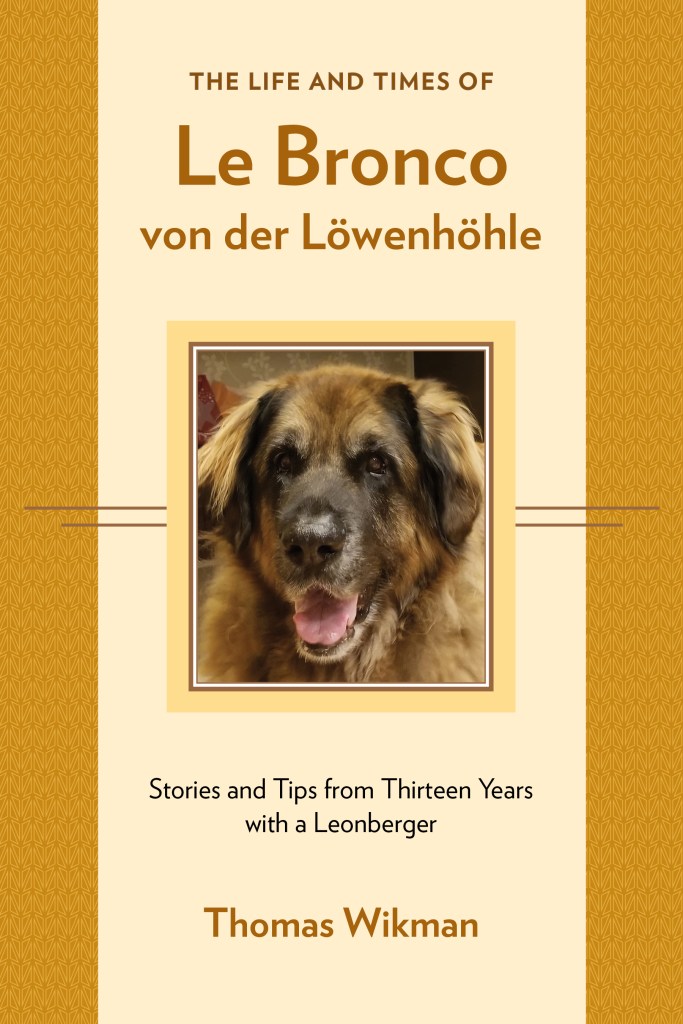
The gold and beige book cover features the face of our Leonberger Bronco and the text "The Life and Times of Le Bronco von der Löwenhöhle. Stories and Tips from Thirteen Years with a Leonberger."
This is the front cover of the book “The Life and Times of Le Bronco von der Löwenhöhle”. Click on the image to go to the Amazon.com location for the paperback version of the book.
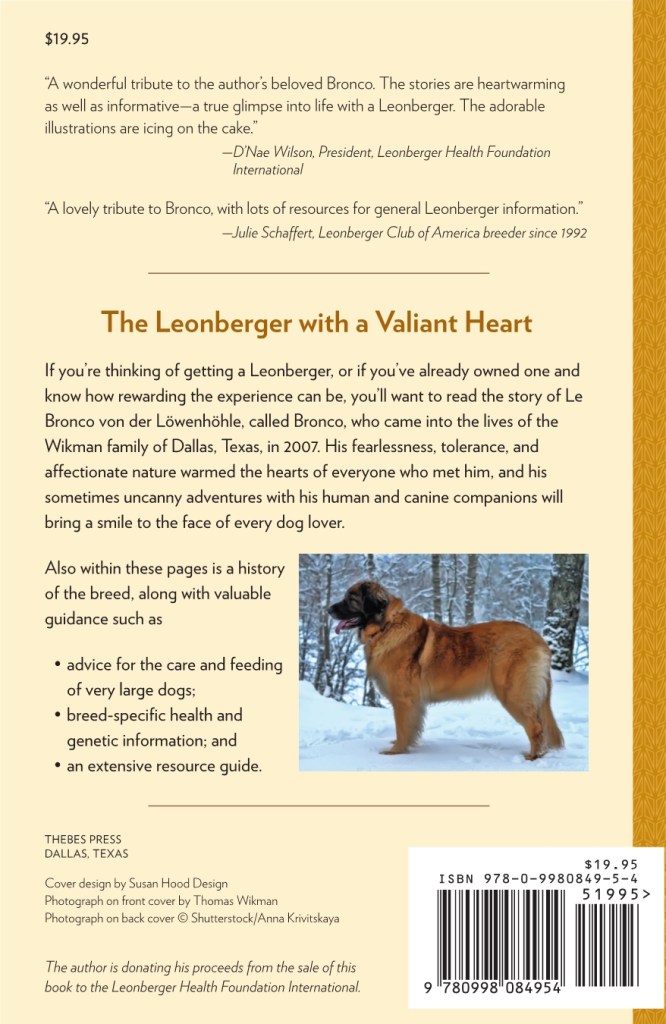
The back cover in gold and beige features a photo of a Leonberger in a snowy forest and an introduction to the book.
This is the back cover of the book “The Life and Times of Le Bronco von der Löwenhöhle”. Click on the image to go to the Amazon.com location for the kindle version of the book.
The endorsements say “A wonderful tribute to the author's beloved Bronco. The stories are heartwarming as well as informative - a true glimpse into life with a Leonberger. D'Nae Wilson, President, Leonberger Health Foundation International.” and “A lovely tribute to Bronco, with lots of resources for general Leonberger information. Julie Schaffert, LCA breeder since 1992.”
These are the endorsements for the book. Click on the image to go to the Barnes and Noble location for the book.

In this book you’ll read about some of Bronco’s amazing feats: the night he scared away a prowler; the day he performed a hamster search and rescue; the time he stumped the Geek Squad; and the late night he snuck into the kitchen and ate a two-pound bag of dog treats, a box of pastries, a loaf of bread, a grilled chicken, and a Key lime pie, all in one sitting. You’ll also read about his unflappable calm during a north Texas tornado and his stoicism as he endured health challenges in his later years.

In addition to entertaining stories, these pages contain a wealth of practical guidance, including:

  • a history of the Leonberger breed;
  • advice for the care of very large dogs;
  • breed-specific health and genetic information;
  • training and feeding tips;
  • suggestions for finding a breeder;
  • the official breed standard; and
  • an extensive resource guide.

Below is a list of places where you can get my book.

The Leonberger Health Foundation International

The Leonberger Health Foundation International is an organization that supports science and research impacting Leonberger health, longevity and breed preservation. Examples of research they’ve supported include research on Addison’s Disease, Inherited Leonberger Polyneuropathy (LPN), LEMP research, the Rabies Challenge Fund, Osteosarcoma, Hemangiosarcoma, genetic causes of male (dog) infertility, Cryptorchidism, study of cruciate ligament repair, Glaucoma, cardiac diseases, thyroid disease, neurological disorders, longevity & aging, population diversity, juvenile renal dysplasia, anal furunculosis, the EGFR Immunotherapy Project, and Leonberger inherited Arrythmia. As mentioned above, a lot of the progress applies to other dog breeds as well.

LHFI’s global biobank contains DNA samples from more than nine thousand Leonbergers. Among the organization’s notable achievements are the eradication of Addison’s disease among Leonbergers and the raising of more than $650,000 for research into conditions that affect canine health. Another success is the fact that since 2011, no Leonbergers with two copies of the LPN1 gene mutation (which causes Leonberger polyneuropathy) have been recorded in LHFI’s biobank. LHFI does other things as well. LHFI grants an award called the Grey Muzzle Award to Leonbergers who reach the impressive age of 12 years. Leonbergers and other giant breeds tend to live short lives, something LHFI is trying to solve and they have made progress. One of the recipients of the Grey Muzzle Award was our Leonberger Bronco.
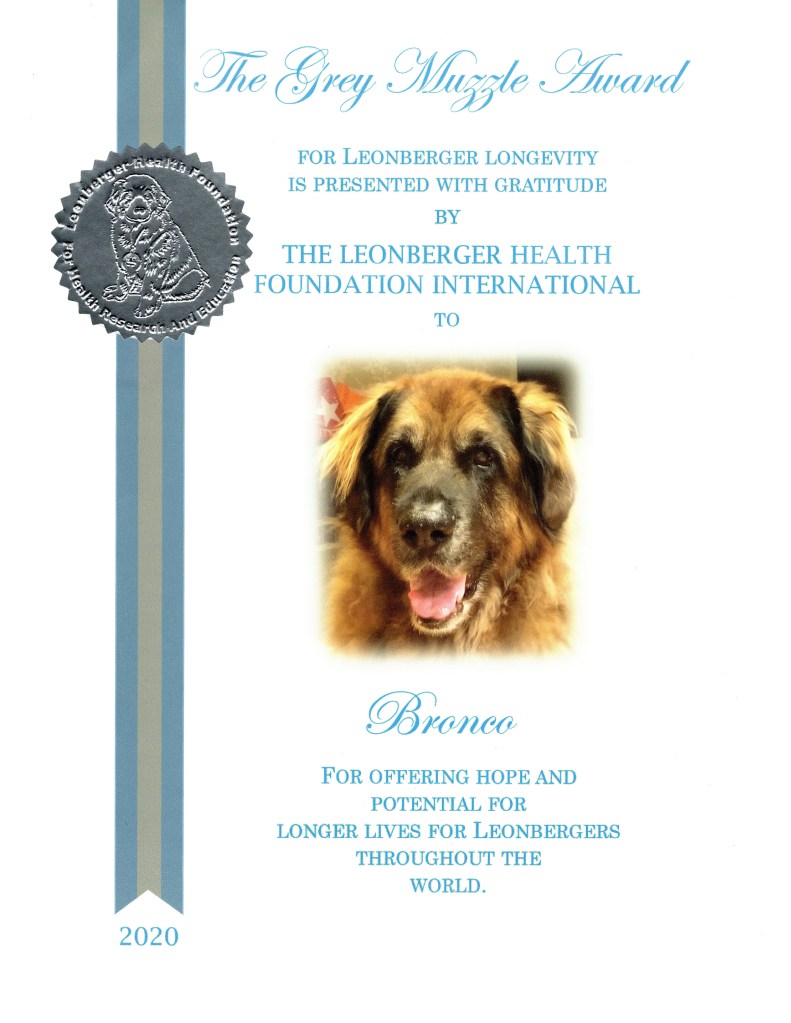
The picture shows our Leonberger Bronco’s Grey Muzzle Award. It says “The Grey Muzzle Award, for Leonberger longevity, is presented with gratitude by The Leonberger Health Foundation International To Bronco, For offering hope and potential for longer lives for Leonbergers throughout the world.”.
The Grey Muzzle Award from the Leonberger Health Foundation International.

Below is an 8-minute video explaining the ongoing research on sudden cardiac death in young Leonbergers.

What is a Leonberger?

The Leonberger breed was originally created by Heinrich Essig (1808–87) in the German town of Leonberg, in what was then the kingdom of Württemberg. According to legend, Essig bred the dog to resemble the lion in the town’s coat of arms. It was bred to be a large companion dog. He registered the new breed in 1846. The Leonberger is often said to be a cross between a Saint Bernard, a Newfoundland, and a Great Pyrenees. However, in reality the story is more complicated. More on that later. One thing is for certain, the history around the interactions between the Leonberger breed and the St. Bernard is quite interesting. Also, more on that in another post. Another interesting fact is that Leonbergers were used in World War I to pull ammunition carts and cannons. Both World War I and World War II was tough on the breed and few survived.

Very few Leonbergers existed in North America until the 1980’s, when a breeding program was established. Saturday, November 2, 1985, the few families owning Leonbergers, the so called, Denver eight, got together to form the Leonberger Club of America. The Leonberger was recognized by the American Kennel Club in 2010 as its 167th breed (in the Working group). Today there are more than 2,300 Leonbergers in the United States and a 1,000 in Canada. There are about 30,000+ Leonbergers in the world. Since there are not millions of them you can still consider the Leonberger a rare breed.

Leonbergers are confident and brave gentle giants. They are great with children, very social and good companions and guard dogs. Leonbergers are double-coated, and they have webbed paws, so they’re natural swimmers. They are sometimes used in water rescue operations. But be careful, they are big, full of energy, and can be rambunctious when they’re young.

According to the original purpose of the Leonberger, and the breed standards, the Leonberger is a large, strong, muscular, elegant dog. He is distinguished by his balanced build and confident calmness, yet he has quite a lively temperament. Males, in particular, are powerful and strong. As a family dog, the Leonberger is an agreeable partner for present-day homes and living conditions who can be taken anywhere without difficulty and is distinguished by his marked friendliness toward children. He is neither shy, nor aggressive. As a companion, he is agreeable, obedient, and fearless in all situations of life.

The following are particular requirements of a steady temperament:

•             Self-assurance and superior composure

•             Medium temperament (including playfulness)

•             Willingness to be submissive

•             Good capacity for learning and remembering

•             Insensitivity to noise

Leonbergers are large and muscular dogs. The height of an adult male is between 28 and 31.5 inches (72 to 80 centimeters) at the withers. The height of an adult female is between 25 and 29.5 inches (65 to 75 centimeters) at the withers. (The withers is the ridge located between the shoulder blades of an animal, on the back right below the neck.) Reputable breeders try to maintain these characteristics.

Leonbergers are sexually dimorphic—that is, there are noticeable differences between males and females. This is not always the case in dogs. Female Leonbergers are usually smaller and look more feminine. Males typically weigh between 120 and 170 pounds, and females usually weigh between 100 and 135 pounds. For comparison’s sake, below are the standard heights and weights for male dogs of other breeds.

• An Irish wolfhound, the world’s tallest dog (when standing on two feet), is 32 inches tall at the withers and weighs between 120 and 155 pounds.

• A Great Dane stands between 31 and 35 inches at the withers and weighs between 110 and 180 pounds.

• A Saint Bernard is between 28 and 35 inches tall at the withers and weighs between 140 and 180 pounds.

• A German shepherd stands between 24 and 26 inches at the withers and weighs between 66 and 86 pounds.

In other words, the Leonberger is right there among the largest breeds in the world.

In the picture below is an overview of the FCI breed standard for Leonberger dogs. I will post the full breed standard in another post.

This photo is a summary of the Leonberger breed standard
Summary of the FCI Leonberger breed standard (Photograph of Leonberger © Shutterstock/Eric Isselee)