
On this blog I’ve previously reviewed five good Leonberger books:
- Leonberger by Caroline Bliss-Isberg (I gave it 5 stars on Amazon)
- Leonberger Special Rare Breed Edition a Kennel Club book by Madeline Lusby (I gave it 5 stars on Amazon)
- Hey What Kind of Dog is that Life with Leonbergers by Julie McGloin (I gave it 5 stars on Amazon)
- The Dog Father Leonberger by Alex Luther (I gave it 5 stars on Amazon)
- Leonberger Dog Complete Owner’s Manual by George Hoppendale and Asia Moore (I gave it 4 stars on Amazon)
I’ve also reviewed four Leonberger books I don’t recommend:
- The Leonberger by Michael Stonewood, Leonberger Training Book for Dogs and Puppies by BoneUp Dog Training, Leonberger Dog by Nelson Dawson.
- Leonberger: The Comprehensive Owners Guide For Costs, Feeding, Care, Grooming, Health, Nutrition, Breeding And Training by Ben Bradley.
With this post I am adding a sixth Leonberger book that I recommend. It is a very short book, but it contains a lot of useful information. It contained a few inaccuracies, so I am giving it four stars instead of five, but it is still a good book.
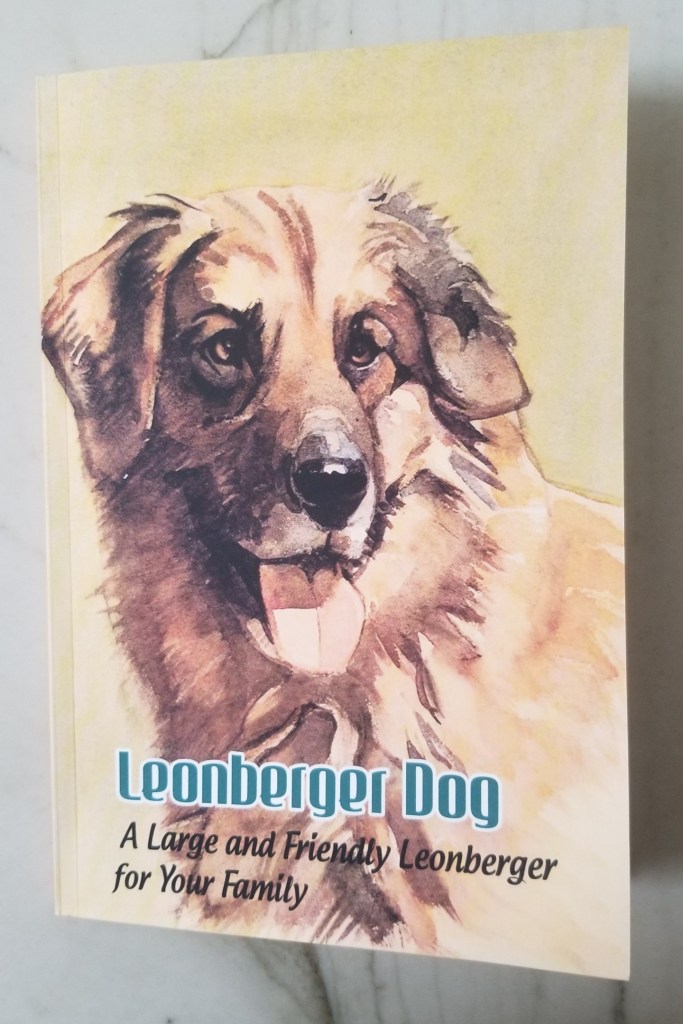
The book is Leonberger Dog: A Large and Friendly Leonberger for Your Family: Leonberger Dog Breed Origin, Behavior, Trainability and Facts by Lankford Marcus. The book is 57 pages, and the current price on Amazon for the paperback is $6.99 and the Kindle is $2.99 unless you have kindle unlimited in which case it is free. ISBN-13 : 979-8463499851, weight : 3.53 ounces and the dimensions are 6 x 0.15 x 9 inches.
This is my review for the book
Short Leonberger book packed with useful information but some inaccuracies
This is a short book. It has 55 pages of actual content. However, it is densely packed with information useful to Leonberger owners and those interested in getting one. The book is primarily addressing British readers, but it also mentions the Leonberger Club of America and give some advice specific to American prospective owners. It is quite useful to both American and European readers. The book feature 17 black and white photographs. I would have preferred the photos to be in color but that raises the printing cost, and some Leonberger books have no photos in them at all.
The book contains 11 chapters; Overview, History, Appearance, Temperament and Personality, Living Needs, Caring for a Leonberger, Feeding, Leonberger Health, Choosing a Leonberger Breeder, Average Cost to Keep for a Leonberger, How to identify a Leonberger. Almost all of the chapters were condensed but contained very useful information to Leonberger owners and prospective Leonberger owners. I especially cherished the “Temperament and Personality” and “Caring for a Leonberger” chapters. However, I had an issue with the two first chapters.
I would have given the book a five-star rating if it wasn’t for some incorrect information regarding the history of the breed. On page 4 it says that Heinrich Essig, the creator of the Leonberger breed, was the mayor of the town of Leonberg. Heinrich Essig was a prominent citizen of the town, and he was a successful businessman, farmer, innkeeper, horse and dog trader, large-dog enthusiast, dog breeder, and town councilman, but he was never the mayor of Leonberg.
On page 5 it says that after World War I there were only 5 Leonberger left alive. World War I was tough on the breed, but it was not quite that bad. After the war, Karl Stadelmann and Otto Josenhans, worked hard to save the breed, and they were able to find twenty-five Leonbergers whose owners were willing to cooperate in reestablishing the breed. Of these, only five were suitable for breeding. That’s where that info comes from. That’s a little different from saying that only five Leonbergers survived.
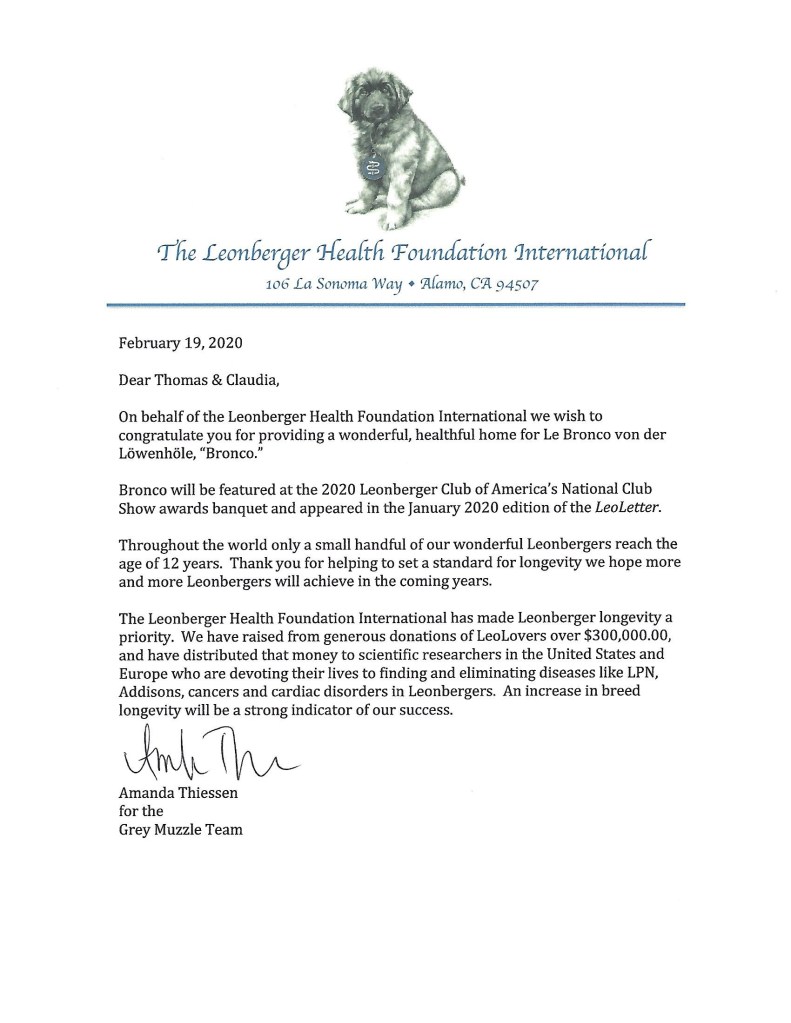
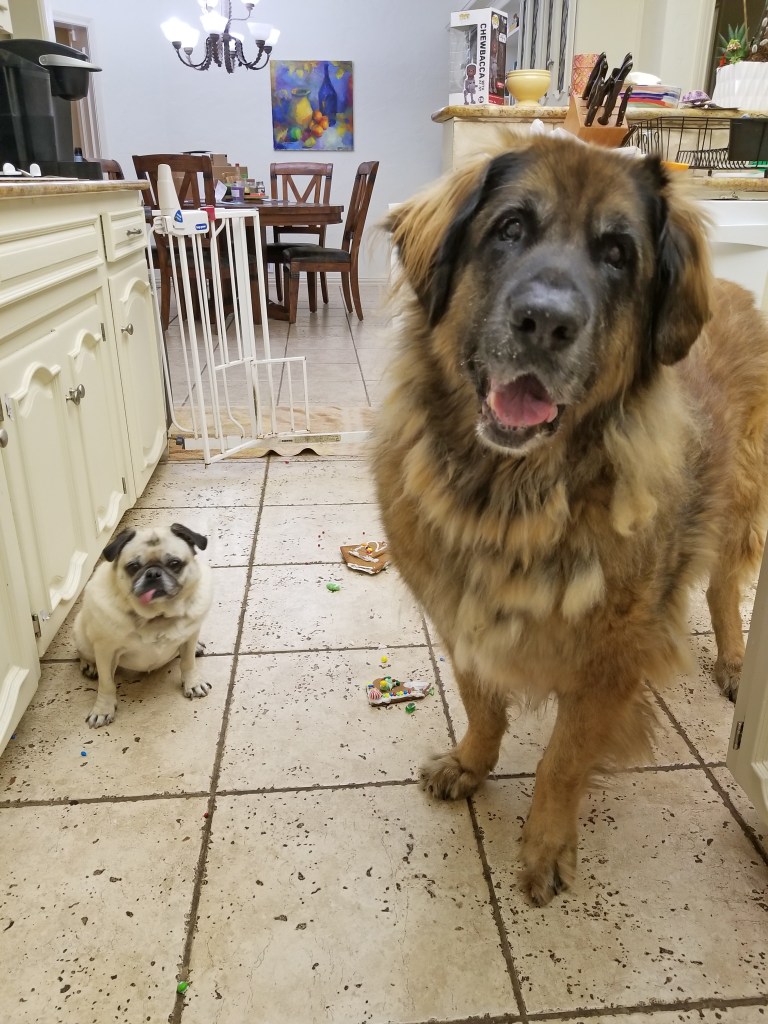
On page 6 it says that after World War II there were only 8 Leonbergers left. However, that is once again an exaggeration. However, there was indeed a “genetic bottleneck” of Leonbergers in the 1940s. This was largely because people repeatedly bred the dogs they thought were the best specimens in a misguided attempt to improve the breed. Scientific pedigree analyses demonstrate that the Leonberger has twenty-two founder animals, or animal ancestors unrelated to one another (ten males and twelve females). Again, a little bit different from “only 8 survived”. Another inaccuracy is that on page 2 the book state that the Leonberger have a tragically short lifespan of 6-8 years. First, all giant breeds have a very short lifespan and the lifespan of the Leonberger has improved partially due to the work of the Leonberger Health Foundation International. Today the Leonberger lifespan is 8-10 years. Ours lived almost 13 years (two weeks short of 13), so the Leonberger Health Foundation International wanted his DNA, which we provided.
This book is short, but it packs a lot of mostly accurate information that is truly useful to Leonberger owners. In that sense I think it is great. I wrote quite a bit about the few mistakes in this book, but I think it is important to point out inaccuracies. These inaccuracies frequently appear on-line and in other Leonberger books as well and they are not important to Leonberger owners. I feel I cannot give five stars considering these inaccuracies are in the book. However, I can still highly recommend this book to all readers interested in a short Leonberger book.

















 Leonberger Life