The Leonberger Club of America

If you own a Leonberger, or are interested in Leonbergers, and you live in North America you likely know about the Leonberger Club of America, or the LCA for short. You are about as likely to find a Leonberger at Petland/Puppy-Mill as you are finding an Elephant for sale there. LCA is very protective of the Leonberger breed and of Leonbergers in general. You typically buy/get a Leonberger dog from an LCA certified Leonberger breeder or from the Leonberger Rescue Pals, and if you don’t that might be a problem.

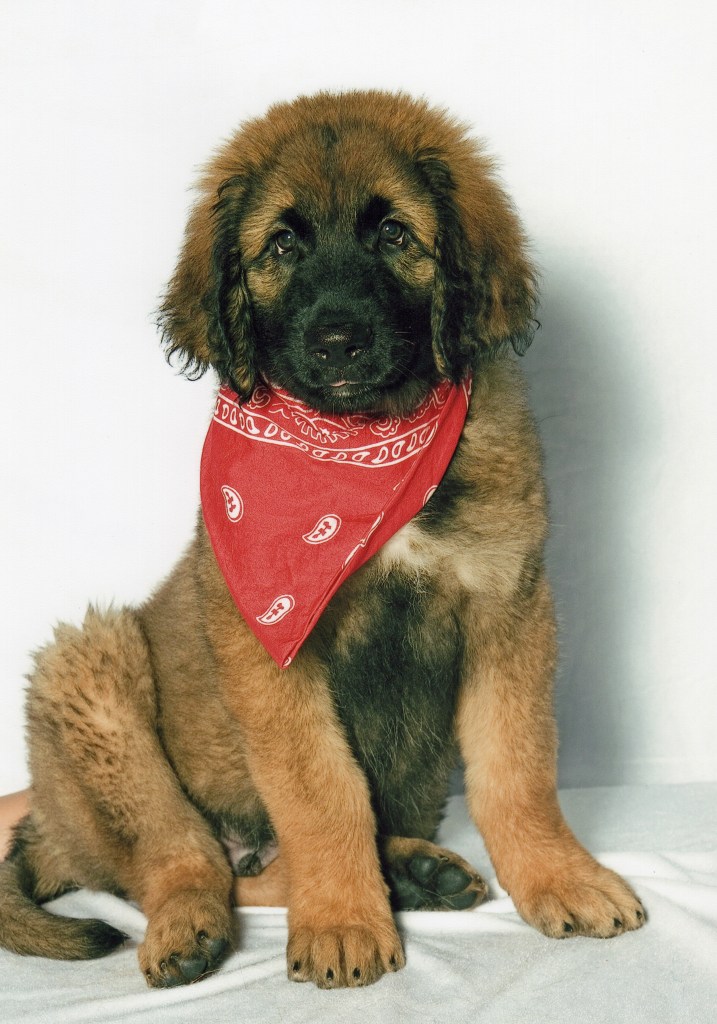
This is a photo of our Leonberger Bronco (Le Bronco von der Löwenhöhle) in 2007. He was three months old.
We bought our Leonberger Bronco (Le Bronco von der Löwenhöhle) in 2007 from Julie Schaffert, a certified LCA breeder since 1992.

There are only about 3,000 Leonbergers in North America and about 2,000 Leonbergers in the United States but the Leonberger Club of America has more than 1,000 members. They publish the Leo-Letter, a quarterly Leonberger magazine. So, the Leonberger Club of America has a very prominent place among Leonberger owners. Click here to see a summary of the Leonberger Breed Standard.

Leonberger winning a price
Photo of a Leonberger from the LCA website

Other clubs associated with the Leonberger Club of America are New Jersey Leonberger Club, Great Lakes Leonberger Club, Greater Bluegrass Leonberger Club, Mid-Atlantic Leonberger Club Of Virginia, AKC Licensed Specialty Club, Tarheel Leonberger Club, AKC Licensed Specialty Club, The Frontier Leonberger Club Of The Southwest, Leonberger Club Of The Northwest, Northern California Leonberger Club. I am a member of The Frontier Leonberger Club Of The Southwest.

Other more or less related Leonberger clubs are the Leonberger University, Leonberger Health Foundation Internation and the Worldwide Leonberger Database. All proceeds from the sale of my book go to the Leonberger Health Foundation International.

Leonbergers have a long history in North America and the United States—despite the fact that until 1985, there were only seventeen Leonbergers known to be living in the United States.

See: Lusby, Leonberger, page 15.

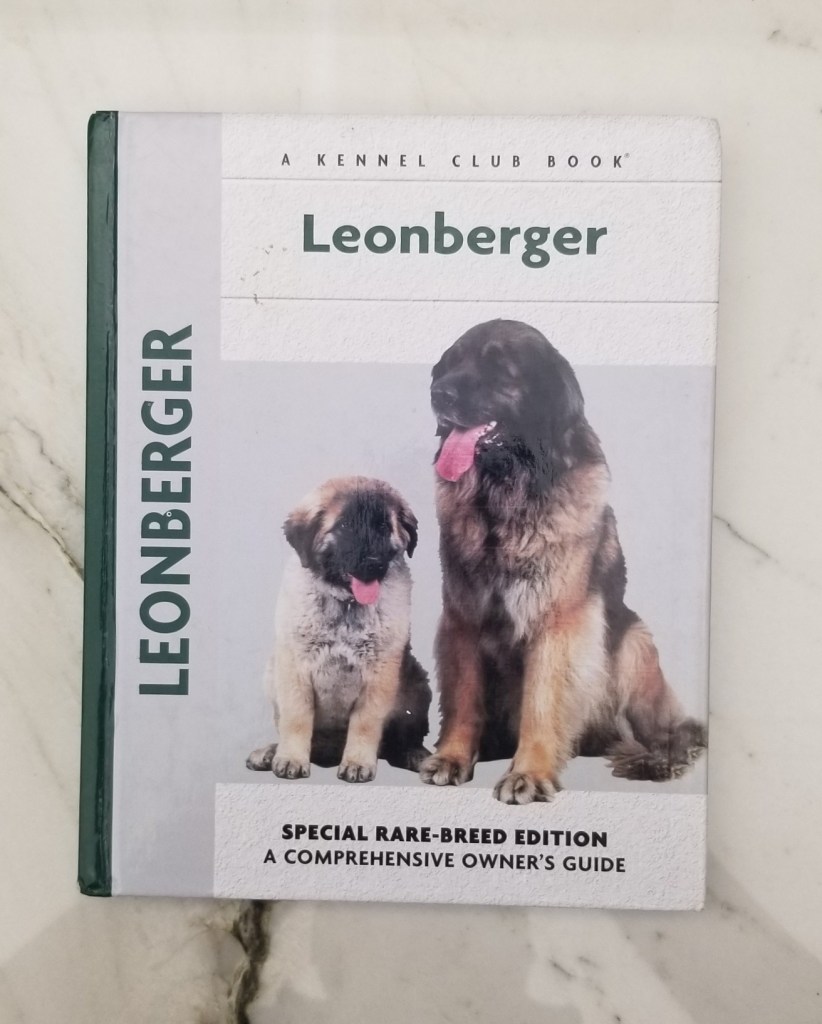
Front cover photo of Leonberger, Special Rare-Breed Edition, A Comprehensive Owners Guide, Madeline Lusby.
Leonberger, Special Rare-Breed Edition, A Comprehensive Owners Guide, Madeline Lusby. Click on the image to see my five star review for this book.

In the 1870s, Leonbergers were brought to Newfoundland to invigorate the stock of Newfoundland dogs. Around the same time, two Leonbergers named Caesar and Sultan were purchased from Heinrich Essig’s kennel (founder of the Leonberger breed) and transported across the ocean to join the Wellesley-Sterling theater company in the United States as the stars of their productions. Then in 1879, Caesar and Sultan visited President Ulysses S. Grant, who called them the largest and most magnificent dogs he had ever seen and presented them with gold medals. During the years between World War I and World War II, a New Jersey family, the Wolfs, opened their home as a temporary refuge for Jews fleeing Germany: they also imported Leonbergers. Unfortunately, this introduction of the breed into the United States did not last, and it would be another fifty years before the Leonberger appeared in America again.

See: Bliss-Isberg, Leonberger, page 60, page 64, page 101

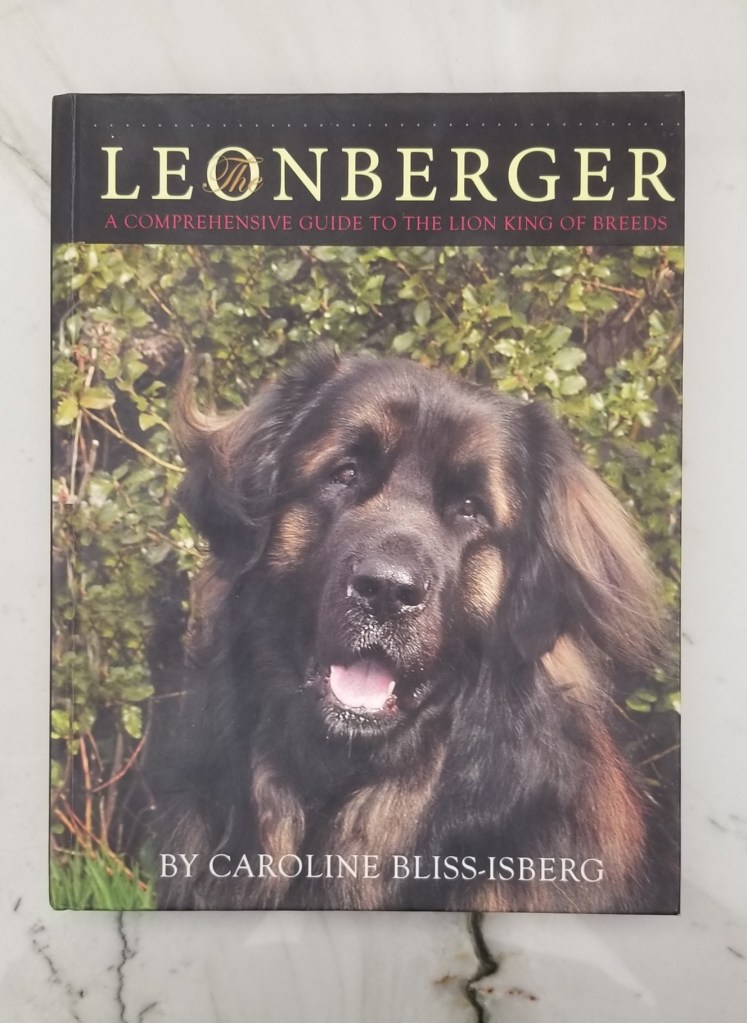
Front cover of Leonberger, A comprehensive guide to the lion king of breeds, Caroline Bliss-Isberg.
Leonberger, A comprehensive guide to the lion king of breeds, Caroline Bliss-Isberg. Click on the image to see my five start review for this book.

During the late 1970s and the 1980s, a few families—Waltraut and Klaus Zieher, Brian Peters, Manfred and Sylvia Kaufmann, Keri Campbell and Melanie Brown, and Mary and Reiner Decher brought Leonbergers to the United States. The Dechers had started a breeding program and were looking for a mate for their first dam, Viona. By chance their neighbor discovered through a newsletter that there was another Leonberger in the United States, and that led to the families’ finding and connecting with one another. I should add that the Dechers were careful to conform to the German breeding regulations and performed hip X-rays that they then submitted to the Orthopedic Foundation for Animals (OFA). Viona became the first OFA-certified Leonberger in America.

See: Bliss-Isberg, Leonberger, page 152.

On Saturday, November 2, 1985, eight of these Leonberger enthusiasts met at a hotel in Denver, Colorado, to found the Leonberger Club of America (LCA). This group of founders, which has since been dubbed the Denver Eight, appointed a registrar, formulated a breeding acceptability checklist, and instituted various policies, including the requirement that OFA certification is mandatory for breeding. LCA membership grew: it held social gatherings, began publishing LeoLetter, and imported an increasing number of dogs. Now the LCA has thousands of members across the country, and Leonbergers receive high ratings on health tests relative to other large breeds. For example, in 2000, the OFA reported that only 14.6 percent of Leonbergers tested positive for hip dysplasia, compared to 47 percent of Saint Bernards.

See: Bliss-Isberg, Leonberger, page 154, page 176.

Another important historical event was the founding of the Leonberger Health Foundation International (LHFI), in 2000 (it was just called the Leonberger Health Foundation back then). According to its website, the organization was founded by Waltraut Zieher and other memers of the LCA’s health, education, and research committee to “facilitate the solicitation and distribution of donations given to support health related breed-specific research.” The LHFI also administers a program that collects DNA samples from Leonbergers to share with universities and research institutions, and of course it administers the Grey Muzzle Award (long living Leonbergers). Our Leonberger Bronco was a recipient of the Grey Muzzle Award, and we provided them with his DNA.

Bronco's Grey Muzzle Award, which he received for being an unusually long lived Leonberger. It was give by the Leonberger Health Foundation International, for offering hope and potential for longer lives for Leonbergers throughout the world.
Bronco’s Grey Muzzle Award, which he received for being an unusually long lived Leonberger.


LHFI’s global biobank contains DNA samples from more than nine thousand Leonbergers. Among the organization’s notable achievements are the eradication of Addison’s disease among Leonbergers and the raising of nearly half a million dollars for research into conditions that affect canine health, including osteosarcoma, hemangiosarcoma, glaucoma, cardiac diseases, thyroid diseases, and neurological disorders. Its research also supports healthful longevity and aging as well as population diversity. Another success is the fact that since 2011, no Leonbergers with two copies of the LPN1 gene mutation (which causes Leonberger polyneuropathy) have been recorded in LHFI’s biobank. LHFI is one of my favorite charities.

The end of the twentieth century marked not only the end of the Cold War but also the beginning of what I call the Dog Wars of America. In 1985, the American Kennel Club (AKC) registry comprised one-third of the world’s known dog breeds. But the AKC had recognized only a few new breeds since 1887—a period of ninety-eight years. So, the organization decided to change that policy, but this did not always go smoothly. The members of rare-breed clubs often did not want to be part of the AKC. For example, the Australian Shepherd Club of America (ASCA) was very reluctant to join, so a relatively small splinter group, the United States Australian Shepherd Association, was formed and designated the official member club of the AKC, which was not welcome news to the ASCA. The border collie is another example. Charles Krauthammer, the late political columnist, called the AKC the politburo of American dog breeding.

See: Bliss-Isberg, Leonberger, page 159.

Similarly, in 2003, a new Leonberger club was formed—the Leonberger Club of the United States—with the goal of becoming the Leonberger member club of the AKC. This essentially forced the LCA’s hand, so they applied for membership in the AKC, a process that took years to complete. But ultimately the AKC approved the LCA as members in 2010: Leonbergers would officially become part of the Working Group. Fortunately, 90 percent of LCA breeders agreed to continue following LCA regulations regardless of whether the club would remain independent or become part of the AKC. Also fortunately, AKC membership afforded more opportunities for Leonbergers to participate in dog shows, which is important to many owners.

See: Bliss-Isberg, Leonberger, page 187

For information on the history of the Leonberger starting in 1830’s see this link

Wonderful Review of The Life and Times of Le Bronco von der Lowenhohle

What a nice surprise. Here I am reblogging a wonderful review of my book that Miriam Hurdle wrote. The review can also be seen on Amazon.

The Life and Times of Le Bronco Von Der Lowenhohle Featured on Smorgasbord

Today my book is being featured on Sally Cronin’s prominent Smorgasbord book promotion blog

Leonberger In Online Preston Hollow Peoples Magazine

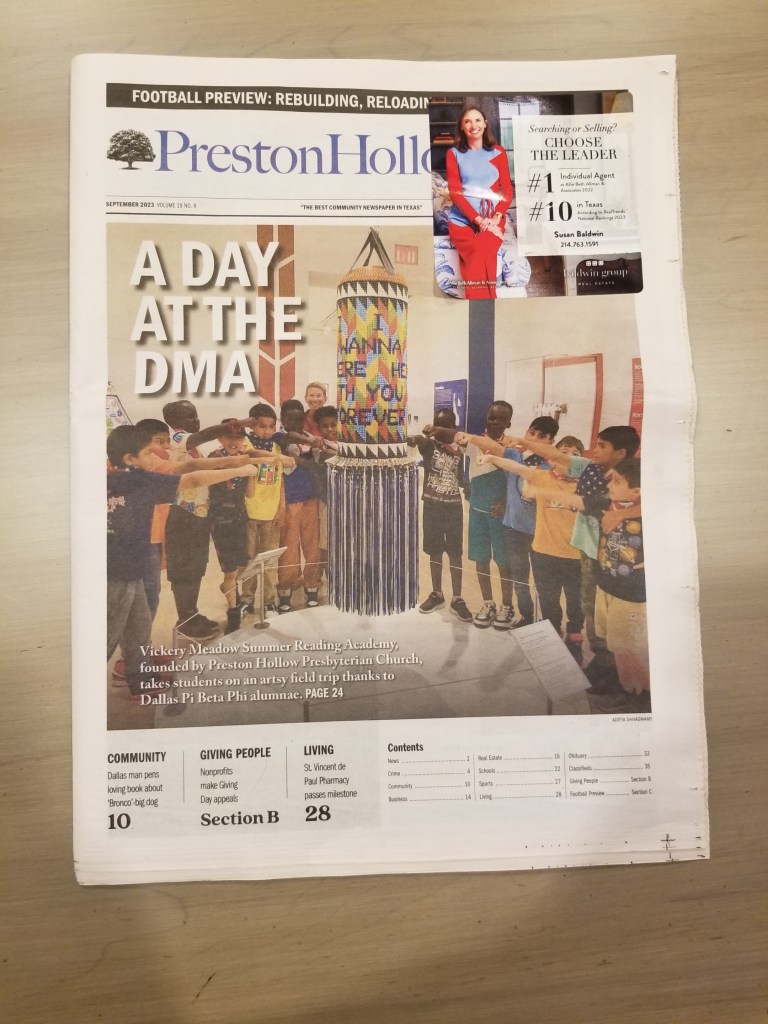
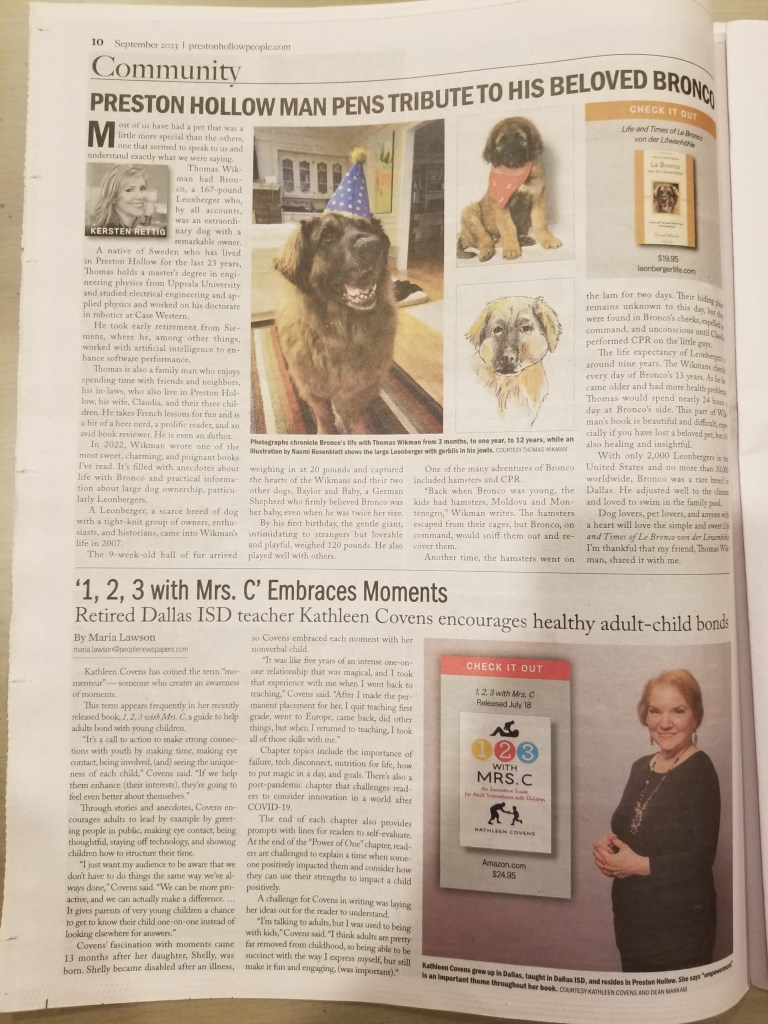
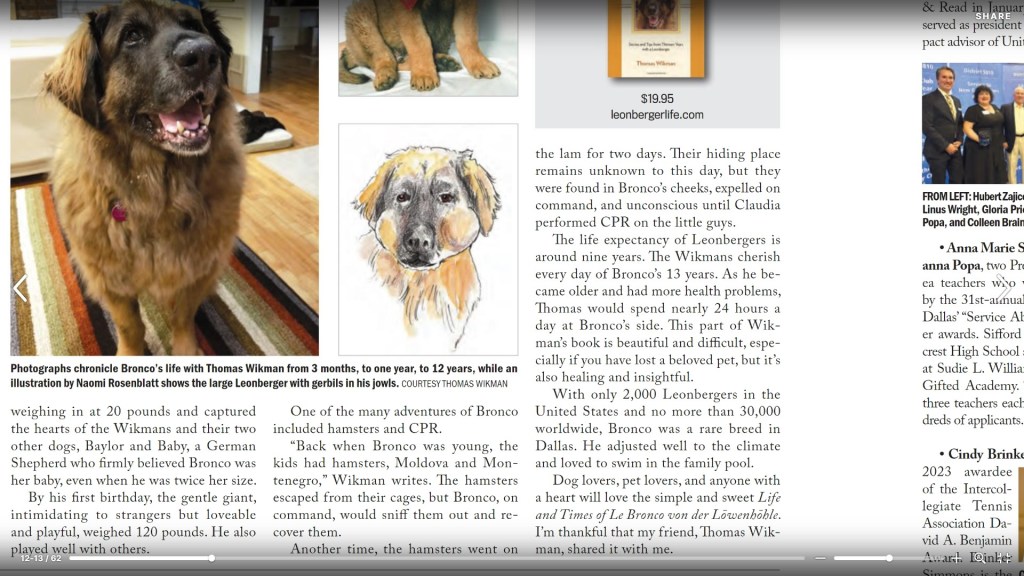
Three weeks ago, I made a post about our late Leonberger Bronco (and my book) being featured in a local Dallas magazine called the Preston Hollow Peoples Magazine. This magazine has 47,000 subscribers. In that post I posted screenshots of the printed version. Today they posted the free online version of the magazine. Click here to see the article about Bronco, my book and me. Click here to see the front page of the online version of Preston Hollow Peoples Magazine. The headline of my article can be found on the front page.

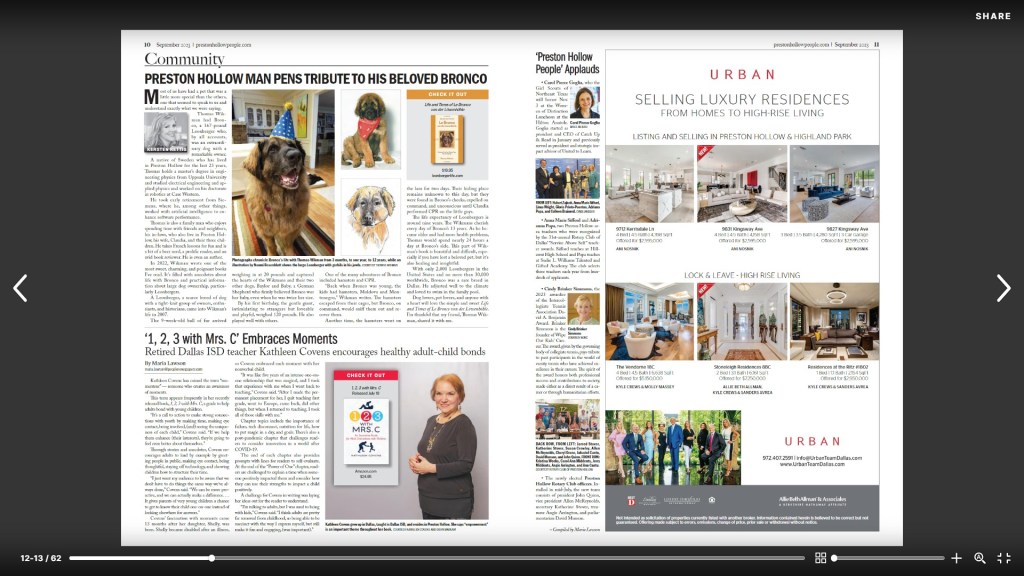
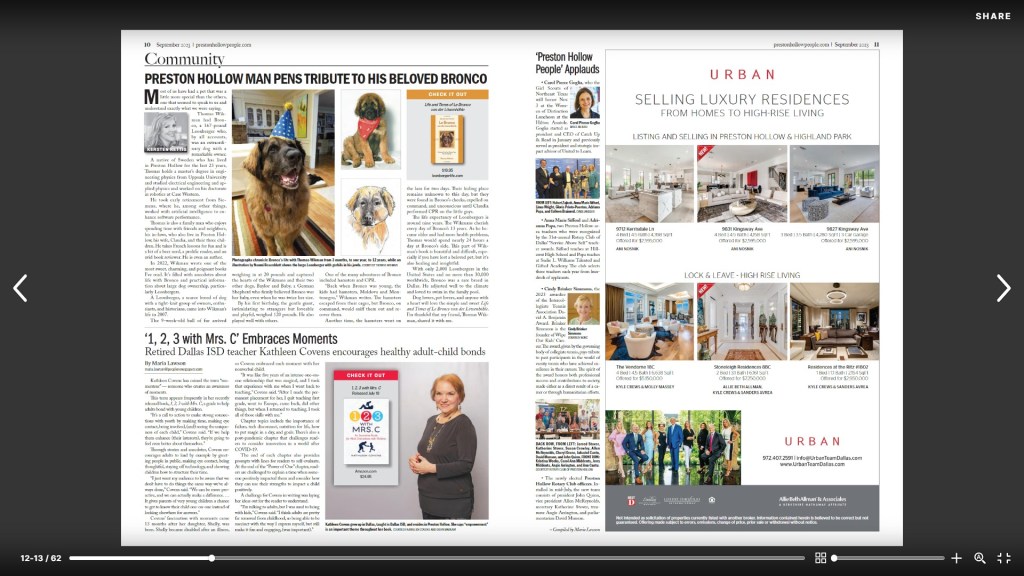
The page showing the article in Preston Hollow Peoples Magazine. My article is on page 10 - left. It is the upper half of the magazine.
The page showing the article in Preston Hollow Peoples Magazine. Click on the image to see the front page of the free online version of Preston Hollow Peoples Magazine.
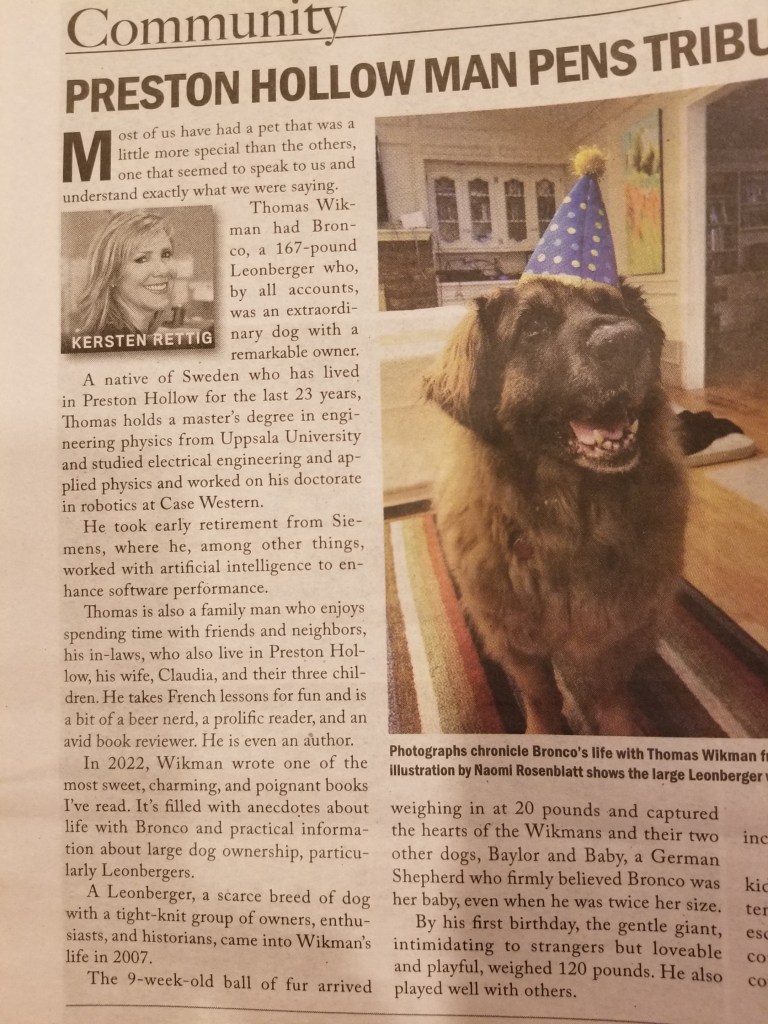
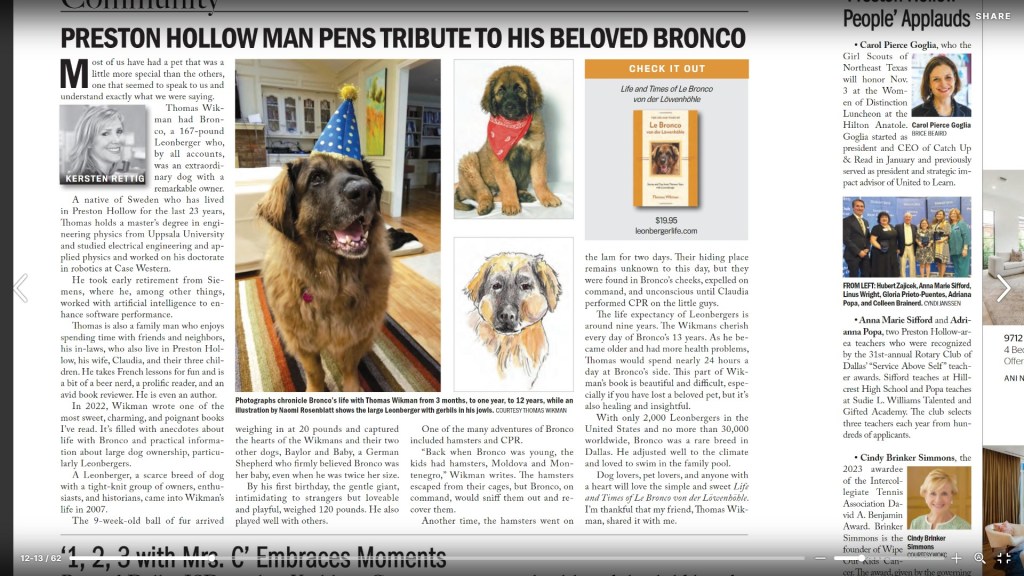
The article in Preston Hollow Peoples Magazine zoomed in a bit. The title is "preston Hollow Man Pens tribute to his beloved Bronco"
The article in Preston Hollow Peoples Magazine. Click on the picture to go to the article in the free online version of the magazine.
Bronco, our Leonberger is standing on an orange sofa while giving me a hug.
Bronco and me

Leonberger In Preston Hollow Peoples Magazine

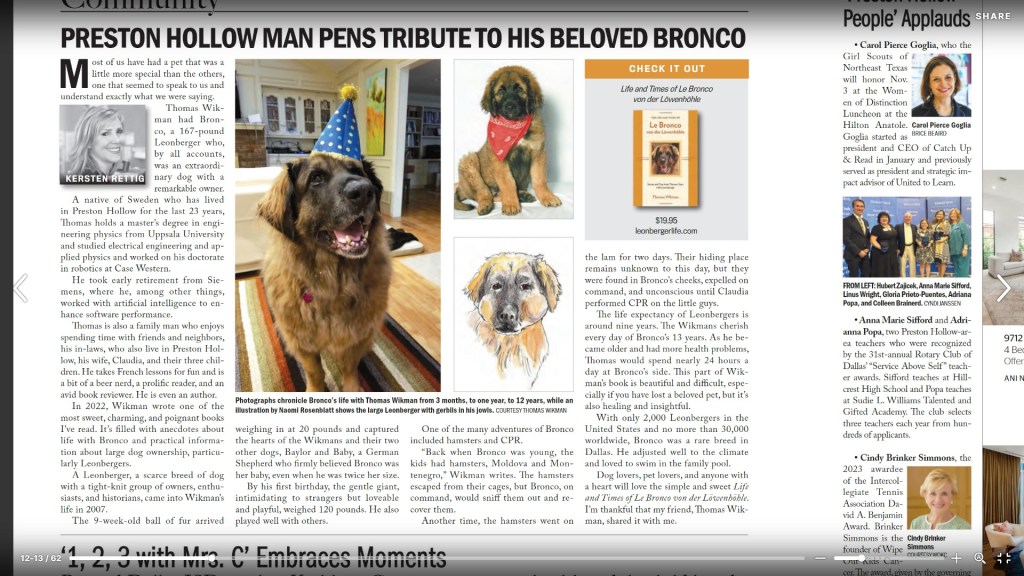
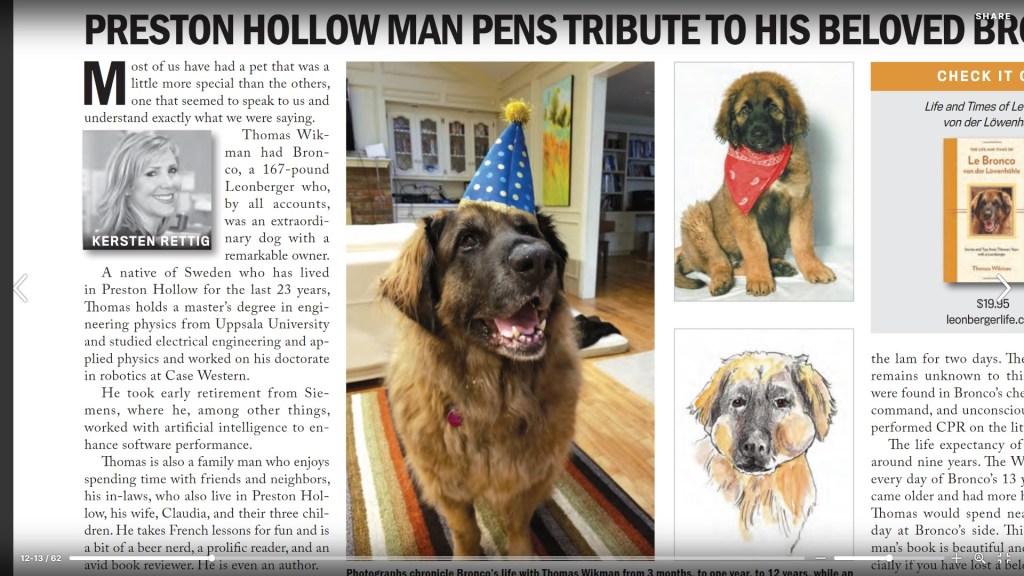
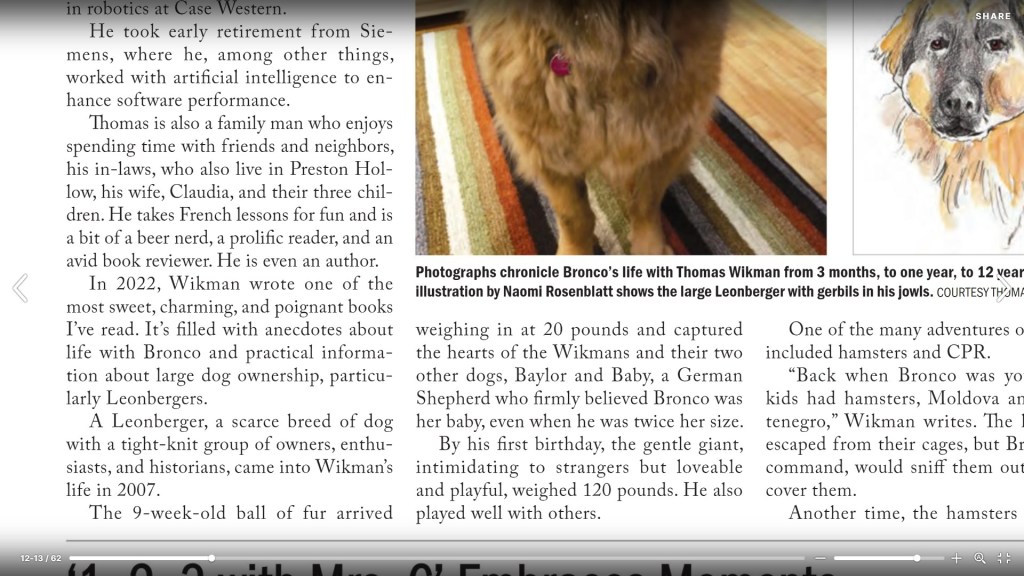
Our Leonberger Bronco, well Le Bronco von der Löwenhöhle, and my book about him, as well as an interview with me by journalist Kersten Rettig was featured on page 10 of the Preston Hollow Peoples Magazine. This magazine is mailed to 47,000 households in north Dallas. Below are pictures from the on-line version of Preston Hollow Peoples Magazine. You can probably not read the text in the top picture. However, I added additional pictures which are enlarged/zoomed-in versions, and you may be able to read those. Also, if you click on any of the pictures you are taken to the magazine where you can zoom in and enlarge as much as you want.

This is the spread of Preston Hollow Peoples Magazine it features a few articles including the article about our Leonberger and my book, which cover half of page 10.
This is the spread of Preston Hollow Peoples Magazine that feature our Leonberger Bronco and my book about him. Click on the picture to see the online page.

Just as an FYI, Preston Hollow is an area in north Dallas with a long history. Some of its residents include former President George W. Bush, Dallas Mavericks owner Mark Cuban, Dallas Stars owner Tom Hicks, Dirk Nowitzki, Jordan Spieth, Tyler Seguin, and the late Ross Perot who once was a Presidential candidate.

In this picture it is just the Leonberger article in the Preston Hollow Peoples Magazine that is featured. Click on the picture to see the online page.
The article in Preston Hollow Peoples Magazine. Click on the picture to see the online page.
This zoom-in of the article in Preston Hollow Peoples Magazine show the top-left portion of the article. It feature text, our Leonberger Bronco wearing a party hat, a puppy picture and an illustration showing Bronco with two hamsters in his mouth.
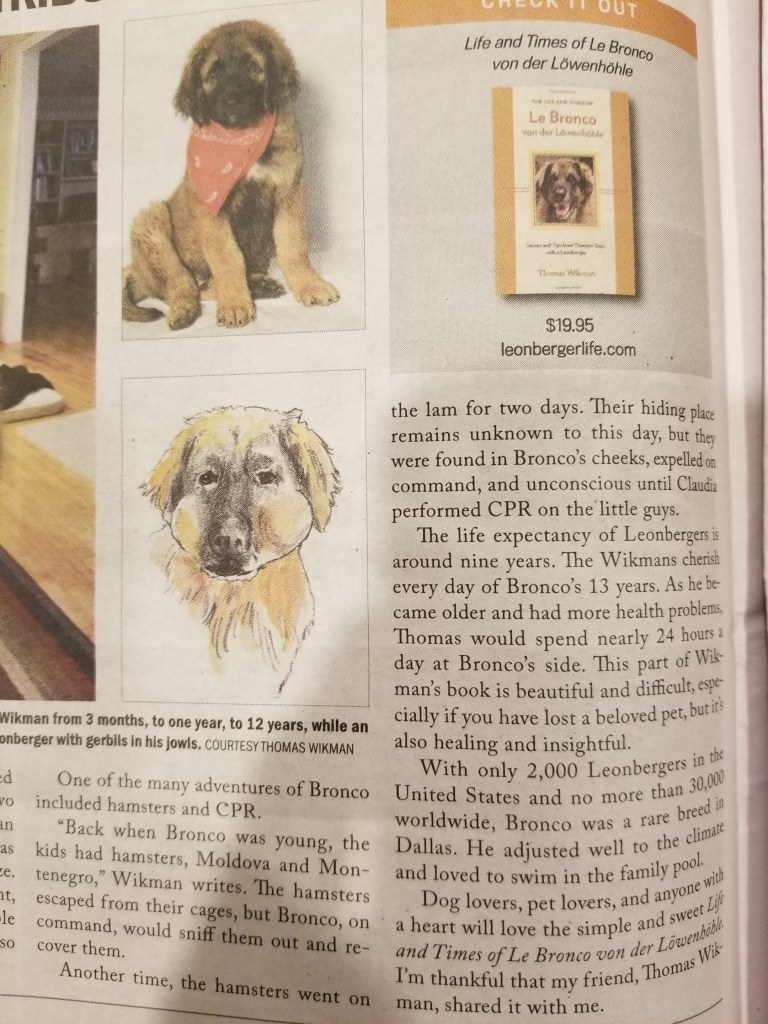
Zoom-in of the article in Preston Hollow Peoples Magazine. The illustration by Naomi Rosenblatt shows Bronco’s face as he is carrying two hamsters in his mouth. Click on the picture to see the online page.
This zoom-in of the article in Preston Hollow Peoples Magazine shows the bottom left of the article. Click on the picture to see the online page.
Another zoom-in of the article in Preston Hollow Peoples Magazine. Click on the picture to see the online page.
The last zoom-in of the article in Preston Hollow Peoples Magazine shows the right side of the article. The top is cut-off because it is only pictures. Click on the picture to see the online page.
Another zoom-in of the article in Preston Hollow Peoples Magazine. Click on the picture to see the online page.

Name Change Successful In the Amazing Leonberger Database

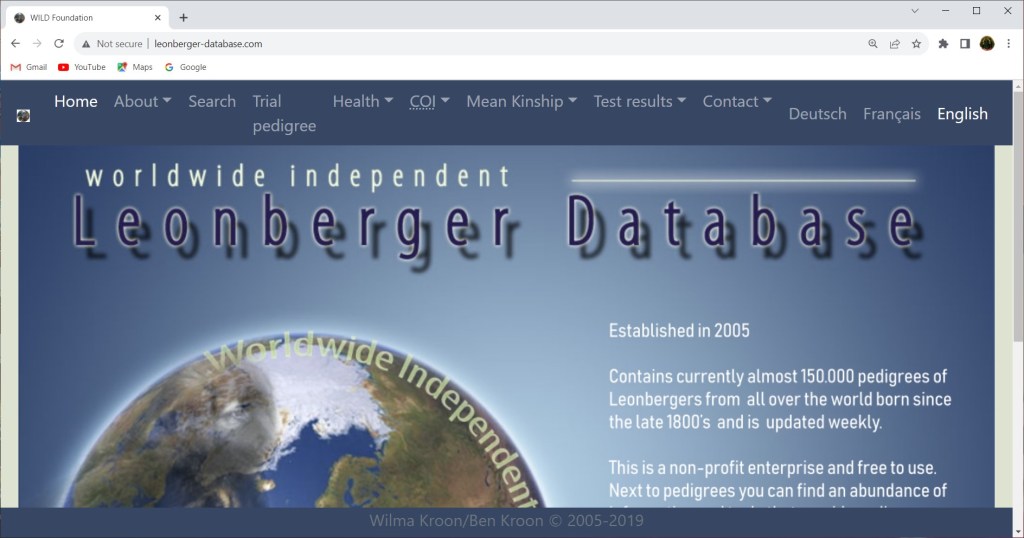
There is a World Wide Independent Leonberger Database (WILD) which features more than 166,000 Leonbergers. That is a lot considering that there are 30,000 Leonbergers in the world and if you go back in time there were many fewer. In fact, genetic research has shown that there are only 22 founder animals (the ancestors of all living Leonbergers) who lived soon after the Second World War. By selecting the search item from the menu and then typing in the name of your Leonberger you can most likely find your dog in the database. If your Leonberger’s entry does not have a photo you can email them a photo, which I did.

Home page for Cthe World Wide Independent Leonberger Database (WILD). It's blue with 12 menus. It is in three languages, Dutch, French and English.
Click on the image to visit the World Wide Independent Leonberger Database (WILD).

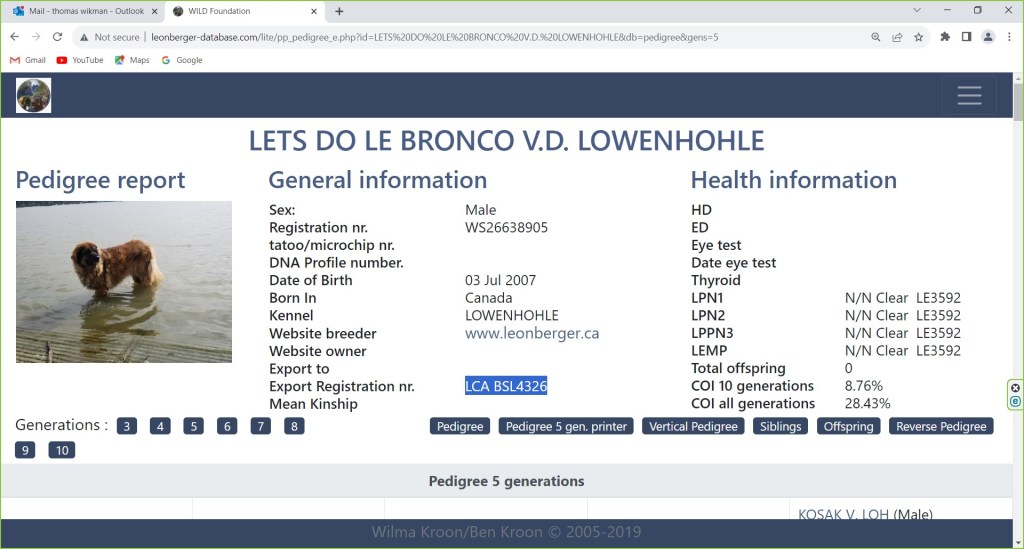
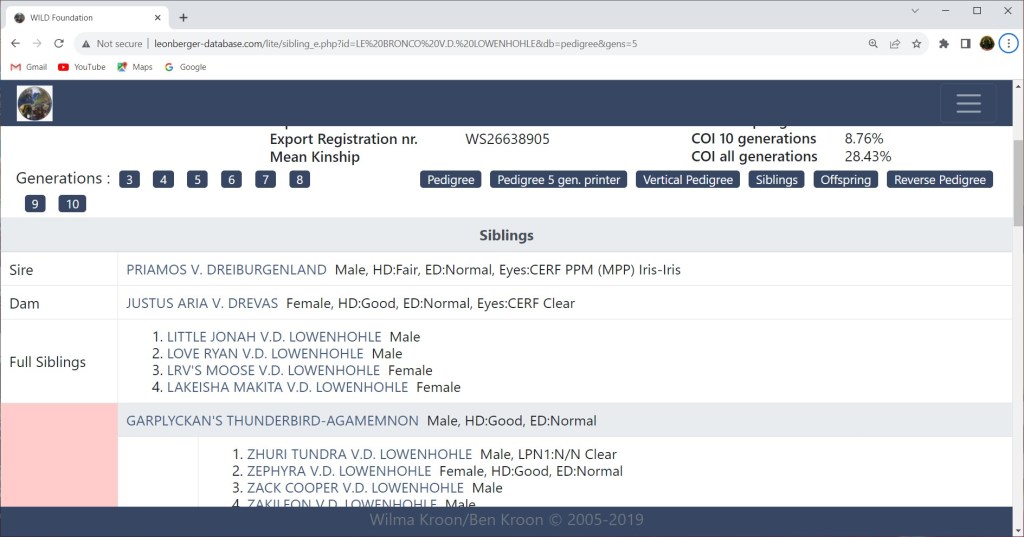
Another update I requested and had approved was an update to Bronco’s name. We wanted to name our Leonberger Bronco. It was our son’s choice. However, the Leonberger community and breeders have rules about how to name your dog. My wife Claudia was told that Bronco would not work because the litter Bronco was part of needed to have names beginning with an ‘L’. You can see the full sibling screenshot below. So, Claudia said “Let’s do Le Bronco”. Imagine our surprise when his birth certificate stated that his name was “Lets Do Le Bronco von der Löwenhöhle”. Well, “Lets Do Le Bronco von der Löwenhöhle” begins with an ‘L’. His birth certificate name including the unexpected preamble “Lets Do” made its way into the database. Fortunately, the World Wide Independent Leonberger Database recently updated his full name to “Le Bronco von der Löwenhöhle” upon my request.

The is the old data base entry for Bronco has his name miss spelled as "Lets Do Le Bronco von der Löwenhöhle"
This is the old data base entry for Bronco. Lets Do Le Bronco von der Löwenhöhle.
This is a screenshot for the corrected data base entry for Bronco. The nameis correct "Le Bronco von der Löwenhöhle". There is also registration number, birthdate, birthplace, and health related information.
This is the corrected data base entry for Bronco. Le Bronco von der Löwenhöhle. Click on the picture to visit Bronco’s database entry.

I should explain that the database entries feature not only name, birthdate and birthplace, kennel, etc. It also contains health related information including important tests, genetic defects and inbreeding coefficients (COI). Note that Bronco lived in Dallas, Texas, but he was born at Kennel Löwenhöhle outside Vancouver, Canada.

Right below Bronco's entry is his father and mother's name and a list of his full siblings (litter).
Sire: Priamos von Dreiburgenland
Dam: Justus Aria von Drevas
Full siblings: Little Jonah von der Löwenhöhle, Love Ryan von der Löwenhöhle, LRV's Moose von der Löwenhöhle, Lakeisha Makita von der Löwenhöhle. Note, the database uses von der Lowenhohle instead of von der Löwenhöhle.
Bronco’s four full siblings (same litter). You don’t call it twins for dogs but that’s what they were. Notice that all their names start with an ‘L’.
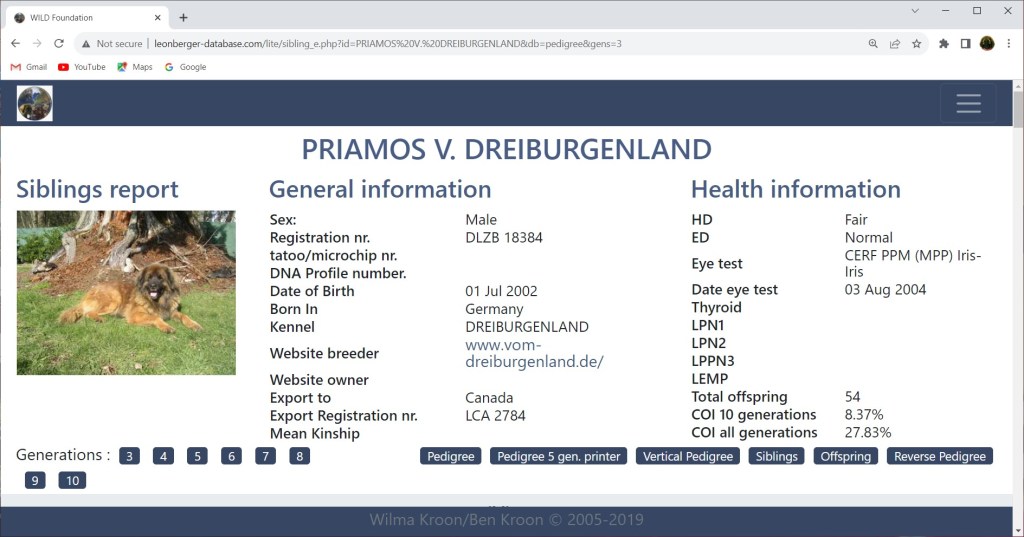
The database entry for Bronco’s father Priamos von Dreiburgenland includes a photo. He had 54 offspring.
The database entry for Bronco’s father.
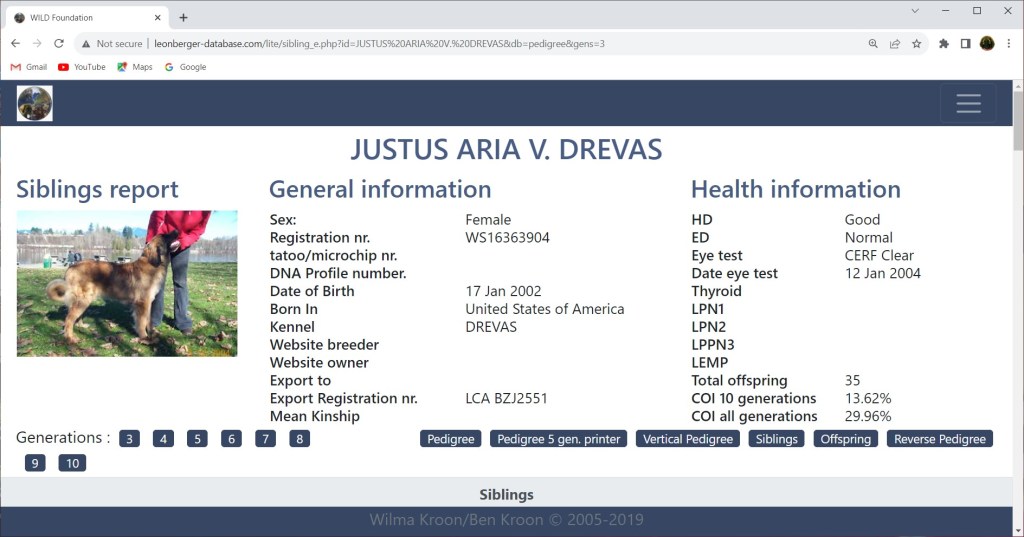
The database entry for Bronco’s mother Justus Aria von Drevas includes a photo. She had 35 pups.
The database entry for Bronco’s mother.
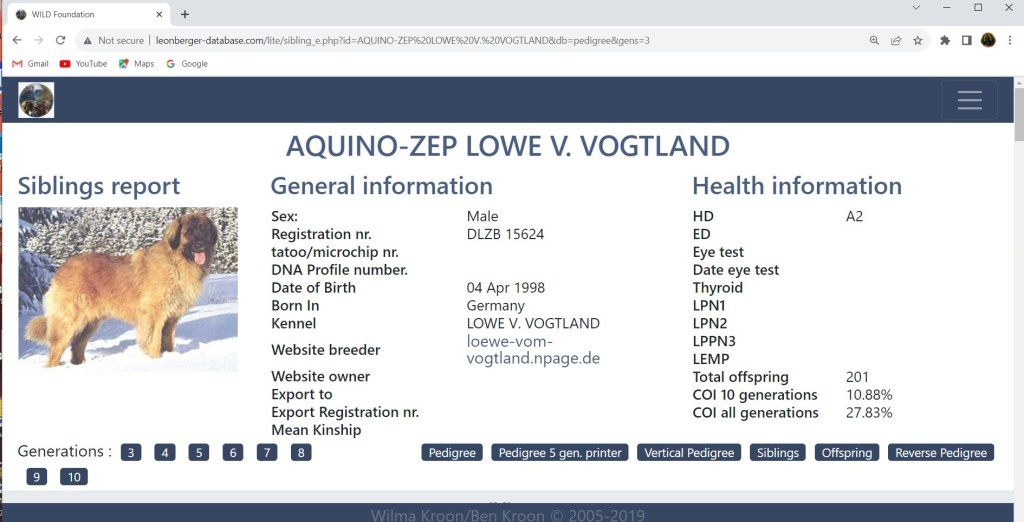
The database entry for Bronco’s grandfather Aquino-Zep Lowe von Vogtland included a photo. He had 201 offspring.
The database entry for Bronco’s grandfather. Notice that he had 201 offspring. This was a kennel in Germany.

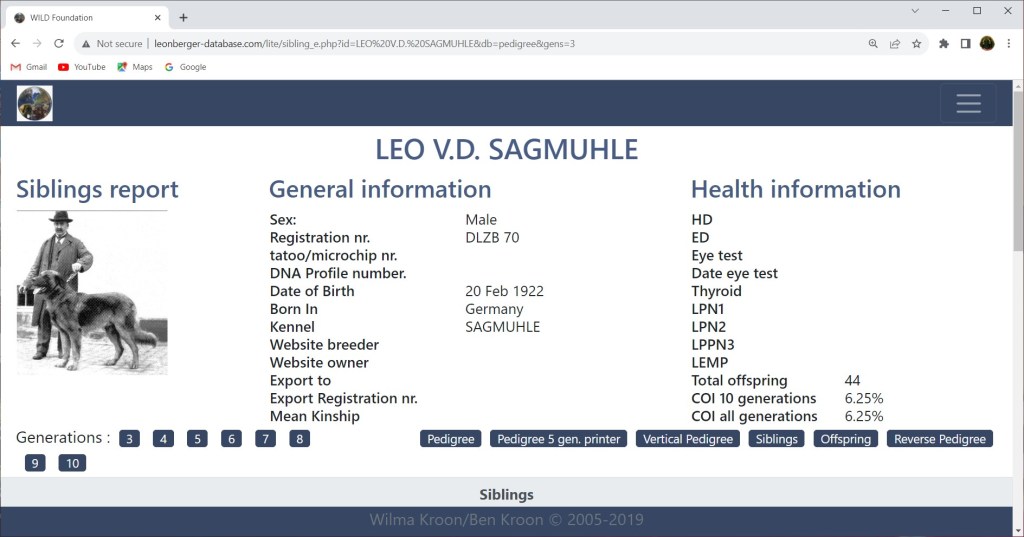
I followed Bronco’s ancestors back on his father’s side 22 generations. The last one with a photo was 17 generations back, born in 1922. However, ancestry is not a straight line along the father’s and the grandfather’s line. It is an ever-growing ancestry tree involving 2, then 4, 8, 16, 32, 64, 128, 256, etc., ancestors, so Bronco has many ancestors with photos.

The entry for Bronco's great grandfather 17 generations back included a photo. He had 44 offspring and he was born in 1922.
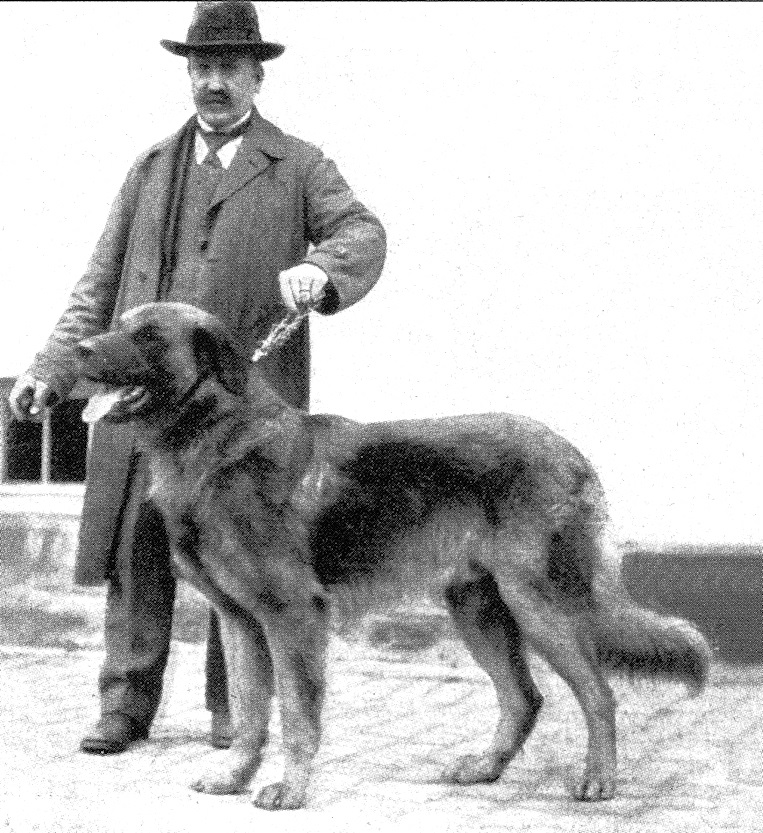
This is Bronco’s great great great father etc., 17 generations back. Leo von der Sagamuhle. He was born February 20th 1922.
There is a big Leonberger in the middle of the photo and behind is his handler a man with a moustache and a hat.
Close up of Leo von der Sagamuhle, Bronco’s straight back ancestor on his father’s side, 17 generations (great great …. grandfather).
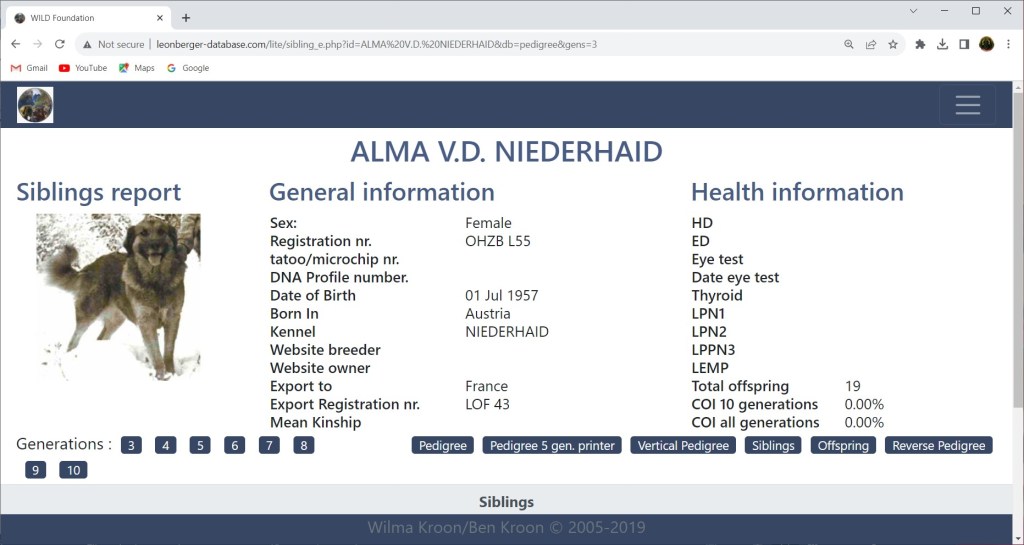
A screenshot of a database entry with a photo of a female Leonberger.
Alma von der Niederhaid, a female ancestor on Bronco’s mother’s side from 1957.
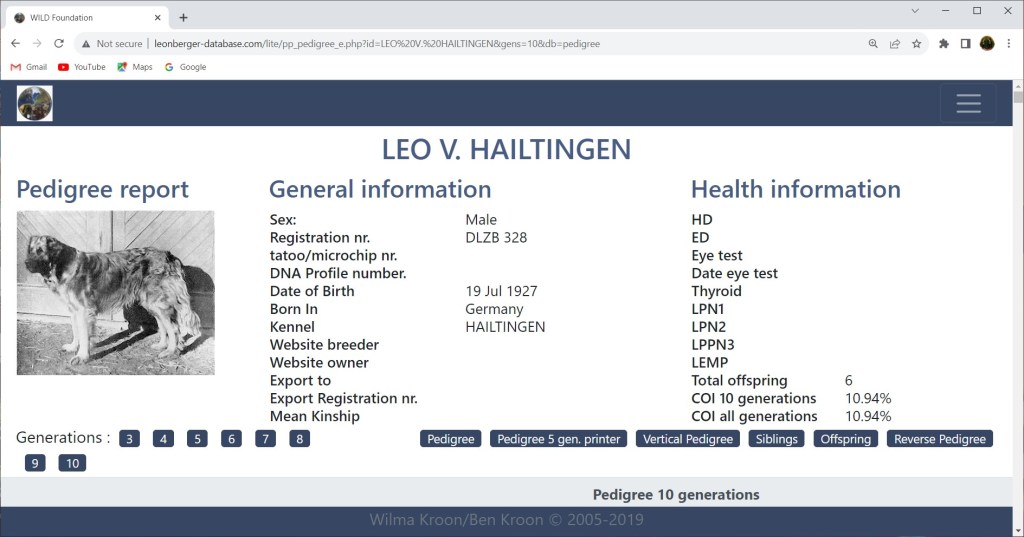
A screenshot of a database entry with a photo of a male Leonberger anno 1927.
Leo von Hailtingen born in 1927, another of Bronco’s ancestors.
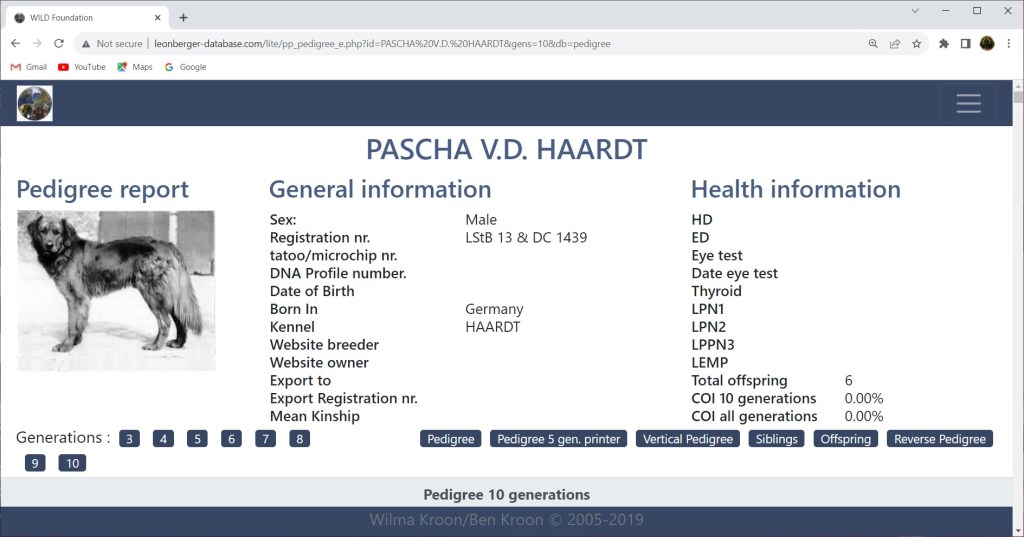
A screenshot of a database entry with a photo of a male Leonberger anno 1904.
Pasha von der Haardt born 1904, the farthest back Bronco ancestor I found that had a photo.

What about you? Do you know your dog’s or cat’s ancestry tree? How about photos, illnesses, and inbreeding coefficients? How about your own lineage?

A Young Canadian Leonberger With My Book

With today’s post I just wanted to show a photo of a beautiful young Leonberger called Hachi with my book. Brenda Saito allowed me to use the photo, which I took from her review on the Canadian Amazon site. I am so grateful for this review. You can read the review by clicking on the photo, and you can view the entry for my book on amazon Canada by clicking here.

In the middle of the photo a young Canadian Leonberger, Hachi, is lying on the floor. Leaning on him is my book, the life and times of Le Bronco von der Löwenhöhle. Click on the photo to see the associated review.
Photo of Hachi a young Leonberger in Canada. Click on the photo to see the associated review.

Leonberger Book Reviews Maybe

On Amazon my Leonberger book has 13 ratings including 11 reviews and on Goodreads I have four reviews and on Bookbub and Barnes & Noble none. All the reviews are wonderful and supportive five-star reviews. I am extremely grateful for this .💖

However, with this post I would like to shamelessly request additional reviews. The vast majority of readers do not write reviews. I know, I am the same way. It is hardly something you expect. But if anyone out there who has read my book and has not written a review somewhere, is willing to do just that, I would be very grateful. I would like to stress that the review certainly doesn’t have to be a four-star, or five-star review and they don’t need to be elaborate or wonderful or long. Short honest reviews between one-star and five-star would all be very helpful to me.

If you go to the Amazon page for my book and you scroll down until you see “Customer Reviews” on the left-hand side, there is a white button below “Customer Reviews” bars that says, “Write a customer review”. You can also get here by clicking on the small blue text near the top that says, “13 ratings”. Once you click on the “Write a customer review” button you will see four fields “Overall rating”, “Add a headline”, “Add a photo or video”, and “Add a written review”. “Add a photo or video” is optional, and I admit I have never used it. You can either type something in the “Add a written review” box or copy from, for example, Microsoft Word. Note that Amazon takes a few days to publish a review after it has been submitted.

It works similarly on Barnes & Noble but here you have a blue button towards the bottom on the left. On Bookbub there is a red button towards the bottom left and on Goodreads there is a black “write a review” button in the middle halfway down.

By clicking on any of the pictures below you can visit my book on Bookbub and Goodreads.

he image shows the Leonberger lying in the green grass. Click on the image to go to the Bookbub location for the book.
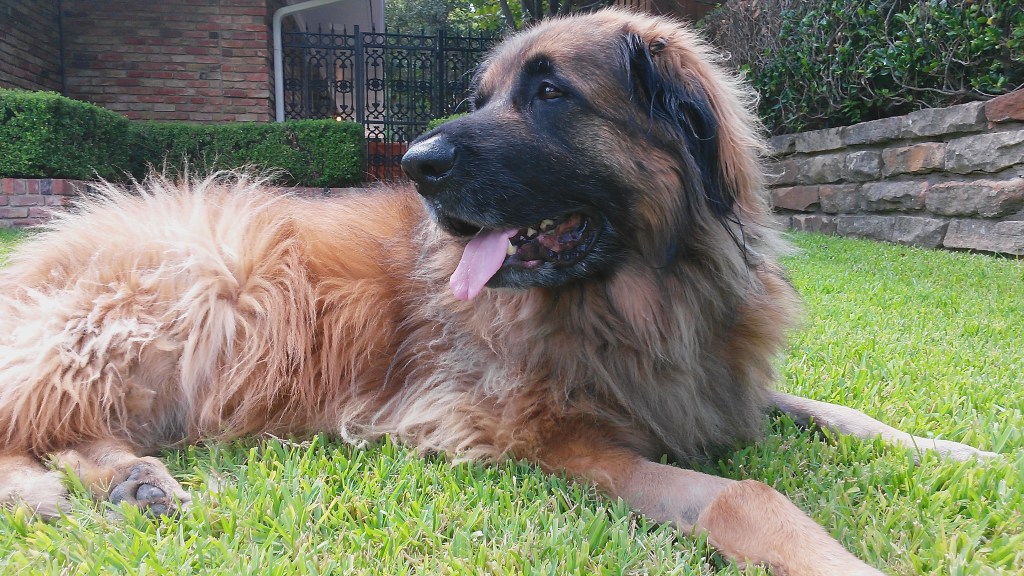
This is a photo of our late Leonberger Bronco lying in the grass in the front yard soon after a toe surgery. Click on the image to go to the Bookbub location for the book.
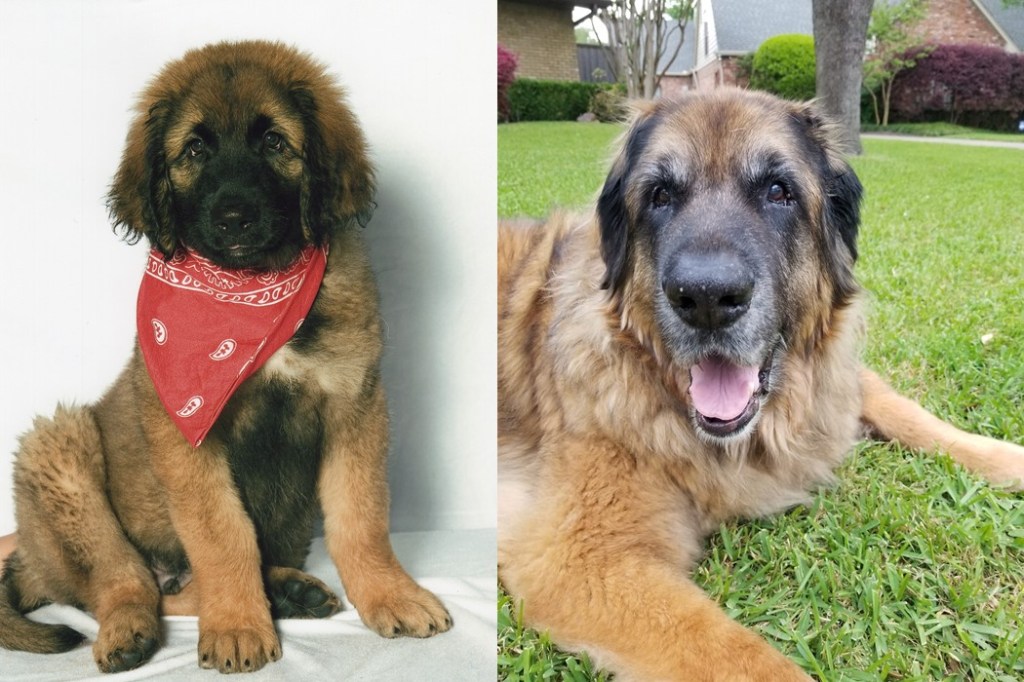
The image shows two photos. On the left is Leonberger puppy wearing scarf. On the right is an old Leonberger lying in the frass. Click on the image to go to the Goodreads location for the book.
This is a photo of our Leonberger Bronco at 3 months old (left) and at almost 13 years old (right). Click on the image to go to the Goodreads location for the book.

The King of Texas is Cute

Recent dialogues at the Wikman residence concerning our mini-Australian Shepherd Rollo.

Rollo loves belly rubs.

Rollo: laying down on his side, opening his legs a bit and barking once. That’s how he asks for a belly rub.

Thomas: Honey, can you give Rollo a belly rub? I’ve done it several times today.

Claudia: No, I am cooking. You do it.

Thomas: I walk over to Rollo to give him a belly rub. He loves it, turns over and kicks his legs, and he looks like he is laughing like a child being tickled. Then I stopped.

Rollo: One loud bark. That means he wants more.

Thomas: continues giving a belly rub.

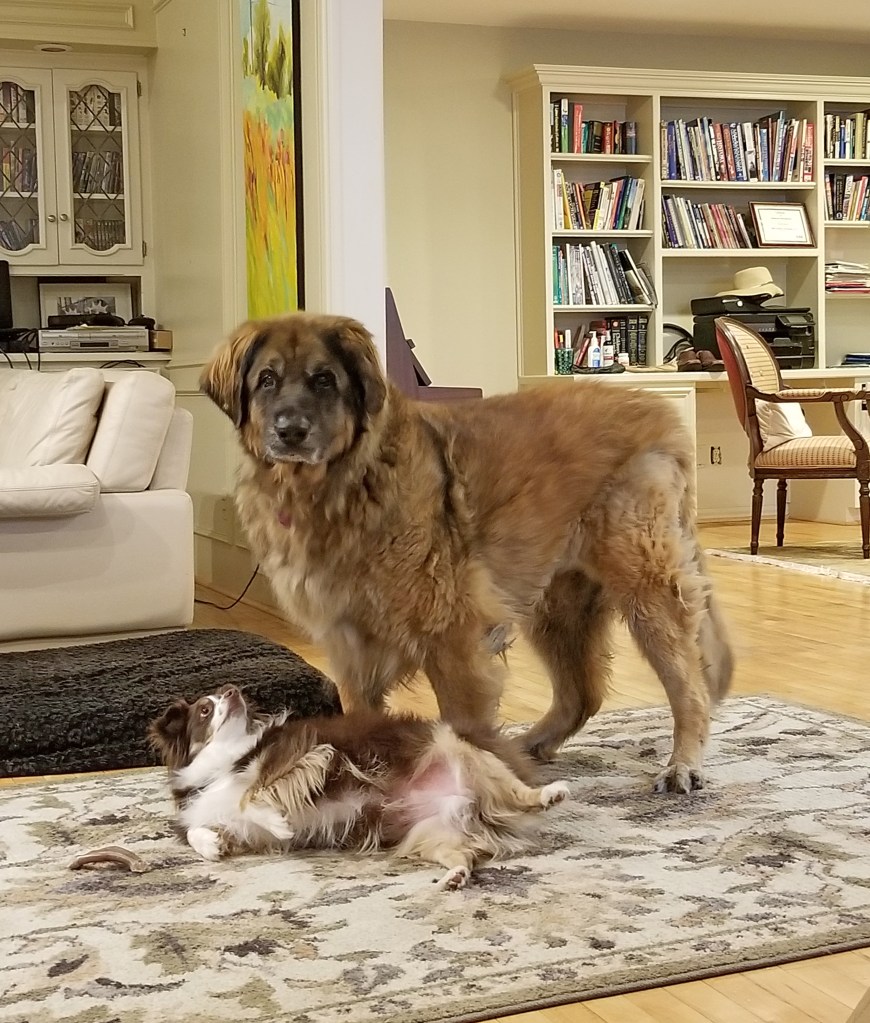
Photo of our Leonberger Bronco with Rollo lying on his side on the floor in front of Bronco seemingly asking him for a belly rub.
Rollo is asking our Leonberger Bronco for a belly rub. Unfortunately, it is not easy for one dog to give another dog a belly rub.

Rollo wants to sit where you are sitting.

Rollo: I am sitting on the sofa and Rollo comes over and taps me twice on my knee. That’s the command Rollo gives when he wants to sit where you are sitting.

Thomas: I move over.

Rollo: jumps up and sits where I sat.

Claudia: Thomas do you remember the trainer who said that Rollo thinks he is in charge and that we need to fix that?

Thomas: Yes, but he is so cute.

Rollo our mini-Australian Shepherd (left) and Daisy our Pug (right) sitting on a white sofa chair.
Rollo and Daisy in sofa chair.

Rollo wants to sleep on the bed but not alone.

Rollo: I am sitting on the sofa and Rollo comes over and scratches me on my knee while leaning backwards as if he wants to leave. That’s the command Rollo gives when he wants to go to bed but he does not want to go alone.

Thomas: Honey can you go lay down in the bed with Rollo. I am busy reading.

Claudia: No, I am not doing that anymore.

Thomas: stands up and follows Rollo into the bedroom and lays down on the bed as Rollo jumps up on the bed.

Claudia: Thomas you should not be doing that either. Remember, it is not good that Rollo thinks he is in charge.

Rollo: falls asleep while Thomas reads a book on the bed.

The head of our mini-Australian Shepherd sticking out from under the covers on our bed.
Rollo tucked in under the covers on our bed.

Rollo and Bronco

Rollo and Bronco (our Leonberger) were best buddies. We no longer have Bronco, but we have Rollo who is the worst behaved dog we’ve ever had. It already started while we were still having Bronco. Rollo walked all over Bronco, like he did with people. If a few people were sitting on the sofa, Rollo would just walk from one end of the sofa to the other, stepping on everyone’s legs or bellies in the process. He still does that. He frequently bit Bronco’s tail and even swung in it as if it was a swing. Bronco was extremely patient and did not get angry, except one time when Rollo stole his toy. Bronco’s loud booming bark scared Rollo and he let go of the toy. However, to be on the safe side we put Rollo in a playpen, or baby jail, as we called it. Rollo came to love his baby jail.

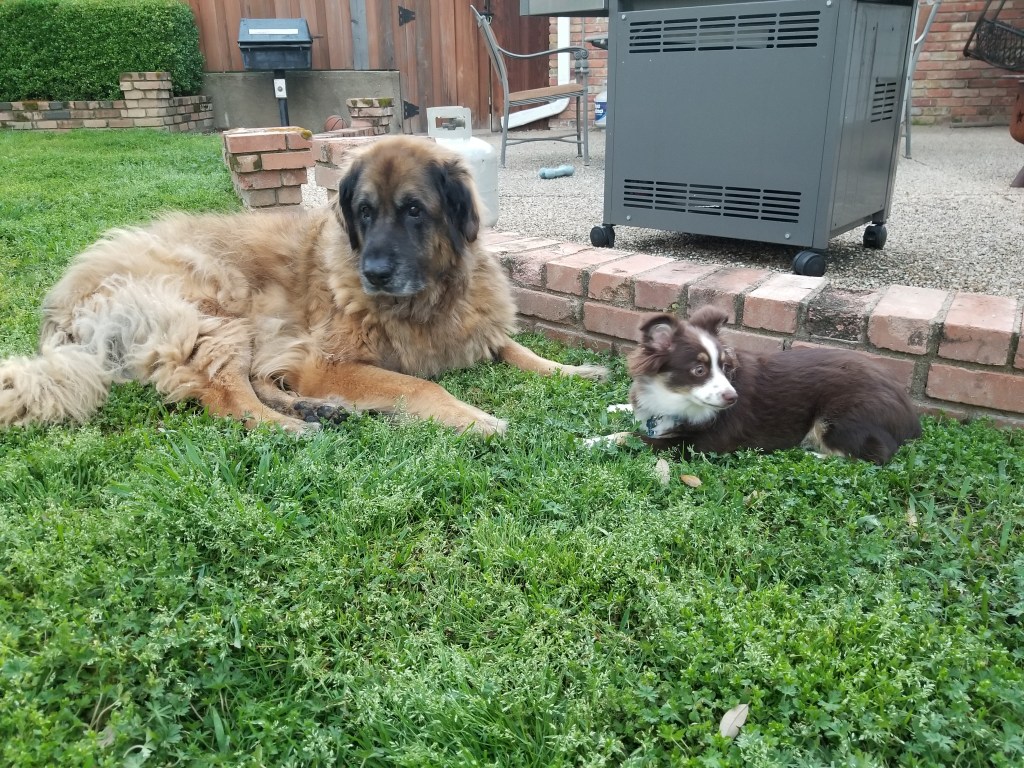
Our Leonberger Bronco lying in the grass in our backyard with our mini-Australian Shepherd Rollo. Bronco is to the left and Rollo to the right.
Bronco and Rollo, best buddies. Bronco is quite old and Rollo is quite young.
The photo shows the back of Bronco to the right including his tail, which Rollo (to the left) is pulling.
Rollo is pulling Bronco’s tail.
The photo shows Rollo, our mini-Australian Shepherd inside a dog play-pen, also including toys and a water bowl and a small bed.
This was Rollo’s Baby Jail

Rollo’s other commands and peculiarities.

Rollo scratches doors he thinks should be open, which is basically every door, and if no one comes to open the door, then he barks. When he wants to play with a toy, he barks at the toy box with one loud bark until I give him the toy he wants. He barks at balls that roll in under sofas and beds and expects someone to get them for him. Rollo loves balls. I should say, naturally, we have commands for him as well, such as sit, stay, come, and shake, and he obeys them most of the time. But he has commands for us too. He sleeps in our bed, typically in the middle, surrounded by his subjects, me, Claudia and Daisy.

Rollo, our mini-Australian Shepherd, is holding a soccer ball with one of his paws. They are inside the house.
Rollo loves balls. He loves to chase balls, chew balls and roll balls.
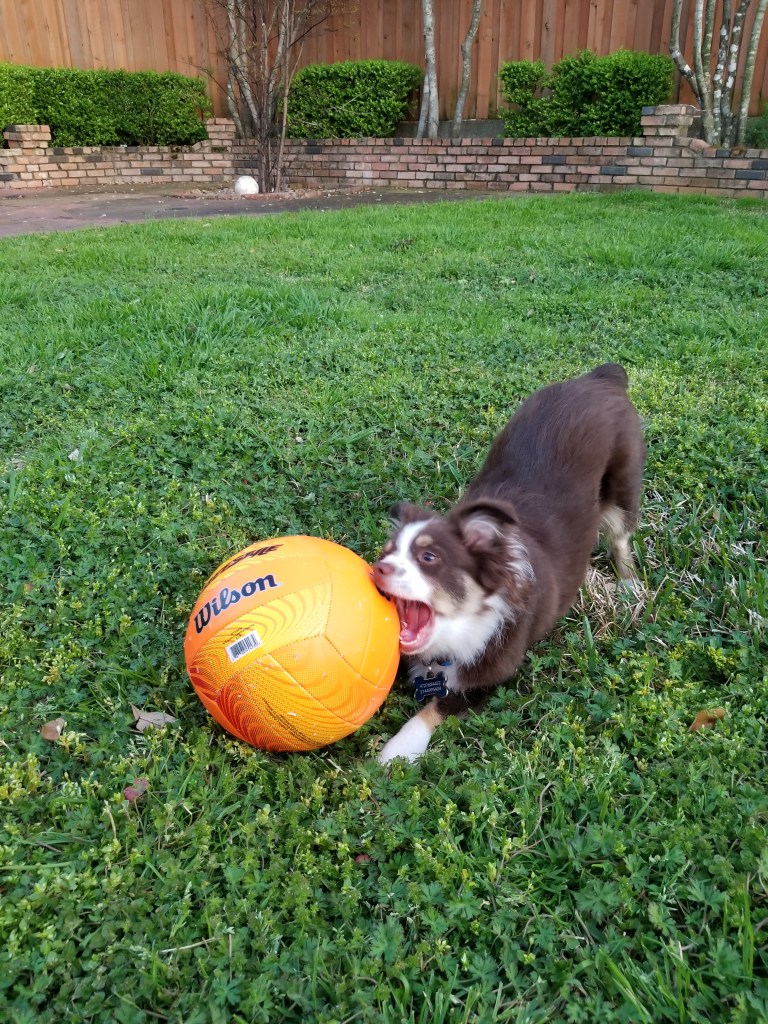
Rollo, our mini-Australian Shepherd is in the backyard biting an orange volley ball.
Rollo is ball crazy.

The greatest quality that someone could have.

What is the greatest quality someone could have? Is it intelligence? Is it knowledge? Is it wisdom? Is it charm? Is it beauty? Is it courage? Is it strength of character? Is it work ethics? Is it honesty? Is it integrity? No, it is none of that. The most important thing in the world is that you are cute. That is why Rollo is the King of the House, in fact the King of Texas. But seriously, Rollo is spoiled, he sleeps in our bed, he does not like other dogs (except Daisy), and this is our fault. Before we can get another Leonberger we must work on certain bad habits. However, his cuteness and his innocence make this harder.

Photo of Rollo, our mini-Australian Shepherd, as a puppy.
Rollo as a puppy. Being cute is all that matters.
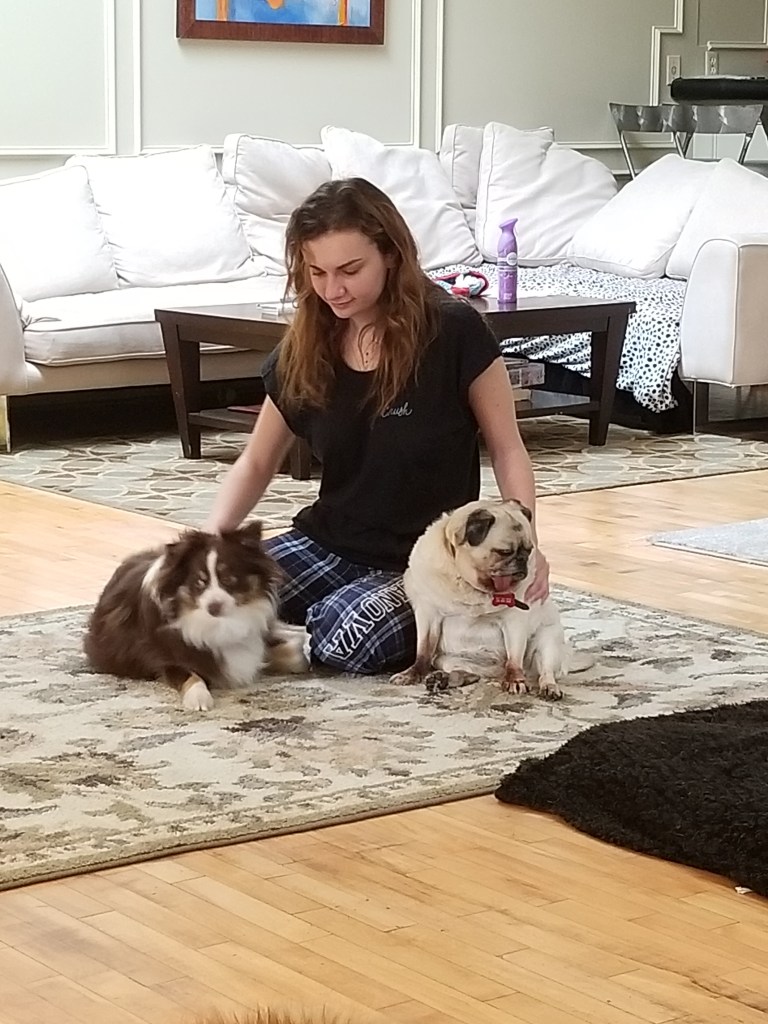
Photo of our daughter in the middle, with Rollo on the left and Daisy on the right.
Our daughter with Rollo and Daisy.
Arguably The Greatest Intellectual Achievement of the Human Race

What is the greatest intellectual achievement of the human race? Is it Beethoven’s third symphony? The book War and Peace by Leo Tolstoy? General Relativity? Quantum Physics? multi layered neural networks? Or is it a theory of almost everything that comprises quantum physics, special relativity, Noether’s theorem and gauge theories, as its basic elements, and then Quantum Electrodynamics, Quantum Chromodynamics, and a framework for all elementary particles, and more. This is the so called “standard model of elementary particles”, or the “standard model” for short. It is a subjective question.

Atom with electrons swirling around displayed in a fuzzy more realistic way.
The standard model of elementary particles, the greatest intellectual achievement of humankind. Close up illustration of atomic particle for nuclear energy imagery. From iStock photos.

Some people like to say, “Science does not know everything”. They are right. If it did, it would stop. However, the people who like to say that typically grossly underestimate what science knows, and not by a little but by a lot, like a million times, or a trillion times. There are things science knows and there are things it doesn’t know, and the difference is often not obvious unless you have near expert knowledge. However, we have figured out a lot. The book I am describing below is a breathtaking reminder of how much we know. It is the book about the theory of almost everything after all.

A photo/illustration from the inside of a particle collider.
Science does not know everything, but it knows a lot. The standard model of elementary particles is the theory of almost everything. Collision of Particles in the Abstract Collider. From iStock photos.

I read The Theory of Almost Everything: The Standard Model, the Unsung Triumph of Modern Physics Hardcover – July 22, 2005, by Robert Oerter, more than 15 years ago. I wrote a lengthy review, which is still the top review for this book. The hardback version is 336 pages. It currently costs $31.93. The dimensions of the hardback are 6.5 x 1.25 x 9.75 inches, and the weight is 1.2 pounds, ISBN 978-0132366786. The paperback version is 336 pages. It currently costs $17.00. The dimensions of the paperback are 5.5 x 0.8 x 8.4 inches, and the weight is 10.9 ounces, ISBN 978-0452287860. The kindle version costs $13.99 and is 348 pages ASIN ‏ : ‎ B002LLCHV6.

Photo of the front cover of the book "The Theory of Almost Everything” by Robert Oerter. Click on the image to go to the Amazon location for the book.
Front cover of “The Theory of Almost Everything” by Robert Oerter. Click on the image to go to the Amazon location for the book.

Someone reminded me that today, Wednesday August 9, is National Book Lovers Day. Even though I already published a post on a Leonberger book today I decided to post about one more book, one of the most mind-blowing books that I’ve ever read. I have a master’s in engineering physics from Uppsala University that was turned into a master’s in electrical engineering and applied physics by Case Western Reserve University in Ohio. That is why I am interested in this topic, which I understand is not everyone’s cup of tea, maybe no one’s. I took a few classes in Quantum Physics, Nuclear Physics, and Molecular Physics, and I had heard of the standard model, I just never realized what it was. Then I read this book many years later and as I said, I was blown away.

Quick note, if you have never heard of Noether’s theorem, don’t worry, almost no one has, yet it is an extremely important discovery in mathematics. Emily Noether discovered that associated with every symmetry was a conservation law and vice versa. It is one of the greatest discoveries of mankind, yet almost no one has heard of it. For example, if you assume (rather acknowledge) that the laws of physics don’t change over time, then energy is conserved. If you acknowledge that the laws of physics don’t change as you change position, then momentum is preserved. You use mathematics to derive one from the other. This is very useful because, if you find a symmetry you can find a conservation law. If you find a conservation law, you can find a symmetry. This has turbo charged modern physics.

The standard model does not get a lot of love. One reason is that unless you have a physics education it is difficult to grasp. It is also a gigantic theory. Well actually not really. You can summarize it in a few formulas that almost no one can understand, as the author of the book does. Another reason is that as soon as physicists were done with it, they were looking to replace it. That was because of the “Almost” in “the theory of almost everything”. There were a few things it could not explain, and it was not compatible with General Relativity even though it incorporated Special Relativity. Anyway, I cleaned up my review a bit and it is given below. If you want to see my original Amazon review, click here.

A long complicated formula.
The Langrangian function that summarizes all of the propagators and interactions in the standard model.

Note; when I wrote the review below, we had not yet found the Higgs Boson. It was found at LHC in Switzerland in 2012.

An introduction to the greatest intellectual achievement of the human race

This review is a little bit long; however, it is more than an assessment of the book, it will also help you prepare for reading the book and explain confusing parts of the book.

Imagine if we had found a two-billion-year-old alien underground civilization under the desert in Arizona several years ago, and you still knew nothing about it, because journalists thought this information was pretty boring stuff and therefore didn’t bother telling anyone about it. Well, that is most likely not true, but what is true is that the general public has entirely missed the greatest scientific revolution in the history of the human race partially because mainstream media has largely ignored this information, even though the Nobel Prize committee has been raining Nobel Prizes over it.

In the 70’s a theory explained, at the deepest level, nearly all of the phenomena that rule our daily lives came into existence. The theory called “The Standard Model of Elementary Particles” is a set of “Relativistic Quantum Field Theories” that explains how elementary particles behave, which elementary particles there are, and why they have the properties they have, for example, isospin, spin, charge, color charge, flavor, even mass, or mass relations in many cases. The theory explains how all of the fundamental forces in nature work except gravity. The theory describes how the elementary particles interact; decay, how long they are expected to exist, and how they combine into other subatomic particles. The theory uses only 18 adjustable parameters to accomplish this.

In the extension the theory thus explains how nucleons and atoms are formed and what properties the atoms will have, and how molecules will form and what properties molecules will have, their chemical reactions, and what elasticity, electric conductivity, heat conductivity, color, hardness, texture, etc. any material will possess. In the extension it explains why mass and matter exist, how the sun and the stars work, and the theory is therefore the ultimate basis of all other science. It also provides a formula, or an equation of almost everything. Best of all it has been thoroughly verified experimentally, in fact the predictions the theory has made have been confirmed with such stunning accuracy and precision that it could be considered the most successful scientific theory ever. A theory that successfully unites all of physics and basically all of human knowledge of the Universe into one single theory has never before existed.

However, “The Standard Model” does not incorporate gravity and the general theory of relativity, and cannot explain dark energy, dark matter and why neutrinos have mass. Therefore as soon as the theory came into existence physicists started looking for the next theory that would finish what the “The Standard Model” did not finish. Example of such theories are GUT theories, SO(5), SO(10), string theories (abandoned), super string theories, and M-theories. Even though those new theories are extremely interesting they have not been verified or able to predict anything. In comparison with the “Standard Model”; superstring theories, grand unified theories, chaos theories, you name it, are essentially nothing, but are still better known.

This book explains to the layman what the “Standard Model” is and how it came into existence. The book is by no means a perfect book. I think there are several problems with the book. However, I decided not to take off any star because there are very few books written for science interested non-physicists that explain the “Standard Model of Elementary Particles”. Dr. Oerter deserves five stars just for his fairly decent attempt at doing so.

Even though the book is a Physics book, it is also a book on Philosophy. In fact Physics is often the best and the deepest Philosophy, the kind of Philosophy that can be falsified, verified and proven wrong or correct. To understand what I mean consider Noether’s theorem. Noether’s theorem states that whenever a theory is invariant under a continuous symmetry, there will be a conserved quantity. As an example of what a continuous symmetry is the following: any physical experiment that is performed at a certain time will have the same result if it is performed exactly the same way a certain time later. That seemingly self-evident observation means that Energy is conserved. Another example is, any physical experiment that is performed at a certain place will have the same result if it is performed exactly the same way somewhere else. That seemingly self-evident observation means that momentum is conserved.

Let me add that “exactly the same way” really means that! Gravity, other forces, differences in light, or anything else cannot be different in the second experiment. The only thing allowed to be different is the position “x” (if that is our symmetry variable). That is what continuous symmetry means, changing just one thing, and everything stays the same.

Noether’s theorem has been the guiding principle behind the standard model, and it is used to find conservation laws where symmetries are found, and it is used to find symmetries where conservation laws are found. It is a spontaneous symmetry brake that allows the Higgs Boson to give all other particles their mass (excepting mass less particles). This is why matter and everything in our Universe exist. The Higgs Boson is also called the God particle (guess why). So Noether’s theorem is both very useful in a practical sense and deeply philosophical at the same time.

The God particle has not yet been found, but scientists will be looking for it using the new Large Hadron Collider (LHC) that will come on line this fall (fall of 2008). LHC will start operating in August and the first collisions are planned for October. It is the largest machine ever built and it has a circumference of 17 miles. However, a lawsuit has been filed in an attempt to stop the LHC from operating. Some people believe that the LHC will create small black holes that could suck up all of the earth. In essence, they believe that our attempt to find the God particle will be the end of the world.

In addition to Noether’s theorem the standard model is built upon the special theory of relativity and a modern formulation of quantum mechanics (Quantum field theory), QED, QCD, as well as some discoveries regarding elementary particles. I can add that Noether’s theorem was formulated by a Jewish woman, Emmily Noether, who could not get a job in academia because she was a woman. This theorem is one of those very important but mostly unknown discoveries, like the invention of paper by the Chinese Tsai Lun.

Oerter does not attempt to explain the special theory of relativity; however, he tries to give the reader an idea of what it is. The problem with his approach is that he gives the reader just enough information to enable the observant reader to come up with the apparent paradoxes within the special theory of relativity, but not enough information to help the reader to easily resolve them.

He also confuses the reader by not distinguishing between rest mass and relativistic mass. The observant reader will think that he is contradicting himself. The term relativistic mass is the total mass and the total quantity of energy in a body. The rest mass is the mass of a body when it is not moving. The formula E = mc² is always true, when it refers to relativistic mass, which is why we talk about an energy/mass equivalence. The other more complex formula Oerter presents refers to rest mass. There is no such thing as an energy/rest mass equivalence (except at speed 0) but that is what the reader who is not already familiar with the subject will end up believing.

Another mistake Oerter makes is in regard to the fact that the speed of clocks will be measured differently in different reference frames. On page 35 last paragraph Oerter writes “Here, we have an apparent paradox: If each reference frame sees the other as slowed down, whose clock will be ahead when the passengers leave the train?” Then he implies that the paradox has to be solved by incorporating the General theory of relativity. Even though that may be how it was first solved, you can solve this form of the so called “Twin Paradox” and other similar paradoxes from within the framework of the special theory of relativity itself.

Oerter explains Quantum Physics in a very typical manner, but he mostly avoids making it look much weirder than it actually is which he should be commended for. However, there is one thing that all Physicists seem to do when they explain Quantum Physics to the layman which annoys me greatly. The matter waves (or quantum fields) in Quantum Physics are quite strange entities. The reason they are so strange is because they do not exist in a real sense, they are more correctly stated mathematical abstractions. Oerter states this clearly, which is good. However, he then goes on to mention De Witts’ idea about multiple Universes without acknowledging that these “bizarre solutions” to Quantum Wave conundrums are completely unnecessary and worthless. There is no more reason to believe in multiple Universes based on matter waves than there is to believe in multiple Universes because we all have different reference frames.

In fact when I took my first class in Quantum Physics (as an engineering physics student) I successfully proved, using a combination of the Schrödinger equation and plain Galileo transformations, that the matter waves are not only “not real” they don’t even represent information in an objective sense, in fact every reference frame had its own matter wave for the same particle. Our own single Universe is thus already all the Universes you need all at once. My associate professor was just scratching his head but the leading Swedish authority on Quantum Physics at the time, Staffan Yngwe, immediately agreed with me. So, in summary there is no need to make Quantum waves weirder than they are or draw unwarranted conclusions from apparent conundrums. Just take them for what they are; one possible mathematical model (among many) of a particle as seen from your frame of reference only.

After giving a background to the special theory of relativity and Quantum Physics Oerter continues explaining relativistic Quantum Physics including the fantastic prediction you get when you combine the special theory of relativity with Quantum Physics; that for every particle there is a twin particle with exactly the same mass, and spin, but opposite charge and isospin. These particles were called anti-particles and until they were actually found physicists tried to get rid of them from the theory. However, the combination of the special theory of relativity and Quantum Physics would lead not only to much better explanation for such things as the radiation and light spectrum and the properties of atoms, it would also lead to new discoveries.

Richard Feyman came up with a new representation of relativistic quantum physics for electrons that did not use waves called Quantum Electro Dynamics, and this was one of the first steps towards the standard model. Physicists started discovering a lot of unexpected particles which remained unexplained for decades (until the standard model came about), QCD was invented, the Higgs Boson (the God particle), symmetry breaks, etc. The story is simply breath taking and Oerter does a good job telling this story, except I think he should have used more and better pictures. However, as I said I cannot honestly take any stars off for these minor flaws. Finally Oerter discusses possible modifications to the standard model, GUT’s, string theory (abandoned), super string theories, and M-theories.

I also would like to add an interesting fact that I think everyone should be aware of. There are elementary particles with whole number spin and they are called Boson’s, and there are elementary particles with half number spin called Fermions. The Pauli Exclusion Principle (that no two particles can occupy the same state) applies to Fermions but not Bosons and therefore the two different types of particles behave very differently and follow different kinds of statistical rules (Bose-Einstein statistics versus Fermi-Dirac statistics). All force carriers are Boson’s while some Fermions are used to build “nomral matter”. Examples of Bosons are the photon, gluons, W and Z Boson, mesons, the Higgs Boson (the God particle). The Fermions come in three families each with four particles and their anti particle.

Electron / positron

Neutrino / anti-neutrino

Up quark / anti up quark

Down quark / anti down quark

muon / anti-muon

Mu Neutrino / anti-mu-neutrino

Charm quark / anti charm quark

Strange quark / anti strange quark

tau / anti-tau

Tau Neutrino / anti-tau-neutrino

Top quark / anti top quark

Bottom quark / anti bottom quark

The quarks can be used to build other particles. For example, a quark and anti-quark pair is called a meson (there are many kinds of mesons). A triplet of quarks is called a Baryon. An example of a baryon is the proton which consists of two up quarks and one down quark. Another example is the neutron which consists of one up quark and two down quarks.

I highly recommend this book for anyone who wants to understand something about our world and the Universe. However, don’t expect to understand everything, it is not written so that you can. I wish Physicists would become a little better at explaining these things to the layman using nice descriptive pictures and a little bit of math too (don’t assume math is always bad). I once read a 30 page long Swedish book on the special theory of relativity that successfully explained the kinematics, dynamics, and magnetism in relativity, to your average high school kid. The Lorenz transforms, formulas for acceleration, E = mc², and magnetism were derived using simple algebra and a tiny bit of calculus at one point. That is the way these kinds of books should be written, but I have seen this only once in my life. Excluding this single example (Swedish book), Oerter’s book is one of the best books on Physics for the layman that I have ever read.

Finally, I would like to ask a question for discussion. Will you and our planet survive this coming fall considering that the LHC is coming online?

Back cover of the book “The Theory of Almost Everything” by Robert Oerter.
Back cover of “The Theory of Almost Everything” by Robert Oerter.