Reviewing The Climate Casino by William D. Nordhaus

Photo by Dom J on Pexels.com

Normally the focus of my blog is on Leonbergers, especially our late Leonberger Bronco, but sometimes I present a good book which I want to promote. Today I would like to present and review The Climate Casino: Risk, Uncertainty, and Economics for a Warming World, Hardcover – October 22, 2013 and paperback– February 24, 2015 by William D. Nordhaus. The hardcover version has the dimensions 6.13 x 1.06 x 9.25 inches and the weight 1.54 pounds and currently cost $13.41 on Amazon.

Photo by Pixabay on Pexels.com

Nordhaus received the Nobel prize in economics 2018 “for integrating climate change into long-run macroeconomic analysis” (Nobel Memorial Prize in Economic Sciences). Nordhaus is one of the most prominent economists in the world and without doubt a genius. He is worth listening to.

Photo by JESHOOTS.com on Pexels.com

Before I present my Amazon review, I would like to point out that this book is very important for a few reasons.

  • Nordhaus has been referenced, for example, in articles in the Wall Street Journal as someone who claims that climate change / global warming is costlier to mitigate than to allow to happen and that it might even be beneficial. He vehemently denies that he ever said something along these lines, and it is important to understand how this misunderstanding came to be.
  • Nordhaus believes that climate change / global warming is happening, that it is dangerous, costly and that we humans are the cause of it.
  • When calculating the potential cost of climate change Nordhaus does not take into account things like the extinction of species, not because it doesn’t matter, but because it is so difficult to put an economic value on it. Therefore, his calculations should be viewed as a baseline, a minimum to consider. If death is free of charge, it is not included, which he makes clear.
  • Nordhaus takes into account the fact that technological progress and economic progress is making us more resilient. For example, despite the fact that natural disasters are getting worse, much fewer people are dying from them because we have become much better at preventing casualties. For example, WHO calculated that if global warming continues unabated 80 million additional people will die from malaria by 2050 due to the extended geographical spread of mosquitoes carrying malaria. Nordhaus takes into account the fact that future medical technology will be much better so that this may not be a big problem.
  • Nordhaus also takes into account discounting. The fact that money is more valuable today than it is tomorrow. Twenty thousand dollars may be worth one hundred thousand dollars fifty years from now if you let it earn interest. Therefore, we should not spend too much money today to fix future problems (despite that fact we should still spend money today). The annual discount rate he is using is 4%. Some say that is too high.
  • All that is mentioned above causes many environmentalists to jump to the conclusion that he is downplaying the cost of climate change / global warming. It also makes fossil fuel industry apologists falsely conclude that he is on their side. Thereof the confusion in Wall Street Journal articles.
  • What he is doing is making his economic arguments for action today unassailable. No matter how you downplay the risks they should be addressed today based on purely economic rationale.
  • He stresses the concept of economic externalities, something a lot of people don’t understand, especially people who learned economics from talk show hosts and politicians instead of taking classes in economics. An externality is an indirect cost or benefit to an uninvolved third party that arises as an effect of another party’s activity. It makes the free market fail and allows regulation to improve economic efficiency. It’s a big deal.

It should be noted that he is the world’s topmost expert on the economics of climate change / global warming. To see my original review, click here.

The blue front cover of the book The Climate Casino: Risk, Uncertainty, and Economics for a Warming World by Nobel Prize Winner in economics William Nordhaus. Click on the picture to go to the Amazon location for the hardcover of the book.
Front cover of the book The Climate Casino: Risk, Uncertainty, and Economics for a Warming World by Nobel Prize Winner in economics William Nordhaus. Click on the picture to go to the Amazon location for the hardcover of the book.

My Amazon Review

About The Thorniest of Externalities

In this book Nobel Prize Laurate in Economics (2018) William Nordhaus analyses the economic consequences of global warming. Nordhaus takes seriously the potentially catastrophic impacts of climate change, but he avoids all exaggeration and tries to be as realistic and conservative in his estimates as possible. He stresses that global warming is a major threat to humans and the natural world. That past climates were driven by natural sources, but that current climate change is increasingly caused by human activities. He gives us a brief introduction to climate science and the conclusions presented by the IPCC. He states that potential damage will be concentrated to low-income and tropical regions and explains that there are dangerous tipping points.

He explains that his economic analysis leaves out some potentially important consequences of climate change because they are difficult to quantity or because economic concerns are not the primary concern in those cases. He states that the most damaging impacts of climate change – in unmanaged and unmanageable human and natural systems – lie well outside the conventional marketplace. An example is species extinctions. There is no price tag on the value of a species. He explains that there have been five mass extinctions over the last 500 million years and now a sixth one is developing. That is a serious scenario he could not include in his economic analysis.

In his economic analysis he takes into account that many northern developed nations will be economically advantaged by global warming, as long as the temperatures do not rise too much. He takes into account that future generations will be wealthier, have better medicine, and will possess technologies that will help them adapt better to climate change. For example, the area in which malaria is endemic is likely to grow because of global warming thus potentially killing tens or hundreds of millions of people assuming today’s medical technology, but in the future medical technology will be better so that is not likely to happen. In fact, many of the health impacts of climate change are likely to be manageable in a future wealthier world. This is one reason why trying to slow economic growth to stop global warming is a bad idea that is counterproductive. There are much better ways.

Another important feature of his analysis is discounting. Money is more valuable today than tomorrow. Twenty thousand dollars may be worth one hundred thousand dollars fifty years from now if you let it earn interest. Therefore, it may not be worth paying a thousand dollars today to save future generations five thousand dollars. He uses a significant discount rate that has been criticized, but the important thing to remember is that this way he is not exaggerating. As it turns out, climate change is still expensive to future generations depending on how far we allow it to go. It is definitely worth investing today in slowing climate change. His graphs demonstrate that economic losses quickly become gigantic if you go too far beyond the temperature optimum (which depends on the assumptions behind the graph). One graph was 2 ¼ Celsius, another 3 ½ Celsius. Note, that is without considering unquantifiable consequences.

All his talk about discounting, certain economically positive consequences of climate change, that we will get better at adapting, etc., has led to misunderstandings by those with imperfect reading comprehension. Some environmentalists have concluded that he is underestimating climate change, and some climate skeptics have incorrectly concluded he is on their side. An article in the Wall Street Journal incorrectly claimed that William Nordhaus predicted that climate change would be economically beneficial.

Perhaps the most central concept in his analysis of how to approach the problem is externalities. An externality is an indirect cost or benefit to an uninvolved third party that arises as an effect of another party’s activity. For example, those who produce emissions/pollution do not pay for that privilege, and those who are harmed are not compensated. Global warming is a particularly thorny externality because it is global. Inventions correspond to positive externalities. Innovators are frequently paid only a small fraction of the benefits their innovations bring, while benefiting all of society. This is why subsidizing technology and innovation can be beneficial to the economy.

He states that economics teaches us that unregulated markets will not put the correct price on externalities like CO2. To make the market more fair, efficient, and grow the economy faster you try to correct for the externality and the best way to do that is a Pigouvian tax. Market fundamentalists who’ve learned economics from talk show hosts but never taken an economics class may balk at this, but it is a basic concept in economics, like supply and demand. Towards the end he strongly argues for some sort of a carbon price, which I saw as the conclusion of the book. I thought his book was very informative, excellent analysis, and very well written.

Back cover of the book The Climate Casino: Risk, Uncertainty, and Economics for a Warming World.

The Day Surstromming Gave American Students a Culture Shock in Their Own Country

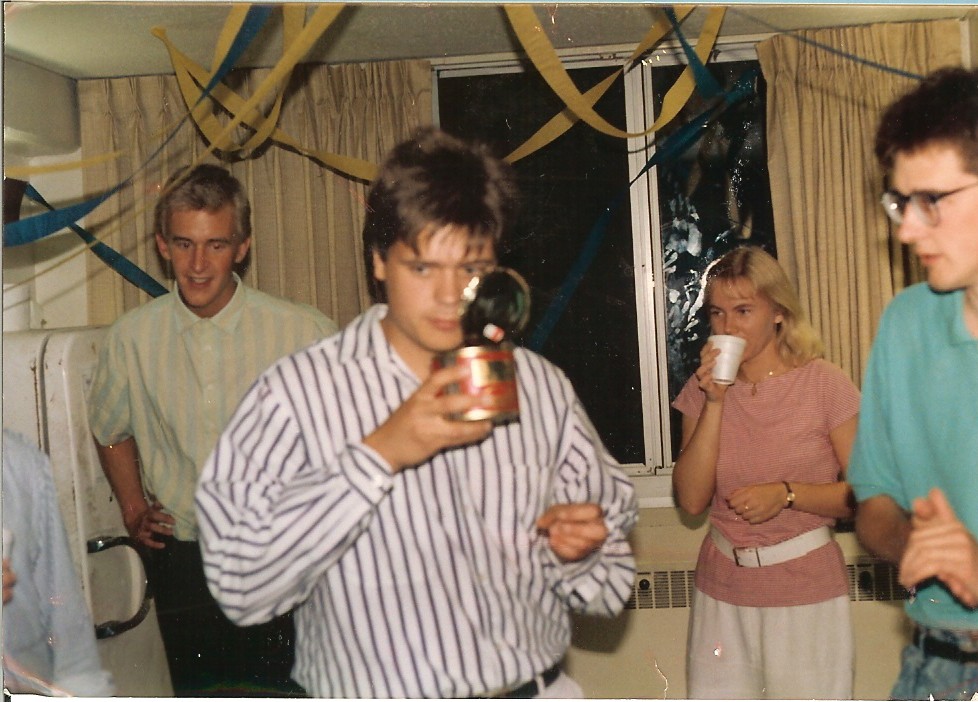
In my recent post called “Culture Shock Sweden USA” I included a photo of myself opening and smelling a can of north Swedish fermented herring, or as it is properly called “surströmming”. It is a specialty from the north Swedish Highcoast where I grew up. Underneath the photo I wrote “Unfortunately, all the Americans experienced a culture shock from the fermented herring.” See the excerpt below. What I should maybe have mentioned in my post is that even though it was a joke, it was still true. People were not ready for what was coming.

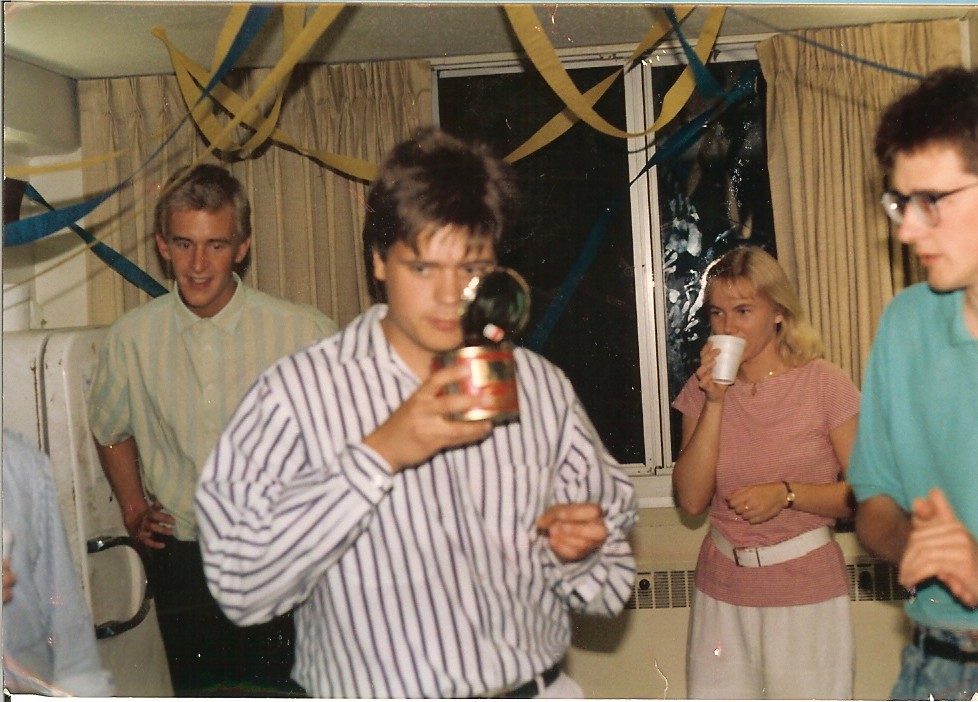
I am standing in the middle holding a can of surströmming. I am surrounded by other Swedes.
Four Swedes inviting Americans to a fermented herring party. Fermented herring is a north Swedish specialty. Unfortunately, all the Americans experienced a culture shock from the fermented herring. I am the guy smelling the fermented herring can.

After I had posted “Culture Shock Sweden USA”, I posted a link to my blog on my Facebook and I received a few comments including comments from two people who actually were there at the fermented herring party in 1987. I’ve included the comments below.


Surströmming first-timer videos are getting pretty common these days, but I still always end up laughing until I can barely breathe when they start the uncontrollable retching! Always reminds of the Surströmming party and that nasty prank we pulled on the residents of Glaser House! 🤣 — Lee

Delicious memories….NOT!!! 🤢🤮 — Alyce


What happened was that as soon as I opened the can, all Americans dashed for the windows or doors trying to escape the smell. In the party invitation we had left out one or two details, like that surströmming is often said to be the worst smelling food in the world. The “nasty prank” Lee was referring to was me and him going around the dorm and placing left over surströmming in the ventilation drums of the dorm. I admit that was immature. Luckily, it did not work as well as we had hoped, or we probably would have both been expelled.

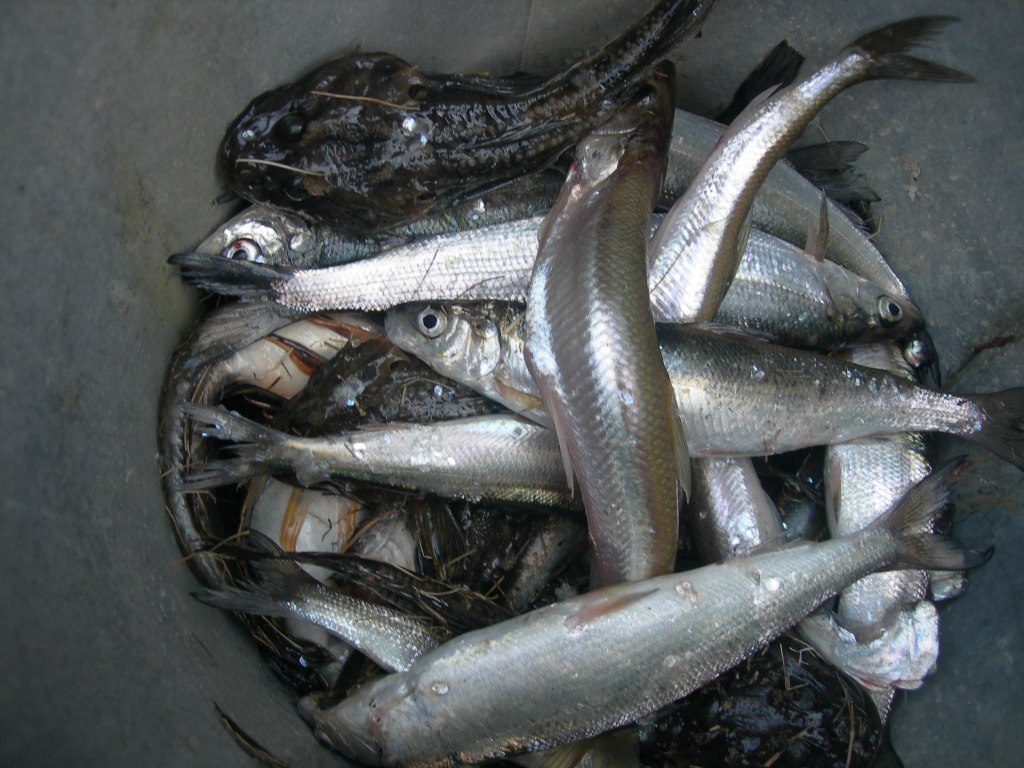
A dozen herrings and a fish called simpa.
Herrings that we caught in northern Sweden. Plus, a fish called Simpa.

This is an excerpt from Wikipedia on the topic:

Since gaining notoriety as one of the world’s smelliest foods, surströmming has become the focus of a number of “challenge” videos on YouTube and other platforms where people uninitiated to the food show themselves opening a can for the first time, usually to visceral reaction, and then try to eat the fish without additional preparation. Often the videos show the participants gagging, swearing, holding their nose, or vomiting.

To read more about surströmming on the disgusting food museum’s webpage click here.

In the end we had a good time. The smell dissipated and people ate and drank other things we offered. We swedes ate the surströmming but a few others tasted a little bit as well. We knew what the reaction would be, and we did not offer the fermented herring in the hopes that people would love it. It became a good source of conversation and jokes, and that’s what we hoped for. I should say that you normally open the cans outside and let the smell dissipate before you eat them. The surströmming taste mostly like pickled herring with lemon and lots of salt and you typically eat with onion and potato or rolled in soft and thin bread (tunnbröd).

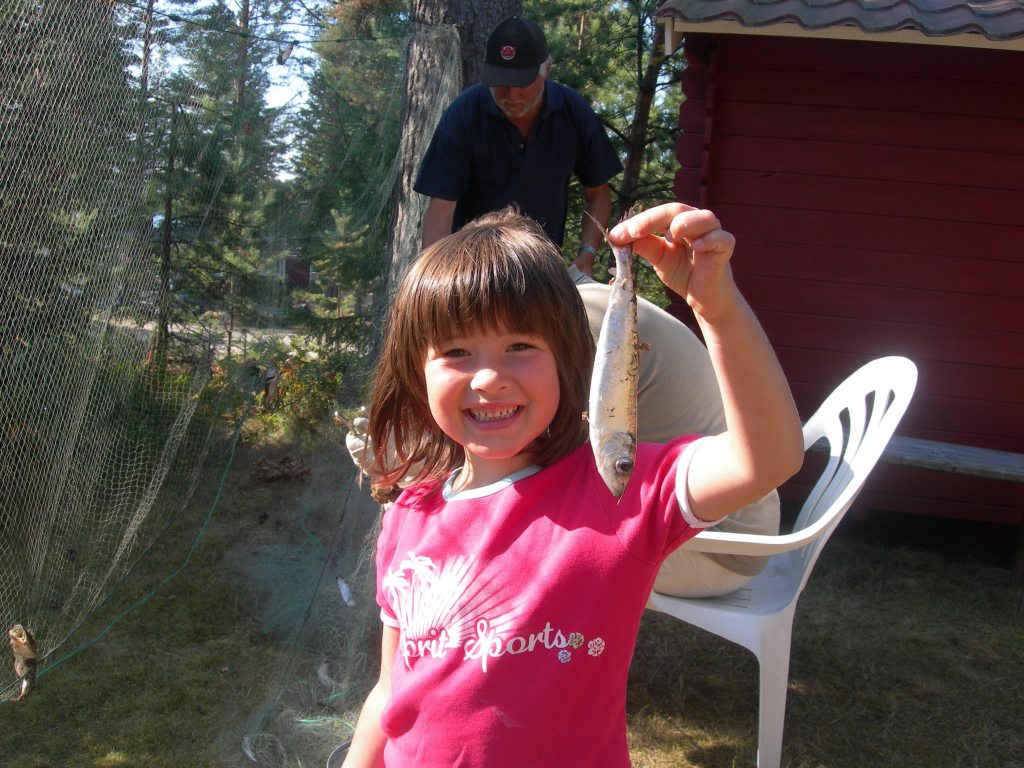
My niece Alma holding a herring. My dad in the background.

Have you eaten any weird foods?

A Very Good Old Leonberger Book

I recently finished reading “The Leonberger Hardcover version – April 1, 2000”, by Angela White. Currently it is only the hardback version that is available on Amazon, and it is 208 pages. I could not find it on Barnes and Noble or Chapters Indigo. The dimensions of this hardback are 7.25 x 0.75 x 10.5 inches, and the weight is 1.63 pounds, ISBN 978-1852790646, and on Amazon it currently costs between $4.95 and $91.85 depending on the quality of the book. It is currently out of print, so you have to buy a used copy. I bought mine for around $20.00 and except for a few scribbles on the inside cover it was in good condition.

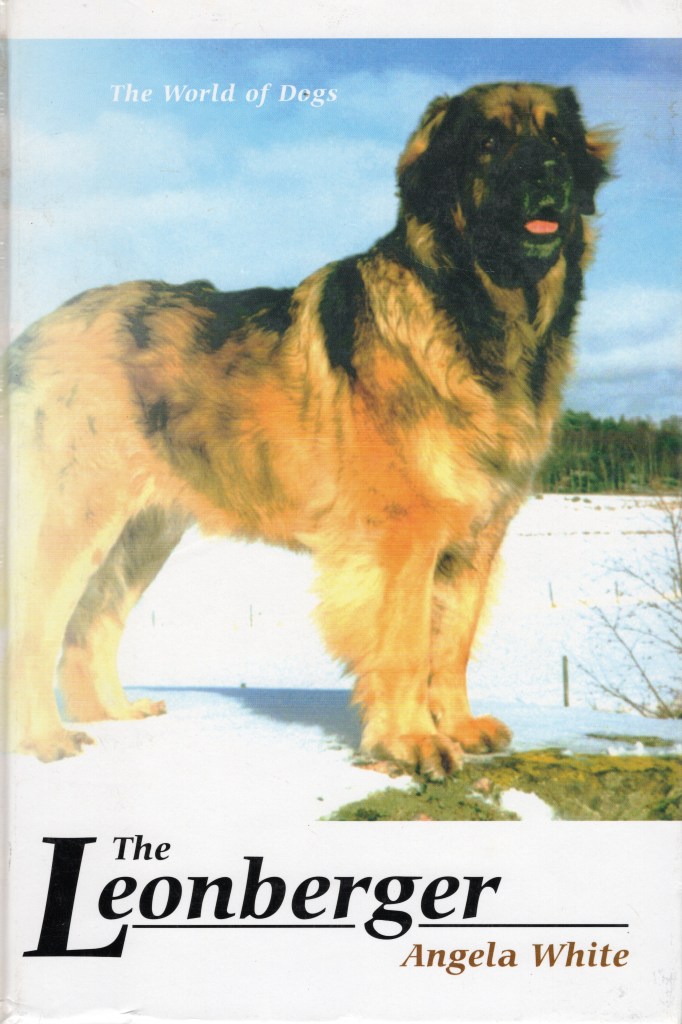
A scan of the front cover of “The Leonberger” by Angela White. It consist of a Leonberger standing on snow. Click on the image to go to the Amazon location for the book.
Front cover of “The Leonberger” by Angela White (scanned). Click on the image to go to the Amazon location for the book.

In summary: Angela White is an experienced British author, an expert dog trainer and a Leonberger owner, well she was at the time. This book was great, much better than I expected. However, it is somewhat outdated and as I mentioned it is out of print. It does not have a great overall rating, but it seems like everyone who downrated it did so because it was out of print. I don’t downrate a book because it is out of print because that is a problem unrelated to the content of the book. Therefore, I gave it five stars.

Below is my review of The Leonberger by Angela White.

It’s Old but It Is the Most Professional Leonberger Book I’ve Come Across

I bought a used copy of the Leonberger by Angela White. Unfortunately, it is no longer in print. The author is a dog trainer and a Leonberger owner. As far as I can tell she is an expert dog trainer. In 208 pages the book covers, in detail, the origins and the history of the Leonberger breed, owning a Leonberger and the care of a Leonberger, showing your Leonberger, nutrition and health, breeding Leonbergers, and training Leonbergers. The author is British, so naturally the book is written from a British perspective. For example, she talks extensively about the (British) Kennel Club, but she does not mention the Leonberger Club of America.

The author is extremely knowledgeable, science oriented, and she knows and understands dogs, especially Leonbergers, exceptionally well. She is also a very good author and I think this book is very well written. It is jam packed with useful information, much of it I did not know. Therefore, I learned a lot from this book. It is well organized and there’s no repetition. I counted more than 180 colorful Leonberger photos that were all helpful and informative in their respective context, from whelping to old age.

I’ve read more than 30 Leonberger books, as well as other dog training books, and this book is hands down the best book on training a Leonberger that I’ve come across. The 80 pages on training Leonbergers is fabulously written with lots of helpful information. I think I can say with confidence that there is no better Leonberger book out there with respect to training. I was also impressed by the chapter on breeding Leonbergers. I am not very interested in this topic, but I’ve noticed that most Leonberger books that claim to cover breeding do not say much useful on the topic, if anything at all. This book gives a 32-page overview of the important aspects of breeding, how to do it, paperwork, etc., while referring to more in-depth sources for details.

The book was written a long time ago in 1998 (hardcover released 2000). Therefore, portions of it are outdated. This shows when the author writes about certain illnesses in Leonbergers. For example, Addison’s disease is no longer a considerable concern and some problems with Leonbergers are not mentioned. Perhaps most notable, the book states that Leonbergers should be neutered / spayed as soon as possible at the beginning of puberty. Since this book was written it has become clear that this will physically harm the dog and I see this as the major drawback of the book. Now a day it is recommended that you wait two years before neutering a Leonberger.

I am rating this book five stars despite it being outdated and despite the unfortunate advice on neutering / spaying, because the book shines in so many other aspects. I am not reducing my rating because the book is out of print since that is a problem unrelated to the content of the book.

A scan of the back cover of the book "the Leonberger" by Angela White. There is a photo of Leonberger in front of a fence as well as an introductory text.
Back cover of “The Leonberger” by Angela White (scanned).

Culture Shock Sweden USA

This post is not about Leonbergers but about something entirely different; culture shock, which I think is an interesting topic. The Merriam-Webster dictionary defines culture shock as : “a sense of confusion and uncertainty sometimes with feelings of anxiety that may affect people exposed to an alien culture or environment without adequate preparation”.

Woman in shock
Photo by Andrea Piacquadio on Pexels.com

In 1987 I was selected to be part of a university level exchange student program. The exchange program was between Uppsala University in Sweden and Case Western Reserve University in Cleveland, Ohio. In total we were six Swedes (two from Uppsala). I was studying Engineering Physics in Sweden but in the US, I would continue studying Electrical Engineering because the Swedish Engineering Physics program was very similar to the Electrical Engineering program at CWRU.

Street view with a cathedral in the background.
Street view of the old city of the Swedish city of Uppsala (1000+ years old). Photo by Aliia Troitskaya on Pexels.com
Four Swedes. I am in the middle opening a can of fermented herring.
Four Swedes inviting Americans to a fermented herring party. Fermented herring is a north Swedish specialty. Unfortunately, all the Americans experienced a culture shock from the fermented herring. I am the guy smelling the fermented herring can.
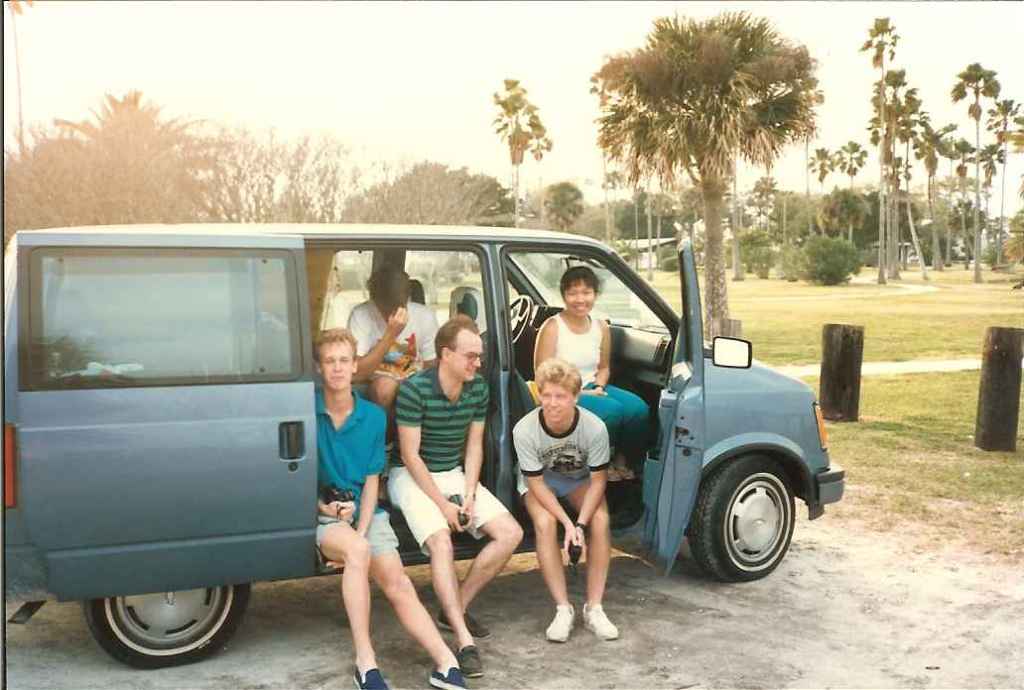
Four Swedes and an Indonesian girl in a van in Florida.
Four Swedes and Jonas girlfriend from Indonesia. We were on a trip to Florida.
Indian girl left. Swedish girl right.
Swedish exchange student Linda and her Indian friend Anuradha.

I arrived in the US in August 1987, and I was not well prepared for what I would experience. That doesn’t mean it wasn’t a great experience but there were challenges. Interestingly, I would later experience reverse culture shock. Reverse culture shock means that after adjusting to your new country you experience another shock when coming back to your old country.

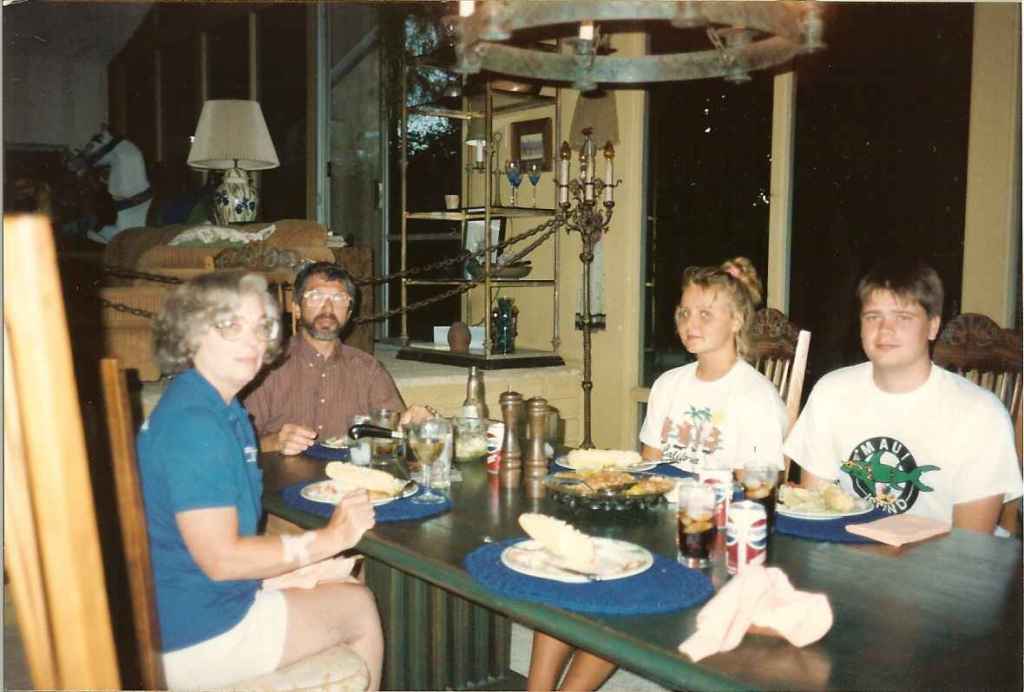
We are sitting around a dinner table.
Before heading out to Cleveland I visited Rakel, a Swedish friend who was living in California at the time. Here we are with our hosts Jay and Nancy Feinstein.

One of my first unpleasant discoveries was that the US uses imperial units instead of the metric system unlike most of the rest of the world. I quickly had to learn how to use inches, feet, miles, ounces, pounds, cups, gallons, etc. I knew about miles per hour versus kilometers per hour, but it had not dawned on me that it applied to everything. This is quite important in engineering.

Tape measure
Photo by Pixabay on Pexels.com

The academic environment was also quite different. In the US there were fewer classes, but you were often required to participate and there were quizzes and homework in addition to the final exam, which was short and relatively rushed. In Sweden you showed what you had learned on one big final exam that lasted 6-8 hours. How you achieved success on that exam was up to you. Well certain lab work had some weight also.

Boy taking an exam
Photo by Jeswin Thomas on Pexels.com

In addition, in Sweden there were no dorms, no fraternities, no Greek life, no meal plans, no college sports teams, no tuition, and no health insurance. Attending a university in Sweden is more like working for a company. You are more independent, and tuition is free, and Sweden has national healthcare. In Sweden there are clubs, organizations, and parties you can go to, but it is more adult and has no likeness to fraternities. I have no opinion on which system is better, but it was a challenge to suddenly adjust to a dorm, meal plans, a different kind of student life, tuition waivers (provided by Uppsala University), etc.

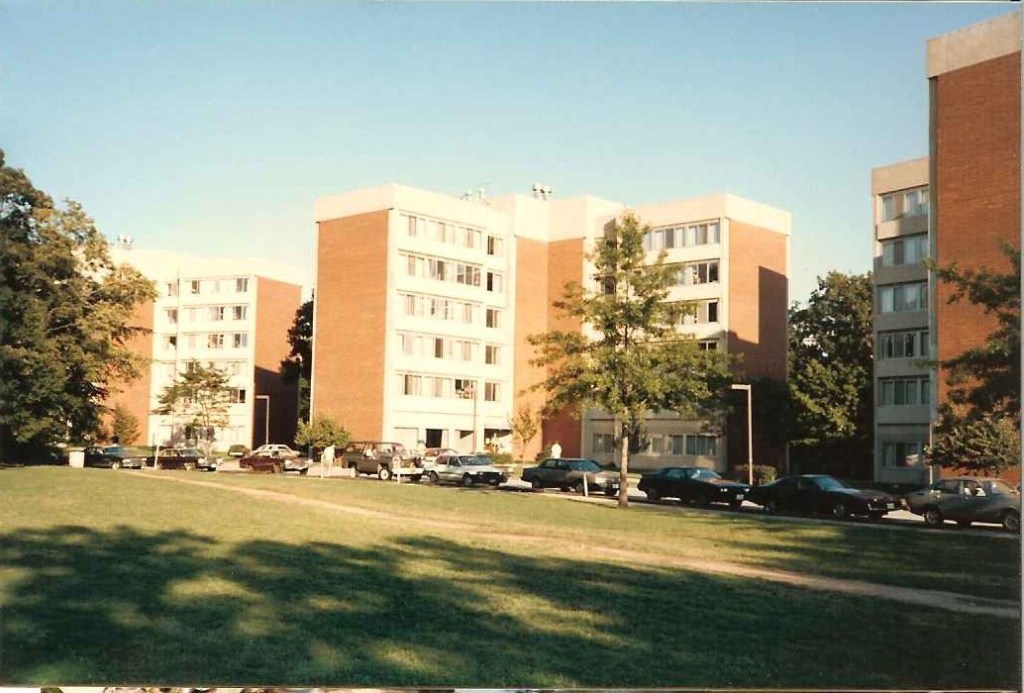
Three dorm buildings. Glaser in the middle.
This is the Glaser dorm at Case Western Reserve University where I stayed.

Another difficulty was that I was not fluent in English at the time. I had a hard time with conversation as well as understanding portions of some lectures. People in English speaking countries often do not understand the amount of work that goes into learning how to speak a second language fluently because unlike most of the rest of the world they never had to do it. English being the premier second language comes with great benefits for native English speakers. Learning to speak a language fluently is one thing, learning to speak it without an accent if you primarily learned it as an adult is quite another. A question I’ve gotten many times is ”why do you still speak with an accent?”. Well, Arnold Schwarzenegger certainly knows the answer to that question.

Yellow English grammar book
Photo by Ivan Samkov on Pexels.com

Another thing people in English speaking countries sometimes miss is that people in the rest of the world are often not as familiar with the culture in English speaking countries as they might expect them to be. Well at least that was the case back then. In high school I studied Swedish and Scandinavian literature, and a little bit of German, French, Italian, and English/American literature, but I did not know much about Shakespear or famous American authors, and if you think about it, this is not strange. In addition, I did not know much about American movies or American music, but that was because I, unlike most Swedes, had not paid much attention to English speaking culture and music in general.

A book by William Shakespear. Romeo and Juliet.
Photo by Sema Nur on Pexels.com

Add to that, the fact that Americans do not know much about cultural phenomenon in the world outside of the United States. For example, most Americans knew nothing about the world’s largest music competition, Eurovision. Eurovision is the largest song contest in the world. Countries compete against each other, and the final typically has as many viewers as the Superbowl, about 200 million. Americans also don’t know much about the second largest comic genre (largest at the time) in world, the French-Belgian Bandé-Dessiné (Astérix, Tintin, Spirou, etc.). So, we knew different things and were used to talking about different things, sometimes leading to awkward situations.

Scanned front cover of one of the Asterix comic books.

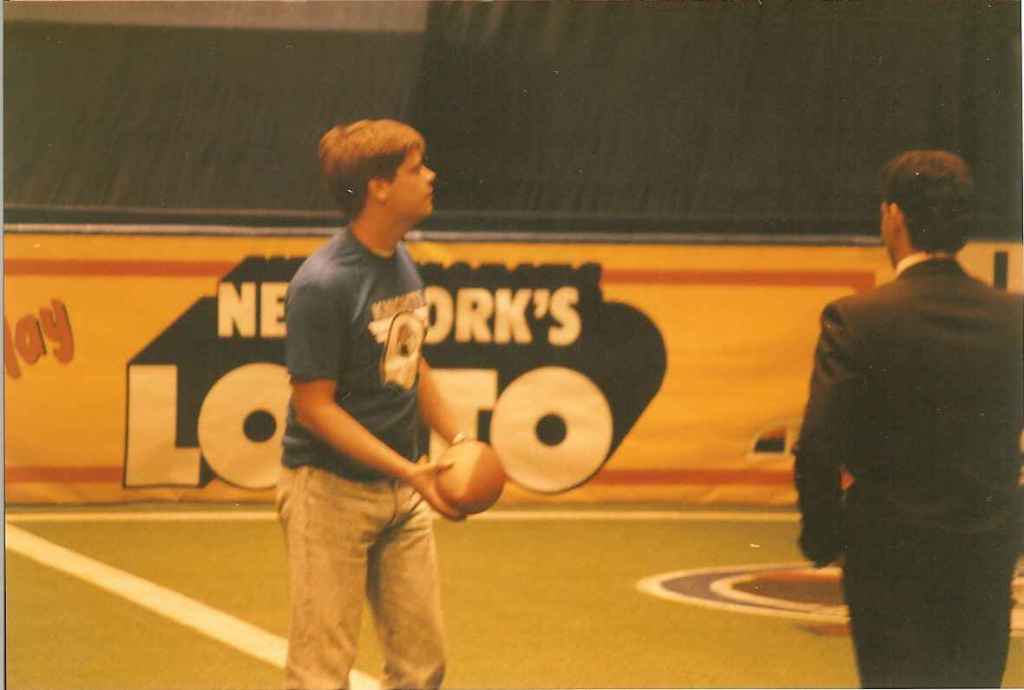
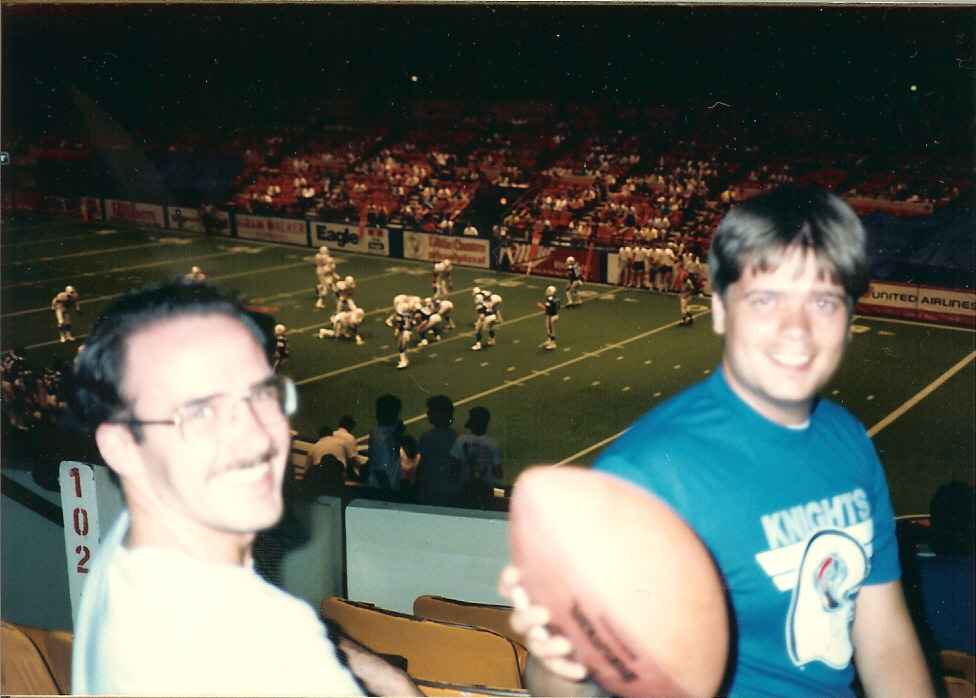
Which brings me to handegg. What most of the world call football is called soccer here, whilst a sport in which you handle an egg-shaped object mostly with your hands is called football, when it should be called “handegg”. When I arrived in the US, I had never heard of American football, but I quickly realized that I better know something about it. Later in the year I went to an indoor football game with a friend in Madison Square Garden in New York. Indoor football is a sport that has almost vanished, but it was still a thing back then. Can you guess who was called down to the field to play football at half time? I was. I told the host that I was from Sweden and that it was the first time I held a football. He showed me how to hold the ball and announced that I was from Sweden and had never held a football. The crowd was cheering for me, and luckily, I threw the ball into the goal two times out of three. Our team did not win but I did well.

Me holding a football in the arena at Madison Square Garden.
I am getting ready to throw the ball.
My friend Hakan and I. I am holding a football.
It went well, and I got to keep the ball (egg), my very first football.

Which brings me to the fact that Americans are typically polite, friendly and supportive of the underdog. They communicate well, they say excuse me when they bump into people, they smile a lot, and are often good conversationalists. Americans can be loud and not everyone is friendly but in general most Americans are friendly. I think this is a good thing that I am trying to emulate but it was yet another thing I needed to learn.

Some friendly Americans including my wife second from left. The others are (left to right) Jim Haggarty, something James Kirkpatrick and his wife.

One thing that might sound like critique is that Americans back then did not know world geography very well. Today’s youth seem to be a lot better educated in this regard. I should say that by the age of ten I knew every country in the world and their capitals, and I could say something about most of the larger countries. So, it was a little bit frustrating to me to speak to people who did not know where anything was. We met people who asked how long the drive from Sweden / or Europe was. A woman asked me where I was from and I said Sweden to which she replied, “is that where all the men wear skirts?”. I said, “no that is Scotland”. I believe that’s what she meant. Another woman asked me the same thing, and after hearing my answer, she said “Sweeting, that’s the name of your country? What a cute name for a country”. Or how about this conversation between the PhD advisor to a friend of mine and my friend’s boss:

Boss : My name is …, what is your name?

PhD advisor : My name is Bahram.

Boss : Baddam, that’s not an American name, is it?

PhD advisor : No, I am from Iran.

Boss : Iran I’ve never heard of that. Where is that?

PhD advisor : It’s in Persia.

Boss : Oh yeah Persia I’ve heard of that.

Photo of a world globe. Iran is in the middle.
Photo by NastyaSensei on Pexels.com

I overcame my culture shock, and we all did well at CWRU. It was a good year. Later that year I met my wife Claudia and with her I would experience a reverse culture shock a few years later. I was working for a Swedish robotics company, and we moved to Sweden with our oldest son for one and a half year. Not only did my wife have a culture shock but I did too, coming back to Sweden. How did that happen? Well, one reason was that in the US I had gotten used to a mix of cultures and ethic groups and Sweden is a very homogenous country. This mattered because through my wife, who is not Swedish, I got to know immigrants to Sweden. It is difficult to fit in when you are different and therefore immigrants tend to hang around other immigrants, so I learned to see Swedish society through their eyes, and I saw what I had never seen before. It took some time to get used to.

Claudia in a purple dress
My wife to be Claudia in 1988
Robot giving a woman a flower
Photo by Pavel Danilyuk on Pexels.com

Have you experienced culture shock? How about a reverse culture shock?

Review of Leonberger Complete Training Guide and Promotion Reminder

In this post I am going to review a Leonberger book, “Leonberger Complete Training Guide” by Bella Ross. However, before I do, I would like to remind everyone about my e-Book promotion in honor of our late Leonberger Bronco’s birthday on July 3rd, as well as the one-year anniversary of my book release.

I temporarily lowered the price of my e-Book from $4.99 to $2.99 on Amazon as well as on IngramSpark, which covers a range of bookstores including Barnes and Noble, Indigo in Canada, independent bookstores, libraries, and Apple devices. I am ending this promotion in a couple of days, but the lower price may stay longer on IngramSpark bookstores because they only update prices on Fridays.

Finally, this is my review of the book Leonberger Complete Training Guide by Bella Ross

I recently finished reading Leonberger Complete Training Guide: Essential Training Guide To Raising A Healthy And Obedient Dog: Caring, Health, Feeding, Exercise, Socialization, Breeding, Showing And Much More. Paperback – Large Print, April 21, 2023. The dimensions of this paperback are 6 x 0.1 x 9 inches, and the weight is 3.84 ounces, ISBN 979-8392099306, and it currently costs $7.99 on Amazon in the US. There is also a Kindle version, ASIN B0C3JGL9FP, which costs $2.99 but is free with Kindle unlimited.

Photo showing the front cover of the book “Leonberger Complete Training Guide” by Bella Ross. It features a commonly used Leonberger stock photo.
Front cover of “Leonberger Complete Training Guide” by Bella Ross. Click on the image to go to the Amazon location for the book.

In summary: The book has 34 pages of content in large text with no images. There are really 40 pages but a few pages are blank. The book does not have much to say about training Leonbergers, so the title “Leonberger Complete Training Guide” is an embellishment. The title also mentions the words breeding and showing and the book says nothing about those topics. The book also has issues with repetition, a few incorrect statements, and the listed categories “Veterinary Genetics”, “Veterinary Parasitology”, “Mammal Field Guides” don’t match the content at all. Aside from those weaknesses, the book is otherwise well edited and positive in its tone. I gave the book three stars. Click here to see my original Amazon review.

A Very Short Leonberger Book with some Strengths as well as Significant Weaknesses

This short book (34 pages of content) in large type gets a lot of information right including information that many Leonberger books get wrong. It is also well edited with respect to spelling, sentence building and paragraphs. I like how positive it is and how well it captures the personality of Leonbergers.

However, it also gets some things wrong. The town of Leonberg is not in Bavaria. Their fur should not be clipped and trimmed if you want to show your dog, and weekly bathing is too often for a Leonberger. Contrary to what it says on page 11 Leonbergers aren’t known for long lives. The book mentions hip dysplasia over and over and states how big of a problem it is when in reality other giant breeds have a significantly bigger problem with hip dysplasia. On page 18 puppies are referred to as kids and on page 35 a reference is made to something that has not been mentioned. The biggest issue with the book is probably that it is very repetitive. Certain things are repeated a half dozen times, which is a lot in a book with only 34 pages of content. The title says “Complete Training Guide” but the book does not say much about training a Leonberger. The book has no pictures and the photo on the front cover is a commonly used stock photo. One more issue; the current categories Veterinary Genetics, Veterinary Parasitology, and Mammal Field Guides do not match the content of the book.

It is a very short Leonberger book with some strengths as well as some significant weaknesses, so I think three stars is a fair rating.

Back cover of “Leonberger Complete Training Guide” by Bella Ross. The back cover is entirely blue except for the bar code and a grey right margin.
Back cover of “Leonberger Complete Training Guide” by Bella Ross.

Leonberger Detects Oncoming Insulin Shock

Our Labrador Baylor had diabetes. I gave him insulin shots before every meal. But he was very cooperative, and he never complained despite the pinch he must have felt every time.

Our Yellow Lab Baylor
A hand holding a shot
I gave Baylor insulin shots at every meal. Photo by Karolina Grabowska on Pexels.com

At this stage in Baylor’s life Bronco, our Leonberger, had joined the family, and one day we witnessed what seemed like a miracle. Bronco started barking while looking at Baylor, then he intently looked at us, then he turned his head toward Baylor and started barking again. He did this a few times—not aggressively, but to get our attention. It became clear that Bronco wanted us to look at Baylor. I examined Baylor but saw nothing wrong at first. Then I looked again. This time I saw that his back legs were shaking slightly. It quickly got worse. His gait became wobbly, then within perhaps fifteen seconds he fainted. He had gone into insulin shock. We rushed him to the emergency clinic, where fortunately the doctors were able to revive him.

Having too much insulin in your blood can lead to having too little glucose/sugar. The insulin shock causes your body to become starved for fuel and it begins to shut down.

We didn’t know this at the time, but giving a dog sugar, or something sweet, can bring him out of insulin shock.

Photo of woman lying on the floor surrounded by sugar.
Sugar for insulin shock. Photo by Mikhail Nilov on Pexels.com
Photo of our Leonberger Bronco standing on a sofa and giving me a hug.
Me and Bronco

Bronco detected a problem with Baylor before we could see anything wrong. His warnings gave us that little bit of extra time we needed to save Baylor’s life. I still wonder what it was that Bronco noticed. Leonbergers have a very keen sense of smell, and people have told me that the dogs can smell when there’s something physically wrong with a person. We had never taught Bronco to detect insulin shock or any other condition. It was entirely his own instinct. This was one of the amazing superpowers Bronco had.

Photo of our Leonberger Bronco on the lawn with a sun ray shining over his head
Bronco was a saint

I can add that you can train dogs to warn their owners when  their blood sugar drops.

To celebrate the one-year anniversary of the publication of my book I am lowering the price of the eBook version from $4.99 to $2.99. It will last until July 20. It is valid for Amazon, Barnes & Noble and many other places.

The image shows the front cover of my book "The Life and Times of Le Bronco von der Löwenhöhle". Stories and Tips from Thirteen Years with a Leonberger. The cover is beige and brown and it has the face of an old Leonberger in the middle. Author is Thomas Wikman. Click on the image to go to the Amazon.com Kindle location for the book.
The front cover of my book “The Life and Times of Le Bronco von der Löwenhöhle”. Click on the image to go to the Kindle version on Amazon.com.
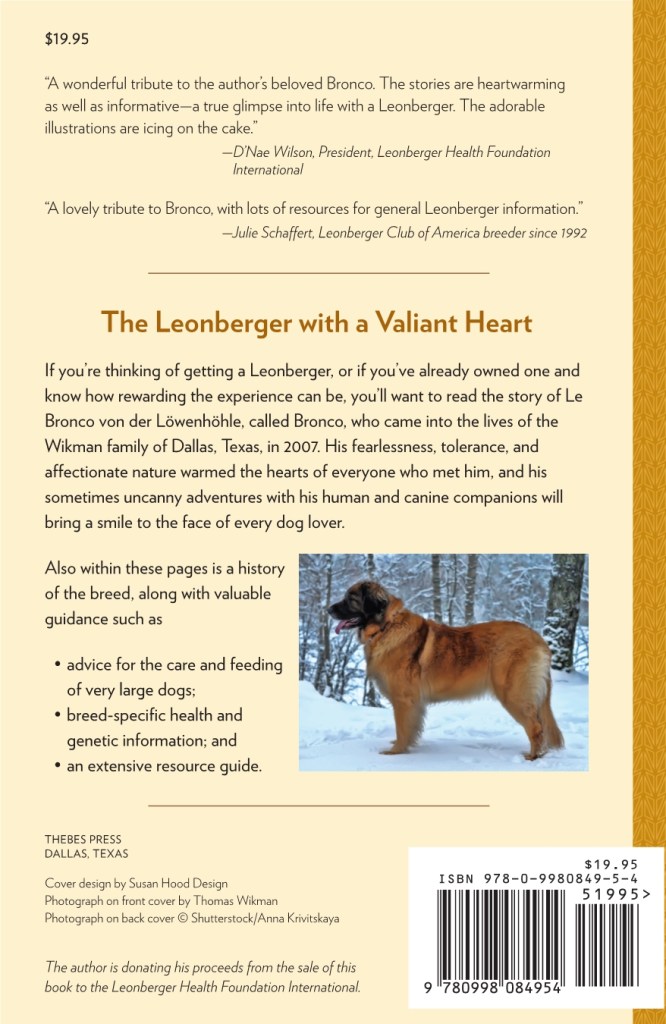
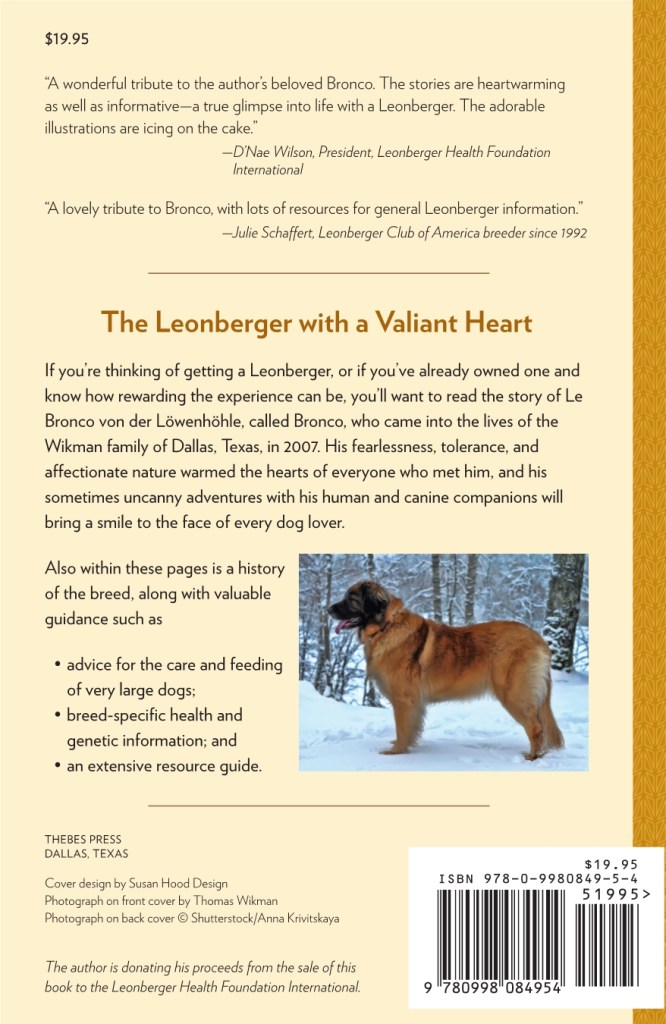
The image shows the back cover of my book "The Life and Times of Le Bronco von der Löwenhöhle". Stories and Tips from Thirteen Years with a Leonberger. The cover is beige and brown and it has in image of a Leonberger in snow. Author is Thomas Wikman. Click on the image to go to the Amazon.com paperback location for the book.
The back cover of my book “The Life and Times of Le Bronco von der Löwenhöhle”. Click on the image to go to the paperback version on Amazon.com.
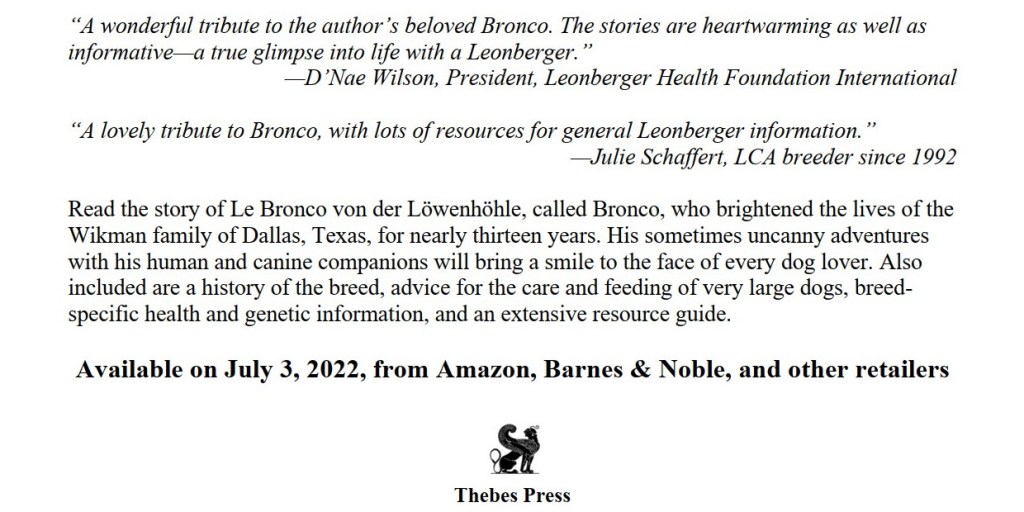
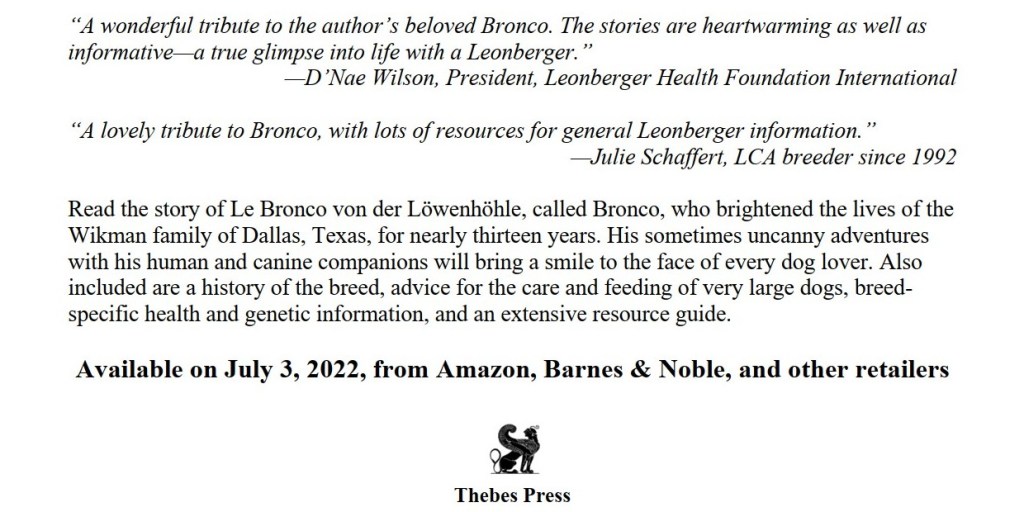
Endorsement by D'Nae Wilson, President, Leonberger Health Foundation International: "A wonderful tribute to the author's beloved Bronco. The stories are heartwarming as well as informative--a true glimpse into the life with a Leonberger". Endorsement by Julie Schaffert, LCA breeder since 1992: "A lovely tribute to Bronco, with lots of resources for general Leonberger Information"
These are the endorsements for the book. Click on the image to go to the Barnes and Noble e-Book location for the book.
Bronco our Leonberger is standing and looking straight into the camera.
Bronco in our living room. Click on the image to go to the Barnes and Noble paperback location for the book.

Finally, if you would like to learn more about the Leonberger book I wrote click here or here. All royalties are donated to the Leonberger Health Foundation International.

All American Pet Photo Day with Leonbergers and Other Dogs

I almost missed it! Earlier today I found out that today is “All American Pet Photo Day”. So here are some photos of our dogs, past and present.

In this photo of our mini-Australian Shepherd Rollo and our Pug Daisy, Rollo is in front and Daisy in the back. They are sitting on a white sofa chair.
A photo of our mini-Australian Shepherd Rollo and our Pug Daisy that I took this afternoon.

Also, as a reminder, the eBook version of my book “The Life and Times of Le Bronco von der Löwenhöhle” is temporarily $2.99 (until July 20th).

Other eBook Versions of my Leonberger Book Are Now Also 2.99

It took a while, but I was finally able to lower the price of my e-Book on IngramSpark to $2.99. It’s been $2.99 on Amazon for almost a week already. IngramSpark only update prices on Fridays, and I managed to lock myself out of my account. Fixing it turned out to be complicated.

For those who don’t know; IngramSpark is a competitor to Amazon which distributes to a whole range of bookstores, Barnes and Noble, Indigo in Canada, independent bookstores, libraries, and Apple devices. Unlike Amazon IngramSpark does not translate the dollar amount to other currencies for you so to make it simple for myself I made it 2.99 in all currencies.

Click here to visit the Nook version of my book on Barnes and Noble

The reason for the 2.99 promotion is that our late Leonberger Bronco was born on July 3rd 2007 and in his honor I launched my book “The Life and Times of Le Bronco von der Löwenhöhle” on July 3rd 2022, one year ago. I will do the $2.99 promotion until July 20th.

The image shows the front cover of my book "The Life and Times of Le Bronco von der Löwenhöhle". Stories and Tips from Thirteen Years with a Leonberger. The cover is beige and brown and it has the face of an old Leonberger in the middle. Author is Thomas Wikman. Click on the image to go to the Nook (e-Book) version of my book on Barnes & Noble.
The front cover of my book “The Life and Times of Le Bronco von der Löwenhöhle”. Click on the image to go to the Nook (e-Book) version of my book on Barnes & Noble.
The image shows the back cover of my book "The Life and Times of Le Bronco von der Löwenhöhle". Stories and Tips from Thirteen Years with a Leonberger. The cover is beige and brown and it has in image of a Leonberger in snow. Author is Thomas Wikman. Click on the image to go to the paperback version of my book on Barnes & Noble.
The back cover of my book “The Life and Times of Le Bronco von der Löwenhöhle”. Click on the image to go to the paperback version of my book on Barnes & Noble.
Endorsement by D'Nae Wilson, President, Leonberger Health Foundation International: "A wonderful tribute to the author's beloved Bronco. The stories are heartwarming as well as informative--a true glimpse into the life with a Leonberger". Endorsement by Julie Schaffert, LCA breeder since 1992: "A lovely tribute to Bronco, with lots of resources for general Leonberger Information"
These are the endorsements for the book. Click on the image to go to the Kindle version on Amazon.com.
The image shows the Leonberger lying in the green grass. Click on the image to go to the paperback version on Amazon.com.
This is a photo of our late Leonberger Bronco lying in the grass in the front yard soon after a toe surgery. Click on the image to go to the paperback version on Amazon.com.

Finally, if you would like to learn more about the Leonberger book I wrote click here or here. All royalties are donated to the Leonberger Health Foundation International.

Happy Independence Day the Leonberger Way

Photo of five Leonbergers wearing American flags and hats with American flags on them.
This photo was provided by Jen O’Keefe, Urgent Animal Care of Arlington. From left to right; Obi, Delfi, Aslan, Gryphon, Digory.

Happy Independence Day

.

.

.

.

As a reminder the price of my book “The Life and Times of Le Bronco von der Löwenhöhle” has been temporarily lowered to $2.99. Click here to visit the Kindle version of my book on Amazon.

Finally, if you would like to learn more about the Leonberger book I wrote click here or here. All royalties are donated to the Leonberger Health Foundation International.

Celebrating Broncos Birthday

On July 3rd 2007 our Leonberger Bronco was born. That was 16 years ago today. He died three years ago. On July 3rd 2022, soon one year ago, I launched my book The Life and Times of Le Bronco von der Löwenhöhle; Stories and Tips from Thirteen Years with a Leonberger.

A photo of our Leonberger from when he turned 12 years old on July 3rd 2019. He is wearing a party hat.
This photo was taken on Bronco’s 12th birthday on July 3rd 2019.

To celebrate Bronco’s birthday as well as the one-year anniversary of the publication of my book I am lowering the price of the Kindle version from $4.99 to $2.99.

Click here to visit the Kindle version of my book on Amazon.

The photo shows an ad that was used for the LeoLetter the official publication for the Leonberger Club of America.
This is a special Ad for The Life and Times of Le Bronco von der Löwenhöhle (from the LeoLetter, the official publication of the Leonberger Club of America). Click on the image to go to the Kindle version on Amazon.com.