This blog feature amusing and heartwarming stories about our late Leonberger dog Bronco, as well as other Leonbergers. It also has a lot of information about the Leonberger breed, the history, care, training, Leonberger organizations, etc. I also wrote a Leonberger book, which I am featuring in the sidebar.
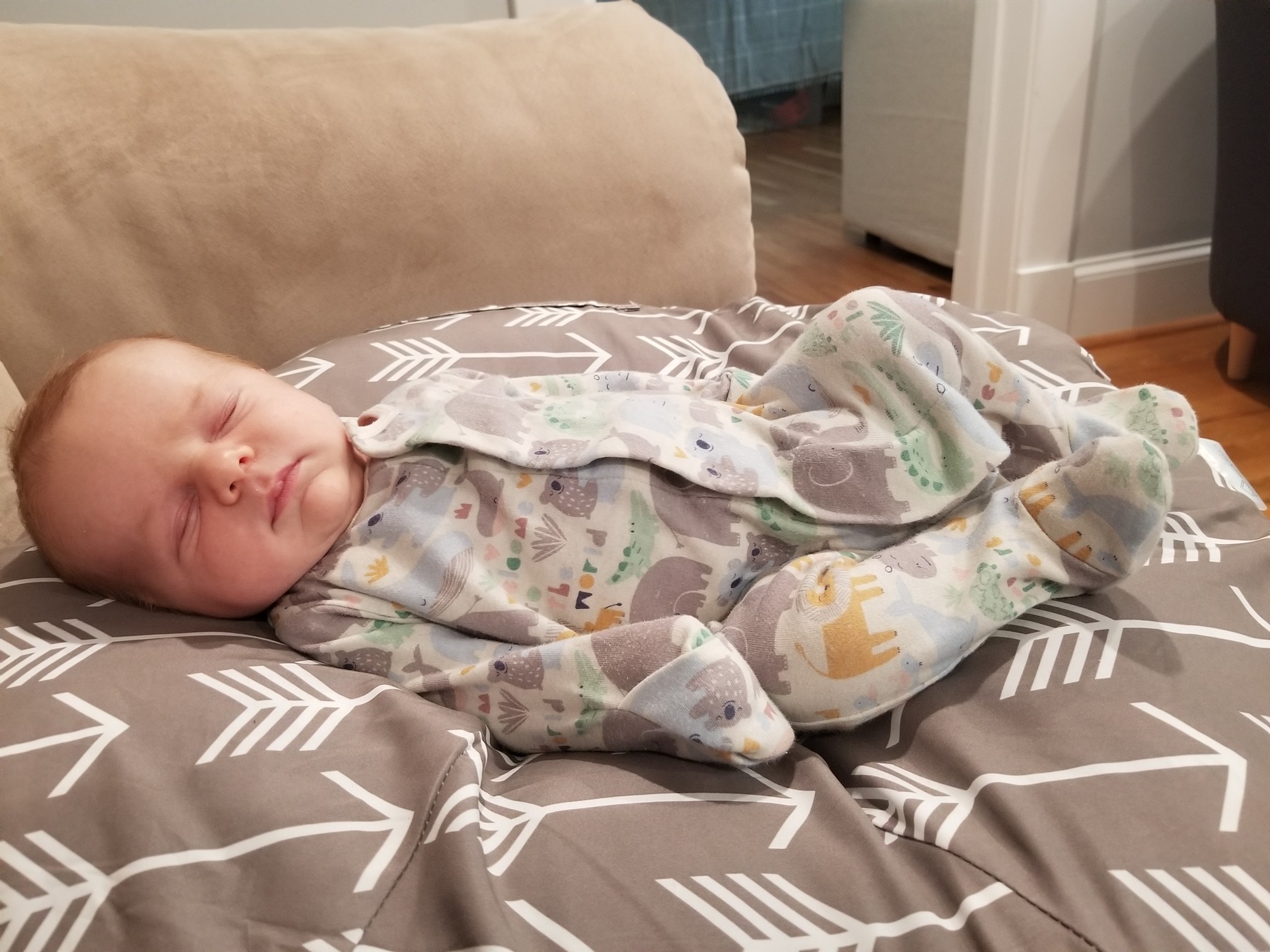
My wife and I recently became grandparents to newborn Baby Jack. We visited my son, his wife and their baby the past week. That is why I have not been as active with blogs lately. It was wonderful to see them and meet the baby. He is a very healthy baby.
The Wikman family in Baltimore. Jack is the little guy in the middle.
Below is photo collage featuring baby Jack. My wife and I are in the photos too.
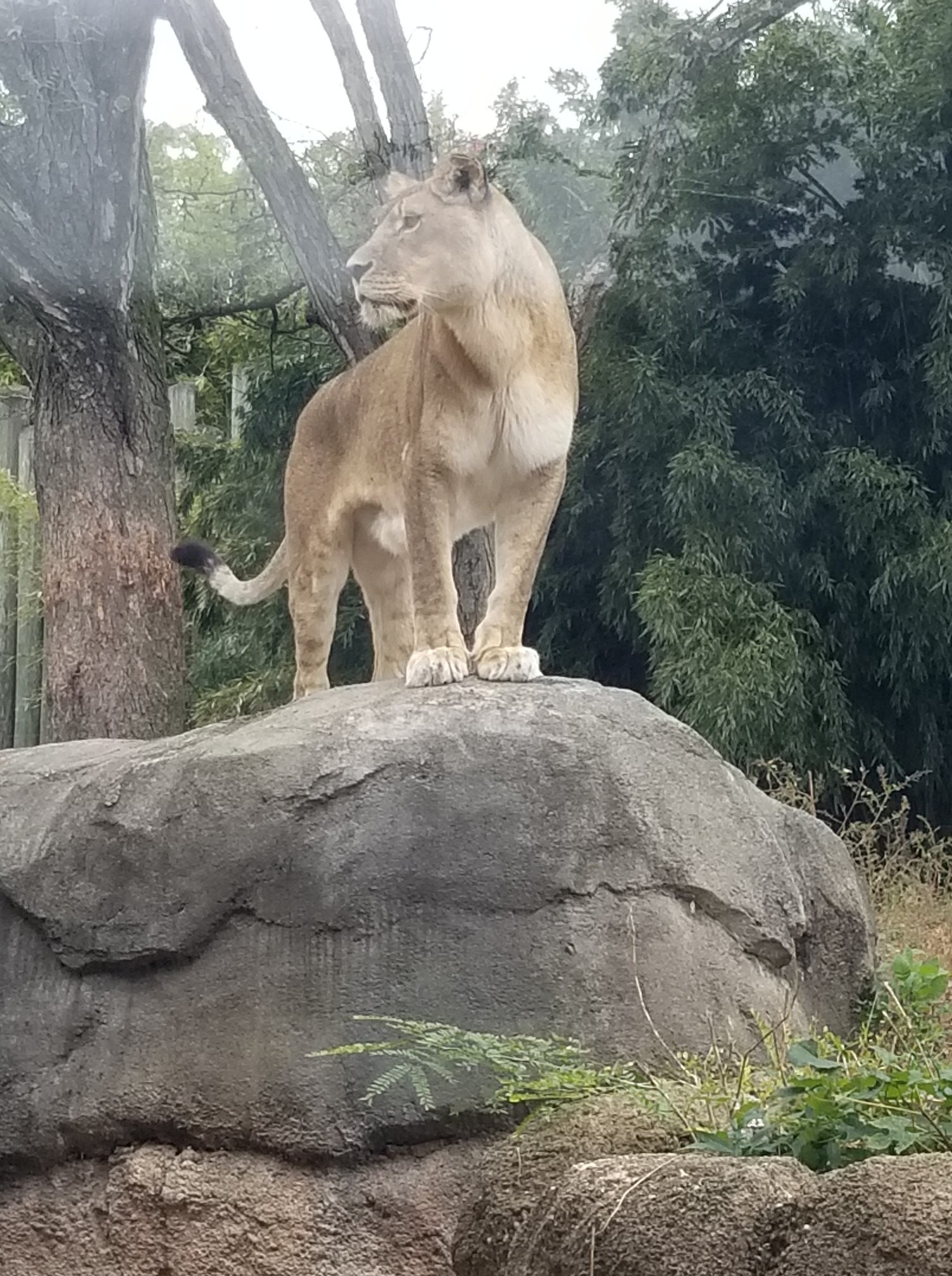
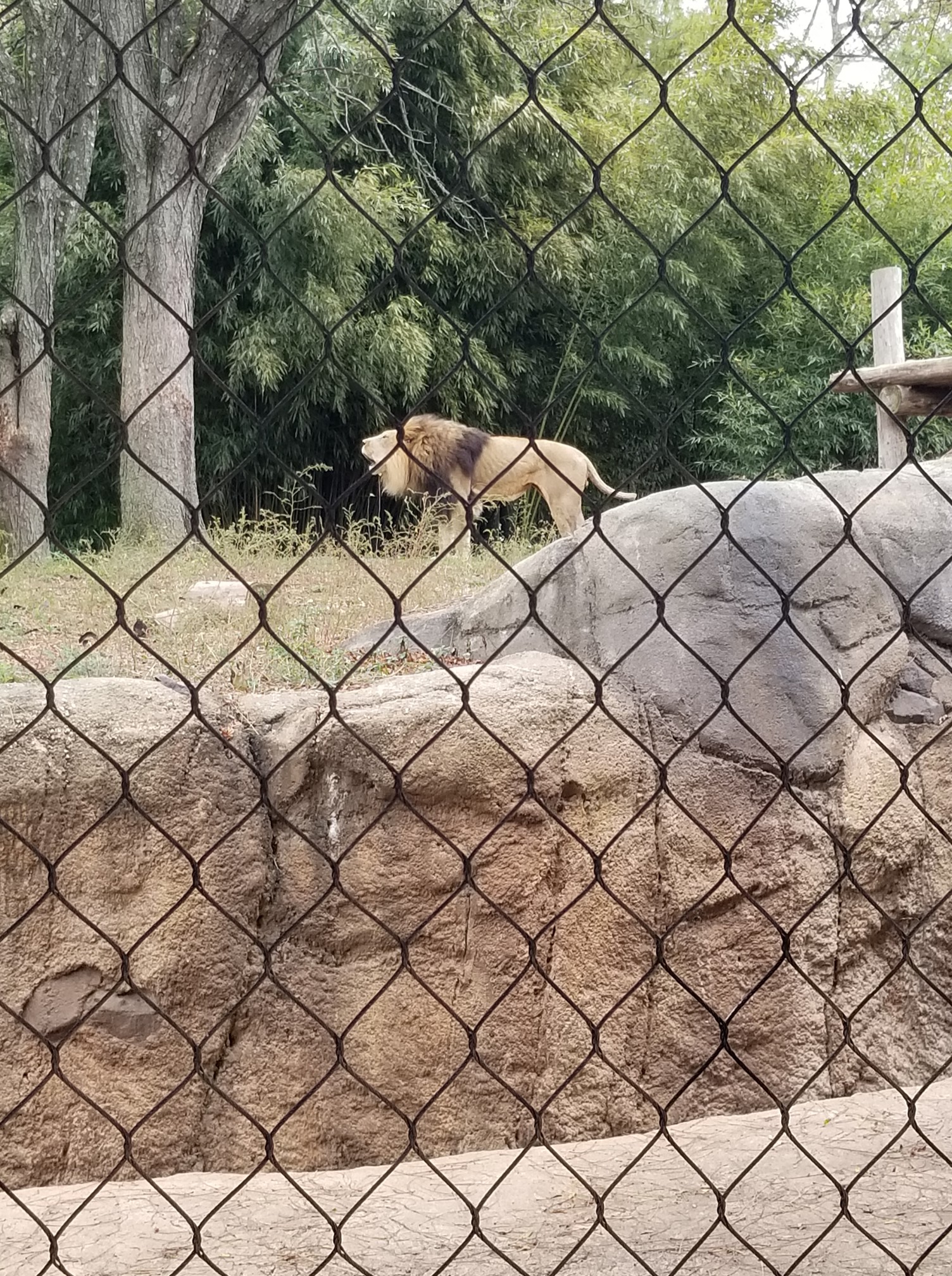
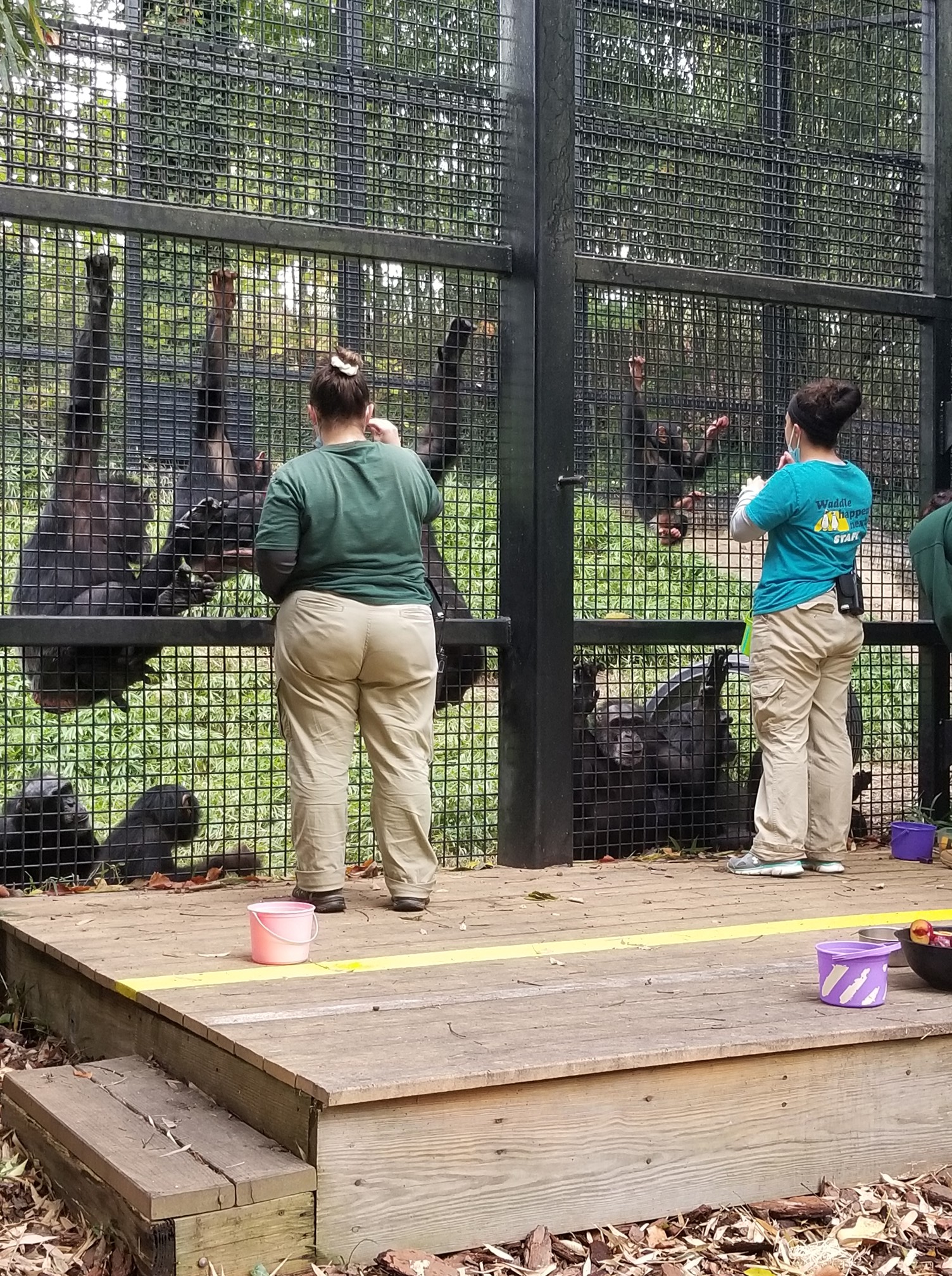
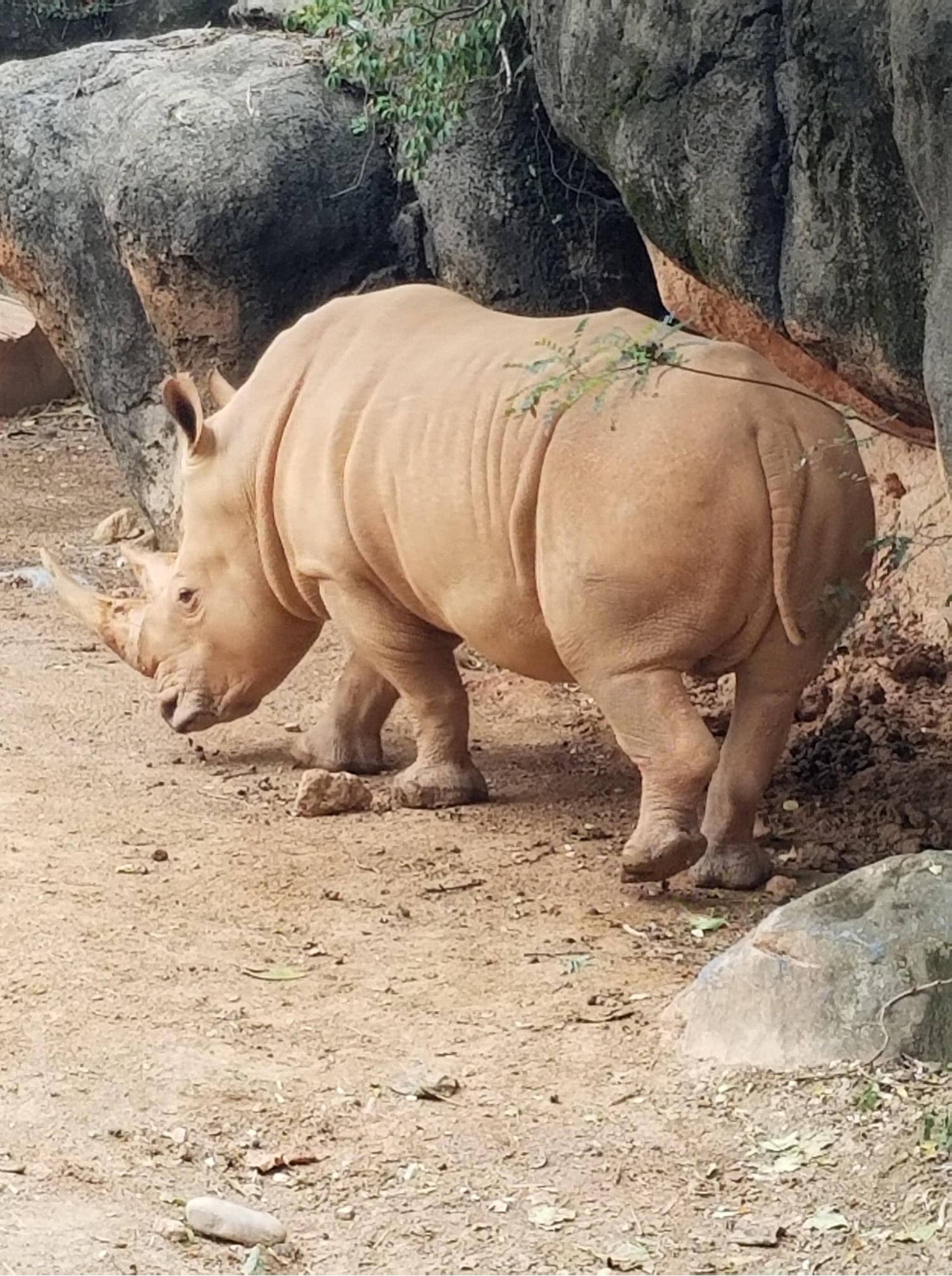
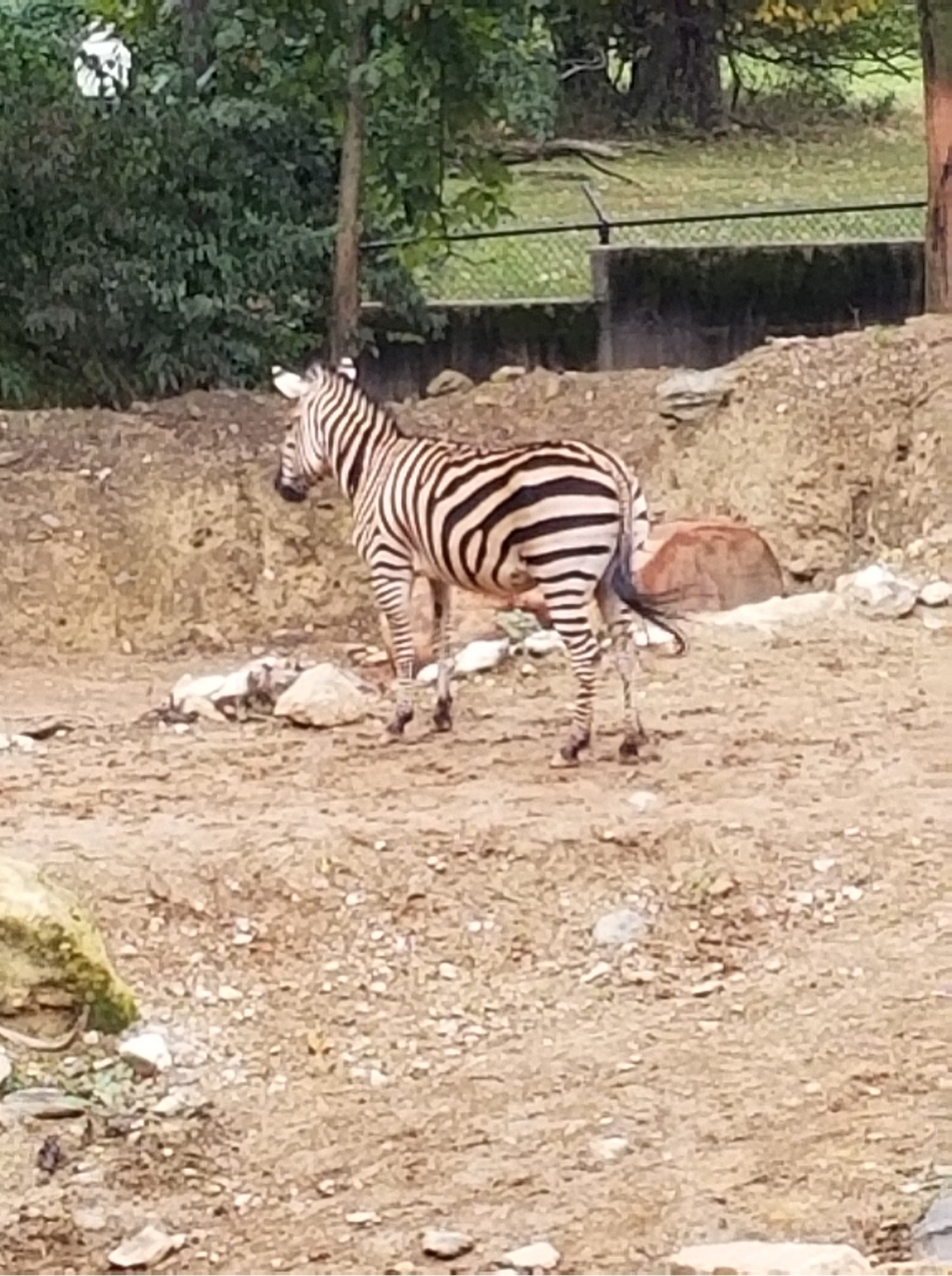
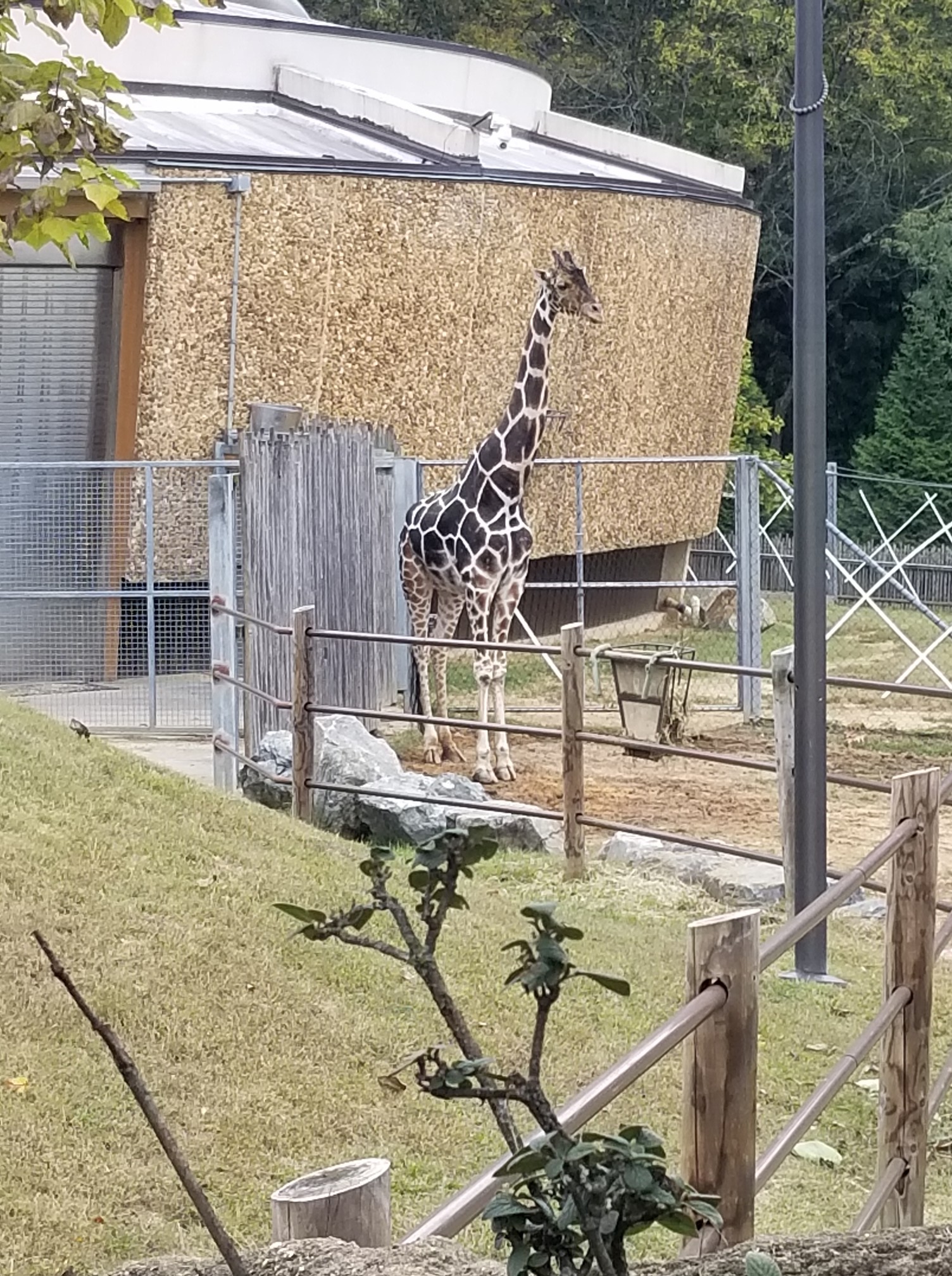
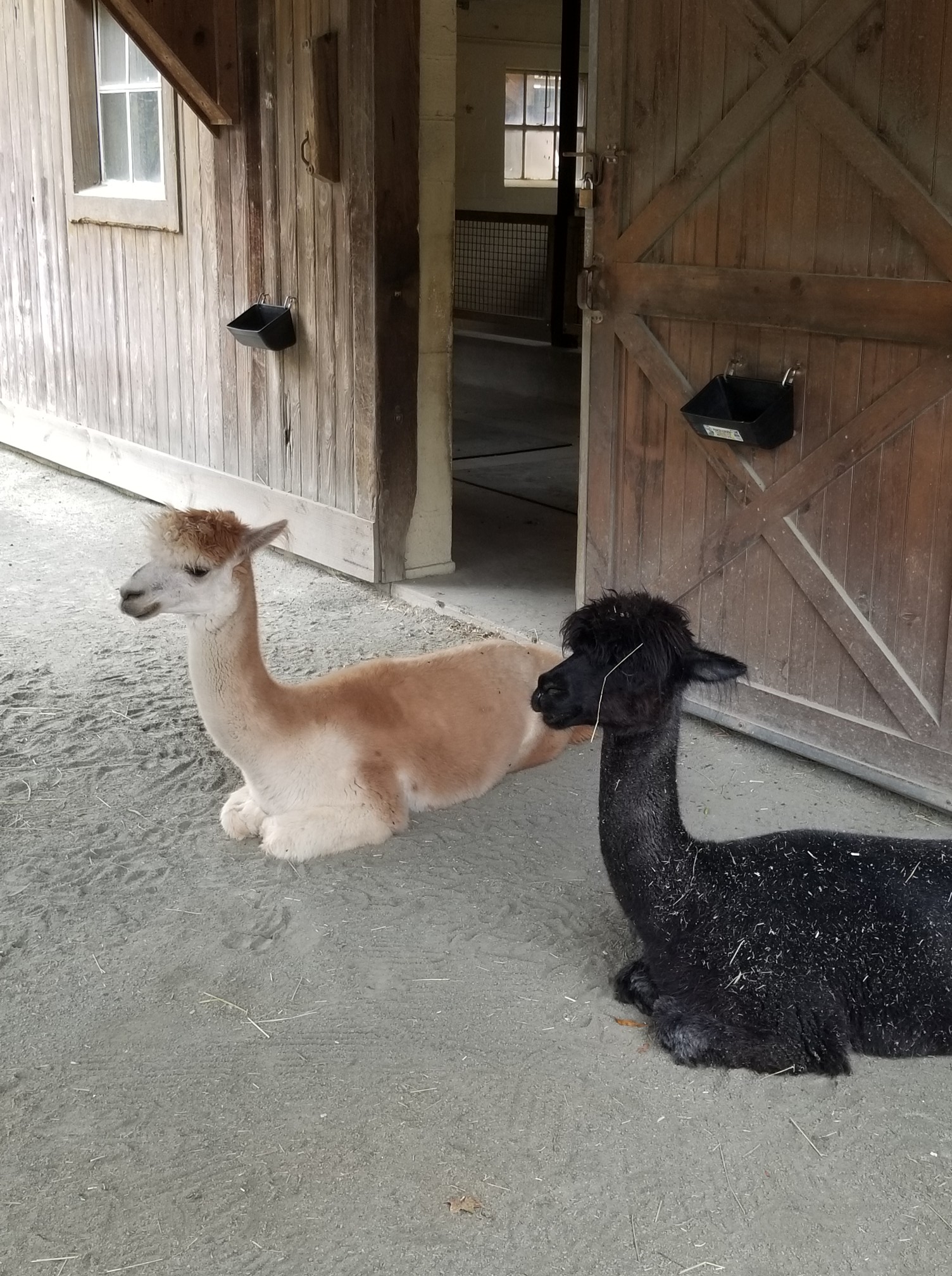
On Tuesday we visited Maryland Zoo. I have also included some animal photos.
Just a few minutes before I saw Esther Chilton’s writing prompt “club” I received my annual invoice for our family membership in the Leonberger Club of America. What a great reminder to pay my bill and create a post about the Leonberger Club of America. We haven’t had a Leonberger since the summer of 2020 when our Leonberger Bronco, or Le Bronco von der Löwenhöhle passed away. However, we’ve kept our membership because I love their LeoLetter magazine, I know some people, I have this blog, and I wrote a book about our Leonberger and the Leonberger breed after the passing of Bronco (see the side bar on the right or click here for more information).
The Leonberger Club of America
I can add that the Leonberger Club of America, LCA for short, is the official national parent club for the Leonberger breed in the United States (and Canada). It was founded in 1985. Its mission is to preserve and promote the health, temperament, and original type of the Leonberger through education, events, performance programs, and social engagement. The American Kennel Club (AKC) recognizes the LCA as the official Leonberger breed club in the United States.
The Leonberger Club of America make sure that the Leonberger dogs are protected. You are about as likely to find a Leonberger at Petland/Puppy-Mill as you are finding an Elephant for sale there. You typically buy/get a Leonberger dog from an LCA certified Leonberger breeder or from the Leonberger Rescue Pals, and if you don’t that might be a problem. Leonberger breeders interview prospective Leonberger owners and make sure they are a good fit. If you are found to have mistreated a dog in the past, turned one into a shelter, or sold one on an auction, you cannot buy a Leonberger. The breeders are also required to take back the dog if it does not work out. To see the transcript from our Leonberger interview, click here.
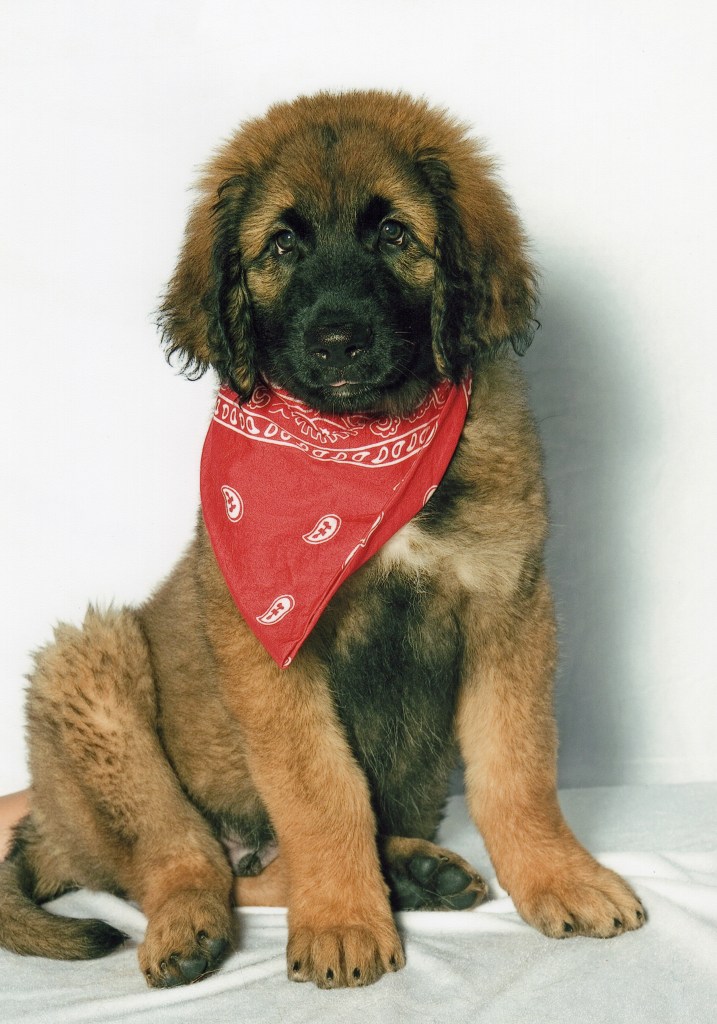
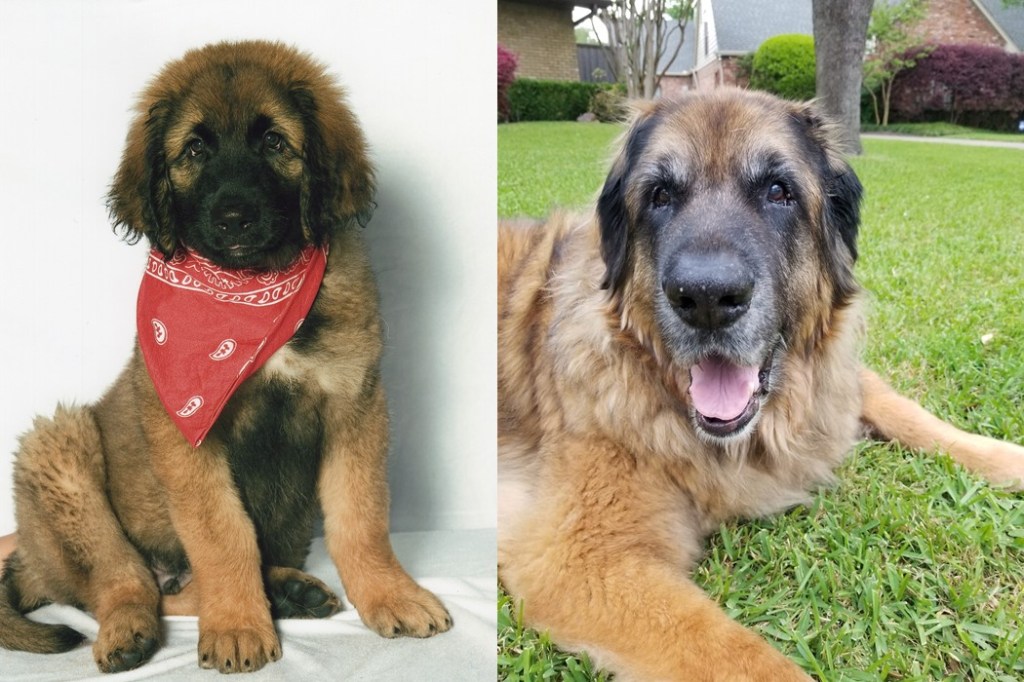
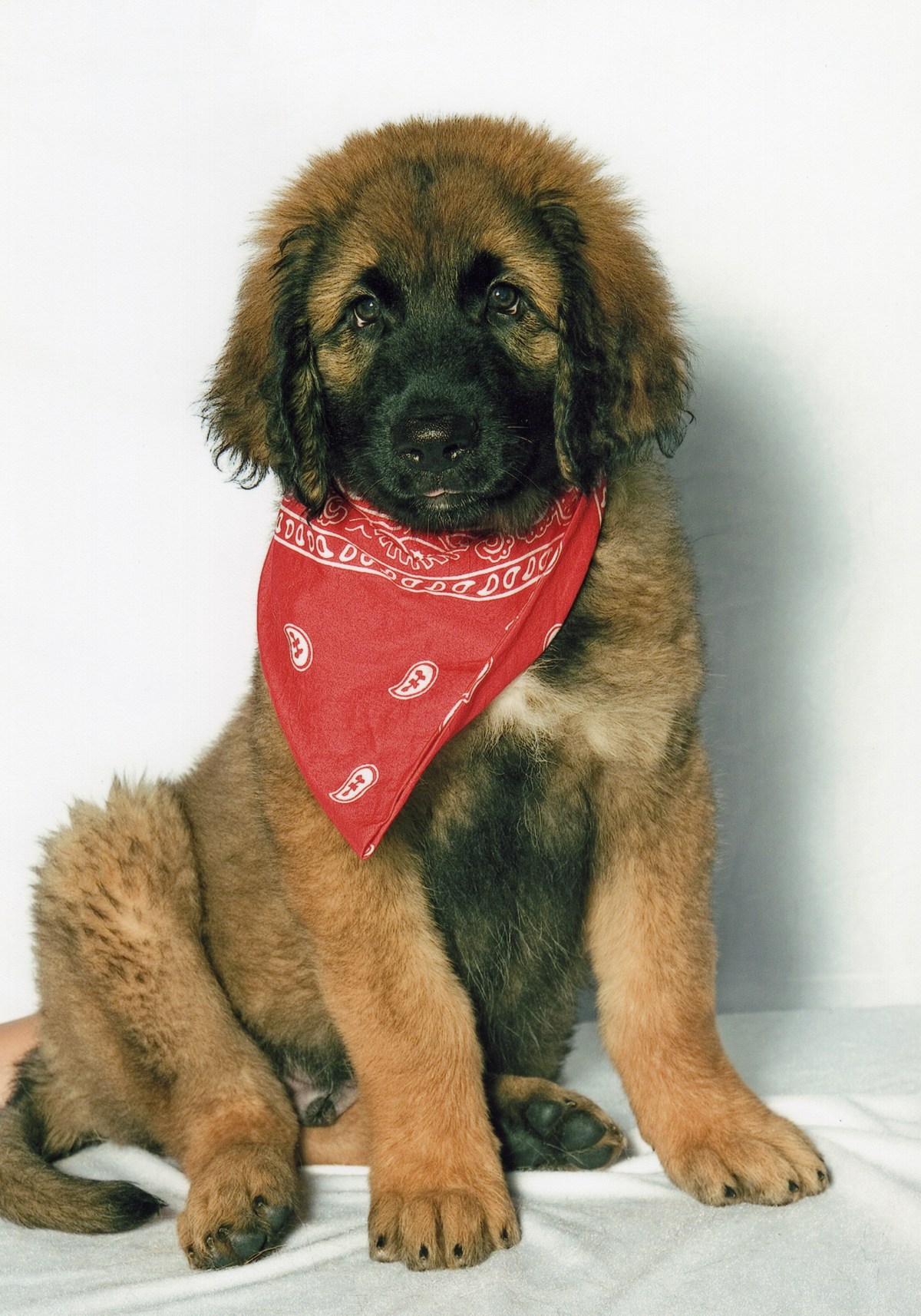
We bought our Leonberger Bronco (Le Bronco von der Löwenhöhle) in 2007 from Julie Schaffert, a certified LCA breeder since 1992. This is a photo of him at three months old.
There are only about 3,000 Leonbergers in North America and about 2,000 Leonbergers in the United States but the Leonberger Club of America has more than 1,000 members. They publish the Leo-Letter, a quarterly Leonberger magazine. So, the Leonberger Club of America has a very prominent place among Leonberger owners. Click here to see a summary of the Leonberger Breed Standard.
Leonbergers have a long history in North America and the United States—despite the fact that until 1985, there were only seventeen Leonbergers known to be living in the United States. See: Lusby, Leonberger, page 15.
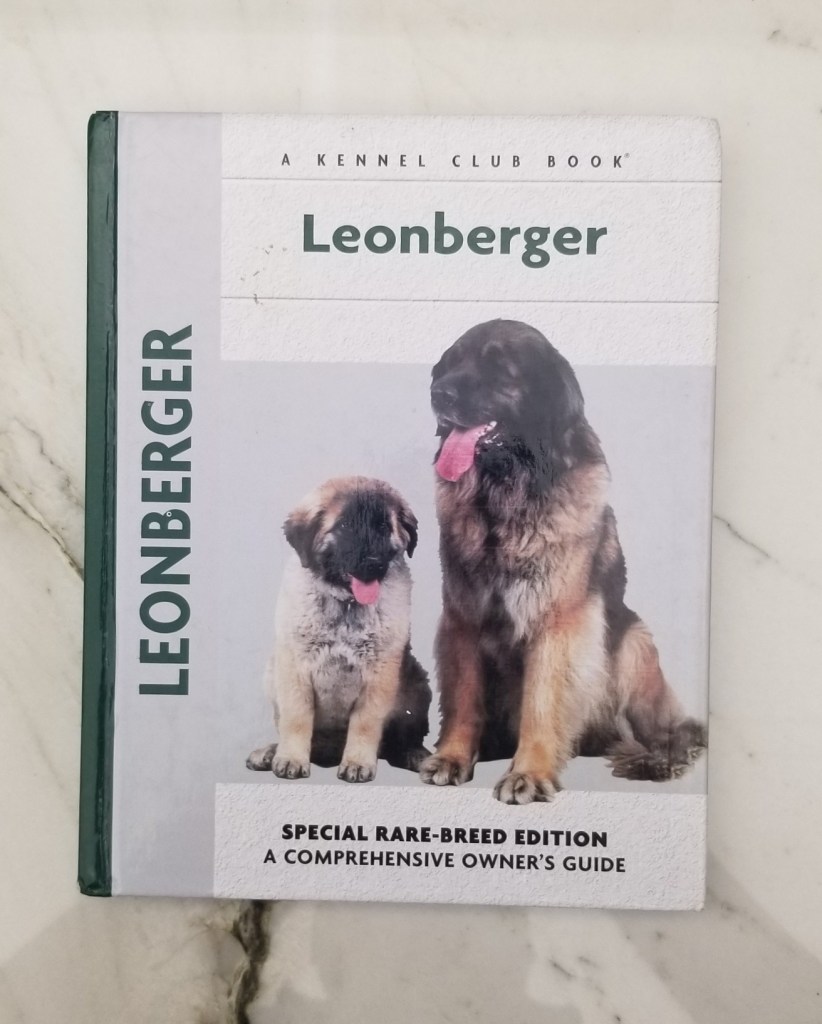
Leonberger, Special Rare-Breed Edition, A Comprehensive Owners Guide, Madeline Lusby
In the 1870s, Leonbergers were brought to Newfoundland to invigorate the stock of Newfoundland dogs. Around the same time, two Leonbergers named Caesar and Sultan were purchased from Heinrich Essig’s kennel (founder of the Leonberger breed) and transported across the ocean to join the Wellesley-Sterling theater company in the United States as the stars of their productions. Then in 1879, Caesar and Sultan visited President Ulysses S. Grant, who called them the largest and most magnificent dogs he had ever seen and presented them with gold medals. During the years between World War I and World War II, a New Jersey family, the Wolfs, opened their home as a temporary refuge for Jews fleeing Germany: they also imported Leonbergers. Unfortunately, this introduction of the breed into the United States did not last, and it would be another fifty years before the Leonberger appeared in America again.
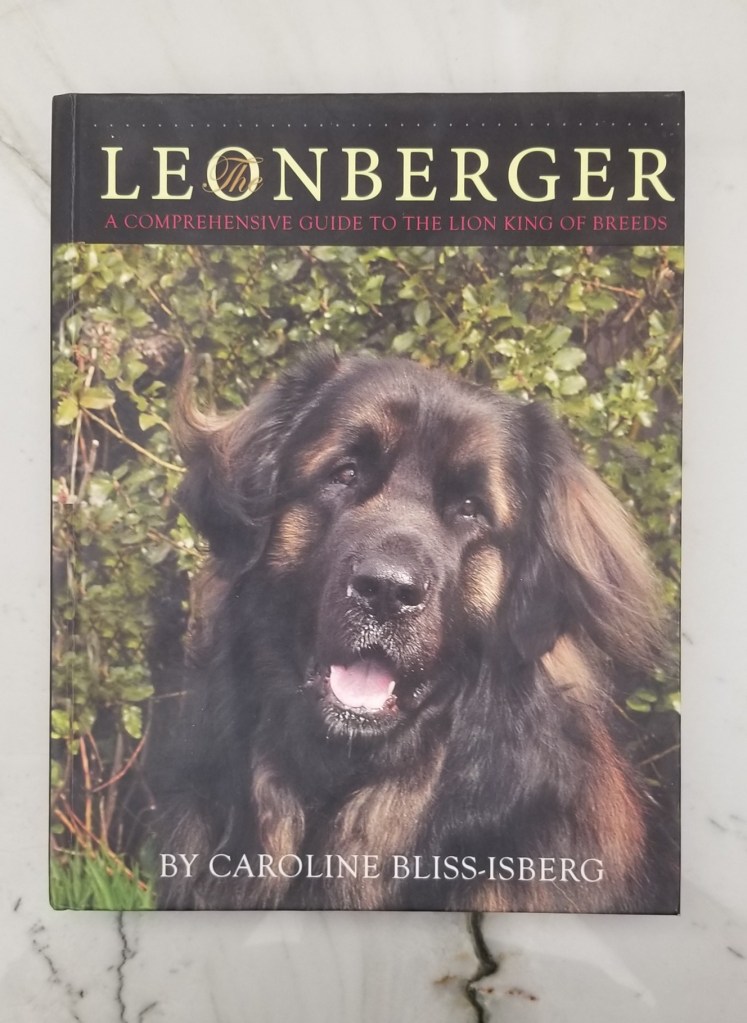
Leonberger, A comprehensive guide to the lion king of breeds, Caroline Bliss-Isberg
During the late 1970s and the 1980s, a few families—Waltraut and Klaus Zieher, Brian Peters, Manfred and Sylvia Kaufmann, Keri Campbell and Melanie Brown, and Mary and Reiner Decher brought Leonbergers to the United States. The Dechers had started a breeding program and were looking for a mate for their first dam, Viona. By chance their neighbor discovered through a newsletter that there was another Leonberger in the United States, and that led to the families’ finding and connecting with one another. I should add that the Dechers were careful to conform to the German breeding regulations and performed hip X-rays that they then submitted to the Orthopedic Foundation for Animals (OFA). Viona became the first OFA-certified Leonberger in America.
See: Bliss-Isberg, Leonberger, page 152.
On Saturday, November 2, 1985, eight of these Leonberger enthusiasts met at a hotel in Denver, Colorado, to found the Leonberger Club of America (LCA). This group of founders, which has since been dubbed the Denver Eight, appointed a registrar, formulated a breeding acceptability checklist, and instituted various policies, including the requirement that OFA certification is mandatory for breeding. LCA membership grew: it held social gatherings, began publishing LeoLetter, and imported an increasing number of dogs. Now the LCA has thousands of members across the country, and Leonbergers receive high ratings on health tests relative to other large breeds. For example, in 2000, the OFA reported that only 14.6 percent of Leonbergers tested positive for hip dysplasia, compared to 47 percent of Saint Bernards.
Founding of the Leonberger Health Foundation International
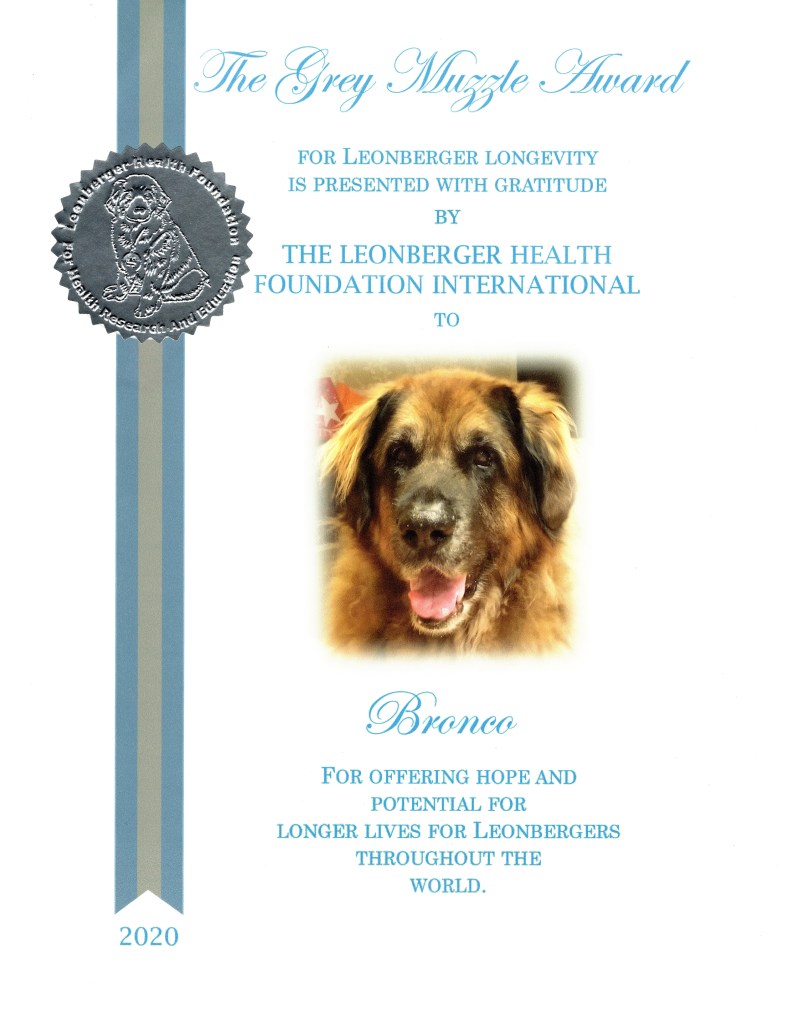
Another important historical event was the founding of the Leonberger Health Foundation International (LHFI), in 2000 (it was just called the Leonberger Health Foundation back then). According to its website, the organization was founded by Waltraut Zieher and other memers of the LCA’s health, education, and research committee to “facilitate the solicitation and distribution of donations given to support health related breed-specific research.” The LHFI also administers a program that collects DNA samples from Leonbergers to share with universities and research institutions, and of course it administers the Grey Muzzle Award (long living Leonbergers). Our Leonberger Bronco was a recipient of the Grey Muzzle Award, and we provided them with his DNA.
Bronco’s Grey Muzzle Award, which he received for being an unusually long lived Leonberger.
LHFI’s global biobank contains DNA samples from more than nine thousand Leonbergers. Among the organization’s notable achievements are the eradication of Addison’s disease among Leonbergers and the raising of nearly half a million dollars for research into conditions that affect canine health, including osteosarcoma, hemangiosarcoma, glaucoma, cardiac diseases, thyroid diseases, and neurological disorders. Its research also supports healthful longevity and aging as well as population diversity. Another success is the fact that since 2011, no Leonbergers with two copies of the LPN1 gene mutation (which causes Leonberger polyneuropathy) have been recorded in LHFI’s biobank. LHFI is one of my favorite charities.
The Dog Wars of America
The end of the twentieth century marked not only the end of the Cold War but also the beginning of what I call the Dog Wars of America. In 1985, the American Kennel Club (AKC) registry comprised one-third of the world’s known dog breeds. But the AKC had recognized only a few new breeds since 1887—a period of ninety-eight years. So, the organization decided to change that policy, but this did not always go smoothly. The members of rare-breed clubs often did not want to be part of the AKC. For example, the Australian Shepherd Club of America (ASCA) was very reluctant to join, so a relatively small splinter group, the United States Australian Shepherd Association, was formed and designated the official member club of the AKC, which was not welcome news to the ASCA. The border collie is another example. Charles Krauthammer, the late political columnist, called the AKC the politburo of American dog breeding.
See: Bliss-Isberg, Leonberger, page 159.
Similarly, in 2003, a new Leonberger club was formed—the Leonberger Club of the United States—with the goal of becoming the Leonberger member club of the AKC. This essentially forced the LCA’s hand, so they applied for membership in the AKC, a process that took years to complete. But ultimately the AKC approved the LCA as members in 2010: Leonbergers would officially become part of the Working Group. Fortunately, 90 percent of LCA breeders agreed to continue following LCA regulations regardless of whether the club would remain independent or become part of the AKC. Also fortunately, AKC membership afforded more opportunities for Leonbergers to participate in dog shows, which is important to many owners.
See: Bliss-Isberg, Leonberger, page 187
For more information on the history of the Leonberger starting in 1830’s click here.
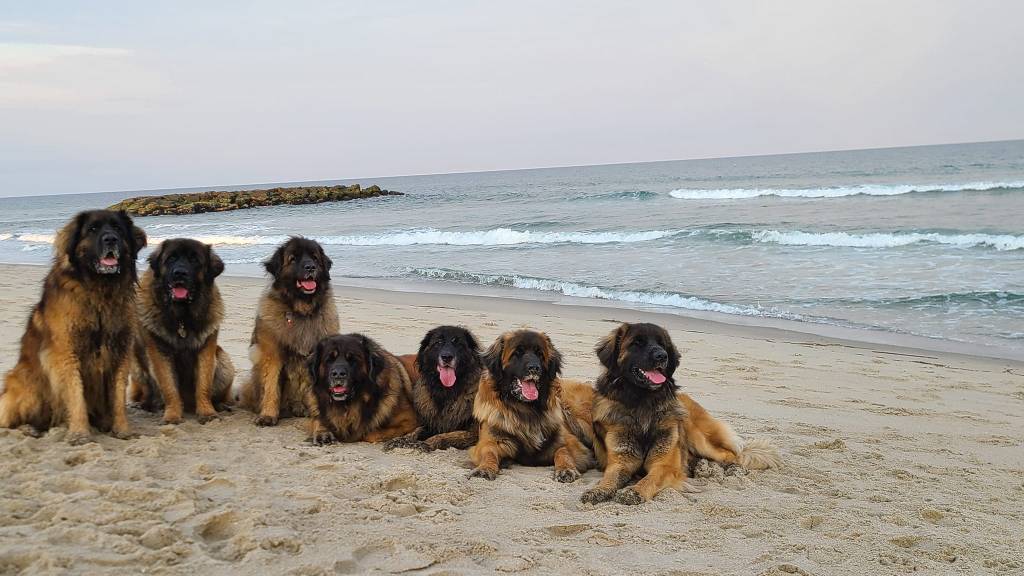
On the left our Leonberger Bronco at three months old. On the right Bronco as an unusually old Leonberger at almost 13.Bronco our Leonberger is giving me a kiss. He is about one year old and not yet fully grown.Seven Leonbergers by the beach. Photo by Jen O’Keefe.
This is going to be a short blog post. First, I would like to make an announcement. My wife and I became grandparents for the first time a little bit less than a week ago. The baby’s name is Jack.
This post is about a dog’s prayer, which I with permission is borrowing from fellow blogger pensitivity101. This post is also related to one of my previous posts : Promises To My Dog.
A dog’s prayer – anonymous author
A Dog’s Prayer
I am typing out the prayer in case it is hard to read the text in the picture.
Before humans die, they write their last Will & Testament, give their home & all they have, to those they leave behind. If, with my paws, I could do the same, this is what I’d ask…
To a poor and lonely stray I’d give:
My happy home
My bowl & cozy bed, soft pillows and all my toys
The lap, which I loved so much
The hand that stroked my fur & the sweet voice which spoke my name
I’d Will to the sad, scared shelter dog, the place I had in my human’s loving heart, of which there seemed no bounds.
So, when I die, please do not say, “I will never have a pet again, for the loss and pain is more than I can stand”.
Instead, go find an unloved dog, one whose life has held no joy or hope and give MY place to HIM.
This is a Leonberger blog, but I also post about other topics including book reviews of books that I love and want to promote. With this post I would like to promote a beautiful poetry book full of wisdom, Celebrating Poetry by Cindy Georgakas.
Below is an overview of the two formats of Celebrating Poetry by Cindy Georgakas
Paperback – Publisher : Literary Revelations LLC (November 16, 2024), ASIN : B0DNCRS8W8, ISBN-13 : 979-8991332538, 183 pages, Item Weight : 11.8 ounces, dimensions : 6 x 0.42 x 9 inches, it cost $6.99 on US Amazon. Click here to order it from Amazon.com.
Kindle – Publisher : Literary Revelations LLC (November 15, 2024), ASIN : B0DNBPC4GP, ISBN-13 : 979-8991332521, 183 pages. It is currently $0.99 on Amazon.com. Click here to order it from Amazon.com.
Front cover of Celebrating Poetry by Cindy Georgakas. Click on the image to go to the Amazon page for the paperback version of the book.
Amazon’s Description of Celebrating Poetry by Cindy Georgakas
Cindy Georgakas is not just a wellness therapist; she is a beacon of hope and creativity through her exceptional poetry. Celebrating the profound impact of her written words, we find that her beautiful verses resonate deeply with those who seek to overcome obstacles in their lives. Each poem serves as a reminder that it’s possible to celebrate success, regain trust in yourself, and ultimately embrace love and happiness. The spirituality of the book is of a religious quality.
In a world where many feel lost or disconnected, Cindy Georgakas offers not only words but also a chance for readers to reconnect with their inner selves and rediscover joy amidst adversity. Embrace the opportunity to explore her work; you may find that within each line lies the key to your own healing journey.
This book is best read as a companion guide to another book by the author; Re-Create and Celebrate. However, as I understand this collection of conversational poems can easily be read stand-alone, which is what I did (the paperback). The book is a collection of motivational poems grouped into 4 steps; Trusting your path, From darkness to light, Ignite insight, and Celebrate. Each step features an introduction of words of wisdom related to life and explaining the purpose of the section.
The poems express thoughts, reflections, wisdom, personal experiences, love, and life lessons. The poems are beautiful and offer hope, comfort, encouragement and deeper meaning. They celebrate nature and the beauty of life. The book is also well organized and offers a flowing and delightful reading experience. The book features thousands of pearls but I would like to mention a couple.
On page 123: I place my shells on my bedside with the ashes and small bones of my grandmother and remember her crooked teeth, her one blue eye and one brown, her wrinkles and I smile, remembering it never mattered how she looked but how she made me feel.
On page 169: I guess we’ll all have to take that chance and see because no matter how much I care and love you, I just must be me and so do you.
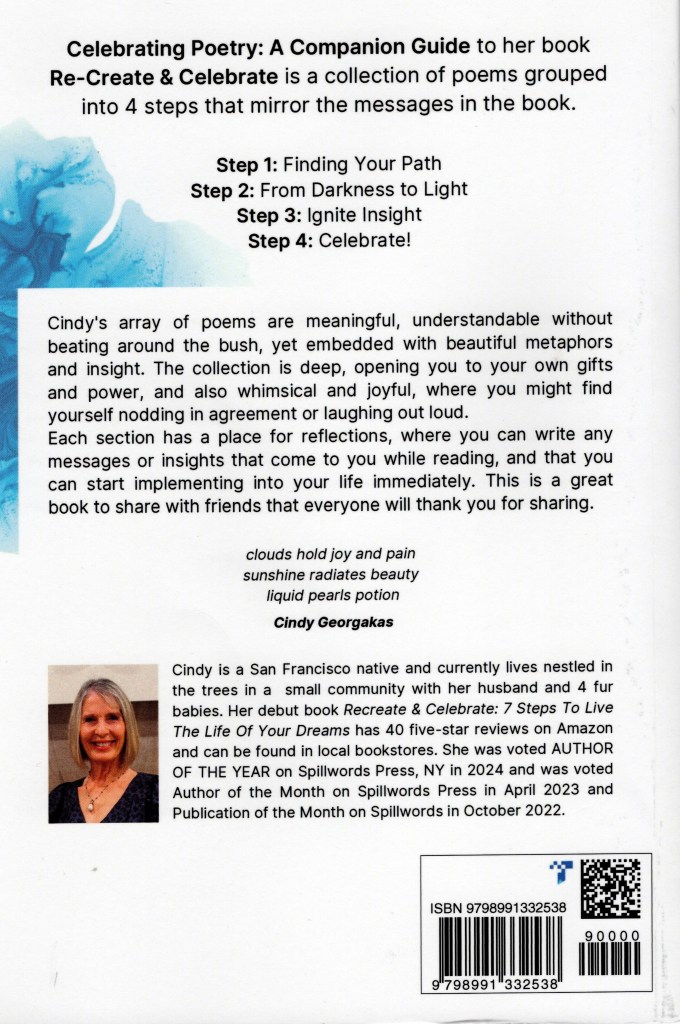
Back cover of Celebrating Poetry by Cindy Georgakas. Click on the image to go to the Amazon page for the Kindle version of the book.
About the Author of Celebrating Poetry
Cindy is a San Francisco native and currently lives nestled in the trees in a small community with her husband. She is a health and wellness professional, a certified life coach, personal trainer, yoga/meditation teacher, and bodyworker. She draws inspiration from her clients, friends, four children, 4 legged furry kids and nature.
Her new book Celebrating Poetry is a #1 New Top Release on Amazon. It is a companion guide to her book, Re-Create & Celebrate: 7 Steps to Live the Life of Your Dreams, has over 41 5 Star Reviews. She was voted Author of the Month on Spillwords Press in April 2023 and Publication of the Month on Spillwords in October 2022.
She is a co-author of #1 Amazon Bestseller, Wounds I Healed: The Poetry of Strong Women, #1 Best Seller of Hidden In Childhood: A Poetry Anthology and is also a Treasured Contributor to MastecadoresUsa.
You can read more of Cindy’s work at Unique Times by Cindy Georgakas
We just came back from a trip to Baltimore. Our oldest son and his wife are having a baby, a son, due in September. He will be our first grandchild. On Saturday they held a baby shower. That is Saturday yesterday or two days ago depending on your time zone. Our son and his wife had organized a barbeque for about forty people. It was what they called a Baby-Q. They have a smoker and had smoked brisket throughout Friday-Saturday night.
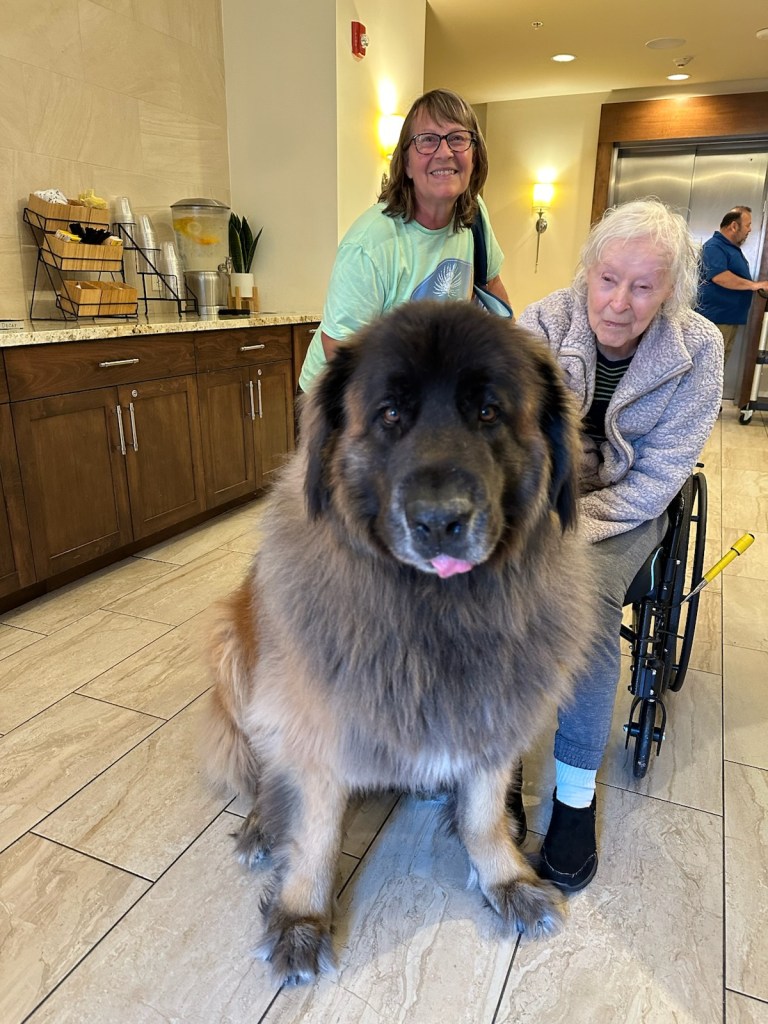
I was talking to our daughter-in-law’s mother when she mentioned a recent chance encounter with a Leonberger. It was at her mother’s nursing home. I can add that Leonbergers are great therapy dogs because of their calm temper, friendly disposition, intelligence and trainability. They are therefore frequently found at hospitals, nursing homes, and similar places.
Our daughter-in-law’s mother is on the left and her mother is on the right. She gave me permission to use this photo. The Leonberger is in the middle front.
A Therapy Leonberger Called Scout
As I mentioned, Leonbergers are great therapy dogs and are often used in hospitals. Below is a video about a Leonberger called Scout by CBC news in Canada. This Leonberger is helping residents at Hamilton mental health hospital. He was bred by Concorde Ridge Leonbergers. They have a website and a blog which I follow. You visit my post about Scout here. The 8-minute video is shown on the website below.
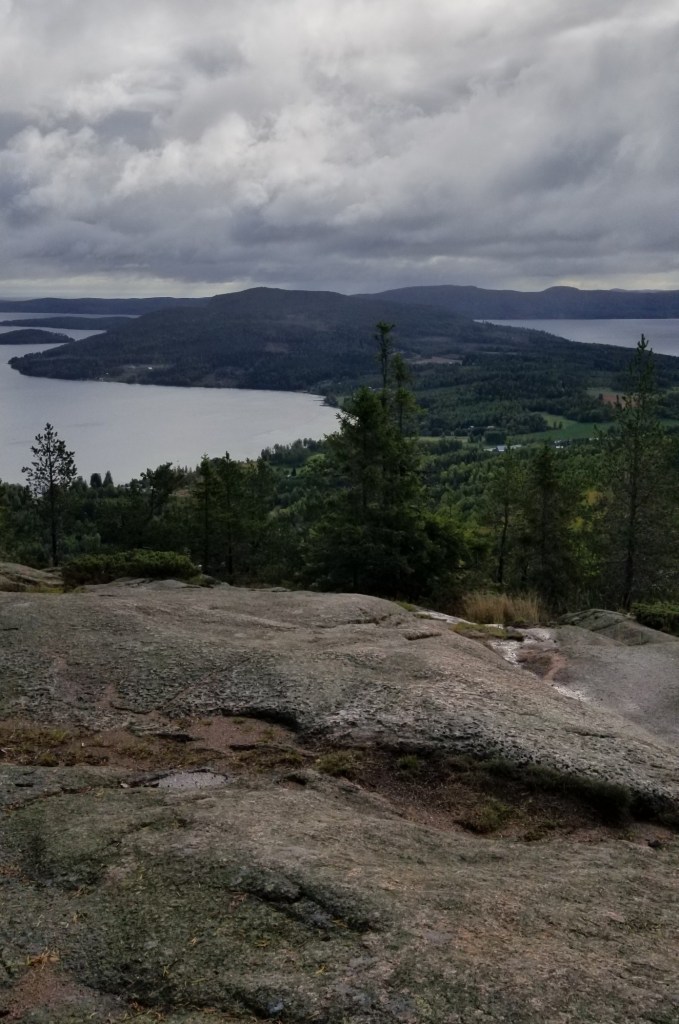
Speaking about Leonberger chance encounters, one very unexpected Leonberger encounter happened to us at the top of a mountain in northern Sweden. My wife, my daughter, my brother and his wife and children were hiking/climbing up to the top of a mountain in the high coast region of northern Sweden. This is a coastal region of Sweden that is quite mountainous and feature fjords, like in Norway. This is the region where I was born and where I grew up. The name of the mountain was Skule Berget, or Skull Mountain. We did it for the adventure, the views, and to visit a famous cave. Below is the view from the top of Skull Mountain in the High Coast.
View from the top of Skule Berget.
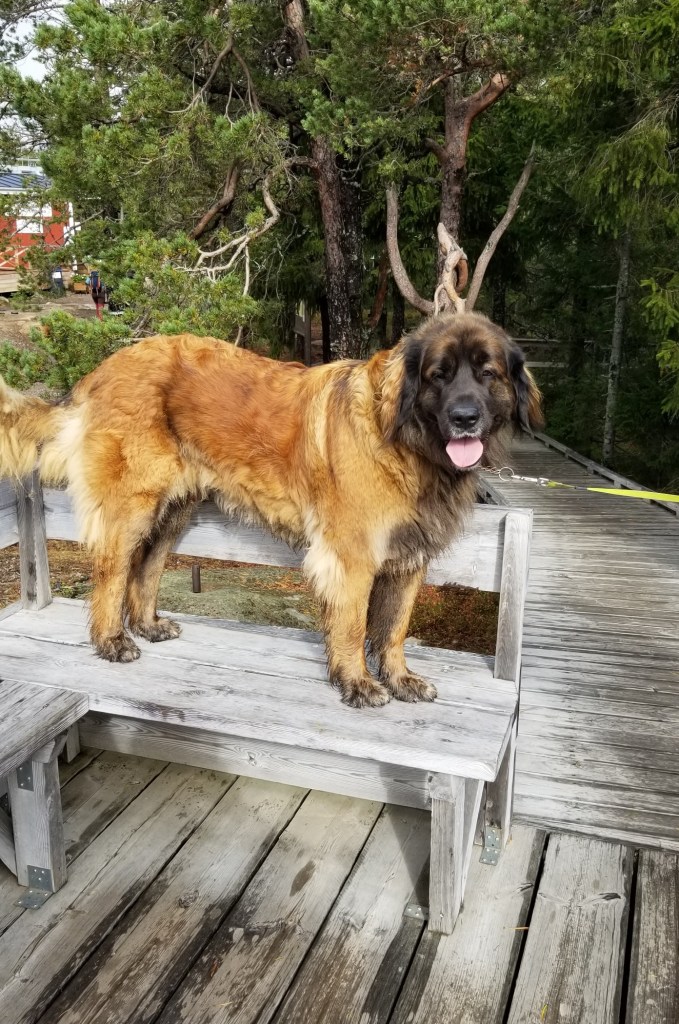
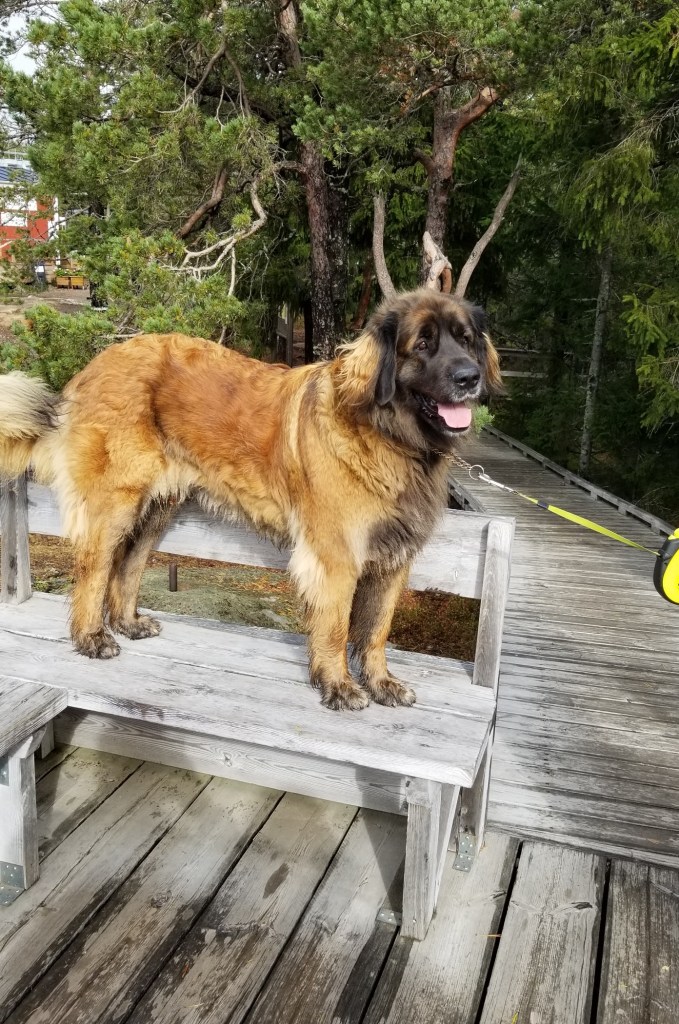
At the top of the mountain, we met a man who had brought his dog, and it was not just any kind of dog, it was a female Leonberger Named Amie. The owner told us that Amie was nine years old, which is old for a Leonberger. It was quite a hike to the top of the mountain so the dog must have been in good shape despite her age. Well, the man we too were in good shape too. You can read about our Skull Mountain adventure here.
As soon as we them, we shouted, “look a Leonberger”, and Amie started wagging her tail and running towards us. She obviously loved attention. Her owner let us pet her and take a few photos of her. Amie was very playful; she rolled around and wanted to be petted. She was very friendly. She reminded us of our late Leonberger Bronco, but being a female, she was a little bit smaller and more feminine looking. Below, are a couple of photos of Amie.
Amie at the top of Skule Berget.Amie was playful but very well behaved.
About the book The Life and Times of Le Bronco von der Löwenhöhle
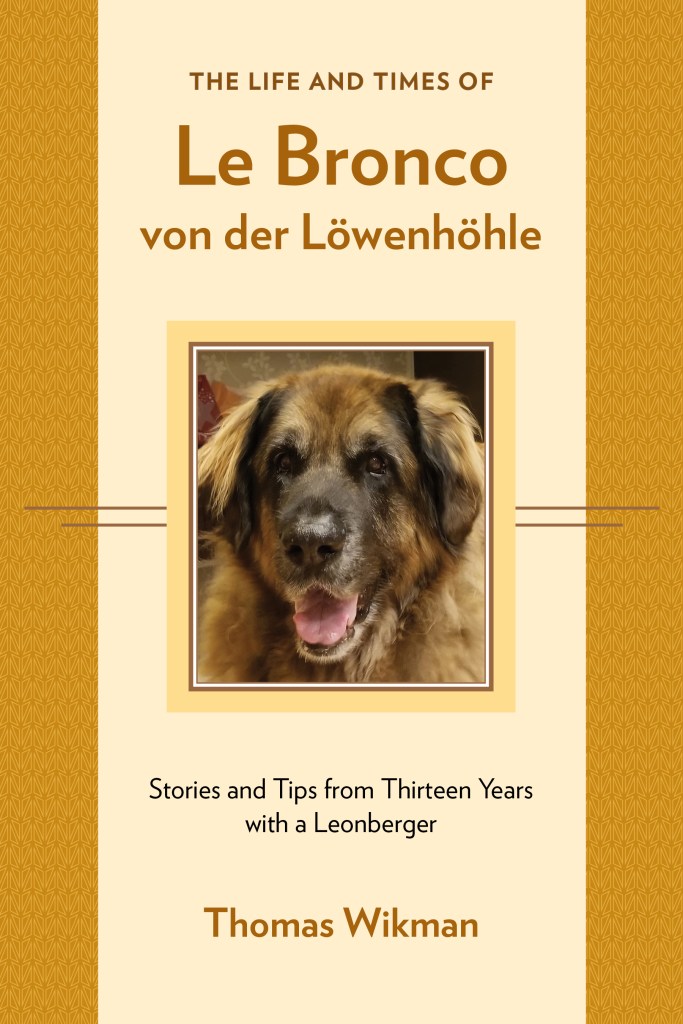
Finally, I would like to mention that I am currently is running a promotion for my book “The Life and Times of Le Bronco von der Löwenhöhle, Stories and Tips from Thirteen Years with a Leonberger”. It is to celebrate Bronco’s birthday and his memory. I should say the book features the amusing adventures of our Leonberger Bronco and his dog friends, and information on how to train and care for Leonbergers and other large breeds, as well as breed history, breed standard, Leonberger organizations, and a resource guide. I can add that all photos and illustrations are in color.
The price of the Kindle version of my book is now only $2.99 and the price of the paperback version is 17.95 (normal prize is $19.95). You can read more about the promotion here. I will keep the promotion going for a few more days.
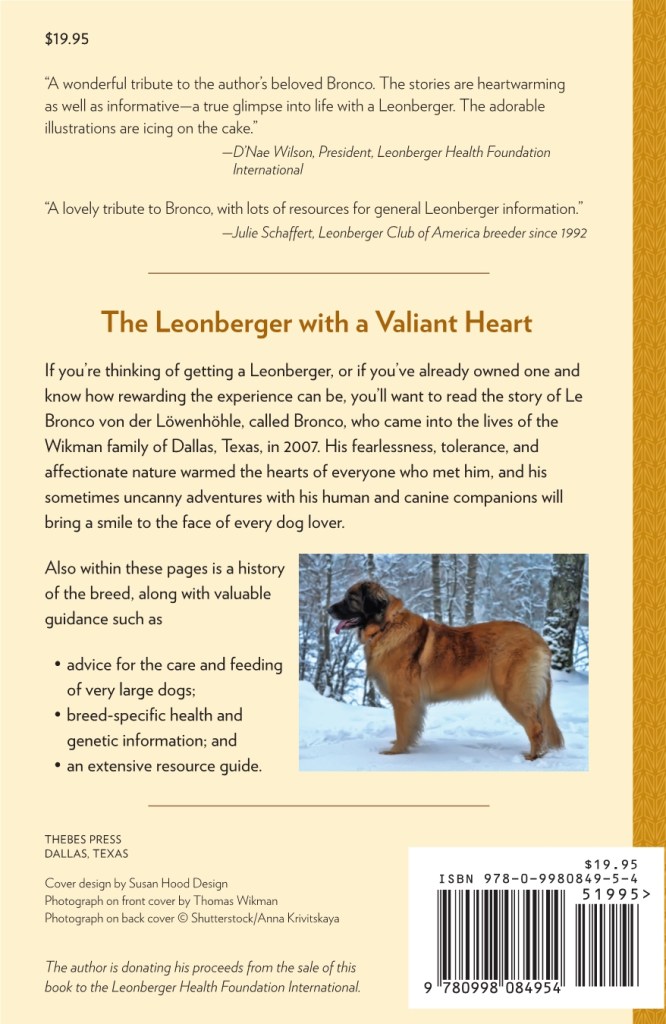
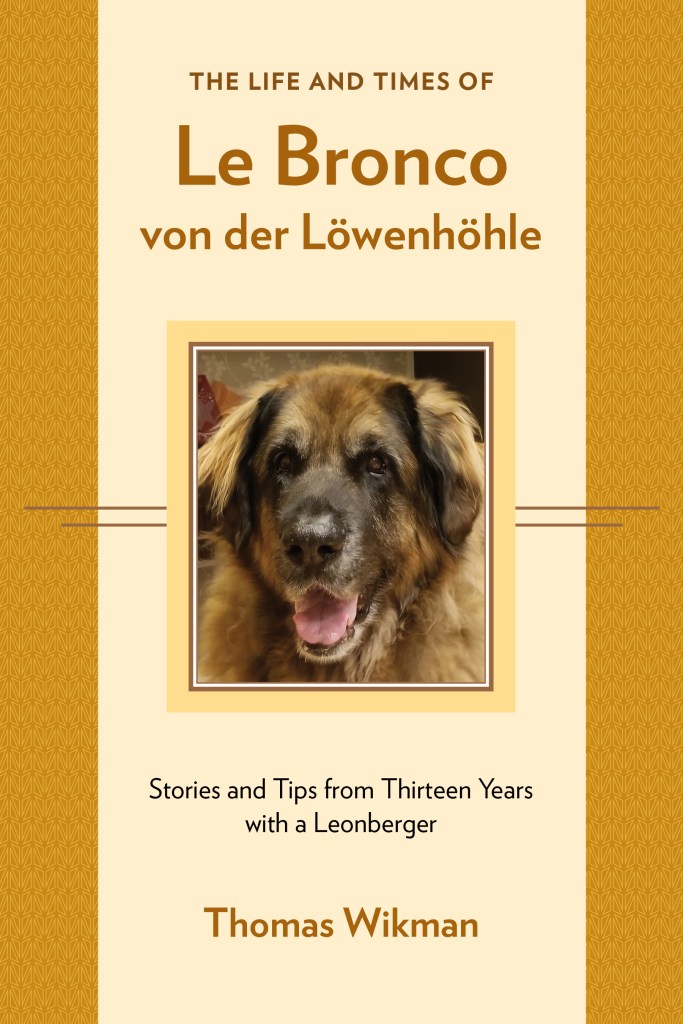
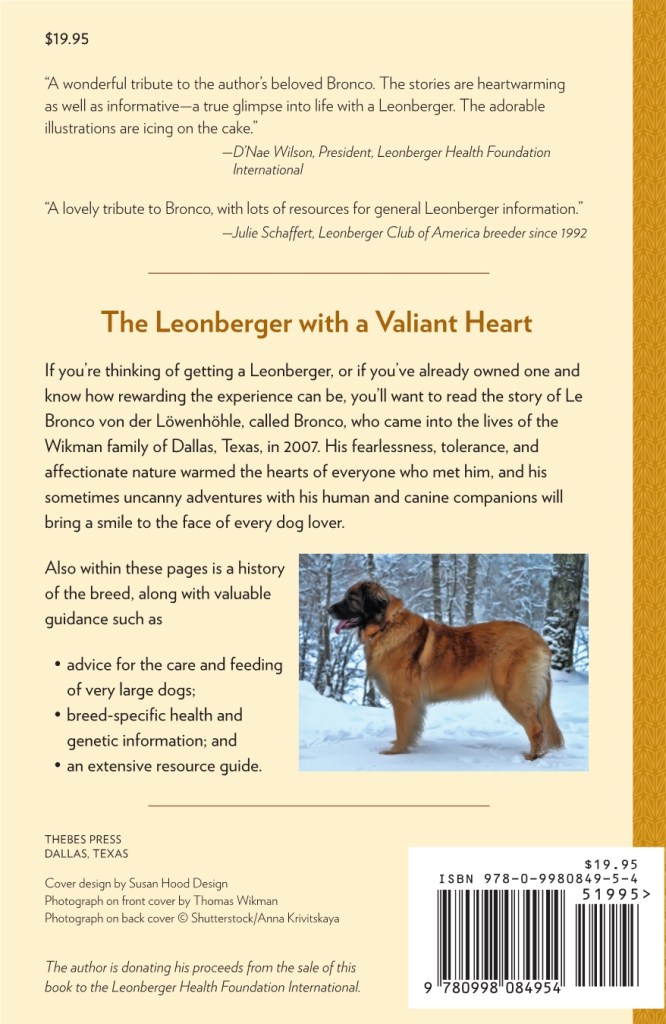
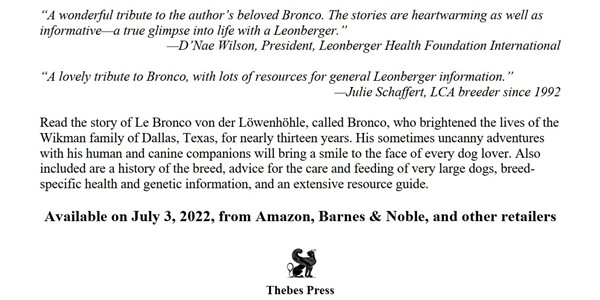
This is the front cover of the book “The Life and Times of Le Bronco von der Löwenhöhle”. Click here or on the image to go to the United States Amazon location for the paperback version of the book.This is the back cover of the book “The Life and Times of Le Bronco von der Löwenhöhle”. Click here or on the image to go to the Amazon.com location for the kindle version of the book.Again, these are the endorsements for the book by some very prominent members of the Leonberger community. Click here or on the image to go to the location for the book Amazon in Canada.
Our late Leonberger Bronco’s birthday was on July 3rd and therefore I am holding a promotion. The price of the Kindle version of my book “The Life and Times of Le Bronco von der Löwenhöhle” is now only $2.99 and the price of the paperback version is 17.95 (normal prize is $19.95). I will keep that price until Jul 31st. The prices in all other countries, Canada, the UK, Germany, France, the Netherlands, Italy, Spain, Australia, etc., are lowered by the same amount. Below is some information about my book as well as four reviews from four different countries.
This is the front cover of the book “The Life and Times of Le Bronco von der Löwenhöhle”. Click here or on the image to go to the United States Amazon location for the paperback version of the book.
Advance Praise for the book
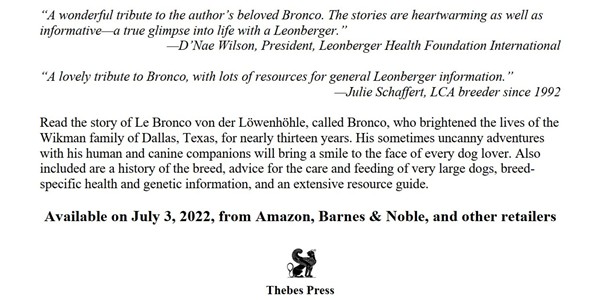
A wonderful tribute to the author’s beloved Bronco. The stories are heartwarming as well as informative—a true glimpse into life with a Leonberger. The adorable illustrations are icing on the cake.” —D’Nae Wilson, President, Leonberger Health Foundation International
“A lovely tribute to Bronco, with lots of resources for general Leonberger information.” —Julie Schaffert, Leonberger Club of America breeder since 1992
Amazon’s description of : The Life and Times of Le Bronco von der Löwenhöhle: Stories and Tips from Thirteen Years with a Leonberger by Thomas Wikman
If you’re thinking of getting a Leonberger, or if you’ve already owned one and know how rewarding the experience can be, you’ll want to read the story of Le Bronco von der Löwenhöhle, called Bronco, who came into the lives of the Wikman family of Dallas, Texas, in 2007. Bronco, a recipient of the Leonberger Health Foundation International’s Grey Muzzle Award, lived an unusually long life for a Leonberger—almost thirteen years. His human family is convinced that what helped him exceed his breed’s normal life expectancy was his brave and loving heart.
Here you’ll read about some of Bronco’s amazing feats: the night he scared away a prowler; the day he performed a hamster search and rescue; the time he stumped the Geek Squad; and the late night he snuck into the kitchen and ate a two-pound bag of dog treats, a box of pastries, a loaf of bread, a grilled chicken, and a Key lime pie, all in one sitting. You’ll also read about his unflappable calm during a north Texas tornado and his stoicism as he endured health challenges in his later years.
In addition to entertaining stories, these pages contain a wealth of practical guidance, including
a history of the Leonberger breed;
advice for the care of very large dogs;
breed-specific health and genetic information;
training and feeding tips;
suggestions for finding a breeder;
the official breed standard; and
an extensive resource guide.
Bronco’s fearlessness, tolerance, and affectionate nature warmed the hearts of everyone who met him, and his sometimes uncanny adventures with his human and canine companions will bring a smile to the face of every dog lover.
The author is donating the proceeds from the sale of this book to the Leonberger Health Foundation International
Thomas Wikman is a retired automation, robotics, and software engineer and inveterate dog lover who emigrated from Sweden to the United States, where he and his wife raised three children. Their cherished Leonberger, Bronco, crossed the Rainbow Bridge in 2020. The Wikmans live in Dallas, Texas, with their two dogs—a pug and a miniature Australian shepherd.
This is the back cover of the book “The Life and Times of Le Bronco von der Löwenhöhle”. Click here or on the image to go to the Amazon.com location for the kindle version of the book.
Having been around big dogs my entire life, I was very much looking forward to reading about Bronco, a large breed of dog known as a Leonberger. Thomas Wikman has penned a wonderful memoir about his family’s 12+ year journey with Bronco. As I read this story, I realized this was no ordinary breed or dog. Bronco and the rest of the Wikmans’ dogs become like family members. The part of the story I enjoyed the most were the engaging and entertaining anecdotal stories. Wikman gives a very honest account and describes the wonderful parts and challenges of owning a Leoberger. It was fascinating how the smaller dogs quickly accepted Bronco into the fold and became pals.
In addition, the author includes lots of general information about Leonbergers including the extensive process involved adopting one of these dogs. I learned too much to describe here, but Wikman doesn’t miss anything from their history, diet, disposition, health challenges and quirks. It’s obvious how much research and energy went into writing this comprehensive book. I was thoroughly impressed and learned a great deal about these loving giants. I would recommend this book for anyone who loves dogs.
We became Leonberger human parents in October 2022. We knew very little about the breed so I searched online. I found a reference to Thomas Wikman’s book and was instantly intrigued given that the book was a personal experience of life with a Leonberger. This book has proven to be the best book about Leonbergers that I have purchased and I have purchased quite a few.
The Life and Times of Le Bronco von der Lowenhohle is a heartwarming story of Bronco’s life with the Wikman family and their other canines. This book also contains a wealth of well researched and experienced information about Leonbergers, both good and bad. Also the bonus in this book is at the back where Thomas Wikman has included 2 Appendices which provided me with the Leonberger database and a Resources and References section.
This book has helped my family through the first amazing year with our male Leonberger, Hachi. We look forward to many more years with him and we keep Thomas Wikman’s book near by for any help we may need.
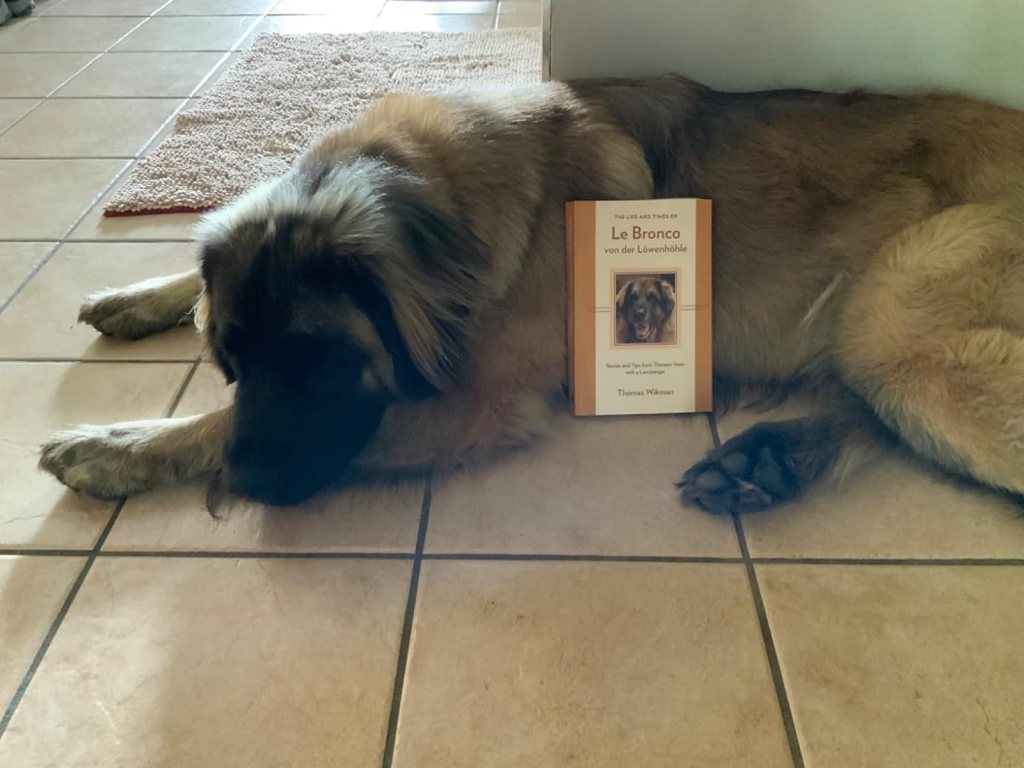
Photo that the reviewer submitted with the review. It is a Leonberger with the book The Life and Times of Le Bronco von der Löwenhöhle: Stories and Tips from Thirteen Years with a Leonberger by Thomas Wikman.
Maybe I should start this book review by clarifying that I’ve never owned a dog! I do like them and enjoy their presence when visiting family and friends. So why did I pick up this book about Bronco, a Leonberger, which is one of the world’s biggest dogs?
What I do love is stories and Thomas Wikman’s book is a terrific series of stories about one of the most affectionate, friendliest and gentle giant of personalities – Bronco. He just happens to be a massive dog, sometimes even mistaken for a bear!
The author is a natural storyteller and his fluid conversational writing style pulls the reader immediately into his family world and their dogs (yes, there are more than Bronco!) A family who care deeply for each other and their pets. It’s a book about character, perseverance, enjoying life to the full, of kindness and of giving. A book that encompasses love and warmth.
‘The Life and Times of Le Bronco von der Löwenhöhle’ is a terrific combination of storytelling of the life of Bronco along with factual expert information.
The book explores how Bronco came to the family (there is drama in that alone!), with hilarious and laugh-out-loud tales of his antics as well as some of his heroic deeds. Bronco was a superhero as he rescued two escaped hamsters — by putting them in the cheeks of his mouth! Luckily quick thinking Claudia, Thomas’s wife, performed CPR and they recovered. There were a few hilarious incidents when Bronco proved just too strong on the lead then on one occasion he successfully scared away a nighttime prowler as well as saving the life of another family dog. Bronco was a gifted escape artist and the scientist Thomas, not seeing any way this was possible, decided the dog had discovered ‘quantum tunnelling’.
The book is also a detailed and superlative reference and resource book for any owners or prospective owners of Leonbergers. The information includes the history of this rare and unusual breed, medical conditions etc in separate chapters as well as information panels regarding their care, diet, etc. Even as a non-dog owner, I found these all interesting and always enjoy learning something new. For example, Leonbergers were a favoured breed for many of the royal courts in Europe at one time and it was mind-boggling to read that after World War Two there were only eight Leonbergers left in the whole world. The medical conditions include many I recognise from human diseases and illness and not something I would associate with dogs. My learning curve was steep when reading these facts.
The numerous photos of Bronco (and some of the other dogs) are adorable and I was smitten with the captivating and beautiful illustrations which are interspersed throughout the book and these capture many of the humorous moments perfectly.
The addition of a small quiz was a welcome surprise and even this non-dog owner didn’t disgrace herself — although not quite acing it!
Just as Bronco becomes an integral part of the family he also became an important member of the local community. At one stage he proved too popular with the football players’ at the daughter’s local matches. Poor Bronco was asked to leave as the players attention was not on the game. The sense of community extended to the Leonberger groups around the globe and the Leonberger Health Foundation International awarded him the treasured Grey Muzzle Award, which is given to any Leonberger aged 12 by which time Bronco was a veritable canine centurion.
The chapters regarding Bronco’s failing health are particularly poignant and moving. By now the Bronco had won a place in my heart and I was tear-eyed as I read of these difficult times for him and the family.
‘The Life and Times of Le Bronco von der Löwenhöhle’ is a gem of a book which shines bright with humour, love and positive energy, the stories carrying the reader away with them while the expert facts are fascinating and informative. A book I highly recommend.
Finally, it should be noted that the author is donating his proceeds from book sales to the Leonberger Health Foundation International, an organisation that supports research aimed at improving the health of large dogs.
Again, these are the endorsements for the book by some very prominent members of the Leonberger community. Click here or on the image to go to the Barnes and Noble location for the book.
Getting My Book in Other Places
You can also get my book in many other places including Amazon in every country where Amazon exists, for example Canada, and other bookstores such as Chapters Indigo, Apple, etc. To see a list of the options visit my Book Page by clicking here.
This is a Leonberger blog, but I also post book reviews of books that I love and want to promote but are not about Leonbergers. With this post I would like to promote a truly wonderful poetry book that also feature a lot of photos, art, information and links to videos about African wildlife. This book is a masterpiece just like this wonderful book from the same author: Lion Scream.
Below is an overview of the two formats of Burning Butterflies: Poetry About Southern African Flora and Fauna Paperback – April 22, 2025, by Robbie Cheadle
Paperback – Independently published April 22, 2025, ASIN : B0F2VCXZZV, ISBN-13 : 979-8315273431, 92 pages, Item Weight : 6.7 ounces, dimensions : 6 x 0.22 x 9 inches, it cost $12.50 on US Amazon. Click here to order it from Amazon.com.
Kindle – Publication date : April 22, 2025, ASIN : B0F2SDF2GW, 94 pages. It is currently $5.99 on Amazon.com and free with Kindle unlimited. Click here to order it from Amazon.com.
Front cover of Burning Butterflies. Click on the image to go to the Amazon page for the paperback version of the book.
Amazon’s Description of Burning Butterflies
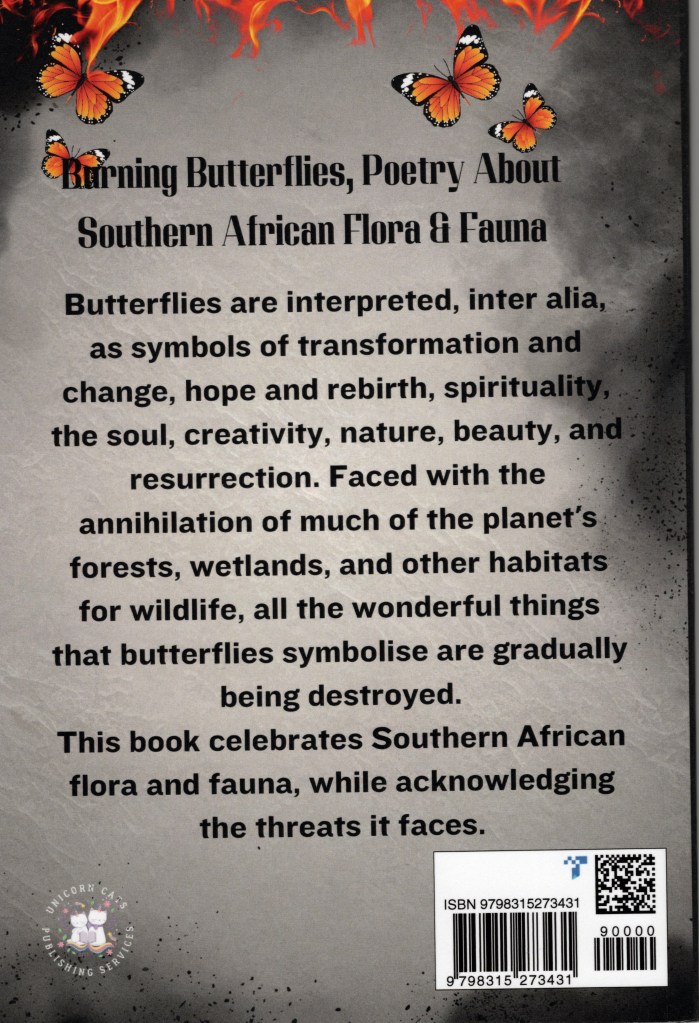
Butterflies are interpreted, inter alia, as symbols of transformation and change, hope and rebirth, spirituality, the soul, creativity, nature, beauty, and resurrection. Faced with the annihilation of much of the planet’s forests, wetlands, and other habitats for wildlife, all the wonderful things that butterflies symbolise are gradually being destroyed.
This book celebrates Southern African flora and fauna, while acknowledging the threats it faces.
This is another masterpiece from author, poet, artist, wildlife photographer and naturalist Robbie Cheadle. I bought both the paper version and the kindle version. I prefer reading a real paper book, but it was easier to view all the beautiful YouTube videos using the Kindle. With only the paperback I would have to type in the url. The book features hundreds of beautiful poems, more than 90 colors photos and paintings, other kinds of art, dozens of YouTube videos and informational links. The focus is on African wildlife.
The author touches on important subjects such as the threats to wildlife and our planet from human development, climate change, and trophy hunting. The author’s love for wildlife and nature shines through in her poems, in her art, in her photos, and videos. More than anything I think this book is a beautiful tribute to the natural world. You also learn about African wildlife and various animals. I found it interesting that there are no bears in Africa. The last bear in Africa, an Atlas bear was killed in Morocco in 1870. Did you know that cheetah cubs have whitish fuzzy back that look like the back of honey badgers, a fierce animal. It is believed that it protects them.
The author is using the Butterfly as a symbol of transformation. She also expresses a special love for elephants. They are magnificent and intelligent animals. I felt that this book has so much to offer in terms of beauty, symbolism, art and wisdom. I highly recommend this book.
Back cover of Burning Butterflies. Click on the image to go to the Amazon page for the Kindle version of the book.
About the Author of Burning Butterflies
South African author, photographer, and artist, Robbie Cheadle, has written and illustrated seventeen children’s books, illustrated a further three children’s books, and written and illustrated four poetry books. Her work has also appeared in poetry and short story anthologies.
Robbie also has two novels and a collection of short stories published under the name of Roberta Eaton Cheadle and has horror, paranormal, and fantasy short stories featured in several anthologies under this name.
Robbie’s blog includes recipes, fondant and cake artwork, poetry, and book reviews.
I’ve been missing in action for a bit more than a week because of a family trip to Paris, France. We visited my wife’s eldest sister and her family, and we celebrated our nephew’s 40th birthday, my wife’s sister’s husband’s birthday, and we got too meet our nephew’s and his wife’s 16-month-old daughter for the first time. We also spent time with an ex-pat friend of my wife and our niece and a friend of hers. She lives in Berlin, but she came to Paris to see us. Naturally we also visited several tourist attractions including several museums, Notre Dame, Montmartre, Sacré Coeur, the Eiffel Tower, and we took a river cruise with dinner and a few of Paris’ 44,000 restaurants. We also went to an opera.
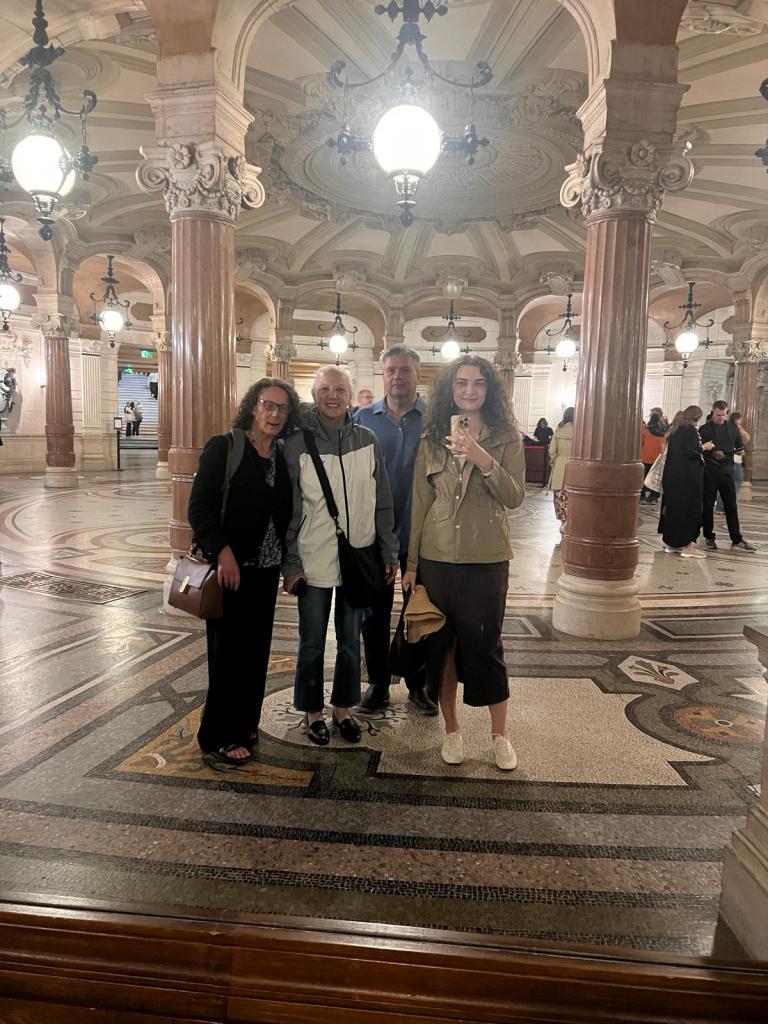
From left to right, my wife’s sister, my wife, me (in the back), and my daughter. This photo was taken in an opera house called Palais Opéra Garnier. I should mention that this was not opera where we saw a performance.
Paris is a fascinating city with so much to offer and so much life. Paris proper/inner-city is 40+ square miles featuring large several hundred years old beautiful buildings, gorgeous esplanades and narrow streets, thousands of restaurants, cafés, bakeries, pastry shops, small stores, thousands of statues, and hundreds of museums, monuments, tourist attractions and parks. Paris is the city in the world with the most restaurants, and the food is great. Italy has been voted to have the best food in the world. I must disagree; it is France. There is culture everywhere and the streets are filled with people long after midnight, and the restaurants are open long after midnight. Paris never sleeps.
The city of Paris (Paris proper) only has 2 million people, but you must add the millions of people working there but living in the suburbs. Paris metropolitan has 13 million people, and the region of Paris called Île-de-France has 12 million people. The city I live in, Dallas, Texas, also has 2 million people (8 million people in the metro) but it has almost nothing to offer in comparison. Dallas has some tourist attractions and offers some culture, it is not bad at all, but Paris has about a hundred times more of that. In Dallas almost all restaurants close before 10PM, which is when Paris really wakes up. That is not to put down Dallas, but to point out that Paris is indeed one of the greatest cities in the world to visit.
Aerial view of the Seine River in Paris. The island Île de la Cité is in the center of the picture and Notre Dame can be seen in the back.
I’ve been to Paris several times before, in 1986 after my Swedish army service, then in 2003 and in 2018. This time was different because I could converse in French with waiters and taxi drivers, read signs and instructions, and newspapers. However, unlike in 1986 and 2003 a lot of French now speak English, at least the younger generation, and they want to speak English. In 1986 even the French who knew how to speak English were kind of offended when you could not speak French. Now they want to practice speaking English, and I want to practice speaking French. The problem I had in 1986 has been reversed. I was so happy when I started talking to a taxi driver in English and he said “Je suis désolé, je ne parle pas anglais. Anglais non. Anglais non.”
I heard a lot of different languages spoken, in addition to French, English, German, Italian, Dutch, Chinese, Japanese, Arabic, Spanish, Swedish, Danish and many other languages, and it was all welcome. When I visited Italy in 1986 someone angrily shouted at us that this is Italy and we speak Italian, not English. In 1986 the same thing almost happened in Paris, but I don’t think that is likely to happen in Paris now. The current US government is not popular for understandable reasons. However, there were signs reminding people that the US government is different from US visitors, and I felt that people treated us in a friendly manner.
Anyway, below is an overview of what we did this time with the focus on my photos. In the past we’ve visited Moulin Rouge, Versailles and Le Louvre, which is the world’s largest museum. I highly recommend those attractions but since we have seen them a few times already we did not visit them on this trip.
The Eiffel Tower
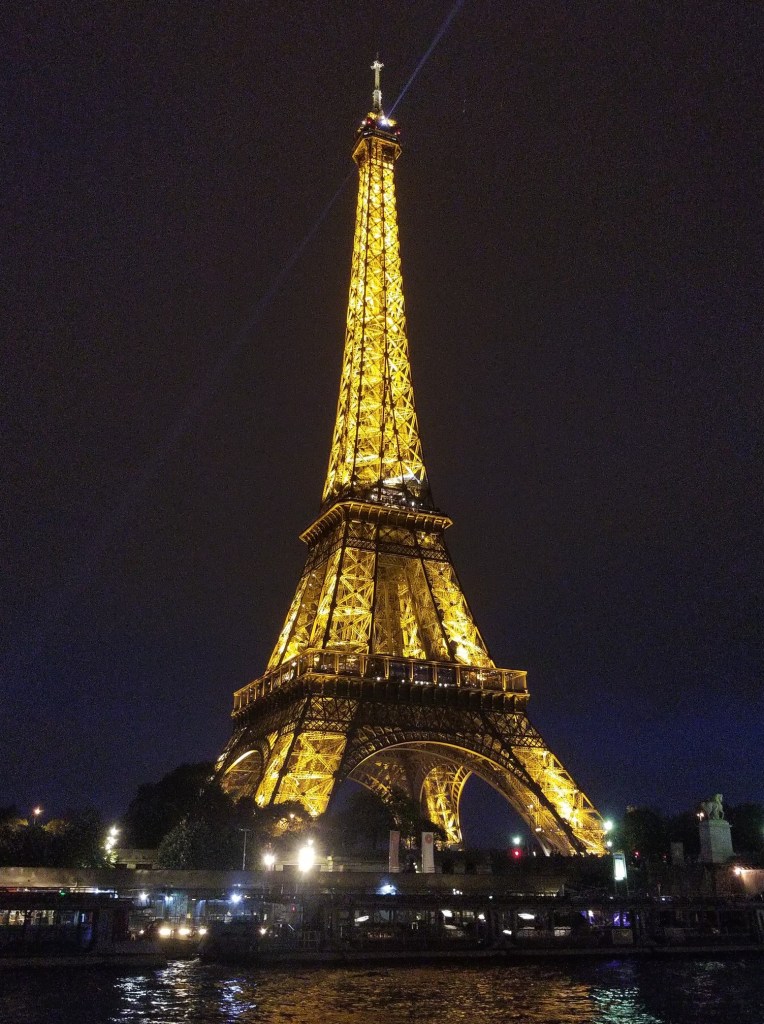
The Eiffel tower is one of the main attractions in Paris. We’ve visited the Eiffel tower before. We’ve eaten at the restaurant on the first floor, and we’ve visited the second floor (halfway up), but I’ve been to the third floor (the top) only once before, in 1986. Unfortunately, it has become difficult to visit the Eiffel Tower top. You must buy the tickets beforehand in good time. My wife’s sister was able to get us all tickets from Paris City Vision (guided tours).
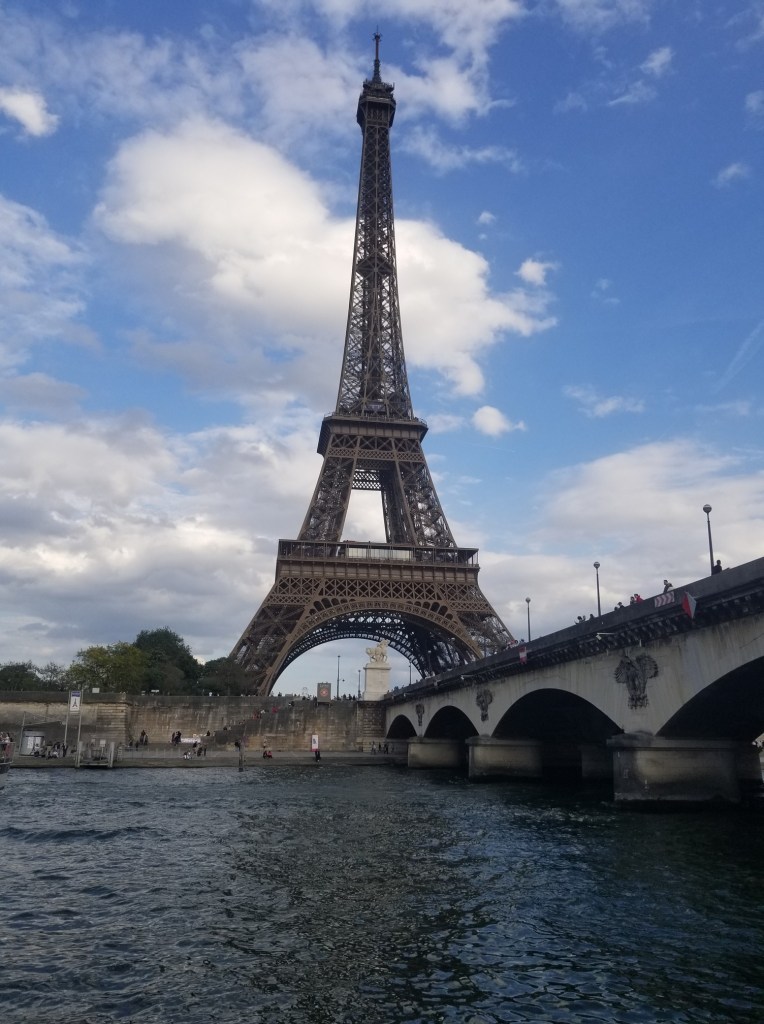
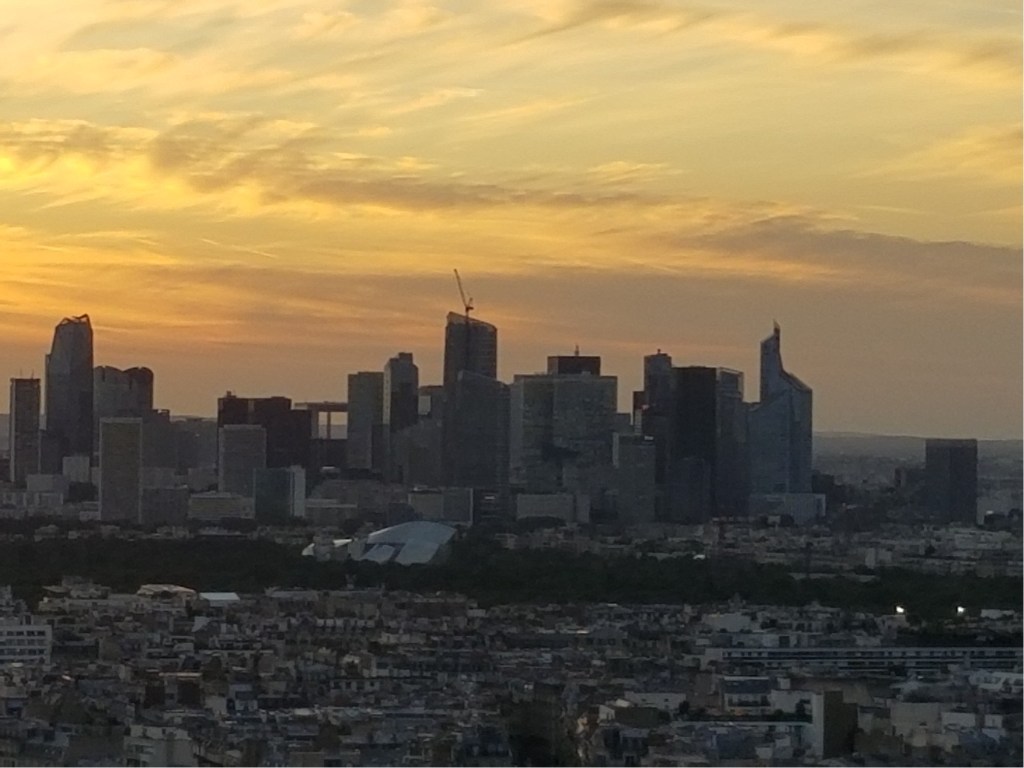
Eiffel Tower from the other side of Seine (my photo)Aerial view of Paris featuring the Eiffel Tower and the Seine River. Stock photo (not my photos). Asset id: 2281050257 by Open Films.Scenery from the second floor of the Eiffel Tower. The garden you see is called Champ de Mars and there’s a dog park.This is a view from the third floor (the top) of the Eiffel Tower. If I were to take a photo of every view angle I would end up with dozens of photos, which is too much. If I were to take a panorama photo you would not be able to see any details. If you look carefully, you can see Notre Dame about 60% up and slightly to the left. The impressive buildings and garden in the middle is the Jardin Du Luxembourg.This is another view from the third floor (the top) of the Eiffel Tower. In the distance (zoomed in) you can see some skyscrapers. That is NOT “downtown” Paris. It is La Défense de Paris, a business area in a suburb of Paris and it is not considered a tourist attraction. However, the first time I visited Paris in 1986 we visited La Défense de Paris because being from the north Swedish countryside we had never seen a skyscraper before.
Notre Dame
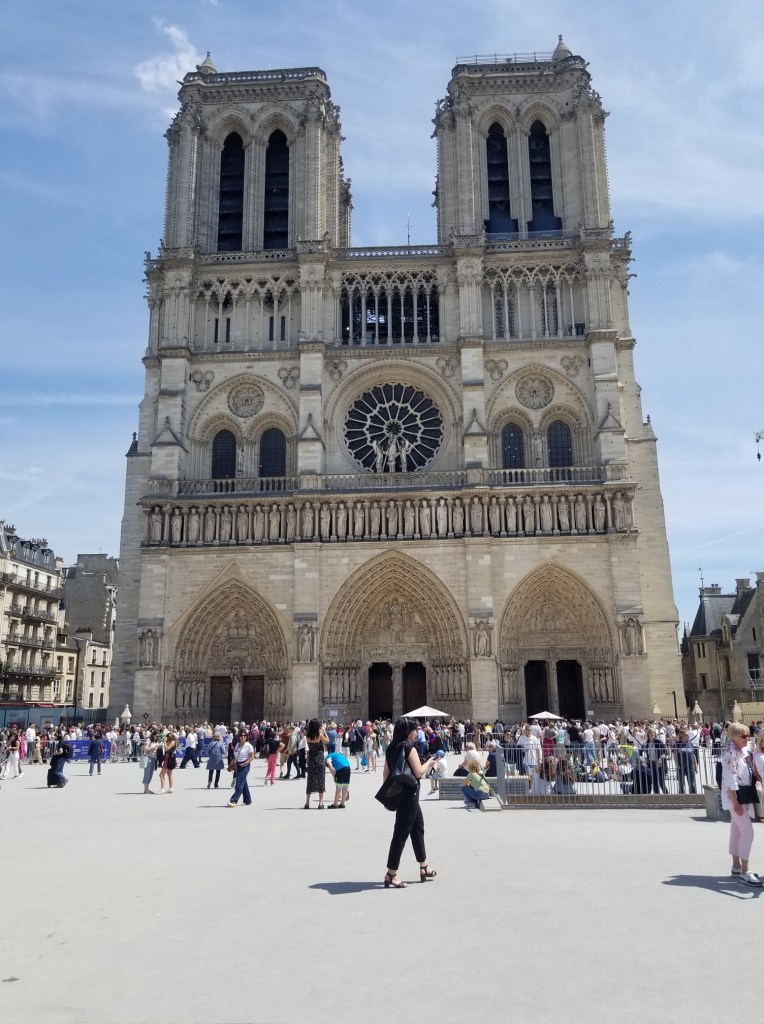
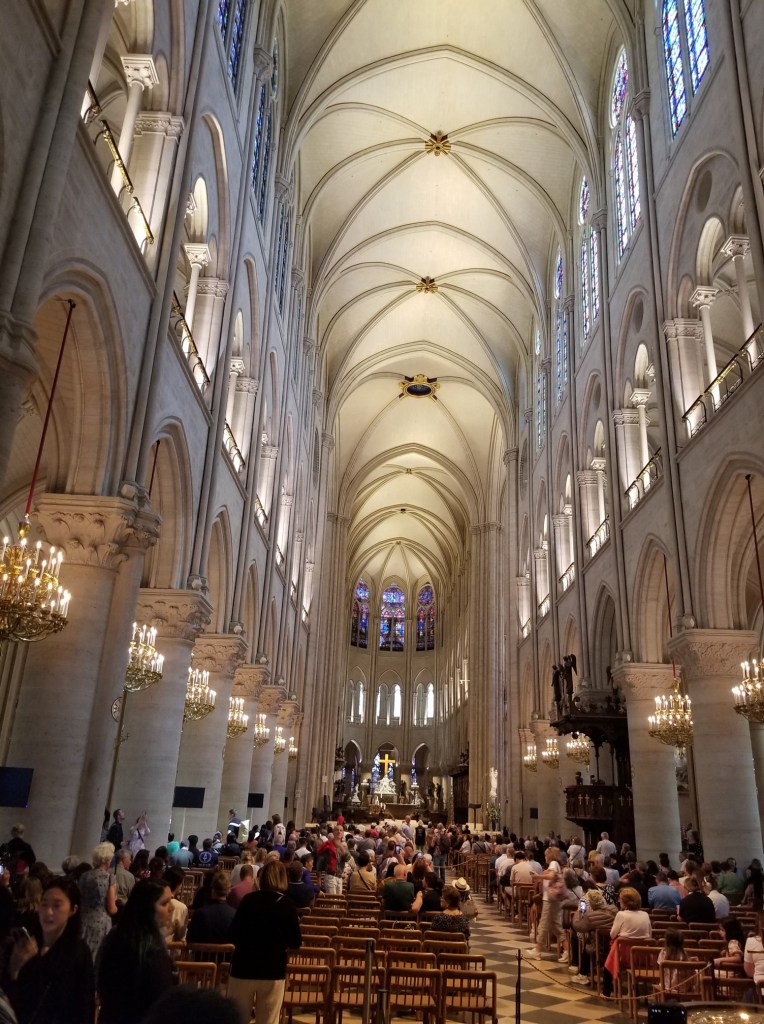
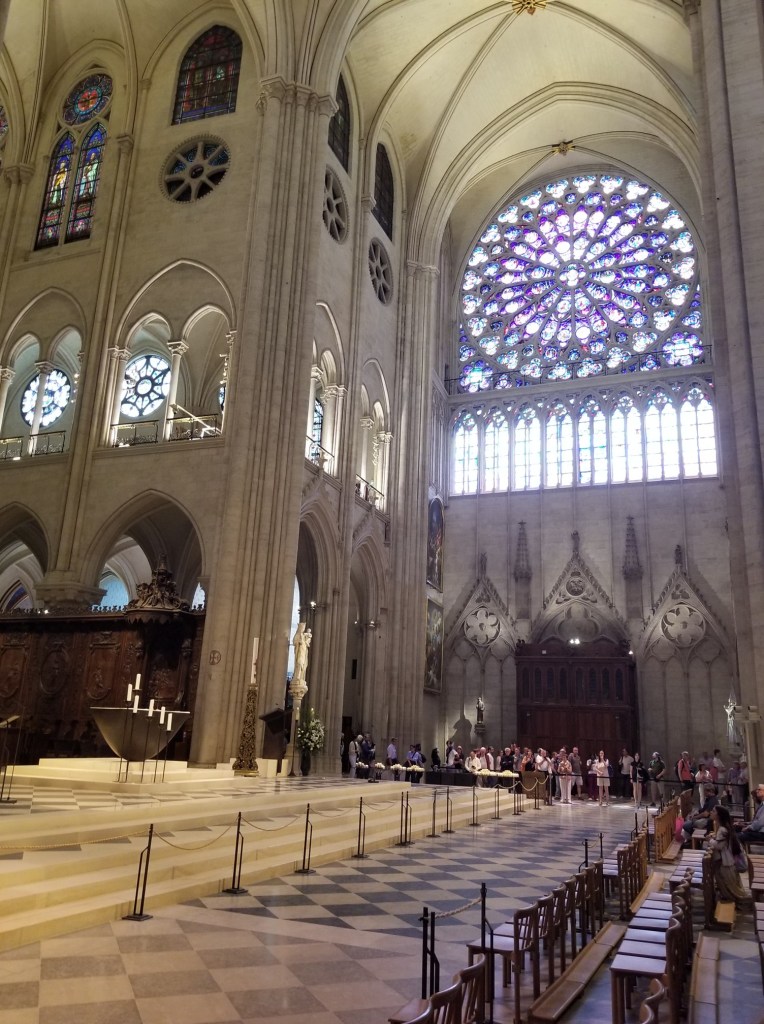
Notre Dame is a very large cathedral located on the island Île de la Cité. The construction of it began in 1163 and it was completed in 1260, 865 years ago. It was severely damaged by a fire in 2019. We’ve visited Notre Dame many times before, but this was the first time we visited Notre Dame since the fire. It looked the same except the big, beautiful pipe organs were missing, and Notre Dame was still being renovated on the outside. We bought tickets beforehand, but you can buy tickets there, but the line is long.
Photo I took of Notre Dame before entering.Inside the Notre Dame cathedral, on the left side.Inside the Notre Dame cathedral, the perpendicular view.
River Cruise on the Seine
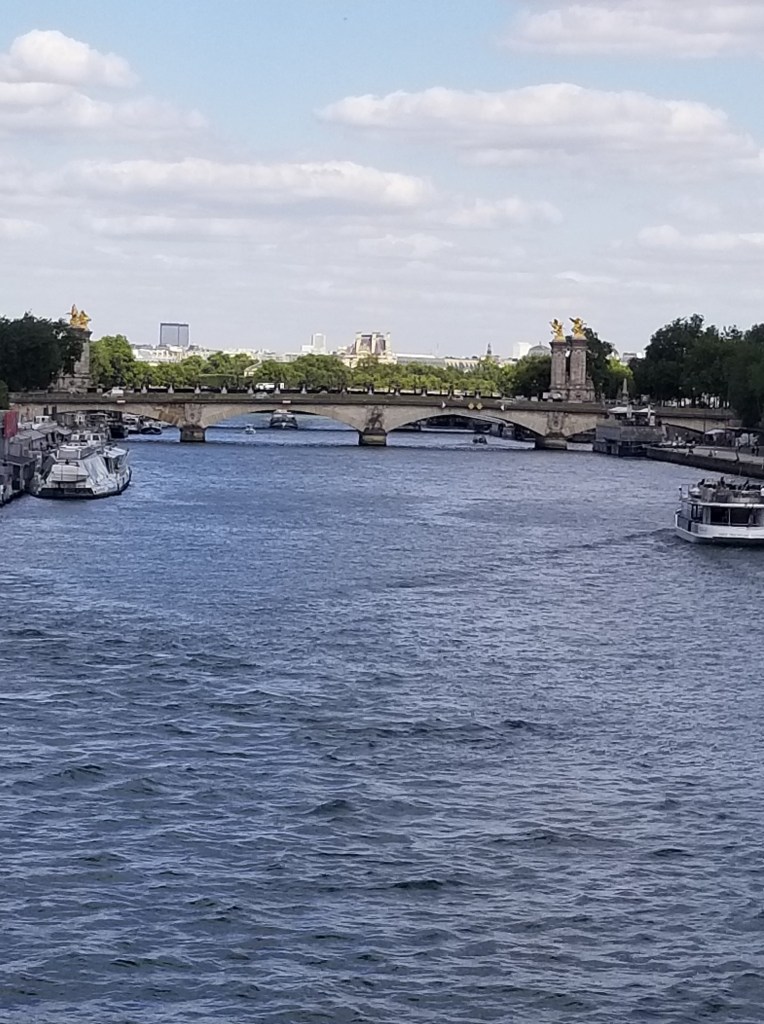
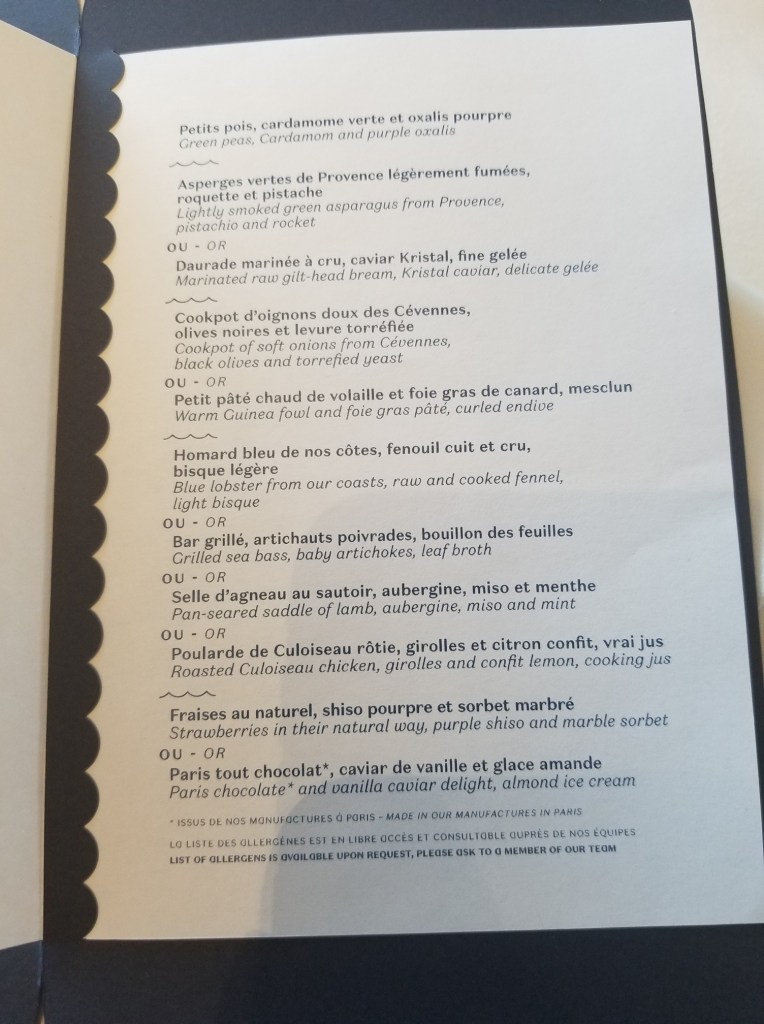
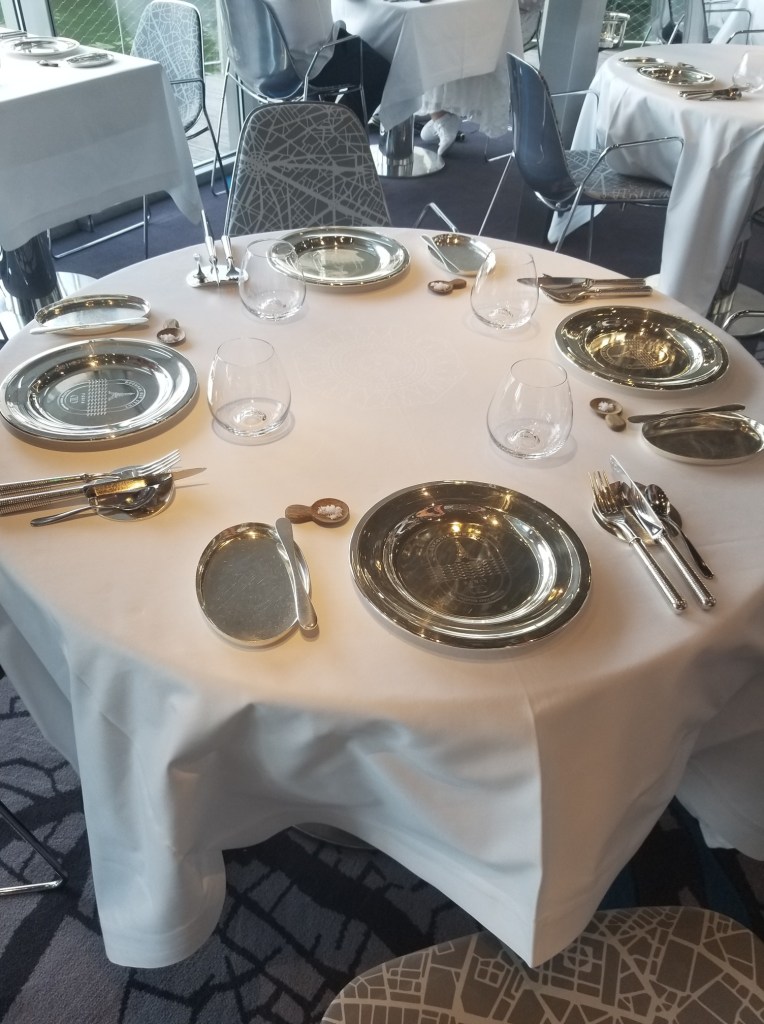
We also took a dinner cruise on the Seine. The boat / cruise was called La Seine Ducasse. I started right across from the Eiffel Tower and went a few miles up, passing by the island Île de la Cité and Notre Dame and then turning around. The cruise was a couple of hours long and the sun set during the cruise. The food was amazing (see the menu below). Unfortunately, the beer options weren’t that great, so I had wine.
A photo of the river Seine.The menu at La Seine Ducasse. I had Marinated raw gilt-head bream, Kristal caviar, and delicate gelée. I also had Warm Guinea fowl and foie gras paté and curled endive. After that I had Roasted Culoiseau chicken, girolles and confit lemon, cooking jus. For dessert I had Strawberries in their natural way, purple shiso and marble sorbet.Our table as when we arrived.The Eiffel Tower as seen from the cruise boat at night.
Opera Rigoletto
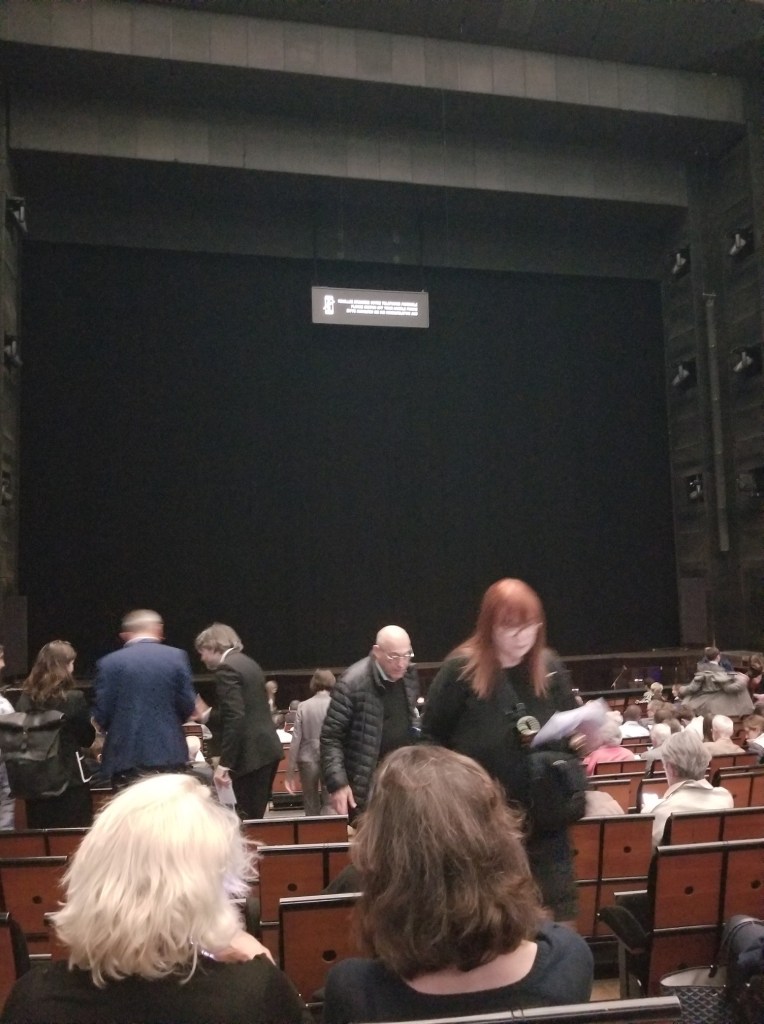
One evening we went to see an Opera at Opera National de Paris located nearby the Bastille. The opera was Rigoletto by Cristiano Grimaldi. It was sung in Italian but above the scene there were subtitles in French and English.
You were not allowed to take pictures, but I snapped this quick photo before of the scene, before the performance started.Hallway outside the theater where you bought snacks and drinks.
This is two minute and 50 second video of La Donna È Mobile sung by Luciano Pavarotti. La Donna È Mobile is a song in Rigoletto. You may recognize it. I should add, it was not Pavarotti who sang it in our performance (he is no longer alive).
Montmartre and Sacré Coeur
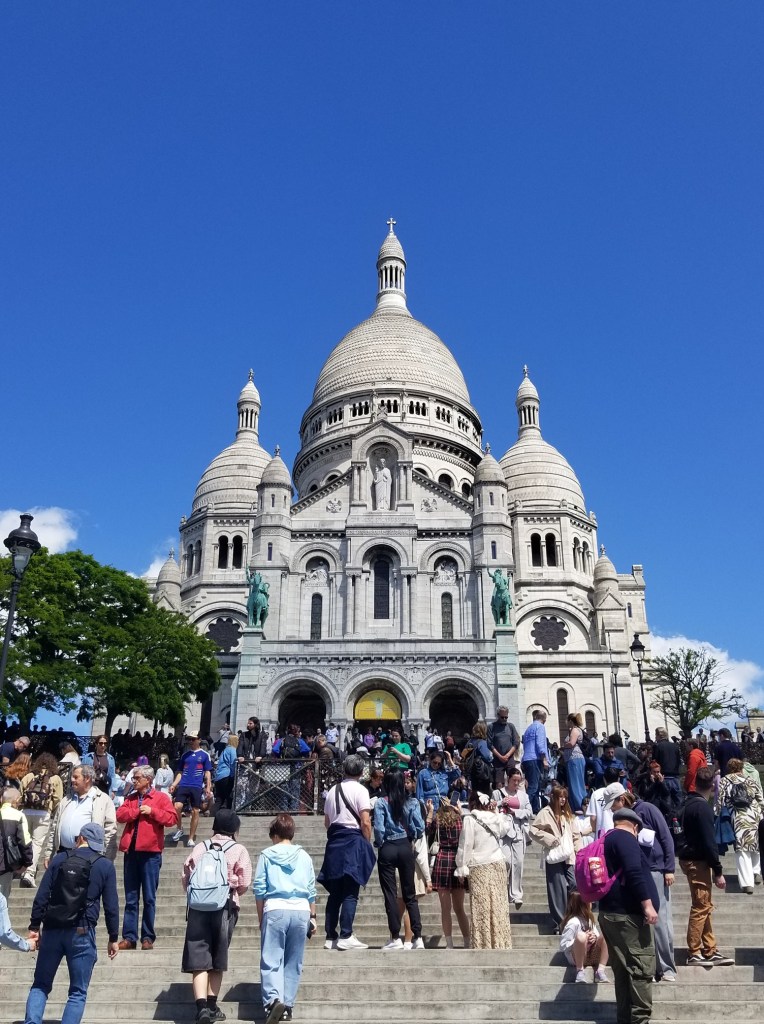
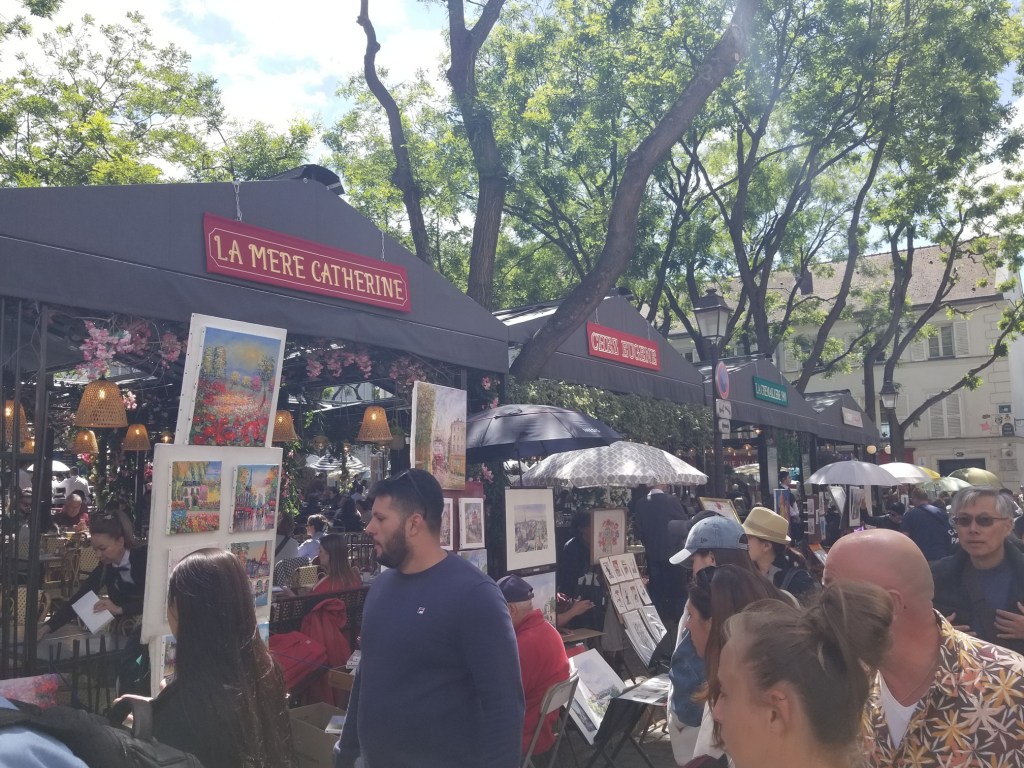
Montmartre is a neighborhood, and a hill located in Paris. It is known for its old picturesque buildings, the plaza, the small stores, cafes and restaurants, and the art. At the top of the hills sits one of Paris most famous cathedrals Basilique du Sacré-Cœur de Montmartre. It is open to visitors, but you may have to stand in line to go inside. The view from the top of the hill is spectacular.
This is the front view of Basilique du Sacré-Cœur de Montmartre. It is one of the most beautiful cathedrals that I have ever seen.This market in Montmartre is located nearby Sacré-Cœur.This market in Montmartre is located nearby Sacré-Cœur.
Sights and Shopping in Paris
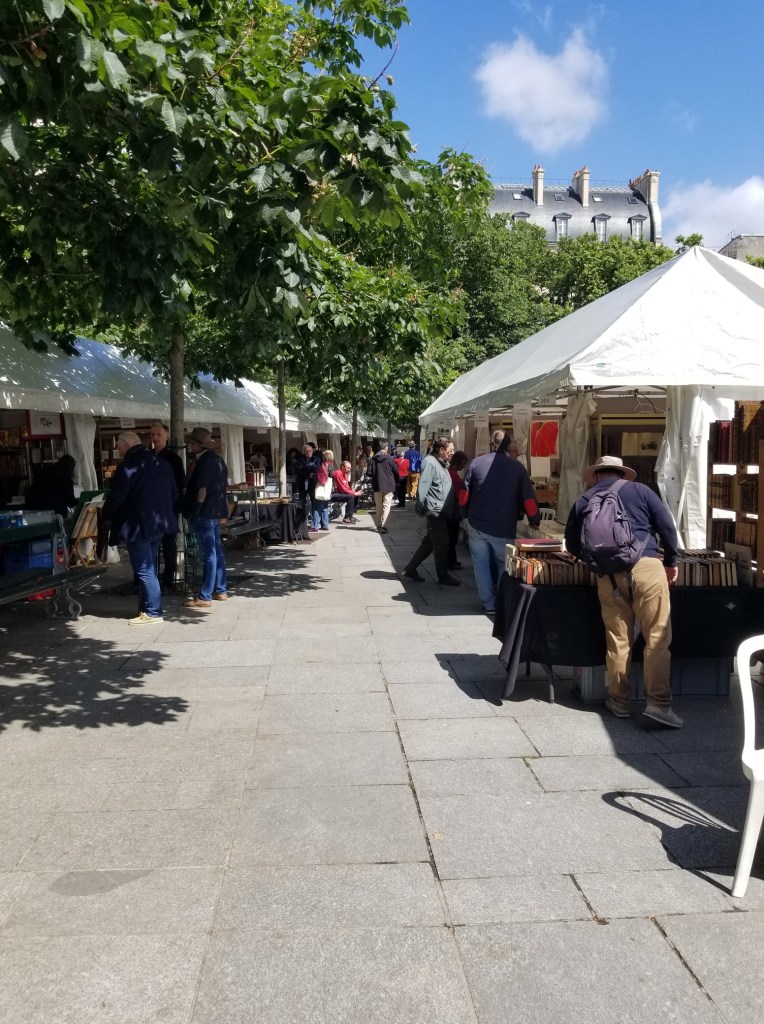
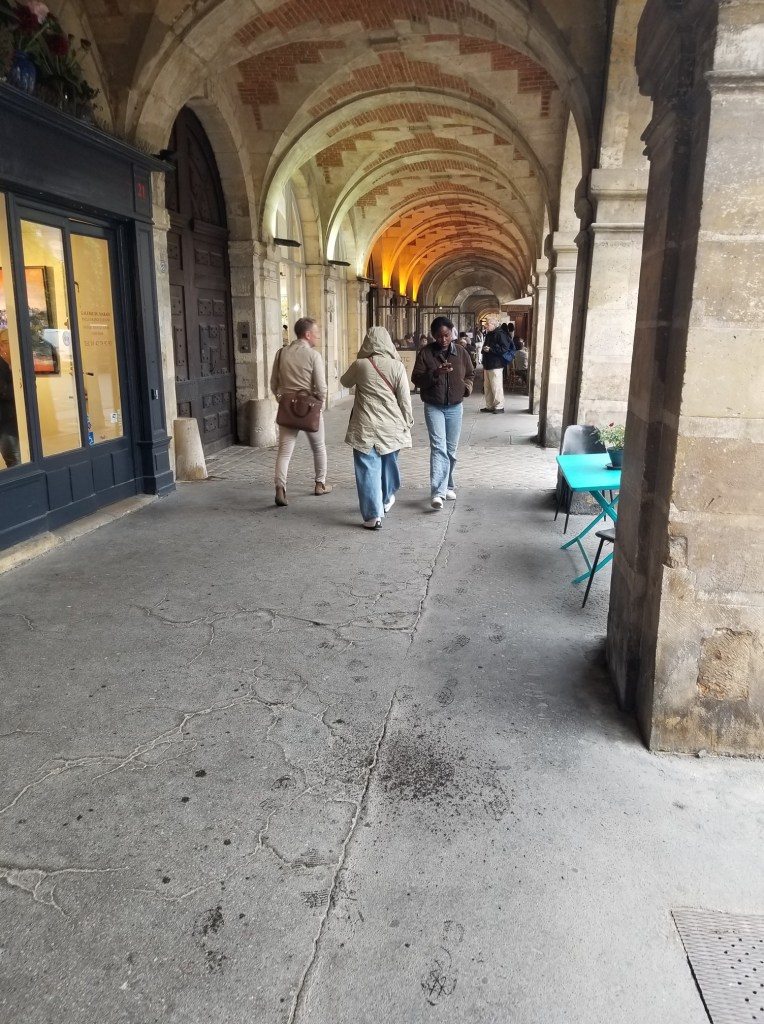
Nobody walks in LA but in Paris everyone walks. There is so much to see everywhere, everything is close, and there are several restaurants and shops in every block. So, why not walk a few miles every day. It is healthy too. Below are a lot of photos that I took of things we visited as we walked around Paris.
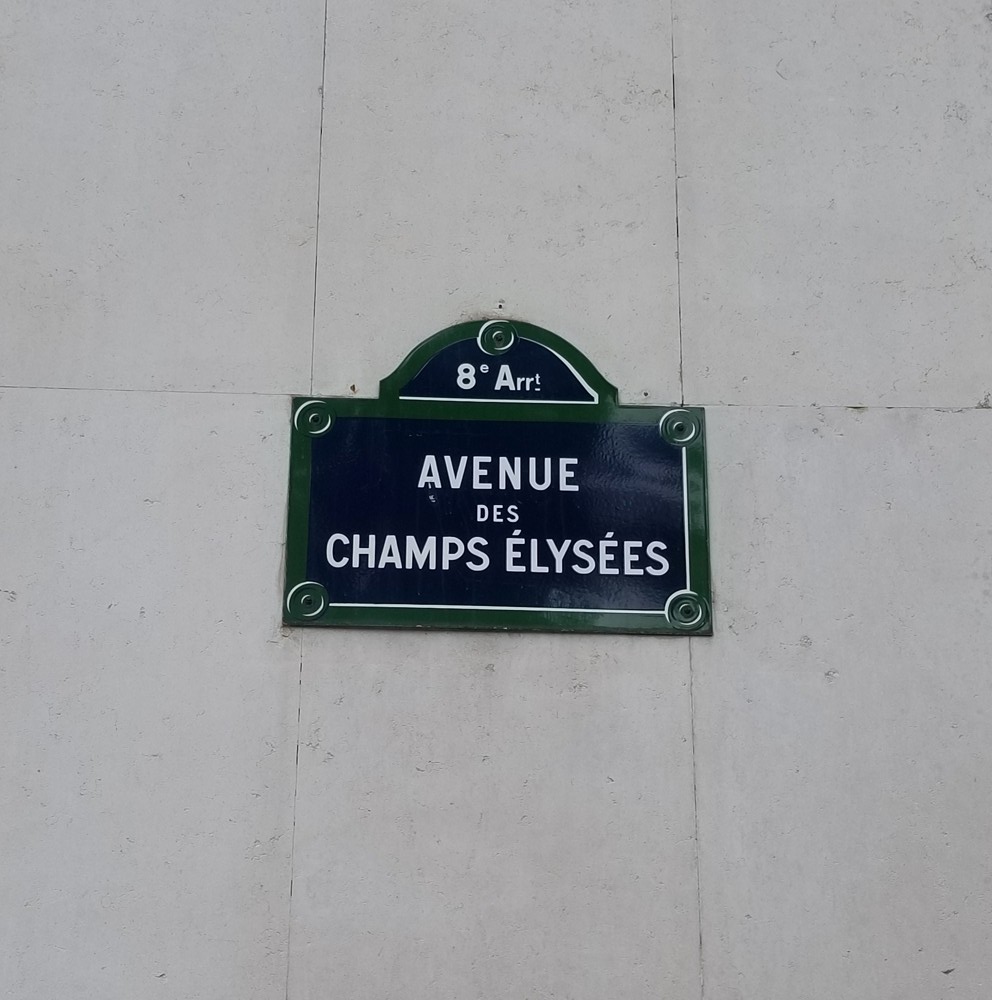
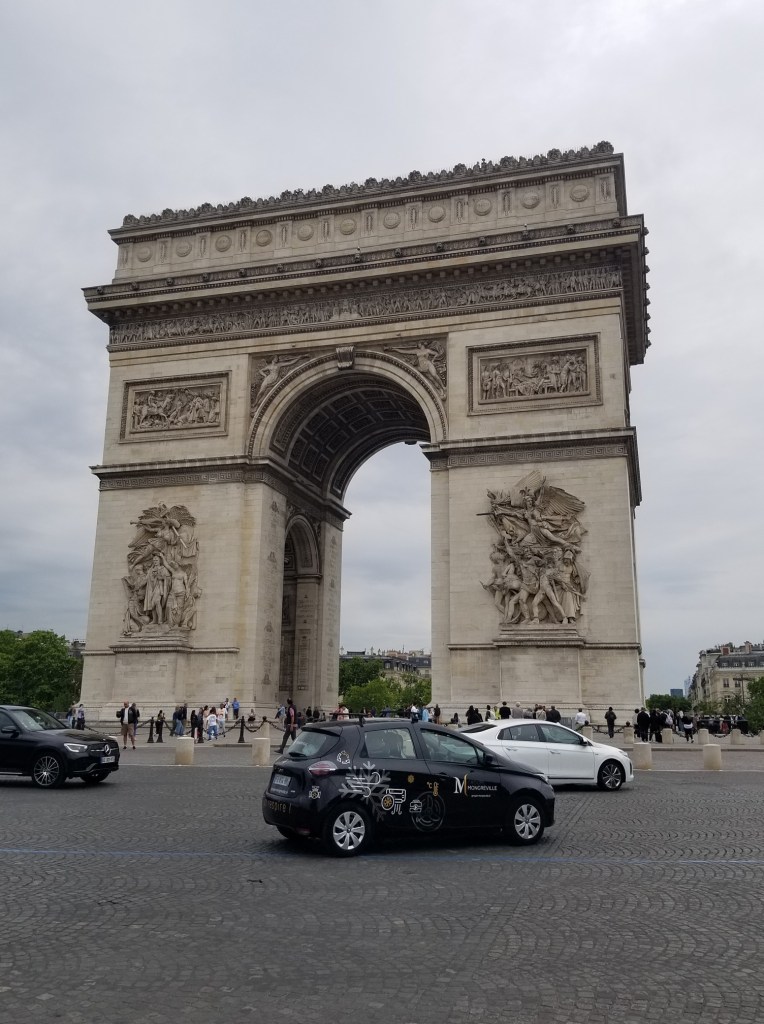
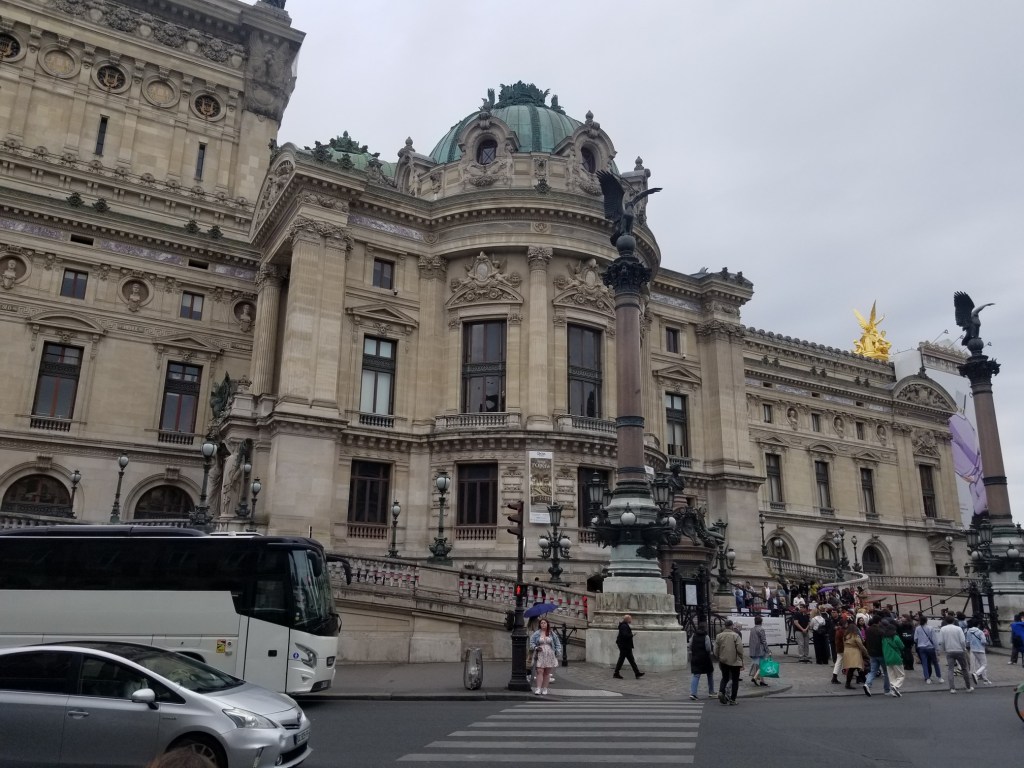
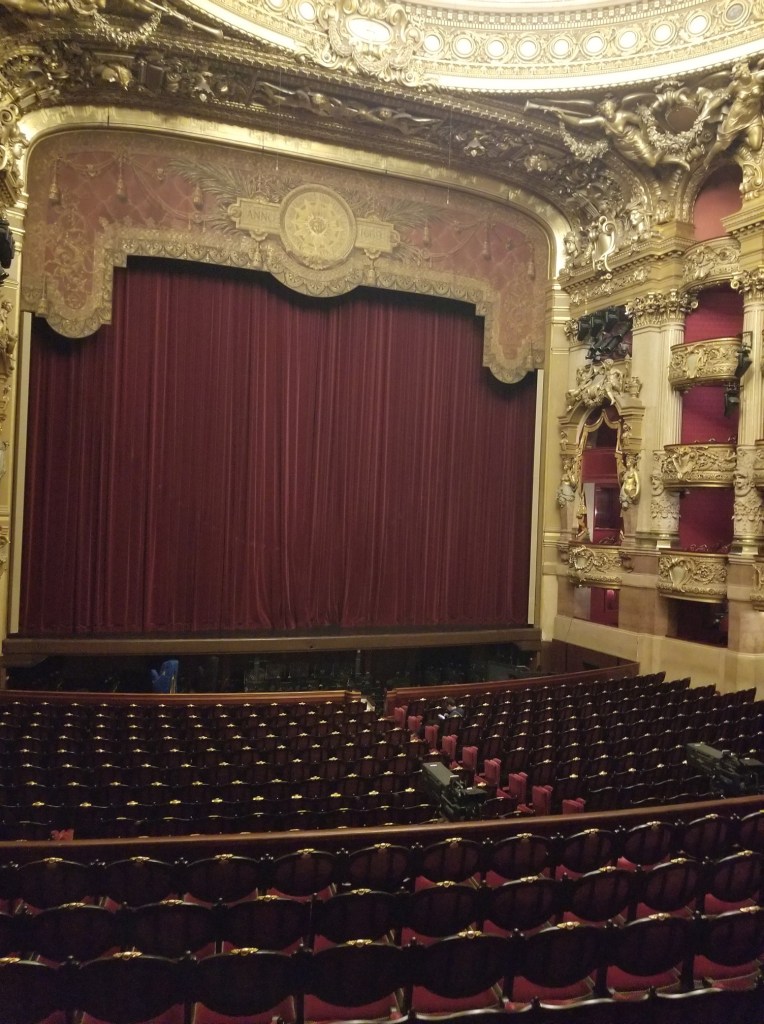
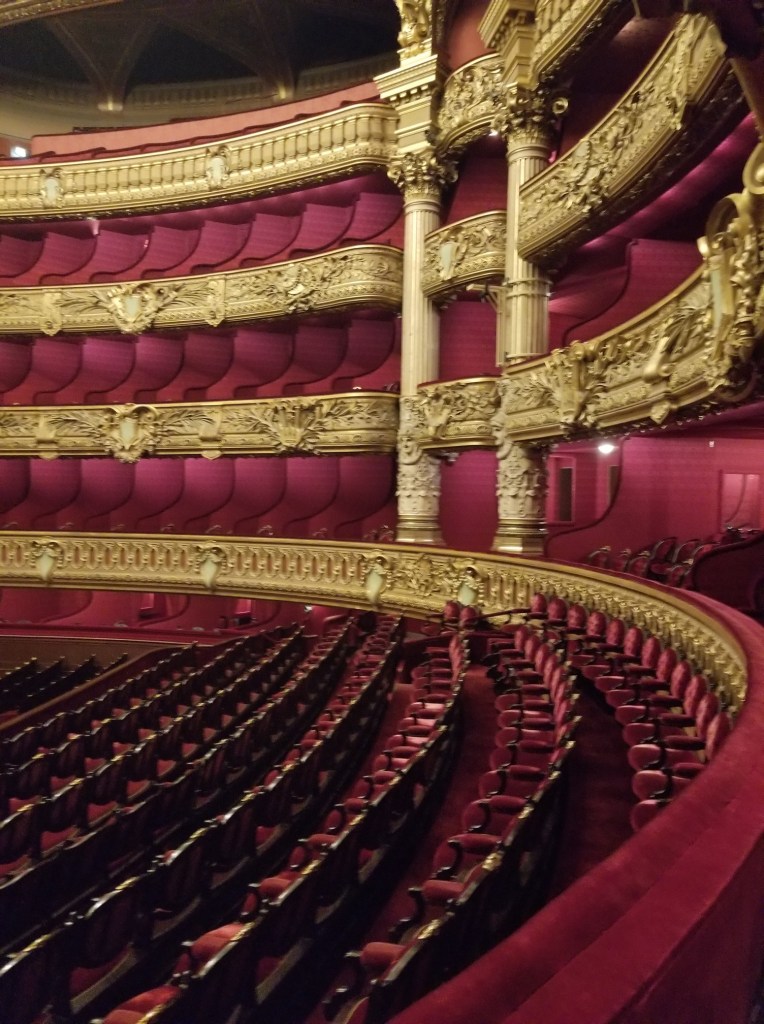
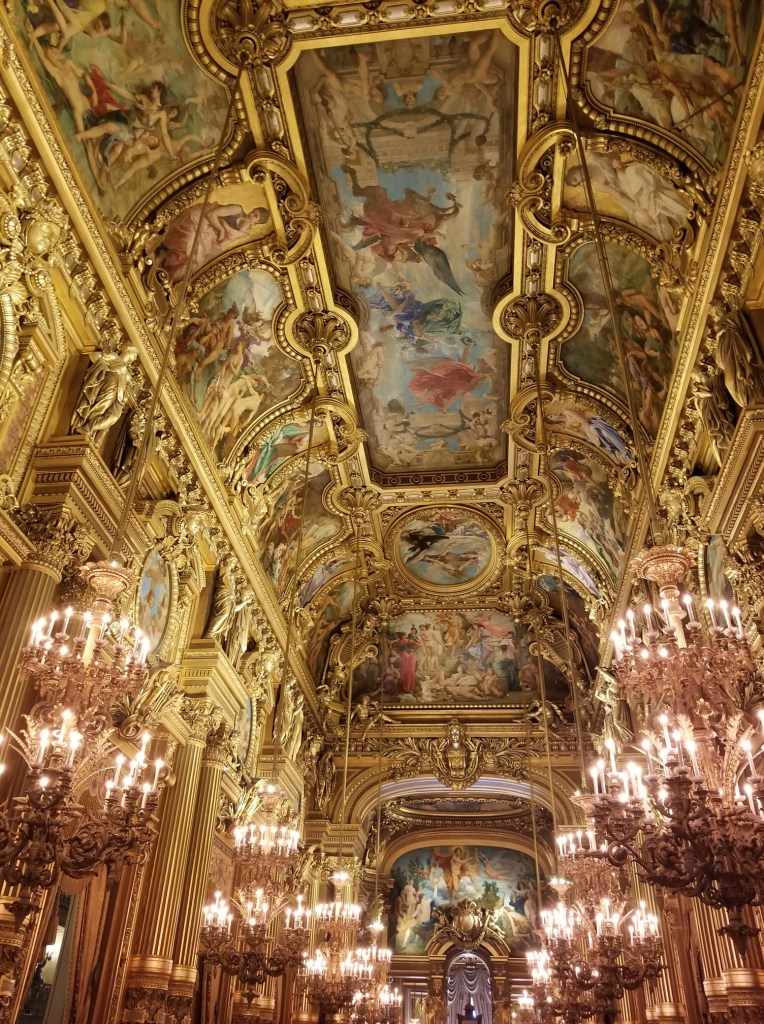
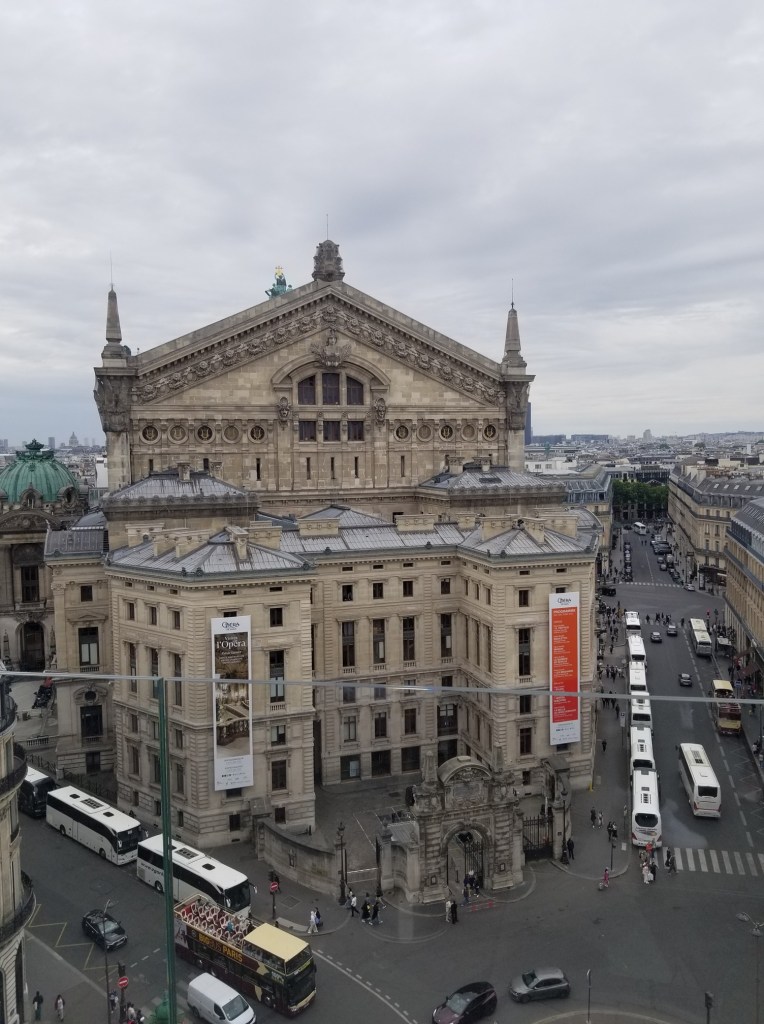
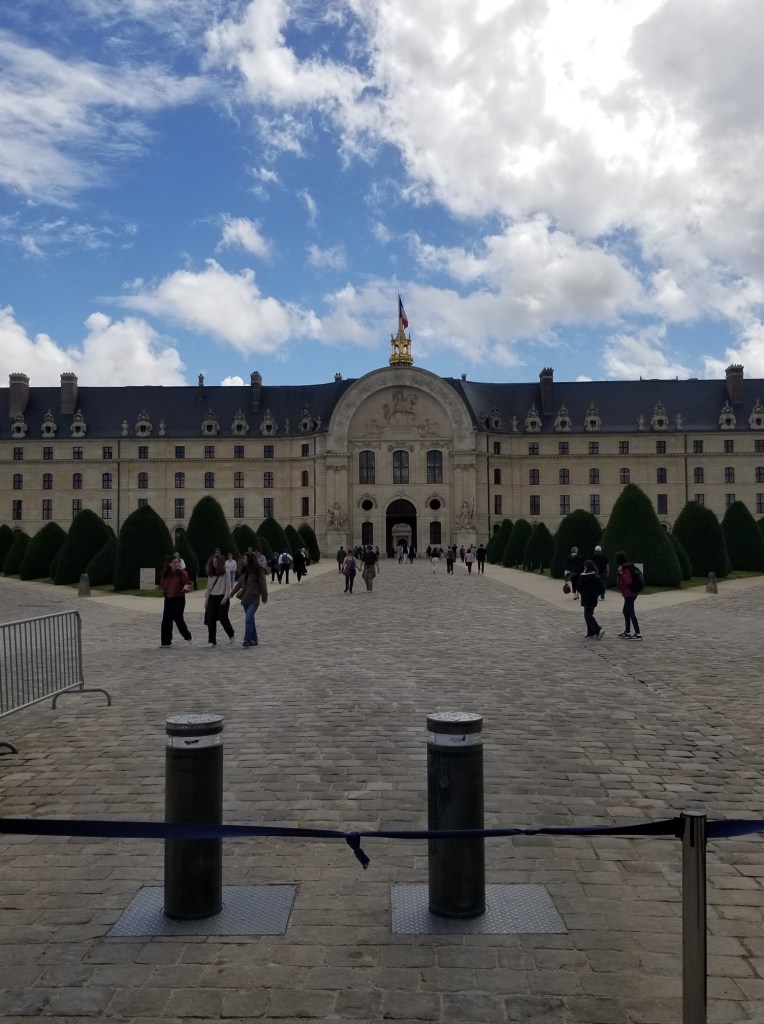
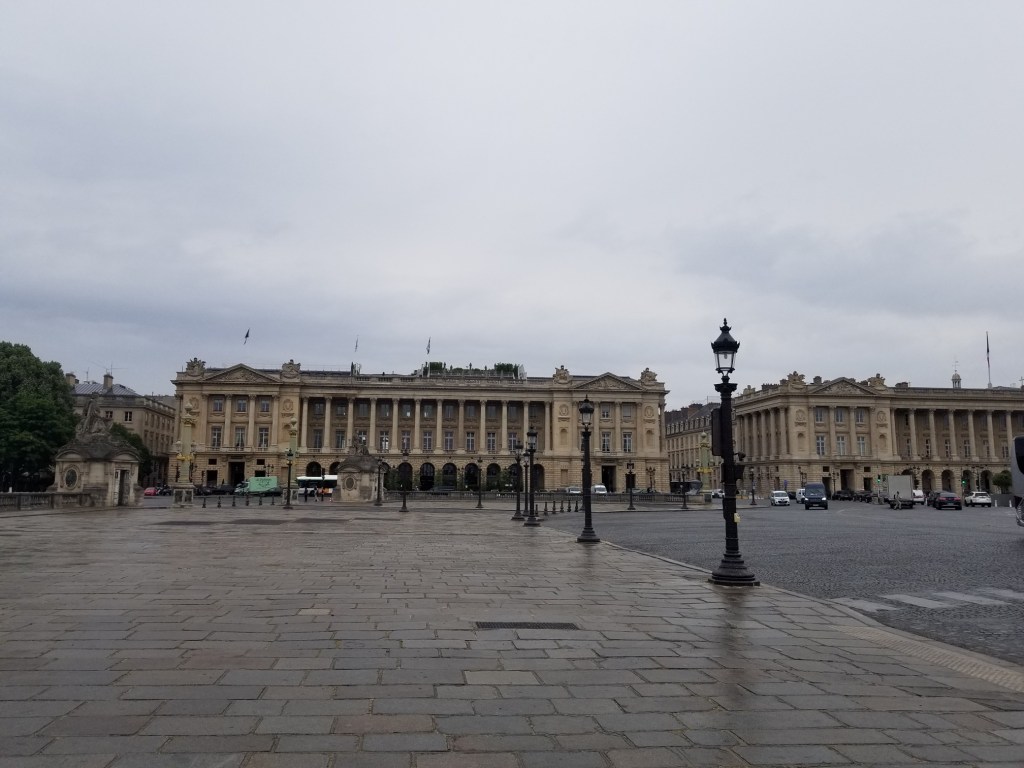
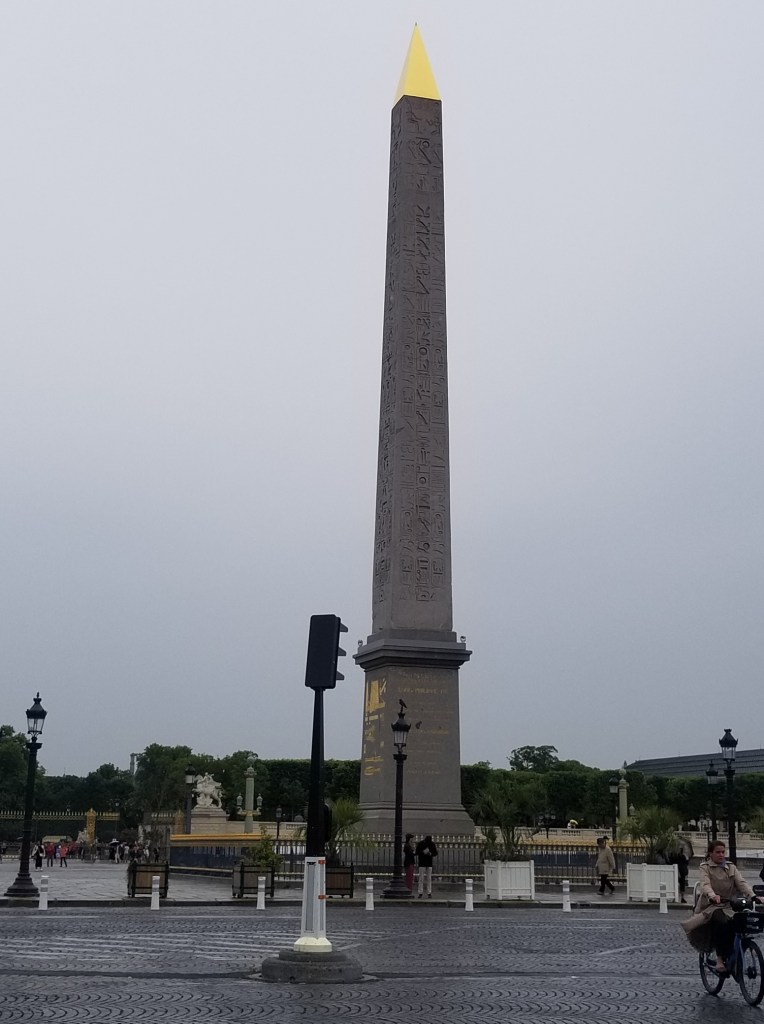
Avenue des Champs Élysées is a long wide street with lots of stores and things to see.My wife found this purse store called Louis Vuitton. I took the photo as I walked into the store. Husbands sat in comfortable sofa chairs and where served coffee, tea and juice while their wives were shopping. When someone made a purchase, they served you champagne and cocktails. My wife did not buy a purse, but my daughter bought one later. The purses were expensive but cheaper than in the states according to my wife.Arc de Triomphe is located on Avenue des Champs Élysées. You can walk up to the top. We did not do that this time.Palais Opéra Garnier was an opera that we toured. However, it was not the opera where we saw Rigoletto, that was Opera National de Paris. However, Palais Opéra Garnier was without doubt a very impressive building.The auditorium of the Palais Opéra Garnier.Another view of the auditorium of Palais Opéra Garnier.One of the large rooms in Palais Opéra Garnier.An artistically decorated hallway in Palais Opéra Garnier.The ceiling of the hallway in Palais Opéra Garnier.I took this photo from the terrace of an eight-story shopping mall called Gallery Lafayette located nearby Palais Opéra Garnier. The photo shows the back of Palais Opéra Garnier. My wife and daughter spend a lot of time shopping here.Photo of Hôtel des Invalides / Les Invalides, where Napoleons tomb is located. Hôtel des Invalides is very large, and this photo only shows a small portion of it.One of the corners of place de la Concorde.The obelix at Place de la Concorde.Inside a church / cathedral called Saint Sulpice.A sidewalk in Paris
Museums and Gardens in Paris
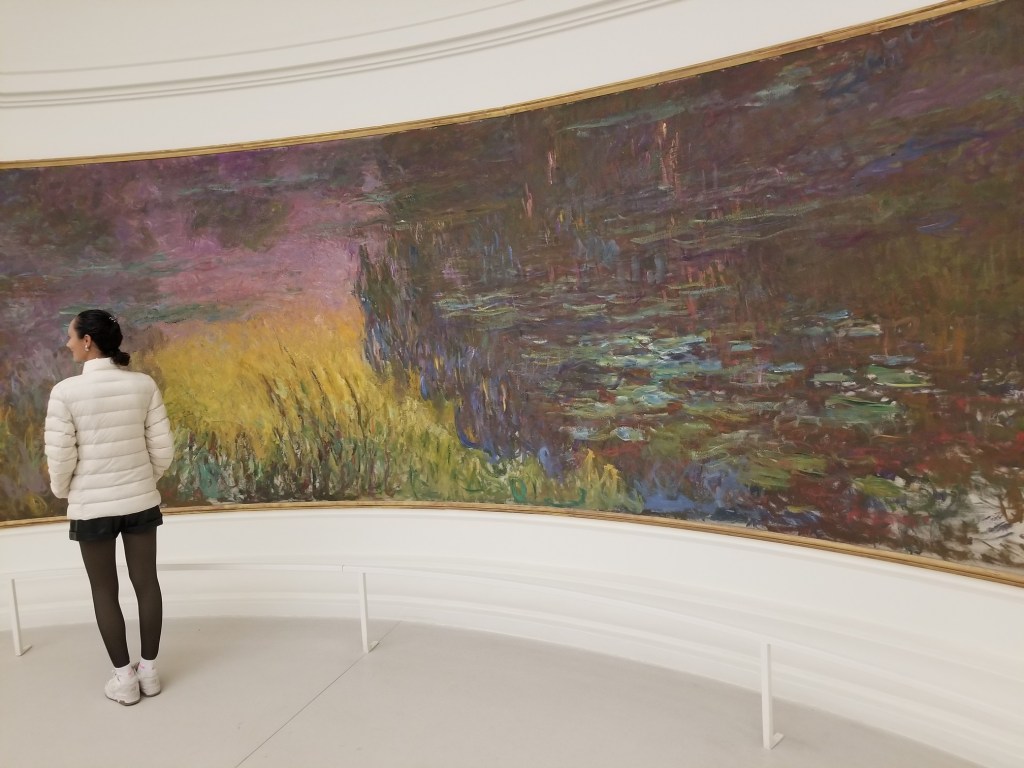
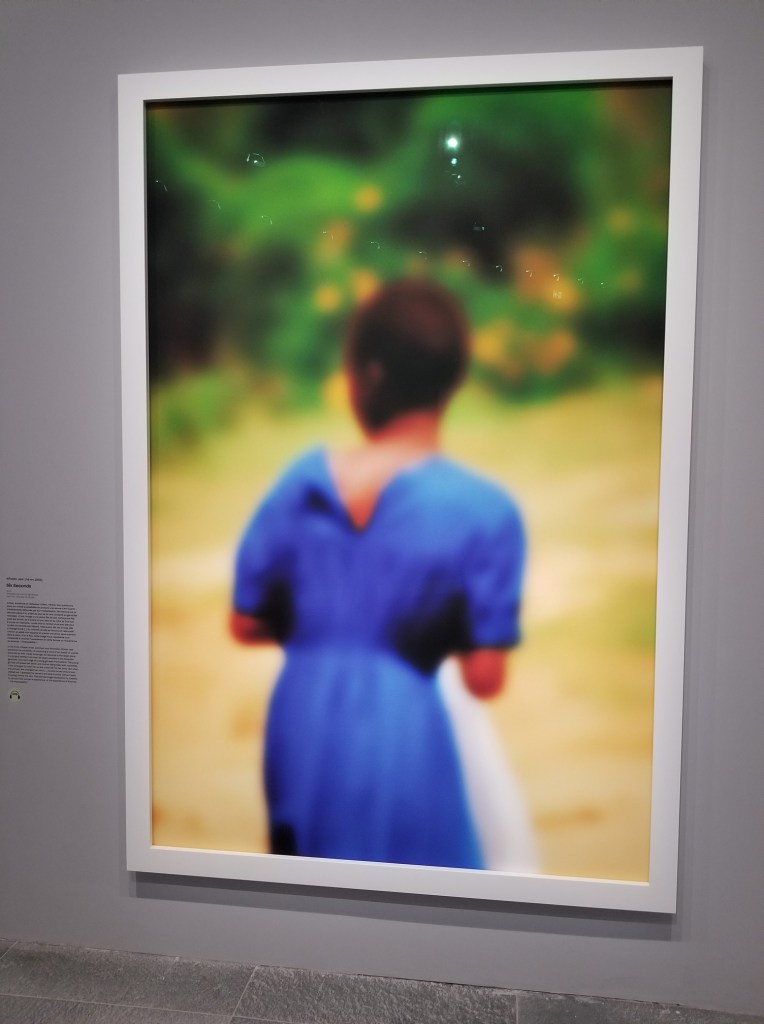
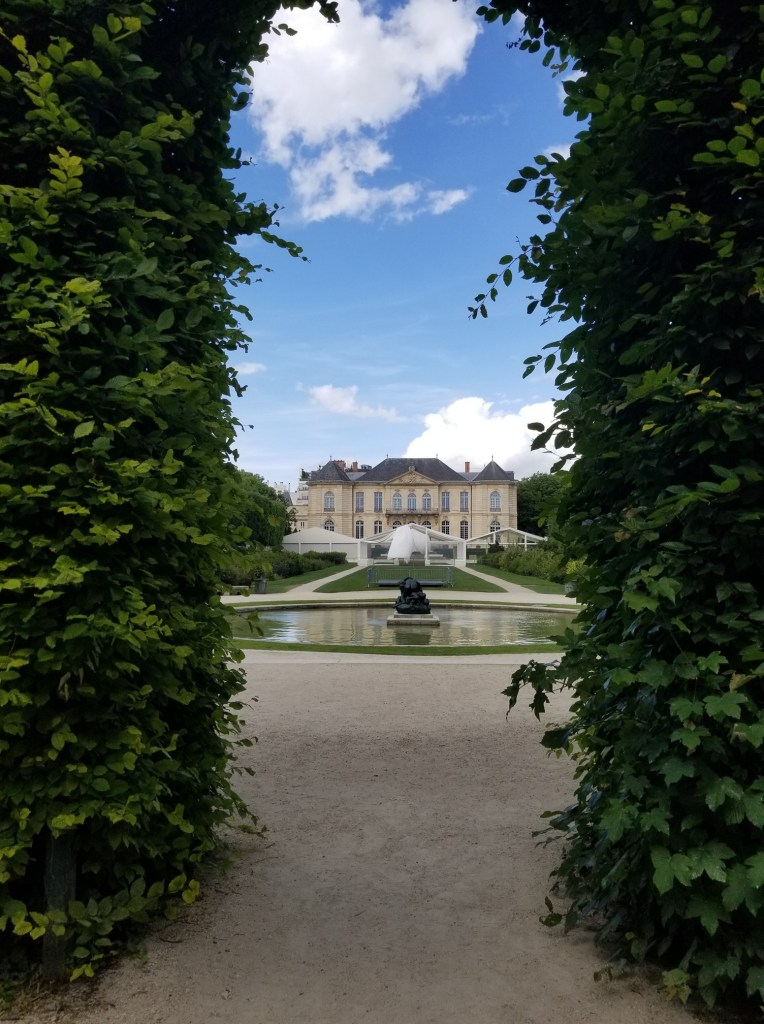
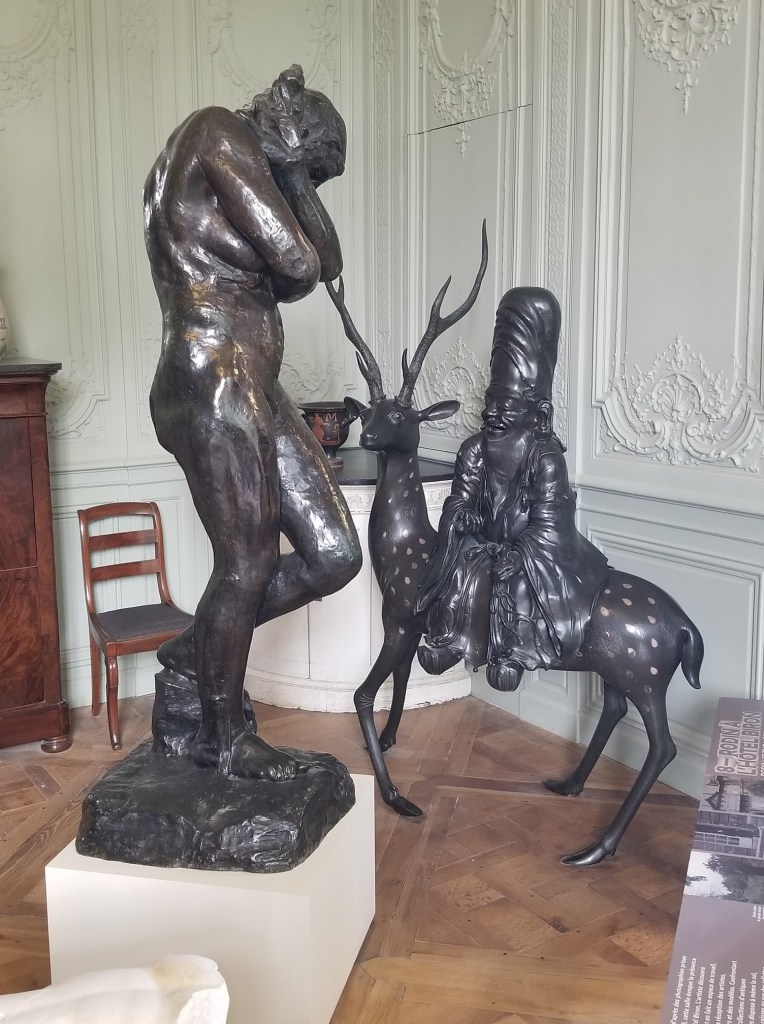
We visited several museums and gardens in Paris. One of the museums we visited was Musée de l’Orangerie which exhibit all kinds of art from ancient times to modern times but especially paintings including several famous painters such as, Pablo Picasso, Claude Monet, Henri Matisse, Henri Rousseau, Walter-Guillaume, Amedeo Modigliano, Marie Laurencine, Maurice Utrillo, Eva Nielsen. Some special exhibits were Monet’s gigantic water lily paintings and “flou” art, intentionally blurry paintings and art because life is blurry. We also visited the Auguste Rodin Museum. The museum had hundreds of Rodin sculptures in the museum building as well as in the surrounding gardens. There were also paintings by Vincent Van Gogh and Claude Monet.
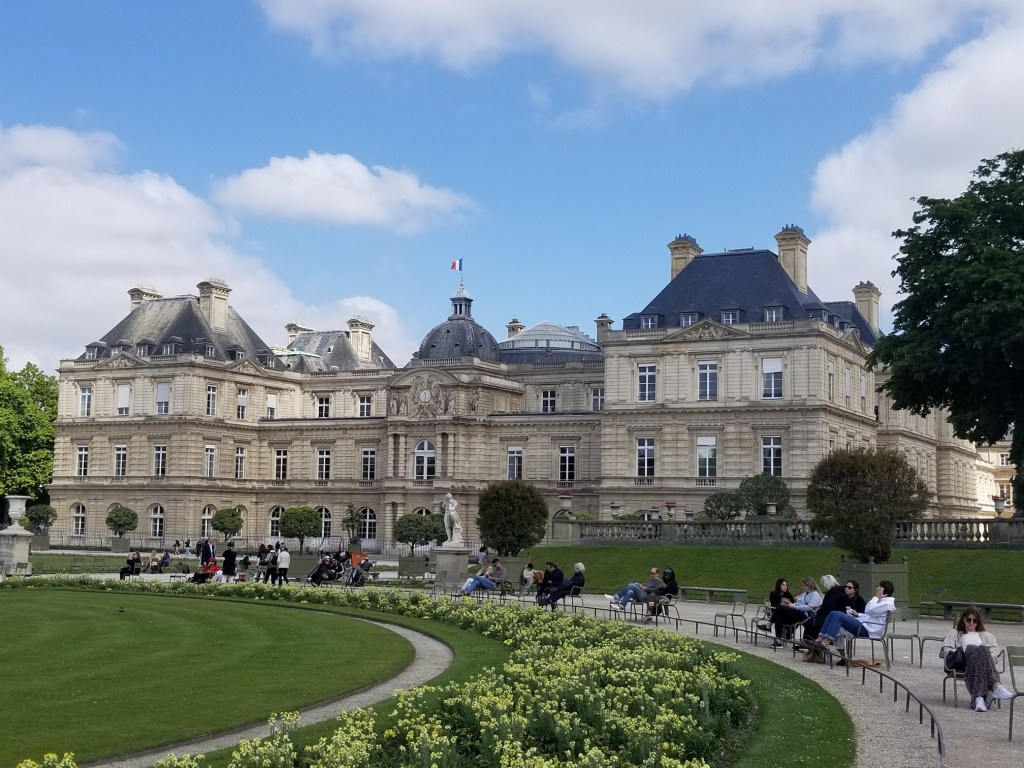
Jardin Du Luxembourg feature several buildings including this one. The garden is huge and difficult to show in a photo, but you can get an idea by looking at the fourth photo (aerial view from the Eiffel Tower) in the Eiffel Tower section above.Musée de l’Orangerie featured many large paintings of water lilies by Claude Monte.Ancient African statues in the Musée de l’Orangerie.An intentionally blurry painting. As mentioned above, this style is referred to as Flou. The paintings are blurry because life is blurry.The Auguste Rodin Museum featured one relatively small museum buildings surrounded by a huge garden. Both the garden and the building contained hundreds of statues, mostly by Auguste Rodin as well as paintings by Vincent Van Gogh and Claude Monet.The famous Rodin bronze statue the thinker, located in the garden.Two of the statues inside the building.
Dessert Places in Paris
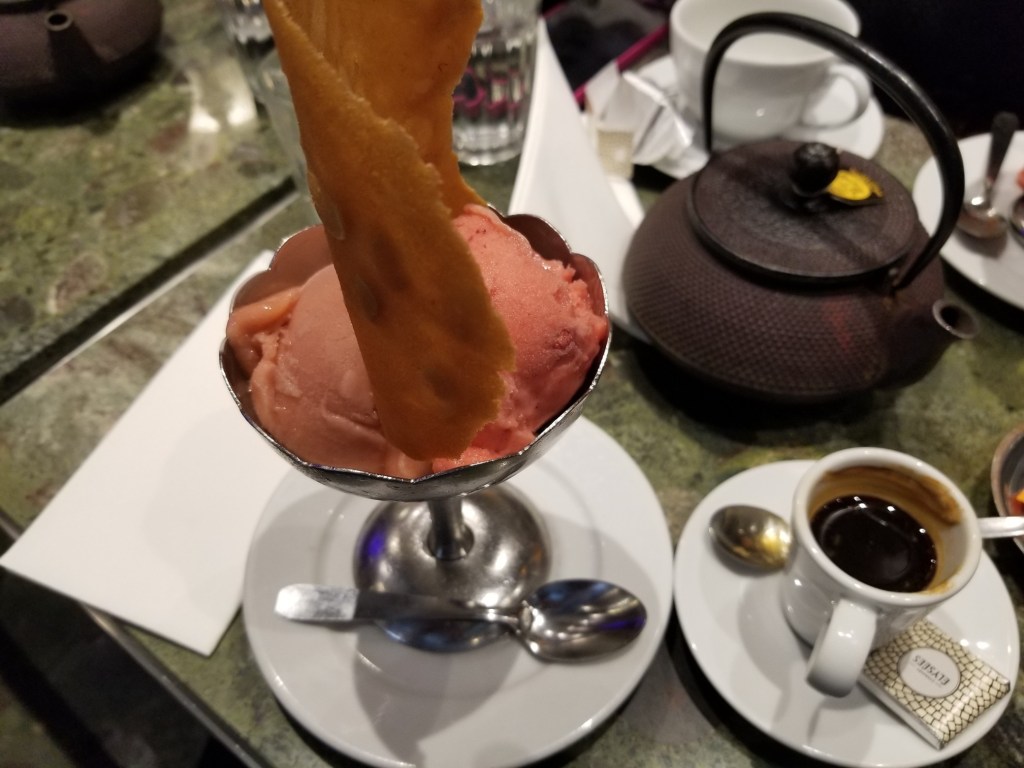
There are thousands of Cafes, bakeries and pastry shops in Paris and the cakes, pastries, desserts, tarts and other baked goods are probably the best in the world. We visited a number of these stores and creperies and we had desserts at various restaurants. You can find wonderful baked goods in Italy and in the Scandinavian countries, but I have to say that France, and Paris, takes the cake (pun intended). At Angelina’s I had delicious coffee and I had some of their thick and creamy hot chocolate with whipped cream as well as two incredible cakes. At Berthilon I had amazing rhubarb and wild strawberry ice cream.
Rhubarb and wild strawberry ice cream with a wafer at Berthilon.Small section of the to go counter at Angelina (a sit-down pastry shop).
Violin d’Ingres Michelin Star Restaurant
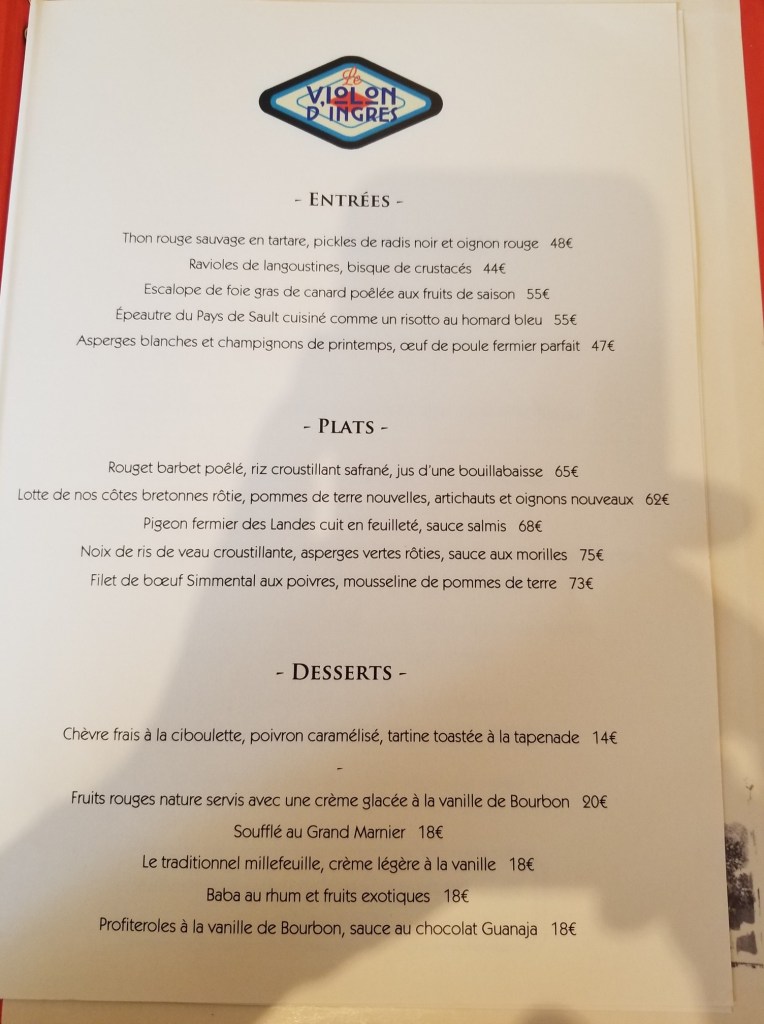
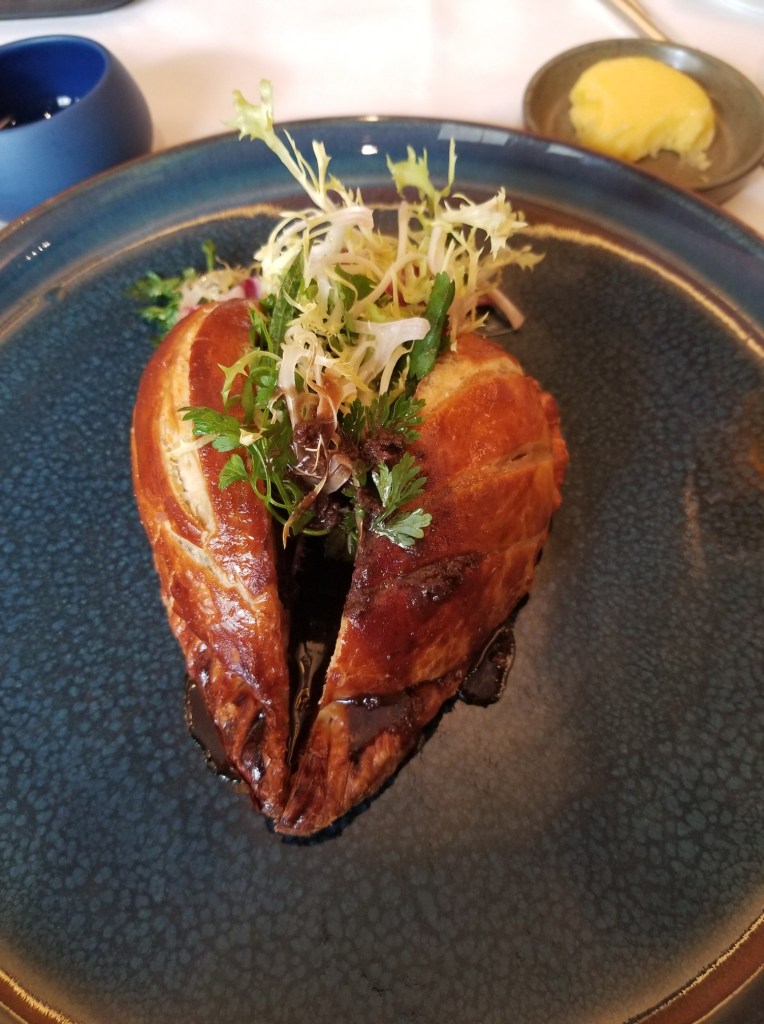
We celebrated a couple of birthdays at a Michelin star restaurant called Violin d’Ingres. In terms of eating that was probably the highlight of the trip. Out of Paris’ 44,000 restaurants only 123 are Michelin star restaurants (10 three-star restaurants, 17 two-star restaurants, and 96 one-star restaurants). I ordered Pigeon, something I’ve never had before. It does not sound appetizing. I joked that you had to go out in the street and kill the Pigeon yourself. However, it was probably the best meal I’ve had so far this year. It was truly delicious.
The menu at Violin d’Ingres. Notice that Entrées means starters or appetizers, just like the word implies. Somehow this got mistranslated into the English language to mean main course.This is my main course, Pigeon in lightly fried bread. It was delicious.
Traffic in Paris
Traffic in Paris is horrendous. Paris has successfully promoted the use of bicycles, mopeds, motorcycles, buses and the metro. As a result, the air is much cleaner than it used to be, but the traffic is still bad. One of the reasons is that it has become quite popular to disturb the traffic in various sorts of protests. When we were there the taxi drivers were on strike. You may think that you could just take an Uber instead, but the taxi drivers were blocking other traffic as well, including blocking the entrance to train stations. We were afraid they might block the entrance to the airport on our return day. I have a hard time understanding this since this kind of behavior is obstruction and is illegal in the United States as well as in Sweden.
However, the striking tax drivers were not the only problem. One day when I was accompanying my wife and daughter shopping, I got bored and decided to walk back to the hotel. It was two miles, and it took me one hour. Since the sidewalks are of such high quality and there is so much to see along the way and so many opportunities to stop if you need, this is easy to do.
Along the way I saw two large demonstrations. One was “dépénaliser cannabis” and there were hundreds of people, many with green hair and weird clothes, carrying flags with green leaves on them, marching down the street and playing music. There were also hundreds of police and the entire street, Rue Voltaire, which is a major street, was blocked. Then came the bicycle demonstration. Hundreds of bicycles blocking traffic and lots of police. Well at least it was not a boring walk. Oh, what I saw on Rue Voltaire!
Today’s post is a highlight of Good News from my super fact blog, which I call Superfactful. I am listing eight posts, seven of which are what I call super facts. A super fact is a fact that is important, not trivia, and that is known to be true and yet are either disputed by large segments of the public or highly surprising or misunderstood by many. The super facts included with this post are what you can call Good News. Surprising news, perhaps shocking news, but still good news.
Peace Is Boring News
The first and my most recent post is not a super fact but my musings on the fact that good news tends to be boring news and therefore forgotten.
West Belfast, Northern Ireland,UK; February, 1994; Girl running with plate of chips past wall where two IRA Volunteers were killed by British soldiers Shutterstock Asset id: 1951602385, Editorial credit: RORY NUGENT.com
Emissions of ozone-depleting gases have fallen by 99 Percent
Super fact 41 : Largely thanks to the Montreal Protocol in 1987 the emissions of ozone-depleting gases have fallen by more than 99%, 99.7% to be exact, according to Our World in Data. This has resulted in halting the expansion of the ozone holes and the reduction in emissions of ozone-depleting gases is saving millions of lives every year.
To visit the page for Emissions of ozone-depleting gases have fallen by 99 Percent click here.
The phase out of six ozone depleting gases. Data source UN Environment Program (2023).
Natural Disasters Kill Less People Now Than 100 Years Ago
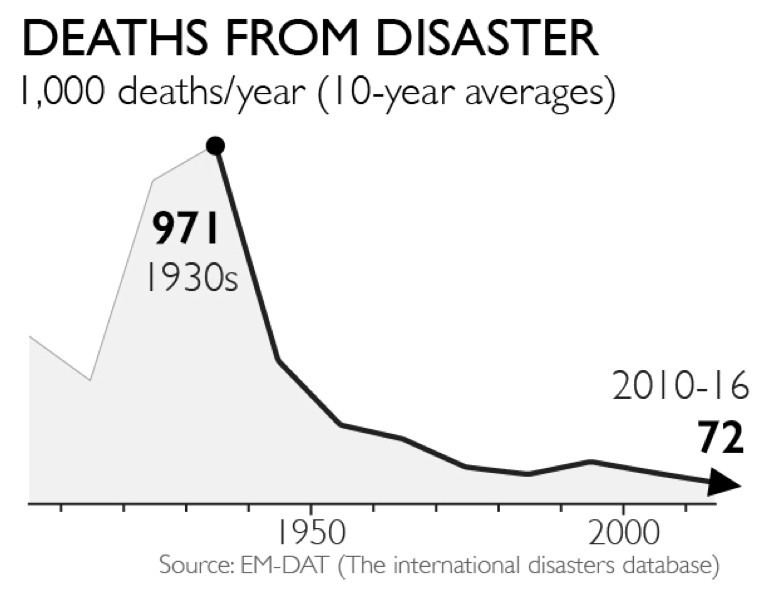
Super fact 35: Natural disasters kill a lot less people now compared to 100 years ago. That is despite a larger population and despite the fact that climate change has increased the frequency and intensity of many types of natural disasters.
The explanation for this is that we have become much better at warning people, preventing deaths and rescue people.
To visit the page for Natural Disasters, Kill Less People Now Than 100 Years Ago click here
This graph from the Gap Minder article shows the annual deaths from natural disasters in ten-year intervals starting with 1930. The trend is down.
EV Cars Indeed Emit Less Carbon Pollution
Super fact 29: EV Cars emit less pollution than Internal Combustion Engine, even considering manufacturing, disposal and EV Cars being charged by dirty grids.
To visit the page for EV Cars Indeed Emit Less Carbon Pollution click here
Lifecycle greenhouse gas emissions comparison of average gasoline car and 300-mile range EV.
Smallpox Killed 300 million People in the Last Century Before Eradication
Superfact 24: Smallpox killed 300 million people in the 20th century. However, there have been no naturally occurring cases of smallpox since 1977, and the world was declared free of smallpox on May 8, 1980, by the 33rd World Health Assembly.
To visit the page for Smallpox Killed 300 million People in the Last Century Before Eradication click here
This world map shows when smallpox was eradicated from different countries. The source is Our World in Data , originally Fenner et al. at CDC.
We are living in relatively peaceful times
Superfact 9 : Despite all the wars going on, the world was filled with a lot more war and violence in the past. Despite the grim news reports we are living in relatively peaceful times.
To visit the page for We are living in relatively peaceful times click here
Death rate from wars since 1946. The uptick in 2022 is largely due to the Ethiopian Tigray war with 162,000–600,000 killed and the invasion of Ukraine, which US and BBC estimates at more than 200,000 deaths (but estimates from most other sources are less).
US Violent Crime Nearly Cut in Half Since 1990
Superfact 8 : Despite all the news reports about rampant crime, the US violent crime rate has fallen to half of what it was in the early 1990’s.
To visit the page for US Violent Crime Nearly Cut in Half Since 1990 click here
The four graphs show that both violent crime and property crime have declined since 1990. Visit the post to see the Pew Research article it is taken from.
Poverty and child mortality has been sharply reduced worldwide
Superfact 7 : Extreme poverty as well as child mortality has been sharply reduced the world over. The countries that are the worst-off today are still better off than the countries that were doing the best at the beginning of the 19th century. Over the last 50 years extreme poverty and child mortality has continued to decline sharply.
To visit the page for Poverty and child mortality has been sharply reduced worldwide click here
This graph from Our World In Data shows a steep decline in extreme poverty over time. Click on the picture to visit the original article.
If you have not subscribed to my super fact blog you are certainly welcome to.





































 Leonberger Life