Leonberger Club of America

Esther’s writing prompt: October 1st : Club

Click here or here  to join in.

Just a few minutes before I saw Esther Chilton’s writing prompt “club” I received my annual invoice for our family membership in the Leonberger Club of America. What a great reminder to pay my bill and create a post about the Leonberger Club of America. We haven’t had a Leonberger since the summer of 2020 when our Leonberger Bronco, or Le Bronco von der Löwenhöhle passed away. However, we’ve kept our membership because I love their LeoLetter magazine, I know some people, I have this blog, and I wrote a book about our Leonberger and the Leonberger breed after the passing of Bronco (see the side bar on the right or click here for more information).

The Leonberger Club of America

I can add that the Leonberger Club of America, LCA for short, is the official national parent club for the Leonberger breed in the United States (and Canada). It was founded in 1985. Its mission is to preserve and promote the health, temperament, and original type of the Leonberger through education, events, performance programs, and social engagement. The American Kennel Club (AKC) recognizes the LCA as the official Leonberger breed club in the United States.

The Leonberger Club of America make sure that the Leonberger dogs are protected. You are about as likely to find a Leonberger at Petland/Puppy-Mill as you are finding an Elephant for sale there. You typically buy/get a Leonberger dog from an LCA certified Leonberger breeder or from the Leonberger Rescue Pals, and if you don’t that might be a problem. Leonberger breeders interview prospective Leonberger owners and make sure they are a good fit. If you are found to have mistreated a dog in the past, turned one into a shelter, or sold one on an auction, you cannot buy a Leonberger. The breeders are also required to take back the dog if it does not work out. To see the transcript from our Leonberger interview, click here.

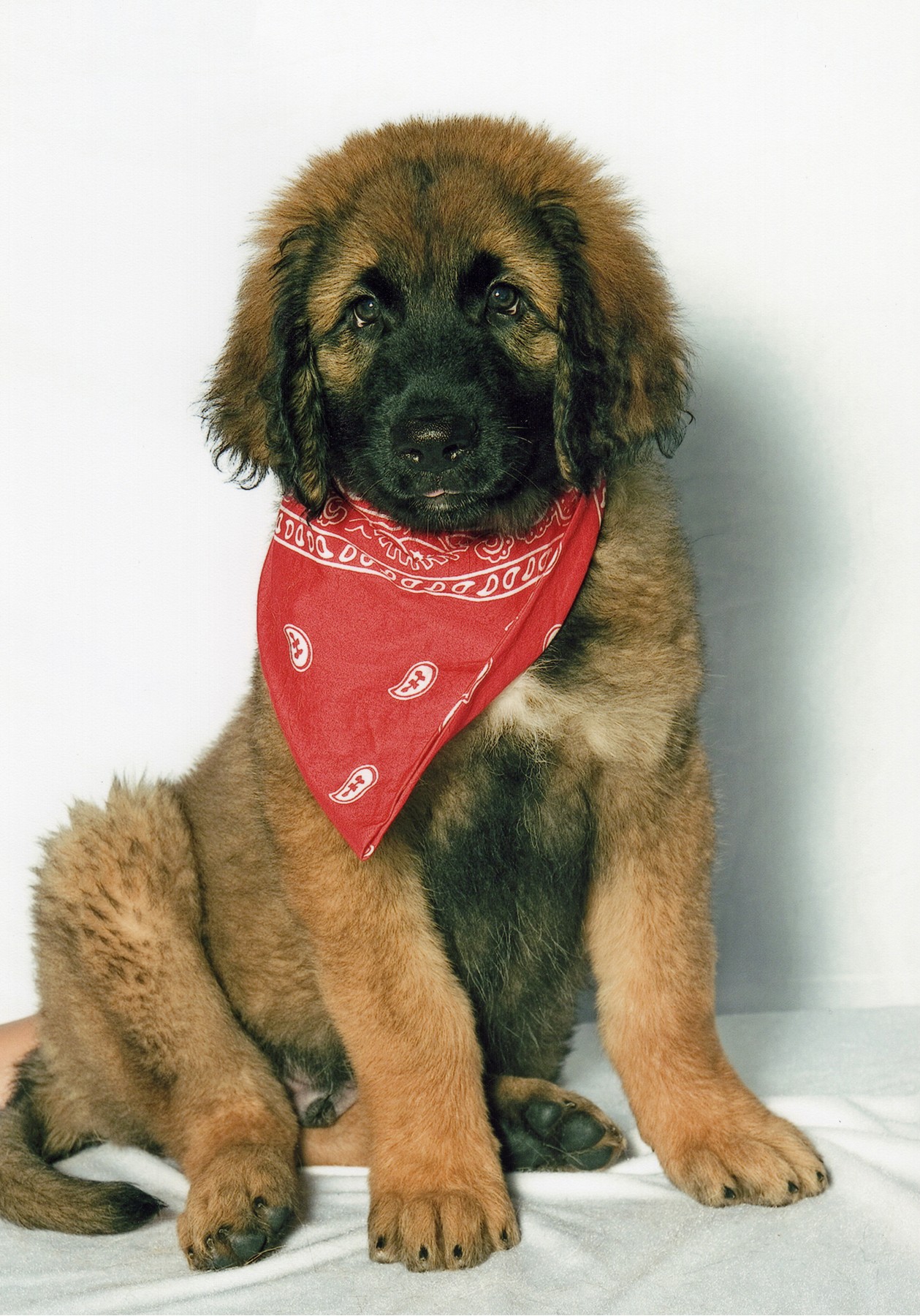
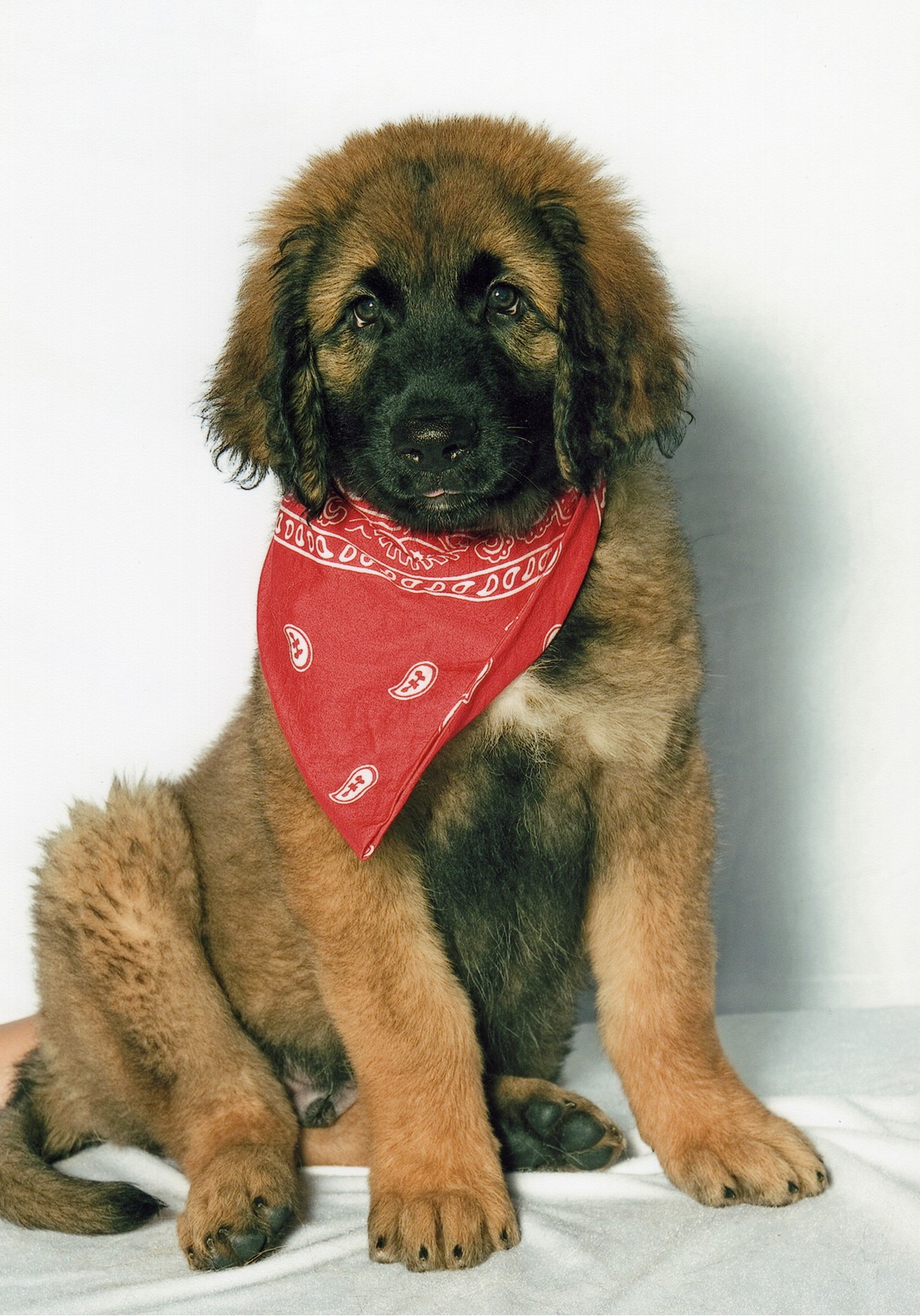
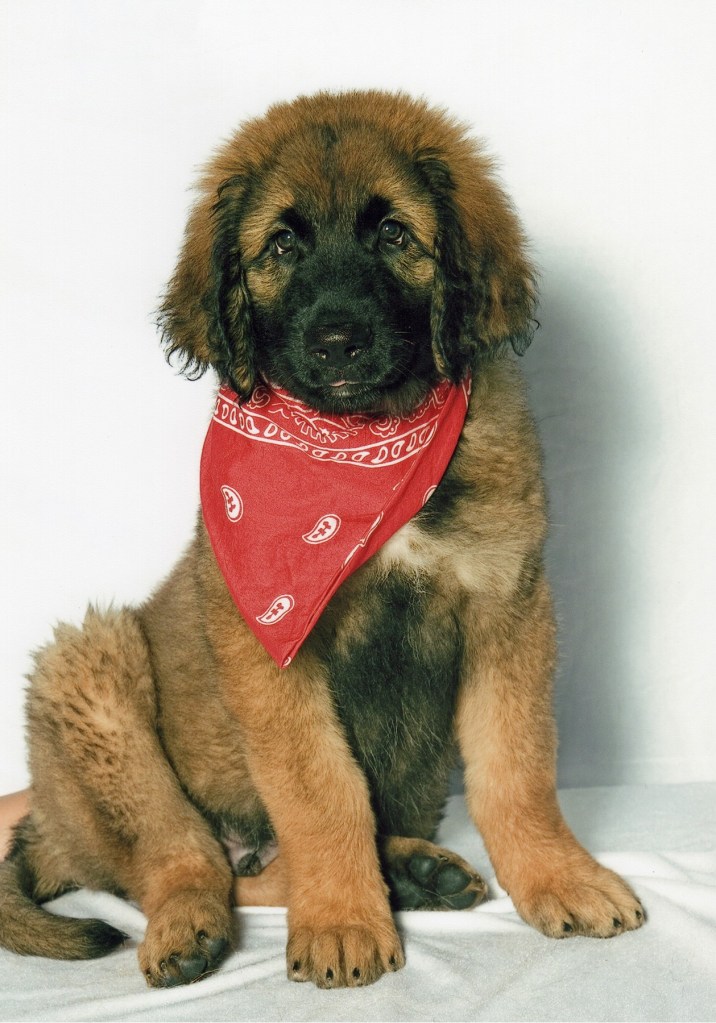
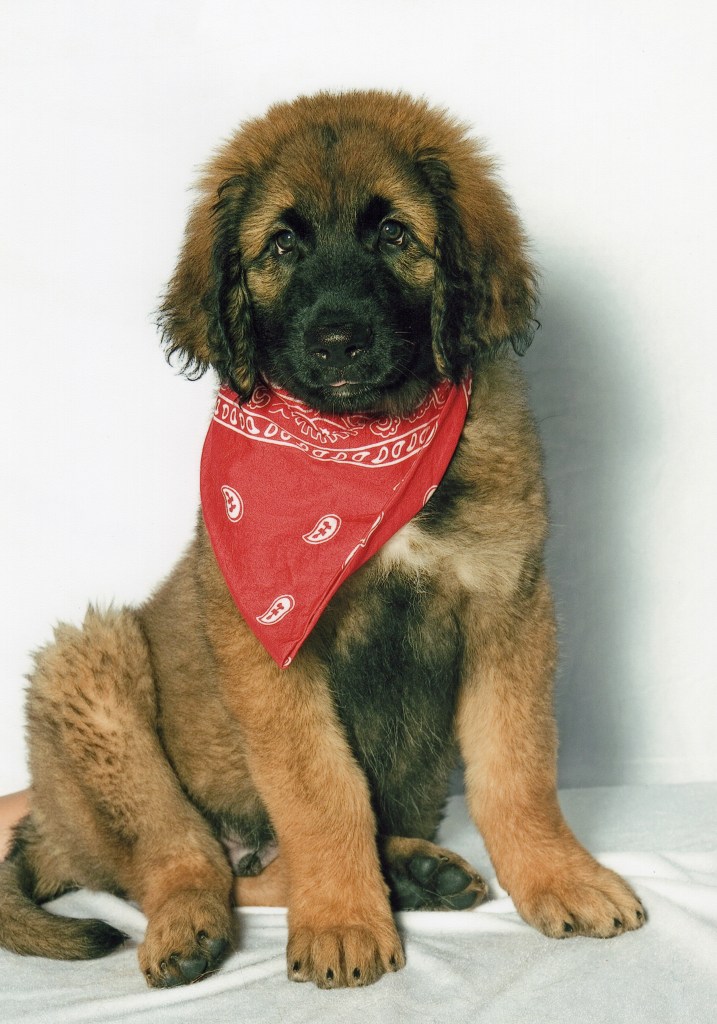
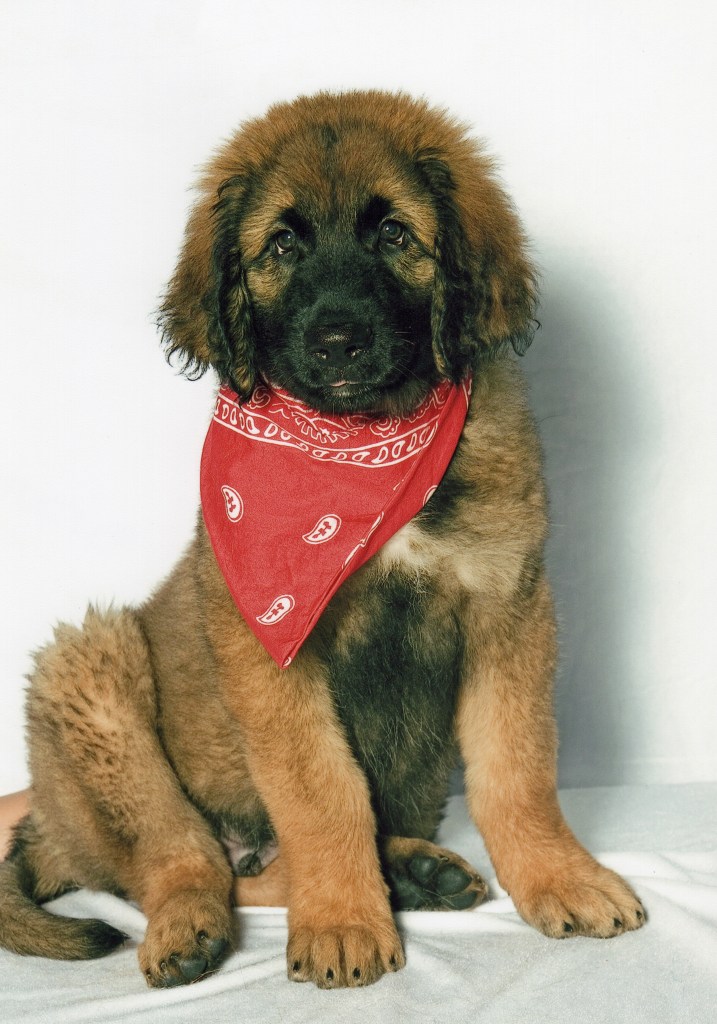
Our three months old Leonberger Bronco wearing a red scarf. He is looking straight into the camera.
We bought our Leonberger Bronco (Le Bronco von der Löwenhöhle) in 2007 from Julie Schaffert, a certified LCA breeder since 1992. This is a photo of him at three months old.

There are only about 3,000 Leonbergers in North America and about 2,000 Leonbergers in the United States but the Leonberger Club of America has more than 1,000 members. They publish the Leo-Letter, a quarterly Leonberger magazine. So, the Leonberger Club of America has a very prominent place among Leonberger owners. Click here to see a summary of the Leonberger Breed Standard.

A majestic Leonberger in standing on a podium and receiving an award. There are two people in picture, judge and handler.
Photo of a Leonberger from the LCA website

Other clubs associated with the Leonberger Club of America are New Jersey Leonberger Club, Great Lakes Leonberger Club, Greater Bluegrass Leonberger Club, Mid-Atlantic Leonberger Club Of Virginia, Tarheel Leonberger Club, AKC Licensed Specialty Club, The Frontier Leonberger Club Of The Southwest, Leonberger Club Of The Northwest, Northern California Leonberger Club, and the Surf And Sand Leonberger Club Of Southern California. I am a member of The Frontier Leonberger Club Of The Southwest. Other Leonberger clubs are the Leonberger University, Leonberger Health Foundation International, and the Worldwide Independent Leonberger Database. You can learn more about the Worldwide Independent Leonberger Database by clicking here.

The History of the Leonberger Club of America

Leonbergers have a long history in North America and the United States—despite the fact that until 1985, there were only seventeen Leonbergers known to be living in the United States. See: Lusby, Leonberger, page 15.

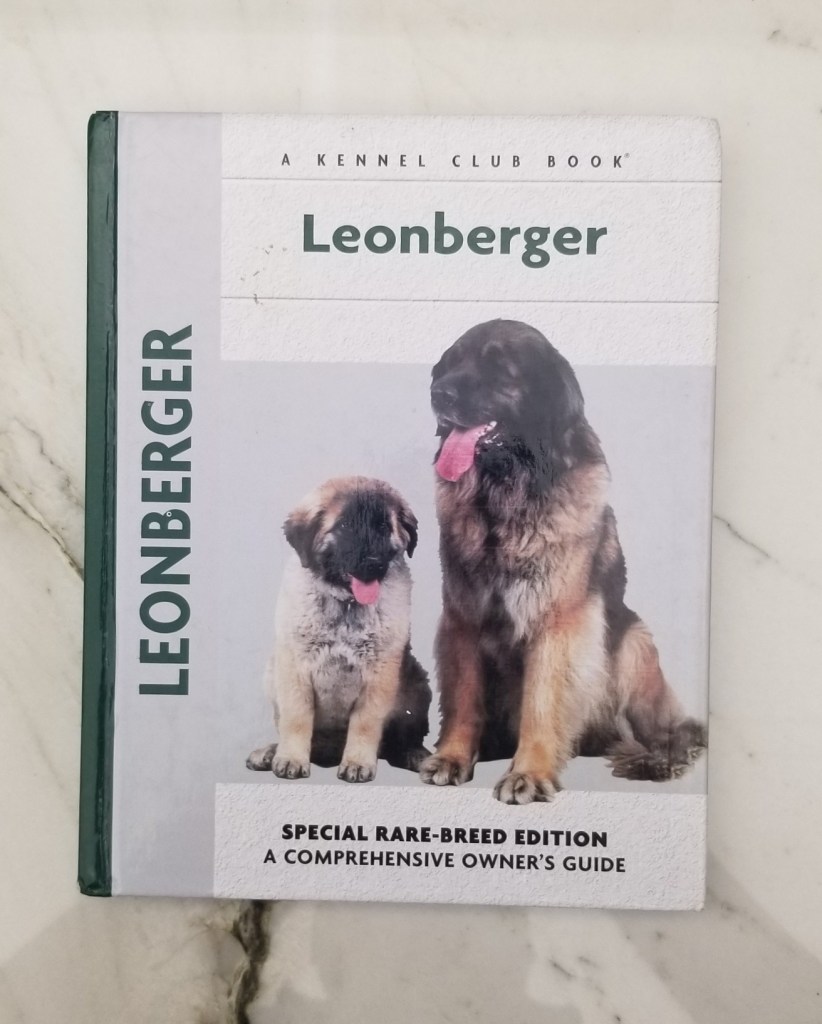
Front cover of the book Leonberger, Special Rare-Breed Edition, A Comprehensive Owners Guide, Madeline Lusby. It features a photo of an adult Leonberger and a puppy Leonberger.
Leonberger, Special Rare-Breed Edition, A Comprehensive Owners Guide, Madeline Lusby

In the 1870s, Leonbergers were brought to Newfoundland to invigorate the stock of Newfoundland dogs. Around the same time, two Leonbergers named Caesar and Sultan were purchased from Heinrich Essig’s kennel (founder of the Leonberger breed) and transported across the ocean to join the Wellesley-Sterling theater company in the United States as the stars of their productions. Then in 1879, Caesar and Sultan visited President Ulysses S. Grant, who called them the largest and most magnificent dogs he had ever seen and presented them with gold medals. During the years between World War I and World War II, a New Jersey family, the Wolfs, opened their home as a temporary refuge for Jews fleeing Germany: they also imported Leonbergers. Unfortunately, this introduction of the breed into the United States did not last, and it would be another fifty years before the Leonberger appeared in America again.

See: Bliss-Isberg, Leonberger, page 60, page 64, page 101

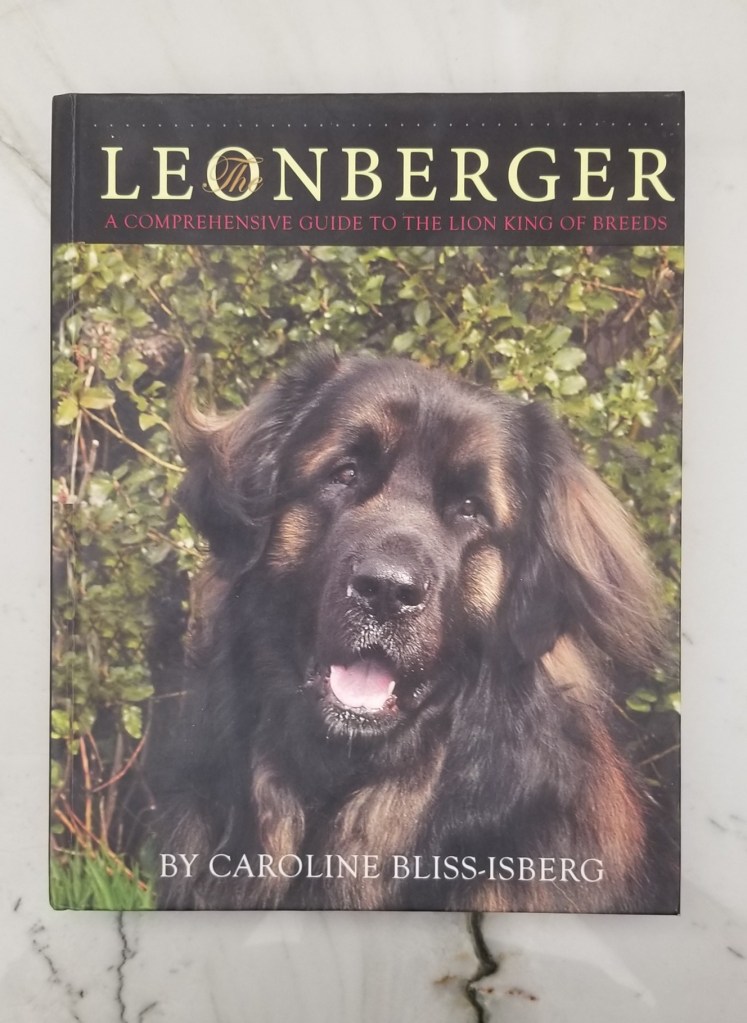
Front cover of the book Leonberger, A comprehensive guide to the lion king of breeds, by Caroline Bliss-Isberg. It features the face of a large Leonberger.
Leonberger, A comprehensive guide to the lion king of breeds, Caroline Bliss-Isberg

During the late 1970s and the 1980s, a few families—Waltraut and Klaus Zieher, Brian Peters, Manfred and Sylvia Kaufmann, Keri Campbell and Melanie Brown, and Mary and Reiner Decher brought Leonbergers to the United States. The Dechers had started a breeding program and were looking for a mate for their first dam, Viona. By chance their neighbor discovered through a newsletter that there was another Leonberger in the United States, and that led to the families’ finding and connecting with one another. I should add that the Dechers were careful to conform to the German breeding regulations and performed hip X-rays that they then submitted to the Orthopedic Foundation for Animals (OFA). Viona became the first OFA-certified Leonberger in America.

See: Bliss-Isberg, Leonberger, page 152.

On Saturday, November 2, 1985, eight of these Leonberger enthusiasts met at a hotel in Denver, Colorado, to found the Leonberger Club of America (LCA). This group of founders, which has since been dubbed the Denver Eight, appointed a registrar, formulated a breeding acceptability checklist, and instituted various policies, including the requirement that OFA certification is mandatory for breeding. LCA membership grew: it held social gatherings, began publishing LeoLetter, and imported an increasing number of dogs. Now the LCA has thousands of members across the country, and Leonbergers receive high ratings on health tests relative to other large breeds. For example, in 2000, the OFA reported that only 14.6 percent of Leonbergers tested positive for hip dysplasia, compared to 47 percent of Saint Bernards.

See: Bliss-Isberg, Leonberger, page 154, page 176.

Founding of the Leonberger Health Foundation International

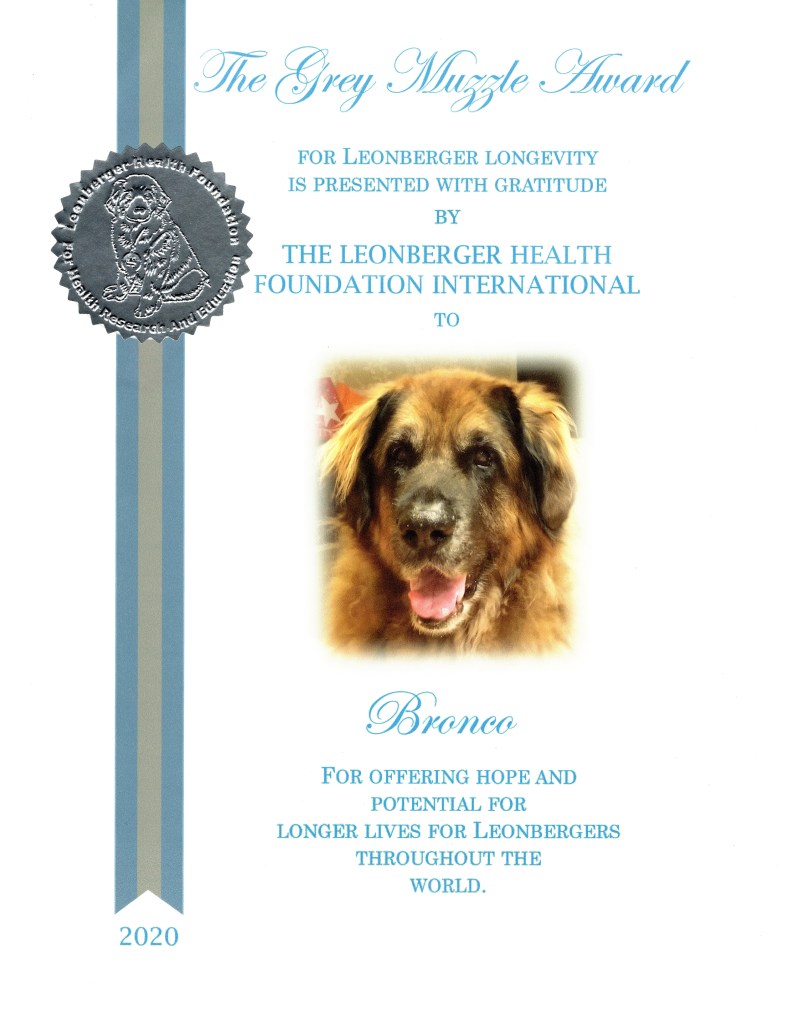
Another important historical event was the founding of the Leonberger Health Foundation International (LHFI), in 2000 (it was just called the Leonberger Health Foundation back then). According to its website, the organization was founded by Waltraut Zieher and other memers of the LCA’s health, education, and research committee to “facilitate the solicitation and distribution of donations given to support health related breed-specific research.” The LHFI also administers a program that collects DNA samples from Leonbergers to share with universities and research institutions, and of course it administers the Grey Muzzle Award (long living Leonbergers). Our Leonberger Bronco was a recipient of the Grey Muzzle Award, and we provided them with his DNA.

The Grey Muzzle Award diploma features a photo of Bronco and contains the text “The Grey Muzzle Award. For Leonberger Longevity is Presented with Gratitude By The Leonberger Health Foundation International To Bronco, for offering hope and longer lives for Leonbergers throughout the World.”
Bronco’s Grey Muzzle Award, which he received for being an unusually long lived Leonberger.

LHFI’s global biobank contains DNA samples from more than nine thousand Leonbergers. Among the organization’s notable achievements are the eradication of Addison’s disease among Leonbergers and the raising of nearly half a million dollars for research into conditions that affect canine health, including osteosarcoma, hemangiosarcoma, glaucoma, cardiac diseases, thyroid diseases, and neurological disorders. Its research also supports healthful longevity and aging as well as population diversity. Another success is the fact that since 2011, no Leonbergers with two copies of the LPN1 gene mutation (which causes Leonberger polyneuropathy) have been recorded in LHFI’s biobank. LHFI is one of my favorite charities.

The Dog Wars of America

The end of the twentieth century marked not only the end of the Cold War but also the beginning of what I call the Dog Wars of America. In 1985, the American Kennel Club (AKC) registry comprised one-third of the world’s known dog breeds. But the AKC had recognized only a few new breeds since 1887—a period of ninety-eight years. So, the organization decided to change that policy, but this did not always go smoothly. The members of rare-breed clubs often did not want to be part of the AKC. For example, the Australian Shepherd Club of America (ASCA) was very reluctant to join, so a relatively small splinter group, the United States Australian Shepherd Association, was formed and designated the official member club of the AKC, which was not welcome news to the ASCA. The border collie is another example. Charles Krauthammer, the late political columnist, called the AKC the politburo of American dog breeding.

See: Bliss-Isberg, Leonberger, page 159.

Similarly, in 2003, a new Leonberger club was formed—the Leonberger Club of the United States—with the goal of becoming the Leonberger member club of the AKC. This essentially forced the LCA’s hand, so they applied for membership in the AKC, a process that took years to complete. But ultimately the AKC approved the LCA as members in 2010: Leonbergers would officially become part of the Working Group. Fortunately, 90 percent of LCA breeders agreed to continue following LCA regulations regardless of whether the club would remain independent or become part of the AKC. Also fortunately, AKC membership afforded more opportunities for Leonbergers to participate in dog shows, which is important to many owners.

See: Bliss-Isberg, Leonberger, page 187

For more information on the history of the Leonberger starting in 1830’s click here.

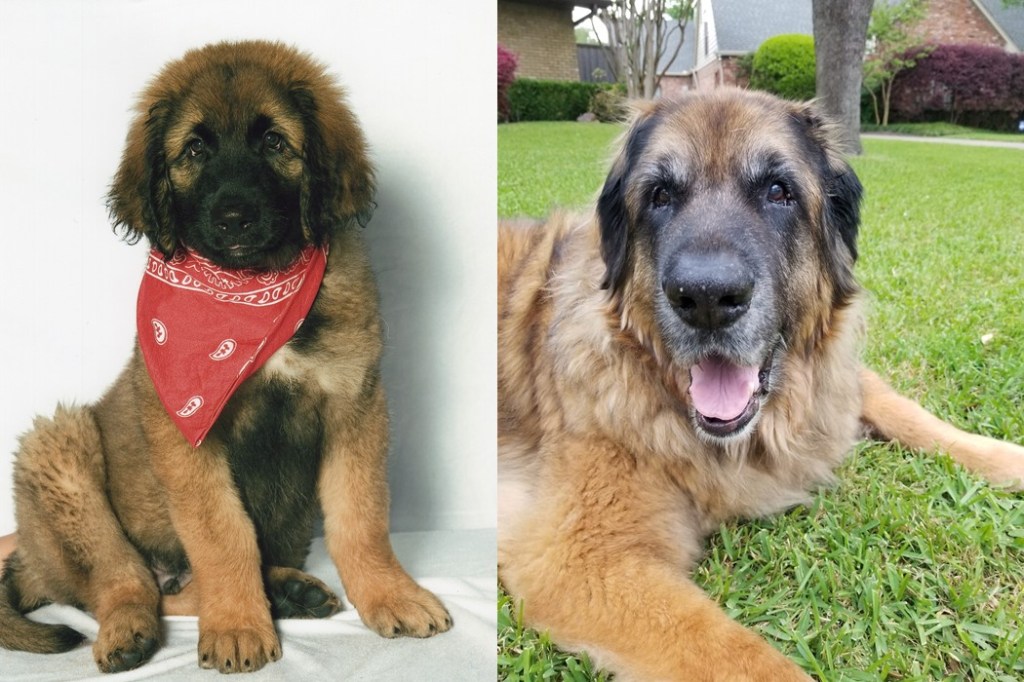
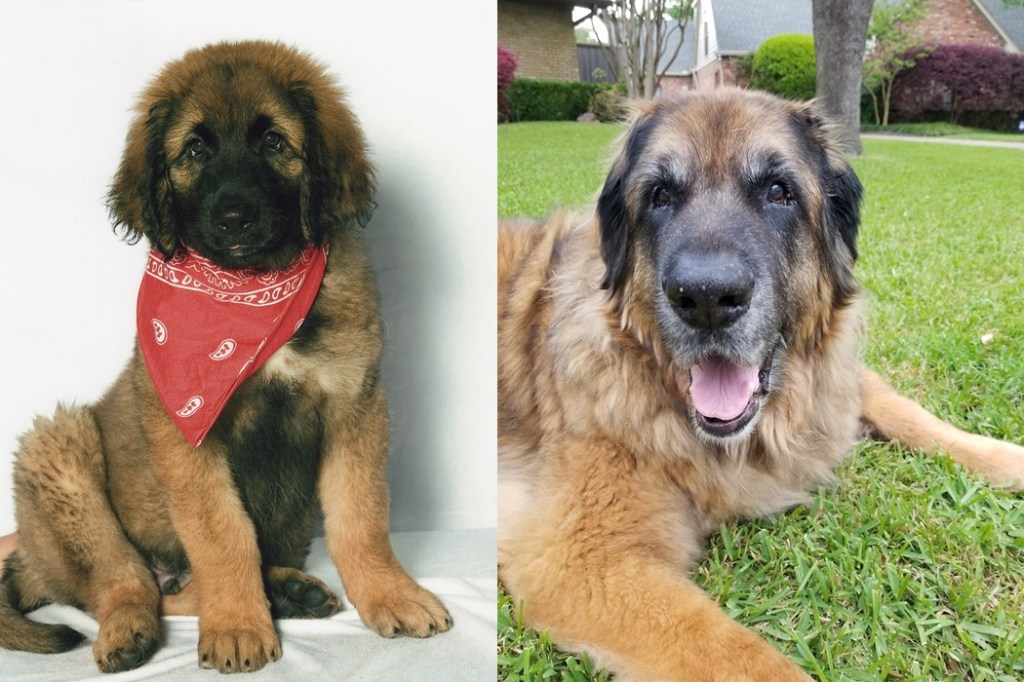
On the left there is a color photo of our Leonberger as a puppy. He is wearing a scarf. On the right he is big, old and gray and lying in the grass looking into the camera.
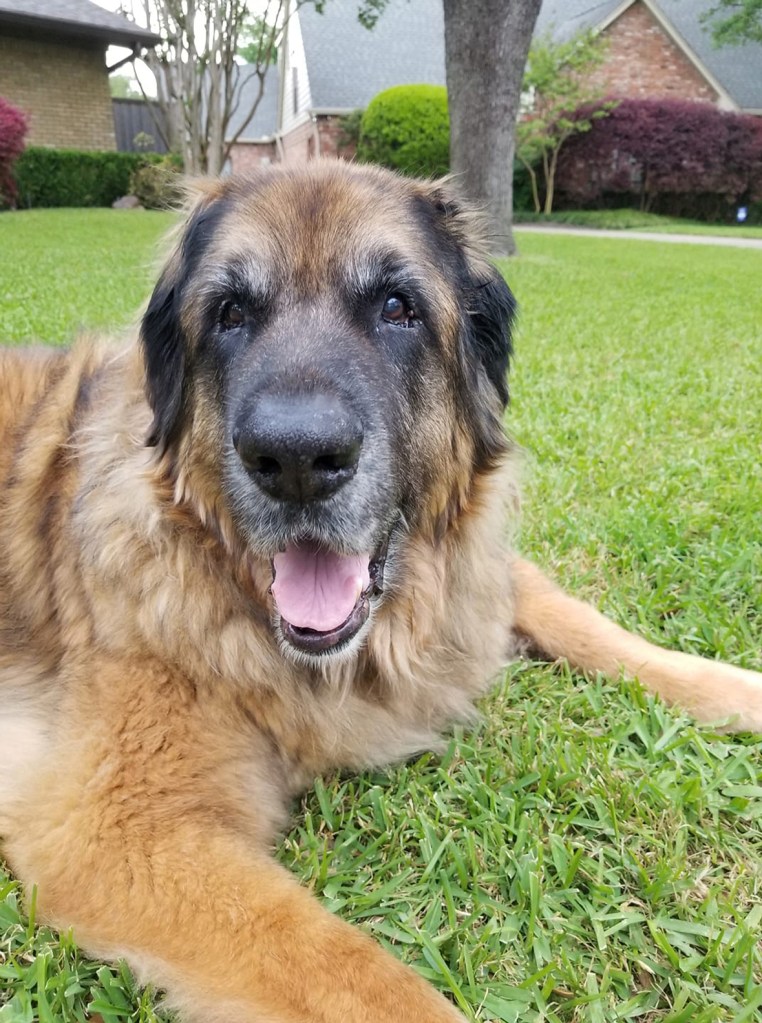
On the left our Leonberger Bronco at three months old. On the right Bronco as an unusually old Leonberger at almost 13.
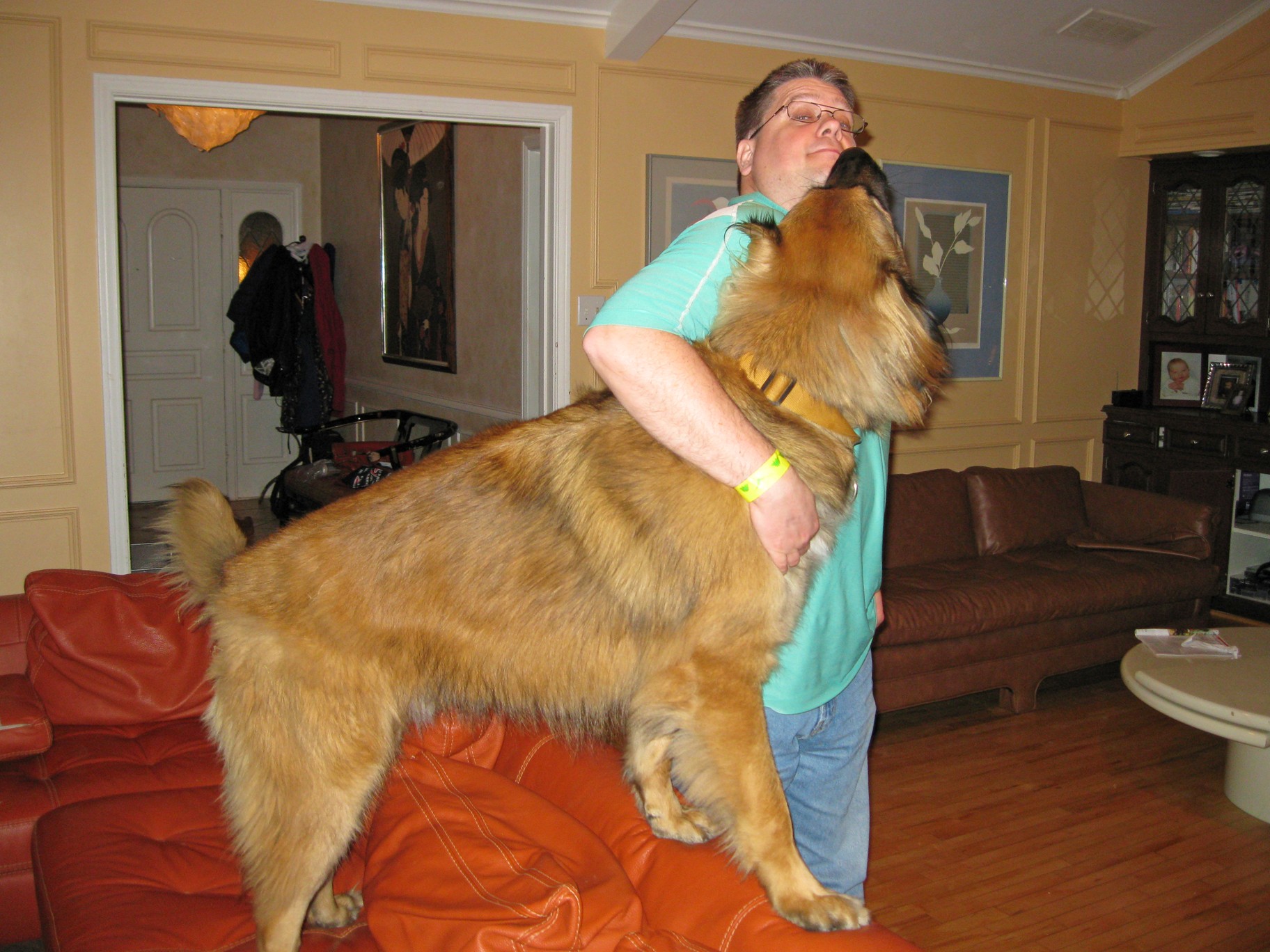
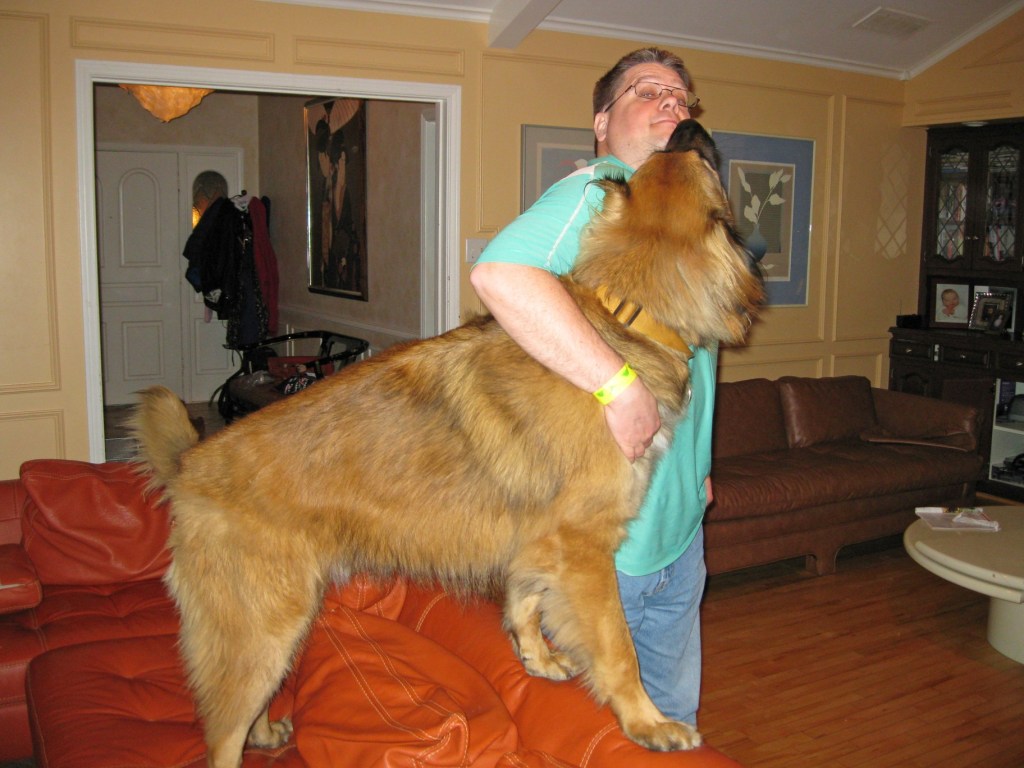
Bronco is standing on our red leather sofa giving me hug and a kiss.
Bronco our Leonberger is giving me a kiss. He is about one year old and not yet fully grown.
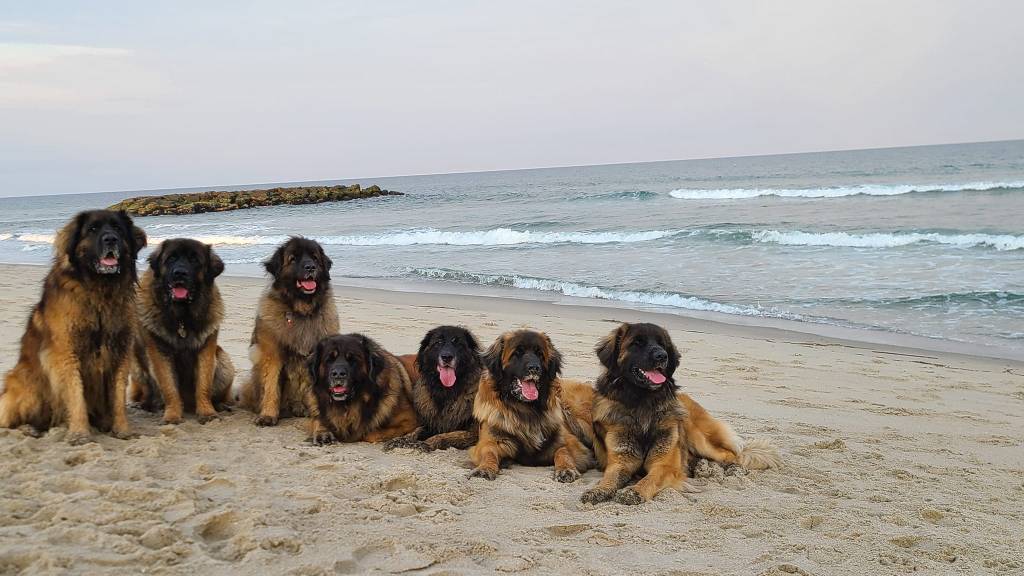
Seven Leonbergers lying or sitting on the sand on a beach.
Seven Leonbergers by the beach. Photo by Jen O’Keefe.

The Origins of the Leonberger Dog

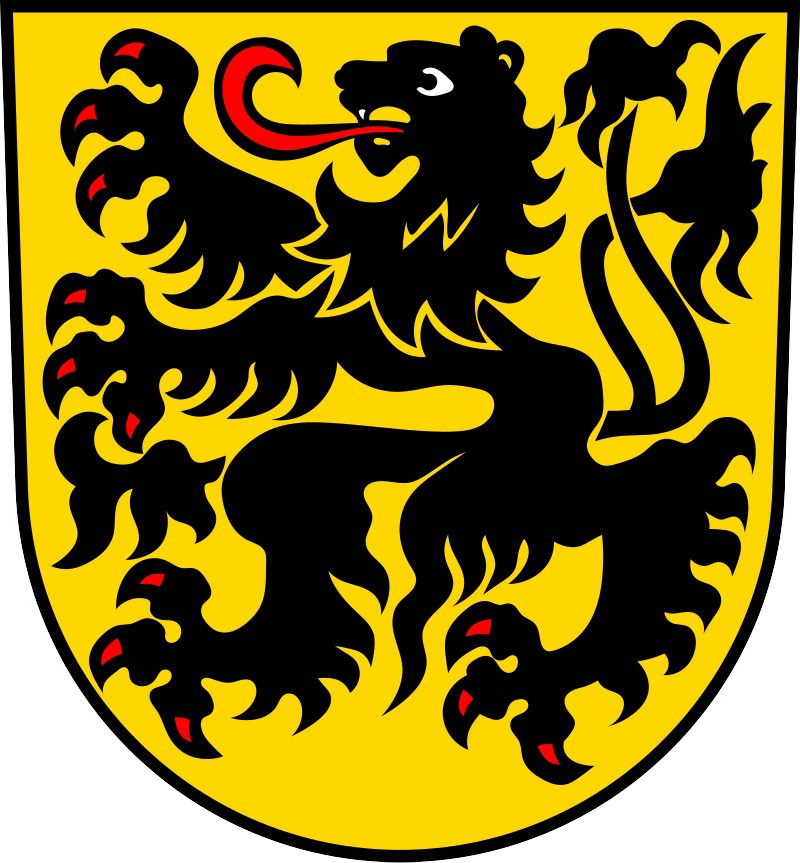
coat of arms of the town of Leonberg. A black lion like figure on a yellow background
The coat of arms of the town of Leonberg, Germany, was allegedly the inspiration for the first breeder of the Leonberger, Heinrich Essig.

The Leonberger breed was originally created by Heinrich Essig (1808–87) in the German town of Leonberg, in what was then the kingdom of Württemberg. According to legend, Essig bred the dog to resemble the lion in the town’s coat of arms. Indeed, as you can see in the image above, the lion in the coat of arms doesn’t look like a real lion, so you could say that the Leonberger looks the way it does because Germans were bad at drawing lions back then. All joking aside, though, Leonbergers do bear some resemblance to lions and maybe even bears. In any case, they are beautiful dogs.

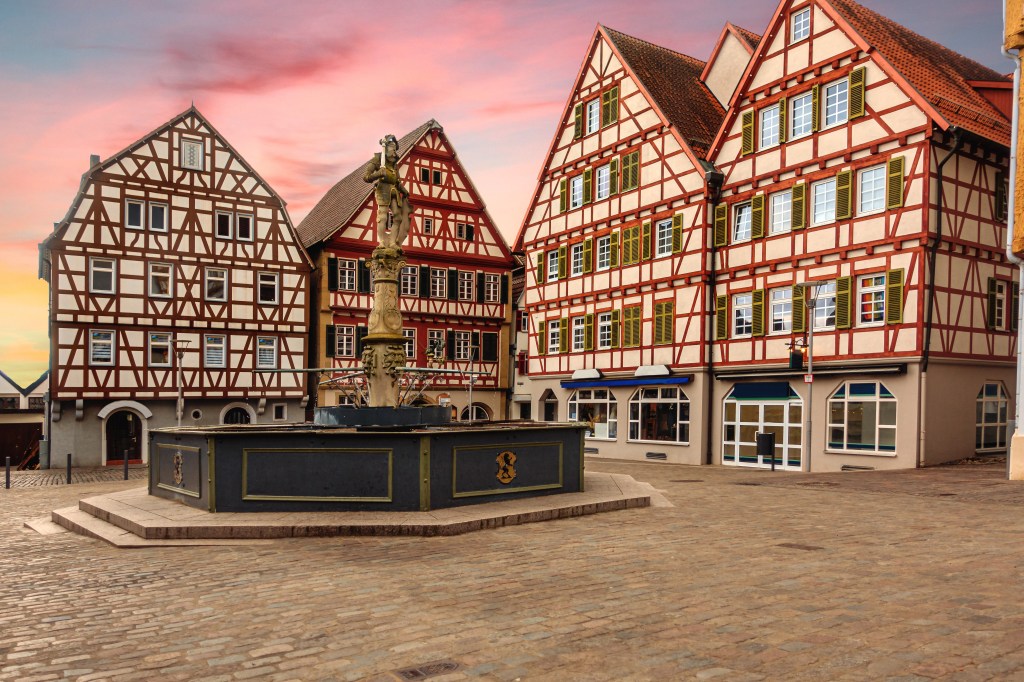
A town square surrounded by buildings. There is a statue in the middle.
The town square in the city of Leonberg. Shutter Stock Photo ID: 1689829297 by Martin Dutkiewicz.

When people would stop me and ask me questions about the kind of dog Bronco was, I would say he was a Leonberger, a cross between a Saint Bernard, a Newfoundland, and a Great Pyrenees and that the breed was created by the mayor of the German town of Leonberg. But, as the economist Tyler Cowen said, “Be suspicious of simple stories.” As it turns out, the story I kept telling was a simplification and not entirely true. History is more complicated. I was unintentionally spreading misinformation about Leonbergers.

A Leonberger puppy wearing a red silk scarf.
Our Leonberger Le Bronco von der Löwenhöhle at 3 months old.

Simple and interesting stories are easy to remember, easy to believe, and easy to propagate. But first, Heinrich Essig was never the mayor of Leonberg. He was a prominent citizen of the town, and he was a successful businessman, farmer, innkeeper, horse and dog trader, large dog enthusiast, dog breeder, and town councilman, but he was never the mayor.

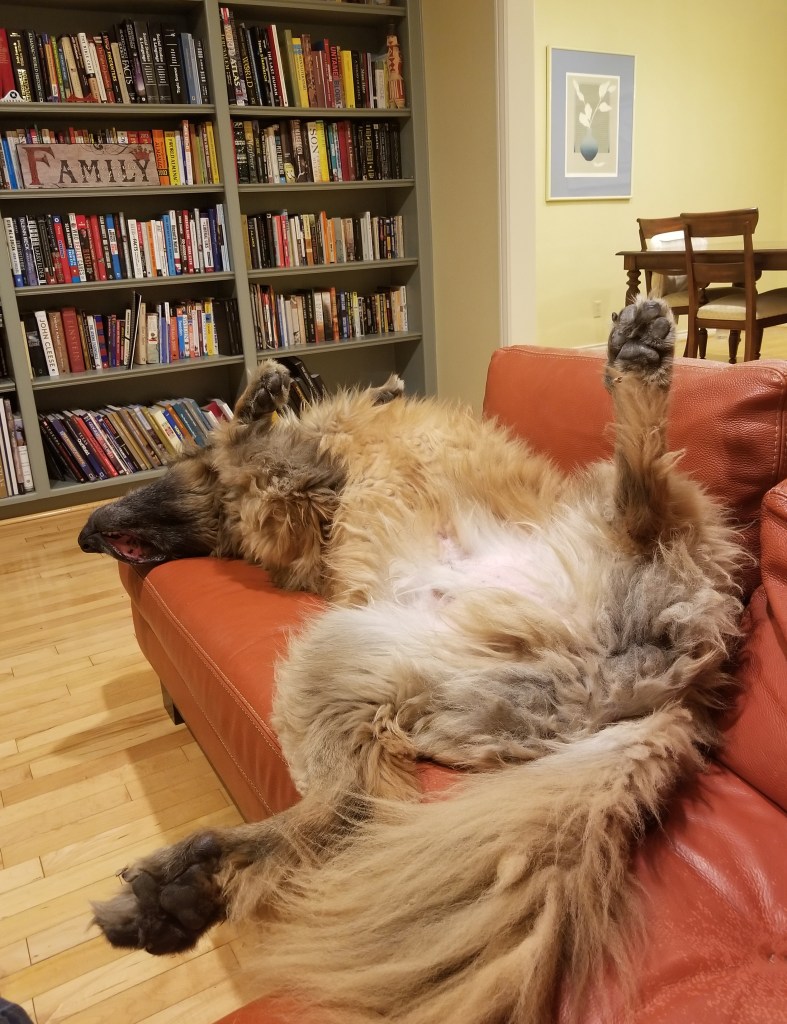
A big Leonberger splayed across a big wide red leather sofa.
Our Leonberger Bronco sleeping on our big red leather sofa.

Essig claimed to have created the Leonberger in the 1830s by crossing a female Landseer Newfoundland with a male long-haired Saint Bernard from the Great Saint Bernard Hospice, a monastery in Switzerland. He continued crossing the Landseer Newfoundland and the Saint Bernard over four generations, then he crossed his Newfoundland Saint Bernard mix with a Pyrenean wolfhound not, as is often asserted, with a Great Pyrenees (called a Pyrenean Mountain dog in Europe). He then crossed that dog with the Saint Bernard again. In 1846, he was finally ready to announce and register his “lion of a dog.” A few years later, Leonbergers were officially introduced to the public at the Munich Oktoberfest.

Our Leonberger is standing on the large red leather sofa giving me a kiss.
Me and our Leonberger Bronco when he was young.

However, the story is more complicated than that. There’s no specific breed named Pyrenean wolfhound today, so Essig could have used a Great Pyrenees or a Pyrenean mastiff . In addition, later in the nineteenth century, Leonbergers were used to breed the long-haired Saint Bernard dog, and this likely saved the Saint Bernard dog from extinction. At one point, too, Leonbergers were deliberately mixed with Newfoundland dogs to strengthen the Newfoundland breed. In other words, breeding happened in both directions, and the characteristics of the large breeds were in constant flux. The dogs, including Leonbergers and Saint Bernards didn’t look like they do today, either. Essig’s Leonbergers were multicolored, mostly white, and lacked the black mask that is so important to the breed now. What has not changed is the essence of what Essig was aiming for: a large but moderately proportioned dog that is friendly and loving and a great companion.

Saint Bernard Dog wearing a cognac barrel. The Alps in the background.
A modern Saint Bernard Dog. Shutter Stock Photo ID: 1713912484 by fred12.

Ultimately, the origins of the Leonberger, as well as the Saint Bernard and the other large breeds from this region, are complex and shrouded in mystery. In addition, some of Essig’s claims have been disputed. Breed standards wouldn’t be codified until the end of the nineteenth century. It should also be noted that it was Essig’s niece Marie who to a large extent bred and cared for the dogs.

Black or dark brown New Foundland Dog with a colorful autumn forest in the background.
Modern New Foundland Dog. Shutter Stock Photo ID: 1925281937 by Marsan.

Essig was selling his Leonberger dogs as luxury items to the wealthy. He was also a marketing genius and was able to get the attention of European nobility and royalty. The czar of Russia, Emperor Napoleon II, Otto von Bismarck, the king of Belgium, Empress Elisabeth of Austria, Emperor Maximilian I, the Prince of Wales, King Umberto of Italy, Giuseppe Garibaldi, and the mikado of Japan were among those who owned Leonbergers. Not everyone was happy about this. Some people viewed the Leonberger as a fashionable knockoff of the Saint Bernard that could hinder that breed’s development.

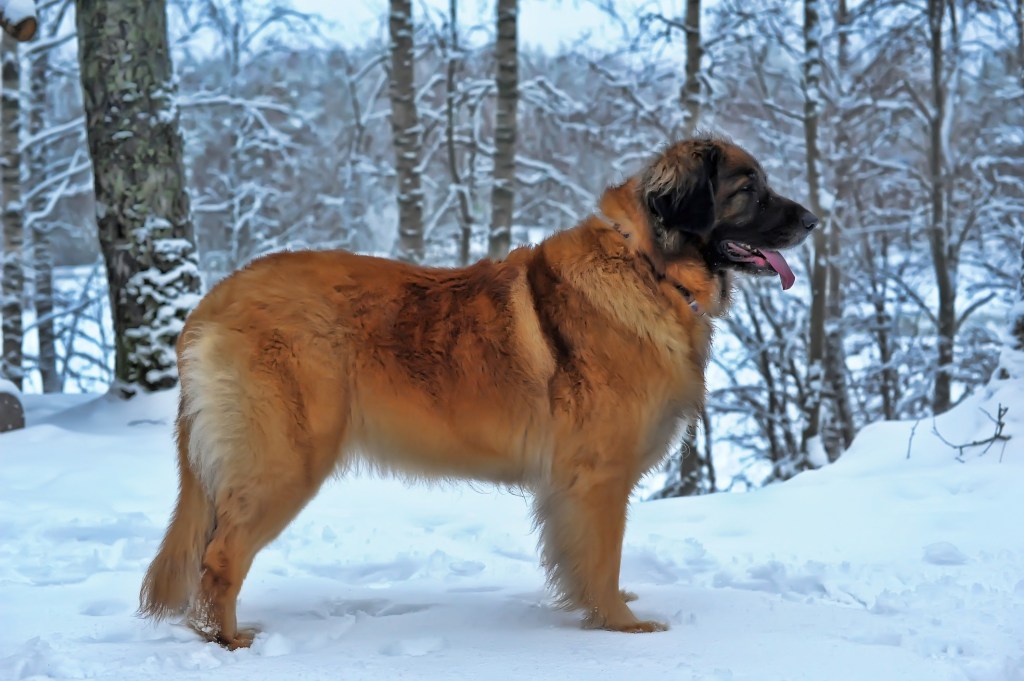
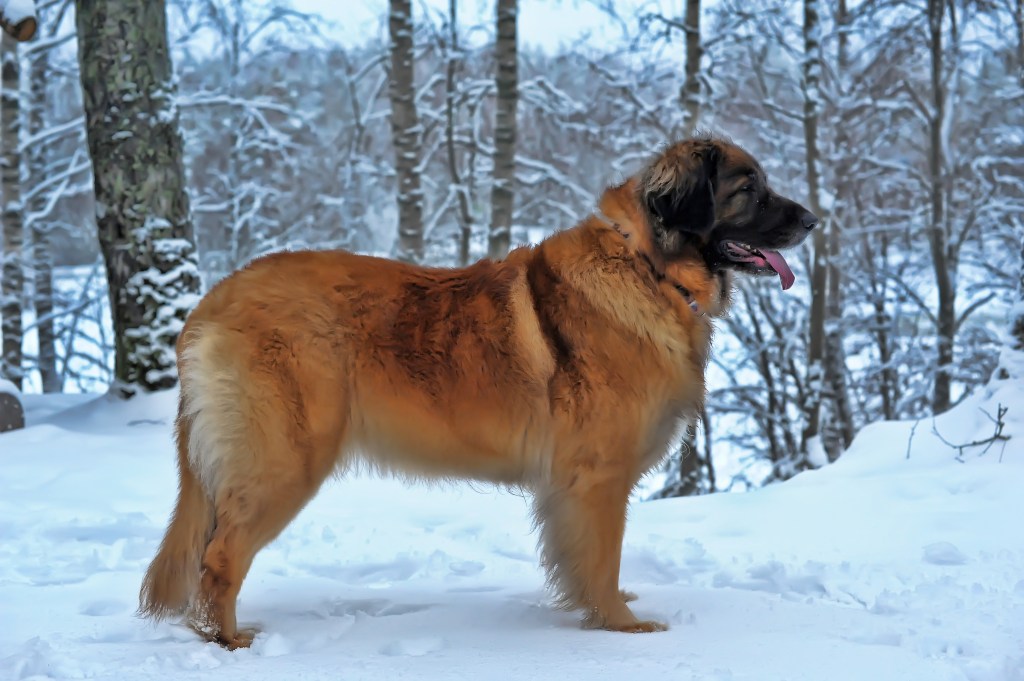
Photo of a Leonberger standing in the snow. There is a wintry forest in the background.
Modern Leonberger. Shutter Stock Photo ID:705193912 by Anna Krivitskaya.

Toward the end of the nineteenth century, the discipline of cynology, or the scientific study of dogs, emerged. Cynologists pushed for breed classification and systematic breeding practices, and breed standards were created. But Essig and others viewed dog breeding as an art rather than a science, and this led to a conflict with the cynologists. Heinrich Schumacher, for example, was a breeder who strove to create a clearly identifiable Saint Bernard type. He was upheld by the cynologists as a paragon, in contrast to Heinrich Essig to the detriment of the Leonberger.

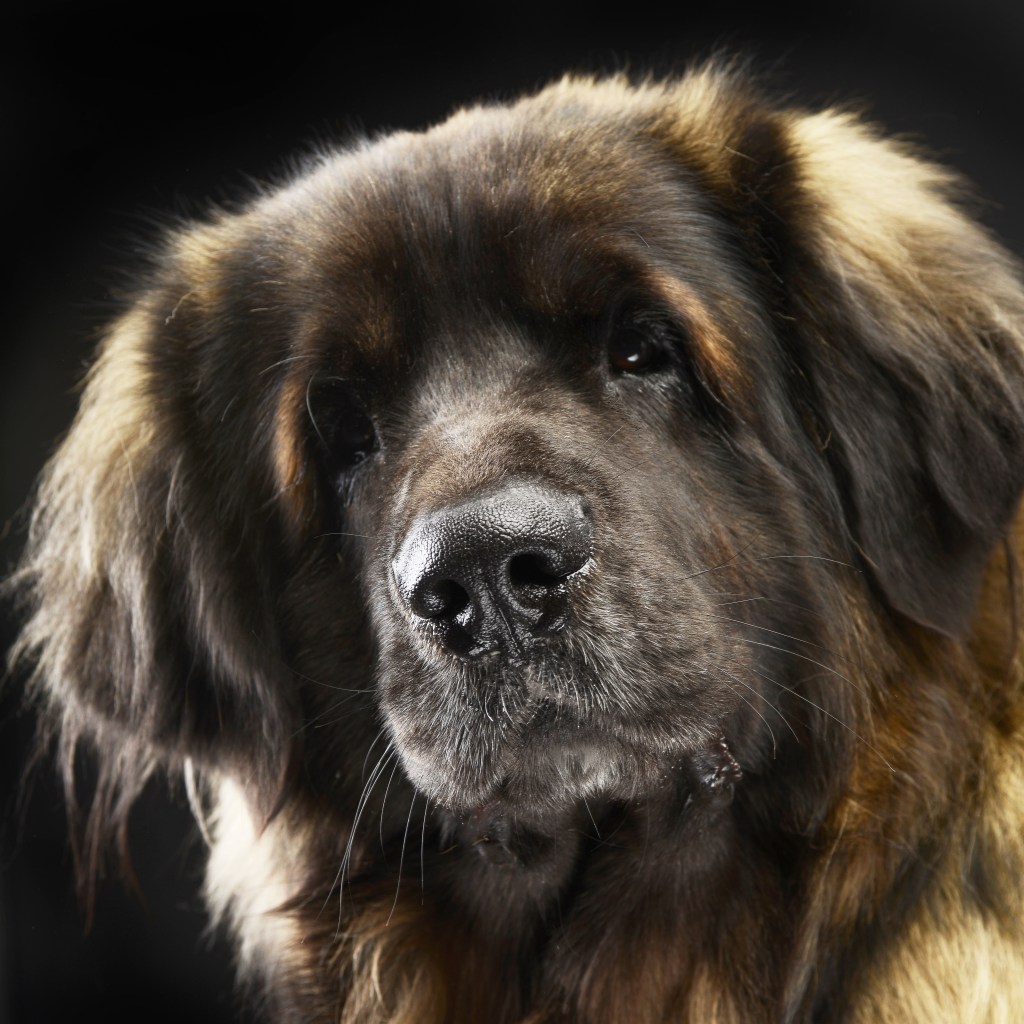
Face of a Leonberger looking into the camera.
Face of modern Leonberger. Shutter Stock Photo ID: 193024763 by Csanad Kiss.

After Essig’s death, in 1887, other people more willing to please the cynologists continued breeding Leonbergers. By that time, the dogs looked for the most part like Leonbergers do today. Then, in 1895, Albert Kull created the Leonberger’s first breed standard. It would go through several revisions in 1901, 1926, 1938, 1951, 1955, and 1972—until finally, in 1996, the FCI approved version was established. The Kennel Club in the UK and the American Kennel Club also have their own breed standards. However, most of them are similar to Albert Kull’s 1895 version. The first Leonberger club was formed 1891 in Berlin: two more were created in 1895, then two more were formed in 1901. The most prominent was the Internationaler Klub für Leonberger Hunde, of which Albert Kull was the first president.

For additional information see :

The Life and Times of Le Bronco von der Löwenhöhle: Stories and Tips from Thirteen Years with a Leonberger by Thomas Wikman.

Madeline Lusby, Leonberger: A Comprehensive Owner’s Guide (Allenhurst, NJ: Kennel Club Books, 2005).

Caroline Bliss-Isberg, Leonberger: A Comprehensive Guide to the Lion King of Breeds (Sea Cliff , NY: Revodana Publishing, 2017), 23, 41, 45, 48–49.

The Interview

There are so many bad dog owners out there. There are owners who mistreat their dogs. There are owners who return their dogs to shelters or worse owners who abandoned their dogs. There are owners who get rid of their dogs when they become old, less fun, more difficult to take care of and have expensive veterinary bills. So many dog owners should never have been allowed to become dog owners. Imagine if prospective dog owners had to go through an interview and sign a contract protecting the dog’s well being before they are allowed to buy a dog. Another problem is substandard breeders and puppy mills.

An old Leonberger dog is lying on the sidewalk.
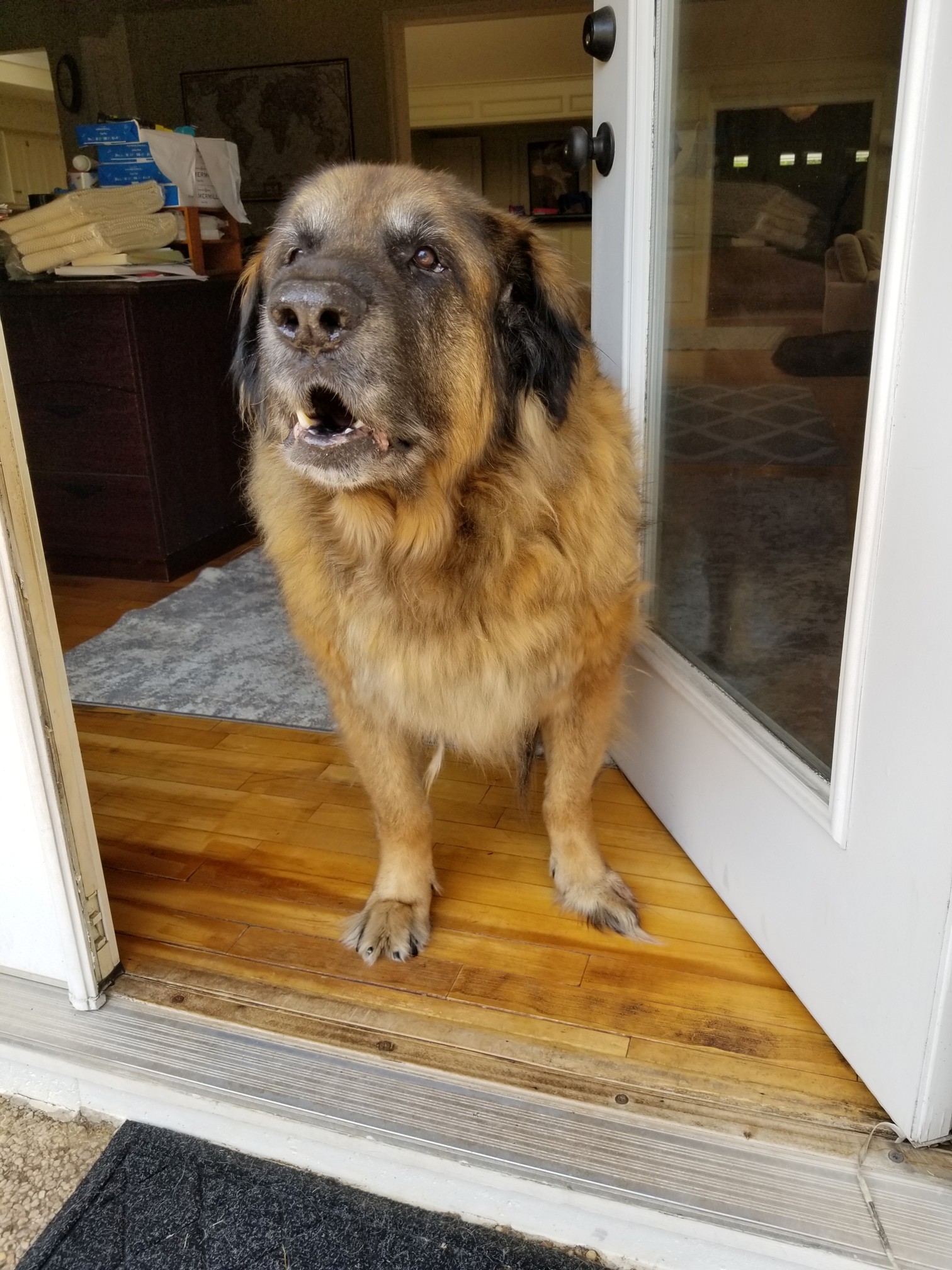
Bronco our Leonberger was very old in this photo. Almost 13 years old and he had health problems.

The Leonberger Club of America (LCA) and the Leonberger community have taken control of both of these problems. The Leonberger Club of America keeps a list of breeders who follow approved breeding practices (there are inspections), treat the dogs well, and have pledged to take back the dog in the event an owner is unable to care for the dog. The breeder will also stay in contact with the new owners, mentor them, and help them with training and care. I am pretty certain there are no Leonberger puppy mills.

From left to right : A Leonberger in the snow, another Leonberger looking into the camera, our 3 months old Leonberger puppy Bronco, our Leonberger Bronco in a green bush, our Leonberger Bronco sitting in my wife’s lap, he is 167lbs, our Leonberger Bronco in the green grass, our old Leonberger Bronco lying in the green grass.
Leonberger photos. All photos are of Bronco except the two on the far left are from Shutterstock ID:705193912 and ID:46221958.

As a prospective owner you are required to go through an interview with the breeder and to sign a contract. For example, as an owner you are required to return the dog to the breeder if you are unable to care for the dog or transfer the dog to another approved owner in a manner that is endorsed by LCA. If you break the rules, you are never allowed to own a Leonberger again. Caring for a Leonberger is a serious commitment and you can feel it. Leonbergers are dogs that are larger than life. But maybe all dogs are larger than life.

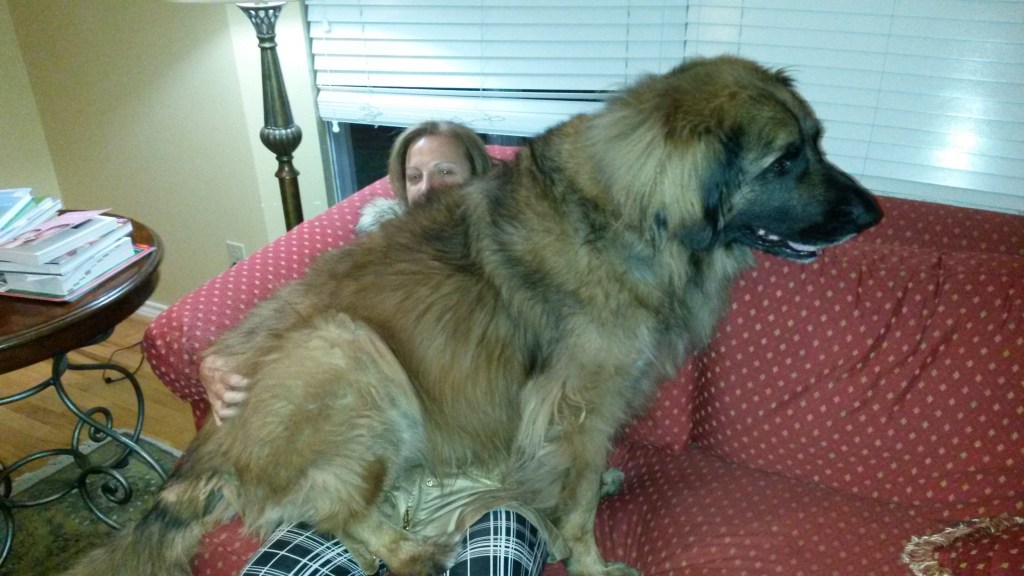
A 167lbs Leonberger sitting in my wife Claudia’s lap. She is disappearing.
Our Leonberger Le Bronco von der Löwenhöhle in my wife Claudia’s lap.

Below is the transcript of the online interview that my wife Claudia did with our breeder Julie Schaffert. I’ve posted this before here. However, that post is one my earliest posts, and this is my attempted improvement.

Kennel von der Löwenhöhle Questionnaire Questions are in bold :

Why do you want a Leonberger?

We have a dog book, and while looking at dogs we came across the Leonberger, a gorgeous dog from Germany. We also had the opportunity to meet some Leonbergers, a mother and her puppies, which were wonderful. We have read that Leonbergers are great with children and good guard dogs, which is something we’d like. We have two dogs, but we have not raised them as puppies. We have never had a puppy and would like to have one.

What do you like about the Leonberger and what do you know about its characteristics? Do you prefer male or female? Why?

They are very beautiful and love to swim. We have a huge pool, and my children love to spend their summers swimming. Leonbergers also make wonderful pets and are good guard dogs, and best of all they don’t drool. We don’t prefer a male or a female dog.

Are you aware this is at least a ten-year commitment?

Yes. We have two other dogs, and of course we are aware that they live up to ten years—hopefully more.

Do you have any other pets? Have you had any experience raising a giant-breed puppy?

We have a Lab and a German shepherd. We have two dwarf hamsters, Moldova and Montenegro. My son also keeps a baby ball python in a cage in his room (UGGH). As I said before, we have never owned a puppy, but we met some Leonberger puppies from a breeder who resides in Houston.

Where will your dog be kept—indoors or outdoors? Backyard or kennel?

Our dog would be kept mostly indoors. (We live in Texas, and it would get too hot outside.) At night we take all our dogs for walks and for occasional swims during the year. When the dog is still a puppy, we would keep it in a puppy playpen and take it out every half hour to go to the bathroom (until obedience training). We do have a fenced backyard the puppy can play in, and we have a dog run with a dog door so the dogs can come and go as they please.

Is your yard fenced?

Yes. Our yard has a seven-foot-high solid wood fence all the way around

How many hours will you be out of the house? Where will your Leonberger be while you are gone?

I am a stay-at-home mom, and we would almost always have someone in the house, such as our housekeeper, children, and family. If we are gone for a long periods of time, we have a dog sitter who comes to our house to take care of our dogs.

Do you have children? If so, what are their ages?

We have three kids, ages thirteen, ten, and eight. Two boys and one girl (in that order).

Describe a typical day at your house now. How do you think it will change once the puppy arrives?

On a typical day, the kids go to school, and I like to take a long walk. I go through some paperwork, I prepare dinner, then everyone comes home. On weekends, my younger kids have sports, but my oldest kid stays home (he plays during the week).

I would be with the dog most of the day and would do my shopping while the housekeeper is there. I do not plan on leaving the puppy for any long period of time. I’m sure that having the puppy will be like having another child. We have been told that the puppy will be quite rambunctious for the first three years of its life.

Have you observed any obedience classes in your area? It is very important that Leonberger puppies start obedience classes by sixteen weeks of age. Would you attend such classes?

We have not observed any obedience classes yet. However, we are interested in the International K9 training facility in Dallas and would absolutely attend these classes.

Von der Löwenhöhle puppies start their crate training at our kennel. Will you continue this training? If not, why not?

Yes, we would continue crate training at our home. We will follow your advice and that of our veterinarians in regard to further training.

What plans do you have for your Leonberger—e.g., showing, breeding, obedience, family companion, therapy? If you plan to show or breed, what experience, if any, have you had?

Our major purpose for wanting a Leonberger is to have a family companion.

Please add any other information you feel will help us pick out a puppy for you.

We would like a dog that will fit in well with our family.

On the left is a Leonberger puppy wearing a red scarf. On the right our old Leonberger Bronco lying in the grass and looking into the camera.
Our Leonberger Bronco three months old and almost 13 years old.

The end result was that we were allowed to buy Bronco. We did not follow through with the crate training as we promised because Bronco was whining at night when he was in the crate. So, we let him sleep between us in our bed. A few months later he started pushing me out of bed with his paws. I don’t like sleeping on the floor, so we had to put an end to that. We got him a big dog bed and he accepted that.

What do you think about having dog owners being approved and signing a contract ?

A Leonberger Therapy Dog Called Scout

Here is an interesting video about a Leonberger called Scout by CBC news in Canada. This Leonberger is helping residents at Hamilton mental health hospital. He was bred by Concorde Ridge Leonbergers. They have a website and a blog which I follow. The 8-minute video is shown on the website below.

https://www.cbc.ca/player/play/video/1.6835161

Reminder Of The Leonberger Health Foundation International

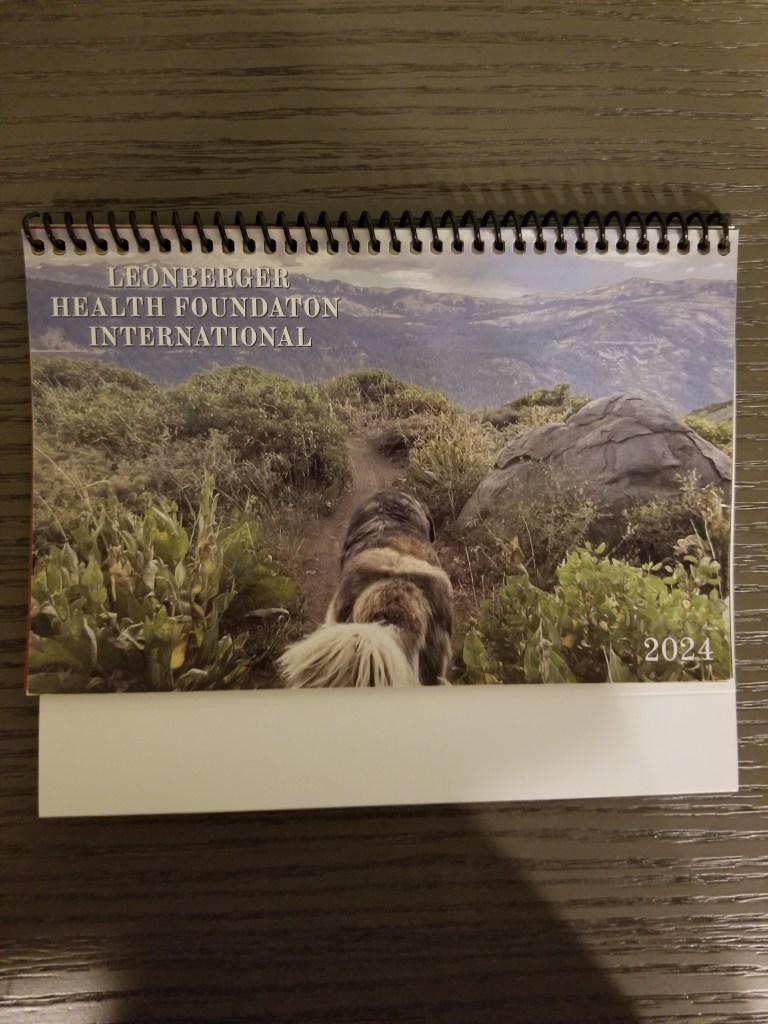
Today I received the Leonberger Health Foundation International (LHFI) Calendar for 2024 and I was reminded of this wonderful organization. LHFI supports medical research that improves the health and lives of Leonbergers as well as other large dog breeds, potentially even humans. They have raised nearly half a million dollars for research into conditions that affect canine health, including osteosarcoma, hemangiosarcoma, glaucoma, cardiac diseases, thyroid diseases, and neurological disorders. Its research also supports healthful longevity and aging as well as population diversity. They have had several successes, for example the eradication of Addision’s disease among Leonbergers.

Front page of the LHFI Calendar showing a mountaneous landscape and a Leonberger
Front page of the Leonberger Health Foundation International 2024 Calendar

The Leonberger Health Foundation International (LHFI) was founded in 2000 by Waltraut Zieher and other members of the LCA’s health, education, and research committee to “facilitate the solicitation and distribution of donations given to support health related breed-specific research.” The LHFI also administers a program that collects DNA samples from Leonbergers to share with universities and research institutions.

January page of LHFI Calendar showing two Leonbergers in snow
January page of the Leonberger Health Foundation International 2024 Calendar

All purebred dogs are more or less inbred, which comes with inherent health risks. That is especially true for large breeds. However, Leonbergers, especially those bred in North America, are fortunate compared to other large breeds. The Leonberger breed standard does not call for traits that can be detrimental to health. The precise and restrictive breeding regulations of the Leonberger Club of America (LCA) and other Leonberger clubs, and the work of the Leonberger Health Foundation International or LHFI, have resulted in Leonbergers being relatively free of inherited illnesses compared to other large dog breeds in America. For more information see Humane Society Veterinary Medical Association, “Guide to Congenital and Heritable Disorders in Dogs,”

June page of the the LHFI Calendar shows a Leonberger on a canoe.
June page of the the Leonberger Health Foundation International 2024 Calendar

One happy event for our family was when Bronco received his Grey Muzzle Award, which is an award given for longevity by LHFI. LHFI bestows the award on any Leonberger who has reached the age of twelve. These Leonbergers are the canine equivalents of centenarians, humans who are at least one hundred years old. The Grey Muzzle Award is also given to breeders, because they are partially responsible for the dogs’ longevity. The Grey Muzzle Award was certainly a happy event in Wikman family. If you have a twelve-year-old Leonberger, simply fill out a form on the LHFI website or send an email to lhfgreymuzzle@gmail.com.

The Grey Muzzle Award from the Leonberger Health Foundation International contains a photo of our Leonberger Bronco's face and the text

The Grey Muzzle Award
For Leonbergers Longevity is Presented with Gratitude By
The Leonberger Health Foundation International To

Bronco
For Offering Hope and Potential For Longer Lives for Leonbergers
The Grey Muzzle Award from the Leonberger Health Foundation International

The foundation will ask for some information, including the registered name and call name of the dog; the breeder’s name, kennel name, address, and email; the dam’s registered name; the sire’s registered name; the owner’s name, address, and email; the birth date of the dog; and whether the dog is alive or dead. If the latter, they will want to know the cause of death. In addition, they would like you to write a one-paragraph tribute to the dog and send two (preferably high-resolution) photos—one head shot and one favorite photo. To find out more about the Grey Muzzle Award click here. To see the 2019–2020 awardees video featuring Bronco click here.

Photo copy of the full Grey Muzzle Award Diploma. Lots of text.
Grey Muzzle Award certificate from the Leonberger Health Foundation International

I can add that when Bronco passed away, we sent his DNA to the University of Minnesota to be used in research. This was facilitated by the LHFI.

Familiar faces. Time marches on.

The faces (Leonberger dogs) of the 33 2019 & 2020 Grey Muzzle Awardees
The 2019-2020 Grey Muzzle Awardees. Bronco is on the second row from the top and second from left. Click on the picture to visit the YouTube video.
Video showing 33 2019 & 2020 Grey Muzzle Awardees (Leonbergers)

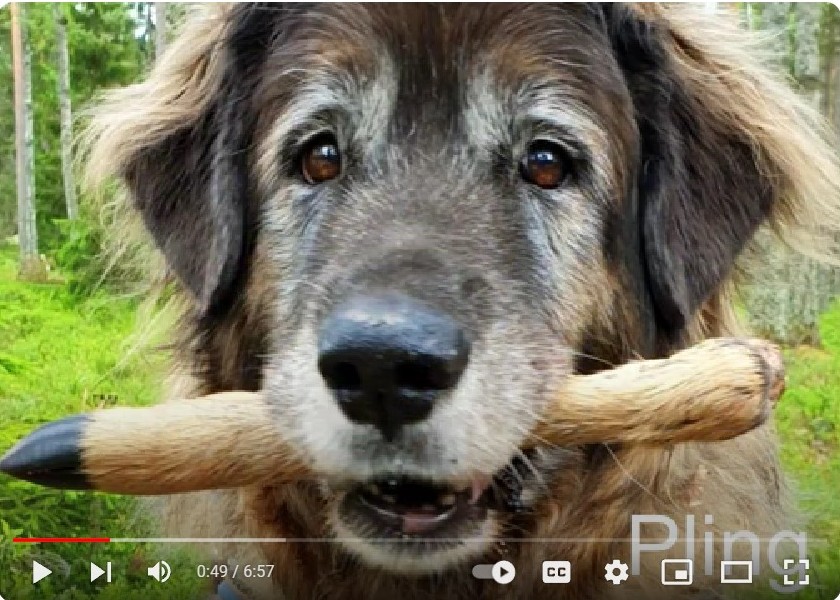
Many of the owners of very old Leonbergers joined the Double Digit Leonberger group on Facebook (Leonberger 10+ years old) and the owners of the extremely old Leonbergers (around 12 or older) started talking to each other a lot. It was a small group from around the world. This is why I said “Familiar faces” above. I knew many of them, including Pling, a Leonberger in Sweden. I and Pling’s owner talked a lot to each other in Swedish. Bronco and Pling reached about the same age and passed not too far from each other in time.

Our Leonberger Bronco from the LHFI Grey Muzzle Awardee Video 2019-2020. The photo/screenshot shows a close up of his face.
Our Leonberger Bronco from the LHFI Grey Muzzle Awardee Video 2019-2020.
The photo shows 12+ year old Bronco in our TV room
Our Leonberger Bronco from the LHFI Grey Muzzle Awardee Video 2019-2020.
Pling the Leonberger from Sweden is holding a stick in her mouth.
Pling a Leonberger from Sweden from the LHFI Grey Muzzle Awardee Video 2019-2020.

Note, all royalty earnings from my book (see right) go to the Leonberger Health Foundation International.

Leonberger Facebook Groups Are the Nicest Dog Groups I Have Found

I’ve been, or am, a member of several Facebook dog groups. I’ve found that most of them are awful. Take for example the Pug groups. I’ve joined a few Pug groups so that can post about Daisy. What I’ve found is that almost all of the Pug groups have preapproval turned on for all posts. Most other groups (Leonberger groups, beer groups, discussion group, etc..) do not. It would not be a bad thing if it wasn’t for the fact that the administrators/moderators of several of the Pug groups take weeks before they approve a post, all while shamelessly doing constant self-promotion, promoting products, and spamming the group they are supposed to moderate. I am a moderator or administrator in several groups, and I certainly don’t behave that way.

Another thing that annoys me is that they copy the photos that members post and then repost them in multiple places and multiple groups without attribution. Look at my photo from Daisy’s birthday below. That photo was copied (not shared) without attribution in lots of groups, multiple times, receiving several thousand reactions and thousands of comments, which is something I only found out about by accident. Who knows how far and wide the photo was spread. Unless someone explained it to you, you would think that it was their pug and that it was they who took the photo. I assume they do this because they want to get attention and be social network influencers. I’ve never complained, that probably would get me banned from the groups in question. However, I don’t think that is the way to run a group. I have not yet found a decent Pug group.

Photo of our Pug Daisy being fed a pupcake.
Photo from Daisy’s 15th birthday on October 22. This photo has been spread all over Facebook without attribution.

This brings me to the seven Leonberger groups that I am a member of (there are many more). I’ve listed them below. Only one group does post pre-approval and they typically approve posts within a few hours. None of moderators/administrators of these groups spam their groups, try to push products, or copy members photos/posts without attribution. People have friendly informative discussions, and they get to know each other. The Leonberger community is smaller, and the owners/administrators/moderators of the groups are more mature and responsible. I think it makes a difference that Pug groups tend to be run by attention seeking youngsters. I wish I could find a Pug group that was more like a Leonberger group.

  • Leonberger’s All Colors Worldwide
  • LEONBERGER
  • Leonberger Double Digit Double Club
  • Leonberger Forum
  • Global Leonberger Lovers
  • Leonberger Lovers
  • Frontier Leonberger Club of the Southwest

I think my favorite Leonberger group is the Leonberger Double Digit Club. It is a group for Leonberger owners with Leonbergers who ten years are old or older. Leonbergers tend not to live very long so that is why this is an exclusive club. It was one of the former administrators (and founder) of this group who suggested to me that I write a book about our Leonberger Bronco.

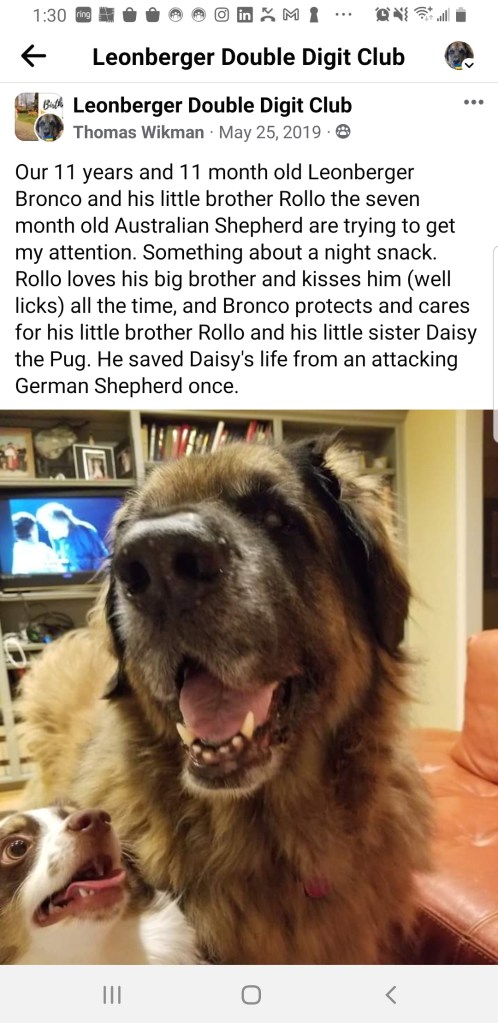
Below I am posting a few screenshots of my posts from the Leonberger Double Digit Club.

Photo of our Leonberger Bronco and our mini-Australian Shepherd Rollo in the lower right corner. Both close up to my face.
Our Leonberger Bronco standing in the kitchen. Our mini-Australian Shepherd Rollo is behind him.
This photo is from Bronco’s 12 years and 8 months birthday. He demanded a greenie by slamming his paw in the floor. Daisy our Pug and Rollo our mini-Australian Shepherd are looking on from behind.
Bronco our Leonberger just got his grey muzzle award, which is given to all Leonberger (who’s owner apply) older than 12 years old. Being older than 12 years old is rare among Leonbergers. The photos show Bronco with my wife holding his diploma.

Jacqui pointed out to me in a comment below that you can take action when people are using your stuff without attribution. A photo that took me a second to take may not be a big deal, even though it is bit rude to use it as if it is yours. However, when people copy artwork, as had happened to a few commentors below we have a more serious situation. So anyway, here is the link that Jacqui posted in her comment. (You can also visit the comment).

Send them a DMCA take-down order (https://www.dmca.com/FAQ/What-is-a-DMCA-Takedown) or turn them into Facebook for copyright infringement.

About Me and Our Leonberger and LHFI

Tomorrow I will do book signing at Wautega Public Library here in Texas. I will read a short story from my book and present myself. I will also mention that all royalties from book sales go to the Leonberger Health Foundation International, or LHFI, a charitable organization working towards healthier Leonbergers and healthier dogs in general. Below is my is my 20 seconds video pitch.

Hi, I’m Thomas Wikman, author of the Life and Times of Le Bronco von der Löwenhöhle, a book featuring funny and informative stories about our Leonberger. It is a great book for all dog lovers. All royalties from book sales are donated to the Leonberger Health Foundation International. Their work gives us healthier dogs.

My 20 second video pitch.
Me standing in front of a painting wearing a blue suit
That’s me a few days ago.
Leonberger Health Foundation Logo. A Leonberger puppy surrounded by flags from around the world.
The Leonberger Health Foundation International. Click on the image to visit the LHFI’s website.

The Leonberger is an unusual and fascinating dog breed that is known for its size, affectionate nature, and intelligence. I know a lot about Leonbergers because my family was lucky enough to live with one for thirteen years. His name was Le Bronco von der Löwenhöhle—but we called him “Bronco” for short.

Bronco wasn’t our only dog, but our world wouldn’t have been the same without him. For instance, he once saved the life of our pug by fending off an attack from another dog. He probably saved our Labrador’s life, too, by sniffing out an impending insulin shock before it happened. Then there was the time he scared off a trespasser who’d been terrorizing my wife and other women in the neighborhood.

Photo of me with one year old Bronco, our Leonberger. He is standing on a sofa.
This is me with our late Leonberger Bronco when he was still young, not even one years old.

Bronco is no longer with us, but even in his passing he was distinctive. Leonbergers tend to live less than nine years—but Bronco came very close to reaching his thirteenth birthday. In fact, he received an award for longevity called the “Grey Muzzle Award.”  We already knew he was a special dog, but we sent his DNA to two labs for research anyway.

Bronco's Grey Muzzle Award. In the middle of the diploma is a photo of Bronco. The text says "The Grey Muzzle Award", "For Leonberger Longevity Is Presented with Gratitude By The Leonberger Health Foundation International To Bronco For Offering Hope And Potential For Longer Lives For Leonbergers Throughout The World"
The Grey Muzzle Award is given to Leonbergers who reach the age of 12 years or older.
YouTube video featuring Grey Muzzle Awardees including Bronco, entry nr 10 out of 34 at 2 minutes. This is an emotional video for me, not only because of Bronco, but I was very familiar with many of the other dogs. Time marches on.
A second part of the Grey Muzzle award is a signed document.
Bronco’s Grey Muzzle Award

The Leonberger Club of America

If you own a Leonberger, or are interested in Leonbergers, and you live in North America you likely know about the Leonberger Club of America, or the LCA for short. You are about as likely to find a Leonberger at Petland/Puppy-Mill as you are finding an Elephant for sale there. LCA is very protective of the Leonberger breed and of Leonbergers in general. You typically buy/get a Leonberger dog from an LCA certified Leonberger breeder or from the Leonberger Rescue Pals, and if you don’t that might be a problem.

This is a photo of our Leonberger Bronco (Le Bronco von der Löwenhöhle) in 2007. He was three months old.
We bought our Leonberger Bronco (Le Bronco von der Löwenhöhle) in 2007 from Julie Schaffert, a certified LCA breeder since 1992.

There are only about 3,000 Leonbergers in North America and about 2,000 Leonbergers in the United States but the Leonberger Club of America has more than 1,000 members. They publish the Leo-Letter, a quarterly Leonberger magazine. So, the Leonberger Club of America has a very prominent place among Leonberger owners. Click here to see a summary of the Leonberger Breed Standard.

Leonberger winning a price
Photo of a Leonberger from the LCA website

Other clubs associated with the Leonberger Club of America are New Jersey Leonberger Club, Great Lakes Leonberger Club, Greater Bluegrass Leonberger Club, Mid-Atlantic Leonberger Club Of Virginia, AKC Licensed Specialty Club, Tarheel Leonberger Club, AKC Licensed Specialty Club, The Frontier Leonberger Club Of The Southwest, Leonberger Club Of The Northwest, Northern California Leonberger Club. I am a member of The Frontier Leonberger Club Of The Southwest.

Other more or less related Leonberger clubs are the Leonberger University, Leonberger Health Foundation Internation and the Worldwide Leonberger Database. All proceeds from the sale of my book go to the Leonberger Health Foundation International.

Leonbergers have a long history in North America and the United States—despite the fact that until 1985, there were only seventeen Leonbergers known to be living in the United States.

See: Lusby, Leonberger, page 15.

Front cover photo of Leonberger, Special Rare-Breed Edition, A Comprehensive Owners Guide, Madeline Lusby.
Leonberger, Special Rare-Breed Edition, A Comprehensive Owners Guide, Madeline Lusby. Click on the image to see my five star review for this book.

In the 1870s, Leonbergers were brought to Newfoundland to invigorate the stock of Newfoundland dogs. Around the same time, two Leonbergers named Caesar and Sultan were purchased from Heinrich Essig’s kennel (founder of the Leonberger breed) and transported across the ocean to join the Wellesley-Sterling theater company in the United States as the stars of their productions. Then in 1879, Caesar and Sultan visited President Ulysses S. Grant, who called them the largest and most magnificent dogs he had ever seen and presented them with gold medals. During the years between World War I and World War II, a New Jersey family, the Wolfs, opened their home as a temporary refuge for Jews fleeing Germany: they also imported Leonbergers. Unfortunately, this introduction of the breed into the United States did not last, and it would be another fifty years before the Leonberger appeared in America again.

See: Bliss-Isberg, Leonberger, page 60, page 64, page 101

Front cover of Leonberger, A comprehensive guide to the lion king of breeds, Caroline Bliss-Isberg.
Leonberger, A comprehensive guide to the lion king of breeds, Caroline Bliss-Isberg. Click on the image to see my five start review for this book.

During the late 1970s and the 1980s, a few families—Waltraut and Klaus Zieher, Brian Peters, Manfred and Sylvia Kaufmann, Keri Campbell and Melanie Brown, and Mary and Reiner Decher brought Leonbergers to the United States. The Dechers had started a breeding program and were looking for a mate for their first dam, Viona. By chance their neighbor discovered through a newsletter that there was another Leonberger in the United States, and that led to the families’ finding and connecting with one another. I should add that the Dechers were careful to conform to the German breeding regulations and performed hip X-rays that they then submitted to the Orthopedic Foundation for Animals (OFA). Viona became the first OFA-certified Leonberger in America.

See: Bliss-Isberg, Leonberger, page 152.

On Saturday, November 2, 1985, eight of these Leonberger enthusiasts met at a hotel in Denver, Colorado, to found the Leonberger Club of America (LCA). This group of founders, which has since been dubbed the Denver Eight, appointed a registrar, formulated a breeding acceptability checklist, and instituted various policies, including the requirement that OFA certification is mandatory for breeding. LCA membership grew: it held social gatherings, began publishing LeoLetter, and imported an increasing number of dogs. Now the LCA has thousands of members across the country, and Leonbergers receive high ratings on health tests relative to other large breeds. For example, in 2000, the OFA reported that only 14.6 percent of Leonbergers tested positive for hip dysplasia, compared to 47 percent of Saint Bernards.

See: Bliss-Isberg, Leonberger, page 154, page 176.

Another important historical event was the founding of the Leonberger Health Foundation International (LHFI), in 2000 (it was just called the Leonberger Health Foundation back then). According to its website, the organization was founded by Waltraut Zieher and other memers of the LCA’s health, education, and research committee to “facilitate the solicitation and distribution of donations given to support health related breed-specific research.” The LHFI also administers a program that collects DNA samples from Leonbergers to share with universities and research institutions, and of course it administers the Grey Muzzle Award (long living Leonbergers). Our Leonberger Bronco was a recipient of the Grey Muzzle Award, and we provided them with his DNA.

Bronco's Grey Muzzle Award, which he received for being an unusually long lived Leonberger. It was give by the Leonberger Health Foundation International, for offering hope and potential for longer lives for Leonbergers throughout the world.
Bronco’s Grey Muzzle Award, which he received for being an unusually long lived Leonberger.


LHFI’s global biobank contains DNA samples from more than nine thousand Leonbergers. Among the organization’s notable achievements are the eradication of Addison’s disease among Leonbergers and the raising of nearly half a million dollars for research into conditions that affect canine health, including osteosarcoma, hemangiosarcoma, glaucoma, cardiac diseases, thyroid diseases, and neurological disorders. Its research also supports healthful longevity and aging as well as population diversity. Another success is the fact that since 2011, no Leonbergers with two copies of the LPN1 gene mutation (which causes Leonberger polyneuropathy) have been recorded in LHFI’s biobank. LHFI is one of my favorite charities.

The end of the twentieth century marked not only the end of the Cold War but also the beginning of what I call the Dog Wars of America. In 1985, the American Kennel Club (AKC) registry comprised one-third of the world’s known dog breeds. But the AKC had recognized only a few new breeds since 1887—a period of ninety-eight years. So, the organization decided to change that policy, but this did not always go smoothly. The members of rare-breed clubs often did not want to be part of the AKC. For example, the Australian Shepherd Club of America (ASCA) was very reluctant to join, so a relatively small splinter group, the United States Australian Shepherd Association, was formed and designated the official member club of the AKC, which was not welcome news to the ASCA. The border collie is another example. Charles Krauthammer, the late political columnist, called the AKC the politburo of American dog breeding.

See: Bliss-Isberg, Leonberger, page 159.

Similarly, in 2003, a new Leonberger club was formed—the Leonberger Club of the United States—with the goal of becoming the Leonberger member club of the AKC. This essentially forced the LCA’s hand, so they applied for membership in the AKC, a process that took years to complete. But ultimately the AKC approved the LCA as members in 2010: Leonbergers would officially become part of the Working Group. Fortunately, 90 percent of LCA breeders agreed to continue following LCA regulations regardless of whether the club would remain independent or become part of the AKC. Also fortunately, AKC membership afforded more opportunities for Leonbergers to participate in dog shows, which is important to many owners.

See: Bliss-Isberg, Leonberger, page 187

For information on the history of the Leonberger starting in 1830’s see this link

Name Change Successful In the Amazing Leonberger Database

There is a World Wide Independent Leonberger Database (WILD) which features more than 166,000 Leonbergers. That is a lot considering that there are 30,000 Leonbergers in the world and if you go back in time there were many fewer. In fact, genetic research has shown that there are only 22 founder animals (the ancestors of all living Leonbergers) who lived soon after the Second World War. By selecting the search item from the menu and then typing in the name of your Leonberger you can most likely find your dog in the database. If your Leonberger’s entry does not have a photo you can email them a photo, which I did.

Home page for Cthe World Wide Independent Leonberger Database (WILD). It's blue with 12 menus. It is in three languages, Dutch, French and English.
Click on the image to visit the World Wide Independent Leonberger Database (WILD).

Another update I requested and had approved was an update to Bronco’s name. We wanted to name our Leonberger Bronco. It was our son’s choice. However, the Leonberger community and breeders have rules about how to name your dog. My wife Claudia was told that Bronco would not work because the litter Bronco was part of needed to have names beginning with an ‘L’. You can see the full sibling screenshot below. So, Claudia said “Let’s do Le Bronco”. Imagine our surprise when his birth certificate stated that his name was “Lets Do Le Bronco von der Löwenhöhle”. Well, “Lets Do Le Bronco von der Löwenhöhle” begins with an ‘L’. His birth certificate name including the unexpected preamble “Lets Do” made its way into the database. Fortunately, the World Wide Independent Leonberger Database recently updated his full name to “Le Bronco von der Löwenhöhle” upon my request.
The is the old data base entry for Bronco has his name miss spelled as "Lets Do Le Bronco von der Löwenhöhle"
This is the old data base entry for Bronco. Lets Do Le Bronco von der Löwenhöhle.
This is a screenshot for the corrected data base entry for Bronco. The nameis correct "Le Bronco von der Löwenhöhle". There is also registration number, birthdate, birthplace, and health related information.
This is the corrected data base entry for Bronco. Le Bronco von der Löwenhöhle. Click on the picture to visit Bronco’s database entry.

I should explain that the database entries feature not only name, birthdate and birthplace, kennel, etc. It also contains health related information including important tests, genetic defects and inbreeding coefficients (COI). Note that Bronco lived in Dallas, Texas, but he was born at Kennel Löwenhöhle outside Vancouver, Canada.

Right below Bronco's entry is his father and mother's name and a list of his full siblings (litter).
Sire: Priamos von Dreiburgenland
Dam: Justus Aria von Drevas
Full siblings: Little Jonah von der Löwenhöhle, Love Ryan von der Löwenhöhle, LRV's Moose von der Löwenhöhle, Lakeisha Makita von der Löwenhöhle. Note, the database uses von der Lowenhohle instead of von der Löwenhöhle.
Bronco’s four full siblings (same litter). You don’t call it twins for dogs but that’s what they were. Notice that all their names start with an ‘L’.
The database entry for Bronco’s father Priamos von Dreiburgenland includes a photo. He had 54 offspring.
The database entry for Bronco’s father.
The database entry for Bronco’s mother Justus Aria von Drevas includes a photo. She had 35 pups.
The database entry for Bronco’s mother.
The database entry for Bronco’s grandfather Aquino-Zep Lowe von Vogtland included a photo. He had 201 offspring.
The database entry for Bronco’s grandfather. Notice that he had 201 offspring. This was a kennel in Germany.

I followed Bronco’s ancestors back on his father’s side 22 generations. The last one with a photo was 17 generations back, born in 1922. However, ancestry is not a straight line along the father’s and the grandfather’s line. It is an ever-growing ancestry tree involving 2, then 4, 8, 16, 32, 64, 128, 256, etc., ancestors, so Bronco has many ancestors with photos.

The entry for Bronco's great grandfather 17 generations back included a photo. He had 44 offspring and he was born in 1922.
This is Bronco’s great great great father etc., 17 generations back. Leo von der Sagamuhle. He was born February 20th 1922.
There is a big Leonberger in the middle of the photo and behind is his handler a man with a moustache and a hat.
Close up of Leo von der Sagamuhle, Bronco’s straight back ancestor on his father’s side, 17 generations (great great …. grandfather).
A screenshot of a database entry with a photo of a female Leonberger.
Alma von der Niederhaid, a female ancestor on Bronco’s mother’s side from 1957.
A screenshot of a database entry with a photo of a male Leonberger anno 1927.
Leo von Hailtingen born in 1927, another of Bronco’s ancestors.
A screenshot of a database entry with a photo of a male Leonberger anno 1904.
Pasha von der Haardt born 1904, the farthest back Bronco ancestor I found that had a photo.

What about you? Do you know your dog’s or cat’s ancestry tree? How about photos, illnesses, and inbreeding coefficients? How about your own lineage?

Leonbergers and Other Big Fluffy Dogs in the Summer Heat

Today it was 104 degrees here in Dallas, Texas, which is 40 Celsius and tomorrow it will be hotter still according to Accuweather. While sitting in my backyard I drank 100 degrees to cool me off. In addition to being less than 104 degrees, 100 degrees is a Farmhouse Ale / Saison from Jester King, Texas, ABV 4.7%. It has the flavor of wheat crackers, lemon, lemon peel and ginger and it is very thirst quenching.

100 degrees is a Saison (type of beer) from Texas. It is good for hot weather.

What about Leonbergers and the hot Texas summer? Unfortunately, the Texas summer is not ideal for large fluffy dogs like Leonbergers, and yet people have them and breed them here in Texas. There is even a Leonberger club for the southwest (Texas, New Mexico, Oklahoma, Arkansas, Louisiana, Colorado), called Frontier Leonberger Club of the Southwest.

Embedded photo from – Frontier Leonberger Club of the Southwest

Hot Advice

In the hot summer, it is important to keep your Leonberger cool and at the same time keep up with the exercise. You can take your walks early in the morning or late at night if it has cooled down enough. You should bring a backpack with cold water and a water bowl, and perhaps ice cubes and ice packs. Unless you are almost back home don’t pour water on his fur to cool him off. This can be counterproductive since wet thick fur will clump and form a layer that will keep the much-needed airflow in. You can put water on his paws, face and belly where the fur is thin and make sure he drinks.

Leonberger with a red and black leash resting in the green grass
Our Leonberger Bronco resting while out walking.

An alternative to walking is to go for a swim. Leonbergers love swimming and they are good at it. We frequently took our Leonberger Bronco to White Rock Lake outside Dallas where he chased ducks and egrets. He never caught any. Well, what can I say, he had no egrets. Just remember to bring a towel and to stand at a distance when he shakes himself dry.

Our Leonberger Bronco swimming in White Rock Lake
Bronco swimming in White Rock Lake

While walking your Leonberger, or any dog, feel the surface temperature with the back of your hand. Asphalt, wood, sidewalks, beaches, and other surfaces can get very hot in the sun and burn the paws of dogs. Remember you have shoes on. Could you walk barefoot on the surface?

A heat stroke can happen very quickly. Dogs are much more susceptible to heatstroke than humans, and Leonbergers are more susceptible to heatstroke than most dogs because of their stocky bodies and thick coats.

Heatstroke can happen in as little as fifteen minutes. Don’t leave your Leonberger in a car. Avoid strenuous activity on hot days and exercise your Leonberger early in the morning or late in the evening. Keep your Leonberger in an air-conditioned dwelling as much as possible and provide plenty of water, shade, and maybe a kiddie pool when he’s outside.

A photo of a young Leonberger in a kiddie pool
Young Bronco in a Kiddie Pool

If there are signs that your Leonberger is getting overheated, you need to cool him off as soon as possible. Ideally, immerse him in cool water and hold his head above the surface to prevent drowning. Alternatively, move him into an air-conditioned building and put cool wet towels or ice packs on his stomach, neck, inner legs, and armpits.

Have seen or heard some people say, “If you want to be green turn off your air-conditioning”. DON’T. This will harm your dogs and is not the way you should reduce greenhouse gases. This type of advice often comes in the form of an admonition, and it does not come from climate scientists or even climate activists but from people with no interest in reducing greenhouse gas emissions. They want to make it seem more difficult than it is to reduce emissions and even shame you or harm you for caring. The responsibility to reduce greenhouse gas emissions lies primarily with industry, government, and those in charge of modernizing our power grid and transportation system. We consumers can certainly help, but the way to do it should be tailored to our circumstances and extreme action is often counterproductive.