This blog feature amusing and heartwarming stories about our late Leonberger dog Bronco, as well as other Leonbergers. It also has a lot of information about the Leonberger breed, the history, care, training, Leonberger organizations, etc. I also wrote a Leonberger book, which I am featuring in the sidebar.
This is a Leonberger blog but sometimes I post about books that I want to promote. This post is a review and a promotion of a very good children’s book called Tina Lost in a Crowd Paperback – April 15, 2021 by Miriam Hurdle and illustrated by Victoria Skakandi.
I bought this book for friends of ours who have young children, but I read it first. I found it to be a very good and useful book, which is why I mailed it to them. Your child getting lost is one of the many nightmares’ parents must suffer. Yet it is such a common occurrence that your nightmare is bound to come true at some point. Would your children know what to do?
Front cover of the Tina Lost in a Crowd Paperback. Click on the image to go to the Amazon page for the paperback.
The paperback version of the Tina Lost in a Crowd, which is what I bought, is 46 pages, ISBN 978-1974340019, item weight 5.4 ounces, dimensions 8 x 0.11 x 10 inches. You can buy Tina Lost in a Crowd from Amazon, as a paperback or e-Book. The paperback version is currently $8.99 on Amazon. The Kindle version is $2.99 or free if you are part of Kindle Unlimited.
Entertaining Preparation for Events Featuring Crowds
I bought this book for friends of ours who have young children. Before I mailed it, I checked out the book to make sure it was good, and I ended up reading the whole book. It is a good story! Fun for children and entertaining for adults too. Tina’s parents are taking Tina and her friend Erica to a concert. Unfortunately, the parents make a quite common mistake, a classic as far as losing your children goes, and the girls end up finding themselves lost. Luckily the girls do what Tina’s mom told them to do in case they get lost and all ends well.
I think most of us parents at some point make a mistake that will render our children lost. No matter how much precaution you take, at some point someone will make a mistake. However, it is good to know about a few typical ways this happens, and more importantly it is great if the children know what to do when it happens. Therefore, this book is quite helpful to both adults and children. The author is a brilliant writer who was able to tell the story in an entertaining way that is easy to understand. I believe the story is based on a real-life event, at least it seemed so. The illustrations were very colorful and very well done. They covered the entire page throughout the book with the text inside white blurbs. I highly recommend this children’s book.
Back cover of the Tina Lost in a Crowd.
About the Author
Miriam Hurdle is a member of the Society of Children’s Book Writers and Illustrators (SCBWI). She published four children’s books at twenty-six years old. Her poetry collection received the Solo “Medalist Winner” for the New Apple Summer eBook Award and achieved bestseller status on Amazon. She has a Doctorate of Education from the University of La Verne in California.
I recently finished reading “My Patronus is a Leonberger”, January 16, 2023 by Alex Luther. The dimensions of this paperback are 6.34 x 0.56 x 6.34 inches, and the weight is 11.8 ounces, ISBN 979-8373947503, and it currently costs $17.99 on Amazon in the US.
Front cover of “My Patronus is a Leonberger” by Alex Luther. Click on the image to go to the Amazon location for the book.
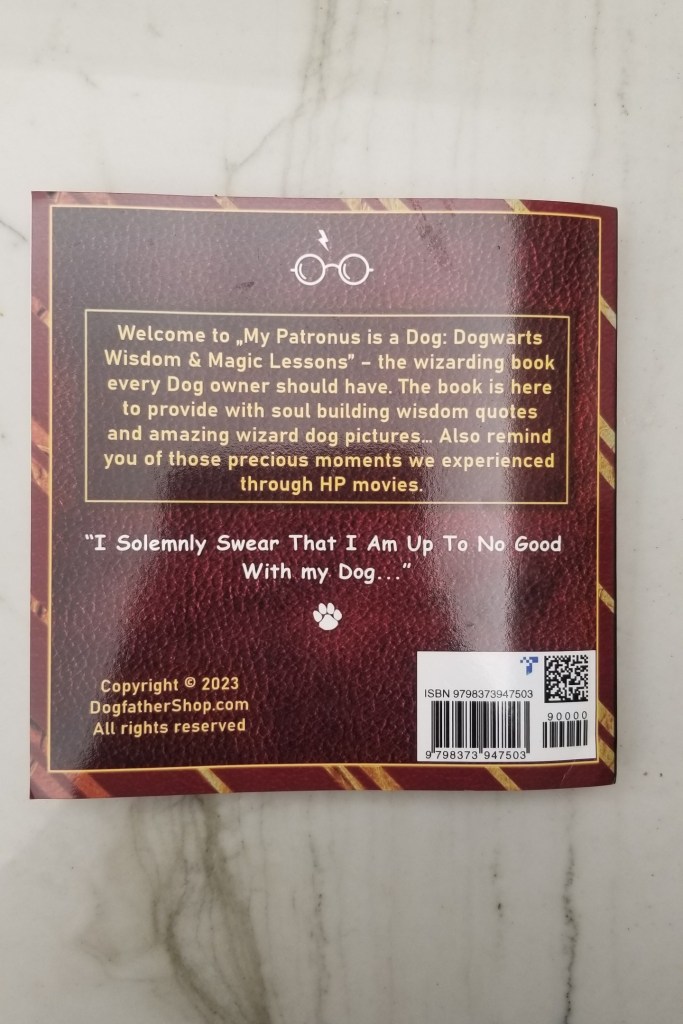
In summary: “My Patronus is a Leonberger” contains 111 pages of text and 111 pages of black and white photos plus advertisement and links to places where you can buy mugs and T-shirts. None of the 111 dog photos feature a Leonberger and the word Leonberger is never used anywhere in the book. It has funny photos of various small dogs though. However, the book has nothing to do with Leonbergers. In my opinion that means that putting Leonberger in the title is a bit misleading.
Below is my review of My Patronus is a Leonberger by Alex Luther. I made minor improvements compared to the Amazon review. Click here to see my original Amazon review. BTW I gave the book three stars.
Cute Dog Book That Never Mention Leonbergers
“My Patronus is a Leonberger” features 111 black and white photos of dogs paired with 111 black pages featuring 3 to 36 words long wisdom words or sayings in white text. The sayings are typically related to wizards and sometimes to Hogwarts. They are of varying quality but some of them are cute. The dog photos are cute and feature mostly small dogs often wearing glasses, real or photoshopped, wands and human clothes. At the end of the book there is an advertisement for dog merchandise from the company the author represents.
It is a cute little book for children or adults. However, there are no photos of Leonbergers, or any giant breed, and the word Leonberger exists only on the cover. Considering that the photos are not in color, that the sayings were just OK, and that the title of the book is potentially misleading to buyers I cannot give the book a high rating. Imagine someone buying this book for a friend owning a Leonberger thinking it contains Leonberger related writing or photos. Then when his friend opens the book, he sees nothing but pugs, Pomeranians and cats, but no Leonbergers or any mention thereof. I think he would be disappointed. I give it three stars.
Back cover of “My Patronus is a Leonberger” by Alex Luther.
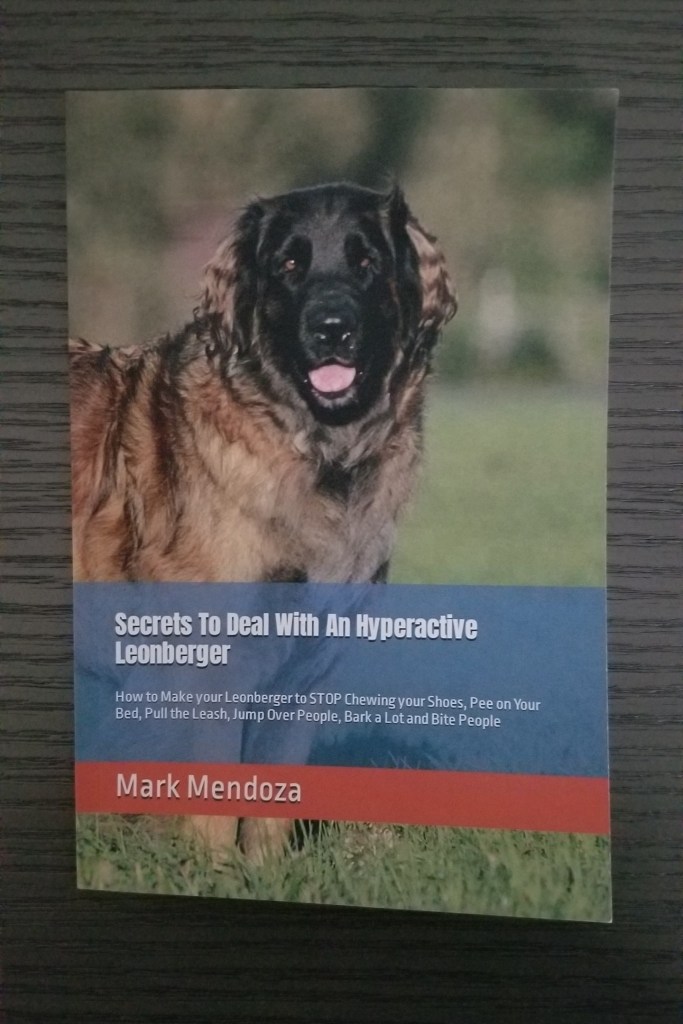
I recently finished Secrets To Deal With An Hyperactive Leonberger: How to Make your Leonberger to STOP Chewing your Shoes, Pee on Your Bed, Pull the Leash, Jump Over People, Bark a Lot and Bite People Paperback – November 26, 2021 by Mark Mendoza. The dimensions are 6 x 0.19 x 9 inches, and the weight is 6.4 ounces, ISBN 979-8774384570, and it currently costs $19.99 on Amazon in the US.
Secrets To Deal With An Hyperactive Leonberger by Mark Mendoza. Click on the image to go to the Amazon location for the book.
In summary: Secrets To Deal With An Hyperactive Leonberger, is a short Leonberger book that is a fairly generic dog behavior book and not really about Leonbergers. In addition, the book needs an editor, it does not have page numbering, no pictures, and considering that it is also a short book I don’t think the price $19.95 is justified. That last statement may not be appropriate for an Amazon review.
Below is my review of Secrets To Deal With An Hyperactive Leonberger by Mark Mendoza. I improved it a bit over the Amazon review. Click here to see my original Amazon review. BTW I gave the book three stars.
Good Advice on Hyperactivity in Dogs But There Are Issues With The Book
This is how the book begins; “My name is Mark Mendoza, and if you are reading this, then probably you know a few things about me;”. Well, I did not know anything about the author when I started reading this short book, which makes me wonder if I was the intended audience. As the title implies, this book is focused on dog training, specifically how to handle hyperactivity in Leonbergers. The author states that he is not a trainer but that he has a lot of knowledge of dog psychology. After reading this book I tend to agree, he does know what he is talking about, and I think he takes a very sensible and modern approach to basic dog training and how to handle hyperactivity and stress in dogs and how to prevent a dog from running away. We could certainly apply this knowledge to our somewhat hyperactive mini-Australian Shepherd.
However, I also had some issues with this book. I am a former Leonberger owner, and I saw no information in this book that applied specifically to Leonbergers. You would think the history section might contain some Leonberger specific information, but the word Leonberger was never used in that section. The book is a generic dog training book with the word Leonberger frequently used instead of the word dog. Making it seem like the book is specifically for Leonbergers when it is not, is not OK in my book. In addition, the sentence structure is frequently faulty, which makes me think the author is not a native English speaker, and there are also a lot of typos. The book needed an editor. There is also no page numbering, and the text is large resulting in less content than the stated 83 pages would imply. There are no pictures. Considering that the book is quite short and has not pictures I also think the price is too high. Therefore, despite the sensible approach to dog training and the handling of dog hyperactivity I am giving it three stars.
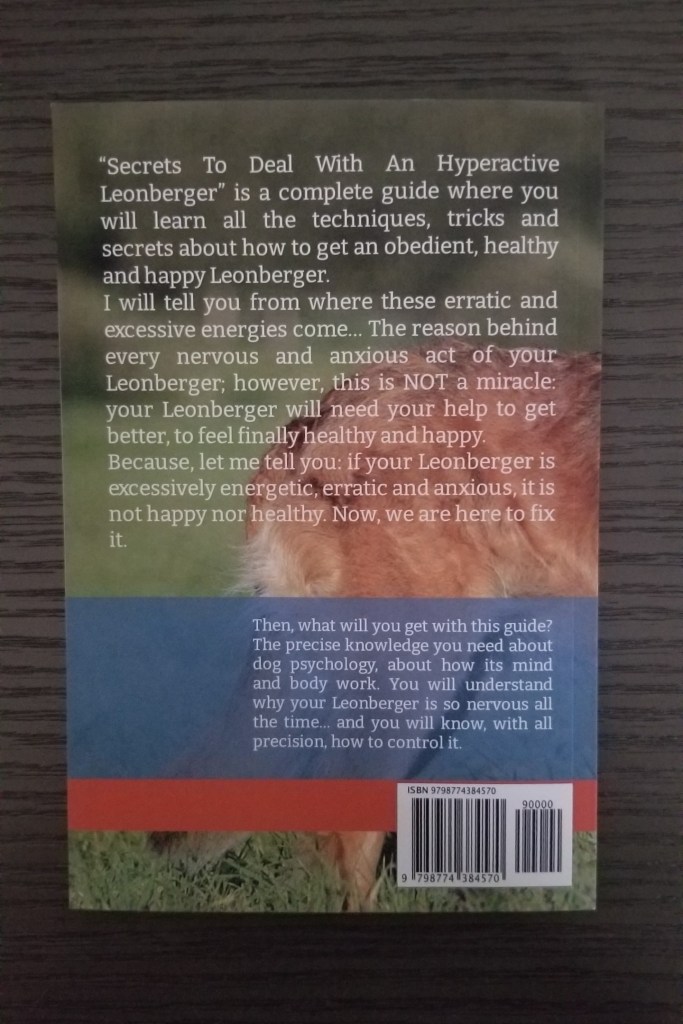
Back cover of Secrets To Deal With An Hyperactive Leonberger by Mark Mendoza.
Jen O’Keefe, a fellow Leonberger enthusiast and Facebook friend gave me permission to post about her late Leonberger Digory and the fundraiser she started to celebrate his memory.
Digory and Obi, two Leonbergers. Click on the image to visit Digory’s Facebook Page. Photo Jen O’Keefe.
Osteosarcoma is an aggressive type of bone cancer that tends to spread to the lungs. It affects both young and old dogs and appears to have environmental as well as genetic components. But according to the American Kennel Club, research into the disease in dogs is likely to have benefits for children who suffer from it as well.
Digory and Obi. Click on the image to visit the Canine Cancer Alliance Facebook Page. Photo Jen O’Keefe.
Digory was diagnosed with Osteosarcoma and had his leg amputated 3 years ago. Although he passed a couple months ago, he still made it 2 years and 10 months, which is about 2 years longer than expected. Part of his treatment was a vaccine through Yale that was in early stages of clinical trials. That vaccine has shown great promise in treating both Osteosarcoma and Hemangiosarcoma, and Jen believes it was integral in giving him so much extra time. That vaccine has moved on to the next stage of trials. The Canine Cancer Alliance is helping to fund this next step, so in honor of Digory, Jen created this fundraiser so that more dogs, and their people, can benefit from the extra time.
Digory the Leonberger. Photo Jen O’Keefe.
Through the duration of this fundraiser, Jen will be posting links with more information about the vaccine and about Digory’s journey. Jen hopes that, even though he is no longer with us, he can continue to be an inspiration in the fight against Osteosarcoma. To end dog cancer, through research in prevention and cures. If you wish you can join in the fundraising. Facebook takes care of the donation processing with no fees.
Digory the Leonberger. Click on the picture to visit Digory’s Fundraiser. Photo Jen O’Keefe.Digory celebrating two years passed the amputation. Photo Jen O’Keefe.Digory with friends at the beach some years ago. Photo Jen O’Keefe.
This blog is focused on Leonbergers but every now and then I post about something else, typically a book I want to promote. This post is different. I have many hobbies and one of them is volunteering for a climate change organization called Citizens Climate Lobby
CCL, 200,000 supporters in the US, 10,000 supporters in Texas, non-partisan and non-profit. CCL supports all energy options that can be used to reduce emissions, renewables, nuclear, natural gas replacing coal, carbon capture.
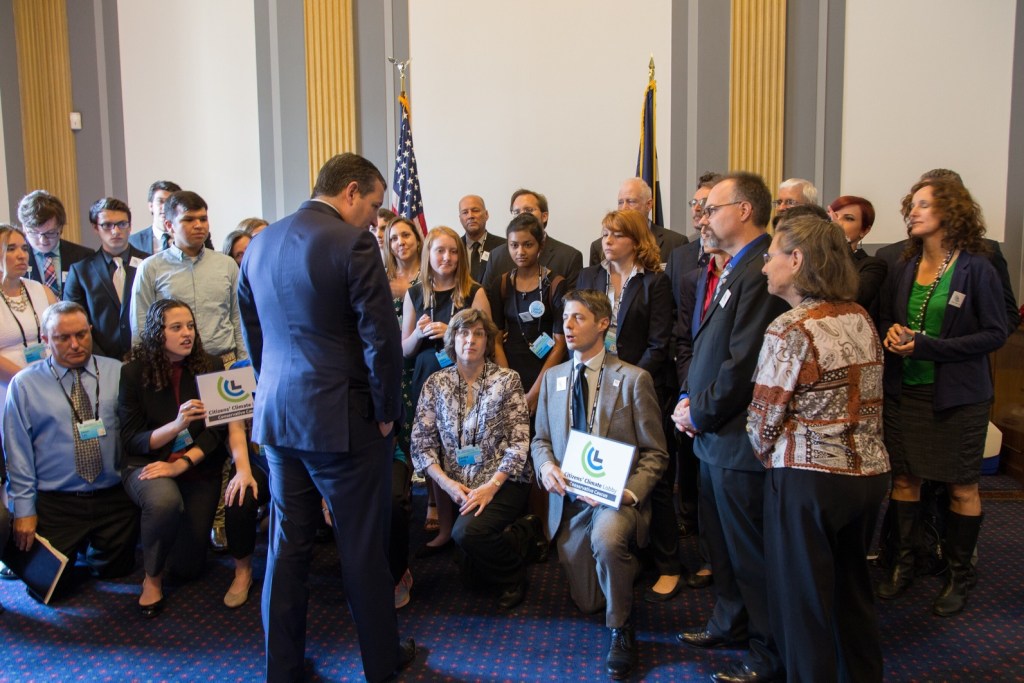
This post is about my journey towards becoming an advocate for a livable planet for future generations as well as the climate journey of my friend Larry Howe, who is a lifelong Texas Republican who became a climate activist (and he is still a Republican). Larry’s three-part article is focused mostly on solutions, and my post is focused mostly on how I got here. We both started out as “skeptical” of global warming and we both support the same solutions, so the two posts complement each other. CCL talks to both sides of the political spectrum, and we try to foster good relations with everyone. Below is a photo of us with Senator Ted Cruz.
Peter Bryn the leader of the conservatives’ action team is presenting our carbon fee and dividend proposal to Senator Ted Cruz in 2017. The CCL Texas delegation is standing in the background.
Citizens Climate Lobby is a volunteer driven non-partisan organization focused on educating the public and lobbying/talking to politicians, industries and organizations. We are not professional lobbyists. We don’t bring a billion dollars to political offices, in fact not even one dollar. We just bring ourselves as voters and constituents, and a friendly and positive attitude. We present well researched proposals for solutions and ideas. We require that the proposals are effective in reducing emissions, good for the economy, market oriented, non-partisan and acceptable to both Democrats and Republicans. In addition, we listen to the concerns of the lawmakers. One of my volunteer positions within CCL is to be the CCL liaison to Senator Ted Cruz office. Climate Change may not be Senator Ted Cruz’ cup of tea, but he voted for one climate bill that we supported, the Growing Climate Solutions Act.
Senator Ted Cruz TXJR with Citizens Climate Lobby in 2017. The senator is standing immediately to the right of the American flag, and I am standing immediately to the left of the American flag.
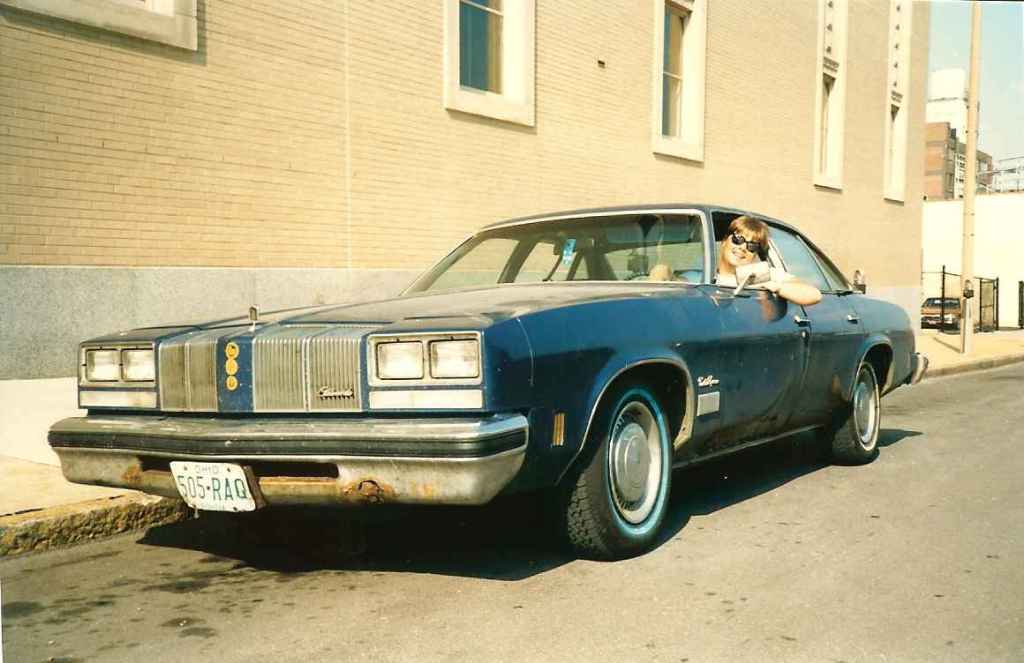
In June of 1988 I embarked on a journey with a friend and with my brother around the United States in an old Oldsmobile Cutlass Supreme 1976. I had just earned a master’s degree in electrical engineering and applied Physics from Case Western Reserve University, Cleveland, Ohio, as well as a degree in engineering physics from the University of Uppsala in Sweden (well they were really the same degree). It was an unusually hot summer. June 23, 1988 was the first time I heard the word “global warming”. I was watching some of Dr. James Hansen’s testimony before the United States Senate Committee on Energy and Natural Resources. I thought it made sense what he said. After all, I knew that greenhouse gases would increase the temperature of the atmosphere. It is hundreds of years old simple basic science and I had certainly not slept through my physics classes. It is why Venus is the hottest planet in the solar system and not Mercury.
Me in my Oldsmobile Cutlass Supreme 1976 in 1988. I bought it for $250.
As time went by (about 10-15 years ago), I became increasingly skeptical and doubtful of global warming or climate change as it was more commonly called later on. The reason was that I almost exclusively read and watched rightwing news media such as world-net-daily (tended to push conspiracy theories), Newsmax and Fox News. I believed in the concept of global warming, it is basic science after all, but I thought that it was exaggerated and that it was promoted and distorted by left-wing agendas, and I incorrectly believed that there was no scientific consensus on the issue. I also bought into the false narrative that this was about environmentalist ideology, politics, or even a sort of environmentalist religion, and not a real and serious problem. My disdain for environmentalists, my ideology, and my gut feelings certainly aided the propaganda in misleading me. In addition, I read a lot by Björn Lomborg and Patrick J. Michaels and I believed them. To clarify, I did not know it at the time, but I was wrong, very wrong. Below is a video from NASA showing the annual shrinkage of the arctic sea ice.
To see the NASA web page from where the YouTube video of the shrinking arctic ice is taken click here.
I should say that I had some lingering doubts about my own “climate skepticism”. During my travels to national parks, the great barrier reef, and other places, I encountered guides who were scientists, as well as others, and they told me about coral bleaching, ocean acidification, receding and disappearing glaciers, the pine beetle problem, white pine blister rust, the destruction of forests due to global warming, and I could see some of the effects with my own eyes in northern Sweden, which is close to the arctic and therefore the effects of global warming are more visible.
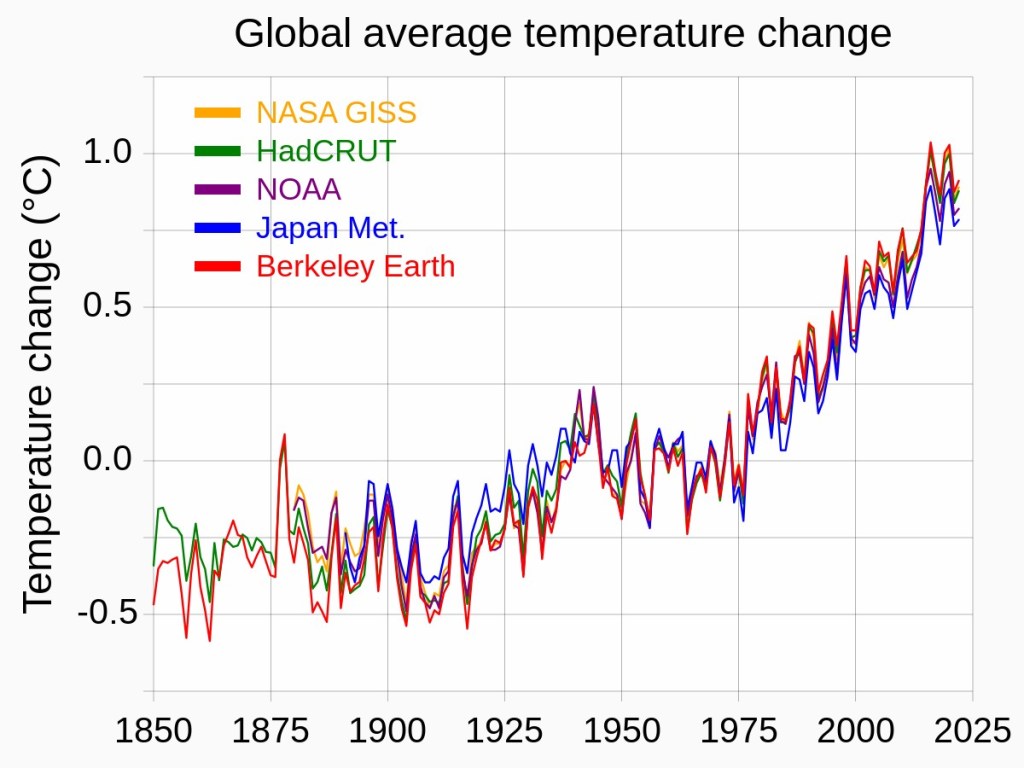
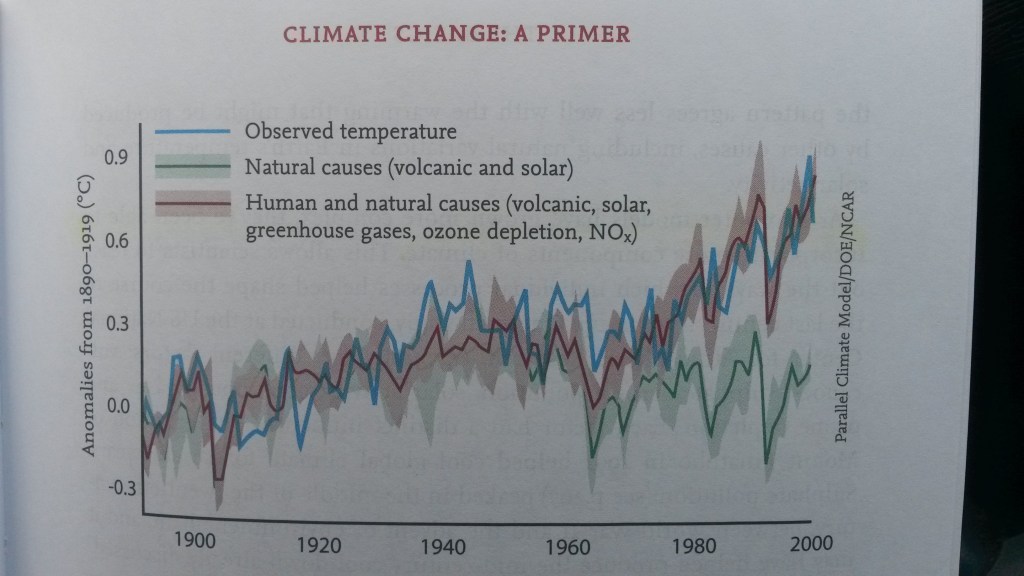
Temperature anomaly graphs from NASA, Hedley Center, Japan Meteorological Agency, NOAA, and Berkley.
It also bothered me that my physics hero Stephen Hawking was a global warming alarmist and that other leading physicists and astrophysicists whom I admired, such as Michio Kaku, promoted and warned us about human caused global warming. Add that popular science magazines I subscribed to, such as Discover and Scientific American frequently wrote about global warming. I should say that I tended to skip those articles and I believed those magazines had a left leaning bias.
The carbon dioxide concentration measurements began in 1958 at the Mauna Loa Observatory on the island of Hawaii. Since then, several other ways of measuring carbon dioxide concentration have been added.
However, there were too many red flags regarding my “climate skepticism”. It seemed like a lot of people knew and understood something I didn’t. This prompted me to take a deep dive into the matter. I had a decent scientific background. I had a master’s degree in engineering physics and a PhD in electrical engineering / computer science/ robotics and I was used to reading and writing research papers, and I had been on both sides of the peer review process, and I love mathematics. Electrical engineering and robotics is certainly not atmospheric physics but I wasn’t going to judge or review papers, I just wanted to know what scientists in the field actually were saying, and due to my background I was able to understand the papers.
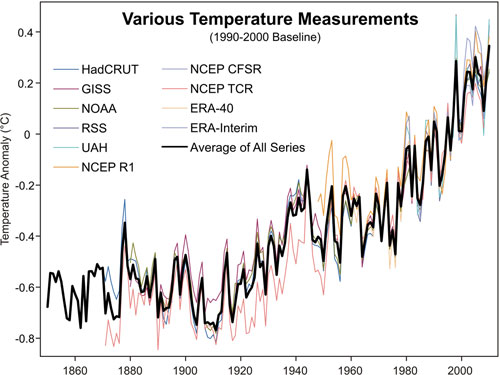
Another temperature anomaly map, this time ten different organizations.
I read peer-reviewed research articles on the topic, I read several dozens of books on the topic, including climate skeptic books, I subscribed to Nature, a very respected science journal publishing peer reviewed articles, I conversed with or listened to climate scientists online. I found out that my cousin Per Wikman-Svahn was a physicist who worked as an expert on the ethics surrounding climate change, and I extracted information from him.
Global temperature going back twenty thousand years, a hockey stick graph. Notice the stable temperature during the last 10,000 years, coinciding with the development of human civilization, and then a sudden sharp increase at the end.
I learned that the evidence that climate change is happening is undeniable and overwhelming including these few examples. I learned that the current global warming is mainly caused by our greenhouse gas emissions. I learned that global warming is not caused by natural cycles, something the experts on natural climate cycles repeatedly stressed. It is not the sun, or volcanoes and as you can see in the hockey stick graph above, it isn’t a normal cycle, and the recent increase in temperature is disturbingly quick.
Natural causes for global warming / climate change would have cooled the planet, not warm it.
I also learned that warming caused by greenhouse gas emissions have a certain fingerprint; the arctic will warm faster, nights will warm faster, the tropopause would be pushing up the boundary with the stratosphere, the mesosphere would be cooling and contracting (think the troposphere as being a blanket). All of that has been observed. It was greenhouse gases, not something else. I learned that scientists had used spectral analysis to verify that most of the warming came from increasing amounts of CO2 in the atmosphere, and they had even used carbon isotopes (C-12, C-13, C-14) in corals and the atmosphere to verify that the new CO2 added to the atmosphere and oceans come from hundreds of millions of years old underground carbon.
I learned that satellite measurements agree with surface thermometers, contrary to what the rightwing media I had read claimed. I learned that nearly all actively publishing climate scientists say humans are causing climate change (~99%). I learned that no national or international scientific body in the world rejects the findings of human-induced effects on climate change. I learned that Rachel Carson was not a fraud and that she had not killed 500 million people. I learned that Dr. Michael Mann was not a fraud and that he was right about his hockey stick curve. I learned that the so-called climate gate scandal was manufactured.
Hockey stick curve last 1,000 years, blue-Michael Mann’s original curve (proxy measurements such as tree rings), green-dots 30-year average, red temperature measurements.
I would later learn that among tens of thousands of climate change related papers only 38 are skeptical of the consensus and they all contain errors that if corrected for they ended up agreeing with consensus. I learned that the vast majority of climate skeptic papers originated with rightwing think tanks. I had foolheartedly donated to one of these organizations, the Heartland Institute. I realized that rightwing media engaged in defamation, harassment and attacks on climate scientists.
From Scripps institute. Keep two things in mind. First the warming from CO2 is delayed and may result in positive feedback that can manifest decades and centuries later. Secondly, human civilization developed during a period of stable climate. That CO2 levels and temperatures were higher millions of years ago is not much comfort.
Above all I learned that I had been bamboozled and misled and that I had believed maybe hundreds of false claims. I learned that there is a very powerful industry consisting of fossil fuel advocates and rightwing think tanks that are trying to confuse and mislead the public, attack and harass scientists, and that if you want the truth you need to trust the scientific evidence and the data, not arguments based on ideology and second guessing the motives of climate scientists is just nonsense.
Going back 800,000 years. From Scripps institute.
Long story short, we know with certainty that global warming / climate change is real and that we are causing it, chiefly with our greenhouse emissions, and we have known this for several decades. The scientific debate is over, but the public is still confused due to propaganda. Again, I had been bamboozled by rightwing think tanks, like so many others, so I understand.
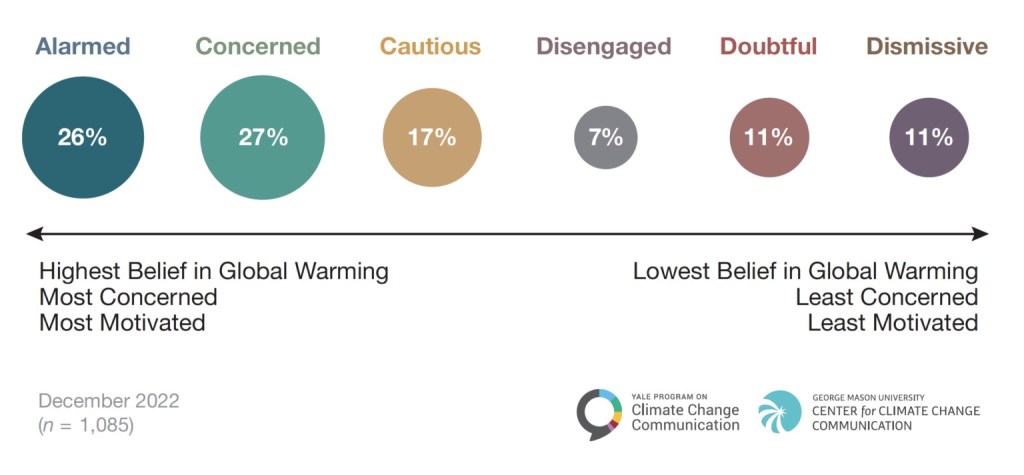
Instead of using somewhat disparaging popular labels such as “believers” or “climate change deniers” Yale University classify people into six groups. For example, climate change deniers are referred to as dismissive.
I do not think I was a “dismissive” but I was “doubtful” due to all the misinformation I had allowed myself to be fed. Again, we know with certainty that global warming / climate change is real and that we are causing it, chiefly with our greenhouse gas emissions, and we have known this for several decades. If you pay attention, there is no good reason to be doubtful, and certainly not dismissive. After reading a book by James Hansen (Storms of My Grandchildren: The Truth About the Coming Climate Catastrophe and Our Last Chance to Save Humanity) in 2013 I decided it was time for me to get involved.
American attitudes over the last 10 years. From the Yale Program on Climate Communication.
At first, I tried to argue with those who were dismissive, either by inserting myself into a discussion or after they approached me, typically because of something I said either on-line or personally. This was a surreal experience. I remember trying to explain to an acquaintance who claimed to be an expert in science (he wasn’t) about the measurements made on the age of the added carbon using isotopes. He resolutely stated that isotopes did not exist, all atoms of the same element are identical, and the peer reviewed research article I provided was fake. He claimed to be an expert on science based on reading biased media (he had no degree) and he had not even heard of isotopes, neutrons, and radiometric dating. I sent him a link to Wikipedia explaining isotopes, just as a help, but that was a mistake. He thought that since Wikipedia is sometimes wrong it proved that I was making up the entire concept of isotopes.
What NASA Knows from Decades of Earth System Observations. To see the original page, click here.
I came across so many dismissive people who thought they understood climate change much better than the scientists themselves or believed that most or all climate scientists in every country on earth were liars. I came across a lot of conspiracy theories and many very strange arguments focusing on speculative assessments of the character of climate scientists or activists rather than focusing on the data and evidence. Many invoked Al Gore, as if it was him, who invented climate science, or the UN. It is nuttier to believe that Al Gore invented climate science than that he invented the internet. However, the worst part was the insults, the mockery, the rage, and the trolls. It became clear to me that dismissives tended not to be reasonable people and that they are louder than most. Considering that they tended to be older angry guys who were unable to convince anyone, especially not the younger and educated, I came to realize that arguing with them was a waste of time. You could not have good-faith arguments with them, and after all they did not matter. There are more productive ways to engage.
CCL meeting with Democratic Congress Woman Sheila Jackson Lee (front). She took us on an impromptu two-hour tour of congress. I am the big guy back-right.
I felt I needed to do something for future generations, especially since I had been on the “wrong side” of the issue and also considering that I understood something many people did not, that climate change was a real and serious issue that we could do something about. In James Hansen’s book Storms of My Grandchildren, I had learned about solutions that seemed effective and doable, one of them being the carbon fee and dividend. I googled carbon fee and dividend and I stumbled upon Citizens Climate Lobby. I decided to join them and as it turns out so did James Hansen, as a board member. My first CCL volunteer position was as the CCL liaison to Congressman Pete Sessions office. He is one of the most conservative congressmen from Texas. In a meeting with the congressman, we asked him whom he trusted the most on the issue, and he answered Trammel Crow (the younger), one of the six children in the Trammel Crow Dallas real estate businesses (billionaires) who was also his biggest donor. Well, after talking to Trammel Crow we got the endorsement from Trammell Crow Company, which we handed to Pete Sessions.
In the photo we are meeting with Pete Sessions legislative director Ryan Ethington who was very supportive of us and loved to talk to us about climate solutions. Ryan was a football player and very tall. The three people on the right are me, my wife and our daughter.
Next is the climate journey of my friend Larry Howe, a lifelong Texas Republican and native Texan, and climate activist. We, 90 Texas CCL members to be specific, recently came back from Austin, Texas, where we lobbied (talked to) 67 Texas lawmakers for the first time in history. This was Larry Howe’s brainchild and doing. Larry is very active and a great leader. His post (in three parts) is more focused on solutions, whereas mine was about the how and why regarding my turn around on the issue.
Click on the picture to visit the three-part climate journey of Larry Howe.
Leash laws – Unless your pet is in a designated off-leash area, he or she has to be on a lead at all times. That’s the law in Dallas, Texas and in many other places. Dogs must be on a leash when outside except for, for example, dog parks. It doesn’t matter how good and obedient the owner thinks his dog is, it does not matter if the owner thinks he’s got perfect control over his dog. It is the law for a reason. Accidents happen, of course, and our dogs escaped on a few occasions. However, we all need to make an effort.
In my Leonberger book “The Life and Times of Le Bronco von der Löwenhöhle” I describe three dog fights resulting from off leash dogs, but we experienced many more, dozens, and it is ugly.
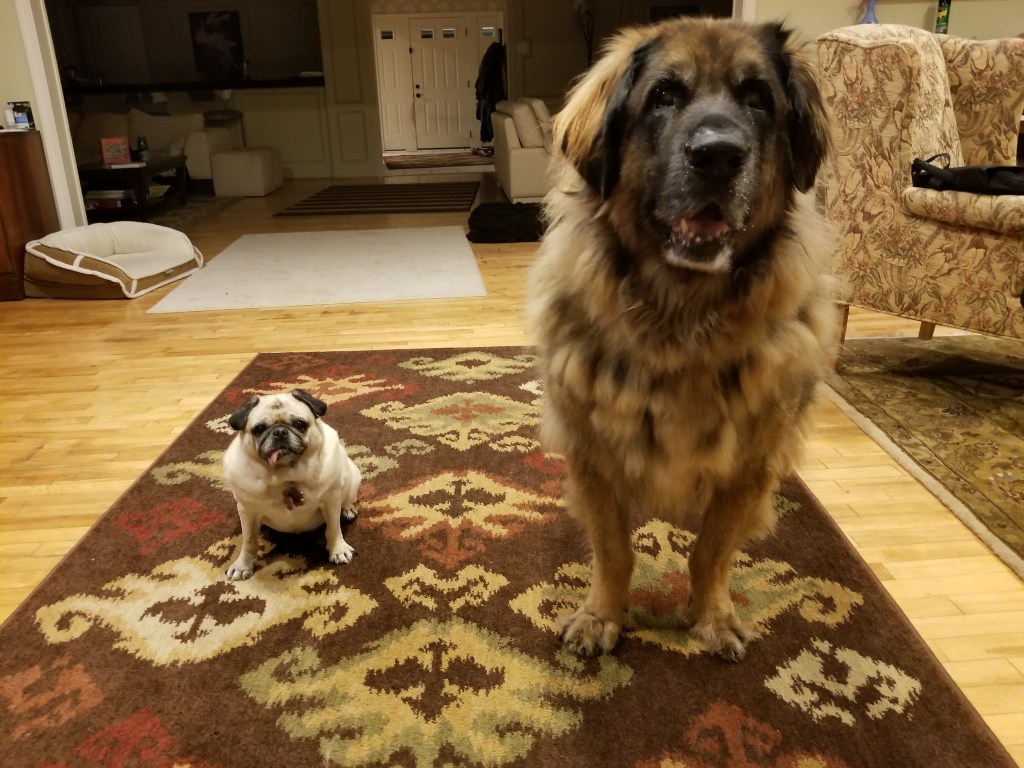
Our Leonberger Bronco (Le Bronco von der Löwenhöhle) grew up with several dogs, one of them being our Pug Daisy, which we still have. Bronco and Daisy were good friends and on one occasion Bronco saved Daisy from an attacking lose German Shepherd. We’ve owned a very well-behaved German Shepherd, our Baby, they are good dogs, but this one was young and aggressive.
Our Pug Daisy with our Leonberger Bronco
Bronco stepped in between the German Shepherd and Daisy and got bitten in the leg in the process. Leonbergers are about double as strong as German Shepherds and almost double as massive and they have more powerful jaws. However, Bronco was old and had just had surgery in the leg in which he was bit, so it was certainly a sacrifice on his part. I was mad and I ran after the German Shepherd and tried kicking him and between mine and Bronco’s efforts he ran off. I cursed at the owner of the German Shepherd for letting him run lose in a public space. Maybe I shouldn’t have, but in the end Daisy, our innocent sweet Pug, was alive. What a day that was.
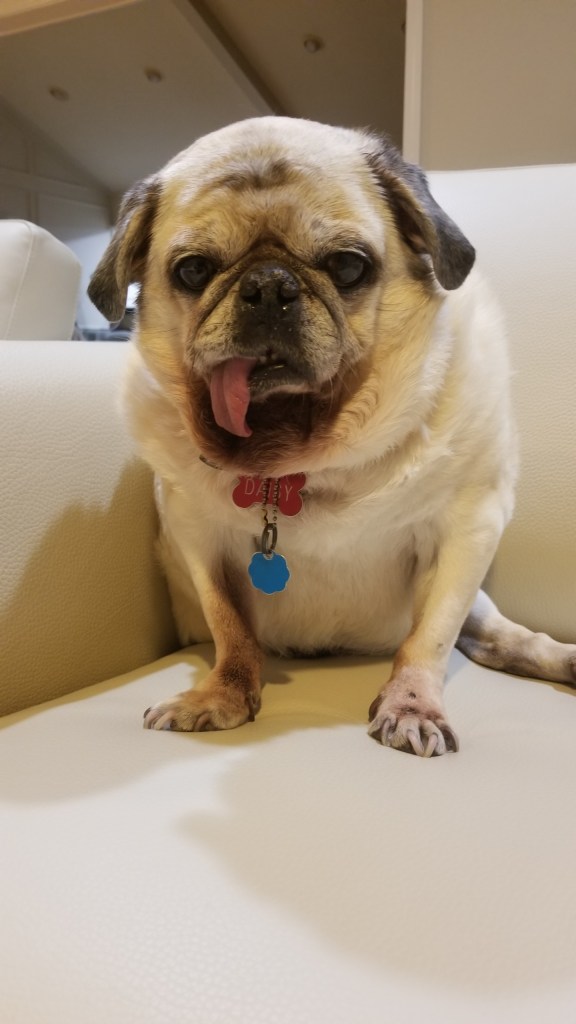
Photo of Daisy that I took a few minutes ago. She is alive today, thanks to Bronco. She is 14 ½ years old.Bronco our saint who saved Daisy.
Another spontaneous dogfight happened before we got Bronco, when two dogs attacked our Labrador Baylor, who later would welcome Bronco into the family.
Baylor our sweet Labrador. He was a rescue.
Baylor was a sweet dog but could defend himself when he needed to. One time, as he and I were walking down a long straight road in the neighborhood, I turned around and saw two dogs running out of an alleyway around half a mile behind us. Right behind them came a woman, and she was running as well. The dogs were racing toward us and barking, and the woman behind the dogs was screaming at them. It was obvious that they had snuck out of a house and were ignoring their owner. For a moment I thought that maybe we should be running as well, but I decided against it. I would not be able to outrun the dogs, even though Baylor could, and letting him loose would be a bad idea. I decided to keep calm and continue walking.
A few seconds later I turned around to look again. The dogs were coming closer. I could see their glistening teeth and their faces full of rage as they charged toward us. The woman behind them was going as fast as she could, but she couldn’t keep up. Both dogs were around the size of Baylor. One of them looked like a pit bull, and the other looked like a golden retriever. I braced for the worst, and Baylor and I positioned ourselves for a fight.
Then the dog who looked like a golden retriever stopped and sat down. He seemed to be less aggressive. But the pit bull came right at us as if he wanted to kill us. There was a violent clash. Baylor fought back valiantly, and he was able to control the situation, despite being on a leash. (Well, I gave him all the leeway I could.) There were loud growls and snarls and sharp white teeth snapping and biting.
The woman finally arrived. Her face was red, and she was sweating profusely. It didn’t look like she was in good shape, and she had just sprinted half a mile without stopping. Breathing heavily, she grabbed her aggressive dog and apologized. I didn’t respond, even though I felt sorry for her. I knew the whole thing was probably an accident, but after that experience I couldn’t spare much sympathy for her. Luckily, there were no serious injuries.
After it was all over, I felt proud of Baylor for defending himself so well. He was a lot stronger and feistier than I expected, yet he was a very friendly and loving Labrador. If you want to read about the time when our German Shepherd Baby defended Bronco when he was a puppy, click here.
Sometimes I make posts not directly related to Leonberger dogs, especially if I want to promote a good book. Today I am announcing that a book written by my on-line friend Alex Diaz-Granados has been improved in various ways. The story is the same, but it has been edited a second time with input from Alex’ journalism professor. It has a new cover, there’s a title page, a copywrite page, a list of content, an improved page layout in the paperback version, and page numbering. If you have not bought the book before, now is the time to do so. I bought it a second time myself.
First some basic facts about the book. The title is Reunion: A Story Paperback – July 2, 2018 by Alex J Diaz-Granados (recently revised). The paperback version is 51 pages. The dimensions are 6 x 0.13 x 9 inches, and the weight is 3.21 ounces, ISBN: 978-1722120474, and it currently costs $7.99 on Amazon in the US, but it can be bought elsewhere, for example, Barnes & Noble (same price). The kindle version (ASIN: B07F4SL6NQ) is $3.99 or free if you have Kindle unlimited.
About the Author
Alex Diaz-Granados (1963-) began writing movie reviews as a staff writer and Entertainment Editor for his high school newspaper in the early 1980s and was the Diversions editor for Catalyst, Miami-Dade Community College, South Campus’ student newspaper for one semester.
Using his experiences in those publications, Alex has been raving and ranting about the movies online since 2003 at various websites, including Amazon, ciao and Epinions. In 2012, Alex published his first book, Save Me the Aisle Seat: The Good, the Bad and the Really Bad Movies: Selected by an Online Film Reviewer through CreateSpace.
Reunion: A Story, is Alex’s first work of fiction. In addition to writing reviews, Alex has collaborated with actor-director Juan Carlos Hernandez on several short films, including A Simple Ad (2019), Clown 345 (2019), and Ronnie and the Pursuit of the Elusive Bliss. You can find his reviews and essays on his blog, A Certain Point of View, Too.
About the Book
It is June 1983. Jim Garraty is a senior at South Miami Senior High. He’s a staff writer for the school paper, a college-bound scholar who plans to become a historian and author of books on military history. He’s well-liked by his peers and teachers, and his future looks bright. But as commencement draws near for the Class of 1983, Jim must deal with unfinished business. The girl he loves from afar is also graduating, and rumor has it that she is going away for the summer before starting college in the fall. Worse still, Marty doesn’t know how deeply Jim’s feelings for her are – unless he tells her. But when an opportunity arises on the last day of classes at South Miami High, Jim hesitates…and the window of opportunity closes. Now, 15 years later, James Garraty is an up-and-coming history professor whose literary career is on the rise. Respected by his fellow faculty professors and recipient of popular and critical acclaim, Jim seems to have it all. Except for one thing. True love.
In the photo below I laid out the two books, old version and new version side by side, the front cover up. The old version is to the left and the new version to the right. The two books are laying on top of our kitchen counter.
Old front cover versus new front cover. Click on the image to go to the Amazon page for the paperback version.Old back cover (left) versus new back cover (right).This is the cover for the e-Book version of Reunion: A Story. Click on the image to go to the Amazon.com E-Book version of the book.
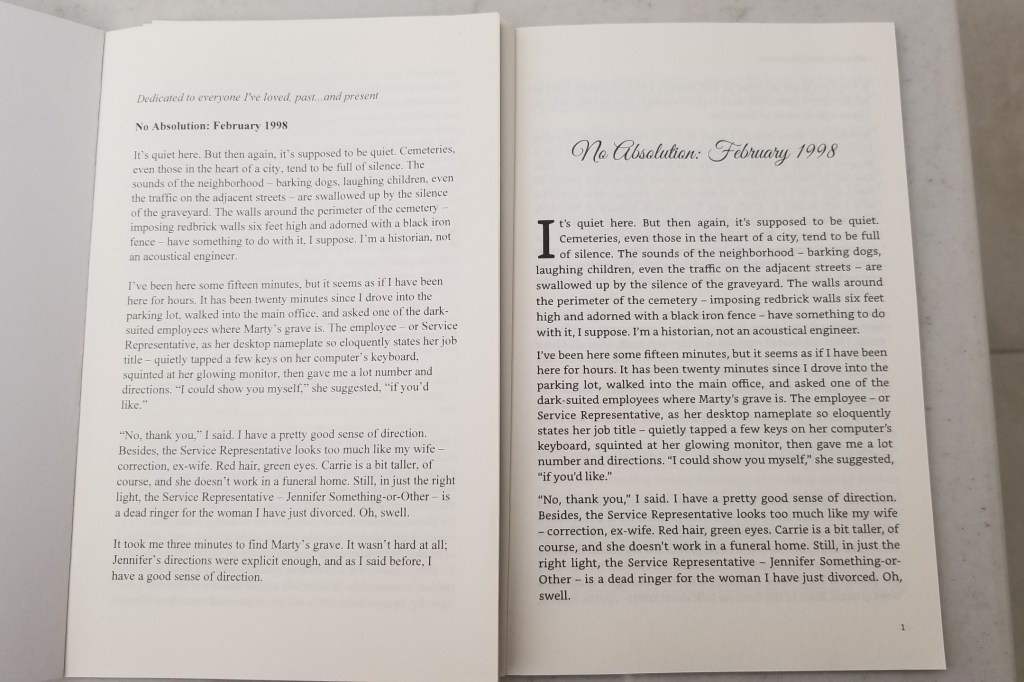
I also thought I include the first page of the old book (left) and the new book (right) to demonstrate the improved page layout / book design (see photo below).
Old page design to the left. New page design to the right.
Finally, a brief review
This book is about a “what if” scenario, about regret, and what could have been. Once you start reading the book you simply must find out what will happen, which is why I could not put it down and therefore I read it in one sitting. It is a sad but timeless love story that is very engaging. It is about life, friendship, and love. I think the story highlights how differently a teenager and an adult view life and what the consequences can be. The author describes the feelings and the thoughts of the characters in a manner that is realistic and easy to relate to. It was emotional but not too sentimental. The book has a message, especially for young people. The book is easy and quick to read, and it is one of the best short stories I’ve ever read. I highly recommend it.
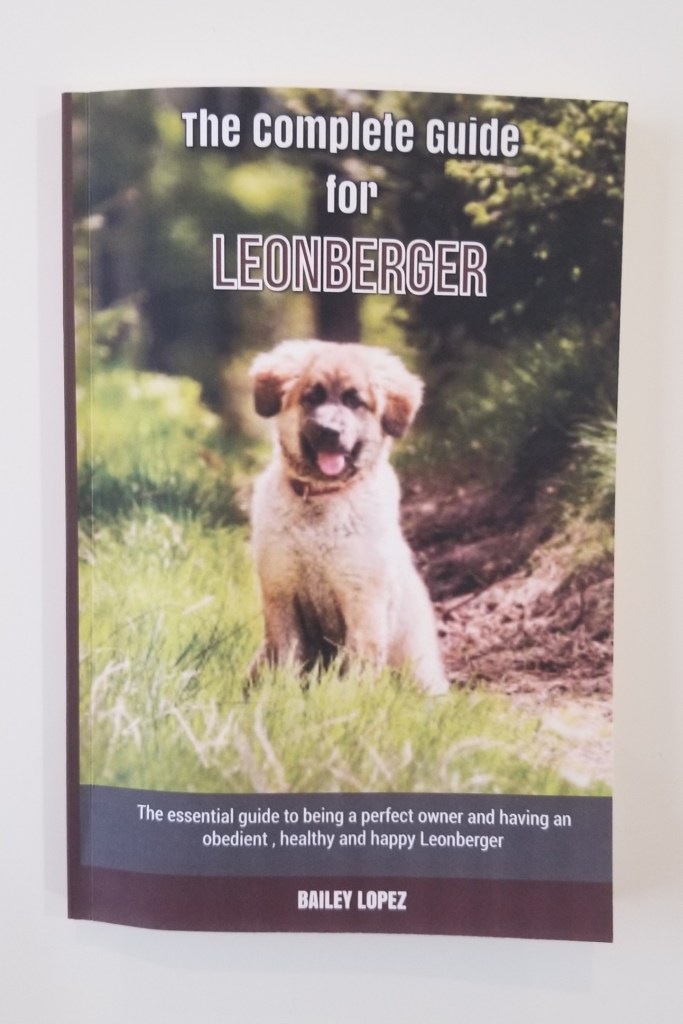
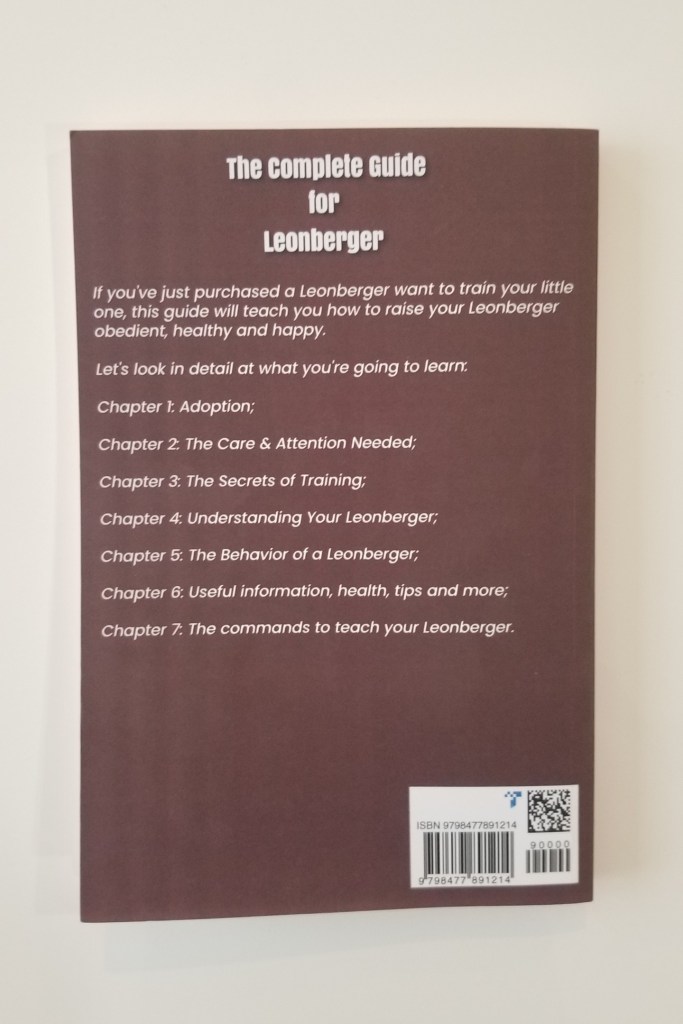
I recently finished The Complete Guide for Leonberger: The essential guide to being a perfect owner and having an obedient, healthy, and happy Leonberger Paperback – September 15, 2021, by Bailey Lopez. As far as I can see there is only a paperback version, which is 133 pages. The dimensions are 6 x 0.34 x 9 inches, and the weight is 9.1 ounces, ISBN 979-8477891214, and it currently costs $15.23 on Amazon in the US.
Front cover of the book The Complete Guide for Leonberger by Bailey Lopez. Click on the image to go to the Amazon location for the book.
This is another strange Leonberger book. I believe the information in the book is very helpful and interesting assuming you are looking for a book on dog behavior, concerning any type of dog. Even though the word “Leonberger” is used quite frequently there is not much Leonberger specific information in the book.
If the title of this book had been “The Complete Guide to Dog Behavior” I would have given the book a four or five star rating. The book gives a good overview of dog behavior and psychology, puppy behavior, adoption issues, training and commands, and a few health tips. I found some good tips in the book that we are going to implement for our mini-Australian Shepherd. I also think that there is some enlightening information in the book that I have not seen in other dog books (Leonberger books or not). The author also understands dogs and their behavior well. He is a true dog behavior specialist.
Unfortunately, it is not really a breed specific book despite the frequent use of the word “Leonberger”. Replace “Leonberger” with “dog” and the veracity of the information does not change, which means that it is not a Leonberger book. On a bit more than half a page he is explaining how to interpret the movement of ears, for example, “ears stretched upwards may also show dominance”, etc. The problem with that is that Leonberger ears are floppy, fleshy, hanging down and they can’t point up. Interestingly he points out at the end of the ear section, essentially invalidating everything he just wrote. The book is missing Leonberger specific behavior, Leonberger characteristics, breed standard stuff, Leonberger history, genetic illnesses common in Leonbergers, life span, nothing about Leonberger organizations, Leonberger awards, sports or activities, and anything specific about Leonbergers. It is all missing and there is not a single picture of a Leonberger in the book. The book also has a substantial number of typos.
I would think a book like this would sell well if it were marketed as a dog behavior book. Why pick a rare breed and essentially replace the word dog with the word Leonberger everywhere? I am glad I read it because of what I learned about dog behavior, but you won’t learn anything specific about Leonbergers by reading this book, which is why I am rating it three stars.
The back cover of the book The Complete Guide for Leonberger by Bailey Lopez.
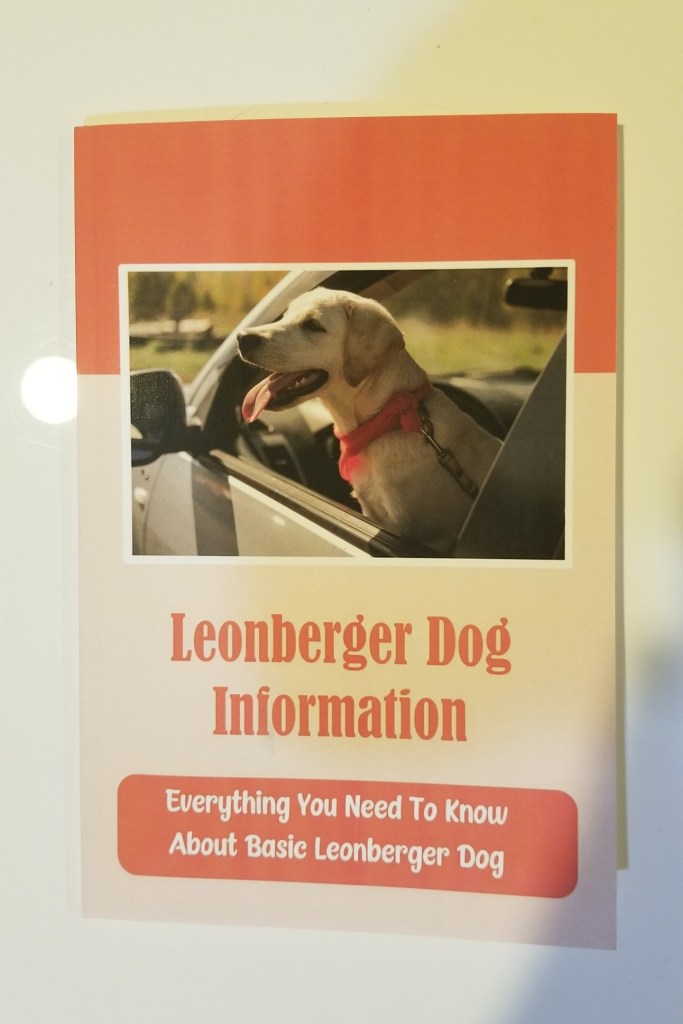
I bought the paperback version of the book Leonberger Dog Information: Everything You Need To Know About Basic Leonberger Dog Paperback – November 16, 2022 by Bao Reives. It is a short book. The paperback version is 55 pages, the dimensions are 6 x 0.14 x 9 inches, and the weight is 4.8 ounces, ISBN 979-8364129697, and it currently costs $10.74 on Amazon in the US. The Kindle version is 110 pages, ASIN B0BMNBL7CV, and cost $5.44 and is written by Matthew Marrow. They are not linked on Amazon, so you have to search for the kindle version separately.
Front cover of the book Leonberger Dog Information by Bao Reives. Click on the image to go to the Amazon location for the book.
This is a strange Leonberger book. There’s a Labrador on the front page. The book is directed at a UK audience in some parts and an American audience in other parts. Yet it is otherwise a decent Leonberger book filled with Leonberger specific information and 16 black and white Leonberger photos. It is as if it was written by two different authors who have a good understanding of Leos, but the book designer screwed up massively. With 16 good Leonberger photos in the book, how did a Labrador end up on the front cover? How would you rate that?
A thought occurred to me that someone copied the content of two other Leonberger books, text, photos and all, and just mixed it all together. That would be bad and I am not sure it is even possible to do, so I am not assuming that.
Short Leonberger Book with Some Good Information and Some Issues
Despite the photo of the Labrador on the cover of this book it is actually a Leonberger book. The book contains some good information on Leonberger care and training and where to get one and who should not get a Leonberger. I think it was good that the author pointed out that Leonbergers love to be with the family, are very large and energetic and need space, and therefore a Leonberger is not a good dog for someone living in an apartment. I also thought it was good that the author pointed out that you should find a breeder who is rigorous about genetic testing. The book contained 16 black and white photos of Leonbergers.
However, I also found a few problems with the book. Starting with the incorrect claims in the history section. The author claims that Heinrich Essig, the creator of the Leonberger breed, was the mayor of the town of Leonberg. He was a prominent citizen of Leonberg, a successful businessman, innkeeper, dog breeder, large-dog enthusiast, and town councilman, but he was not the mayor of Leonberg. It is claimed that only five Leonbergers survived World War I. It is true that World War I was tough on the breed, but it was not quite that bad. After the war, Karl Stadelmann and Otto Josenhans, worked hard to save the breed, and they were able to find twenty-five Leonbergers whose owners were willing to cooperate in reestablishing the breed. Of these, only five were suitable for breeding, which is different from saying that only five survived. In addition, the book claims that only eight Leonbergers survived World War II, which is even more incorrect.
The beginning of the book is written for readers in the UK, and later on it switches to North American readers (Leonberger Club of America), only to switch back to the UK again. It is if two different people wrote the book. Add the wrong dog breed on the cover and the somewhat funny book page design and I got the feeling that this book was put together haphazardly. It contains mostly good information, but it was not put together well, with the pieces perhaps originating from different sources. It is a quick read, it is not bad, but there are better Leonberger books out there. I give it three stars.
On February 29 the Texas Legislature passed HB64 and SB14 and thus Texas became the first US state to allow dogs to drive. Any dog of any breed is allowed to drive a car as long as they are two years or older and are facilitated by a DDAD, a dog drivers assistance device. A DDAD is a device that reads traffic signs for the dog and takes cues from the dog’s body language to turn the car and control it in other ways. DDAD utilizes a multi layered neural network (deep learning style neural network) that has been trained using several thousand dogs that included all of AKC’s approved dog breeds as well as 100’s of mixed breeds.
Rollo is our first dog to officially have a driving license. In the picture below he is coming back from a visit to grandma and grandpa.
Rollo coming back from a visit to grandma and grandpa.
The dog driving license is not without controversy. Some people have concerns with safety and others feel that dogs should not be able to drive if they are not, as Walter Ericsson who lost his driver’s license due to a DUI pointed out.




















 Leonberger Life