This blog feature amusing and heartwarming stories about our late Leonberger dog Bronco, as well as other Leonbergers. It also has a lot of information about the Leonberger breed, the history, care, training, Leonberger organizations, etc. I also wrote a Leonberger book, which I am featuring in the sidebar.
Purebred large dog breeds tend to have shorter life spans compared to most other dogs and they have more health issues. However, Leonbergers are fortunate compared to other large breeds, especially those bred in North America, primarily for three reasons:
The Leonberger breed standard does not call for traits that can be detrimental to health.
The precise and restrictive breeding regulations of the Leonberger Club of America (LCA) and other Leonberger clubs.
The work of the Leonberger Health Foundation International or LHFI, have resulted in Leonbergers being relatively free of inherited illnesses compared to other large dog breeds in America.
Today I received my first payment for the sale of my book from Amazon (for the month of July) and I donated all proceeds to the Leonberger Health Foundation International like I said I would. Regardless of whether you get my book or not you can donate to LHFI. It is one of my favorite charities. LHFI “facilitate the solicitation and distribution of donations given to support health related breed-specific research.” The LHFI also administers a program that collects DNA samples from Leonbergers to share with universities and research institutions.
Among the organization’s achievements are the eradication of Addison’s disease among Leonbergers, the raising of nearly half a million dollars for research into conditions that affect canine health, including osteosarcoma, hemangiosarcoma, glaucoma, cardiac diseases, thyroid diseases, and neurological disorders. Another notable achievement is the fact that since 2011, no Leonbergers with two copies of the LPN1 gene mutation, which causes Leonberger polyneuropathy, have been recorded in LHFI’s biobank (featuring 9,000 Leonbergers). Its research also supports healthful longevity and aging as well as population diversity.
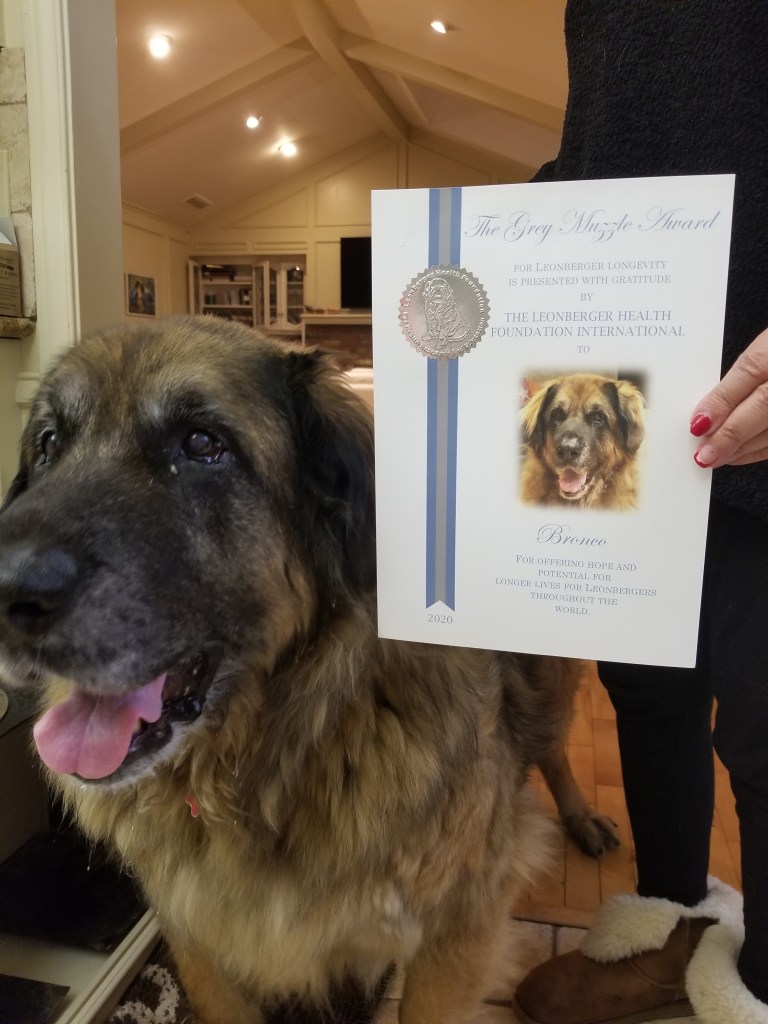
One happy event for our family was when Bronco received his Grey Muzzle Award, which is an award given for longevity by LHFI. LHFI bestows the award on any Leonberger who has reached the age of twelve. To find out more about the Grey Muzzle Award click here. To see the 2019–2020 awardees video featuring Bronco click here.
Bronco receiving his grey muzzle award.Grey Muzzle Award certificate from the Leonberger Health Foundation International.The Grey Muzzle Award from the Leonberger Health Foundation International.
I can add that when Bronco passed away, we sent his DNA to the University of Minnesota to be used in research. This was facilitated by the LHFI.
Today I received a nice gift from a couple of friends, six stamps from Grenada and Grenadines featuring six dogs, a Leonberger (upper left side), a Newfoundland dog (upper right side), a boxer (mid-left), a St. Bernard (mid-right), a silky terrier (lower left side), and a miniature schnauzer (lower right side). I was very happy receive this gift, especially since one of the dogs is a Leonberger. FYI: The Grenadines is a chain of small islands that lie on a line between the larger islands of Saint Vincent and Grenada in the Lesser Antilles.
Stamps from Grenada and Grenadines featuring dogs including a Leonberger.
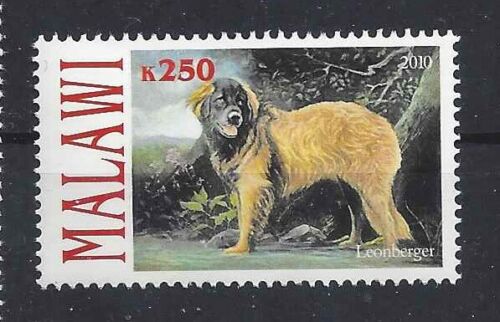
Out of curiosity I decided to search the internet and I found that not only are stamps featuring dogs common but stamps featuring Leonbergers are common as well. I found Leonberger stamps from Angola, Guinea-Bissau, Equatorial Guinea, Djibouti, Congo, Niger, Monaco, Malawi, and Christmas Island. Below I am showing a few of them.
Stamp from Monaco featuring Leonberger and Newfoundland dog.Stamp from Malawi featuring Leonberger.Stamp from Angola, Guinea-Bissau, Equatorial Guinea, Djibouti, Congo, Niger and country I can’t make out featuring Leonbergers.
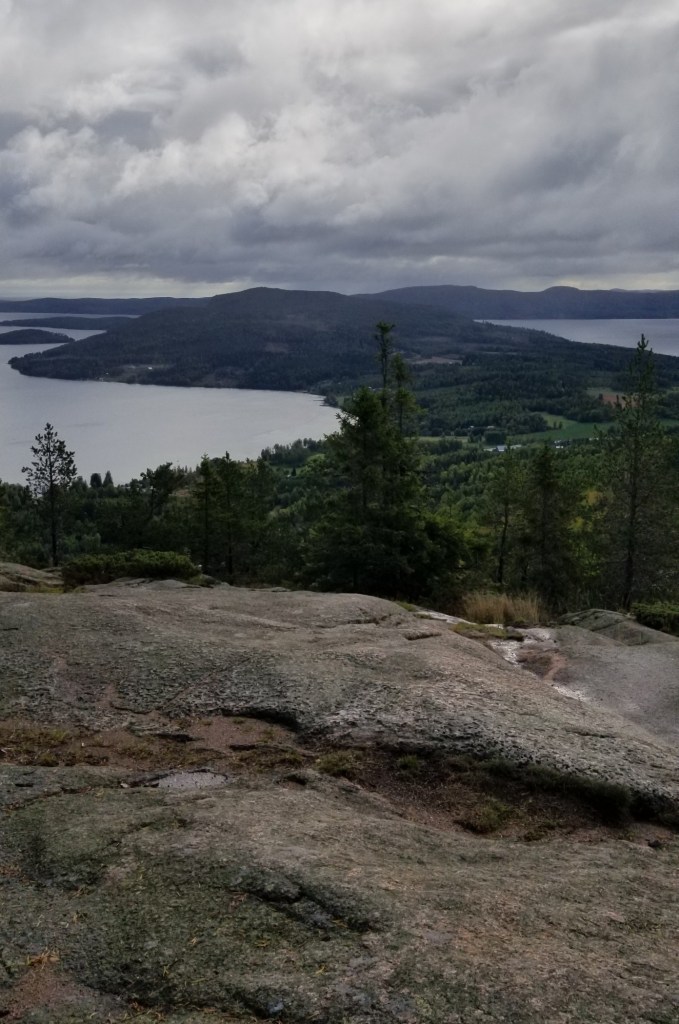
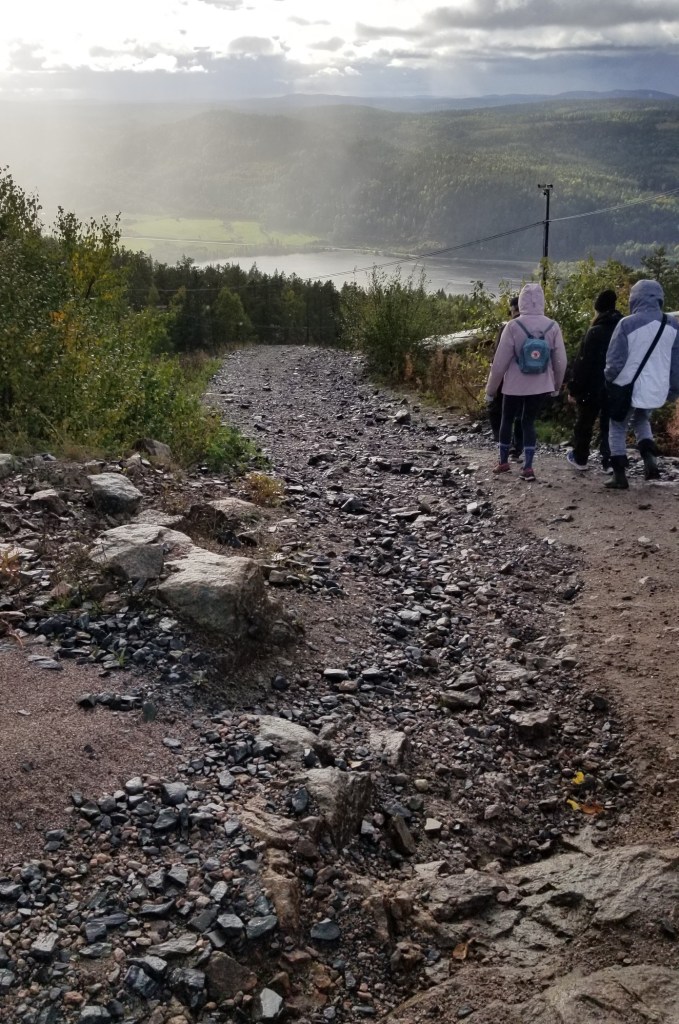
We are visiting Sweden, specifically the High Coast. I am originally from here. This is a beautiful area with fjords, mountains and forests. We took a ski lift up to the top of a mountain called Skule Berget/Mountain. At the top there is a cabin that’s open for tourists. You can also walk up the mountain on a steep long trail. In addition to visiting the cabin and watching the views from the mountain top we climbed down a cliff to visit a cave and after our visit we walked down the trail. It was a day filled with exercise. However, the highlight of the day was that we met a Leonberger, Amie, and her owner at the top of mountain.
Amie at the top of the Skule Mountain.
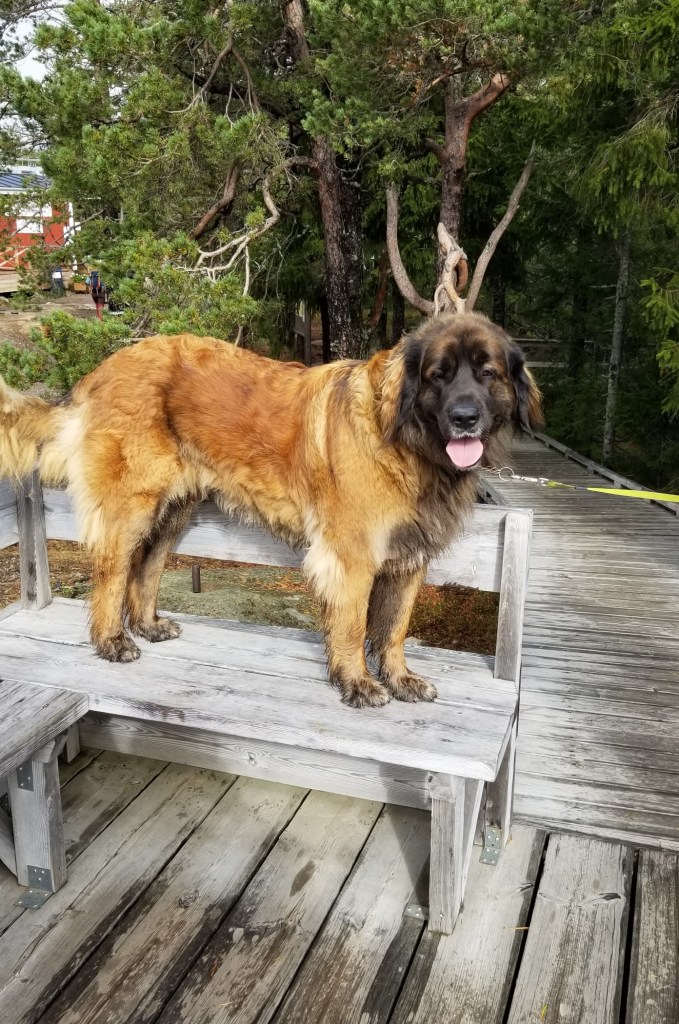
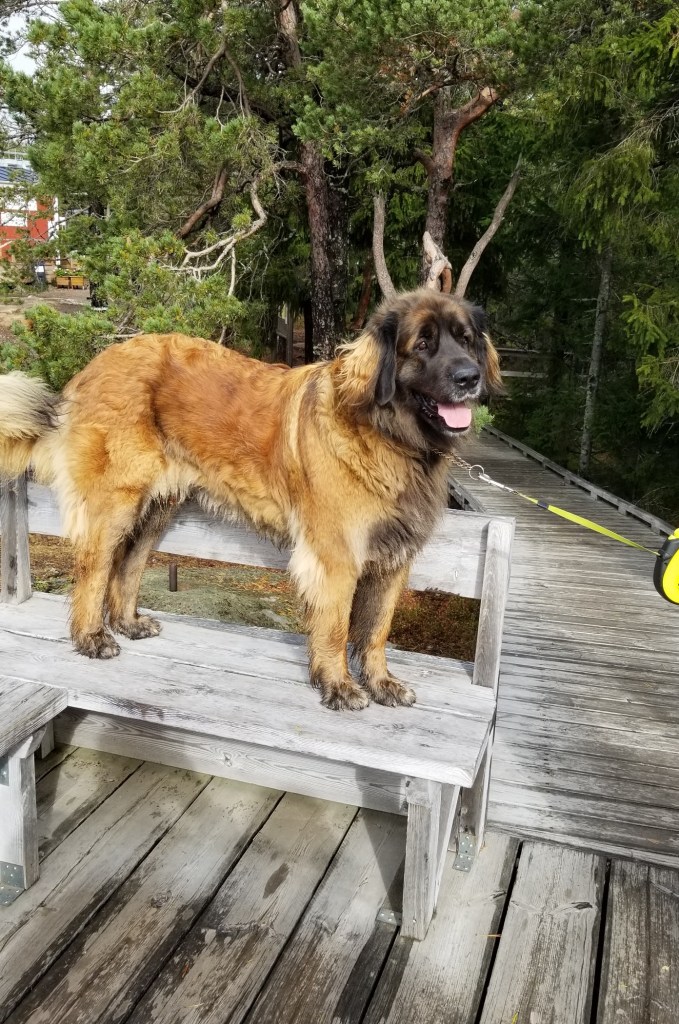
We shouted, “look a Leonberger”, and Amie started wagging her tail and running towards us. She obviously loved attention. Her owner let us pet her and take a few photos of her. Amie was very playful, she rolled around and wanted to be petted. She was very friendly. She reminded us of our late Leonberger Bronco, but being a female she was a little bit smaller and more feminine looking.
Amie was playful but very well behaved.
Amie is nine years old, which is old for a Leonberger. We were impressed that she walked all the way up to the mountain top.
View from the Skule Mountain topThe cabin at the Skule mountain topWe are walking back down
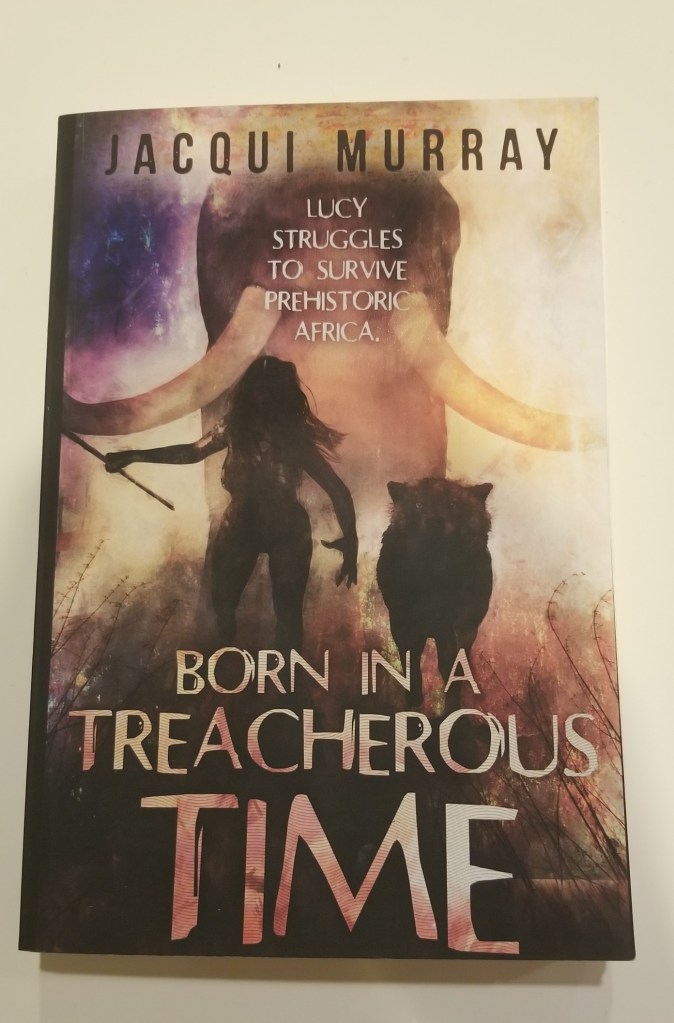
This blog is primarily about Leonbergers and our late Leonberger Bronco as well as the book I wrote about him and his dog friends. However, sometimes I review other Leonberger books and on occasion other great books. This time I am reviewing Born in a Treacherous Time, the first book in the Dawn of Humanity series – March 8, 2019, by Jacqui Murray. This paperback is 381 pages, ISBN 978-1942101451, item weight 1.23 pounds, dimensions 6 x 0.96 x 9 inches. You can buy it from, for example, Amazon or Barnes and Noble, as a paperback or e-Book. The paperback version is currently $15.99 on Amazon.
Front cover of the book Born in a Treacherous Time by Jacqui Murray. Click on the image to go to the Amazon page for the book.
This book, “Born in a Treacherous Time” is the story of a Homo Habilis woman, Lucy, who lived 1.8 million years ago in Africa. The book also features a large, loyal, and brave dog “Ump” who reminded me of our large, loyal and brave Leonberger dog Le Bronco von der Löwhenhöhle.
Lucy suffers many great losses, she travels across a great rift, she is very resourceful, she is a huntress and a healer, and she survives many potentially deadly challenges. She interacts with many interesting characters and experiences many harrowing adventures. She is a survivor but a survivor with a good heart. The characters in the book are compelling, and they will touch your heart despite being of a primitive human species. The many action-packed adventures in the book, makes it difficult to put it down.
The depiction of life in the early Quaternary is realistic, which some may have a problem with. The characters in this book hunt and kill, and they are hunted and killed. They don’t eat pizza and hot dogs with relish and mustard. Life back then was brutish, cruel and short and food was raw and whatever you could get. In this book there’s loss, sadness, starvation, violence as well as a lot of adventure. So many of us hide behind our modern comforts. We eat meat without considering the destructive environmental impacts of factory farming or that the animal providing our meal was treated much more inhumanely than any free running animal killed by a hunter. We forget how harsh life used to be. I prefer realistic depictions over Disney like fairy tales.
The same is true for Ump, the friendly and brave prehistoric dog that became one of Lucy’s companions. Their friendship began after Ump’s tragic loss of his family. He did not want to move on but Lucy, having suffered so much great loss herself, encouraged him to move on. Ump was very loving and fiercely protective. Perhaps he carried a Leonberger gene? Fossil records show that prehistoric dogs and hominids came across each other in Africa 1.8 million years ago. Any domestication might have been unlikely but that doesn’t mean the story about Lucy and Ump couldn’t have happened.
Just like some of Jean M Auel’s work was made into a film, I think this book and the rest of the series could be made into a film, or a TV series. There are so many fascinating stories in this book. I should mention that Jean M Auel wrote about a time period about 20,000 years ago towards the end of the last glacial period and it was taking place in Europe. Jacqui Murray is writing about a time period 1.8 million years ago at the beginning of the ice age (Quaternary) and the first glacial periods and it is taking place in Africa. So, the setting is quite different. Like Jean M Auel Jacqui Murray did her research. I highly recommend this thrilling and enlightening book of adventures and I am looking forward to reading the next books in the series.
Our Leonberger Bronco or Le Bronco von der Löwenhöhle lived a very long life for a Leonberger. Large dogs do not live as long as small dogs and giant breeds such as St. Bernards, Great Danes, and Leonbergers have much shorter life spans. The average life span for Leonbergers is 8 years. Bronco died two weeks short of 13 years. He got a so called, Grey Muzzle Award, from the Leonberger Health Foundation International, and we submitted his DNA to a lab for research. The Leonberger Health Foundation International is an organization that support health related Leonberger-specific research. They fund research on various illnesses common in Leonbergers as well as the longevity of Leonbergers. This research benefit other giant breeds as well.
Dogs are considered senior after they pass 2/3 of their expected lifespan (5.3 years), which means that Bronco technically was a senior for more than 2/3’s of his life. This posts, feature 20 photos from his old age.
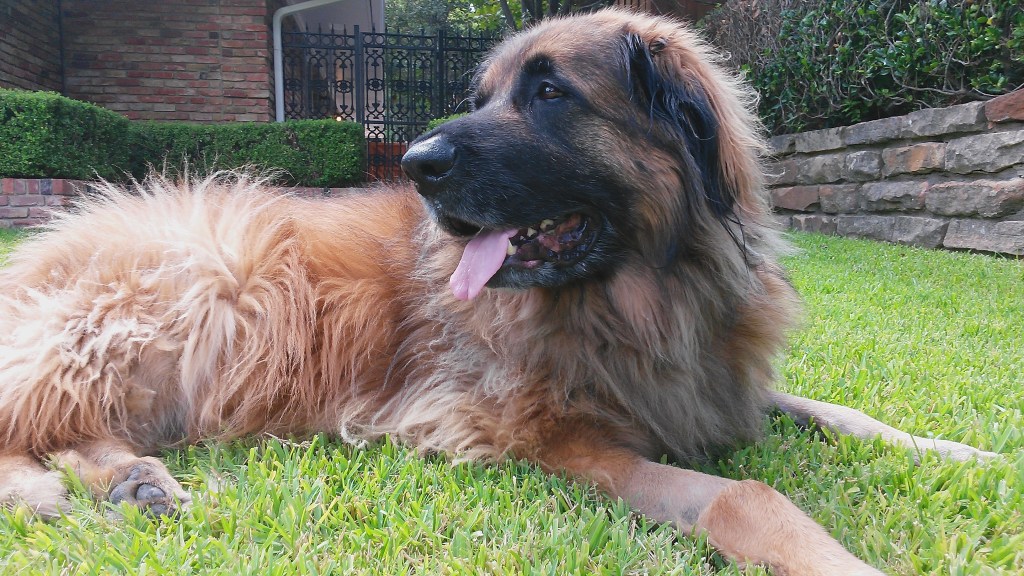
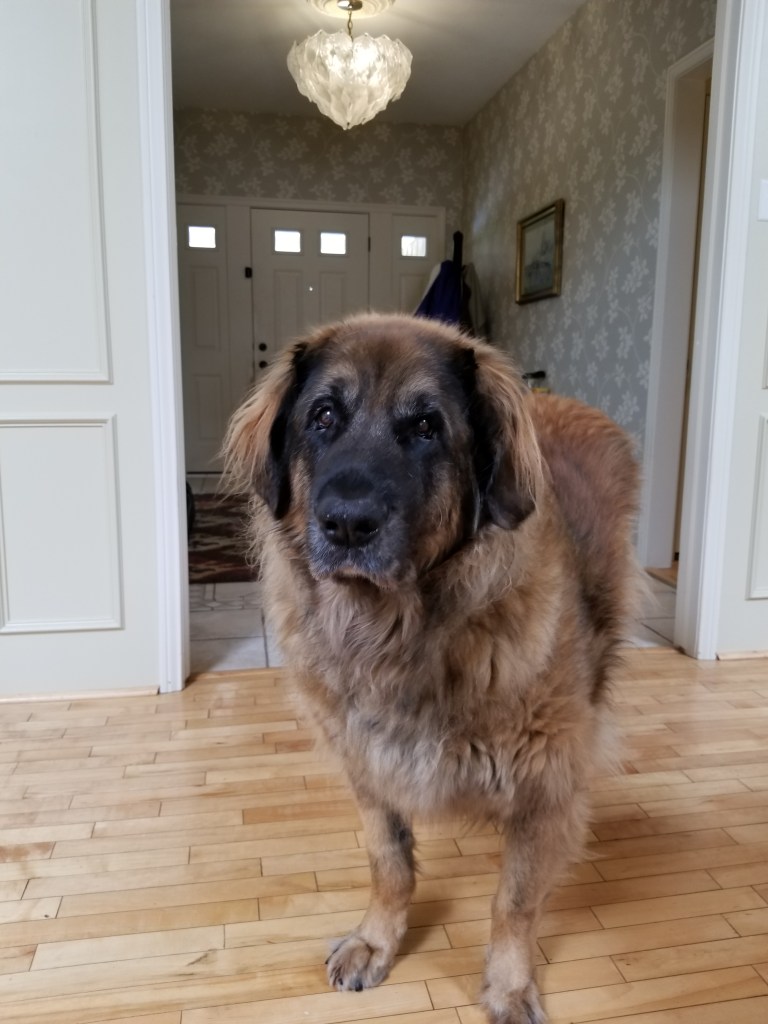
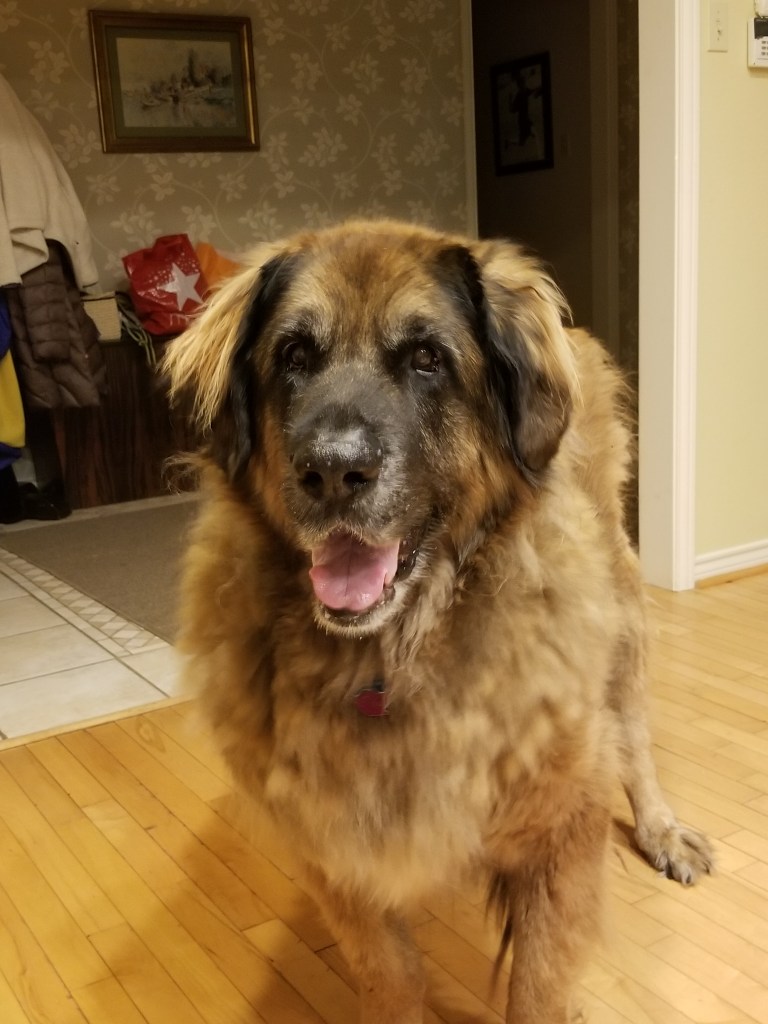
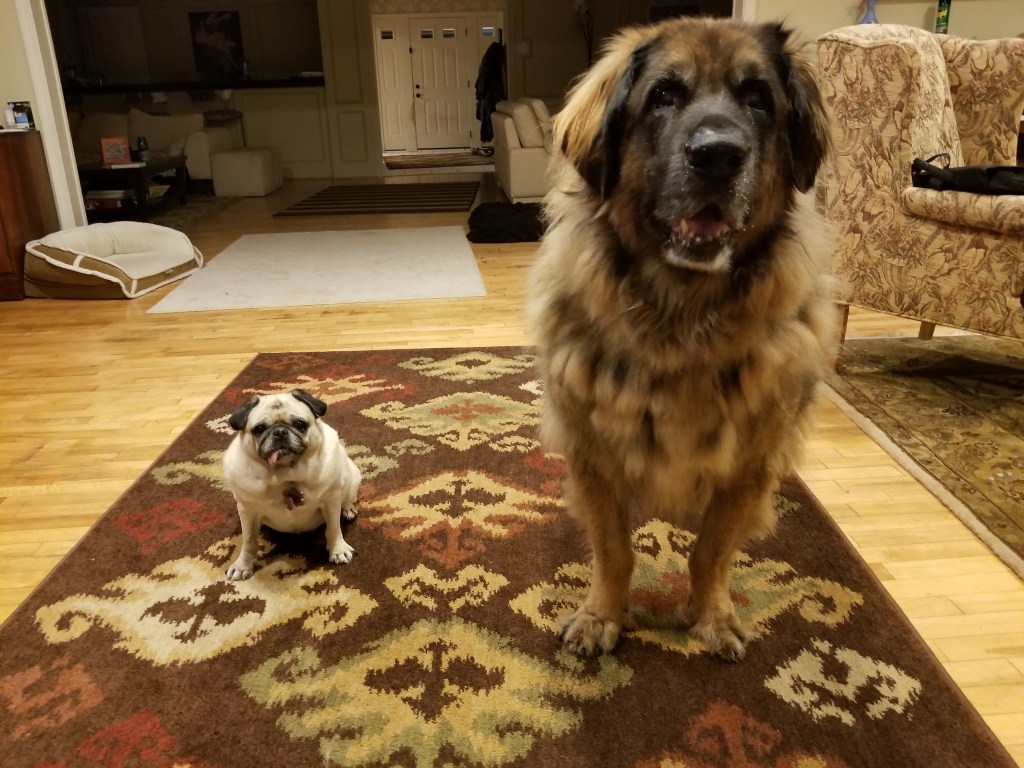
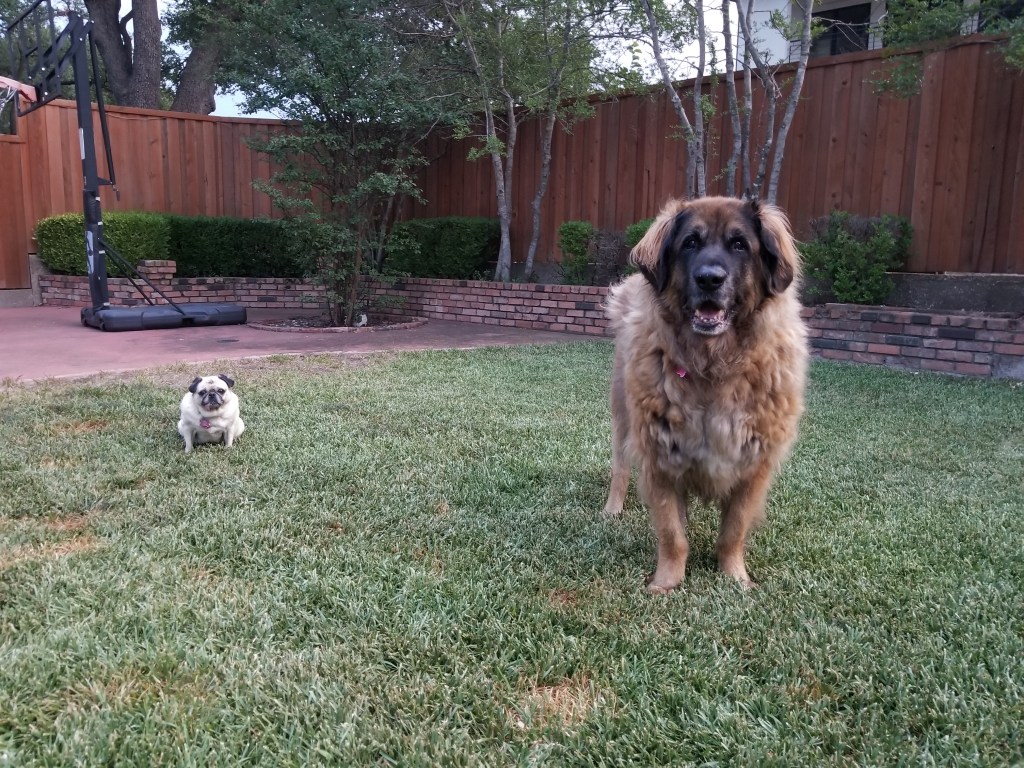
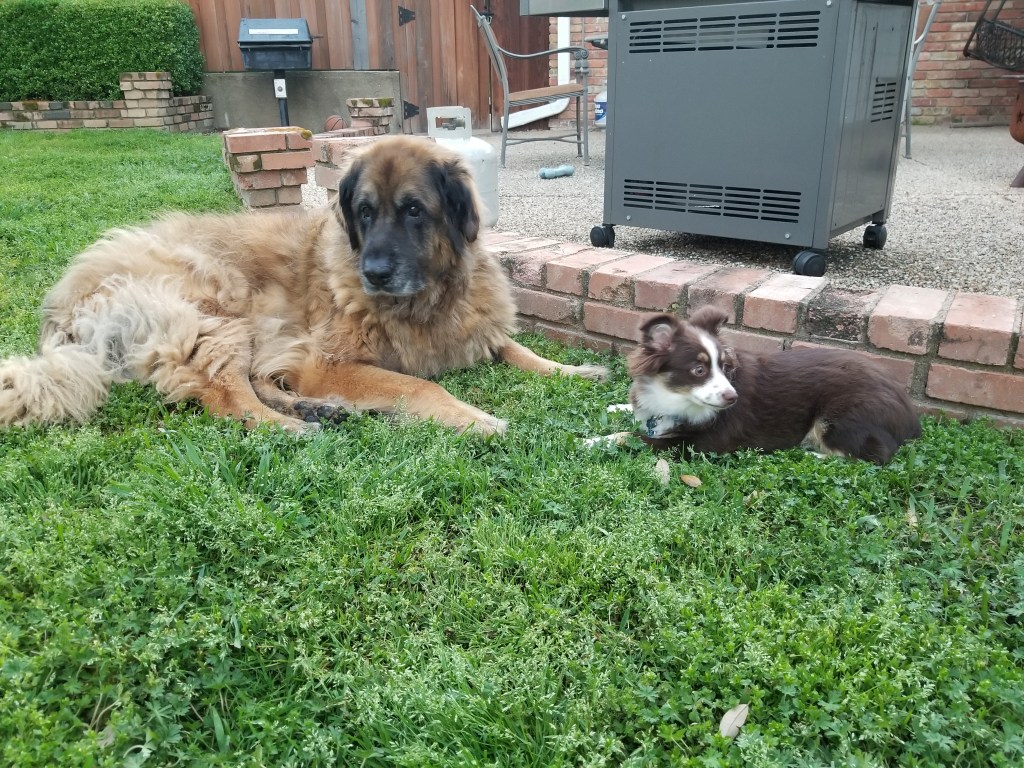
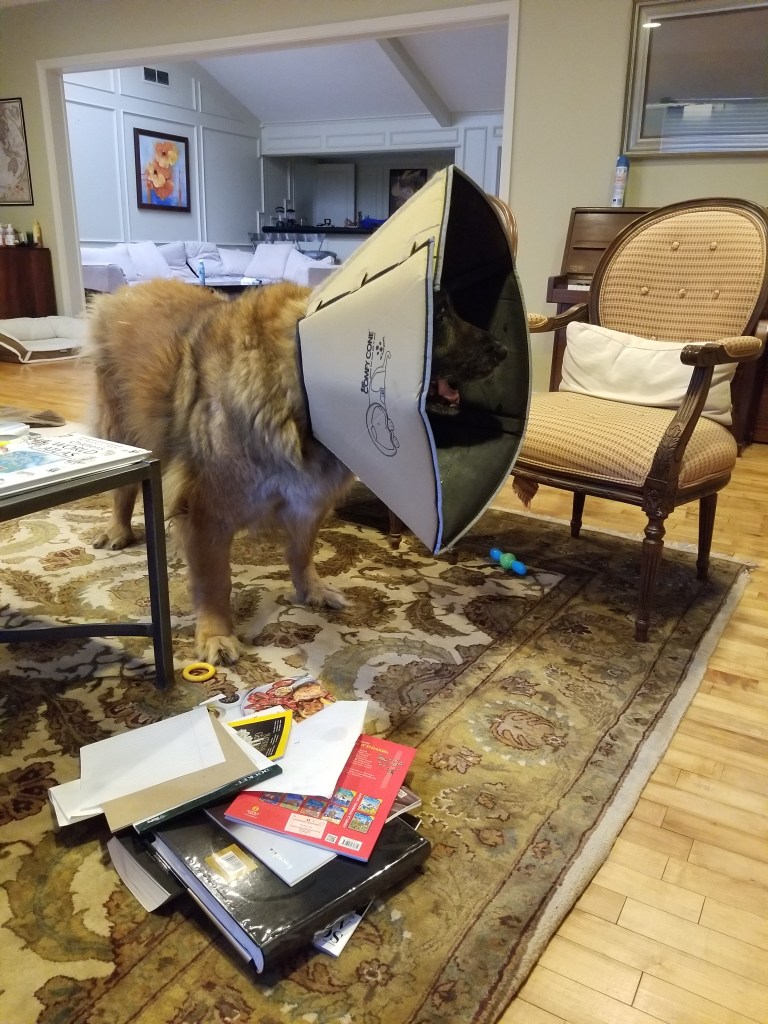
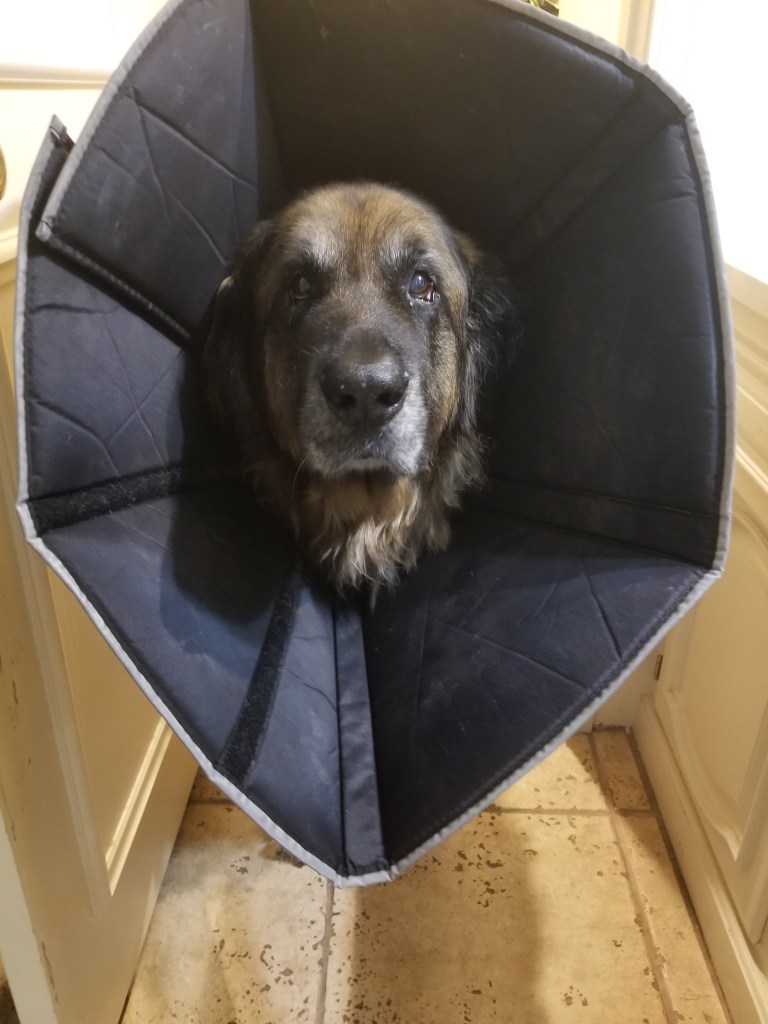
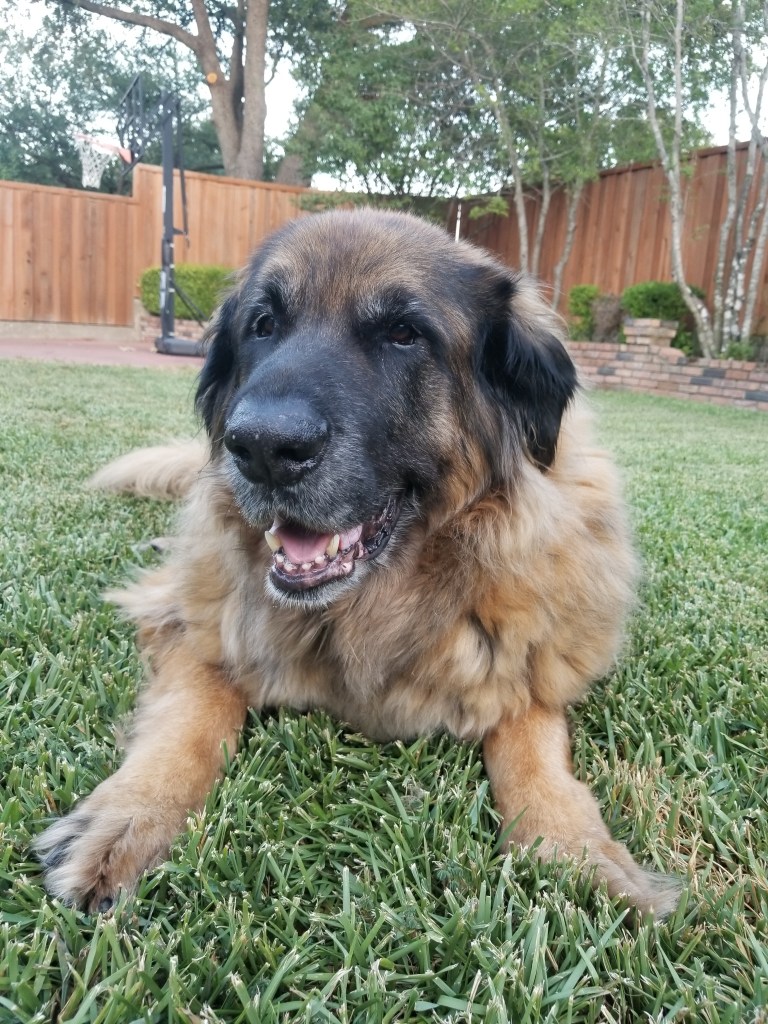
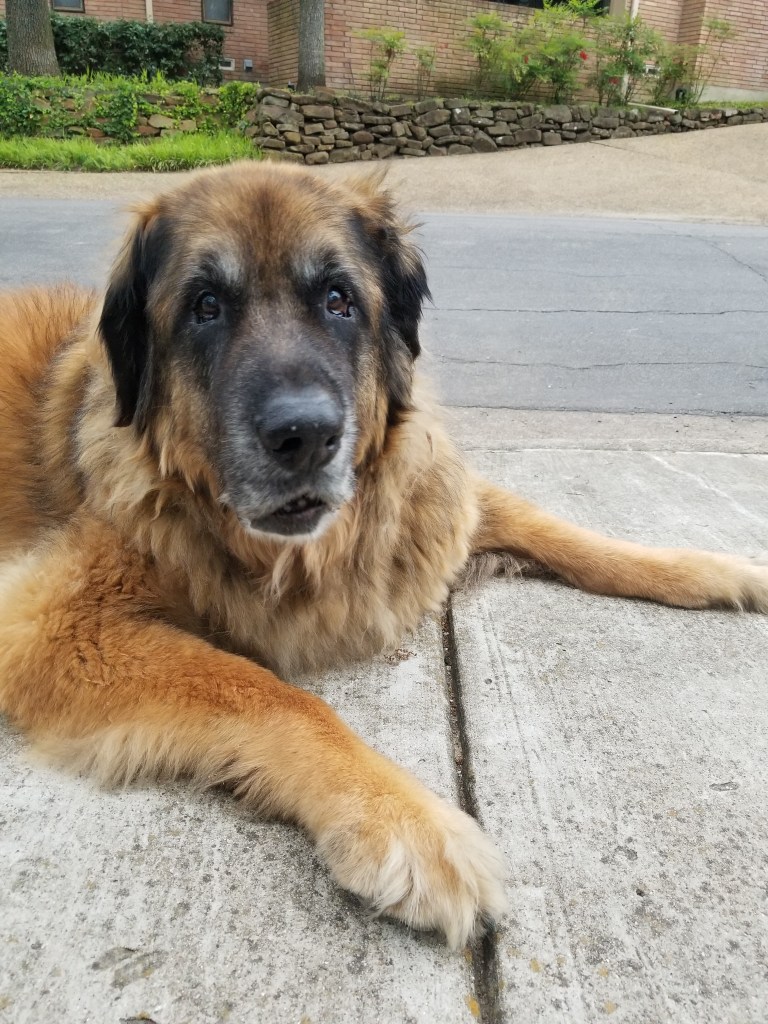
Our Leonberger Bronco sitting in the front lawn.In this photo our Leonberger Bronco is eleven years old and standing in front of our hallway. Old age is starting to set in. In this photo he has already had squamous cell carcinoma a toe-skin cancer and he has amputated a couple of toes.Our Leonberger Bronco eleven years old, looking a little bit scruff and getting grey hair.Bronco with our pug Daisy whom he protected with his life. He saved her life by intervening when a lose German Shepherd went after her and he even shared food with her he had stolen from me.Bronco loved our big red sofa. It was great for him but too deep to be comfortable for humans.Bronco and Daisy in the backyard.Bronco is welcoming a new puppy, a mini-Australian Shepherd called Rollo.Rollo loved playing with Bronco. He walked all over him, sat on his head like a hat and dangled in his tail. Bronco was patient.Two buddies in the backyard.Bronco is hungry and is coming to get my attention.Our Leonberger Bronco in Grandpa’s bushes.Our Leonberger Bronco is twelve years old in this photo, a quite respectable age for a Leonberger.Our Leonberger Bronco was a saint. He saved Daisy’s life, he might have saved the life of our Labrador Baylor as well, when he sniffed out an oncoming insulin shock before it happened.A tornado ravaged our neighborhood, smashed our chimney, ruined our roof, and partially damaged our fence. It was not Bronco huffing and puffing. He had just had a toe amputation due to a reoccurrence of squamous cell carcinoma. He has a bandage on his leg, which was protected by a one-gallon zip-lock bag when he is walking outside.Bronco’s Grey Muzzle Award has arrived. He received the award for living longer than 12 years, a rare feat for a Leonberger. It is the Leonberger Health Foundation International that give out this award.Our Leonberger Bronco with the, so called, cone of shame. Well, it was a soft cone for comfort and the largest size to match his size. Unfortunately, he swung that cone around sometimes clearing tabletops.Bronco barging into the bathroom with his cone and all. He didn’t like being alone.Old Bronco sitting in the backyard.Our Leonberger Bronco was almost 13 years old in this photo.Among the last photos of Bronco. After this photo he passed away from a heart failure. He always had a heart of gold but even hearts of gold don’t last forever.
This blog is primarily about Leonbergers and our late Leonberger Bronco as well as the book I wrote about him and his dog friends. However, sometimes I review other Leonberger books. This time I am reviewing The Dogfather: Dog wisdom & Life lessons: Leonberger book ~ Leonberger gifts Paperback – May 12, 2020 by Alex Luther. This paperback is 285 pages, black and white, ISBN 979-8645268923, item weight 13.4 ounces, dimensions 6.34 x 0.65 x 6.34 inches, so fairly small. You can buy it from Amazon but exist only in paperback format. It is currently $18.99 on Amazon.
The Dogfather Leonberger book by Alex Luther.
We’ve owned many dogs, all wonderful dogs, but our Leonberger was the most amazing creature I’ve come across. He passed away one year ago. Originally bred to be large companion dogs they are in tune with your feelings, and for the same reason they make great therapy dogs. They are double coated and have webbed large paws, making them excellent swimmers, they are sometimes used for water rescue. They are smart, very strong, they have an excellent sense of smell, they are big, about the same size as a St. Bernhard, and they are excellent guard dogs as well. Our Leonberger became the protector of our smaller dogs. He saved our pug’s life once. He also found and brought back our hamsters when they escaped their cage. He noticed (smelled) that our Labrador, who had diabetes, was about to have an insulin shock and alerted us to it. One time he chased away an intruder that frequently trespassed on our property and threatened us as well as our neighbors. No, he didn’t try to eat him. He probably just wanted to say hello, but the intruder didn’t know that. After that the intruder never came back. Above all he was very loving, very sociable, and sensitive to our feelings.
I thought the book looked interesting and might be worth reading at the same time as I expected a lot of sayings I’ve heard before and maybe silly jokes, but as I read on, I found the book to be better than I had expected. It is a very touching collection of sayings that were all new to me and the poetic wisdom words captured the personality of a Leonberger very well. Initially this made me believe that the author must own or had owned and loved a Leonberger like us. A few examples: “I think Leonbergers are the most amazing creature; they give unconditional love. For me, they are the role model for being alive.” “One reason a Gentle Lion can be such a comfort when you’re feeling blue is that he doesn’t try to find out why.” “The reason a Gentle Lion has so many friends is that he wags his tail instead of his tongue” and my favorite “Sometimes I think I like Leonbergers more than I like humans. The only time a Gentle Lion has ever betrayed me…was by dying.” However, upon rereading the book I realized that it is possible that the sayings could apply to any kind of dog breed. Furthermore, I also realized that the author has written 160 nearly identical books called “The Dogfather <insert dog breed> or “The Dogmother <insert dog breed>”. So, I had just fooled myself. Most likely the author has never seen a Leonberger.
However, the sayings in the book are touching and the word Leonberger is used throughout the book. Not as good as I thought, but close. In the middle of the book there are two pages of advertisement and a web link for buying stuff. So, this book is partially advertising. That’s OK. The book is mostly for a younger audience but also sentimental adults. I gave the book four stars on Amazon.
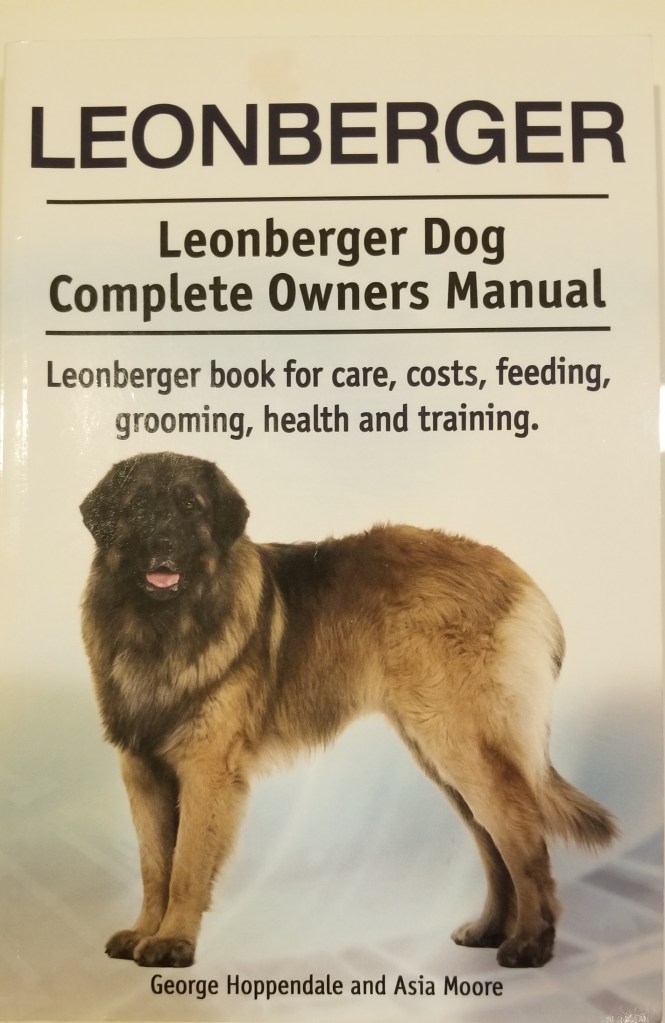
Followers of my blog probably know that I sometimes review Leonberger books, and on occasion other types of books. This time I am reviewing Leonberger, Leonberger Dog Complete Owners Manual. Leonberger book for care, costs, feeding, grooming, health and training. May 31, 2015 by George Hoppendale (Author), Asia Moore (Author). The paperback is 186 pages, black and white, ISBN 978-1910941003, item weight 9.1 ounces, dimensions 6 x 0.41 x 9m inches. You can buy it from Amazon and Barnes & Noble and it exist in both printed version (paperback) and e-Book (kindle). Currently the paperback version is $12.58 on Amazon and $13.97 on Barnes and the kindle version is $8.97.
Leonberger Dog Complete Owner’s Manual by George Hoppendale and Asia Moore. Click on the photo to go to the Amazon page for the book.
Our Leonberger Bronco lived a long life for a Leonberger. He was the sweetest most loving and brave soul I’ve known, and he was quite intelligent. The average life span of a Leonberger is 8 years and Bronco was two weeks short of 13 years old when we had to put him to sleep. I read this book while we still had Bronco and later on, I read it again. The first four chapters of the book are fairly specific to Leonbergers, including a description of Leonbergers, how to choose a breeder, and some vital statistics. The next five chapters apply to any dogs but still contain some information about Leonbergers regarding health problems, feeding and care. Chapter 10 to 18 apply to any dog and describes training, grooming, medical care, poisonous food and caring for aging dogs. The book also lists rescue organizations, resources and references.
Page 6 of Leonberger Dog Complete Owner’s Manual by George Hoppendale and Asia Moore. Click on the photo to go to the Barnes and Noble page for the book.
I should say that the authors did not own a Leonberger and they wrote a lot of dog books for many different breeds containing similar content. However, a lot of dog book authors have done this. They basically mass produce dog books reusing material. In some Leonberger books the breed specific information minor and incorrect, as if the authors had never seen a Leonberger and copied their information from an online source focused on Pugs. Yes you really have to watch out when you buy a Leonberger book. It might not be about Leonbergers at all. At least the authors of this book included substantial Leonberger information that was mostly correct. Another consideration is that if you write about Leonbergers you have to include some information that is apply to all dogs or the information will be insufficient.
The book is fairly basic, but it contains useful and important information, some of it that I did not know before reading it. The book contains an error on page 120 where they are referring to Leonbergers as “smaller dogs”. I believe that is a copy and paste error, maybe from their Pug book. However, the book describes Leonbergers as being big (120lbs to 170lbs) everywhere else in the book, so this is obviously just a typo. The book was well written, easy to read, and as a (former) Leonberger owner I think it was a good introduction to caring for a Leonberger (as well as other dogs). The fact that the paperback version was in black and white was a little bit of a disappointment, but the color printing cost is quite high. There are better Leonberger books, but I still recommend this book because it contains mostly correct information, and it is inexpensive.
I gave it four stars on Amazon. Some people may think that four stars might be high based on what I’ve said. However, based on all the Leonberger books I’ve read, and I’ve read many; if you go any cheaper on your Leonberger book you are going to get a book with nothing but nonsense.
This blog post is focused on Ryu one of the dogs that Bronco grew up with.
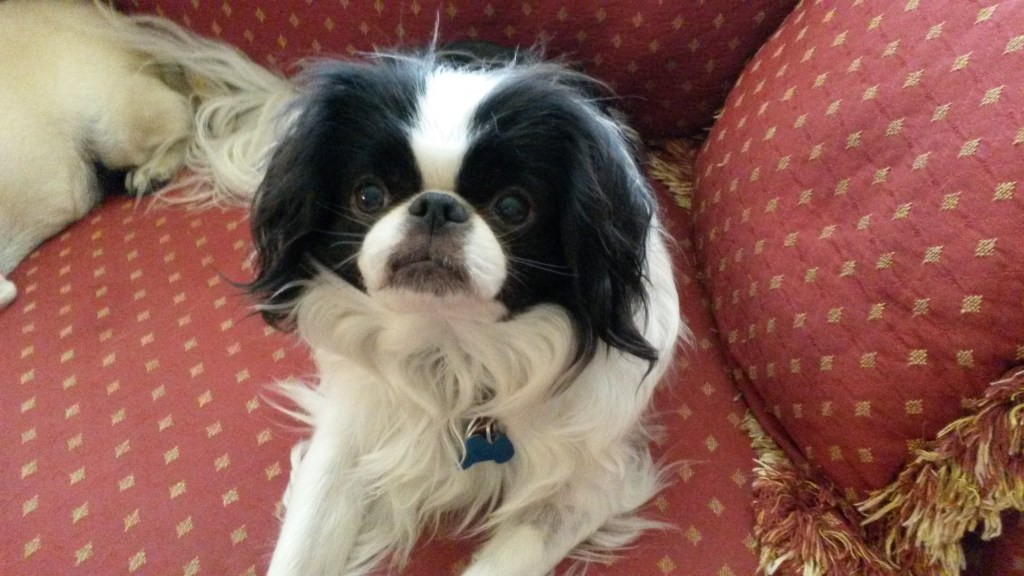
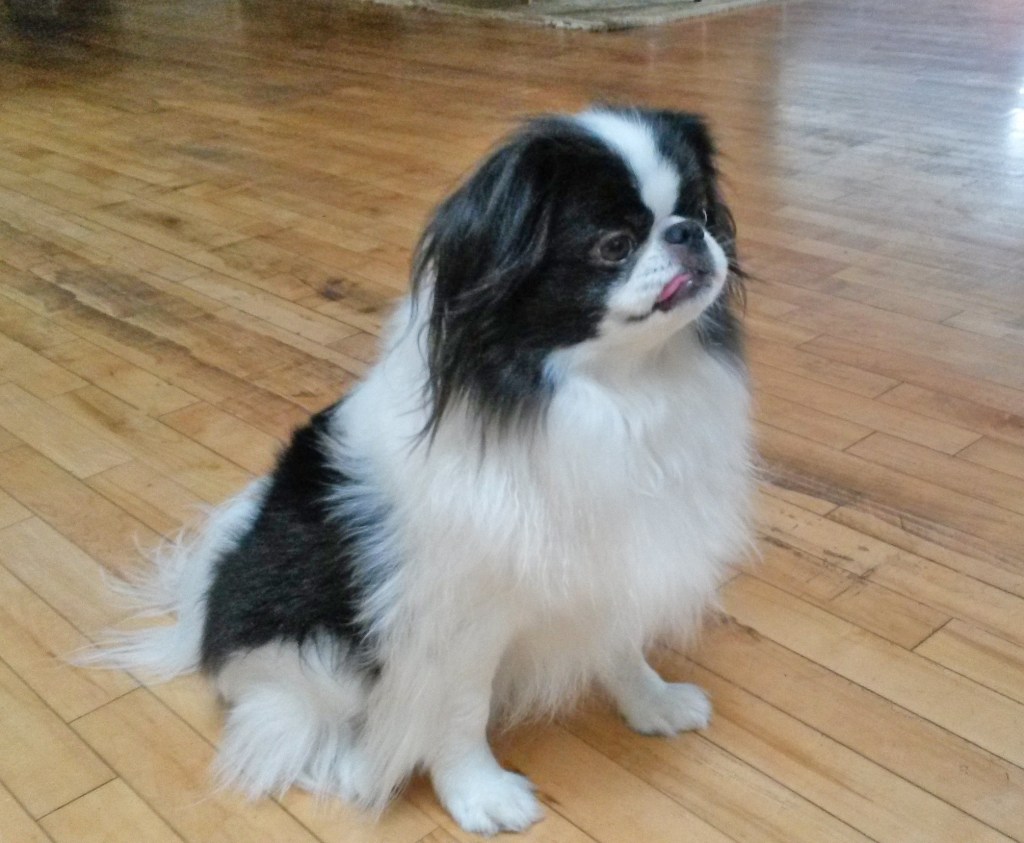
Ryu a Japanese Chin
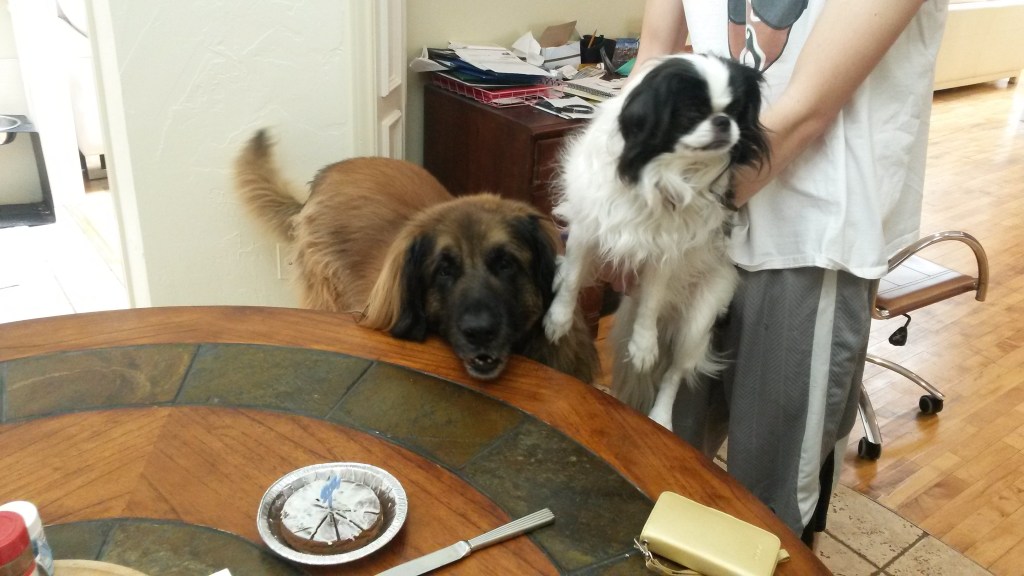
Around a year after we got Bronco, we got a fourth dog, a Japanese Chin. He was a gift for our daughter, Rachel, who named him Ryu after a Japanese ninja warrior. Ryu was a very energetic dog, quick and brave—except that he was terrified of thunderstorms. At seventeen or eighteen pounds, he was bigger than most Japanese Chins, but he was still a small dog. He got along very well with Bronco.
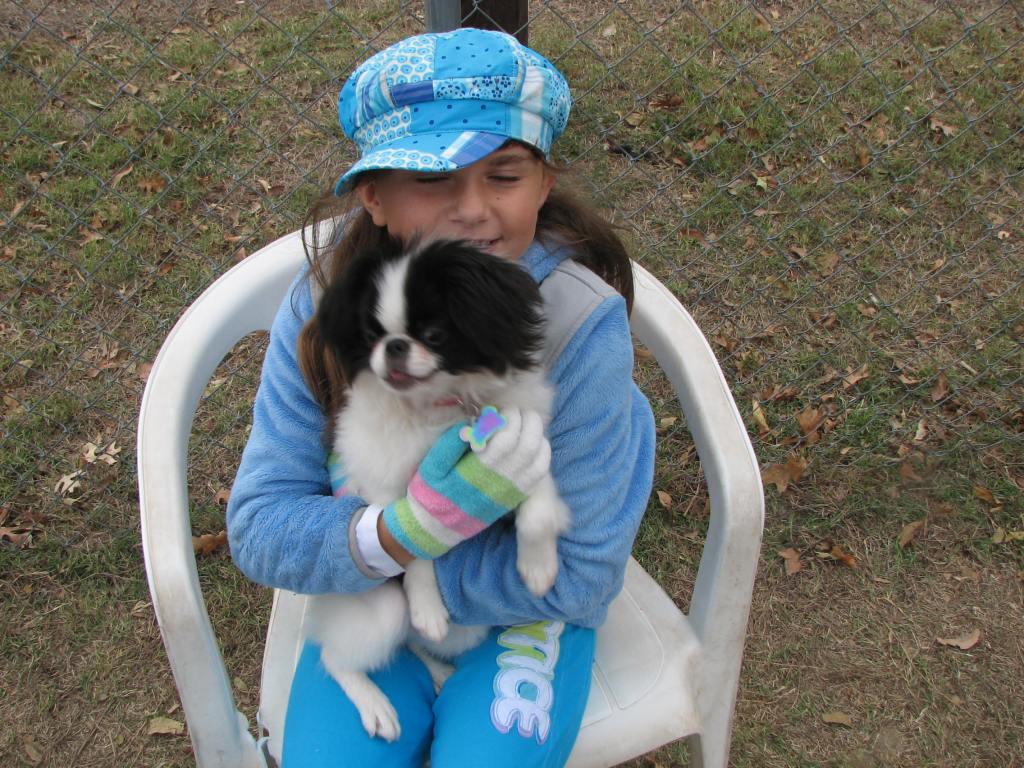
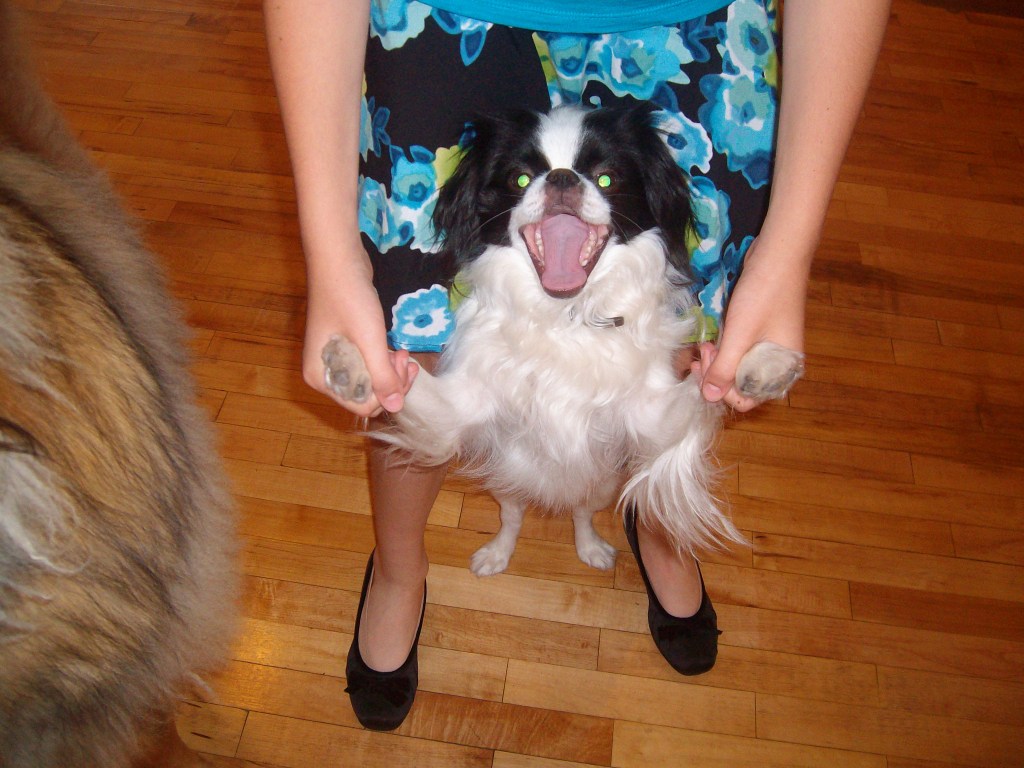
Rachel and Ryu, the Japanese Shin at the dogpark.
One of the things that stood out about Ryu was his singing. Japanese Chins are famous for their singing—well, actually, it’s closer to howling, but Ryu’s was a beautiful howl, and he was very proud of it.
Ryu the howling opera singer.
As soon as he discovered that he got a lot of attention for it, he started doing it quite often. Whenever we came home, he would sit politely, look at us intently—it seemed like he was clearing his throat too and howl. Like an opera singer, he would slowly turn his head to look at us, as if he were performing. In fact, I think Ryu’s howling sounded just like a night at the opera—especially when the lyrics are sung in Italian.
Ryu loved dancing and singing and Bronco partially visible on the left was his big brother and protector.
We would say, “Good boy, Ryu,” and clap, and he looked mighty proud. Other people thought it was cute and wonderful, too, and they gave him lots of praise, and of course he loved doing it and got good at it. When Rachel played the harmonica, Ryu would howl along. They made quite a duo.
“Good boy” might not be the kind of praise Andrea Bocelli would want, but Ryu was perfectly happy with it.
The interaction between Ryu and Bronco was sometimes truly amazing to watch. I remember one instance in which Bronco was sleeping in the house and Ryu was outside in our fenced backyard. The door to the backyard was open. I heard Ryu bark a few times. He had evidently seen something he wanted us to notice—or something he wanted other people to notice.
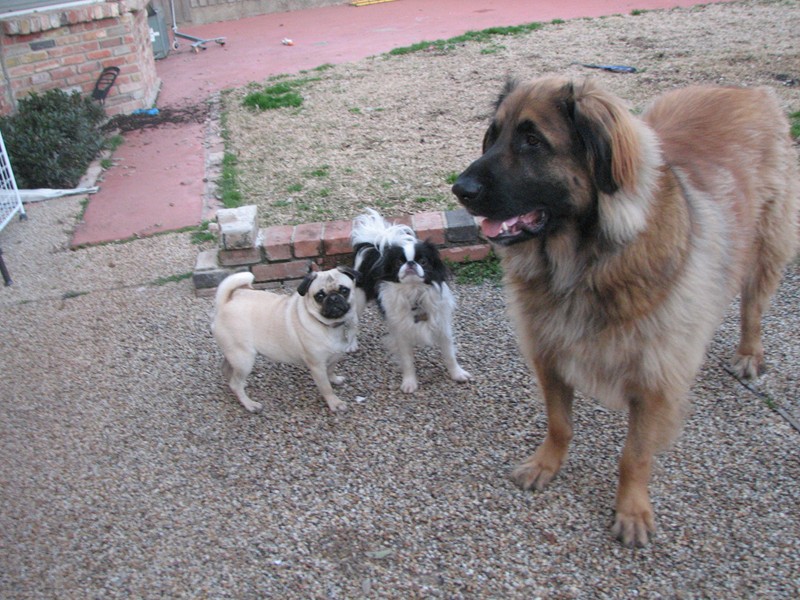
On the left Daisy (Pug) and Ryu (Japanese Chin). On the right Bronco our Leonberger.
Then I saw Ryu running in through the back door. He was a fast runner. He ran to Bronco, jumped on his stomach, and barked at him. Bronco woke up, looking drowsy and confused. Ryu waited for Bronco to shake off his grogginess and get up, then he ran out the back door with Bronco in tow. They both hurried to the gate that leads to the street. Ryu yapped, and Bronco barked his loud, booming bark. Ryu had enlisted help to multiply his bark power.
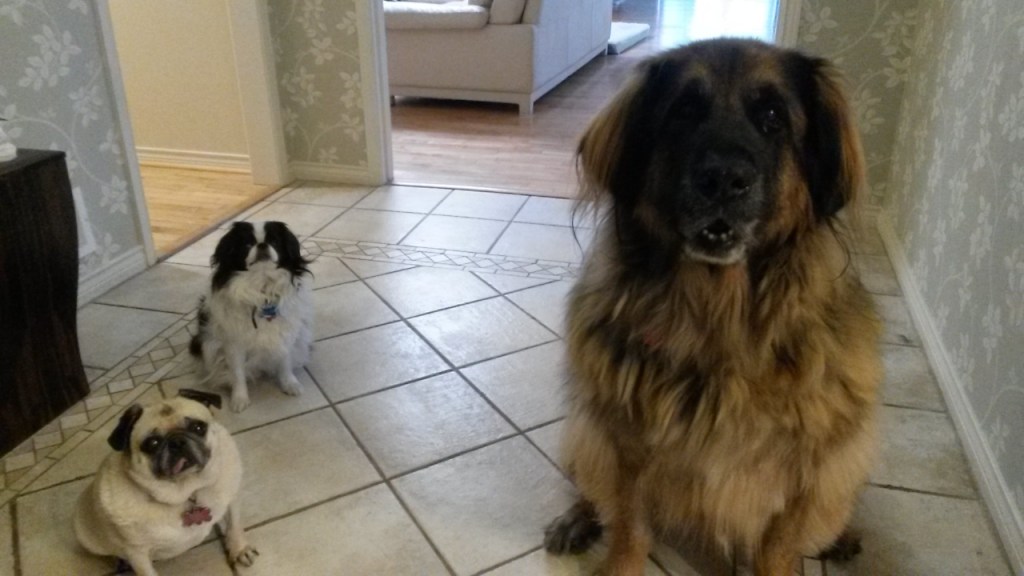
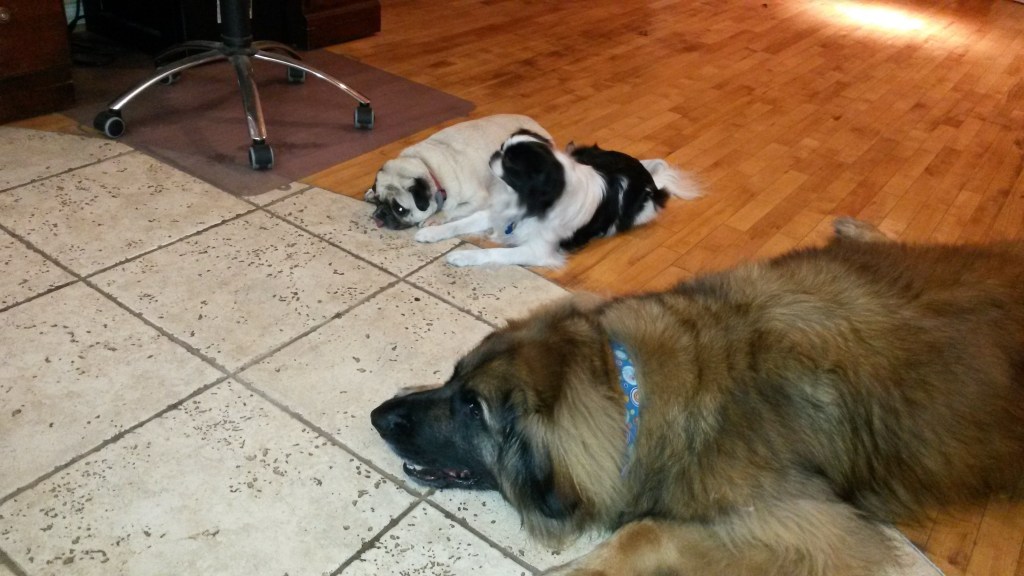
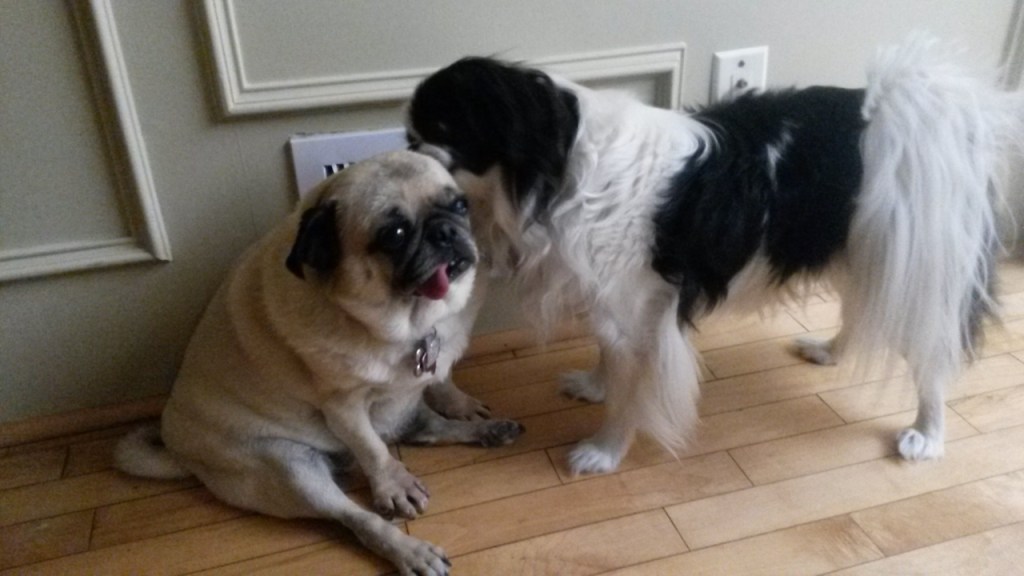
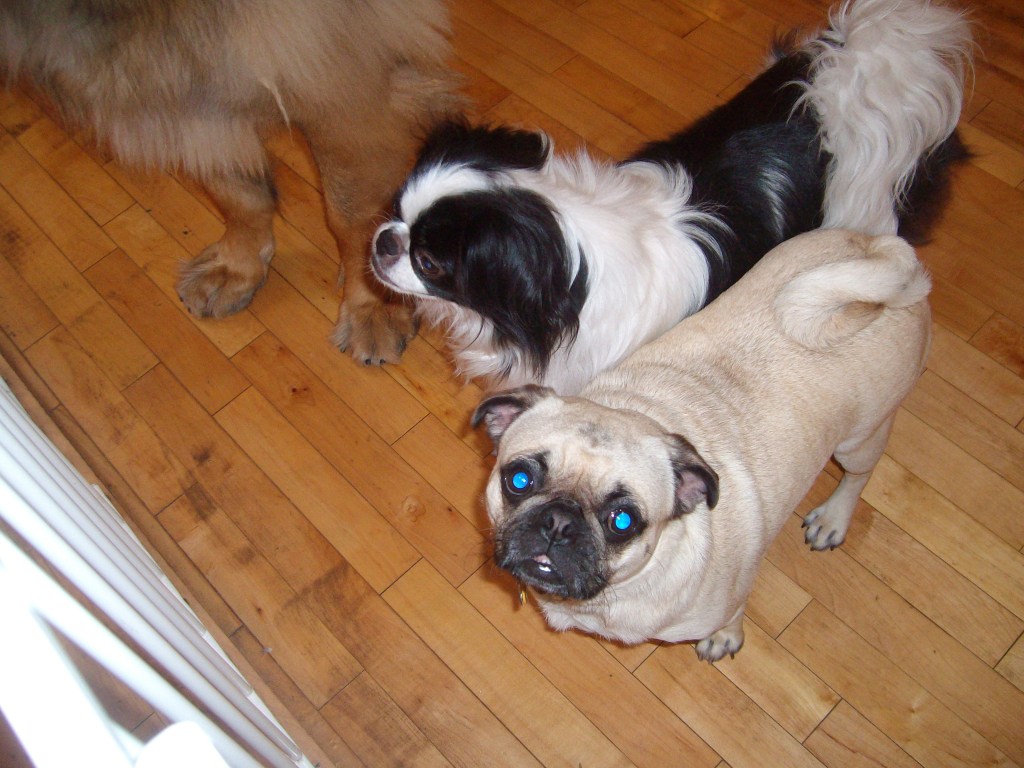
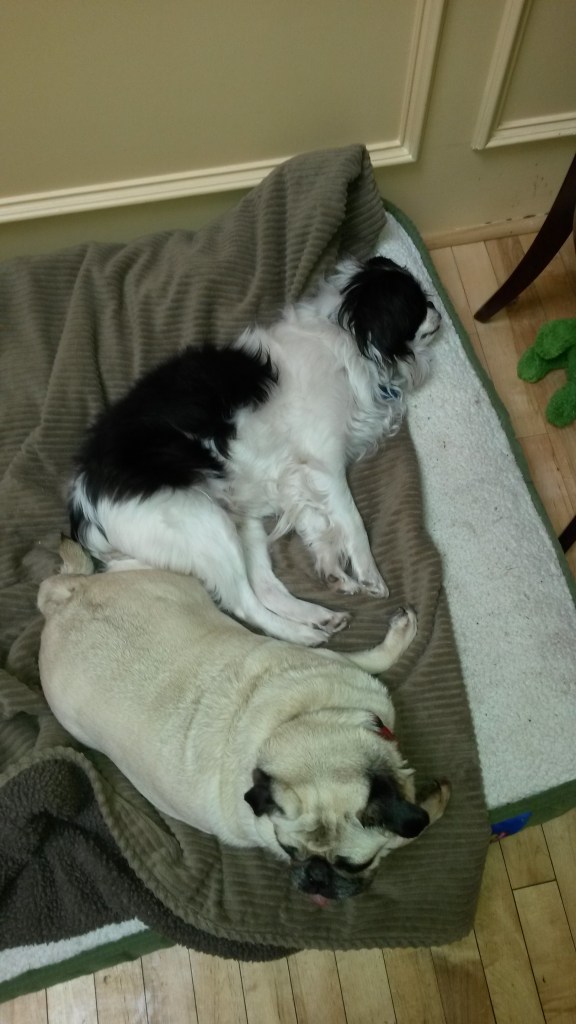
Three dogs resting and probably thinking up mischief. Ryu a clever little dog enlisting big brother’s help.Bronco our Leonberger was very protective of his little siblings Ryu our Japanese Shin and Daisy our Pug. He saved Daisy’s life when he got in between her and an attacking loose big dog.Ryu loved DaisyDaisy and Ryu, Bronco in the corner.Sleeping little dogsRyu’s birthday. Bronco is helping with the celebrations.Not every day was great.
Bronco gave us many funny stories and great memories. The book I wrote “The Life and Times of Le Bronco von der Löwenhöhle” feature several dozen stories. I’ve told a few of the stories here in my blog, but my recent visitors have not seen the early ones. Instead of telling too many stories from the book I’ve decided to rerun of the earlier stories including this one. It also an improvement because I am including images that were used in the book. In the first telling of this story back in March, I used an unfinished image. Anyway, this story is about our Leonberger Bronco finding run-away hamsters.
Bronco’s friendly face
Back when Bronco was young, the kids had pet hamsters—Moldova and Montenegro. The hamsters escaped from their cages sometimes, but Bronco usually helped us find them whenever they did. Claudia would tell him, “Bronco, find the hamsters,” and he would go around the house sniffing until he found them. One time he found them in the linen closet; another time he found them on a shelf in the living room.
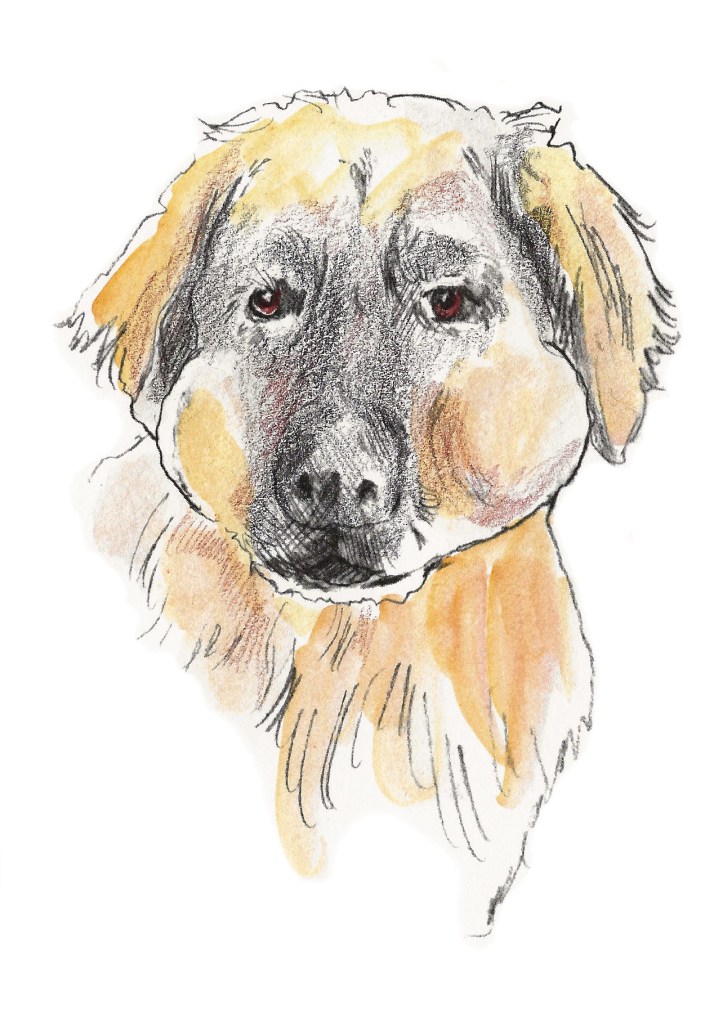
On one occasion, a friend of David trusted us with his two hamsters while he and his family went on vacation. A couple of days later, Claudia noticed that the two hamsters were missing from their cage. The next thing she noticed was that Bronco’s cheeks looked puffy, so she said, “Bronco, drop it!” Out came the two hamsters, both unconscious.
Bronco’s puffy cheeks. Are there hamsters in there? Illustration by Naomi Rosenblatt.
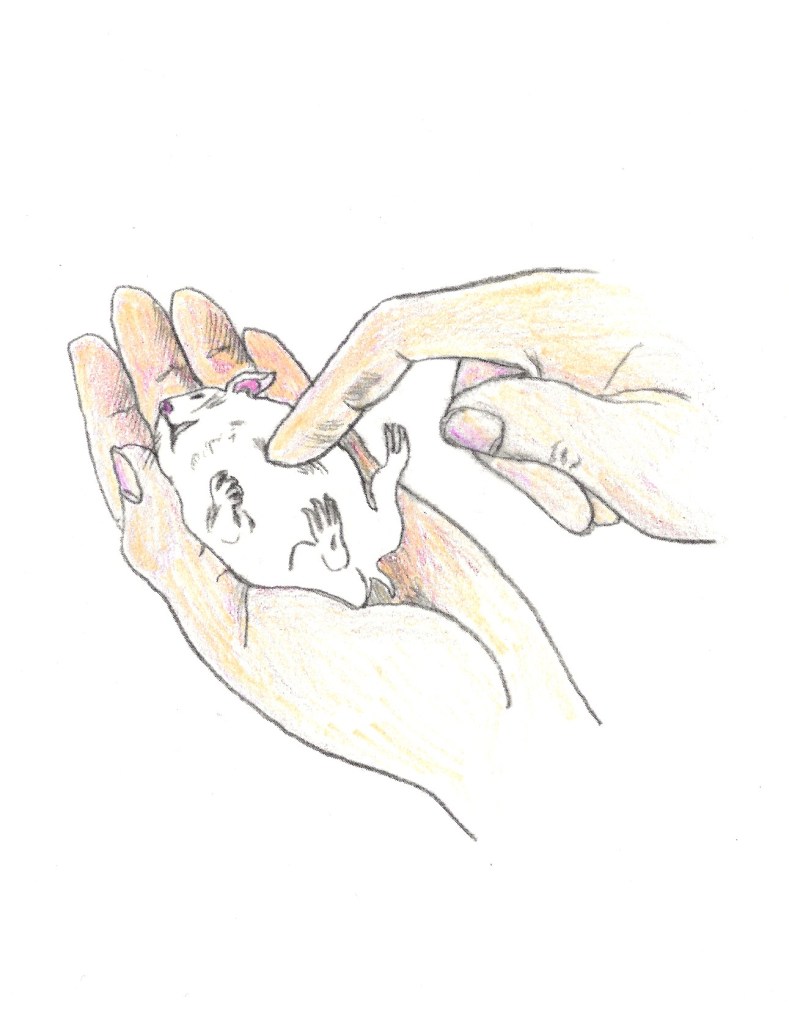
In a panic, Claudia started performing CPR on the unconscious hamsters. She put one hamster at a time in her hand and gently compressed each tiny chest using the finger of the other hand. Fortunately, one hamster revived right away. The CPR didn’t seem to be working on the other hamster, but Claudia put both of them back in their cage, and soon the second hamster also woke up. We decided to keep the incident to ourselves. Hamsters don’t squeal.
Claudia performing CPR on Hamster. They came back alive. Illustration by Naomi Rosenblatt.
The question is, Did Bronco try to eat the hamsters? Or did he simply find them and pick them up, intending to alert us to their presence? I’ve asked several people this question, including some who know Leonbergers well. The answer they give is that he tried to save them from whatever danger he thought they might have been in. If he wanted to eat them, they say, he would have tried chewing them. But clearly, he didn’t.
The hamsters may have felt differently about the situation and may have fainted from the shock. Who knows? Bronco was a hero on many occasions, but this time, perhaps, he was a hamster superhero.
Eventually our own hamsters died, but that didn’t end Bronco’s interest in them. When the first hamster died, we held a funeral. We put the hamster in a shoe box, said goodbye, put some flowers in the box, and buried it in the backyard underneath some bushes. But when we turned our backs, Bronco was there, digging under the bushes. Perhaps he thought he could save the hamster. So, we called Bronco off and tried again: this time I dug a deeper hole and put a wide rock over the shoe box before covering it. Now Bronco couldn’t dig up the hamster. When the second hamster died, I had learned my lesson and did the same thing.
Our late Leonberger Bronco and his sister, the pug Daisy.
Bronco gave us many funny and exciting stories to tell. The book I wrote “The Life and Times of Le Bronco von der Löwenhöhle” feature several dozen stories. I’ve told a few of them here in my blog, but it was early on before I had many followers and I think most of you have not seen them. Instead of telling too many of the stories in the book I’ve decided to rerun some of the stories I’ve already told here in my blog, with some improvements, such as better images. Images that were used in the book (the images previously used in my blog were low-resolution early versions). This story is about the time when our Leonberger Bronco saved us as well as the neighborhood from a peeping tom who haunted and taunted us at night. Here we go!
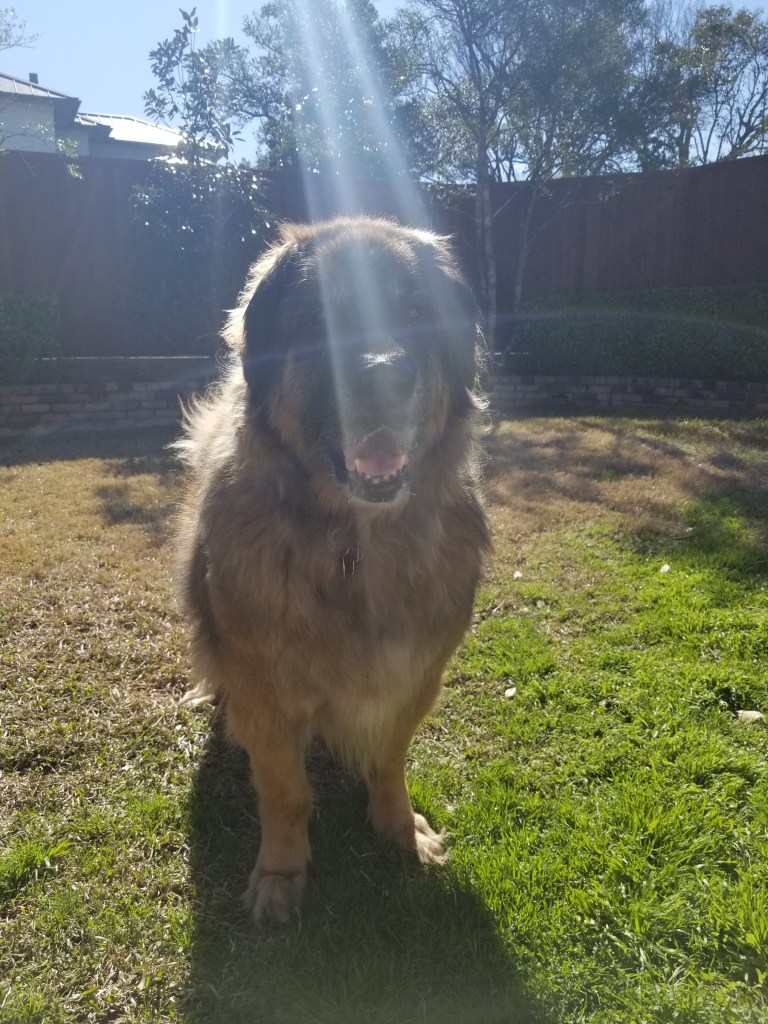
Le Bronco von der Löwenhöhle or Bronco as we called him.
It was a quiet evening, and I was home alone. My wife, Claudia, was visiting her parents a few blocks away with Rachel, our daughter. Our son Jacob was meeting with his debate team; our other son, David, was visiting a friend.
I was making myself a ham sandwich in the kitchen when I suddenly felt a hand on my right shoulder. I startled and turned my head to face what I feared was an intruder, and there he stood on his hind legs—our Leonberger, Bronco. His big paw on my shoulder felt for a moment exactly like a human hand.
Bronco looked at me with his kind, wise eyes, then he looked at the sandwich. Then he turned his head toward me again and held my gaze. At that moment I understood what he wanted. I cut the sandwich in two and gave him his half.
I should explain that we had a problem with a trespasser at that time, which was the reason I was startled. This trespasser would sit outside our bedroom window at night and make threats and shout obscene comments at Claudia when I was not present. At first, though, we didn’t know where the threats and comments were coming from. I doubted Claudia’s accounts of these incidents, especially because she thought the voice might be coming from within our bedroom, perhaps via an electronic speaker. I thought she was just having nightmares.
Then one night I heard it myself—a voice screaming, “I am going to burn your house down!” Just as Claudia had said, it sounded like it came from within our bedroom, almost as if it were right next to me.
After Claudia and I went through our “Oh, so now you believe me” routine, I started looking under our bed and inside the heating and air-conditioning vents for hidden speakers and/or microphones. It was hard to believe that someone had planted these things in our bedroom, but that seemed to be the case.
Then it finally dawned on me. Next to the headboard of our bed, on Claudia’s side, just inches from her pillow, is a window. At night, when the blinds are lowered and the slats are partially open, you can see in, even if we have just a few lights on in the house. But, of course, under these conditions, you can’t see anything that might be outside.
I ran out the front door and around the back of the house, and there, right in front of our bedroom window, was one of our lawn chairs. The trespasser had climbed our fence, taken the chair, sat down in front of the window, and spied on us. Whenever I left the room, he would shout obscenities and threats at Claudia. When his face was planted in front of our window, he was just two or three feet away. This was why the voice felt so close. This had been going on for two weeks. We were happy to have finally figured it out, but we realized we had a problem.
Peeping Tom outside our bedroom window at night, illustration Naomi Rosenblatt
We talked to our neighbors about the situation, and they told us that the trespasser had terrorized them as well. He had been quite busy looking through bedroom windows at night. People in the neighborhood were scared. I called the police, who told us they could do nothing unless the man was caught in the act or he committed a crime other than trespassing.
Therefore, I decided to hire private investigators. I found them in the phone book. Phone books still existed back then.
The investigators told me that they typically spy on people suspected of cheating on their spouses, so this would be a more interesting job for them. The plan was for them to hide behind the bushes in our backyard and in a dark car parked on our street. When the man appeared, they would record him on video. They had a lot of fancy equipment and instruments, including big microphones, cameras, and metal detectors. They reminded us of Ghostbusters with all their technology and enthusiasm. They clearly loved their job. Unfortunately, though, the trespasser didn’t show up, so after a couple of days I decided to let the investigators go.
However, I soon figured out who the trespasser was. I started paying attention to what was going on in the neighborhood, and one evening, I noticed a strange looking but relatively young man, apparently homeless, who seemed to be stealthily roaming our neighborhood. I did not confront him, because I had no proof.
But a few days later, I heard shuffling noises outside our bedroom window. The trespasser was finally back. This time I sent Bronco out to chase him, and he did. Like the detectives, Bronco was enthusiastic but didn’t catch him. Still, he chased the man off. Having a big bearlike dog rushing toward you at night is probably a bit unnerving, even if the dog just wants to lick you. We never experienced or heard about the problem after this event, so Bronco may have helped the entire neighborhood.
Bronco chasing off intruder at night, illustration Naomi Rosenblatt.
A couple of weeks later, while walking Bronco on a neighboring block, I saw the homeless man across the street, at a bit of a distance. He stared at us in fright. Bronco just calmly looked at him without barking. The man was clearly terrified of Bronco, and he ran away.
But despite the nightmare the homeless man had inflicted on us, I felt sorry for him. My guess is that he was suffering from mental illness and that he had had a very tough and lonely life.

















 Leonberger Life