
Read this review of my book “The Life and Times of Le Bronco von der Löwenhöhle”. Bronco was my best friend and I love when someone loves the book about him.
Tag: Lowenhohle
The Origins of the Leonberger Dog
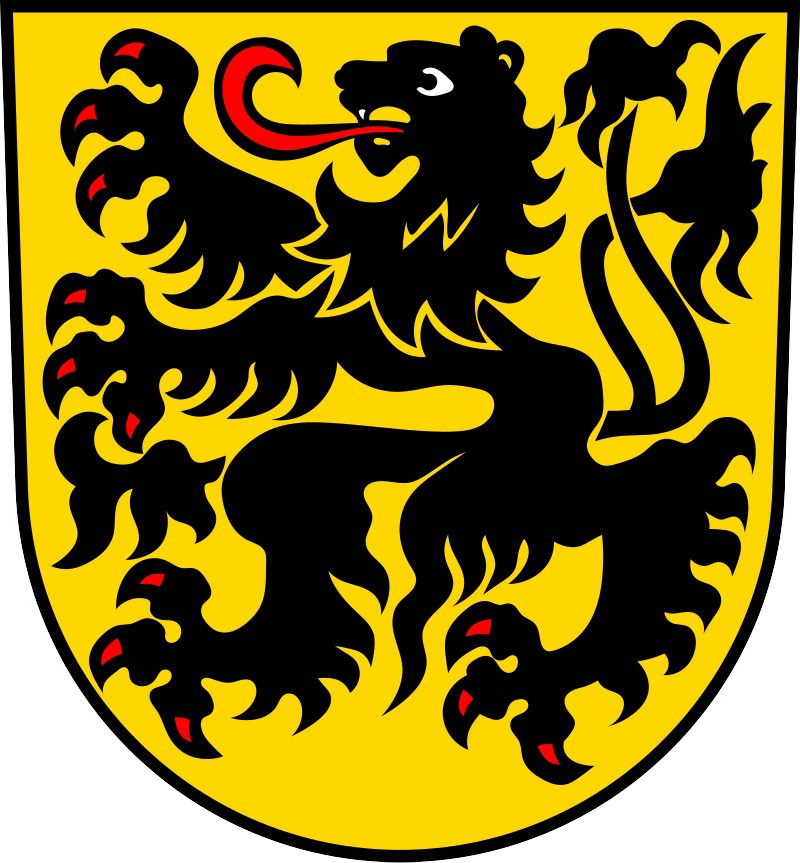
The Leonberger breed was originally created by Heinrich Essig (1808–87) in the German town of Leonberg, in what was then the kingdom of Württemberg. According to legend, Essig bred the dog to resemble the lion in the town’s coat of arms. Indeed, as you can see in the image above, the lion in the coat of arms doesn’t look like a real lion, so you could say that the Leonberger looks the way it does because Germans were bad at drawing lions back then. All joking aside, though, Leonbergers do bear some resemblance to lions and maybe even bears. In any case, they are beautiful dogs.

When people would stop me and ask me questions about the kind of dog Bronco was, I would say he was a Leonberger, a cross between a Saint Bernard, a Newfoundland, and a Great Pyrenees and that the breed was created by the mayor of the German town of Leonberg. But, as the economist Tyler Cowen said, “Be suspicious of simple stories.” As it turns out, the story I kept telling was a simplification and not entirely true. History is more complicated. I was unintentionally spreading misinformation about Leonbergers.
Simple and interesting stories are easy to remember, easy to believe, and easy to propagate. But first, Heinrich Essig was never the mayor of Leonberg. He was a prominent citizen of the town, and he was a successful businessman, farmer, innkeeper, horse and dog trader, large dog enthusiast, dog breeder, and town councilman, but he was never the mayor.
Essig claimed to have created the Leonberger in the 1830s by crossing a female Landseer Newfoundland with a male long-haired Saint Bernard from the Great Saint Bernard Hospice, a monastery in Switzerland. He continued crossing the Landseer Newfoundland and the Saint Bernard over four generations, then he crossed his Newfoundland Saint Bernard mix with a Pyrenean wolfhound not, as is often asserted, with a Great Pyrenees (called a Pyrenean Mountain dog in Europe). He then crossed that dog with the Saint Bernard again. In 1846, he was finally ready to announce and register his “lion of a dog.” A few years later, Leonbergers were officially introduced to the public at the Munich Oktoberfest.

However, the story is more complicated than that. There’s no specific breed named Pyrenean wolfhound today, so Essig could have used a Great Pyrenees or a Pyrenean mastiff . In addition, later in the nineteenth century, Leonbergers were used to breed the long-haired Saint Bernard dog, and this likely saved the Saint Bernard dog from extinction. At one point, too, Leonbergers were deliberately mixed with Newfoundland dogs to strengthen the Newfoundland breed. In other words, breeding happened in both directions, and the characteristics of the large breeds were in constant flux. The dogs, including Leonbergers and Saint Bernards didn’t look like they do today, either. Essig’s Leonbergers were multicolored, mostly white, and lacked the black mask that is so important to the breed now. What has not changed is the essence of what Essig was aiming for: a large but moderately proportioned dog that is friendly and loving and a great companion.

Ultimately, the origins of the Leonberger, as well as the Saint Bernard and the other large breeds from this region, are complex and shrouded in mystery. In addition, some of Essig’s claims have been disputed. Breed standards wouldn’t be codified until the end of the nineteenth century. It should also be noted that it was Essig’s niece Marie who to a large extent bred and cared for the dogs.
Essig was selling his Leonberger dogs as luxury items to the wealthy. He was also a marketing genius and was able to get the attention of European nobility and royalty. The czar of Russia, Emperor Napoleon II, Otto von Bismarck, the king of Belgium, Empress Elisabeth of Austria, Emperor Maximilian I, the Prince of Wales, King Umberto of Italy, Giuseppe Garibaldi, and the mikado of Japan were among those who owned Leonbergers. Not everyone was happy about this. Some people viewed the Leonberger as a fashionable knockoff of the Saint Bernard that could hinder that breed’s development.
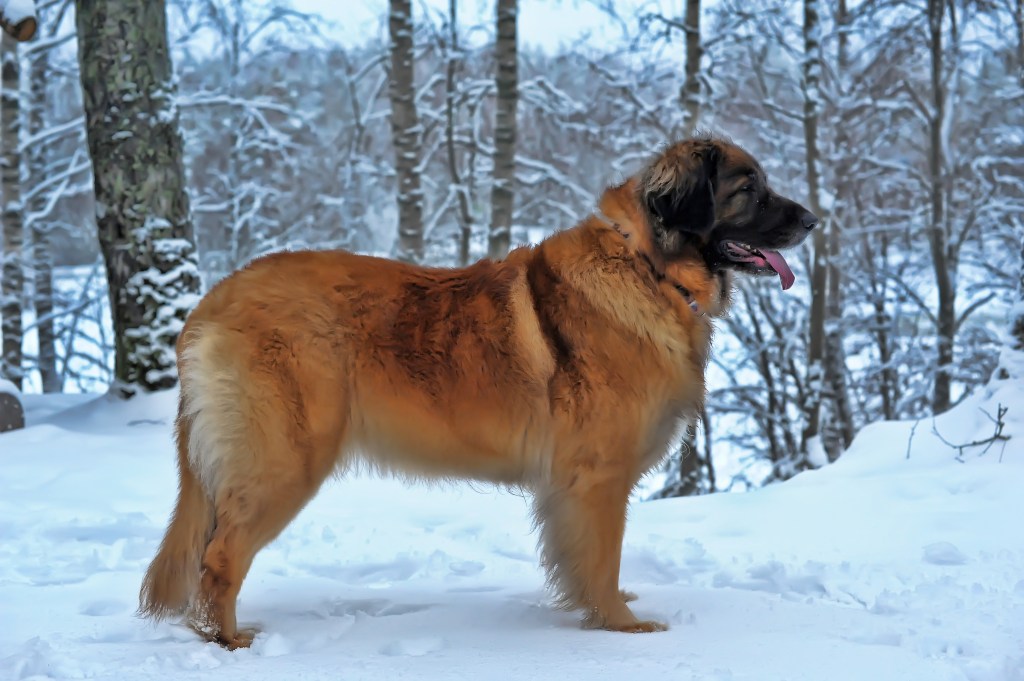
Toward the end of the nineteenth century, the discipline of cynology, or the scientific study of dogs, emerged. Cynologists pushed for breed classification and systematic breeding practices, and breed standards were created. But Essig and others viewed dog breeding as an art rather than a science, and this led to a conflict with the cynologists. Heinrich Schumacher, for example, was a breeder who strove to create a clearly identifiable Saint Bernard type. He was upheld by the cynologists as a paragon, in contrast to Heinrich Essig to the detriment of the Leonberger.
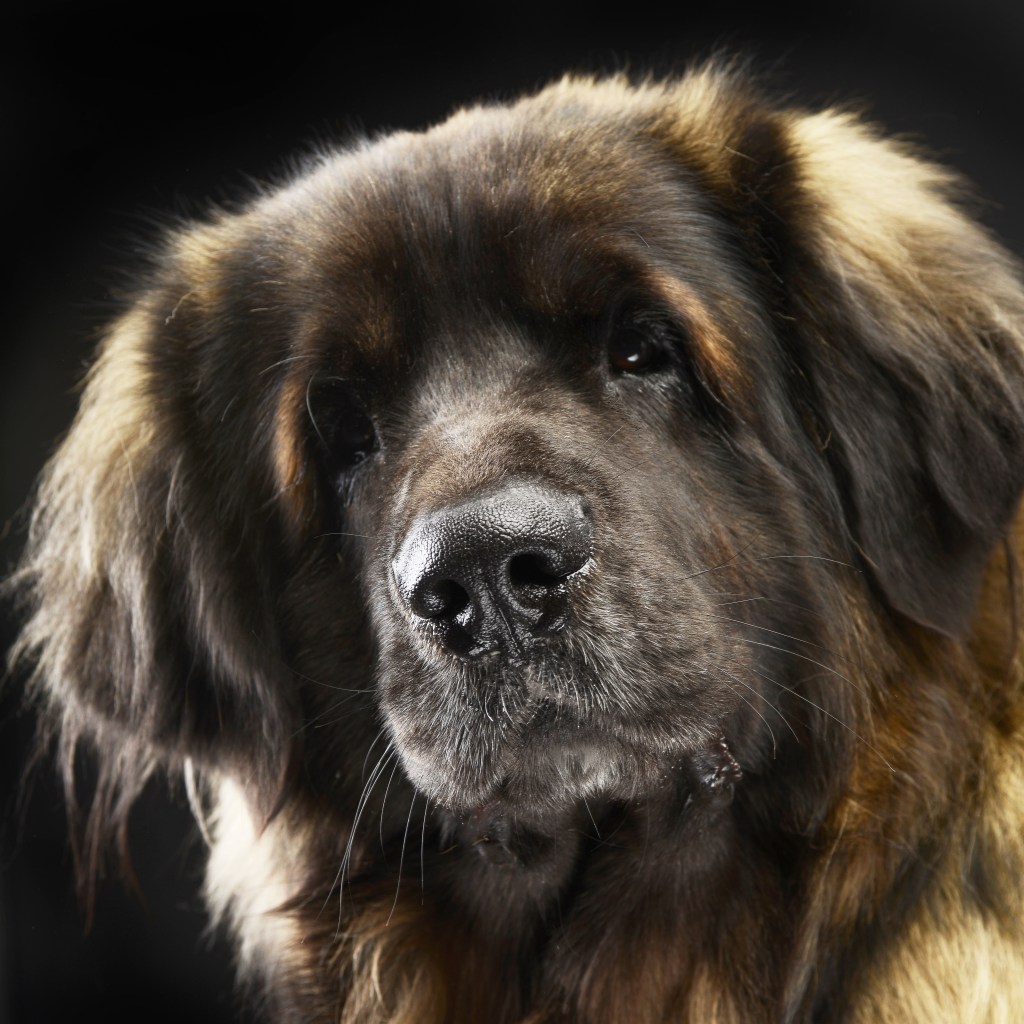
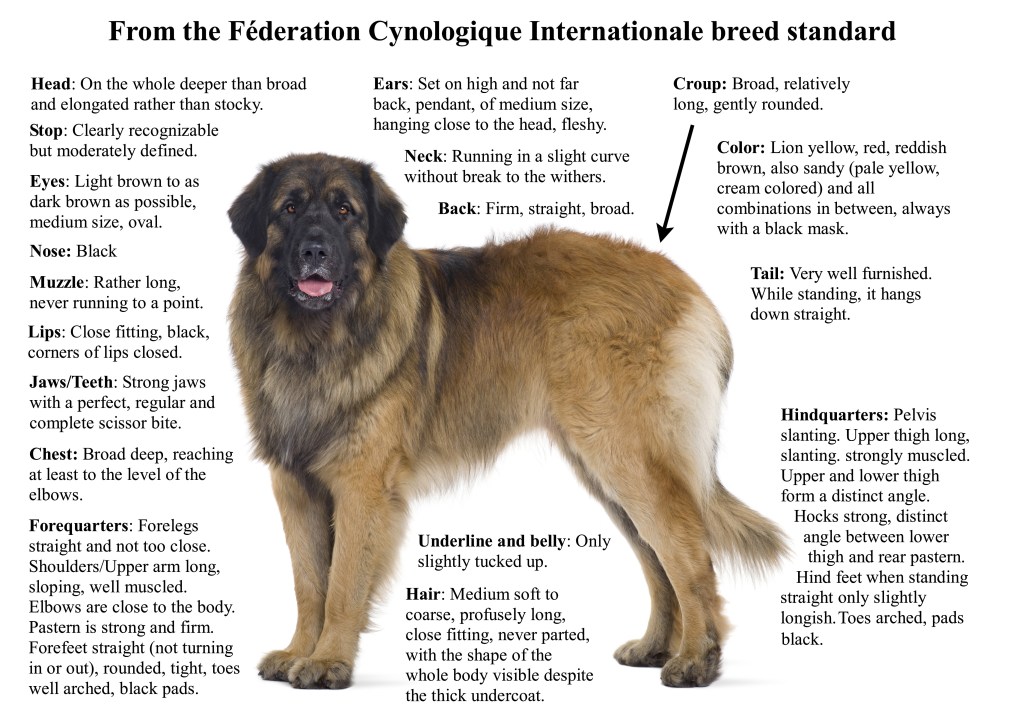
After Essig’s death, in 1887, other people more willing to please the cynologists continued breeding Leonbergers. By that time, the dogs looked for the most part like Leonbergers do today. Then, in 1895, Albert Kull created the Leonberger’s first breed standard. It would go through several revisions in 1901, 1926, 1938, 1951, 1955, and 1972—until finally, in 1996, the FCI approved version was established. The Kennel Club in the UK and the American Kennel Club also have their own breed standards. However, most of them are similar to Albert Kull’s 1895 version. The first Leonberger club was formed 1891 in Berlin: two more were created in 1895, then two more were formed in 1901. The most prominent was the Internationaler Klub für Leonberger Hunde, of which Albert Kull was the first president.
For additional information see :
The Life and Times of Le Bronco von der Löwenhöhle: Stories and Tips from Thirteen Years with a Leonberger by Thomas Wikman.
Madeline Lusby, Leonberger: A Comprehensive Owner’s Guide (Allenhurst, NJ: Kennel Club Books, 2005).
Caroline Bliss-Isberg, Leonberger: A Comprehensive Guide to the Lion King of Breeds (Sea Cliff , NY: Revodana Publishing, 2017), 23, 41, 45, 48–49.
The Day Bronco Wearing a Leg Cast Chased Our Neighbor
An excerpt from my book : The Life and Times of Le Bronco von der Löwenhöhle
When Bronco was almost eight years old, we discovered a case of squamous cell carcinoma in one of his toes—or, rather, in one of his toenails. It was on his right rear paw.

Squamous cell carcinoma is a type of skin cancer that certain large-breed dogs, including Leonbergers, are susceptible to. It often grows out from the skin around the nail and can affect the bone and tissue around it. It is typically not very aggressive, but it can spread, and it is painful. It manifests itself as a swollen toe, or you may be able to see a large red papule that looks like a pimple. Sometimes the toenail falls off. The dog is likely to limp and lick the toe and may become reluctant to go for walks, although that was never the case with Bronco.
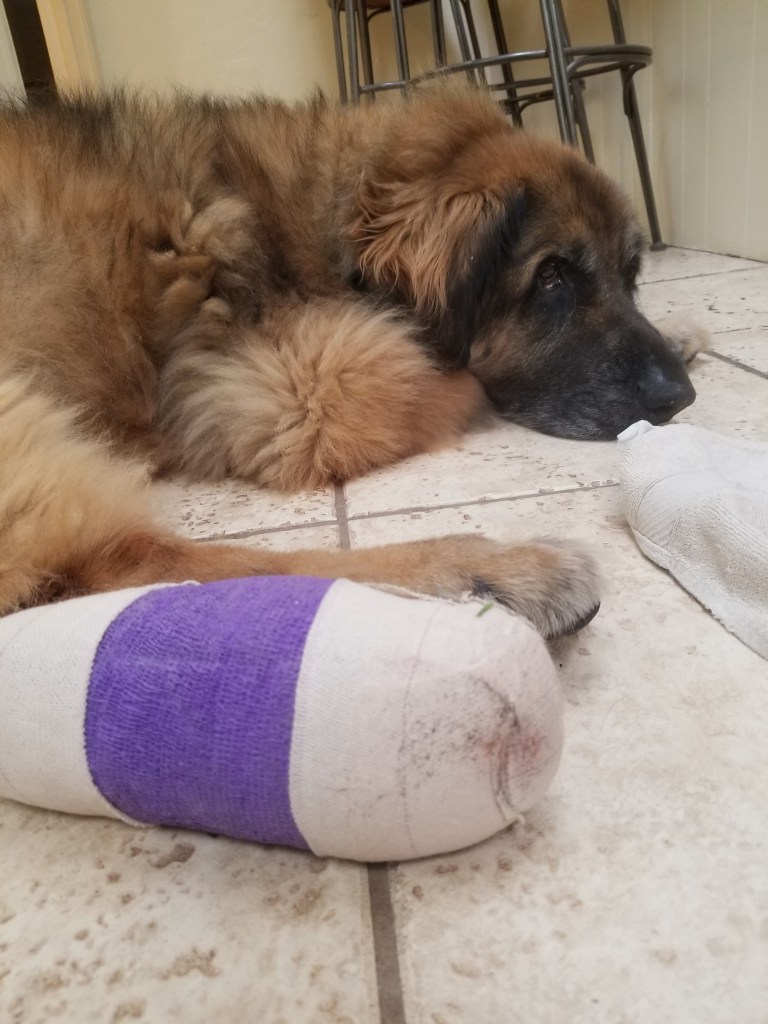
Primarily because of the pain, but also because of the small risk of metastasis, it is usually recommended that the affected toe be amputated. So we went through with the procedure. When we picked Bronco up the day after the surgery, his paw was in a bandage. But he got some treats, and he was in a good mood. We went back to the veterinary surgical center for a bandage change a few times, and then he was done.

Unfortunately, though, we discovered another lesion a year later. This time it was on a large toe on his left front leg. We asked the doctors if the cancer had spread to this toe. We were told no—Bronco was just prone to getting this type of cancer. But the cause could also have been something in the environment. In Texas, the ultraviolet radiation from the sun is significant. We really don’t know why this happened to him, but we were assured that it was not because the cancer had spread.
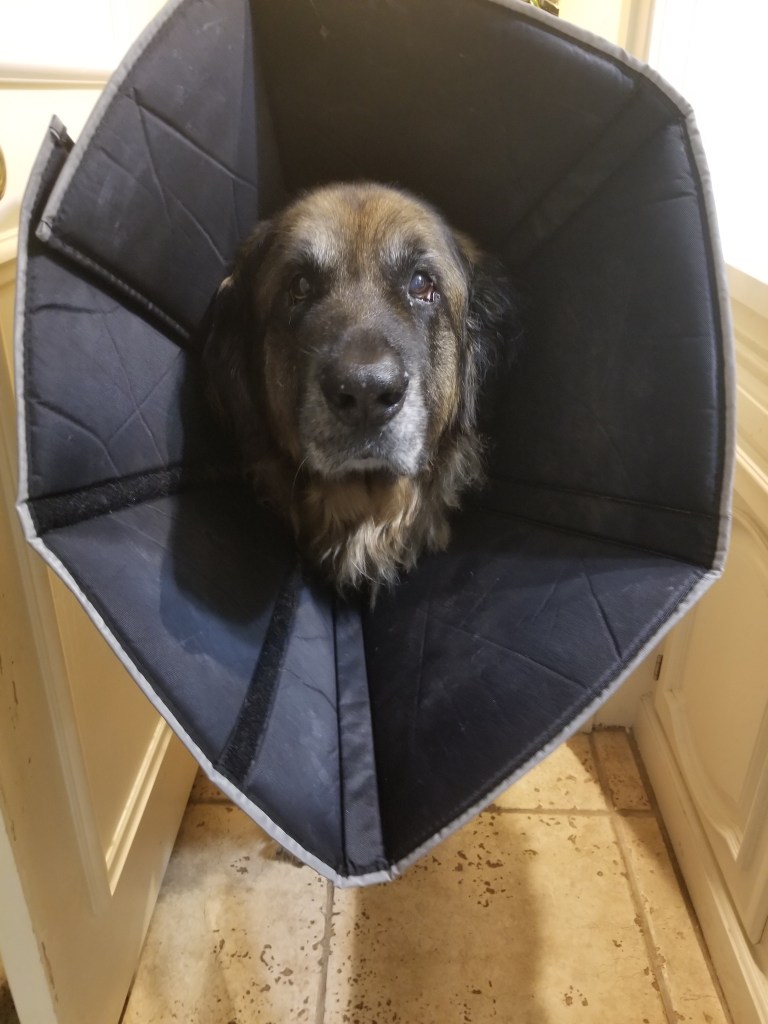
This time around, Bronco’s entire leg was put in a cast, to be replaced by a bandage after ten days. We were instructed to keep him inside during those ten days and keep him as still as possible. We were to make sure he wouldn’t bump the cast. This was, of course, almost impossible to do, but we were going to try.
However, Bronco really wanted to go out, which he showed us in various ways, such as scratching at the front door. After a week or so, Claudia suggested that we take him outside a little bit, just in our driveway. I agreed. When I handed her the leash, she said, “He can barely walk; do you think he’s going to run off without it?” We laughed, and I agreed that it didn’t seem like we needed it this time. So Claudia walked out with Bronco slowly limping beside her.

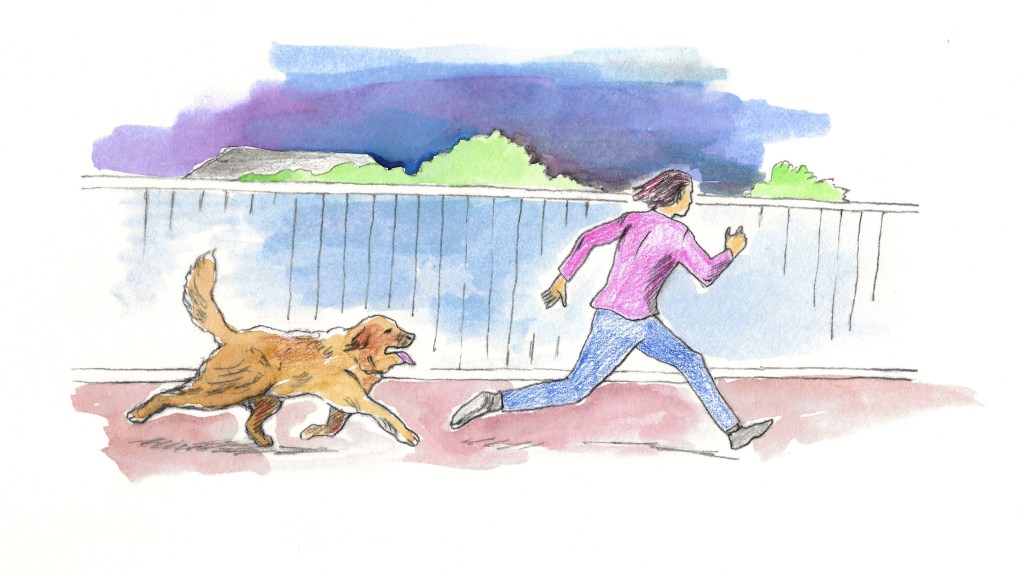
Less than a minute had passed when I heard shouting outside. I opened the door and looked outside to see what was going on. First I saw our neighbor and his two corgis running down the street as fast as they could. Our neighbor was screaming at he top of his lungs, “Get him off me! Get him off me!” Behind him, Bronco was running with his cast going kabonk-kabonk-kabonk as it hit the sidewalk. Behind Bronco ran Claudia, who was also screaming at the top of her lungs. Bronco! Sit! Stay! Stop!” Finally, Bronco stopped, and Claudia grabbed him. Holding his collar, she led him back in.
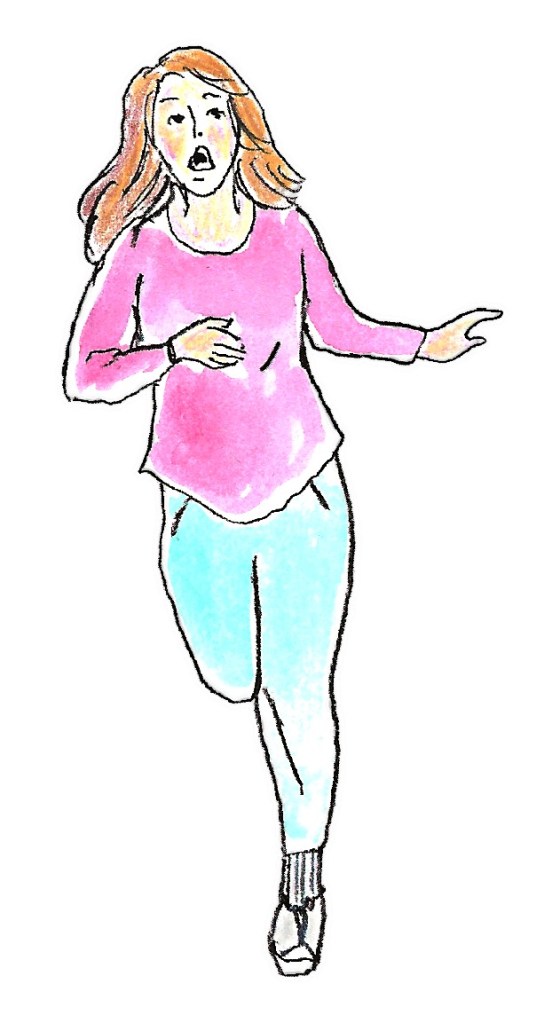
Our red-faced and sweaty neighbor was very nice about it and forgave us. He even forgave Bronco, though Bronco was chasing the corgis, not our neighbor. But still, if I had been chased by a big dog wearing a cast, I would not have gotten over it that easily. Our neighbor is clearly a better man than I am.
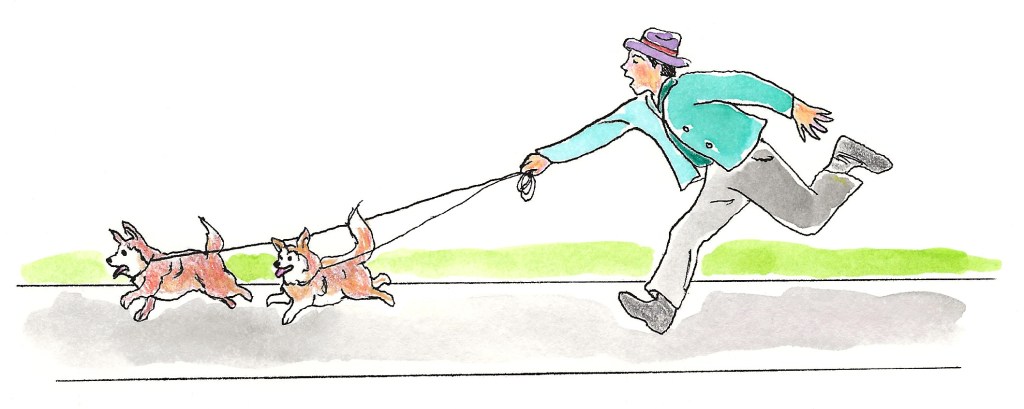
This was an embarrassing event for all of us, but at the same time it was one of the most surreal and amazing things I’ve ever seen. It was so unexpected, so bizarre, and so funny. I really wish I had had a video camera handy. Talk about a potentially viral video.
When we went back to the veterinary surgical center to have Bronco’s cast removed, we decided not to say anything about the incident to the doctors. We sat in the waiting room and wondered if the episode had caused any permanent damage to Bronco’s paw or leg. But when the veterinary technicians came back with Bronco in a bandage instead of a cast, they told us that everything looked good. Great job, everyone!
We thought they might not have checked his sore carefully enough, so we asked them again: Are you sure everything looks good? The sore, the stitches—did you really look at them thoroughly? They insisted that yes, they looked good. So Bronco got his treats, he looked happy, and we went home.
The Adventures of a Leonberger a Leonberger Guest Post
da-AL was gracious enough to host me via a guest post. It features the story of why I wrote my Leonberger book as well as the story about our Leonberger Bronco’s hamster rescue operation. I would like to direct all comments to her post. See da-AL’s post below.
Another 25 Leonberger Photos and Illustrations
My blog is primarily about Leonbergers, an unusual and fascinating dog breed that is known for its size, affectionate nature, and intelligence. I know a lot about Leonbergers because we were lucky enough to live with one for thirteen years. His name was Le Bronco von der Löwenhöhle—but we called him “Bronco” for short. I also wrote a book about Leonbergers and about Bronco’s many adventures : The Life and Times of Le Bronco von der Löwenhöhle. If you are on a desktop computer you’ll see the book on the right, and if you are on a phone you have to scroll to the bottom of the page. You can also click here.
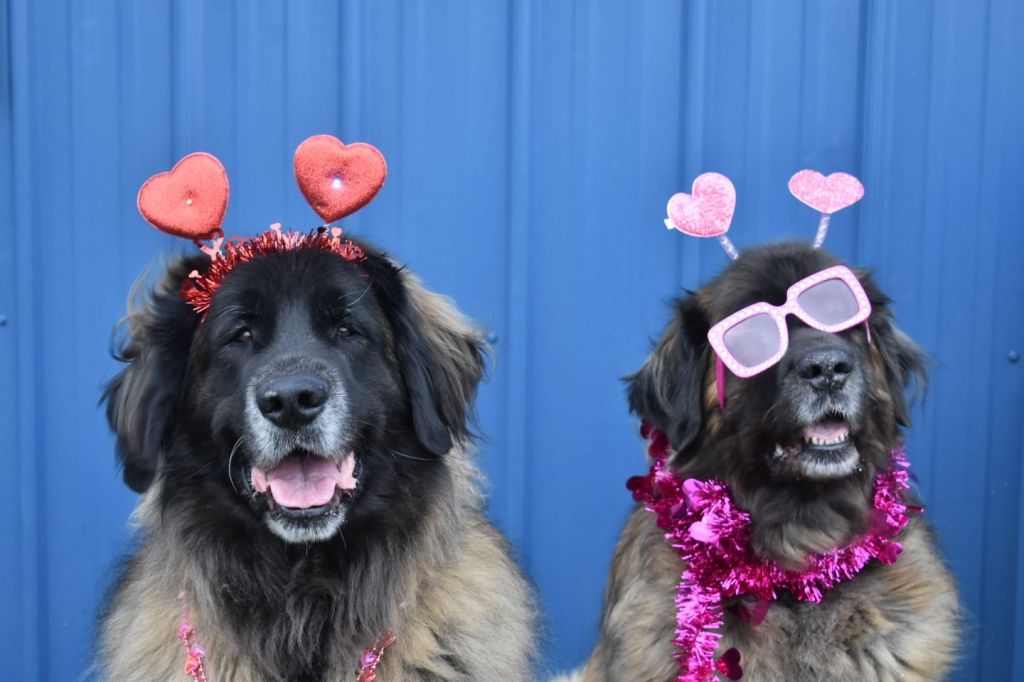
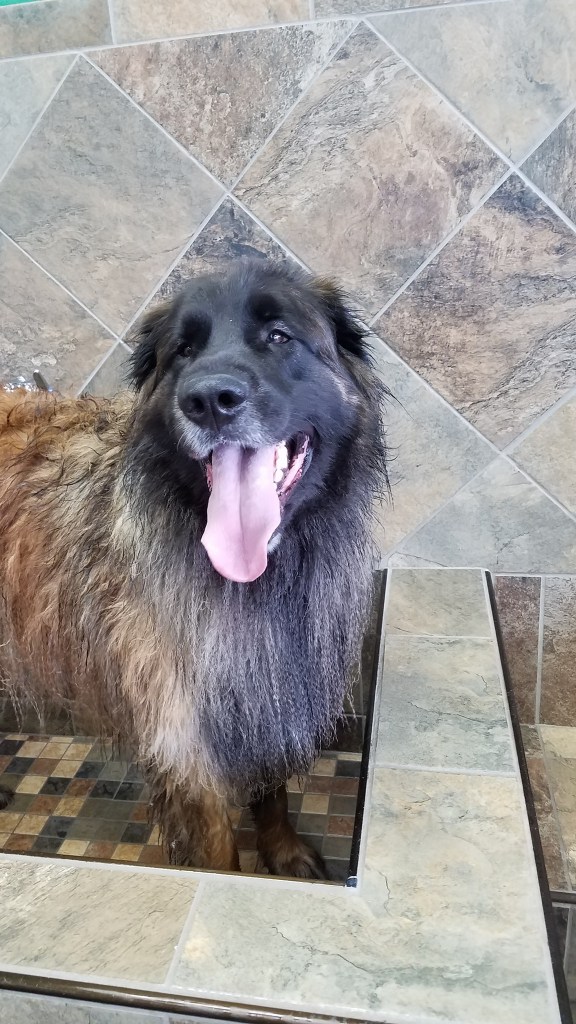
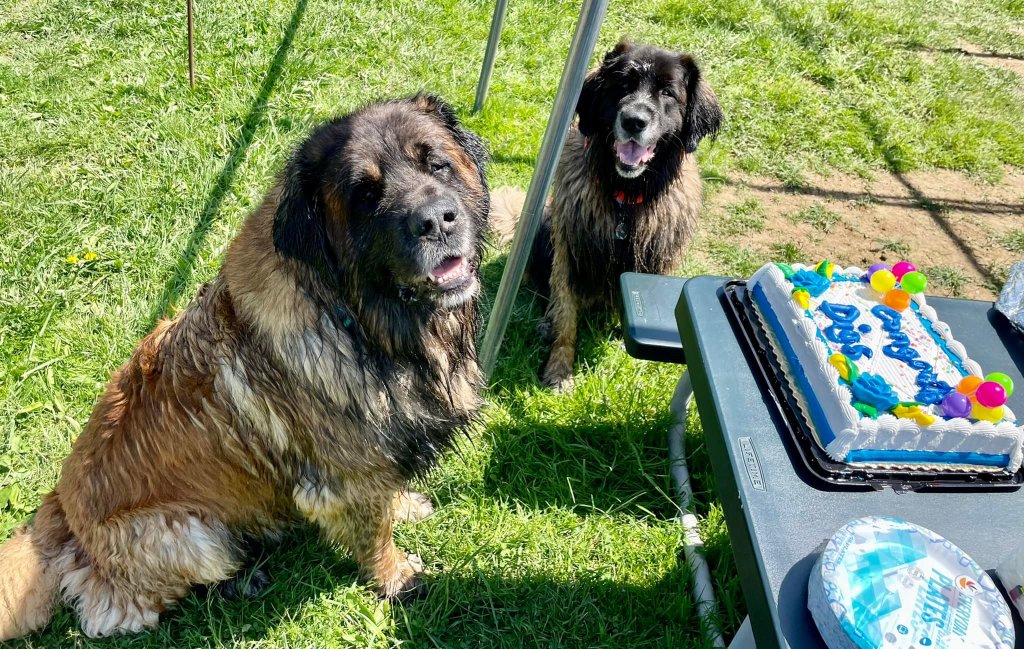
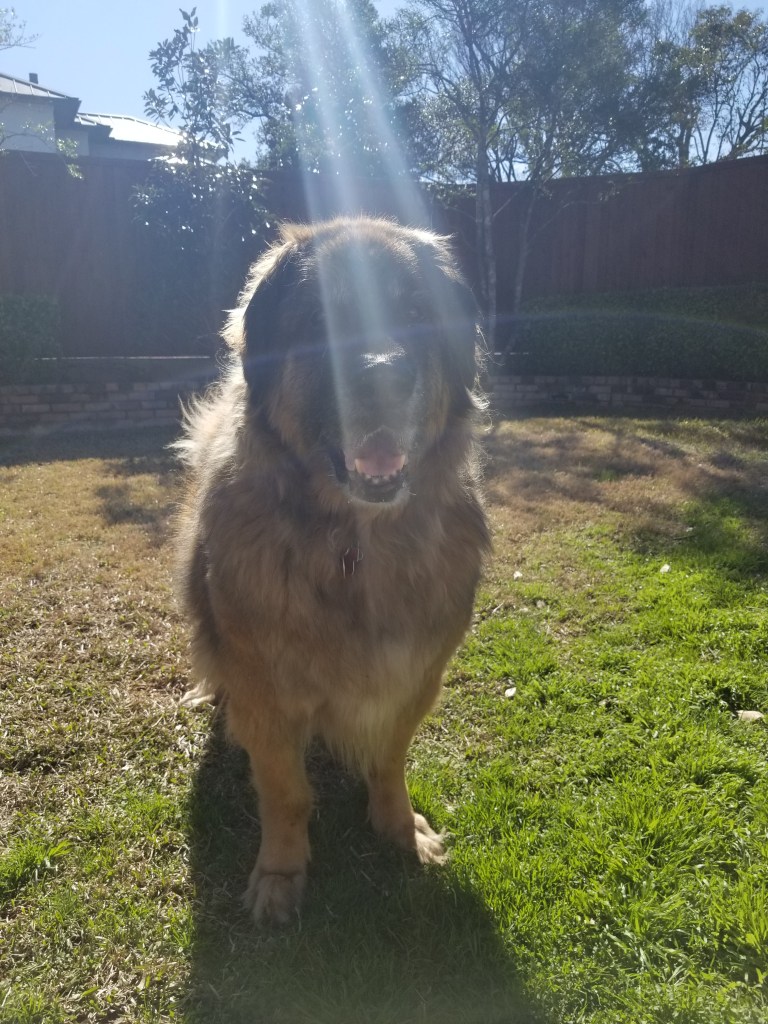
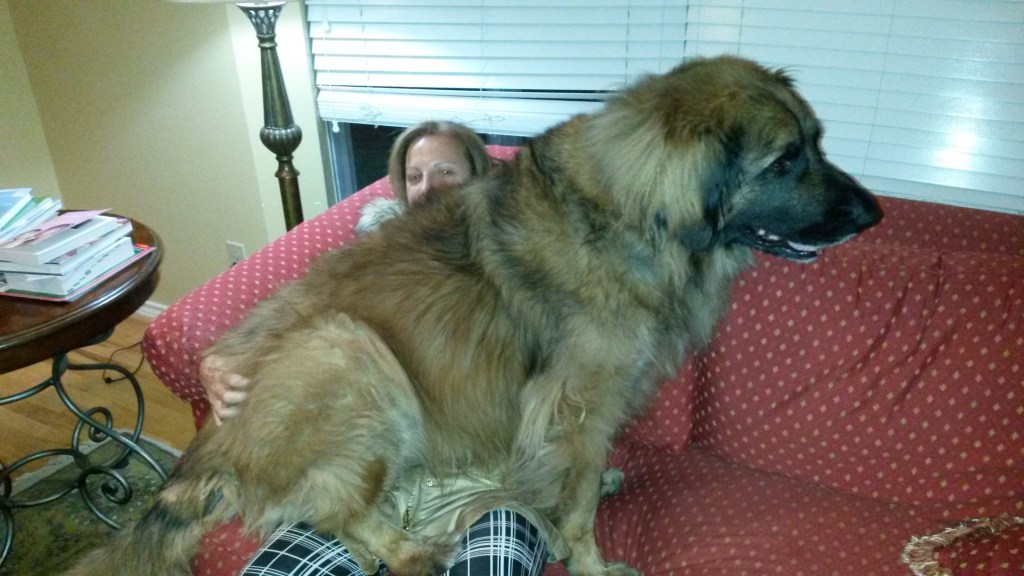
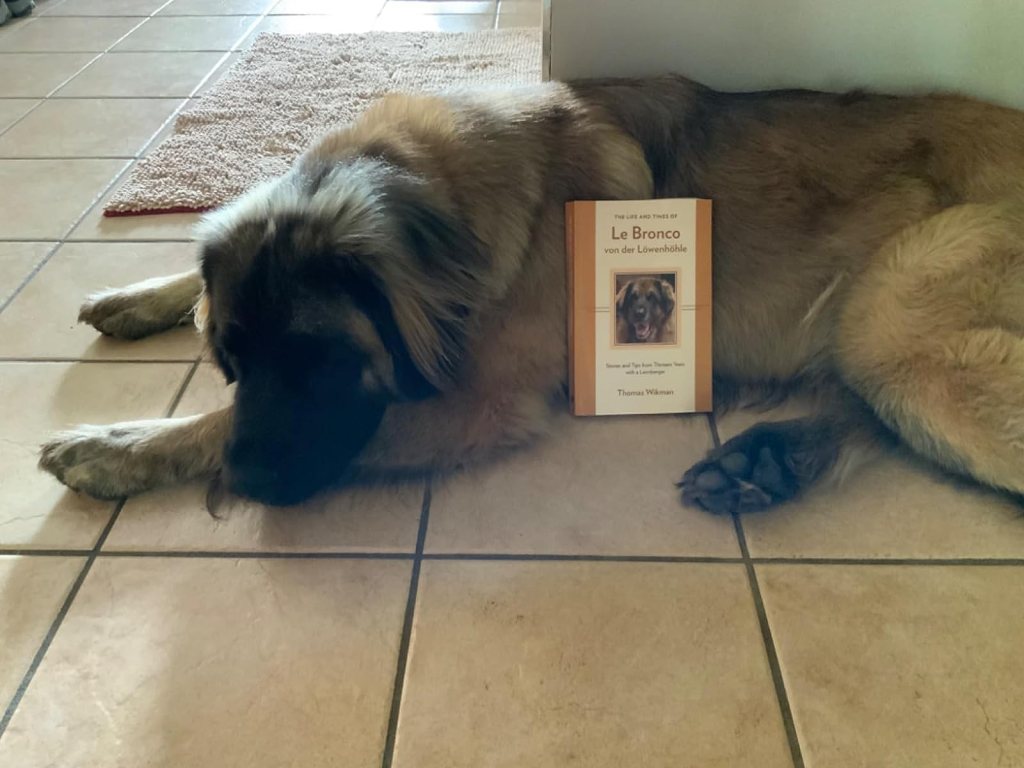
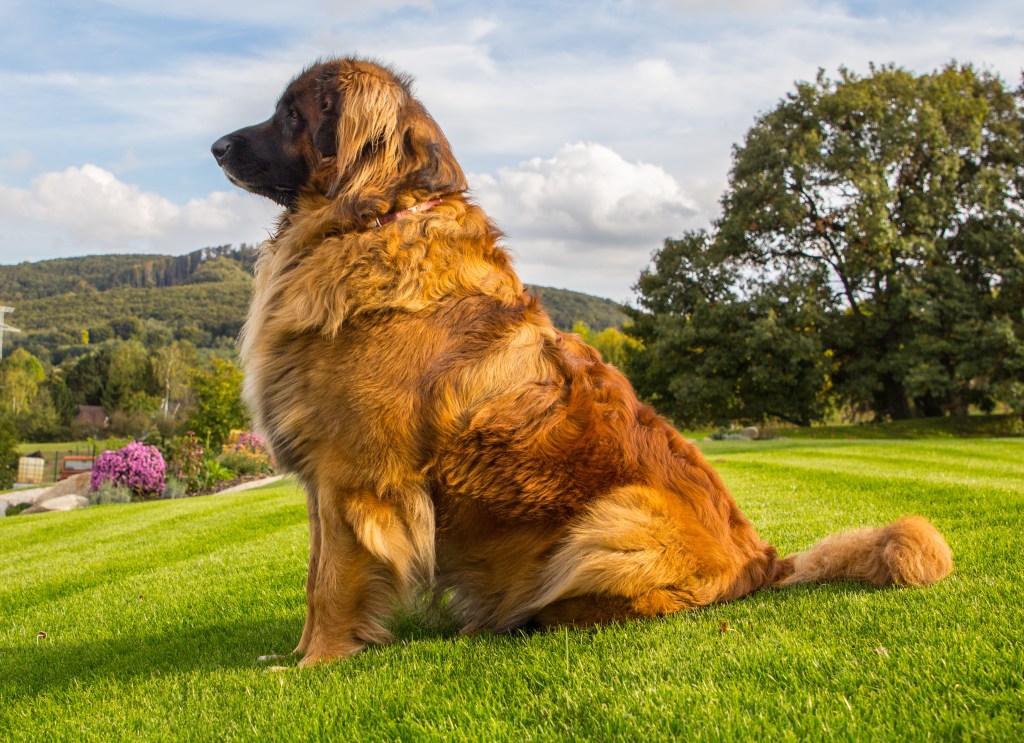
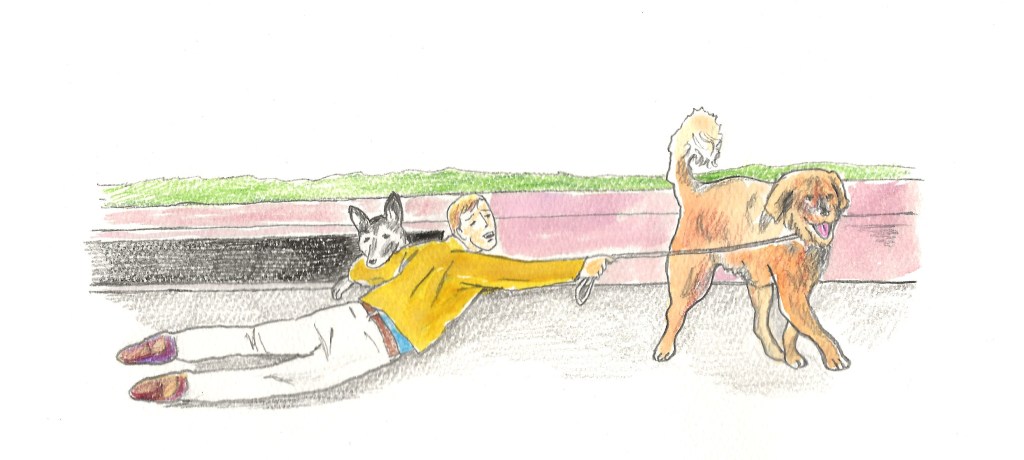
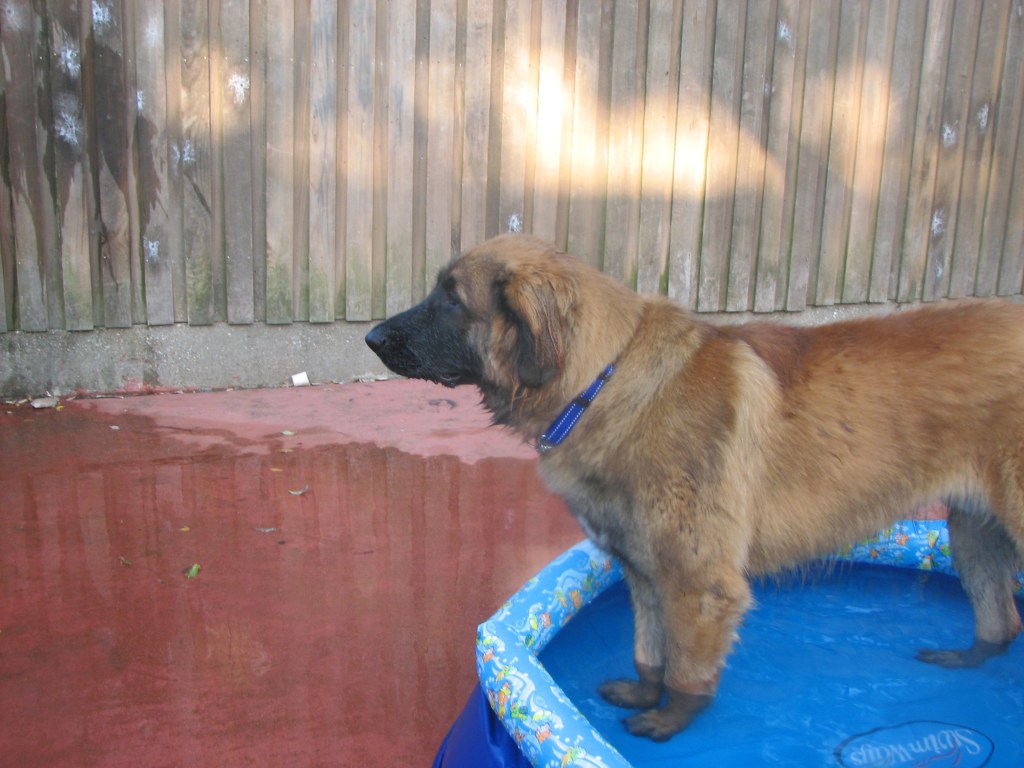
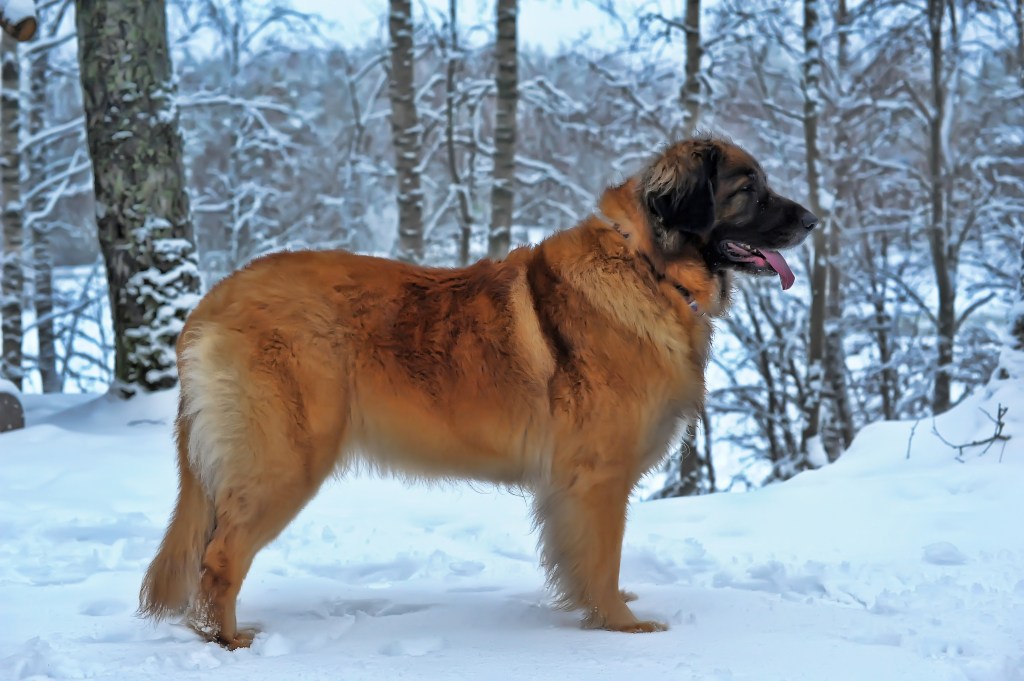
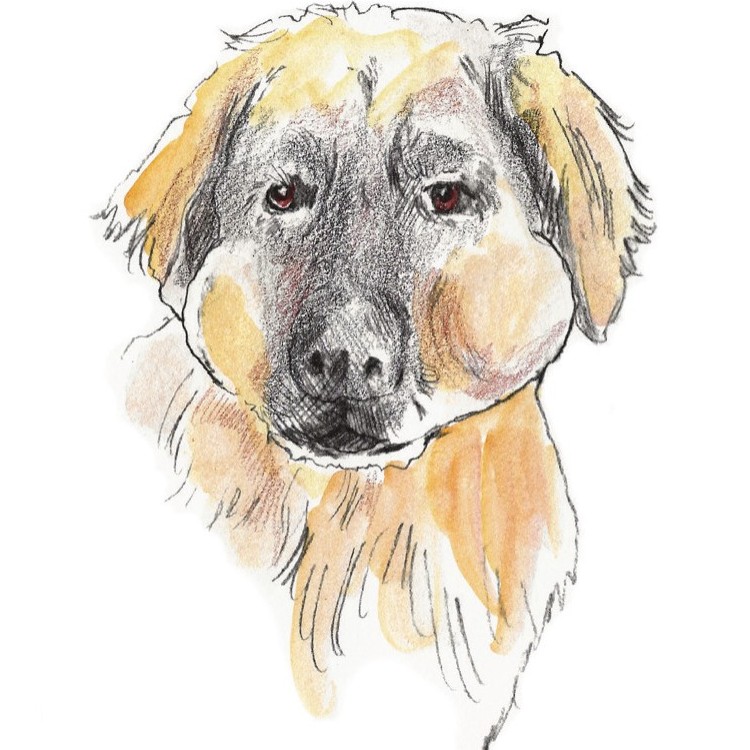
This post features 25 photos and illustrations. Most of the photos are of our Leonberger Bronco, a few are photos by friends and the illustrations were created by Naomi Rosenblatt. If you want to see another set of 25 Leonberger photos click here. If you want to see Leonberger puppy photos, then click here.

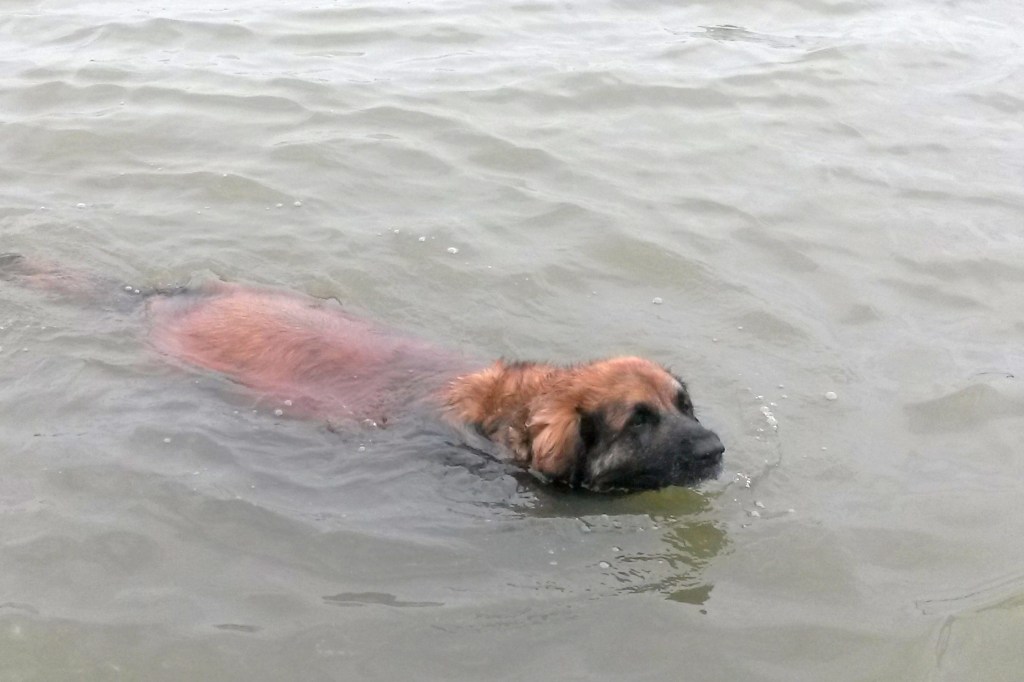
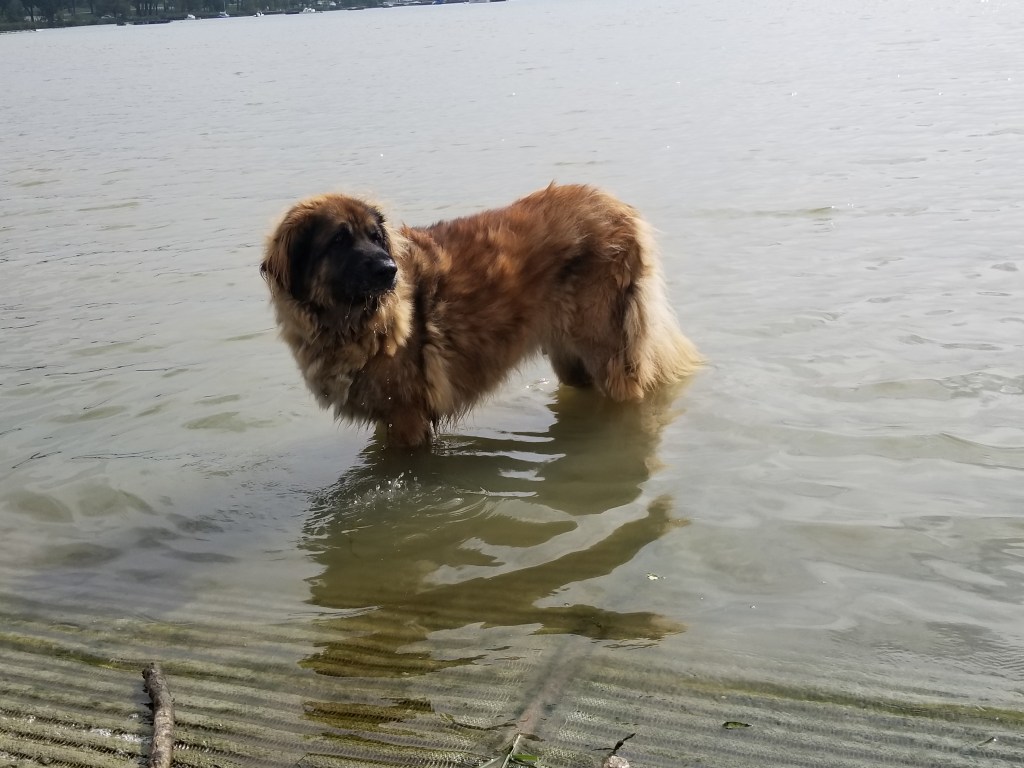
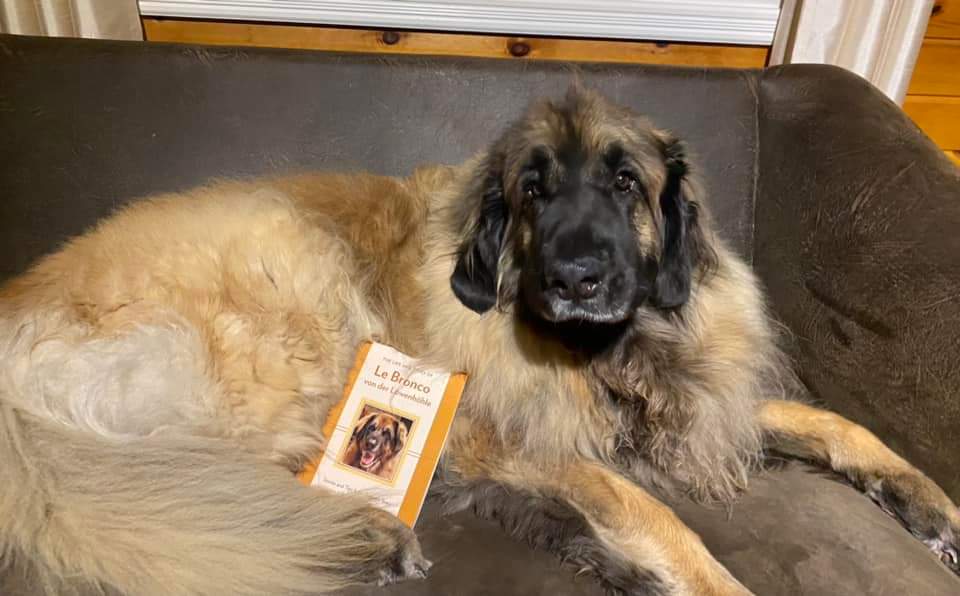
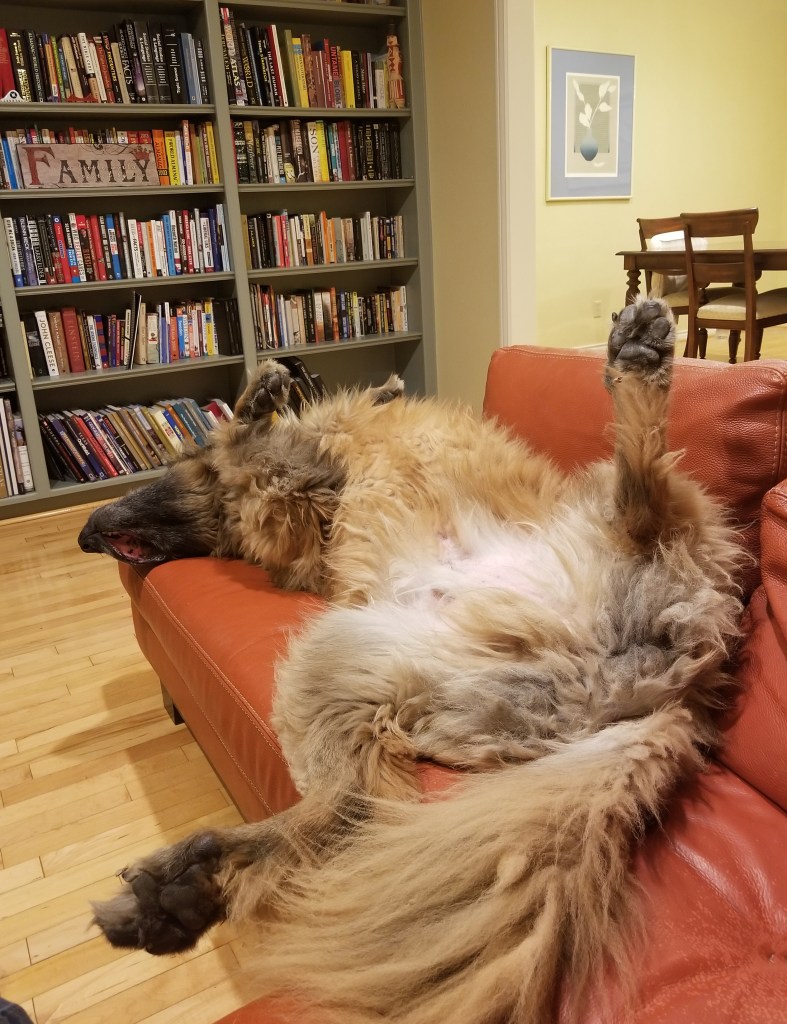


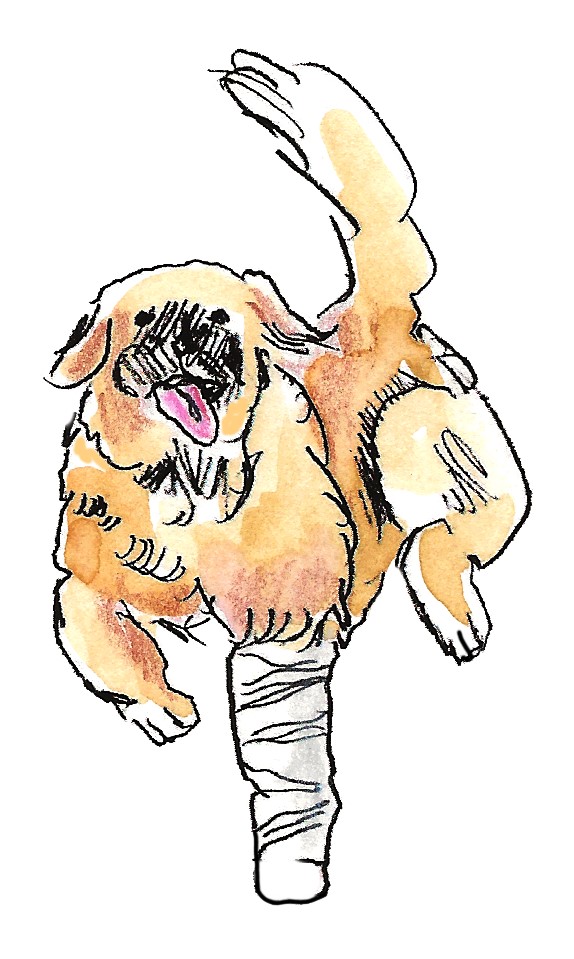
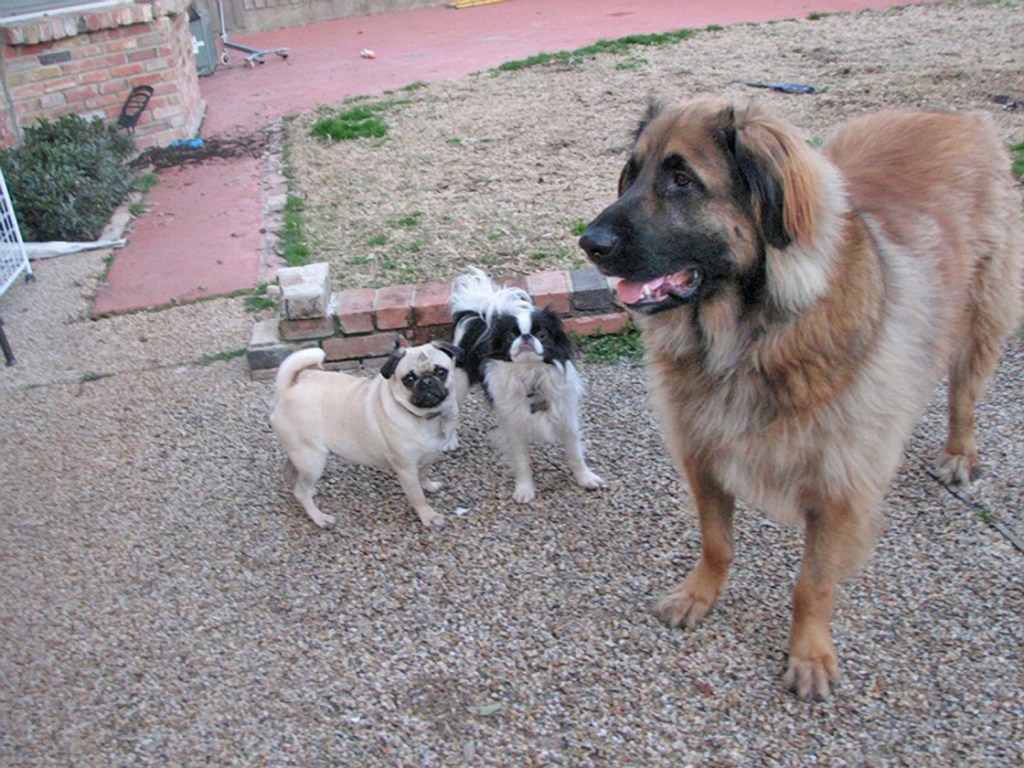





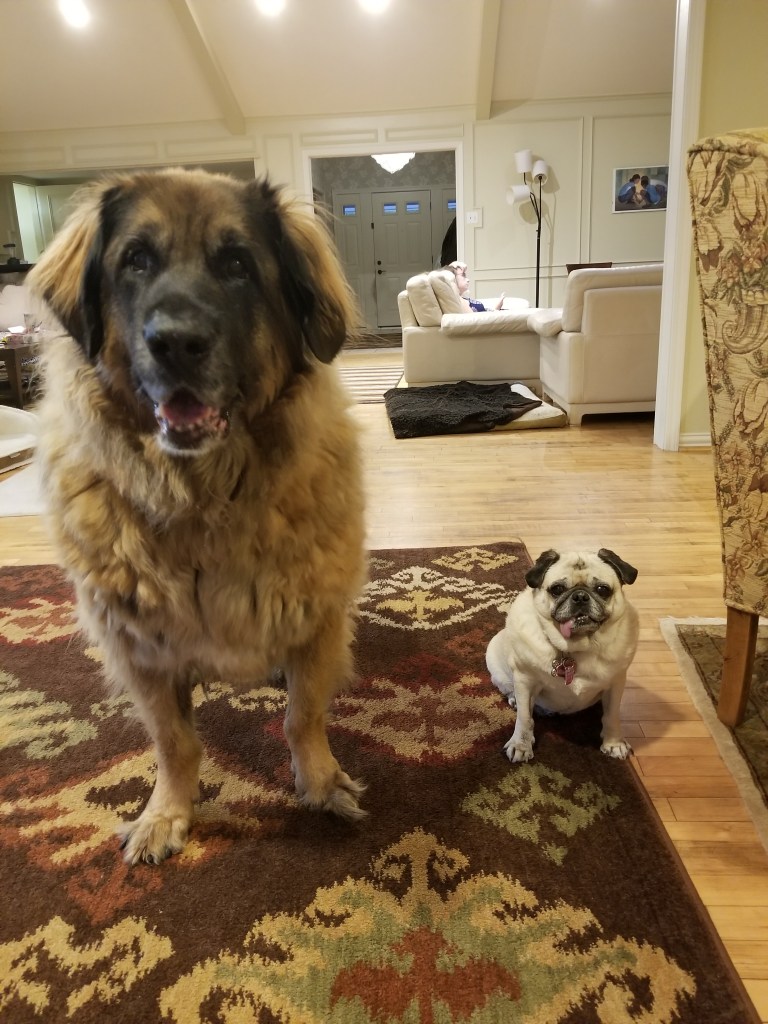
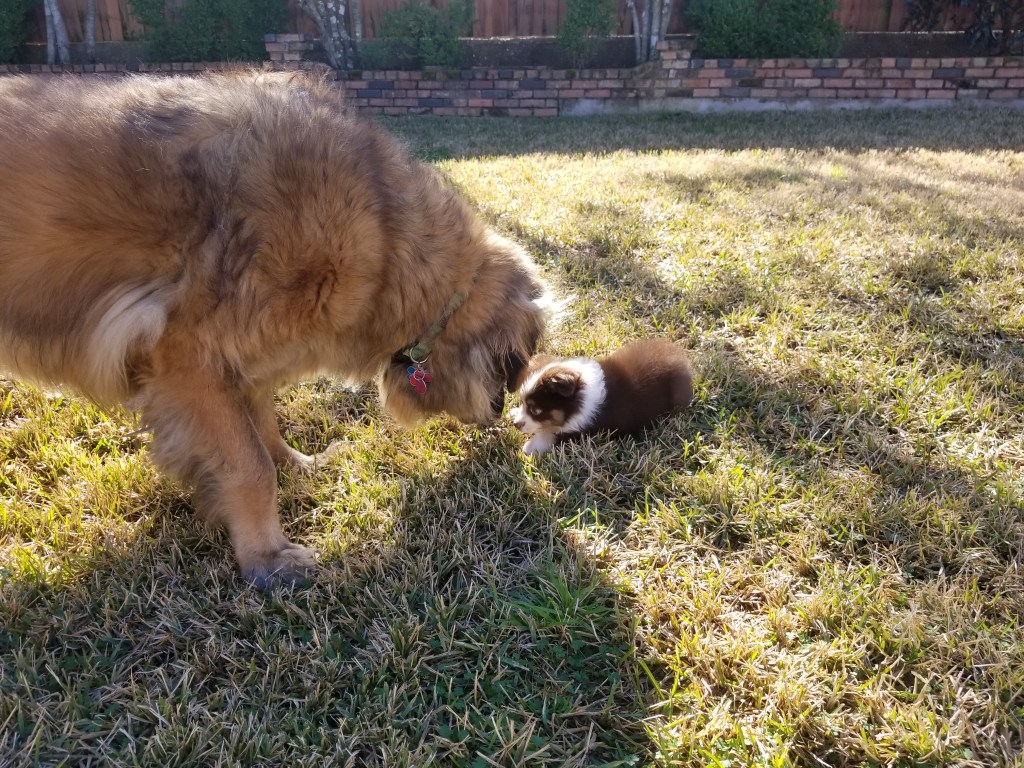
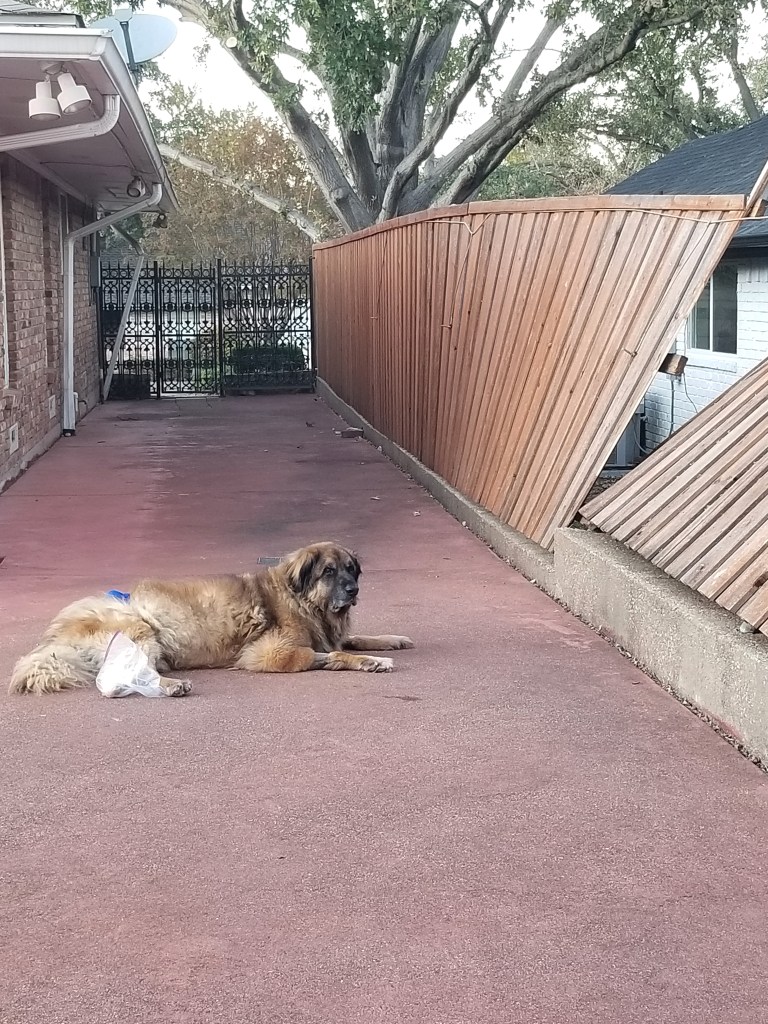
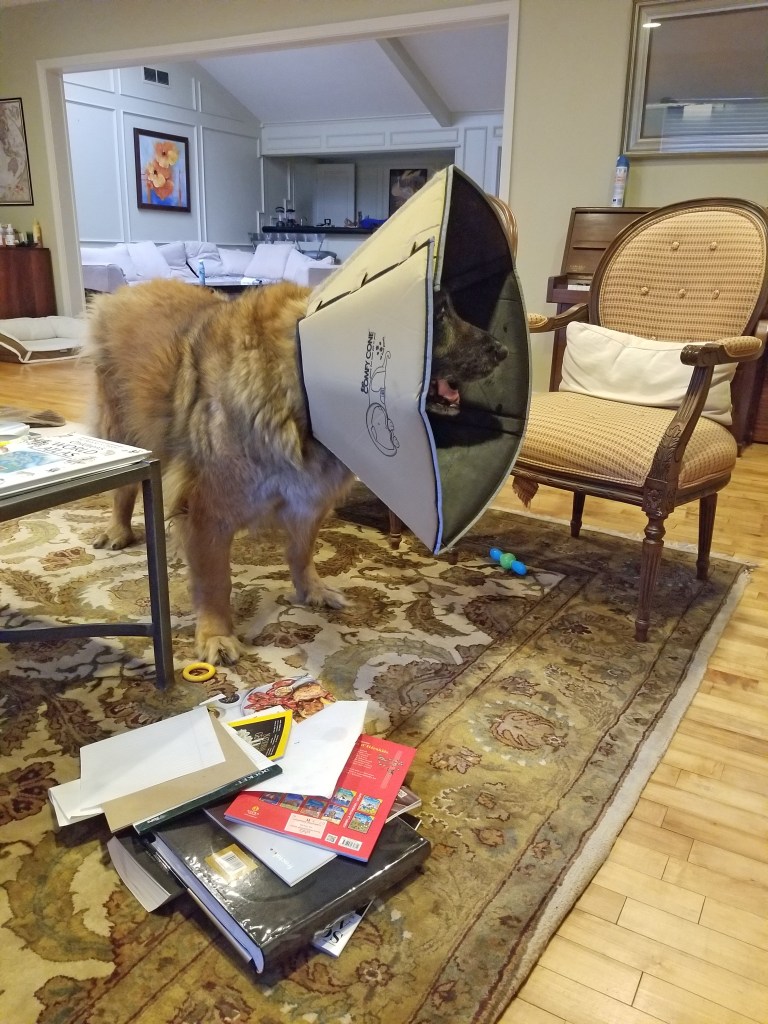

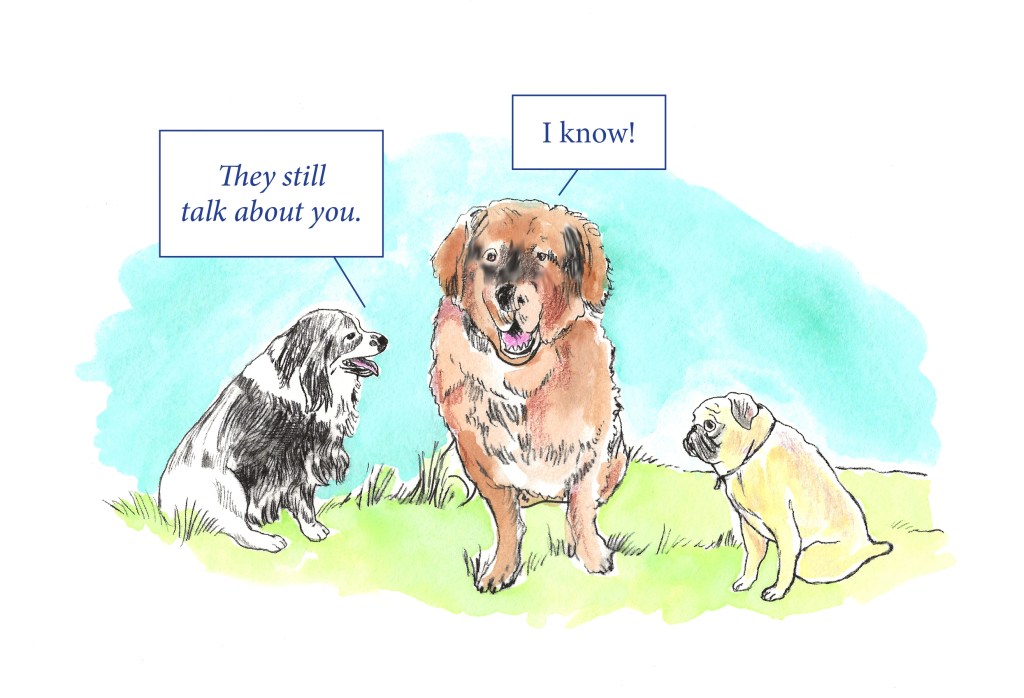
25 Leonberger Photos and Illustrations
First, check out my Leonberger book and consider purchasing it. It features amusing and amazing stories about our truly remarkable Leonberger Bronco, as well as information about Leonbergers. It is a great book for all dog lovers. All royalties/proceeds from sales are donated to the Leonberger Health Foundation International. To check out my book click on the book cover images on the right.
This post has 25 photos and illustrations. Most of the photos are of our late Leonberger Bronco (Le Bronco von der Löwenhöhle) but there are also Leonberger photos by friends as well as a few Shutterstock photos. The illustrations are from my book. The illustrations for my book were made by Naomi Rosenblatt (I don’t know how to draw).

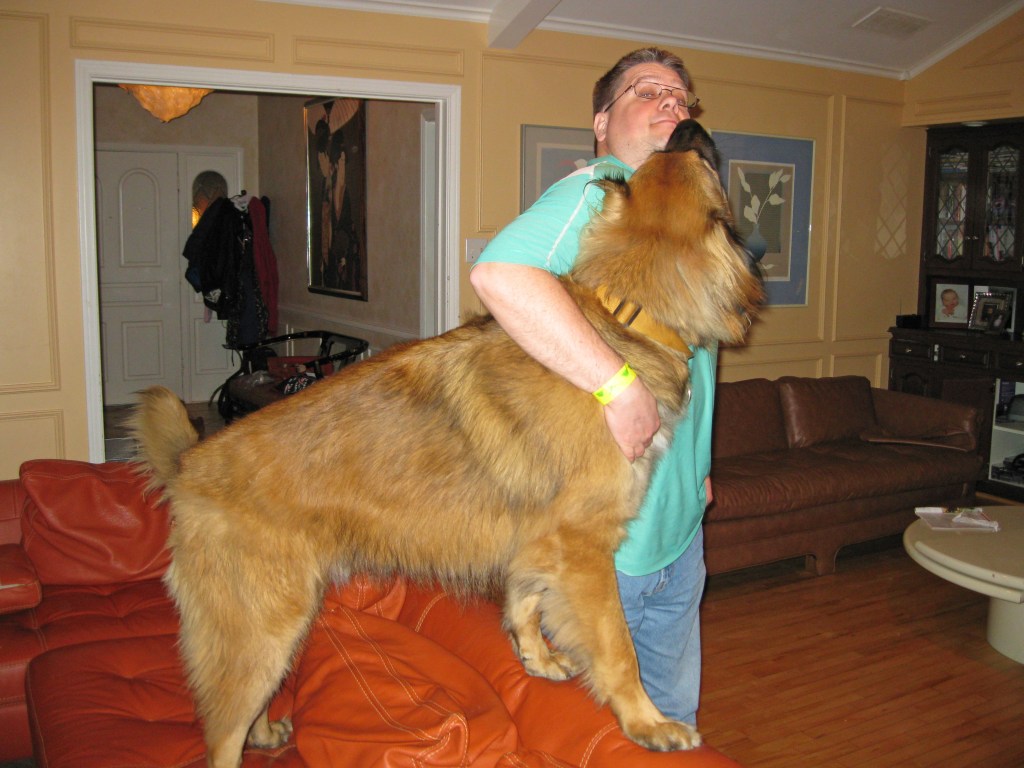
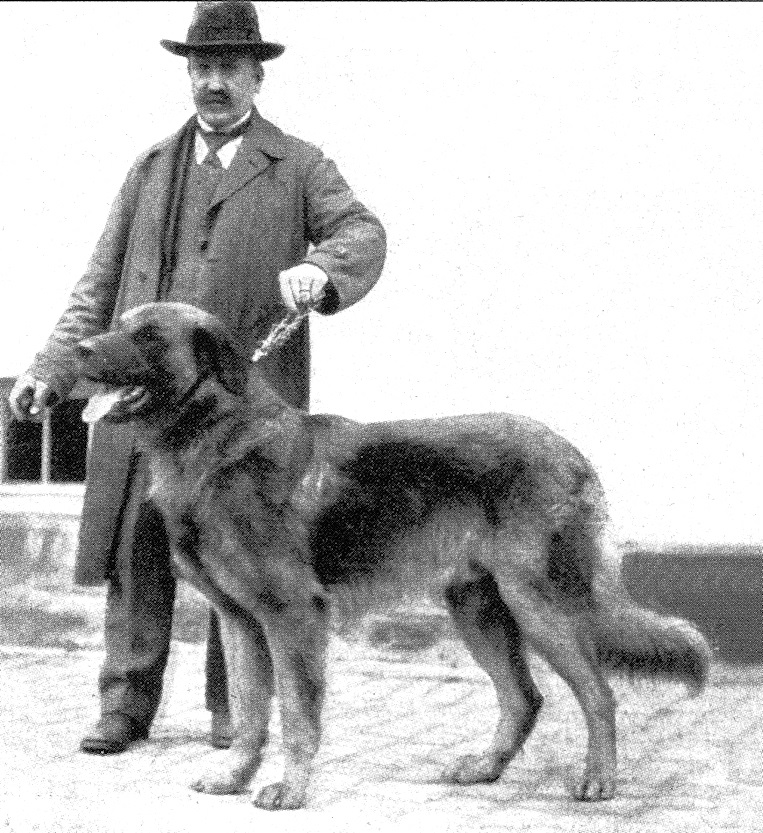



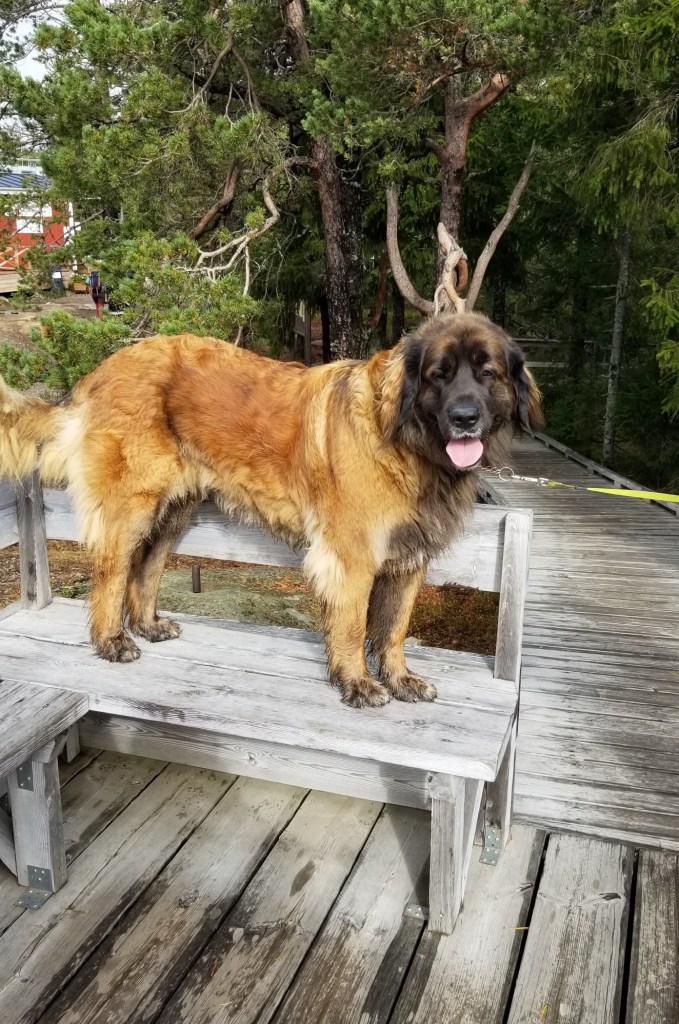

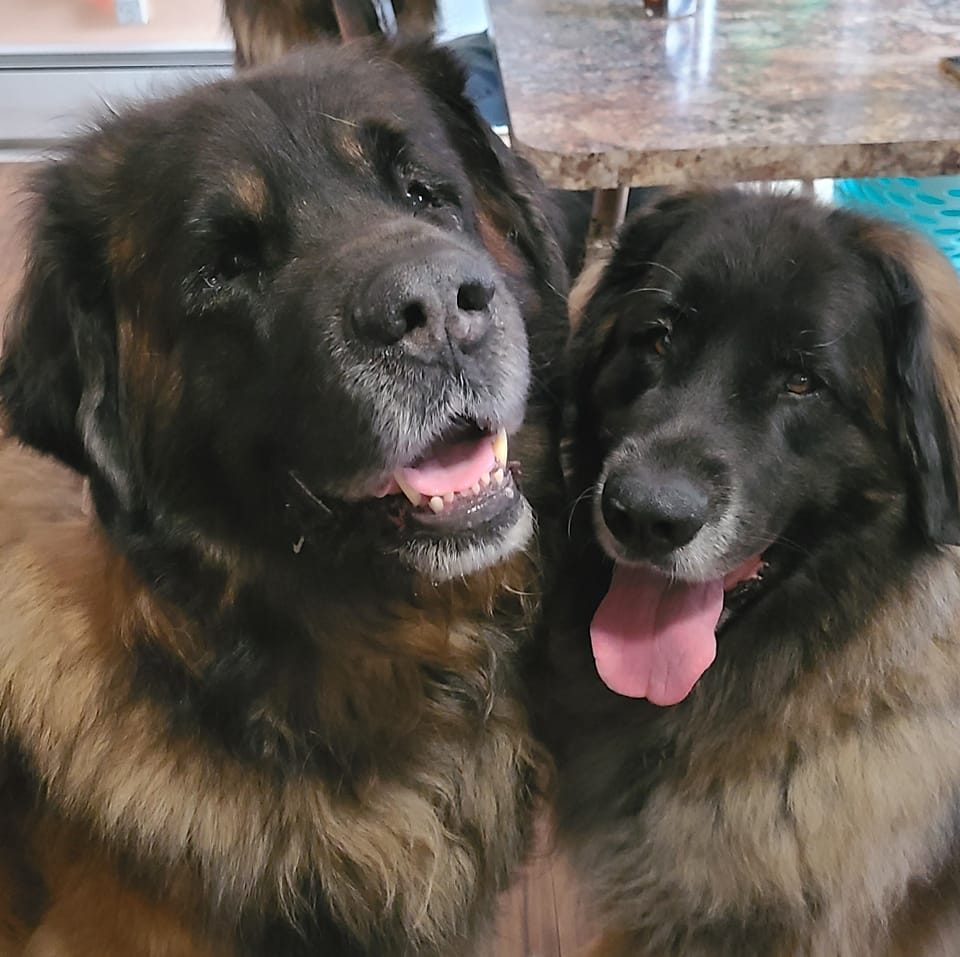
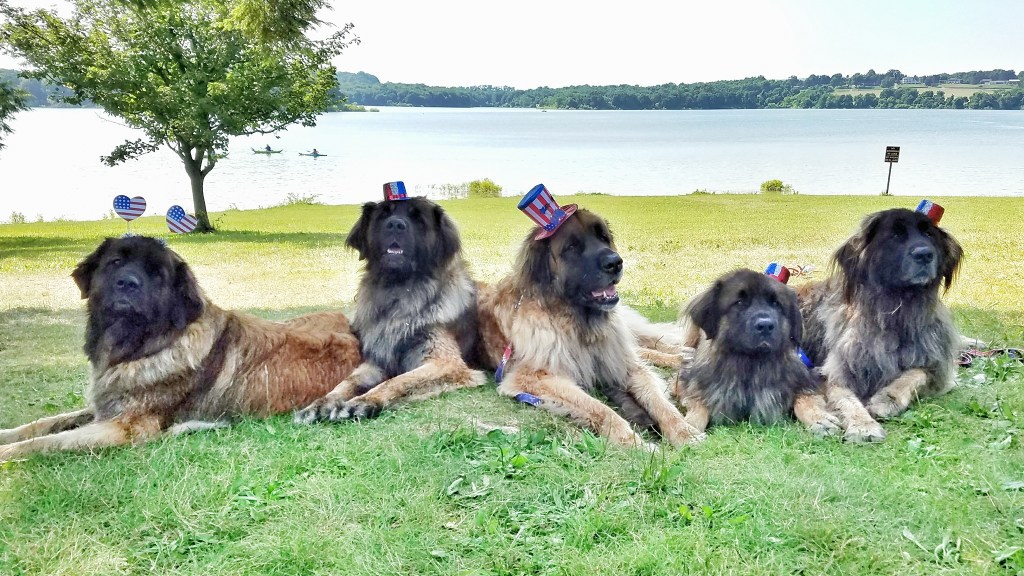
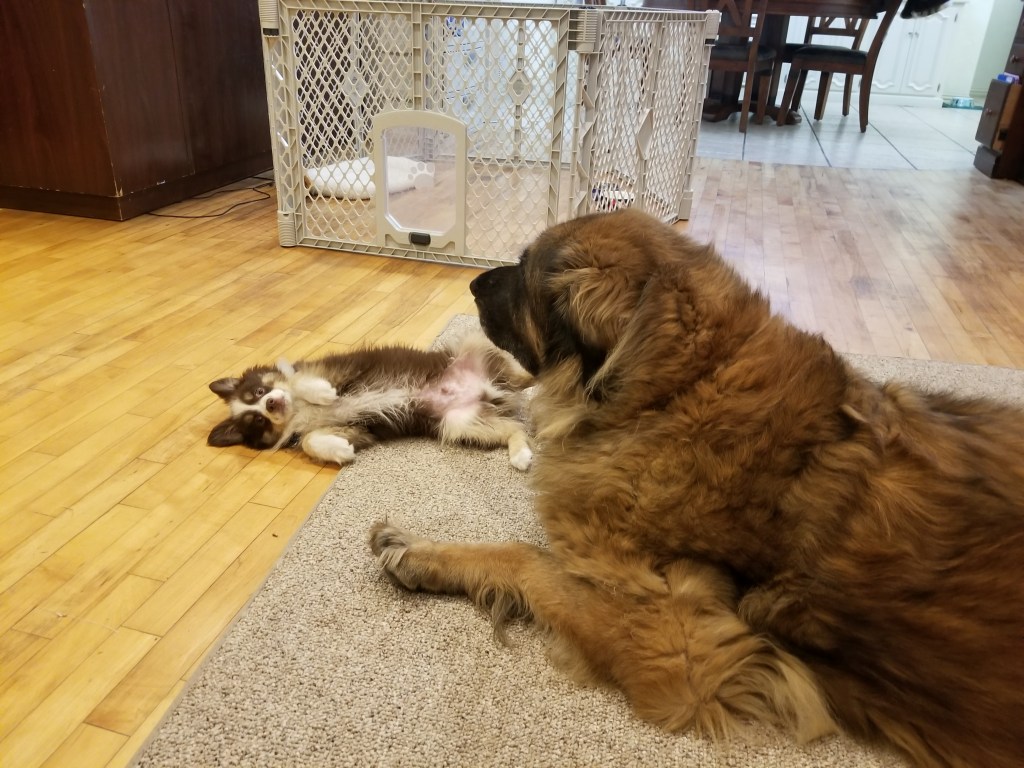

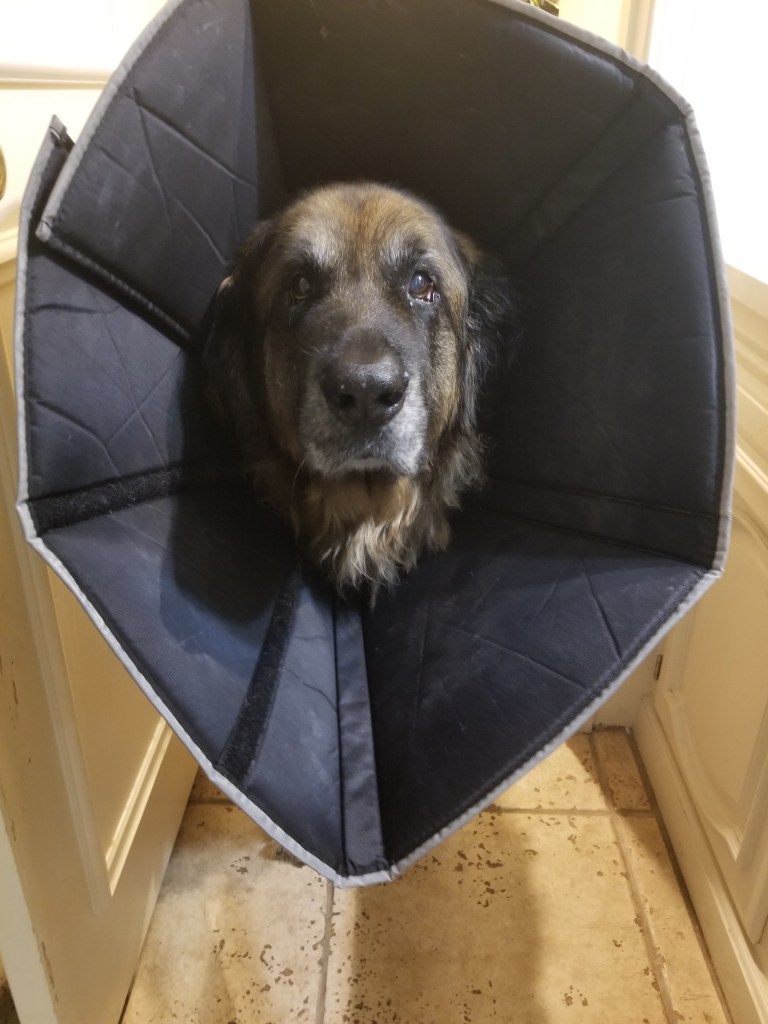
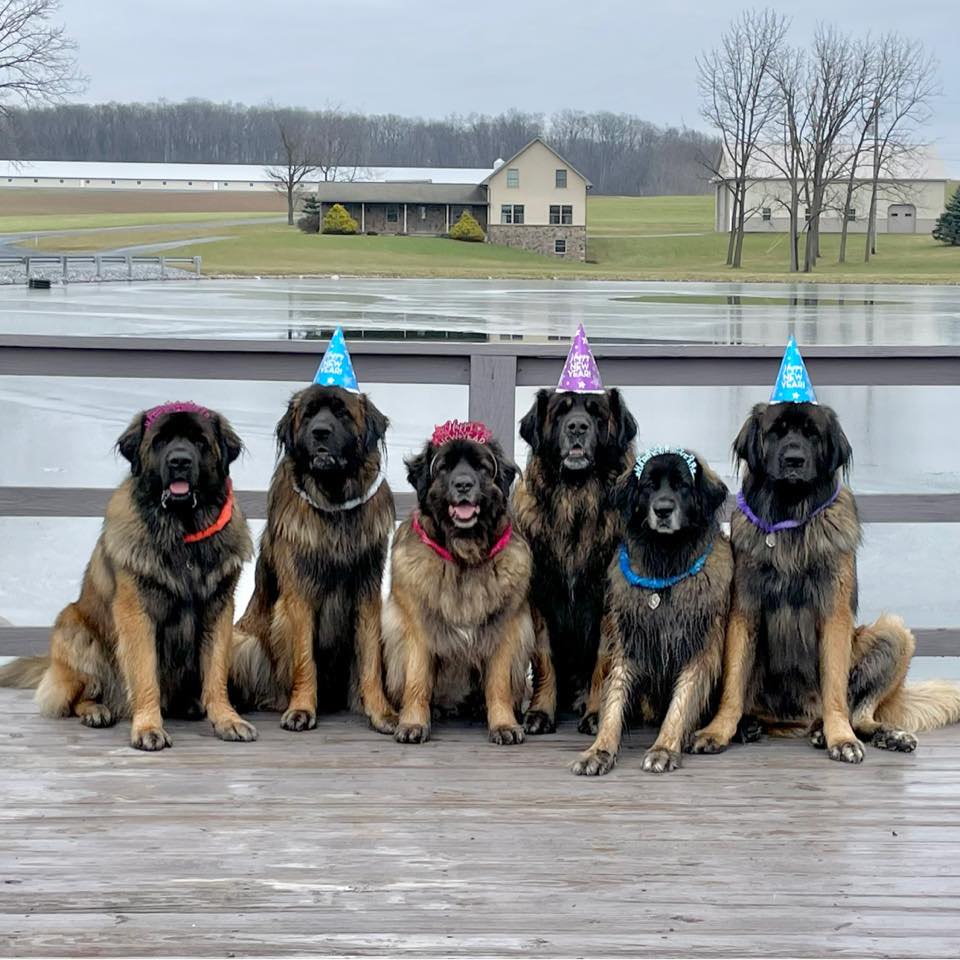
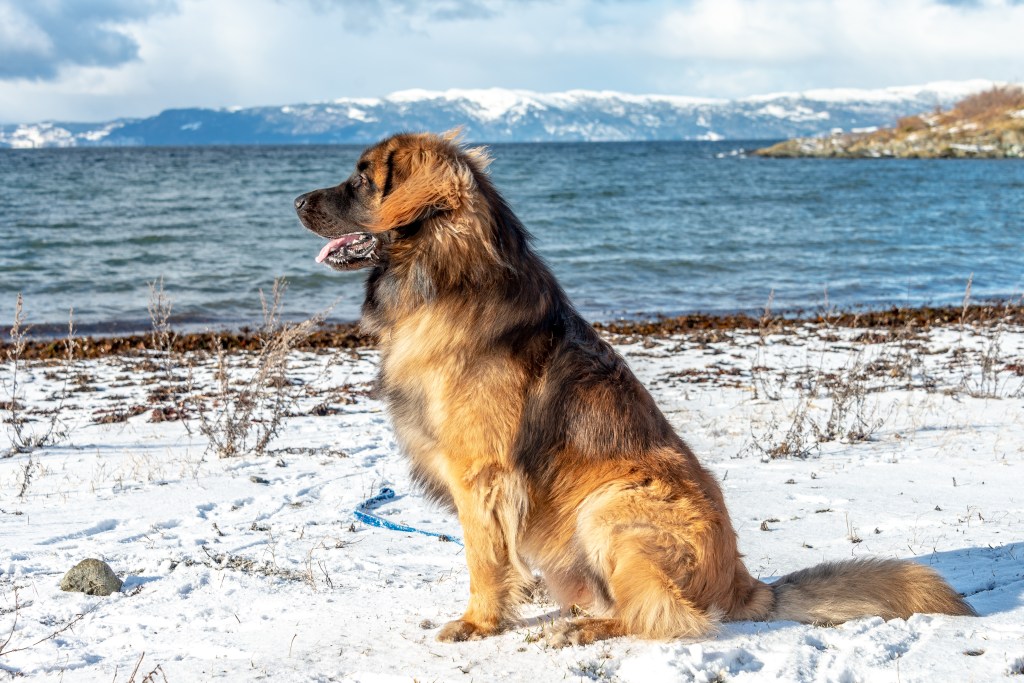
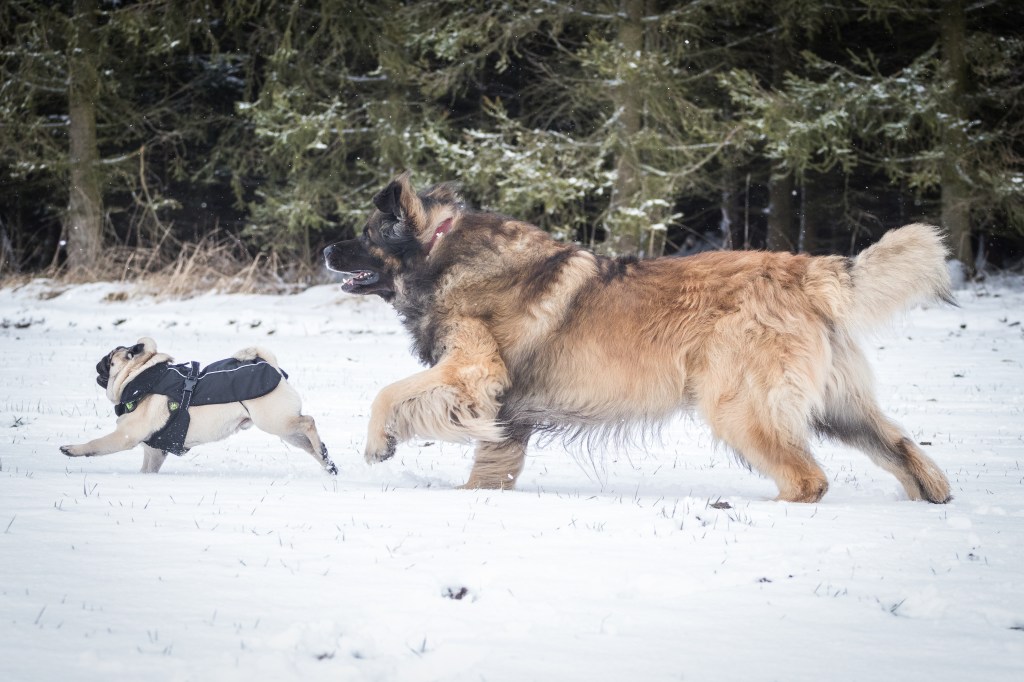
Photos of Leonberger Puppies
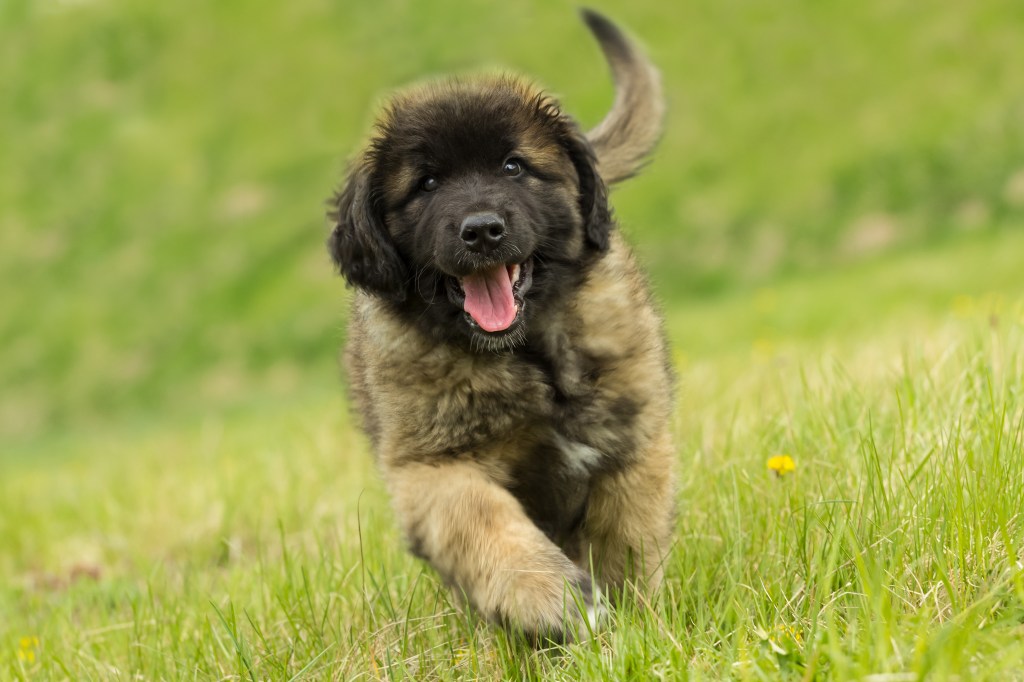
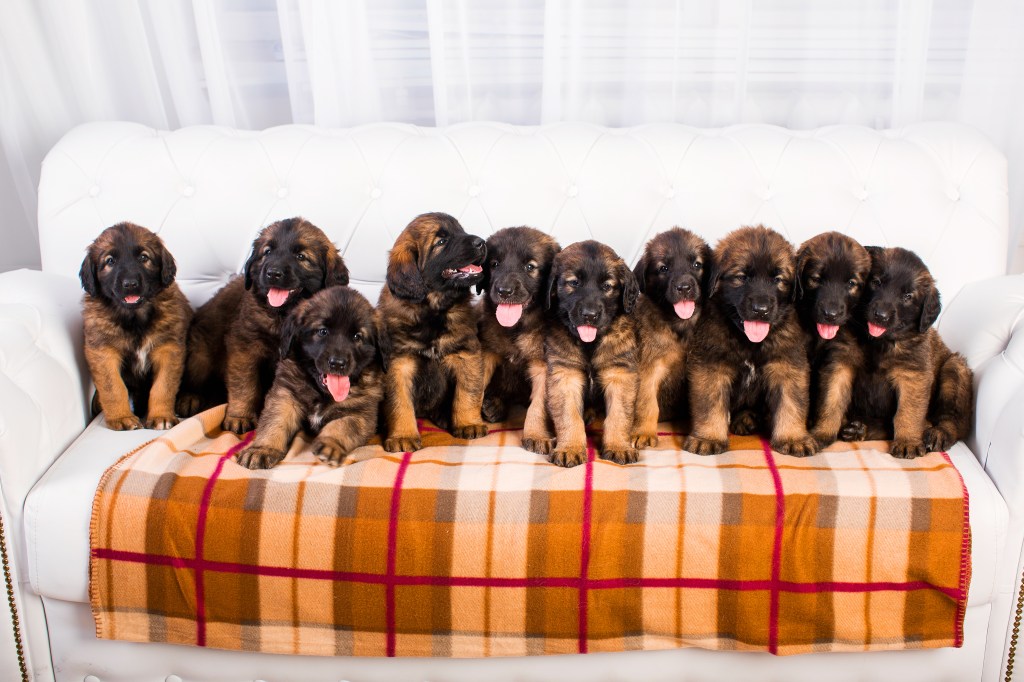
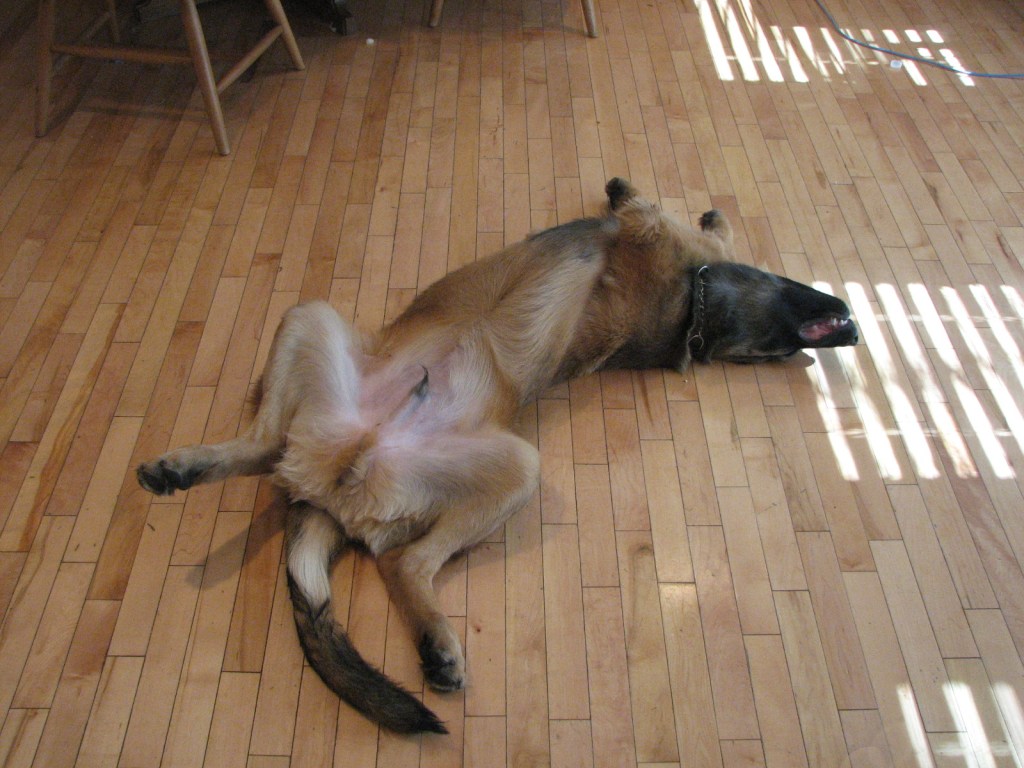
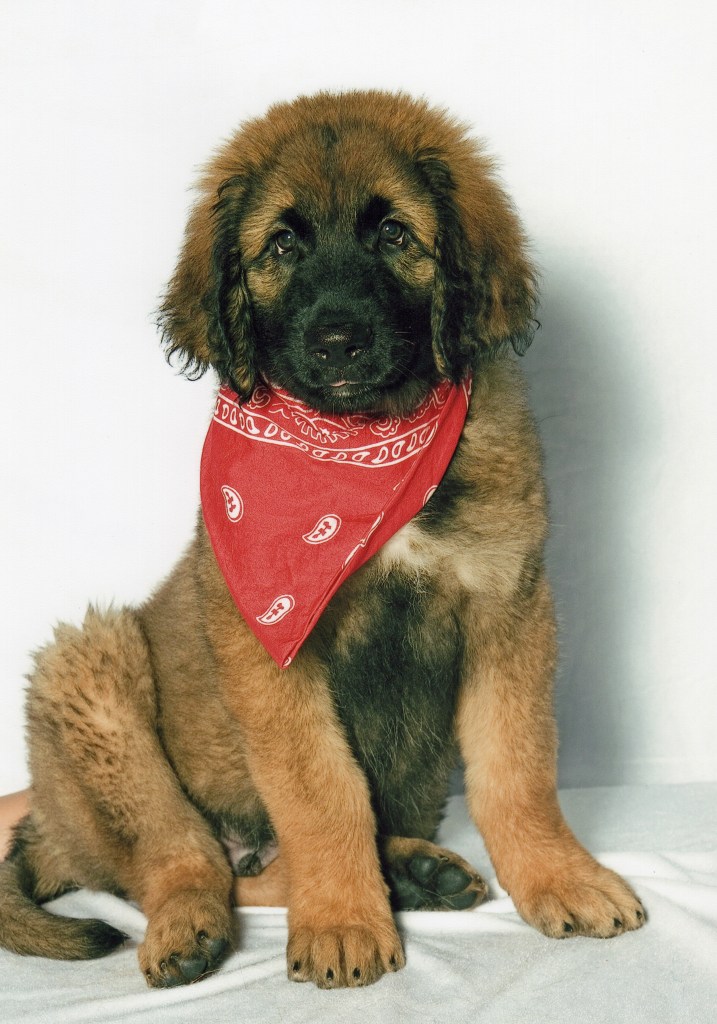
This post features ten Leonberger photos. First there are two photos of our Leonberger Bronco from when he was three months old. Then there are three shutter stock photos of Leonberger puppies, who are probably about two months old. We did not take many photos of Bronco when he was a little puppy so that’s why I am including three puppy photos from shutter stock. Then there are five photos of our Leonberger Bronco between the ages 4-5 months to around one year old. He is bigger in those photos but still not an adult.






Reminder Of The Leonberger Health Foundation International
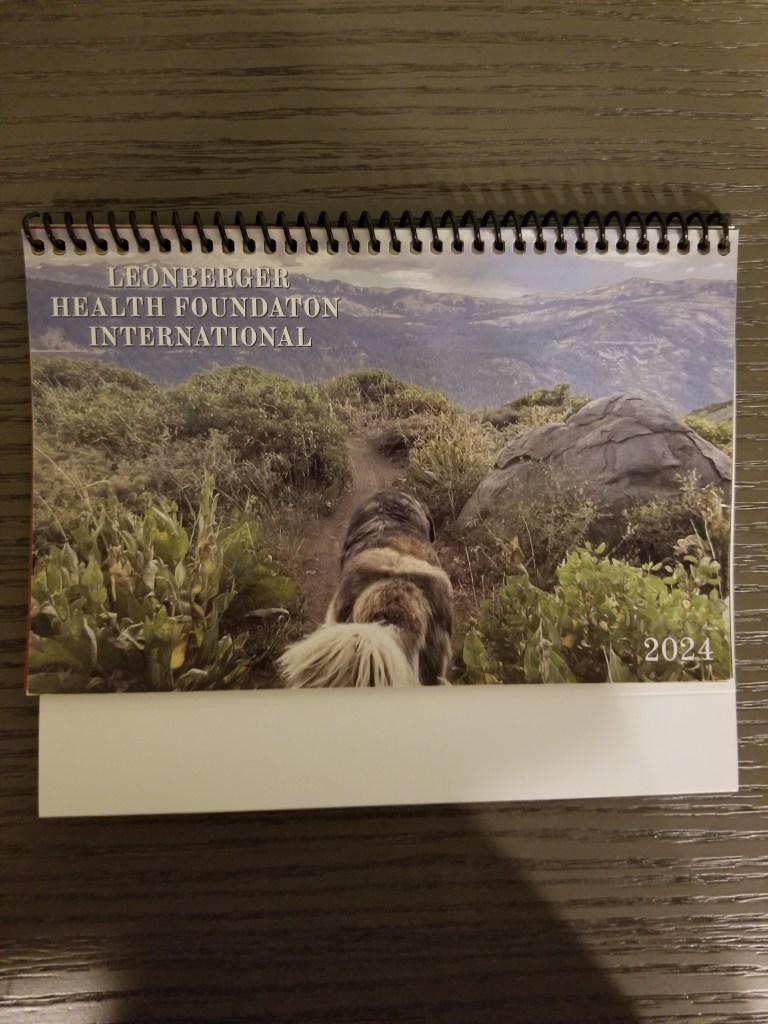
Today I received the Leonberger Health Foundation International (LHFI) Calendar for 2024 and I was reminded of this wonderful organization. LHFI supports medical research that improves the health and lives of Leonbergers as well as other large dog breeds, potentially even humans. They have raised nearly half a million dollars for research into conditions that affect canine health, including osteosarcoma, hemangiosarcoma, glaucoma, cardiac diseases, thyroid diseases, and neurological disorders. Its research also supports healthful longevity and aging as well as population diversity. They have had several successes, for example the eradication of Addision’s disease among Leonbergers.
The Leonberger Health Foundation International (LHFI) was founded in 2000 by Waltraut Zieher and other members of the LCA’s health, education, and research committee to “facilitate the solicitation and distribution of donations given to support health related breed-specific research.” The LHFI also administers a program that collects DNA samples from Leonbergers to share with universities and research institutions.

All purebred dogs are more or less inbred, which comes with inherent health risks. That is especially true for large breeds. However, Leonbergers, especially those bred in North America, are fortunate compared to other large breeds. The Leonberger breed standard does not call for traits that can be detrimental to health. The precise and restrictive breeding regulations of the Leonberger Club of America (LCA) and other Leonberger clubs, and the work of the Leonberger Health Foundation International or LHFI, have resulted in Leonbergers being relatively free of inherited illnesses compared to other large dog breeds in America. For more information see Humane Society Veterinary Medical Association, “Guide to Congenital and Heritable Disorders in Dogs,”

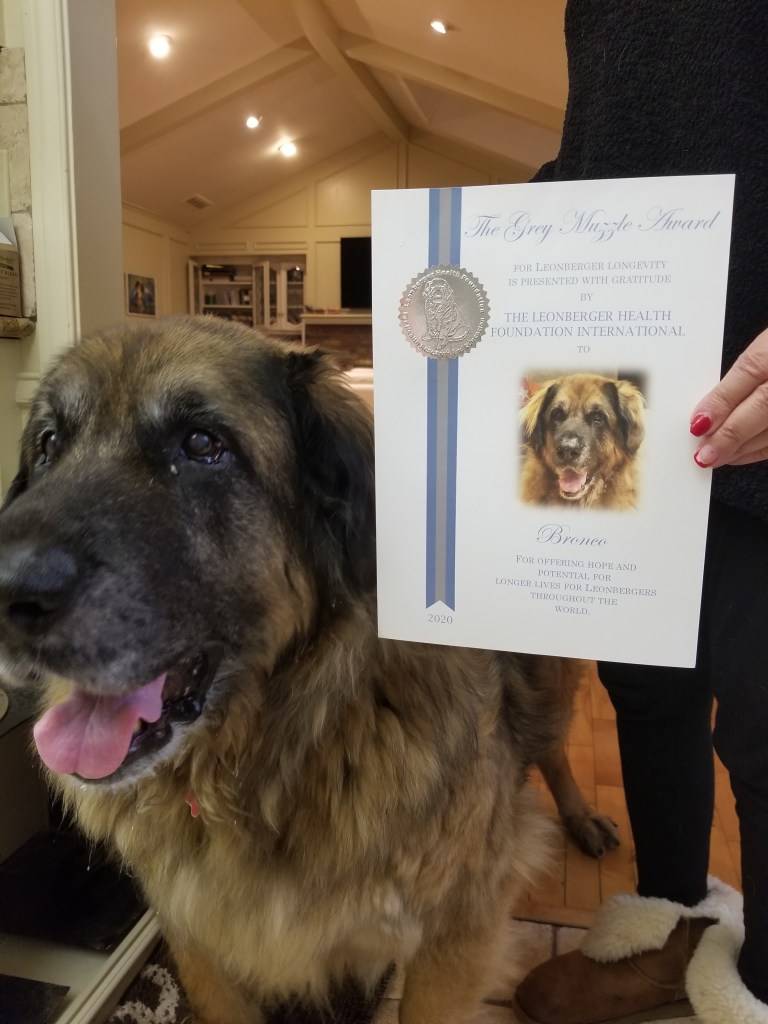
One happy event for our family was when Bronco received his Grey Muzzle Award, which is an award given for longevity by LHFI. LHFI bestows the award on any Leonberger who has reached the age of twelve. These Leonbergers are the canine equivalents of centenarians, humans who are at least one hundred years old. The Grey Muzzle Award is also given to breeders, because they are partially responsible for the dogs’ longevity. The Grey Muzzle Award was certainly a happy event in Wikman family. If you have a twelve-year-old Leonberger, simply fill out a form on the LHFI website or send an email to lhfgreymuzzle@gmail.com.

The foundation will ask for some information, including the registered name and call name of the dog; the breeder’s name, kennel name, address, and email; the dam’s registered name; the sire’s registered name; the owner’s name, address, and email; the birth date of the dog; and whether the dog is alive or dead. If the latter, they will want to know the cause of death. In addition, they would like you to write a one-paragraph tribute to the dog and send two (preferably high-resolution) photos—one head shot and one favorite photo. To find out more about the Grey Muzzle Award click here. To see the 2019–2020 awardees video featuring Bronco click here.

I can add that when Bronco passed away, we sent his DNA to the University of Minnesota to be used in research. This was facilitated by the LHFI.
Familiar faces. Time marches on.

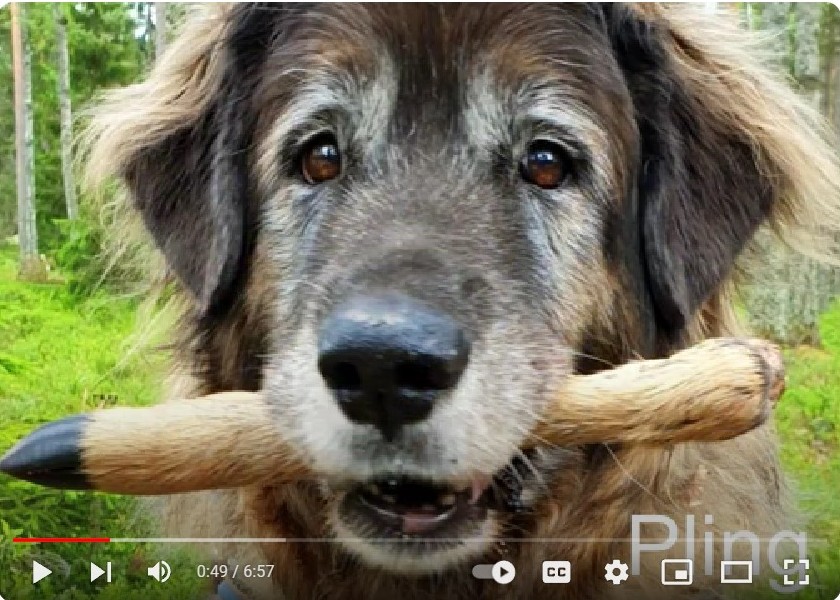
Many of the owners of very old Leonbergers joined the Double Digit Leonberger group on Facebook (Leonberger 10+ years old) and the owners of the extremely old Leonbergers (around 12 or older) started talking to each other a lot. It was a small group from around the world. This is why I said “Familiar faces” above. I knew many of them, including Pling, a Leonberger in Sweden. I and Pling’s owner talked a lot to each other in Swedish. Bronco and Pling reached about the same age and passed not too far from each other in time.


Note, all royalty earnings from my book (see right) go to the Leonberger Health Foundation International.
Indy Author Day At Watauga Library 2023
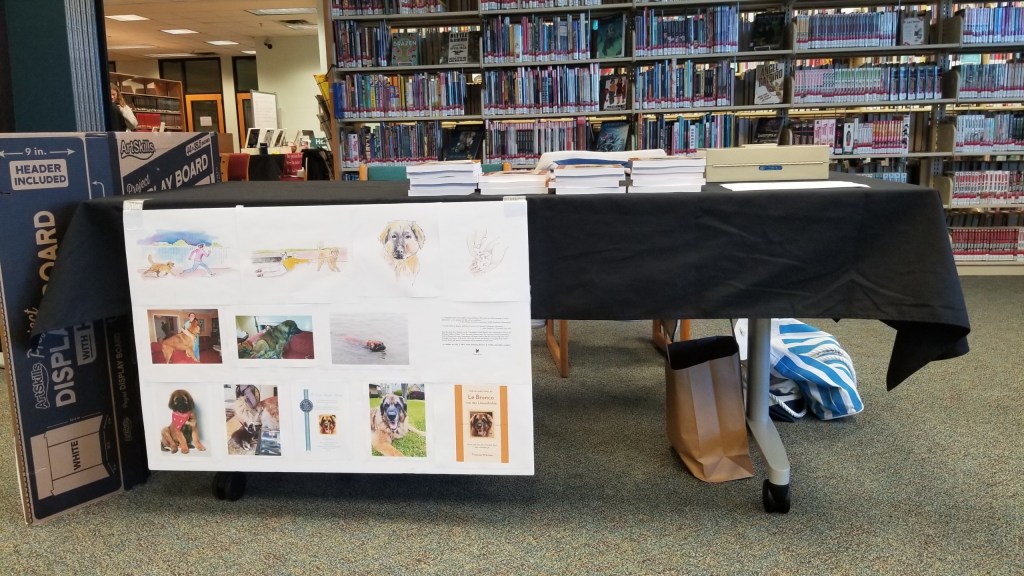
On Saturday November 4th Watauga public library hosted an indy author day to which I was invited, and I gladly joined. Wautauga is a small city located between Dallas and Fort Worth. It is closer to Fort Worth. They also hosted an indy author day last year, which I also partook in. We all had a booth where we sold and signed our books. I did not sell a whole lot, half a dozen, but that’s OK. It is a great way to interact with and get to know other authors, and it is fun.
We also read a short passage from our respective books in front of an audience. My reading went very well. I read one of the shorter funny Bronco stories from my book and people laughed a lot. Well, I had practiced, and I was animating the story a bit. I felt like a comedian. I am including the story I read at the end of this post. If you are an indy author and you live in the Dallas Fort Worth area I suggest you participate next year, just for the fun of it.



The story I read during reading time (3 minutes)
Bronco’s Hamster Search and Rescue
Back when Bronco was young, the kids had pet hamsters—Moldova and Montenegro. The hamsters escaped from their cages sometimes, but Bronco usually helped us find them whenever they did. Claudia (my wife) would tell him, “Bronco, find the hamsters,” and he would go around the house sniffing until he found them. One time he found them in the linen closet; another time he found them on a shelf in the living room.
On one occasion, a friend of David (our son) trusted us with his two hamsters while he and his family went on vacation. A couple of days later, Claudia noticed that the two hamsters were missing from their cage. The next thing she noticed was that Bronco’s cheeks looked puffy, so she said, “Bronco, drop it!” Out came the two hamsters, both unconscious.
In a panic, Claudia started performing CPR on the unconscious hamsters. She put one hamster at a time in her hand and gently compressed each tiny chest using the finger of the other hand. Fortunately, one hamster revived right away. The CPR didn’t seem to be working on the other hamster, but Claudia put both of them back in their cage, and soon the second hamster also woke up. We decided to keep the incident to ourselves. Hamsters don’t squeal.

The question is, Did Bronco try to eat the hamsters? Or did he simply find them and pick them up, intending to alert us to their presence? I’ve asked several people this question, including some who know Leonbergers well. The answer they give is that he tried to save them from whatever danger he thought they might have been in. If he wanted to eat them, they say, he would have tried chewing them. But clearly, he didn’t.
Note: Unless they bought my book, they probably still don’t know what happened
Have you been an indy author day or similar?
The Leonberger Club of America
If you own a Leonberger, or are interested in Leonbergers, and you live in North America you likely know about the Leonberger Club of America, or the LCA for short. You are about as likely to find a Leonberger at Petland/Puppy-Mill as you are finding an Elephant for sale there. LCA is very protective of the Leonberger breed and of Leonbergers in general. You typically buy/get a Leonberger dog from an LCA certified Leonberger breeder or from the Leonberger Rescue Pals, and if you don’t that might be a problem.
There are only about 3,000 Leonbergers in North America and about 2,000 Leonbergers in the United States but the Leonberger Club of America has more than 1,000 members. They publish the Leo-Letter, a quarterly Leonberger magazine. So, the Leonberger Club of America has a very prominent place among Leonberger owners. Click here to see a summary of the Leonberger Breed Standard.

Other clubs associated with the Leonberger Club of America are New Jersey Leonberger Club, Great Lakes Leonberger Club, Greater Bluegrass Leonberger Club, Mid-Atlantic Leonberger Club Of Virginia, AKC Licensed Specialty Club, Tarheel Leonberger Club, AKC Licensed Specialty Club, The Frontier Leonberger Club Of The Southwest, Leonberger Club Of The Northwest, Northern California Leonberger Club. I am a member of The Frontier Leonberger Club Of The Southwest.
Other more or less related Leonberger clubs are the Leonberger University, Leonberger Health Foundation Internation and the Worldwide Leonberger Database. All proceeds from the sale of my book go to the Leonberger Health Foundation International.
Leonbergers have a long history in North America and the United States—despite the fact that until 1985, there were only seventeen Leonbergers known to be living in the United States.
See: Lusby, Leonberger, page 15.
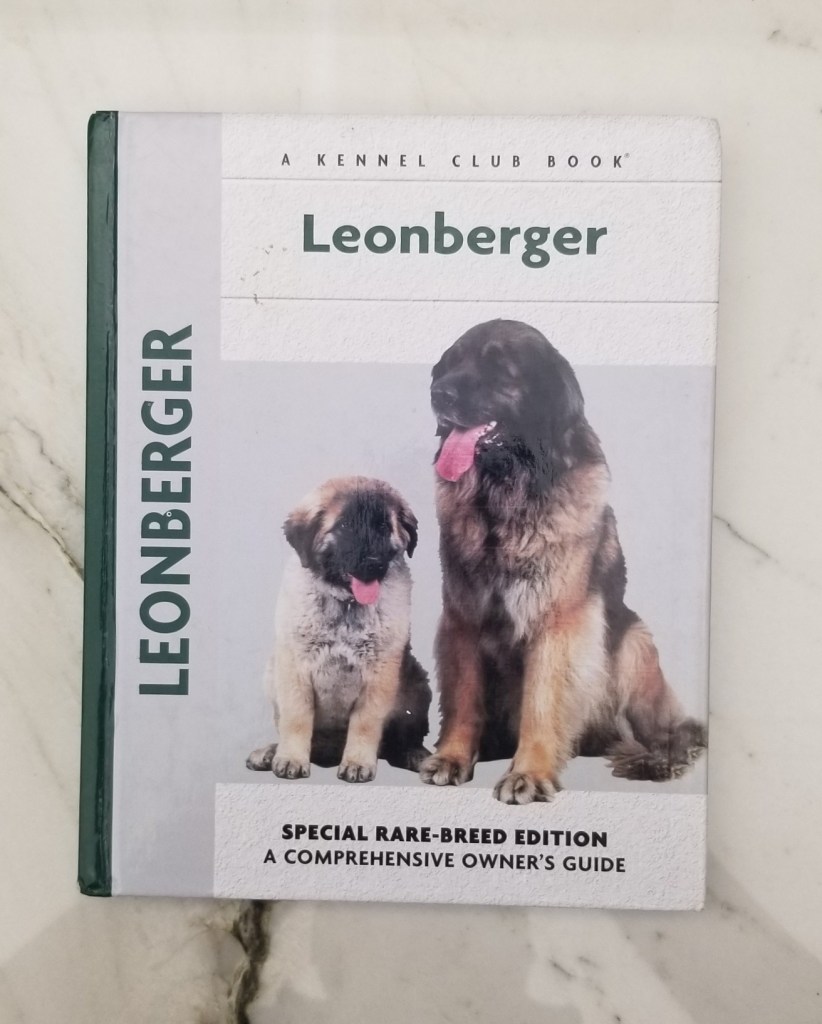
In the 1870s, Leonbergers were brought to Newfoundland to invigorate the stock of Newfoundland dogs. Around the same time, two Leonbergers named Caesar and Sultan were purchased from Heinrich Essig’s kennel (founder of the Leonberger breed) and transported across the ocean to join the Wellesley-Sterling theater company in the United States as the stars of their productions. Then in 1879, Caesar and Sultan visited President Ulysses S. Grant, who called them the largest and most magnificent dogs he had ever seen and presented them with gold medals. During the years between World War I and World War II, a New Jersey family, the Wolfs, opened their home as a temporary refuge for Jews fleeing Germany: they also imported Leonbergers. Unfortunately, this introduction of the breed into the United States did not last, and it would be another fifty years before the Leonberger appeared in America again.
See: Bliss-Isberg, Leonberger, page 60, page 64, page 101
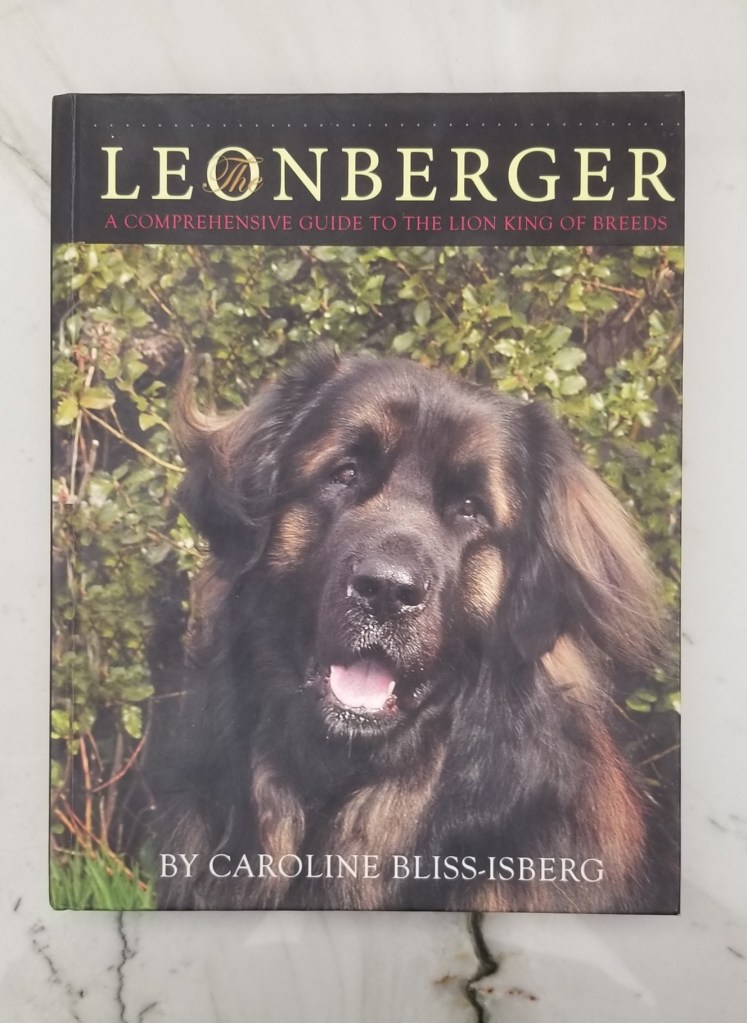
During the late 1970s and the 1980s, a few families—Waltraut and Klaus Zieher, Brian Peters, Manfred and Sylvia Kaufmann, Keri Campbell and Melanie Brown, and Mary and Reiner Decher brought Leonbergers to the United States. The Dechers had started a breeding program and were looking for a mate for their first dam, Viona. By chance their neighbor discovered through a newsletter that there was another Leonberger in the United States, and that led to the families’ finding and connecting with one another. I should add that the Dechers were careful to conform to the German breeding regulations and performed hip X-rays that they then submitted to the Orthopedic Foundation for Animals (OFA). Viona became the first OFA-certified Leonberger in America.
See: Bliss-Isberg, Leonberger, page 152.
On Saturday, November 2, 1985, eight of these Leonberger enthusiasts met at a hotel in Denver, Colorado, to found the Leonberger Club of America (LCA). This group of founders, which has since been dubbed the Denver Eight, appointed a registrar, formulated a breeding acceptability checklist, and instituted various policies, including the requirement that OFA certification is mandatory for breeding. LCA membership grew: it held social gatherings, began publishing LeoLetter, and imported an increasing number of dogs. Now the LCA has thousands of members across the country, and Leonbergers receive high ratings on health tests relative to other large breeds. For example, in 2000, the OFA reported that only 14.6 percent of Leonbergers tested positive for hip dysplasia, compared to 47 percent of Saint Bernards.
See: Bliss-Isberg, Leonberger, page 154, page 176.
Another important historical event was the founding of the Leonberger Health Foundation International (LHFI), in 2000 (it was just called the Leonberger Health Foundation back then). According to its website, the organization was founded by Waltraut Zieher and other memers of the LCA’s health, education, and research committee to “facilitate the solicitation and distribution of donations given to support health related breed-specific research.” The LHFI also administers a program that collects DNA samples from Leonbergers to share with universities and research institutions, and of course it administers the Grey Muzzle Award (long living Leonbergers). Our Leonberger Bronco was a recipient of the Grey Muzzle Award, and we provided them with his DNA.

LHFI’s global biobank contains DNA samples from more than nine thousand Leonbergers. Among the organization’s notable achievements are the eradication of Addison’s disease among Leonbergers and the raising of nearly half a million dollars for research into conditions that affect canine health, including osteosarcoma, hemangiosarcoma, glaucoma, cardiac diseases, thyroid diseases, and neurological disorders. Its research also supports healthful longevity and aging as well as population diversity. Another success is the fact that since 2011, no Leonbergers with two copies of the LPN1 gene mutation (which causes Leonberger polyneuropathy) have been recorded in LHFI’s biobank. LHFI is one of my favorite charities.
The end of the twentieth century marked not only the end of the Cold War but also the beginning of what I call the Dog Wars of America. In 1985, the American Kennel Club (AKC) registry comprised one-third of the world’s known dog breeds. But the AKC had recognized only a few new breeds since 1887—a period of ninety-eight years. So, the organization decided to change that policy, but this did not always go smoothly. The members of rare-breed clubs often did not want to be part of the AKC. For example, the Australian Shepherd Club of America (ASCA) was very reluctant to join, so a relatively small splinter group, the United States Australian Shepherd Association, was formed and designated the official member club of the AKC, which was not welcome news to the ASCA. The border collie is another example. Charles Krauthammer, the late political columnist, called the AKC the politburo of American dog breeding.
See: Bliss-Isberg, Leonberger, page 159.
Similarly, in 2003, a new Leonberger club was formed—the Leonberger Club of the United States—with the goal of becoming the Leonberger member club of the AKC. This essentially forced the LCA’s hand, so they applied for membership in the AKC, a process that took years to complete. But ultimately the AKC approved the LCA as members in 2010: Leonbergers would officially become part of the Working Group. Fortunately, 90 percent of LCA breeders agreed to continue following LCA regulations regardless of whether the club would remain independent or become part of the AKC. Also fortunately, AKC membership afforded more opportunities for Leonbergers to participate in dog shows, which is important to many owners.
See: Bliss-Isberg, Leonberger, page 187
For information on the history of the Leonberger starting in 1830’s see this link
 Leonberger Life