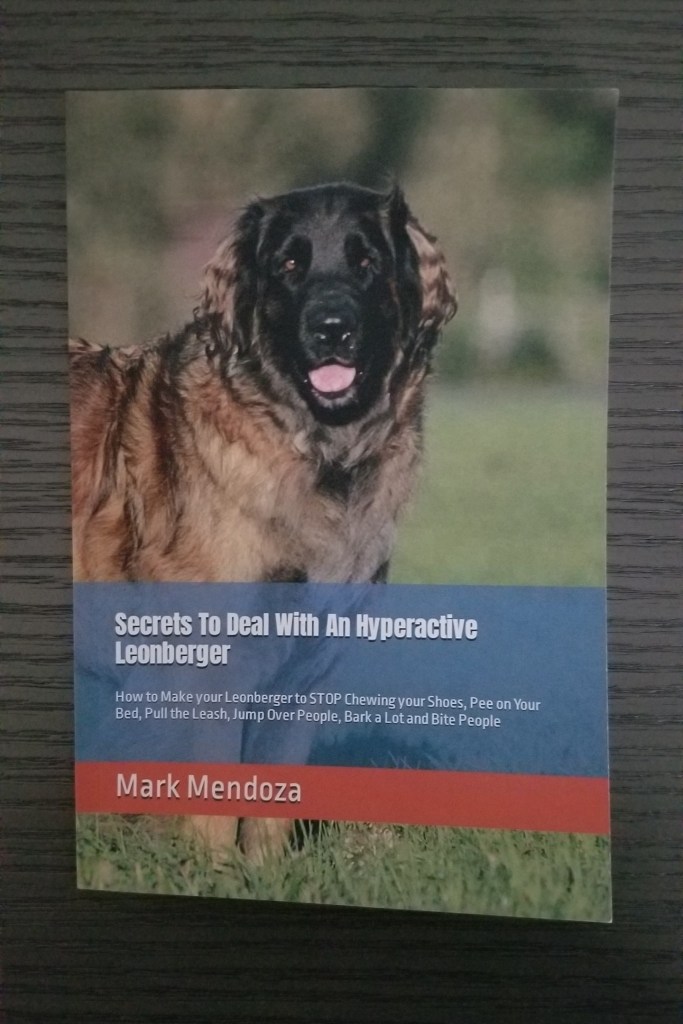
I recently finished Secrets To Deal With An Hyperactive Leonberger: How to Make your Leonberger to STOP Chewing your Shoes, Pee on Your Bed, Pull the Leash, Jump Over People, Bark a Lot and Bite People Paperback – November 26, 2021 by Mark Mendoza. The dimensions are 6 x 0.19 x 9 inches, and the weight is 6.4 ounces, ISBN 979-8774384570, and it currently costs $19.99 on Amazon in the US.
Secrets To Deal With An Hyperactive Leonberger by Mark Mendoza. Click on the image to go to the Amazon location for the book.
In summary: Secrets To Deal With An Hyperactive Leonberger, is a short Leonberger book that is a fairly generic dog behavior book and not really about Leonbergers. In addition, the book needs an editor, it does not have page numbering, no pictures, and considering that it is also a short book I don’t think the price $19.95 is justified. That last statement may not be appropriate for an Amazon review.
Below is my review of Secrets To Deal With An Hyperactive Leonberger by Mark Mendoza. I improved it a bit over the Amazon review. Click here to see my original Amazon review. BTW I gave the book three stars.
Good Advice on Hyperactivity in Dogs But There Are Issues With The Book
This is how the book begins; “My name is Mark Mendoza, and if you are reading this, then probably you know a few things about me;”. Well, I did not know anything about the author when I started reading this short book, which makes me wonder if I was the intended audience. As the title implies, this book is focused on dog training, specifically how to handle hyperactivity in Leonbergers. The author states that he is not a trainer but that he has a lot of knowledge of dog psychology. After reading this book I tend to agree, he does know what he is talking about, and I think he takes a very sensible and modern approach to basic dog training and how to handle hyperactivity and stress in dogs and how to prevent a dog from running away. We could certainly apply this knowledge to our somewhat hyperactive mini-Australian Shepherd.
However, I also had some issues with this book. I am a former Leonberger owner, and I saw no information in this book that applied specifically to Leonbergers. You would think the history section might contain some Leonberger specific information, but the word Leonberger was never used in that section. The book is a generic dog training book with the word Leonberger frequently used instead of the word dog. Making it seem like the book is specifically for Leonbergers when it is not, is not OK in my book. In addition, the sentence structure is frequently faulty, which makes me think the author is not a native English speaker, and there are also a lot of typos. The book needed an editor. There is also no page numbering, and the text is large resulting in less content than the stated 83 pages would imply. There are no pictures. Considering that the book is quite short and has not pictures I also think the price is too high. Therefore, despite the sensible approach to dog training and the handling of dog hyperactivity I am giving it three stars.
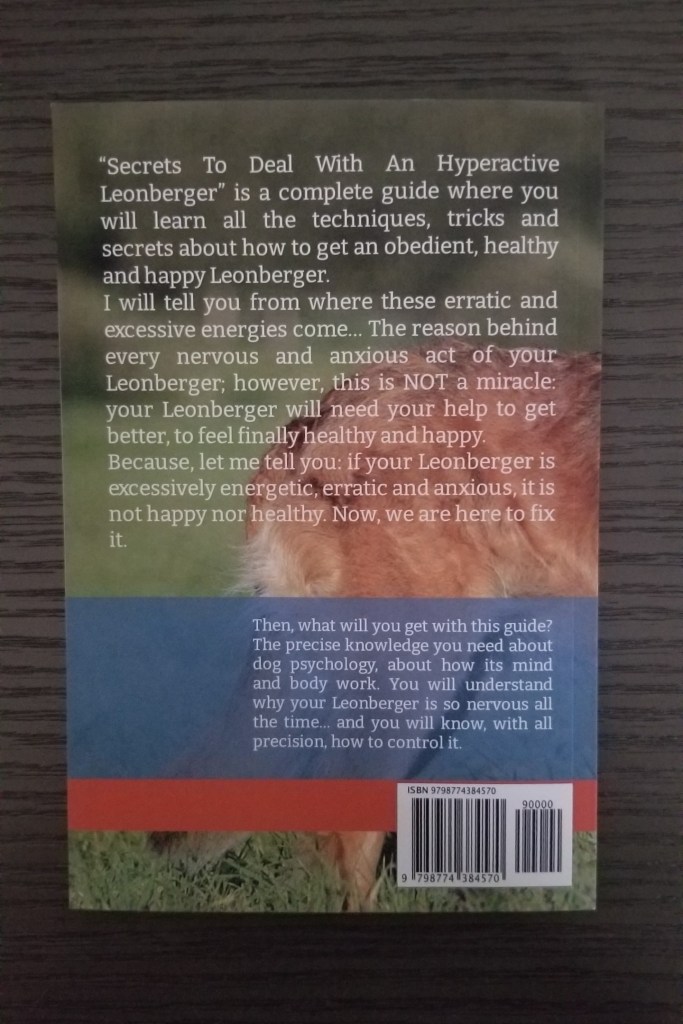
Back cover of Secrets To Deal With An Hyperactive Leonberger by Mark Mendoza.
One year ago, I launched my Leonberger blog. Alex Diaz-Granados another blogger I know gave me some advice so I could get started. Well, that was one year and one day ago today (March 13, 2022). I was too busy yesterday to work on my blog, so this post is one day late for a one-year anniversary, but I am doing my one-year anniversary today.
The purpose of the blog was to inform people about Leonbergers, a truly remarkable dog breed, as well as advertise my then upcoming book “The Life and Times of Le Bronco von der Löwenhöhle, Stories and Tips from Thirteen Years with a Leonberger.” I invited friends and announced the existence of my blog on Facebook and Instagram. Later in July of 2022 my book would be released, and a couple of months after that I started interacting with other WordPress bloggers upon the advice of Alex. At this point I am blogging just because it is fun.
I read somewhere that when you launch a blog you should make five posts at once because having a blog with just one or two posts makes it look empty. Therefore, I made five posts on launch day. Below I am posting five pictures corresponding to each of the five posts. If you click on the picture, you can look at that original old post.
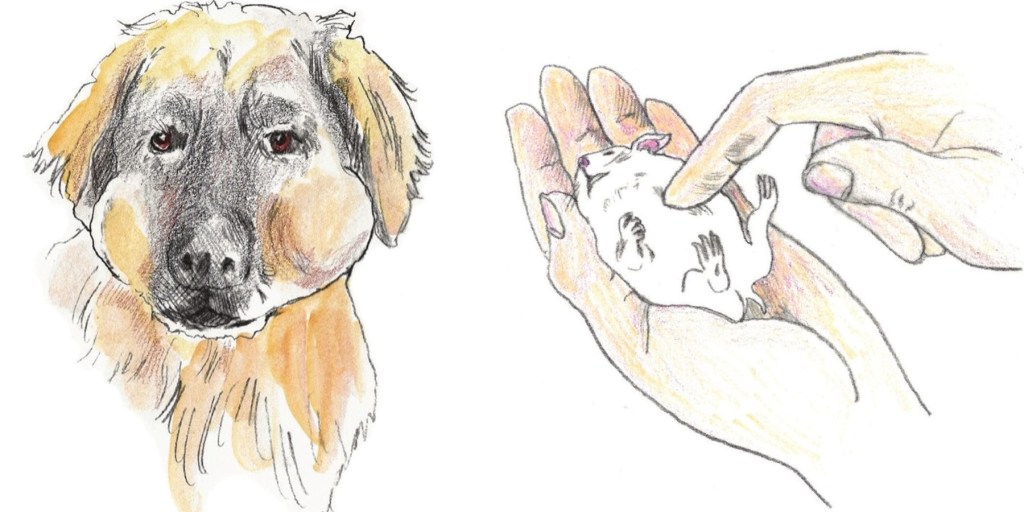
What is a Leonberger? Click on the image to see this one-year-old blog post.Our Leonberger Bronco. Click on the image to see this one-year-old blog post.The Time Bronco Saved the Neighborhood. Click on the image to see this one-year-old blog post.Bronco’s Hamster Search and Rescue. Click on the image to see this one-year-old blog post.The Grey Muzzle Award. Click on the image to see this one-year-old blog post.
With this post I am adding another Leonberger book that I recommend. It is a very good guide for new Leonberger owners with one caveat. It implies that you should neuter/spay your Leonberger at six months old, which would severely harm your dog if you did. The in general recommended six months does not apply to Leonbergers. Vannessa Richie did her research except regarding this. She has written many dog books, interviewed many Leonberger breeders, and she is a skilled author. However, it is obvious that she has never owned a Leonberger. Therefore, I am giving this otherwise great book four stars instead of five.
Front cover of the book the Complete Guide To Leonbergers by Vanessa Richie. Click on the image to go to the Amazon page for the book.
The book is The Complete Guide to Leonbergers: Selecting, Training, Feeding, Exercising, Socializing, and Loving Your New Leonberger Puppy Paperback – May 12, 2022 by Vanessa Richie. It is 195 pages, and the current price on Amazon for the paperback is $19.95, the hardback is $26.95, and the Kindle is $9.95. ISBN-13 978-1954288485, weight 12.5 ounces and the dimensions are 6 x 0.44 x 9 inches.
Complete and Very Helpful Guide to Leonbergers, but DON’T Neuter/Spay a Leonberger at Six Months
As the title promises this book is indeed a complete guide to Leonbergers. It is focused on training and care. First the book examines whether a Leonberger is the right dog for you as well as the history of the breed. The rest of the book includes topics on how to find and prepare your home for a Leonberger, puppy training, socialization, exercise, grooming, nutrition, health, etc. The book has a lot of detail and a lot of useful information. The author clearly did her research. She interviewed ten breeders after all.
The content of the book is almost 100% correct as far as I can tell, and the information is very useful to Leonberger owners. I question the second page of the chapter on history where she claims that Essig bred his Leonbergers from two dogs, a white and black Newfoundland and a long-haired St. Bernard. Essig claimed a third dog was also involved, a Pyrenean Mountain Wolfhound or possibly a Pyrenean Mountain Dog (Great Pyrenees). However, Essig’s claims have been disputed, and this is not important.
The book design is very professionally done with various sorts of sidebars, highlighted headers, professional looking tables, dividers, little corner boxes with graphics for “helpful tips”, “fun facts”, “historical facts”, “Health Alerts”, pros-cons sidebars with graphics, and 62 black and white Leonberger photos. The author is not only a good writer, but she also knows a thing or two about book design.
I’ve read more than a dozen Leonberger books and this is among the best Leonberger books I’ve read. I wish this book had existed when we got our Leonberger. I should say that we did not do everything right, but we got a lot right, and he lived exceptionally long for a Leonberger, 13 years. If we have had this book, maybe he would have lived even longer. I should add that we donated his DNA to Leonberger health research (upon request).
The reason I am not giving this book five stars is because of a problematic blooper in the middle of page 30. It says “….the dog is spayed or neutered once it reaches maturity (typically six months)”. Leonbergers aren’t fully matured until the age of two and should not be neutered/spayed until then. If you spay/neuter a Leonberger much earlier (six months) you will harm the dog. Yes, they are different from most dogs. I should say that we did not wait two years, it was not practical, but we waited about one and half year, which is much better than six months. If the author removes the faulty parenthesis, I will change my rating to five stars and update this paragraph and the title of the review. Assuming the book is print on demand you can update so that future prints here on Amazon will be correct.
So, in conclusion, this is a great Leonberger book with a lot of useful information, and I highly recommend it to Leonberger owners and prospective owners, but the blooper on page 30 prevents me from giving a perfect rating at the moment.
Back cover of the book the Complete Guide To Leonbergers by Vanessa Richie.
I launched this Leonberger dog blog in March of 2022. The purpose of the blog was to promote my upcoming book “The Life and Times of Le Bronco von der Löwenhöhle, stories and tips from thirteen years with a Leonberger” and to spread the word about Leonbergers, a rare but very special breed of dog. They are very large, friendly, unafraid but sensitive and loving, protective and strong, energetic and funny, especially when they are young.
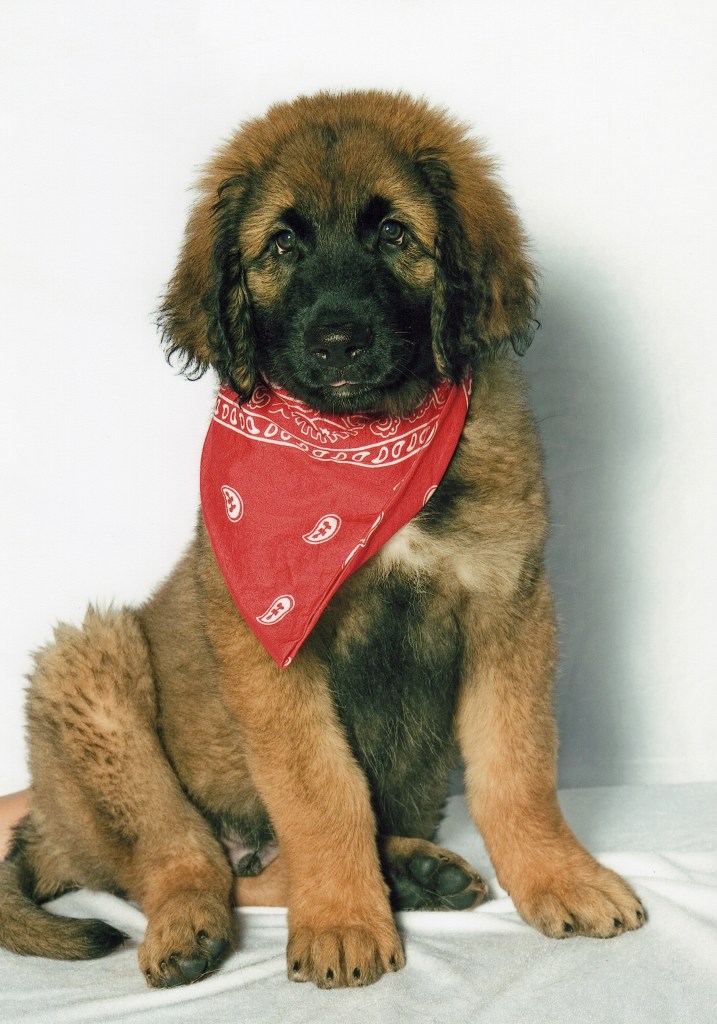
Le Bronco von der Löwenhöhle at three months old.
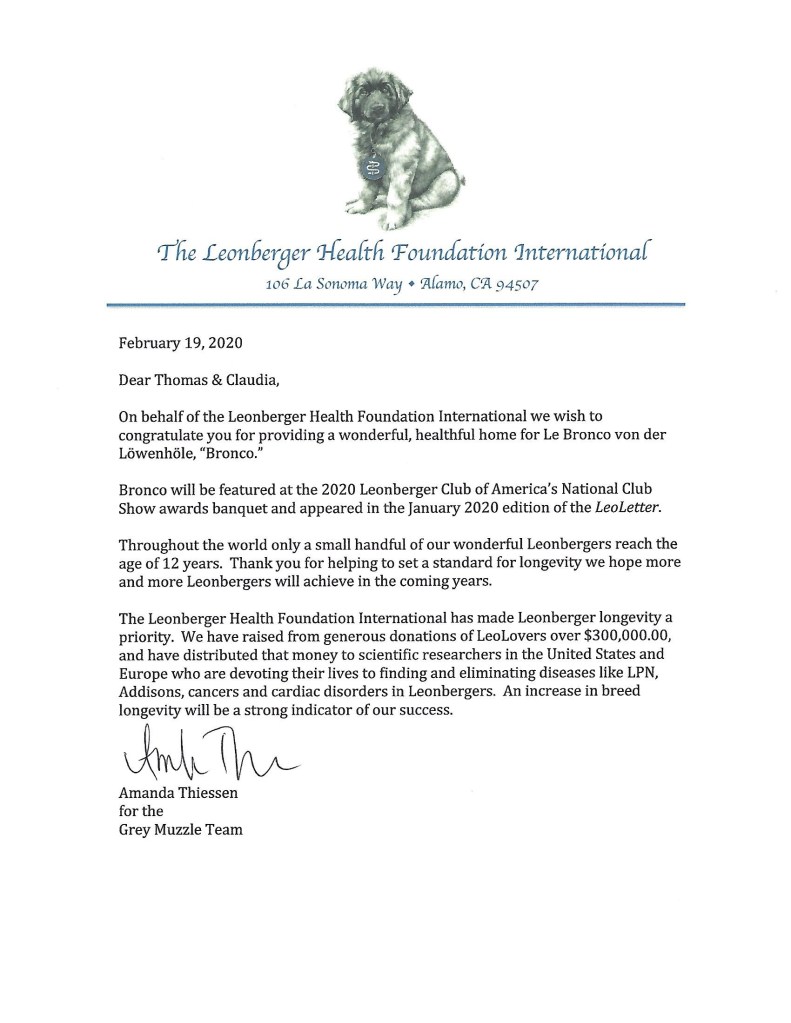
In addition, Bronco was a very special Leonberger. Purebred Leonbergers typically live 8-10 years, but Bronco lived almost 13 years. He was two weeks short of 13 when he died from heart failure. Therefore, he received an award for longevity from the Leonberger Health Foundation International and we donated his DNA for research. I can add that I donate all royalties from sales of my book to the Leonberger Health Foundation International. It is a great organization that has improved the health of Leonbergers and other giant dog breeds substantially.
Bronco’s Grey Muzzle Award presented by the Leonberger Health Foundation International. He received this award because he lived longer than 12 years.
My on-line friend Alex Diaz-Granados, who is an experienced blogger (see “A certain point of view”) helped me get started. He suggested that I use wordpress.com, and here we are. I can add that Alex and I have been on-line friends for a long time. It started with epinions.com, a review site that paid reviewers for writing reviews. I joined epinions.com in 2008. He had joined a few years before that. I focused on software, travel, books, computer hardware and electronics. He focused on books, film, travel, and I think on-line stores and a few more topics. He can fill me in. I can add that sometimes epinions.com paid pretty well, so after a while it became more than a hobby for me. It became a source of supplementary income. I joined twitter and Facebook in 2010 and he was already there, and we both eventually joined Instagram. Unfortunately, epinions.com went belly up in 2014.
In March of 2022 I invited friends and Facebook friends to visit and follow my blog if they wished to do so, and many did. I had some traffic and comments in the beginning but then it died down, and it didn’t seem like search engines picked up my blog. In July of 2022 I released my book in honor of Bronco’s birthday on July 3rd. In the beginning I sold many books, well for a Leonberger book anyway, and I also had more visitors to my blog, but after a while the activity on my blog as well as book sales died down.
Alex suggested that I visit, comment and like the posts of other bloggers and in August I started doing that using Alex’ blog as a starting point and now I was getting more visitors and a lot more comments and likes, and search engines started to pick up my blog a lot more. Lately I even had a couple of posts go sort of viral with thousands of visitors in a couple of days. Those unknown visitors tend not to leave comments (or likes) but other wordpress bloggers do. That was not the best part though. The best part was meeting other bloggers and authors on-line, reading their blogs, reading their books, typically great books. This was fun. Blog visits and book sales became secondary. Blogging is now a hobby.
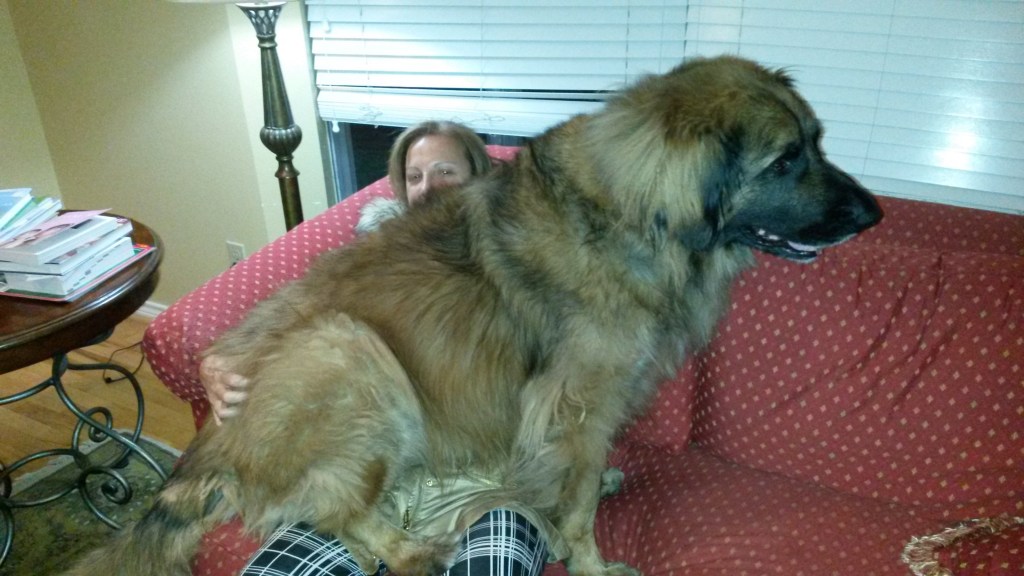
Bronco in my wife Claudia’s lap.Bronco a few weeks after his first heart failure heading towards the end of his life.
So, what are my goals for my Leonberger blog in 2023?
Continue my Leonberger blog and keep promoting my book on the blog for at least six more months.
Virtual Book Blast For Natural Selection with Jacqui Murray on February 13 2023.
I still have a lot to learn more about wordpress.com. I don’t know how to do inline images, I don’t know how to store images for later use, I don’t know how to make those little icons, hearts and clover, etc., that people put in comments, I only know the basics of the 20/20 template, I don’t know other templates. I have a wordpress book that I am planning to read. I need to learn more.
I will read more books by authors I know online. Knowing an author and reading their book(s) is a completely different feeling compared to reading someone you’ve never talked to (I have a long TBR list).
Post 20-30 book reviews on my blog. I don’t post all my book reviews on my blog. Most of my book reviews are only for Amazon (or Goodreads). On my blog I just post reviews for Leonberger books and reviews for books by fellow bloggers that I love and want to promote.
I want to start a second blog that is about facts and insights that could have a high impact on someone’s worldview and yet may not be well known, understood, believed or are controversial, yet are fully backed by the expertise in that field. As someone who have studied modern physics, loves gapminder, and have read a ton of books on all kinds of topics, I’ve come across quite a few, and I have radically changed my view of the world several times. However, I am hoping for good suggestions from visitors so I can expand the collection. I can be in charge of the fact checking, at least to begin with.
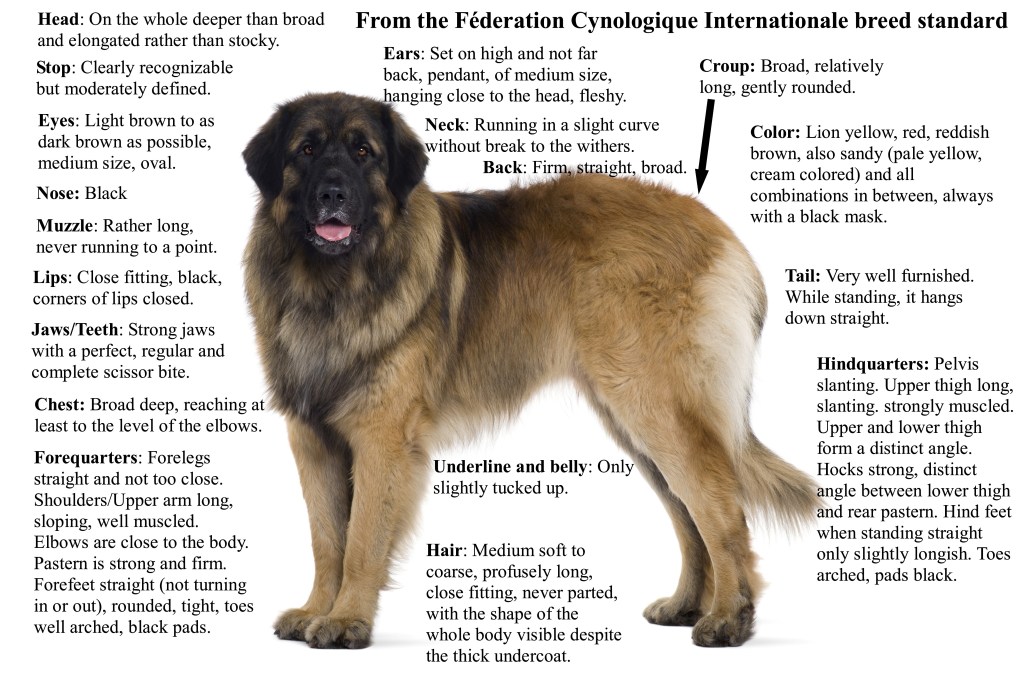
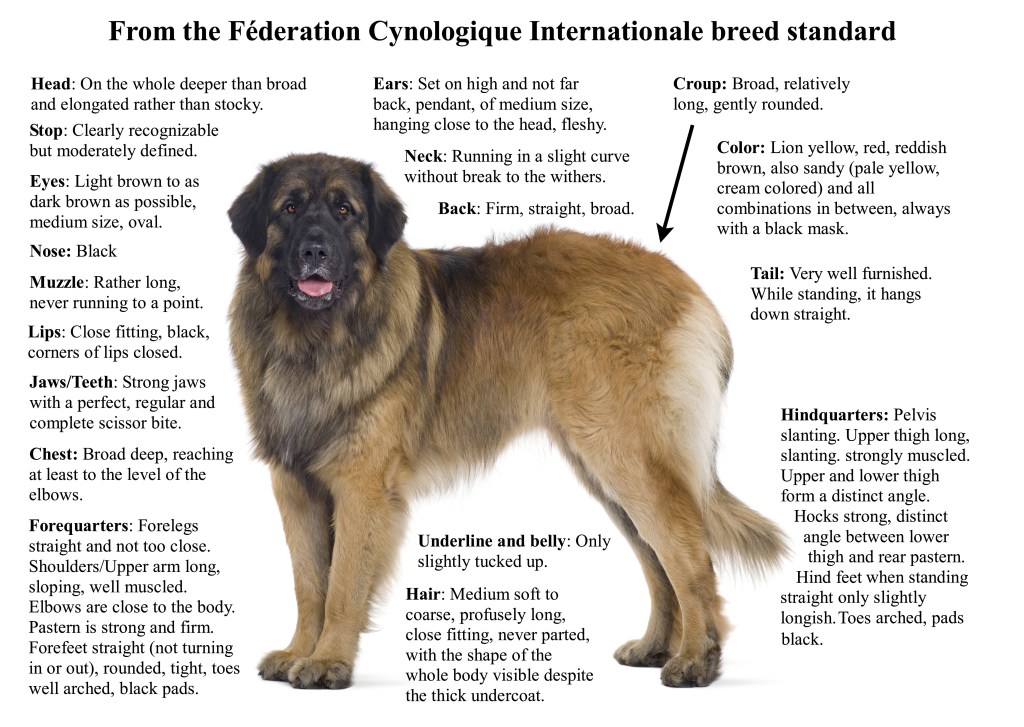
In case you are interested. This is an overview of the Leonberger breed standard from the Féderation Cynologique Internationale.
With this post I am adding a sixth Leonberger book that I recommend. It is a very short book, but it contains a lot of useful information. It contained a few inaccuracies, so I am giving it four stars instead of five, but it is still a good book.
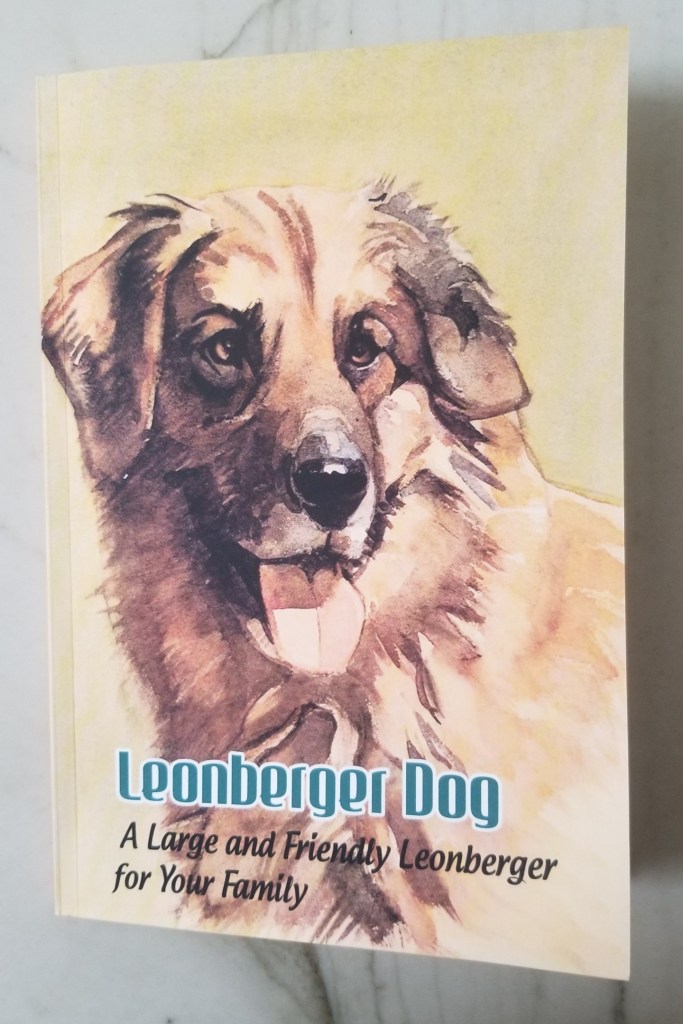
The book Leonberger Dog by Lankford Marcus. Click on the book to go to the Amazon page for this book.
The book is Leonberger Dog: A Large and Friendly Leonberger for Your Family: Leonberger Dog Breed Origin, Behavior, Trainability and Facts by Lankford Marcus. The book is 57 pages, and the current price on Amazon for the paperback is $6.99 and the Kindle is $2.99 unless you have kindle unlimited in which case it is free. ISBN-13 : 979-8463499851, weight : 3.53 ounces and the dimensions are 6 x 0.15 x 9 inches.
This is my review for the book
Short Leonberger book packed with useful information but some inaccuracies
This is a short book. It has 55 pages of actual content. However, it is densely packed with information useful to Leonberger owners and those interested in getting one. The book is primarily addressing British readers, but it also mentions the Leonberger Club of America and give some advice specific to American prospective owners. It is quite useful to both American and European readers. The book feature 17 black and white photographs. I would have preferred the photos to be in color but that raises the printing cost, and some Leonberger books have no photos in them at all.
The book contains 11 chapters; Overview, History, Appearance, Temperament and Personality, Living Needs, Caring for a Leonberger, Feeding, Leonberger Health, Choosing a Leonberger Breeder, Average Cost to Keep for a Leonberger, How to identify a Leonberger. Almost all of the chapters were condensed but contained very useful information to Leonberger owners and prospective Leonberger owners. I especially cherished the “Temperament and Personality” and “Caring for a Leonberger” chapters. However, I had an issue with the two first chapters.
I would have given the book a five-star rating if it wasn’t for some incorrect information regarding the history of the breed. On page 4 it says that Heinrich Essig, the creator of the Leonberger breed, was the mayor of the town of Leonberg. Heinrich Essig was a prominent citizen of the town, and he was a successful businessman, farmer, innkeeper, horse and dog trader, large-dog enthusiast, dog breeder, and town councilman, but he was never the mayor of Leonberg.
On page 5 it says that after World War I there were only 5 Leonberger left alive. World War I was tough on the breed, but it was not quite that bad. After the war, Karl Stadelmann and Otto Josenhans, worked hard to save the breed, and they were able to find twenty-five Leonbergers whose owners were willing to cooperate in reestablishing the breed. Of these, only five were suitable for breeding. That’s where that info comes from. That’s a little different from saying that only five Leonbergers survived.
On page 6 it says that after World War II there were only 8 Leonbergers left. However, that is once again an exaggeration. However, there was indeed a “genetic bottleneck” of Leonbergers in the 1940s. This was largely because people repeatedly bred the dogs they thought were the best specimens in a misguided attempt to improve the breed. Scientific pedigree analyses demonstrate that the Leonberger has twenty-two founder animals, or animal ancestors unrelated to one another (ten males and twelve females). Again, a little bit different from “only 8 survived”. Another inaccuracy is that on page 2 the book state that the Leonberger have a tragically short lifespan of 6-8 years. First, all giant breeds have a very short lifespan and the lifespan of the Leonberger has improved partially due to the work of the Leonberger Health Foundation International. Today the Leonberger lifespan is 8-10 years. Ours lived almost 13 years (two weeks short of 13), so the Leonberger Health Foundation International wanted his DNA, which we provided.
This book is short, but it packs a lot of mostly accurate information that is truly useful to Leonberger owners. In that sense I think it is great. I wrote quite a bit about the few mistakes in this book, but I think it is important to point out inaccuracies. These inaccuracies frequently appear on-line and in other Leonberger books as well and they are not important to Leonberger owners. I feel I cannot give five stars considering these inaccuracies are in the book. However, I can still highly recommend this book to all readers interested in a short Leonberger book.
This post is just an announcement. For Black Friday throughout the weekend and Cyber Monday the Kindle version of my book, “The Life and Times of Le Bronco von der Löwenhöhle”, stories and tips from 13 years with a Leonberger, will sell for only $2.99.
If you would like to learn about more about my book and find out where to buy it, click here or here.
If click you on any of the images below you will be taken to the Kindle version of my book.
Bronco three months old. Click on the image to go to the Amazon.com Kindle location for the book.Bronco the lapdog. He is sitting in my wife’s lap all 167 pounds of him. Click on the image to go to the Amazon.com Kindle location for the book.Bronco lived unusually long for a Leonberger or for any giant breed. Bronco’s was awarded the Grey Muzzle Award given by the Leonberger Health Foundation International. Click on the image to go to the Amazon.com Kindle location for the book.Bronco 12 years old going on 13. Click on the image to go to the Amazon.com Kindle location for the book.
Our Labrador Baylor was a stealthy, opportunist and quick food thief. Food tended to disappear around him as if it never was there. Our German Shepherd on the other hand never stole food and took it upon herself to guard the entrance to the kitchen to the chagrin of Baylor. If she could have spoken, she would have said “you shall not pass”.
Baylor and Baby
Our Leonberger Bronco was our biggest dog, and he could eat a lot. Once we had prepared a big plate with five pounds of roast beef for a dinner party. Bronco finished those five pounds of roast beef with astonishing speed. I saw him do it, but I was not quick enough to stop him. Luckily, he thoughtfully left us the carrots, the broccoli and the dip, so the guests had something to eat. All our dogs were, and are, great dogs, but many dogs have this vice, food theft. I should say that Bronco often willingly shared his loot with other dogs. He was not selfish. Below I am including a few excerpts from my book concerning food theft.
Labrador food theft stories
Photo of our Labrador Baylor
In addition to his hatred for mailmen, Baylor had one more vice, and that was stealing food. He was always hungry, and he was pretty good at culinary theft. On one occasion, I was standing in the kitchen holding a sandwich in my hand. Suddenly the sandwich disappeared from my fingers as if it had been teleported. I didn’t feel a thing—no pull, no touch, no wet nose. It just vanished. I turned around, and behind me stood Baylor, swallowing something. He looked at me, wagging his tail. Was he innocent? Did Captain Kirk beam my sandwich to another dimension? How could I be mad at him when I didn’t have proof?
On another occasion, Baylor jumped up on top of the kitchen table using a chair as a step stool and cleared it of the desserts that Claudia’s grandmother had brought for the kids and the family. That’s how I learned that she had a swear-word vocabulary—and that it was substantial. Fortunately, the kids weren’t nearby. On yet another occasion, Baylor emptied a tray of baklava that had been sitting on the kitchen counter.
His most notable food raid was probably when he stole the Thanksgiving turkey and ran off with it. We salvaged most of it, but knowing that Baylor had been all over it, we decided not to eat what he left us. It wasn’t very appetizing.
Leonberger food theft stories
Our Leonberger Bronco is ready for dinner
I believe dogs have empathy, and sometimes they want to share, at least Bronco did. There was a time when we were in our home eating take-out food and Bronco stole one of our dinners, including meat, vegetables, and a baked potato. He started eating the meat, then he glanced at Daisy, who was sitting in the middle of the floor looking sad. Immediately he took the baked potato in his mouth and carried it over to her and dropped it right at her feet. I was going to get mad at him for stealing, but when I saw his kindhearted and unselfish act, I let it be.
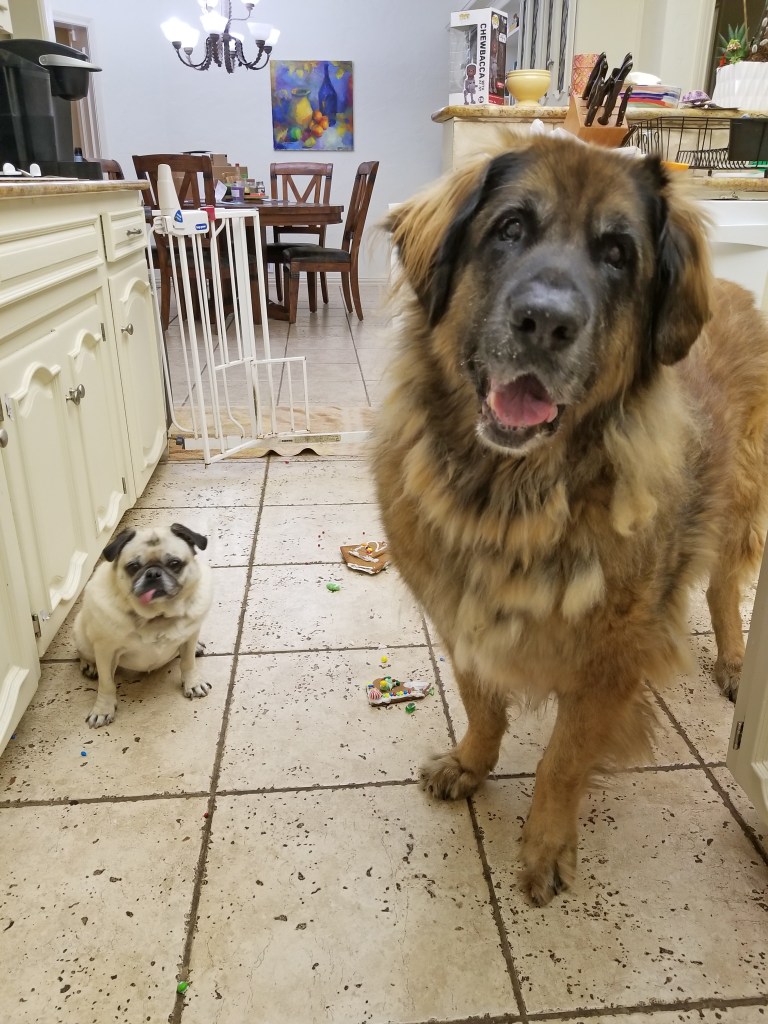
On another occasion, Rachel made a gingerbread house and left it on the kitchen counter. I had forgotten to lock the kitchen gate, and the photograph above shows what greeted me when I got home. Guess who ate half the gingerbread house. I should say that Bronco shared some with Daisy. He was always very generous.
Bronco and our Pug Daisy sharing a gingerbread house
On yet another occasion, Bronco got hold of a box of chocolates in the shape of small gnomes. Each gnome was filled with liquor—some with gin, some with vodka, some with whiskey, and some with rum. It was a gift from Rachel, who had just come back from a visit to China. She had bought the present for us at the airport in Hong Kong. But Bronco ate the entire thing—tinfoil wrappers, chocolate, liquor, and all. We were afraid he might get very sick, and we carefully monitored him, ready to rush him to the emergency clinic if necessary. Fortunately, nothing happened, except he threw up a little bit of tinfoil. I guess he had a stomach of steel.
So, for this Thanksgiving watch your dogs so they don’t run off with your Turkey
Note the books above are Leonberger books that I do recommend. I can add that the first book Leonberger by Caroline Bliss-Isberg is a masterpiece, but it is very expensive.
However, I’ve also read Leonberger books that have substantial issues and that I therefore cannot recommend. This blog is about them.
The problems with the books I am presenting below include that the author has never owned a Leonberger, the book is full of factual errors, it’s full of grammatical errors, spelling errors and other typos. In addition, two of the books were copy and paste operations. What I mean by that is that the author wrote a book about how to train a dog, any dog, for example a Pug, and then changed the word Pug to Leonberger (copy and replace) to create a Leonberger book. Of course, they needed to add a few Leonberger facts, that may or may not be correct. Repeat the process for 65 breeds, or 167 breeds. You can write hundreds of books in one day using this procedure. The last book was written by a Russian who obviously did not speak English and probably rammed Russian text through a mediocre translation app with comical results. Parts of the book was unreadable. None of the books had any photos or illustrations to make them more interesting.
They say that you should not slam the competition. It will come back and to haunt you. That’s true. However, I don’t think these authors are my competition because they are not “Leonberger people”, and they are unlikely to ever read this. Below I am presenting and reviewing three books which I have given three stars, two stars and one star respectively on Amazon.
.
.
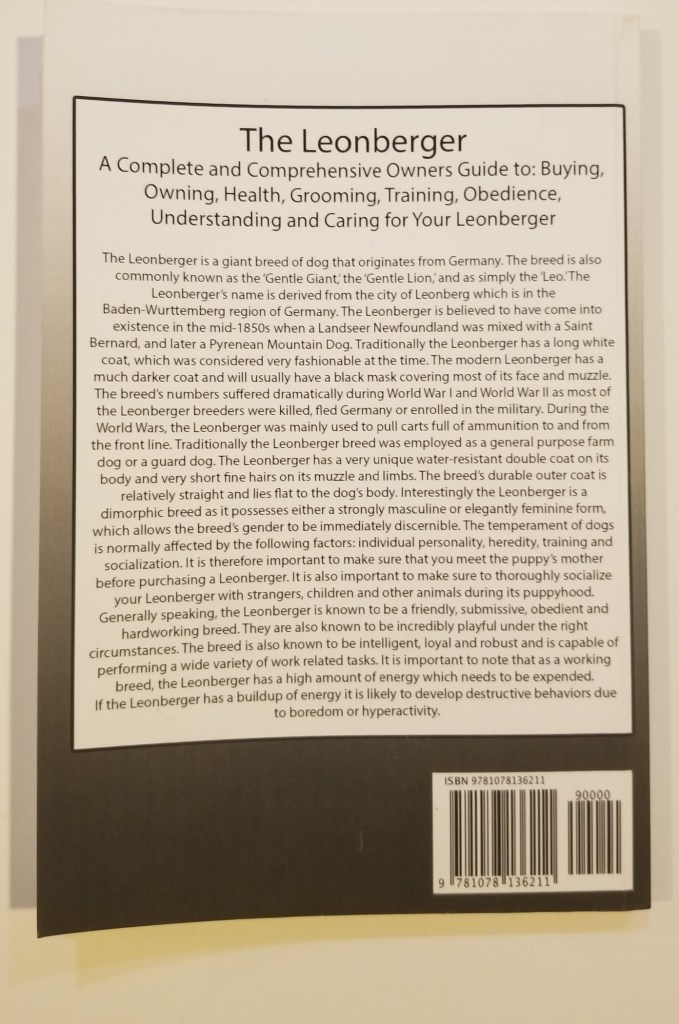
The Leonberger: A Complete and Comprehensive Owners Guide to: Buying, Owning, Health, Grooming, Training, Obedience, Understanding and Caring for Your Leonberger. By Michael Stone. Three stars.
It was published July 4, 2019
The paperback is 112 pages
ISBN-13 is 978-1078136211
Weight is 6.2 ounces
The dimensions : 6 x 0.28 x 9 inches
The price of the paperback is $8.00
Prcie of Kindle version is $2.99
Kindle unlimited is of course $0.00
Review below
A brief Dog Owner’s Manual with some Leonberger specific information, plus comical typos
This is a very basic book, about 14,000 words, no pictures or photos (other than the front page), and no diagrams or graphs, just text. However, considering that the printed version is eight dollars and the kindle version is free that is to be expected. The book should be judged accordingly. It is a simple and inexpensive book. The book description here on Amazon may not be entirely helpful. According to the “Final Thoughts” on the last page the author is planning to publish “multiple other dog care manuals …”. He is associated with the Dog Care Professionals organization. Based on the focus of the book and from what I can “read between the lines”, I am fairly certain the author has never owned a Leonberger and that he is not very familiar with the Leonberger breed or the community. For example, I don’t think he is part of the Leonberger Club of America. Maybe he can correct me if I am wrong.
However, where the author shines, is in his knowledge regarding the training of, and caring for dogs. I assume he is a professional dog trainer or a dog care professional. The book may not be a true Leonberger book, but it is useful for Leonberger owners none the less. We would have been helped by reading this book while training and caring for our Leonberger, or our German Shepherd, or our Pug, or our Labrador, or our Japanese Shin, or our Australian Shepherd, you get the picture. Therefore, the book is useful to Leonberger owners but may not be the best book for those specifically interested in the Leonberger breed.
I found the typos in the book a bit distracting. On page 74 he is giving a “Breif overview” and he is urging us to contact our local “Keenle Club” (my guess is that was supposed to be Kennel club), and “Heir on the side of safety” I can’t even guess what that means. That’s just one page. On page 15 he claims that the Leonberger will stand between 25 to 31 inches (? To ? cm) tall at the shoulder and weigh between 120 to 170 pounds (? to ? kg). He could have used a calculator or Wikipedia to complete page 15 without question marks. Better still, hire an editor. Question marks in the text looks sloppy. Also, the 25 to 31 inches refers to the withers, not the shoulders, it is close, but not the same thing.
From a training and caring for your dog perspective this is not a bad book. In fact, I found it to have a lot of useful information. The author is without doubt a skilled dog trainer professional. Hiring him to train our Leonberger would have been a good idea. Hiring him to spell our dog’s name, not so much (Le Bronco Von Der Löwenhöhle). Leonbergers have fancy names. Intimate understanding of Leonbergers seem to be missing in this book, and the editor is missing too. Therefore, I cannot give this book a five star rating.
The question is, should I give it three stars or four stars. I decided to give it three stars. It is an inexpensive book, that is an easy and quick read that is helpful to Leonberger owners, or prospective Leonberger owners from a general dog knowledge and training perspective. However, between the feeling you get of something missing in the Leonberger department and the comical typos, I don’t think it can be highly rated. An editor and a Leonberger (owned by the author) would have guaranteed a five star review from me.
Back cover of the book Leonberger by Michael Stonewood
.
.
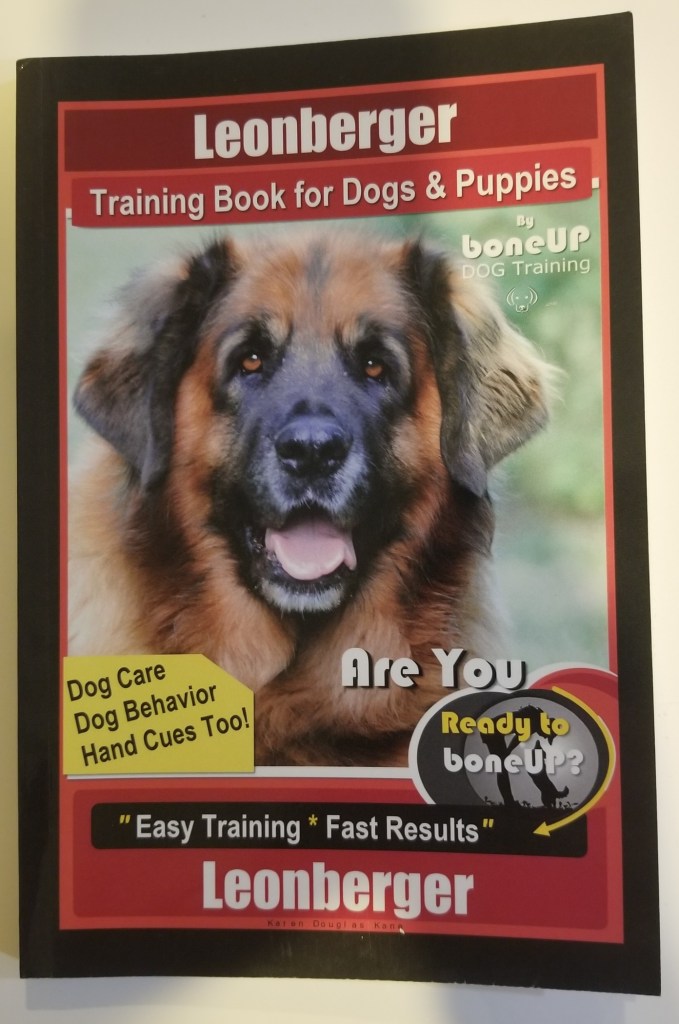
Leonberger Training Book for Dogs & Puppies By BoneUP DOG Training, Dog Care, Dog Behavior, Hand Cues Too! Are You Ready to Bone Up? Easy Training * Fast Results, Leonberger. By Karen Douglas Kane two stars. Two stars.
It was published December 13, 2020
The paperback is 102 pages
ISBN-13 is 979-8580681658
Weight is 5.3 ounces
The dimensions : 6 x 0.23 x 9 inches
The price of the paperback is $11.97
Prcie of Kindle version is $5.19
Kindle unlimited is of course $0.00
Review below
A good dog training manual, but it is not a Leonberger book
This book contains a lot of good dog care and dog training advice. The author describes how and when to feed dogs, brushing, cleaning teeth, health related issues, raising and training dogs, how to train your dog to obey commands, clicker training, hand signals, etc. It is fairly complete and written with some lighthearted humor. I noticed a few typos but not many. As a dog training manual, this is a good book.
On page 5 it says, “Thanks to a British Politician Heinrich Essig the Leonberger was created”. The author got the most basic Leonberger fact wrong. Heinrich Essig was a German businessman, dog breeder, horse breeder, and occasional councilman of the town of Leonberg in the Kingdom of Würtenberg (now Germany). “Heinrich Essig” doesn’t even sound British. The rest of the extremely short two paragraph Leonberger history section was pretty misleading as well and did not do Leonbergers justice.
On page 21 and 22 the author presents a guideline for feeding dogs that starts at 5lbs and ends at 100lbs. The book says; “But keep in mind that the average Leonberger is about thirty-five to sixty five pounds fully grown…”. It is difficult to find an adult Leonberger under 100lbs, unless he starved to death. On another page in the book she says (more correctly) that adult Leonbergers weigh between 90 to 170lbs, thus contradicting herself. A lot of interesting and useful Leonberger information is missing. There’s nothing about their love for swimming, webbed paws, breed characteristics, natural drafting/pulling skills, and the explanations of how and if to get a Leonberger left a lot to be desired. The most important American Leonberger kennel club; the Leonberger Club of America was never mentioned. By the way, they have a ton of useful Leonberger information on their website.
It is obvious that the author has never owned a Leonberger and that she does not know much about them. Considering that her website (or their website) is mentioned several times in the book and the fact that she has written 65 identical looking books on different dog breeds it seems like this book is a quick “search and replace” operation of a dog training manual created for advertising purposes. To me the book looked exactly like she did a search for “your dog” and replaced it with “your Leonberger” (in a few hundred places), and then added a little bit about the specific breed (using google) but without much care for getting it right. You can write 65 books very quickly that way. By the way, she is not the only dog trainer doing this. It is a clever advertising trick. However, as a Leonberger enthusiast this rubbed me the wrong way. She should have written one generic dog training book or taken the time to research the breed better if she wanted to make it Leonberger specific. Therefore, despite the overall good dog training and dog care advice in the book I can only give it two stars.
Back cover of the book Leonberger by Karen Douglas Kane
.
.
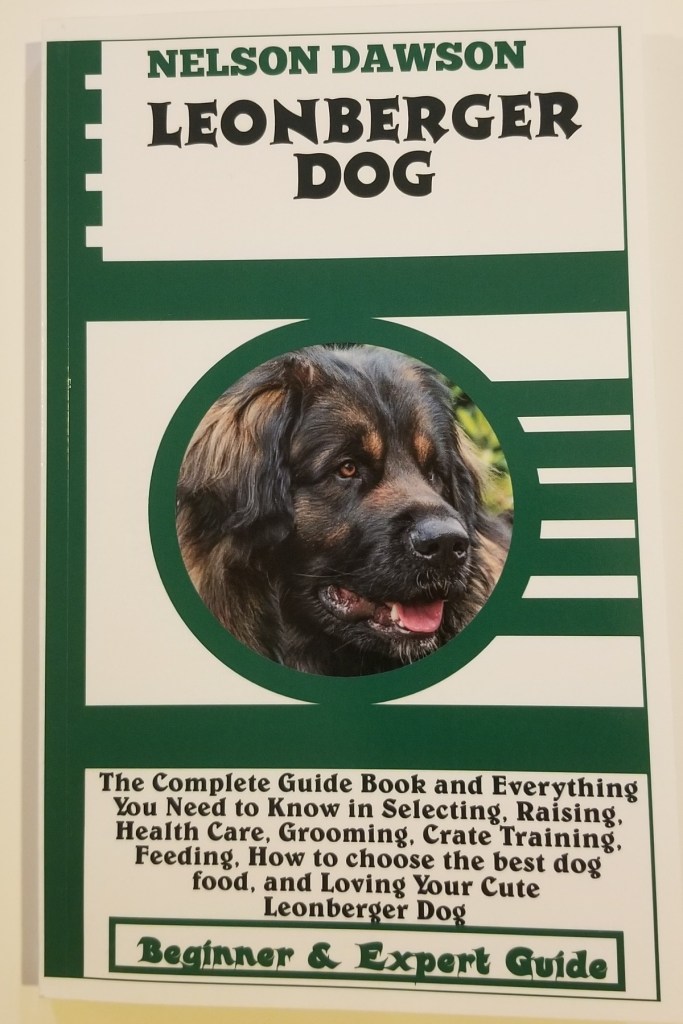
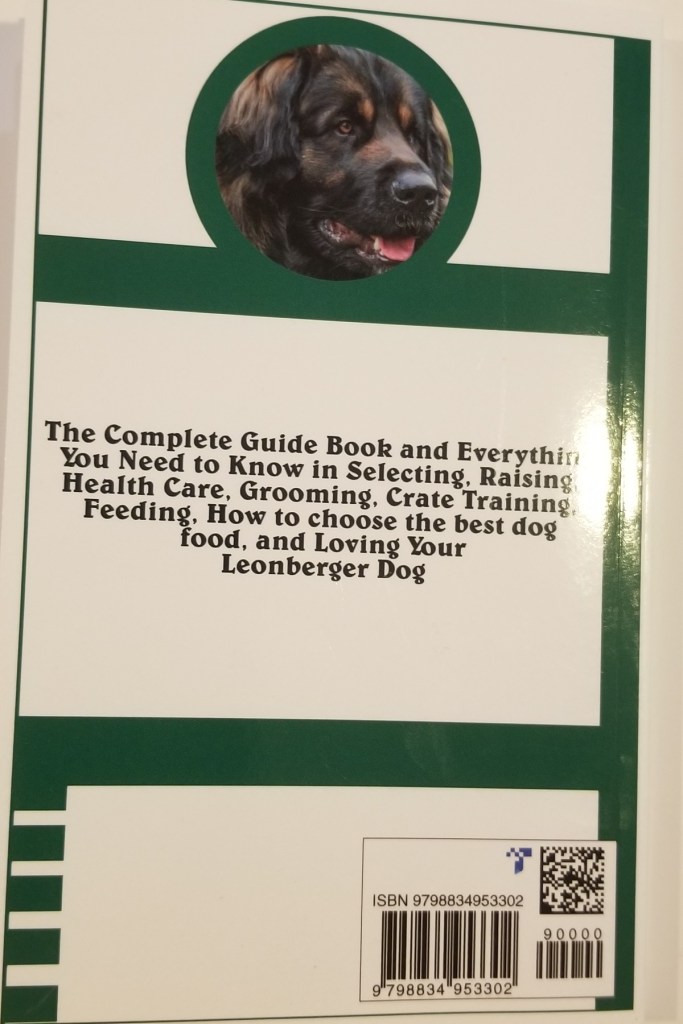
Leonberger Dog: Complete Guide Book and Everything You Need To Know in Selecting, Raising, Health Care, Grooming, Crate Training, Feeding, Choosing the best dog food, and Loving Your Cute Puppy. By Nelson Dawson. One star.
The paperback is 145 pages
ISBN-13 is 979-8834953302
Note, the book was deleted from Amazon before I had a chance to write a review so the review below was never published. In fact, all of Nelson Dawson’s dog books disappeared from Amazon. He had written hundreds of books on hundreds of breeds. I suspect Amazon deleted them.
Priceless translation errors
This book has a lot of quality issues. First of all, it contains a lot of incorrect facts. For example, it states that the Leonberger was created in the 1930 and 1940’s (it was 1830’s and 1840’s), that the breeder tried to match the appearance of a mountain lion (it was a lion), that the first Leonberger arrived in Russia 1989 (no they existed in Russia in the 1800’s), etc. The book also contains a lot of grammatical errors, strange sentences, and incorrectly used words. For example, puppies are sometimes referred to as “children”, dogs are sometimes called “cattle”, and crates are called boxes. The word “order” is used instead of “command”, as in: Simple orders include ”Next”, “Fu”, “Give a paw”, and “Tumble”. By the way can anyone guess what the commands “Next” and “Fu” are supposed to be? I think “Tumble” is “Roll over”.
The book also features many bizarre sentences that I could not figure out what they meant. On page 28 the book states: “It is not advisable to bring two Leonberger puppies into the house at the same time. Representatives of this type are gregarious men who easily make friends with their tribesmen.” Yes, the Leonberger puppies are called “gregarious men”, which is hilarious. On page 30 the book states in regard to teaching the Leonberger a trick: “Leonbergers are true virtuosos who may stomp on the neck of their own song in order to gratify the owner. These individuals are the ones who compete in agility events.” On page 46 the book states: “When you return to work, have someone check on your dog, let him out, play with him, and reshape him with a yummy kong.” In regard to crate training the author states out of the blue: “if your home has battens, you may wish to select wood”. I have no idea what that means.
Since the prices mentioned in the book are in rubles and the intended audience seems to be Russian my guess is that the book was created by running a Russian book through a mediocre language translation application. I don’t think it could have been Google Translate because it is not that bad, not anymore. I believe the author may have taken a large stash of Russian books for different breeds and just rammed them through a translator and then uploaded it Amazon without anyone checking if the English made sense.
In any case, this book has a lot of problems, and I cannot recommend it. One star.
Back cover of the book Leonberger Dog by Nelson Dawson
I typically end my blog posts with a promotion of my book that includes a few images and a list of links to places where you can get it. I’ve come to realize that doing this takes away from the blog post itself. One image with a link is not too much but the full length three images and a list with 13 links is too much. This piece of repeated information often takes up half the post. So, I decided to make a book promotion post to which I will be linking to instead of repeating every time. By the way, I will delete this paragraph later on.
This post is a promotion of my book “The Life and Times of Le Bronco von der Löwenhöhle”, stories and tips from 13 years with a Leonberger and it lists the places where you can get the book. I can add that the price of the Kindle version is temporarily reduced to $4.99.
In the book you can read about some of our Leonberger Bronco’s amazing feats: the night he scared away a prowler; the day he performed a hamster search and rescue; the time he stumped the Geek Squad; and the late night he snuck into the kitchen and ate a two-pound bag of dog treats, a box of pastries, a loaf of bread, a grilled chicken, and a Key lime pie, all in one sitting. You’ll also read about his unflappable calm during a north Texas tornado and his stoicism as he endured health challenges in his later years.
In addition to entertaining stories, these pages contain a wealth of practical guidance, including
a history of the Leonberger breed;
advice for the care of very large dogs;
breed-specific health and genetic information;
training and feeding tips;
suggestions for finding a breeder;
the official breed standard; and
an extensive resource guide.
Bronco’s fearlessness, tolerance, and affectionate nature warmed the hearts of everyone who met him, and his sometimes uncanny adventures with his human and canine companions will bring a smile to the face of every dog lover. The book has a lot of color photos, amusing Leonberger stories, and information about Leonbergers that has been verified.
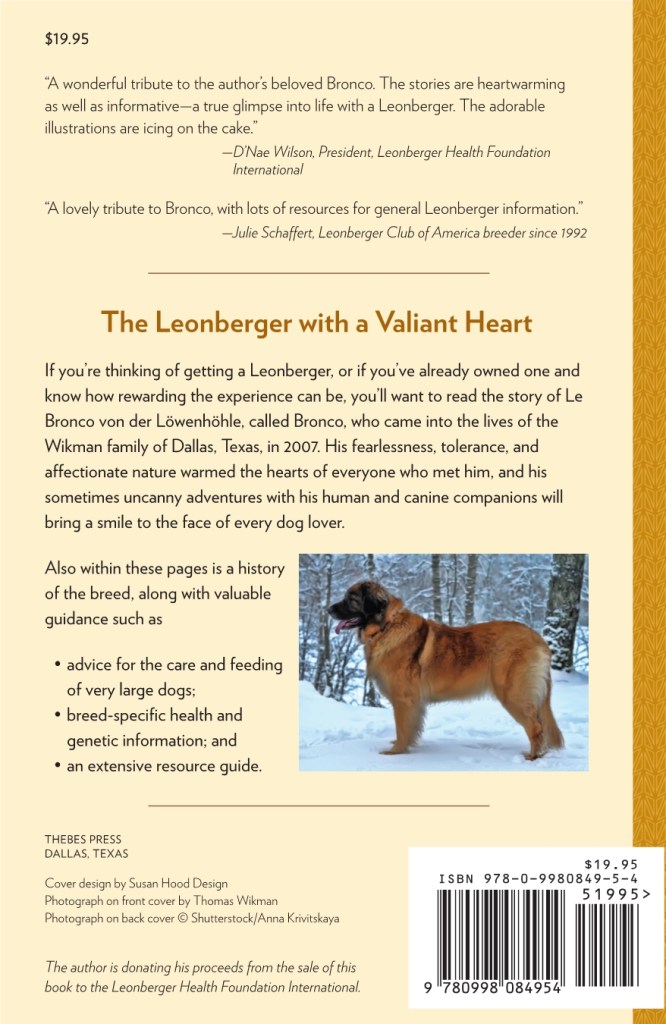
The front cover of my book “The Life and Times of Le Bronco von der Löwenhöhle”. Click on the image to go to the Amazon.com location for the book.This is the back cover of the book “The Life and Times of Le Bronco von der Löwenhöhle”. Click on the image to go to the Amazon.se location for the book.These are the endorsements for the book. Click on the image to got to the Barnes and Noble location for the book.
Below is a list of where you can find the book. Click on the links to go to the respective store. However, if your favorite bookstore is not listed below you can search for it using the ISBN or ASIN numbers.