Our late Leonberger Bronco’s birthday and the two years anniversary of the release of my book about him was at the beginning of July. Therefore, I decided to have a promotion for the month of July. I lowered the price of both the paperback and the kindle version on Amazon by two dollars in all countries (or close to two dollars). For the United States I lowered the price of the Kindle version from $4.99 to $2.99 and for the paperback from $19.95 to $17.95. In Sweden I lowered the price from 180 Swedish Crowns to 150 Crowns or 159 Crowns with VAT.
This is a reminder of that promotion. Since I sort of forgot about my promotion and this reminder is late I am extending it three more days until the end if August 3rd, midnight Central Standard Time.
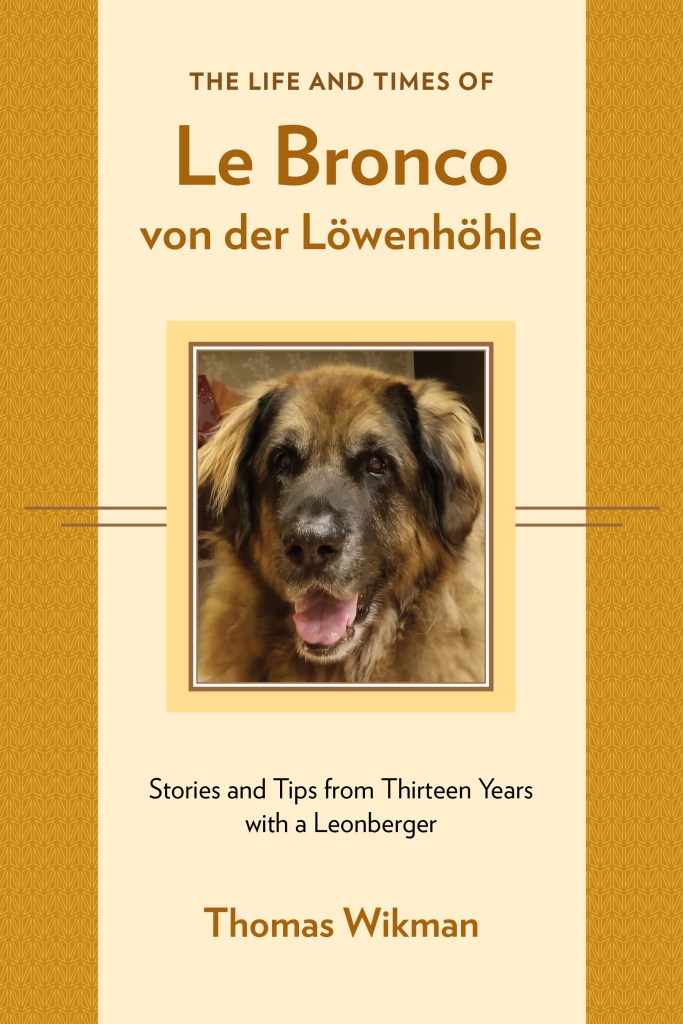
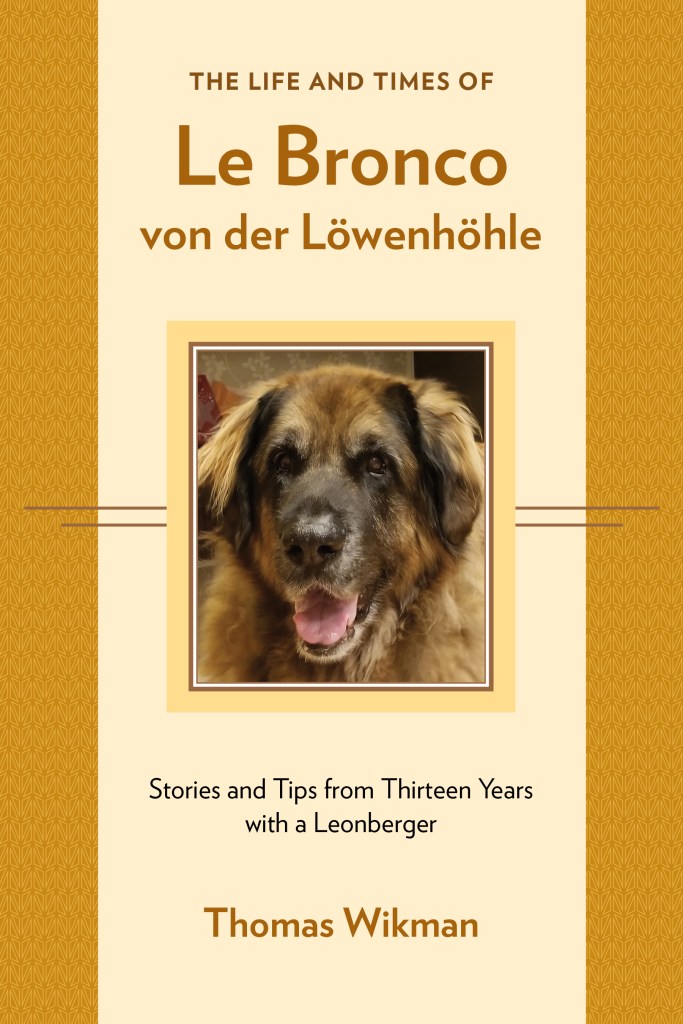
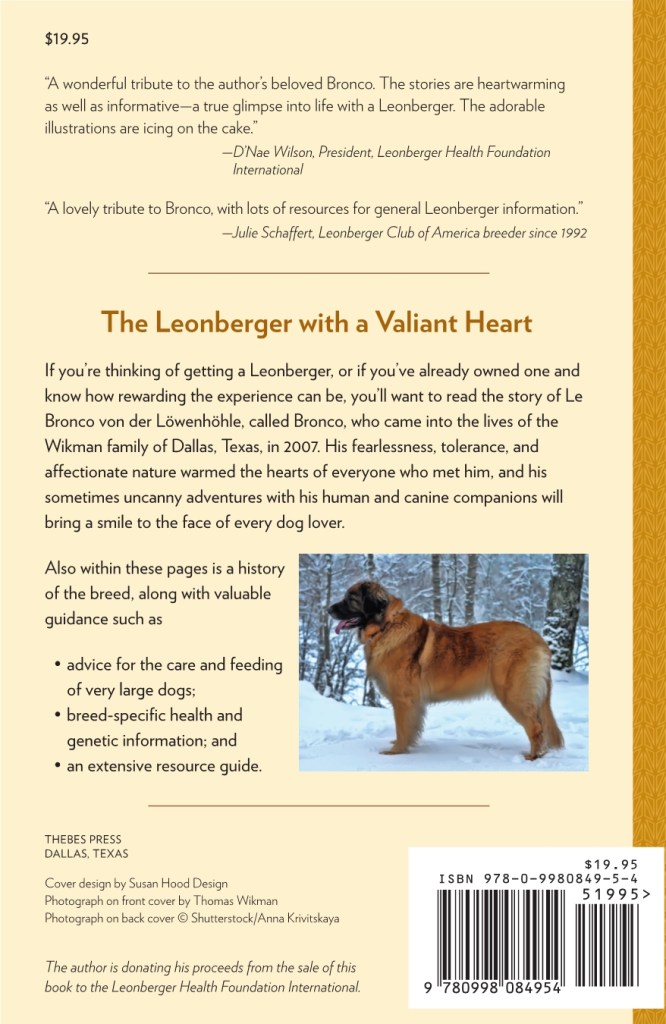
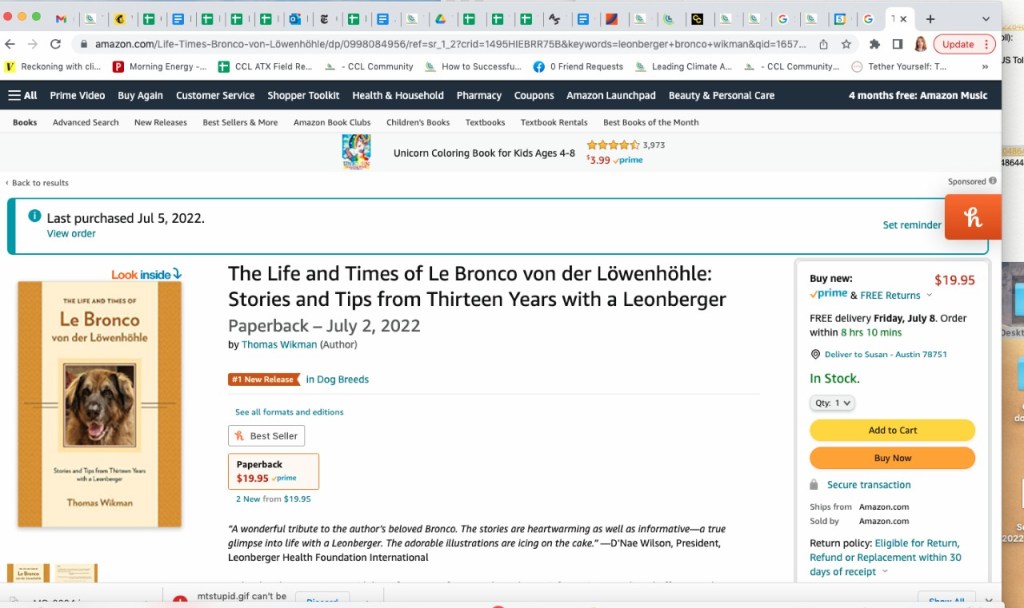
This is the front cover of the book “The Life and Times of Le Bronco von der Löwenhöhle”. Click on the image to go to the Amazon.com location for the paperback version of the book.
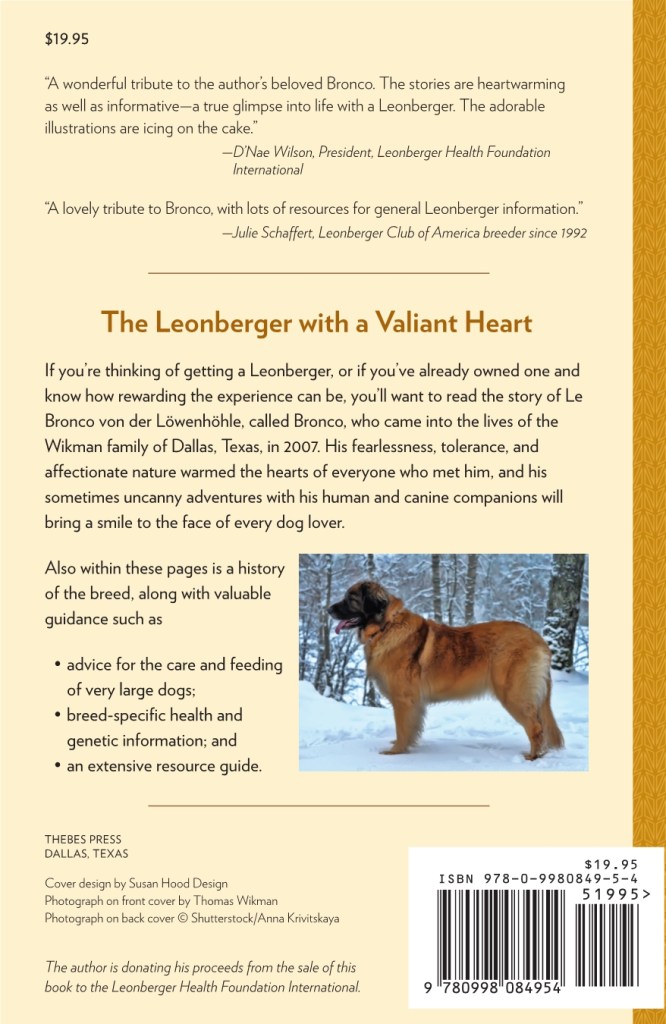
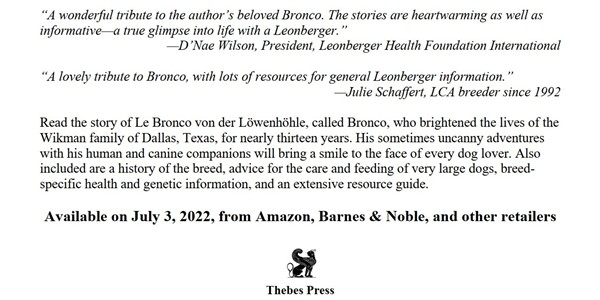
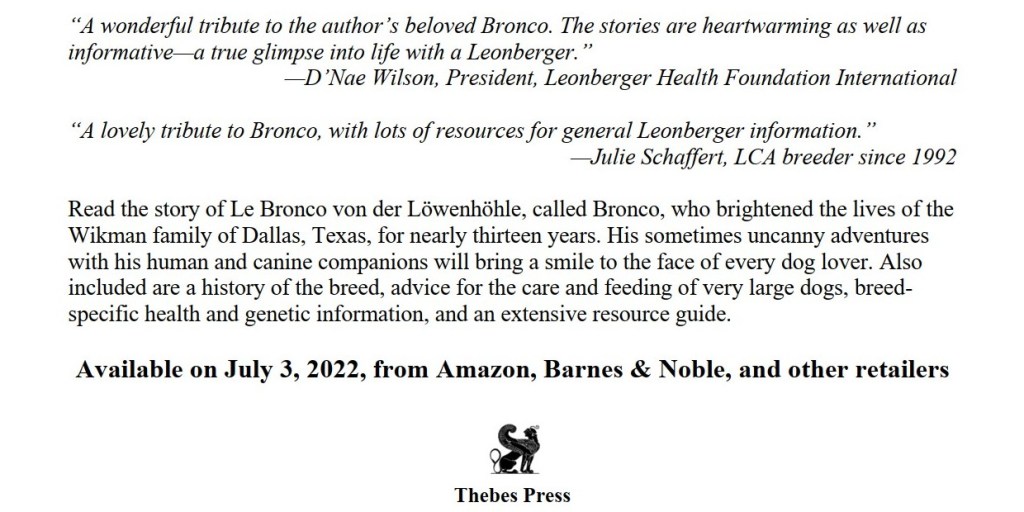
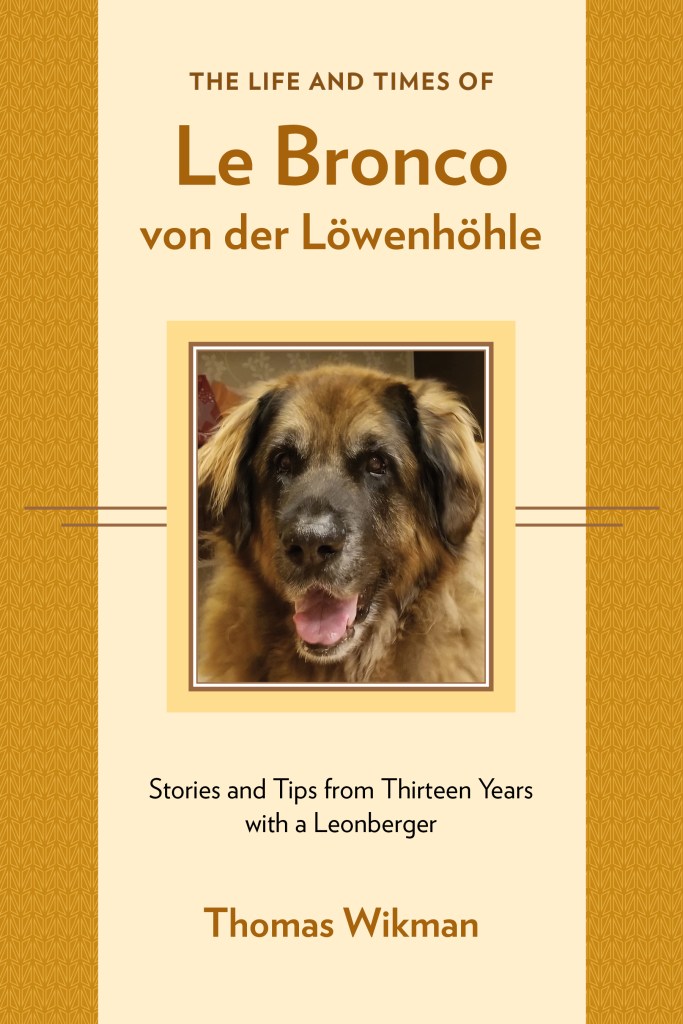
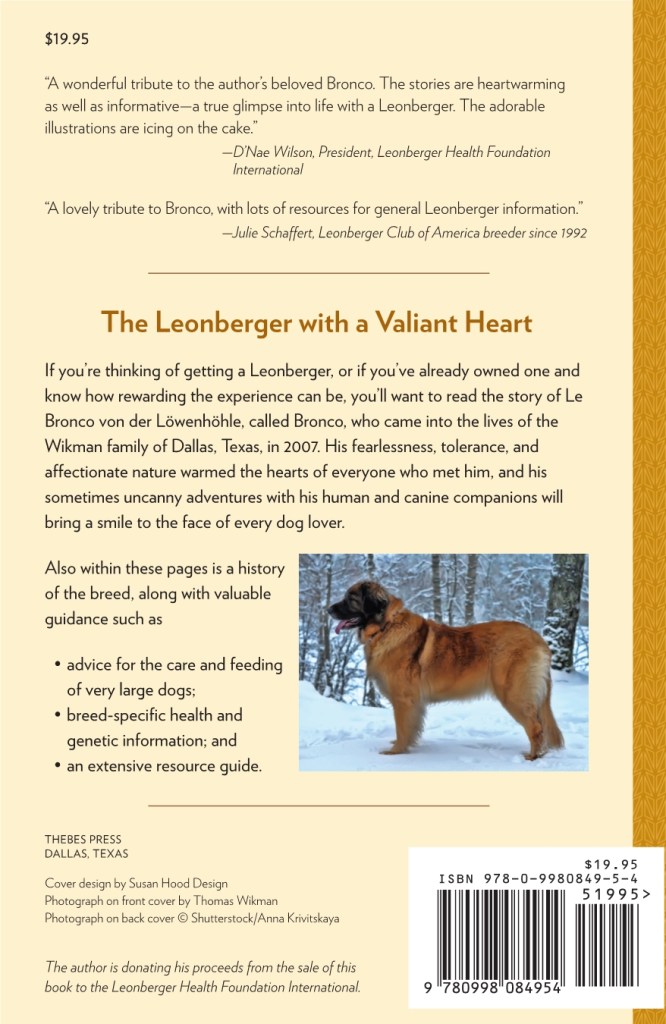
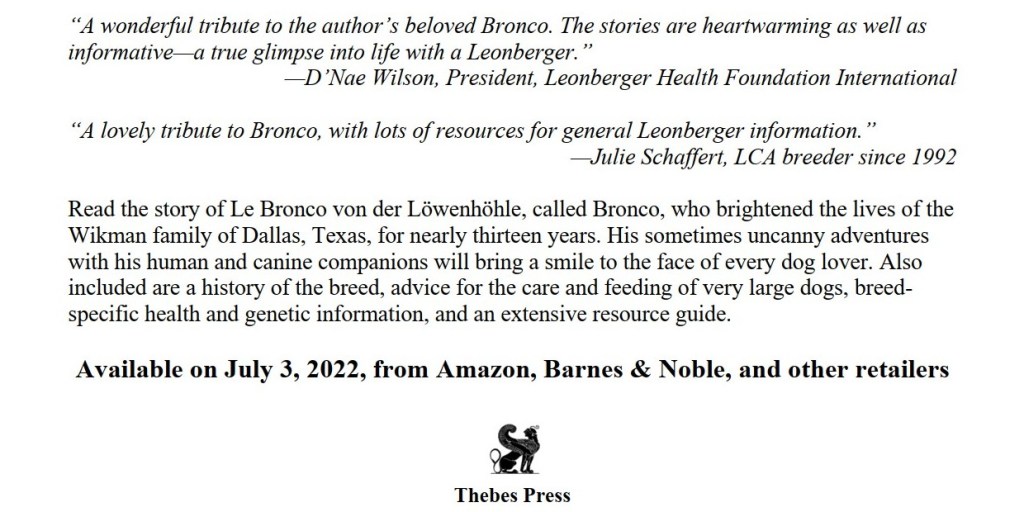
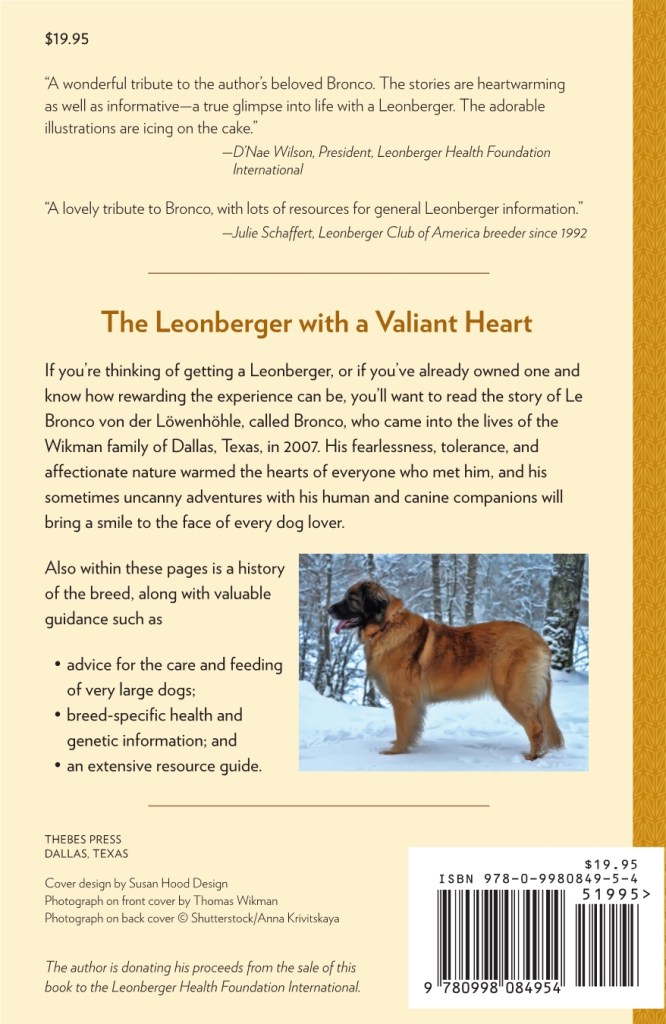
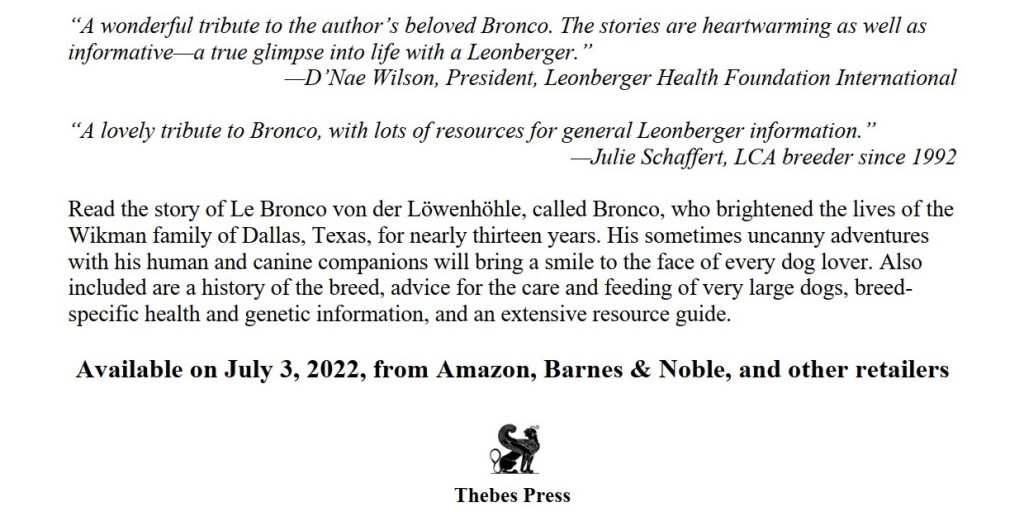
This is the back cover of the book “The Life and Times of Le Bronco von der Löwenhöhle”. Click on the image to go to the Amazon.com location for the kindle version of the book.These are the endorsements for the book. Click on the image to got to the Barnes and Noble location for the book.
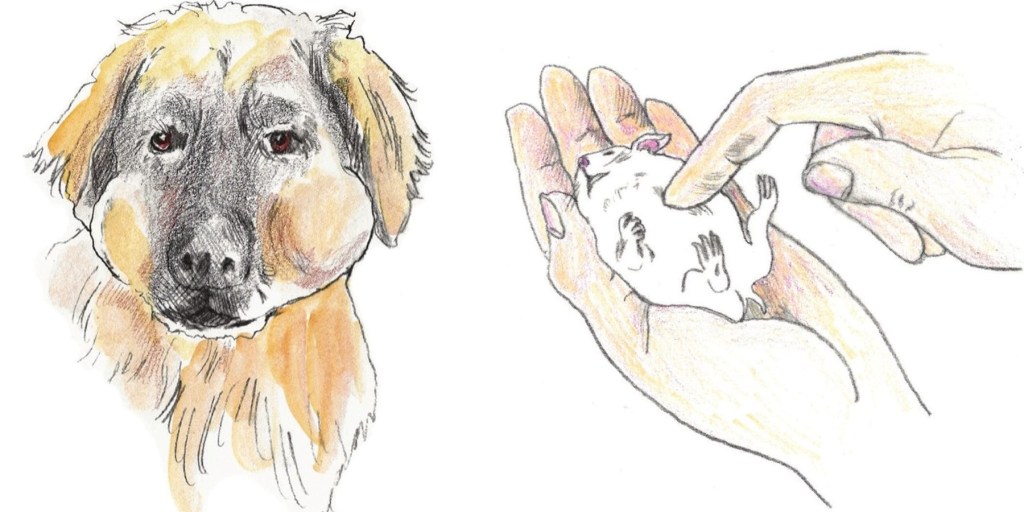
In this book you’ll read about some of Bronco’s amazing feats: the night he scared away a prowler; the day he performed a hamster search and rescue; the time he stumped the Geek Squad; and the late night he snuck into the kitchen and ate a two-pound bag of dog treats, a box of pastries, a loaf of bread, a grilled chicken, and a Key lime pie, all in one sitting. You’ll also read about his unflappable calm during a north Texas tornado and his stoicism as he endured health challenges in his later years.
In addition to entertaining stories, these pages contain a wealth of practical guidance, including:
a history of the Leonberger breed;
advice for the care of very large dogs;
breed-specific health and genetic information;
training and feeding tips;
suggestions for finding a breeder;
the official breed standard; and
an extensive resource guide.
Below is a list of places where you can get my book.
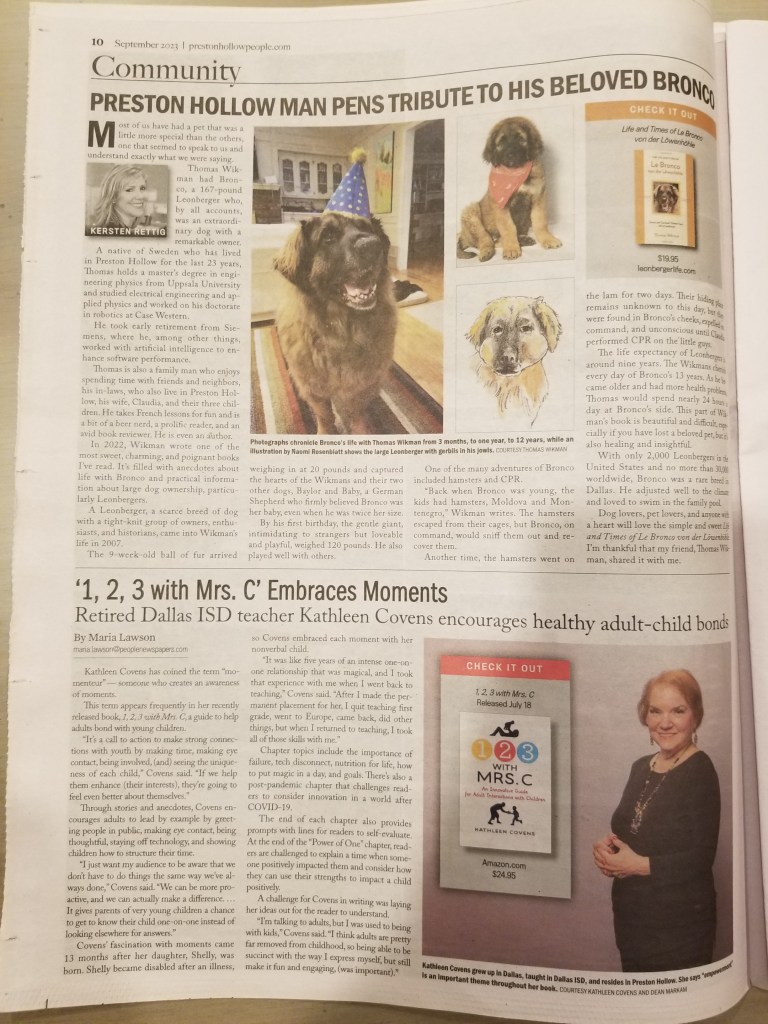
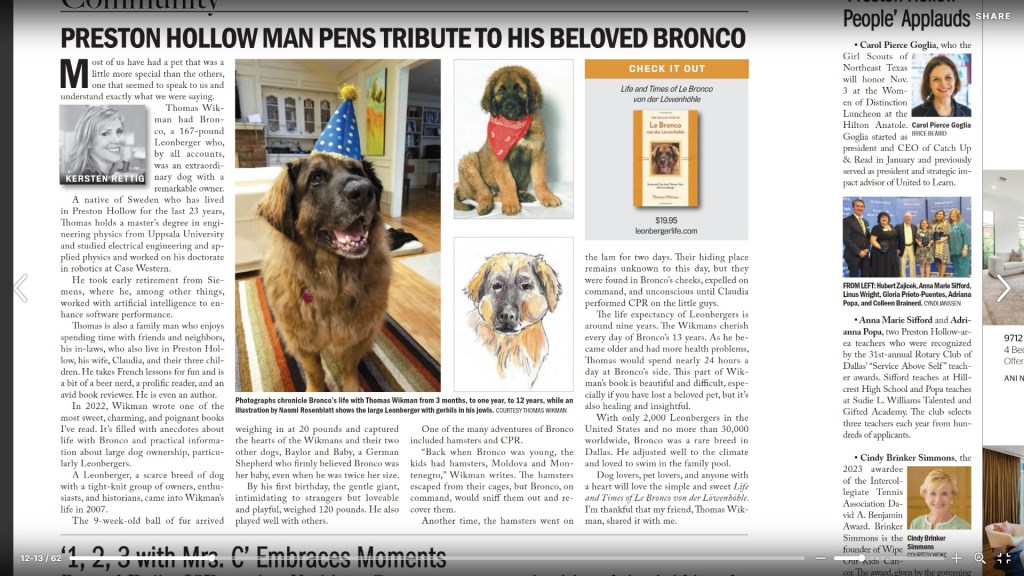
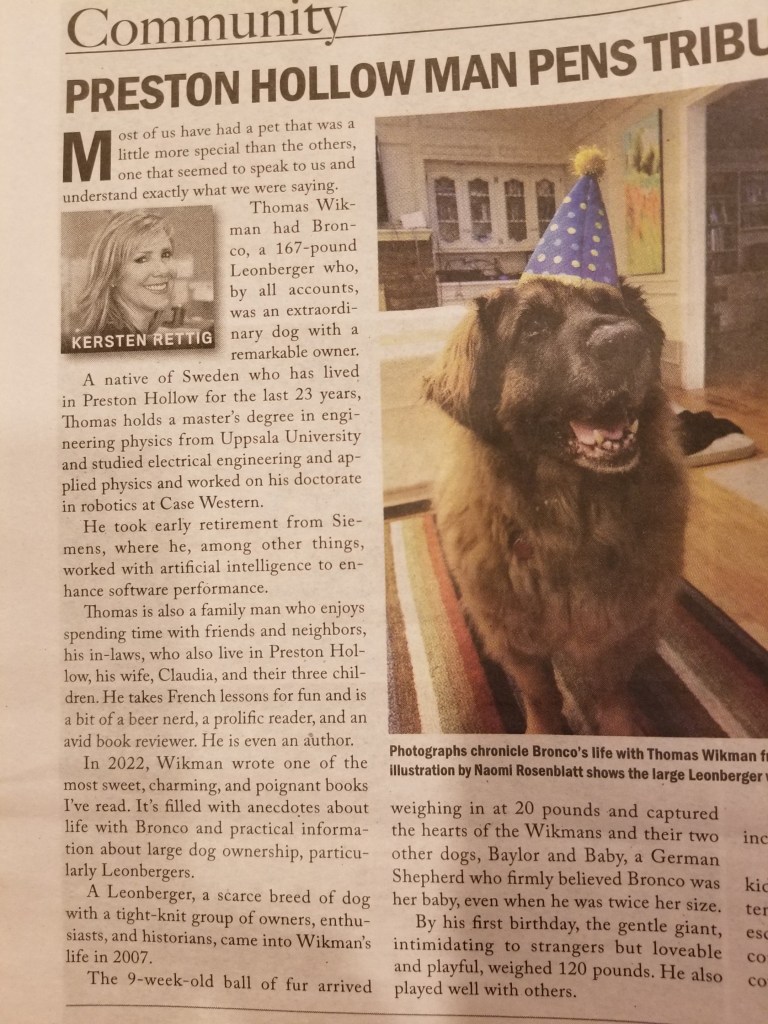
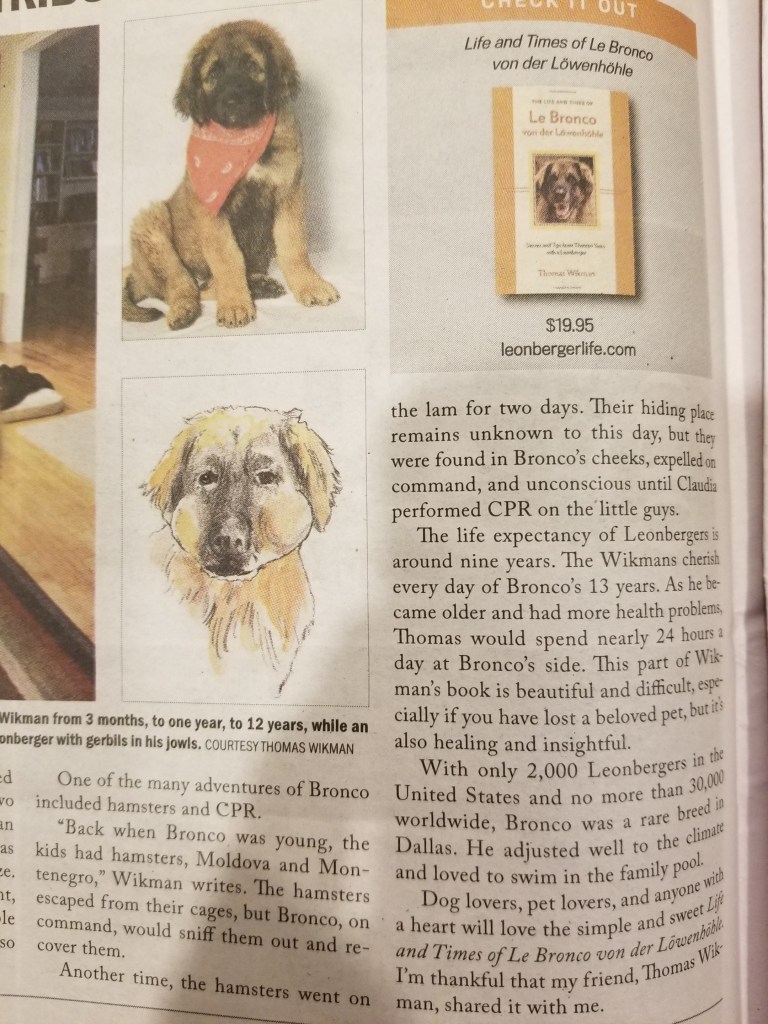
Park Cities People and Preston Hollow People Magazine here in Dallas (Preston Hollow) received 15 awards in this year’s National Newspaper Association Better Newspaper Contest. The National Newspaper Association (NNA), founded in 1885, has over 2,300 members, making it the largest newspaper trade association in the United States. There are slightly more than 100 categories and there is a first price, second price, third price, and an honorable mention, so a bit more than 400 opportunities for an award. Considering that there are 2,300 newspapers I think winning 15 is quite impressive. It is certainly a high-quality magazine. They earned three first-place awards, two second places, five third places, and five honorable mentions. One of the honorable mentions was for Best Book Review. That book review was written by Journalist Kersten Rettig and the book in question was “The Life and Times of Le Bronco von der Löwenhöhle”.
This is a photo of the page of Preston Hollow People Magazine where the review appeared. If you click on the picture (or click here) you can see the online version of the book review in Preston Hollow People Magazine.
A screenshot of another online version of Preston Hollow People Magazine where the review appeared. If you click on the picture (or click here) you can see it online.
It is certainly not my accomplishment. It is the newspaper’s award and Kersten Rettig’s accomplishment, but I am very happy about this for myself as well, since I wrote the book, and that is kind of exciting.
Close up of the review in Preston Hollow People Magazine.Close up of the review in Preston Hollow People Magazine.
I’ve written about this book review before back when it was published in September/October last year (2023). You can click here or here to see those blog posts. Finally, a reminder. To celebrate Bronco’s birthday (July 3rd), for the month of July I am lowering the price of the paperback on Amazon from $19.95 to $17.95 and I am lowering the price of the kindle from $4.95 to $2.95. That applies to all countries. By clicking on the pictures below you can visit the Amazon locations for the book.
This is the front cover of the book “The Life and Times of Le Bronco von der Löwenhöhle”. Click on the image to go to the Amazon.com location for the paperback version of the book.This is the back cover of the book “The Life and Times of Le Bronco von der Löwenhöhle”. Click on the image to go to the Amazon.com location for the kindle version of the book.These are the endorsements for the book. Click on the image to go to the Barnes and Noble location for the book.
Below is a list of places where you can get my book.
Our late Leonberger Bronco’s birthday was a few days ago, and so was the two years anniversary of the release of my book about him. It is a special occasion and therefore I’ve decided to have a promotion for the month of July. I lowered the price of both the paperback and the kindle version on Amazon by two dollars in all countries (or close to two dollars). For the United States I lowered the price of the Kindle version from $4.99 to $2.99 and for the paperback from $19.95 to $17.95. In Sweden I lowered the price from 180 Swedish Crowns to 150 Crowns or 159 Crowns with VAT.
This is the front cover of the book “The Life and Times of Le Bronco von der Löwenhöhle”. Click on the image to go to the Amazon.com location for the paperback version of the book.
This is the back cover of the book “The Life and Times of Le Bronco von der Löwenhöhle”. Click on the image to go to the Amazon.com location for the kindle version of the book.
If you’re thinking of getting a Leonberger, or if you’ve already owned one and know how rewarding the experience can be, or if you are just a dog lover, then you’ll want to read the story of Le Bronco von der Löwenhöhle, called Bronco, who came to live with us in Dallas, Texas, in 2007. Bronco, a recipient of the Leonberger Health Foundation International’s Grey Muzzle Award, lived an unusually long life for a Leonberger—almost thirteen years. We believe that what helped him exceed his breed’s normal life expectancy was his brave and loving heart.
These are the endorsements for the book. Click on the image to got to the Barnes and Noble location for the book.
In this book you’ll read about some of Bronco’s amazing feats: the night he scared away a prowler; the day he performed a hamster search and rescue; the time he stumped the Geek Squad; and the late night he snuck into the kitchen and ate a two-pound bag of dog treats, a box of pastries, a loaf of bread, a grilled chicken, and a Key lime pie, all in one sitting. You’ll also read about his unflappable calm during a north Texas tornado and his stoicism as he endured health challenges in his later years.
In addition to entertaining stories, these pages contain a wealth of practical guidance, including:
a history of the Leonberger breed;
advice for the care of very large dogs;
breed-specific health and genetic information;
training and feeding tips;
suggestions for finding a breeder;
the official breed standard; and
an extensive resource guide.
Bronco’s fearlessness, tolerance, and affectionate nature warmed the hearts of everyone who met him, and his sometimes uncanny adventures with his human and canine companions will bring a smile to the face of every dog lover.
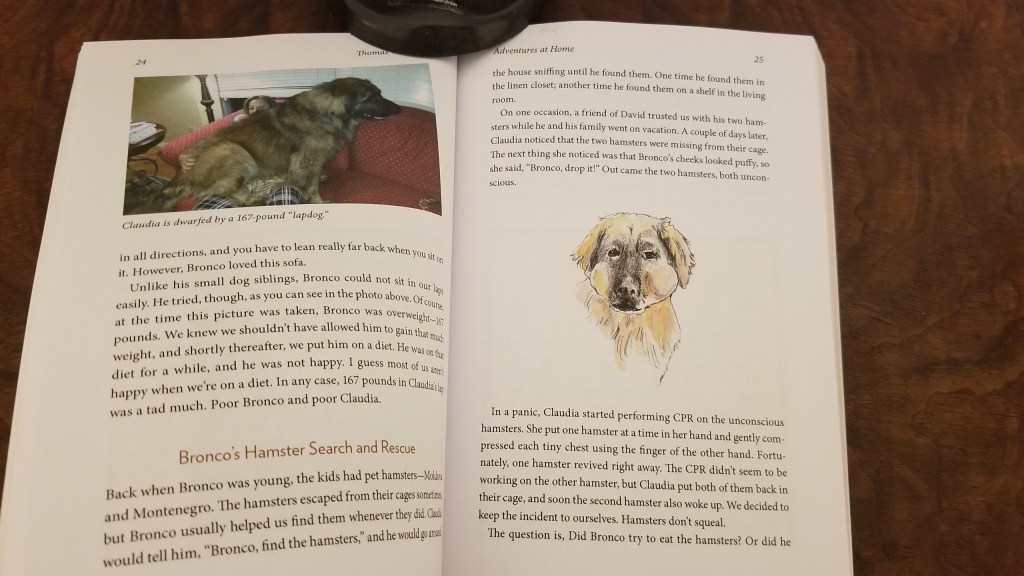
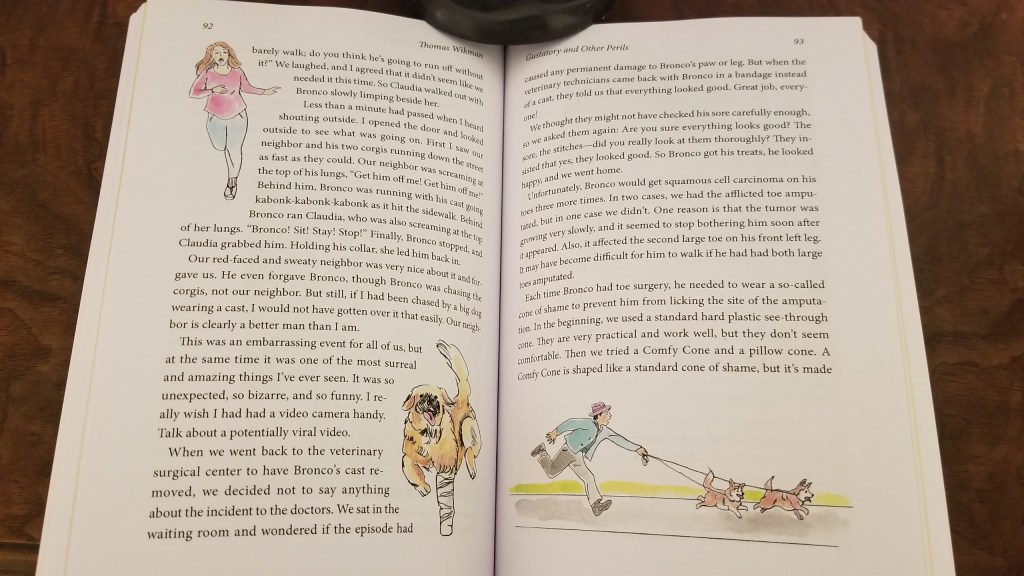
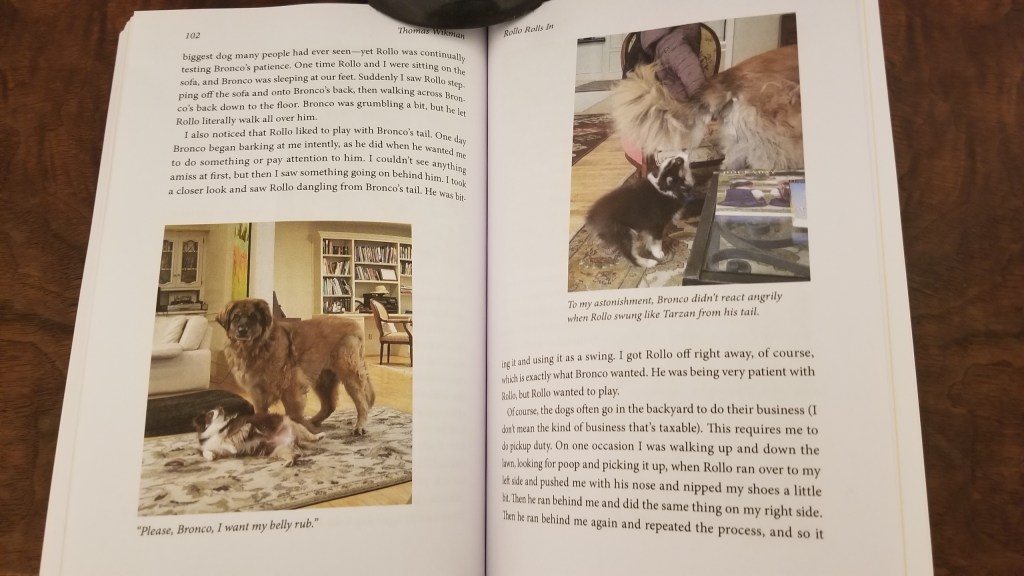
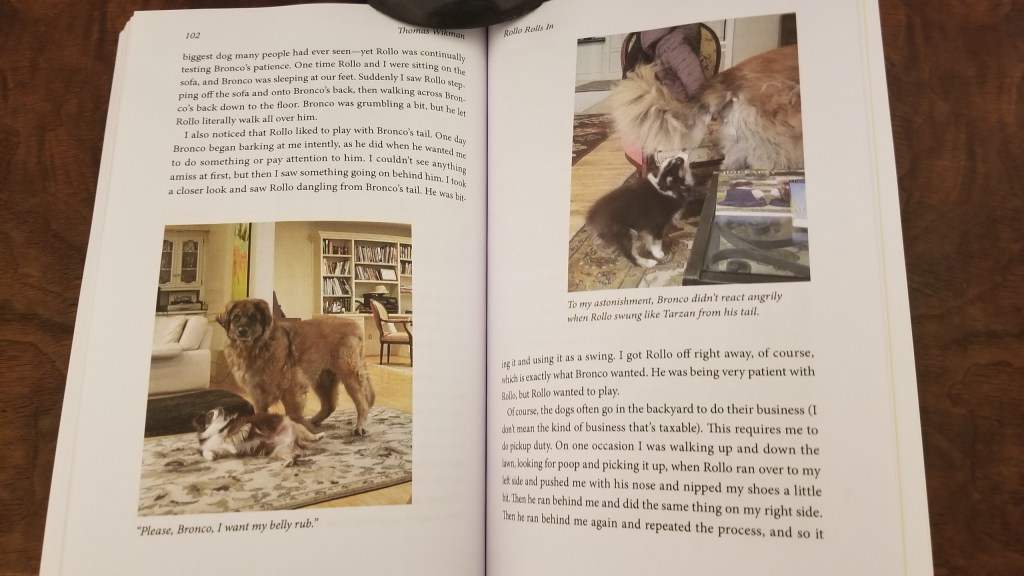
This is a sample spread from my book (The Life and Times of Le Bronco von der Löwenhöhle). It is page 24 and 25. The illustration (by Naomi Rosenblatt) showing Bronco with puffy cheaks depicts him holding two rescued hamsters in his mouth.This is another sample spread from my book. It is page 92 and 93. The spread contains the story about when Bronco was chasing our nice neighbor while wearing full leg cast, despite the fact he was not supposed to bump it. The illustrations were made by Naomi Rosenblatt.This is another sample spread from my book. It is page 102 and 103. The other dog is our mini-Australian Shepherd Rollo.
Below is a list of places where you can get my book.
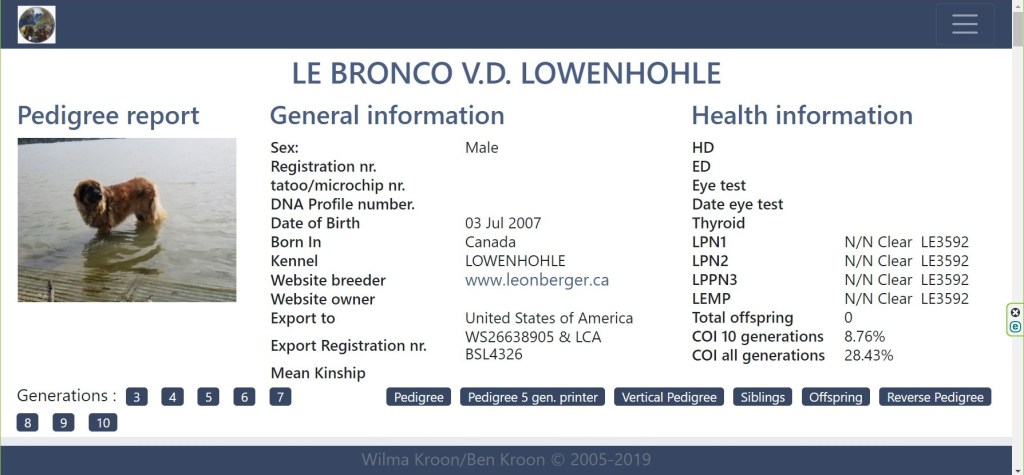
Our Leonberger Bronco was born in British Columbia, Canada (nearby Vancouver), on July 3rd, 2007. That was 17 years ago today. His full name was Le Bronco von der Löwenhöhle. His father’s name was Priamos Vom Dreiburgenland and his mother’s name was Justus Aria Von Drevas. He had four full siblings, or twins, Little Jonah, Love Ryan, LRV’s Moose, and Lakeisha Makita. That was his litter. Notice that all names begin with an ‘L’. He had 83 siblings in total. The breeder’s name was Julie Schaffert, who is a Leonberger Club of America certified breeder (since 1992), and arguably North America’s most prominent breeder.
Bronco’s entry in the Leonberger Data Base. Click on the picture to visit the Leonberger Data Base.
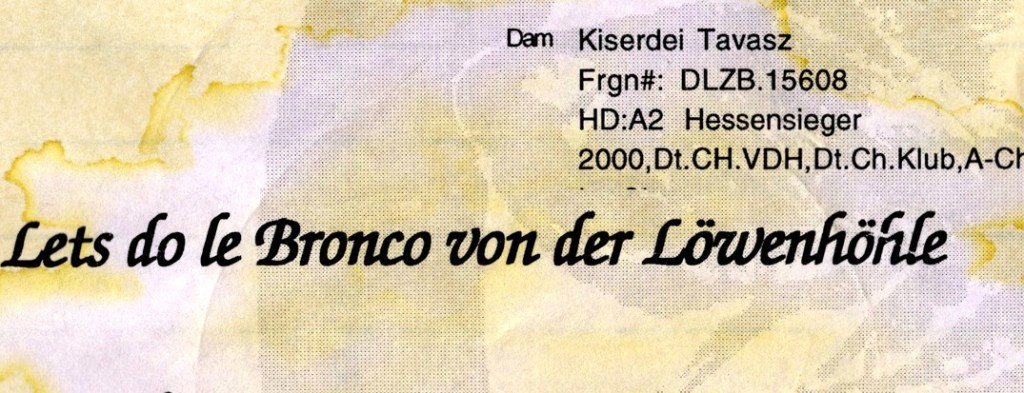
About 8-9 weeks later he came to Dallas, Texas to be with his new family. That was us. 13 years later he passed away. The name we picked for him was Bronco. However, we were told that his name needed to begin with an ‘L’, so my wife said, “Let’s do Le Bronco”, intending it to be “Le Bronco”. It took us several years to change his name from “Lets Do Le Bronco”, which also begins with an ‘L’, to “Le Bronco”.
Bronco’s original birth certificate from LCA (Leonberger Club of America). His name at this time was “Lets Do Le Bronco von der Löwenhöhle”.Close up of his name, which incorrectly was “Lets Do Le Bronco von der Löwenhöhle”.Bronco at the age of three months and at the age of almost 13.
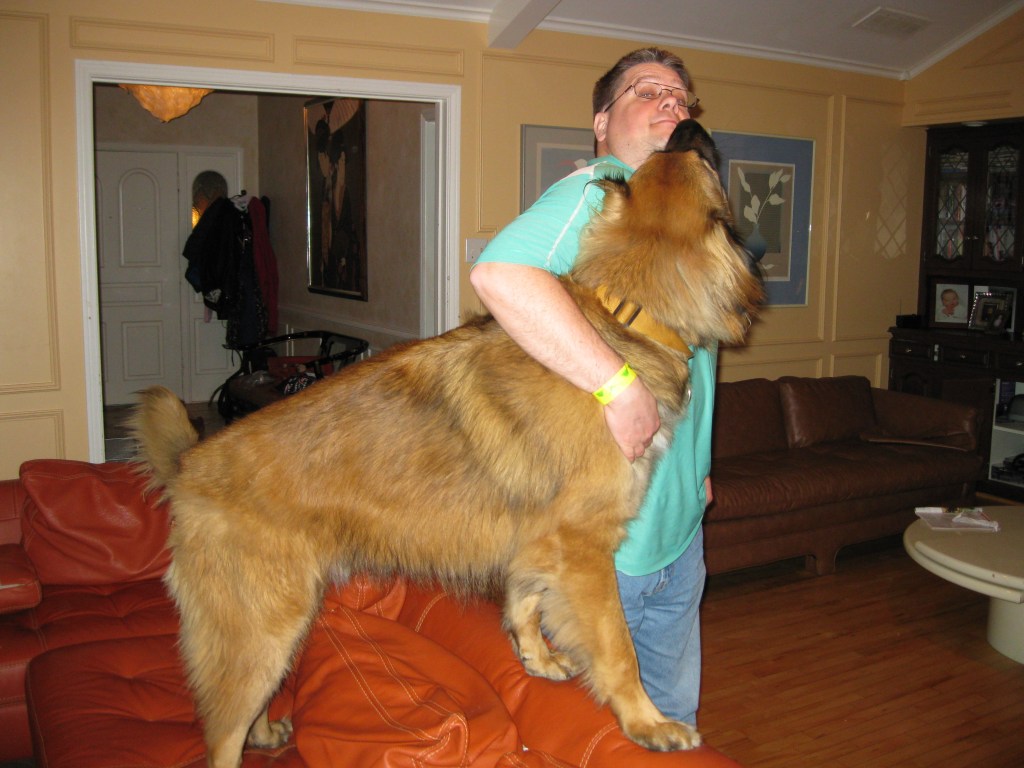
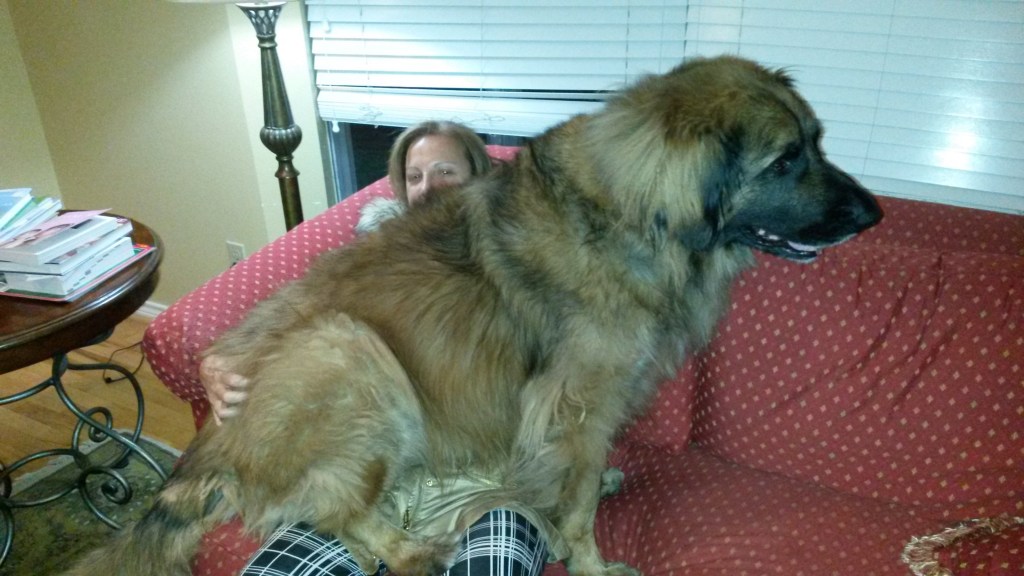
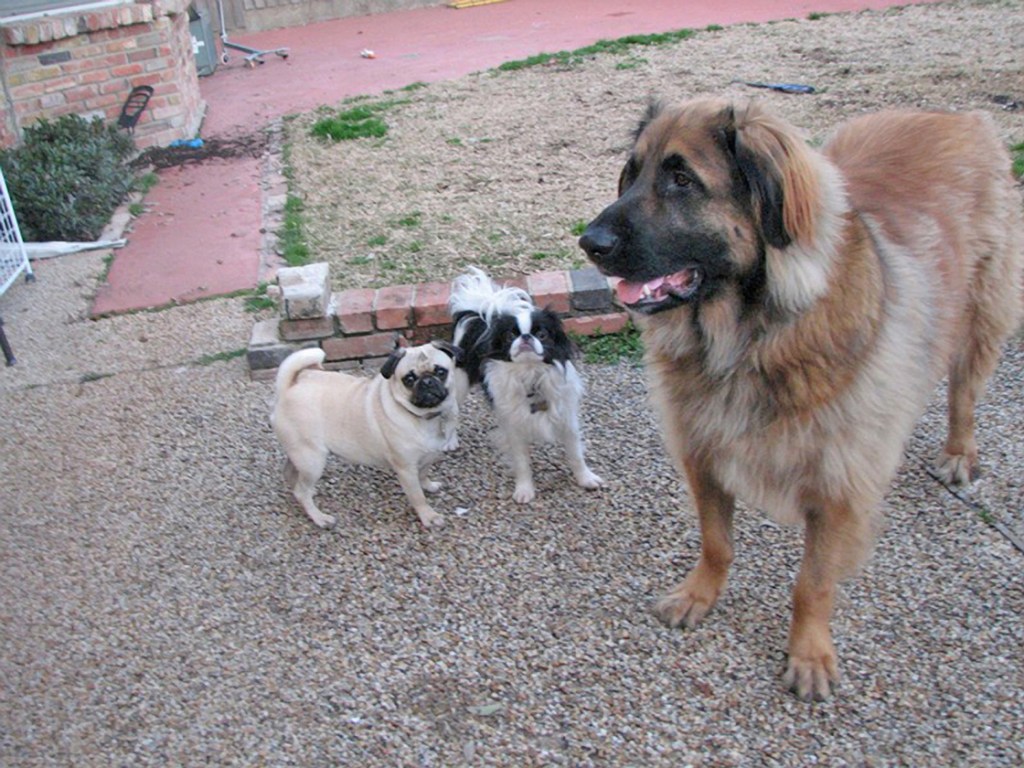
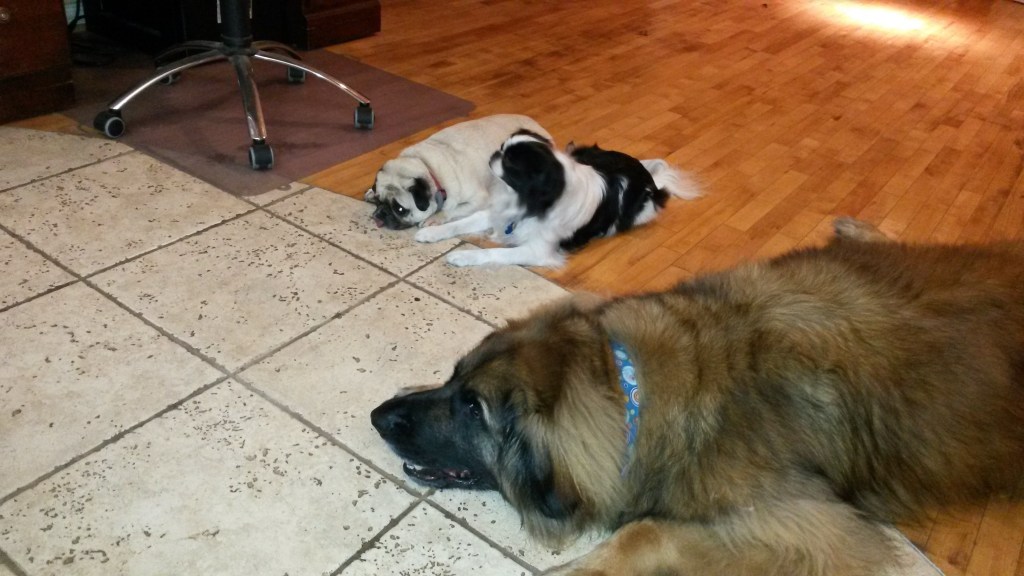
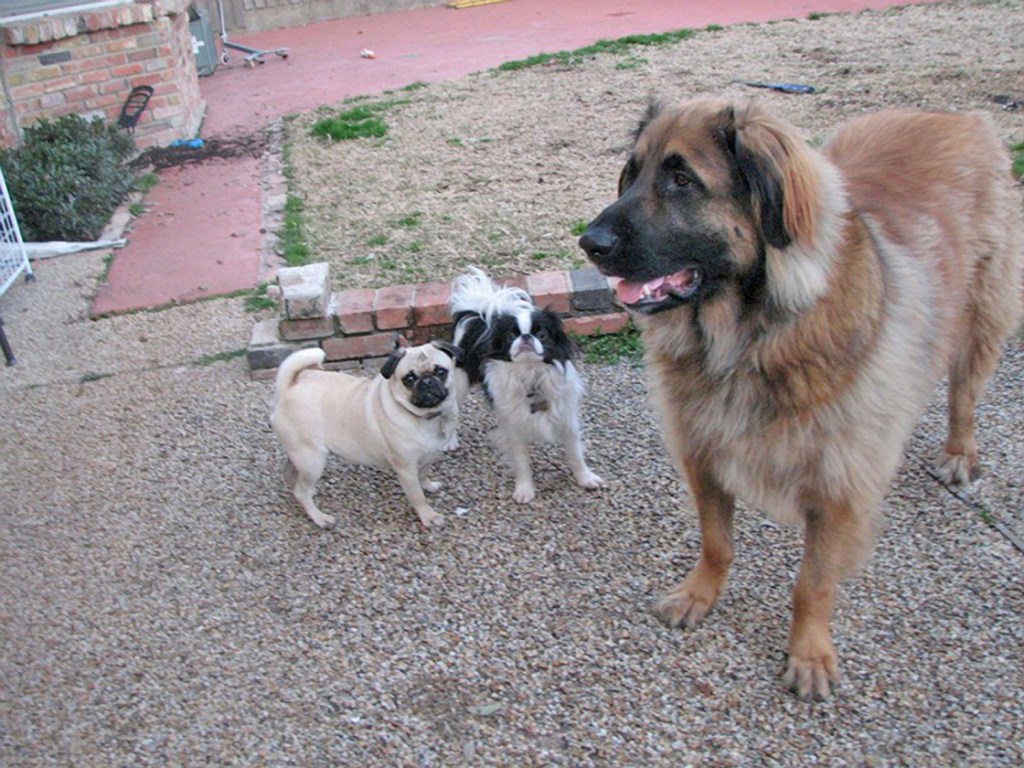
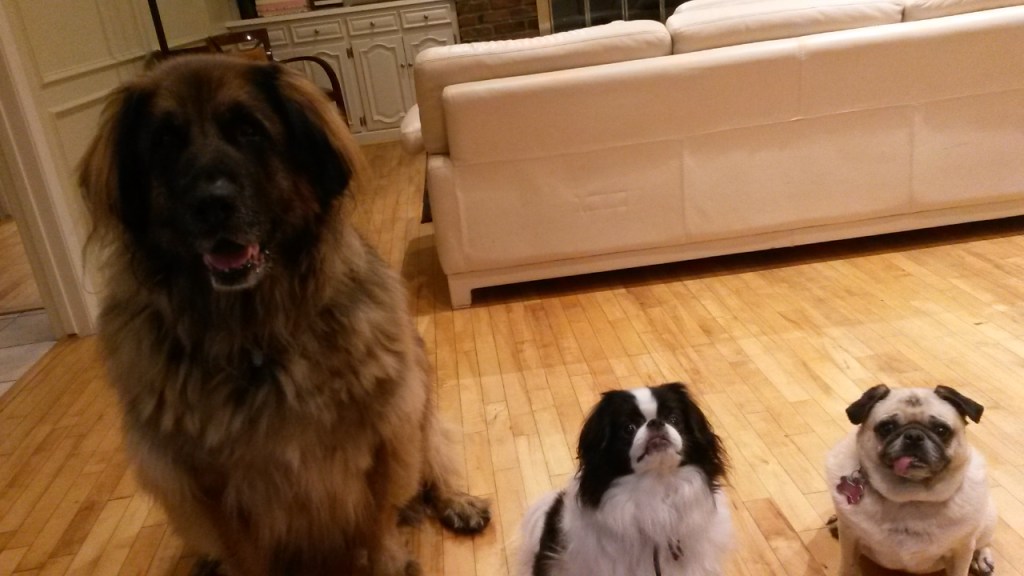
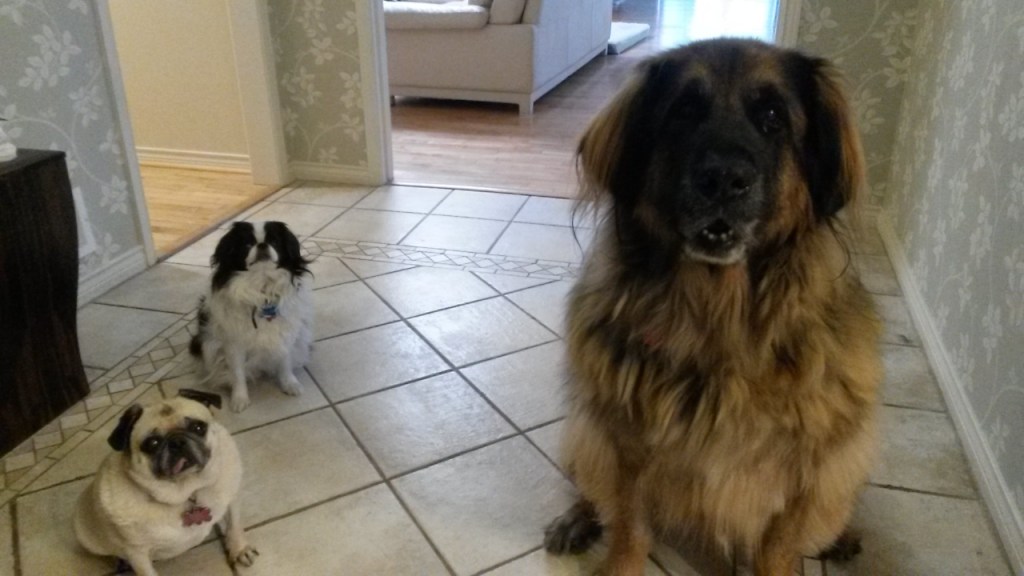
Bronco quickly grew to become a big dog. At one point he was 167lbs but his ideal weight was 135lbs. When he joined our family, we had two other dogs, a Labrador (or Labrador mix) called Baylor and a female German Shepherd called Baby. Baby was like a mother to Bronco, and she was fiercely protective of him. We would soon get two more dogs, a Japanese Chin called Ryu and a pug called Daisy. Once Bronco was older, we would get one more dog, a mini-Australian Shepherd called Rollo. Bronco loved all the other dogs, and he was very protective of them. He saved the life of our Labrador by sniffing out an oncoming insulin shock and he saved our pug Daisy from an attacking German Shepherd.
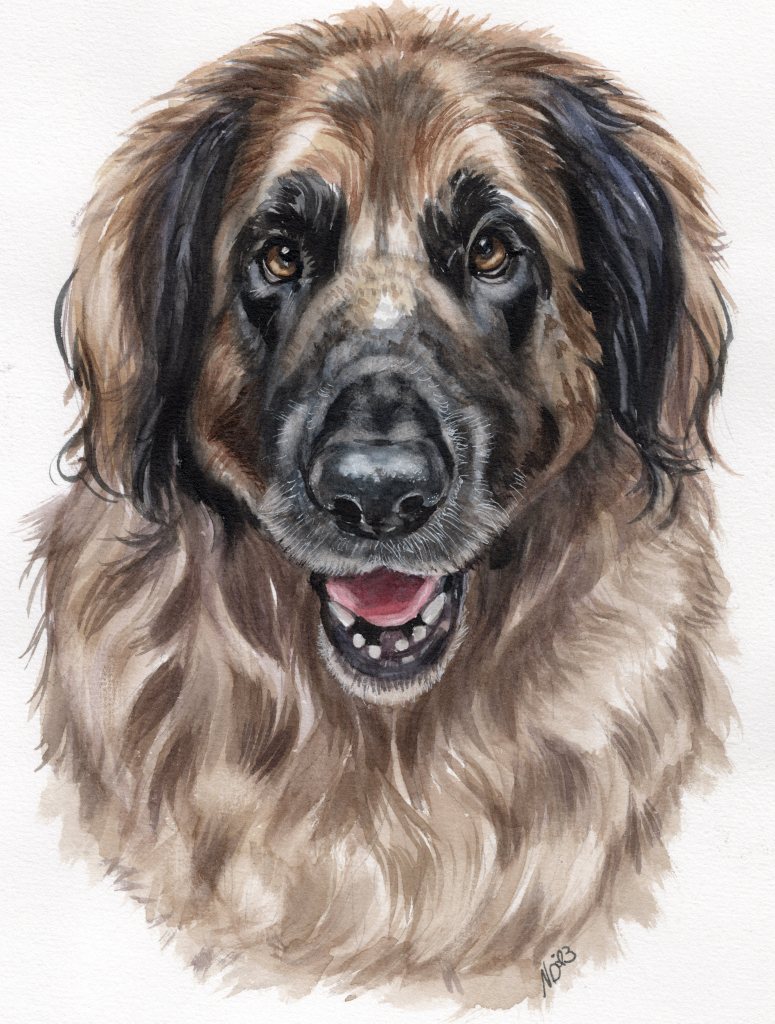
This is Bronco and me. He is about one year old. Not yet fully grown but still big.Bronco when he was 167lbs sitting in my wife’s lap. He went on a diet after this photo.Bronco with our pug Daisy and Japanese Chin Ryu.Bronco with our pug Daisy and Japanese Chin Ryu again.The portrait was drawn by Veniceme at Etsy (Natasha Dall’Ara) and it is based on one of our photos.
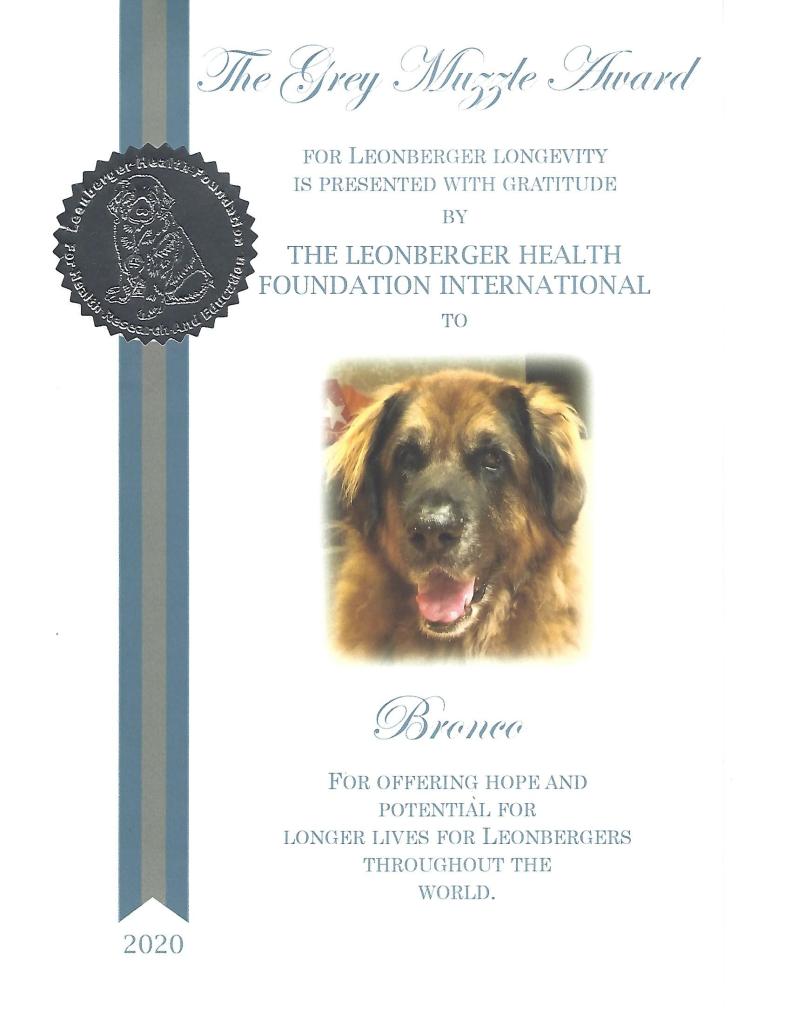
One thing that we are proud of is that Bronco lived very long for a Leonberger. The typical lifespan for a Leonberger is 8-10 years. Giant breeds tend to have a short lifespan. The Leonbergers who live at least 12 years are awarded the so-called Grey-Muzzle Award by the Leonberger Health Foundation International, and Bronco was a recipient. The Leonberger Health Foundation International (LHFI) is supporting research that aims to solve health issues in Leonbergers and other giant breeds. All proceeds from the sale of my book are donated to the Leonberger Health Foundation International. I can add that when Bronco passed away, we sent his DNA to the University of Minnesota to be used in research. This was facilitated by the LHFI.
Bronco was a very special dog, and he also gave us many amusing stories. Some of the stories were great, like when he chased off a trespasser / peeping Tom who had been terrorizing my wife and the other women in the neighborhood, but that the police and the private detectives I hired could not catch. Or when he saved runaway hamsters or saved the lives of other dogs. He also gave us some embarrassing stories, such as when he put our neighbor’s head in his mouth, like the circus lion trick, or pushed our German Shepherd into a storm drain. After Bronco passed, I decided that the world needed to know about Bronco, so I wrote a book about him. It is a tribute to him as well as a collection of funny stories. I also added information about Leonbergers in the book, their origins, care, training, health, etc.
Bronco is chasing off a trespassing peeping Tom who had been terrorizing the women in the neighborhood at night. Illustration by Naomi Rosenblatt.Bronco with hamsters in his mouth. When he dropped them, they were unconscious, so my wife gave the hamsters CPR. They were fine. Illustration by Naomi Rosenblatt.Bronco acting wild pushing our German Shepherd into a storm drain. I am trying to get her up. Illustration by Naomi Rosenblatt.
Finally, I would like to give an overview of my book about Bronco and Leonbergers. I intended to release the Book on July 3rd, 2022, on what would have been Bronco’s 15th birthday. However, Amazon was quicker than I expected. The Kindle version became available on the day I uploaded it July 1st, 2022, and the paperback version July 2nd, 2022, but I did not tell people about it until July 3rd. Well today it is July 3rd again. To read more about my book click here.
In July of 2022 my book was the number one new release on American Amazon in the category “dog breeds”This is a sample spread from my book (The Life and Times of Le Bronco von der Löwenhöhle). It is page 102 and 103. The other dog is our mini-Australian Shepherd Rollo.This is the front cover of the book “The Life and Times of Le Bronco von der Löwenhöhle”. Click on the image to go to the Amazon.com location for the paperback version of the book.This is the back cover of the book “The Life and Times of Le Bronco von der Löwenhöhle”. Click on the image to go to the Amazon.com location for the kindle version of the book.These are the endorsements for the book. Click on the image to got to the Barnes and Noble location for the book.
If you haven’t already, please take a look at my book
I once apologized to our neighbor Sam because our Leonberger Bronco had been barking. To my surprise Sam told me not to worry, let him bark he said, it scares the bad guys away, and is good for the entire neighborhood. I think the story below, which is an excerpt from my book might explain his thinking.
Our Leonberger dog Le Bronco von der Löwenhöhle when he was young. He is giving me a hug.
A quiet and spooky evening alone
It was a quiet evening, and I was home alone. My wife, Claudia, was visiting her parents a few blocks away with Rachel, our daughter. Our son Jacob was meeting with his debate team; our other son, David, was visiting a friend.
I was making myself a ham sandwich in the kitchen when I suddenly felt a hand on my right shoulder. I startled and turned my head to face what I feared was an intruder, and there he stood on his hind legs—our Leonberger, Bronco. His big paw on my shoulder felt for a moment exactly like a human hand.
Bronco looked at me with his kind, wise eyes, then he looked at the sandwich. Then he turned his head toward me again and held my gaze. At that moment I understood what he wanted. I cut the sandwich in two and gave him his half.
The night stalker
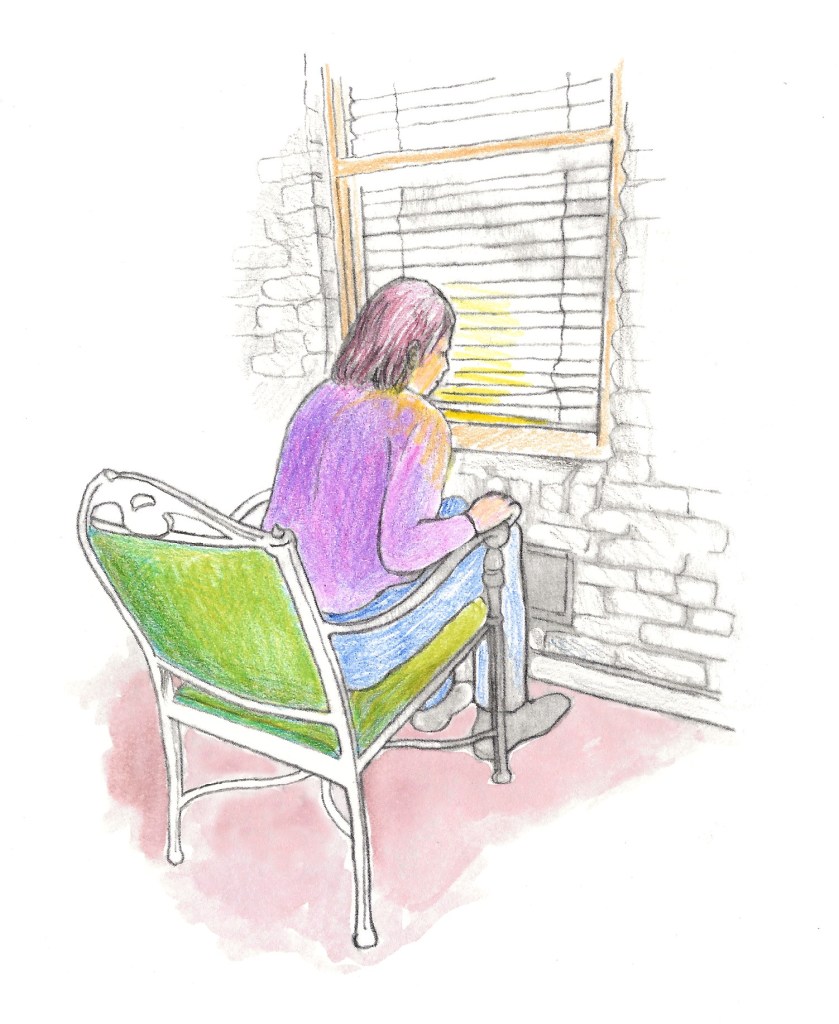
I should explain that we had a problem with a trespasser at that time, which was the reason I was startled. This trespasser would sit outside our bedroom window at night and make threats and shout obscene comments at Claudia when I was not present. At first, though, we didn’t know where the threats and comments were coming from. I doubted Claudia’s accounts of these incidents, especially because she thought the voice might be coming from within our bedroom, perhaps via an electronic speaker. I thought she was just having nightmares.
Then one night I heard it myself—a voice screaming, “I am going to burn your house down!” Just as Claudia had said, it sounded like it came from within our bedroom, almost as if it were right next to me.
After Claudia and I went through our “Oh, so now you believe me” routine, I started looking under our bed and inside the heating and air-conditioning vents for hidden speakers and/or microphones. It was hard to believe that someone had planted these things in our bedroom, but that seemed to be the case. Then it finally dawned on me. Next to the headboard of our bed, on Claudia’s side, just inches from her pillow, is a window. At night, when the blinds are lowered and the slats are partially open, you can see in, even if we have just a few lights on in the house. But of course under these conditions, you can’t see anything that might be outside.
The nightly stalker or voyeur looking through our bedroom window. Illustration by Naomi Roseblatt.
I ran out the front door and around the back of the house, and there, right in front of our bedroom window, was one of our lawn chairs. The trespasser had climbed our fence, taken the chair, sat down in front of the window, and spied on us. Whenever I left the room, he would shout obscenities and threats at Claudia. When his face was planted in front of our window, he was just two or three feet away. This was why the voice felt so close. This had been going on for two weeks. We were happy to have finally figured it out, but we realized we had a problem.
We talked to our neighbors about the situation, and they told us that the trespasser had terrorized them as well. He had been quite busy looking through bedroom windows at night. People in the neighborhood were scared. I called the police, who told us they could do nothing unless the man was caught in the act or he committed a crime other than trespassing.
The detectives
Therefore, I decided to hire private investigators. I found them in the phone book. Phone books still existed back then.
The investigators told me that they typically spy on people suspected of cheating on their spouses, so this would be a more interesting job for them. The plan was for them to hide behind the bushes in our backyard and in a dark car parked on our street. When the man appeared, they would record him on video. They had a lot of fancy equipment and instruments, including big microphones, cameras, and metal detectors. They reminded us of Ghostbusters with all their technology and enthusiasm. They clearly loved their job. Unfortunately, though, the trespasser didn’t show up, so after a couple of days I decided to let the investigators go.
However, I soon figured out who the trespasser was. I started paying attention to what was going on in the neighborhood, and one evening, I noticed a strange-looking but relatively young man, apparently homeless, who seemed to be stealthily roaming our neighborhood. I did not confront him, because I had no proof.
Bronco saves the neighborhood.
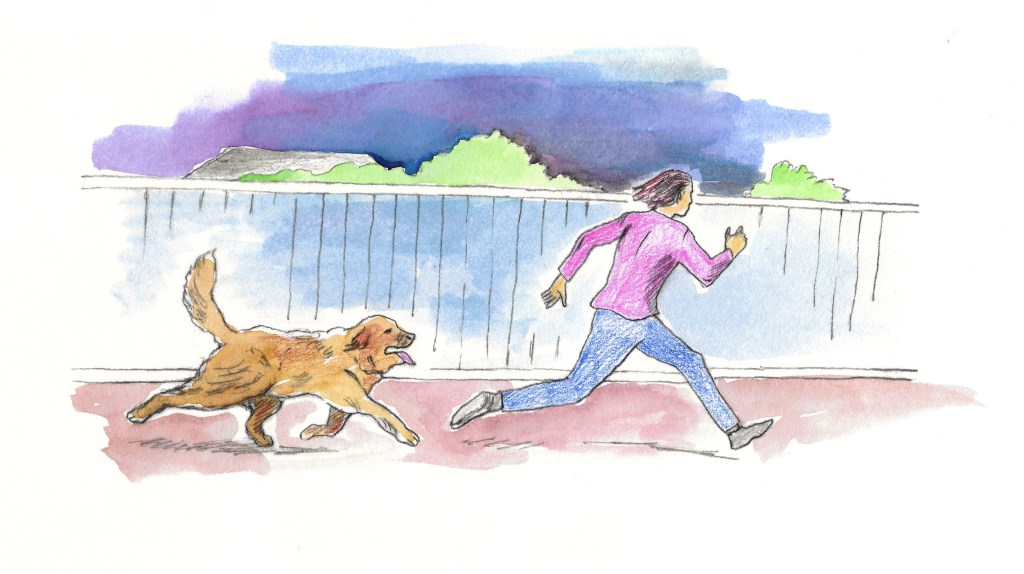
But a few days later, I heard shuffling noises outside our bedroom window. The trespasser was finally back. This time I sent Bronco out to chase him, and he did. Like the detectives, Bronco was enthusiastic but didn’t catch him. Still, he chased the man off. Having a big bearlike dog rushing toward you at night is probably a bit unnerving, even if the dog just wants to lick you. We never experienced or heard about the problem after this event, so Bronco may have helped the entire neighborhood.
Bronco chasing off the intruder who would not return. Illustration by Naomi Rosenblatt.
A couple of weeks later, while walking Bronco on a neighboring block, I saw the homeless man across the street, at a bit of a distance. He stared at us in fright. Bronco just calmly looked at him without barking. The man was clearly terrified of Bronco, and he ran away. But despite the nightmare the homeless man had inflicted on us, I felt sorry for him. My guess is that he was suffering from mental illness and that he had had a very tough and lonely life.
This is another post featuring 25 photos. This time it is photos of Leonbergers in the company of other dogs. Most of the photos are of our late Leonberger Bronco and the dogs he grew up with (our Labrador Baylor, German Shepherd Baby, Japanese Chin Ryu, Pug Daisy, and mini-Australian Shepherd Rollo). However, I have also included photos of other Leonbergers. A few photos from friends and two stock photos. I hope you will like them.
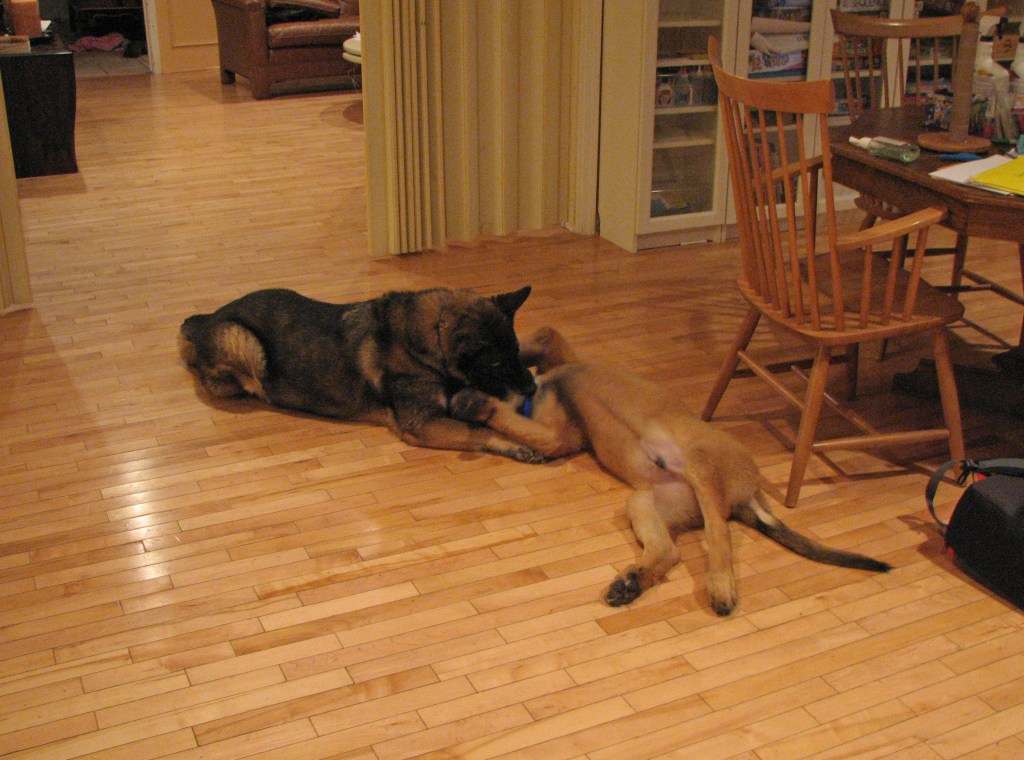
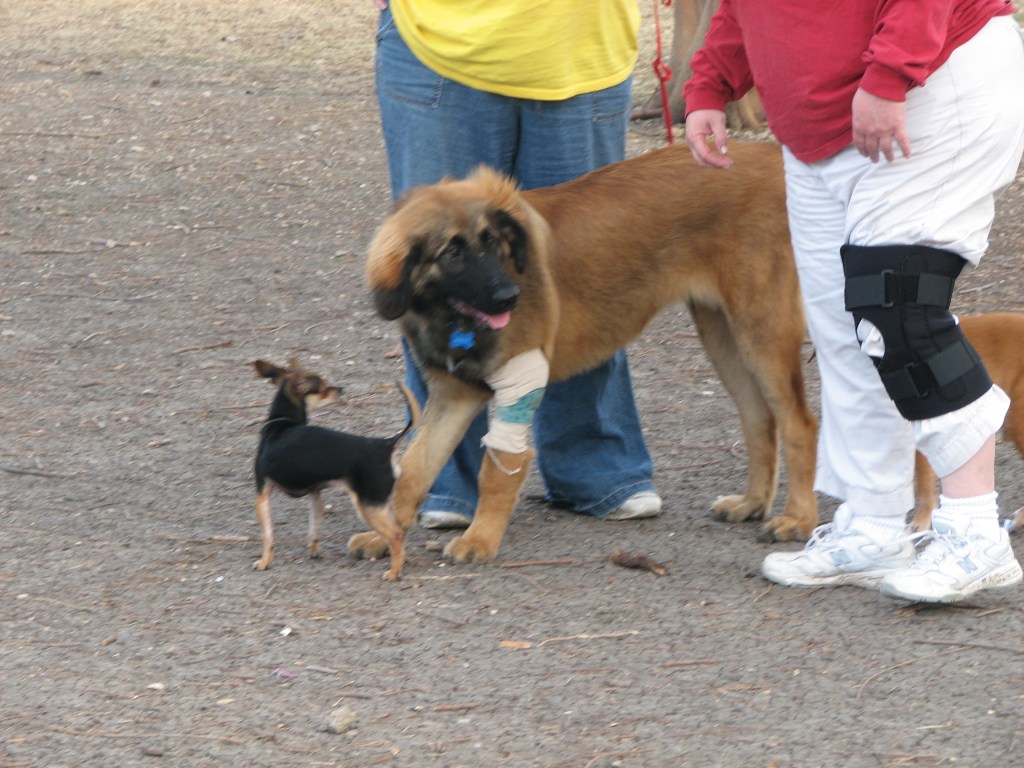
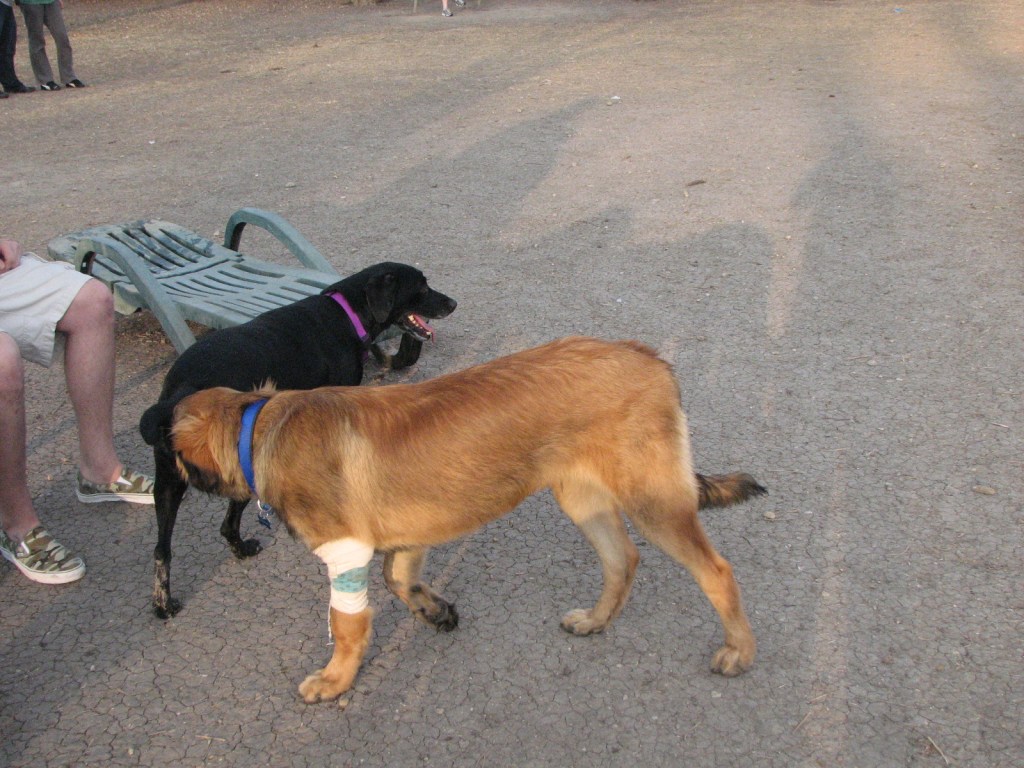
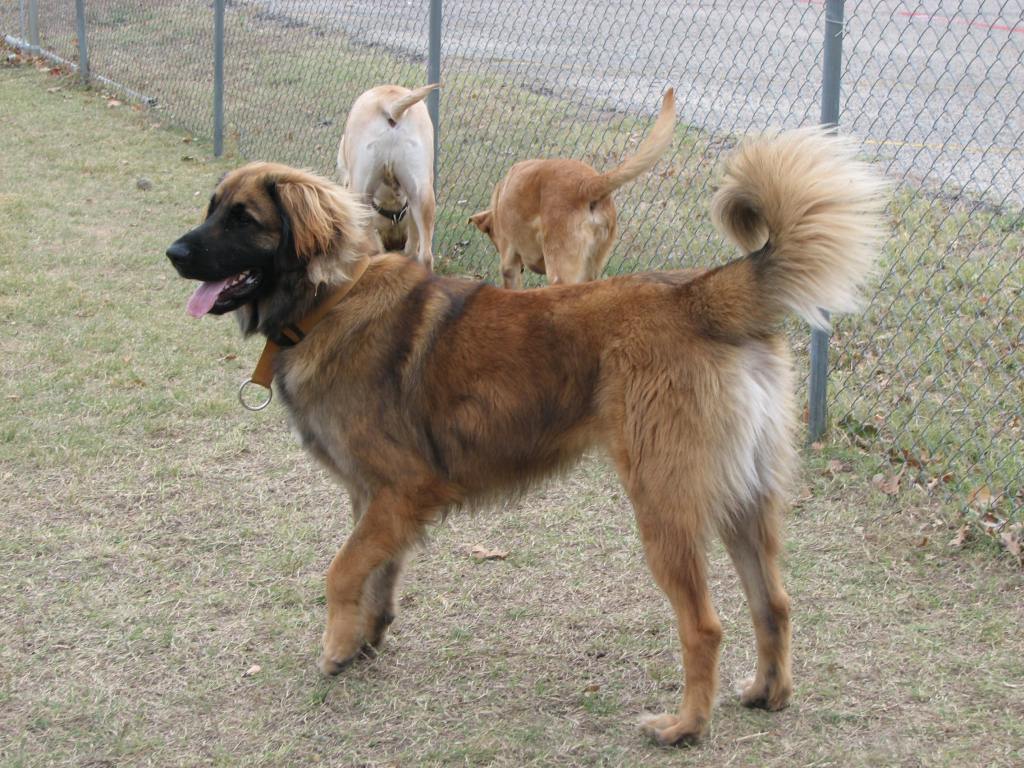
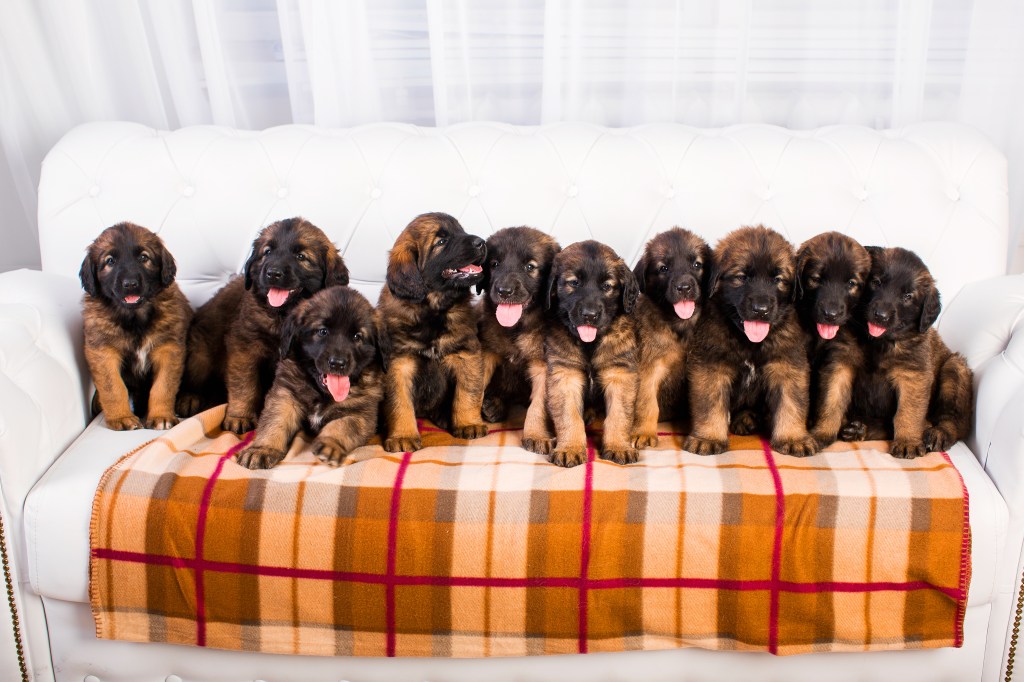
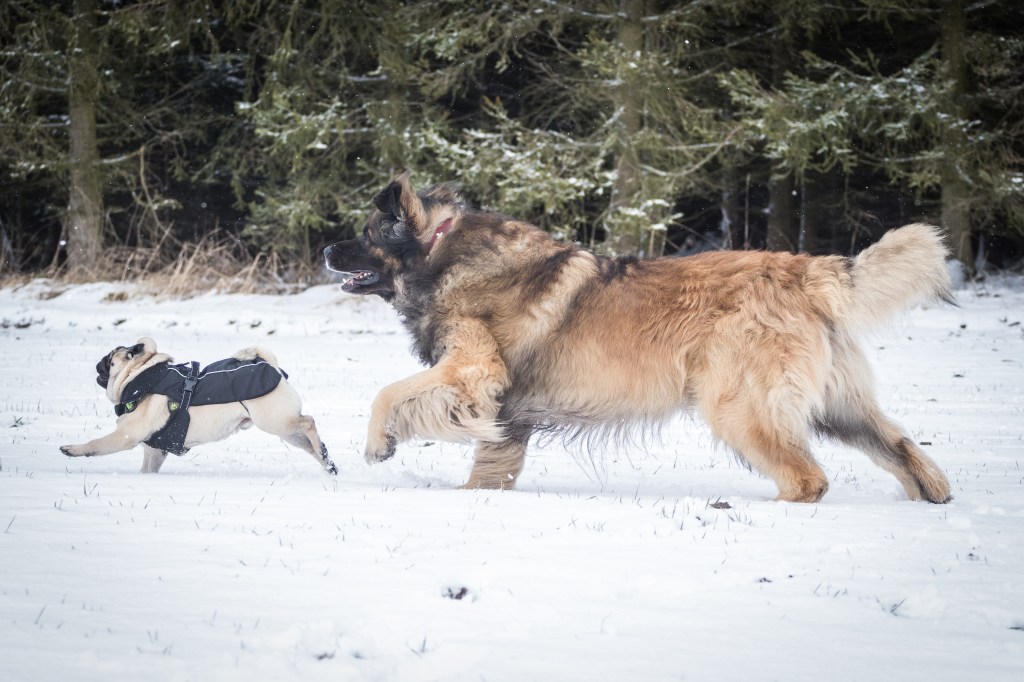
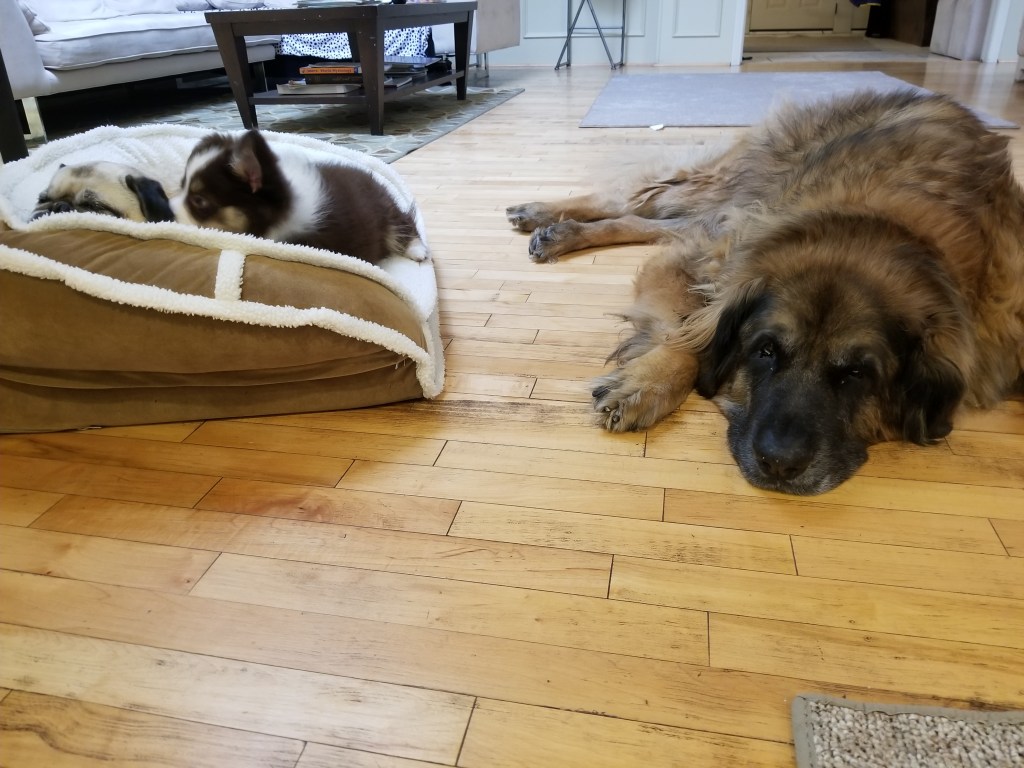
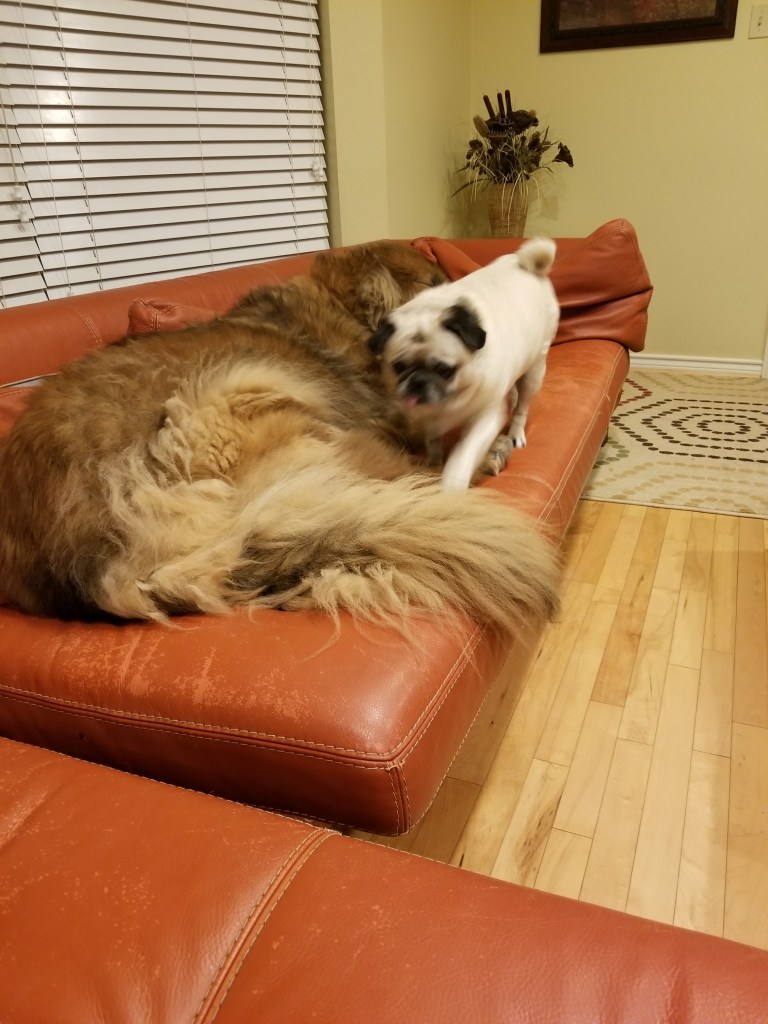
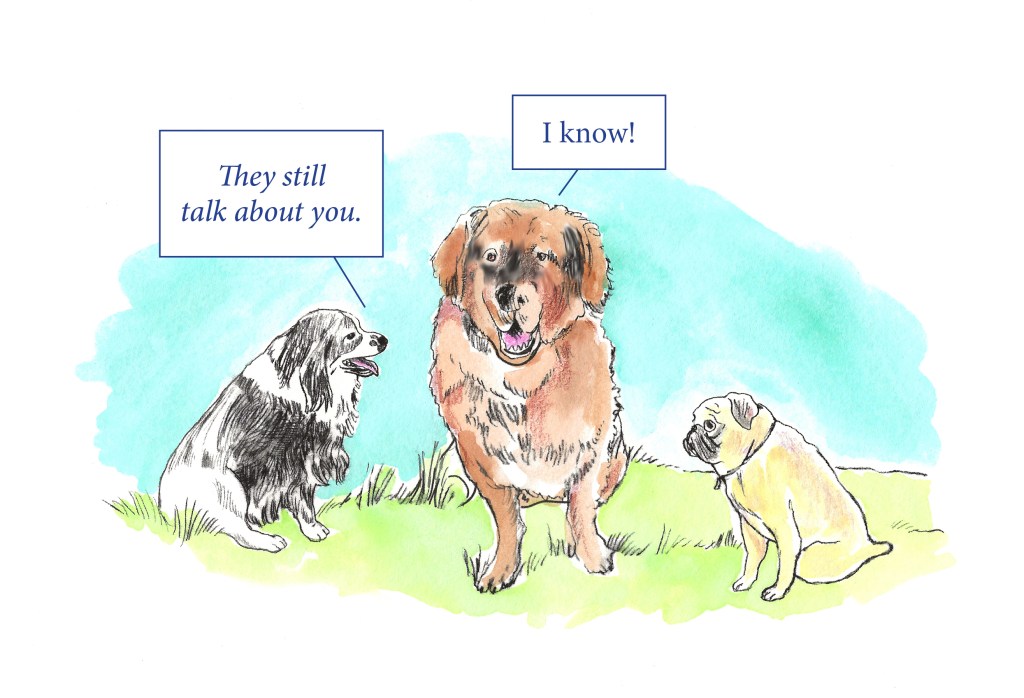
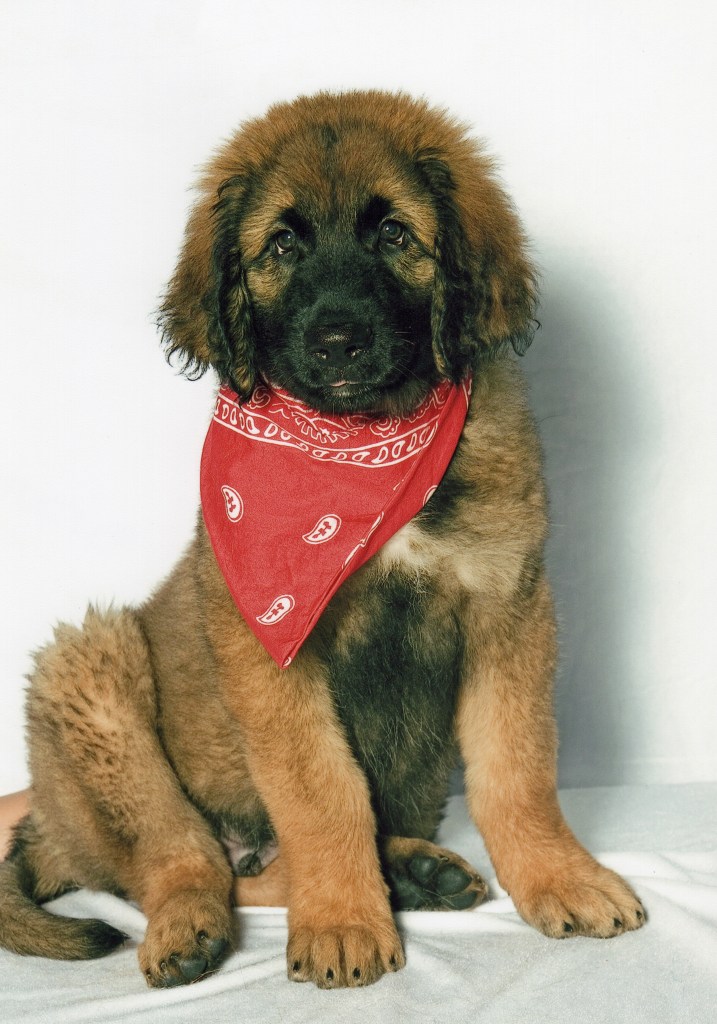
Baby (German Shepherd) is playing with our four months old Leonberger Bronco.Our Leonberger Bronco at the dog park at five/six months old. He is wearing a bandage on his knee because he got a condition from growing too fast. The two ladies are the owners of the little dog.Our five/six months old Leonberger is sniffing a dog at the dog park.Our not yet one year old Leonberger Bronco at the dog park. Bronco has not yet finished growing, he has not yet filled out and he is gangly. Not quite the Leonberger look yet. Our beige-brown Labrador Baylor can be seen in the background.Again our not yet one year old Leonberger Bronco at the dog park. Baylor in the background.Our not yet one year old Leonberger Bronco at the dog park with our German Shepherd Baby.Our Labrador Baylor behind our Leonberger Bronco at a dog park.Our old Labrador Baylor running behind our Japanese Chin Ryu at a dog park. Bronco is not in this photo, but he was there.Bronco our Leonberger once sniffed out an oncoming insulin shock in Baylor and alerted us. Bronco was a hero.Once when Bronco was not so well behaved. He pushed our German Shepherd into a storm drain and I had to get her out while holding onto an agitated Bronco. Illustration by Naomi Rosenblatt.Ten Leonberger puppies. My guess is that they are about two months old. Shutterstock-ID:561107710 by Akbudak Rimma.A Leonberger and a Pug running through the snow. Shutterstock-ID:1659034960 AnetaZabranska.Digory and Obi, two Leonbergers. Photo by Jen O’Keefe.Digory and Obi, two Leonbergers. Photo by Jen O’Keefe.Six Leonbergers from left to right: Caspian (Obi’s nephew), Austin (Obi’s son), Delfi, Obi, Digory, and Rilian (Obi’s son). Photo by Velvy TheLion.Our Leonberger Bronco with our Japanese Chin Ryu and our pug Daisy.Our Leonberger Bronco stole and smashed a gingerbread house. He shared some with his little pug sister Daisy.Our Leonberger Bronco with our Japanese Chin Ryu and our pug Daisy.Our Leonberger Bronco with our Japanese Chin Ryu and our pug Daisy.Our pug Daisy and our mini-Australian Shepherd puppy Rollo in the little bed and Bronco our Leonberger is lying on the floor.Our pug Daisy and our Leonberger Bronco is sharing the big red leather sofa, but Daisy decided Bronco took up too much room.Bronco and our mini-Australian Shepherd puppy Rollo.Bronco and our mini-Australian Shepherd Rollo.Our mini-Australian Shepherd puppy Rollo is playing with Bronco’s tail. Bronco did not like it but tolerated it. Well, when Rollo was swinging in the tail it was a bit much.One day Bronco left us, leaving Rollo and Daisy behind. Illustration by Naomi Rosenblatt.
Read this review of my book “The Life and Times of Le Bronco von der Löwenhöhle”. Bronco was my best friend and I love when someone loves the book about him.
The coat of arms of the town of Leonberg, Germany, was allegedly the inspiration for the first breeder of the Leonberger, Heinrich Essig.
The Leonberger breed was originally created by Heinrich Essig (1808–87) in the German town of Leonberg, in what was then the kingdom of Württemberg. According to legend, Essig bred the dog to resemble the lion in the town’s coat of arms. Indeed, as you can see in the image above, the lion in the coat of arms doesn’t look like a real lion, so you could say that the Leonberger looks the way it does because Germans were bad at drawing lions back then. All joking aside, though, Leonbergers do bear some resemblance to lions and maybe even bears. In any case, they are beautiful dogs.
The town square in the city of Leonberg. Shutter Stock Photo ID: 1689829297 by Martin Dutkiewicz.
When people would stop me and ask me questions about the kind of dog Bronco was, I would say he was a Leonberger, a cross between a Saint Bernard, a Newfoundland, and a Great Pyrenees and that the breed was created by the mayor of the German town of Leonberg. But, as the economist Tyler Cowen said, “Be suspicious of simple stories.” As it turns out, the story I kept telling was a simplification and not entirely true. History is more complicated. I was unintentionally spreading misinformation about Leonbergers.
Our Leonberger Le Bronco von der Löwenhöhle at 3 months old.
Simple and interesting stories are easy to remember, easy to believe, and easy to propagate. But first, Heinrich Essig was never the mayor of Leonberg. He was a prominent citizen of the town, and he was a successful businessman, farmer, innkeeper, horse and dog trader, large dog enthusiast, dog breeder, and town councilman, but he was never the mayor.
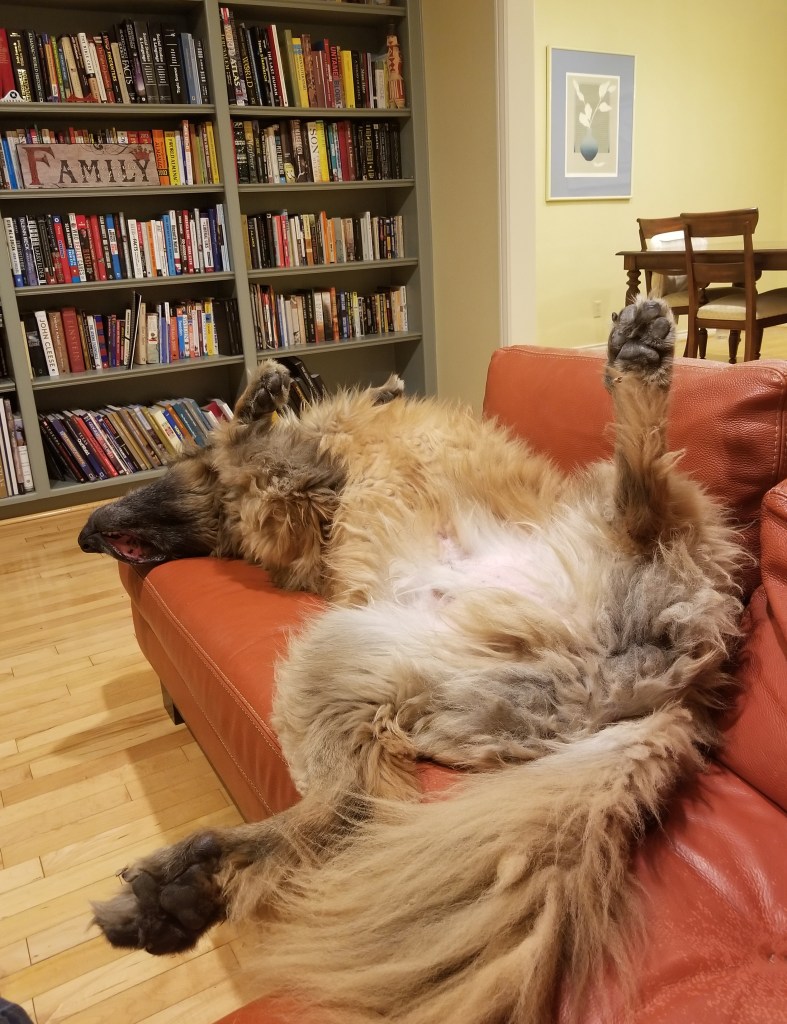
Our Leonberger Bronco sleeping on our big red leather sofa.
Essig claimed to have created the Leonberger in the 1830s by crossing a female Landseer Newfoundland with a male long-haired Saint Bernard from the Great Saint Bernard Hospice, a monastery in Switzerland. He continued crossing the Landseer Newfoundland and the Saint Bernard over four generations, then he crossed his Newfoundland Saint Bernard mix with a Pyrenean wolfhound not, as is often asserted, with a Great Pyrenees (called a Pyrenean Mountain dog in Europe). He then crossed that dog with the Saint Bernard again. In 1846, he was finally ready to announce and register his “lion of a dog.” A few years later, Leonbergers were officially introduced to the public at the Munich Oktoberfest.
Me and our Leonberger Bronco when he was young.
However, the story is more complicated than that. There’s no specific breed named Pyrenean wolfhound today, so Essig could have used a Great Pyrenees or a Pyrenean mastiff . In addition, later in the nineteenth century, Leonbergers were used to breed the long-haired Saint Bernard dog, and this likely saved the Saint Bernard dog from extinction. At one point, too, Leonbergers were deliberately mixed with Newfoundland dogs to strengthen the Newfoundland breed. In other words, breeding happened in both directions, and the characteristics of the large breeds were in constant flux. The dogs, including Leonbergers and Saint Bernards didn’t look like they do today, either. Essig’s Leonbergers were multicolored, mostly white, and lacked the black mask that is so important to the breed now. What has not changed is the essence of what Essig was aiming for: a large but moderately proportioned dog that is friendly and loving and a great companion.
A modern Saint Bernard Dog. Shutter Stock Photo ID: 1713912484 by fred12.
Ultimately, the origins of the Leonberger, as well as the Saint Bernard and the other large breeds from this region, are complex and shrouded in mystery. In addition, some of Essig’s claims have been disputed. Breed standards wouldn’t be codified until the end of the nineteenth century. It should also be noted that it was Essig’s niece Marie who to a large extent bred and cared for the dogs.
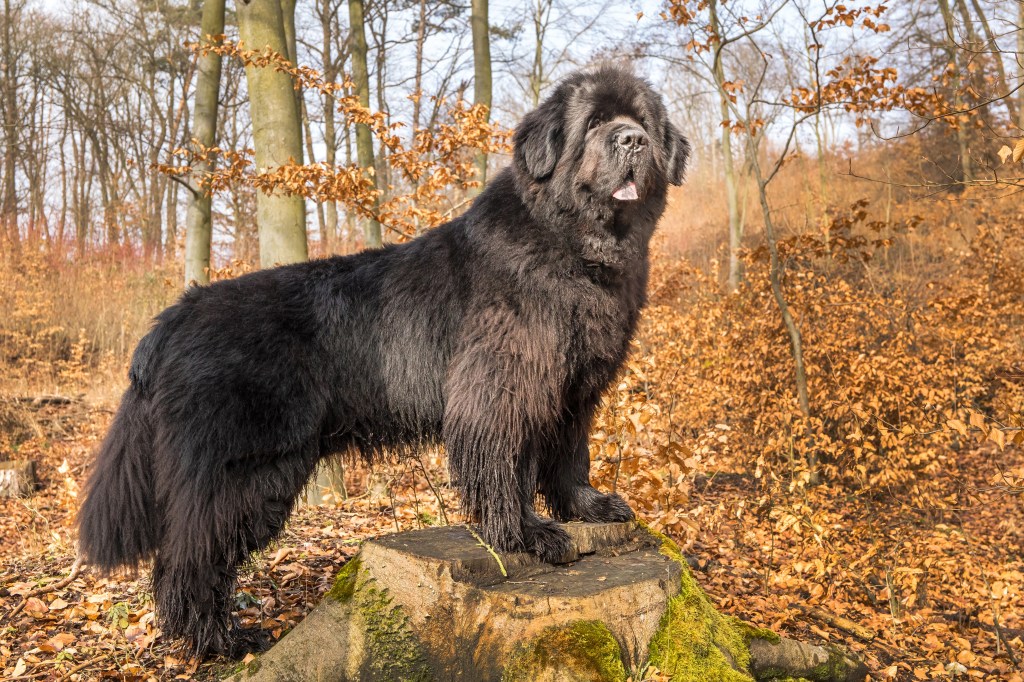
Modern New Foundland Dog. Shutter Stock Photo ID: 1925281937 by Marsan.
Essig was selling his Leonberger dogs as luxury items to the wealthy. He was also a marketing genius and was able to get the attention of European nobility and royalty. The czar of Russia, Emperor Napoleon II, Otto von Bismarck, the king of Belgium, Empress Elisabeth of Austria, Emperor Maximilian I, the Prince of Wales, King Umberto of Italy, Giuseppe Garibaldi, and the mikado of Japan were among those who owned Leonbergers. Not everyone was happy about this. Some people viewed the Leonberger as a fashionable knockoff of the Saint Bernard that could hinder that breed’s development.
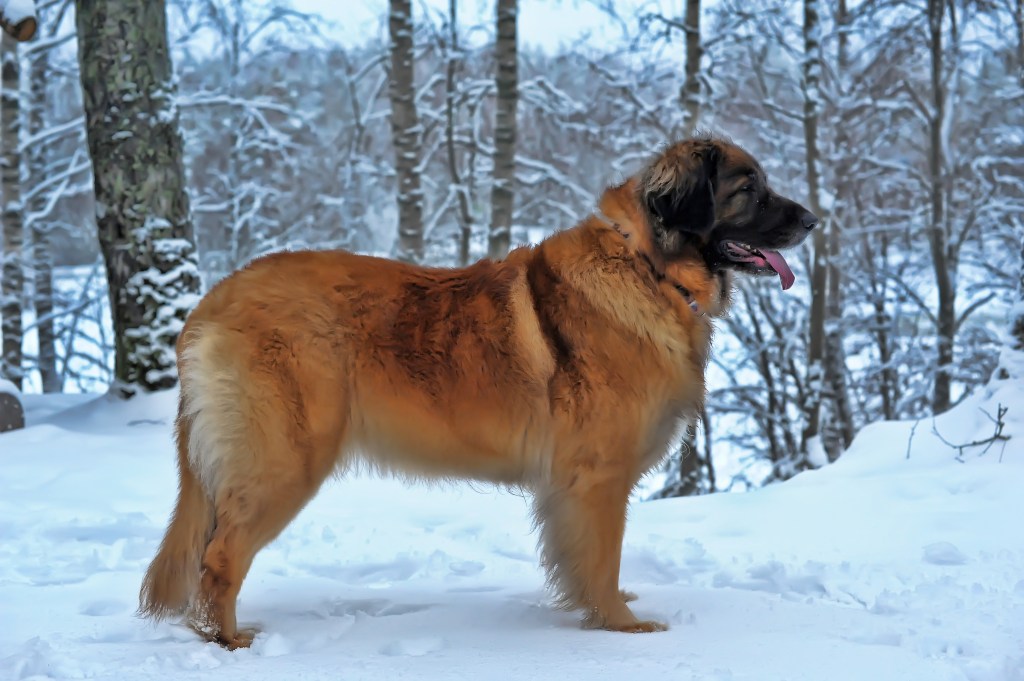
Modern Leonberger. Shutter Stock Photo ID:705193912 by Anna Krivitskaya.
Toward the end of the nineteenth century, the discipline of cynology, or the scientific study of dogs, emerged. Cynologists pushed for breed classification and systematic breeding practices, and breed standards were created. But Essig and others viewed dog breeding as an art rather than a science, and this led to a conflict with the cynologists. Heinrich Schumacher, for example, was a breeder who strove to create a clearly identifiable Saint Bernard type. He was upheld by the cynologists as a paragon, in contrast to Heinrich Essig to the detriment of the Leonberger.
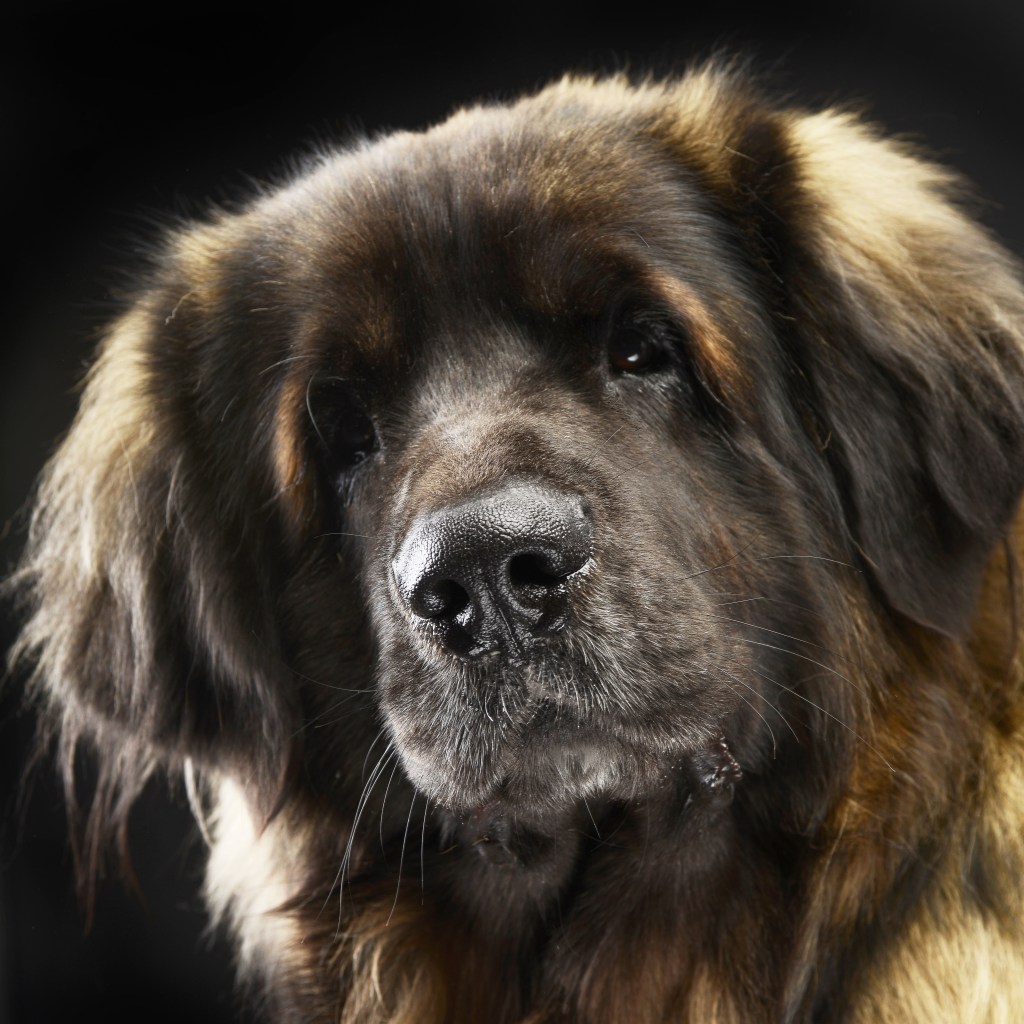
Face of modern Leonberger. Shutter Stock Photo ID: 193024763 by Csanad Kiss.
After Essig’s death, in 1887, other people more willing to please the cynologists continued breeding Leonbergers. By that time, the dogs looked for the most part like Leonbergers do today. Then, in 1895, Albert Kull created the Leonberger’s first breed standard. It would go through several revisions in 1901, 1926, 1938, 1951, 1955, and 1972—until finally, in 1996, the FCI approved version was established. The Kennel Club in the UK and the American Kennel Club also have their own breed standards. However, most of them are similar to Albert Kull’s 1895 version. The first Leonberger club was formed 1891 in Berlin: two more were created in 1895, then two more were formed in 1901. The most prominent was the Internationaler Klub für Leonberger Hunde, of which Albert Kull was the first president.
When Bronco was almost eight years old, we discovered a case of squamous cell carcinoma in one of his toes—or, rather, in one of his toenails. It was on his right rear paw.
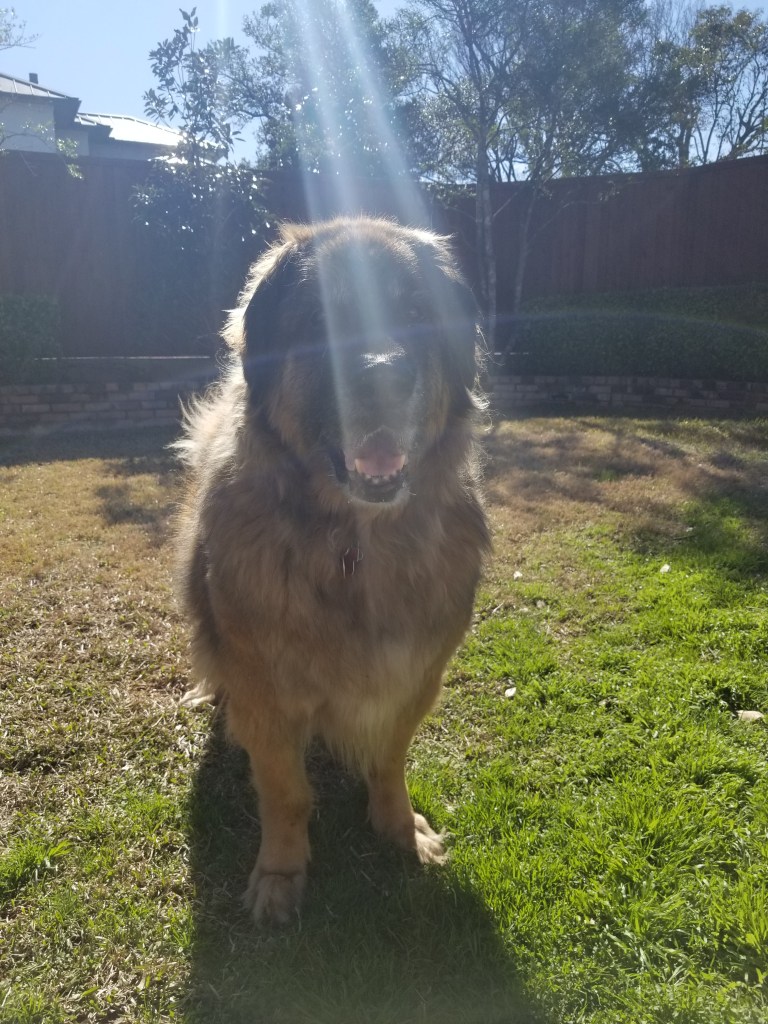
Our Leonberger Bronco, or Le Bronco von der Löwenhöhle.
Squamous cell carcinoma is a type of skin cancer that certain large-breed dogs, including Leonbergers, are susceptible to. It often grows out from the skin around the nail and can affect the bone and tissue around it. It is typically not very aggressive, but it can spread, and it is painful. It manifests itself as a swollen toe, or you may be able to see a large red papule that looks like a pimple. Sometimes the toenail falls off. The dog is likely to limp and lick the toe and may become reluctant to go for walks, although that was never the case with Bronco.
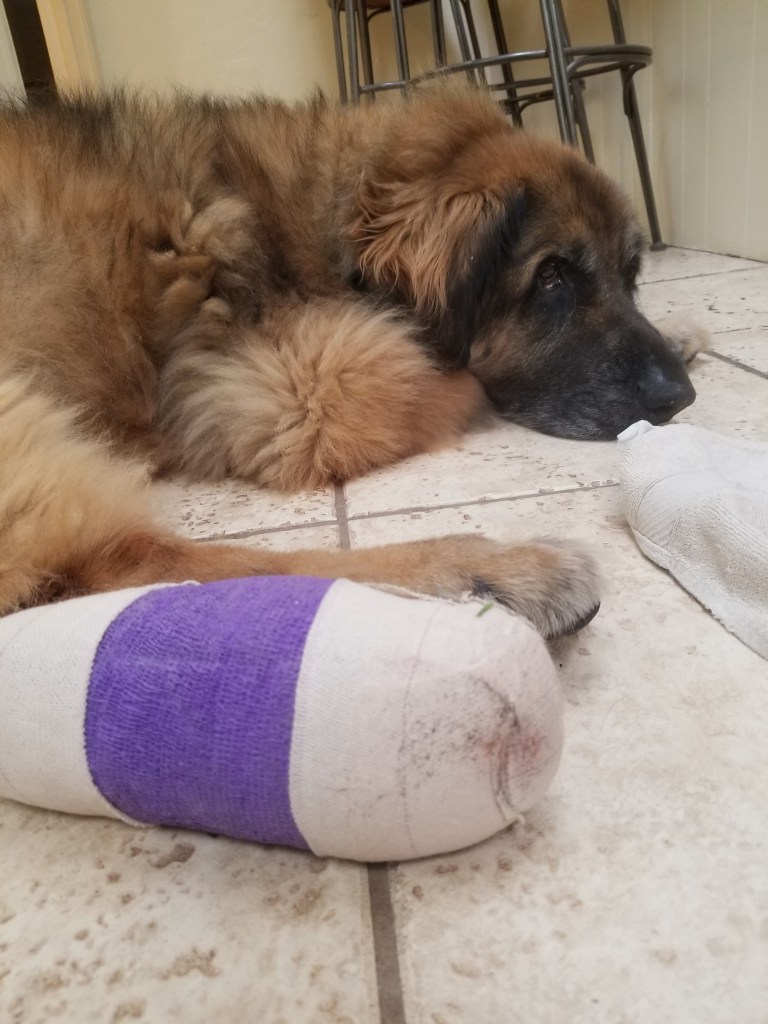
Bandage on Bronco’s paw after a toe amputation.
Primarily because of the pain, but also because of the small risk of metastasis, it is usually recommended that the affected toe be amputated. So we went through with the procedure. When we picked Bronco up the day after the surgery, his paw was in a bandage. But he got some treats, and he was in a good mood. We went back to the veterinary surgical center for a bandage change a few times, and then he was done.
An agitated Bronco stands guard at the back door. Note the missing toe on his left front paw.
Unfortunately, though, we discovered another lesion a year later. This time it was on a large toe on his left front leg. We asked the doctors if the cancer had spread to this toe. We were told no—Bronco was just prone to getting this type of cancer. But the cause could also have been something in the environment. In Texas, the ultraviolet radiation from the sun is significant. We really don’t know why this happened to him, but we were assured that it was not because the cancer had spread.
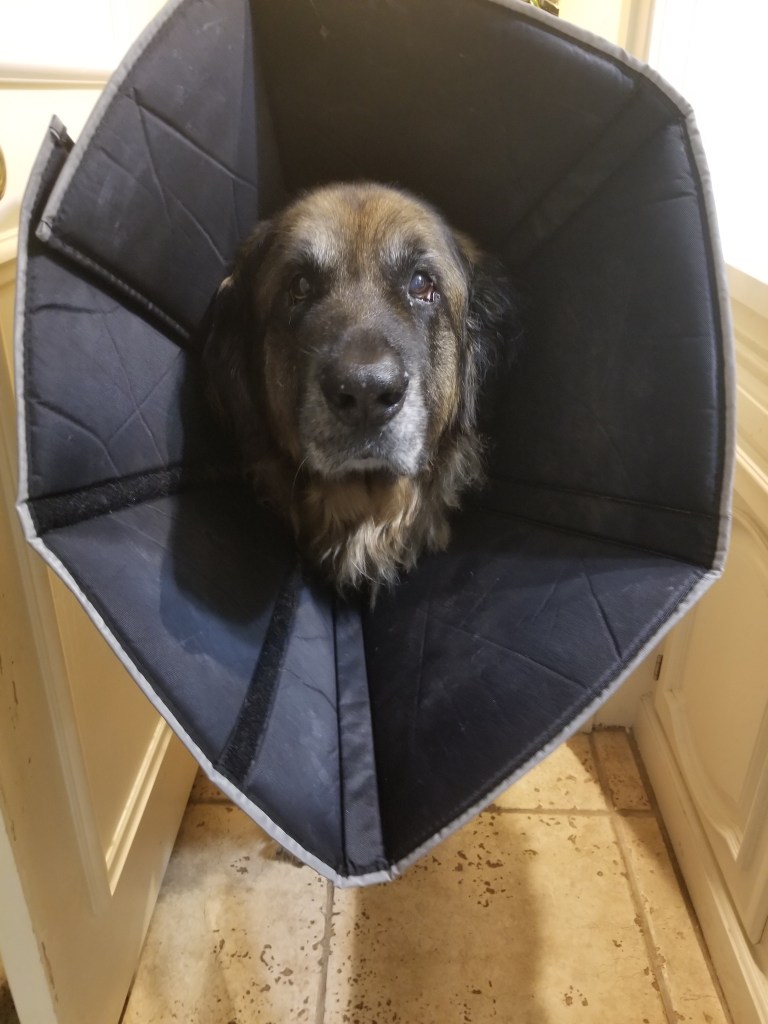
A cone of shame or as in this case a soft cone typically accompanied a bandage or a cast.
This time around, Bronco’s entire leg was put in a cast, to be replaced by a bandage after ten days. We were instructed to keep him inside during those ten days and keep him as still as possible. We were to make sure he wouldn’t bump the cast. This was, of course, almost impossible to do, but we were going to try.
However, Bronco really wanted to go out, which he showed us in various ways, such as scratching at the front door. After a week or so, Claudia suggested that we take him outside a little bit, just in our driveway. I agreed. When I handed her the leash, she said, “He can barely walk; do you think he’s going to run off without it?” We laughed, and I agreed that it didn’t seem like we needed it this time. So Claudia walked out with Bronco slowly limping beside her.
Bronco could barely walk with his full leg cast, but when motivated enough he could run. Illustration by Naomi Rosenblatt.
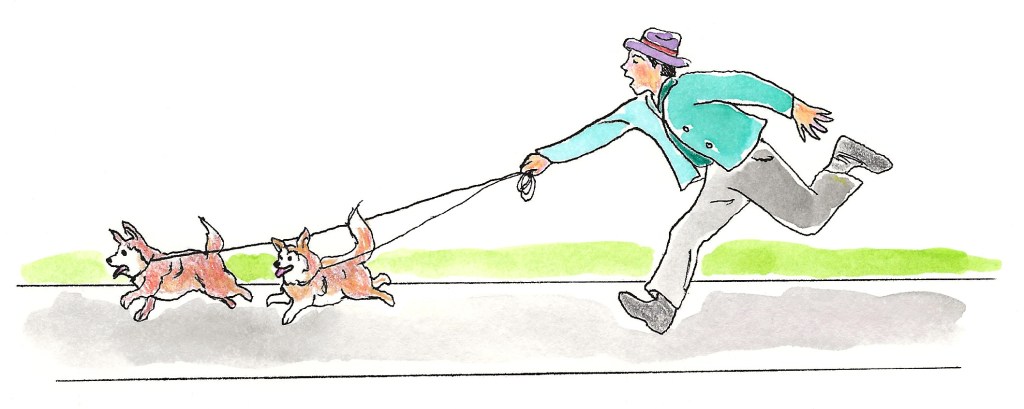
Less than a minute had passed when I heard shouting outside. I opened the door and looked outside to see what was going on. First I saw our neighbor and his two corgis running down the street as fast as they could. Our neighbor was screaming at he top of his lungs, “Get him off me! Get him off me!” Behind him, Bronco was running with his cast going kabonk-kabonk-kabonk as it hit the sidewalk. Behind Bronco ran Claudia, who was also screaming at the top of her lungs. Bronco! Sit! Stay! Stop!” Finally, Bronco stopped, and Claudia grabbed him. Holding his collar, she led him back in.
Claudia running after Bronco. Illustration by Naomi Rosenblatt.
Our red-faced and sweaty neighbor was very nice about it and forgave us. He even forgave Bronco, though Bronco was chasing the corgis, not our neighbor. But still, if I had been chased by a big dog wearing a cast, I would not have gotten over it that easily. Our neighbor is clearly a better man than I am.
Our neighbor and his corgis running from Bronco. Illustration by Naomi Rosenblatt.
This was an embarrassing event for all of us, but at the same time it was one of the most surreal and amazing things I’ve ever seen. It was so unexpected, so bizarre, and so funny. I really wish I had had a video camera handy. Talk about a potentially viral video.
When we went back to the veterinary surgical center to have Bronco’s cast removed, we decided not to say anything about the incident to the doctors. We sat in the waiting room and wondered if the episode had caused any permanent damage to Bronco’s paw or leg. But when the veterinary technicians came back with Bronco in a bandage instead of a cast, they told us that everything looked good. Great job, everyone!
We thought they might not have checked his sore carefully enough, so we asked them again: Are you sure everything looks good? The sore, the stitches—did you really look at them thoroughly? They insisted that yes, they looked good. So Bronco got his treats, he looked happy, and we went home.
da-AL was gracious enough to host me via a guest post. It features the story of why I wrote my Leonberger book as well as the story about our Leonberger Bronco’s hamster rescue operation. I would like to direct all comments to her post. See da-AL’s post below.